


Abstract
Mediterranean regions are forecasted to be increasingly threatened by climate change, leading to the occurrence of extreme events. One strategy to improve the resilience of agricultural systems is to introduce rotations that combine legumes and crops with high intraspecific diversity such as evolutionary populations (EPs). These cropping systems may be characterized by lower external input needs and higher buffering capacity than traditional ones. Our objective was to test if the introduction of wheat EPs impacts soil microbial functions—including microbial biomass, community structure, and enzymatic activity—and soil organic matter composition within a crop rotation framework. We conducted a two-year field experiment at two sites in Italy comparing a modern bread wheat variety to two EPs, evolved in different areas, in rotation with legumes. The composition and processes of rhizosphere microbial communities were characterized using EL-FAME and enzyme activities. In addition, rhizosphere soil organic matter signatures were measured by mid-infrared spectroscopy, and their relationships with microbial parameters were investigated using principal component analyses. The results showed that the EP–rhizosphere relationship, as well as its influence on microbial abundance and activity, is dependent both on the site of origin and local pedoclimatic conditions, although no consistent response was observed across the two sites. These effects may be buffered by the choice of the preceding crop in rotation.
1. Introduction
Intensive use of annual cropping systems and climate change are threatening agricultural production in many parts of the world due to their impact on soil health and biodiversity [1]. Cultivation of high-yield uniform varieties, extensive fertilization, and the use of agrochemicals have resulted in soil degradation and negative impacts on essential ecosystem services [2].
Among the various agroecological approaches that have been developed, the use of evolutionary populations (EPs) can be considered a worthy evaluation. In contrast to conventional varieties, EPs are characterized by a high degree of intraspecific genetic diversity [3]. They combine the individual adaptations of a specific genotype with the population adaptation capacity to local conditions arising from the interaction among different genotypes, typical of heterogeneous populations [4]. Despite the actual use of EPs in agriculture still being considerably limited by their comparatively lower yield to modern high-yield varieties, it was also demonstrated that EPs, selected through natural selection and farmer input, can achieve high yields and stability, often exceeding commercial varieties under organic farming conditions [5]. Furthermore, studies conducted on marginal lands, including Mediterranean regions, demonstrated that certain EPs exhibit remarkable yield stability, outperforming modern hybrids where the latter often fail [6].
The success of EPs in organic and low-input agriculture, where synthetic pesticides and fertilizers are not applied, is a key point, since genetic variation is the primary mechanism for buffering environmental fluctuations and maintaining important traits such as yield stability, resistance to pathogens, and adaptation to low soil fertility [7].
Therefore, EPs may be able to use resources more efficiently and adapt to extreme conditions [8]. Wheat EPs are usually obtained by mixing F1 or F2 seeds obtained by crossing wheat varieties and leaving the mixtures to evolve at a specific site in order to improve their adaptation to the site-specific pedoclimatic conditions [3,9]. Given their better ability to tolerate more climatic variability, they can be promising alternatives, particularly when cultivated in rotation with N-fixing legume species in areas where agricultural production is limited by environmental constraints. For example, in Mediterranean areas, it has been shown that EP/legume rotations could provide food with fewer resources and may be able to perform better during drought events with respect to uniform varieties [8]. Moreover, a recent study by Natale and collaborators [10] demonstrated that wheat EPs can successfully adapt to the Italian environment, fully expressing their nutritional and technological potential. These results indicate that wheat EPs are promising materials both for enhancing nutritional value and for supporting more sustainable agricultural practices.
Microorganisms are key players in the cycling of nitrogen, sulfur, and phosphorus and in the decomposition of organic residues, thereby influencing nutrient and carbon dynamics on a global scale [11]. Extracellular enzymes produced by microbial communities are central to the decomposition of soil organic matter (SOM) and to the global cycling of C, P, and N, making them sensitive and early indicators of soil fertility and health [12,13]. Agronomic practices, as well as soil temperature, moisture, pH, substrate availability, and climatic conditions, significantly influence enzyme activities, which may increase or decrease under climate change scenarios [14]. In this context, crop rotations with legumes enrich the soil with biologically fixed nitrogen and stimulate diverse rhizosphere interactions, while the genetic variability inherent to EPs could contribute to creating more heterogeneous and resilient root environments, thereby supporting differentiated microbial niches, enhancing enzyme activity, and ultimately promoting more stable and adaptive soil–plant–microbe interactions.
Recent studies further confirm that legume-based cropping systems and biologically oriented management practices can affect plant–soil interaction via nitrogen-fixing bacteria, humic substances, seed inoculation, crop rotation structure, and soil fertility. In soybean-based systems, nitrogen-fixing bacteria and humic substances were considered as key elements for sustainable crop management; moreover, seed inoculation combined with foliar biostimulant application positively affected the productivity of organic soybean cultivation [15]. For cereal-based systems, the role of crop rotation structure and cereal saturation was confirmed in the context of winter wheat productivity under semiarid conditions; meanwhile, the fertilization system had a significant impact on soil agrochemical indicators and crop productivity [16].
While studies assessing agronomic traits such as yield and yield stability are well established, research aimed at evaluating microbial composition and functioning, particularly under field conditions, remains emergent. Furthermore, belowground traits related to nutrient acquisition strategies have been shown to be of major importance for the positive outcomes of crop species or variety mixtures [17,18]. In this explorative study, we evaluated the soil response of two EPs compared to a high-yield modern variety grown under different rotations at two distinct Italian sites (Parma and Rome). To this end, we established a two-year field experiment including two wheat EPs, initially developed in Syria and then evolved in two different pedoclimates (Sicily and Tuscany), and a conventional bread wheat variety grown in rotation with legume species. The objective was to analyze the microbial composition and activity in the rhizosphere to evaluate the impact and influence of crop systems based on high intraspecific diversity on microbial functioning. We hypothesized that a higher plant intraspecific diversity would modulate soil microbial communities and functional diversity due to the existence of crop specific core microbiota [19], with an effect on SOM composition. We investigated the activity of enzymes, including cellulases, glucosidases, phosphoesterases, and sulfatases, which are sensitive indicators of the impacts of management practices and climate change [20]. Thus, they provide a reliable approach to study the short-term impact of agricultural management on soil quality and functioning [13,21]. In addition, we determined ester-linked fatty acids methyl esters (EL-FAMEs), which are indicators of the community composition of living microorganisms showing sensibility to agricultural management in semiarid regions, even in soils with a low soil organic matter (SOM) content [22]. Finally, mid-infrared spectroscopy (MIRS) was used as rapid and integrative technique to characterize soil properties and SOM composition, allowing for a broader assessment of soil quality in relation to microbial functioning. Furthermore, the study investigated the impact of the preceding crops on microbial parameters and SOM signatures to evaluate the potential legume species-specific effects.
2. Materials and Methods
2.1. Modern Wheat, Evolutionary Populations (EPs), and Their Origin
We used Monnalisa, which is a modern bread wheat (Triticum aestivum L.) variety commercialized by CGS sementi-Semìa (Monnalisa, CGS sementi, Acquasparta, TR, Italy). Monnalisa was chosen as the bread wheat commercial control since it is widely grown in the central-northern Italian regions, including in organic management, and it is also valued by the milling industry. The two EPs (Furat Li Rosi and Furat Floriddia) are different bread wheat (Triticum aestivum L.) populations evolved from the same wheat EP that was assembled in 2009 by Salvatore Ceccarelli and Stefania Grando with the collaboration of the bread wheat breeders of the International Centre for Agriculture Research in Dry Areas (ICARDA, Beirut, Lebanon), containing F2, F3, and F4 of 1996 crosses. The original bread wheat EP arrived in Italy in 2010, thanks to the Italian Association for Organic Agriculture (AIAB, Rome, Italy) under the framework of the EU-FP7 SOLIBAM project, and was distributed to two organic farmers, Mr. Rosario Floriddia in Tuscany (Peccioli, Pisa, Italy) and Mr. Giuseppe Li Rosi in Sicily (Raddusa, Catania, Italy), who, since then, have planted and harvested the EPs in their respective farms [3] and are authorized to produce and sell seeds according to Commission Implementing Decisions 2014/150 and 2018/1519. The EP Furat Floriddia evolved in Peccioli, Tuscany (43.29 N 10.47 E; 124 m a.s.l.), under a Mediterranean climate (Csa) according to Köppen-Geiger classification. The soil was a Vertic Cambisol (WRBFU) with a clay loam texture with 356 g kg−1 of clay and showed a pH of 8.1 (Table 1) [5].
Table 1.
Characteristics of the different sites where the EPs were evolving (Peccioli and Raddusa, soil data from [5]).
The EP Furat Li Rosi evolved in Raddusa, Sicily (37.29 N 14.29 E; 315 m a.s.l.), also under a Mediterranean climate (Csa) according to Köppen-Geiger classification. The soil was a Vertic Cambisol (WRBFU) with a sandy clay texture with 422 g kg−1 of clay (Table 1) [5]. Over the duration of the EP’s evolution (from 2010 to 2018), seasonal rainfall and temperature were recorded and described for both sites [5]. In Tuscany, the EP experienced higher rainfall than the EP in Sicily, where a decreasing pattern over the season was recorded. Temperatures increased during the season at both sites but were always higher in Sicily.
2.2. Field Experiments
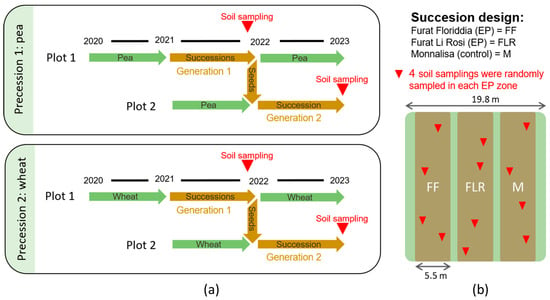
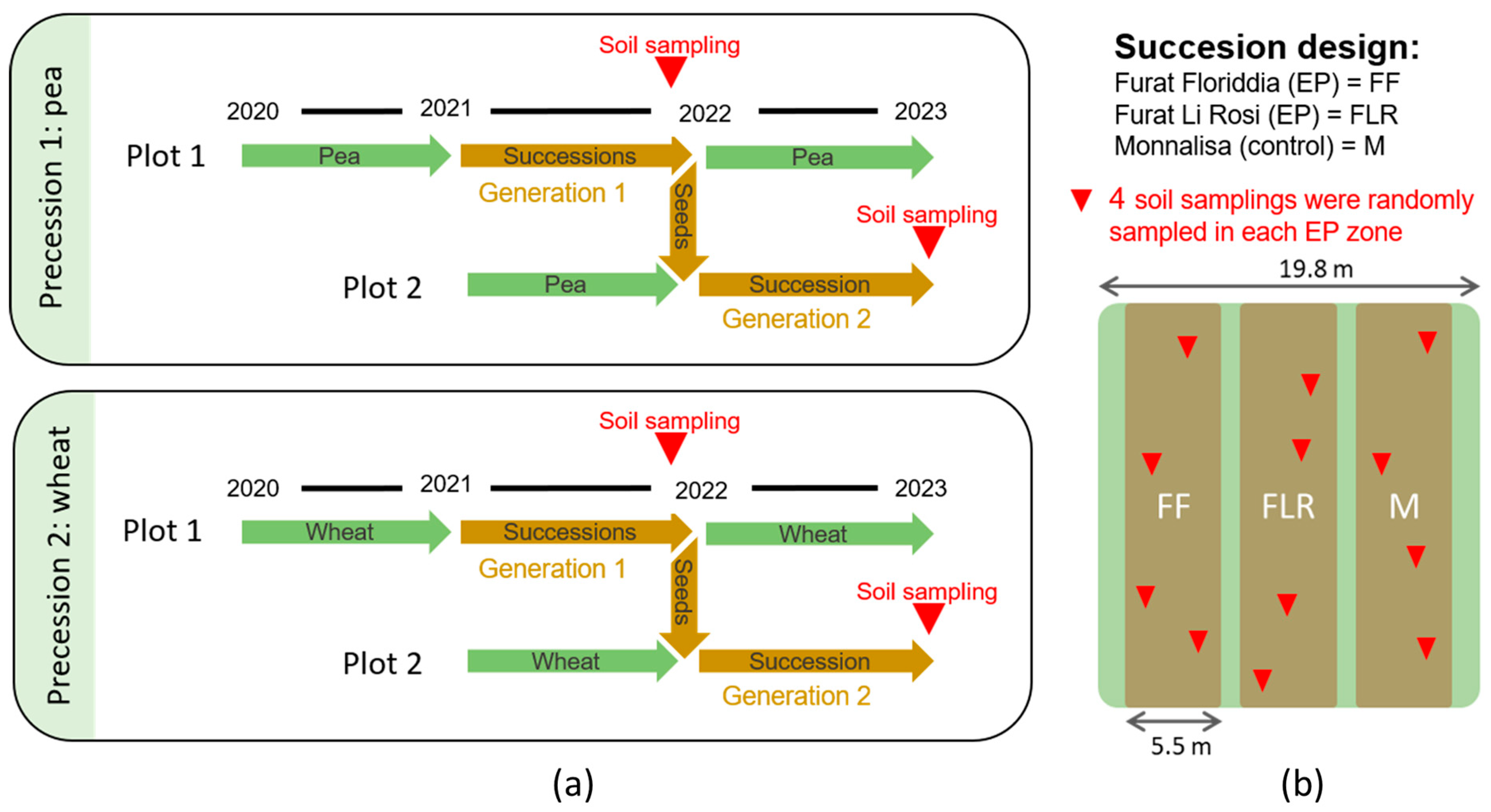
We set up a two-year field experiment at two sites in Italy (Figure 1). For both years, crop rotations were performed with different legumes or wheat as preceding cultures, followed by the two EPs (Furat Floriddia and Furat Li Rosi) and the conventional wheat Monnalisa as the succession crop. The plots were set up in strips (Figure 1). The site preparation included, in both cases, plowing and refining the planting area with a harrow both before the precessions and the successions. No fertilization, irrigation, pest control, or herbicide treatments were used at any of the sites. The experiment was repeated for two years using part of the harvested grain as seed for the following year at both experimental sites.
Figure 1.
Experimental design of the plots in Parma (same design was implemented in Rome with two different precessions: alfalfa and chickpea). (a) In 2020, first-year experimentation was conducted in plots 1, which were cultivated with pea or wheat (precessions). In 2021, after precession harvesting, Furat Floriddia (FF), Furat Li Rosi (FLR), and Monnalisa (M) were sown and then harvested in 2022. Seeds were collected to be used during the second-year experimentation in plots 2. During 2021, for the second-year experimentation, precessions were implemented in plots 2, and after precessions harvesting, FF, FLR, and M were sowed in 2022 and then harvested in 2023. (b) Successions design: FF, FLR, and M were sowed in strips. Red triangles indicate the random rhizosphere sampling in each zone, before the crops’ harvest.
The first experimental site was located at the Stuard demonstration farm (Azienda Agraria Sperimentale Stuard) in Parma, Italy (44.79 N 10.27 E; 50 m a.l.s.). In Parma, on 2 November and 4 November 2020, pea and bread wheat were sown as preceding crops in 2515 m2 plots in the first-year experiment. The harvest of the preceding crops was carried out on 7 July and 19 June 2021. EPs and Monnalisa (succession crops) were sown on 12 November 2021, in two 699 m2 plots and harvested on 27 June 2022 (Table 2). Following the harvest, grain yields were measured (Table 2, Figure S1).
Table 2.
Characteristics and organization of the two experimental sites (Stuard farm and Montelibretti).
In the second-year experiments on 12 November and 24 November 2021, wheat and pea (preceding crops) were sown in 2525 m2 plots and harvested on 4 July and 2 July 2022. EP and Monnalisa (succession crops) sowing were carried out on 3 November 2022, on two large plots, one with wheat as the preceding crop and one with pea as the preceding crop (Table 2). Each large plot was 17.6 m wide and 127 m long, and the four subplots with the four entries were 4.4 m wide and 127 m long. Following the harvest, grain yields were measured.
The second site was in Rome at the experimental farm of CREA-IT (Montelibretti Rome; 42.08 N 12.44 E; 24 m a.s.l.). Alfalfa and chickpea preceding crops were sown on 1 March and on 2 February 2021, in 1600 m2 plots, and harvested on 31 August and on 28 May 2021, in the first-year experiment. EPs and Monnalisa (succession crops) were sown on 17 January 2022, in three 360 m2 plots, and harvested on 1 July 2022 (Table 2). Following the harvest, grain yields were measured. In the second-year experiment, alfalfa and chickpea were sown as preceding crops on 1 October 2021 and on 4 February 2022, in 1600 m2 plots, and harvested on 31 March and on 24 May 2022. EPs and Monnalisa (succession crops) were sown on 18 October 2022, in three 360 m2 plots, and harvested on 3 July 2023 (Table 2). Following the harvest, grain yields were measured.
For both sites, soil characteristics, meteorological data, and sowing/harvesting time are described in Table 2 and Figure S1. At the Stuard farm (Parma), meteorological data were obtained from the Agenzia Regionale per la Protezione Ambientale—Emilia-Romagna (ARPAE) https://simc.arpae.it/dext3r/ (accessed on 13 February 2024). At the Montelibretti site (Rome), meteorological parameters were recorded by an automatic weather station (Acronet Cadorna, Savona, Italy).
2.3. Sampling and Sample Preparation
Rhizosphere soils for each succession were sampled on each site one week before harvest in four different areas of the field (Table 2, Figure 1). Briefly, for each of the sampling areas, ten EP plants showing different heights and spikelet morphologies were sampled and pooled, up to the same number of Monnalisa plants. Since EPs are made up of different genotypes, we sampled rhizospheres derived from plants showing diversified phenotypes to minimize the genotype effect and highlight the overall effect of EPs compared to monoculture following rotation. Rhizosphere soil was then detached from the roots of the pooled plants at each of the four sites with a sterile spatula.
After the harvest, an aliquot of fresh rhizosphere soil samples was freeze dried and used for enzyme activities and ester-linked fatty acid (EL-FAME) analysis. The rest of each sample was air dried and ground at 200 µm before collection of mid-infrared analysis (MIRS) spectra.
2.4. Mid-Infrared Analysis (MIRS)
MIRS was performed on dried and ground soils (200 µm) using FTIR spectroscopy (Tensor 27, Bruker, Fällanden, Switzerland) operating in attenuated total reflectance (ATR) mode. Measurements (n = 4) were conducted at 2 cm−1 intervals in the MIR range (from 4000 to 600 cm−1) and converted to absorbance. Baseline and CO2 and H2O interference corrections were performed, and absorbances were reported as A/1000 S.I. The absorbance intensity of all the wavenumbers was normalized with the sum of total absorbance over 4000 to 600 cm−1, and a Savitzky–Golay smoothing filter was used to remove the noise (filter order = 3 and filter length = 15) [24]. Peaks were detected using the software OriginPro 2024 SR0 and the local maximum method (local points = 20) [24] and extracted for multivariate statistical analysis.
2.5. Enzyme Activities
Twenty-three hydrolytic enzymes involved in the principal carbon, nitrogen, and phosphorus cycles were tested, namely α-glucosidase (alphaG), β-glucosidase (betaG), α-galactosidase (alphaGAL), β-galactosidase (betaGAL), cellulase (cell), β-1,4-xylanase (xilo), β-D-glucuronidase (uroni), chitinase/N-acetyl-β-D-glucosaminidase (chit), arginase (arg), leucine aminopeptidase (leu), aspecific protease (APROT), serin-like protease (CBZ), acid- (acP) and alkaline- (alkP) phosphomonoesterase, inositol-phosphatase (inositP), phosphodiesterase (bisP), pirophosphate-phosphodiesterase (piroP), arylsulfatase (aryS), peroxidase, (PEROXIDASE), oxidase (OXIDASE), fluorescein diacetate (FDA), nonanoate-esterase (nona), and butyrrate-esterase (butirr).
All these potential enzymatic activities were measured from all the rhizosphere samples via a heteromolecular exchange procedure [25] and bead beating to disrupt soil aggregates and microbial cells. Briefly, 0.4 g of soil (fw) was placed into 2 mL microcentrifuge tubes along with 1.4 mL of a solution containing 3% lysozyme, 0.4 mL of 100 mm glass beads, and 0.4 mL of 800 mm ceramic beads. An aliquot of soil for each rhizosphere sample was collected, and moisture loss determination was estimated by weight loss at 110 °C.
The sample tubes were then subjected to bead beating using a Retsch 400 beating mill (Verder Company, Haan, Germany) at 30 strokes s−1 for 3 min, followed by centrifugation at 20,000× g for 5 min. The supernatant containing desorbed enzymes was dispensed into 384-well white microplates with the appropriate buffer to determine the enzymatic activities via a fluorogenic assay using 4-methyl-umbelliferyl- (MUF) and 4-amido-7-methyl-coumarine (AMC) fluorescent substrates. Readings were performed using a Synergy HT microplate reader (Bio-Tek) (BioTek Instruments, Inc., Winooski, VT, USA). All measurements were carried out in quadruplicate, and the activities were expressed as nanomoles of MUF (or AMC) min−1 g−1 dry soil.
2.6. Microbial Community Composition
To characterize the community composition of living microorganisms most likely affected by the cultivation of different crops, we determined the EL-FAMEs [26]. Briefly, fatty acids were extracted from 3 g of freeze-dried soil and methylated at 37 °C using 15 mL of 0.2 M KOH/MeOH solution for 1 h, followed by neutralization by adding 3 mL of 1.0 M acetic acid. Fatty acid methyl ester extraction was carried out using 3 mL of hexane, followed by complete evaporation under nitrogen flow. Once dried, EL-FAMEs were resuspended in 500 µL of hexane, and 180 µL of the solution was transferred to a vial with 20 µL of 19:0 internal standard (methyl nonadecanoate acid). The analysis of EL-FAMEs was performed with an Agilent 6890N gas chromatograph equipped with a flame ionization detector and a BPX70 column (60 m, 0.32 mm, 0.25 µm) (Agilent Technologies, Inc., Santa Clara, CA, USA). Ultra-high-purity helium was used as a carrier gas. The column was kept at 80 °C for 1 min and then heated to 160 °C at a rate of 25 °C min−1, 180 °C at a rate of 2 °C min−1, and finally 220 °C at a rate of 3 °C/min and kept at 220 °C for 10 min. The injector was kept at 280 °C and the detector at 350 °C. A volume of 1 μL was injected at a split ratio of 1:10. Peaks were identified using EL-FAME mix and Bacterial FA mix standards. EL-FAME abundances were given in nmol g−1 of soil. Mono-unsaturated and cyclopropylated EL-FAMEs (16:1w7c, 18:1w9c, and 18:1w9t) were considered markers of Gram-negative (Gram−) bacteria. When found with other fungal markers, the 18:1w9c marker is often defined as a fungal indicator [27], but in our case, this marker was found alone and thus categorized as Gram− bacteria [27]. Iso- and ante-iso-EL-FAMEs (iC14:0, aC14:0, i15:0, a16:0, a17:0, and a18:0) were considered Gram-positive (Gram+) bacteria markers, and 10Me16:0 was considered as Gram-positive actinobacteria. Other EL-FAMEs were considered as unspecified. Finally, Gram+-to-Gram− bacteria ratios were calculated.
2.7. Statistics
EL-FAMEs, Gram+/Gram−, as well as all enzymes separately were all presented according to the precession (pea, wheat, cicer, or alfalfa) and succession (Monnalisa, Furat Floriddia, or Furat Li Rosi). Normality and the homogeneity of the variances were evaluated with the Shapiro–Wilk test (significance level α = 0.05) and Bartlett test (significance level α = 0.05), respectively. If normality and homoscedasticity tests were satisfied, an Analysis of Variance (ANOVA) as well as a Tukey multiple comparisons test (significance level α = 0.05) were performed. If normality was not met, non-parametric Kruskal–Wallis tests followed by Dunn multiple comparisons tests (with a confidence interval of 5%) were carried out. We applied a Benjamini–Hochberg false discovery rate correction to all ANOVA p-values.
Hellinger distances (vegan package) were applied to microbial communities, enzyme activities, and SOM signature datasets to characterize the organization of the data and avoid the sole quantities effect as explicative data. We then used principal component analysis (PCA) (ade4 package) on the transformed datasets (after applying Hellinger distances) of microbial communities, enzyme activities, and SOM signature datasets for Parma and Rome separately and for each site for both generation 1 and generation 2 separately. We used PCA to present how Monnalisa, Furat Floriddia, and Furat Li Rosi were spread according to each of the three datasets.
We performed co-inertia analysis (ade4 package) using the correlation coefficient (RV test) on the different previously edited PCAs for a same-generation experiment both in Parma and in Rome to assess the degree of similarities of the global co-structure of the datasets with the three tested wheat varieties as factors. These results were tested using Monte Carlo tests (RV.randtest from ade4 package).
Additionally, between-class analyses (BCA) (ade4 package) were carried out based on all the PCAs already conducted to analyze how the different EPs were distinguished from each other using Monte Carlo tests (randtest from ade4 package) to assess their significance. Monnalisa and EP differences were tested all together or two by two as couples. Statistics were performed with RStudio version 1.4.171.
3. Results
3.1. Microbial Analysis
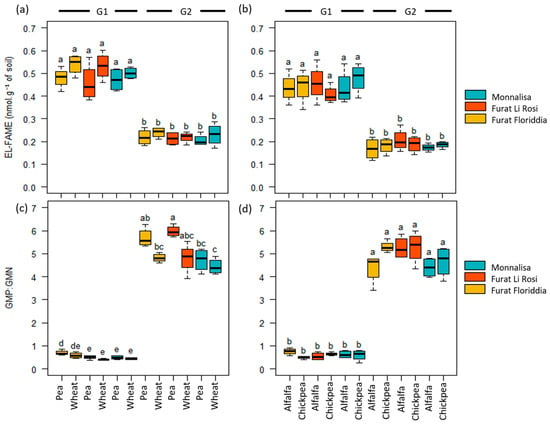
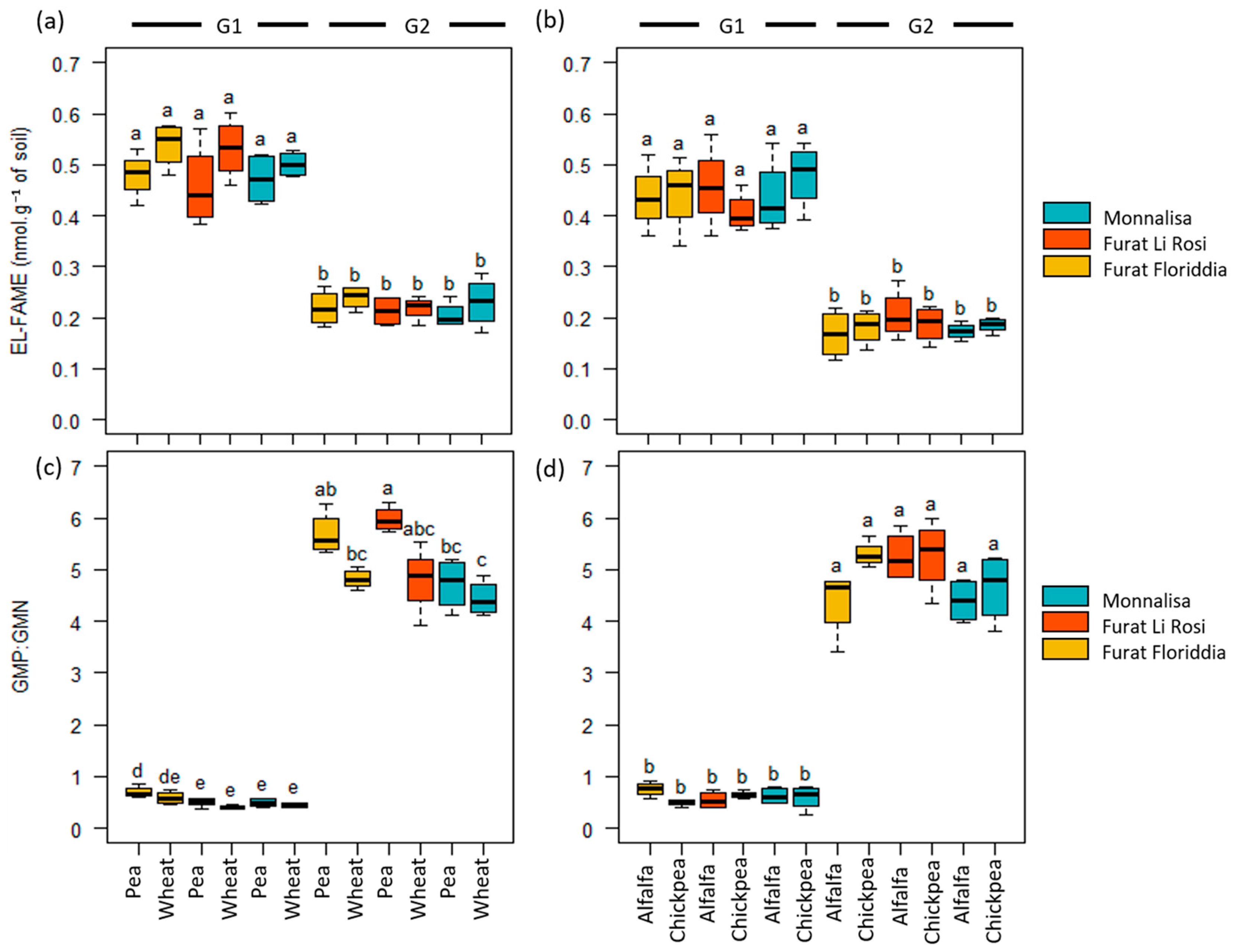
EL-FAME concentrations, indicative of active rhizosphere microbial populations, were not different among the treatments in Parma (Figure 2a). Their concentration ranged between 0.50 and 0.27 nmol g−1 of dry soil for the first- and second-year experiments, respectively, showing a decrease of 53% between the first- and second-year experiments (Figure 2a). Moreover, a significant increase in Gram+/Gram− (+5.6-fold) was observed between the first- and second-year experiments (Figure 2c). Additionally, a higher ratio was observed with Furat Floriddia in the first-year experiment and with pea as the preceding crop in the second-year experiment, particularly in combination with Furat Li Rosi succession (Figure 2c). This increase was mainly the result of a significant decrease in Gram-related EL-FAME markers during the second-year experiment. Nevertheless, no significant differences in Gram+/Gram− were observed between the EPs.
Figure 2.
Total extracted EL-FAMEs (a,b) and Gram-positive-to-negative ratio (c,d) of the rhizosphere soil of EPs and Monnalisa and of the different rotations used in Parma (on the left) and Rome (on the right) over the two experiments (i.e., during the cultivation of generation (G) 1 and generation 2). Letters are the results of significant differences between wheat population for each of the site from the Tukey or Dunn test. Statistics are performed independently for each experiment, G1 and G2. Values are based on four replicates per treatment (n = 4).
The EL-FAME concentrations were similar among all the treatments in Rome, with an average of 0.44 and 0.18 nmol g−1 (41% decrease) of dry soil for the first- and second-year experiments, respectively (Figure 2b). Analysis of Gram+ and Gram− markers revealed a reduction in Gram− markers, resulting in a 6.6-fold increase in Gram+/Gram− (Figure 2d).
3.2. Enzyme Activities Analysis
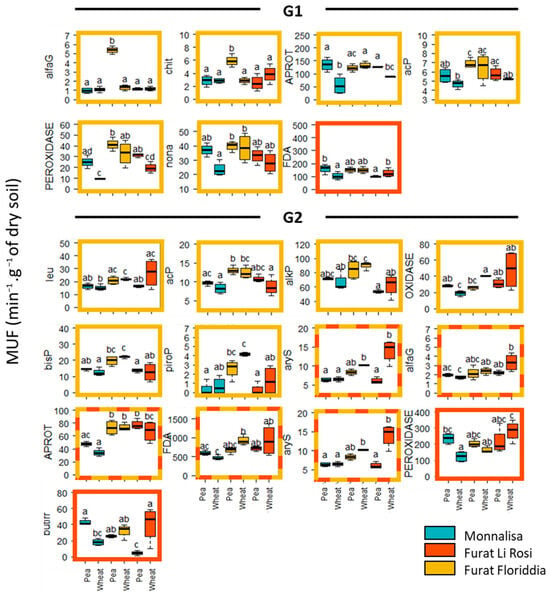
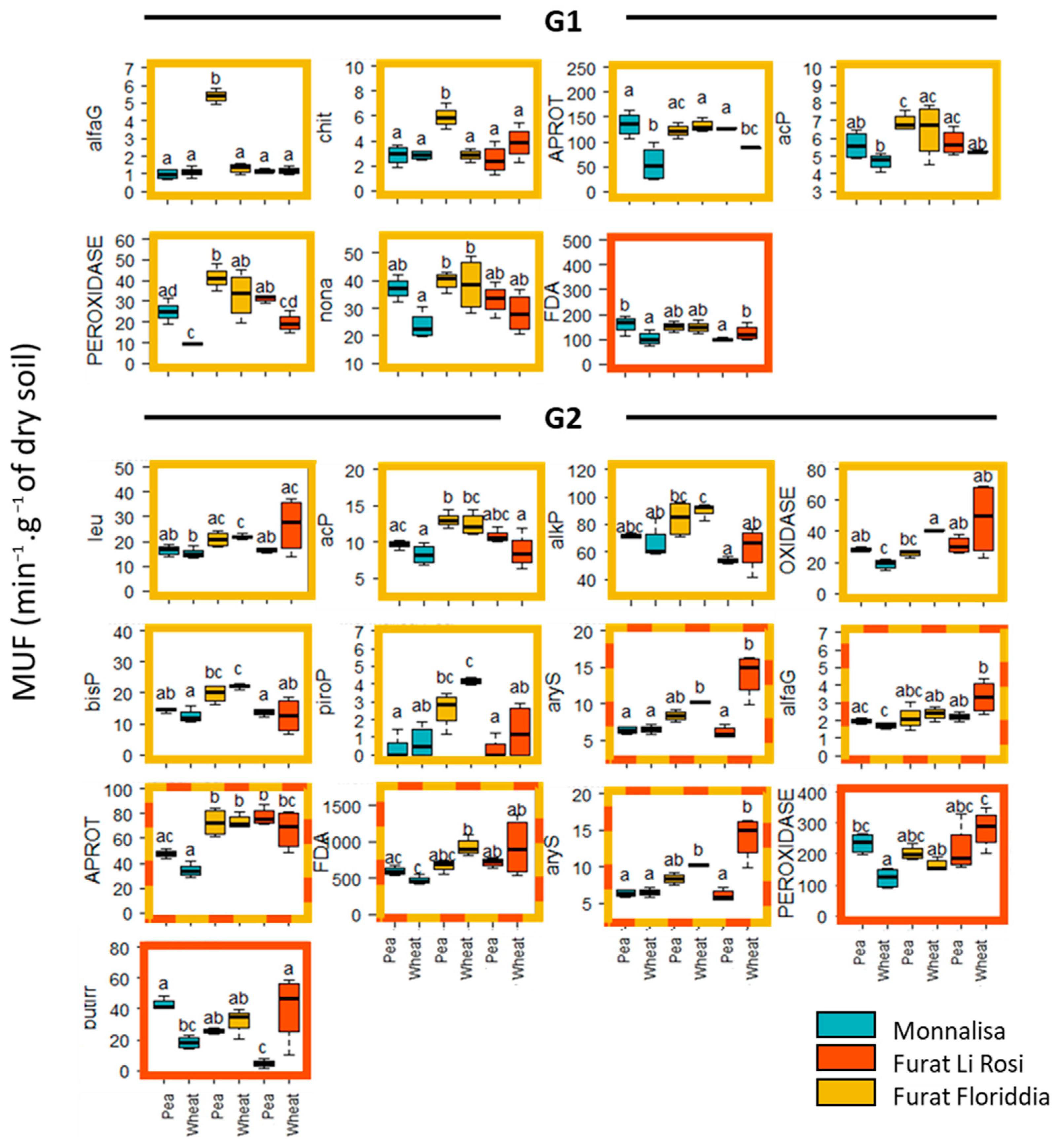
In Parma, after the first-year experiment, Furat Floriddia showed higher enzyme activities than Monnalisa for six enzymes. More specifically, higher activities were found for alpha-glucosidase and chitinase/N-acetyl-β-D-glucosaminidase in rotation with pea (Figure 3 and Figure S2), with higher enzyme activities for aspecific protease and nonanoate-esterase when wheat was used as a preceding crop (Figure 3). Moreover, Furat Floriddia showed higher acid phosphomonoesterase and peroxidase activities than Monnalisa, independently of the preceding crop. On the other hand, Furat Li Rosi almost never differed from Monnalisa except for an increase in FDA when wheat was used as a preceding crop (Figure 3 and Figure S2). During the second-year experiment in Parma, higher levels of enzyme activity were observed in Furat Floriddia in comparison with Monnalisa for a total of ten enzymes. Additionally, Furat Li Rosi showed higher enzyme activities in a subset of 6 enzymes among the 22 measured (Figure 3 and Figure S2).
Figure 3.
Enzyme activities measured in rhizospheres of Monnalisa, Furat Floriddia, and Furat Li Rosi in Parma during both experiments (i.e., during the cultivation of generation (G) 1 and generation 2) and presenting differences with their respective controls, Monnalisa (all enzymes presented in the Supplementary Materials). Letters are the results of significant differences between the wheat population for each site from the Tukey or Dunn test. The color of the edges of each graphic refers to the EP, presenting the so-called significant difference in yellow for Furat Floriddia and in orange for Furat Li Rosi. Both colors mean that both EPs were presenting differences. Values are based on four replicates per treatment (n = 4).
More precisely, leucine aminopeptidase, alkaline phosphomonoesterase, acid phosphomonoesterase, aspecific protease, pirophosphate-phosphodiesterase, phosphodiesterase, oxidase, α-glucosidase, fluorescein diacetate, and arylsulfatase under Furat Floriddia in rotation with wheat increased significantly compared with Monnalisa under the same rotation (Figure 3). Moreover, Furat Floriddia showed higher acid phosphomonoesterase, alkaline phosphomonoesterase, pirophosphate-phosphodiesterase, and aspecific protease activities than Monnalisa regardless of the preceding crop. On the other hand, Furat Li Rosi differed from Monnalisa, with an increase in α-glucosidase, fluorescein diacetate, arylsulfatase, peroxidase, and butirr when wheat was used as a preceding crop (Figure 3). Finally, Furat Li Rosi showed higher aspecific protease activities than Monnalisa regardless of the preceding crop.
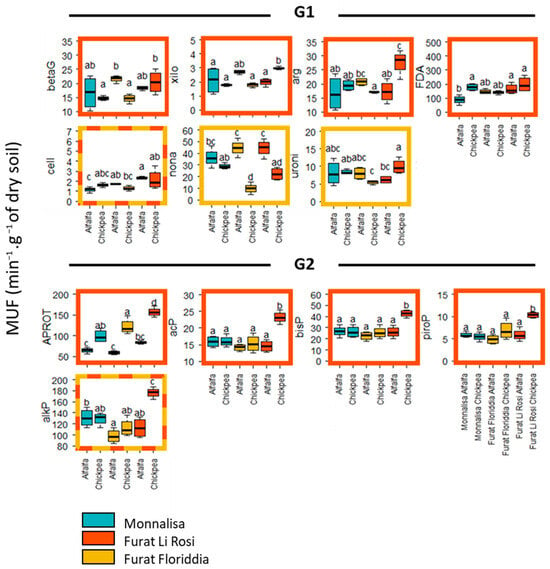
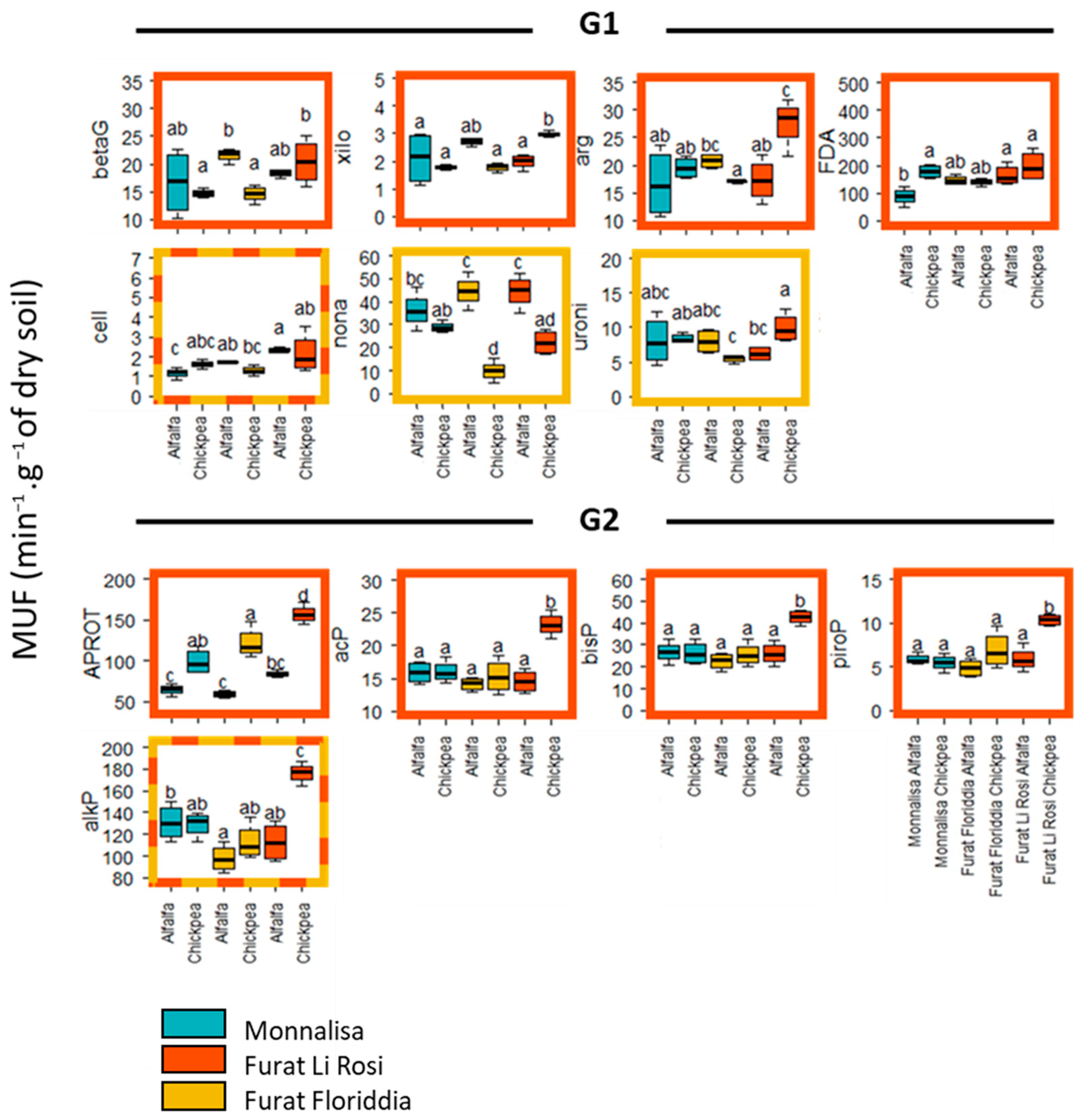
In Rome, Furat Li Rosi showed significantly higher enzyme activities than Monnalisa for β-glucosidase, β-1,4-xylanase, arginase, and fluorescein diacetate in rotation with chickpea and significantly higher cellulase activity in rotation with alfalfa (Figure 4 and Figure S3). On the other hand, in rotation with chickpea, Furat Floriddia showed a significant increase in cellulase activities in rotation with alfalfa and a significant decrease in α-glucosidase, β-D-glucuronidase, and nonanoate-esterase activities compared to Monnalisa (Figure 4).
Figure 4.
Enzyme activities measured in rhizospheres of Monnalisa, Furat Floriddia, and Furat Li Rosi in Rome during both experiments (i.e., during the cultivation of generation (G) 1 and generation 2) and presenting differences with their respective controls, Monnalisa (all enzymes presented in the Supplementary Materials). Letters are the results of significant differences between the wheat population for each site from the Tukey or Dunn test. The color of the edges of each graphic refers to the EP, presenting the so-called significant difference in yellow for Furat Floriddia and in orange for Furat Li Rosi. Both colors means that both EPs were presenting differences. Values are based on four replicates per treatment (n = 4).
During the second-year experiment in Rome, Furat Floriddia showed lower enzyme activity in alkaline phosphomonoesterase than Monnalisa in rotation with alfalfa (Figure 4 and Figure S3). On the other hand, when chickpea was used as a preceding crop, Furat Li Rosi differed from Monnalisa, with an increase in aspecific protease, acid phosphomonoesterase, pyrophosphate-phosphodiesterase, phosphodiesterase, and alkaline phosphomonoesterase (Figure 4 and Figure S3).
The color refers to the EP, presenting the so-called significant difference in yellow for Furat Floriddia and in orange for Furat Li Rosi. Both colors mean that both EPs were presenting differences.
3.3. Principal Component Analysis and Co-Inertia
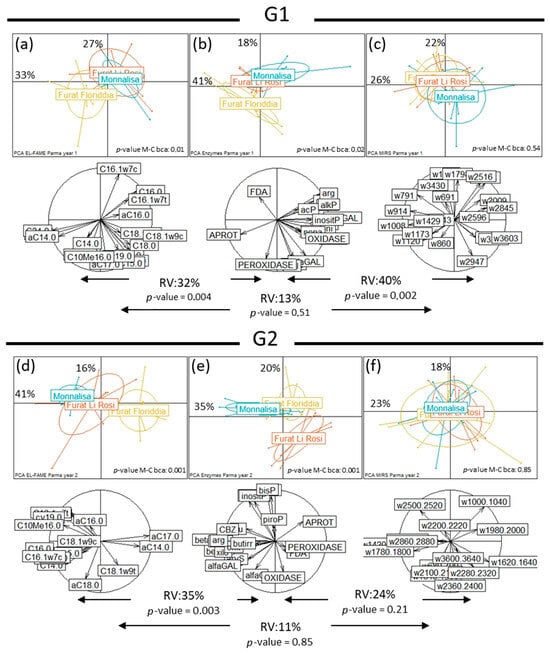
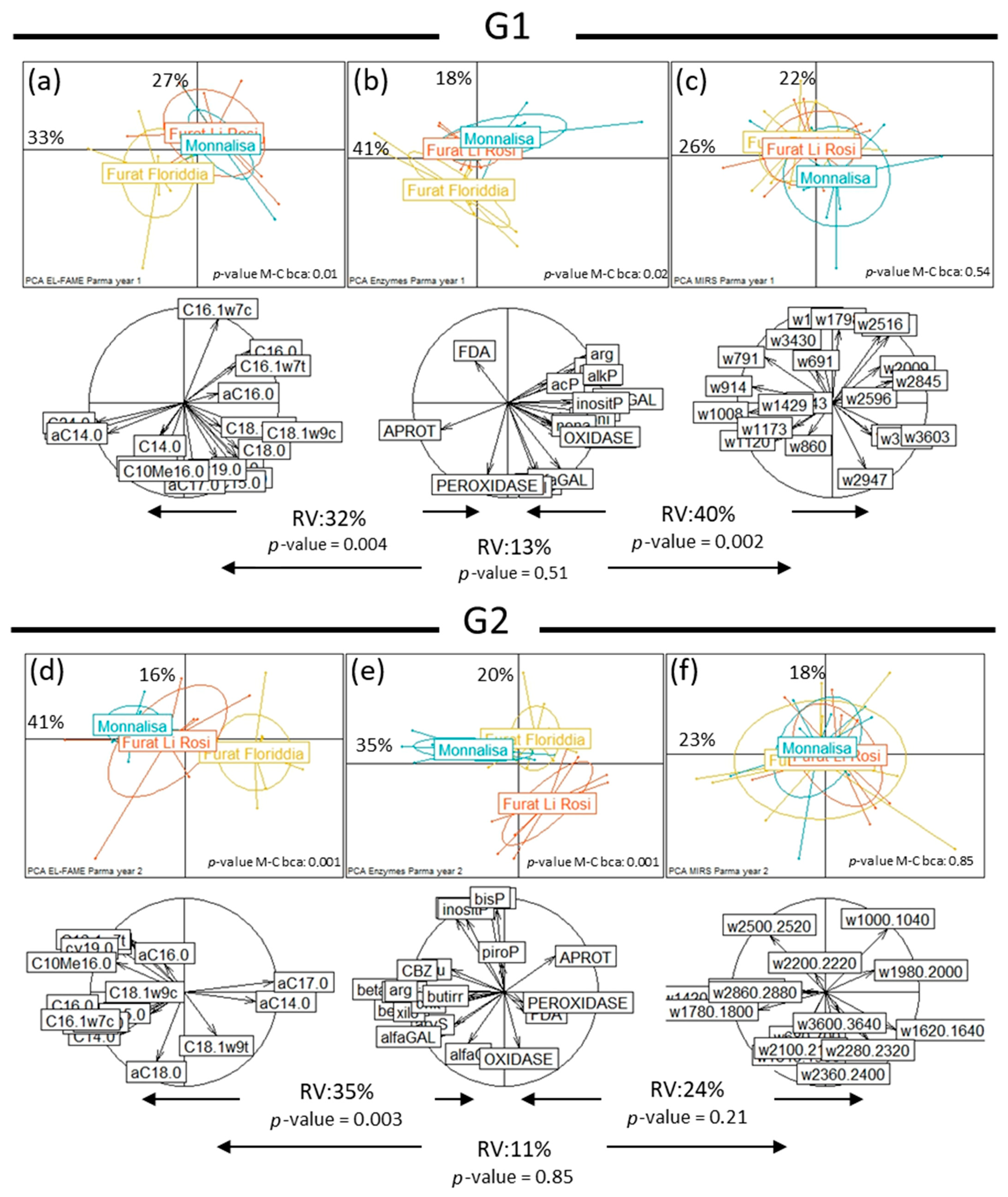
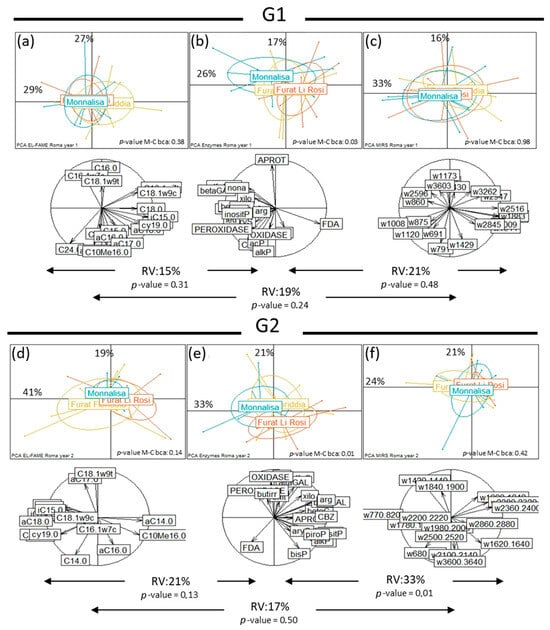
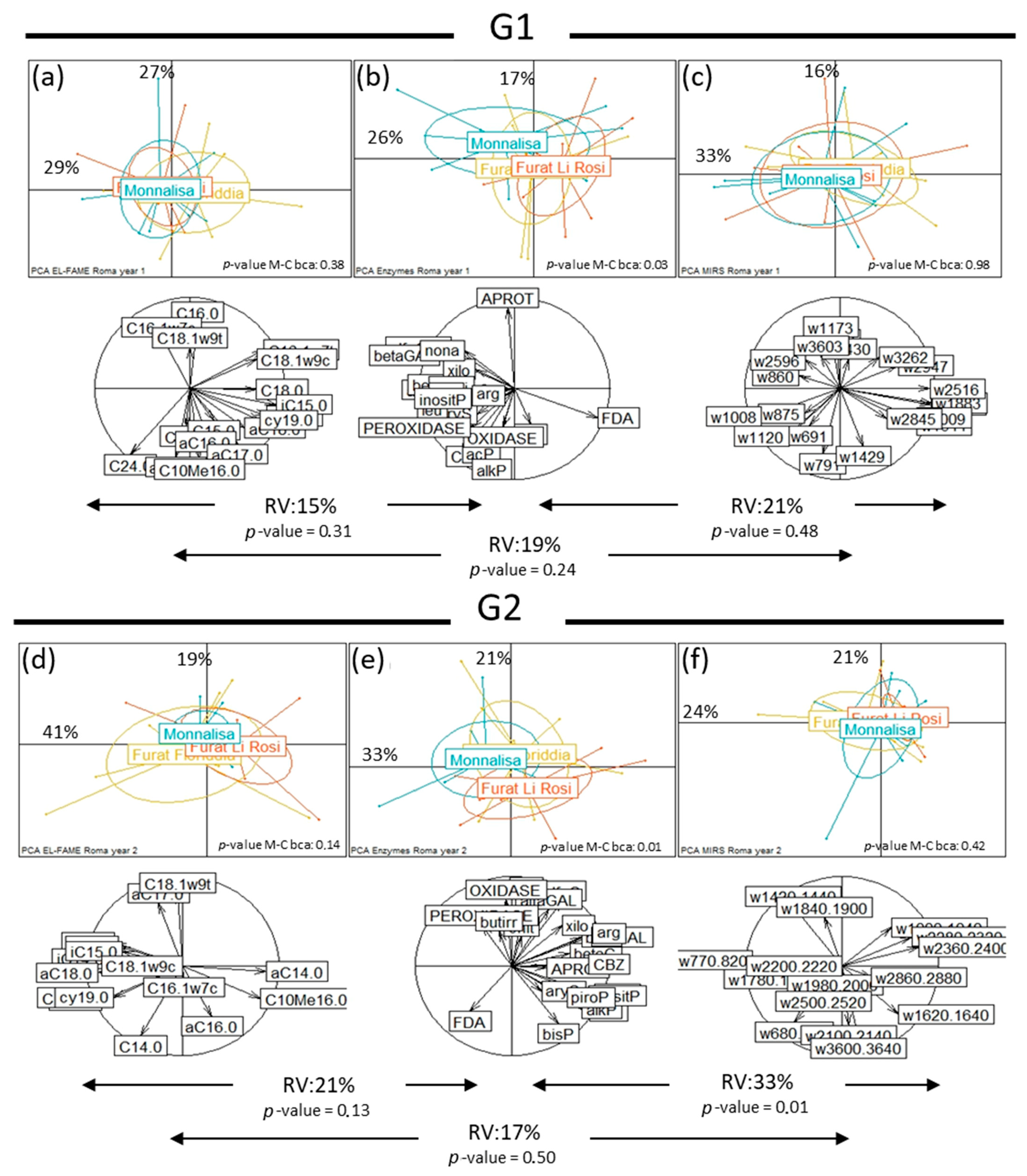
PCAs resulting from the MIRS signature, EL-FAMEs, and enzyme activities are shown in Figure 5 and Figure 6 for Parma and Rome, respectively. The PCA based on the MIRS signatures did not allow us to distinguish EPs from Monnalisa regardless of the site or year (Figure 5c,f and Figure 6c,f), while the PCA based on EL-FAMEs allowed us to differentiate Furat Floriddia from Monnalisa in Parma (Figure 5a,d) in both first- (p-value: 0.01) and second-year experiments (p-value: 0.001). This differentiation was based both on the first axis, explaining 33% and 41% of the variability for the first- and second-year experiments, respectively, and along the second axis, explaining 27% and 16% of the variability, respectively, indicating a higher proportion of ante-iso markers specific to Gram+ bacteria in the rhizosphere of Furat Floriddia. In Rome, no differentiation was observed among the three varieties in the EL-FAME-based PCA (Figure 6a,d).
Figure 5.
PCAs of EL-FAMEs (a,d), enzymes (b,e), and MIRS datasets (c,f) obtained from the rhizospheres of Monnalisa, Furat Floriddia, and Furat Li Rosi in Parma during both first- (G1) and second-year (G2) experiments. (i.e., during the cultivation of generation 1 (G1) and generation 2 (G2)). RV = RV coefficient, measuring the closeness of our three datasets two by two. p-values from the Monte Carlo tests presented in the figure are the result of the comparison of the three groups together. The number of samples in each modality (Monnalisa, Furat Floriddia, and Furat Li Rosi) = 24.
Figure 6.
PCAs of EL-FAMEs (a,d), enzymes (b,e), and MIRS datasets (c,f) obtained from the rhizospheres of Monnalisa, Furat Floriddia, and Furat Li Rosi in Rome during both first- (G1) and second-year (G2) experiments. (i.e., during the cultivation of generation 1 (G1) and generation 2 (G2)). RV = RV coefficient, measuring the closeness of our three datasets two by two. p-values from the Monte Carlo tests presented in the figure are the result of the comparison of the three groups together. The number of samples in each modality (Monnalisa, Furat Floriddia, and Furat Li Rosi) = 24.
In the first-year experiment in Parma, the higher proportion of peroxidase, fluorescein diacetate, and aspecific protease was responsible for the differentiation of Furat Floriddia from Monnalisa (p-value: 0.003) along the two axes (41% and 18% of the variability) (Figure 5b).
During the second-year experiment, PCA seems to differentiate Furat Floriddia and Furat Li Rosi (p-value: 0.001) from Monnalisa along the first axis (35% of the variability) due to a higher proportion of peroxidase, fluorescein diacetate, and aspecific protease. Along with the second axis (20% of the variability), Furat Li Rosi differentiated from Monnalisa and Furat Floriddia due to higher proportions of oxidase and alpha-glucosidase (Figure 5e). In contrast, neither EPs nor Monnalisa could be differentiated in Rome based on their enzyme activities (Figure 6b,e).
Co-inertia analyses were performed at both sites to investigate the similarity of the datasets. These analyses showed a higher correlation coefficient for MIRS signatures and enzyme activities in the first-year (Parma-RV = 40%, p-value = 0.002; Rome-RV = 21%, p-value > 0.05) and second-year experiments (Parma-RV = 24%, p-value > 0.05; Rome-RV = 33%, p-value = 0.01) with respect to the correlation between MIRS signatures and EL-FAMEs in the first-year (Parma-RV = 13%, p-value > 0.05; Rome-RV = 19%, p-value > 0.05) and second-year experiments (Parma-RV = 11%, p-value > 0.05; Rome-RV = 17%, p-value > 0.05) (Figure 5 and Figure 6). The RV between PCAs of EL-FAMEs and enzyme activities datasets was included between 15% and 35% (p-value = 0.004). Overall, the co-inertias were generally less satisfying in Rome, with insignificant p-values due to the low differentiation between the different EP classes (Figure 6).
4. Discussion
Our comprehensive dataset combined two experimental sites, two growing seasons, and multiple analyses, including MIRS signatures, EL-FAME profiling, and rhizosphere enzymatic activities, to evaluate how genetic diversity and crop precession shape the rhizospheres of EPs relative to the commercial cultivar Monnalisa.
EL-FAME analysis at both sites revealed a consistent pattern: microbial biomass declined from the first to the second year and was accompanied by a 6.6-fold increase in Gram+/Gram−, with no appreciable differences associated with plant genotype, preceding crop, or location (Figure 2).
The Gram+/Gram− ratio is commonly used as an indicator of substrate quality, as Gram+ bacteria are generally associated with the decomposition of less labile organic matter. These patterns may reflect differences in nutritional strategies within microbial communities. Many Gram+ bacteria are oligotrophic and tend to dominate nutrient-poor environments, whereas Gram− are typically more copiotrophic, relying on labile carbon, exhibit rapid growth, and exploiting a broader range of carbon sources [28]. This interpretation is supported by previous studies showing that the Gram+/Gram− ratio increases as C availability declines or after labile substrates are depleted [29]. Therefore, it is plausible that the shift observed in the second year may reflect the emergence of a more stress-tolerant and oligotrophic microbial community, typically characterized by lower overall biomass [29], likely driven by a reduction in readily available C.
The consistent microbial patterns observed across treatments indicate that the detected changes were more likely associated with broad environmental or resource-related constraints than with a direct selective effect exerted by the wheat genotypes themselves. In the PCA analysis, the MIRS signature did not discriminate between EPs and Monnalisa in either site or year, whereas the EL-FAME profile successfully separated the population in Parma. Indeed, PCA showed a change in the composition of the microbial communities when Furat Floriddia was used (Figure 5a,d). This differentiation was stronger during the second year of the experiment using the seed harvested from the first-year experiment (Table 2), and it is mainly ascribed to an increase in some Gram+ bacteria, although it was not yet strong enough to induce a change in the ratio of Gram+/Gram−. Although taxonomic richness of soil biota is important, the capacity of microbial communities to preserve functional diversity (i.e., the ability to maintain enzymatic activities and biogeochemical functions) of critical processes through disturbance, stress, or succession may be more decisive for long-term ecosystem productivity and stability than species-level diversity [30].
As far as enzymatic activity is concerned, in Parma, for both years, the results showed a stronger differentiation between both EPs with respect to Monnalisa. Specifically, it is determined mainly by peroxidase activity measured in the rhizosphere of Furat Floriddia before the community shift in the first and in Furat Li Rosi in the second year of cultivation (Figure 5). Moreover, Furat Li Rosi in the second year of cultivation resulted in increased activity also in OXIDASE and FDA.
Lignocellulose represents the dominant component of plant primary production, and its depolymerization is considered a rate-limiting step governing macronutrient flux. The degradation of lignin relies primarily on non-specific oxidative reactions mediated by phenol oxidase and peroxidase, enzymes that play a central role in carbon turnover and nutrient cycling processes [31]. Li et al. [32] reports that systems with lower microbial abundance but elevated oxidase activity can produce more oxidase per unit of SOC, implying greater enzymatic efficiency and an accelerated rate of recalcitrant C degradation. Accordingly, if microbial biomass is comparable between the two EPs and Monnalisa, it is plausible that the microbial community colonizing the EP rhizosphere is more metabolically active, yielding higher levels of oxidative enzymes involved in recalcitrant C breakdown and thereby increasing the release of degradation products and mobilizing associated nutrients. Beyond the differences observed in the enzymatic activities described above, our analyses revealed additional, non-negligible divergences in rhizosphere microbial functioning of EPs.
In the two EPs cultivated in Parma, increases in oxidative enzyme activities were accompanied by concomitant rises in enzymes associated with nitrogen acquisition. Compared to Monnalisa, Furat Floriddia exhibited elevated PEROXIDASE and APPROT activities in the first year and increased OXIDASE, leu, and APPROT activities in the second year. Likewise, during the second year, Furat Floriddia showed a simultaneous increase in APPROT and PEROXIDASE activities (Figure 3).
Soil proteases catalyze the hydrolysis of proteins to amino acids. Proteolysis is widely recognized as a key rate-limiting step in nitrogen mineralization in soils [33,34].
Microbial guild models of decomposition associate nitrogen acquisition by late-successional microorganisms capable of degrading lignocellulose and humic compounds with the activity of phenol oxidase and peroxidase [35]. A well-established relationship has been described between oxidase activity and nitrogen acquisition, whereby increased nitrogen availability commonly results in the suppression of oxidase activity. Similarly, experimental nitrogen addiction has been reported to reduce leucine aminopeptidase activity [36]. In contrast, evidence from wheat systems suggests that increasing varietal diversity positively influences nitrogen-related enzymatic processes, as demonstrated by enhanced leucine aminopeptidase activity observed under higher levels of wheat varietal diversity [37].
As reported by Sinsabough and Follstad Shah [36], who defined the correlation between oxidase and leucine aminopeptidase well, the oxidative depolymerization of lignocellulose and humic material releases complexed peptides and other nitrogen moieties, thereby making previously protected N accessible. As SOM becomes increasingly recalcitrant, the acquisition of carbon, nitrogen, and phosphorous is predicted to rely more heavily on oxidative enzyme activity.
The higher oxidase activity observed in Furat Floriddia in Parma may be linked to the elevated enzymatic activities detected for all phosphorous-acquisition enzymes included in the analysis (acP, alkP, bisP, or piroP) (Figure 3). Based on these observations, it is plausible that the genetic diversity of the EPs in Parma stimulates enhanced microbial activity in the rhizosphere. Increased oxidase activity, by producing more readily available compounds, could, in turn, drive the upregulation of enzymes associated with less complex nitrogen and phosphorous forms.
In Rome, overall enzymatic activities measured in the rhizospheres of the EPs were higher for betaG, xilo, arg, FDA, cell, uroni, and nona in the first year and for APPROT, acP, bisP, piroP, and alkP in the second year (Figure 3). Despite these increases, the differences observed between the EPs and Monnalisa remained relatively limited (Figure 4 and Figure 6), and the consistently enhanced performance across the analyzed enzyme activities observed in Parma for EPs was not replicated. This trend was further supported by the PCA based on EL-FAME markers (Figure 6), which showed comparable patterns across both the first and second experimental years. Collectively, these findings point toward a pronounced site-dependent response of the EPs, suggesting that the effects of EP-derived genetic diversity on soil functionality are strongly influenced by local soil conditions and environmental context. Consequently, the outcomes observed in Parma cannot, within the framework of the present study, be directly extrapolated or generalized to other locations.
Soils from Emilia-Romagna are generally deeper and provide substantially greater water availability, which may allow the different genotypes to better express their specific traits.
Despite the observed differences in microbial activities, the absence of a clear response in microbial composition and in the SOM signature between EPs and Monnalisa may be related to the short duration of the experiment. Indeed, while changes in plant biodiversity can promote positive plant–soil feedback, such effects are more likely to occur only after several years of treatment implementation [38]. Intraspecific diversity has previously been shown to influence microbial biomass and community composition, but these observations were made in tree populations that had been established for 13 years, which also implies differences in litter deposition [39]. Moreover, core microbiota is not only influenced by implemented crops but also by pedoclimatic conditions like soil pH and mean annual precipitation [19], highlighting the complex relation between soils, plants, and climate.
The findings of this study align with challenges frequently highlighted in the literature regarding the role of crop genetics in shaping soil functionality. While plant genetic diversity has the potential to influence soil processes, its contribution remains difficult to disentangle from other major drivers, including soil physiochemical properties, environmental conditions, agronomic management, residence time, and plant phenological stage, which often exert stronger or interacting effects. Previous studies have shown that genotypes effects on the rhizosphere microbiomes and soil functions are highly context dependent and frequently secondary to broader ecological and management factors [40,41]. Similarly, although genetic diversity can affect specific soil functional traits, such as nitrogen-related enzymatic activities, its influence is often selective [37]. Furthermore, studies comparing modern varieties and perennial wheat systems indicate that broader plant traits, such as perenniality, may exert a stronger influence than genotype itself in shaping rhizosphere biological and chemical composition [42,43].
Similarly, our results indicate that the genetic diversity introduced through EPs can influence soil functionality, particularly soil enzymatic activities and, to lesser extent, microbial community composition (Figure 3 and Figure 5). However, these responses were not stable across years and sites, suggesting a context-dependent dynamic shaped by the complex interaction between plant genetic and environmental conditions rather than as a generalizable pattern.
Finally, preceding crops produced limited and inconsistent effects. Although crop rotations, particularly those involving legumes, are often associated with positive plant–soil feedback [44,45], these benefits generally emerge over longer periods through cumulative changes in residues inputs, nutrient cycling, and microbial community reorganization. The relatively short duration of the rotational scheme in the present study may therefore explain the lack of clear and consistent signals.
5. Conclusions
In order to adapt agricultural systems to climate change, which increasingly threatens plant growth and crop productivity [46], wheat EPs cultivated in rotation with legumes may represent a promising strategy. While we have already demonstrated good technological and nutritional performance and their adaptation to different environments [10], in this explorative study, we investigated their potential impact on rhizosphere soil compared with a conventional wheat cultivar. Although MIRS signatures did not discriminate EPs from Monnalisa across site or years, our findings highlight the strong influence of local soil conditions on active microbial communities and their associated enzyme activities. After one year of cultivation, no distinct crop-specific rhizosphere microbial composition emerged. Nevertheless, site-dependent differences in microbial functioning differentiated EPs from the conventional cultivar according to the environmental context in which they were grown. The lack of a consistent response across locations indicates that no generalizable pattern can yet be defined. Overall, our results suggest that EPs may be associated with greater microbial activity than conventional wheat systems but that these effects are linked to environmental context. However, these findings should be interpreted with caution given the exploratory nature of the study, the relatively short experimental duration, and the use of a single conventional cultivar as a reference. Longer-term studies will be necessary to determine whether these site-specific responses persist over time, become reproducible across locations, and ultimately clarify the role of EPs in driving soil functionality and microbial dynamics.
Supplementary Materials
The following supporting information can be downloaded at: https://www.mdpi.com/article/10.3390/agriculture16121303/s1, Figure S1: Weather records near both sites: Parma on the top and Rome on the bottom between 2021 and 2023; Figure S2: Enzymes activities measured in rhizosphere of Monnalisa, Furat Floriddia and Furat Li Rosi in Parma during the first-generation experiment. Letters are the results of significant differences between wheat population for each of the site from the Tukey or Dunn test. Coloured cells refers to the modalities that are significantly different from their controls (Monnalisa). Yellow refers to Furat Floriddia and Orange to FuratLi Rosi. Uncoloured plots were showing no significant differences with their respective controls (Monnalisa); Figure S3: Enzymes activities measured in rhizosphere of Monnalisa, Furat Floriddia and Furat Li Rosi in Parma during the second-generation experiment. Letters are the results of significant differences between wheat population for each of the site from the Tukey or Dunn test. Coloured cells refers to the modalities that are significantly different from their controls (Monnalisa). Yellow refers to Furat Floriddia and Orange to Furat Li Rosi. Uncoloured plots were showing no significant differences with their respective controls (Monnalisa).
Author Contributions
C.V.: Conceptualization, Methodology, Investigation, Writing—original draft, Writing—review and editing, Formal analysis, and Visualization. G.G. (Gianluigi Giannelli): Conceptualization, Methodology, Investigation, Formal analysis, Writing—original draft, and Writing—review and editing. L.G.: Supervision. S.F.: Supervision. A.F.: Investigation and Writing—review and editing. S.C.: Supervision. G.G. (Gianni Galaverna): Funding acquisition and Project administration. G.V.: Conceptualization, Methodology, Writing—review and editing, and Supervision. C.R.: Conceptualization, Methodology, Writing—review and editing, Supervision, and Project administration. All authors have read and agreed to the published version of the manuscript.
Funding
This study is part of the project CHANGE-UP—Innovative agroecological APProaches to achieving resilience to climate CHANGE in Mediterranean countries, funded by MUR (DD n.16787, 19 November 2021) within the PRIMA EU Sect. 2—Multi-topic 2020 (Partnership for Research and Innovation in the Mediterranean Area) CALL 2020.
Data Availability Statement
The data that support the findings of this study are available in the main text and in the Supplementary Materials associated to this manuscript. Raw data will be available on request.
Acknowledgments
The authors acknowledge the National Research Agency (Agence Nationale de la recherche (ANR) which led to establishment of the collaboration between Sorbonne University (Paris), CREA (Rome), and University of Parma (Parma). The authors acknowledge Pierino Cacciatori from CREA, Research Centre for Engineering and Agro-Food Processing, Rome, for the field management in Rome and Jad B. Novi from Stuard Experimental Farm, San Pancrazio Parmense, Parma, for the field management in Parma.
Conflicts of Interest
Author Silvia Folloni was employed by the company Open Fields S.r.l. The remaining authors declare that the research was conducted in the absence of any commercial or financial relationships that could be construed as potential conflicts of interest.
References
- Tilman, D.; Cassman, K.G.; Matson, P.A.; Naylor, R.; Polasky, S. Agricultural Sustainability and Intensive Production Practices. Nature 2002, 418, 671–677. [Google Scholar] [CrossRef] [Scilit]
- Kopittke, P.M.; Minasny, B.; Pendall, E.; Rumpel, C.; McKenna, B.A. Healthy Soil for Healthy Humans and a Healthy Planet. Crit. Rev. Environ. Sci. Technol. 2024, 54, 210–221. [Google Scholar] [CrossRef] [Scilit]
- Ceccarelli, S.; Grando, S. Evolutionary Plant Breeding as a Response to the Complexity of Climate Change. iScience 2020, 23, 101815. [Google Scholar] [CrossRef] [Scilit]
- Allard, R.W.; Hansche, P.E. Some Parameters of Population Variability and Their Implications in Plant Breeding. In Advances in Agronomy; Elsevier: Amsterdam, The Netherlands, 1964; Volume 16, pp. 281–325. ISBN 978-0-12-000716-5. [Google Scholar] [CrossRef] [Scilit]
- Bocci, R.; Bussi, B.; Petitti, M.; Franciolini, R.; Altavilla, V.; Galluzzi, G.; Di Luzio, P.; Migliorini, P.; Spagnolo, S.; Floriddia, R.; et al. Yield, Yield Stability and Farmers’ Preferences of Evolutionary Populations of Bread Wheat: A Dynamic Solution to Climate Change. Eur. J. Agron. 2020, 121, 126156. [Google Scholar] [CrossRef] [Scilit]
- Colombo, F.; Franguelli, N.; Licheri, G.; Ghidoli, M.; Cassani, E.; Castelli, L.; Pasquali, M.; Bresciani, A.; Marti, A.; Dell’Anno, M.; et al. Agriculture in Marginal Areas: Reintroduction of Rye and Wheat Varieties for Breadmaking in the Antrona Valley. Agronomy 2022, 12, 1695. [Google Scholar] [CrossRef] [Scilit]
- Murphy, K.; Lammer, D.; Lyon, S.; Carter, B.; Jones, S.S. Breeding for Organic and Low-Input Farming Systems: An Evolutionary–Participatory Breeding Method for Inbred Cereal Grains. Renew. Agric. Food Syst. 2005, 20, 48–55. [Google Scholar] [CrossRef] [Scilit]
- Reiss, E.R.; Drinkwater, L.E. Cultivar Mixtures: A Meta-analysis of the Effect of Intraspecific Diversity on Crop Yield. Ecol. Appl. 2018, 28, 62–77. [Google Scholar] [CrossRef] [Scilit]
- Wolfe, M.S.; Ceccarelli, S. The Increased Use of Diversity in Cereal Cropping Requires More Descriptive Precision. J. Sci. Food Agric. 2020, 100, 4119–4123. [Google Scholar] [CrossRef] [Scilit]
- Natale, C.; Galassi, E.; Nocente, F.; Taddei, F.; Folloni, S.; Visioli, G.; Ceccarelli, S.; Galaverna, G.; Gazza, L. Rheological, Technological, and Nutritional Profile of Sustainable Crops: Bread Wheat Evolutionary Populations. Foods 2025, 14, 3821. [Google Scholar] [CrossRef] [Scilit]
- Pankhurst, C.E.; Doube, B.M.; Gupta, V.V.S.R. (Eds.) Biological indicators of soil health: Synthesis. In Biological Indicators of Soil Health; CABI: Oxfordshire, UK, 1997; pp. 419–435. [Google Scholar]
- Sinsabaugh, R.L.; Antibus, R.K.; Linkins, A.E. An Enzymic Approach to the Analysis of Microbial Activity During Plant Litter Decomposition. Agric. Ecosyst. Environ. 1991, 34, 43–54. [Google Scholar] [CrossRef] [Scilit]
- Dick, R.P.; Breakwell, D.P.; Turco, R.F. Soil Enzyme Activities and Biodiversity Measurements as Integrative Microbiological Indicators. In SSSA Special Publications; Doran, J.W., Jones, A.J., Eds.; Wiley: Hoboken, NJ, USA, 1997; Volume 49, pp. 247–271. ISBN 978-0-89118-826-1. [Google Scholar]
- Daunoras, J.; Kačergius, A.; Gudiukaitė, R. Role of Soil Microbiota Enzymes in Soil Health and Activity Changes Depending on Climate Change and the Type of Soil Ecosystem. Biology 2024, 13, 85. [Google Scholar] [CrossRef] [Scilit] [PubMed]
- Syromiatnykov, Y.; Vircava, I.; Yakovleva, A.; Semenenko, S.; Fiļipovičs, M.; Snitko, V. Seed inoculation with Rizoline-r and foliar application of KALNINI enhance organic soybean growth and yield. Res. Rural Dev. 2025, 40, 60–67. [Google Scholar] [CrossRef] [Scilit]
- Ishniyazova, S.; Troyanovskaya, I.; Malikov, V.; Orekhovskaya, A. Optimizing crop rotation and cereal saturation for sustainable winter wheat production under semiarid conditions of Uzbekistan. Adv. Agric. 2026, 2026, 5863850. [Google Scholar] [CrossRef] [Scilit]
- Dubs, F.; Enjalbert, J.; Barot, S.; Porcher, E.; Allard, V.; Pope, C.; Gauffreteau, A.; Niboyet, A.; Pommier, T.; Saint-Jean, S.; et al. Unfolding the Link between Multiple Ecosystem Services and Bundles of Functional Traits to Design Multifunctional Crop Variety Mixtures. Agron. Sustain. Dev. 2023, 43, 71. [Google Scholar] [CrossRef] [Scilit]
- Montazeaud, G.; Violle, C.; Roumet, P.; Rocher, A.; Ecarnot, M.; Compan, F.; Maillet, G.; Fort, F.; Fréville, H. Multifaceted Functional Diversity for Multifaceted Crop Yield: Towards Ecological Assembly Rules for Varietal Mixtures. J. Appl. Ecol. 2020, 57, 2285–2295. [Google Scholar] [CrossRef] [Scilit]
- Jiao, S.; Xu, Y.; Zhang, J.; Hao, X.; Lu, Y. Core Microbiota in Agricultural Soils and Their Potential Associations with Nutrient Cycling. mSystems 2019, 4, e00313-18. [Google Scholar] [CrossRef] [Scilit] [PubMed]
- Dotaniya, M.L.; Aparna, K.; Dotaniya, C.K.; Singh, M.; Regar, K.L. Role of Soil Enzymes in Sustainable Crop Production. In Enzymes in Food Biotechnology; Elsevier: Amsterdam, The Netherlands, 2019; pp. 569–589. ISBN 978-0-12-813280-7. [Google Scholar] [CrossRef] [Scilit]
- Dick, R. Soil enzyme activities as integrative indicators of soil health. In Biological Indicators of Soil Health; Pankhurst, C.E., Doube, B.M., Gupta, V.V.S.R., Eds.; CAB International: Oxfordshire, UK, 1997; pp. 121–256. [Google Scholar]
- Pérez-Guzmán, L.; Phillips, L.A.; Acevedo, M.A.; Acosta-Martínez, V. Comparing Biological Methods for Soil Health Assessments: EL-FAME, Enzyme Activities, and qPCR. Soil Sci. Soc. Am. J. 2021, 85, 636–653. [Google Scholar] [CrossRef] [Scilit]
- Karger, D.N.; Conrad, O.; Böhner, J.; Kawohl, T.; Kreft, H.; Soria-Auza, R.W.; Zimmermann, N.E.; Linder, H.P.; Kessler, M. Climatologies at High Resolution for the Earth’s Land Surface Areas. Sci. Data 2017, 4, 170122. [Google Scholar] [CrossRef] [Scilit] [PubMed]
- Bottinelli, N.; Jouquet, P.; Tran, T.M.; Aroui Boukbida, H.; Rumpel, C. Mid-Infrared Spectroscopy to Trace Biogeochemical Changes of Earthworm Casts during Ageing under Field Conditions. Geoderma 2021, 383, 114811. [Google Scholar] [CrossRef] [Scilit]
- Cowie, A.L.; Lonergan, V.E.; Rabbi, S.M.F.; Fornasier, F.; Macdonald, C.; Harden, S.; Kawasaki, A.; Singh, B.K. Impact of Carbon Farming Practices on Soil Carbon in Northern New South Wales. Soil Res. 2013, 51, 707–718. [Google Scholar] [CrossRef] [Scilit]
- Li, C.; Cano, A.; Acosta-Martinez, V.; Veum, K.S.; Moore-Kucera, J. A Comparison between Fatty Acid Methyl Ester Profiling Methods (PLFA and EL-FAME) as Soil Health Indicators. Soil Sci. Soc. Am. J. 2020, 84, 1153–1169. [Google Scholar] [CrossRef] [Scilit]
- Frostegård, Å.; Tunlid, A.; Bååth, E. Use and Misuse of PLFA Measurements in Soils. Soil Biol. Biochem. 2011, 43, 1621–1625. [Google Scholar] [CrossRef] [Scilit]
- Naylor, D.; McClure, R.; Jansson, J. Trends in Microbial Community Composition and Function by Soil Depth. Microorganisms 2022, 10, 540. [Google Scholar] [CrossRef] [Scilit]
- Fanin, N.; Kardol, P.; Farrell, M.; Nilsson, M.-C.; Gundale, M.J.; Wardle, D.A. The Ratio of Gram-Positive to Gram-Negative Bacterial PLFA Markers as an Indicator of Carbon Availability in Organic Soils. Soil Biol. Biochem. 2019, 128, 111–114. [Google Scholar] [CrossRef] [Scilit]
- Caldwell, B.A. Enzyme Activities as a Component of Soil Biodiversity: A Review. Pedobiologia 2005, 49, 637–644. [Google Scholar] [CrossRef] [Scilit]
- Khosrozadeh, S.; Guber, A.; Kravchenko, A.; Ghaderi, N.; Blagodatskaya, E. Soil Oxidoreductase Zymography: Visualizing Spatial Distributions of Peroxidase and Phenol Oxidase Activities at the Root-Soil Interface. Soil Biol. Biochem. 2022, 167, 108610. [Google Scholar] [CrossRef] [Scilit]
- Li, Q.; Jia, W.; Zhang, Q.; Cheng, X. Localized Plant-Soil-Microbe Interactions Regulate Spatial Variations of Soil Oxidase Activities within Afforested Systems in a Subtropical Area. Geoderma 2022, 406, 115499. [Google Scholar] [CrossRef] [Scilit]
- Romillac, N.; Slezack-Deschaumes, S.; Amiaud, B.; Piutti, S. Soil Microbial Communities Involved in Proteolysis and Sulfate-Ester Hydrolysis Are More Influenced by Interannual Variability than by Crop Sequence. Agronomy 2023, 13, 180. [Google Scholar] [CrossRef] [Scilit]
- Weintraub, M.N.; Schimel, J.P. Seasonal Protein Dynamics in Alaskan Arctic Tundra Soils. Soil Biol. Biochem. 2005, 37, 1469–1475. [Google Scholar] [CrossRef] [Scilit]
- Moorhead, D.L.; Sinsabaugh, R.L. A Theoretical Model of Litter Decay and Microbial Interaction. Ecol. Monogr. 2006, 76, 151–174. [Google Scholar] [CrossRef] [Scilit]
- Sinsabaugh, R.L.; Follstad Shah, J.J. Ecoenzymatic Stoichiometry of Recalcitrant Organic Matter Decomposition: The Growth Rate Hypothesis in Reverse. Biogeochemistry 2011, 102, 31–43. [Google Scholar] [CrossRef] [Scilit]
- Taschen, E.; Dezette, D.; Guillot, E.; Abadie, J.; Arnal, D.; Plassard, C.; Taudière, A.; Wheatamix consortium; Violle, C.; Enjalbert, J.; et al. Wheat Varietal Diversity Modulates Nitrogen-Related Enzymatic Activities but Has Limited Impact on Arbuscular Mycorrhizal Fungi. Plant Soil 2024, 503, 13–27. [Google Scholar] [CrossRef] [Scilit]
- Thakur, M.P.; Van Der Putten, W.H.; Wilschut, R.A.; Veen, G.F.C.; Kardol, P.; Van Ruijven, J.; Allan, E.; Roscher, C.; Van Kleunen, M.; Bezemer, T.M. Plant–Soil Feedbacks and Temporal Dynamics of Plant Diversity–Productivity Relationships. Trends Ecol. Evol. 2021, 36, 651–661. [Google Scholar] [CrossRef] [Scilit]
- Schweitzer, J.A.; Bailey, J.K.; Fischer, D.G.; LeRoy, C.J.; Lonsdorf, E.V.; Whitham, T.G.; Hart, S.C. Plant-soil microorganism interactions: Heritable relationship between plant genotype and associated soil microorganisms. Ecology 2008, 89, 773–781. [Google Scholar] [CrossRef] [Scilit]
- Simonin, M.; Dasilva, C.; Terzi, V.; Ngonkeu, E.L.M.; Diouf, D.; Kane, A.; Béna, G.; Moulin, L. Influence of Plant Genotype and Soil on the Wheat Rhizosphere Microbiome: Evidences for a Core Microbiome across Eight African and European Soils. FEMS Microbiol. Ecol. 2020, 96, fiaa067. [Google Scholar] [CrossRef] [Scilit]
- Quiza, L.; Tremblay, J.; Pagé, A.P.; Greer, C.W.; Pozniak, C.J.; Li, R.; Haug, B.; Hemmingsen, S.M.; St-Arnaud, M.; Yergeau, E. The Effect of Wheat Genotype on the Microbiome Is More Evident in Roots and Varies through Time. ISME Commun. 2023, 3, 32. [Google Scholar] [CrossRef] [Scilit] [PubMed]
- Bertola, M.; Righetti, L.; Gazza, L.; Ferrarini, A.; Fornasier, F.; Cirlini, M.; Lolli, V.; Galaverna, G.; Visioli, G. Perenniality, More than Genotypes, Shapes Biological and Chemical Rhizosphere Composition of Perennial Wheat Lines. Front. Plant Sci. 2023, 14, 1172857. [Google Scholar] [CrossRef] [Scilit]
- Giannelli, G.; Luche, S.; Righetti, L.; Galaverna, G.; Bonini, P.; Gazza, L.; Visioli, G. Unveiling the Root–Rhizosphere Environment of Perennial Wheat: A Metabolomic Perspective. BMC Plant Biol. 2025, 25, 942. [Google Scholar] [CrossRef] [Scilit]
- Wang, G.; Van Der Putten, W.H.; Klironomos, J.; Zhang, F.; Zhang, J. Steering Plant-Soil Feedback for Sustainable Agriculture. Science 2025, 389, eads2506. [Google Scholar] [CrossRef] [Scilit] [PubMed]
- Van Der Putten, W.H.; Bardgett, R.D.; Bever, J.D.; Bezemer, T.M.; Casper, B.B.; Fukami, T.; Kardol, P.; Klironomos, J.N.; Kulmatiski, A.; Schweitzer, J.A.; et al. Plant–Soil Feedbacks: The Past, the Present and Future Challenges. J. Ecol. 2013, 101, 265–276. [Google Scholar] [CrossRef] [Scilit]
- Gebrechorkos, S.H.; Sheffield, J.; Vicente-Serrano, S.M.; Funk, C.; Miralles, D.G.; Peng, J.; Dyer, E.; Talib, J.; Beck, H.E.; Singer, M.B.; et al. Warming Accelerates Global Drought Severity. Nature 2025, 642, 628–635. [Google Scholar] [CrossRef] [Scilit] [PubMed]

Disclaimer/Publisher’s Note: The statements, opinions and data contained in all publications are solely those of the individual author(s) and contributor(s) and not of MDPI and/or the editor(s). MDPI and/or the editor(s) disclaim responsibility for any injury to people or property resulting from any ideas, methods, instructions or products referred to in the content. |
© 2026 by the authors. Licensee MDPI, Basel, Switzerland. This article is an open access article distributed under the terms and conditions of the Creative Commons Attribution (CC BY) license.