


Abstract
Domestic demand for honey in Kenya consistently exceeds national production, resulting in periodic reliance on imports. Kenyan honey is typically branded and marketed according to its geographical origin, whereas information regarding botanical origin is rarely communicated. This study was undertaken in two phases: a systematic review of the literature on honey varieties in Kenya—with an emphasis on legislation, production, and processing—and an online survey assessing front-of-pack (FoP) labeling descriptions. Legislatively, Kenyan honey varieties are categorized based on (i) the bee species producing the honey (honeybee or stingless bee), (ii) the intended use (direct human consumption or industrial application), and (iii) the presence of added flavoring agents. The results from the FoP labeling survey indicated that all domestic honey samples (n = 24) failed to comply with labeling requirements, instead emphasizing descriptors such as “natural” and “pure.” Only 40% of imported honey brands (n = 10) declared the botanical origin and processing method. Mellisopalynological studies showed that honey produced in the Acacia woodlands of Baringo, West Pokot, and Kitui can legitimately be marketed as Acacia honey. In contrast, honey from the Eastern Mau forest can be characterized as monofloral Eucalyptus, Croton, Albizia, or Cordia spp. honeys, with numerous bifloral and multifloral combinations. Sisal and mangrove honeys were also identifiable in landscapes dominated by these plant species. The lack of legislative classification for Kenyan monofloral honeys appears to contribute to widespread non-compliance in industry labeling practices. Although Kenyan honey remains competitive, inadequate product differentiation and weak labeling hinder access to niche domestic and international markets. To strengthen competitiveness, Kenyan honey legislation should incorporate provisions for characterizing monofloral honey types, processing standards, and mellisopalynological authentication. Such measures will enhance producer awareness, promote adoption of good processing practices, strengthen compliance with trade regulations, and support the development of a robust national honey value chain.
1. Introduction
Honey is a natural product of bees whose compositional and functional attributes vary widely depending on geographic origin [1], botanical origin [2], beekeepers’ technologies [3,4], management practices [5], post-harvest handling, and storage conditions [6]. According to the Codex Alimentarius Standard, honey produced by Apis spp. is classified by botanical origin as either (i) blossom honey, derived from plant nectars or (ii) honeydew honey, derived from plant secretions or excretions of sap-feeding Hemiptera [7]. Monofloral honeys are characterized by the predominance of pollen grains from a specific plant species, which imparts distinctive organoleptic, physicochemical, and microscopic features. The Codex further lists examples of monofloral honeys, such as Alfalfa, Eucalyptus, False Acacia, Manuka, and Red gum for their unique properties corresponding to that origin [6,7].
The Kenyan regulation defines honey as “the natural sweet substance produced by bees from the nectar of plants or from secretions of living parts of plants or excretions of plant sucking insects on the living parts of plants, which the bees collect, transform by combining with specific substances of their own, deposit, dehydrate, store and leave in the honey comb or pot to ripen and mature” [8], acknowledging the importance of both Apis spp. and non-Apis (stingless bees (Meliponinae)) in the beekeeping industry in Kenya and East Africa [9]. However, although the Kenyan Honey Standard includes the definition of monofloral honey, it provides neither botanical exemplars nor detailed characterization criteria. Consequently, Kenyan honey is predominantly marketed based on geographic origin rather than botanical origin [10]. For example, honey from the arid and semi-arid lands (ASALs) of Baringo and Kitui—which, incidentally, are home to the Acacia woodlands—is often perceived as higher in quality than honeys from other regions [11,12,13,14,15] without explicit botanical substantiation [11,12,13,14,15], possibly due to the unique variety of plant species in those landscapes [15].
Failure to classify and market honey according to its botanical origin can lead to inadequate quality assurance and product differentiation [11,16], weak consumer trust and transparency in the value chain [15], obscure quality variations [17], low consumer knowledge of honey quality differences [18], and difficulty in honey traceability and authentication [15]. Compounding this challenge, the taxonomic reclassification of African Acacia species into the genus Senegalia and Vachellia [17] and the use of the term “Acacia” honey for Robinia pseudoacacia in Europe and Asia [19] create additional confusion.
The present study, therefore, examined (i) botanical characterization of Kenyan Apis mellifera honey and (ii) compliance of honey labeling with national standards. This study was guided by two core questions: “How does the botanical origin of Apis mellifera honey vary across different geographic regions in Kenya?” and “Are the front-of-package (FoP) labels of honey products compliant with the Kenya Standard Honey Specification in informing consumers of the product?”
Accurate identification and labeling of botanical origin is critical for product integrity, consumer protection, traceability, and market competitiveness. This study combines a systematic review with an online product survey to assess the current status of honey varieties, legislation, production, processing, and labeling in Kenya, focusing on Apis mellifera honey due to the absence of a finalized standard for Meliponini honey. This paper will proceed by describing the methodology applied, followed by a presentation of the results, a discussion of their implications, and finally, concluding remarks.
2. Materials and Methods
2.1. Systematic Review
This review followed the Preferred Reporting Items for Systematic Reviews and Meta-Analyses (PRISMA) guidelines [20]. A Google Scholar search (22 May–20 June 2025) identified the literature published between 2015 and 2025 using the following search words: “honey varieties” OR “honey types” OR “botanical origin” OR “monofloral” OR “labeling” OR “honey quality” OR “honey value chain” OR “beekeeping industry” in Kenya. A total of 465 records were identified from the search. The titles and abstracts of the articles were screened for relevance and included in this study. Where necessary, further screening of the introduction, results, and discussion segments was performed. The screening was carried out using Microsoft Excel, where articles were arranged under various criteria. The screening excluded non-Kenyan studies, pre-2015 literature, inaccessible texts, duplicates, and non-relevant topics. In summary, 65 records were included in this study, comprising 17 journal articles, 12 theses, and 9 supplementary documents from the references of the journal articles included to enrich the search strategy. Additionally, this study reviewed the 2023–2027 County Integrated Development Plans (CIDP) across the 47 county governments in Kenya, after which 8 CIDP documents that had prioritized the honey value chain were also included. Furthermore, 8 food legislative documents, 6 institutional reports, and 5 websites were included in this study. Table A1 summarizes the included references.
2.2. Online Survey on Front-of-Pack (FoP) Labeling of Honeys
During this review, the authors noticed a literature gap in the product-labeling component of branding and carried out an online survey of front-of-pack (FoP) labeling of honeys. The online survey entailed identifying the largest supermarket chains in Kenya for their large variety of honey brands and for their elaborate product portfolio via digital platforms. Therefore, the websites of the 4 hypermarkets, namely, Naivas, QuickMart, Chandarana, and Carrefour [21], with 95, 60, 29, and 28 branches, across 27, 16, 7, and 4 counties, respectively [22,23,24,25], were searched to identify all honey products retailed. The online survey was justified for use by its ability to enumerate all honey brands, both available (on-the-shelf) and out-of-stock, and for its ability to collect information from a large population efficiently. The FoP information was scrutinized for descriptions of (i) botanical origin, (ii) the method of processing, and (iii) the honey’s form of presentation, for comparison with the requirements in the Kenya honey specification. The results of this combined study are discussed under the following sub-headings: Honey Legislation, Production, Honey Varieties, Processing, Branding and Labeling, and Trade.
3. Results
3.1. Beekeeping Legislation in Kenya
Honey legislation is governed by three Acts of Parliament, namely, the Livestock (Bee Industry) Regulations, 2023; The Beekeeping Act, 2002; and the Food, Drugs and Chemical Substance Act, Chapter 254, 2012 [8,26,27], which define and categorize honey varieties and set compositional criteria and guidelines. Along with these regulations, established standards help ensure honey quality and safety to prevent adulteration and mislabeling. These standards include the Kenya Standard Honey—Specification (KS EAS 36:2020) [28], the Kenya Standard on Industrial Honey—Specifications (KS EAS 1149:2024) [29], the Kenya Standard on Flavored Honey—Specification (KS EAS 1147:2024) [30], and the East African Stingless Bee Honey Specification (DEAS 991:2019) [31], which is still in draft form. All these Kenyan Standards (KSs) are identical and align with the East African Standards (EASs), which provide product specifications, sampling, and testing procedures for various honey types across the seven other members of the East African Community.
This review noted that the Kenyan honey standard (KS EAS 36:2020) has optionally set stricter guidelines for reducing sugars, sucrose, and total ash in honey compared with the guidelines in the Food, Drugs, and Chemical Substances Act (Cap 254), as shown in Table 1. Similarly, the KS EAS 36:2020 was found to be fairly comparable to the Codex Standard but contained fewer specifications. The local standard still uses parameters such as total ash, the fructose–glucose ratio, and Fiehe’s test, which have since been replaced or modified with other measurements in the current Codex standard.
Table 1.
Kenya’s compositional specifications of honey varieties against the Codex.
3.2. Honey Production in Kenya
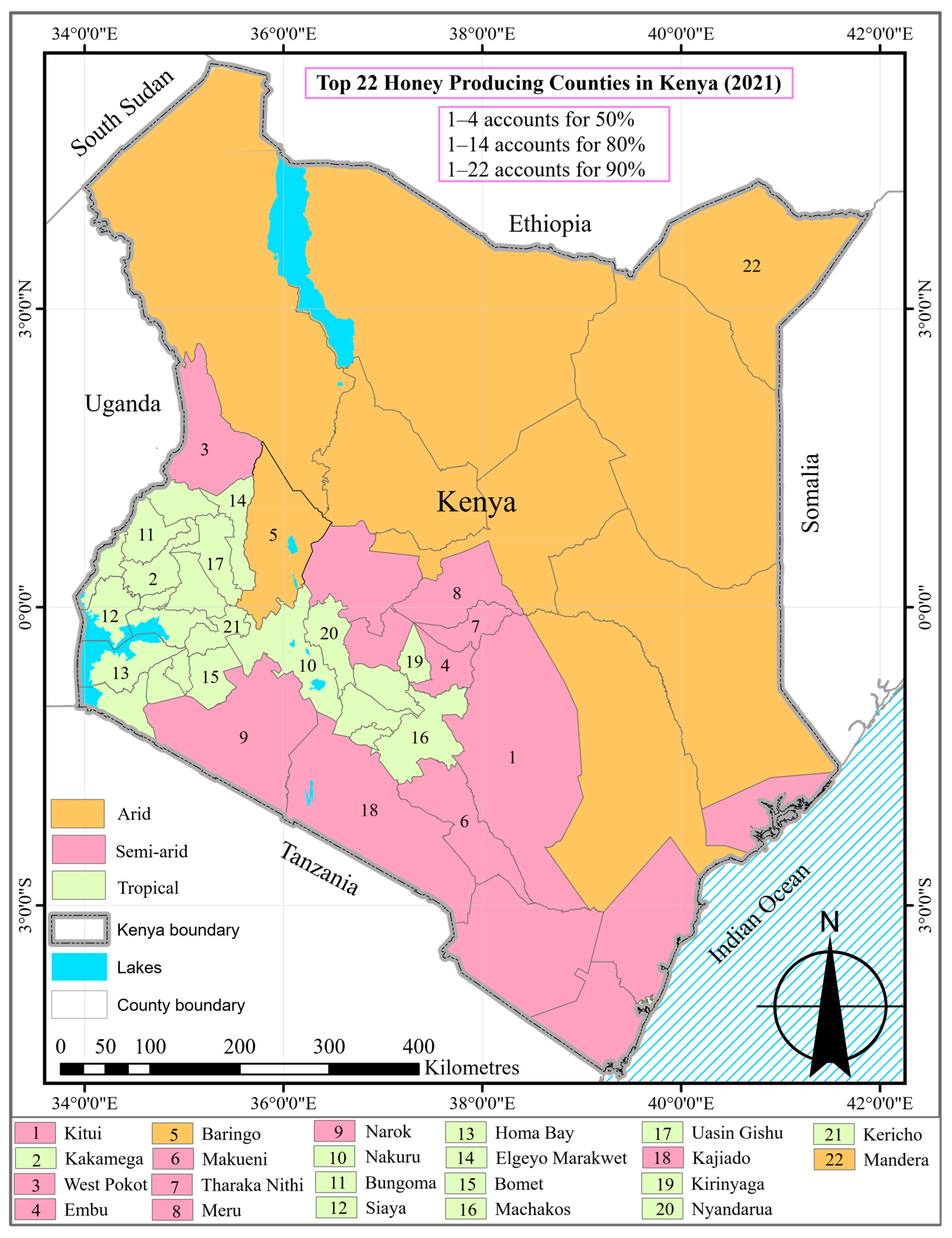
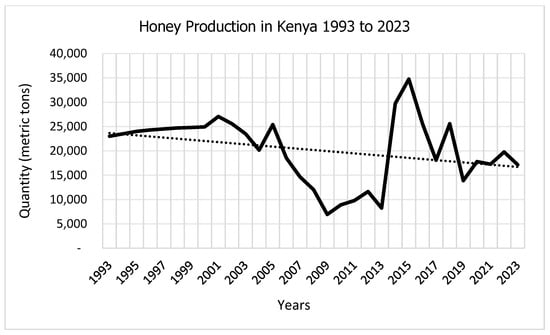
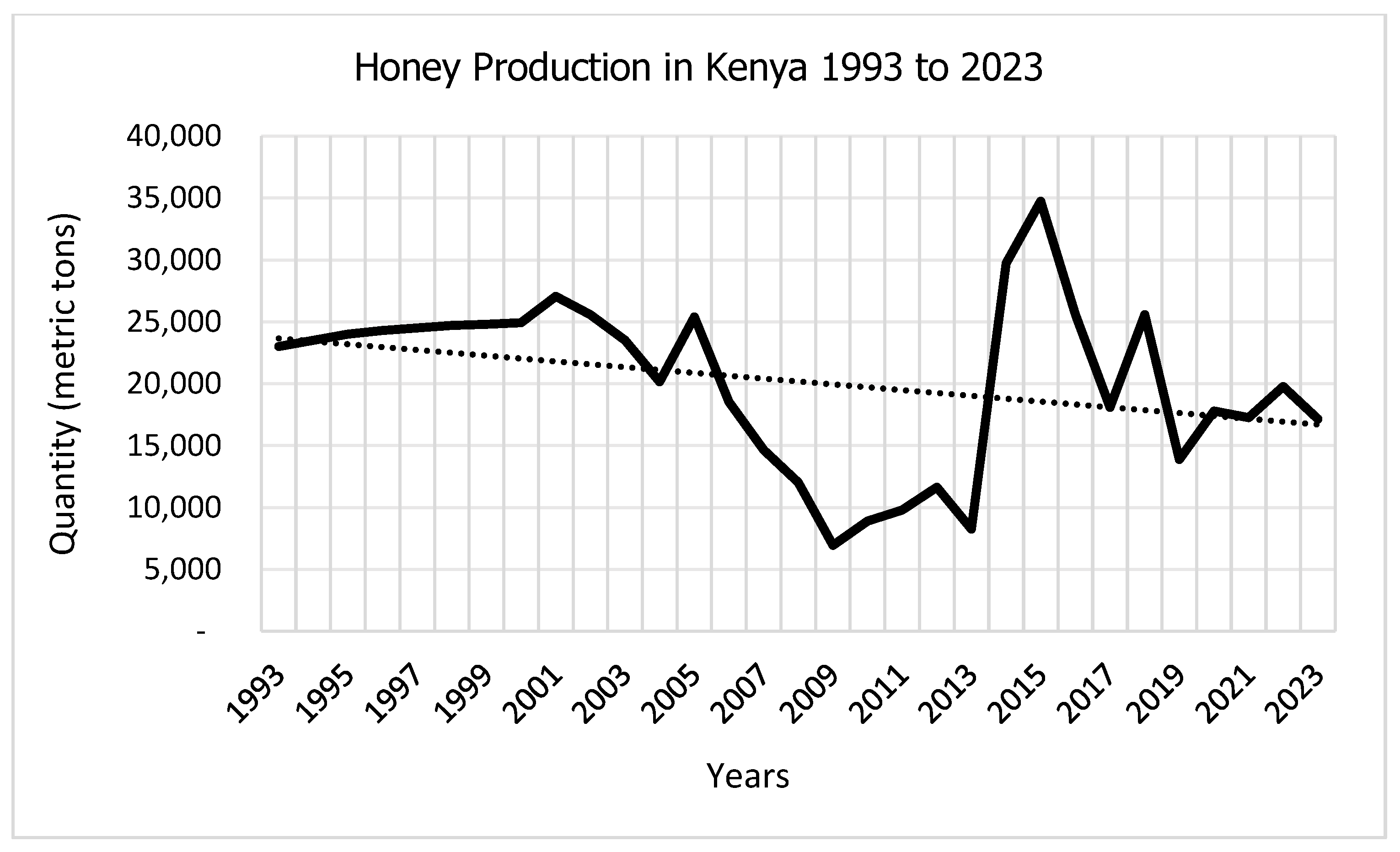
Four counties led honey production in 2021, accounting for 50.96% (8,799,051 kg) of the total 17,265,068 kg produced nationwide, specifically, Kitui (4,508,023 kg), Kakamega (1,557,668 kg), West Pokot (1,402,320 kg), and Embu (1,331,040 kg) [32]. Figure A1 shows a map of the top 22 honey-producing counties in Kenya. Over the past 30 years, annual honey production in Kenya has fluctuated significantly with a general decreasing trend, as shown in Figure 1. The last decade experienced a notable drop in the yearly honey output, nearly halving from 34,759 MT in 2015 to 17,151 MT in 2023 [33].
Figure 1.
Honey production in Kenya in 1993–2023. Source: [33]. Black line; graph line, Dashed line; trend line.
3.3. Honey Varieties
Honey legislation in Kenya categorizes honey largely based on (i) the bee species producing the honey (honeybee or stingless bee), (ii) the intended use of the honey (direct human use or industrial use), and (iii) the presence of other additional flavoring agents.
3.3.1. Honeybee (Apis mellifera) Honey
The KS EAS 36:2020 standard outlines the requirements, sampling, and test procedures for A. mellifera honey intended for direct human consumption within the East African Community (EAC) jurisdiction. A. mellifera honey varieties have been further grouped into three categories, namely, by origin (blossom, honeydew, monofloral, or plant juices), processing method (extracted, pressed, or drained), and form of presentation (liquid, comb, chunk, crystallized, or creamed), as shown in Table 2.
Table 2.
Categorization of Apis honey by the Kenya Standard Honey–Specification (KS EAS 36:2020).
3.3.2. Flavored Honey
Flavored honey is defined as honey combined with flavoring agents. While KS EAS 1147: 2024 does not outline the specific flavoring agents fit for use, it stipulates that the purpose of the flavoring agent is to add flavor but not alter the honey in any other way, and, therefore, sugar, salt, and vinegar do not constitute flavoring agents in this product [29]. Examples of such products surveyed in the Kenyan market include cinnamon, mint, and lemon and ginger flavors.
3.3.3. Monofloral Honeys in Kenya
The classification of honeys by botanical origin has been enabled by advancements in the analysis of types of pollen grains present in honey (mellisopalynology) that identify, count, and determine the frequencies of pollen grains in a honey sample [34]. This review notes that the Kenyan Standard KS EAS 36:2020 solely describes monofloral honey as “honey derived from the nectar of one predominant plant species” without providing distinctive specifications and local examples. The standard also lacks a reference for sampling and test procedures for the analysis of botanical origin. Globally, the types of pollen grains in honey can be either predominant, secondary, important minor, or minor. Predominant pollen grains are defined as those that originate from a single plant species and constitute more than 45% of the total pollen grains. Secondary, important minor and minor pollen contain between 16 to 45%, 3 to 15%, and less than 3% of a single plant species, respectively. Therefore, honey can be classified as either monofloral (containing a predominant pollen grain representing more than 45% of the total pollen grains), bifloral (containing pollen grains from two plant species at a frequency of 16 to 45% per species), or multifloral (containing pollen grains from multiple plant sources, each with a frequency of less than 15% per species) [16,34].
Mellisopalynological studies identified within the observation period were few and generally focused on identifying pollen grain spectra and botanical origin [2,16,35], while palynological studies focused on pollination services [36] and pollen grain diversity across landscapes [37,38]. A study that assessed the origin attributes of Kenyan honey for geographical indication labeling [39] reported that Acacia spp. had been the most dominant pollen grain type identified across the Acacia woodlands of West Pokot, Baringo, and Kitui counties, and, therefore, such honey can be labeled Acacia. Multifloral honeys with diverse pollen grain types were also identified, as shown in Table 3. The total number of pollen grain types identified in honey sampled across the Acacia woodland landscape study was 29 in comparison with 75 reported in the Eastern Mau forest honey samples [35]. In the latter study, known for the production of Ogiek honey, monofloral honeys of Acacia spp., Eucalyptus spp., Croton spp., Albizia spp., and Cordia spp., as well as combinations of bifloral origins, such as Vernonia uriculifera and Croton spp., V. uriculifera and Acacia spp., V. uriculifera and Mangifera indica, Cordia abyssinica and Albizia coriaria, Acacia spp. and Eucalyptus spp., Acacia spp. and Grevillea robusta, and Bothriocline fusca and Tithonia diversifolia, were characterized. Multifloral honey from the Eastern Mau forest had a greater diversity of pollen grain types, with some samples having up to 10 pollen grains being identified, implying a rich forest vegetation diversity, in comparison with the Acacia woodlands. Another mellisopalynological study of honey from the Marsabit Forest reserve [40] reported the Euphorbiaceae family to be the highest represented family, with pollen grains from eight genera being identified. The richness in pollen grain diversity in Marsabit Forest honey was quite notable, with the study having identified 108 pollen grain types, implying a high species diversity of represented plants in this forested landscape. Some honey samples had as many as 42 pollen grain types identified.
Table 3.
Predominant and secondary pollen frequency classes in honey samples across Kenya.
3.4. Honey Processing and Value Addition
Nationally, honey processing remains largely small-scale, constrained by limited access to modern equipment and credit [16]. In view of this, various county governments have made plans to establish honey aggregation centers and processing plants across their administrative wards to enhance processing and commercialization [41,42,43,44,45]. Beekeepers in Kitui County, for instance, described honey processing as a resource-intensive activity that requires modern processing technology, particularly honey extractors that are expensive [5]. Their inability to access credit, low knowledge level of processing technology, and the presence of many middlemen are some of the factors that have contributed to low processing performance.
This review identified a link between types of beehives and honey processing. A study in Homa Bay showed that beekeepers with predominantly modern beehives, such as Langstroth, harvested honey using centrifugal extraction [46], while those with predominantly traditional log hives manually mashed combs [47,48]. Traditional extraction methods, such as mashing and squeezing (pressing), are reported to contribute to low production volumes and honey quality [49]. Several authors reported the use of temperature-unregulated water baths to heat up honey, which results in the destruction and lowering of heat-sensitive quality parameters due to overheating [46,47,50]. According to KS EAS 36:2020, honey must not be heated to an extent that compromises its fundamental composition or quality. However, the specification does not provide specific temperature guidelines for heating, especially for granulated honey. This provision is vague and may lead to different interpretations, inadequate quality control, and poor handling and processing practices. During the 10-year review study period, data about honey packaging or bottling were limited.
3.5. Honey Branding and Labeling
A study on Nyandarua honey consumers’ preference and willingness to pay for quality attributes found that the majority of consumers purchased honey informally, either directly from the beekeepers (53.38%), hawkers (20.54%), kiosks (7.55%), or on roadsides and open markets (3.49%). Only 14.34% of consumers purchased honey from formal retail markets, predominantly supermarkets [12]. Another study observed that in Taita Taveta County, honey was bottled in recycled plastic or glass containers and sold unbranded [48].
While it is a prerequisite for honey and other products sold in the formal retail market in Kenya to undergo a mandatory conformity assessment (purposely to assure product quality, generate product labels with certification marks, access markets, and raise quality awareness), honey consumers still have quality concerns with formally retailed honey, particularly over adulteration, poor packaging and labeling, and contamination with pesticide residues [12,40]. As stipulated by KS EAS 36:2020, honey labeling should inform of the type of honey by informing of the origin, method of processing, and/or form of presentation [28]. This review noted insufficient studies addressing honey branding and labeling and sought to generate new data. An online survey was carried out to identify the nature of labeling information on the front-of-pack (FoP) label of honey products retailed in Kenyan supermarkets. A total of 34 honey products had been marketed online across the top four largest supermarket chains in Kenya. The results of all the 34 honey products evaluated are shown in Table 4. Out of the 34 honey products marketed online, 24 were local, while 10 were imports from India (n = 3), Egypt (n = 2), the USA (n = 2), Australia (n = 2), and China (n = 1). Descriptive information contained in the FoP label included the brand name and description of the honey product. None of the surveyed local honey brands informed the consumer of the type of honey offered for sale by either mentioning its botanical origin, its method of processing, or its form of presentation, as is provided by the honey standard, yet they possessed the KEBS standardization mark. Across the three flavored honeys identified in the survey (cinnamon, mint, and lemon and ginger), the name “flavored honey” was omitted in all products, contravening the labeling requirements of the flavored honey specification (KS EAS 1147:2024). Furthermore, three honey samples sold in one supermarket did not bear the KEBS standardization mark. Only 40% of imported honey brands had declared their botanical origin and honey processing method.
Table 4.
Product descriptions on front-of-pack (FoP) labels of 20 online retail honey brands in Kenya.
3.6. Honey Trade
Honey trade predominantly follows domestic value chains. According to the FAO food balance sheet [51], the per capita honey consumption in Kenya was 0.3 kg per person annually, and was ranked sixth in the continent, together with Tunisia, Libya and Mauritius, behind Tanzania and Rwanda (0.5), Angola (0.6), and Seychelles (0.7), with the Central African Republic having the highest per capita honey consumption in the world at 2.8 kg per person per year. Though Kenya trades honey in the international market, the trading quantities are minor, with dominant traders being within the East African community [52]. In comparison with the annual production of 17,265 MT in 2021 [32], only 0.46% (79.1 MT) was exported, with Somalia, an EAC partner being the largest trader, having imported 71.38 MT (96.71%) of honey. Other minor export destinations included Uganda, Rwanda, Zambia, and the United States [52]. The past 10 years (2013–2023) have seen Kenya’s honey continuously keep a largely negative trade balance, with the 10-year import volumes (2116 MT) being 4.5 times larger than the exports (460.8 MT), as shown in Table 5. Kenya was delisted from exporting honey to the EU in 2006 due to non-submission of a Residue Monitoring Plan that reveals the level of compliance with maximum residue limits for production inputs such as pesticides, as well as heavy metals [40].
Table 5.
Annual honey production, imports, and exports from 2013 to 2023.
Similarly, the percentage of export share from production has never exceeded 1%. The domestic demand for honey is high, prompting many county governments to support, promote, and regulate beekeeping and honey production for socio-economic growth and industrialization. As outlined in their mid-term development plans, commitments have been made to improve beekeepers’ access to finance, establish cooperatives, supply improved bees [54], purchase modern beehives and honey-processing equipment, and build honey-processing plants and aggregation centers [41,44,55]. Makueni County has taken a conservation approach by promoting and supporting beekeeping along water towers, riverine areas, and forests to both reduce poverty and prevent deforestation and ecosystem degradation [56]. In Tharaka Nithi County, attention has begun to focus on using biopesticides [45], while in Embu, efforts have increased to train beekeepers on extracting and processing other hive products, especially bee venom and royal jelly [42]. Since honey production is accessible to underserved groups and requires only a small land area, both government and non-governmental organizations have encouraged the activity to promote market participation and income generation for the poor, women, and landless people [57]. As a result, these programs have led to widespread smallholder honey production, strengthening a competitive domestic value chain.
4. Discussion
This review emphasizes that while traditional Acacia species are common across various agro-ecological zones of Kenya, several Acacia variants produce large amounts of sap, such as Senegalia senegal (formerly Acacia senegalia) and Vachellia seyal (formerly Acacia seyal) [58]. Additionally, some species in the Euphorbiaceae family produce sap, and, therefore, honey from these botanical sources could be honeydew when produced during non-flowering seasons. This review noted that the honey criteria established in the Kenyan honey standard (KS EAS 36:2020) cannot distinguish between blossom and honeydew honey, as the specific composition guidelines fail to detect differences between the two. Honeydew honey, derived from secretions of living plant parts like sap, is recognized globally for its medicinal potential, and marketing health claims for it can command premium prices, especially in European and Asian markets [59]. Unlike the Kenyan standard, the Codex standard removed the use of ‘reducing sugar’ as a composition criterion and adopted ‘sum of fructose and glucose,’ which can differentiate the two types of honey. The minimum limit for the combined fructose and glucose content in honeydew honey is set at no less than 45%, while for blossom honey, it is at least 60%. This difference is because blossom honeys mainly contain more reducing sugars (fructose and glucose), whereas honeydew honeys have a higher content of non-reducing sugars like melezitose, maltotriose, and raffinose, which are not included in the sum of fructose and glucose. The sugar melezitose is considered a characteristic chemical marker for honeydew honey and chestnut honey [60]. Furthermore, the Codex standard goes further by setting limits on electrical conductivity, a parameter not determined by the local standard. Therefore, it appears that the local standard is relatively simple and may have limited usefulness for product labeling that requires honey to be sold under specific names indicating its origin. This lack of differentiation could reduce awareness among bee industry stakeholders, restrict access to niche markets, and hinder fair trade in Kenya and globally.
The significant decline in annual honey production over the past decade by nearly 50% has been caused by several factors, including climate change, loss of bee habitats, bacterial diseases, pests, and pesticide use [3,61,62,63]. An example of the impact of climate change is highlighted in a national survey of beekeepers (n = 589), which reported an average bee population decline of 36.6% between 2021 and 2022, with a greater decrease during the hot and dry season (31.9%) than in the cold and wet season (20.2%) [61]. Bee habitat loss has been documented in multiple studies, noting extensive deforestation of Acacia woodlands for charcoal burning in major honey-producing counties like Baringo [62], Makueni [63], and Kitui [3,36]. According to a market research study [40], in 2009, the Kenyan government prioritized six major bee pests and diseases: varroa mites, tropilaelaps mites, acarine mites, the small hive beetle (Aethina tumida), American Foulbrood, and European Foulbrood bacterial diseases. This was after Kenya was delisted from exporting all hive products to the European Union in 2006 due to poor management of these pests and diseases, the absence of a residue-monitoring plan—especially for pesticides—and a lack of technical and infrastructural capacity to analyze honey in line with updated EU standards. This ban remains in effect, limiting Kenya’s participation in the lucrative EU honey market. In addition to these factors, the use of traditional hives and extraction methods like mashing completely destroys the combs, reducing hive productivity. In centrifugal extraction, unlike mashing, the combs stay relatively intact after extraction and can be returned to the hive for more effective swarming, thereby optimizing honey production [49,64].
This study noted distinct variations of honey varieties across the different geographical honey-producing areas. The Eastern Mau region [35] was associated with distinct monofloral honeys of Acacia spp., Eucalyptus spp., Croton spp., Albizia spp., and bifloral and multifloral honeys of these species. In Eastern Kenya, and particularly the Mwingi North sub-county of Kitui [36], Acacia spp. was the dominant monofloral honey, while Mwingi Central [16] had Euphorbiaceae as the key secondary pollen grain, yielding bifloral honeys of either Euphorbiaceae and Acacia spp., or Euphorbiaceae and Combretaceae combinations. Honey from Pokot Central sub-county of West Pokot [16] was predominantly monofloral of Acacia spp. origin, while bifloral honeys were dominant in the Baringo South sub-county of Baringo [16], with secondary pollen grain combinations of Acacia spp. and the Combretaceae family, Acacia spp. and the Acanthaceae family, and the Combretaceae and Capparaceae families. With eight genera, the Euphorbiaceae had the highest pollen grain frequency in the honey samples from the Marsabit Forest Reserve [2]. These were followed by Asteraceae and Labiatae, with seven genera, Acanthaceae and Leguminosae, with six genera each, and the Rubiaceae, Capparaceae, Cucurbitaceae, and Malvaceae families, with four genera. In the majority of the samples, Leucas spp. accounted for 23.5% of the total, followed by Leonotis spp. (20.1%), Croton spp. (7.8%), Eucalyptus spp. (6.9%), and Rhus spp. (5.3%), indicating the predominance of multifloral honey in the Marsabit forest reserve.
The physicochemical characteristics of sisal honey and mangrove honey have been described in the sisal estates in Taita Taveta County and along the mangrove forests bordering the Indian Ocean in Kilifi County, respectively [48,65]. Although these two studies did not conduct mellisopalynological analysis, they inferred the honey’s botanical origin based on the dominant botanical species or genus in the landscape. This review revealed that the mere abundance of a botanical species in a particular area does not necessarily guarantee the botanical origin and identity of the honey. A study analyzing pollen grain types in a landscape predominantly growing pumpkin (Cucurbita maxima Duchesne ex Lam) in Machakos County failed to identify pumpkin pollen grains after setting up a pollen trap at the hive entrance for 48 h [38]. The authors explained that because the pumpkin pollen grain is too large, greasy, and spiky to fit easily into the worker bee’s pollen basket (corbicula) located on the hind tibia, honeybees did not bring back its pollen to the hive, even though it was always present on the farms throughout the year. This demonstrates that branding honey based on its botanical origin necessitates melissopalynological investigation rather than just linking it to the predominant botanical species in the landscape.
Honey processing has been described as the activities that take place between harvesting (emptying of decapped combs) and bottling of honey [5]. This review identified a lack of legislative definition of the term honey processing, as outlined in the KS EAS 36:2020 and the Livestock (Bee Industry) Regulations, which can cause confusion among stakeholders regarding its interpretation and practice. While the standard describes honey processing as the method of extracting or emptying honey from broodless decapped combs through draining, centrifugation, or pressing, with or without moderate heat, the regulation only defines a “processor” as someone who adds value to a bee product. Conversely, the act of emptying honey from combs has been referred to as harvesting by several authors, not processing [5,49,64]. This review proposes a more comprehensive definition that includes procedures relevant to processors, such as pre-heating to reduce viscosity, pasteurization, straining, filtering, and packaging, factors affecting the product’s quality before retail. Additionally, the categorization of honey types by form of presentation should be clearly defined to enable product diversification by processors and a clear distinction by consumers. For example, the Livestock (Bee Industry) Act of 2023 categorizes honey by processing into crude/unprocessed, refined, and semi-refined, but lacks legislative definitions for these categories. Unlike the honey standard KS EAS 36:2020, the Act also fails to distinguish between creamed and ungranulated honey, which implies the terms might be used interchangeably.
Honey branding and labeling trends on the front-of-pack label predominantly focused on the naturalness and purity of the product, while some mentioned regions of production (e.g., Kenya, Africa) and landscape (wild bush). The current honey labeling practices underline noncompliance, which is a critical challenge to consumer education, product quality identity, and development of the beekeeping industry.
5. Conclusions
This review noted that the honey statutory documents are not in harmony in language, provisions, and guidelines, and the testing criteria employed are inconclusive, making the comparison of honey varieties challenging. Therefore, this review recommends a revision of the statutory documents to harmonize the legislative definitions, to add relevant criteria that will enable a clear distinction between honey varieties, and to update honey testing requirements and methods to be in tandem with global standards.
Honey production in Kenya is greatly affected by the changing climate, declining bee forage, pests and diseases, and use of pesticides. To be regionally and globally competitive, the Kenya beekeeping industry ought to prioritize modern beekeeping practices and equipment, become sensitized on active hive management, and prioritize bee health, conservation, and management of botanical biodiversity, prudent use of crop pesticides, and promotion of biopesticides.
Despite national honey standards being affected, the implementation is not enforced. Mellisopalynological analyses identified and categorized honey into several monofloral and bifloral origins, with distinct variations across geographical areas. However, front-of-pack labeling of honey products is inadequate in relying on descriptive information, particularly of honey origin, processing, and form of presentation. This review identified potential niche market opportunities for Kenyan honey. This study recommends honey value chain stakeholder sensitization on honey varieties of known botanical origins, product testing for origin and traceability, and promotional labeling and marketing.
Author Contributions
Conceptualization, V.A.K. and H.C.; methodology, V.A.K.; validation, V.A.K., H.C. and S.W.; formal analysis, V.A.K.; investigation, V.A.K.; resources, S.W. and H.C.; data curation, V.A.K.; writing—original draft preparation, V.A.K.; writing—review and editing, V.A.K., H.C. and S.W.; visualization, V.A.K.; supervision, S.W. and H.C.; project administration, S.W.; funding acquisition, S.W. All authors have read and agreed to the published version of the manuscript.
Funding
This research was supported by the Cooperative Research Program for Agriculture Science and Technology Development (project no. RS-2023-00228817), the Rural Development Administration (RDA), the Republic of Korea.
Data Availability Statement
The original contributions presented in this study are included in the article. Further inquiries can be directed to the corresponding author.
Acknowledgments
This work was carried out with the support of the Cooperative Research Program for Agriculture Science and Technology Development (project no. RS-2023-00228817) and The 2025 On-the-Job Training for Young Scientists Program, between the Korea–Africa Food and Agriculture Cooperation Initiative (KAFACI) and the Kenya Agricultural and Livestock Research Organization (KALRO), facilitated by the Rural Development Administration (RDA), the Republic of Korea. A special mention to Kim Hyo Young for inducting the author into the National Institute of Agricultural Science apiary, and to Robert Toroitich for generating the study map using QGIS Open-Source Software, version 2.14x. The authors have reviewed and edited the output and take full responsibility for the content of this publication.
Conflicts of Interest
The authors declare no conflicts of interest.
Abbreviations
The following abbreviations were used in this manuscript:
| ASALs | Arid and Semi-Arid Lands |
| EU | European Union |
| EAC | East African Community |
| FoP | Front-of-Pack |
| PRISMA | Preferred Reporting Items for Systematic Reviews and Meta-Analyses |
| CIDP | County Integrated Development Plan |
| FAO | Food and Agriculture Organization of the United Nations |
| KS EAS | Kenya Standard Published from the East African Standard |
| CODEX | Codex Alimentarius International Food Standard |
| KNBS | Kenya National Bureau of Statistics |
| MT | Metric Tons |
Appendix A
Table A1.
List of articles included from Google Search.
Figure A1.
Map of top 22 honey-producing counties in Kenya. Created by authors using data from [32].
References
- Mokaya, H.O.; Bargul, J.L.; Irungu, J.W.; Lattorff, H.M.G. Bioactive constituents, in vitro radical scavenging and antibacterial activities of selected Apis mellifera honey from Kenya. Int. J. Food Sci. Technol. 2020, 55, 1246–1254. [Google Scholar] [CrossRef] [Scilit]
- Muhati, G.L.; Warui, M.W. Physicochemical Properties and Floral Sources of Honey Produced in Marsabit Forest Reserve, Northern Kenya. J. Food Qual. 2022, 1, 384184. [Google Scholar] [CrossRef] [Scilit]
- Wambua, B.M. Assessment of Performance Indices of Frame Hive Beekeeping and the Traditional Technology in Kenya: A Case Study of Kitui County. Master’s Thesis, South Eastern Kenya University, Kwa Vonza, Kenya, 2015. Available online: https://repository.seku.ac.ke/handle/123456789/2584 (accessed on 22 May 2025).
- Kiiti, M.K. Socio-Economic, Cultural and Institutional Factors Influencing Modern Box Hives Adoption in Kitui County, Kenya. Master’s Thesis, Kenyatta University, Nairobi, Kenya, 2019. Available online: https://ir-library.ku.ac.ke/server/api/core/bitstreams/fc5ed71d-3978-4b9c-9173-a337507ac697/content (accessed on 22 May 2025).
- Ngomo, L.K. Determinants of Production and Performance of Honey Processing Projects: The Case of Kitui County. Master’s Thesis, University of Nairobi, Nairobi, Kenya, 2021. Available online: http://erepository.uonbi.ac.ke/handle/11295/160350 (accessed on 22 May 2025).
- Thrasyvoulou, A. Legislation of honey criteria and standards. J. Apic. Res. 2018, 57, 88–96. [Google Scholar] [CrossRef] [Scilit]
- CXS 12-1981; Codex Alimentarius Standard for Honey. FAO: Rome, Italy; WHO: Geneva, Switzerland, 2022. Available online: https://www.fao.org/fao-who-codexalimentarius/codex-texts/list-standards/en/ (accessed on 22 May 2025).
- Government of Kenya. Livestock (Bee Industry) Regulations; Government of Kenya: Nairobi, Kenya, 2023; Available online: https://kilimo.go.ke/ministry-policies/ (accessed on 22 May 2025).
- Héger, M.; Noiset, P.; Nkoba, K.; Vereecken, N.J. Traditional ecological knowledge and non-food uses of stingless bee honey in Kenya’s last pocket of tropical rainforest. J. Ethnobiol. Ethnomed. 2023, 19, 42. [Google Scholar] [CrossRef] [Scilit]
- Warui, M.W.; Mburu, J.; Kironchi, G.; Gikungu, M. Existing value addition initiatives enhancing recognition of territorial traits of three Kenyan honey. J. World Intellect. Prop. 2020, 23, 598–605. [Google Scholar] [CrossRef] [Scilit]
- Ingram, V.; Hansen, M.E.; Bosselmann, A.S. To Label or Not? Governing the Costs and Benefits of Geographic Indication of an African Forest Honey Value Chain. Front. For. Glob. Change 2020, 3, 102. [Google Scholar] [CrossRef] [Scilit]
- Maina, M.W. Consumers’ Perceptions and Willingness to Pay for Honey Quality Attributes in Nyandarua County, Kenya. Master’s Thesis, University of Nairobi, Nairobi, Kenya, 2023. Available online: https://erepository.uonbi.ac.ke/handle/11295/164516 (accessed on 23 May 2025).
- Kiptoo, E.; Machio, P. Drivers of Honey Production and Commercialization in Kenya’s Arid and Semi-Arid Lands; The Kenya Institute for Public Policy Research and Analysis (KIPPRA): Nairobi, Kenya, 2023; Available online: https://repository.kippra.or.ke/handle/123456789/4625 (accessed on 23 May 2025).
- Musinguzi, P.; Bosselmann, A.S.; Pouliot, M. Livelihoods-conservation initiatives: Evidence of socio-economic impacts from organic honey production in Mwingi, Eastern Kenya. For. Policy Econ. 2018, 97, 132–145. [Google Scholar] [CrossRef] [Scilit]
- Nabwire, E.J.C. Economic Analysis of Consumers’ Awareness and Willingness to pay for Geographical Indicators and Other Quality Attributes of Honey in Kenya. Master’s Thesis, University of Nairobi, Nairobi, Kenya, 2016. Available online: https://ageconsearch.umn.edu/record/265574/?v=pdf (accessed on 2 April 2025).
- Warui, M.W.; Hansted, L.; Gikungu, M.; Mburu, J.; Kironchi, G.; Bosselmann, A.S. Characterization of Kenyan Honeys Based on Their Physicochemical Properties, Botanical and Geographical Origin. Int. J. Food Sci. 2019, 2019, 2932509. [Google Scholar] [CrossRef] [Scilit]
- Kyalangalilwa, B.; Boatwright, J.S.; Daru, B.H.; Maurin, O.; van der Bank, M. Phylogenetic position and revised classification of Acacia s.l. (Fabaceae: Mimosoideae) in Africa, including new combinations in Vachellia and Senegalia. Bot. J. Linn. Soc. 2013, 172, 500–523. [Google Scholar] [CrossRef] [Scilit]
- Vîjan, L.E.; Mazilu, I.C.; Enache, C.; Enache, S.; Topală, C.M. Botanical Origin Influence on Some Honey Physicochemical Characteristics and Antioxidant Properties. Foods 2024, 18, 3923–3934. [Google Scholar] [CrossRef] [Scilit]
- Gismondi, A. From Robinia pseudo Acacia L. nectar to Acacia monofloral honey: Biochemical changes and variation of biological properties. J. Sci. Food Agric. 2018, 98, 4312–4322. [Google Scholar] [CrossRef] [Scilit]
- Moher, D.; Liberati, A.; Tetzlaff, J.; Altman, D.G. Preferred reporting items for systematic reviews and meta-analyses: The PRISMA statement. PloS Med. 2009, 6, e1000097. [Google Scholar] [CrossRef] [Scilit]
- Nakile, J.; Kibuine, D.M.; Kimemia, M.D. Influence of Supplier Relationship Management on Performance of Large Supermarkets in Nairobi Metropolitan, Kenya. J. Procure. Supply Chain. 2025, 5, 17–29. [Google Scholar] [CrossRef] [Scilit]
- Naivas Supermarket. Our Business. 2025. Available online: https://naivas.info/our-business/ (accessed on 30 October 2025).
- The Kenya Times. List of QuickMart Supermarket Branches in Kenya. 2025. Available online: https://thekenyatimes.com/business/list-of-quickmart-supermarket-branches-in-kenya/ (accessed on 30 October 2025).
- Chandarana Supermarket. Our Branches. 2025. Available online: https://www.foodplus.co.ke/our-branches/ (accessed on 30 October 2025).
- African Marketing Confederation News. Carrefour Continues Kenyan Expansion with Opening of 28th Outlet. 2025. Available online: https://africanmarketingconfederation.org/carrefour-continues-kenyan-expansion-with-opening-of-28th-outlet/ (accessed on 30 October 2025).
- Government of Kenya. The Beekeeping Act. FAOLEX Database. 2002. Available online: https://faolex.fao.org/docs/pdf/tan34430.pdf (accessed on 23 May 2025).
- Government of Kenya. Food, Drugs and Chemical Substances Act Chapter 254. 2012. Available online: https://faolex.fao.org/docs/pdf/ken106440.pdf (accessed on 23 May 2025).
- KS EAS 36:2020; Kenya Standard Honey Specification. Kenya Bureau of Standards: Nairobi, Kenya, 2021.
- KS EAS 1149:2024; Kenya Standard Industrial Honey Specification. Kenya Bureau of Standards: Nairobi, Kenya, 2024.
- KS EAS 1147:2024; Kenya Standard Flavoured Honey Specification. Kenya Bureau of Standards: Nairobi, Kenya, 2024.
- DEAS 991:2019; Draft East African Standard Stingless Bee Honey—Specification. East African Community: Arusha, Tanzania, 2019.
- KNBS. National Agriculture Production Report; Kenya National Bureau of Statistic: Nairobi, Kenya, 2024; Available online: https://www.knbs.or.ke/reports/national-agriculture-production-report-2024/ (accessed on 12 April 2025).
- FAOSTAT. Natural Honey Production in Kenya: 1993 to 2023; Food and Agriculture Organization of the United Nations (FAO): Rome, Italy, 2025; Available online: https://www.fao.org/faostat/en/#data/QCL (accessed on 12 April 2025).
- Louveaux, J.; Maurizio, A.; Vorwohl, G. Methods of Melissopalynology. Bee World 1978, 59, 139–157. [Google Scholar] [CrossRef] [Scilit]
- Onyango, P. Melissopalynological determination of the Pollen density, Botanical origin and Ogiek Honey types in Eastern Mau Forest, Kenya. Int. J. Adv. Sci. Res. Eng. 2019, 5, 156–165. [Google Scholar] [CrossRef] [Scilit]
- Warui, M.W.; Gikungu, M.; Bosselmann, A.S.; Hansted, L. Pollination of Acacia woodlands and honey production by honey bees in Kitui, Kenya. Futur. Food J. Food Agric. Soc. 2018, 6, 11. Available online: https://kobra.uni-kassel.de/items/34b01634-b8df-4990-b25a-a0dc833acfa3 (accessed on 15 April 2025).
- Ochungo, P. Pollen diversity and protein content in differentially degraded semi-arid landscapes in Kenya. J. Apic. Res. 2021, 60, 828–841. [Google Scholar] [CrossRef] [Scilit]
- Nang’oni, M.W. Annual diversity of honeybee pollen sources in two pumpkin growing landscapes, Machakos County, Kenya. J. Pollinat. Ecol. 2025, 38, 97–109. [Google Scholar] [CrossRef] [Scilit]
- Warui, M.W. Analysis of Quality and Origin Attributes of Kenyan Honey for Geographical Indication Labelling in West Pokot, Baringo and Kitui Counties. Ph.D. Thesis, University of Nairobi, Nairobi, Kenya, 2018. Available online: https://erepository.uonbi.ac.ke/handle/11295/104615 (accessed on 14 May 2025).
- Kamau, S.K.; Onyango, I.A. Progress and Challenges Towards Listing of Kenya in European Union Market for Export of Honey and Hive Products. In Bulletin of Animal Health and Production in Africa: Special Edition—Honey Production, Bee Health and Pollination Services; African Union Inter-African Bureau for Animal Resources: Nairobi, Kenya, 2016; pp. 271–273. Available online: http://105.27.231.85/xmlui/handle/123456789/538 (accessed on 14 May 2025).
- Baringo County Government. Baringo County Integrated Development Plan (2023–2027); Baringo County Government: Kabarnet Town, Kenya, 2023; Available online: www.baringo.go.ke (accessed on 22 April 2025).
- Embu County Government. Embu County Integrated Development Plan 2023–2027; Embu County Government: Embu, Kenya, 2023; Available online: https://embuassembly.go.ke/mdocs-posts/report-on-embu-integrated-development-plan-2023-2027/ (accessed on 22 April 2025).
- Homa Bay County Government. County Integrated Development Plan 2023–2027; Homa Bay County Government: Homa Bay Town, Kenya, 2023; Available online: https://www.homabay.go.ke/ (accessed on 22 April 2025).
- Taita Taveta County Government. County Integrated Development Plan III 2023–2027; Taita Taveta County Government: Mwatate, Kenya, 2023; Available online: https://taitatavetaassembly.go.ke/ (accessed on 22 April 2025).
- Tharaka Nithi County Government. County Government of Tharaka Nithi Third County Integrated Develoment Plan 2023–2027; Tharaka Nithi County Government: Kathwana, Kenya, 2023; Available online: www.tharakanithi.go.ke (accessed on 22 April 2025).
- Odongo, L.K. Determination of the Physicochemical Properties of Honey from Suba Region, Homa Bay County, Kenya. Master’s Thesis, Kenyatta University, Nairobi, Kenya, 2023. Available online: https://ir-library.ku.ac.ke/items/8b419f19-0586-400f-9c32-634671a52236 (accessed on 21 September 2025).
- Chepkemoi, M.; Kollongei, J.; Some, D. Characterization of Honey from Marigat in Baringo County, Kenya, based on their Physical Properties. Afr. Environ. Rev. J. 2021, 4, 227–233. [Google Scholar]
- Otieno, L.A. Determination of Physicochemical Properties of Sisal Honey from Taita Taveta County, Kenya. Master’s Thesis, Kenyatta University, Nairobi, Kenya, 2021. Available online: https://ir-library.ku.ac.ke/items/31145a57-8fd1-433c-afd3-28f06ee9fd8c (accessed on 2 June 2025).
- Njuguna, M.; Keraita, J.; Ongarora, B. Geothermal Energy System for Honey Extraction Process. IOSR J. Mech. Civ. Eng. 2020, 17, 8. Available online: https://www.iosrjournals.org/iosr-jmce/papers/vol17-issue6/Series-3/A1706030108.pdf (accessed on 2 June 2025).
- Rotich, E.J. Physicochemical Characterization of Honey from Selected Counties in Kenya. Master’s Thesis, University of Nairobi, Nairobi, Kenya, 2019. Available online: https://erepository.uonbi.ac.ke/handle/11295/109666 (accessed on 2 June 2025).
- FAOSTAT. World Per Capita Honey Consumption—2022. Available online: https://www.fao.org/faostat/en/#data/FBS (accessed on 22 April 2025).
- WITS. Kenya Natural Honey Exports by Country in 2023. Available online: https://wits.worldbank.org/trade/comtrade/en/country/KEN/year/2023/tradeflow/Exports/partner/ALL/product/040900 (accessed on 2 May 2025).
- FAOSTAT. Kenya Import and Export Values and Quantities of Natural Honey; Food and Agriculture Organization of the United Nations: Rome, Italy, 2025; Available online: https://www.fao.org/faostat/en/#data/TCL (accessed on 2 June 2025).
- Kitui County Government. Kitui County Integrated Development Plan 2023–2027; Kitui County Government: Kitui Town, Kenya, 2023; Available online: www.kitui.go.ke (accessed on 14 April 2025).
- West Pokot County Government. West Pokot County Integrated Development Plan 2023–2027; West Pokot County Government: Kapenguria, Kenya, 2023; Available online: https://repository.kippra.or.ke/handle/123456789/4432 (accessed on 14 May 2025).
- Makueni County Government. Makueni County Integrated Development Plan 2023–2027; Makueni County Government: Wote, Kenya, 2023; Available online: https://makueni.go.ke/documents/makueni-county-integrated-development-plan-cidp-2023-2027/ (accessed on 15 May 2025).
- Berem, R.M. Economic Analysis of Honey Production and Marketing in Baringo County, Kenya: An Application of the Institutional Analysis and Development Framework. J. Nat. Sci. Res. 2015, 5, 9. [Google Scholar]
- Asgar, A. Gum Arabic from Africa’s Acacia Trees in the Sahel Is Used in Hundreds of Products: What’s Worth Knowing. The Conversation, 29 April 2024. Available online: https://theconversation.com/gum-arabic-from-africas-Acacia-trees-in-the-sahel-is-used-in-hundreds-of-products-whats-worth-knowing-225577 (accessed on 30 June 2025).
- Choi, S.H.; Nam, M.S. Classification of honeydew and blossom honeys by principal component analysis of physicochemical parameters. Korean J. Agric. Sci. 2020, 47, 67–81. [Google Scholar] [CrossRef] [Scilit]
- Pita-Calvo, C.; Vázquez, M. Differences between honeydew and blossom honeys: A review. Trends Food Sci. Technol. 2017, 59, 79–87. [Google Scholar] [CrossRef] [Scilit]
- Leyton, M.S.; Lattorff, H.M.G.; Kiatoko, N.; Requier, F. Climate effects on honey bees can be mitigated by beekeeping management in Kenya. J. Environ. Manag. 2025, 374, 123879. [Google Scholar] [CrossRef] [Scilit] [PubMed]
- Kipruto, C.C. Factors Influencing Honey Production in Marigat, Baringo County—Kenya. Master’s Thesis, Moi University, Kesses, Kenya, 2016. Available online: http://ir.mu.ac.ke:8080/xmlui/handle/123456789/1107 (accessed on 17 April 2025).
- Mutua, C.; Waswa, F.; Mcharo, M. Apiculture for Sustainable Land Use and Enhanced Community Livelihoods in Dryland Ecosystems: The Case of Makueni in Kenya. East African J. Environ. Nat. Resour. 2023, 6, 198–216. [Google Scholar] [CrossRef] [Scilit]
- Chepkemoi, M. Development of an Extractor to Improve the Processing of Quality Honey Harvested from Indigenous Hives and Natural Colonies. Master’s Thesis, University of Eldoret, Eldoret, Kenya, 2021. Available online: http://41.89.164.27:8080/xmlui/handle/123456789/1527 (accessed on 10 April 2025).
- Kwamboka, O.N. Physical and Chemical Characterization of Freshly Harvested and Factory-Processed Mangrove Honey from Kilifi County, Kenya. Master’s Thesis, Kenyatta University, Nairobi, Kenya, 2021. Available online: https://ir-library.ku.ac.ke/items/5f1c2246-4c0f-4dcd-bd22-cee1de17c27c (accessed on 22 April 2025).

Disclaimer/Publisher’s Note: The statements, opinions and data contained in all publications are solely those of the individual author(s) and contributor(s) and not of MDPI and/or the editor(s). MDPI and/or the editor(s) disclaim responsibility for any injury to people or property resulting from any ideas, methods, instructions or products referred to in the content. |
© 2025 by the authors. Licensee MDPI, Basel, Switzerland. This article is an open access article distributed under the terms and conditions of the Creative Commons Attribution (CC BY) license (https://creativecommons.org/licenses/by/4.0/).