


Abstract
From a cultural point of view, Maize is the most important crop in Mexico, and is also an essential food in the Mexican diet. This study aimed to evaluate the physical and chemical characteristics of maize grain and their influence on the quality of dough and tortillas produced with three native maize cultivars from western Mexico. Physical, structural, and chemical characteristics of the grain were evaluated, including hectolitric weight, 100-grain weight, flotation index, grain structure, grain color, pedicel, pericarp, germ, and floury endosperm, vitreous endosperm, ethereal extract, and protein. Nixtamal and tortilla quality include nixtamal moisture, dough moisture, freshly made tortilla moisture, total soluble solids, pericarp remnant, dough yield, and hot tortilla yield. In general, statistical differences (p ≤ 0.05) were found in almost all variables analyzed. The principal component analysis (PCA) showed that two principal components (PCs), described approximately 79% of the variation, and a positive correlation between the characteristics of freshly made tortilla moisture (FMTM), dough yield (DY), and nixtamal moisture (NM), as well as dough moisture (DM) and hot tortilla yield (HTY). Future studies on these and other native maize cultivars of western Mexico must be conducted to assess the physicochemical and phytochemical characteristics of maize grains that may be useful for food and pharmaceutical applications, contributing to the conservation, propagation, and use of natural and ancient resources.
1. Introduction
Maize (Zea mays L.) is the main crop cultivated in Mexico and Latin America due to its agricultural, socioeconomic, cultural, and food importance since its domestication between 7000 and 10,000 years ago [1]. Mexico has the greatest genetic diversity worldwide of maize and is considered the center of origin and domestication; nationwide, there are 68 cultivars, of which more than 350 have been reported in the Americas [2,3]. In 2021, Mexico produced 27.5 million tons of maize, mainly white corn (88%), followed by yellow corn (11%), and pigmented corn (0.4%) [4]. Maize is the main grain cultivated in the country with 7.9 million hectares [4]; however, there is a deficit in its consumption, mainly of yellow corn, due to diversified uses in the livestock sector, while white corn is used mainly for human consumption [5]. In Mexico, maize is mainly consumed through a diversity of corn-based products such as tortillas, tamales, tostadas, atole, tortilla chips, snacks, tejuino, and pinole, among others [6]. Moreover, tortilla is the main form of maize consumption, due to it being a food used to prepare and accompany diverse dishes, particularly in rural and urban areas, with an average consumption of 218 and 155 g/day [7].
Tortillas are produced through nixtamalization, a thermo-alkaline process, which is an ancient process that involves the alkaline cooking of corn in water and lime [Ca(OH)2]. This process alters the physicochemical, nutritional, and sensory properties of the products derived from it [8,9], including the loss of folic acid and riboflavin [10,11], increasing the content of Ca, Mg, and K [12], and reducing fumonisin levels and the quality of protein [13,14]. The use of nixtamal in the Dough-Tortilla Industry (DTI) and Nixtamalized Flour Industry (NFI) differs in some respects. DTI requires soft corn from small to medium size, with higher retention of the pericarp and water, while NFI requires white grains from medium to large size with hard endosperm and humidity ≤ 42% [15]. Recently, various studies have been carried out to determine the quality and potential of native maize for its nixtamalization and tortillas production [16,17]. However, currently, there is the problem of the loss of the characteristics of native maize due to the loss of diversity that occurs due to the constant flow of genes between native maize, commercial maize, and its wild relatives [18,19]. This problem is accompanied by the lack of evaluation of their physicochemical properties that significantly influenced the industrial uses of much native maize around the country. Unfortunately, the quality and potential uses of native maize are undervalued since they remain unassessed and are only used for the producer’s consumption. Therefore, this work aimed to evaluate the physical and chemical characteristics of maize grain, dough, and tortillas quality produced with three native maize cultivars from the Jalisco Highlands, Mexico.
2. Materials and Methods
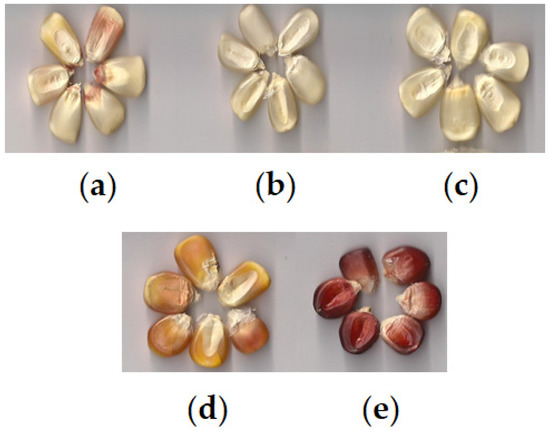
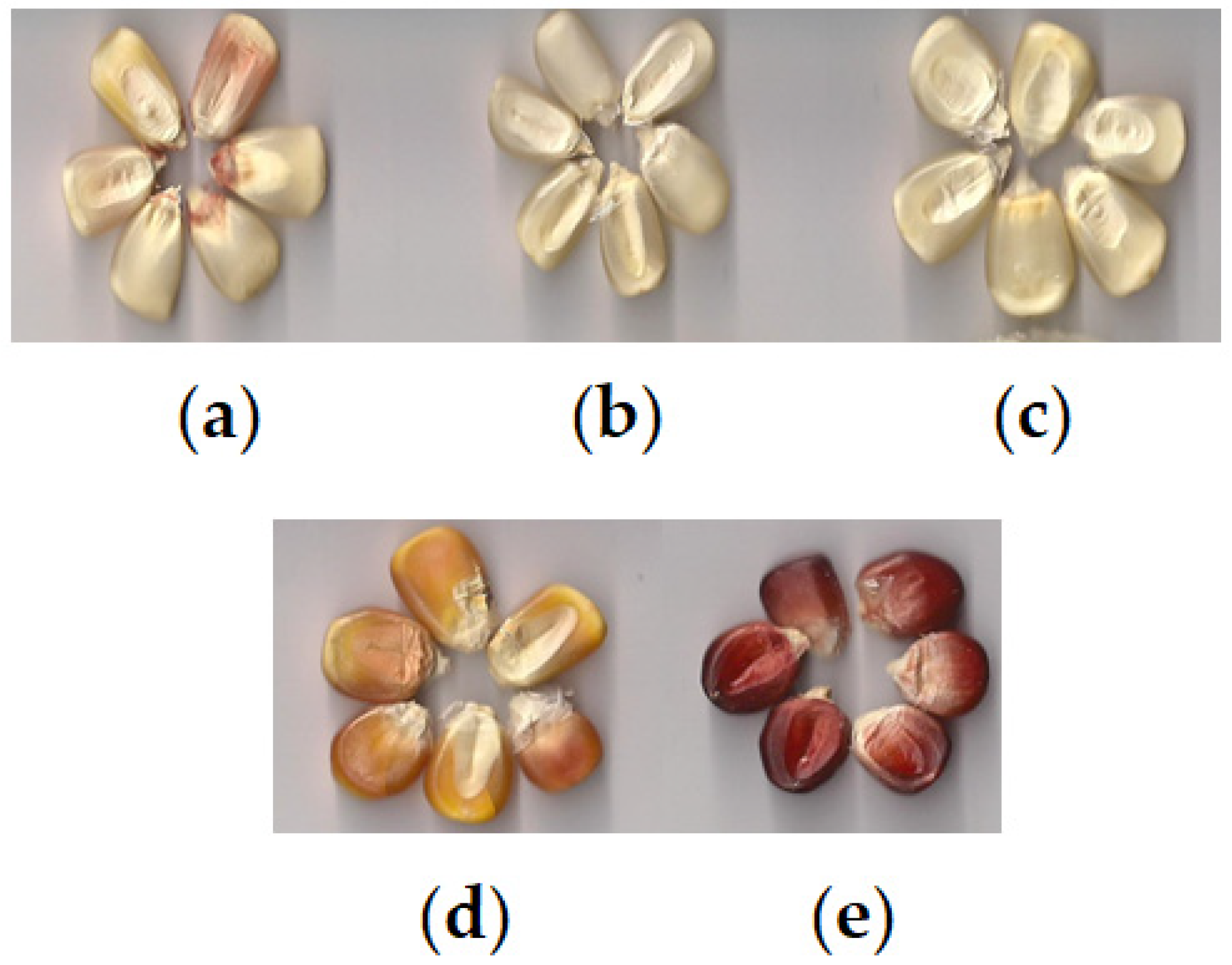
The accessions used in this experiment were obtained by collecting native maize from the Jalisco Highlands in 2008–2009. These accessions correspond to three white grain maize, one accession of Pepitilla cultivar (202), and two accessions of Celaya cultivar (203 and 204); as well as two accessions of Zamorano Amarillo cultivar, one yellow grain (205), and another red grain (206) (Figure 1). The climate in the region is subtemperate; the average annual temperature is 19.0 °C, with minimums of 16.9 °C and maximums of 19.5 °C. The average annual rainfall in the region is 753 mm per year, and the height is 1866 m above sea level [20].
Figure 1.
Accessions of native maize from the Jalisco Highlands, Mexico: (a) 202; (b) 203; (c) 204; (d) 205; (e) 206.
2.1. Physical Characterization of Maize Grain
The physical characteristics evaluated were grain size by 100-grain weight (HGW), and hectolitric weight (HW) according to the 55-10.01 method of the American Association of Cereal Chemistry [21]. Grain hardness was determined by the flotation index (FI) according to NMX-FF-034/1-SCFI-2020 [22]. Structural components of the grain: pedicel (PED), pericarp (PER), germ (GER), floury endosperm (FE), and vitreous endosperm (VE) were evaluated following the method described by Salinas and Vázquez [23]. Grain color was determined with a HunterLab MiniScan XE Plus® Model 45/0-L colorimeter (Reston, VA, USA), according to Vázquez-Carrillo et al. [24]. The variables tested were color brightness (L), angle tone (Hue), and color saturation index (Chroma).
2.2. Chemical Characteristics of Maize Grain
The chemical variables evaluated were ether extract (EE) (method 30-10) and protein (method 46-13), where the nitrogen content was first quantified with Technicon equipment and a protein conversion factor of 6.25 was used. Both variables were quantified using the official methods in the American Association of Cereal Chemists (AACC) [21].
2.3. Nixtamalization and Tortillas Procedure
For nixtamalization, 150 g of grain from each corn sample were weighed, 1.5 g of calcium oxide (CaO), and 300 mL of water were added. The cooking time was assigned according to the grain hardness [22]. Nixtamal was left to stand for 16 h, then the cooking liquor (nejayote) was separated and the nixtamal was rinsed with 200 mL of water. To obtain the percentage of total soluble solids (TSS), the volume of the cooking liquor and the nixtamal wash water were measured, after that, both were mixed and homogenized, and 50 mL of each sample were taken to total evaporation in an oven at 60 °C. The pericarp retained in the nixtamal was determined following the method of Salinas and Vázquez [23]. Nixtamal was ground in a stone mill, and the mass obtained from the milling was weighed and conditioned, adding water to it until obtaining an appropriate consistency for molding.
The preparation and cooking of the tortillas were carried out following the traditional method described by Vázquez-Carrillo et al. [25]. The moisture of nixtamal (NM), dough (DM), and freshly made tortilla (FMTM) were evaluated according to Salinas and Vázquez [23]. To obtain dough yield (DY), the conditioned dough was weighed and related to the amount of nixtamalized grain used; hot tortilla yield (HTY) was quantified as the amount of tortilla obtained per kilogram of processed corn.
2.4. Data Analysis
The experiment was performed under a completely randomized design, where each variable was analyzed in duplicate. Data obtained were subjected to an analysis of variance (ANOVA) and means comparison was carried out with the least significant difference (LSD) test (p ≤ 0.05). The results were analyzed using the Statistical Analysis Software (SAS) (v9.3, Cary, NC, USA). Furthermore, Statistica software (v12.5 Statsoft ®, Tulsa, OK, USA) was used for the principal component analysis (PCA) of the data obtained.
3. Results and Discussion
3.1. Physical Characteristics of the Grain
The physical characteristics of the grain showed highly significant differences (p ≤ 0.01) between the accessions (Table 1), which shows the variability between them.
Table 1.
Physical characteristics of native corn grain from the Jalisco Highlands, Mexico.
Regarding the HW of corn grain, statistical differences were observed among accessions, but only accessions 203 (75.3 kg hL−1) and 206 (73.4 kg hL−1) did not meet with the Mexican standard [22], which was 66–73 kg hL−1. Likewise, the greater HW of this accession resulted in a greater grain hardness due to the compact structure of vitreous endosperm weighing more than that of the floury one [26]. This characteristic related to higher flour and masa yields once processed [27].
FI varied significantly (p ≤ 0.05) with a range from 30–74%; however, accessions 203 and 206 met DTI and NFI standards as indicated in [22]. Corn quality was related to kernel hardness, which could be known indirectly through HW and FI; kernel hardness was directly related to HW and inversely related to FI [28,29]. In this work, HW and FI indicated that the hardness kernel of accession 203 was hard, meanwhile accessions 202 and 204 were soft, and 205 and 206 were intermediate. Grain hardness plays an important role in nixtamalization since they are related to water absorption when cooking and steeping the grain [30]. These results were in contrast with that reported by Salinas-Moreno et al. [31], who indicated that when evaluating 61 accessions of blue/purple native maize within 10 cultivars from Oaxaca, all of them complied with such standard; likewise, Gaytán-Martínez et al. [32] reported the same situation when evaluating six native maize from different sites in Mexico.
HGW varied from 32.35 g to 46.65 g with significant differences. However, the Mexican standard [22] did not include specifications for the nixtamalization process, therefore Salinas and Vázquez [23] classified the grains as large (>38 g), medium (33 g to 38 g), and small (<33 g). In this work, grains from accessions 203, 204, and 205 were large grains, while accession 202 was medium grain, and accession 206 was a small grain. HGW was important in the nixtamalization process due to hydration and cooking time [33], therefore three accessions could be used in both NFI and DTI.
3.2. Grain Color
The L values of analyzed accessions varied (p ≤ 0.05) within 36.43–72.29% (Table 2). The values for white maize (accessions 202, 203, and 204) ranged within 65.6–72.29%. Yellow maize (accession 205) showed a value of 54.35% and red maize (accession 206) had a value of 36.43%. This has been previously reported that high L values corresponded to white or yellow maize, whereas these values may decrease in pigmented maize, such as red maize, due to anthocyanin content in the grain [34,35]. The color of the corn grains was an important characteristic for the kind of industry to be used, such as NFI or FTI, as well as in the elaboration of artisanal dishes.
Table 2.
Color grain of native maize from the Jalisco Highlands, Mexico.
NFI preferred bright cream-white corns with a minimum reflectance of 57%; therefore, accessions 202, 203, and 204 meet the specifications of such industry [15,36]. Low reflectance percentages, such as accessions 205 and 206, cause colors that can affect consumer acceptance [31]. L value of accession 206 was similar to those previously reported in different varieties of red native maize from different Mexican states [37,38], and could be used to prepare other special dishes, not only tortillas [36,39,40].
Hue (°) values in maize accessions varied (p ≤ 0.05) from 82.7–46.27° (Table 2). Higher Hue values were found in accessions that belonged to white (202, 203, and 204) and yellow (205) kernels, respectively; whereas accession 206 showed the lowest Hue value and belonged to the red kernel. This data agreed with Rodríguez-Salinas et al. [34], who analyzed 15 native maize genotypes from northeast Mexico and found in red maize, a Hue value of 23.78°, while in yellow maize, it was 77.71°, and in white maize, the values reached 85.71°.
Statistical differences (p ≤ 0.05) were found in Chroma values; its values ranged from 22.94–32.04. The highest Chroma value (32.04) reported here (Table 2), belonged to yellow maize (accession 205), which was in agreement with Suriano et al. [41] and Rodríguez-Salinas et al. [34], who reported Chroma values of 32.27 and 32.10 in yellow maize, respectively. Chroma was related to the color saturation index, with high values in pure colors and low values in matte colors or colors with less purity of color [38], the latter was observed in white (202, 203, and 204) and red (206) accessions.
3.3. Structural Composition of Grain
In general, all structural components of the grain varied (p ≤ 0.05) among accessions except for PER, as listed in Table 3.
Table 3.
Characteristics of the structural components of native corn grain from the Jalisco Highlands, Mexico.
PED varied (p ≤ 0.05) from 0.47–1.62% (Table 3); these values were lower than previously reported in native maize of the Chapalote, Cónico, Chalqueño, and Arrocillo cultivars [24,42]; however, they were similar to blue/purple grain corn cultivars analyzed by Salinas-Moreno et al. [31]. The data obtained in this work complied with the limit established by the DTI (≤2%), since it favored the molding of the dough and improved its texture, since a higher percentage caused incomplete lignin hydrolysis during nixtamalization and with it, the appearance of dark spots on the tortillas [43,44].
PER varied from 5.26–6.00% (p > 0.05); however, all accessions complied with the requirements of DTI, as they preferred corn with pericarp 4.5–6.0%, due to poor removal of the bran causing darkening and off-color in tortillas [45].
GER values varied (p ≤ 0.05) and ranged from 8.28% to 11.59% in accessions 206 and 203, respectively (Table 3). All the accessions complied with the requirements of the DTI and NFI (≤13%), which was important since a higher percentage implied an increase in the oil content, making it difficult to grind the nixtamal, reducing the life shelf of nixtamalized products [25].
FE and VE varied (p ≤ 0.05) among the accessions analyzed (Table 3). FE ranged from 28.81–42.24%, accessions 202, 203, and 204 showed the highest percentages, followed by accessions 205 and 206. This showed that accessions 202 and 204 with the highest percentage of floury endosperm, had a soft kernel. VE ranged from 41.31–56.25%, and accessions 205 and 206 had the highest percentages compared to accessions 202, 203, and 204. Vitreous endosperm reflected the compactness of the starch-protein matrix, i.e., previous reports mentioned that a higher percentage of vitreous endosperm implied an increase in protein content [46,47] as was found in this work in accession 206.
3.4. Chemical Composition of Grain
PROT and EE showed statistical differences (p ≤ 0.05) among accessions (Table 4).
Table 4.
Chemical composition of the grain of native corn from the Jalisco Highlands, Mexico.
PROT content ranged from 8.4–9.1%, accession 206 (9.1%) showed the highest value and accession 202 (8.4) showed the lowest value. These results were lower than those reported by Vázquez-Carrillo et al. [42] and Salinas-Moreno et al. [31], who analyzed 10 Chapalote accessions from Sonora (Mexico), and 61 cultivars of blue/purple maize from tropical and subtropical regions of Oaxaca (Mexico), respectively. These results were in contrast with Pliego et al. [48] who reported that PROT content (8.12–8.29) in 23 accessions of blue/red maize from Mexico highlands was lower than that reported herein. PROT content in corn kernel was important since it influenced the functional properties of dough made from corn meal, as well as the texture/hardness of the grain [49].
EE content ranged from 4.33–5.75%; these results were similar to those reported by Salinas-Moreno et al. [31], who analyzed 61 cultivars of blue/purple maize from Oaxaca. Likewise, Rodríguez-Salinas et al. [34] found statistical differences in EE content in15 native cultivars from northern Mexico. Alternatively, the values reported herein were greater than those reported in 41 native populations of Yucatán (3.37–4.52%) [50]. Finally, these results showed that only accession 204 met the requirements for NFI, where grain corn with 3.5–4.5% oil was required to avoid rancidity problems during flour storage [51]. These very dissimilar values for protein and oil were a clear example of how the environmental conditions, genotypes, and cultivation practices could alter grain quality, both chemically and physically, as well as in the corn plant [52,53].
3.5. Nixtamal and Tortilla Quality
Most characteristics of nixtamal and tortilla quality varied (p ≤ 0.05) among accessions except NM and DY, as listed in Table 5.
Table 5.
Nixtamal and tortilla quality made of native maize from the Jalisco Highlands, Mexico.
NM did not show statistical differences (p > 0.05); however, accessions 204, 205, and 206 met DTI standard (45–50%), but any accession met NFI standard (37–42%) as indicated in [22]. NFI required such values since its moisture facilitated the grinding process. In the case of DTI, higher percentages were required since it sought to improve the yields through the moisture of its products [15].
DM varied (p ≤ 0.05) from 54.92–57.59% (Table 5), accession 202 had the highest value (57.59%). Chimimba et al. [54] found that 13 blue maize cultivars DM values ranged from 47.2–56%. Similarly, Salinas-Moreno and Aguilar-Modesto [33] reported the same values in 27 accessions of native maize from Puebla and Tlaxcala, Mexico.
FMTM varied (p ≤ 0.05) among the accessions (39.00–47.15%), where only accession 202 met with DTI (≥43%). This finding agreed with Palacios-Pola et al. [55], who reported similar values for FMTM. In addition, DTI required 45% tortilla moisture to obtain 1.5 kg of tortilla per kilogram of corn [56].
PR values varied (p ≤ 0.05) from 32.49–65.82%. Accessions 203 and 205 met DTI standard (25–35%), and only accession 202 met NFI requirements (40–50%) as indicated in [22], since they contribute to the reduction of dry matter loss, increasing water retention and improving the texture of the dough and tortilla [57].
TSS varied (p ≤ 0.05) from 2.66–3.71%. All the accessions met DTI standard (2.5–5.0%); however, only accessions 204 and 206 met NFI standard (1.5–3.0%), as indicated in [22].
For DY and HTY, accessions 202 and 204 showed the highest yields (2.00 kg dough/kg corn and 1.56 kg tortilla/kg corn, respectively). Although DY did not show statistical differences, all the accessions met the requirements of the DTI (≥1.8 kg dough/kg corn) [15]. These values were similar to those reported by other authors for native and hybrid maize varieties [33,36,58]. HTY varied (p ≤ 0.05) from 1.45 kg tortilla/kg corn–1.56 kg tortilla/kg corn. The results obtained here, were similar to previous reports, such as López-Morales et al. [57], who evaluated Tuxpeño cultivar corn with values from 1.33 kg tortilla/kg corn–1.48 kg tortilla/kg corn. Similarly, Vázquez-Carrillo et al. [59], who analyzed two blue native corn and nine white-grain hybrids with values from 1.35 kg tortilla/kg corn–1.47 kg tortilla/kg corn.
3.6. Principal Component Analysis
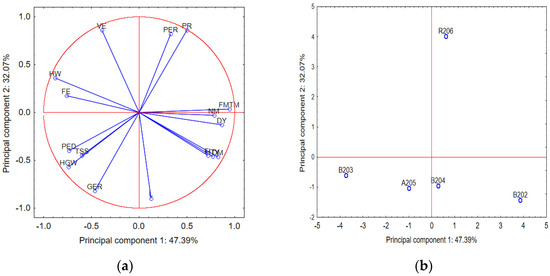
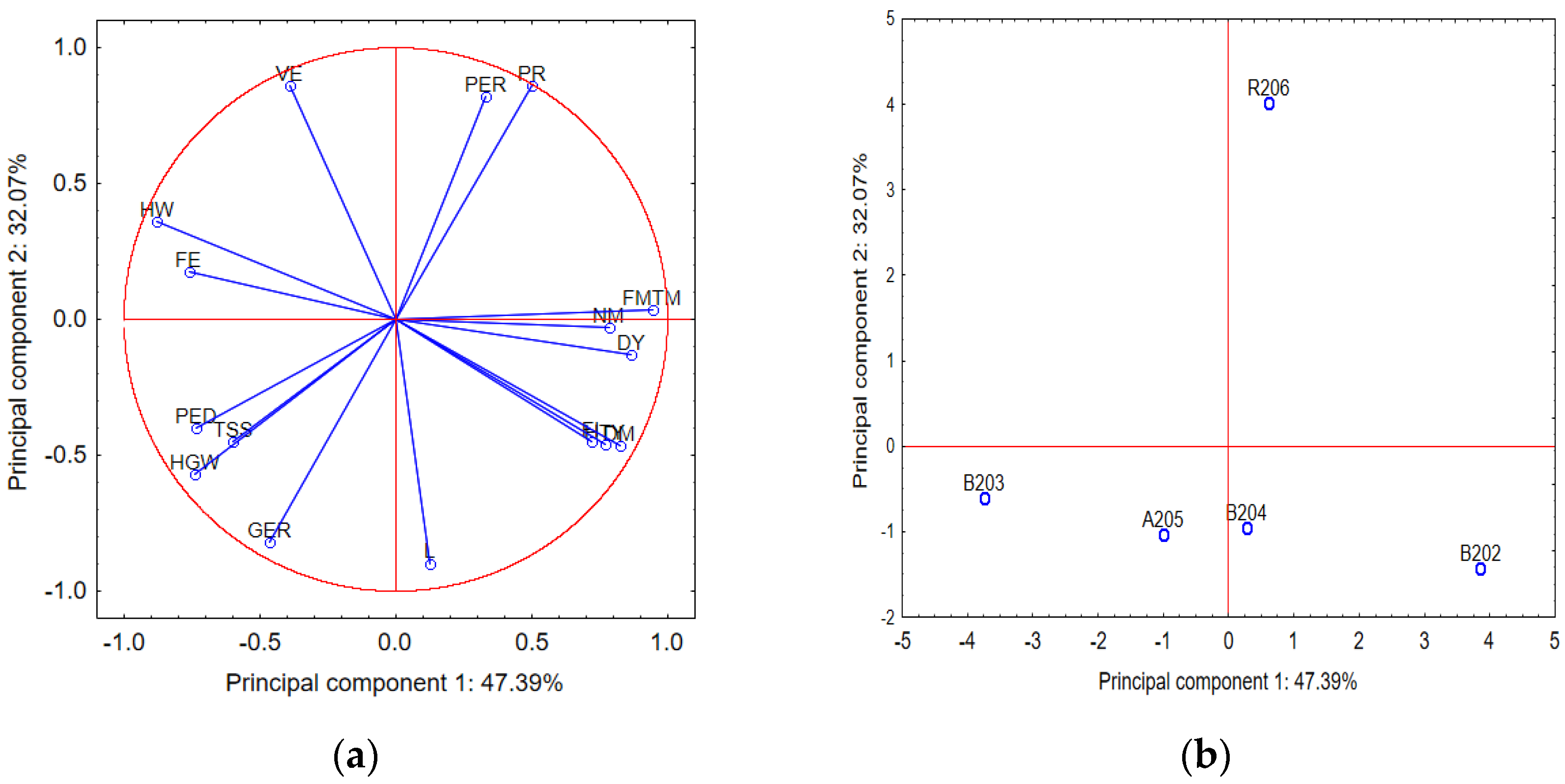
Principal component analysis (PCA) was performed to assess the association between the characteristics of the grain and maize dough quality used for NFI and DTI (Figure 2 and Table 6). Two principal components (PCs) described approximately 79% of the variation (PC1: 47.39% and PC2: 32.07%); the graph of the physicochemical quality parameter is presented in Figure 2a. It showed that the most important characteristics for PC1 were FMTM, DY, and DM; in PC2, the predominant characteristics were VE and PER. Likewise, Figure 2a showed a positive correlation between the characteristics FMTM (0.9438), DY (0.8631) and NM (0.7839), as well as DM (0.8228) and HTY (0.7696), where it was observed that a higher NM, would produce a higher DY, but this did not necessarily imply that there would be a higher FMTM, which generated a higher DY and HTY measured as kg tortilla per kg corn, as reported in this article. Alternatively, it was evident there was a negative correlation between HW (−0.8821) and FE (−0.7611) and the former two groups. It may have been due to the accessions not having been selected or improved for this type of industry, only for use as fodder and self-consumption in some cases.
Figure 2.
Principal component analysis (PCA) plots of native maize from the Jalisco Highlands, Mexico. (a) Location of different physicochemical quality parameters; (b) Location of different maize cultivars.
Table 6.
Factor coordinates of the physicochemical parameters, based on correlations.
From the results in Figure 2b and Table 7, accessions 202 and 206 had the largest contribution to PC1 and PC2, respectively; furthermore, accessions 204 and 205 formed a cluster close to the origin of the plot, which indicated they had similar characteristics. As previously mentioned, it was observed that accession 206 differed from the rest of the accessions analyzed, although accessions 205 and 206 were genetically related, and the only thing that differed was the color of the kernel. This indicated that all samples had some good characteristics required by the NFI and DTI, except accession 206, in which its pigmentation was not accepted for these industries since such color greatly influenced consumer preference [28].
Table 7.
Factor coordinates of accessions, based on correlations.
4. Conclusions
The experimental results showed statistical differences (p ≤ 0.05) in almost all variables analyzed; some of them of commercial importance for both NFI and DTI. It is worth mentioning that all accessions met with pedicel (PED), pericarp (PER), germ (GER), total soluble solids (TSS), and dough yield (DY) for Dough Tortilla Industry (DTI). In this context, accession 203 was selected for use in improvement programs to increase the characteristics requested by Nixtamalized Flour Industry (NFI) for further research. Pigmented accessions (205 and 206) can be used as a functional ingredient to develop food and nutraceuticals.
Native maize has been part of the life of smallholder maize farmers who have selected and preserved it over generations. Future studies on these and other native maize cultivars of western Mexico must be conducted to assess the physicochemical and phytochemical characteristics of maize grains that may be useful for food and pharmaceutical applications, contributing to the conservation, propagation, and use of natural and ancient resources.
Author Contributions
Conceptualization: H.R.-V., L.M.A.-E. and V.M.G.-R.; methodology: G.V.-C., H.R.-V. and G.M.M.-R.; writing—original draft preparation: H.R.-V., V.M.G.-R. and R.M.-L.; writing—review and editing: H.R.-V., V.M.G.-R., G.V.-C., D.H.-N. and J.Á.M.-S.; project administration: H.R.-V. and V.M.G.-R.; funding acquisition: H.R.-V. All authors have read and agreed to the published version of the manuscript.
Funding
This research received no external funding.
Institutional Review Board Statement
Not applicable.
Informed Consent Statement
Not applicable.
Data Availability Statement
Not applicable.
Conflicts of Interest
The authors declare no conflict of interest.
References
- García-Lara, S.; Serna-Saldivar, S.O. Corn history and culture. In Corn: Chemistry and Technology, 3rd ed.; Serna-Saldivar, S.O., Ed.; Woodhead Publishing and AACC International Press: Cambridge, UK, 2019; pp. 1–18. [Google Scholar]
- Caballero-García, M.A.; Córdova-Téllez, L.; López-Herrera, A.D.J. Validación empírica de la teoría multicéntrica del origen y diversidad del maíz en México. Rev. Fitotec. Mex. 2019, 42, 357–366. [Google Scholar] [CrossRef] [Scilit]
- Vigouroux, Y.; Glaubitz, G.C.; Matsuoka, Y.; Goodman, M.M.; Sánchez-González, J.; Doebley, J. Population structure and genetic diversity of new world maize races assessed by DNA microsatellites. Amer. J. Bot. 2008, 95, 1240–1253. [Google Scholar] [CrossRef] [Scilit]
- SIAP. Servicio de Información Agroalimentaria y Pesquera. Secretaría de Agricultura, Ganadería, Desarrollo Rural, Pesca y Alimentación (SAGARPA). 2022. Available online: https://nube.siap.gob.mx/cierreagricola/ (accessed on 8 June 2022).
- SADER. Secretaría de Agricultura y Desarrollo Rural. Centro de Información de Mercados Agroalimentarios. Available online: https://www.cima.aserca.gob.mx/swb/cima/Maiz (accessed on 8 January 2020).
- Escalante-Aburto, A.; Mariscal-Moreno, R.M.; Santiago-Ramos, D.; Ponce-García, N. An update of different nixtamalization technologies, and its effects on chemical composition and nutritional value of corn tortillas. Food Rev. Int. 2019, 36, 456–498. [Google Scholar] [CrossRef] [Scilit]
- CONEVAL. Consejo Nacional de Evaluación de la Política de Desarrollo Social. Contenido y Valor de las Líneas de Pobreza por Ingresos 1992–2021. Available online: https://www.coneval.org.mx/Medicion/MP/Paginas/Lineas-de-bienestar-y-canasta-basica.aspx (accessed on 8 June 2022).
- Yahuaca-Juárez, B.; Martínez-Flores, H.E.; Huerta-Ruelas, J.A.; Vázquez-Landaverde, P.A.; Pless, R.C.; Tello-Santillán, R. Effect of thermal-alkaline processing conditions on the quality level of corn oil. CYTA J. Food. 2013, 11, 1–7. [Google Scholar] [CrossRef] [Scilit]
- Villada, J.A.; Sanchez-Sinencio, F.; Zelaya-Angel, O.; Gutierrez-Cortez, E.; Rodríguez-García, M.E. Study of the morphological, structural, thermal, and pasting corn transformation during the traditional nixtamalization process: From corn to tortilla. J. Food Eng. 2017, 212, 242–251. [Google Scholar] [CrossRef] [Scilit]
- Burton, K.E.; Steele, F.M.; Jefferies, L.; Pike, O.A.; Dunn, M.L. Effect of micronutrient fortification on nutritional and other properties of nixtamal tortillas. Cereal Chem. 2008, 85, 70–75. [Google Scholar] [CrossRef] [Scilit]
- Chapman, J.S.; Steele, F.M.; Eggett, D.L.; Johnston, N.P.; Dunn, M.L. Stability of native folate and added folic acid in micronutrient-fortified corn masa and tortillas. Cereal Chem. 2010, 87, 434–438. [Google Scholar] [CrossRef] [Scilit]
- Mariscal-Moreno, R.M.; Figueroa, J.D.C.; Santiago-Ramos, D.; Arámbula-Villa, G.; Jiménez-Sandoval, S.; Rayas-Duarte, P.; Véles-Medina, J.J.; Martínez-Flores, H.E. The effect of different nixtamalisation processes on some physicochemical properties, nutritional composition and glycemic index. J. Cereal Sci. 2015, 65, 140–146. [Google Scholar] [CrossRef] [Scilit]
- Pappa, M.R.; de Palomo, P.P.; Bressani, R. Effect of lime and wood ash on the nixtamalization of maize and tortilla chemical and nutritional characteristics. Plant Foods Hum. Nutr. 2010, 65, 130–135. [Google Scholar] [CrossRef] [Scilit]
- Voss, K.; Ryu, D.; Jackson, L.; Riley, R.; Gelineau-van Waes, J. Reduction of fumonisin toxicity by extrusion and nixtamalization (alkaline cooking). J. Agric. Food Chem. 2017, 65, 7088–7096. [Google Scholar] [CrossRef] [Scilit]
- Salinas-Moreno, Y.; Gómez-Montiel, N.O.; Cervantes-Martínez, J.F.; Sierra-Macías, M.; Palafox-Caballero, A.; Betanzos-Mendoza, E.; Coutiño-Estrada, B. Calidad nixtamalera y tortillera en maíces del trópico húmedo y sub-húmedo de México. Rev. Mex. Cienc. Agric. 2010, 1, 509–523. [Google Scholar]
- González-Cortés, N.; Silos-Espino, H.; Estrada-Cabral, J.C.; Chávez-Muñoz, J.A.; Tejero-Jiménez, L. Características y propiedades del maíz (Zea mays L.) criollo cultivado en Aguascalientes, México. Rev. Mex. Cienc. Agríc. 2016, 7, 669–680. [Google Scholar]
- Amador-Rodríguez, K.Y.; Silos-Espino, H.; Valera-Montero, L.L.; Perales-Segovia, C.; Flores-Benitez, S.; Martínez-Bustos, F. Physico-chemical, thermal, and rheological properties of nixtamalized creole corn flours produced by high-energy milling. Food Chem. 2019, 283, 481–488. [Google Scholar] [CrossRef] [Scilit]
- Moreno-Letelier, A.; Aguirre-Liguori, J.A.; Piñero, D.; Vázquez-Lobo, A.; Eguiarte, L.E. The relevance of gene flow with wild relatives in understanding the domestication process. Roy. Soc. Open Sci. 2020, 7, 191545. [Google Scholar] [CrossRef] [Scilit]
- Rojas-Barrera, I.C.; Wegier, A.; Sánchez-González, J.J.; Owens, G.L.; Rieseberg, L.H.; Piñero, D. Contemporary evolution of maize landraces and their wild relatives influenced by gene flow with modern maize varieties. Proc. Natl. Acad. Sci. USA 2019, 116, 21302–21311. [Google Scholar] [CrossRef] [Scilit]
- CEAJALISCO. Comisión Estatal del Agua de Jalisco. 2021. Available online: http://info.ceajalisco.gob.mx/region03.html (accessed on 10 June 2021).
- American Association of Cereal Chemists. Approved Methods of the American Association of Cereal Chemists, Approved Methods Committee, 10th ed.; American Association of Cereal Chemists: St. Paul, MN, USA, 2000; 425p. [Google Scholar]
- Norma Mexicana NMX-FF-034/1-SCFI-2020. Productos Alimenticios para Uso Humano No Industrializados. Cereales. Maíz—Parte 1. Granos para Tortillas y Productos Nixtamalizados. Especificaciones y Métodos de Prueba. Secretaría de Economía (SE). Available online: https://www.sinec.gob.mx/SINEC/Vista/Normalizacion/DetalleNMX.xhtml?pidn=L2hiV0psQ0FqTUdtQkc2OS81dTJvUT09 (accessed on 3 July 2022).
- Salinas-Moreno, Y.; Vázquez-Carrillo, G. Metodologías de análisis de la calidad nixtamalera-tortillera en maíz. In Folleto Técnico; No. 24; INIFAP-CEVAMEX: Mexico, Mexico, 2006; p. 98. [Google Scholar]
- Vázquez-Carrillo, G.; García-Lara, S.; Salinas-Moreno, Y.; Bergvinson, D.J.; Palacios-Rojas, N. Grain and tortilla quality in landraces and improved maize grown in the Highlands of Mexico. Plant Foods Hum. Nutr. 2011, 66, 203–208. [Google Scholar] [CrossRef] [Scilit]
- Vázquez-Carrillo, M.G.; Preciado-Ortíz, R.E.; Santiago-Ramo, D.; Palacios-Rojas, N.; Terrón-Ibarra, A.; Hernández-Calette, A. Estabilidad del rendimiento y calidad de grano y tortilla de nuevos híbridos de maíz con valor agregado para el subtrópico de México. Rev. Fitotec. Mex. 2018, 41, 509–518. [Google Scholar] [CrossRef] [Scilit]
- García-Jiménez, A.; Vázquez, C. Secado de maíz y propiedades del grano. IDCYTA 2006, 1, 73–77. [Google Scholar]
- González-Amaro, R.M.; Figueroa-Cárdenas, J.D.D.; Perales, H.; Velés-Medina, J.J. Physicochemical and nutritional properties of different maize races on toasted tortillas. Cereal Chem. 2017, 94, 451–457. [Google Scholar] [CrossRef] [Scilit]
- Aragón-Cuevas, F.; Figueroa-Cárdenas, J.D.D.; Flores-Zarate, M.; Gaytán-Martínez, M.; Véles-Medina, J.J. Calidad Industrial de Maíces Nativos de la Sierra Sur de Oaxaca; Libro Técnico, 15; Instituto Nacional de Investigaciones Forestales, Agrícolas y Pecuarias: Oaxaca, Mexico, 2012; p. 249.
- Bautista-Ramírez, B.; Salinas-Moreno, Y.; Santracruz-Varela, A.; Córdova-Téllez, L.; López-Sánchez, H. Características físicas y químicas de la raza de maíz Palomero Toluqueño. Rev. Mex. Cienc. Agríc. 2019, 10, 441–446. [Google Scholar] [CrossRef] [Scilit]
- Palacios-Pola, G.; Perales, H.; Estrada-Lugo, E.I.; Figueroa-Cárdenas, J.D.D. Nixtamal techniques for different maize races prepared as tortillas and tostadas by women of Chiapas, Mexico. J. Ethn. Foods. 2022, 9, 2. [Google Scholar] [CrossRef] [Scilit]
- Salinas-Moreno, Y.; Aragón-Cuevas, F.; Ybarra-Moncada, C.; Aguilar-Villarreal, J.; Altunar-López, B.; Sosa-Montes, E. Caracterización física y composición química de razas de maíz de grano azul/morado de las regiones tropicales y subtropicales de Oaxaca. Rev. Fitotec. Mex. 2013, 36, 23–31. [Google Scholar] [CrossRef] [Scilit]
- Gaytán-Martínez, M.; Figueroa-Cárdenas, J.D.D.; Reyes-Vega, M.D.L.L.; Morales-Sánchez, E.; Rincón-Sánchez, F. Selección de maíces criollos para su aplicación en la industria con base en su valor agregado. Rev. Fitotec. Mex. 2013, 36, 339–346. [Google Scholar] [CrossRef] [Scilit]
- Salinas-Moreno, Y.; Aguilar-Modesto, L. Efecto de la dureza del grano de maíz (Zea mays L.) sobre el rendimiento y calidad de la tortilla. Ing. Agric. Biosis. 2010, 2, 5–11. [Google Scholar]
- Rodríguez-Salinas, P.A.; Zavala-Garcia, F.; Urias-Orona, V.; Muy-Rangel, D.; Heredia, J.B.; Niño-Medina, G. Chromatic, nutritional and nutraceutical properties of pigmented native maize (Zea mays L.) genotypes from the northeast of Mexico. Arab. J. Sci. Eng. 2020, 45, 95–112. [Google Scholar] [CrossRef] [Scilit]
- Yang, Z.; Zhai, W. Identification and antioxidant activity of anthocyanins extracted from the seed and cob of purple corn (Zea mays L.). Innov. Food Sci. Emerg. 2010, 11, 169–176. [Google Scholar] [CrossRef] [Scilit]
- Vázquez-Carrillo, M.G.; Pérez-Camarillo, J.P.; Hernández-Casillas, J.M.; Marrufo-Díaz, M.L.; Martínez-Ruíz, E. Calidad de grano y de tortillas de maíces criollos del Altiplano y Valle del Mezquital, México. Rev. Fitotec. Mex. 2010, 33, 49–56. [Google Scholar] [CrossRef] [Scilit]
- Salinas-Moreno, Y.; Soto, H.M.; Martínez, B.F.; González, H.V.; Ortega, P.R. Análisis de antocianinas en maíces de grano azul y rojo provenientes de cuatro razas. Rev. Fitotec. Mex. 1999, 22, 161–174. [Google Scholar]
- Salinas-Moreno, Y.; Cruz-Chávez, F.J.; Díaz-Ortiz, S.A.; Castillo-González, F. Granos de maíces pigmentados de Chiapas, características físicas, contenido de antocianinas y valor nutracéutico. Rev. Fitotec. Mex. 2012, 35, 33–41. [Google Scholar] [CrossRef] [Scilit]
- Fernández-Suárez, R.; Morales-Chávez, L.; Gálvez-Mariscal, A. Importancia de los maíces nativos de México en la dieta nacional. Una revisión indispensable. Rev. Fitotec. Mex. 2013, 36, 275–283. [Google Scholar] [CrossRef] [Scilit]
- Espinosa-Trujillo, E.; Mendoza-Castillo, M.D.C.; Castillo-González, F.; Ortiz-Cereceres, J.; Delgado-Alvarado, A. Aptitud combinatoria del rendimiento de antocianinas y de características agronómicas en poblaciones nativas de maíz pigmentado. Rev. Fitotec. Mex. 2010, 33, 11–19. [Google Scholar] [CrossRef] [Scilit]
- Suriano, S.; Balconi, C.; Valoti, P.; Redaelli, R. Comparison of total polyphenols, profile anthocyanins, color analysis, carotenoids and tocols in pigmented maize. LWT-Food Sci. Technol. 2021, 144, 111257. [Google Scholar] [CrossRef] [Scilit]
- Vázquez-Carrillo, M.G.; Santiago-Ramos, D.; Figueroa-Cárdenas, J.D. Kernel properties and popping potential of Chapalote, a Mexican ancient native maize. J. Cereal Sci. 2019, 86, 69–76. [Google Scholar] [CrossRef] [Scilit]
- Salinas-Moreno, Y.; Pérez-Herrera, P. Calidad nixtamalera-tortillera en maíces comerciales de México. Rev. Fitotec. Mex. 1997, 20, 121–136. [Google Scholar]
- Vázquez-Carrillo, M.G.; Guzmán-Báez, L.; Andrés-García, J.L.; Márquez-Sánchez, F.; Castillo-Merino, J. Calidad de grano y tortillas de maíces criollos y sus retrocruzas. Rev. Fitotec. Mex. 2003, 26, 231–238. [Google Scholar] [CrossRef] [Scilit]
- Serna-Saldivar, S.O.; Chuck-Hernandez, C. Food uses of lime-cooked corn with emphasis in tortillas and snacks. In Corn: Chemistry and Technology, 3rd ed.; Serna-Saldivar, S.O., Ed.; Woodhead Publishing and AACC International Press: Cambridge, UK, 2019; pp. 469–500. [Google Scholar]
- Gayral, M.; Gaillard, C.; Bakan, B.; Dalgalarrondo, M.; Elmorjani, K.; Delluc, C.; Brunet, S.; Linossier, L.; Morel, M.H.; Marion, D. Transition from vitreous to floury endosperm in maize (Zea mays L.) kernels is related to protein and starch gradients. J. Cereal Sci. 2016, 68, 148–154. [Google Scholar] [CrossRef] [Scilit]
- Zhang, H.; Xu, G. Physicochemical properties of vitreous and floury endosperm flours in maize. Food Sci. Nutr. 2019, 7, 2605–2612. [Google Scholar] [CrossRef] [Scilit] [PubMed]
- Pliego, C.E.; Ramírez, M.D.L.; Ortiz, R.; Hidalgo, B. Caracterización de proteínas, grasa y perfil graso de maíces criollos (Zea mays) en poblados del Estado de México. Soc. Rural. Prod. Medio Ambiente 2021, 21, 16. [Google Scholar]
- Larkins, B.A. Proteins of the Kernel. In Corn: Chemistry and Technology, 3rd ed.; Serna-Saldivar, S.O., Ed.; Woodhead Publishing and AACC International Press: Cambridge, UK, 2019; pp. 319–336. [Google Scholar]
- Cázares-Sánchez, E.; Chávez-Servia, J.L.; Salinas-Moreno, Y.; Castillo-González, F.; Ramírez-Vallejo, P. Variación en la composición del grano entre poblaciones de maíz (Zea mays L.) nativas de Yucatán, México. Agrociencia 2015, 49, 15–30. [Google Scholar]
- Salinas-Moreno, Y. Calidad de maíz para las industrias molinero-tortillera y de harinas nixtamalizadas. In Proceedings of the I Congreso Nacional de Nixtamalización, Querétaro, Mexico, 17–21 October 2004; pp. 5–9. [Google Scholar]
- Cong, B.; Maxwell, C.; Luck, S.; Vespestad, D.; Richard, K.; Mickelson, J.; Zhong, C. Genotypic and environmental impact on natural variation of nutrient composition in 50 non genetically modified commercial maize hybrids in North America. J. Agric. Food Chem. 2015, 63, 5321–5334. [Google Scholar] [CrossRef] [Scilit]
- Holmes, M.; Renk, J.S.; Coaldrake, P.; Kalambur, S.; Schmitz, C.; Anderson, N.; Gusmini, G.; Annor, G.; Hirsch, C.N. Food-grade maize composition, evaluation, and genetics for masa-based products. Crop Sci. 2019, 59, 1392–1405. [Google Scholar] [CrossRef] [Scilit]
- Chimimba, J.; Pratt, R.; Cuellar, M.; Delgado, E. Quality parameters of masa and tortillas produced from blue maize (Zea mays sp. mays) landraces. J. Food Sci. 2019, 84, 213–223. [Google Scholar] [CrossRef] [Scilit] [PubMed]
- Palacios-Pola, G.; Rivera-Perales, H.; Figueroa-Cárdenas, J.D.D.; Hernández-Estrada, Z.J. Changes in the physical, chemical, and sensory properties from three native corn landraces from Chiapas using two nixtamalization times. Int. J. Gastron. Food Sci. 2021, 25, 100373. [Google Scholar] [CrossRef] [Scilit]
- Jiménez-Juárez, J.A.; Arámbula-Villa, G.; de la Cruz-Lázaro, E.; Aparicio-Trapala, M.A. Calidad nixtamalera y tortillera de maíces del trópico húmedo de México. Phyton 2015, 84, 1–7. [Google Scholar]
- López-Morales, F.; Vázquez-Carrillo, M.G.; García-Zavala, J.J.; López-Romero, G.; Reyes-López, D.; Molina-Galán, J.D. Estabilidad y adaptación del rendimiento y calidad de tortilla en maíz Tuxpeño, Valles-Altos. Rev. Mex. Cienc. Agric. 2019, 10, 1809–1821. [Google Scholar] [CrossRef] [Scilit]
- Vázquez-Carrillo, M.G.; Santiago-Ramos, D.; Gaytán-Martínez, M.; Morales-Sánchez, E.; Guerrero-Herrera, M.J. High oil content maize: Physical, thermal and rheological properties of grain, masa, and tortillas. LWT Food Sci. Technol. 2015, 60, 156–161. [Google Scholar] [CrossRef] [Scilit]
- Vázquez-Carrillo, M.G.; Rojas-Martínez, I.; Santiago-Ramos, D.; Arellano-Vázquez, J.L.; Espinosa-Calderón, A.; García-Pérez, M.; Crossa, J. Stability analysis of yield and grain quality traits for the nixtamalization process of maize genotypes cultivated in the central high valleys of Mexico. Crop Sci. 2016, 56, 3090–3099. [Google Scholar] [CrossRef] [Scilit]

Publisher’s Note: MDPI stays neutral with regard to jurisdictional claims in published maps and institutional affiliations. |
© 2022 by the authors. Licensee MDPI, Basel, Switzerland. This article is an open access article distributed under the terms and conditions of the Creative Commons Attribution (CC BY) license (https://creativecommons.org/licenses/by/4.0/).