


Abstract
Agritourism is not a new phenomenon; moreover, it has increased significantly over the past decade and is expected to continue growing in the future. Despite this growth, there is no shared understanding of agritourism, which is problematic because it creates confusion and diminishes its appeal among consumers, thereby impeding communication and collaboration between stakeholders. Agritourism activities can be carried out on a microscale in rural areas by families and agricultural practitioners or on a large scale by hotels, restaurants, and catering firms. Despite many developing countries’ agricultural potential, agritourism has not been inserted into development plans in these countries. Only agritourism in small accommodation enterprises is carried out on a microscale by rural families. This study seeks to test the relationship between the positive impacts of peer-to-peer (P2P) accommodation and agritourism performance, with the mediating effects of support for P2P accommodations and organizational citizenship behavior towards P2P accommodations. The data were derived from 300 Airbnb consumers and hosts of agritourism accommodations in the eastern province of the kingdom of Saudi Arabia (KSA). The results of “Structural Equation Modeling” (SEM) via the “Partial least squares” (PLS) showed a positive direct relationship between peer-to-peer accommodation and agritourism performance with a significant mediating role of Organizational Citizenship Behavior and a positive moderating role of information on Agritourism destinations. Several theoretical and practical implications are discussed.
1. Introduction
In 2011, the World Tourism Organization predicted that agritourism would be among the five significant factors in developing international tourism by 2020 [1]. The popularity of agritourism as a distinct from of tourism is continually growing [2]. The concept of “agritourism” appeared in the last 25 years of twentieth-century literature [3]. Agritourism is also known as the concept of tourist farms, holiday farms, farm-based tourism, and rural tourism [4]. Ref. [5] asserted that there is not yet a common definition for agritourism, which has limited the development of effective policies for its support. In general, any action, activity, or service that is created in farms and rural destinations to attract visitors includes a combination of activities such as tours, overnight stays, unique events and festivals, on-farm stores, hunting, bird watching, hiking, horseback riding, and so on, which are generally amusing [6].
Many policymakers, researchers, and governments have suggested agritourism as an alternative solution and a sustainable development strategy to facilitate the recovery of local economies in rural communities and a complementary source of revenue generation for growers [2,7,8,9], especially in countries where rural communities have encountered many challenges such as migration, low prices of products, and economic recession [5,10]. Rural tourism is a revitalizing tool for economic growth, sociocultural development, the provision of essential and non-essential services, and raising living standards [11,12]. By directly and indirectly bringing economic benefits to local businesses, encouraging the development of related small businesses, serving as an impetus for developing rural and isolated areas, and reviving traditional industries on the brink of extinction [13], these benefits can contribute to the development of positive attitudes among local communities concerning tourism development [14].
Agritourism activities can be carried out on a microscale in rural areas by families and agricultural practitioners [15] or on a large scale by hotels, restaurants, and catering firms [16]. Despite the agricultural potential in many countries, agritourism has not been inserted into development plans in these countries. Only agritourism in small accommodation enterprises is carried out on a microscale by rural families.
Small businesses dominate the rural economic landscape, so small accommodation enterprises represent a core service and supply a considerable share of accommodational capacity in most rural destinations and play a significant role in agritourism development, poverty alleviation, and rural revitalization [17]. With the boom of sharing economy platforms (e.g., Airbnb), peer-to-peer accommodation will continue to expand in scale and thereby reshape the hospitality industry’s future dynamics, especially in rural destinations [18,19]. Peer-to-peer accommodation (P2P) in agritourism destinations is considered a typical form of indigenous tourism, and its growth is expected to bring more financial rewards to rural homes and promote local economies [20], as well as preserve agritourism destinations’ attractiveness with respect to traditional lifestyles, quality service, and memorable experiences [18,21].
Drawing on business growth theory, increasing investment in P2P accommodations leads to increased accommodational capacity, a greater amount of additional capital invested, and more hired employees [22]. Thus, this process results in the reception of more guests, an increase in the range of services, and the improvement of the facilities in agritourism destinations, whereby more satisfactory products and services can be delivered to each guest [23,24]. According to social exchange theory (SCT), a rural community will likely support P2P accommodations if the perceived positive effects outweigh the negative consequences [25]. In fact, most P2P accommodation owners are rural locals, which causes residents to feel psychological ownership derived from a sense of emotional attachment to these places. Based on the affective events theory (AET), we argue that when residents feel psychological ownership of the P2P accommodation, they will defend it from criticism and express their loyalty to it (i.e., a commitment to an organizational citizenship behavior exhibited towards it) [26,27].
Contrary to this stream of the literature focusing on primary tourist markets, the potential effects of P2P accommodations on less developed tourism destinations (rural destinations) are rarely documented in the literature [28]. A structured literature review of 118 articles published between 2013 and 2018 on the P2P accommodation topic (i.e., Airbnb) identified five principal research themes: user motives and user kinds, reputation systems and confidence, prices and pricing, economic effects and media coverage, and legal and regulatory aspects [29]. Research on the impact of P2P accommodations and the creation and development of tourism types is still sparse and very limited. Therefore, this study strives to bridge this gap by diverging from these themes contained in most of the previous studies and clarifying how to exploit the benefits and possibilities of a P2P accommodation—whose existence has become a reality in all societies in the world as a kind of small economic business—to promote agricultural tourism to support local rural economies.
Grounded in business growth theory, the social exchange theory (SCT), and the affective events theory (AET), this study seeks to test the relationship between the positive impacts of P2P accommodations and agritourism performance, with the mediating effects of support for P2P accommodations and organizational citizenship behavior toward P2P accommodations, and the moderating effect of the information on the agritourism destination from the P2P accommodation website between the positive impacts of P2P accommodations and support for P2P accommodations.
2. Theoretical Background and Hypotheses Development
2.1. Support for P2P Accommodations and Organizational Citizenship Behavior toward P2P Accommodations as a Mediator in the Relationship between P2P Accommodations and Agritourism Performance
Today, the internet has enabled individuals to reach a broad audience more effectively to trade their goods and services [30]. The rental of vacation accommodations has attracted by far the most interest in the peer-to-peer internet trading area, with a host selling the use of a room or home to a guest for a set amount of time [31,32]. The peer-to-peer economy has developed as a serious challenger to the traditional hospitality business over the last decade, reshaping social and economic life. Tourism has been touched by four primary areas of the peer-to-peer economy: transportation, food, tour guide services, and lodging [33]. Paid online peer-to-peer accommodation is a space appropriate for overnight stays sold by a non-commercial provider (the host) to an end user (the guest) for short-term use via the direct interaction between the host and guest [32]. A host is a person or group who rents out the real property on the P2P accommodation platform, whereas a P2P accommodation guest stays overnight at the listed property [31].
The P2P accommodation industry has been heavily criticized with respect to a host of issues ranging from the security threat posed by strangers in residents’ backyards to inadequate parking, rental and housing cost increases, the impairment of job growth, the disruption caused by party houses, the unruly behavior by P2P accommodation guests towards neighbors, and the museumization of neighborhoods [34]. In short, P2P accommodations might negatively affect residents’ quality of life [35]. On the other hand, [36] it has been stated that the P2P accommodation industry was subjected to an extensive campaign that included lobbying and the funding of anti-research to display its negative socioeconomic influences. Media discourse has continually reinforced these negative results to distort the industry’s image in favor of hotels [34]. Generally, [37] argues that residents perceived P2P accommodations as having more positive than negative impacts. The P2P accommodation industry has grown to the point that countless people have been transformed into hospitality micro-entrepreneurs [38,39]. The findings of [40] study reveal that rural Airbnb listings during COVID-19 took advantage of the low density of tourism facilities and businesses and the ease of social distancing in rural areas and targeted and promoted agritourism tourists. The authors of [30] predicted that P2P accommodations could be used to strengthen rural economies. Thus, drawing on business growth theory, the following hypothesis is proposed:
Hypothesis 1 (H1).
The positive impacts of P2P accommodations are positively related to agritourism performance.
The development of tourism may differ between urban and rural areas [41]. Rural tourism operators tend to be rural families, usually showcasing regional agricultural products and cultural activities [14]. Family-owned and operated small businesses (e.g., farm stays, caravan and camps, and bed and breakfast operations) are undertaken to support the family’s goals. However, traditionally, these enterprises tend to be a supplemental form of revenue and are mainly operated by female family members [42]. To this end, rural tourism often enjoys substantial local support [14]. So, according to the social exchange theory (SCT), we argue that when P2P accommodations contribute to the support of agritourism, this in turn contributes to the development of positive attitudes among local communities concerning P2P accommodations. Therefore, we hypothesize the following:
Hypothesis 2 (H2).
The positive impacts of P2P accommodations are positively related to support for P2P accommodations.
P2P online platforms have resulted in a new organizational structure that does not necessarily concentrate on possessing main products or hiring service providers [43]. In this transition, P2P accommodations with online platforms has realized the inevitability of incorporating and satisfying individual market partners (i.e., hosts) [44]. As mentioned earlier, P2P hosts in rural destinations tend to be from rural families [14]. P2P accommodations strengthen agritourism and rural economies [30]. This reciprocal cooperation between the rural community, including the P2P hosts, and P2P firms makes both the hosts and the residents feel psychological ownership of the P2P firms. P2P hosts who feel ownership have a neighborly sense of duty, which leads to extended efforts and investments to help the P2P firm [45]. Here, based on the affective events theory (AET) and the social exchange theory (SCT), organizational citizenship behaviors OCB are formed among collaborative relations [46], and P2P hosts are more likely to engage in citizenship attitudes and behaviors toward the P2P company or their peer hosts due to the P2P accommodations’ support for the local community and vice versa. On this basis, we develop the following hypothesis:
Hypothesis 3 (H3).
Thesupport for P2P accommodations is positively related to organizational citizenship behavior toward P2P accommodations.
Social exchange theory (SCT) “proposes that social behavior is the result of an exchange process” [47]. SCT can be adapted to illustrate an interaction information system such as P2P accommodation platforms [48] as it allows researchers to explain “the formation of transaction relationships and motivations to engage in exchanges in a network of actors, given variations in the power of actors, the value of resources, costs, and unpredictability of outcomes from exchanges” [49,50]. So, according to the principle of reciprocity, the following hypothesis is proposed:
Hypothesis 4 (H4).
Organizational citizenship behavior toward P2P accommodations is positively related to agritourism performance.
Based on the justification of the previous four hypotheses, this study suggests the following hypotheses:
Hypothesis 5 (H5).
The support for P2P accommodations mediates the relationship between the positive impacts of P2P accommodations and agritourism performance.
Hypothesis 6 (H6).
The support for P2P accommodations and organizational citizenship behavior toward P2P accommodations mediates the relationship between the positive impacts of P2P accommodations and agritourism performance.
2.2. Information on Agritourism Destination in the P2P Accommodation Website as a Moderator in the Relationship between Positive Impacts of P2P Accommodations and Support for P2P Accommodations
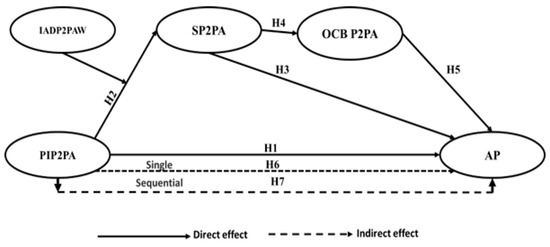
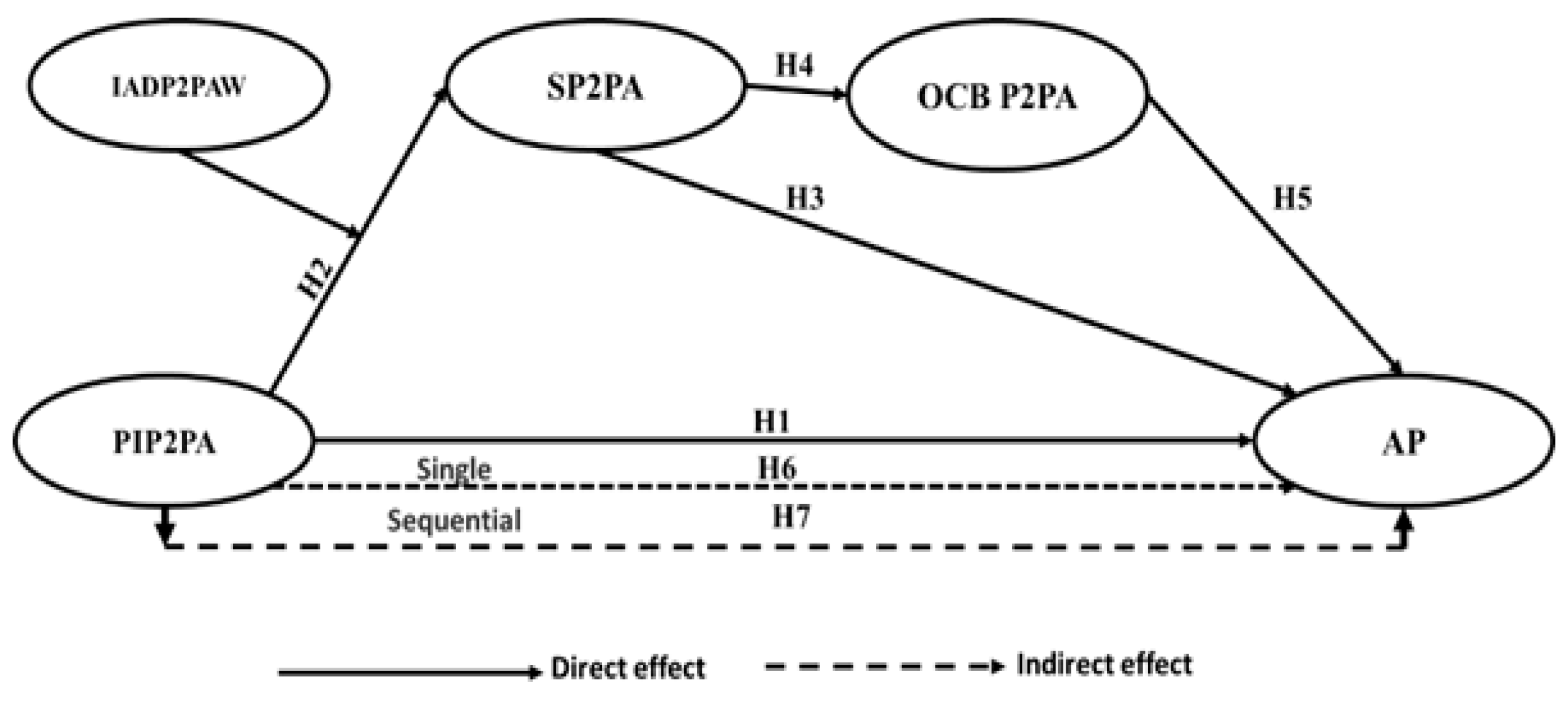
The significance of websites has resulted in the production of various studies on technology (internet) and tourism. Several studies on the evaluation of tourism websites have concluded that information is one of the most critical success criteria [51,52]. The importance of this information increases according to its variety, accuracy, relevance, or reliability [53]. The information on the rural destination where the P2P hosts are situated concerns a critical variable influencing the adoption of websites by guests of agritourism [54]. It is also postulated that this information positively impacts the promotion of rural destinations, thereby boosting the rural community’s support for the P2P accommodations placed therein. On this basis, we develop the following hypothesis ( as shown in Figure 1):
Figure 1.
The proposed conceptual framework and hypotheses. PIP2PA→Positive Impacts of P2PA; AP→Agritourism performance; SP2PA→Support for P2PA; OCBP2PA→Organizational Citizenship Behavior toward P2PA; IADP2PAW→Information on Agritourism Destination on the P2PA website.
Hypothesis 7 (H7).
The information on the agritourism destination on the P2P accommodation website moderates the influence of the positive impacts of P2P accommodations on the support for P2P accommodations, such that the relationship will be stronger when the information on the agritourism destination on the P2P accommodation website is extensive.
3. Methodology
3.1. Instrument Measurement
A questionnaire was created to test the hypotheses. An extensive review of the literature defined the study’s scales. Thus, five dimensions have been identified. The PIP2PA (Positive Impacts of Peer-to-Peer Accommodation) and SP2PA (Support for P2PA) were tested by 14 items based on the findings of [55]. The AP (Agritourism performance) was measured using the eight-item scale proposed by [56]. Seven items from [44] were employed to measure organizational Citizenship Behavior toward P2PA (OCBP2PA). Finally, the IADP2PAW (Information on Agritourism Destination on the P2PA Website) was measured using the nine-item scale proposed by [54]. A Likert scale of 1 (strongly disagree) to 5 (strongly agree) was employed. The text was transcribed and clarified. Eight Academics and eight professionals in the field tested the instrument. The content was retained and processed with no changes.
3.2. Participants and Data Collection
The research team selected Airbnb firms in KSA’s eastern province’s rural destinations to conduct the field study. As a result of its success, the number of Airbnb studies has recently grown [39], with the platform accounting for nearly 75% of peer-to-peer accommodation studies in the academic literature [33]. Data collection was accomplished through a web-based and paper questionnaire survey. The survey was divided into two stages. Residents—who were not Airbnb hosts but had Airbnb activity in their locations and were aware of this activity—were required to provide the necessary information for the PIP2PA, SP2PA, P2PA, and IADP2PAW variables in the first survey stage. A month later, Airbnb hosts in the same rural destinations completed the OCBP2PA questionnaire. In the two surveys, 300 questionnaires were distributed. After eliminating the unqualified and useless questionnaires, 246 resident–host dyads were evaluated, with an effective recovery rate of 82%. The final resident sample comprised 192 males (78%) and 54 females (22%). They were mainly aged between 28 and 45 years of age. For Airbnb hosts, the final host sample consisted of 203 males (82.5%) and 43 females (17.5%). The previous results showed that the majority of the Airbnb hosts were males They were mainly aged 24–47 years of age, with most of them having a university degree (86.5%).
The previous results showed that the majority of the respondents were educated mature (24–47 years old) males, which is consistent with the nature of residents in KSA as a dominant masculinity country. The majority of KSA women have a tendency to place their trust in their male spouses because they believe their partners are better equipped to deal with the majority of life’s challenges.
To check for non-response bias and check how representative the responding sample was, an independent t-test was used. No statistically significant difference was found between early and late responses in terms of the mean, indicating that non-response bias was not a problem in this study [57].
4. Data Analysis Results
The current study utilized “Structural Equation Modeling” (SEM) via the “Partial least squares PLS” technique to examine the hypotheses of the research with SmartPLS-3.0. The proposed theoretical model was examined using a two-step approach suggested by [57], which is illustrated as follows.
4.1. Assessment of Outer Measurement Model
To evaluate the outer model’s reliability and validity, the internal consistency reliability, indicator reliability, convergent validity, and discriminant validity were all tested. First, as displayed in Table 1, the structures’ internal consistency reliability was tested with Cronbach’s alpha (α) ranging from 0.933 to 0.966 and the composite reliability (CR) ranging from 0.946 to 0.970.
Table 1.
Assessment of the formative measurement model.
Second, the indicators’ reliability was acceptable as all the loading values of the structure indicators were higher than 0.70. Third, the convergent validity was evaluated by the average variance extracted (AVE) values exceeding the satisfactory value of 0.50 [57]. Finally, three criteria were implemented to assess the discriminant validity of the constructs: the cross-loading, Fornell–Larcker criterion, and heterotrait–monotrait ratio (HTMT) [57]. As indicated in Table 2, the outer-loading for each latent variable (underlined and bolded) was higher than the cross-loading with other measurements.
Table 2.
Cross-loading results.
As illustrated in Table 3, the bolded values of the AVEs in the diagonals are greater than the correlation coefficients between variables. Ref. [58] states that HTMT readings should be less than 0.90. The levels for HTMT in this study were lower than this value (see Table 3). The results indicate that the model’s structure has appropriate discriminant validity. As a result, the outer measurement model’s outputs were regarded as sufficient to proceed with the structural model’s evaluation.
Table 3.
Inter-construct correlations, the square root of AVE, and HTMT results.
4.2. Assessment of the Structural Model
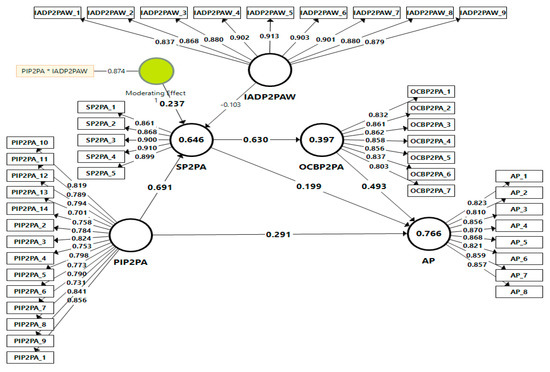
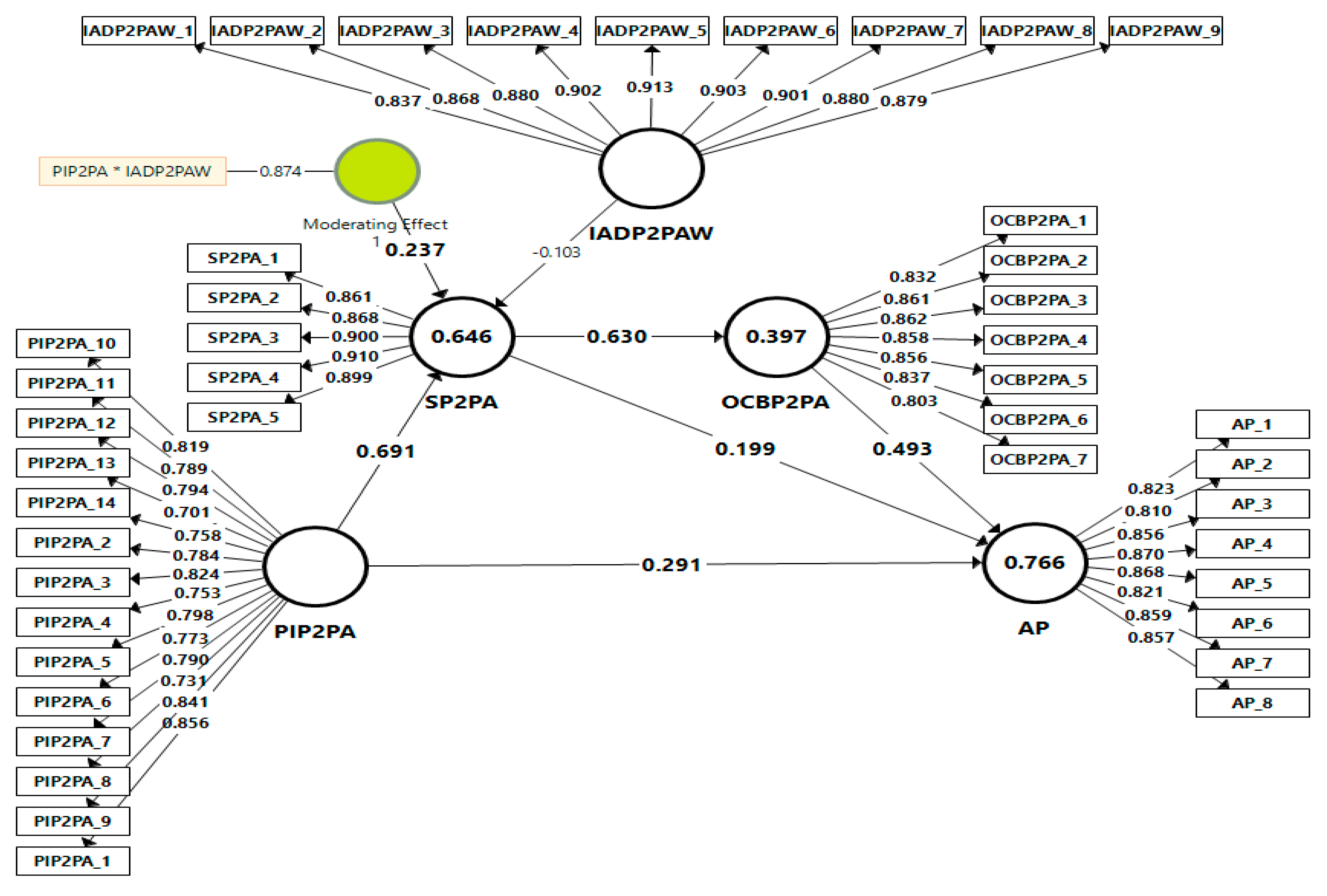
The hypotheses were then tested by a structural equation analysis (SQM). In particular, the model’s predictive capacity and explanatory power were analyzed [59]. With the VIF values of the manifest indicators ranging from 2.734 to 4.951 below 5, the multicollinearity of the structural model has been verified as inexistent. Next, [60] indicated that the lower limit for the R2 values is 0.10. Therefore, the R2 values for the variables of AP (R2 = 0.766), OCBP2PA (R2 = 0.397), and SP2PA (R2 = 0.646) are acceptable (Table 4). Moreover, The Stone-Geisser Q2 test indicates AP, OCBP2PA, and SP2PA values greater than zero (Table 4), indicating the adequate predictive validity of the model [61]. Accordingly, the sufficient predictive validity of the structural model was also confirmed.
Table 4.
Coefficient of determination R2 and Q2 of the model.
Lastly, the path coefficient and t-value of the hypothesized association were analyzed using a bootstrapping technique. Table 5 and Figure 2 below display the hypothesis test results, given the path coefficient values and the relevant significance. The PIP2PA was found to have a positive and significant correlation with the AP at β = 0.291—p < 0.001 and with the SP2PA at β = 0.691—p < 0.001, so H1 and H2 were supported. The findings showed that the SP2PA significantly and positively influenced the OCBP2PA (β = 0.630, p < 0.001), supporting H3. H4 also was accepted because the correlation between the OCBP2PA and AP is positive and significant at β = 0.493 with p < 0.001. The mediation exerted by the variable SP2PA in the PIP2PA–AP relationship with β = 0.138 and p < 0.001 is significant, i.e., H5 can be accepted. In the same vein, the sequential mediation of the SP2PA and OCBP2PA in the relationship between the PIP2PA and AP yielded a result of β = 0.215 with p < 0.001, which allows us to accept H6. Finally, the results confirm the positive moderation effect of the IADP2PAW on PIP2PA towards the SP2PA at β = 0.237 with p < 0.001, which supports H7.
Table 5.
The structural model’s results.
Figure 2.
The tested structural and measurement model. PIP2PA→Positive Impacts of P2PA; AP→ Agritourism performance; SP2PA→Support for P2PA; OCBP2PA→Organizational Citizenship Behavior toward P2PA; IADP2PAW→Information on Agritourism destination on the P2PA website; * moderating effect.
5. Discussion and Implications
5.1. PIP2PA, PA, SP2PA, and OCBP2PA (Direct Relationship)
This study’s results reveal a direct and positive relationship between the PIP2PA and AP (Hypothesis 1). The current findings are aligned with the notion that the PIP2PA increases agritourism’s performance and value [30,40]. It is argued that the presence of P2P accommodations in less developed tourism destinations (e.g., rural destinations) can spur ignored types of tourism (e.g., agritourism) [62] without necessarily causing the negative consequences observed in primary destinations, mainly urban tourism markets [28,63]. This study additionally confirms that the PIP2PA represent an antecedent factor in the SP2PA practice implementation (Hypothesis 2); this result matches the use of social exchange theory (SCT) to illustrate an interaction between residents and P2P accommodation firms based on the principle of reciprocity [47,48,49]. Furthermore, our findings help verify the positive influence of the SP2PA on OCBP2PA (Hypothesis 3). This study consequently extends the OCB literature by examining the OCB in the collaborative relations in a sharing economy, which is consistent with [44]. It follows from the results obtained that the OCBP2PA positively influences the AP achieved (Hypothesis 4). This supports the notion that corporate social responsibility (CSR) encourages positive attitudes among employees while suppressing negative ones. CSR can also make an OCB. In the context of the sharing economy, a P2P host is a kind of worker and service provider. From this perspective, it can be assumed that P2P hosts’ perception of a P2P firm’s social responsibility toward their community helps to increase the OCB behaviors toward it [64]. This reciprocal relationship ultimately leads to improving the performance of agritourism.
5.2. Assessing the Moderating Effect
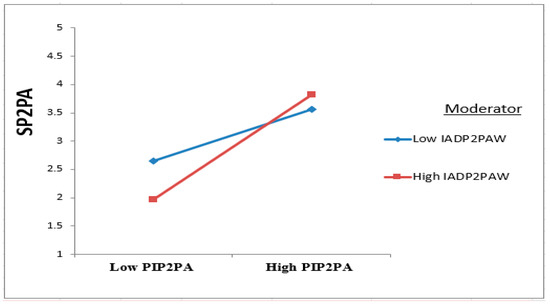
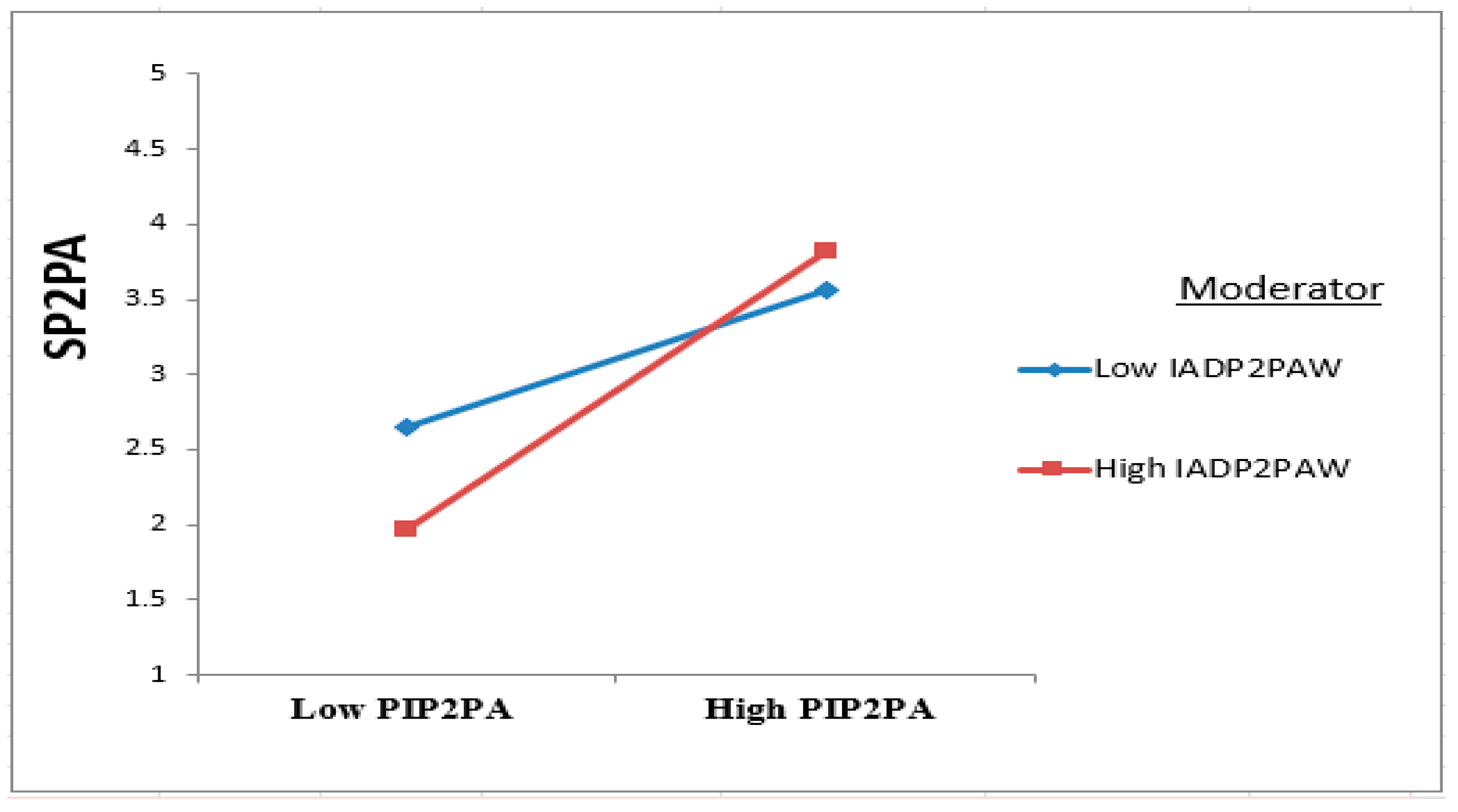
The practical results validated the positive moderation influences of the IADP2PAW variable on the relationship between the PIP2PA and SP2PA (Hypothesis 7). In other words, the IADP2PAW can strengthen the positive relationship between the PIP2PA and SP2PA (Figure 3, Interaction plot). Returning to Figure 2 and calculating the moderator’s interaction values (0.691 + 0.237 = 0.928), we conclude that the IADP2PAW strengthened the relationship between the PIP2PA and SP2PA. This result agrees with the findings of [54]. Additionally in line with this result, Airbnb—as an example of a P2P platform—has more robust data, given the large number of users, listings, and reviews, than the metropolitan planners, placing itself as a strong knowledge broker in the future of tourism that may change travel destinations [65]. Thus, having information about the destination of agritourism on the P2P platform improves agritourism performance, and the result is an increase in community support for P2P companies.
Figure 3.
Interaction plot for the IADP2PAW moderation effect on PIP2PA towards SP2PA.
5.3. The Mediating Role of SP2PA and OCBP2PA in the Study Model
One of the study’s main aims was to examine the mediating role of the SP2PA and OCBP2PA between the PIP2PA and AP. In relation to hypothesis 5, the results confirm that the role of the SP2PA as a mediating variable in the relationship between the PIP2PA and AP is significant and positive. Finally, the empirical evidence obtained permits us to state that the sequential mediation exerted by the variables SP2PA and OCBP2PA indirectly affects the relationship between the PIP2PA and AP (Hypothesis 6). These results are consistent with social representation theory (SR), which suggests that residents’ perceptions of tourism impacts are “informed by direct experiences, social interaction and other information sources such as the media” [66] and often dictated by instinct and practical consciousness [67,68]. According to [69], local community members are categorized into three groups: advocates, the socially and environmentally concerned, and economic skeptics. Thus, when the rural community (i.e., residents and rural P2P hosts) feels the P2P accommodation’s positive effects, it will support said accommodation.
By examining the mediating relationships in the model of this study, we find that the indirect effect of the sequential mediation of the SP2PA and OCBP2PA variables in the relationship between the PIP2PA and AP was more significant than the mediating effect of the SP2PA in the same association, and in both cases the mediation was partial. Thus, we can conclude that the relationship between the PIP2PA and AP is not dependent only on community support or organizational citizenship behaviors of the P2P hosts. Further research is required to identify other elements that may support the relationship between the PIP2PA and AP. These variables may be the responsibility of local authorities or officials of tourism affairs.
The current paper presents clear theoretical and practical implications. In terms of the theoretical implications, this study not only improves our understanding of the peer-to-peer economy but also gives it a new function by highlighting the advantages of P2P lodgings and demonstrating how they can be used to realize the economy’s potential regarding support for sustaining rural communities through the growth of agricultural tourism. In terms of practical implications, this paper delivers a valuable synthesis of P2P accommodations’ economic role and P2P firm–local community exchange relationships that should be useful to both, especially rural destinations. By supporting this type of micro-enterprise (e.g., P2P accommodations), it is possible to build local economies that protect members of society from the problems of a lack of government capabilities, in addition to P2P firms’ ability to promote the local heritage, which appeals to many segments of tourists who long for nostalgia [70,71]. In addition, it is recommended that decision-makers in Saudi Arabia plan aids or specific policies aimed at enhancing the country’s agritourism sector.
6. Conclusions and Further Studies Opportunities
The amount of research that has been undertaken on the effects of peer-to-peer accommodations on the birth and development of different tourism types is still very limited. This study directly reacts to calls by [72,73] to broaden the understanding of P2P accommodation’s effects by incorporating a holistic approach to examine the viewpoints of multiple stakeholders. We have employed an integrative view of P2P accommodations and rural destinations, which has allowed us to use the business growth theory, the social exchange theory (SCT), the affective events theory (AET), and social representation theory (SR) to explain how rural destinations can take advantage of the positives of P2P accommodations to develop agricultural tourism.
Furthermore, the study tested and confirmed four direct relationships, two mediators, and one moderator effect. Specifically, the study investigated the impact of the positive impacts of peer-to-peer accommodations (PAP2PA) on agritourism performance (AP) with the mediating role of support for P2PA (SP2PA) and an organizational citizenship behavior toward P2PA (OCBP2PA) and the moderating role of information on the agritourism destination on the P2PA website (IADP2PA). The results of the tested model showed that all the direct, mediating, and moderating impacts were supported. Additionally, the study showed the reciprocal relationship between the P2P platform and its hosts, where the hosts showed organizational citizenship behaviors towards the P2P platform as a result of mutual support between residents and P2P companies.
The current study, similar to other studies on this subject, has several limitations, and such limitations suggest investigating additional research avenues. First, apart from the employed mediating variables (SP2PA and OCBP2PA) and moderating variable (IADP2PA), other variables can be further examined as a moderator, such as gender, country, quality of life, and guest age, while other dimensions can be further investigated as mediators, such as tourists’ perceived experience and tourists’ satisfaction. Second, using cross-sectional data enables the determination of the exact causal relationships between the tested variables. In the future, researchers may try to validate the structural model of the study by using longitudinal data or multiple sources of data. Third, an evaluation of these relationships in a variety of other settings can be accomplished through the utilization of a multi-group analysis technique (country or industry).
Author Contributions
Conceptualization, I.A.E. and S.F.; methodology, I.A.E., S.F. and A.M.S.A.; software, I.A.E. and S.F.; validation, I.A.E., A.M.S.A., F.A.A. and S.F.; formal analysis, I.A.E. and A.M.S.A.; investigation, I.A.E., S.F. and A.M.S.A.; resources, I.A.E.; data curation, I.A.E.; writing—original draft preparation, S.F., I.A.E. and A.M.S.A.; writing—review and editing, I.A.E., S.F. and A.M.S.A.; visualization, I.A.E.; supervision, I.A.E.; project administration, I.A.E., S.F., F.A.A. and A.M.S.A.; funding acquisition, I.A.E. and A.M.S.A. All authors have read and agreed to the published version of the manuscript.
Funding
This work was supported by The Saudi Investment Bank Scholarly Chair for Investment Awareness Studies, the Deanship of Scientific Research, Vice Presidency for Graduate Studies and Scientific Research, King Faisal University, Saudi Arabia (Grant No. CHAIR147).
Institutional Review Board Statement
The study was conducted according to the guidelines of the Declaration of Helsinki and approved by the deanship of the scientific research ethical committee, King Faisal University (project number: CHAIR147, date of approval: 1 July 2022).
Informed Consent Statement
Informed consent was obtained from all subjects involved in the study.
Data Availability Statement
Data are available upon request from researchers who meet the eligibility criteria. Kindly contact the first author privately through the e-mail.
Conflicts of Interest
The authors declare no conflict of interest.
References
- World Tourism Organization. Tourism Towards 2030; World Tourism Organization: Madrid, Spain, 2011. [Google Scholar]
- Lak, A.; Khairabadi, O. Leveraging agritourism in rural areas in developing countries: The case of Iran. Front. Sustain. Cities 2022, 4, 95. [Google Scholar] [CrossRef] [Scilit]
- Gil Arroyo, C.; Barbieri, C.; Rozier Rich, S. Defining agritourism: A comparative study of stakeholders’ perceptions in Missouri and North Carolina. Tour. Manag. 2013, 37, 39–47. [Google Scholar] [CrossRef] [Scilit]
- Pérez-Olmos, K.N.; Aguilar-Rivera, N. Agritourism and sustainable local development in Mexico: A systematic review. Environ. Dev. Sustain. 2021, 23, 17180–17200. [Google Scholar] [CrossRef] [Scilit]
- Rauniyar, S.; Awasthi, M.K.; Kapoor, S.; Mishra, A.K. Agritourism: Structured literature review and bibliometric analysis. Tour. Recreat. Res. 2021, 46, 52–70. [Google Scholar] [CrossRef] [Scilit]
- Barbieri, C.; Mshenga, P.M. The role of the firm and owner characteristics on the performance of agritourism farms. Sociol. Rural. 2008, 48, 166–183. [Google Scholar] [CrossRef] [Scilit]
- Sonnino, R. For a “piece of bread”? Interpreting sustainable development through agritourism in Southern Tuscany. Sociol. Rural. 2004, 44, 285–300. [Google Scholar] [CrossRef] [Scilit]
- Tew, C.; Barbieri, C. The perceived benefits of agritourism: The provider’s perspective. Tour. Manag. 2012, 33, 215–224. [Google Scholar] [CrossRef] [Scilit]
- Baig, S.; Khan, A.A.; Khan, A.A.; Bano, S. Rural tourism, income and rapid urbanization: Exploring the nexus using a multidisciplinary approach for Hunza, Pakistan. Int. J. Econ. Environ. Geol. 2020, 10, 1–6. [Google Scholar] [CrossRef] [Scilit]
- Askarpour, M.H.; Mohammadinejad, A.; Moghaddasi, R. Economics of agritourism development: An iranian experience. Econ. J. Emerg. Mark. 2020, 12, 93–104. [Google Scholar] [CrossRef] [Scilit]
- Nunkoo, R.; Gursoy, D. Residents’ support for tourism. Ann. Tour. Res. 2012, 39, 243–268. [Google Scholar] [CrossRef] [Scilit]
- Blair, H.; Bosak, K.; Gale, T. Protected areas, tourism, and rural transition in Aysén, Chile. Sustainability 2019, 11, 7087. [Google Scholar] [CrossRef] [Scilit]
- MacDonald, R.; Jolliffe, L. Cultural rural tourism. Ann. Tour. Res. 2003, 30, 307–322. [Google Scholar] [CrossRef] [Scilit]
- Jaafar, M.; Rasoolimanesh, S.M.; Lonik, K.A.T. Tourism growth and entrepreneurship: Empirical analysis of development of rural highlands. Tour. Manag. Perspect. 2015, 14, 17–24. [Google Scholar] [CrossRef] [Scilit]
- Kizos, T.; Iosifides, T. The contradictions of agrotourism development in Greece: Evidence from three case studies. South Eur. Soc. Politics 2007, 12, 59–77. [Google Scholar] [CrossRef] [Scilit]
- Barbieri, C.; Mahoney, E.; Butler, L. Understanding the nature and extent of farm and ranch diversification in North America. Rural Sociol. 2008, 73, 205–229. [Google Scholar] [CrossRef] [Scilit]
- Komppula, R. The role of individual entrepreneurs in the development of competitiveness for a rural tourism destination—A case study. Tour. Manag. 2014, 40, 361–371. [Google Scholar] [CrossRef] [Scilit]
- Ye, S.; Xiao, H.; Zhou, L. Small accommodation business growth in rural areas: Effects on guest experience and financial performance. Int. J. Hosp. Manag. 2019, 76, 29–38. [Google Scholar] [CrossRef] [Scilit]
- Guttentag, D. Airbnb: Disruptive innovation and the rise of an informal tourism accommodation sector. Curr. Issues Tour. 2015, 18, 1192–1217. [Google Scholar] [CrossRef] [Scilit]
- Goodwin, H.; Santilli, R. Community-based tourism: A success. ICRT Occas. Pap. 2009, 11, 37. [Google Scholar]
- Shaw, G.; Williams, A.M. Critical Issues in Tourism: A Geographical Perspective; Blackwell Publishers: Hoboken, NJ, USA, 1994. [Google Scholar]
- Getz, D.; Petersen, T. Growth and profit-oriented entrepreneurship among family business owners in the tourism and hospitality industry. Int. J. Hosp. Manag. 2005, 24, 219–242. [Google Scholar] [CrossRef] [Scilit]
- Skokic, V.; Morrison, A. Conceptions of tourism lifestyle entrepreneurship: Transition economy context. Tour. Plan. Dev. 2011, 8, 157–169. [Google Scholar] [CrossRef] [Scilit]
- di Domenico, M. ‘I’m not just a housewife’: Gendered roles and identities in the home-based hospitality enterprise. Gend. Work. Organ. 2008, 15, 313–332. [Google Scholar] [CrossRef] [Scilit]
- Nunkoo, R.; Ramkissoon, H. Developing a community support model for tourism. Ann. Tour. Res. 2011, 38, 964–988. [Google Scholar] [CrossRef] [Scilit]
- Weiss, H.M.; Cropanzano, R. Affective events theory. Res. Organ. Behav. 1996, 18, 1–74. [Google Scholar]
- Pierce, J.L.; Kostova, T.; Dirks, K.T. The state of psychological ownership: Integrating and extending a century of research. Rev. Gen. Psychol. 2003, 7, 84–107. [Google Scholar] [CrossRef]
- Leick, B.; Kivedal, B.K.; Eklund, M.A.; Vinogradov, E. Exploring the relationship between Airbnb and traditional accommodation for regional variations of tourism markets. Tour. Econ. 2022, 28, 1258–1279. [Google Scholar] [CrossRef] [Scilit]
- Dann, D.; Teubner, T.; Weinhardt, C. Poster child and guinea pig—Insights from a structured literature review on Airbnb. Int. J. Contemp. Hosp. Manag. 2019, 31, 427–473. [Google Scholar] [CrossRef] [Scilit]
- Dolnicar, S. Sharing economy and peer-to-peer accommodation—A perspective paper. Tour. Rev. 2021, 76, 34–37. [Google Scholar] [CrossRef] [Scilit]
- Godovykh, M.; Back, R.M.; Bufquin, D.; Baker, C.; Park, J.-Y. Peer-to-peer accommodation amid COVID-19: The effects of Airbnb cleanliness information on guests’ trust and behavioral intentions. Int. J. Contemp. Hosp. Manag. 2022. ahead-of-print. [Google Scholar] [CrossRef] [Scilit]
- Dolnicar, S. A review of research into paid online peer-to-peer accommodation: Launching the annals of tourism research curated collection on peer-to-peer accommodation. Ann. Tour. Res. 2019, 75, 248–264. [Google Scholar] [CrossRef] [Scilit]
- Kuhzady, S.; Seyfi, S.; Béal, L. Peer-to-peer (P2P) accommodation in the sharing economy: A review. Curr. Issues Tour. 2020, 25, 3115–3130. [Google Scholar] [CrossRef] [Scilit]
- Mody, M.; Suess, C.; Dogru, T. How does my neighbor feel about my Airbnb? Boston Hosp. Rev. 2018, 18, 1–19. [Google Scholar]
- Shankman, S. Documentary: Barcelona and the Trials of 21st Century Overtourism; Skift: New York, NY, USA, 2017. [Google Scholar]
- Benner, K. Inside the Hotel Industry’s Plan to Combat Airbnb. New York Times. 2017. Available online: https://www.cnbc.com/2017/04/17/inside-the-hotel-industrys-plan-to-combat-airbnb.html (accessed on 1 September 2022).
- Mody, M.; Suess, C.; Dogru, T. Not in my backyard? Is the anti-airbnb discourse truly warranted? Ann. Tour. Res. 2019, 74, 198–203. [Google Scholar] [CrossRef] [Scilit]
- Guttentag, D. Regulating innovation in the collaborative economy: An examination of airbnb’s early legal issues. In Collaborative Economy and Tourism: Perspectives, Politics, Policies and Prospects; Dredge, D., Gyimóthy, S., Eds.; Springer International Publishing: Cham, Switzerland, 2017; pp. 97–128. [Google Scholar] [CrossRef] [Scilit]
- Guttentag, D. Progress on Airbnb: A literature review. J. Hosp. Tour. Technol. 2019, 10, 814–844. [Google Scholar] [CrossRef] [Scilit]
- Jang, S.; Kim, J.; Kim, J.; Kim, S.S. Spatial and experimental analysis of peer-to-peer accommodation consumption during COVID-19. J. Destin. Mark. Manag. 2021, 20, 100563. [Google Scholar] [CrossRef] [Scilit]
- Ashworth, G.; Page, S.J. Urban tourism research: Recent progress and current paradoxes. Tour. Manag. 2011, 32, 1–15. [Google Scholar] [CrossRef] [Scilit]
- Tinsley, R.; Lynch, P. Small tourism business networks and destination development. Int. J. Hosp. Manag. 2001, 20, 367–378. [Google Scholar] [CrossRef] [Scilit]
- Sundararajan, A. What Airbnb gets about culture that uber doesn’t. Harv. Bus. Rev. 2014, 11. [Google Scholar]
- Lee, H.; Yang, S.-B.; Koo, C. Exploring the effect of airbnb hosts’ attachment and psychological ownership in the sharing economy. Tour. Manag. 2019, 70, 284–294. [Google Scholar] [CrossRef] [Scilit]
- van Dyne, L.; Pierce, J.L. Psychological ownership and feelings of possession: Three field studies predicting employee attitudes and organizational citizenship behavior. J. Organ. Behav. 2004, 25, 439–459. [Google Scholar] [CrossRef] [Scilit]
- Elshaer, I.A.; Azazz, A.M.S.; Fayyad, S. Underdog environmental expectations and environmental organizational citizenship behavior in the hotel industry: Mediation of desire to prove others wrong and individual green values as a moderator. Int. J. Environ. Res. Public Health 2022, 19, 9501. [Google Scholar] [CrossRef] [Scilit] [PubMed]
- Priporas, C.-V.; Stylos, N.; Rahimi, R.; Vedanthachari, L.N. Unraveling the diverse nature of service quality in a sharing economy. Int. J. Contemp. Hosp. Manag. 2017, 29, 2279–2301. [Google Scholar] [CrossRef] [Scilit]
- Kim, J.; Yoon, Y.; Zo, H. Why people participate in the sharing economy: A social exchange perspective. PACIS 2015, 76, 1–10. [Google Scholar]
- Bellotti, V.; Ambard, A.; Turner, D.; Gossmann, C.; Demkova, K.; Carroll, J.M. A muddle of models of motivation for using peer-to-peer economy systems. In Proceedings of the 33rd Annual ACM Conference on Human Factors in Computing Systems, ACM, New York, NY, USA, 18–23 April 2015; pp. 1085–1094. [Google Scholar] [CrossRef] [Scilit]
- Akarsu, T.N.; Foroudi, P.; Melewar, T. What makes airbnb likeable? Exploring the nexus between service attractiveness, country image, perceived authenticity and experience from a social exchange theory perspective within an emerging economy context. Int. J. Hosp. Manag. 2020, 91, 102635. [Google Scholar] [CrossRef] [Scilit]
- Bai, B.; Law, R.; Wen, I. The impact of website quality on customer satisfaction and purchase intentions: Evidence from Chinese online visitors. Int. J. Hosp. Manag. 2008, 27, 391–402. [Google Scholar] [CrossRef] [Scilit]
- Law, R.; Hsu, C.H.C. Importance of hotel website dimensions and attributes: Perceptions of online browsers and online purchasers. J. Hosp. Tour. Res. 2006, 30, 295–312. [Google Scholar] [CrossRef] [Scilit]
- Park, Y.A.; Gretzel, U. Success factors for destination marketing web sites: A qualitative meta-analysis. J. Travel Res. 2007, 46, 46–63. [Google Scholar] [CrossRef] [Scilit]
- Herrero, Á.; San Martín, H. Developing and testing a global model to explain the adoption of websites by users in rural tourism accommodations. Int. J. Hosp. Manag. 2012, 31, 1178–1186. [Google Scholar] [CrossRef] [Scilit]
- Mody, M.; Suess, C.; Dogru, T. Does Airbnb impact non-hosting residents’ quality of life? Comparing media discourse with empirical evidence. Tour. Manag. Perspect. 2021, 39, 100853. [Google Scholar] [CrossRef] [Scilit]
- Domi, S.; Belletti, G. The role of origin products and networking on agritourism performance: The case of Tuscany. J. Rural. Stud. 2022, 90, 113–123. [Google Scholar] [CrossRef] [Scilit]
- Leguina, A. A Primer on partial least squares structural equation modeling (PLS-SEM). Int. J. Res. Method Educ. 2015, 38, 220–221. [Google Scholar] [CrossRef] [Scilit]
- Gold, A.H.; Malhotra, A.; Segars, A.H. Knowledge management: An organizational capabilities perspective. J. Manag. Inf. Syst. 2001, 18, 185–214. [Google Scholar] [CrossRef] [Scilit]
- Hair, J.F., Jr.; Hult, G.T.M.; Ringle, C.; Sarstedt, M. A Primer on Partial Least Squares Structural Equation Modeling (PLS-SEM); SAGE Publications: New York, NY, USA, 2016. [Google Scholar]
- Chin, W.W. The partial least squares approach for structural equation modeling. Mod. Methods Bus. Res. 1998, 295, 295–336. [Google Scholar]
- Henseler, J.; Ringle, C.M.; Sinkovics, R.R. The use of partial least squares path modeling in international marketing. In Advances in International Marketing; Sinkovics, R.R., Ghauri, P.N., Eds.; Advances in International Marketing; Emerald Group Publishing Limited: Bingley, UK, 2009; Volume 20, pp. 277–319. [Google Scholar] [CrossRef] [Scilit]
- Oskam, J.; Boswijk, A. Airbnb: The future of networked hospitality businesses. J. Tour. Futures 2016, 2, 22–42. [Google Scholar] [CrossRef] [Scilit]
- Strømmen-Bakhtiar, A.; Vinogradov, E.; Kvarum, M.K.; Antonsen, K.R. Airbnb contribution to rural development. Int. J. Innov. Digit. Econ. 2020, 11, 31–46. [Google Scholar] [CrossRef] [Scilit]
- Tie, X.R.; Lee, H.; Chung, N. Airbnb host’s perceptions on airbnb customer social responsibility and organizational justice in Airbnb 2.0. In Information and Communication Technologies in Tourism 2021; Springer International Publishing: Cham, Switzerland, 2021; pp. 216–221. [Google Scholar] [CrossRef] [Scilit]
- Lalicic, L.; Marine-Roig, E.; Ferrer-Rosell, B.; Martin-Fuentes, E. Destination image analytics for tourism design: An approach through Airbnb reviews. Ann. Tour. Res. 2021, 86, 103100. [Google Scholar] [CrossRef] [Scilit]
- Cheng, M.; Houge Mackenzie, S.; Degarege, G.A. Airbnb impacts on host communities in a tourism destination: An exploratory study of stakeholder perspectives in Queenstown, New Zealand. J. Sustain. Tour. 2022, 30, 1122–1140. [Google Scholar] [CrossRef] [Scilit]
- Sharpley, R. Host perceptions of tourism: A review of the research. Tour. Manag. 2014, 42, 37–49. [Google Scholar] [CrossRef] [Scilit]
- Suess, C.; Mody, M. Gaming can be sustainable too! Using social representation theory to examine the moderating effects of tourism diversification on residents’ tax paying behavior. Tour. Manag. 2016, 56, 20–39. [Google Scholar] [CrossRef] [Scilit]
- Andriotis, K.; Vaughan, R.D. Urban residents’ attitudes toward tourism development: The case of crete. J. Travel Res. 2003, 42, 172–185. [Google Scholar] [CrossRef] [Scilit]
- Elshaer, I.A.; Azazz, A.M.S.; Fayyad, S. Authenticity, involvement, and nostalgia in heritage hotels in the era of digital technology: A moderated meditation model. Int. J. Environ. Res. Public Health 2022, 19, 5784. [Google Scholar] [CrossRef] [Scilit]
- Elshaer, I.A.; Fayyad, S.; Ammar, S.; Abdulaziz, T.A.; Mahmoud, S.W. Adaptive reuse of heritage houses and hotel conative loyalty: Digital technology as a moderator and memorable tourism and hospitality experience as a mediator. Sustainability 2022, 14, 3580. [Google Scholar] [CrossRef] [Scilit]
- Cheng, M. Sharing economy: A review and agenda for future research. Int. J. Hosp. Manag. 2016, 57, 60–70. [Google Scholar] [CrossRef] [Scilit]
- Prayag, G.; Ozanne, L.K. A systematic review of peer-to-peer (P2P) accommodation sharing research from 2010 to 2016: Progress and prospects from the multi-level perspective. J. Hosp. Mark. Manag. 2018, 27, 649–678. [Google Scholar] [CrossRef] [Scilit]

Publisher’s Note: MDPI stays neutral with regard to jurisdictional claims in published maps and institutional affiliations. |
© 2022 by the authors. Licensee MDPI, Basel, Switzerland. This article is an open access article distributed under the terms and conditions of the Creative Commons Attribution (CC BY) license (https://creativecommons.org/licenses/by/4.0/).