


Abstract
Background/Objectives: The C-reactive protein–albumin–lymphocyte (CALLY) index integrates systemic inflammation, nutritional status, and immune competence. We investigated the association between the preoperative CALLY index and early outcomes after isolated coronary artery bypass grafting (CABG). Methods: This single-center retrospective study included 470 consecutive patients who underwent elective isolated CABG between January 2024 and June 2025. The CALLY index was calculated from preoperative serum albumin, lymphocyte count, and C-reactive protein. The optimal cut-off for in-hospital mortality was determined by receiver operating characteristic (ROC) analysis and 1:1 propensity score matching was applied. Results: Thirteen patients (2.8%) died in hospital. The area under the curve (AUC) of the CALLY index for in-hospital mortality was 0.662 (95% confidence interval [CI] 0.516–0.809); the optimal cut-off was 0.230 (sensitivity 76.9%, specificity 58.0%). In the unmatched cohort, patients with a low CALLY index (<0.230; n = 202) had higher in-hospital mortality (5.0% vs. 1.1%, p = 0.012), more deep sternal wound infections (6.9% vs. 2.6%, p = 0.025), and a longer hospital stay. After matching (165 pairs), mortality no longer differed significantly (3.0% vs. 1.2%, p = 0.448), whereas postoperative hospital stay remained longer in the low-CALLY group (median 7 vs. 6 days, p = 0.026), although this difference was of borderline significance in paired and sensitivity analyses. Conclusions: A low preoperative CALLY index was associated with a modestly longer postoperative hospital stay after isolated CABG, an association that was consistent in direction but of borderline significance in sensitivity analyses. The CALLY index did not improve mortality prediction beyond EuroSCORE II. These exploratory findings require external validation.
1. Introduction
Coronary artery disease (CAD) remains a leading cause of morbidity and mortality worldwide. Coronary artery bypass grafting (CABG) is the standard revascularization strategy for patients with complex multivessel or left main disease, particularly in the presence of diabetes mellitus [1,2]. Despite continuous improvements in surgical technique and perioperative care, postoperative complications such as atrial fibrillation, renal dysfunction, wound infection, stroke, and death still occur, prolong hospitalization, and increase healthcare costs [2,3].
Surgical trauma and cardiopulmonary bypass (CPB) trigger a systemic inflammatory response characterized by complement activation, cytokine release, endothelial dysfunction, and oxidative stress, and an exaggerated response has been linked to postoperative organ dysfunction and mortality [4]. Accordingly, composite blood-based indices such as the systemic immune-inflammation index have been associated with adverse outcomes after cardiac surgery and CABG [5,6]. However, recovery after surgery also depends on nutritional reserve and immune competence, which are not captured by purely inflammatory indices.
The C-reactive protein–albumin–lymphocyte (CALLY) index combines these three domains in a single score derived from routine laboratory tests. It was first described by Iida et al. as a prognostic marker after hepatectomy for hepatocellular carcinoma [7] and has since been associated with survival in colorectal and gastric cancer, in broader cancer populations, and in acute ischemic stroke [8,9,10,11]. Recent reports have extended its use to coronary surgery, including conventional CABG and minimally invasive direct coronary artery bypass (MIDCAB) [12,13]. Nevertheless, evidence on its relationship with early outcomes after isolated CABG remains limited, and few studies have accounted for baseline imbalances between patients with high and low CALLY values.
Therefore, the aim of this study was to evaluate the association between the preoperative CALLY index and in-hospital mortality, postoperative morbidity, and length of hospital stay after isolated CABG using propensity score matching.
2. Materials and Methods
This retrospective, single-center, observational study was conducted at the Department of Cardiovascular Surgery, Basaksehir Cam and Sakura City Hospital, Istanbul, Turkey. All consecutive adult patients (≥18 years) who underwent elective isolated CABG between January 2024 and June 2025 were screened. Patients undergoing concomitant cardiac procedures (n = 162), emergency operations (n = 32), and those requiring perioperative extracorporeal membrane oxygenation (n = 12) were excluded. Of the 676 patients screened during the study period, 206 met one or more exclusion criteria, leaving 470 patients in the final study cohort. The study is reported in accordance with the Strengthening the Reporting of Observational Studies in Epidemiology (STROBE) statement [14].
The study was conducted in accordance with the Declaration of Helsinki and was approved by the Istanbul Basaksehir Cam and Sakura City Hospital Institutional Ethics Committee (No: 2026-468; date: 15 September 2026). Owing to the retrospective design and the use of anonymized data, the requirement for informed consent was waived by the ethics committee.
Data were extracted from the electronic medical record system and the institutional cardiovascular surgery database. Collected variables included demographic characteristics, comorbidities, preoperative transthoracic echocardiographic findings (left ventricular ejection fraction [LVEF] and tricuspid annular plane systolic excursion [TAPSE]), the European System for Cardiac Operative Risk Evaluation II (EuroSCORE II), laboratory values obtained within one week before surgery, operative data (on-pump or off-pump technique, minimally invasive approach, coronary endarterectomy, use of the left internal mammary artery [LIMA], number of distal anastomoses, CPB and aortic cross-clamp times), and postoperative outcomes.
The CALLY index was calculated from preoperative laboratory values as follows: CALLY index = [serum albumin (g/dL) × lymphocyte count (/µL)]/[C-reactive protein (CRP, mg/L) × 104]. Because CRP was expressed in mg/L, the values in this study are one-tenth of those obtained when CRP is expressed in mg/dL, as in the original description [7]; the cut-off of 0.230 reported here therefore corresponds to 2.30 in that formulation. Serum albumin, CRP, and lymphocyte count were measured simultaneously in the same routine preoperative blood sample obtained within one week before surgery. The lower detection limit of the CRP assay was 0.2 mg/L; values at or below this limit were recorded as 0.2 mg/L (n = 2), and no patient had a CRP value of zero.
The primary outcome was in-hospital mortality, defined as death from any cause before hospital discharge. Secondary outcomes were reexploration for bleeding, cerebrovascular accident, new-onset atrial fibrillation, continuous renal replacement therapy, postoperative percutaneous coronary intervention (PCI), intra-aortic balloon pump (IABP) insertion, deep sternal and superficial wound infection, gastrointestinal bleeding, tracheostomy, major adverse cardiac and cerebrovascular events (MACCE; composite of in-hospital death, cerebrovascular accident, or repeat revascularization by postoperative PCI), vasoactive–inotropic score, blood product use, chest tube drainage, duration of mechanical ventilation, intensive care unit (ICU) stay, and postoperative hospital stay defined as the number of days from surgery to hospital discharge or in-hospital death.
Statistical analyses were performed using IBM SPSS Statistics version 27.0 (IBM Corp., Armonk, NY, USA). The normality of continuous variables was assessed with the Kolmogorov–Smirnov and Shapiro–Wilk tests. Because most continuous variables were not normally distributed, they are presented as median (first-third quartile), and categorical variables are presented as frequencies and percentages. Comparisons between the high-CALLY and low-CALLY groups were performed with the Mann–Whitney U test for continuous variables and with Pearson’s chi-square test or Fisher’s exact test, as appropriate, for categorical variables. All consecutive eligible patients during the study period were included.
Receiver operating characteristic (ROC) curve analysis was performed to determine the optimal cut-off value of the CALLY index for predicting in-hospital mortality, and the optimal cut-off was defined as the value that maximized the sum of sensitivity and specificity. The area under the curve (AUC) and its 95% confidence interval (CI) were calculated. The stability of the optimal cut-off was assessed with 1000 bootstrap resamples, and the CALLY index was also analyzed as a continuous variable after logarithmic transformation and by quartiles. Patients were then classified into high-CALLY (≥0.230) and low-CALLY (<0.230) groups. To assess whether the CALLY index provided prognostic information beyond established measures, its discriminative ability for in-hospital mortality was compared with that of EuroSCORE II, serum albumin, and CRP, and areas under the curve were compared with the DeLong test. The incremental value of the CALLY index was evaluated by adding it to a logistic regression model containing EuroSCORE II and comparing the models with the likelihood ratio test. The association between the CALLY index and postoperative hospital stay independent of EuroSCORE II was examined with multivariable linear regression using log-transformed length of stay. In these analyses, the CALLY index was entered both as a dichotomous variable and, after logarithmic transformation, as a continuous variable.
Propensity score matching (PSM) was performed to reduce baseline differences between the groups. The propensity score was calculated with a binary logistic regression model including sex, age, height, LVEF, EuroSCORE II, CPB time, and aortic cross-clamp time. Matching was performed with a 1:1 nearest-neighbor method without replacement, with exact matching for sex and a caliper of 0.2 standard deviations of the logit of the propensity score [15]. Observations outside the common support region were not included in the matching pool. Covariate balance was assessed with the absolute standardized mean difference (|SMD|), and |SMD| < 0.10 was considered adequate. Because the propensity model included CPB and aortic cross-clamp times, which are intraoperative variables, matching was repeated as a sensitivity analysis using only preoperative covariates (sex, age, height, LVEF, and EuroSCORE II) with the same matching parameters. To account for the paired structure of the matched cohorts, postoperative hospital stay was additionally compared with the Wilcoxon signed-rank test and binary outcomes with the McNemar test. In the overall cohort, the association between a low CALLY index and log-transformed hospital stay was also examined with multivariable linear regression adjusted for the same preoperative covariates. To assess the influence of in-hospital deaths on length of stay, the analyses of hospital stay were repeated in patients discharged alive. A two-tailed p value < 0.05 was considered statistically significant.
3. Results
A total of 470 patients were included (median age 60 (54–67) years; 82 [17.4%] women); 30 (6.4%) underwent off-pump CABG. The median preoperative CALLY index was 0.291 (0.106–0.608). Thirteen patients (2.8%) died in hospital; causes of death were multiorgan failure (n = 6), cardiogenic shock (n = 4, one with concomitant bleeding), bleeding (n = 1), stroke with acute kidney injury (n = 1), and respiratory arrest (n = 1).
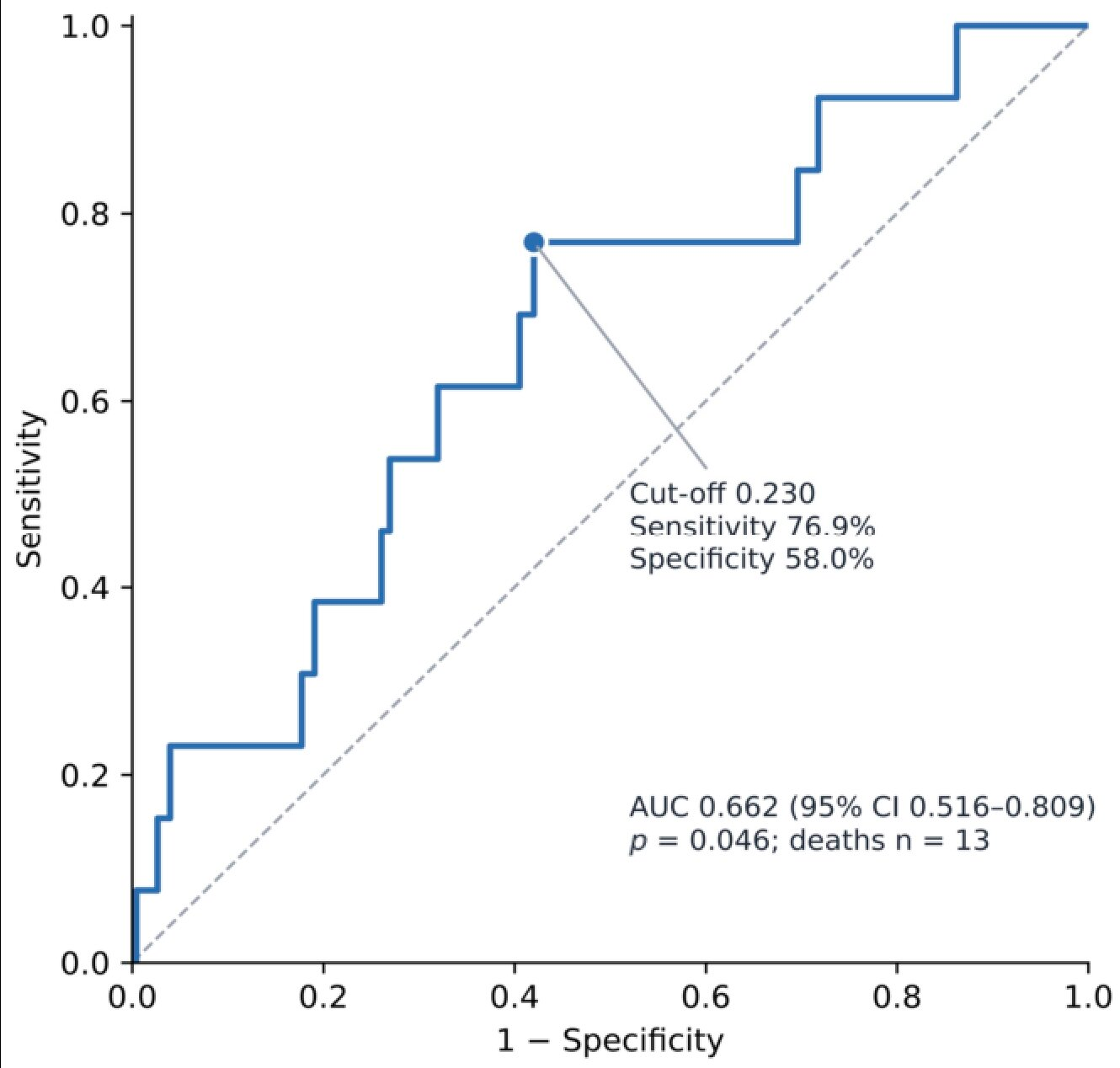
The AUC of the CALLY index for in-hospital mortality was 0.662 (95% CI 0.516–0.809; p = 0.046). The optimal cut-off was 0.230, with a sensitivity of 76.9% and a specificity of 58.0% (Figure 1); 10 of the 13 deaths occurred in patients with a CALLY index below this value. Accordingly, 268 patients (57.0%) were classified into the high-CALLY group and 202 (43.0%) into the low-CALLY group. In bootstrap resampling, the optimal cut-off varied widely (median 0.214, 95% interval 0.016–0.565), indicating limited stability. When analyzed as a continuous variable, a higher log-transformed CALLY index was associated with lower in-hospital mortality (OR 0.66 per unit increase, 95% CI 0.46–0.94, p = 0.023). In-hospital mortality was 4.2%, 4.3%, 1.7%, and 0.8% from the lowest to the highest CALLY quartile (p for trend = 0.069).
Figure 1.
Receiver operating characteristic curve of the preoperative CALLY index for in-hospital mortality in the overall cohort. The marker indicates the optimal cut-off (0.230).
Before matching, patients in the low-CALLY group were more often women (25.7% vs. 11.2%, p < 0.001), were shorter, and had a lower LVEF (55% vs. 60%, p = 0.002), a higher EuroSCORE II (1.5% vs. 1.2%, p < 0.001), a longer CPB time (131 vs. 121 min, p = 0.017), and less frequently underwent off-pump surgery (3.0% vs. 9.0%, p = 0.009) (Table 1). The region of common support of the propensity score was 0.234–0.784; 18 patients (10 low-CALLY and 8 high-CALLY) fell outside this region. Matching yielded 165 pairs (330 patients), corresponding to 81.7% of the low-CALLY and 61.6% of the high-CALLY patients. After matching, all seven covariates in the propensity model had |SMD| < 0.10, and none of the other baseline characteristics differed significantly between the groups (Table 1). However, several variables not included in the propensity model retained |SMD| values above 0.10 after matching (hypertension, previous cerebrovascular accident, chronic kidney disease, carotid artery stenosis, rheumatic disease, history of malignancy, TAPSE, off-pump and minimally invasive CABG, and coronary endarterectomy; |SMD| 0.101–0.192).
Table 1.
Baseline demographic, clinical, echocardiographic, and operative characteristics before and after propensity score matching.
In the matched cohort, the low-CALLY group had a higher CRP level (9.8 vs. 1.9 mg/L), a lower albumin level (4.2 vs. 4.3 g/dL), and a lower lymphocyte count (2.09 vs. 2.42 × 10⁹/L) (all p < 0.001), as well as a higher low-density lipoprotein (LDL) cholesterol level (114 vs. 103 mg/dL, p = 0.014) and a slightly lower potassium level (4.30 vs. 4.43 mEq/L, p = 0.041). Other laboratory parameters were comparable (Table 2). Before matching, the low-CALLY group also had lower hemoglobin and higher troponin levels.
Table 2.
Preoperative laboratory parameters before and after propensity score matching.
In the unmatched cohort, in-hospital mortality was higher in the low-CALLY group than in the high-CALLY group (10 [5.0%] vs. 3 [1.1%], p = 0.012), as were the rates of deep sternal wound infection (6.9% vs. 2.6%, p = 0.025), superficial wound infection (19.3% vs. 9.3%, p = 0.002), and IABP use (2.0% vs. 0%, p = 0.034). The low-CALLY group also had a longer duration of mechanical ventilation and a longer postoperative hospital stay (7 [6,7,8,9,10] vs. 6 [5,6,7,8] days, p < 0.001) (Table 3).
Table 3.
Postoperative outcomes before and after propensity score matching.
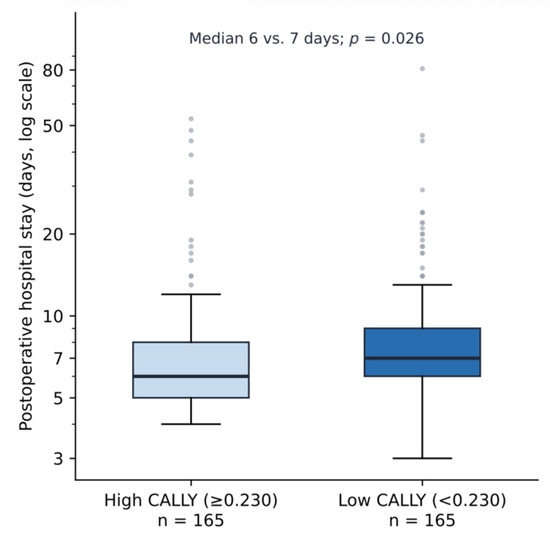
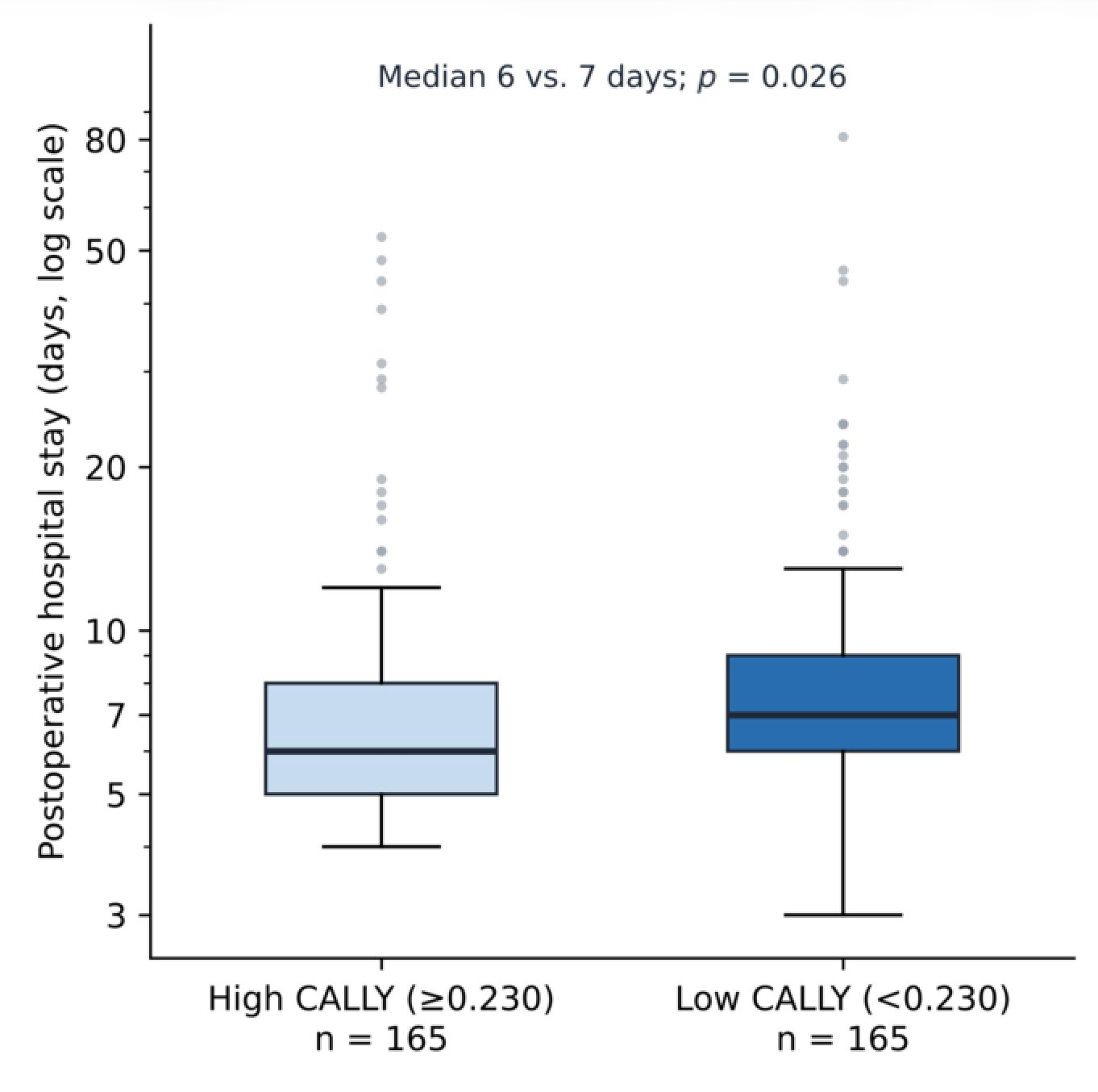
After matching, postoperative hospital stay remained significantly longer in the low-CALLY group (7 [6,7,8,9] vs. 6 [5,6,7,8] days, p = 0.026) (Figure 2). In-hospital mortality was numerically higher in the low-CALLY group but the difference was not statistically significant (5 [3.0%] vs. 2 [1.2%], p = 0.448). The remaining postoperative outcomes did not differ significantly between the matched groups (Table 3). In paired analyses of the matched cohort, the difference in postoperative hospital stay was of borderline significance (Wilcoxon signed-rank test, p = 0.057), and in-hospital mortality did not differ (McNemar test, p = 0.375). In the sensitivity analysis using only preoperative covariates, 171 pairs were matched, and all covariates had |SMD| < 0.10. In this cohort, postoperative hospital stay was again longer in the low-CALLY group (median 7 vs. 6 days), but the difference did not reach statistical significance (p = 0.093; Wilcoxon signed-rank test, p = 0.081), and in-hospital mortality did not differ (6 [3.5%] vs. 2 [1.2%]; McNemar test, p = 0.289). In the overall cohort, after adjustment for preoperative covariates, a low CALLY index was associated with an 11.0% longer hospital stay (95% CI 0.7–22.3%, p = 0.037). When the analysis was restricted to patients discharged alive, the difference in hospital stay persisted in the matched cohort (median 7 vs. 6 days in 159 pairs in which both patients survived; Wilcoxon signed-rank test, p = 0.024). In the matched cohort, a hospital stay of 10 days or longer occurred in 24.2% of patients in the low-CALLY group and 15.8% of those in the high-CALLY group (p = 0.074).
Figure 2.
Postoperative hospital stay according to CALLY index group in the propensity score-matched cohort.
The AUC of the CALLY index for in-hospital mortality was similar to those of serum albumin (0.655, 95% CI 0.504–0.806) and CRP (0.632, 95% CI 0.489–0.774) and significantly lower than that of EuroSCORE II (0.840, 95% CI 0.717–0.963; p = 0.003). Adding the CALLY index to EuroSCORE II did not significantly improve the prediction of in-hospital mortality (likelihood ratio test, p = 0.152 for the log-transformed CALLY index and p = 0.051 for a low CALLY index). In contrast, the CALLY index remained independently associated with postoperative hospital stay after adjustment for EuroSCORE II: a low CALLY index was associated with a 12.7% longer hospital stay (95% CI 2.5–24.0%, p = 0.014), and each one-unit increase in the log-transformed CALLY index was associated with a 5.4% shorter stay (95% CI 2.0–8.6%, p = 0.002).
4. Discussion
In this propensity score-matched study of patients undergoing isolated CABG, a low preoperative CALLY index was associated with higher crude in-hospital mortality, more wound complications, and a longer postoperative hospital stay. After matching, the difference in hospital stay persisted, whereas the association with mortality was attenuated and no longer statistically significant.
Several mechanisms may explain these findings. CPB and surgical trauma induce systemic inflammation that contributes to myocardial, renal, and pulmonary dysfunction [4]. Preoperative inflammatory and nutritional markers, including the CRP-to-albumin ratio and other systemic inflammatory indices, have been associated with early mortality and morbidity after CABG [16,17]. Low albumin reflects reduced nutritional and physiological reserve, whereas lymphopenia indicates impaired immune competence and stress, and inflammation, nutrition, and immunosuppression are closely interrelated in patients undergoing cardiovascular surgery [18]. By integrating these domains, the CALLY index may provide additional prognostic information beyond inflammatory indices such as the neutrophil-to-lymphocyte ratio, systemic immune-inflammation index, or pan-immune-inflammation value [5,6,19,20]. We previously evaluated another composite index, the inflammatory prognostic index, in patients undergoing CABG [21]. In the present study, we evaluated a score that also includes nutritional status.
Our findings are consistent with recent reports that have associated the CALLY index with outcomes after coronary surgery. In a study of 620 patients undergoing CABG, Cetin and Demir found that higher CALLY quartiles were associated with shorter ICU and hospital stays, fewer major adverse cardiac and cerebrovascular events, and lower 2-year mortality, whereas in-hospital mortality did not differ [12]. Similarly, in patients undergoing MIDCAB, a higher CALLY index was associated with shorter ICU and hospital stays [13]. Although the CALLY index is not a new marker, our study extends these observations by balancing baseline differences between patients with high and low CALLY values through propensity score matching and by assessing whether the index provides prognostic information beyond EuroSCORE II. Our results largely confirm previous observations regarding hospital stay and extend them by showing that this association persisted after adjustment for EuroSCORE II and other preoperative covariates, which was not assessed in the previous studies. In contrast to the study by Cetin and Demir, in which the CALLY index was independently associated with in-hospital mortality after adjustment for EuroSCORE II [12], the CALLY index did not improve mortality prediction beyond EuroSCORE II in our cohort. This discrepancy may be explained by the smaller number of deaths in our study (13 vs. 32), which limited statistical power, as well as by differences in patient selection. Taken together, these findings suggest that the main clinical value of the index may lie in identifying patients at risk of delayed recovery rather than in predicting mortality. In our cohort, in-hospital mortality was higher in the low-CALLY group before matching (5.0% vs. 1.1%). However, patients with a low CALLY index were more often women and had a lower LVEF, a higher EuroSCORE II, and longer CPB times, and the difference in mortality was no longer significant after propensity score matching (3.0% vs. 1.2%). Because only seven deaths occurred after matching, the loss of statistical significance may reflect limited power as well as the balancing of baseline risk, and our data cannot distinguish between these explanations. Nevertheless, the attenuation of the association after adjustment for EuroSCORE II suggests that a low CALLY index at least partly reflects a higher-risk patient profile. Consistent with this interpretation, the CALLY index showed considerably lower discrimination for in-hospital mortality than EuroSCORE II, did not improve mortality prediction when added to it, and performed similarly to albumin and CRP alone. The CALLY index should therefore be used together with, not instead of, established surgical risk scores.
Postoperative atrial fibrillation is the most common complication after CABG, and systemic inflammation has been implicated in its development [19]. A low CALLY index has recently been associated with recurrence of atrial fibrillation after catheter ablation [22]. In our study, however, the incidence of new-onset atrial fibrillation did not differ between the groups before (19.3% vs. 16.0%, p = 0.356) or after matching (17.6% vs. 20.6%, p = 0.484). Postoperative atrial fibrillation is multifactorial and is largely driven by perioperative factors such as atrial injury, autonomic imbalance, electrolyte shifts, and the inflammatory response to CPB, which a single preoperative measurement may not capture. To our knowledge, the relationship between the CALLY index and new-onset atrial fibrillation after cardiac surgery has not been reported previously, and our findings do not support the use of the index for this purpose.
Before matching, both deep sternal wound infection (6.9% vs. 2.6%) and superficial wound infection (19.3% vs. 9.3%) were more frequent in the low-CALLY group. Low preoperative albumin has been associated with postoperative complications and prolonged hospitalization after cardiac surgery [23], and inflammation and immunosuppression are closely interrelated in these patients [18]. After matching, the rates remained numerically higher in the low-CALLY group (4.8% vs. 2.4% and 15.8% vs. 10.9%), but the differences were no longer significant. This may reflect the smaller sample size and low number of events after matching, as well as the balancing of factors such as sex. Because wound complications are a major cause of prolonged hospitalization, this finding is consistent with the longer hospital stay observed in the low-CALLY group.
The most consistent finding of our study was the association between a low CALLY index and a longer postoperative hospital stay, which persisted after propensity score matching. The magnitude of this difference was modest. Moreover, the difference was of borderline significance in paired analyses and in the sensitivity analysis restricted to preoperative covariates, although its direction and magnitude were consistent across all analyses. The difference also persisted when patients who died in hospital were excluded. Although a median difference of one day appears small, a hospital stay of 10 days or longer was more frequent in the low-CALLY group, and even a one-day difference may be relevant to resource use at the population level. Nevertheless, the clinical significance of this finding should be interpreted with caution. Length of hospital stay depends largely on wound healing, mobilization, and recovery from inflammation, which may be impaired in patients with poor nutritional and immune status. Because all components of the CALLY index are routinely measured before cardiac surgery, the index can be calculated at no additional cost and might help identify patients who could benefit from nutritional optimization, prehabilitation, or closer postoperative monitoring. Whether such interventions improve outcomes in patients with a low CALLY index should be tested prospectively.
5. Limitations
This study has several limitations. Its retrospective, single-center design limits causal inference and generalizability, and residual confounding cannot be excluded despite propensity score matching. In addition, the cut-off value was derived from our own cohort with a small number of deaths, showed limited stability in bootstrap analysis, and has not been externally validated; it should therefore be regarded as exploratory, and the propensity model included a limited set of covariates, two of which (CPB and cross-clamp times) are intraoperative variables; matching also excluded a considerable number of high-CALLY patients. Moreover, several baseline variables that were not included in the propensity model retained |SMD| values above 0.10 after matching, so residual imbalance cannot be excluded. CRP and lymphocyte counts may have been influenced by factors that were not systematically recorded, such as recent acute coronary syndrome, subclinical infection, or the use of statins and immunosuppressive drugs, and 20 patients had a history of malignancy. Finally, the CALLY index was measured only once before surgery, length of stay may also have been affected by non-clinical factors, and long-term outcomes were not assessed. In addition, the STS risk score was not available, because EuroSCORE II is the risk model routinely used at our institution.
6. Conclusions
In patients undergoing isolated CABG, a low preoperative CALLY index was associated with a modestly longer postoperative hospital stay. This association was consistent in direction and magnitude across the main and sensitivity analyses but was of borderline statistical significance in some of them. The CALLY index did not provide incremental prognostic information beyond EuroSCORE II for in-hospital mortality, and whether its association with mortality is independent of baseline risk could not be determined because of the small number of deaths. As an inexpensive index derived from routine preoperative laboratory tests, the CALLY index may help identify patients at risk of delayed recovery; however, these exploratory findings, including the proposed cut-off, require confirmation in prospective multicenter studies.
Author Contributions
Conceptualization, M.K.; methodology, M.K.; formal analysis, M.K. and O.F.B.; investigation, M.K. and O.F.B.; data curation, M.K. and O.F.B.; writing—original draft preparation, M.K. and O.F.B.; writing—review and editing, M.K.; supervision, M.K. and O.F.B. All authors have read and agreed to the published version of the manuscript.
Funding
This research received no external funding.
Institutional Review Board Statement
The study was conducted in accordance with the Declaration of Helsinki and approved by the Istanbul Basaksehir Cam and Sakura City Hospital Institutional Ethics Committee (No: 2026-468; date: 15 September 2026).
Informed Consent Statement
Patient consent was waived due to the retrospective design of the study and the use of anonymized data.
Data Availability Statement
The data presented in this study are available on request from the corresponding author due to privacy restrictions.
Conflicts of Interest
The authors declare no conflicts of interest.
References
- Gaba, P.; Sabik, J.F.; Murphy, S.A.; Bellavia, A.; O’Gara, P.T.; Smith, P.K.; Serruys, P.W.; Kappetein, A.P.; Park, S.J.; Park, D.W.; et al. Percutaneous coronary intervention versus coronary artery bypass grafting in patients with left main disease with and without diabetes: Findings from a pooled analysis of 4 randomized clinical trials. Circulation 2024, 149, 1328–1338. [Google Scholar] [CrossRef] [Scilit] [PubMed]
- Dimeling, G.; Bakaeen, L.; Khatri, J.; Bakaeen, F.G. CABG: When, why, and how? Clevel. Clin. J. Med. 2021, 88, 295–303. [Google Scholar] [CrossRef] [Scilit] [PubMed]
- Akintoye, O.O.; Fasina, O.P.; Adiat, T.S.; Nwosu, P.U.; Olubodun, M.O.; Adu, B.G. Outcomes of coronary artery bypass graft surgery in Africa: A systematic review and meta-analysis. Cureus 2023, 15, e47541. [Google Scholar] [CrossRef] [Scilit] [PubMed]
- Squiccimarro, E.; Lorusso, R.; Consiglio, A.; Labriola, C.; Haumann, R.G.; Piancone, F.; Speziale, G.; Whitlock, R.P.; Paparella, D. Impact of inflammation after cardiac surgery on 30-day mortality and machine learning risk prediction. J. Cardiothorac. Vasc. Anesth. 2025, 39, 683–691. [Google Scholar] [CrossRef] [Scilit] [PubMed]
- Dey, S.; Kashav, R.; Kohli, J.K.; Magoon, R.; ItiShri; Walian, A.; Grover, V. Systemic immune-inflammation index predicts poor outcome after elective off-pump CABG: A retrospective, single-center study. J. Cardiothorac. Vasc. Anesth. 2021, 35, 2397–2404. [Google Scholar] [CrossRef] [Scilit] [PubMed]
- Güntürk, İ.; Ozmen, R.; Ozocak, O.; Güntürk, E.E.; Dagli, F.; Yazici, C. The systemic immune-inflammation index predicts in-hospital mortality in patients who underwent on-pump cardiac surgery. Arq. Bras. Cardiol. 2024, 121, e20230245. [Google Scholar] [CrossRef] [Scilit] [PubMed]
- Iida, H.; Tani, M.; Komeda, K.; Nomi, T.; Matsushima, H.; Tanaka, S.; Ueno, M.; Nakai, T.; Maehira, H.; Mori, H.; et al. Superiority of CRP-albumin-lymphocyte index (CALLY index) as a non-invasive prognostic biomarker after hepatectomy for hepatocellular carcinoma. HPB 2022, 24, 101–115. [Google Scholar] [CrossRef] [Scilit] [PubMed]
- Yang, M.; Lin, S.Q.; Liu, X.Y.; Tang, M.; Hu, C.L.; Wang, Z.W.; Zhang, Q.; Zhang, X.; Song, M.M.; Ruan, G.T.; et al. Association between C-reactive protein-albumin-lymphocyte (CALLY) index and overall survival in patients with colorectal cancer: From the investigation on nutrition status and clinical outcome of common cancers study. Front. Immunol. 2023, 14, 1131496. [Google Scholar] [CrossRef] [Scilit] [PubMed]
- Zhang, H.; Shi, J.; Xie, H.; Liu, X.; Ruan, G.; Lin, S.; Ge, Y.; Liu, C.; Chen, Y.; Zheng, X.; et al. Superiority of CRP-albumin-lymphocyte index as a prognostic biomarker for patients with gastric cancer. Nutrition 2023, 116, 112191. [Google Scholar] [CrossRef] [Scilit] [PubMed]
- Zhu, D.; Lin, Y.D.; Yao, Y.Z.; Qi, X.J.; Qian, K.; Lin, L.Z. Negative association of C-reactive protein-albumin-lymphocyte index (CALLY index) with all-cause and cause-specific mortality in patients with cancer: Results from NHANES 1999–2018. BMC Cancer 2024, 24, 1499. [Google Scholar] [CrossRef] [Scilit] [PubMed]
- Pan, Y.; Liu, Z.; Tu, R.; Feng, X.; Yu, F.; Wei, M.; Feng, J.; Xie, W.; Deng, B.; Xia, J.; et al. The value of the CRP-albumin-lymphocyte index (CALLY index) as a prognostic biomarker in acute ischemic stroke. Sci. Rep. 2025, 15, 13672. [Google Scholar] [CrossRef] [Scilit] [PubMed]
- Cetin, H.K.; Demir, T. Importance of CALLY scores in predicting coronary artery bypass grafting outcomes. Ann. Thorac. Cardiovasc. Surg. 2025, 31, oa.25-00156. [Google Scholar] [CrossRef] [Scilit] [PubMed]
- Ciftci, H.; Sahin, M. Potential role of the C-reactive protein-albumin-lymphocyte (CALLY) index in predicting MIDCAB outcomes. J. Cardiothorac. Surg. 2026, 21, 696. [Google Scholar] [CrossRef] [Scilit] [PubMed]
- von Elm, E.; Altman, D.G.; Egger, M.; Pocock, S.J.; Gøtzsche, P.C.; Vandenbroucke, J.P. The Strengthening the Reporting of Observational Studies in Epidemiology (STROBE) statement: Guidelines for reporting observational studies. Lancet 2007, 370, 1453–1457. [Google Scholar] [CrossRef] [Scilit] [PubMed]
- Austin, P.C. Optimal caliper widths for propensity-score matching when estimating differences in means and differences in proportions in observational studies. Pharm. Stat. 2011, 10, 150–161. [Google Scholar] [CrossRef] [Scilit] [PubMed]
- Yılmaz, S.; Söylemez, N.; Ekici, M.; Yılmaz, M.; Sürmeli, A.O.; Toprak, B.; Karaca, Ö.; Bora, R.; Ballı, M.; Keçeoğlu, S. A composite indicator of inflammation and nutritional status for predicting mortality after CABG: The CRP-to-albumin ratio. Nutrients 2026, 18, 1721. [Google Scholar] [CrossRef] [Scilit] [PubMed]
- Önder, R.; Özçobanoğlu, S.; Gündoğdu, B.P.; Taçkın, V.B.; Kakillioğlu, İ. Association of preoperative and postoperative systemic inflammatory markers with early mortality and morbidity after CABG surgery. J. Cardiothorac. Surg. 2026, 21, 186. [Google Scholar] [CrossRef] [Scilit] [PubMed]
- Yoshida, M.; Kanda, N.; Kashiwagi, S.; Wakimoto, Y.; Ohbe, H.; Nakamura, K. Relationship between very early enteral nutrition and persistent inflammation, immunosuppression, and catabolism syndrome in cardiovascular surgery patients: A propensity score-matched study. Am. J. Clin. Nutr. 2024, 120, 610–618. [Google Scholar] [CrossRef] [Scilit] [PubMed]
- Shao, Q.; Chen, K.; Rha, S.W.; Lim, H.E.; Li, G.; Liu, T. Usefulness of neutrophil/lymphocyte ratio as a predictor of atrial fibrillation: A meta-analysis. Arch. Med. Res. 2015, 46, 199–206. [Google Scholar] [CrossRef] [Scilit] [PubMed]
- Dolapoglu, A.; Avci, E. Relationship between pan-immune-inflammation value and major cardiovascular and cerebrovascular events in stable coronary artery disease patients undergoing on-pump coronary artery bypass graft surgery. J. Cardiothorac. Surg. 2024, 19, 241. [Google Scholar] [CrossRef] [Scilit] [PubMed]
- Karaarslan, M.; Beyazal, O.F.; Temizturk, Z.; Cevik, B.; Kayalar, N.; Yanartas, M. Does inflammatory prognostic index predict postoperative outcomes in coronary artery bypass grafting? J. Clin. Med. 2026, 15, 4547. [Google Scholar] [CrossRef] [Scilit] [PubMed]
- Deng, Y.; Huang, J.; Deng, L.; Zhou, Y.; Pan, L.; Wang, J.; Chen, Q.; Gu, Q.; Zhang, Y.; Wei, J.; et al. C-Reactive Protein–Albumin–Lymphocyte (CALLY) Index as an Independent Risk Factor for Postoperative Atrial Fibrillation Recurrence. Clin. Cardiol. 2025, 48, e70157. [Google Scholar] [CrossRef] [Scilit] [PubMed]
- Engelman, D.T.; Adams, D.H.; Byrne, J.G.; Aranki, S.F.; Collins, J.J., Jr.; Couper, G.S.; Allred, E.N.; Cohn, L.H.; Rizzo, R.J. Impact of body mass index and albumin on morbidity and mortality after cardiac surgery. J. Thorac. Cardiovasc. Surg. 1999, 118, 866–873. [Google Scholar] [CrossRef] [Scilit] [PubMed]

Disclaimer/Publisher’s Note: The statements, opinions and data contained in all publications are solely those of the individual author(s) and contributor(s) and not of MDPI and/or the editor(s). MDPI and/or the editor(s) disclaim responsibility for any injury to people or property resulting from any ideas, methods, instructions or products referred to in the content. |
© 2026 by the authors. Licensee MDPI, Basel, Switzerland. This article is an open access article distributed under the terms and conditions of the Creative Commons Attribution (CC BY) license.