


Abstract
Background: Cervical proprioception contributes to head and neck posture and balance. Neck pain may alter muscle activity and afferent input, contributing to impaired proprioception. Although cervical kinesthetic sense (CKS) and pressure pain threshold (PPT) are reliable measures, methodological heterogeneity limits comparison across studies. More objective and standardized measurements of pain and proprioception in physiotherapy are needed. This study assessed the CKS and PPT of the neck muscles in a non-patient population using standardized testing protocols. Methods: Ten participants without current or recent neck pain (mean age 26.1 ± 1.87 years; 6 females) completed the Neck Disability Index. CKS was assessed using a head-mounted laser during flexion, extension, and bilateral rotation with eyes closed. Joint position error was measured in degrees, with absolute error (AE) and constant error (CE) calculated. Bilateral PPT was assessed using a manual algometer at three sites of the sternocleidomastoid (SCM) and upper trapezius (UT) muscles. Standardized positioning, verbal instructions, evaluator training, and three randomized trials per movement and PPT site were used. Results: Head flexion demonstrated the greatest AE (3.78° ± 2.15), while right rotation showed the lowest (2.97° ± 1.61). CE indicated undershooting during extension and bilateral rotation, with the greatest undershooting during left rotation (−1.92° ± 2.77), whereas flexion showed overshooting (0.76° ± 2.90). PPT was highest at the UT midpoint (6.43 ± 2.26), followed by the UT suboccipital (4.41 ± 1.38), and lowest at the SCM (3.69 ± 1.42). Conclusions: This pilot study provides preliminary descriptive estimates for CKS and PPT in a non-patient population using standardized and objective assessment procedures. These findings support the clinical feasibility of the CKS and PPT evaluation in physiotherapy practice and provide a foundation for future research examining the relationship between cervical proprioceptive and mechanical pain sensitivity in individuals with neck pain.
1. Introduction
The cervical spine has a proprioceptive system that plays a fundamental role in controlling the head and neck posture and balance. Alteration of cervical proprioception leads to the disturbance of cervical sensorimotor control [1,2]. Cervical sensorimotor control involves central integration of the afferent information from the visual, vestibular, and cervical proprioceptive inputs and execution of motor control through the cervical muscles, contributing to the maintenance of head and neck posture and stability [3].
It has been reported that patients with nonspecific neck pain have motor control impairments [2]. People with neck pain often exhibit reduced ability to accurately perceive the position of their head and neck, which can lead to poor posture and increased pain. The relationship between altered neck proprioception and pain has been found in healthy subjects receiving injections to induce neck pain [4]. Cervical sensorimotor control disturbances secondary to neck pain are considered as a protective response to limit further stimulation of the painful tissue and prevent further tissue damage. This corresponds to a decrease in muscle activity of the painful muscles, whose activity moves from deeper pained muscles to superficial muscles. Therefore, it is likely that, in neck pain, this transfer may interfere with normal proprioception [4]. These structural and functional changes in the deep and superficial cervical muscles can change the discharge of muscle spindles, which affects the afferent input and leads to alterations in proprioception [5]. Such disturbances may further cause tissue damage, aggravate pain through peripheral and central nervous system sensitization, and promote dysfunctional motion patterns [6].
Self-reported pain intensity has been the most common approach to pain measurement in a clinical setting. The pressure pain threshold (PPT) test is self-reported but is also a more objective technique to measure pain sensitivity [7]. It determines the point at which a pressure stimulus becomes painful, serving as a quantitative measure of pain. More studies with objective and standardized measurements are needed to evaluate pain in physiotherapy practice. Similarly, the same is true for measuring cervical kinesthetic sense (CKS). The literature lacks studies utilizing standardized equipment, testing positions, trial numbers, and examiner training, which impairs reproducibility and comparison across studies [8]. There is variability in proprioceptive testing and factors affecting reliability, including movement direction and number of repetitions [9]. Although both tests of CKS and PPT are useful and reliable measures, methodological heterogeneity and the absence of generally accepted testing standards limit reproducibility and comparison across studies.
The objective of this study is to investigate CKS and PPT of the neck muscles in a non-patient population using standardized protocols for testing. This pilot study will provide preliminary objective data using a standardized procedure from a non-patient population, serving as preliminary baseline descriptive estimates that can be repeated in future studies, including those with larger patient populations. It will also advance the clinical feasibility of integrating both portable assessment tools into routine rehabilitation practice.
2. Material and Methods
2.1. Research Design and Subjects
This cross-sectional pilot study included adults aged 18 years or older who were asymptomatic, had no current or recent neck pain, and were not receiving any treatment for head and neck conditions between the Fall semester of 2024 and Spring semester of 2025. Subjects were excluded if they had a history of head or neck trauma, systemic or neurological diseases, vestibular dysfunction or high neck disability. Neck disability was evaluated with a self-reported neck disability index (NDI). NDI consists of 10 items related to daily activities, for which individuals rate their functional ability on a 0–5 scale. Final scores range from 0 to 50, with higher scores corresponding to a greater disability. NDI is a valid measurement of neck disability [10].
Subjects were recruited using word of mouth and through recruitment posters placed around the university campus. A QR code was included so interested subjects could answer some preliminary questions related to eligibility. A formal sample-size calculation was not performed, as the study was exploratory in nature. This study was approved by the Institutional Review Board (IRB) of Florida International University (IRB-24-0318).
2.2. Procedures
Prior to each participant’s arrival for data collection, the testing room was prepared. A testing chair was positioned with its center precisely measured and fixed at 90 cm from a whiteboard target. Additionally, the randomization order was prepared for the sequence of all CKS movement directions and sides, as well as the sequence of muscle points and sides for the performance of the PPT for each participant scheduled for data collection. The order of measurements was randomized independently for each participant.
The CKS was evaluated first, followed by the PPT to minimize the potential influence of pain on neck movement performance during the CKS assessment. Although potential learning or fatigue effects cannot be entirely excluded, the same assessment order was maintained for all participants. Both tests were performed with the subjects in a seated position. The total time required for both procedures was approximately 40 min.
2.2.1. Cervical Kinesthetic Sense (CKS)
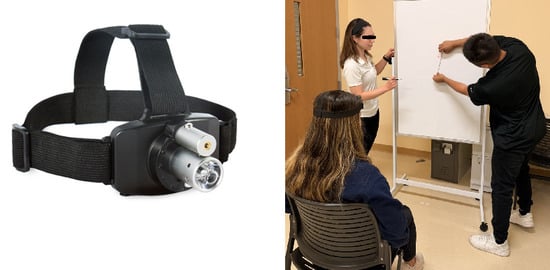
CKS was assessed using the SenMoCOR head-mounted laser with the participant in a standardized position (Figure 1). Subjects were asked to perform maximum comfortable head movements (flexion, extension, left/right rotation) with their eyes closed and return to the initial position as accurately as possible, controlling for movement velocity. The difference between the projected starting position (zero) and the projected returning point (joint position error—JPE) was measured in centimeters and converted to degrees later (Figure 1). Each movement was tested three times in a random order.
Figure 1.
Head-mounted laser used and procedure for CKS evaluation.
2.2.2. Standardized CKS Protocol
Upon subject arrival, a brief explanation about the laser use and particular movements tested was provided. After the explanation of the test, standardization of posture was performed by asking the subjects to sit comfortably on the chair with both feet on the ground, their back resting on the back of the chair, and arms resting on their legs. Familiarization of the test was performed by asking the subjects to perform all the movement directions with their eyes open and then with their eyes closed. The following verbal command example was used: “Move your head all the way down in a comfortable pace and comfortable limit and reposition the head back to the starting point as accurately as possible.” Therefore, head movement speed was not externally controlled or standardized using a metronome or predetermined movement duration. However, the same verbal instructions were provided to all participants to promote consistency in the movement procedure.
After the familiarization, the test was initiated. To ensure scientific rigor, three evaluators were used: one to give verbal commands to the subjects, one to measure the distance on the whiteboard, and the other to write down the measurements shown by the second evaluator. The measurement was not verbally stated. The subjects were tasked with the following: “With your eyes closed, indicate when you had returned to the starting position with the word now”. Subjects were asked to open their eyes only after the measurements were performed by the evaluator and the mark erased using the following verbal command: “You can open your eyes now”. This was used to avoid subjects being influenced by the previous measurements. A 30 s rest between movement directions was used, with 3 trials for each direction (order randomized).
2.2.3. Pressure Pain Threshold (PPT)
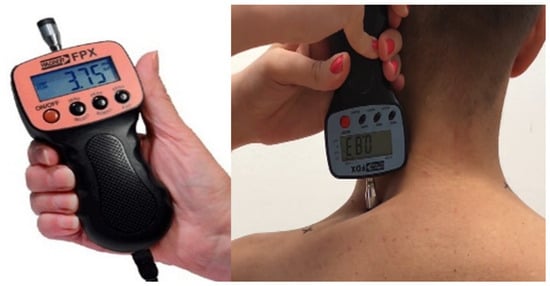
The PPT of the sternocleidomastoid (SCM) and upper trapezius (UT) muscles was measured in kilo-force (kgf) bilaterally using a manual pressure Algometer (Wagner FPX 50) (Figure 2).
Figure 2.
Manual pressure algometer used to measure pressure pain threshold (PPT).
2.2.4. Standardized PPT Protocol
Using photos, an explanation of the algometer and particular muscles tested and demonstration on the investigated hypothenar region was provided. The evaluator emphasized that the objective was to determine the pain threshold (transition from pressure sensation to pain) and not tolerance to pain. After that, the subjects were familiarized with the algometer by a demonstration on the participant’s dominating hand (thenar eminence). The participants were instructed to verbally indicate the exact moment when the applied pressure first became painful by saying “Now”. The following verbal command was used: “When the sensation of pressure changes to pain, say ‘now’” “Again, we don’t want to measure the tolerance to pain”
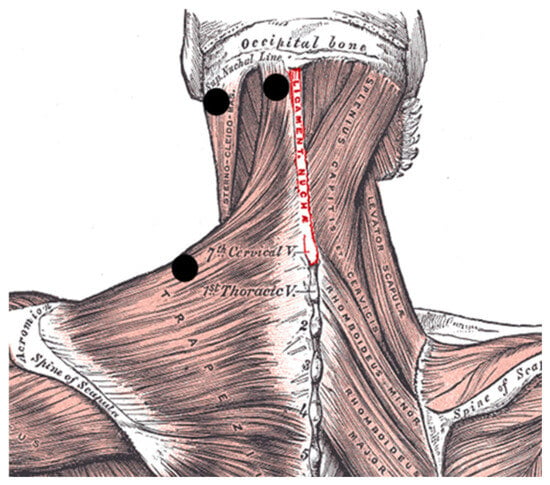
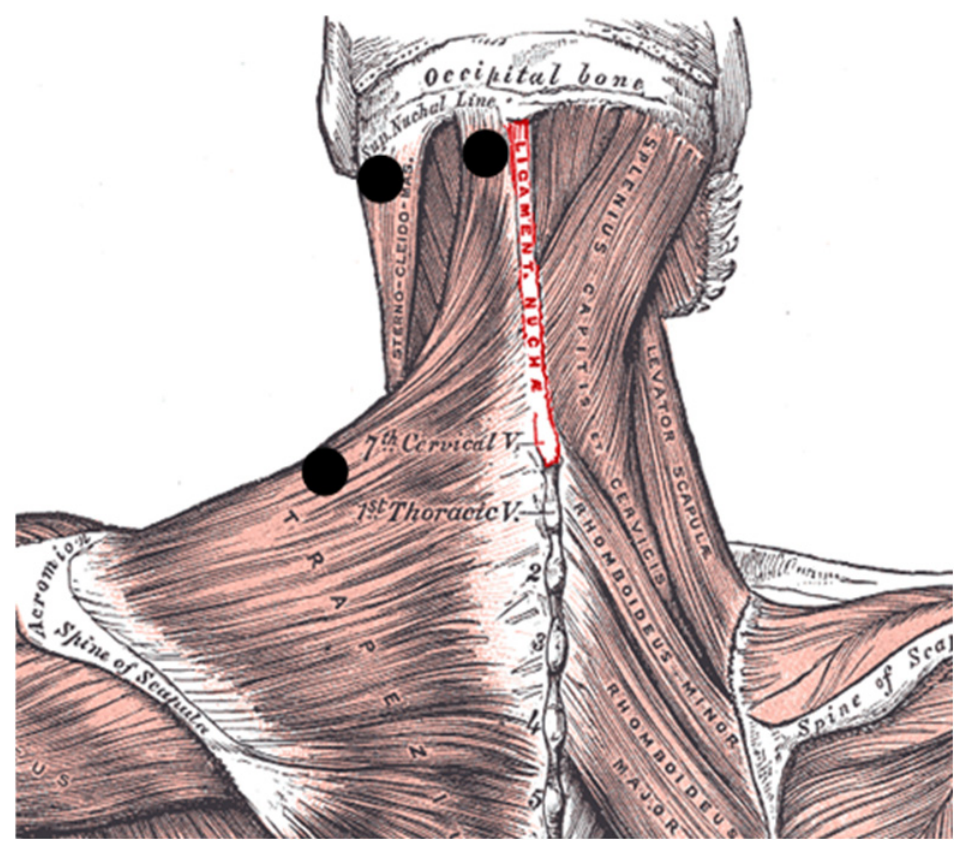
After the familiarization, the subjects were asked to sit comfortably upright on a chair, and the position was standardized the same way for the CKS procedure. The evaluator palpated the muscles and marked the muscle points with a hypoallergenic marker. The following procedures were used to identify the muscle points (Figure 3).
Figure 3.
PPT points evaluated bilaterally.
Upper trapezius (UT) muscle (2 points):
- UT suboccipital attachment: With the participant’s head stabilized by the evaluator, the occipital bone was palpated to identify its inferior border. The marking point was located immediately inferior to the occipital bone, in the region of the superior attachment of the upper trapezius, close to the midline.
- UT midpoint between C7 and the acromion: The C7 spinous process was identified by palpation while the participant was instructed to repeatedly flex and extend the neck (i.e., “Look all the way up and down”). C7 was distinguished from C6 by identifying the more prominent spinous process that remained stationary during neck movement. The acromion was palpated, and the midpoint between the C7 spinous process and the acromion was identified and marked.
Sternocleidomastoid (SCM) muscle (1 point):
- Upper portion of the SCM: With the participant’s head stabilized by the evaluator, the mastoid process was palpated to identify the attachment of the SCM muscle. The participant was then instructed to rotate the head to the right to facilitate identification and palpation of the left SCM muscle. This was repeated to the other side. The marking point was located over the upper portion of the muscle, close to its mastoid insertion.
During the test, the algometer was applied perpendicularly at a consistent pressure rate of 1 kgf/s using a 1 cm2 rubber probe area to all muscle points in randomized order. To ensure the subject’s head remained in a neutral position during the test for the SCM muscles, the head was stabilized with the evaluator’s hand placed on the opposite side being tested to avoid rotation or movement. One evaluator applied the algometer, and another read the value and wrote it down. The measurement was not verbally stated. The evaluator applying the algometer was blind to the measurements. Similarly to the CKS procedure, this was also implemented to avoid subjects being influenced by the previous measurements. After all measurements were performed, the skin where the points were marked was cleaned with alcohol pads. The Algometer was calibrated after each use.
2.2.5. Training Prior to Data Collection
Training was implemented for all evaluators for both CKS and PPT protocols. For the PPT protocol, the same evaluator applying the algometer was used for all subjects. The training and the utilization of the same evaluator were important to ensure the algometer was applied at a consistent rate for all subjects. The verbal command was also practiced among evaluators to ensure consistency.
2.3. Data Analysis
Descriptive analysis (mean and standard deviation) was performed for age, sex, and score of neck disability. The categorical level of neck disability was determined based on the NDI score. PPT and CKS procedures were measured independently, and no correlation was performed in this study.
Three measurements were performed for each movement of the CKS test and for the muscle points for the PPT test. The three repetitions were intended to provide a balance between obtaining sufficiently consistent measurements and maintaining the clinical feasibility and time efficiency of the assessment protocol. The absolute error (AE) and the constant error (CE) were used to analyze the JPE. The AE is the mean of the total deviation from the target, ignoring positive (overshoot) and negative (undershoot) values, whereas CE is the mean of the total deviation from the target considering positive and negative values. For each subject, CE was calculated as the difference between the starting position (zero) and the movement returning point (JPE), retaining the sign of the difference to indicate the direction of the error (overestimation or underestimation). AE was calculated as the difference between the starting position and the returning point, as the absolute value of this difference, representing the magnitude of the error irrespective of its direction. The measurements in centimeters were converted to degrees. The following formula was used for the conversion: θ = (d/πD) × 360. Here, θ represents the angle in degrees, d is the measured distance in centimeters, and D is the diameter. The conversion was performed using an online calculator (https://calculator.academy/cm-to-degrees-calculator/(accessed on Summer 2025 for analysis)). For PPT, the means of the second and third trials were used for analysis. The first trial was used for familiarization and excluded from the analysis to allow participants to become familiarized with the testing procedure and minimize potential learning effects. The mean of the second and third trials was calculated and used for statistical analysis to obtain a more representative measure of PPT [11]. Dependent t-tests were calculated to analyze differences between PPT right and left sides.
2.4. Disclosure of Artificial Intelligence Use
During the preparation of this manuscript, the authors used ChatGPT (GPT-6) to improve the conciseness of the text and correct potential grammar errors. The tool was not used to generate new information. The authors have reviewed and edited the output and take full responsibility for the content of this publication.
3. Results
Ten subjects participated (mean age 26.1 ± 1.87, 6 females). A total of 8 subjects were classified as having no neck disability, and 2 had mild disability according to the NDI.
3.1. Cervical Kinesthetic Sense (CKS)
The mean and SD for absolute error (AE) and for constant error (CE) are shown in Table 1. The values fell well within normal limits of joint position error [9].
Table 1.
Mean (SD) for absolute and constant error in degrees.
The absolute error values show the general inaccuracy of kinesthetic sense, while the constant error indicates if the subject possesses a systematic tendency to overshoot or undershoot the initial target. Because positive and negative values can cancel each other out, the normal values for CE are much smaller than those for AE, as observed in Table 1.
3.2. Pressure Pain Threshold (PPT)
No differences between PPT for the right and left sides were found according to dependent t-tests (p > 0.22). The mean and standard deviation (SD) for the muscle points were calculated for both sides together (Table 2). The results indicate the subjects had no presence of hypersensitivity according to normative literature benchmarks [12].
Table 2.
Mean (SD) for PPT in kilo-force (sides calculated together).
4. Discussion
This pilot study used standardized protocols to evaluate the cervical kinesthetic sense (proprioception) and the pressure pain threshold of the neck muscles in a healthy non-patient population. The lack of standardized assessment protocols in the literature makes it difficult to compare and synthesize findings across studies. This limits the development of a robust evidence base. Therefore, even with the small sample included, this study helped address this limitation by utilizing a standardized assessment protocol, facilitating more reliable comparisons and contributing to stronger evidence. However, the reported values are preliminary descriptive estimates rather than established normative values.
4.1. Cervical Kinesthetic Sense
Some variability of CKS was found even for the healthy non-patient participants in this study, with head flexion producing the highest joint position error. This is consistent with previous evidence showing that cervical joint position sense exhibits inherent variability even in asymptomatic individuals, although the movement direction associated with the greatest error varies across studies because of methodological differences in assessment protocols [8].
The negative values for CE observed for right and left rotation and extension indicate a systematic directional bias, meaning the subjects consistently undershot the target or failed to return completely to the initial starting position. Based on the positive value for cervical flexion, the subjects over-corrected and extended their head too far backward past the starting center point.
According to English and colleagues [9], joint position error >4.5° (>7 cm) when standardizing the patient to target distance at 90 cm is likely to indicate impairment in sense of position. Participants from this study presented normal results according to this data, suggesting absence of sensorimotor dysfunction. This was expected, as the subjects included had no current or recent neck pain, were not receiving any treatment, and had no history of head or neck trauma, systemic or neurological diseases, vestibular dysfunction, or elevated neck disability. However, this study did not include a direct comprehensive assessment of motor control, and absence of sensorimotor dysfunction in these participants cannot be assumed.
4.2. Pressure Pain Threshold (PPT)
Normative reference values in pain-free cohorts typically range from 2.2 to 3.5 kgf for the upper trapezius (UT) muscle, while the sternocleidomastoid (SCM) muscle consistently displays lower thresholds, generally with values between 1.5 and 2.5 kgf [12]. Lower values suggest increased mechanical pain sensitivity (hyperalgesia), although interpretation should account for age, sex, and testing protocol.
As expected in our results, PPT values for SCM were lower than those of the UT muscles. This can be explained by the smaller muscular cross-sections (lower muscle bulk) and greater tissue sensitivity in the SCM muscle [13]. Our sample recorded an elevated average SCM pressure pain threshold of 3.69 ± 1.42 kgf. This suggests that our participants required substantially greater localized pressure before experiencing pain. This deviation may be attributed to the age range of our cohort, which entirely comprised healthy young adults with a mean age of 26 years (usually more physically active individuals), a demographic typically associated with robust nociceptive processing and higher mechanical thresholds than broader, more heterogeneous reference populations. Although physical activity may represent a possible contributing factor, it was not assessed in the present study; therefore, this explanation should be interpreted with caution. Another possible explanation for differences in PPT values compared with previous studies is the variation in the anatomical locations of measurement sites and the assessment procedures used. Differences in algometer positioning, pressure application rate, participant instructions, and the number and timing of repeated measurements may influence the PPT values. These methodological differences should be considered when comparing findings across studies, as they may contribute to inconsistencies in reported PPT values.
The combination of healthy, normal proprioceptive tracking (JPE ≤ 4.5°) and high PPT (no hypersensitivity) suggests an optimally functioning cervical sensorimotor control in the sample studied. Because the sample was free of neck pain, the central nervous system received unprovoked, normal afferent input from cervical mechanoreceptors. This clean signaling loops directly back into the motor control system, enabling the subjects to maintain an accurate sense of head and neck position and successfully execute the relocation of the targets [9,14]. However, JPE and PPT assess specific components of cervical sensorimotor function and pain sensitivity, respectively, and should not be considered comprehensive indicators of overall cervical sensorimotor control. Therefore, a broader assessment incorporating additional sensorimotor measures would be necessary to establish whether cervical sensorimotor function is optimal in the population studied.
4.3. Clinical Applicability and Feasibility
Both the head-mounted laser used for evaluating CKS and the manual algometer used for measuring PPT are highly portable, cost-effective, and practical tools for routine clinical practice. By minimizing financial and logistical barriers, such as using high-tech equivalent laboratory equipment, this offers physiotherapists an accessible, objective tool to quantify proprioceptive impairment and nociceptive sensitivity. Ultimately, this can empower physiotherapists to quantify their routine testings and enhance objective documentation.
While more than one investigator was used for the measurements of CKS and PPT in this study to optimize blinding, it does not diminish the clinical feasibility or utility of these assessments when performed by a single clinician in daily practice. For instance, in an outpatient clinic, a single physiotherapist can deliver standardized instructions, read the laser target coordinates/PPT values, and document the results without compromising the diagnostic value of either the CKS or PPT measurements.
One important consideration is the distinction between the practical characteristics of the equipment and formally evaluated feasibility outcomes. Although the assessment tools offer potential advantages for rehabilitation practice, including portability, relatively low cost, and reasonable assessment time, these characteristics alone do not directly establish their feasibility or practicality in routine clinical settings. Therefore, further research is needed to directly evaluate the feasibility of implementing these measures in clinical practice, considering factors such as time requirements, ease of administration, patient acceptability, and integration into routine rehabilitation workflow. Therefore, this study represents a preliminary stage in assessing the feasibility and suitability of the proposed procedures, and further validation of the protocols in a clinical population, particularly individuals with neck pain, is needed.
4.4. Importance of Standardized Verbal Command
Consistency when collecting data is essential in all aspects to ensure reproducibility, minimize confounding variables, and maximize the statistical power. The standardization of verbal commands is a frequently overlooked methodological variable in the literature when using manual algometry and kinesthetic testing. When performing these tests, the evaluator relies on a subject’s immediate behavioral response, and therefore, the exact phrasing, tone, and timing of the examiner’s instructions can directly affect the study’s internal validity and data consistency [15].
For the evaluation of the PPT, this study used a standardized explanation and verbal command to isolate the precise physiological boundary of the pain threshold (the initial transition from pressure to pain sensation) from pain tolerance (the maximum pressure a subject can endure). Similarly, during the CKS testing, the scripted commands were identical for all subjects and across trials, meaning this study effectively minimized examiner bias and increased consistency. More studies should report the way verbal commands are used when evaluating PPT and CKS, as the precise instructional scripts delivered to participants are routinely omitted in the literature.
4.5. Limitations and Future Recommendations
This study included subjects who were mostly graduate students, limiting the representativeness of the sample. Furthermore, it did not provide normative data because of the limited sample size. The small sample size limits the statistical power and generalizability of the findings, as well as the opportunity for more extensive statistical analyses. Additionally, a small number of participants may not adequately capture the natural variation that exists in the broader population. Therefore, the results should be interpreted with caution and considered primarily exploratory. Future studies should replicate this study’s protocol with a larger, more diverse sample to establish generalizable normative data. The student-based sample limits the external validity of the findings, and therefore, the values reported in this study should be interpreted as preliminary descriptive estimates.
Although two participants presented with mild disability according to the NDI, their inclusion was consistent with the study’s eligibility criteria, which excluded individuals with moderate to complete disability. While mild disability does not necessarily indicate substantial functional impairment, the potential influence of these symptoms on the measured outcomes cannot be entirely excluded. Therefore, this should be considered when interpreting the findings. Future studies with larger samples may help clarify the potential influence of different levels of cervical disability on the measured outcomes.
Evaluators underwent training prior to data collection; however, the reliability of the measurements, including the consistency of the evaluator’s assessments (intra-rater reliability), was not formally evaluated in this study. Further studies should investigate the reliability and validity of these protocols, as well as the responsiveness of the measurements. Also, assessing the measurement properties of the CKS in standing in addition to sitting is recommended, as well as reporting absolute and constant error for each testing position [8].
Although PPT is quantified using an algometer, the threshold is determined by the participant’s individual perception of when the applied pressure first becomes painful. Therefore, PPT is best described as a quantitative psychophysical measure of pain sensitivity, reflecting the participant’s subjective response to a standardized mechanical stimulus. Nevertheless, the use of an algometer allows for the controlled application and objective quantification of pressure, facilitating standardized assessment and comparison of pain sensitivity across participants and measurement sites.
A methodological limitation of the current pilot study involves the utilization of three testing repetitions per movement direction for the cervical kinesthetic sense (CKS) assessment. According to a systematic review, the discriminant validity of the CKS test improved with six or more repetitions [9]. This current study used three repetitions for each movement direction. While our protocol was selected to preserve clinical feasibility and maintain time efficiency, it may have limited the psychometric precision required to detect subtle sensorimotor variations.
While the study does not yet include a correlation analysis between CKS and PPT, due in part to the limited sample size, the dataset will allow for future inferential exploration of potential relationships between proprioceptive accuracy and mechanical pain sensitivity. Expanding the sample size will provide the necessary statistical power to run inferential regression and correlation models.
Furthermore, the inclusion of an objective postural assessment would provide critical, additional insight into the potential influence of normal or abnormal CKS and PPT measures on head and neck postural control. Because structural alignment and mechanical sensorimotor loops are interdependent, future studies should consider incorporating standardized postural evaluations, such as head and neck photogrammetry, to investigate the multi-directional relationships connecting posture, cervical kinesthetic sense, and deep-tissue pressure pain thresholds. Finally, future larger studies should consider additional participant characteristics, such as body mass index (BMI), physical activity level, and side dominance, alongside age and gender, to explore their potential influence on the measured outcomes.
5. Conclusions
This pilot study provides preliminary objective data for CKS and PPT evaluation using a standardized procedure from a non-patient population, with the data serving as preliminary baseline descriptive estimates that can be repeated in larger future studies, including in terms of patient population. The lack of standardized assessment protocols limits comparison across studies and the development of a robust clinical evidence base. Despite its small sample, this study helped to address this limitation by utilizing a standardized assessment protocol to improve comparability and advance clinical feasibility of the CKS and PPT evaluation in physiotherapy practice. The data will allow for future exploration of potential relationships between proprioceptive accuracy and mechanical pain sensitivity with a larger sample. Further research is also needed to directly evaluate the feasibility of implementing these protocols in clinical practice.
Author Contributions
Conceptualization, I.C.G.; Methodology, I.C.G.; Data Collection, D.J.M.; G.M.; T.R.; and M.R.; Formal Analysis, I.C.G.; D.J.M.; G.M.; T.R.; and M.R.; Writing—Original Draft Preparation, I.C.G.; Writing—Review and Editing, I.C.G.; D.J.M.; G.M.; T.R.; and M.R.; Supervision, I.C.G. All authors have read and agreed to the published version of the manuscript.
Funding
This research received no external funding.
Institutional Review Board Statement
This study was approved by the Institutional Review Board (IRB) from Florida International University (IRB-24-0318, 25 June 2024). The study was conducted in accordance with the Declaration of Helsinki.
Informed Consent Statement
Informed consent was obtained from all subjects involved in the study.
Data Availability Statement
The data presented in this study is available on request to the corresponding author.
Acknowledgments
During the preparation of this manuscript, the author(s) used ChatGPT (GPT-6) to improve the conciseness of the text and correct potential grammar errors. The tool was not used to generate new information. The author(s) have reviewed and edited the output and take full responsibility for the content of this publication.
Conflicts of Interest
The authors declare no conflicts of interest.
References
- Treleaven, J. Dizziness, unsteadiness, visual disturbances, and sensorimotor control in traumatic neck pain. J. Orthop. Sports Phys. Ther. 2017, 47, 492–502. [Google Scholar] [CrossRef] [Scilit] [PubMed]
- Peng, B.; Yang, L.; Li, Y.; Liu, T.; Liu, Y. Cervical proprioception impairment in neck pain-pathophysiology, clinical evaluation, and management: A narrative review. Pain Ther. 2021, 10, 143–164. [Google Scholar] [CrossRef] [Scilit] [PubMed]
- Treleaven, J. Sensorimotor disturbances in neck disorders affecting postural stability, head and eye movement control. Man. Ther. 2008, 13, 2–11. [Google Scholar] [CrossRef] [Scilit] [PubMed]
- Malmström, E.M.; Westergren, H.; Fransson, P.A.; Karlberg, M.; Magnusson, M. Experimentally induced deep cervical muscle pain distorts head on trunk orientation. Eur. J. Appl. Physiol. 2013, 113, 2487–2499. [Google Scholar] [CrossRef] [Scilit] [PubMed]
- Jull, G.; Falla, D.; Treleaven, J.; Hodges, P.; Vicenzino, B. Retraining cervical joint position sense: The effect of two exercise regimes. J. Orthop. Res. 2007, 25, 404–412. [Google Scholar] [CrossRef] [Scilit] [PubMed]
- McCaskey, M.A.; Schuster-Amft, C.; Wirth, B.; Suica, Z.; de Bruin, E.D. Effects of proprioceptive exercises on pain and function in chronic neck- and low back pain rehabilitation: A systematic literature review. BMC Musculoskelet. Disord. 2014, 15, 382. [Google Scholar] [CrossRef] [Scilit] [PubMed]
- Walton, D.M.; Levesque, L.; Payne, M.; Schick, J. Clinical pressure pain threshold testing in neck pain: Comparing protocols, responsiveness, and association with psychological variables. Phys. Ther. 2014, 94, 827–837. [Google Scholar] [CrossRef] [Scilit] [PubMed]
- AlDahas, A.; Heneghan, N.R.; Althobaiti, S.; Deane, J.A.; Rushton, A.; Falla, D. Measurement properties of cervical joint position error in people with and without neck pain: A systematic review and narrative synthesis. BMC Musculoskelet. Disord. 2024, 25, 44. [Google Scholar] [CrossRef] [Scilit] [PubMed]
- English, D.J.; Zacharias, A.; Green, R.A.; Weerakkody, N. Reliability of cervicocephalic proprioception assessment: A systematic review. J. Manip. Physiol. Ther. 2022, 45, 346–357. [Google Scholar] [CrossRef] [Scilit] [PubMed]
- MacDermid, J.C.; Walton, D.M.; Avery, S.; Blanchard, A.; Etruw, E.; McAlpine, C.; Goldsmith, C.H. Measurement properties of the Neck Disability Index: A systematic review. J. Orthop. Sports Phys. Ther. 2009, 39, 400–417. [Google Scholar] [CrossRef] [Scilit] [PubMed]
- Silveira, A.; Gadotti, I.C.; Armijo-Olivo, S.; Biasotto-Gonzalez, D.A.; Magee, D. Jaw dysfunction is associated with neck disability and muscle tenderness in subjects with and without chronic temporomandibular disorders. BioMed Res. Int. 2015, 2015, 512792. [Google Scholar] [CrossRef] [Scilit] [PubMed]
- Geri, T.; Botticchio, A.; Rossettini, G.; Pournajaf, S.; Pellicciari, L.; Di Antonio, S.; Castaldo, M. Pressure pain threshold of the upper trapezius trigger point: A systematic review with meta-analysis of baseline values and their modification after physical therapy. J. Clin. Med. 2022, 11, 7243. [Google Scholar] [CrossRef] [Scilit] [PubMed]
- Kim, S.J.; Lee, J.H. Effects of sternocleidomastoid muscle and suboccipital muscle soft tissue release on muscle hardness and pressure pain of the sternocleidomastoid muscle and upper trapezius muscle in smartphone users with latent trigger points. Medicine 2018, 97, e12133. [Google Scholar] [CrossRef] [Scilit] [PubMed]
- de Vries, J.; Ischebeck, B.; Voogt, L.; van der Geest, J.; Janssen, M.; Frens, M.; Kleinrensink, G. Joint position sense error in people with neck pain: A systematic review. Man. Ther. 2015, 20, 736–744. [Google Scholar] [CrossRef] [Scilit] [PubMed]
- Evans, D.W.; Mear, E.; Neal, B.S.; Waterworth, S.; Liew, B.X.W. Words matter: Effects of instructional cues on pressure pain threshold values in healthy people. Musculoskelet. Sci. Pract. 2024, 73, 103133. [Google Scholar] [CrossRef] [Scilit] [PubMed]

Disclaimer/Publisher’s Note: The statements, opinions and data contained in all publications are solely those of the individual author(s) and contributor(s) and not of MDPI and/or the editor(s). MDPI and/or the editor(s) disclaim responsibility for any injury to people or property resulting from any ideas, methods, instructions or products referred to in the content. |
© 2026 by the authors. Licensee MDPI, Basel, Switzerland. This article is an open access article distributed under the terms and conditions of the Creative Commons Attribution (CC BY) license.