


Abstract
Background: Long-term MACE risk after AMI remains heterogeneous. We assessed whether pre-PCI Gensini score and LVEF jointly define prognostic phenotypes with distinct long-term outcomes. Methods: In this single-center retrospective cohort, 520 of 658 screened AMI patients undergoing PCI were analyzed (138 excluded for missing data). Gensini burden was categorized by cohort-derived tertiles and LVEF at 50%, yielding four groups. Kaplan–Meier and adjusted Cox analyses were performed; nested Cox models and restricted cubic splines assessed the incremental value of LVEF. Results: During follow-up, 110 patients experienced MACE. MACE incidence in Groups 1–4 was 15.6%, 24.8%, 50.0%, and 35.3%. Adjusted MACE risk was higher in Groups 2, 3, and 4 than in Group 1 (HR 1.80, 4.80, and 2.31, respectively). Adding LVEF to the adjusted model increased the C-index from 0.704 to 0.723 and improved model fit (likelihood-ratio test, p < 0.001). LVEF showed a monotonic association with MACE (p for nonlinearity = 0.886). All-cause mortality differed across phenotypes (log-rank p < 0.001), with higher observed mortality in the reduced-LVEF groups. Conclusions: Pre-PCI Gensini burden and LVEF jointly define distinct long-term prognostic phenotypes after AMI, providing complementary anatomical and functional information. High Gensini burden was associated with increased MACE risk in patients with preserved LVEF, and LVEF added incremental discrimination. However, in mutually adjusted continuous models, only LVEF remained an independent predictor of MACE. External validation is warranted to confirm the clinical utility of this descriptive anatomical–functional framework.
1. Introduction
Acute myocardial infarction (AMI) remains a major clinical event despite substantial advances in timely percutaneous coronary intervention (PCI), antithrombotic therapy, lipid lowering, and secondary prevention. Contemporary guidelines emphasize early reperfusion, comprehensive in-hospital assessment, and long-term risk management [1,2,3,4]. Nevertheless, recurrent ischemic events, heart failure, and death continue to occur after discharge, and long-term outcomes remain heterogeneous among patients who initially receive similar reperfusion-based care. This heterogeneity is unlikely to be captured fully by any single clinical measurement. A clinically useful prognostic description after AMI therefore needs to consider both the functional consequences of the index event and the extent of underlying coronary disease.
Left ventricular ejection fraction (LVEF) is a cornerstone of post-AMI assessment because it quantifies left ventricular systolic function and is consistently associated with subsequent adverse outcomes across acute coronary syndrome and PCI-treated populations [5,6,7]. Reduced LVEF identifies patients with an important burden of ventricular dysfunction and higher observed risks of heart failure and mortality. However, LVEF principally describes ventricular systolic performance at the time of assessment; it does not directly quantify the distribution, severity, or anatomical extent of atherosclerotic disease throughout the coronary.
Coronary atherosclerosis is frequently distributed across multiple vessels and segments. Angiographic assessment can therefore provide a dimension of disease not represented by ventricular function alone. The Gensini score summarizes overall angiographic coronary disease burden by weighting stenosis severity and the anatomical importance of the affected coronary segments [8]. This differs from the SYNTAX score, which principally characterizes lesion complexity; the two scores address related but distinct anatomical features [9]. Prior studies in acute coronary syndrome and AMI populations have reported associations between angiographic disease burden, multivessel disease, and subsequent adverse events [10,11,12]. A pre-PCI Gensini score therefore quantifies the anatomical disease burden present at the time of intervention.
Although early reperfusion and secondary prevention have improved outcomes after AMI, long-term MACE remains heterogeneous among patients who receive similar acute care. LVEF is a cornerstone of post-AMI risk assessment and is consistently associated with adverse outcomes. However, preserved LVEF does not equate to uniformly low risk. The Gensini score summarizes the baseline angiographic burden of coronary atherosclerosis by incorporating stenosis severity and segment-specific anatomical weighting. Most previous studies examined LVEF or angiographic burden separately; whether baseline Gensini burden adds prognostic information within the preserved-LVEF subgroup after PCI-treated AMI remains unclear. We therefore conducted a retrospective cohort study to examine long-term MACE risk across four Gensini–EF categories, focusing on whether high Gensini burden identifies higher risk among patients with preserved LVEF.
2. Materials and Methods
2.1. Study Design and Population
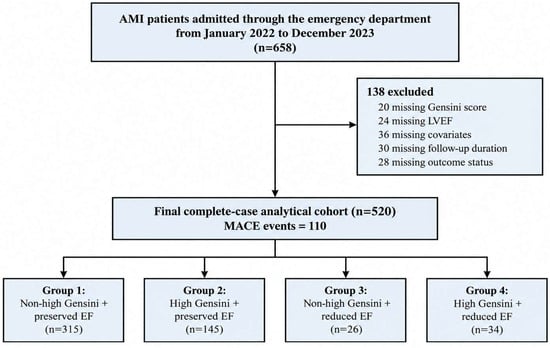
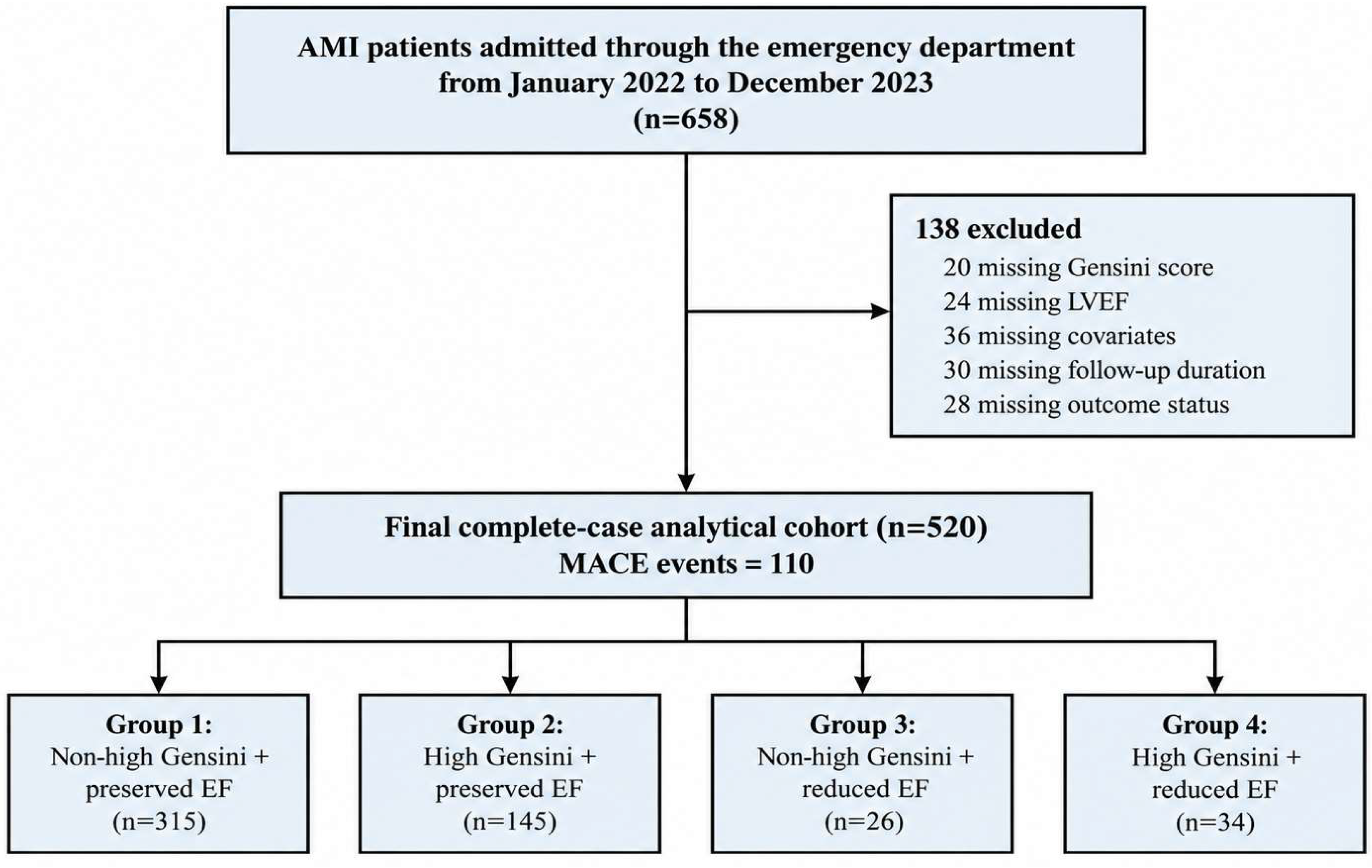
This was a single-center, retrospective cohort study of consecutive patients with acute myocardial infarction (AMI) who underwent percutaneous coronary intervention (PCI) at Xuanwu Hospital, Capital Medical University, between January 2022 and December 2023. AMI was diagnosed according to the Fourth Universal Definition of Myocardial Infarction [13]. Both patients with ST-segment elevation myocardial infarction (STEMI) and those with non-ST-segment elevation myocardial infarction (NSTEMI) who underwent PCI were eligible. Of the 658 patients initially screened, 138 were excluded because of missing exposure, covariate, follow-up, or outcome data required for the primary complete-case analysis. The final analytical cohort comprised 520 patients, including 110 who experienced major adverse cardiovascular events (MACE) during follow-up.
2.2. Clinical Data Collection
Demographic characteristics, cardiovascular risk factors, laboratory measurements, echocardiographic parameters, coronary angiographic findings, and follow-up information were retrospectively extracted from the institutional clinical database and electronic medical records.
Collected demographic and clinical variables included age, sex, smoking status, alcohol use, hypertension, diabetes mellitus, and other available clinical characteristics. Laboratory variables included markers of myocardial injury, glucose, lipid profiles, serum creatinine, and complete blood count parameters. Heart rate, systolic blood pressure, diastolic blood pressure, left ventricular end-diastolic diameter (LVEDD), left ventricular ejection fraction (LVEF), culprit vessel, coronary artery involvement, and multivessel disease were also recorded.
Laboratory measurements were performed in the hospital’s clinical laboratory using standard automated methods. Echocardiographic and angiographic measurements were obtained from the corresponding clinical records.
2.3. Coronary Angiography and Assessment of Coronary Atherosclerotic Burden
The Gensini score was calculated from coronary angiographic findings obtained before PCI. The score quantifies the overall angiographic burden of coronary atherosclerosis by incorporating stenosis severity and the anatomical importance of the affected coronary segments [8].
For categorical analyses, the Gensini score was divided into tertiles based on its distribution in the analytical cohort. High Gensini burden was defined as membership in the highest tertile, whereas non-high burden comprised the lower two tertiles. The resulting categories were used to characterize relative angiographic disease burden within the study population.
2.4. Assessment of Left Ventricular Systolic Function
LVEF was assessed by transthoracic echocardiography within 24 h of hospital admission. Preserved LVEF was defined as ≥50%, whereas reduced LVEF was defined as <50%, based on the prespecified clinical threshold [5,6,7]. LVEF classification was based on the admission-related measurement window and was not determined by its temporal relationship to PCI. Accordingly, the measurement was not assumed to represent a strictly pre-PCI or post-PCI assessment.
2.5. Definition of the Gensini–EF Phenotypes
Four descriptive Gensini–EF phenotypes were defined by combining Gensini burden and LVEF status: Group 1, non-high Gensini burden and preserved LVEF; Group 2, high Gensini burden and preserved LVEF; Group 3, non-high Gensini burden and reduced LVEF; and Group 4, high Gensini burden and reduced LVEF. Group 1 served as the reference category in Cox regression models incorporating the four-level phenotype variable.
2.6. Follow-Up and Clinical Outcomes
2.6.1. Primary Outcome
The primary endpoint was MACE during follow-up after the index AMI hospitalization. According to the original study database, MACE comprised rehospitalization for recurrent myocardial infarction, angina pectoris, or heart failure, or death from any cause.
For the primary time-to-event analysis, follow-up was calculated from the index AMI event to the first documented MACE event. Patients without a documented MACE event were censored at their last available follow-up assessment. Follow-up time was recorded in days and used as the time scale for survival analyses.
2.6.2. Secondary Outcome: All-Cause Mortality
All-cause mortality was analyzed separately as a secondary outcome. Follow-up for this analysis was calculated from the index AMI event to death from any cause or the last available follow-up assessment, whichever occurred first. Patients who remained alive at their last documented follow-up were censored at that time.
2.7. Statistical Analysis
Continuous variables were expressed as mean ± standard deviation (SD) or median (interquartile range [IQR]), as appropriate, and categorical variables as frequencies and percentages. Differences among the four Gensini–EF phenotypes were assessed using one-way analysis of variance or the Kruskal–Wallis test for continuous variables and the chi-square test or Fisher’s exact test for categorical variables.
Kaplan–Meier analysis was used to estimate MACE-free survival and all-cause mortality-free survival, and differences among the four phenotypes were assessed using the log-rank test. Univariable and multivariable Cox proportional hazards regression models were used to evaluate associations between the Gensini–EF phenotypes and MACE. The multivariable model was adjusted for age, sex, hypertension, diabetes mellitus, current smoking, and creatinine, with Group 1 as the reference category. Hazard ratios (HRs) and 95% confidence intervals (CIs) were reported. The proportional hazards assumption was assessed using Schoenfeld residuals. Because admission Killip class is a coarse four-level classification and only three patients were in class IV, it was not included in the primary model to avoid overfitting; instead, a separate sensitivity analysis further adjusting for Killip class was performed.
To examine the independent prognostic associations of coronary anatomical burden and ventricular function, additional multivariable Cox models included the continuous Gensini score and LVEF simultaneously, with HRs expressed per 10-point increase in the Gensini score and per 10-percentage-point increase in LVEF, respectively. A separate model included the product term between the continuous Gensini score and LVEF to evaluate their statistical interaction. Categorical analyses were also performed by simultaneously including reduced LVEF (<50%) and high Gensini burden (highest tertile) as binary variables.
The incremental prognostic value of LVEF beyond the Gensini score was assessed using Harrell’s concordance index (C-index) and likelihood-ratio tests comparing nested Cox models. C-indices were evaluated in unadjusted models incorporating the Gensini score alone and the Gensini score with LVEF, and in adjusted models incorporating clinical covariates and the Gensini score with and without LVEF. The change in C-index was calculated to quantify the difference in discrimination between the adjusted models.
Restricted cubic spline analysis with four knots was used to examine the continuous association between LVEF and MACE. The model was adjusted for the Gensini score, age, sex, hypertension, diabetes mellitus, current smoking, and creatinine. The overall association and departure from linearity were evaluated separately. The conventional 50% LVEF threshold was retained for categorical analyses on clinical grounds rather than selected as a data-derived optimal cutoff.
All-cause mortality was analyzed separately using Kaplan–Meier estimation and multivariable Cox proportional hazards regression, adjusted for age, sex, hypertension, diabetes mellitus, current smoking, and creatinine, with Group 1 as the reference category.
All statistical tests were two-sided, and p < 0.05 was considered statistically significant. Analyses were performed using R Statistical Software (version 4.4.0; R Foundation for Statistical Computing, Vienna, Austria; https://www.R-project.org/).
3. Results
3.1. Study Population
Of 658 initially screened patients, 138 were excluded because of missing exposure, covariate, follow-up, or outcome data required for complete-case analysis. The final analytical cohort comprised 520 patients with AMI, of whom 110 experienced MACE during follow-up. The cohort included Group 1 (n = 315), Group 2 (n = 145), Group 3 (n = 26), and Group 4 (n = 34). The study flow is shown in Figure 1.
Figure 1.
Flow diagram of study population.
3.2. Baseline Characteristics Across Gensini–EF Phenotypes
Baseline clinical characteristics, laboratory measurements, echocardiographic parameters, and angiographic findings across the four Gensini–EF phenotypes are summarized in Table 1. LVEF and Gensini score differed across groups as expected from the phenotype definitions. The table also presents distributions of demographic characteristics, cardiovascular risk factors, hemodynamic measures, creatinine, lipid and metabolic measures, and selected angiographic findings.
Table 1.
Baseline characteristics according to Gensini–EF phenotype.
3.3. Long-Term Clinical Outcomes and Adjusted Associations According to Gensini–EF Phenotypes
During follow-up, 110 patients experienced major adverse cardiovascular events (MACE). The crude MACE incidence varied across the four phenotypes, ranging from 15.6% in Group 1 to 50.0% in Group 3. The incidence was 15.6% (49/315), 24.8% (36/145), 50.0% (13/26), and 35.3% (12/34) in Groups 1–4, respectively. Among patients with preserved left ventricular ejection fraction (LVEF), the crude MACE incidence was higher in patients with a high Gensini score than in those with a non-high score (24.8% vs. 15.6%). The distribution of MACE and follow-up duration across the four phenotypes is summarized in Table 2.
Table 2.
Long-term clinical outcomes and follow-up duration according to Gensini–EF phenotype.
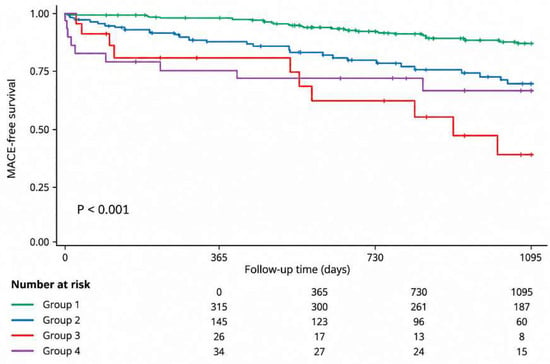
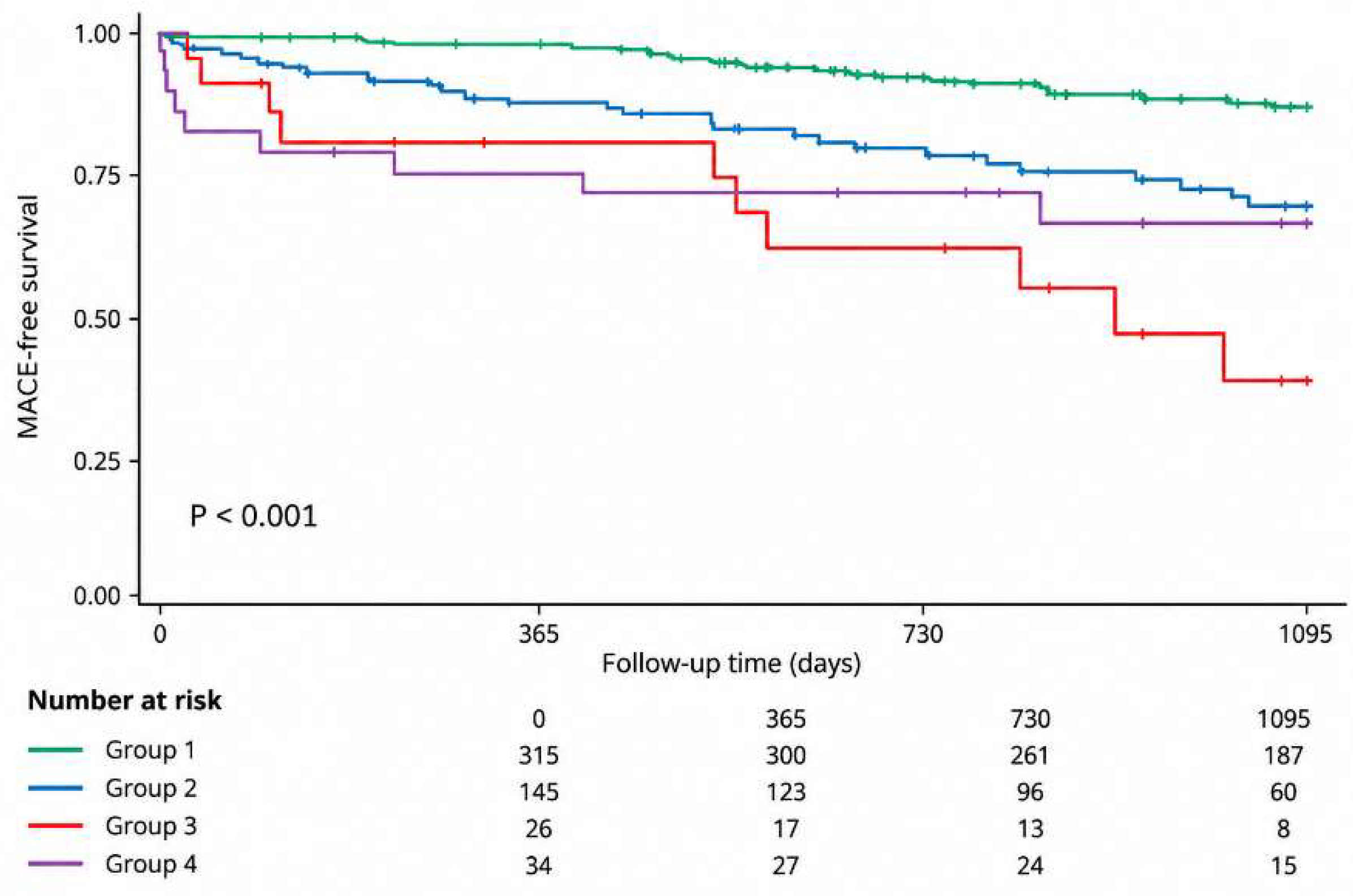
Three-year Kaplan–Meier analysis demonstrated significant differences in MACE-free survival among the four Gensini–EF phenotypes (log-rank p < 0.001; Figure 2). Group 1 (non-high Gensini score with preserved LVEF) showed the most favorable survival profile, whereas Group 3 (non-high Gensini score with reduced LVEF) showed the lowest MACE-free survival during follow-up.
Figure 2.
Three-year Kaplan–Meier curves for MACE-free survival according to Gensini–EF phenotype.
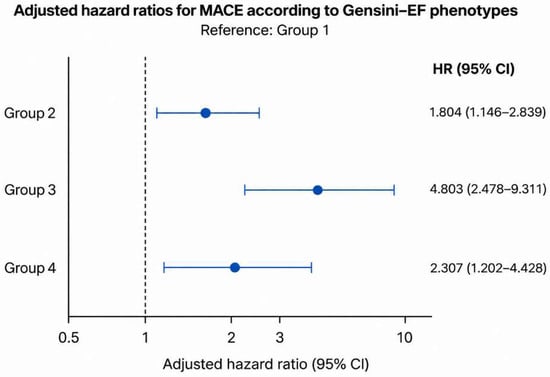
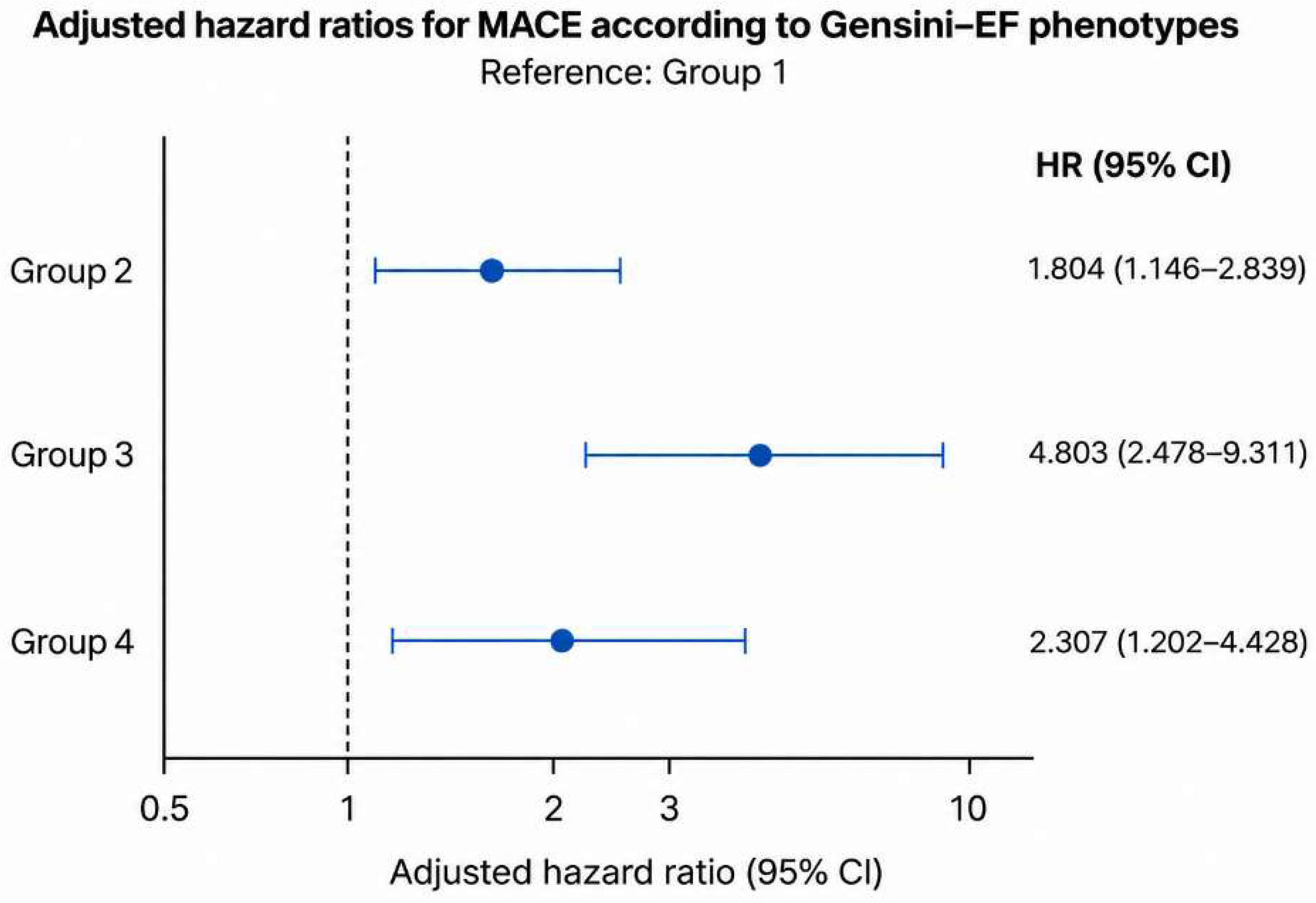
In multivariable Cox regression analyses adjusted for age, sex, hypertension, diabetes mellitus, current smoking, and creatinine, Groups 2, 3, and 4 had higher hazards of MACE than Group 1 (adjusted HRs, 1.804 [95% CI, 1.146–2.839; p = 0.011], 4.803 [95% CI, 2.478–9.311; p < 0.001], and 2.307 [95% CI, 1.202–4.428; p = 0.012], respectively; Table 3 and Figure 3). Older age (adjusted HR per year, 1.055; 95% CI, 1.033–1.077; p < 0.001), diabetes mellitus (adjusted HR, 1.554; 95% CI, 1.044–2.312; p = 0.030), and creatinine (adjusted HR per μmol/L, 1.004; 95% CI, 1.002–1.006; p < 0.001) were independently associated with MACE, whereas sex, hypertension, and current smoking were not.
Table 3.
Univariable and multivariable Cox regression analyses for MACE.
Figure 3.
Adjusted hazard ratios for MACE according to Gensini–EF phenotypes.
3.4. Incremental and Independent Prognostic Value of LVEF Relative to Coronary Atherosclerotic Burden
Adding LVEF to the Gensini score increased the Harrell C-index from 0.612 to 0.653 in unadjusted models and from 0.704 to 0.723 in fully adjusted models (ΔC-index = 0.019; Table 4). The likelihood-ratio test indicated improved model fit after adding LVEF (χ2 = 11.98, df = 1; p < 0.001). At 3 years, the continuous net reclassification improvement (NRI) was 0.114, and the integrated discrimination improvement (IDI) was 0.0121 in the 344 patients with known 3-year status, including 74 MACE.
Table 4.
Incremental prognostic value of LVEF beyond the Gensini score for MACE.
In the mutually adjusted continuous model, LVEF was independently associated with MACE (HR per 10-percentage-point increase, 0.728; 95% CI, 0.611–0.867; p <0.001), whereas the Gensini score was not (HR per 10-point increase, 1.025; 95% CI, 0.970–1.083; p = 0.383). Consistent findings were observed in the categorical model: reduced LVEF (<50%) was associated with a higher hazard of MACE (HR, 2.248; 95% CI, 1.392–3.630; p = 0.0009), whereas high Gensini burden was not (HR, 1.311; 95% CI, 0.874–1.966; p = 0.190; Table 5).
Table 5.
Independent prognostic significance of LVEF and the Gensini score for MACE.
3.5. Restricted Cubic Spline Analysis of LVEF
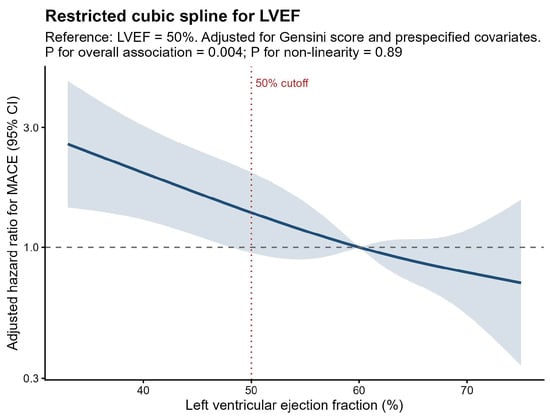
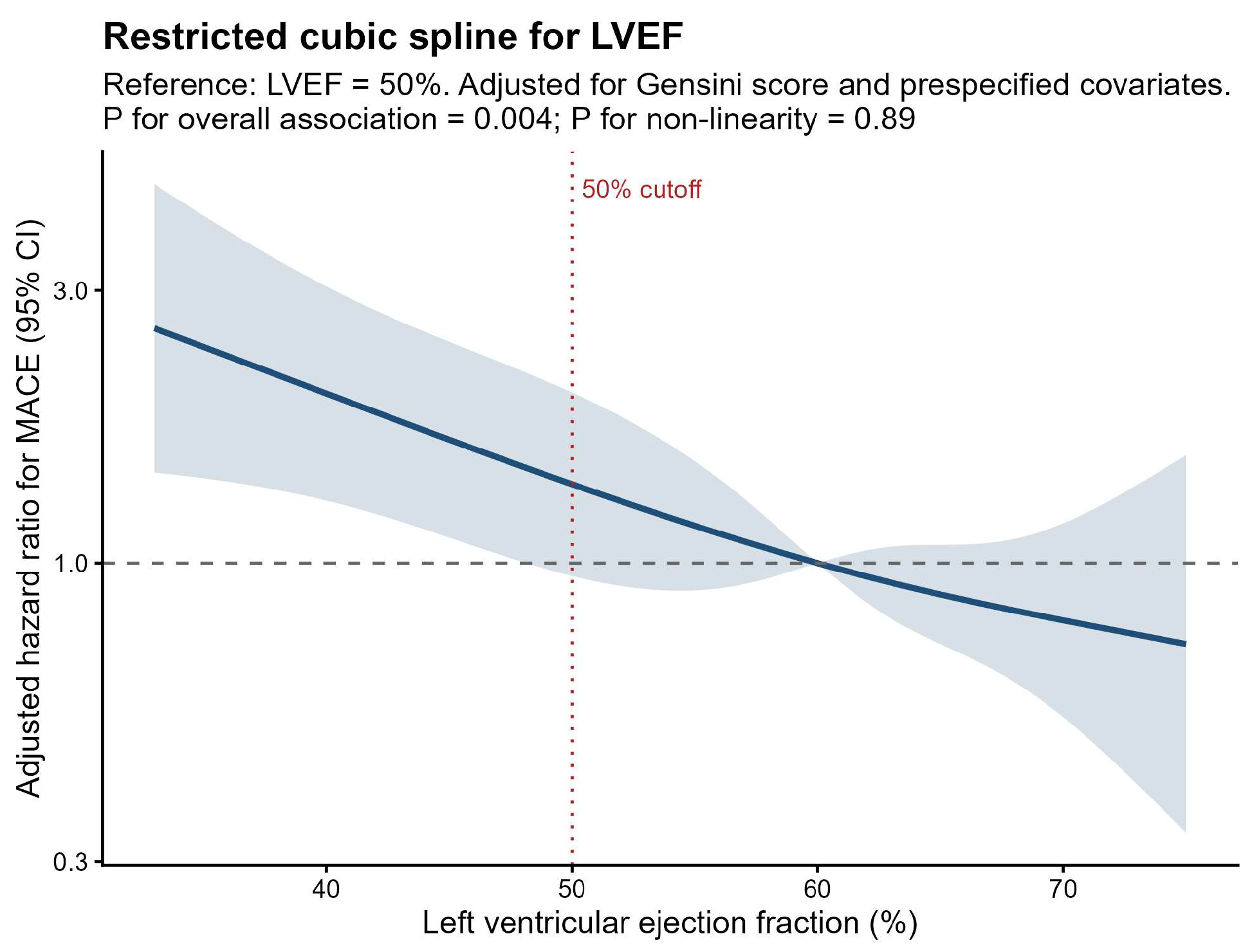
To further characterize the association between LVEF and MACE and assess the appropriateness of the prespecified 50% threshold, LVEF was modeled continuously using a restricted cubic spline with four knots, adjusted for the Gensini score and prespecified clinical covariates. LVEF was significantly associated with MACE (p for overall association = 0.004), with no evidence of a nonlinear association (p for nonlinearity = 0.89; Figure 4). The estimated hazard of MACE decreased as LVEF increased. Given this continuous relationship and the established clinical relevance of the 50% threshold, the prespecified cutoff was retained for categorical analyses. In a separate analysis modeling the Gensini score continuously, the adjusted HR per 10-point increase was 1.045 (95% CI, 0.990–1.104; p = 0.108).
Figure 4.
Restricted cubic spline analysis of the association between left ventricular ejection fraction and major adverse cardiovascular events. Footnote: The adjusted HR for MACE is plotted across LVEF values, with 50% LVEF as the reference. The solid line represents the estimated HR, and the shaded area indicates the 95% confidence interval. The red dotted vertical line marks the prespecified 50% LVEF threshold, and the gray dashed horizontal line indicates HR = 1. The model was adjusted for the Gensini score, age, sex, hypertension, diabetes mellitus, current smoking, and creatinine. p values are shown for the overall association and the test for nonlinearity.
3.6. All-Cause Mortality According to Gensini–EF Phenotype
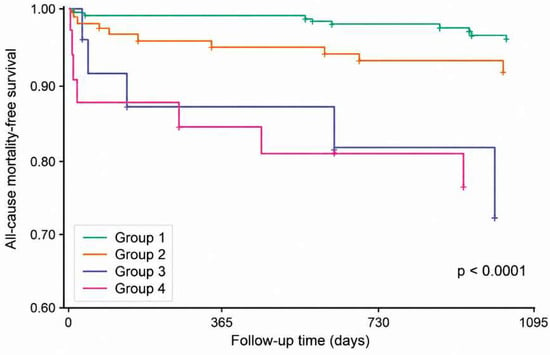
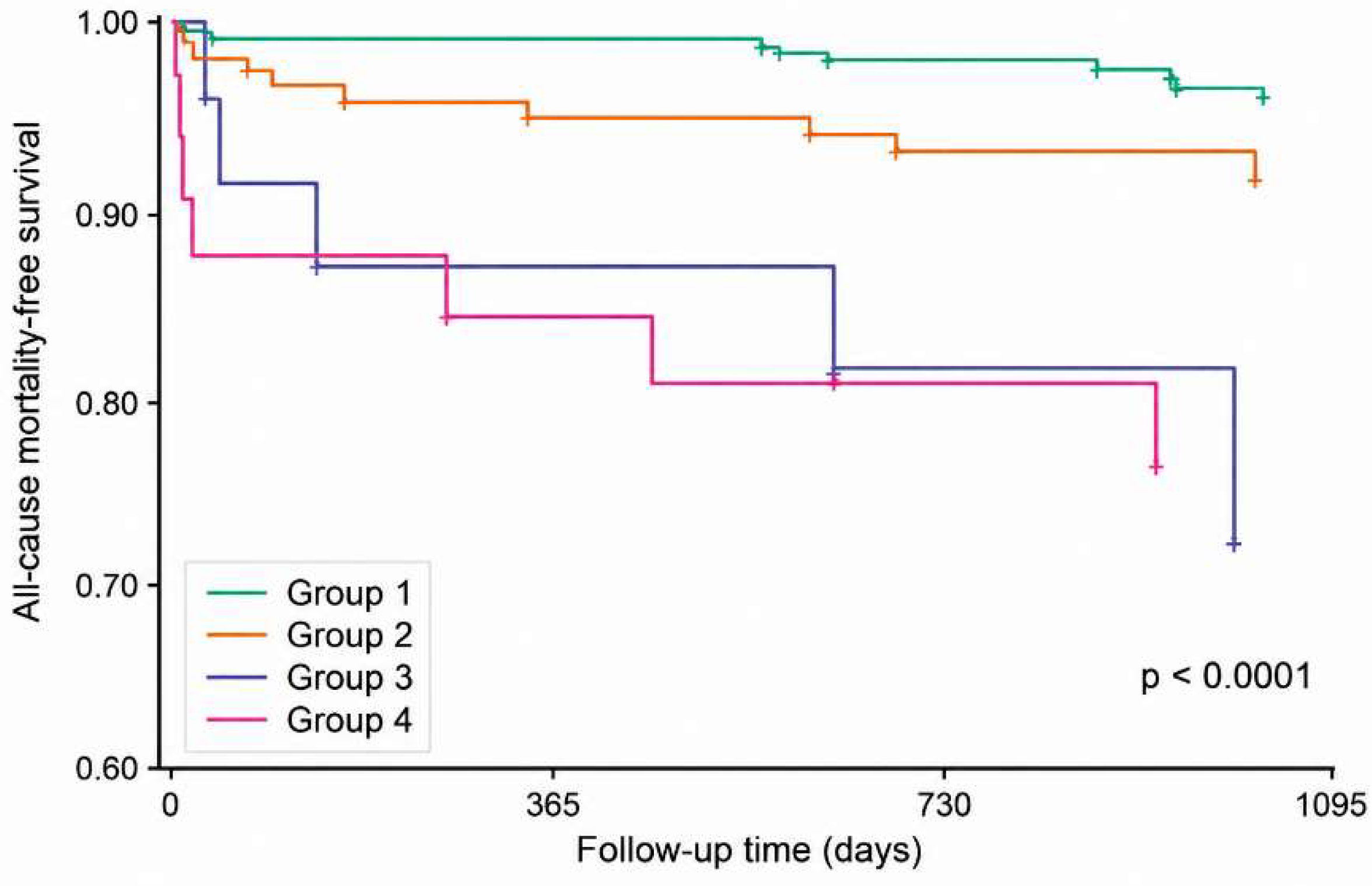
To complement the composite MACE analysis, all-cause mortality was examined separately (Table 6). During follow-up, 48 of 520 patients (9.2%) died. Crude mortality rates were 7.0% in Group 1, 8.3% in Group 2, 23.1% in Group 3, and 23.5% in Group 4. Kaplan–Meier analysis demonstrated significant differences in all-cause mortality-free survival among the four phenotypes (log-rank p < 0.001; Figure 5).
Table 6.
All-cause mortality according to Gensini–EF phenotype.
Figure 5.
Kaplan–Meier curves for all-cause mortality according to Gensini–EF phenotype.
In multivariable Cox regression adjusted for age, sex, hypertension, diabetes mellitus, current smoking, and creatinine, Groups 3 and 4 had higher hazards of all-cause death than Group 1 (HR 4.246, 95% CI 1.470–12.265; p = 0.008, and HR 4.008, 95% CI 1.699–9.456; p = 0.002, respectively). Group 2 was not significantly associated with all-cause mortality (HR 1.431, 95% CI 0.675–3.036; p = 0.350). The global Schoenfeld residual test did not indicate a significant departure from the proportional hazards assumption (p = 0.222; Table 6).
3.7. Sensitivity Analysis According to Admission Killip Class
Admission Killip class was available for all 520 patients (Class I: n = 410; Class II: n = 84; Class III: n = 23; Class IV: n = 3). The proportion of patients with Killip class II–IV increased progressively across the phenotypes (Group 1: 14.3%; Group 2: 20.7%; Group 3: 53.8%; Group 4: 61.8%; p < 0.001).
For MACE, further adjustment for Killip class II–IV left the phenotype associations essentially unchanged (Group 2: HR 1.814, 95% CI 1.150–2.861; Group 3: HR 4.920, 95% CI 2.469–9.806; Group 4: HR 2.345, 95% CI 1.206–4.557; all p < 0.05), and adding Killip class did not improve model fit (p = 0.50).
For all-cause mortality, adjustment for Killip class attenuated the associations but did not abolish them (Group 3: HR 3.361, 95% CI 1.120–10.089, p = 0.031; Group 4: HR 3.391, 95% CI 1.401–8.207, p = 0.007). The proportional hazards assumption was satisfied in all models.
4. Discussion
In this single-center cohort of 520 patients with acute myocardial infarction (AMI) undergoing percutaneous coronary intervention (PCI), 110 patients experienced MACE during follow-up. MACE incidence varied across the four Gensini–EF phenotypes, with the highest crude event rates observed in patients with reduced LVEF. Among patients with preserved LVEF, a high pre-PCI Gensini score was associated with a higher crude MACE incidence and remained associated with MACE after adjustment for prespecified clinical covariates. However, the continuous Gensini score-by-LVEF interaction was not statistically significant, and the findings do not establish a statistically significant interaction between anatomical disease burden and ventricular function. The principal finding is that angiographic disease burden may provide additional prognostic information among patients with preserved LVEF.
The association between reduced LVEF and adverse outcomes is consistent with previous studies in patients with AMI and acute coronary syndromes [5,6,7]. LVEF reflects ventricular systolic function and is an established marker of prognosis following AMI. In the present cohort, reduced LVEF was associated with a greater observed burden of adverse events. Nevertheless, preserved LVEF did not uniformly identify patients at low long-term risk. Among patients with preserved LVEF, those with a high Gensini score had a higher adjusted hazard of MACE than those with a non-high score. This finding suggests that assessment of coronary anatomical burden may complement LVEF-based risk stratification, although its incremental predictive value and generalizability require further validation.
The Gensini score was used to characterize the overall angiographic burden of coronary atherosclerosis by incorporating stenosis severity and segment-specific anatomical weighting [8]. Previous studies have associated angiographic disease burden and multivessel disease with adverse outcomes in patients with acute coronary syndromes and AMI [10,11,14]. In the present cohort, high Gensini burden was associated with a higher adjusted hazard of MACE among patients with preserved LVEF. This finding suggests that angiographic disease burden may help identify residual long-term risk even when systolic function is preserved. Although both Gensini and SYNTAX scores characterize coronary artery disease, they emphasize different anatomical features, with Gensini quantifying weighted stenosis burden and SYNTAX focusing more extensively on lesion complexity. However, the present study did not directly compare their prognostic performance.
The four Gensini–EF categories should be interpreted as clinically defined joint phenotypes rather than as an ordinal risk scale. Although the adjusted HR point estimate was numerically higher in Group 3 than in Group 4, no direct statistical comparison between these groups was performed. Therefore, their relative risks cannot be inferred from the point estimates alone. Moreover, the reduced-LVEF subgroups were relatively small, comprising 26 and 34 patients, with 13 and 12 MACE, respectively, resulting in limited precision of the corresponding effect estimates. The continuous Gensini score-by-LVEF interaction was not statistically significant.
Because LVEF and coronary angiography are routinely available during AMI care, their joint assessment may help characterize heterogeneity in long-term outcomes among patients with preserved systolic function. This approach may complement established risk assessment based on clinical presentation, hemodynamic status, and conventional risk scores [1,2,3,4,15]. Recent studies have evaluated the performance of established risk prediction models, including GRACE and TIMI, in contemporary ACS populations, while the extension of the GRACE score further illustrates ongoing efforts to refine individualized risk prediction [16,17]. Future studies should directly compare the prognostic performance of the Gensini–EF phenotype framework with established clinical risk models and angiographic measures, including the SYNTAX score and post-PCI residual coronary disease indices, to assess incremental prognostic value and support external validation [18,19,20,21]. Standardized timing of LVEF measurement and serial assessment of ventricular function may also help distinguish acute-phase myocardial dysfunction from subsequent functional recovery.
In additional analyses, adding LVEF to the model containing the Gensini score and clinical covariates increased the C-index and improved model fit. The restricted cubic spline analysis showed a monotonic association between LVEF and MACE, without statistically significant evidence of nonlinearity. The conventional 50% LVEF threshold was therefore retained for the categorical analyses on clinical grounds rather than as a data-derived optimal cutoff. In the mutually adjusted continuous model, LVEF was independently associated with MACE, whereas the Gensini score was not statistically significant. This finding suggests that while the anatomical burden of atherosclerosis (Gensini) provides valuable descriptive risk information—particularly within the preserved-LVEF subgroup—the functional consequence of the infarction (LVEF) remains the dominant independent driver of long-term adverse events. Therefore, the Gensini–EF phenotypes are best interpreted as descriptive anatomical–functional profiles, with the independent prognostic value being largely captured by LVEF.
MACE-free survival and all-cause mortality were both analyzed from the index AMI to the first occurrence of the respective endpoint or the last available follow-up, as appropriate. Although all deaths in this cohort occurred in patients with a recorded MACE event, the risk sets for the two survival analyses are not necessarily identical because patients with nonfatal MACE may continue to contribute follow-up time to the all-cause mortality analysis. Accordingly, the number at risk should be calculated separately for each endpoint using its corresponding event and censoring definitions. The all-cause mortality analysis therefore provides a complementary assessment of the fatal component of the observed clinical outcomes.
Several limitations should be acknowledged. First, this was a single-center retrospective study restricted to complete cases. Since exclusion was not random with respect to disease severity, selection bias cannot be excluded, and the generalizability of the findings to other populations and healthcare settings remains uncertain. Second, residual confounding and exposure misclassification cannot be excluded. Several prognostic factors, including infarct severity, completeness of revascularization, and discharge medications, were insufficiently characterized; in addition, although Killip class was available, it is a coarse classification with few class IV patients, limiting statistical power to fully exclude confounding by hemodynamic status. Furthermore, LVEF was measured within 24 h of admission without standardized timing relative to PCI, so it may have reflected transient myocardial stunning or acute hemodynamic changes. Third, the Gensini thresholds defining the phenotypes were derived from this cohort and may not be directly transferable to other populations, and no external validation was performed. The present results should therefore be regarded as hypothesis-generating, and external validation in independent cohorts is needed to assess reproducibility, prognostic performance, and clinical applicability.
5. Conclusions
Pre-PCI Gensini burden and LVEF jointly define distinct long-term prognostic phenotypes after AMI. High Gensini burden was associated with increased MACE risk in patients with preserved LVEF, and LVEF added incremental discrimination. However, in mutually adjusted continuous models, only LVEF remained an independent predictor of MACE. External validation is warranted to confirm its clinical utility.
Author Contributions
Conceptualization, Z.L.; data curation, S.W.; formal analysis, S.W. and W.Z.; writing—original draft preparation, S.W.; writing—review and editing, Y.W., Z.F. and Z.L. All authors have read and agreed to the published version of the manuscript.
Funding
This research was funded by the National Natural Science Foundation of China, grant number 62172288.
Institutional Review Board Statement
This study was approved by the Ethics Committee of Xuanwu Hospital, Capital Medical University. Approval code: KS2022161. Approval date: 29 September 2022 initial approval; 20 September 2024 annual renewal, with validity extended to 9 October 2025.
Informed Consent Statement
Written informed consent was obtained from all participants.
Data Availability Statement
The data presented in this study are available from the corresponding author upon reasonable request.
Conflicts of Interest
The authors declare no conflicts of interest.
References
- Byrne, R.A.; Rossello, X.; Coughlan, J.J.; Barbato, E.; Berry, C.; Chieffo, A.; Claeys, M.J.; Dan, G.-A.; Dweck, M.R.; Galbraith, M.; et al. 2023 ESC Guidelines for the management of acute coronary syndromes. Eur. Heart J. 2023, 44, 3720–3826. [Google Scholar] [CrossRef] [Scilit] [PubMed]
- Rao, S.V.; O’Donoghue, M.L.; Ruel, M.; Rab, T.; Tamis-Holland, J.E.; Alexander, J.H.; Baber, U.; Baker, H.; Cohen, M.G.; Cruz-Ruiz, M.; et al. 2025 ACC/AHA/ACEP/NAEMSP/SCAI Guideline for the Management of Patients with Acute Coronary Syndromes. J. Am. Coll. Cardiol. 2025, 85, 2135–2237. [Google Scholar] [CrossRef] [Scilit] [PubMed]
- Lawton, J.S.; Tamis-Holland, J.E.; Bangalore, S.; Bates, E.R.; Beckie, T.M.; Bischoff, J.M.; Bittl, J.A.; Cohen, M.G.; DiMaio, J.M.; Don, C.W.; et al. 2021 ACC/AHA/SCAI Guideline for Coronary Artery Revascularization. J. Am. Coll. Cardiol. 2022, 79, e21–e129. [Google Scholar] [CrossRef] [Scilit] [PubMed]
- Virani, S.S.; Newby, L.K.; Arnold, S.V.; Bittner, V.; Brewer, L.C.; Demeter, S.H.; Dixon, D.L.; Fearon, W.F.; Hess, B.; Johnson, H.M.; et al. 2023 AHA/ACC/ACCP/ASPC/NLA/PCNA Guideline for the Management of Patients with Chronic Coronary Disease. J. Am. Coll. Cardiol. 2023, 82, 833–955. [Google Scholar] [CrossRef] [Scilit] [PubMed]
- Furtado, R.H.M.; Juliasz, M.G.; Chiu, F.Y.J.; Bastos, L.B.C.; Dalcoquio, T.F.; Lima, F.G.; Rosa, R.; Caporrino, C.A.; Bertolin, A.; Genestreti, P.R.; et al. Long-term mortality after acute coronary syndromes among patients with normal, mildly reduced, or reduced ejection fraction. ESC Heart Fail. 2023, 10, 442–452. [Google Scholar] [CrossRef] [Scilit] [PubMed]
- Jortveit, J.; Myhre, P.L.; Berge, K.; Halvorsen, S. Survival after myocardial infarction according to left ventricular function and heart failure symptoms. ESC Heart Fail. 2025, 12, 2528–2539. [Google Scholar] [CrossRef] [Scilit] [PubMed]
- Ndrepepa, G.; Cassese, S.; Byrne, R.A.; Bevapi, B.; Joner, M.; Sager, H.B.; Kufner, S.; Xhepa, E.; Ibrahim, T.; Laugwitz, K.; et al. Left Ventricular Ejection Fraction Change Following Percutaneous Coronary Intervention: Correlates and Association with Prognosis. J. Am. Heart Assoc. 2024, 13, e035791. [Google Scholar] [CrossRef] [Scilit] [PubMed]
- Gensini, G.G. A more meaningful scoring system for determining the severity of coronary heart disease. Am. J. Cardiol. 1983, 51, 606. [Google Scholar] [CrossRef] [Scilit] [PubMed]
- Sinning, C.; Lillpopp, L.; Appelbaum, S.; Ojeda, F.; Zeller, T.; Schnabel, R.; Lubos, E.; Jagodzinski, A.; Keller, T.; Munzel, T.; et al. Angiographic score assessment improves cardiovascular risk prediction: The clinical value of SYNTAX and Gensini application. Clin. Res. Cardiol. 2013, 102, 495–503. [Google Scholar] [CrossRef] [Scilit] [PubMed]
- Zhang, Y.; Luo, R.; Sun, X.; Cai, J.; Al-Kaif, M.A.; Wang, Z.; Li, C.; Wu, C.; Wang, Z.; Li, Z.; et al. The relationship between Gensini score and rates of 30-day mortality in acute coronary syndrome patients in China. BMC Cardiovasc. Disord. 2025, 26, 3. [Google Scholar] [CrossRef] [Scilit] [PubMed]
- Supriami, K.; Urbut, S.M.; Tello-Ayala, J.R.; Unlu, O.; Friedman, S.F.; Abou-Karam, R.; Koyama, S.; Uddin, M.; Pomerantsev, E.; Lu, M.T.; et al. Genomic Drivers of Coronary Artery Disease and Risk of Future Outcomes After Coronary Angiography. JAMA Netw. Open 2025, 8, e2455368. [Google Scholar] [CrossRef] [Scilit] [PubMed]
- Bertolini, D.; Armillotta, M.; Angeli, F.; Sansonetti, A.; Bodega, F.; Amicone, S.; Canton, L.; Fedele, D.; Suma, N.; Impellizzeri, A.; et al. Identification of Clinical Phenotypes in Type 2 Myocardial Infarction: Insights Into Characteristics, Prognosis, and Management Strategies. J. Am. Heart Assoc. 2025, 14, e042858. [Google Scholar] [CrossRef] [Scilit] [PubMed]
- Thygesen, K.; Alpert, J.S.; Jaffe, A.S.; Chaitman, B.R.; Bax, J.J.; Morrow, D.A.; White, H.D.; Executive Group on behalf of the Joint European Society of Cardiology (ESC)/American College of Cardiology (ACC)/American Heart Association (AHA)/World Heart Federation (WHF) Task Force for the Universal Definition of Myocardial Infarction. Fourth Universal Definition of Myocardial Infarction (2018). J. Am. Coll. Cardiol. 2018, 72, 2231–2264. [Google Scholar] [CrossRef] [Scilit] [PubMed]
- He, Q.; Zhang, P.; Li, Y.; Cai, C.; Wang, C. The application of Gensini score and IL-1ra in assessing the condition and prognosis of patients with coronary artery disease. Am. J. Transl. Res. 2021, 13, 10421–10427. [Google Scholar] [PubMed]
- Visseren, F.L.J.; Mach, F.; Smulders, Y.M.; Carballo, D.; Koskinas, K.C.; Bäck, M.; Benetos, A.; Biffi, A.; Boavida, J.-M.; Capodanno, D.; et al. 2021 ESC Guidelines on cardiovascular disease prevention in clinical practice. Eur. Heart J. 2021, 42, 3227–3337. [Google Scholar] [CrossRef] [Scilit] [PubMed]
- Bai, L.; Li, Y.M.; Yang, B.S.; Cheng, Y.-H.; Zhang, Y.-K.; Liao, G.-Z.; Ye, Y.-Y.; Chen, X.-F.; Chai, H.; Peng, Y. Performance of the Risk Scores for Predicting In-Hospital Mortality in Patients with Acute Coronary Syndrome in a Chinese Cohort. Rev. Cardiovasc. Med. 2023, 24, 356. [Google Scholar] [CrossRef] [Scilit] [PubMed]
- Wenzl, F.A.; Kofoed, K.F.; Simonsson, M.; Ambler, G.; van der Sangen, N.M.R.; Lampa, E.; Bruno, F.; A de Belder, M.; Hlasensky, J.; Mueller-Hennessen, M.; et al. Extension of the GRACE score for non-ST-elevation acute coronary syndrome: A development and validation study in ten countries. Lancet Digit. Health 2025, 7, 100907. [Google Scholar] [CrossRef] [Scilit] [PubMed]
- Gaba, P.; Gersh, B.J.; Ali, Z.A.; Moses, J.W.; Stone, G.W. Complete versus incomplete coronary revascularization: Definitions, assessment and outcomes. Nat. Rev. Cardiol. 2021, 18, 155–168. [Google Scholar] [CrossRef] [Scilit] [PubMed]
- Kashiwagi, D.; Ebisawa, S.; Yui, H.; Maruyama, S.; Nagae, A.; Sakai, T.; Kato, T.; Saigusa, T.; Okada, A.; Motoki, H.; et al. Prognostic usefulness of residual SYNTAX score combined with clinical factors for patients with acute coronary syndrome who underwent percutaneous coronary intervention from the SHINANO Registry. Heart Vessels 2021, 36, 170–179. [Google Scholar] [CrossRef] [Scilit] [PubMed]
- Stähli, B.E.; Varbella, F.; Linke, A.; Schwarz, B.; Felix, S.B.; Seiffert, M.; Kesterke, R.; Nordbeck, P.; Witzenbichler, B.; Lang, I.M.; et al. Timing of Complete Revascularization with Multivessel PCI for Myocardial Infarction. N. Engl. J. Med. 2023, 389, 1368–1379. [Google Scholar] [CrossRef] [Scilit] [PubMed]
- Böhm, F.; Mogensen, B.; Engstrøm, T.; Stankovic, G.; Srdanovic, I.; Lønborg, J.; Zwackman, S.; Hamid, M.; Kellerth, T.; Lauermann, J.; et al. FFR-Guided Complete or Culprit-Only PCI in Patients with Myocardial Infarction. N. Engl. J. Med. 2024, 390, 1481–1492. [Google Scholar] [CrossRef] [Scilit] [PubMed]

Disclaimer/Publisher’s Note: The statements, opinions and data contained in all publications are solely those of the individual author(s) and contributor(s) and not of MDPI and/or the editor(s). MDPI and/or the editor(s) disclaim responsibility for any injury to people or property resulting from any ideas, methods, instructions or products referred to in the content. |
© 2026 by the authors. Licensee MDPI, Basel, Switzerland. This article is an open access article distributed under the terms and conditions of the Creative Commons Attribution (CC BY) license.