


Abstract
Background: Cirrhosis is increasingly prevalent among older adults, driven in part by the rising burden of metabolic dysfunction-associated steatotic liver disease, which disproportionately affects this population. These patients are particularly vulnerable to premature geriatric syndromes, including frailty, disability, and cognitive impairment, reflecting the combined—if not synergistic—effects of aging and end-stage liver disease. As a result, they experience high symptom burden and health care utilization. Despite this complexity, cirrhosis care remains largely organized around disease-specific management and liver transplant evaluation, often failing to address geriatric and patient-centered needs. Approach: The Age-Friendly Health Systems initiative, developed by the John A. Hartford Foundation and the Institute for Healthcare Improvement, provides a standardized framework for high-quality care of older adults through the 4Ms: What Matters, Medication, Mentation, and Mobility. Although widely implemented across health systems, its application to hepatology remains limited. We propose an adaptation of the 4Ms framework for hepatology practice, supplemented by a fifth domain—Multicomplexity—to capture the intersecting challenges of symptom burden, multimorbidity, psychosocial vulnerability, and fragmented care. We describe how each domain can be operationalized within routine hepatology care and aligned with existing liver-specific tools and workflows. “What Matters” addresses prognostic uncertainty in cirrhosis and emphasizes structured advance care planning and goals-of-care conversations, particularly in the context of evolving transplant eligibility. “Medication” focuses on reducing polypharmacy and medication-related harm through careful prescribing in the setting of hepatic dysfunction and aging. “Mentation” targets identification and management of cognitive impairment, including minimal hepatic encephalopathy, alongside psychiatric comorbidities. “Mobility” emphasizes assessment and treatment of sarcopenia and frailty using liver-specific tools such as the Liver Frailty Index. “Multicomplexity” captures broader biopsychosocial and system-level challenges, including symptom burden, multimorbidity, social determinants of health, and care fragmentation. We further highlight palliative care as a complementary strategy for operationalizing the 5Ms in hepatology, supported by the PAL-LIVER trial, a multisite cluster randomized study demonstrating that trained hepatologist-delivered palliative care is noninferior to specialist-delivered care in improving quality of life and enhanced emotional well-being and patient satisfaction. Conclusions: An Age-Friendly, 5Ms-based approach adapted for hepatology has the potential to improve quality of life, reduce unnecessary health care utilization, and better align care with what matters most to older adults with cirrhosis. Integrating this framework into routine hepatology practice, supported by palliative care training principles and liver-specific tools, represents a scalable strategy for improving care delivery. Pragmatic implementation studies are needed to evaluate effectiveness, scalability, and sustainability across diverse health system settings.
1. Background
The epidemiology of cirrhosis is shifting toward older adults, reshaping hepatology practice and exposing gaps in traditional models of liver care. Adults aged 65 and older are now the fastest growing demographic among individuals with newly diagnosed cirrhosis [1,2]. This shift reflects the convergence of several trends. Metabolic dysfunction-associated steatotic liver disease (MASLD), now the leading cause of cirrhosis, is increasing in parallel with rising rates of obesity and type 2 diabetes [3]. Broader screening and noninvasive fibrosis assessment tools have contributed to expanded case identification [4]. Concurrently, population aging and increasing life expectancy provide a longer window for chronic liver diseases, including MASLD, to advance to cirrhosis.
As cirrhosis and aging intersect, patients experience compounded vulnerabilities that extend beyond liver-related complications. The aging liver undergoes significant physiologic changes, including reduced hepatic volume and diminished regenerative capacity, resulting in impaired drug metabolism and increased susceptibility to pathologic changes [5]. Polypharmacy is common in this population, and high-risk medications may precipitate or worsen hepatic encephalopathy, which can be difficult to distinguish from cognitive impairment and other neuropsychiatric disorders prevalent in older adults [6,7,8]. Cirrhosis-related therapies (e.g., diuretics, lactulose, non-selective beta blockers) may exacerbate geriatric syndromes. Concurrently, age-related sarcopenia is accelerated by altered catabolism in cirrhosis, increasing the risk for frailty and falls [9]. Despite substantial multimorbidity and poor prognosis associated with decompensated cirrhosis, advance care planning (ACP) is often inadequate in this population, contributing to high utilization of life-sustaining treatments at the end of life [10,11]. As a result, older adults with cirrhosis experience increased health care utilization, functional decline, disability, and mortality compared with age-equivalent adults [12]. Yet, cirrhosis care remains largely focused on managing liver-related complications (e.g., ascites, variceal bleeding, and hepatic encephalopathy) and transplant evaluation, often failing to address the multidimensional needs and priorities of older adults with cirrhosis.
The Age-Friendly Health Systems (AFHS) initiative, led by the John A. Hartford Foundation and the Institute for Healthcare Improvement (IHI), provides an evidence-based, practical framework for improving quality care for older adults through the 4Ms: What Matters, Medication, Mentation, and Mobility. AFHS implementation has demonstrated measurable impact: reduced hospital readmissions, deprescribing of inappropriate medications, and increased rates of ACP [13,14,15,16]. While over 7000 care settings have implemented the 4Ms, its applicability to hepatology is unknown, with only one IHI-recognized hepatology setting (San Francisco Veterans Affairs Liver Clinic) and no published implementation studies to date [17]. This gap represents an important opportunity to integrate geriatric principles into routine liver care. Hepatologists are uniquely positioned to implement the 4Ms because each domain aligns closely with common challenges encountered in cirrhosis care, and validated liver-specific tools already exist to support assessment and intervention within this framework.
While the AFHS initiative provides evidence-based tools and best practices to assess and act on the 4Ms in older adults, the existing 4Ms framework does not include liver-specific considerations. In this article, we highlight the unique needs of older adults with cirrhosis and present practical strategies to incorporate the 4Ms and a fifth M—Multicomplexity—into hepatology care (Table 1) [18]. We also describe how findings from the recent PAL-LIVER trial, a large cluster randomized trial comparing palliative care (PC) delivered by PC specialists to that delivered by trained hepatologists, complement the 5Ms-based approach to care delivery in older adults with cirrhosis [19]. Although AFHS was primarily designed for adults aged 65 years and older, its application may also extend to younger patients with cirrhosis, in whom accelerated aging can result in phenotypes similar to those observed in older adults. Together, these approaches can help align hepatology care with the priorities and needs of older adults across the spectrum of cirrhosis, irrespective of liver transplant eligibility, with the goal of improving quality of care and patient outcomes (Table 2).
Table 1.
Practical implementation of age-friendly cirrhosis care in ambulatory hepatology.
Table 2.
Applying the 5Ms framework across the spectrum of cirrhosis stages in older adults.
Table 1 provides a list of evidence-based assessment tools in the Age-Friendly Health Systems toolkit and suggested tools for the cirrhosis population as denoted by asterisk (*). We suggest adding QuickStroop or PHES to screen for minimal hepatic encephalopathy, Liver Frailty Index to assess for frailty, LiverTox database to identify medication-related hepatotoxicity, Edmonton Symptom Assessment System to assess for symptoms, Hunger Vital Sign to screen for food insecurity, and Zarit Burden Interview to screen for caregiver burden. Tools were selected based on relevance and/or evidence in liver disease and ease of implementation. Selection of assessment tools, responsible team members, and corresponding management strategies should be individualized to the local care setting.
2. Applying the 5Ms Framework to the Unique Needs of Older Adults with Cirrhosis
2.1. Competing Goals and Prognostic Uncertainty (What Matters)
Older adults with cirrhosis face an unpredictable disease trajectory characterized by periods of stability punctuated by acute decompensation. As a result, they experience disproportionately high health care utilization near the end-of-life compared with age-equivalent adults, yet ACP remains infrequent, particularly among patients awaiting liver transplantation [11]. The uncertainty surrounding prognosis, treatment burden, and transplant eligibility underscores the importance of aligning care with patients’ values, priorities, and evolving goals.
Hepatologists are uniquely positioned to facilitate goals of care conversations. Their expertise in liver-specific prognostication and liver transplant candidacy informs decisions regarding management of cirrhosis-related complications, such as procedures (e.g., paracentesis, endoscopy), hospitalizations, and end-of-life care. The PAL-LIVER trial, a multisite cluster randomized comparative effectiveness trial conducted across 19 U.S. medical centers, compared PC delivered by trained hepatologists with that delivered by PC specialists. Hepatologists completed a 12-week virtual training focused on core PC skills, communication and goals of care conversations, symptom management, and psychosocial support in the context of end stage liver disease. The trial showed non-inferiority of hepatologist delivered PC in improving quality of life of patients with cirrhosis at 3 months, with better improvement in emotional well-being and patient satisfaction, as compared with PC specialist delivered care [19]. These findings support the fact that hepatologists can deliver supportive care as a part of their routine practice, with additional training.
Early integration of PC, either through trained hepatologists or specialty PC co-management, can ensure that care plans reflect patient values, particularly in the context of limited transplant eligibility. PC integration can also promote timely ACP discussions and appropriate use of hospice services. ACP discussions should ideally occur early in the disease course and prior to the onset of hepatic encephalopathy or cognitive impairment. It is particularly important in patients with cirrhosis to identify and document a surrogate decision-maker in an advance directive, such as durable power of attorney for health care and/or living will [20]. Clinicians should prepare surrogate decision-makers by promoting a shared understanding of the patient’s values and goals, prognosis, and preferences for care should the patient become incapacitated [21].
“What Matters” should be elicited as an ongoing, patient-centered process rather than a single formal intervention. While structured interventions such as PAL-LIVER demonstrate the potential benefit of training hepatology clinicians in serious illness communication, similar principles can be incorporated into routine care using brief, structured conversations focused on patients’ values, goals, understanding of illness, treatment preferences, and priorities for quality of life. These conversations should be revisited as cirrhosis progresses and clinical circumstances change, with involvement of specialty PC when additional support is needed. Importantly, eliciting “What Matters” is an interdisciplinary responsibility; nurses, social workers, advanced practice providers, physicians, chaplains, and other members of the care team may identify opportunities to explore patient and caregiver priorities, facilitate communication, and ensure that these preferences are incorporated into the overall care plan. This team-based approach is consistent with recommendations for integrating palliative and supportive care into the management of advanced cirrhosis.
Practical implementation strategies include training hepatologists on effective serious illness communication, incorporating standardized ACP documentation templates into the electronic health record, providing patient-facing ACP resources, and routinely revisiting goals following major clinical transitions such as hospitalizations, hepatic decompensation and liver transplant de-listing.
2.2. Polypharmacy in Liver Dysfunction (Medication)
Medication management is particularly challenging in older adults with cirrhosis. Hepatic dysfunction, compounded by age-related changes in drug metabolism, increases susceptibility to medication-related adverse events. Yet, potentially inappropriate and high-risk medications, such as benzodiazepines, opioids, and nonsteroidal anti-inflammatory drugs, are commonly used among patients with cirrhosis [6]. Polypharmacy is highly prevalent; patients with cirrhosis take a median of nine medications [7]. Over-the-counter medications (e.g., acetaminophen) and herbal supplements pose additional risks for drug-induced liver injury, particularly among older adults with cirrhosis.
Hepatologists can leverage their expertise to optimize medication use by balancing therapeutic benefits against risks related to hepatic dysfunction, frailty, and comorbidities. The Beers Criteria is an expert consensus-derived list of medications commonly used to identify inappropriate medication use in older adults [22]. However, the Beers Criteria do not fully capture the medication-related risks unique to cirrhosis. Liver-specific resources, such as LiverTox, can complement geriatric prescribing guidance to inform medication safety, dose adjustment, and deprescribing decisions [22,23]. General principles for pharmacotherapy in older adults with cirrhosis include initiating medications at low doses with slow titration and cautious monitoring for adverse effects. Time limited trials with regular reassessments can help determine ongoing benefit of medications.
Cirrhosis-specific therapies should similarly be individualized to the older adult’s comorbidities, functional status, and vulnerability to adverse effects. For example, non-selective beta blockers and diuretics have been associated with increased fall risk among older adults [24]. These medications are not contraindicated in older adults with cirrhosis, but their benefits should be weighed against potential risks, particularly in patients at increased risk of falls, and require close monitoring. Lactulose therapy for hepatic encephalopathy may pose additional challenges in older adults, including dehydration, mobility limitations, and incontinence. Rifaximin monotherapy should be considered for patients who cannot tolerate lactulose. Further research is needed to identify common medication-related problems in older adults with cirrhosis and to characterize the risks and benefits of cirrhosis-specific therapies in this population.
Practical approaches include pharmacist-led medication reconciliation of both prescribed and over-the-counter medications, use of prescribing checklists tailored to cirrhosis, and clinical decision support tools that flag high-risk medications or supplements. Nonpharmacologic approaches for common symptoms such as pain and muscle cramps should also be incorporated when appropriate [25].
2.3. Hepatic Encephalopathy, Cognitive Impairment, and Psychiatric Comorbidities (Mentation)
Cognitive dysfunction in older adults with cirrhosis presents a diagnostic conundrum. Hepatic encephalopathy, dementia, and depression frequently co-exist and may be difficult to distinguish clinically. Minimal hepatic encephalopathy, the earliest and subclinical stage of hepatic encephalopathy (HE), affects up to 80% of patients with cirrhosis and is challenging to diagnose without specialized tests [26]. Yet, these subtle cognitive deficits may impair medication adherence, self-management, and decision-making capacity, and are associated with falls and decreased quality of life [27].
For the Mentation domain, the AFHS 4Ms framework includes Mini-Cog [28] and Montreal Cognitive Assessment (MoCA) [29] to screen for cognitive impairment and the Patient Health Questionnaire (PHQ-2 or PHQ-9) [30,31] to screen for depression. We advocate that minimal hepatic encephalopathy screening is a critical part of cognitive assessment in older adults with cirrhosis, for whom subtle impairments can have profound detrimental effects and these impairments can be treated with medications such as lactulose or rifaximin. We recommend adding validated hepatic encephalopathy diagnostic tools such as the QuickStroop or Psychometric Hepatic Encephalopathy Score to the 5Ms framework for older adults with cirrhosis [32,33]. If minimal hepatic encephalopathy is suspected, a time limited trial of lactulose should be considered with repeat cognitive testing at follow up.
Notably, hepatic encephalopathy is a key determinant of caregiver burden among patients with cirrhosis [34]. A PC approach is especially valuable in helping patients and caregivers cope with hepatic encephalopathy and cognitive impairment through targeted education, anticipatory guidance and shared decision-making. Early recognition of cognitive changes can enhance management and reduce preventable hospitalizations.
2.4. Cirrhosis-Driven Sarcopenia and Frailty (Mobility)
Age-related sarcopenia is accelerated by cirrhosis-related catabolic state, systemic inflammation, and malnutrition. While the AFHS 4Ms framework incorporates validated mobility assessments in older adults such as the Timed Up and Go [35] and Tinetti Performance Oriented Mobility Assessment [36], widely established liver-specific frailty assessments are not included. Frailty as assessed by the Liver Frailty Index, a validated liver-specific measure, is independently associated with disability, mortality, hospitalizations, and post-liver transplant outcomes in patients with cirrhosis [37,38]. Embedding liver-specific frailty assessment into the Mobility domain would not only better capture frailty and associated risks in patients with cirrhosis but also complement existing hepatology and liver transplant care.
Recognition of frailty has important management implications, as interventions targeting nutrition, complications and physical function can contribute to improvement in patient well-being. However, there are several unique management considerations in patients with cirrhosis. Due to increased muscle protein catabolism and “accelerated starvation” among patients with cirrhosis, evidence supports benefits of a high-protein diet (1.2–1.5 g/kg/day) and small frequent meals with nighttime nutrition supplement. Vitamin D deficiency and reduced bone mineral density frequently occur in patients with liver disease—routine screening and supplementation should be provided as appropriate. Liver-specific complications that affect mobility should also be optimized, such as hepatic encephalopathy or ascites.
Exercise interventions, including resistance and aerobic training, can improve muscle mass and function and may provide additional liver-specific benefits in patients with MASLD. As more older adults are being considered for liver transplantation, there are emerging data that prehabilitation programs may improve physical function, waitlist survival, and decreased post-transplant length of stay [39].
2.5. Symptom Burden, Multimorbidity and Care Fragmentation (Multicomplexity)
Older adults with cirrhosis often experience multiple concurrent symptoms, with prevalence comparable to other advanced diseases such as cancer and heart failure [40]. Symptom burden not only contributes to poor quality of life but is also associated with frailty and high health care utilization [41]. Comorbidity is common and can further complicate management due to potentially competing priorities, polypharmacy and fragmented care plans.
Beyond medical complexity, older adults with cirrhosis also have substantial biopsychosocial needs. Social determinants of health, such as low income, food insecurity, and social isolation, are strongly associated with cirrhosis and hepatocellular carcinoma-related outcomes [42]. In addition, patients often receive care across multiple settings, including specialty clinics, emergency departments, and inpatient units increasing the risk of fragmentation. Together, symptom burden, multimorbidity, psychosocial vulnerability, and care fragmentation represent the broader concept of “Multicomplexity” in cirrhosis.
Implementation strategies should focus on identifying and addressing Multicomplexity across the 4Ms domains. Tools such as the Edmonton Symptom Assessment System [43] can be used to assess symptom burden, Hunger Vital Sign [44] to screen for food insecurity, and Zarit Burden Interview [45] to screen for caregiver burden. PC, delivered by trained hepatologists or specialty PC, is particularly well repositioned to address Multicomplexity through:
- Symptom Management: PC provides structured approaches to managing common symptoms in older adults with cirrhosis such as pain, dyspnea, pruritus, and fatigue. These symptoms are frequently under-treated in cirrhosis and significantly affect quality of life.
- Psychosocial Support: The interdisciplinary palliative care team is well positioned to address social, emotional, spiritual and caregiver needs that may extend beyond the resources available in routine hepatology care and promote equitable delivery of 5Ms framework.
- Care Coordination and Transitions: By improving communication across settings and focusing on continuity, PC can reduce unnecessary hospitalizations and improve patient and caregiver experience.
As workforce shortages and increasing patient complexity challenge health systems, this model offers a scalable approach for integrating person-centered care into specialty practice [46].
3. Implementation and Evaluation Considerations
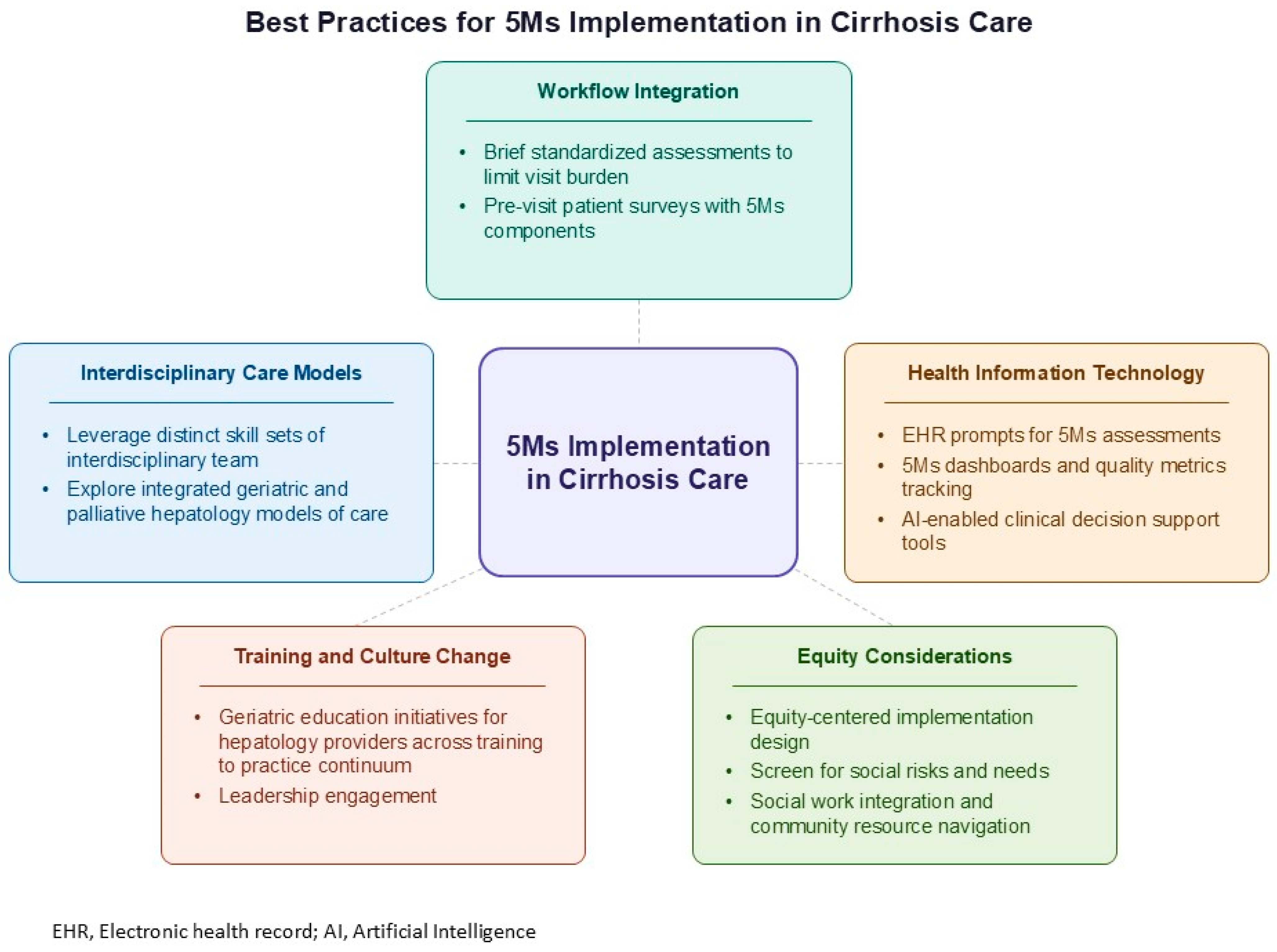
Successful implementation of the 5Ms framework in hepatology requires a multifaceted approach that includes workflow integration, interdisciplinary care models, provider education, health information technology support, and attention to health equity (Figure 1). Implementation evaluation should also adopt a multidimensional approach and include both clinical and implementation outcomes (Table 3). Implementation science frameworks, such as RE-AIM (Reach, Effectiveness, Adoption, Implementation, Maintenance), can guide evaluation and inform scalability [47].
Figure 1.
Best practices for 5Ms Implementation in Cirrhosis Care.
Table 3.
Measuring impact of Age-Friendly Cirrhosis Care.
Delivering age-friendly cirrhosis care is challenged by a limited workforce in geriatrics, palliative care, and hepatology. Given these shortages, additional training of hepatologists, and interdisciplinary collaboration among physicians, advanced practice providers (APPs), and other healthcare professionals is essential to effectively implement the 5Ms framework and meet the complex needs of older adults with cirrhosis.
4. Conclusions and Future Directions
Older adults with cirrhosis have complex, multidimensional needs that are not fully addressed by traditional disease-focused models of care. The rapid aging of the cirrhosis population, combined with increasing clinical complexity, underscores the need to redesign hepatology care around age-friendly, person-centered principles. Integrating the 5Ms into hepatology practice—particularly when combined with palliative care—has the potential to improve quality of life, reduce unnecessary health care utilization, and ensure that care aligns with what matters most to older adults with cirrhosis.
Further research is needed to evaluate the effectiveness of the 5Ms framework in cirrhosis-specific populations. Priorities include:
- Developing and validating cirrhosis-specific tools aligned with the 5Ms, such as measuring goal concordant care (recently validated as a part of PAL-LIVER trial) [48].
- Testing integrated care models that combine hepatology, geriatrics, and palliative care [49]
- Evaluating cost-effectiveness and impact on healthcare utilization
- Identifying scalable strategies to improve adoption in diverse hepatology care settings
Pragmatic trials and real-world implementation studies will be essential to translate age-friendly principles into routine hepatology practice.
Author Contributions
M.V. and L.D. are co-first authors who drafted the initial version. J.L. and T.T. are co-senior authors who provided critical input. All authors have read and agreed to the published version of the manuscript.
Funding
This research received no external funding.
Institutional Review Board Statement
Not applicable.
Informed Consent Statement
Not applicable.
Data Availability Statement
No new data were created or analyzed in this study. Data sharing is not applicable to this article.
Conflicts of Interest
The authors declare no conflicts of interest.
References
- Zamani, M.; Alizadeh-Tabari, S.; Ajmera, V.; Singh, S.; Murad, M.H.; Loomba, R. Global prevalence of advanced liver fibrosis and cirrhosis in the general population: A systematic review and meta-analysis. Clin. Gastroenterol. Hepatol. 2025, 23, 1123–1134. [Google Scholar] [CrossRef] [Scilit] [PubMed]
- Orman, E.S.; Roberts, A.; Ghabril, M.; Nephew, L.; Desai, A.P.; Patidar, K.; Chalasani, N. Trends in characteristics, mortality, and other outcomes of patients with newly diagnosed cirrhosis. JAMA Netw. Open 2019, 2, e196412, Erratum in JAMA Netw. Open 2019, 2, e1913673. [Google Scholar] [CrossRef] [Scilit] [PubMed]
- Le, P.; Tatar, M.; Dasarathy, S.; Alkhouri, N.; Herman, W.H.; Taksler, G.B.; Deshpande, A.; Ye, W.; Adekunle, O.A.; McCullough, A.; et al. Estimated burden of metabolic dysfunction–associated steatotic liver disease in US adults, 2020 to 2050. JAMA Netw. Open 2025, 8, e2454707. [Google Scholar] [CrossRef] [Scilit] [PubMed]
- Zhang, Y.; Luo, M.; Ming, Y. Global burden of cirrhosis and other chronic liver diseases caused by specific etiologies from 1990 to 2021. BMC Gastroenterol. 2025, 25, 641. [Google Scholar] [CrossRef] [Scilit] [PubMed]
- Williams, S.N.; Ding, W.X. The impact of aging on liver health and the development of liver diseases. Hepatol. Commun. 2025, 9, e0808. [Google Scholar] [CrossRef] [Scilit] [PubMed]
- Thomson, M.J.; Lok, A.S.; Tapper, E.B. Appropriate and potentially inappropriate medication use in decompensated cirrhosis. Hepatology 2021, 73, 2429–2440. [Google Scholar] [CrossRef] [Scilit] [PubMed]
- Weersink, R.A.; Taxis, K.; Drenth, J.P.; Houben, E.; Metselaar, H.J.; Borgsteede, S.D. Prevalence of drug prescriptions and potential safety in patients with cirrhosis: A retrospective real-world study. Drug Saf. 2019, 42, 539–546. [Google Scholar] [CrossRef] [Scilit] [PubMed]
- Brown, C.L.; Bajaj, J.S. Considerations in the Diagnoses and Management of Hepatic Disease in Older Adults. Off. J. Am. Coll. Gastroenterol. ACG 2025, 120, S56–S66. [Google Scholar] [CrossRef] [Scilit] [PubMed]
- Lai, J.C.; Tandon, P.; Bernal, W.; Tapper, E.B.; Ekong, U.; Dasarathy, S.; Carey, E.J. Malnutrition, frailty, and sarcopenia in patients with cirrhosis: 2021 practice guidance by the American Association for the Study of Liver Diseases. Hepatology 2021, 74, 1611–1644, Erratum in Hepatology 2021, 74, 3563. [Google Scholar] [CrossRef] [Scilit] [PubMed]
- Patel, A.A.; Ryan, G.W.; Tisnado, D.; Chuang, E.; Walling, A.M.; Saab, S.; Khemichian, S.; Sundaram, V.; Brook, R.H.; Wenger, N.S. Deficits in advance care planning for patients with decompensated cirrhosis at liver transplant centers. JAMA Intern. Med. 2021, 181, 652–660. [Google Scholar] [CrossRef] [Scilit] [PubMed]
- Patel, A.A.; Walling, A.M.; Ricks-Oddie, J.; May, F.P.; Saab, S.; Wenger, N. Palliative care and health care utilization for patients with end-stage liver disease at the end of life. Clin. Gastroenterol. Hepatol. 2017, 15, 1612–1619. [Google Scholar] [CrossRef] [Scilit] [PubMed]
- Huang, D.Q.; Terrault, N.A.; Tacke, F.; Gluud, L.L.; Arrese, M.; Bugianesi, E.; Loomba, R. Global epidemiology of cirrhosis—Aetiology, trends and predictions. Nat. Rev. Gastroenterol. Hepatol. 2023, 20, 388–398. [Google Scholar] [CrossRef] [Scilit] [PubMed]
- Bayer, T.A.; Barber, M.; Halladay, C.; Rowneki, M.; Davila, H.; Mengeling, M.A.; Hartronft, S.; Rudolph, J.L.; Hayes, K.N. Post-hospitalization outcomes for Veterans receiving Age-Friendly Health Systems 4M care. J. Am. Geriatr. Soc. 2026, 74, 220–226. [Google Scholar] [CrossRef] [Scilit] [PubMed]
- Wismann, A.; Kleszynski, K.; Jelinek, D.; Hand, R.; Lich, B.; Wickersham, E.; Jennings, L.A. An age-friendly approach to primary care in an academic health system. J. Am. Geriatr. Soc. 2024, 72, S23–S35. [Google Scholar] [CrossRef] [Scilit] [PubMed]
- King, S.E.; Ruopp, M.D.; Mac, C.T.; O’Malley, K.A.; Meyerson, J.L.; Lefers, L.; Bean, J.F.; Driver, J.A.; Schwartz, A.W. Early clinical and quality impacts of the Age-Friendly Health System in a Veterans Affairs skilled nursing facility. J. Am. Geriatr. Soc. 2024, 72, 3865–3874. [Google Scholar] [CrossRef] [Scilit] [PubMed]
- Rosner, B.I.; Thombley, R.L.; Rogers, S.E.; Adler-Milstein, J. Patient outcomes associated with a composite measure of 4Ms care adherence in the inpatient setting. J. Am. Geriatr. Soc. 2026. Epub ahead of printing. [Google Scholar] [CrossRef] [Scilit] [PubMed]
- Institute for Healthcare Improvement. Age-Friendly Health Systems Recognition. Available online: https://www.ihi.org/partner/initiatives/age-friendly-health-systems/recognition (accessed on 28 September 2026).
- Kochar, B.; Ufere, N.N.; Ritchie, C.S.; Lai, J.C. The 5Ms of geriatrics in gastroenterology: The path to creating age-friendly care for older adults with inflammatory bowel diseases and cirrhosis. Clin. Transl. Gastroenterol. 2022, 13, e00445. [Google Scholar] [CrossRef] [Scilit] [PubMed]
- Verma, M.; Navarro, V.; Kosinski, A.; Taddei, T.; Kalman, R.; Barritt, A.S., IV; Jakab, S.; Serper, M.; Orman, E.; Balakrishnan, M.; et al. Palliative care intervention for patients with end-stage liver disease: A cluster randomized clinical trial. JAMA Intern. Med. 2026, 186, 677–686. [Google Scholar] [PubMed]
- Deng, L.X.; Tana, M.M.; Lai, J.C. Thinking ahead: Advance care planning for patients with cirrhosis. Clin. Liver Dis. 2022, 19, 7–11. [Google Scholar] [CrossRef] [Scilit] [PubMed]
- Ufere, N.N. Advance care planning and goals of care discussions in advanced liver disease. Curr. Hepatol. Rep. 2021, 20, 77–84. [Google Scholar] [CrossRef] [Scilit] [PubMed]
- 2023 American Geriatrics Society Beers Criteria® Update Expert Panel. American Geriatrics Society 2023 updated AGS Beers Criteria® for potentially inappropriate medication use in older adults. J. Am. Geriatr. Soc. 2023, 71, 2052–2081. [Google Scholar] [CrossRef] [Scilit] [PubMed]
- Liver Tox. Clinical and Research Information on Drug Induced Liver Injury. Available online: https://www.ncbi.nlm.nih.gov/books/NBK547852/ (accessed on 19 July 2026).
- Ham, A.C.; van Dijk, S.C.; Swart, K.M.A.; Enneman, A.W.; van der Zwaluw, N.L.; Brouwer-Brolsma, E.M.; van Schoor, N.M.; Zillikens, M.C.; Lips, P.; de Groot, L.C.P.G.M.; et al. Beta-blocker use and fall risk in older individuals: Original results from two studies with meta-analysis. Br. J. Clin. Pharmacol. 2017, 83, 2292–2302. [Google Scholar] [CrossRef] [Scilit] [PubMed]
- Rogal, S.S.; Hansen, L.; Patel, A.; Ufere, N.N.; Verma, M.; Woodrell, C.D.; Kanwal, F. AASLD Practice Guidance: Palliative care and symptom-based management in decompensated cirrhosis. Hepatology 2022, 76, 819–853. [Google Scholar] [CrossRef] [Scilit] [PubMed]
- Lv, X.H.; Lu, Q.; Deng, K.; Yang, J.L.; Yang, L. Prevalence and characteristics of covert/minimal hepatic encephalopathy in patients with liver cirrhosis: A systematic review and meta-analysis. Off. J. Am. Coll. Gastroenterol. ACG 2024, 119, 690–699. [Google Scholar] [CrossRef] [Scilit] [PubMed]
- Bajaj, J.S.; Duarte-Rojo, A.; Xie, J.J.; Acharya, C.; Wade, J.B.; Robles, C.; Thacker, L.R.; Flud, C.; Fagan, A.; Garcia-Saenz-de-Sicilia, M.; et al. Minimal hepatic encephalopathy and mild cognitive impairment worsen quality of life in elderly patients with cirrhosis. Clin. Gastroenterol. Hepatol. 2020, 18, 3008–3016. [Google Scholar] [CrossRef] [Scilit] [PubMed]
- Borson, S.; Scanlan, J.; Brush, M.; Vitaliano, P.; Dokmak, A. The mini-cog: A cognitive ‘vital signs’ measure for dementia screening in multi-lingual elderly. Int. J. Geriatr. Psychiatry 2000, 15, 1021–1027. [Google Scholar] [CrossRef] [Scilit] [PubMed]
- Nasreddine, Z.S.; Phillips, N.A.; Bédirian, V.; Charbonneau, S.; Whitehead, V.; Collin, I.; Cummings, J.L.; Chertkow, H. The Montreal Cognitive Assessment, MoCA: A brief screening tool for mild cognitive impairment. J. Am. Geriatr. Soc. 2005, 53, 695–699, Erratum in J. Am. Geriatr. Soc. 2019, 67, 1991. [Google Scholar] [CrossRef] [Scilit] [PubMed]
- Kroenke, K.; Spitzer, R.L.; Williams, J.B. The Patient Health Questionnaire-2: Validity of a two-item depression screener. Med. Care 2003, 41, 1284–1292. [Google Scholar] [PubMed]
- Kroenke, K.; Spitzer, R.L.; Williams, J.B. The PHQ-9: Validity of a brief depression severity measure. J. Gen. Intern. Med. 2001, 16, 606–613. [Google Scholar] [PubMed]
- Acharya, C.; Shaw, J.; Duong, N.; Fagan, A.; McGeorge, S.; Wade, J.B.; Thacker, L.R.; Bajaj, J.S. QuickStroop, a shortened version of EncephalApp, detects covert hepatic encephalopathy with similar accuracy within one minute. Clin. Gastroenterol. Hepatol. 2023, 21, 136–142. [Google Scholar] [CrossRef] [Scilit] [PubMed]
- Nardelli, S.; Gioia, S.; Ridola, L.; Carlin, M.; Cioffi, A.D.; Merli, M.; Spagnoli, A.; Riggio, O. Risk of falls in patients with cirrhosis evaluated by timed up and go test: Does muscle or brain matter more? Dig. Liver Dis. 2022, 54, 371–377. [Google Scholar] [CrossRef] [Scilit] [PubMed]
- Tapper, E.B.; Woodrell, C.D.; Rakoski, M.; Huang, R.; Kosinski, A.S.; Verma, M. Hepatic Encephalopathy is the Key Driver of Symptom Burden in a Longitudinal Cohort of Patients with Advanced Chronic Liver Disease: PAL-LIVER sub-study. Am. J. Gastroenterol. 2026, 121, 2441–2448. [Google Scholar] [CrossRef] [Scilit] [PubMed]
- Podsiadlo, D.; Richardson, S. The timed “Up & Go”: A test of basic functional mobility for frail elderly persons. J. Am. Geriatr. Soc. 1991, 39, 142–148. [Google Scholar] [CrossRef] [Scilit] [PubMed]
- Tinetti, M.E. Performance-oriented assessment of mobility problems in elderly patients. J. Am. Geriatr. Soc. 1986, 34, 119–126. [Google Scholar] [CrossRef] [Scilit] [PubMed]
- Lai, J.C.; Shui, A.M.; Duarte-Rojo, A.; Ganger, D.R.; Rahimi, R.S.; Huang, C.Y.; Yao, F.; Kappus, M.; Boyarsky, B.; McAdams-Demarco, M.; et al. Frailty, mortality, and health care utilization after liver transplantation: From the Multicenter Functional Assessment in Liver Transplantation (FrAILT) Study. Hepatology 2022, 75, 1471–1479. [Google Scholar] [CrossRef] [Scilit] [PubMed]
- Wang, S.; Whitlock, R.; Xu, C.; Taneja, S.; Singh, S.; Abraldes, J.G.; Burak, K.W.; Bailey, R.J.; Lai, J.C.; Tandon, P. Frailty is associated with increased risk of cirrhosis disease progression and death. Hepatology 2022, 75, 600–609. [Google Scholar] [CrossRef] [Scilit] [PubMed]
- Lin, F.P.; Visina, J.M.; Bloomer, P.M.; Dunn, M.A.; Josbeno, D.A.; Zhang, X.; Clemente-Sanchez, A.; Tevar, A.D.; Hughes, C.B.; Jakicic, J.M.; et al. Prehabilitation-driven changes in frailty metrics predict mortality in patients with advanced liver disease. Off. J. Am. Coll. Gastroenterol. ACG 2021, 116, 2105–2117. [Google Scholar] [CrossRef] [Scilit] [PubMed]
- Peng, J.K.; Hepgul, N.; Higginson, I.J.; Gao, W. Symptom prevalence and quality of life of patients with end-stage liver disease: A systematic review and meta-analysis. Palliat. Med. 2019, 33, 24–36. [Google Scholar] [CrossRef] [Scilit] [PubMed]
- Deng, L.X.; Kent, D.S.; O’Riordan, D.L.; Pantilat, S.Z.; Lai, J.C.; Bischoff, K.E. Symptom burden is associated with increased emergency department utilization among patients with cirrhosis. J. Palliat. Med. 2022, 25, 213–218. [Google Scholar] [CrossRef] [Scilit] [PubMed]
- Hasjim, B.J.; Harris, A.; Balbale, S.N.; Obayemi, J.E.; Beestrum, M.; Polineni, P.; Paukner, M.; Mohammadi, M.; Dentici, O.C.; Kershaw, K.N.; et al. Social disadvantage and disparities in chronic liver disease: A systematic review. Off. J. Am. Coll. Gastroenterol. ACG 2025, 120, 1548–1566. [Google Scholar] [CrossRef] [Scilit] [PubMed]
- Bruera, E.; Kuehn, N.; Miller, M.J.; Selmser, P.; Macmillan, K. The Edmonton Symptom Assessment System (ESAS): A simple method for the assessment of palliative care patients. J. Palliat. Care 1991, 7, 6–9. [Google Scholar] [CrossRef] [Scilit]
- Hager, E.R.; Quigg, A.M.; Black, M.M.; Coleman, S.M.; Heeren, T.; Rose-Jacobs, R.; Cook, J.T.; Ettinger de Cuba, S.A.; Casey, P.H.; Chilton, M.; et al. Development and validity of a 2-item screen to identify families at risk for food insecurity. Pediatrics 2010, 126, e26–e32. [Google Scholar] [CrossRef] [Scilit] [PubMed]
- Higginson, I.J.; Gao, W.; Jackson, D.; Murray, J.; Harding, R. Short-form Zarit Caregiver Burden Interviews were valid in advanced conditions. J. Clin. Epidemiol. 2010, 63, 535–542. [Google Scholar] [CrossRef] [Scilit] [PubMed]
- Verma, M.; Tapper, E.; Singal, A.; Navarro, V. Nonhospice Palliative Care within the Treatment of End Stage Liver Disease. Hepatology 2020, 71, 2149–2159. [Google Scholar] [CrossRef] [Scilit] [PubMed]
- Verma, M.; Tahir, H.; Kalman, R. Implementation science: A primer for hepatology research. Curr. Opin. Gastroenterol. 2026, 42, 136–142. [Google Scholar] [CrossRef] [Scilit] [PubMed]
- Verma, M.; Navarro, V.; Reeve, B.B.; Lin, L.; Jakab, S.; Bakitas, M.; Totten, A.; Volk, M. Measuring Perceived Goal Concordant Care Among Patients with Advanced Chronic Liver Diseases and their Caregivers. Clin. Transl. Gastroenterol. 2026, 17, e01079. [Google Scholar] [CrossRef] [Scilit] [PubMed]
- Verma, M.; Taddei, T.; Volk, M.; Navarro, V. From Efficacy to Implementation: Integrating Palliative Care after the PAL-LIVER Trial. Curr. Hepatol. Rep. 2026, 25, 23. [Google Scholar] [CrossRef] [Scilit]

Disclaimer/Publisher’s Note: The statements, opinions and data contained in all publications are solely those of the individual author(s) and contributor(s) and not of MDPI and/or the editor(s). MDPI and/or the editor(s) disclaim responsibility for any injury to people or property resulting from any ideas, methods, instructions or products referred to in the content. |
© 2026 by the authors. Licensee MDPI, Basel, Switzerland. This article is an open access article distributed under the terms and conditions of the Creative Commons Attribution (CC BY) license.