


Abstract
Background/Objectives: Sepsis is a major cause of hospitalization and mortality which may be prevented with early diagnosis. This systematic review aims to evaluate the literature on diagnostic errors in sepsis. Methods: We conducted a systematic review to evaluate the rate and outcomes of diagnostic errors in sepsis. We searched MEDLINE and EMBASE in September 2026 for studies that evaluated diagnostic errors in sepsis. Data were extracted into tables and narratively synthesized. Results: Twenty-six studies involving 868,057 patients diagnosed with sepsis were included. Definitions of diagnostic error varied and included misdiagnosis, missed diagnosis, delayed diagnosis, failure of recognition systems, and overdiagnosis. Among adults, reported rates of diagnostic error ranged from 0.6% to 86.2%, depending on the definition used. Misdiagnosis of infection source occurred in 11.6% of patients, sepsis misdiagnosis rates ranged from 8.3% to 25.3% in most cohorts, and delayed recognition ranged from 20.0% to 72.9%. In pediatric studies, missed or delayed sepsis occurred in 2.9% to 16.9% of patients. Diagnostic error was associated with delayed antibiotic administration, increased illness severity, longer hospitalization, and higher intensive care utilization. However, findings regarding mortality were inconsistent, with several studies reporting no significant association after adjustment. In children, missed sepsis was associated with increased risk of intensive care admission, but no difference in mortality. Conclusions: Diagnostic error in sepsis is common and variably defined across studies. Evidence linking diagnostic error to mortality and intensive care admission is inconsistent; however, diagnostic error is frequently associated with delayed treatment.
1. Introduction
Sepsis refers to a systemic illness caused by microbial invasion of normally sterile parts of the body [1]. It is defined as life-threatening organ dysfunction caused by a dysregulated host response to infection, where organ dysfunction can be identified as an acute change in total Sequential Organ Failure Assessment (SOFA) score of 2 or more points [2]. For children, the Society of Critical Care Medicine task force recommends that sepsis in children be identified by a Phoenix Sepsis Score of at least 2 points in children with suspected infection, which indicates potentially life-threatening dysfunction of the respiratory, cardiovascular, coagulation, and/or neurological systems [3]. It is a condition that can progress rapidly, and in severe cases, one or more organ systems fail, which can result in hypotension from septic shock [4]. In the United States, the incidence of sepsis hospitalizations is estimated to range between 28 and 121 per 1000 hospitalizations depending on the coding strategy used [5]. It is important, as the average mortality reported by a review of 170 studies was 24.4% at 30 days [6]. In the United Kingdom in 2016 to 2017, an analysis of 133 hospital trusts had 77,996 admissions for sepsis and 15,851 deaths [7]. Globally, sepsis accounts for 49 million cases each year, resulting in deaths reaching 11 million [8]. The World Health Organization (WHO) reported that the deaths could be prevented through early diagnosis and appropriate clinical management [9]. The key recommendations from the Surviving Sepsis Campaign 2021 guidelines emphasize the importance of early recognition and screening, rapid antimicrobial therapy, fluid resuscitation, vasopressor therapy, lactate measurement, source control, corticosteroids, mechanical ventilation, ICU care, and post-discharge care [10].
Diagnostic error is a broad and non-specific concept that warrants careful consideration in the context of sepsis. It encompasses misdiagnosis or delayed diagnosis, where an initial diagnosis is subsequently revised to a different diagnosis [11], as well as delayed recognition, where patients may be triaged as low priority [12]. Distinguishing diagnostic error from true disease progression can be challenging, particularly because demonstrating progression requires high-quality clinical data from both the initial and subsequent evaluations. In sepsis, misclassification of the site of infection may also be regarded as a form of misdiagnosis [13]. More broadly, diagnostic accuracy can be conceptualized using the framework of true-positive, true-negative, false-positive, and false-negative diagnoses. Within this framework, false-positive diagnoses represent overdiagnosis, whereas false-negative diagnoses represent underdiagnosis [14]. Diagnostic errors in sepsis may also relate to missed sepsis, which could be evaluated by emergency department visits that were followed up for readmissions with sepsis and those where patients who are admitted with sepsis were referred for previous encounters in the emergency department [15,16].
We conducted a systematic review of the literature to evaluate diagnostic errors in sepsis. Our objective was to determine how diagnostic errors related to sepsis have been defined in the literature, how frequently they occur, and whether there are differences in outcomes associated with misdiagnosis.
2. Materials and Methods
This review was prepared in accordance with the recommendations of the PRISMA 2020 criteria [17]. The PRISMA 2020 Checklist is provided in Supplementary Material. Although the review was not registered, a protocol was developed and followed.
2.1. Eligibility Criteria
We selected studies that evaluated diagnostic errors in patients with sepsis. There was no restriction on the definition of diagnostic error, which could include missed sepsis, misdiagnosis of sepsis, and delayed recognition of sepsis. For a study to be included, it had to have a definition for diagnostic error or misdiagnosis of sepsis and evaluate one or more of the following: (i) the number of patients who had a misdiagnosis of sepsis and another set of patients who were not misdiagnosed, or (ii) outcomes for patients with a misdiagnosis of sepsis compared to patients who were correctly diagnosed. There was no restriction on the language of the study, and we used Microsoft Translator to translate published articles in other languages when texts were not in English. However, we only included studies or reviews with multiple patients and original data, so editorials, comments, and case reports were excluded.
2.2. Search Strategy
We used the OVID platform (Wolters Kluwer, New York, NY, USA) to search MEDLINE and EMBASE on 24 September 2026 with no limits on date or language. The exact search terms were: (missed sepsis or (missed diagnos* adj3 sepsis) or (unrecogni* adj1 sepsis) or (misdiagnosis and sepsis) or (missed diagnosis and sepsis) or missed septicemia or (missed diagnos* adj3 septicemia) or (unrecogni* adj1 septicemia) or (misdiagnosis and septicemia) or (missed diagnosis and septicemia) or missed septicaemia or (missed diagnos* adj3 septicaemia) or (unrecogni* adj1 septicaemia) or (misdiagnosis and septicaemia) or (missed diagnosis and septicaemia)) or ((diagnostic error adj3 sepsis) or (diagnostic error adj3 septicaemia) or (diagnostic error adj3 septicemia) or (delayed diagnosis adj3 sepsis) or (delayed diagnosis adj3 septicaemia) or (delayed diagnosis adj3 septicemia) or (failure to diagnose adj3 sepsis) or (failure to diagnose adj3 septicaemia) or (failure to diagnose adj3 septicemia) or (underdiagnosis adj3 sepsis) or (underdiagnosis adj3 septicaemia) or (underdiagnosis adj3 septicemia) or (overdiagnosis adj3 sepsis) or (overdiagnosis adj3 septicaemia) or (overdiagnosis adj3 septicemia) or (recognition adj3 sepsis) or (recognition adj3 septicaemia) or (recognition adj3 septicemia)).
The bibliographies of included and potentially relevant studies were reviewed for additional studies that met the inclusion criteria.
2.3. Selection Process and Data Collection Process
Two reviewers (CSK and SL) independently screened all titles and abstracts from the search for studies that met the inclusion criteria. The studies that potentially met the inclusion criteria were retrieved and reviewed for final inclusion. The decision to include or exclude studies was made by consensus, and data extraction was carried out independently by two reviewers (CSK and SL). The data collected included study design, country of study origin, year, sample size, mean age, percentage of the cohort that was male, inclusion criteria, definition of diagnostic error in sepsis, setting where the study took place, and results. Results were defined by the number of cases of diagnostic error in sepsis and outcomes associated with diagnostic error in sepsis.
2.4. Study Risk of Bias Assessment
The methodological quality assessment for the included studies was conducted based on some of the relevant elements from the Ottawa-Newcastle scale for non-randomized studies [18]. The risk of bias was independently extracted by two reviewers (CSK and SL). Disagreements were resolved by auditing the data by SL. The criteria in the quality assessment were: (i) Was the cohort representative of typical patients with sepsis? (ii) Does the study have a reliable diagnostic error evaluation? (iii) Does the study evaluate an outcome that was not present at the start of the study? (iv) Is there use of adjustments if appropriate? (v) Is there a reliable evaluation of the outcome? (vi) Is the follow-up period for outcomes appropriate? and (vii) Is the follow-up adequate (<5% missing or lost data)?
2.5. Synthesis Methods
Data were extracted into pre-designed and piloted tables in Microsoft Word (Microsoft 365). The significant heterogeneity in study methodology meant that we could not perform meta-analysis, so the study findings were narratively synthesized. The definition, rate, and outcomes associated with diagnostic error were determined. A subgroup evaluation was performed for studies of children.
3. Results
3.1. Description of Studies
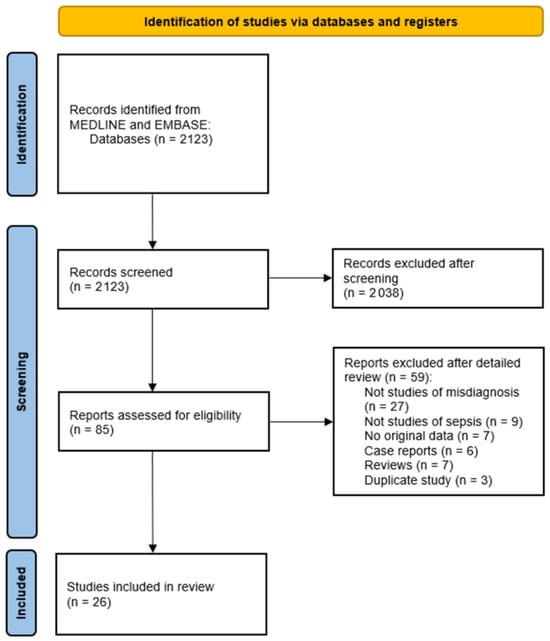
A total of 26 studies were included in this review, and the process of study selection is shown in Figure 1 [11,12,13,14,15,16,19,20,21,22,23,24,25,26,27,28,29,30,31,32,33,34,35,36,37,38].
Figure 1.
Flow diagram of study selection.
Table 1 shows the description of the included studies. There were 23 retrospective cohort studies, 2 studies that were secondary analyses of data collected for other studies, and one prospective cohort study. These studies took place in the United States, Japan, Italy, Hungary, Germany, the Netherlands, China, and Australia, and they took place between 2004 and 2024. Excluding the patient contribution from 3 studies [15,16,29] because of possible overlap with other studies, there were a total of 873,140 patients included in the analysis with 868,057 diagnosed with sepsis, 2451 with infections or suspected infections, 2386 without a diagnosis of sepsis and 246 with a diagnosis of heart failure. Five of the studies reviewed were cohorts of children [11,15,34,35,36], while the remaining 21 studies evaluated misdiagnosis in adult patients. The average proportion of patients who were male that was reported in 16 studies was 54.8%.
Table 1.
Study design, patient characteristics, and participant inclusion criteria of the included studies.
3.2. Study Quality Assessment
The study quality assessment is shown in Table 2. There were 25 studies with cohorts that were representative of patients with sepsis. The study by Horberg et al. was a cohort of patients who were seen in the emergency department with fluid and electrolyte disorders and altered mental status [16]. Another evaluation only included patients with surgical mortality, with a subgroup having a diagnosis of sepsis [33]. Methods for diagnostic error were considered to be satisfactory for all but one study, which focused on patients who only had acute decompensated heart failure if they did not have sepsis [31]. There were 10 studies that evaluated outcomes, and the most common was in-hospital or 30-day mortality. Only 3 of the studies used adjustments in the outcome analysis [13,21,23]. Among studies that evaluated outcomes, all 10 had reliable outcome ascertainment and reasonable duration for follow-up. Missing data was significant in 6 studies [13,21,22,28,30,32] and not significant in 2 studies [12,31]. For 3 studies, missing data were unclear [23,35,36], and for 15 studies there were no outcomes.
Table 2.
Study quality assessment.
3.3. Rate of Diagnostic Error in Sepsis in Adults
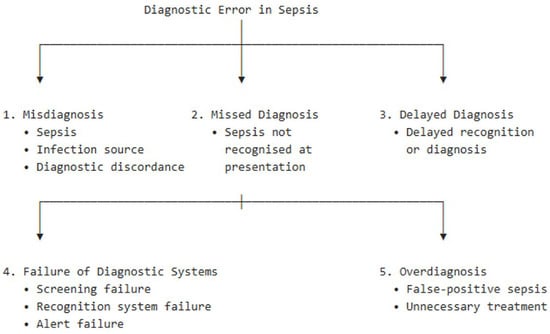
The definitions and rate of diagnostic error in sepsis are shown in Table 3. Considerable heterogeneity was observed in the definitions of diagnostic error across studies. Definitions were broadly categorized into five domains: (1) misdiagnosis of sepsis or the site of infection, including discordance between initial and final diagnoses; (2) missed diagnosis, characterized by failure to recognize sepsis at presentation; (3) delayed diagnosis or delayed recognition of sepsis; (4) failure of diagnostic screening or recognition systems to identify patients with sepsis; and (5) overdiagnosis, including false-positive sepsis diagnoses (Figure 2).
Table 3.
Definition and rates of diagnostic errors in sepsis.
Figure 2.
Key domains in diagnostic error in sepsis.
Among adult populations, reported rates of diagnostic error in sepsis varied substantially depending on the definition used. Misdiagnosis, missed diagnosis, delayed diagnosis, and failure of recognition ranged from 0.57% to 86.2% [12,13,14,16,19,20,21,22,23,24,25,26,27,28,29,30,31,32,33,34,38,39]. Misdiagnosis of the site of infection occurred in approximately 11.6% of patients [23], while sepsis misdiagnosis rates ranged from 8.3% to 25.3% in most cohorts, although rates as high as 77.8% were reported among patients requiring ICU escalation [26]. Delayed recognition of sepsis ranged from 20.0% to 34.3% when defined by delays exceeding 6 to 12 h and reached 72.9% when sepsis was omitted from the provisional diagnosis [19]. Failure to recognize sepsis was also common, occurring in 33.0% of emergency department presentations [12] and 86.2% of cases assessed by emergency medical services personnel [38]. Studies evaluating diagnostic test performance reported false-positive rates of 11.0%, false-negative rates of 78.7%, and sepsis overdiagnosis rates of 15.1% [14,30].
3.4. Rate of Diagnostic Error in Sepsis in Children
Among pediatric populations, missed or delayed diagnosis of sepsis remained common, although rates were generally lower than those reported in adult cohorts. Missed sepsis was reported in 2.9% (32/1094) to 8.3% (15,331/184,157) of children with sepsis [34,35], while delayed diagnosis occurred in 16.9% (109/646) of pediatric sepsis cases [11]. Additional studies reported missed sepsis among 8.1% (158/1945) of hospital admissions with sepsis [15] and 5.5% (53/972) of children presenting to the emergency department [36]. Overall, estimates of missed or delayed pediatric sepsis ranged from 2.9% to 16.9%.
3.5. Harm or Potential Impact on Outcomes for Patients with Misdiagnosis of Sepsis
Table 4 shows that ten studies of adults [12,13,14,20,21,23,28,29,30,32] and two studies of children [35,36] evaluated the association between diagnostic error and clinical outcomes. In one study, in-hospital mortality was higher among patients with an incorrect source diagnosis than among those with a correct diagnosis (24.8% vs. 13.7%, p < 0.01), with misdiagnosis independently associated with mortality after adjustment (aOR 2.66, 95% CI 1.45–4.89) and in a propensity-matched analysis (aOR 3.03, 95% CI 1.24–7.38) [13]. The same study reported a higher 28-day mortality among patients with source misdiagnosis (20.6% vs. 13.4%, p = 0.05), although length of stay did not differ significantly [13]. In another study, patients with late recognition had higher illness severity scores (SOFA 9.2 ± 1.6 vs. 6.5 ± 1.3, p < 0.001), longer hospital stays (14.6 ± 2.5 vs. 12.5 ± 1.2 days, p < 0.001), and higher mortality (25.5% vs. 10.3%, p = 0.010) compared with those recognized early [22]. Also, patients with missed sepsis were less likely to receive timely antibiotics within 60 min than those with recognized sepsis, while persistent missed sepsis was associated with particularly low rates of prompt treatment (52.2% vs. 72.6%) [30]. However, this study did not demonstrate significant differences in mortality.
Table 4.
Outcomes associated with diagnostic errors in sepsis.
The findings regarding unrecognized sepsis in adults were inconsistent. One large emergency department study found lower crude mortality among patients with unrecognized sepsis compared with recognized sepsis (2.3% vs. 10.4%), although unrecognized patients experienced longer emergency department stays [12]. Several studies found no clear association between diagnostic error and mortality or intensive care admission after adjustment [28,32]. One study reported no significant association between misdiagnosis and 30-day mortality (aOR 0.8, 95% CI 0.3–1.9), ICU admission (aOR 1.3, 95% CI 0.6–3.0), or duration of hospitalization, although misdiagnosed patients were more likely to receive broad-spectrum antibiotics (aOR 4.0, 95% CI 1.8–8.8) [23].
In pediatric studies, missed sepsis was associated with delayed antibiotic administration and greater likelihood of subsequent intensive care admission. Children with missed sepsis were nearly three times more likely to require ICU admission within 24 h (87.5% vs. 30.5%) and were less likely to receive intravenous antibiotics within 90 min of emergency department triage (22.6% vs. 55.1%; RR 0.4, 95% CI 0.3–0.7) [35,36]. No significant difference in 30-day mortality was observed (0% vs. 1.4%) [35].
4. Discussion
Rates of diagnostic error in sepsis vary widely across populations, but several patterns emerge. In adults, misdiagnosis varies from one in four to one in ten patients depending on the definition used, while delayed recognition of sepsis occurs in one in five to three out of four adult patients. In pediatric studies, missed or delayed sepsis occurred in 2.9% to 16.9% of patients. Together, these factors highlight that the relationship between errors in diagnosis of sepsis and outcomes is not straightforward and may reflect underlying differences in case severity and clinical context rather than the direct consequences of diagnostic error.
Patient pathways provide a useful lens through which to identify potential missed opportunities in sepsis care, as they map the sequence of clinically relevant events from a patient’s first contact with healthcare services through subsequent assessment, diagnosis, treatment, and follow-up [39]. Although there is no single universally accepted diagnostic pathway for sepsis, a sequence of recognition, assessment, diagnosis, treatment, and reassessment is consistent with the principles of the Surviving Sepsis Campaign [10]. Diagnostic errors may occur at any stage of this pathway and should be interpreted within the wider context of an individual patient’s clinical trajectory.
Sepsis pathways are highly heterogeneous. Some patients present early in the community with non-specific symptoms and physiological stability, making sepsis difficult to recognize, while others present later with more overt manifestations of infection but are at greater risk of adverse outcomes because of disease progression. Patients may also initially present for unrelated reasons and subsequently develop healthcare-associated infections that progress to sepsis. Such variability can make it difficult to distinguish true diagnostic error from the natural evolution of illness.
Recognition, assessment, and diagnostic decision-making are particularly vulnerable to error because the clinical presentation of sepsis is often heterogeneous and may overlap with alternative diagnoses, especially during the early stages of illness. Furthermore, the first healthcare professional to assess a patient may vary according to the healthcare setting and may include paramedics, nurses, primary care physicians, emergency department clinicians, or hospital specialists. Differences in training, experience, and exposure to severe infection may influence clinical judgment and contribute to variation in diagnostic accuracy.
Ongoing monitoring and reassessment are therefore critical components of the diagnostic process. Not all patients initially present with sepsis; some present with uncomplicated infection and subsequently deteriorate as organ dysfunction develops. Reassessment provides an opportunity to recognize evolving sepsis, refine the working diagnosis, and identify patients whose condition is not responding as expected. Repeated clinical evaluation is also necessary to confirm that the source of infection has been correctly identified and that antimicrobial therapy, source-control measures, fluid resuscitation, and other supportive treatments remain appropriate. This highlights that sepsis diagnosis should be viewed as a dynamic and iterative process rather than a single-point clinical decision.
Importantly, retrospective reviews frequently identify earlier encounters as potential “missed opportunities”; however, such assessments may not adequately consider whether sepsis was reasonably diagnosable at that specific point in time. The most clinically meaningful missed opportunities are those in which earlier recognition, escalation, treatment, or safer discharge decisions could realistically have altered patient outcomes or reduced healthcare resource utilization. Further research, particularly prospective studies examining patient pathways in real time, is needed to determine when earlier intervention is both feasible and clinically justified and to better distinguish avoidable diagnostic errors from the inherent uncertainty associated with the progression of infectious illness.
The clinical implications of diagnostic errors can be substantial given the time-sensitive nature of severe infections. Misdiagnosis of sepsis may contribute to both underdiagnosis and overdiagnosis. Underdiagnosis can result in delays to appropriate treatment, leading to disease progression and, in severe cases, adverse outcomes such as long-term complications or death. Although prompt and optimal treatment improves outcomes, delayed recognition may reduce the effectiveness of subsequent interventions.
Conversely, overdiagnosis may lead to unnecessary antibiotic exposure and inappropriate use of broad-spectrum antimicrobial agents. This may contribute to the development of antimicrobial resistance, which remains a major public health concern. Antibiotics are also associated with potential adverse effects, including Clostridioides difficile infection and other drug-related complications, exposing patients to avoidable risks when treatment is not clinically indicated.
The consequences of antimicrobial overuse may extend beyond the immediate episode of care. Patients may subsequently develop infections caused by more resistant organisms, which can increase the risk of treatment failure, recurrent infections, and hospital readmissions. These considerations highlight the importance of antimicrobial stewardship and careful diagnostic assessment when initiating broad-spectrum antibiotic therapy, while recognizing the need for individualized clinical decision-making based on the patient’s presentation and risk profile. Antimicrobial stewardship programs are designed to optimize antibiotic use and have been associated with reduced incidence of infections and colonization with antibiotic-resistant bacteria, as well as improved patient outcomes and fewer adverse events [40].
In this review, most of the evidence was from high-income health systems, particularly the United States, with only a few studies considering community settings. The setting in which each study was conducted remains an important consideration, as the likelihood and nature of diagnostic error differ substantially between community general practice, emergency departments, inpatient wards, and intensive care units. Diagnostic resources and access to investigations are often more limited in community and emergency settings, making it unsurprising that some patients initially receive an alternative diagnosis before sepsis becomes apparent. In contrast, hospital wards and intensive care units typically have greater diagnostic capacity and more continuous monitoring, which may support earlier recognition. These contextual differences highlight that variation in diagnostic error rates may reflect differences in system capability as much as clinician performance, and they underscore the importance of interpreting misdiagnosis data within the clinical environment in which it arises.
This review demonstrates that diagnostic error in sepsis is a heterogeneous construct encompassing multiple distinct phenomena. The identified definitions can be broadly classified into five domains: (1) misdiagnosis of sepsis or the site of infection, including discordance between initial and final diagnoses; (2) missed diagnosis, defined as failure to recognize sepsis at presentation; (3) delayed diagnosis or delayed recognition of sepsis; (4) failure of diagnostic screening or recognition systems to identify patients with sepsis; and (5) overdiagnosis, including false-positive sepsis diagnoses. Although these domains are frequently considered collectively under the term diagnostic error, greater precision in terminology is warranted. Future studies should explicitly distinguish between these domains to improve consistency in measurement, interpretation, and reporting.
This review has several important limitations. First, substantial inconsistencies in how studies defined diagnostic errors in sepsis and considerable methodological heterogeneity prevented any form of meta-analysis. Second, aside from one secondary analysis of a prospective cohort study, all included studies were retrospective and observational, making them vulnerable to confounding and various forms of bias. In particular, studies using look-back designs are susceptible to immortal time bias and survivor bias, as patients who die before re-presenting with sepsis are not captured in administrative datasets, likely underestimating the true harm of errors in diagnoses [41]. Additionally, many of the included studies were available only as conference abstracts, limiting methodological appraisal and potentially introducing publication bias toward more striking misdiagnosis rates. None of the included studies reported outcomes stratified by sex or ethnicity, which is a key gap given emerging evidence of demographic disparities in sepsis recognition and time to treatment [42]. Third, we identified limited studies examining misdiagnosis of sepsis in community settings, despite general practice often being the first point of contact for patients with infection. Finally, we found no studies that directly addressed strategies to reduce diagnostic error in sepsis, highlighting a critical need for research focused on improving diagnostic accuracy and enhancing the quality of care for patients with sepsis.
5. Conclusions
In conclusion, diagnostic errors in sepsis are relatively common, though reported rates vary widely due to inconsistent definitions and study methods. Despite this, errors related to the diagnosis of sepsis were not consistently associated with higher mortality or increased ICU use, suggesting that its clinical impact may be more nuanced than expected. Continued, methodologically robust research is needed to determine when errors in sepsis diagnosis may lead to preventable harm and how diagnostic accuracy can be improved.
Supplementary Materials
The following supporting information can be downloaded at: https://www.mdpi.com/article/10.3390/jcm15208152/s1.
Author Contributions
Conceptualization, C.S.K.; methodology, C.S.K.; validation, C.S.K., S.L., A.A. and S.B.; formal analysis, C.S.K.; investigation, C.S.K.; data curation, C.S.K. and S.L.; writing—original draft preparation, C.S.K.; writing—review and editing, C.S.K., S.L., A.A., S.B., J.H. and C.H. All authors have read and agreed to the published version of the manuscript.
Funding
This research received no external funding.
Institutional Review Board Statement
Not applicable.
Informed Consent Statement
Not applicable.
Data Availability Statement
Data used for this study is derived from published data. The data is available from the authors of the original studies.
Conflicts of Interest
C.S.K. has received funding from Pfizer and Bayer for unrelated research projects, as well as support for travel and conference attendance. These activities were not related to the work presented in this manuscript. The remaining authors declare no competing interests.
Abbreviations
The following abbreviations are used in this manuscript:
| SOFA | Sequential Organ Failure Score |
| WHO | World Health Organization |
| PRISMA | Preferred Reporting Items for Systematic Reviews and Meta-Analyses |
| ED | emergency department |
| ICD | international classification of disease |
| SIRS | systemic inflammatory response syndrome |
References
- Lever, A.; Mackenzie, I. Sepsis: Definition, epidemiology, and diagnosis. BMJ 2007, 335, 879–883. [Google Scholar] [CrossRef] [Scilit]
- Singer, M.; Deutschman, C.S.; Seymour, C.W.; Shankar-Hari, M.; Annane, D.; Bauer, M.; Bellomo, R.; Bernard, G.R.; Chiche, J.-D.; Coopersmith, C.M.; et al. The third international consensus definitions for sepsis and septic shock (Sepsis-3). JAMA 2016, 315, 801–810. [Google Scholar] [CrossRef] [Scilit]
- Schlapbach, L.J.; Watson, R.S.; Sorce, L.R.; Argent, A.C.; Menon, K.; Hall, M.W.; Akech, S.; Albers, D.J.; Alpern, E.R.; Balamuth, F.; et al. International Consensus Criteria for Pediatric Sepiss and Septic Shock. JAMA 2024, 331, 665–674. [Google Scholar] [CrossRef] [Scilit]
- National Institute of General Medical Sciences. Sepsis. NIGMS 2023. Available online: https://nigms.nih.gov/education/fact-sheets/Pages/sepsis.aspx (accessed on 1 September 2026).
- Chan, H.K.; Khose, S.; Chavez, S.; Patel, B.; Wang, H.E. Updated estimates of sepsis hospitalizations at United States academic medical centers. J. Am. Coll. Emerg. Physicians Open 2022, 3, e12782. [Google Scholar] [CrossRef] [Scilit]
- Bauer, M.; Gerlach, H.; Vogelmann, T.; Preissing, F.; Stiefel, J.; Adam, D. Mortality in sepsis and septic shock in Europe, North America and Australia between 2009 and 2019. Crit. Care 2020, 24, 239. [Google Scholar] [CrossRef] [Scilit]
- Burki, T.K. Sharp rise in sepsis deaths in the UK. Lancet Respir. Med. 2018, 6, 826. [Google Scholar] [CrossRef] [Scilit]
- Rudd, K.E.; Johnson, S.C.; Agesa, K.M.; Shackelford, K.A.; Tsoi, D.; Kievlan, D.R.; Colombara, D.V.; Ikuta, K.S.; Kissoon, N.; Finfer, S.; et al. Global, regional, and national sepsis incidence and mortality, 1990–2017. Lancet 2020, 395, 200–211. [Google Scholar] [CrossRef] [Scilit]
- World Health Organization. WHO Calls for Global Action on Sepsis. 2020. Available online: https://www.who.int/news/item/08-09-2020-who-calls-for-global-action-on-sepsis---cause-of-1-in-5-deaths-worldwide (accessed on 1 September 2026).
- Evans, L.; Rhodes, A.; Alhazzani, W.; Antonelli, M.; Coopersmith, C.M.; French, C.; Machado, F.R.; Mcintyre, L.; Ostermann, M.; Prescott, H.C.; et al. Surviving sepsis campaign: International guidelines for management of sepsis and septic shock 2021. Intensive Care Med. 2021, 47, 1181–1247. [Google Scholar] [CrossRef] [Scilit]
- Michelson, K.A.; Bachur, R.G.; Cruz, A.T.; Grubenhoff, J.A.; Reeves, S.D.; Chaudhari, P.P.; Monuteaux, M.C.; Dart, A.H.; Finkelstein, J.A. Multicenter evaluation of a method to identify delayed diagnosis of diabetic ketoacidosis and sepsis in administrative data. Diagnosis 2023, 10, 383–389. [Google Scholar] [CrossRef] [Scilit]
- Bosetti, C.; Santucci, C.; Signorini, F.; Cortellaro, F.; Villa, G.; Rossi, C.; Nattino, G.; Bertolini, G. Diagnosis of sepsis in the emergency department: A real-world analysis from Lombardy, Italy. Intern. Emerg. Med. 2024, 19, 313–320. [Google Scholar] [CrossRef] [Scilit]
- Abe, T.; Tokuda, Y.; Shiraishi, A.; Fujishima, S.; Mayumi, T.; Sugiyama, T.; Deshpande, G.A.; Shiino, Y.; Hifumi, T.; Otomo, Y.; et al. In-hospital mortality associated with the misdiagnosis or unidentified site of infection at admission. Crit. Care 2019, 23, 202. [Google Scholar] [CrossRef] [Scilit]
- Nguyen-Luu, T.; Simonetti, G.R.E.G.; Gandhi, Z.J.; Issa, A.A.; Humayun, S.; Georgievskiy, I.; Djekidel, K.; Naik, S. Sepsis Alerts: A Guide or Siren? Chest 2024, 166, A3915–A3916. [Google Scholar] [CrossRef] [Scilit]
- Cifra, C.; Westlund, E.; Ten Eyck, P.; Ward, M.M.; Mohr, N.M.; Katz, D.A. An Estimate of Missed Pediatric Sepsis in the Emergency Department. Diagnosis 2021, 8, 193–198. [Google Scholar] [CrossRef] [Scilit]
- Horberg, M.A.; Nassery, N.; Rubenstein, K.B.; Certa, J.M.; Shamim, E.A.; Rothman, R.; Wang, Z.; Hassoon, A.; Townsend, J.L.; Galiatsatos, P.; et al. Rate of sepsis hospitalizations after misdiagnosis in adult emergency department patients: A lookforward analysis with administrative claims data using Symptom-Disease Pair Analysis of Diagnostic Error (SPADE) methodology in an integrated health system. Diagnosis 2021, 8, 479–488. [Google Scholar] [CrossRef] [Scilit]
- Page, M.J.; McKenzie, J.E.; Bossuyt, P.M.; Boutron, I.; Hoffmann, T.C.; Mulrow, C.D.; Shamseer, L.; Tetzlaff, J.M.; Akl, E.A.; Brennan, S.E.; et al. The PRISMA 2020 statement: An updated guideline for reporting systematic reviews. BMJ 2021, 372, n71. [Google Scholar] [CrossRef] [Scilit]
- Wells, G.A.; Shea, B.; O’Connell, D.; Peterson, J.; Welch, V.; Losos, M.; Tugwell, P. Newcastle-Ottawa Scale. OHRI 2023. Available online: https://www.ohri.ca/programs/clinical_epidemiology/oxford.asp (accessed on 1 September 2026).
- Barker, N.; Scott, I.A.; Seaton, R.; Mehta, N.; Kalke, V.R.; Redpath, L. Recognition and Management of Hospital-Acquired Sepsis Among Older General Medical Inpatients: A Multi-Site Retrospective Study. Int. J. Gen. Med. 2023, 15, 1039–1046. [Google Scholar] [CrossRef] [Scilit]
- Hamdon, M.S.; Uchel, T.; Ralh, N.; Dhillon, S.; Fityan, M. Screening Sepsis During Rapid Respond. Eur. J. Case Rep. Int. Med. 2019, 6, 505. [Google Scholar]
- Husabø, G.; Nilsen, R.M.; Flaatten, H.; Solligård, E.; Frich, J.C.; Bondevik, G.T.; Braut, G.S.; Walshe, K.; Harthug, S.; Hovlid, E. Early diagnosis of sepsis in emergency departments, time to treatment, and association with mortality: An observational study. PLoS ONE 2020, 15, e0227652, Correction in PLoS ONE 2021, 16, e0248879. [Google Scholar] [CrossRef] [Scilit]
- Jing, Y.; Wu, Y. A Correlation Analysis of Early Sepsis Recognition and Patient Prognosis: A Single-Center Retrospective Study. Br. J. Hosp. Med. 2025, 86, 1–12. [Google Scholar] [CrossRef] [Scilit]
- Kaal, A.; Speelman, E.; Meziyerh, S.; Steyerberg, E.; Nieuwkoop, K.; Kolfschoten, N.; van Aken, M.; Schippers, E. Incidence, Impact and Risk Factors of Misdiagnoses Among Patients Hospitalized with Suspected Bacteremia. Diagnosis 2022, 9, eA39. Available online: https://www.degruyterbrill.com/document/doi/10.1515/dx-2022-0024/html?srsltid=AU7gw4XY3CkM7phZ9WfP0a7H1JdEQvAltz5QBCKcFT2sAIiL9NlF8jFD (accessed on 1 September 2026).
- Kathi, B.; Varga, E.; Bácskay, I.; Lekli, I.; Somodi, S.; Fésüs, A. Evaluation of the correlation between procalcitonin (PCT) level and other biomarkers, sepsis diagnosis and antibiotic prescription pattern at an emergency department (ED). Eur. J. Hosp. Pharm. 2025, 32, A197. [Google Scholar] [CrossRef] [Scilit]
- Kirkpatrick, A.R.; Walkey, A.J.; Summer, R.S. Delayed recognition of severe sepsis. Am. J. Resp. Crit. Care Med. 2013, 187, A1562. [Google Scholar]
- Martin, R.; Dorwart, K.; Holland, C. Intensive care unit upgrades: Misdiagnosis vs mistriage. Acad. Emerg. Med. 2019, 26, S292. [Google Scholar]
- Miller, H.C.; Prescott, H.C. What happens during outpatient visits immediately prior to sepsis hospitalization? Am. J. Resp. Crit. Care Med. 2019, 199, A2693. [Google Scholar] [CrossRef] [Scilit]
- Morr, M.; Lukasz, A.; Rübig, E.; Pavenstädt, H.; Kümpers, P. Sepsis recognition in the emergency department—Impact on quality of care and outcome? BMC Emerg. Med. 2017, 17, 11. [Google Scholar] [CrossRef] [Scilit]
- Nassery, N.; Horberg, M.A.; Rubenstein, K.B.; Certa, J.M.; Watson, E.; Somasundaram, B.; Shamim, E.; Townsend, J.L.; Galiatsatos, P.; Pitts, S.I.; et al. Antecedent treat-and-release diagnoses prior to sepsis hospitalization among adult emergency department patients: A look-back analysis employing insurance claims data using symptom-disease pair analysis of diagnostic error (spade) methodology. Diagnosis 2021, 8, 469–478. [Google Scholar] [CrossRef] [Scilit]
- Pandey, S.R.; Knack, S.K.S.; Driver, B.E.; Prekker, M.E.; Scott, N.; Ringstrom, S.J.; Maruggi, E.; Kaus, O.; Tordsen, W.; Puskarich, M.A. Factors and outcomes associated with under-and overdiagnosis of sepsis in the first hour of emergency department care. Acad. Emerg. Med. 2025, 32, 204–215. [Google Scholar] [CrossRef] [Scilit]
- Pino, J.E.; Ramos Tuarez, F.J.; Saona, J.E.; Chen, K.; Ceka, E.; Chavez, J.G.; Martinez, A.C.; Bornmann, C.; Torres, P.; Chait, R. Misdiagnosis of Sepsis in Patients with Acutely Decompensated Heart Failure. Real World Outcomes. J. Card. Fail. 2019, 25, S150. [Google Scholar] [CrossRef] [Scilit]
- Prasad, P.A.; Fang, M.C.; Abe-Jones, Y.; Calfee, C.S.; Matthay, M.A.; Kangelaris, K.N. Time to Recognition of Sepsis in the Emergency Department Using Electronic Health Record Data: A Comparative Analysis of SIRS, SOFA, and qSOFA. Crit. Care Med. 2020, 48, 200–209. [Google Scholar] [CrossRef] [Scilit]
- Ramanathan, R.; Leavell, P.; Stocklager, G.; Mays, C.; Harvey, D.; Duane, T.M. Accuracy of identification of sepsis in surgical mortalities thorugh ICD-9-C and DRG codes. Surg. Infect. 2013, 14, S32. [Google Scholar] [CrossRef] [Scilit]
- Sawicki, J.C.; Graham, J.; Larsen, G.; Workman, J.K. Harbingers of sepsis misdiagnosis among pediatric emergency department patients. Diagnosis 2025, 12, 241–249. [Google Scholar] [CrossRef] [Scilit]
- Scott, H.F.; Greenwald, E.E.; Bajaj, L.; Davies, S.J.D.; Brou, L.; Kempe, A. The Sensitivity of Clinician Diagnosis of Sepsis in Tertiary and Community-Based Emergency Settings. J. Pediatr. 2018, 195, 220–227. [Google Scholar] [CrossRef] [Scilit]
- Sougandis, E.; Abbasdessa, M.K.; Ku, B.; Minich, C.; Lavelle, J.; Zorc, J.; Balamuth, F. Analysis of Missed Sepsis Patients in a Pediatric Emergency Department With a Vital Sign-Based Electronic Sepsis Alert. Pediatr. Emerg. Care 2022, 38, e1–e4. [Google Scholar] [CrossRef] [Scilit]
- Struble, R.D.; Cavanaugh, J.; Polgreen, P.; Miller, A. Diagnostic Delays Associated With Sepsis. Am. J. Resp. Crit. Care Med. 2024, 209, A5066. [Google Scholar] [CrossRef] [Scilit]
- Van der Wekken, L.C.W.; Alam, N.; Hollenman, F.; van Exter, P.; Kramer, M.H.; Nanayakkara, P.W. Epidemiology of Sepsis and its Recognition by Emergency Medical Services Personnel in the Netherlands. Prehosp Emerg. Care 2016, 20, 90–96. [Google Scholar] [CrossRef] [Scilit]
- Kwok, C.S.; Muntean, E.A.; Mallen, C.D. The Patient Pathway Review: A New Method of Evaluating Clinical Practices to Understand the Complexities of Real-world Care. Crit. Pathw. Cardiol. 2021, 20, 213–219. [Google Scholar] [CrossRef] [Scilit]
- Baur, D.; Gladstone, B.P.; Burkert, F.; Carrara, E.; Foschi, F.; Döbele, S.; Tacconelli, E. Effect of antibiotic stewardship on the incidence of infection and colonisation with antibiotic-resistant bacteria and Clostridium difficile infection: A systematic review and meta-analysis. Lancet Infect. Dis. 2017, 17, 990–1001. [Google Scholar] [CrossRef] [Scilit]
- Hazard, D.; Grodd, M.; Walzer, D.; Biever, P.; Rieg, S.R.; Wolkewitz, M. Avoiding time-related bias in infectious disease analysis. Clin. Microbiol. Infect. 2025, 31, 1467–1474. [Google Scholar] [CrossRef] [Scilit]
- Pak, T.R.; Sánchez, S.M.; McKenna, C.S.; Rhee, C.; Klompas, M. Assessment of Racial, Ethnic, and Sex-Based Disparities in Time-to-Antibiotics and Sepsis Outcomes in a Large Multihospital Cohort. Crit. Care Med. 2024, 52, 1928–1933. [Google Scholar] [CrossRef] [Scilit]

Disclaimer/Publisher’s Note: The statements, opinions and data contained in all publications are solely those of the individual author(s) and contributor(s) and not of MDPI and/or the editor(s). MDPI and/or the editor(s) disclaim responsibility for any injury to people or property resulting from any ideas, methods, instructions or products referred to in the content. |
© 2026 by the authors. Licensee MDPI, Basel, Switzerland. This article is an open access article distributed under the terms and conditions of the Creative Commons Attribution (CC BY) license.