


Abstract
Background: Esophagectomy carries substantial morbidity and mortality with advanced age being a known risk factor. This study aims to evaluate the outcome of esophagectomy in octogenarians in the context of increasing adoption of minimally invasive esophagectomy (MIE). Methods: A retrospective cohort study was conducted using the National Surgical Quality Improvement Program database. Patients undergoing esophagectomy were stratified by age (<80 and ≥80). Univariate and multivariable analysis were used to assess the age and patient-dependent factors with surgical outcomes. Results: Among 11,210 patients identified who underwent esophagectomy, 447 were octogenarians. Overall, octogenarians experienced higher rates of 30-day mortality (p = 0.004), LOS (p = 0.0001), and serious complications (p = 0.001). Within the subset of MIE patients, morbidity (p = 0.001) and mortality (p = 0.051) remain elevated but significance was not reached for LOS (p = 0.116) between the two age groups. Multivariable analysis confirmed that age ≥80 was independently associated with serious complications (p = 0.008), readmission (p = 0.015), and extended LOS (p = 0.001). However, it was not an independent predictor of reoperation or anastomotic leak. MIE significantly decreased the rate of overall complications and extended LOS with a trend towards decreased mortality (p = 0.065). Conclusions: Octogenarians experience significantly higher morbidity, mortality, and post-surgical care needs. While age is a risk factor, patient-specific comorbidities and frailty are critical determinants of outcome. Furthermore, surgical approaches have a significant impact on the outcome of patients post-esophagectomy with MIE narrowing the outcome gap between the two age groups. These findings underscore the necessity for meticulous patient selection, preoperative optimization, and shared decision-making when considering esophagectomy in this growing demographic.
1. Introduction
Esophageal cancer is the eighth most common cancer worldwide and sixth in cancer-related mortality [1] with an estimated 511,000 new cases and 445,000 deaths globally in 2022 [2]. In the United States, the incidence is projected to exceed 22,000 cases in 2025. With the median age of diagnosis at 69 and 29.3% of new cases affecting patients above the age of 75, esophageal cancer disproportionally affects older adults [3].
Treatment of esophageal cancer is multidisciplinary, involving surgery, medical and radiotherapy, frequently involving all three modalities [4,5,6]. However, esophagectomy itself carries substantial perioperative risk, with overall complication rates of 42–65% and 90-day mortality reported at 4.5% in contemporary series [7].
Advanced age is a reported risk factor for post-operative morbidity and mortality following esophagectomy [8]. With the rapid shift toward an aging population and the increasing surgical needs by elderly patients [7], understanding outcomes of esophagectomy in octogenarians has become critically important for shared decision-making and informed patient choice [9]. Compared to patients under 80, octogenarians are at higher risk of post-surgical morbidity and mortality that increases progressively with age [8]. 30-day mortality has been described at 0.6% for patients <70 years old, 3.2% in patients 70–79 and 6.3% in octogenarians who also experience increased rates of complications at an odds ratio of 1.67 [10,11].
Currently, there is conflicting evidence in published literature regarding age as an independent variable in the outcome of esophagectomy [4,12,13]. These studies are limited by sample sizes, single center experiences, and heterogenous patient selection. Indeed, there have been past attempts to elucidate the outcome of elderly patients through large-scale national NSQIP dataset from 2005 to 2014, showing age independently associated with adverse outcomes including mortality [14]. However since then, there has been rapid adoption of minimally invasive approaches in esophagectomy that significantly improved mortality and morbidity in patients, with increase in minimally invasive or robotic-assisted esophagectomies of 49% and 704%, respectively, between 2010 and 2019 [15,16]. There is also evidence to suggest that the minimally invasive procedures may attenuate age-related differences in operative outcomes, including one study demonstrating no significant difference in overall survival after propensity score matching in patients above or below 75 years of age [17]. The widespread adoption of minimally invasive approaches in recent years necessitates an update to existing literature [7].
The current study aims to fill this gap by firstly evaluating practice patterns and approach to esophagectomy in patients over 80 years old. Secondly, the study assesses postoperative complications, including 30-day morbidity, reintervention, reoperation, and mortality rates. By elucidating the risks and realistic expectations of surgical intervention in this age group, our findings may guide clinicians in patient selection, preoperative optimization, and shared decision-making for octogenarians with esophageal cancer.
2. Materials & Methods
This retrospective cohort study utilized data from the National Surgical Quality Improvement Program (NSQIP) Participant Use File (PUF), a premier clinical surgical dataset in North America that aggregates over one million annual cases from accredited centers. These institutions adhere to rigorous international standards, with data collected prospectively by professional reviewers under HIPAA-compliant protocols. Data integrity is maintained through frequent audits, targeting a disagreement rate of no more than 5%. Given that the NSQIP database consists of de-identified, anonymous information, formal ethics approval was not required for this analysis.
All patients in the NSQIP database aged 18 or over undergoing esophagectomy for all indications were considered in this retrospective cohort study. Patients under age 18 were excluded from this analysis. Included patients were divided into two cohorts: <80 cohort if age was less than 80 at the time of surgery or octogenarians if age was ≥80.
Data collected included patient, operative, and post-operative factors. Patient factors included age, sex, race, height, weight, BMI, smoking status, functional status, American Society of Anesthesiologists (ASA) physical status classification, and comorbidities including diabetes, chronic obstructive pulmonary disease (COPD), hypertension, history of falls, dementia, renal dysfunction including pre-operative kidney injury or dialysis requirement, chronic immunosuppressive therapy, bleeding disorders, heart failure, ascites, or disseminated cancer. Technical factors included the year of the procedure, acuity of the procedure, unplanned conversions from minimally invasive to open, operative length, and primary procedure type including operative approach was obtained with the following standardized esophagectomy CPT codes: 43107, 43108, 43286, 43117, 43118, 43112, 43113, and 43288. Patients undergoing esophagectomy that did not have an immediate reconstruction were excluded. Use of a robot was also extracted and cross-referenced to CPT codes. The extended esophagectomy PUFs from the included years were also accessed to determine the presence of anastomotic leakage and management utilized, exposure to neoadjuvant radiation and/or chemotherapy within 90 days of the procedure.
Specific postoperative complications that were assessed included superficial and deep surgical site infection, organ space infection, wound disruption, urinary tract infection, pneumonia, Clostridium difficile infection, septic shock, bleed requiring transfusion, reintubation, failure to wean ventilator, postop acute kidney injury and/or dialysis requirement, myocardial infarction, cardiac arrest, cerebrovascular accident (CVA), and a composite variable of overall serious complications. Length of stay (LOS), 30-day readmission, reoperation, mortality, and withdrawal of care rates were assessed. Excess LOS was defined as LOS greater than the 75th percentile, resulting in our definition being discharge from hospital on post-operative day 14 or later. Missing data are described in Supplemental Tables S1 and S2.
Statistical analysis involved presenting categorical variables as absolute numbers and percentages, analyzed via Chi-squared tests. Continuous variables were reported as weighted means with standard deviations, using independent two-sample t-tests for parametric data or the Kruskal–Wallis test for non-parametric data.
To account for differences between groups and evaluate the independent effect of octogenarians on 30-day serious complications in patients undergoing esophagectomy, we developed a non-parsimonious multivariable logistic regression model using a hypothesis-driven purposeful selection approach. Additionally, a multivariate linear regression model was constructed to assess the independent effect of drains on length of stay (LOS). Bivariate analysis of variables with a p-value < 0.1, along with those previously identified as clinically relevant to our primary outcome, was used to create a preliminary main effects model. Model performance was assessed using the Brier score and Receiver Operating Characteristic (ROC) curve. Statistical analyses were conducted using STATA 19 software (StataCorp., College Station, TX, USA).
3. Results
3.1. Study Population
We identified a total of 11,210 cases with 10,763 cases < 80 years old and 447 cases > 80 years old (octogenarian cohort). An overwhelming majority of the patients received esophagectomy for indications related to malignancy versus 6.59% for non-malignancy or unknown indications. The median age was 65 (range 18–79) for the <80 cohort and 82 (range 80–90) for the octogenarian cohort. The sex distribution was not significantly different between the two groups with 79.94% male in the <80-year-old group and 78.97% among the octogenarians (p = 0.62). The majority of the cases were elective (94.22%). The majority of esophagectomies performed were the Ivor Lewis technique (n = 7463, 66.57%), followed by transhiatal (n = 1921, 17.14%) and McKeown (n = 1826, 16.29%).
Octogenarians were significantly less likely to smoke (6.49% vs. 23.90%, p < 0.001) and have obesity (p < 0.001), but were more likely to have hypertension (67.79% vs. 47.93%, p < 0.001), bleeding disorders (7.87% vs. 4.05%, p = 0.037) and heart failure (3.13% vs. 1.40%, p = 0.003). There was no significant difference between cohorts in rates of COPD, ascites, ventilator dependence, or diabetes. Patient demographics are summarized in Table 1.
Table 1.
Patient demographics and clinical characteristics.
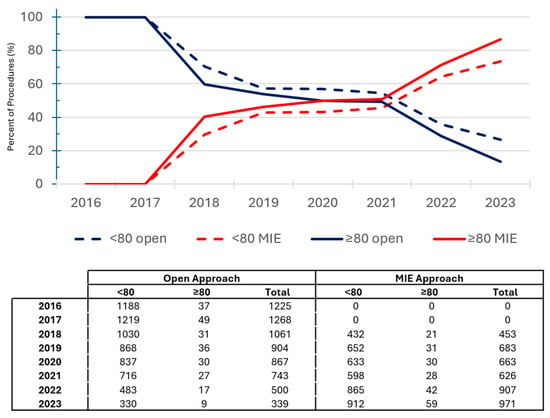
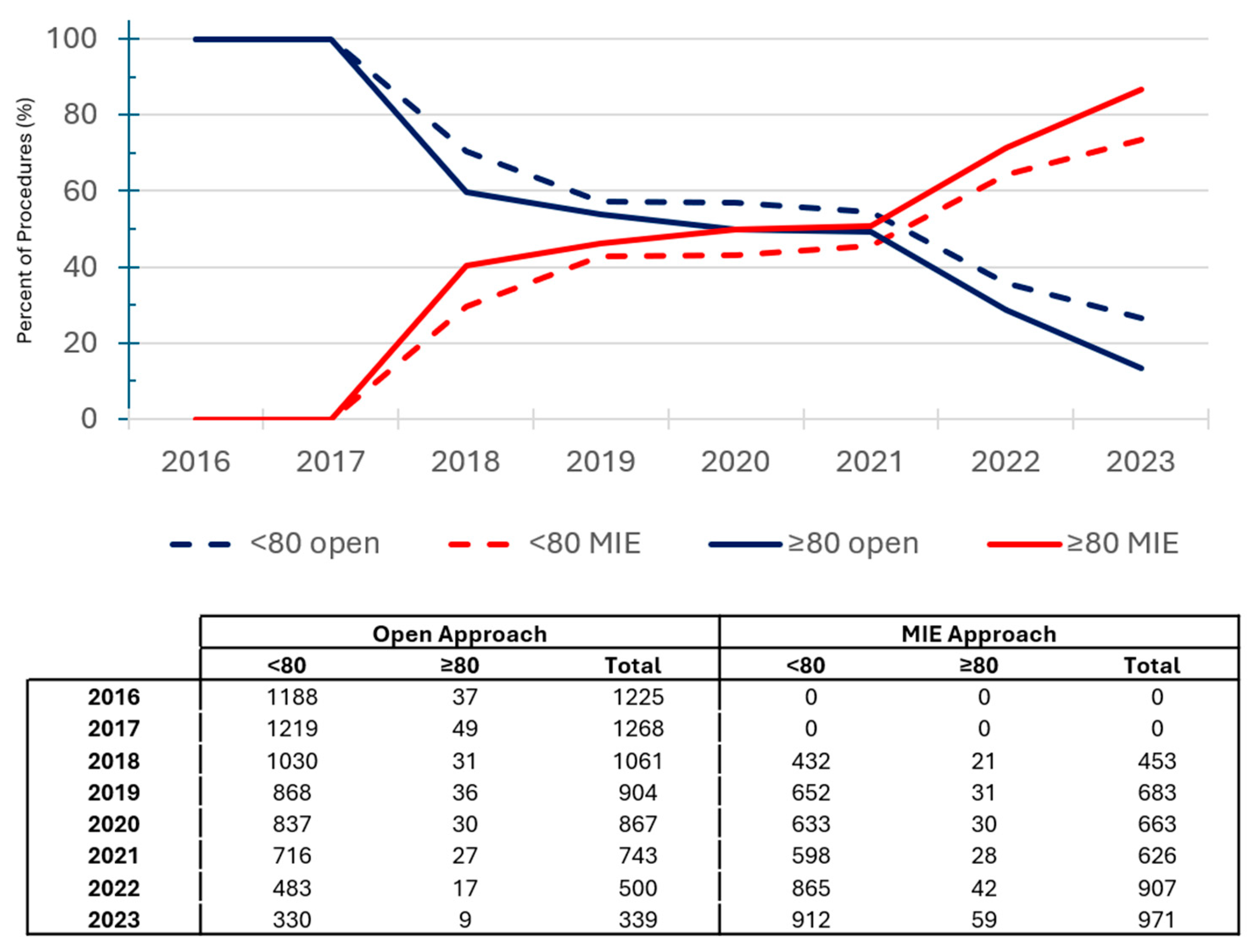
NSQIP began capturing minimally invasive esophagectomy (MIE) as of 2018, therefore all esophagectomies recorded prior to 2018 were performed via an open approach. Following its introduction in 2018, MIE accounted for 29.92% of cases in 2018 and increased rapidly to 74.12% by 2023. Among octogenarians, uptake was even greater, with 86.76% of all esophagectomies performed using minimally invasive techniques (Figure 1).
Figure 1.
Trends in adoption of MIE techniques in esophagectomy from 2016 to 2023.
3.2. Univariate Analysis
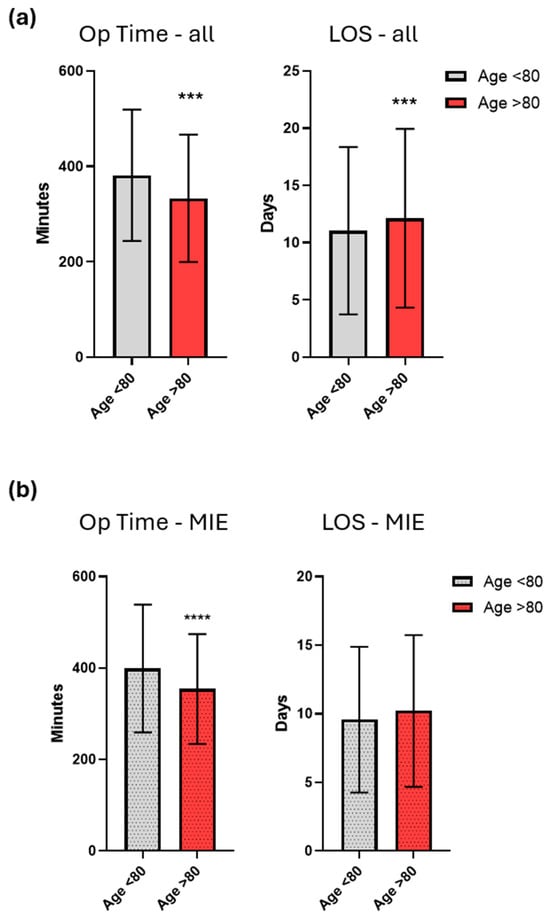
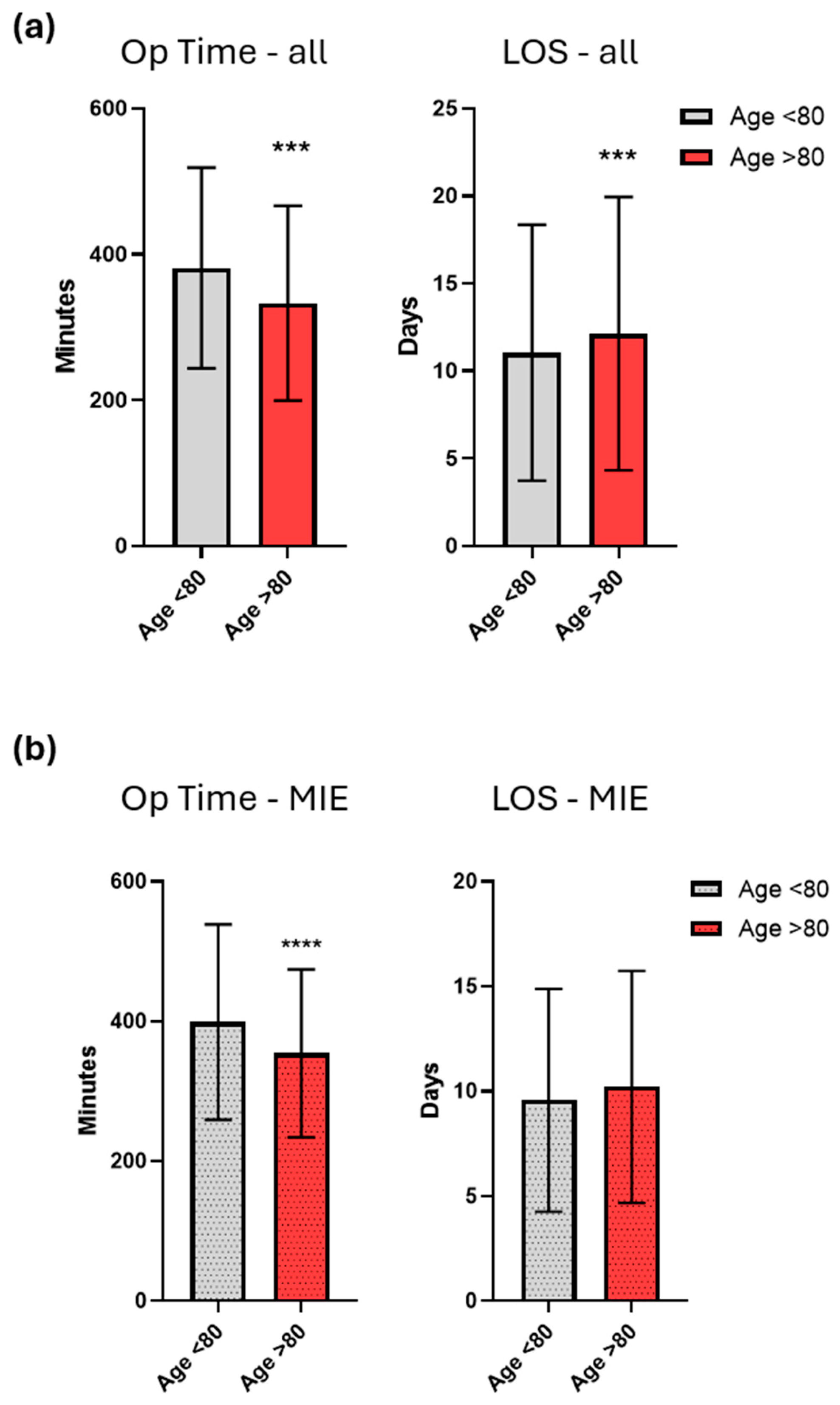
Compared to octogenarians, <80 yo patients experienced significantly longer operative time (median 370 vs. 319 min, p = 0.0001) while octogenarians required longer length of stay (mean 12.1 vs. 11.0, p = 0.0001) (Figure 2a). There were no differences in infectious complications with comparable rates of superficial, deep, and organ space surgical site infections between the two groups. The incidence of anastomotic leak was also similar between the two groups (11.47% vs. 13.20%, p = 0.261). Urinary tract infections were more common in the octogenarian cohort versus <80 yo cohort (3.13% versus 1.6%, p = 0.013), along with an increased incidence of septic shock (7.83% vs. 5.49%, p = 0.035). There was no difference in incidences of pneumonia between the two age groups; however, octogenarians were significantly more likely to require intubation during the postoperative period (p = 0.002). Octogenarians exhibited increased incidence for venous thrombosis events (VTEs, p < 0.01) but did not have an increased incidence of pulmonary embolisms (p = 0.15). There were no differences in renal insufficiency (p = 0.806) nor postoperative dialysis requirements (p = 0.411). There was no significant difference in incidence of myocardial infarctions (p = 0.411) or cardiopulmonary resuscitation following cardiac arrest (p = 0.158). Octogenarians were more likely to require blood transfusions with 13.2% versus 9.6% in the <80 yo group (p = 0.012). Overall, there was a significant increase in serious complications amongst octogenarians (45.86% vs. 37.95%, p = 0.001) (Table 2).
Figure 2.
Operative time and LOS in (a) all esophagectomy and (b) MIE between patients above and below 80 years of age. (*** p < 0.001, **** p < 0.0001).
Table 2.
Univariate analysis of clinical outcomes in all esophagectomies between young (<80) and elderly (≥80) patients.
Rate of reoperation was not significantly different between the two age groups (p = 0.993); however, there was a significantly elevated rate of readmission in octogenarians (15.21% vs. 11.06%, p = 0.006). There was also an overall 1.8-fold increase in mortality with 5.37% in octogenarians vs. 2.97% (p = 0.004) in those below 80.
Subset analysis limited to MIE (laparoscopic or robotic approaches) showed similar trends in octogenarians with significant increase in rates of readmission (18.95% vs. 11.63%, p = 0.001), serious complications (47.39% vs. 35.70%, p = 0.001) and discharge to higher level of care (17.54% vs. 9.26%, p < 0.001) (Table 3). There is a trend towards increased mortality in octogenarians as well (4.27% vs. 2.2%, p = 0.051). There remains no significant difference in anastomotic leak (16.11% vs. 12.78%, p = 0.16) or reoperation (15.17% vs. 16.03%, p = 0.738). Unique to MIE, octogenarians did not exhibit significantly increased LOS (mean of 10.21, SD 5.53 vs. mean of 9.57 SD 5.31, p = 0.116). Operative time remains significantly shorter for octogenarians (mean of 354.2 ± 130.1 min vs. mean of 399.0 ± 139.7 min, p = 1.304 × 10⁻⁶) (Figure 2b).
Table 3.
Univariate analysis of clinical outcomes in MIE between patients above and below 80 years of age.
3.3. Multivariate Analysis
Multivariate analysis was performed on outcomes of interest including mortality, complications, extended LOS, reoperation, readmission, and discharge to higher care, as well as anastomotic leak (Table 4). With multivariable logistic regression models, an age over 80 was found to be independently associated with discharge to higher care (OR 2.56, CI 1.83–3.60, p < 0.001), readmission (OR 1.48, CI 1.08–2.03, p = 0.015), and serious complications (OR 1.36, CI 1.082–1.715, p = 0.008), as well as extended LOS (OR 1.54, CI 1.20–1.98 p = 0.001). However, it was not significantly associated with reoperation (OR 0.94, CI 0.68–1.28, p = 0.686) and did not pass the significance threshold for 30-day mortality (OR 1.74, CI 0.97–3.13, p = 0.065).
Table 4.
Multivariate analysis of patient factors associated with clinical outcomes in all esophagectomies.
Other patient characteristics that were significantly associated with 30-day mortality included ASA 3+ (OR 2.98 CI 1.57–5.68, p = 0.001), CHF (OR 2.37 CI 1.07–5.28, p = 0.034), COPD (OR 1.88 CI 1.26–2.82, p = 0.002), smoking history (OR 1.42 CI 1.04–1.94, p = 0.029), and diabetes (OR 1.38 CI 1.12–1.70, p = 0.003). The aforementioned mortality risk factors were also associated with extended LOS but only diabetes was associated with increased odds of readmission (OR 1.36 CI 1.22–1.53, p < 0.001) along with being octogenarians (OR 1.48 CI 1.08–2.03, p = 0.015). Many factors were significantly associated with increased odds of anastomotic leak including BMI (OR 1.07, CI 1.02–1.13, p = 0.01), ASA 3+ (OR 1.26 CI 1.04–1.52, p = 0.02), diabetes (OR 1.21 CI 1.09–1.34, p < 0.001), and smoking history (OR 1.28 CI 1.11–1.48, p = 0.001).
Interestingly, BMI was protective against extended LOS (OR 0.92 CI 0.87–0.96, p < 0.001), but did not affect readmission, reoperation, serious complications, or mortality, while female sex was associated with decreased odds of anastomotic leak (OR 0.83, CI 0.71–0.98, p = 0.024) but also with extended LOS (OR 1.14 CI 1.00–1.30, p = 0.045).
Prior treatment with radiation therapy with 90 days of surgery did not appear to significantly impact patients’ surgical outcome in anastomotic leak, readmission, reoperation or 30-day mortality but did increase the patients’ odds of discharge to a higher level of care (OR 1.35 CI 1.03–1.77, p = 0.031) and decrease odds of extended LOS (OR 0.82 CI 0.69–0.97 p = 0.024). Meanwhile, chemotherapy was protective against extended LOS (OR 0.70 CI 0.59–0.84, p < 0.001), discharge to higher level of care (OR 0.62 CI 0.47–0.82, p = 0.001) and reoperation (OR 0.77 CI 0.63–0.94 p = 0.012) without significant effect on rate of 30-day mortality (p = 0.451).
4. Discussion
Esophageal cancer is increasingly a disease of older adults, with incidence peaking in the eighth decade of life [3]. As the population ages, octogenarians have become a clinically important group in whom surgical decision-making is often complicated by advanced age, comorbidity burden, and uncertainty regarding operative risk and expected outcomes, making patient counseling especially challenging. Herein, we present the largest contemporary analysis using the ACS-NSQIP database outlining outcomes of open and minimally invasive esophagectomy in this population, filling this critical gap in the literature. Prior studies in smaller cohorts or single-center studies have yielded conflicting results [4,12,13]. Over the past two decades, esophagectomy has evolved substantially, with the Ivor Lewis technique becoming the dominant approach as well as the adoption of minimally invasive techniques [15].
Using the ACS-NSQIP database from 2016 to 2023, we demonstrate that octogenarians have an overall mortality of nearly double that of the <80 yo cohort (5.37% vs. 2.97%). This was in line with previous multi-center studies of 4–5% [7,18,19]. The effect was not statistically significant (p = 0.065) in multivariate analysis with odds ratio of 1.73. This suggests that other variables such as patient factors and comorbidities may be stronger predictors of post-operative mortality than age. Indeed, on multivariate analysis, elevated ASA (3+), diabetes, history of smoking, COPD, and CHF all posed significantly increased odds of mortality. Interestingly, while the octogenarians were generally expected to be more comorbid, this was not always reflected in the esophagectomy patients. While octogenarians did exhibit higher rates of comorbidities including hypertension, bleeding disorders and heart failure, they were significantly less likely to smoke and less obese. There was also no significant difference in other comorbidities such as COPD, diabetes, or ascites. It has also long been described that frailty is a more accurate predictor than age in post-operative outcomes [20,21,22]. Overall, 98.81% of all esophagectomy patients were functionally independent prior to surgery. Of the octogenarians, only 6 patients (1.34%) were partially dependent, and none were fully dependent. The <80 yo cohort exhibited a similar trend with only 0.93% of patients with partially functional dependency and 0.12% were totally dependent. Given the observational nature of the study, it is likely that surgeons exercised selection bias in choosing eligible patients with stricter criterion applied in the aged population.
Despite advancements in surgical technique and the adoption of minimally invasive procedures, esophagectomy remains associated with high rates of postoperative morbidity. The present study revealed an overall rate of serious complication at 38.27% with octogenarians at significantly higher risk at 45.86%. Previous studies that examined data from Esophagectomy Complications Consensus Group (ECCG) also described postoperative morbidity of 59–65% [7,23]. Pulmonary complication is one of the most common adverse events following esophagectomy [24]. Intriguingly, NSQIP data did not show a significant change in rate of postoperative pneumonia in octogenarians; however, there was significant increase in unplanned intubations (p = 0.0019). This is in contrast with previous studies which showed a higher rate of post-esophagectomy pneumonia in octogenarians [14]. The increased morbidity is also reflected in LOS post-operatively with significantly increased mean length of stay by 1 day (12.13 vs. 11.04 days, p = 0.0001).
Despite the increase in morbidity and mortality, surgical parameters for octogenarians did not reflect the same adverse trends. In fact, octogenarians were found to have significantly shorter mean operative time by nearly 48 min (p = 0.0001). Possibly due to decreased rate of obesity which has been shown to correlate with operative time [25]. Previous literature has shown that operative time is a significant predictor of poor post-operative morbidity [26]. This could be an indication that the outcomes of the octogenarian group are secondary to the patients’ comorbidities rather than the operative challenges of an elderly population.
Of the surgical approaches outlined, McKeown was significantly correlated with increased rate of complications on multivariate analysis with increased rate of anastomotic leak, reoperation and serious complications whereas transhiatal approach did not show the same trends (Table 5). Another study on NSQIP data has previously identified that McKeown approach is the least common approach used at under 20% of esophagectomies and continues to decline over time [15]. This is reflective of the epidemiological shift from squamous cell carcinoma of the esophagus which is predominantly in proximal to middle third of the esophagus to adenocarcinoma of the esophagus commonly in distal esophagus and gastroesophageal junction [27]. Ivor Lewis is the more appropriate technique for cancers of the distal esophagus/gastroesophageal junction and expectedly rose in prominence. The same epidemiological shift was not observed in Asian and African countries where squamous cell carcinoma of esophagus remains the overwhelming majority (~90%) of all esophageal cancers and McKeown remains the dominant surgical approach [2]. The epidemiological divide between Western and Asia/African nations limits the cross-applicability of our findings.
Table 5.
Multivariate analysis of surgical parameters associated with clinical outcomes in all esophagectomies.
Minimally invasive techniques also appear to have a positive impact on patient outcomes with both laparoscopic and robotic approaches significantly decreasing the length of stay and odds of complications even when accounting for comorbidities on multivariate analysis.
We observed a rapidly shifting trend toward MIE since being tracked by the NSQIP database, with 29.92% of cases (453 MIE procedures) being performed minimally invasive (laparoscopic or robotic) in 2018, compared to 74.12% of total cases (971 MIE procedures) by 2023. Unfortunately, NSQIP does not differentiate between hybrid vs. full MIE/robotic approaches, thus hybrid procedures were analyzed as MIE/robotics where applicable. There is a slightly higher adoption rate of MIE in octogenarians (86.76%) vs. <80 yo cohort (73.43%) as of 2023. Within the MIE cohort, octogenarians no longer exhibit significant difference in LOS (p = 0.116) and 30-day mortality rate is borderline non-significant (p = 0.051). There remains a significant increase in readmission, serious complications, and discharge to higher level of care within the octogenarian population. Previous studies have demonstrated that adoption of MIE techniques significantly decreased morbidity and mortality of patients and indeed our results show early promise of MIE approaches in tightening the outcome gap between octogenarians and <80 yo patients. This finding may have a significant impact on treatment decisions for elderly patients. Previous study comparing esophagectomy versus chemoradiotherapy showed survival advantage in patients age 75–79 but not in octogenarians [28]. However, that study was carried out using data from 2008 to 2011 prior to the adoption of minimally invasive techniques. The improvement in octogenarians undergoing MIE may provide a benefit over chemoradiotherapy alone and future updates may be needed to delineate the outcome between the two in the elderly population. While the findings should be interpreted in the lens of the highly selected patient population, further studies exploring outcomes of surgical techniques in matched populations could be another avenue by which esophagectomies may be optimized.
5. Conclusions
We present the first and largest study to evaluate esophagectomy outcomes in octogenarians since the widespread adoption of MIE. Overall, this study concludes that the current octogenarian patient population selected for esophagectomy by surgeons, despite comparable or more favorable pre-operative comorbidities, still exhibit increased post-operative morbidity and mortality within a 30-day period. However, the adoption of minimally invasive techniques is beginning to narrow the gap in outcomes and future studies may be warranted to reassess the risk of esophagectomy in octogenarians compared to other treatment modalities. We identified key patient factors influencing esophagectomy outcomes that can aid in patient selection and shared decision-making in this vulnerable population.
6. Limitations
This study has several important limitations by nature of its design. First, the retrospective nature of the analysis predisposes data to potential selection bias by surgeons. While NSQIP only examines patients who underwent surgery, one study examining other datasets such as National Cancer Database described that only 11.5% of octogenarians with esophageal cancer underwent esophagectomy versus 33.3% of patients under the age of 80, with the same trend persisting after multi-variate adjustments [29]. This is also indirectly reflected in our study: whereas ~29% of esophageal cancer arises in patients above 75 years of age [30], only 4% of the NSQIP cohort who underwent esophagectomy were over the age of 80. This is an indication that there is intense clinical selection in octogenarians who undergo esophagectomy; the findings from this cohort may serve as a proof of feasibility and we caution against indiscriminate extrapolations to octogenarians at large. We have included esophagectomy for all indications rather than malignancy alone, though malignancy accounted for 93.41% of all included cases. Certainly, the diversity in both surgical indications and types of malignancy could introduce heterogeneity in data but the findings are reflective of the overall safety of the esophagectomy procedure in a Western setting.
Furthermore, we are only able to abstract data using the ACS-NSQIP’s pre-determined set of variables, which may not capture nuanced technical details such as anastomotic technique, extent of nodal dissection, intraoperative blood loss, robotic platform, and and others, which may confound associations between operative approach and outcomes. The database also only captures thirty-day outcomes precluding any assessment of long-term endpoints such as cancer-related survival or late deterioration or functional decline. Previous studies have identified quality-of-life measures such as functional decline and autonomy are frequently prioritized by patients over marginal survival benefits, which is not captured by NSQIP and represents an important blind spot in our data [31,32]. Finally, this cohort of patients is that of primarily functionally independent treated at participating institutions, most of which are higher-volume academic or large community hospitals, limiting generalizability to smaller or non-NSQIP centers as well as more frail or dependent populations and it is unclear if the same trends observed in this study will apply and extrapolations of data should be done cautiously.
Supplementary Materials
The following supporting information can be downloaded at: https://www.mdpi.com/article/10.3390/jcm15197590/s1, Supplemental Table S1: Number of patients with reported data for each of the patient characteristic variables included in Table 1. Supplemental Table S2: Number of patients with reported data for each of the variables in univariate analysis included in Table 2.
Author Contributions
Conceptualization, J.X. and D.M.; Formal analysis, J.X., M.H. and D.M.; Investigation, J.X., M.H. and D.M.; Data curation, D.M.; Writing—original draft, J.X. and D.M.; Writing—review & editing, J.X., M.H., E.D., N.C., P.M. and D.M.; Supervision, D.M. All authors have read and agreed to the published version of the manuscript.
Funding
This research received no external funding.
Institutional Review Board Statement
Ethics approval was not sought because only pre-existing, de-identified ACS NSQIP data was analyzed.
Informed Consent Statement
Individual informed consent was not obtained for this secondary analysis because ACS NSQIP Participant Use Files contain completely de-identified data and the investigation had no access to patient identities or contact information.
Data Availability Statement
The data presented in this study are openly available in [NSQIP] [https://www.facs.org/quality-programs/data-and-registries/acs-nsqip/] (accessed on 30 April 2025).
Acknowledgments
We would like to acknowledge D.M. for conceptualization, data curation and formal analysis. J.X. and D.M. carried out writing the original draft of the manuscript. J.X., D.M. and M.H. were responsible for review and editing of the manuscript. The other authors provided feedback during various stages. We thank our colleagues at University of Calgary Department of Surgery for their continued support and for advice and mentorship.
Conflicts of Interest
The authors declare no conflict of interest.
References
- Ferlay, J.; Soerjomataram, I.; Dikshit, R.; Eser, S.; Mathers, C.; Rebelo, M.; Parkin, D.M.; Forman, D.; Bray, F. Cancer incidence and mortality worldwide: Sources, methods and major patterns in GLOBOCAN 2012. Int. J. Cancer 2015, 136, E359–E386. [Google Scholar] [CrossRef] [Scilit]
- Bray, F.; Laversanne, M.; Sung, H.; Ferlay, J.; Siegel, R.L.; Soerjomataram, I.; Jemal, A. Global cancer statistics 2022: GLOBOCAN estimates of incidence and mortality worldwide for 36 cancers in 185 countries. CA Cancer J. Clin. 2024, 74, 229–263. [Google Scholar] [CrossRef] [Scilit]
- Cancer Stat Facts: Esophageal Cancer. Available online: https://seer.cancer.gov/statfacts/html/esoph.html (accessed on 2 May 2026).
- Lagergren, J.; Bottai, M.; Santoni, G. Patient Age and Survival After Surgery for Esophageal Cancer. Ann. Surg. Oncol. 2020, 28, 159. [Google Scholar] [CrossRef] [Scilit]
- Lagergren, J.; Smyth, E.; Cunningham, D.; Lagergren, P. Oesophageal cancer. Lancet 2017, 390, 2383–2396. [Google Scholar] [CrossRef] [Scilit]
- Hoeppner, J.; Brunner, T.; Schmoor, C.; Bronsert, P.; Kulemann, B.; Claus, R.; Utzolino, S.; Izbicki, J.R.; Gockel, I.; Gerdes, B.; et al. Perioperative Chemotherapy or Preoperative Chemoradiotherapy in Esophageal Cancer. N. Engl. J. Med. 2025, 392, 323–335. [Google Scholar] [CrossRef] [Scilit]
- Low, D.E.; Kuppusamy, M.K.; Alderson, D.; Cecconello, I.; Chang, A.C.; Darling, G.; Davies, A.; D’journo, X.B.; Gisbertz, S.S.; Griffin, S.M.; et al. Benchmarking Complications Associated with Esophagectomy. Ann. Surg. 2019, 269, 291–298. [Google Scholar] [CrossRef] [Scilit]
- Turrentine, F.E.; Wang, H.; Simpson, V.B.; Jones, R.S. Surgical Risk Factors, Morbidity, and Mortality in Elderly Patients. J. Am. Coll. Surg. 2006, 203, 865–877. [Google Scholar] [CrossRef] [Scilit]
- Fowler, A.J.; Abbott, T.E.F.; Prowle, J.; Pearse, R.M. Age of patients undergoing surgery. Br. J. Surg. 2019, 106, 1012–1018. [Google Scholar] [CrossRef] [Scilit]
- Kamarajah, S.K.; Gujjuri, R.R.; Elhadi, M.; Umar, H.; Bundred, J.R.; Subramanya, M.S.; Evans, R.P.; Powell, S.L.; Griffiths, E.A. Elderly patients have increased perioperative morbidity and mortality from oesophagectomy for oesophageal cancer: A systematic review and meta-analysis. Eur. J. Surg. Oncol. (EJSO) 2021, 47, 1828–1835. [Google Scholar] [CrossRef] [Scilit]
- Tapias, L.F.; Muniappan, A.; Wright, C.D.; Gaissert, H.A.; Wain, J.C.; Morse, C.R.; Donahue, D.M.; Mathisen, D.J.; Lanuti, M. Short and long-term outcomes after esophagectomy for cancer in elderly patients. Ann. Thorac. Surg. 2013, 95, 1741–1748. [Google Scholar] [CrossRef] [Scilit]
- Aminian, A.; Alibakhshi, A.; Mirsharifi, R.; Jahangiri, Y.; Dashti, H.; Karimian, F. The effect of age on the outcome of esophageal cancer surgery. Ann. Thorac. Med. 2009, 4, 71. [Google Scholar] [CrossRef] [Scilit]
- Ruol, A.; Portale, G.; Zaninotto, G.; Cagol, M.; Cavallin, F.; Castoro, C.; Sileni, V.C.; Alfieri, R.; Rampado, S.; Ancona, E. Results of esophagectomy for esophageal cancer in elderly patients: Age has little influence on outcome and survival. J. Thorac. Cardiovasc. Surg. 2007, 133, 1186–1192. [Google Scholar] [CrossRef] [Scilit]
- Otero, J.; Arnold, M.R.; Kao, A.M.; Schlosser, K.A.; Prasad, T.; Lincourt, A.E.; Heniford, B.T.; Colavita, P.D. Short-term Outcomes of Esophagectomies in Octogenarians—An Analysis of ACS-NSQIP. J. Surg. Res. 2019, 235, 432–439. [Google Scholar] [CrossRef] [Scilit]
- Zheng, R.; Tham, E.J.H.; Rios-Diaz, A.J.; Grenda, T.R.; Evans, N.R.; Rosato, E.L.; Palazzo, F.; Berger, A.C. A 10-year ACS-NSQIP Analysis of Trends in Esophagectomy Practices. J. Surg. Res. 2020, 256, 103–111. [Google Scholar] [CrossRef] [Scilit]
- Weiser, L.; Perez, C.; Watson, J.J.J.; Chen, Q.; Nammalwar, S.; Razavi, A.; Fuller, C.; Soukiasian, S.G.; Brownlee, A.R.; Soukiasian, H.J. National trends in operative approach to esophagectomy: Utilization rates, outcomes, and overall survival. Surg. Endosc. 2025, 39, 2267–2274. [Google Scholar] [CrossRef] [Scilit]
- Takebayashi, K.; Kaida, S.; Otake, R.; Fukuo, A.; Miyake, T.; Kojima, M.; Tani, S.; Maehira, H.; Nitta, N.; Ishikawa, H.; et al. Clinical Outcomes of Minimally Invasive Esophageal Surgery for Older Esophageal Cancer Patients: A Propensity Score-matched Study. Am. Surg. 2026, 92, 329–336. [Google Scholar] [CrossRef] [Scilit]
- Oesophago-Gastric Anastomotic Audit (OGAA) Collaborative; Kamarajah, S.K.; Evans, R.P.T.; Nepogodiev, D.; Hodson, J.; Bundred, J.R.; Gockel, I.; Gossage, J.A.; Isik, A.; Kidane, B.; et al. Textbook outcome following oesophagectomy for cancer: International cohort study. Br. J. Surg. 2022, 109, 439–449. [Google Scholar] [CrossRef] [Scilit]
- Kuppusamy, M.K.; Low, D.E. Evaluation of International Contemporary Operative Outcomes and Management Trends Associated with Esophagectomy: A 4-Year Study of >6000 Patients Using ECCG Definitions and the Online Esodata Database. Ann. Surg. 2022, 275, 515–525. [Google Scholar] [CrossRef] [Scilit]
- Hao, X.; Xu, Z.; Guo, Y.; Liu, J.; Tian, J.; Cao, F.; Song, Y.; Liu, Y.; Fu, Q.; Cao, J.; et al. Brief preoperative frailty predicts postoperative adverse outcomes in older patients with radical esophageal cancer surgery. BMC Geriatr. 2025, 25, 781, Correction in BMC Geriatr. 2025, 25, 1015. [Google Scholar] [CrossRef] [Scilit]
- Zhang, F.; Yan, Y.; Li, B.; Ge, C. Frailty as a predictor of postoperative outcomes in older gastroesophageal cancer patients: A systematic review and meta-analysis. BMC Geriatr. 2025, 26, 170. [Google Scholar] [CrossRef] [Scilit]
- Lee, D.U.; Hastie, D.J.; Fan, G.H.; Addonizio, E.A.; Han, J.; Karagozian, R. Clinical frailty is a risk factor of adverse outcomes in patients with esophageal cancer undergoing esophagectomy: Analysis of 2011–2017 US hospitals. Dis. Esophagus 2022, 35, doac002. [Google Scholar] [CrossRef] [Scilit]
- van der Werf, L.R.; Busweiler, L.A.D.; van Sandick, J.W.; van Berge Henegouwen, M.I.; Wijnhoven, B.P.L.; Dutch Upper, G.I.C.A.g. Reporting National Outcomes After Esophagectomy and Gastrectomy According to the Esophageal Complications Consensus Group (ECCG). Ann. Surg. 2020, 271, 1095–1101. [Google Scholar] [CrossRef] [Scilit]
- Markar, S.R.; Karthikesalingam, A.; Thrumurthy, S.; Ho, A.; Muallem, G.; Low, D.E. Systematic review and pooled analysis assessing the association between elderly age and outcome following surgical resection of esophageal malignancy. Dis. Esophagus 2013, 26, 250–262. [Google Scholar] [CrossRef] [Scilit]
- Salem, A.I.; Thau, M.R.; Strom, T.J.; Abbott, A.M.; Saeed, N.; Almhanna, K.; Hoffe, S.E.; Shridhar, R.; Karl, R.C.; Meredith, K.L. Effect of body mass index on operative outcome after robotic-assisted Ivor-Lewis esophagectomy: Retrospective analysis of 129 cases at a single high-volume tertiary care center. Dis. Esophagus 2016, 30, 1. [Google Scholar] [CrossRef] [Scilit]
- Valsangkar, N.; Salfity, H.V.; Timsina, L.; Ceppa, D.P.; Ceppa, E.P.; Birdas, T.J. Operative time in esophagectomy: Does it affect outcomes? Surgery 2018, 164, 866–871. [Google Scholar] [CrossRef] [Scilit]
- Rodriguez, G.M.; DePuy, D.; Aljehani, M.; Bien, J.; Lee, J.S.H.; Wang, D.H.; Lin, A.Y. Trends in Epidemiology of Esophageal Cancer in the US, 1975-2018. JAMA Netw. Open 2023, 6, e2329497. [Google Scholar] [CrossRef] [Scilit]
- Motoyama, S.; Maeda, E.; Iijima, K.; Sato, Y.; Koizumi, S.; Wakita, A.; Nagaki, Y.; Fujita, H.; Yoneya, T.; Imai, K.; et al. Does Esophagectomy Provide a Survival Advantage to Patients Aged 80 Years or Older? Analyzing 5066 Patients in the National Database of Hospital-based Cancer Registries in Japan. Ann. Surg. 2020, 276, E16–E23. [Google Scholar] [CrossRef] [Scilit]
- Bakhos, C.T.; Salami, A.C.; Kaiser, L.R.; Petrov, R.V.; Abbas, A.E. Outcomes of octogenarians with esophageal cancer: An analysis of the National Cancer Database. Dis. Esophagus 2019, 32, 1–8. [Google Scholar] [CrossRef] [Scilit]
- Yadlapati, R.H.; Shaheen, N.J. Gastro-Esophageal Disorders of the Geriatric Population. Am. J. Gastroenterol. 2025, 120, S34–S44. [Google Scholar] [CrossRef] [Scilit]
- Soto-Perez-De-Celis, E.; Li, D.; Yuan, Y.; Lau, Y.M.; Hurria, A. Functional versus chronological age: Geriatric assessments to guide decision making in older patients with cancer. Lancet Oncol. 2018, 19, e305–e316. [Google Scholar] [CrossRef] [Scilit]
- Martin, C.; Banks, J.; Battisti, N.M.L.; Bekker, H.; Edwards, A.; Wyld, L.; Morgan, J. Treatment decision-making and quality of life versus length of life preferences of older patients with early stage cancer: A systematic review. J. Geriatr. Oncol. 2025, 16, 102773. [Google Scholar] [CrossRef] [Scilit]

Disclaimer/Publisher’s Note: The statements, opinions and data contained in all publications are solely those of the individual author(s) and contributor(s) and not of MDPI and/or the editor(s). MDPI and/or the editor(s) disclaim responsibility for any injury to people or property resulting from any ideas, methods, instructions or products referred to in the content. |
© 2026 by the authors. Licensee MDPI, Basel, Switzerland. This article is an open access article distributed under the terms and conditions of the Creative Commons Attribution (CC BY) license.