


Abstract
Introduction: Severe local envenomation following extremity snakebite may mimic acute compartment syndrome and complicate surgical assessment. We aimed to describe the clinical, laboratory, and treatment-timing characteristics of patients managed with and without fasciotomy. Methods: This single-center retrospective study included patients with extremity snakebite treated between 2023 and 2025. A six-item clinical profile score was constructed retrospectively to summarize documented local findings: pain at rest, pain with passive motion, delayed capillary refill, marked swelling or tenseness, paresthesia, and motor deficit (1 point for documented presence, 0 for documented absence; range, 0–6). Clinical, laboratory, and treatment-timing characteristics were compared between patients managed with and without fasciotomy; analyses were exploratory and interpreted descriptively. Results: The overall cohort included 50 patients, six of whom underwent fasciotomy. Antivenom administration was documented in 25 patients, absent in 14, and unknown in 11. The complete-case subset comprised 35 patients, including 21 antivenom-treated patients. Within this subset, patients undergoing fasciotomy had higher clinical profile scores (median, 6 vs. 1) and longer bite-to-presentation intervals (median, 4.5 vs. 2 h; both p < 0.001). No significant between-group difference was detected in emergency department arrival-to-antivenom intervals (p = 0.129). Platelet counts were lower and activated partial thromboplastin time was longer in the fasciotomy group. Median bite-to-fasciotomy and antivenom-to-fasciotomy intervals were 8 and 2 h, respectively. Conclusions: Patients selected for fasciotomy had more pronounced documented local findings and later presentation. These exploratory associations do not establish surgical necessity or pressure-confirmed acute compartment syndrome; the retrospectively constructed clinical profile score remains descriptive, without established diagnostic validity.
1. Introduction
Snakebite envenoming is a neglected public health problem that causes substantial morbidity and mortality worldwide [1]. Snakebites most commonly involve the extremities, where local envenomation may present with pain, progressive swelling, tenseness, tissue injury, and neurovascular findings [2]. These findings may influence emergency department monitoring, the need for antivenom, and the decision to obtain surgical evaluation.
In the limbs, the deep fascia forms a connective tissue sheath overlying muscles and gives rise to intermuscular septa that contribute to the organization of muscular compartments. Histologically, it comprises two to three layers of collagen fiber bundles with differing orientations, separated by thin layers of loose connective tissue that permit sliding between layers [3]. Snake venom can cause direct tissue and microvascular injury, increased vascular permeability, and secondary inflammation, resulting in local edema and pain [2,4]. These effects may produce marked swelling, tenseness, and sensory disturbances that mimic acute compartment syndrome without necessarily indicating pressure-related impairment of tissue perfusion [2,4]. However, recent literature emphasizes that true venom-induced compartment syndrome is uncommon and that the use of intracompartmental pressure measurement and fasciotomy varies across studies and centers [5,6]. In a US snakebite registry study, compartment syndrome was suspected in 22 patients, representing approximately 1% of all reported cases; nine of these 22 patients underwent fasciotomy [6]. This uncertainty highlights the need to better characterize the clinical profile of patients who undergo fasciotomy, particularly in practice settings where objective pressure measurement is not routinely used.
To address this gap, we aimed to describe the clinical, laboratory, and treatment-timing characteristics of patients with extremity snakebite managed with and without fasciotomy in routine practice.
2. Materials and Methods
2.1. Study Design, Setting, and Ethical Approval
This single-center retrospective observational study was conducted by reviewing the medical records of patients who presented with extremity involvement after snakebite at a tertiary care hospital between 2023 and 2025. The objective was to describe the clinical, laboratory, and treatment-timing characteristics of patients with extremity snakebite managed with and without fasciotomy in routine clinical practice. Between-group comparisons were considered exploratory and descriptive because of the small number of fasciotomy cases.
The study was approved by the relevant Institutional Ethics Committee (Decision No. 2025/08/86). Because of the retrospective design, the requirement for informed consent was waived.
2.2. Patient Identification and Eligibility Criteria
Patients were identified by screening the hospital information management system for records coded with ICD-10 T63.0, corresponding to the toxic effect of snake venom. Available emergency department, inpatient, operative, and outpatient clinical records were reviewed to confirm snakebite-related extremity involvement and extract study variables. Patients presenting during the study period with extremity snakebite were eligible for the overall cohort. Non-extremity bites and presentations ultimately attributed to non-snake traumatic or dermatologic conditions were excluded. Missing clinical or treatment-timing data did not preclude inclusion in the overall cohort. A complete-case subset was defined by the availability of the predefined local clinical findings, bite-to-presentation time, and reliable antivenom timing and total dose data where applicable. Complete-case status referred to the availability of these analysis variables, not to the completeness or duration of postoperative follow-up. Available clinical follow-up records were reviewed without requiring a standardized follow-up schedule or minimum follow-up duration.
2.3. Case Selection Flow
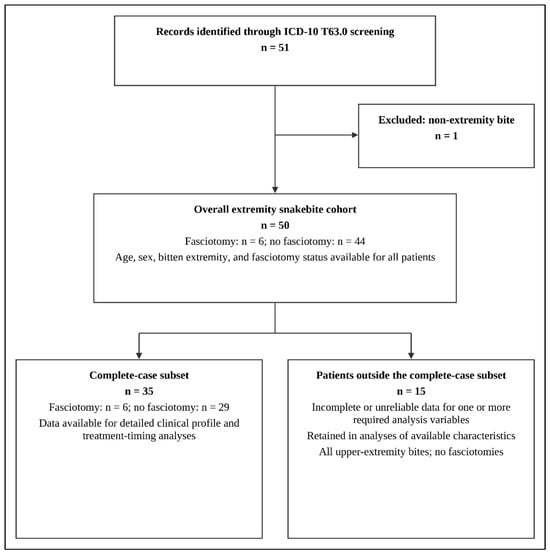
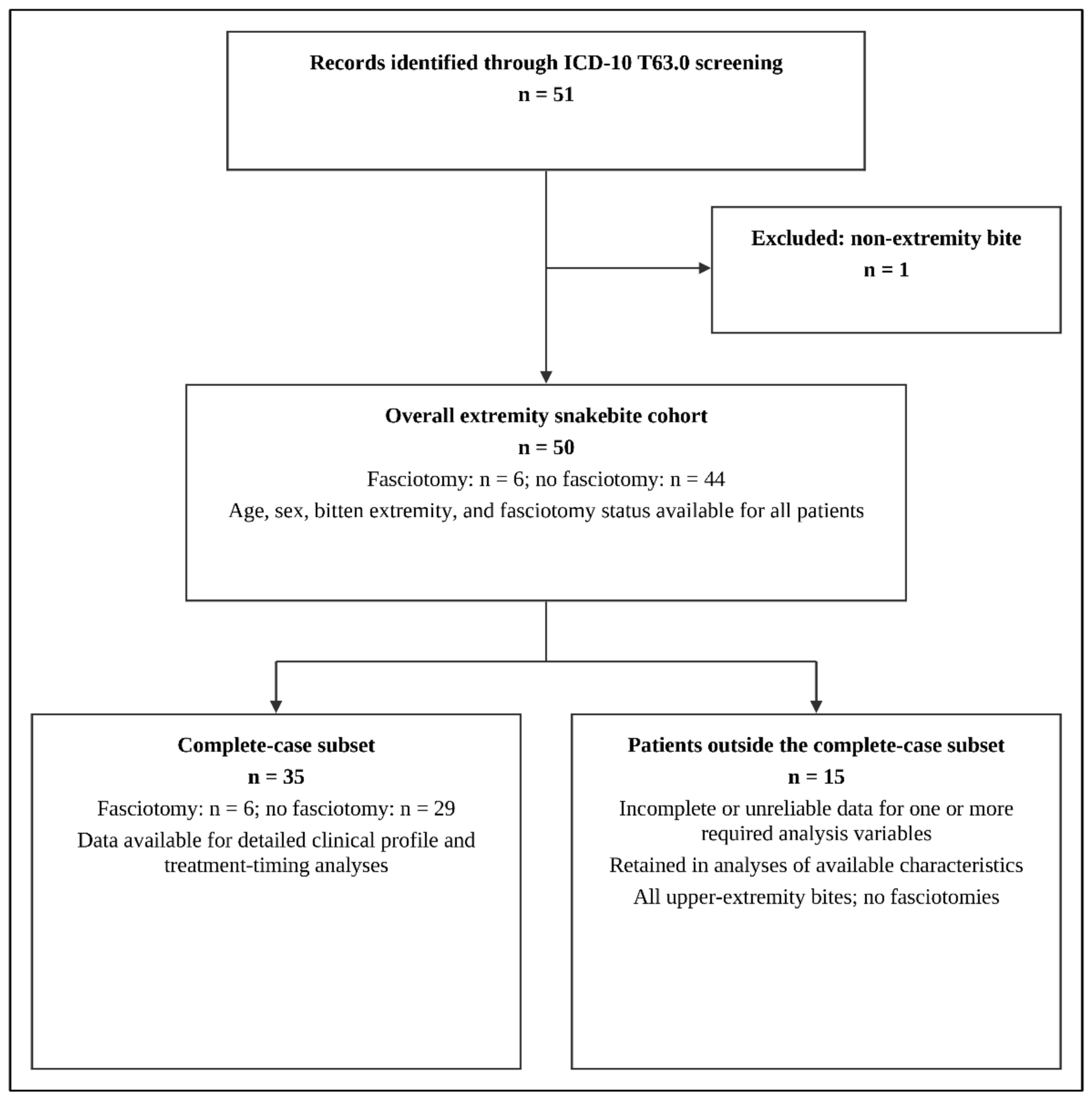
During the study period, 51 records coded as ICD-10 T63.0 were identified. One patient was excluded because the bite did not involve an extremity, leaving an overall cohort of 50 patients, six of whom underwent fasciotomy. Age, sex, bitten extremity, and fasciotomy status were available for all 50 patients. Thirty-five patients constituted the complete-case subset for detailed clinical profile and treatment-timing analyses. The remaining 15 patients had incomplete or unreliable data for one or more required variables but were retained in analyses of available characteristics. All 15 had upper-extremity bites, and none underwent fasciotomy. Antivenom administration was documented in four of these patients, although dose and timing data were unavailable; administration status could not be determined for the other 11. Antivenom administration status was therefore known for 39 patients, whereas dose and timing analyses included the 21 antivenom-treated patients in the complete-case subset. The patient selection process is summarized in Figure 1.
Figure 1.
Flow diagram of the overall cohort and complete-case subset.
Antivenom administration status was known in 39 patients and unknown in 11. Dose and timing analyses included 21 treated patients in the complete-case subset; four additional patients had documented antivenom administration but lacked reliable dose and timing data.
2.4. Management Approach, Snake Species, and Antivenom
Clinical management was performed by emergency physicians using the clinical severity-based treatment framework described by the Turkish Emergency Medicine Association Toxicology Working Group [7]. For patients in whom antivenom administration was considered, case-specific recommendations were obtained from the National Poison Consultation Center. Treatment decisions were guided by the clinical and laboratory severity and progression of envenomation rather than by confirmed snake species.
The antivenom used in this cohort was the HSGM Polyvalent Snake Antivenom, owned by the General Directorate of Public Health of the Ministry of Health of Türkiye. The product was manufactured at Albila Serum Biological Products Co., Ltd. (Eskişehir, Türkiye), and vial filling was performed by Nobel Pharmaceuticals (Istanbul, Türkiye). Each vial contained 10 mL of injectable solution. The antivenom is produced using venoms from Vipera ammodytes montandoni, Macrovipera lebetina obtusa, and Montivipera xanthina [8]. The referenced framework recommends withholding antivenom when there are no local or systemic manifestations (grade 0) or when swelling is mild, without systemic manifestations or laboratory abnormalities (grade 1), unless edema progresses, in which case 1 vial may be administered. It recommends 2–4 vials for moderate envenomation (grade 2), characterized by increasing swelling, pain, and ecchymosis with mild systemic manifestations and laboratory abnormalities, and 4–6 vials for severe envenomation (grade 3), characterized by progressive local injury and severe systemic manifestations, such as marked thrombocytopenia, coagulopathy, or renal failure [7]. It recommends dilution in normal saline and intravenous administration under close monitoring [7]. In routine practice, decisions to administer additional vials were made by emergency physicians in consultation with the National Poison Consultation Center, based on serial clinical and laboratory assessments and continued progression of local or systemic findings.
Reliable cumulative antivenom dose and timing data were available for the 21 antivenom-treated patients in the complete-case subset and were used in the corresponding analyses. However, a formal envenomation grade, the specific clinical rationale for each additional dose, and the patient-level route of administration were not consistently documented in the retrospective medical records. Therefore, patient-level grading, grade-specific dose concordance, and route-specific analyses could not be performed. No confirmed, probable, photograph-based, or patient-description-based snake identification was available for any patient in the complete-case cohort. Accordingly, all 35 cases were classified as completely unidentified, and species-based subgroup analysis was not performed.
2.5. Data Collection and Timing Variables
Demographic characteristics, bite-to-presentation time, anatomical site of the bite, documented local clinical findings, laboratory results, antivenom administration, bite-to-antivenom interval, ED arrival-to-antivenom interval, total antivenom dose, fasciotomy performance, time to fasciotomy, antivenom-to-fasciotomy interval, postoperative complications, and hospital length of stay were extracted from the electronic medical records. Bite-to-presentation time was defined as the interval between the patient-reported time of snakebite and arrival at the emergency department. Among patients who received antivenom, the bite-to-antivenom interval was defined as the interval between the patient-reported time of snakebite and initiation of antivenom infusion. The ED arrival-to-antivenom interval was calculated as the difference between the bite-to-antivenom interval and the bite-to-presentation time. All timing variables, including bite-to-presentation time, bite-to-antivenom interval, ED arrival-to-antivenom interval, time to fasciotomy, and antivenom-to-fasciotomy interval, were recorded and analyzed in hours. Total antivenom dose was defined as the cumulative number of antivenom vials administered during the hospital course. Among patients who underwent fasciotomy, time to fasciotomy was defined as the interval between the patient-reported time of snakebite and the fasciotomy procedure. The antivenom-to-fasciotomy interval was calculated among patients who received antivenom before fasciotomy. Data extraction was performed using predefined variables, and records were reviewed independently by two investigators; discrepancies were resolved by consensus with a third investigator.
For the six patients who underwent fasciotomy, additional patient-level information was extracted, when available, regarding the specific bite location, documented reason for proceeding to surgery, anatomical extent of fasciotomy, intraoperative findings including muscle viability, tissue necrosis and debridement, wound closure and skin grafting, postoperative neurovascular status, infection and other complications, additional surgery after grafting, amputation, range of motion, contracture, and functional recovery. Available inpatient and outpatient postoperative records were reviewed; however, there was no prespecified or standardized follow-up schedule, and the timing and duration of follow-up could not be reliably determined on a patient-by-patient basis. These patient-level variables were reported descriptively without additional statistical analysis.
A six-item clinical profile score was derived from emergency department records and orthopedic consultation notes to summarize local extremity findings documented during early emergency department assessment and/or orthopedic consultation before the final management decision. The six items were pain at rest, pain with passive motion, delayed capillary refill, marked swelling or tenseness, paresthesia, and motor deficit. These components were selected because they were regularly documented in the available clinical records, allowing for a consistent retrospective description of the local clinical profile.
Pain at rest and pain with passive motion were coded according to explicit documentation of pain at rest and pain elicited by passive movement, respectively. Delayed capillary refill was defined as a capillary refill time exceeding 2 s, based on the documented clinical assessment. Marked swelling or tenseness was coded as present only when the examination notes explicitly described swelling or tenseness as marked, severe, or clinically prominent. Paresthesia was based on documented patient-reported symptoms, whereas motor deficit was coded only when motor loss or weakness was explicitly recorded by the examining physician. The score was calculated as an unweighted count of documented positive findings, assigning 1 point for documented presence and 0 points for documented absence of each item (total range, 0–6). This approach does not imply equal clinical importance or diagnostic value across components. Missing documentation was not coded as absence. The score was constructed retrospectively for research purposes to summarize the documented local clinical profile; it was not part of the contemporaneous clinical assessment and was not used to guide treatment or fasciotomy decisions.
2.6. Outcome Definitions
The primary outcome was fasciotomy performance during the hospital course. Fasciotomy performance was defined as the documentation of fasciotomy in the operative record or clinical follow-up notes after orthopedic evaluation. Fasciotomy was analyzed as an observed management outcome.
Intracompartmental pressure measurements were not routinely performed or documented. Secondary outcomes included hospital length of stay and, among patients who underwent fasciotomy, documented postoperative complications, reoperation, amputation, and postoperative neurovascular status.
2.7. Laboratory Evaluation
Admission laboratory parameters selected for the focused analysis included hemoglobin, platelet count, international normalized ratio (INR), activated partial thromboplastin time (aPTT), creatine kinase (CK), and serum creatinine. The first available laboratory value obtained at admission or on the same calendar day was used. Hemoglobin, platelet count, INR, aPTT, CK, and creatinine were available for all 35 patients. Fibrinogen and D-dimer were available for only 7 (20.0%) and 12 (34.3%) patients, respectively, and were therefore not included in between-group comparisons. Separate prothrombin time and fibrin degradation product measurements were not consistently available and were not analyzed.
2.8. Statistical Analysis
Statistical analyses were performed using IBM SPSS Statistics for Windows, version 26.0 (IBM Corp., Armonk, NY, USA). Continuous variables were assessed for distributional characteristics and are presented as median and interquartile range. Categorical variables are presented as numbers and percentages. Patients were compared according to fasciotomy management using the available data for each analysis. Age, sex, and bitten extremity were analyzed in the overall cohort (n = 50). Antivenom administration was compared among patients with known administration status (n = 39); unknown status was not classified as non-administration. Clinical profile, laboratory, presentation-timing, and hospital length-of-stay analyses used the complete-case subset (n = 35). Antivenom dose and timing analyses were restricted to treated patients within this subset (n = 21). Continuous variables were compared using the Mann–Whitney U test, and categorical variables using two-sided Fisher’s exact tests. Exploratory correlations between the clinical profile score and selected continuous variables were assessed using Spearman’s rank correlation coefficient. Because only six patients underwent fasciotomy, all between-group comparisons were considered exploratory and were interpreted descriptively. No multivariable regression model was constructed, and no data-driven diagnostic or surgical decision threshold was derived from the clinical profile score. All tests were two-sided, and a p-value < 0.05 was used as the nominal significance threshold. Given the exploratory nature of the study, no adjustment was made for multiple comparisons. Accordingly, all reported p-values are unadjusted and should be interpreted cautiously.
3. Results
3.1. Study Population and Baseline Characteristics
The overall cohort comprised 50 patients with extremity snakebite, of whom six (12.0%) underwent fasciotomy. The median age was 47 years (interquartile range [IQR], 29.5–60), 20 patients (40.0%) were female, and 37 (74.0%) had upper-extremity bites. Antivenom administration was documented in 25 patients (50.0%), whereas 14 (28.0%) did not receive antivenom, and administration status could not be determined for 11 (22.0%).
Thirty-five patients formed the complete-case subset for detailed analyses, including all six fasciotomy patients and 29 patients managed without fasciotomy (Figure 1). Of these, 21 received antivenom and had reliable dose and timing data. Snake species could not be identified in any patient in this subset. Characteristics of the overall cohort and complete-case subset are summarized in Table 1.
Table 1.
Characteristics of the overall extremity snakebite cohort and complete-case subset.
3.2. Individual Documented Local Clinical Findings During Early Clinical Evaluation
Individual documented local clinical findings recorded during emergency department assessment and/or orthopedic consultation before the final management decision are shown in Table 2. Pain with passive motion was documented in all patients in both groups (6/6 vs. 29/29). In contrast, pain at rest (6/6 vs. 3/29), marked swelling or tenseness (6/6 vs. 3/29), paresthesia (6/6 vs. 2/29), motor deficit (6/6 vs. 0/29), and delayed capillary refill (5/6 vs. 0/29) were more frequently documented among patients who underwent fasciotomy.
Table 2.
Individual documented local clinical findings during early clinical evaluation according to fasciotomy management.
3.3. Other Characteristics According to Fasciotomy Management
Comparisons of demographic, treatment-timing, laboratory, and hospital-course characteristics according to fasciotomy management are presented in Table 3. In the overall cohort, no statistically significant differences were detected in age, sex, or bitten extremity between management groups. Antivenom administration also did not differ significantly among patients with known administration status. Within the complete-case subset, the following treatment-timing, laboratory, and hospital-course findings were observed. Patients who underwent fasciotomy presented later after the bite than those managed without fasciotomy (4.5 h [IQR, 4–5] vs. 2 h [IQR, 2–2], p < 0.001). Among patients who received antivenom, the bite-to-antivenom interval was longer in the fasciotomy group (4.5 h [IQR, 4–5] vs. 2 h [IQR, 2–3], p < 0.001). However, the ED arrival-to-antivenom interval was not significantly different between the groups (0 h [IQR, 0–0] vs. 0 h [IQR, 0–1], p = 0.129). Among antivenom-treated patients, the total antivenom dose was higher in the fasciotomy group (4.5 vials [IQR, 4–5] vs. 3 vials [IQR, 2–3], p < 0.001). Among patients who underwent fasciotomy, time to fasciotomy was 8 h [range, 7–8] after the bite, and the antivenom-to-fasciotomy interval was 2 h [range, 1–3]. Hospital length of stay was longer in patients who underwent fasciotomy (8 days [IQR, 6.75–9.25] vs. 1 day [IQR, 1–2], p < 0.001). In unadjusted exploratory comparisons of admission laboratory parameters, the fasciotomy group had a lower platelet count (174.5 [IQR, 174–175] vs. 219 [IQR, 176–270] × 103/µL; p = 0.014), a longer aPTT (37.75 [IQR, 35.70–41.45] vs. 31.00 [IQR, 26.30–34.30] s; p = 0.027), and a lower serum creatinine level (0.61 [IQR, 0.58–0.74] vs. 0.86 [IQR, 0.70–0.96] mg/dL; p = 0.020). Hemoglobin, INR, and CK did not differ between the groups. Given the small number of fasciotomy cases and the multiple comparisons performed, these laboratory findings should be interpreted cautiously.
Table 3.
Demographic, treatment-timing, laboratory, and hospital-course characteristics according to fasciotomy management.
Exploratory correlations are presented in Table 4. The clinical profile score was positively correlated with bite-to-presentation time, bite-to-antivenom interval, and hospital length of stay. No statistically significant correlation was observed with age.
Table 4.
Exploratory correlations between the clinical profile score and selected demographic, timing, and hospital-course variables.
3.4. Profile and Complications Among Patients Undergoing Fasciotomy
All six patients who underwent fasciotomy had upper-extremity bites, comprising four forearm bites, one finger bite, and one hand bite, and all received antivenom before surgery. Patient-level clinical, operative, and postoperative characteristics are presented in Table 5. Fasciotomy wounds were closed with split-thickness skin grafts in all six patients. Mild superficial flexor muscle necrosis requiring superficial debridement was documented in one patient. One patient developed a surgical-site infection during the second postoperative week, which resolved with wound care and antibiotic treatment without additional surgery. No graft loss, persistent open wound, additional surgery after grafting, neurovascular deficit, or amputation was documented in the available postoperative follow-up records. However, follow-up timing and duration were not standardized, and range of motion, contracture, and functional recovery were not systematically assessed; therefore, long-term functional outcomes could not be evaluated.
Table 5.
Patient-level clinical, treatment, operative, and outcome characteristics of patients who underwent fasciotomy.
4. Discussion
Within the complete-case subset, patients who underwent fasciotomy had more pronounced documented local findings during early clinical evaluation and presented later after the bite than those managed without fasciotomy. Among antivenom-treated patients in this subset, the fasciotomy group had a longer bite-to-antivenom interval and received a higher cumulative antivenom dose, whereas no statistically significant between-group difference was detected in the ED arrival-to-antivenom interval.
Snakebite envenomation can produce progressive swelling, pain, tenseness, paresthesia, and neurovascular abnormalities that may mimic acute compartment syndrome [4,9]. Previous studies have indicated that venom-induced compartment syndrome is uncommon and that substantial heterogeneity exists in diagnostic criteria, intracompartmental pressure measurement, and fasciotomy practices [5,6]. Consistent with these concerns, a recent global scoping review of 115 reported cases found that compartment pressure was measured in only 38% of patients and that reliance on clinical findings alone may contribute to overdiagnosis [10]. The review supported antivenom as first-line treatment but emphasized that evidence defining when fasciotomy should be used as rescue therapy remains limited [10].
The more pronounced local findings among patients who underwent fasciotomy are consistent with the prominence of pain and swelling in cases included in the global scoping review [10]. This similarity may reflect the local tissue effects of envenomation, which can overlap with findings used to suspect acute compartment syndrome [10,11,12]. However, pain with passive motion was documented in every patient in the complete-case subset and therefore did not distinguish the management groups. This observation is consistent with Pattinson et al., who emphasized that pain on passive stretch may occur after snakebite without necessarily indicating true compartment syndrome and should not be interpreted in isolation when assessing the need for fasciotomy [13]. The clinical profile score, which incorporated six documented local findings, should nevertheless remain interpreted as a descriptive summary rather than as a validated diagnostic tool or surgical threshold.
Within the complete-case subset, time from bite to emergency department presentation was positively correlated with the clinical profile score. This finding suggests that patients presenting later may have more pronounced local envenomation findings during early clinical evaluation. Local tissue effects after snakebite envenomation may evolve over time, and swelling, pain, tenseness, tissue injury, and neurovascular findings are important components of clinical monitoring [2]. Therefore, presentation timing should be considered not only as a measure of delay but also as a variable that should be interpreted together with the documented clinical severity of local findings during early evaluation. Nevertheless, because of the retrospective design and the use of emergency department records together with orthopedic consultation notes, this association should not be interpreted as causal or as reflecting findings present exclusively at emergency department arrival.
Antivenom timing and total dose may be influenced by multiple factors, including prehospital presentation delay, documented local findings during early clinical evaluation, progression during observation, and treatment requirements during follow-up [2]. Among the 21 antivenom-treated patients with reliable dose and timing data, the bite-to-antivenom interval was longer in the fasciotomy group, whereas the ED arrival-to-antivenom interval was not significantly different between groups. This distinction is important because the bite-to-antivenom interval reflects the overall time from snakebite to antivenom initiation and includes both the prehospital interval and in-hospital management time. Therefore, the longer bite-to-antivenom interval observed in the fasciotomy group appears to be largely related to later emergency department presentation rather than a clear delay in antivenom administration after hospital arrival. The higher cumulative antivenom dose observed in our fasciotomy group contrasts with Darracq et al., who found no statistically significant difference in total antivenom use between patients who underwent fasciotomy and those in whom fasciotomy was considered but not performed [14]. However, their study involved a selected cohort of rattlesnake-envenomated patients treated with a different antivenom product and dosing regimen; therefore, absolute vial counts are not directly comparable across studies, and the differing within-cohort patterns may reflect differences in case selection and treatment practices. Although recent preclinical testing demonstrated paraspecific neutralization by the HSGM polyvalent antivenom against Vipera berus berus, Vipera ammodytes ammodytes, and Montivipera raddei venoms [8], species-specific effectiveness and dose requirements could not be evaluated because snake species identification was unavailable. Among patients who underwent fasciotomy, surgery was performed 7–8 h after the bite and 1–3 h after antivenom initiation. The global scoping review reported a median antivenom-to-fasciotomy interval of 4 h (IQR, 0–13), although timing data were frequently missing [10]. Differences in case selection and clinical management limit direct comparison, and our retrospective records did not permit standardized assessment of the response to antivenom before surgery. Therefore, antivenom-related findings should be interpreted as descriptive treatment-timing and management characteristics rather than as causal determinants of fasciotomy.
The fasciotomy rate was 12.0% (6/50) in the overall extremity snakebite cohort and 17.1% (6/35) in the complete-case analytic cohort. Türkmen and Temel reported three fasciotomies among 97 patients with extremity snakebite (3.1%) managed using a structured classification and follow-up approach [15]. The higher proportion observed in our overall cohort may reflect differences in case mix and surgical decision-making. However, differences in assessment protocols and the absence of routine intracompartmental pressure measurement in our cohort limit direct comparison.
Hospital length of stay was also longer in patients who underwent fasciotomy, consistent with Darracq et al., who similarly reported longer hospitalization among patients undergoing fasciotomy [14]. This difference may reflect both greater clinical severity among patients selected for surgery and the additional wound and postoperative care associated with fasciotomy.
Admission laboratory comparisons were exploratory. The fasciotomy group had lower platelet counts, longer aPTT, and lower serum creatinine, whereas hemoglobin, INR, and CK did not differ significantly between groups. The global scoping review reported coagulopathy at admission in 40% of patients with reported venom-induced compartment syndrome [10], illustrating the coexistence of local and systemic manifestations of envenomation. However, that frequency cannot be directly compared with the between-group differences in platelet count and aPTT observed here, which do not by themselves establish coagulopathy. The clinical significance of the lower creatinine level remains uncertain. Given the small number of fasciotomy cases and multiple unadjusted comparisons, these laboratory findings should be interpreted cautiously and considered alongside clinical progression, bleeding risk, and response to antivenom rather than as isolated indications for surgery [2].
Given the diagnostic uncertainty, decisions regarding fasciotomy after extremity snakebite should incorporate a structured assessment rather than rely on isolated local examination findings. Serial neurovascular examinations, monitoring of local progression and clinical response to antivenom, and, when feasible, intracompartmental pressure measurement may help balance the risks of delayed decompression against unnecessary surgical intervention [10,16,17].
5. Limitations
This study has several important limitations. First, it was a single-center retrospective study; therefore, the findings depended on the accuracy and completeness of medical records, and external validity is limited. In addition, the overall cohort comprised only 50 patients, with six fasciotomy cases, and detailed clinical and treatment-timing analyses were restricted to a complete-case subset of 35 patients. This limited number of events precluded meaningful multivariable analysis and prevented independent or causal-effect interpretations regarding factors associated with fasciotomy performance. Restricting detailed analyses to the 35-patient complete-case subset may have introduced selection bias, particularly because all 15 patients omitted from these analyses were managed without fasciotomy. This may have affected the representativeness of the non-fasciotomy comparison group and the observed between-group differences; however, the direction and magnitude of any resulting bias could not be determined from the available data. Antivenom administration status was unknown in 11 patients, which also limits interpretation of the available-case comparison of antivenom administration.
Second, because intracompartmental pressure measurements were not routinely performed or documented, objective confirmation of acute compartment syndrome was not possible, and fasciotomy was therefore analyzed as an observed management outcome rather than as confirmation of the diagnosis. In addition, the snake species could not be identified in any patient in the complete-case subset; given the documented variation in venom composition among Turkish viper taxa [18], the findings could not be attributed to a specific snake species, venom profile, or species-specific clinical course.
Laboratory analyses were based on initial or same-day admission values and did not capture serial changes in coagulation parameters, muscle injury markers, or renal function. Fibrinogen and D-dimer were available for only 7 and 12 patients, respectively, while separate PT and fibrin degradation product measurements were not consistently available; therefore, these parameters could not be included in between-group comparisons. The small number of fasciotomy cases and the use of multiple unadjusted comparisons further limit the robustness of the observed laboratory differences.
In addition, the retrospective records did not permit standardized assessment of clinical progression or response to antivenom before fasciotomy. Intraoperative muscle viability was incompletely documented; mild superficial flexor muscle necrosis was recorded in one patient, whereas detailed muscle viability findings were unavailable for the remaining five patients. The records also did not provide a standardized account of the precise rationale underlying each surgical decision or the timing of split-thickness skin grafting. Furthermore, the timing and duration of postoperative follow-up were not standardized, and range of motion, contracture, and functional recovery were not systematically assessed; therefore, long-term functional outcomes could not be evaluated.
Finally, the clinical profile score was not a validated snakebite-specific score; it was retrospectively constructed to standardize bedside clinical findings documented during early clinical evaluation. Because these findings were extracted from emergency department records and orthopedic consultation notes, the score may reflect both initial clinical status and findings documented during subsequent evaluation before the final management decision. Furthermore, the association between the clinical profile score and fasciotomy may partly reflect the influence of its component findings on surgical decision-making. Accordingly, our results should be considered hypothesis-generating and require confirmation in prospective, multicenter studies incorporating serial clinical assessment and objective pressure measurement when feasible.
6. Conclusions
In the complete-case subset of this single-center retrospective cohort, patients who underwent fasciotomy had more pronounced documented local findings and later presentation than those managed without fasciotomy. Among antivenom-treated patients in this subset, cumulative doses were higher, and the bite-to-antivenom interval was longer in the fasciotomy group, whereas no statistically significant difference was detected in the ED arrival-to-antivenom interval. These descriptive findings characterize patients selected for fasciotomy but do not establish pressure-confirmed acute compartment syndrome or the necessity of surgery. Prospective studies incorporating standardized serial clinical assessments, documentation of the response to antivenom, and objective compartment pressure measurement when feasible are needed to better evaluate surgical decision-making.
Author Contributions
Conceptualization, G.S. and M.Ç.; Methodology, G.S. and M.Ç.; Software, G.S.; Validation, G.S. and F.I.; Formal analysis, G.S. and Ö.K.; Investigation, G.S. and M.Ç.; Resources, G.S. and F.I.; Data curation, G.S. and F.I.; Writing—original draft, G.S. and Ö.K.; Writing—review & editing, G.S. and Ö.K.; Visualization, G.S. and M.Ç.; Supervision, G.S. and F.I.; Project administration, G.S. and F.I. All authors have read and agreed to the published version of the manuscript.
Funding
This research received no external funding.
Institutional Review Board Statement
The study was approved by the relevant institutional ethics committee (Balıkesir Atatürk City Hospital Scientific Research Ethics Committee, Decision No. 2025/08/86, date: 21 August 2025).
Informed Consent Statement
Because of the retrospective design, the requirement for informed consent was waived by the ethics committee.
Data Availability Statement
The datasets generated and/or analyzed during the current study are not publicly available because they contain de-identified clinical data subject to institutional and ethical restrictions but are available from the corresponding author upon reasonable request and with appropriate institutional permission.
Acknowledgments
The authors would like to thank the clinical staff involved in the care of the patients included in this study. During manuscript preparation, OpenAI’s ChatGPT-6 ASTRA was used for language editing, formatting assistance, and refinement of academic wording. The tool was not used to generate or alter study data, perform statistical analyses, interpret results independently, or draw scientific conclusions. All authors critically reviewed, verified, and approved the final manuscript content and remain fully responsible for the accuracy and integrity of the work.
Conflicts of Interest
The authors declare no conflict of interest.
Abbreviations
| aPTT | Activated partial thromboplastin time |
| CK | Creatine kinase |
| ED | Emergency department |
| HSGM | Halk Sağlığı Genel Müdürlüğü (General Directorate of Public Health, Türkiye) |
| IBM | International Business Machines |
| ICD-10 | International Classification of Diseases, 10th Revision |
| INR | International normalized ratio |
| IQR | Interquartile range |
| PT | Prothrombin time |
| SPSS | Statistical Package for the Social Sciences |
| US/USA | United States/United States of America |
References
- World Health Organization. Snakebite Envenoming. Available online: https://www.who.int/news-room/fact-sheets/detail/snakebite-envenoming (accessed on 30 June 2026).
- Seifert, S.A.; Armitage, J.O.; Sanchez, E.E. Snake Envenomation. N. Engl. J. Med. 2022, 386, 68–78. [Google Scholar] [CrossRef] [Scilit] [PubMed]
- Stecco, C.; Porzionato, A.; Lancerotto, L.; Stecco, A.; Macchi, V.; Day, J.A.; De Caro, R. Histological study of the deep fasciae of the limbs. J. Bodyw. Mov. Ther. 2008, 12, 225–230. [Google Scholar] [CrossRef] [Scilit] [PubMed]
- Cañas, C.A. Is the acute compartment syndrome diagnosed in snake bites true?: A review. Medicine 2024, 103, e40008. [Google Scholar] [CrossRef] [Scilit] [PubMed] [PubMed Central]
- Newman, J.; Therriault, C.; White, M.S.; Nogee, D.; Carpenter, J.E. Compartment Syndrome Following Snake Envenomation in the United States: A Scoping Review of the Clinical Literature. West J. Emerg. Med. 2024, 25, 651–660. [Google Scholar] [CrossRef] [Scilit] [PubMed] [PubMed Central]
- Spyres, M.B.; Maker, G.; Aldy, K.; Wolk, B.J.; Meadors, K.E.; Christian, M.; Ruha, A.-M. Compartment Syndrome after Crotalid Envenomation in the United States: A Review of the North American Snakebite Registry from 2013 to 2021 on Behalf of the ToxIC Snakebite Study Group. Wilderness Environ. Med. 2023, 34, 322–327. [Google Scholar] [CrossRef] [Scilit] [PubMed]
- Akın, M.A. Yılan ve Akrepler Kış Uykusundan Uyanıyor [Snakes and Scorpions are Waking from Hibernation]. Turkish Emergency Medicine Association Toxicology Working Group. Published 27 April 2017. Available online: https://tatd.org.tr/toksikoloji/yilan-ve-akrepler-kis-uykusundan-uyaniyor/ (accessed on 2 September 2026).
- Numanoglu Cevik, Y.; Altun, D.; Serin, M.; Namli Bozkurt, E.N.; Bozyigit, I.; Icigen, H.O.; Kanat, M.A. Investigation of paraspecific effects of polyvalent snake antivenom on the venom of three vipers (Vipera berus berus; Linnaeus 1758, Vipera ammodytes ammodytes; Linnaeus, 1758 and Montivipera raddei; Boettger, 1890). Toxicon 2025, 260, 108349. [Google Scholar] [CrossRef] [Scilit] [PubMed]
- Sarıkaya, G. The persistent fear of compartment syndrome in snakebite envenomation: Implications for fasciotomy decision-making. Clin. Toxicol. 2026, 64, 410–411. [Google Scholar] [CrossRef] [Scilit] [PubMed]
- Steinhorst, J.; Amuasi, J.H.; Werker, P.M.N.; Habib, A.G.; Lavonas, E.J.; Kreuels, B.; Lalloo, D.G.; Stienstra, Y. Under pressure: Clinical management of venom-induced compartment syndrome in snakebite–A scoping review of the global literature. PLoS Negl. Trop. Dis. 2026, 20, e0014536. [Google Scholar] [CrossRef] [Scilit] [PubMed]
- Bouklouch, Y.; Agel, J.; Obremskey, W.T.; Schmidt, A.H.; Liu, K.; Westberg, J.R.; Zakariah, M.; Bunzel, E.; Henry, G.; Diaz, A.F.; et al. Rethinking the Paradigm of Using Ps for Diagnosing Compartment Syndrome. JBJS Open Access 2025, 10, e24.00065. [Google Scholar] [CrossRef] [Scilit] [PubMed]
- McQueen, M.M.; Duckworth, A.D. The diagnosis of acute compartment syndrome: A review. Eur. J. Trauma Emerg. Surg. 2014, 40, 521–528. [Google Scholar] [CrossRef] [Scilit] [PubMed]
- Pattinson, J.P.; Kong, V.Y.; Bruce, J.L.; Oosthuizen, G.V.; Bekker, W.; Laing, G.L.; Wood, D.; Brysiewicz, P.; Clarke, D.L. Defining the need for surgical intervention following a snakebite still relies heavily on clinical assessment: The experience in Pietermaritzburg, South Africa. S. Afr. Med. J. 2017, 107, 1082–1085. [Google Scholar] [CrossRef] [Scilit] [PubMed]
- Darracq, M.A.; Cantrell, F.L.; Klauk, B.; Thornton, S.L. A chance to cut is not always a chance to cure—Fasciotomy in the treatment of rattlesnake envenomation: A retrospective poison center study. Toxicon 2015, 101, 23–26. [Google Scholar] [CrossRef] [Scilit] [PubMed]
- Türkmen, A.; Temel, M. Algorithmic approach to the prevention of unnecessary fasciotomy in extremity snake bite. Injury 2016, 47, 2822–2827. [Google Scholar] [CrossRef] [Scilit] [PubMed]
- Toschlog, E.A.; Bauer, C.R.; Hall, E.L.; Dart, R.C.; Khatri, V.; Lavonas, E.J. Surgical considerations in the management of pit viper snake envenomation. J. Am. Coll. Surg. 2013, 217, 726–735. [Google Scholar] [CrossRef] [Scilit] [PubMed]
- Kim, Y.H.; Choi, J.H.; Kim, J.; Chung, Y.K. Fasciotomy in compartment syndrome from snakebite. Arch. Plast. Surg. 2019, 46, 69–74. [Google Scholar] [CrossRef] [Scilit] [PubMed]
- Damm, M.; Karış, M.; Petras, D.; Nalbantsoy, A.; Göçmen, B.; Süssmuth, R.D. Venomics and peptidomics of Palearctic vipers: A clade-wide analysis of seven taxa of the genera Vipera, Montivipera, Macrovipera, and Daboia across Türkiye. J. Proteome Res. 2024, 23, 3524–3541. [Google Scholar] [CrossRef] [Scilit] [PubMed]

Disclaimer/Publisher’s Note: The statements, opinions and data contained in all publications are solely those of the individual author(s) and contributor(s) and not of MDPI and/or the editor(s). MDPI and/or the editor(s) disclaim responsibility for any injury to people or property resulting from any ideas, methods, instructions or products referred to in the content. |
© 2026 by the authors. Licensee MDPI, Basel, Switzerland. This article is an open access article distributed under the terms and conditions of the Creative Commons Attribution (CC BY) license.