


Abstract
Background/Objectives: Older adults residing in long-term care frequently experience multimorbidity, low habitual activity, mobility decline, executive dysfunction, and reduced quality of life. Evidence separating the effects of exercise, cognitive stimulation, and their combination remains limited. The primary objective of this trial is to determine whether a 12-week combined physical exercise plus cognitive stimulation programme improves executive function, functional mobility, and health-related quality of life compared with usual care. Secondary objectives are to estimate the effects of each single-component programme, compare the combined programme with each component, and examine maintenance at six months. Methods: This is a four-arm, parallel-group, assessor-blinded randomised controlled trial in Portuguese long-term care facilities. A total of 140 residents aged 65 years or older, residing in long-term care for at least three months and able to provide informed consent, will be allocated 1:1:1:1 to supervised multicomponent exercise, group cognitive stimulation, combined exercise plus cognitive stimulation, or usual care. Active programmes will be delivered three times weekly for 12 weeks. Assessments are planned at baseline, post-intervention, and six-month follow-up according to the prespecified schedule. Primary outcomes are the Stroop interference score, Timed Up and Go time, and EQ-5D-5L index value at 12 weeks. Analyses will follow the intention-to-treat principle using mixed-effects models; multiplicity across the three primary endpoints will be controlled using Holm’s procedure, and interaction analyses will be exploratory and hypothesis-generating. Results: Recruitment and data collection had not started at manuscript submission; therefore, no participant data are reported. Conclusions: The trial will estimate the effects of the combined programme versus usual care and provide exploratory comparative evidence on the single-component programmes in real-world long-term care.
1. Introduction
Residents of long-term care facilities commonly experience accelerated functional and cognitive decline. Multimorbidity, polypharmacy, sedentary routines, and restricted opportunities for autonomous activity can reduce strength, balance, mobility, participation, and health-related quality of life. Executive abilities such as planning, inhibition, and divided attention are important for safe transfers, adapting gait, following daily routines, and engaging in meaningful activities. Decline in these domains is associated with greater dependence, falls risk, and poorer quality of life [1,2,3]. Participation in health-promoting activities also depends on the interaction between individual capability, motivation, social opportunity, and the physical environment, as emphasised by the COM-B framework and multidimensional active-ageing models [4,5]. Interventions must therefore be safe, accessible, motivating, compatible with facility routines, and sufficiently standardised for replication.
Supervised multicomponent physical exercise is a core non-pharmacological strategy for older adults. Programmes that combine balance, strength, flexibility, and functional mobility are consistent with international guidance and current geriatric exercise recommendations [6,7,8,9,10]. In long-term care, exercise can improve physical function and reduce factors associated with falls [2,3]. It may also support cognitive health through better vascular and metabolic function, sleep, mood, and brain plasticity [11,12,13]. These potential benefits are relevant where inactivity and limited environmental stimulation can accelerate both motor and cognitive decline.
Cognitive stimulation offers a complementary pathway through structured group activities involving attention, memory, executive control, language, orientation, calculation, and problem-solving. Such activities can support cognitive engagement and social interaction [14,15,16]. However, the strongest evidence for formal cognitive stimulation therapy concerns people with dementia [14,15]; evidence for group cognitive stimulation in older adults without a major neurocognitive disorder is smaller and partly extrapolated from cognitive-training research [16]. Testing this extrapolation is therefore an important purpose of the present trial. A combined physical-cognitive programme may target both motor capacity and executive control within the same care pathway [17,18].
Evidence on combined programmes remains heterogeneous in intervention dose, content, professional resources, outcomes, follow-up, and comparator definition. Trials of multicomponent exercise with simultaneous cognitive training suggest possible benefits in selected executive domains [19], while small pilot work integrating physical activity with mindful awareness supports feasibility but cannot establish comparative effectiveness [20]. Most studies compare one programme with usual care, so they cannot distinguish exercise effects from cognitive-stimulation effects or determine whether a combined programme adds benefit beyond either component. Complex behavioural interventions also make participant and provider blinding impracticable and create challenges for intervention fidelity, contact-time matching, and implementation [21]. The present four-arm design addresses these challenges through common eligibility and assessment procedures, blinded outcome assessment, standardised intervention manuals, component-specific fidelity records, and direct comparisons of exercise alone, cognitive stimulation alone, their combination, and usual care under the same facility conditions.
The primary objective is to determine whether a 12-week combined physical exercise plus cognitive stimulation programme improves executive function (Stroop interference score), functional mobility (Timed Up and Go time), and health-related quality of life (EQ-5D-5L index value) at 12 weeks compared with usual care. Secondary objectives are to estimate the effects of exercise and cognitive stimulation separately, compare the combined programme with each single-component programme, examine maintenance of selected outcomes at six months, and describe safety, adherence, and feasibility. The principal hypothesis is that the combined intervention will produce greater improvements than usual care across the three primary domains. Comparisons involving the single-component arms and formal interaction analyses are prespecified as exploratory and hypothesis-generating.
2. Materials and Methods
2.1. Trial Design, Setting, and Reporting Framework
This is a pragmatic, randomised, parallel-group, assessor-blinded, four-arm controlled trial with a 1:1:1:1 allocation ratio. Participants will be allocated to multicomponent physical exercise, cognitive stimulation, combined physical exercise plus cognitive stimulation, or usual care. Assessments are planned at baseline (T0), immediately after the 12-week intervention period (T1), and six months after programme completion (T2). The trial is designed to preserve ecological validity by delivering interventions on site within the participating long-term care facilities rather than in a laboratory or hospital environment.
The study will be conducted in four long-term care facilities (Estruturas Residenciais para Pessoas Idosas, ERPI units) operated by three non-profit private social solidarity providers in the district of Viseu, Portugal, in collaboration with Escola Superior de Saúde Jean Piaget de Viseu. One provider operates two of the participating ERPI units. Written institutional authorisation has been obtained from all four ERPI units. At the providers’ request, their identities are not reported in the public manuscript. The manuscript follows SPIRIT 2025 as the primary protocol-reporting framework, with CONSORT 2025 and TIDieR elements used where relevant [22,23,24]. The SPIRIT checklist, TIDieR intervention description, bilingual Portuguese-English participant information sheet and informed consent form, and a separate high-resolution planned CONSORT-style flow diagram are provided as supporting files.
2.2. Trial Status, Ethics, Registration, and Participant Consent
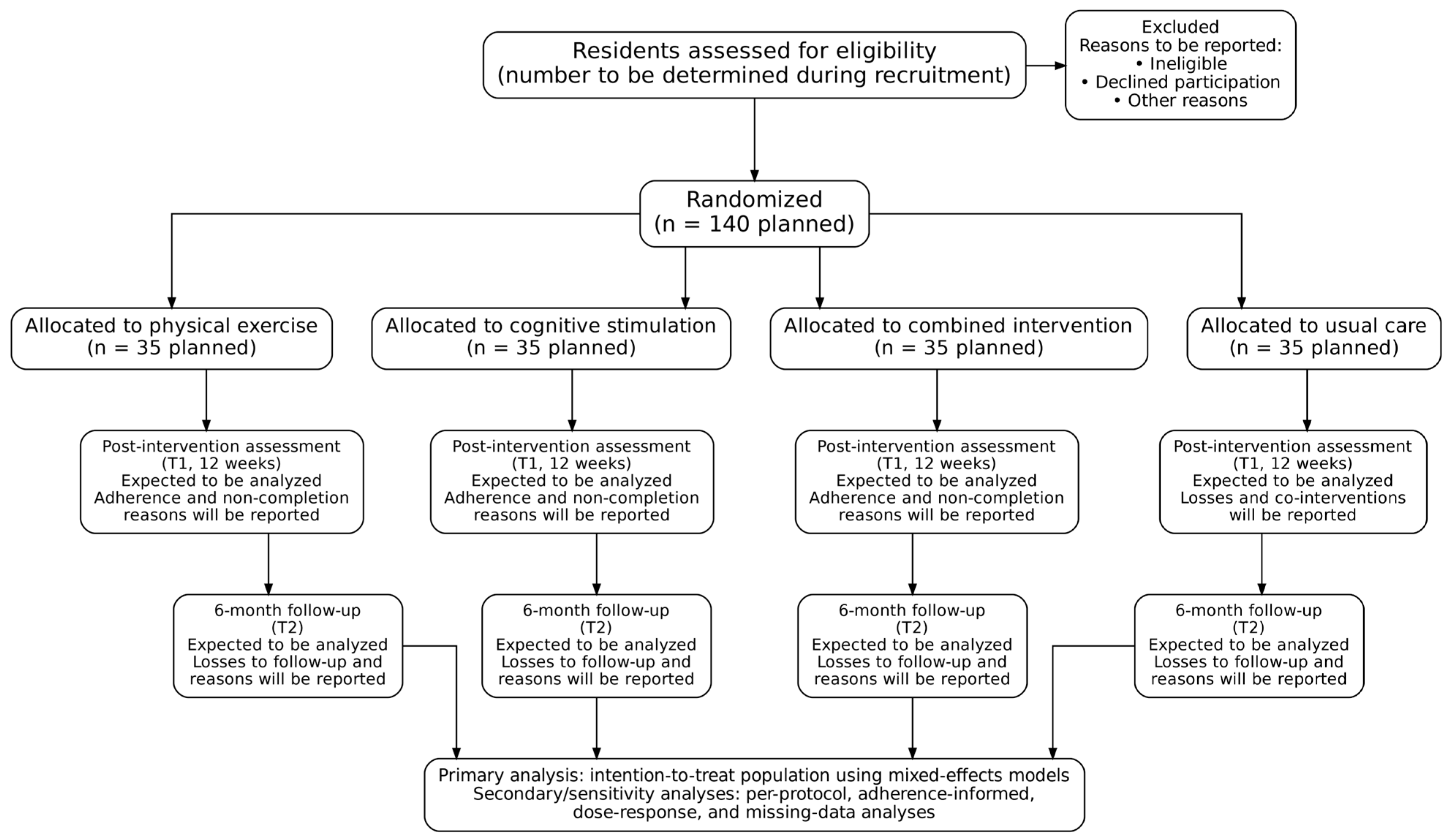
Participant screening, recruitment, and data collection had not started at the time of manuscript submission. Written institutional authorisation has been obtained from all four participating ERPI units. Accordingly, no participant flow, baseline data, or trial outcomes are reported. This protocol describes the planned trial design, intervention procedures, assessment framework, and analysis strategy. The planned participant pathway is summarised in Figure 1.
Figure 1.
Planned CONSORT-style flow diagram for participant screening, allocation, post-intervention assessment, and 6-month follow-up.
This study is being conducted as part of the Doctoral Programme in Health, Disability, Dependency and Well-being at the University of Salamanca, in collaboration with Escola Superior de Saúde Jean Piaget de Viseu and the InSIGHT Research Centre, Instituto Piaget, Portugal. Within this collaborative framework, the participant information sheet and informed consent form underwent official translation into Portuguese and back-translation to support linguistic and conceptual equivalence for their use in Portugal. The trial received prospective ethical approval from the Research Ethics Committee of the University of Salamanca (registry no. 1379; 20 May 2025). At the protocol-planning stage, the Ethics Committee of the Piaget Institute (CEIP), Portugal, was consulted regarding the need for an additional ethical review in Portugal and indicated that no further ethical review was required in view of the existing prospective ethical approval from the Research Ethics Committee of the University of Salamanca. Written institutional authorisation to conduct the study was obtained from each of the four participating ERPI units before recruitment. No resident was approached before institutional authorisation was completed, and recruitment and study procedures will be initiated in accordance with the approved protocol and site procedures. The study is registered at ClinicalTrials.gov (NCT07082504). All procedures will comply with the Declaration of Helsinki, applicable Portuguese requirements, and the General Data Protection Regulation [25,26].
Written informed consent will be obtained before baseline testing from participants with full decision-making capacity. Participants will be informed that participation is voluntary, that they may withdraw without penalty, and that withdrawal will not affect facility care. Eligibility and consent procedures will be implemented in collaboration with facility technical directors and nursing teams. Screening will use resident lists, available clinical records, staff referral, and routine institutional assessment of the capacity to understand the study information and follow instructions. No biological specimens will be collected. General study results will be communicated to participants and participating facilities according to participants’ preferences and institutional procedures.
2.3. Patient and Public Involvement
No patients or members of the public were formally involved in drafting the original protocol. Nevertheless, the intervention and assessment procedures were selected to be feasible within routine long-term care, and operational input from participating facilities informed scheduling, safety procedures, and the choice of group-based delivery. During trial implementation, practical feedback from residents and staff regarding acceptability, session burden, and logistical feasibility will be documented to inform interpretation and future scaling.
2.4. Participants and Recruitment
Potential participants will be residents of the participating long-term care facilities. Inclusion criteria are age 65 years or older; residence in the facility for more than three months; capacity to provide informed consent and understand the study instructions; sufficient Portuguese literacy to complete the Torga Stroop test; and willingness to complete the planned assessments and intervention procedures. Cognitive exclusions are a documented major neurocognitive disorder or other impairment that precludes valid consent or comprehension of instructions. Physical and safety exclusions are an acute medical condition, an unstable cardiovascular or respiratory condition, an unresolved injury following a recent fall, a recent fracture or surgery that makes exercise unsafe, or a physical or sensory impairment that prevents safe completion of study procedures despite reasonable adaptation. A recent fall alone will not exclude a resident because falls risk is clinically relevant to the target population; unresolved injury or medical instability will prompt temporary ineligibility and medical review. Nursing staff and a physiotherapist will complete a pre-exercise safety screen, and medical clearance will be requested whenever contraindications are uncertain.
Recruitment will be conducted within the facilities through staff referral and screening of resident lists. Eligible residents will receive oral and written study information. Baseline assessment will include sociodemographic and clinical variables, medication use, length of residence, recent falls and fractures, exercise contraindications, and standardised physical, cognitive, and psychosocial measures. The numbers screened, excluded, randomised, assessed after intervention, and assessed at follow-up will be documented to support transparent reporting of feasibility and retention.
Recruitment in long-term care is influenced by clinical instability, fluctuating motivation, family involvement, and the operational routines of each institution. For this reason, the trial emphasises local coordination and resident-centred communication rather than external recruitment campaigns. Facility staff may support the identification of residents who can be approached, but participation will remain a research decision made by each eligible resident after receiving study information. This process is intended to balance feasibility with respect for autonomy and to reduce the risk that the resident-care relationship could be perceived as pressure to participate.
2.5. Randomisation, Allocation Concealment, and Blinding
Randomisation will be performed only after eligibility confirmation, written consent, and completion of baseline assessment. Participants will be allocated 1:1:1:1 within each ERPI using computer-generated lists with randomly varying block sizes. An adjunct professor at Escola Superior de Saúde Jean Piaget de Viseu who has no role in recruitment, baseline or outcome assessment, intervention delivery, or data analysis will generate and hold the allocation sequence. The sequence will be stored in a password-protected file on an institutional computer accessible only to this custodian. After baseline data are confirmed as complete, the facility technical director will send the coded participant identifier to the custodian, who will reveal only that participant’s assignment through individual secure communication. Local staff will retain the revealed assignment and intervention schedule but will not have access to future allocations. Outcome assessors will remain blinded. These safeguards distinguish allocation concealment before assignment from assessor blinding after assignment.
Participants and intervention providers cannot be blinded because of the behavioural nature of the programmes. Outcome assessors will be blinded to group allocation and will conduct assessments using participant lists that include identifiers but not treatment assignment. Participants and staff will be reminded not to disclose intervention participation during assessments. Statistical analysis will use coded group labels until the primary analyses are complete.
Contamination is a realistic risk in residential facilities because residents share social spaces and may discuss activities. To mitigate this, interventions will be scheduled separately where feasible, provider teams will follow predefined procedures, and usual-care activities will be documented monthly. Baseline comparability and any material changes in routine activities will be reported transparently, and sensitivity analyses will consider potential clustering or contamination effects.
2.6. Interventions
All active interventions will be group-based, delivered face-to-face on site, and scheduled three times per week for 12 weeks. Attendance, protocol deviations, and relevant occurrences will be recorded. The combined arm will receive both intervention components during the same visit, which reflects a realistic multimodal delivery model but introduces greater contact time than the single-component arms; this issue will be considered when interpreting comparative effects.
Table 1 summarises the main intervention components. More detailed intervention reporting is provided in Supplementary Material S2.
Table 1.
Summary of intervention arms and comparator.
2.6.1. Physical Exercise Programme
The physical exercise programme is designed to improve balance, strength, aerobic endurance, flexibility, and functional mobility while minimising risk and preserving feasibility in long-term care. Each approximately 60-min session will include about 50 min of active exercise and 10 min for transitions and individualised rest: 5 min of joint mobility and seated or standing marching; 10 min of balance training; 20 min of resistance and functional-mobility exercises; 10 min of continuous or interval walking or seated stepping; and 5 min of cool-down, breathing, and flexibility. Balance tasks will include supported static and dynamic postures, progressive reductions in base of support, controlled weight shifts, stepping, turning, figure-of-eight walking, and obstacle negotiation when clinically appropriate [6,7,8,9,10].
Resistance and functional exercises will include sit-to-stand, knee extension, plantar flexion, hip abduction, upper-limb pulling or elbow flexion, and step practice using body weight, chairs, elastic bands, bottles, or ankle weights. Weeks 1–2 will begin with one set of 8–10 repetitions; weeks 3–6 will progress toward two sets of 8–12 repetitions; and weeks 7–12 may progress to two or three sets of 8–12 repetitions according to tolerance. Exercise will be tailored to baseline function while preserving the standardised session structure. Aerobic intensity will be maintained at a positive talk test, allowing complete sentences with some effort, and overall exertion will start at 2–3 and progress to 3–4 on the Borg category-ratio 10 scale (CR10) [27,28,29]. Progression will be reviewed every two weeks and implemented only after two consecutive sessions are completed with safe technique, Borg CR10 no higher than 3 at the current dose, an appropriate talk test, and no clinically relevant symptoms. Only one variable will be increased at a time: repetitions up to 12, then the smallest available resistance increment, task complexity, or aerobic duration. Sessions will be paused or discontinued for chest pain, marked breathlessness, dizziness, symptomatic hypotension, new or worsening pain, gait instability, or any clinically relevant change in well-being, followed by nursing or medical review according to facility procedures.
2.6.2. Cognitive Stimulation Programme
The cognitive stimulation programme will consist of small-group sessions designed to stimulate executive and broader cognitive domains relevant to daily functioning. Activities will include structured games, riddles, puzzles, orientation tasks, reasoning exercises, inhibition tasks, memory activities, and paper-and-pencil exercises targeting attention, working memory, cognitive flexibility, language, and visuospatial skills [14,15,16].
Tasks will be adapted according to participants’ comprehension and performance, progressing from simpler to more complex activities over the intervention period. Group delivery is intended not only to stimulate cognition but also to reinforce social interaction, motivation, and adherence, which are central to sustainable long-term care programming.
2.6.3. Combined Intervention and Concomitant Care
Participants in the combined arm will receive both programmes during the same visit, with exercise followed immediately by cognitive stimulation. Attendance will be recorded separately for each component so that delivered dose can be characterised accurately. The design reflects a clinically plausible multimodal intervention but also introduces higher weekly structured contact time than the single-component arms; this will be acknowledged explicitly when interpreting whether the combined arm performs better than either single-component arm.
Routine facility care, regular medication, and usual supportive services will be permitted in all groups. New structured physiotherapy or organised exercise/sport programmes outside the study interventions will be discouraged when feasible and, if they occur, documented for sensitivity analyses. Monthly logs completed by facility technical directors will record relevant co-interventions, new rehabilitation programmes, and material changes in routine activities.
2.7. Outcomes and Assessment Schedule
The three primary outcomes are assessed at 12 weeks (T1): functional mobility measured by Timed Up and Go (TUG) time, with dual-task TUG as a supportive measure [30,31]; executive function measured by the Torga Stroop inhibitory-control index (correctly read words per second minus correctly named incongruent colours per second; lower values indicate better inhibitory control) [32,33]; and health-related quality of life measured by the EQ-5D-5L index value derived from the Portuguese value set [34,35]. The EQ visual analogue scale (EQ-VAS) will be collected at the same visits as a supportive quality-of-life measure.
Secondary outcomes include balance assessed with the Performance-Oriented Mobility Assessment (POMA/Tinetti) [36]; lower- and upper-limb strength, flexibility, and aerobic endurance assessed using Senior Fitness Test components, with handgrip strength assessed by dynamometry (Baseline® Hydraulic Hand Dynamometer (Fabrication Enterprise Inc., Elmsford, NY, USA) [37]; global cognition measured by the Mini-Mental State Examination (MMSE) and complementary executive measures using the Trail Making Test (TMT) and Digit Span [38,39,40]; sleep quality measured by the Pittsburgh Sleep Quality Index (PSQI) [41,42]; depressive symptoms, life satisfaction, and psychological well-being measured by the Geriatric Depression Scale (GDS), Satisfaction With Life Scale (SWLS), and Psychological Well-Being Scales (PWBS) [43,44,45]; functional independence measured by the Barthel Index [46]; physical activity measured by the Global Physical Activity Questionnaire (GPAQ) and pedometer monitoring (three-axis digital pedometer (Walking Style One 2.1, HJ-321-E; OMRON HEALTHCARE Co., Ltd., Muko, Kyoto, Japan) [47,48]; and anthropometrics, vital signs, and selected sociodemographic and clinical variables. Blood pressure and resting heart rate will be measured using an automated upper-arm blood pressure monitor (OMRON M6 Comfort, HEM-7221-E; OMRON Healthcare Co., Ltd., Kyoto, Japan) and body mass will be measured using a digital scale (Seca 813; seca GmbH & Co. KG, Hamburg, Germany), and height using a portable stadiometer (Seca 213; seca GmbH & Co. KG, Hamburg, Germany.
Trained assessors blinded to allocation will perform assessments according to the prespecified schedule. The three primary outcomes, the EQ-VAS, TMT, and Digit Span will be measured at baseline (T0), 12 weeks (T1), and six months after programme completion (T2). The MMSE and most other secondary outcomes will be measured at T0 and T1 only, as shown in Table 2 and Table 3. Written standard operating procedures will standardise administration, scoring, and data recording.
Table 2.
Outcomes and measurement instruments.
Table 3.
Schedule of enrolment, interventions, and assessments (SPIRIT).
The EQ-5D-5L and EQ-VAS will be resident-reported and administered by a trained blinded assessor using the standardised Portuguese interviewer-administered format. The assessor will read the standard instructions and items and record the resident’s own responses without interpretation or prompting. For frail residents with physical, visual, hearing, or fatigue-related difficulties, usual sensory aids, additional time, and rest breaks will be permitted. Proxy responses will not be used; if a resident is unable to provide a valid response despite these accommodations, the corresponding measure will be recorded as missing.
2.8. Sample Size
The target sample size is 140 randomised participants (approximately 35 per arm). This is the pragmatic recruitment target rather than a zero-dropout analysable sample; loss of up to 20% by T1 is anticipated, leaving approximately 112 participants (28 per arm). The sample is feasibility-driven, reflecting the recruitment capacity of the participating facilities and intervention workload. The Torga validation study reported a standard deviation of 0.43 for its inhibitory-control index [33]. With 35 participants in the combined and usual-care arms, a two-sided independent comparison at alpha = 0.05 and 80% power has a minimum detectable difference of approximately 0.67 standard deviations, equivalent to 0.29 index points. If 20% are unavailable at T1 (28 per arm), the corresponding value is approximately 0.75 standard deviations or 0.32 index points. Baseline-adjusted mixed models may improve precision, but these conservative values make clear that the trial is designed to detect moderate-to-large rather than small effects.
The primary estimand is the adjusted between-group difference in change from baseline to T1 for the combined intervention versus usual care. This estimand will be evaluated for the Stroop interference score, TUG time, and EQ-5D-5L index. Effect estimates and 95% confidence intervals will be emphasised. Comparisons involving the exercise-only and cognitive-stimulation-only arms, maintenance at T2, and exercise-by-cognitive-stimulation interaction effects are exploratory because the pragmatic sample was not selected to power those tests.
2.9. Data Management and Quality Assurance
Data will be recorded on standardised collection forms and then entered into a protected electronic database accessible only to authorised members of the research team. Participant identifiers will be stored separately from outcome data, and each participant will be assigned a study code. Data checks will include verification of missing fields, range plausibility, and consistency across time points. Only de-identified data will be used for analysis and reporting.
Fidelity procedures will include provider training before intervention delivery, use of session templates and attendance logs, and documentation of relevant deviations or unusual events. Written standard operating procedures will be used to support consistency in assessment, intervention progression, and adverse-event recording. Any protocol amendments affecting eligibility, outcomes, or procedures will be documented and communicated to the participating institutions and research personnel before implementation.
2.10. Statistical Analysis
Statistical analyses will be performed using IBM SPSS Statistics, version 32.0 (IBM Corp., Armonk, NY, USA). Analyses will follow the intention-to-treat principle, with all randomised participants analysed in their allocated groups regardless of adherence [49]. Baseline characteristics will be summarised using appropriate descriptive statistics. Mixed-effects models will estimate changes over time and group-by-time differences for each outcome distribution [50]. Models will include group, time, group-by-time interaction, baseline outcome value, and facility as a fixed effect or clustering factor, as supported by the number of participating facilities and model stability.
The primary family comprises the combined-intervention versus usual-care contrasts at T1 for the Stroop interference score, TUG time, and EQ-5D-5L index. The family-wise two-sided Type I error rate will be controlled at 0.05 using Holm’s step-down procedure. Secondary between-arm contrasts and secondary outcomes will be treated as exploratory; within prespecified outcome families and time points, false discovery rate will be controlled using the Benjamini–Hochberg procedure, with both unadjusted and adjusted p-values reported. Follow-up models will examine maintenance only for outcomes collected at T2. Supportive analyses may include per-protocol, adherence-informed, dose-response, and co-intervention-adjusted models. Multiple imputation may be used if missingness is non-trivial and the assumptions are defensible [51] (Table 4).
Table 4.
Summary of planned estimands and main analytical comparisons.
Results will be reported as adjusted mean differences or appropriate model-based contrasts with 95% confidence intervals. The direction of benefit will be stated explicitly. Adherence will be summarised by arm and component using sessions attended, percentage of planned sessions completed, and total minutes delivered. A factorial coding of exercise (present/absent) and cognitive stimulation (present/absent) will be used in an exploratory exercise-by-cognitive-stimulation-by-time model. Because the trial is not powered for interaction testing and the combined arm has greater contact time, these analyses will be described as hypothesis-generating and will not support confirmatory claims of synergy.
2.11. Safety Monitoring and Adverse Events
The interventions are considered low risk, but adverse events may include fatigue, transient pain, dizziness, hypotension, fear of falling, emotional discomfort during cognitive tasks, or exacerbation of pre-existing symptoms. During assessments and intervention sessions, staff will monitor participants for signs of discomfort or instability. If clinically indicated, sessions will be interrupted and institutional or medical follow-up will be initiated according to local procedures.
All adverse events and unusual occurrences will be recorded, together with their timing, severity, management, and whether they appear related to study procedures. Because this is a behavioural intervention protocol conducted in residential care rather than a drug trial, no formal data monitoring committee has been convened. Oversight will be exercised by the principal investigators and collaborating institutions, with transparent reporting of harms in the final trial report.
2.12. Trial Status
At the time of manuscript submission, participant recruitment, baseline assessments, intervention delivery, and follow-up had not yet started. Consequently, the flow diagram provided in Figure 1 is presented as a planned CONSORT-style diagram, and all references to screening numbers, allocation totals, retention, and outcome data are intentionally omitted from the present manuscript.
3. Discussion
This protocol describes a pragmatic four-arm randomised trial addressing a practical long-term care question: whether a combined physical exercise plus cognitive stimulation programme improves executive function, mobility, and health-related quality of life compared with usual care, and how the estimates from exercise-only and cognitive-stimulation-only programmes compare. The design extends a simple intervention-versus-control trial by placing all four strategies under common eligibility, assessment, and facility conditions. This component-specific information is relevant because the programmes differ in professional requirements, materials, scheduling demands, participant preferences, and implementation costs.
The intervention model is clinically plausible: multicomponent exercise targets capacities required for transfers, walking, and fall prevention, while cognitive stimulation targets attention, inhibition, working memory, and problem-solving relevant to daily function. The combined programme may produce broader effects, but greater weekly contact time prevents a simple causal interpretation as synergy. Dose- and adherence-informed analyses will aid interpretation but cannot remove this structural difference. Formal interaction results will therefore remain exploratory and hypothesis-generating.
Strengths include implementation in real-world long-term care facilities, blinded outcome assessment, multiple active comparison arms, standardised fidelity monitoring, and clinically meaningful outcome domains. The six-month follow-up will provide information on maintenance of the primary outcomes and selected cognitive measures. The TIDieR-based supplementary description supports replication by specifying providers, materials, dose, progression, tailoring, and fidelity procedures.
The trial also has limitations. Participants and providers cannot be blinded, usual care may vary across facilities, and facility culture or staffing may influence adherence. The target sample is pragmatic and may be underpowered for small effects, many secondary outcomes, and formal exercise-by-cognitive-stimulation interactions. Attrition by the six-month follow-up may further reduce precision and introduce bias if loss to follow-up is differential; retention will therefore be reported by arm and addressed through mixed models and sensitivity analyses. Most secondary outcomes are assessed only at T0 and T1, so their long-term maintenance cannot be evaluated. No residents or public contributors were formally involved in designing the original protocol. The cognitive-stimulation component extrapolates evidence derived largely from people with dementia to residents without a major neurocognitive disorder, and its effectiveness in this population remains uncertain. Excluding residents unable to provide consent or follow instructions also limits generalisability to those with more severe cognitive impairment. Finally, the combined arm’s greater contact time precludes confirmatory mechanistic claims of synergy.
If the interventions demonstrate clinically meaningful benefits, the findings will inform scalable strategies to preserve mobility, cognition, and well-being in long-term care settings. Even modest effects may be relevant when programmes are safe, feasible, and integrated into routine care. Conversely, if single-component programmes provide benefits comparable to the combined programme, facilities with limited staffing may prioritise the component most aligned with local needs and resources. The trial will also provide useful information about recruitment, retention, intervention dose, adverse events, and outcome responsiveness for future confirmatory research and may help define realistic implementation pathways in long-term care.
4. Conclusions
This protocol presents a pragmatic, randomised trial whose primary objective is to estimate the effect of combined physical exercise plus cognitive stimulation versus usual care on executive function, functional mobility, and health-related quality of life at 12 weeks in older adults residing in long-term care. Secondary and interaction analyses will provide exploratory estimates of the isolated and combined components, while the six-month assessment will examine maintenance of prespecified outcomes. The findings may inform future confirmatory trials and feasible strategies for preserving mobility, cognition, and psychosocial well-being in long-term care.
Supplementary Materials
The following supporting information can be downloaded at: https://www.mdpi.com/article/10.3390/jcm15166327/s1, Supplementary Material S1: SPIRIT 2025 checklist; Supplementary Material S2: TIDieR intervention description; Supplementary Material S3: Portuguese participant information sheet and informed consent form with a full English translation.
Author Contributions
Conceptualisation, N.C. and I.L.-R.; methodology, N.C., R.L.-R. and I.L.-R.; investigation, N.C.; project administration, N.C.; data curation, N.C.; formal analysis, N.C.; supervision, I.L.-R.; writing—original draft preparation, N.C.; writing—review and editing, R.L.-R. and I.L.-R. All authors have read and agreed to the published version of the manuscript.
Funding
This project has been funding by the Instituto de Investigación Biomédica de Salamanca (IBSAL) IBOA25/0009. The study is an investigator-initiated, non-commercial doctoral research project. Participating long-term care facilities will provide in-kind operational support through access to facilities, staff collaboration, and on-site resources required for delivery.
Institutional Review Board Statement
This study is being conducted as part of the Doctoral Programme in Health, Disability, Dependency and Well-being at the University of Salamanca, in collaboration with Escola Superior de Saúde Jean Piaget de Viseu and the InSIGHT Research Centre, Instituto Piaget, Portugal. Within this collaborative framework, the participant information and informed consent documents underwent official translation into Portuguese and back-translation to support linguistic and conceptual equivalence for their use in Portugal. The trial received prospective ethical approval from the Research Ethics Committee of the University of Salamanca (registry no. 1379; 20 May 2025). At the protocol-planning stage, the Ethics Committee of the Piaget Institute (CEIP), Portugal, was consulted regarding the need for an additional ethical review in Portugal and indicated that no further ethical review was required in view of the existing prospective ethical approval from the Research Ethics Committee of the University of Salamanca. Written institutional authorisation to conduct the study was subsequently obtained from each of the four participating ERPI units before recruitment. The study will be conducted in accordance with the Declaration of Helsinki, applicable Portuguese legal and institutional requirements, and the General Data Protection Regulation.
Informed Consent Statement
Written informed consent will be obtained from all participants involved in the study before enrolment.
Data Availability Statement
No trial dataset is reported in this protocol manuscript because participant recruitment and data collection had not yet started at the time of submission. De-identified data generated during the trial may be made available from the corresponding author on reasonable request, subject to ethical, legal, and institutional constraints.
Acknowledgments
The authors thank the participating long-term care institutions, technical directors, and staff for their collaboration in the planning of the study and for facilitating the preparation of the trial procedures.
Conflicts of Interest
The authors declare no conflicts of interest.
Abbreviations
ACSM, American College of Sports Medicine; AE, adverse event; BH, Benjamini–Hochberg; COM-B, capability, opportunity, motivation, and behaviour; EQ-5D-5L, EuroQol 5-Dimension 5-Level; EQ-VAS, EuroQol visual analogue scale; GDS, Geriatric Depression Scale; GPAQ, Global Physical Activity Questionnaire; ITT, intention-to-treat; MMSE, Mini-Mental State Examination; POMA, Performance-Oriented Mobility Assessment; PSQI, Pittsburgh Sleep Quality Index; PWBS, Psychological Well-Being Scales; RCT, randomised controlled trial; RPE, rating of perceived exertion; SPIRIT, Standard Protocol Items: Recommendations for Interventional Trials; SWLS, Satisfaction With Life Scale; TIDieR, Template for Intervention Description and Replication; TMT, Trail Making Test; TUG, Timed Up and Go.
References
- Jerez-Roig, J.; de Brito Macedo Ferreira, L.M.; Torres de Araujo, J.R.; Costa Lima, K. Functional decline in nursing home residents: A prognostic study. PLoS ONE 2017, 12, e0177353. [Google Scholar] [CrossRef] [Scilit] [PubMed]
- Cao, P.Y.; Zhao, Q.H.; Xiao, M.Z.; Kong, L.N.; Xiao, L. The effectiveness of exercise for fall prevention in nursing home residents: A systematic review and meta-analysis. J. Adv. Nurs. 2018, 74, 2511–2522. [Google Scholar] [CrossRef] [Scilit] [PubMed]
- Valenzuela, P.L.; Saco-Ledo, G.; Morales, J.S.; Gallardo-Gómez, D.; Morales-Palomo, F.; López-Ortiz, S.; Rivas-Baeza, B.; Castillo-García, A.; Jiménez-Pavón, D.; Santos-Lozano, A.; et al. Effects of physical exercise on physical function in older adults in residential care: A systematic review and network meta-analysis of randomised controlled trials. Lancet Healthy Longev. 2023, 4, e247–e256. [Google Scholar] [CrossRef] [Scilit] [PubMed]
- Michie, S.; van Stralen, M.M.; West, R. The behaviour change wheel: A new method for characterising and designing behaviour change interventions. Implement. Sci. 2011, 6, 42. [Google Scholar] [CrossRef] [Scilit] [PubMed]
- Napoletano, R.; Lopez, A.; Traficante, S.; Ricciardi, E.; Tinella, L.; Caffò, A.O.; Bosco, A.; Spano, G. A scoping review of measurement tools and a content validity evaluation of the University of Jyvaskyla Active Aging Scale (UJACAS). Eur. J. Ageing 2025, 22, 57. [Google Scholar] [CrossRef] [Scilit] [PubMed]
- World Health Organization. WHO Guidelines on Physical Activity and Sedentary Behaviour; World Health Organization: Geneva, Switzerland, 2020. [Google Scholar]
- Chodzko-Zajko, W.J.; Proctor, D.N.; Fiatarone Singh, M.A.; Minson, C.T.; Nigg, C.R.; Salem, G.J.; Skinner, J.S. American College of Sports Medicine position stand: Exercise and physical activity for older adults. Med. Sci. Sports Exerc. 2009, 41, 1510–1530. [Google Scholar] [CrossRef] [Scilit] [PubMed]
- Bouaziz, W.; Lang, P.O.; Schmitt, E.; Kaltenbach, G.; Geny, B.; Vogel, T. Health benefits of multicomponent training programmes in seniors: A systematic review. Int. J. Clin. Pract. 2016, 70, 520–536. [Google Scholar] [CrossRef] [Scilit] [PubMed]
- Izquierdo, M.; Merchant, R.A.; Morley, J.E.; Anker, S.D.; Aprahamian, I.; Arai, H.; Aubertin-Leheudre, M.; Bernabei, R.; Cadore, E.L.; Cesari, M.; et al. International exercise recommendations in older adults (ICFSR): Expert consensus guidelines. J. Nutr. Health Aging 2021, 25, 824–853. [Google Scholar] [CrossRef] [Scilit] [PubMed]
- Izquierdo, M.; de Souto Barreto, P.; Arai, H.; Bischoff-Ferrari, H.A.; Cadore, E.L.; Cesari, M.; Chen, L.-K.; Coen, P.M.; Courneya, K.S.; Duque, G.; et al. Global consensus on optimal exercise recommendations for enhancing healthy longevity in older adults (ICFSR). J. Nutr. Health Aging 2025, 29, 100401. [Google Scholar] [CrossRef] [Scilit] [PubMed]
- Cotman, C.W.; Berchtold, N.C. Exercise: A behavioral intervention to enhance brain health and plasticity. Trends Neurosci. 2002, 25, 295–301. [Google Scholar] [CrossRef] [Scilit] [PubMed]
- Erickson, K.I.; Voss, M.W.; Prakash, R.S.; Basak, C.; Szabo, A.; Chaddock, L.; Kim, J.S.; Heo, S.; Alves, H.; White, S.M.; et al. Exercise training increases size of hippocampus and improves memory. Proc. Natl. Acad. Sci. USA 2011, 108, 3017–3022. [Google Scholar] [CrossRef] [Scilit] [PubMed]
- Northey, J.M.; Cherbuin, N.; Pumpa, K.L.; Smee, D.J.; Rattray, B. Exercise interventions for cognitive function in adults older than 50: A systematic review with meta-analysis. Br. J. Sports Med. 2018, 52, 154–160. [Google Scholar] [CrossRef] [Scilit] [PubMed]
- Woods, B.; Rai, H.K.; Elliott, E.; Aguirre, E.; Orrell, M.; Spector, A. Cognitive stimulation to improve cognitive functioning in people with dementia. Cochrane Database Syst. Rev. 2023, 1, CD005562. [Google Scholar] [CrossRef] [Scilit] [PubMed]
- Spector, A.; Thorgrimsen, L.; Woods, B.; Royan, L.; Davies, S.; Butterworth, M.; Orrell, M. Efficacy of an evidence-based cognitive stimulation therapy programme for people with dementia: A randomised controlled trial. Br. J. Psychiatry 2003, 183, 248–254. [Google Scholar] [CrossRef] [Scilit] [PubMed]
- Lampit, A.; Hallock, H.; Valenzuela, M. Computerized cognitive training in cognitively healthy older adults: A systematic review and meta-analysis of effect modifiers. PLoS Med. 2014, 11, e1001756. [Google Scholar] [CrossRef] [Scilit] [PubMed]
- Gavelin, H.M.; Dong, C.; Minkov, R.; Bahar-Fuchs, A.; Ellis, K.A.; Lautenschlager, N.T.; Mellow, M.L.; Wade, A.T.; Smith, A.E.; Finke, C.; et al. Combined physical and cognitive training for older adults with and without cognitive impairment: A systematic review and network meta-analysis of randomized controlled trials. Ageing Res. Rev. 2021, 66, 101232. [Google Scholar] [CrossRef] [Scilit] [PubMed]
- Ngandu, T.; Lehtisalo, J.; Solomon, A.; Levälahti, E.; Ahtiluoto, S.; Antikainen, R.; Bäckman, L.; Hänninen, T.; Jula, A.; Laatikainen, T.; et al. A 2-year multidomain intervention to prevent cognitive decline in at-risk elderly people (FINGER): A randomised controlled trial. Lancet 2015, 385, 2255–2263. [Google Scholar] [CrossRef] [Scilit] [PubMed]
- Eggenberger, P.; Schumacher, V.; Angst, M.; Theill, N.; de Bruin, E.D. Does multicomponent physical exercise with simultaneous cognitive training boost cognitive performance in older adults? A 6-month randomized controlled trial with a 1-year follow-up. Clin. Interv. Aging 2015, 10, 1335–1349. [Google Scholar] [CrossRef] [Scilit] [PubMed]
- Germani, A.; Lopez, A.; Mirenghi, C.; Di Masi, M.N.; Bosco, A. A pilot feasibility study of mindful walking in older adults: Exploratory Bayesian estimates of psychological distress and alexithymia. Int. J. Environ. Res. Public Health 2026, 23, 836. [Google Scholar] [CrossRef] [Scilit] [PubMed]
- Yonis, A.; Dean, S.G.; Warren, F.C.; Taylor, R.S.; Levack, W.; Hay-Smith, J. Navigating blinding challenges in complex intervention trials: Insights from a UK researcher survey. Trials 2025, 26, 501. [Google Scholar] [CrossRef] [Scilit] [PubMed]
- Chan, A.W.; Boutron, I.; Hopewell, S.; Moher, D.; Schulz, K.F.; Collins, G.S.; Tunn, R.; Aggarwal, R.; Berkwits, M.; Berlin, J.A.; et al. SPIRIT 2025 statement: Updated guideline for protocols of randomised trials. BMJ 2025, 389, e081477. [Google Scholar] [CrossRef] [Scilit] [PubMed]
- Hopewell, S.; Chan, A.W.; Collins, G.S.; Hróbjartsson, A.; Moher, D.; Schulz, K.F.; Tunn, R.; Aggarwal, R.; Berkwits, M.; Berlin, J.A.; et al. CONSORT 2025 statement: Updated guideline for reporting randomised trials. BMJ 2025, 389, e081123. [Google Scholar] [CrossRef] [Scilit] [PubMed]
- Hoffmann, T.C.; Glasziou, P.P.; Boutron, I.; Milne, R.; Perera, R.; Moher, D.; Altman, D.G.; Barbour, V.; Macdonald, H.; Johnston, M.; et al. Better reporting of interventions: Template for Intervention Description and Replication (TIDieR) checklist and guide. BMJ 2014, 348, g1687. [Google Scholar] [CrossRef] [Scilit] [PubMed]
- World Medical Association. World Medical Association Declaration of Helsinki: Ethical principles for medical research involving human participants. JAMA 2025, 333, 71–74. [Google Scholar] [CrossRef] [Scilit] [PubMed]
- European Parliament; Council of the European Union. Regulation (EU) 2016/679 of 27 April 2016 on the protection of natural persons with regard to the processing of personal data and on the free movement of such data (General Data Protection Regulation). Off. J. Eur. Union 2016, L119, 1–88. [Google Scholar]
- Borg, G. Borg’s Perceived Exertion and Pain Scales; Human Kinetics: Champaign, IL, USA, 1998. [Google Scholar]
- Foster, C.; Porcari, J.P.; Anderson, J.; Paulson, M.; Smaczny, D.; Webber, H.; Doberstein, S.T.; Udermann, B. The talk test as a marker of exercise training intensity. J. Cardiopulm. Rehabil. Prev. 2008, 28, 24–30. [Google Scholar] [CrossRef] [Scilit] [PubMed]
- Persinger, R.; Foster, C.; Gibson, M.; Fater, D.; Porcari, J.; Klein, W. Consistency of the talk test for exercise prescription. Med. Sci. Sports Exerc. 2004, 36, 1632–1636. [Google Scholar] [CrossRef] [Scilit] [PubMed]
- Podsiadlo, D.; Richardson, S. The timed ‘Up & Go’: A test of basic functional mobility for frail elderly persons. J. Am. Geriatr. Soc. 1991, 39, 142–148. [Google Scholar] [CrossRef] [Scilit] [PubMed]
- Shumway-Cook, A.; Brauer, S.; Woollacott, M. Predicting the probability for falls in community-dwelling older adults using the Timed Up & Go Test. Phys. Ther. 2000, 80, 896–903. [Google Scholar] [CrossRef] [Scilit]
- Scarpina, F.; Tagini, S. The Stroop Color and Word Test. Front. Psychol. 2017, 8, 557. [Google Scholar] [CrossRef] [Scilit] [PubMed]
- Garcia, I.Q.; Pessoa, I.A.; Monteiro, B.; Daniel, F.; Lemos, L.; Espírito Santo, H. Propriedades psicométricas da versão Torga do Teste Stroop. Rev. Port. Investig. Comport. Soc. 2016, 2, 55–64. [Google Scholar] [CrossRef] [Scilit]
- EuroQol Group. EuroQol—A new facility for the measurement of health-related quality of life. Health Policy 1990, 16, 199–208. [Google Scholar] [CrossRef] [Scilit] [PubMed]
- Ferreira, P.L.; Antunes, P.; Ferreira, L.N.; Pereira, L.N.; Ramos-Goñi, J.M. A hybrid modelling approach for eliciting health state preferences: The Portuguese EQ-5D-5L value set. Qual. Life Res. 2019, 28, 3163–3175. [Google Scholar] [CrossRef] [Scilit] [PubMed]
- Tinetti, M.E. Performance-oriented assessment of mobility problems in elderly patients. J. Am. Geriatr. Soc. 1986, 34, 119–126. [Google Scholar] [CrossRef] [Scilit] [PubMed]
- Rikli, R.E.; Jones, C.J. Development and validation of a functional fitness test for community-residing older adults. J. Aging Phys. Act. 1999, 7, 129–161. [Google Scholar] [CrossRef] [Scilit]
- Folstein, M.F.; Folstein, S.E.; McHugh, P.R. Mini-mental state: A practical method for grading the cognitive state of patients for the clinician. J. Psychiatr. Res. 1975, 12, 189–198. [Google Scholar] [CrossRef] [Scilit] [PubMed]
- Cavaco, S.; Gonçalves, A.; Pinto, C.; Almeida, E.; Gomes, F.; Moreira, I.; Fernandes, J.; Teixeira-Pinto, A. Trail Making Test: Regression-based norms for the Portuguese population. Arch. Clin. Neuropsychol. 2013, 28, 189–198. [Google Scholar] [CrossRef] [Scilit] [PubMed]
- Wechsler, D. Wechsler Adult Intelligence Scale, 4th ed.; Pearson: San Antonio, TX, USA, 2008. [Google Scholar]
- Buysse, D.J.; Reynolds, C.F., III; Monk, T.H.; Berman, S.R.; Kupfer, D.J. The Pittsburgh Sleep Quality Index: A new instrument for psychiatric practice and research. Psychiatry Res. 1989, 28, 193–213. [Google Scholar] [CrossRef] [Scilit] [PubMed]
- Del Rio João, K.A.; Becker, N.B.; de Neves Jesus, S.; Santos Martins, R.I. Validation of the Portuguese version of the Pittsburgh Sleep Quality Index (PSQI-PT). Psychiatry Res. 2017, 247, 225–229. [Google Scholar] [CrossRef] [Scilit] [PubMed]
- Yesavage, J.A.; Brink, T.L.; Rose, T.L.; Lum, O.; Huang, V.; Adey, M.; Leirer, V.O. Development and validation of a geriatric depression screening scale: A preliminary report. J. Psychiatr. Res. 1982–1983, 17, 37–49. [Google Scholar] [CrossRef] [Scilit] [PubMed]
- Diener, E.; Emmons, R.A.; Larsen, R.J.; Griffin, S. The Satisfaction with Life Scale. J. Pers. Assess. 1985, 49, 71–75. [Google Scholar] [CrossRef] [Scilit] [PubMed]
- Ryff, C.D. Happiness is everything, or is it? Explorations on the meaning of psychological well-being. J. Pers. Soc. Psychol. 1989, 57, 1069–1081. [Google Scholar] [CrossRef]
- Mahoney, F.I.; Barthel, D.W. Functional evaluation: The Barthel Index. Md. State Med. J. 1965, 14, 61–65. [Google Scholar] [PubMed]
- Bull, F.C.; Maslin, T.S.; Armstrong, T. Global Physical Activity Questionnaire (GPAQ): Nine-country reliability and validity study. J. Phys. Act. Health 2009, 6, 790–804. [Google Scholar] [CrossRef] [Scilit] [PubMed]
- Ribeiro, M.; Fernandes, E.; Borges, M.; Pires, M.; Melo, X.; Pinto, F.J.; Abreu, A.; Pinto, R. Reliability and validity of the Global Physical Activity Questionnaire for Portuguese adults. Percept. Mot. Skills 2024, 131, 1548–1570. [Google Scholar] [CrossRef] [Scilit] [PubMed]
- Hollis, S.; Campbell, F. What is meant by intention-to-treat analysis? Survey of published randomised controlled trials. BMJ 1999, 319, 670–674. [Google Scholar] [CrossRef] [Scilit] [PubMed]
- Gueorguieva, R.; Krystal, J.H. Move over ANOVA: Progress in analyzing repeated-measures data and its reflection in papers published in the Archives of General Psychiatry. Arch. Gen. Psychiatry 2004, 61, 310–317. [Google Scholar] [CrossRef] [Scilit] [PubMed]
- Rubin, D.B. Multiple Imputation for Nonresponse in Surveys; Wiley: New York, NY, USA, 1987. [Google Scholar]

Disclaimer/Publisher’s Note: The statements, opinions and data contained in all publications are solely those of the individual author(s) and contributor(s) and not of MDPI and/or the editor(s). MDPI and/or the editor(s) disclaim responsibility for any injury to people or property resulting from any ideas, methods, instructions or products referred to in the content. |
© 2026 by the authors. Licensee MDPI, Basel, Switzerland. This article is an open access article distributed under the terms and conditions of the Creative Commons Attribution (CC BY) license.