


Abstract
Background/Objectives: Non-invasive ventilation (NIV) is a highly effective and safe treatment for hypercapnic acute respiratory failure (ARF). This study aimed to identify and examine the content and recommendations within local health guidance documents (LHGDs) that facilitate ward-based implementation of NIV for the treatment of ARF in adults in Australian health services. Methods: A scoping review was conducted on 26 May 2023, updated on 11 January 2024 and 16 September 2025 to identify public health services NIV LHGDs. Data were extracted and analysed regarding NIV initiation, monitoring, maintenance and weaning, and management of clinical deterioration. Results: Twenty-two LHGDs were included, of which only six (27.3%) referenced international NIV guidelines. Most LHGDs (n = 17, 77.3%) required an arterial blood gas (ABG) measurement before NIV initiation, with eight (36.4%) specifying PaCO2 > 45 mmHg and pH < 7.35 as a basis to consider NIV initiation. Most (n = 13, 59.1%) specified a target SpO2 range to monitor NIV, but recommendations varied. NIV implementation recommendations general wards (n = 12, 54.5%) were most common, followed by respiratory wards (n = 5, 22.7%) and respiratory care units (n = 4, 18.2%). Most LHGDs did not specify criteria for medical review (n = 13, 59.1%), clinical escalation (n = 13, 59.1%) or palliation care (n = 13, 59.1%), and weaning guidance was rarely specified (n = 7, 31.8%). Conclusions: There was substantial variation in the structure and content of LHGDs for ward-based NIV across Australian hospitals, including inconsistencies in initiation, monitoring, weaning, and detection of patient deterioration. Variation and limited alignment with major clinical guidelines may impact care quality and safety.
1. Introduction
Acute respiratory failure (ARF) is a common and serious medical condition, making it the leading cause of hospitalisation with high morbidity and mortality [1,2]. ARF is characterised by ventilatory failure that leads to inadequate oxygenation (hypoxemia), with or without carbon dioxide retention (hypercapnia). Conventional oxygen therapy (COT), high-flow nasal oxygen (HFNO), and non-invasive ventilation (NIV) are forms of non-invasive respiratory support (NIRS) that can be safely delivered to adults with ARF in medical wards, outside of intensive care units and emergency departments [3,4,5]. For more than two decades, ward-delivered NIV has been used across various settings (e.g., medical and respiratory wards, and respiratory care units) and, when delivered by a multidisciplinary respiratory team, has proven to be a safe and effective treatment [5,6,7,8,9,10]. A 2024 systematic review found that prompt use of NIV in acute COPD exacerbations is highly effective and safe, significantly reducing mortality, intubation rates, complications, and hospital stay compared to invasive mechanical ventilation [11].
Real-world international surveys regarding acute NIV have highlighted significant variations in clinical practice compared to evidence from randomised controlled trials and established guideline recommendations [12,13,14,15]. These surveys reveal substantial variation in NIV implementation, including differences in clinical indications, ventilation and oxygen parameters, models of care (intensive care unit (ICU), respiratory, and general wards), the range of healthcare professionals involved (doctors, nurses, physiotherapists), availability of monitoring, organisational resources, and level of clinician education and training [12,13,14,15]. Moreover, reported real-world NIV success rates are lower than those achieved in trials, with delays in NIV initiation leading to higher failure rates [14] and uncertain efficacy for complex patients, particularly in settings with less access to monitoring [13,16].
In 2014, a Danish single-site hospital conducted an audit to assess the safety of NIV delivery, revealing that guideline-concordant care is achievable, with 82.3% of COPD admissions to the respiratory ward receiving appropriate NIV treatment [17]. However, in 2015, a Canadian study, including 11 hospitals and 330 patients, found significant variations in NIV provision and mortality (p = 0.006) [18]. More recently, the British Thoracic Society (BTS) national NIV report (2019), which included 158 UK hospitals and 3502 episodes of patient care, reported significant variation in NIV implementation approaches (models of care, patient selection and time to treatment, clinical workforce and organisational resources) and patient outcomes [19,20].
Clinical practice guidelines strongly recommend NIV as the first-line treatment for acute hypercapnic respiratory failure in patients with COPD exacerbations [21,22]. However, NIV is not advised as first-line therapy for all respiratory conditions presenting with acute hypercapnic respiratory failure, such as asthma exacerbations [21,23]. A crucial requirement for the safe and consistent implementation of NIV in hospitals is the development of local health guidance documents (LHGDs), including policies and protocols based on national and international clinical practice guidelines. These documents outline the practical steps for NIV delivery, staff training and ongoing local audits to monitor clinical practice and patient outcomes [11,13,23,24,25,26]. In the absence of clear local guidance, NIV tends to be used less frequently and inconsistently across hospital settings [11,13]. However, the availability and content quality of LHGDs is not known.
This study aimed to identify and examine the content and recommendations within LHGDs that facilitate ward-delivered NIV for the treatment of ARF in adults being cared for in Australian hospitals. Additionally, we aimed to assess the alignment of LHGDs with national and international clinical guidelines. We hypothesised that healthcare organisations’ LHGDs would vary widely in content and structure. Additionally, we aimed to develop a core set of standardised information regarding NIV implementation to inform LHGDs nationally.
2. Materials and Methods
A scoping review was conducted to identify and examine LHGDs from public hospitals detailing the implementation of NIV in medical wards for patients with ARF in Australia. This methodical approach maps relevant content beyond peer-reviewed literature to identify potential gaps [27]. The scoping review protocol was registered on the Open Science Framework (https://osf.io/ztkjp, accessed on 17 July 2024). The “PROMPT” database and South Australian local health network databases were searched on 26 May 2023, updated on 11 January 2024 and updated on 16 September 2025. The PROMPT database (https://prompt.org.au/, accessed on 29 June 2024) is an online guidance document management system for 110 public and private health services in Victoria and South Australia. It aims to facilitate sharing of LHGDs between participating health services in order to support safe and high-quality clinical care. Databases were searched using the words “non-invasive ventilation”, which identified documents that included keywords alone or in combination. LHGDs from healthcare organisations affiliated with the study team, but not using PROMPT, were also eligible for inclusion. The core set of standardised NIV implementation information will be developed following review of the LHGDs and synthesis of recommendations, and alignment of these recommendations with current clinical practice guidelines based on the expert opinion of the authors.
2.1. Inclusion and Exclusion Criteria
LHGDs identified from the search were included if they met the following criteria: the document was labelled as a policy, procedure, protocol, local guideline, or a combination of any of these; the title contained the term “non-invasive ventilation” or similar; the content focused on ward-delivered NIV implementation for adults with ARF. Where multiple documents existed from a health service, all were included if they met the inclusion criteria. LHGDs were excluded if they focused only on NIV delivery in aged care, palliative care, intensive care, emergency care or home settings.
2.2. Data Screening, Extraction and Analysis
Two independent reviewers (MF and AC) conducted title and full-text screening, with differences resolved by discussion among the study team (NS, CB, and AW). Data were extracted using a specifically developed data extraction tool, with key domains including: (a) indications for NIV, (b) NIV initiation, monitoring, maintenance and weaning, and (c) processes for identifying clinical deterioration and escalating care. Two reviewers (CB and IC) independently extracted and then cross-checked the data. Data are reported using descriptive statistics (Microsoft Excel, v16.63.1).
3. Results
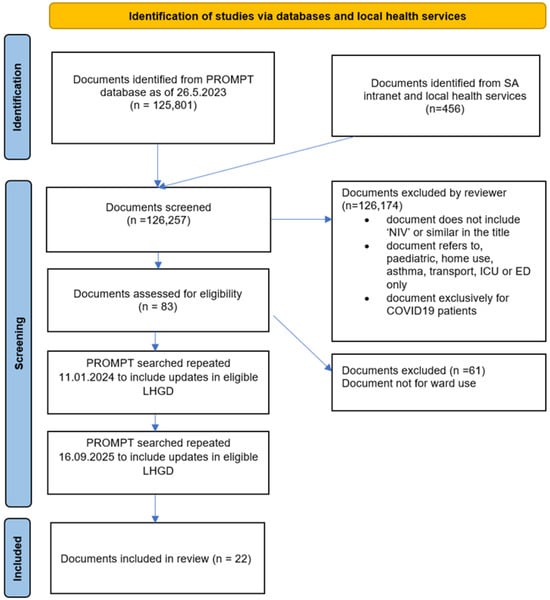
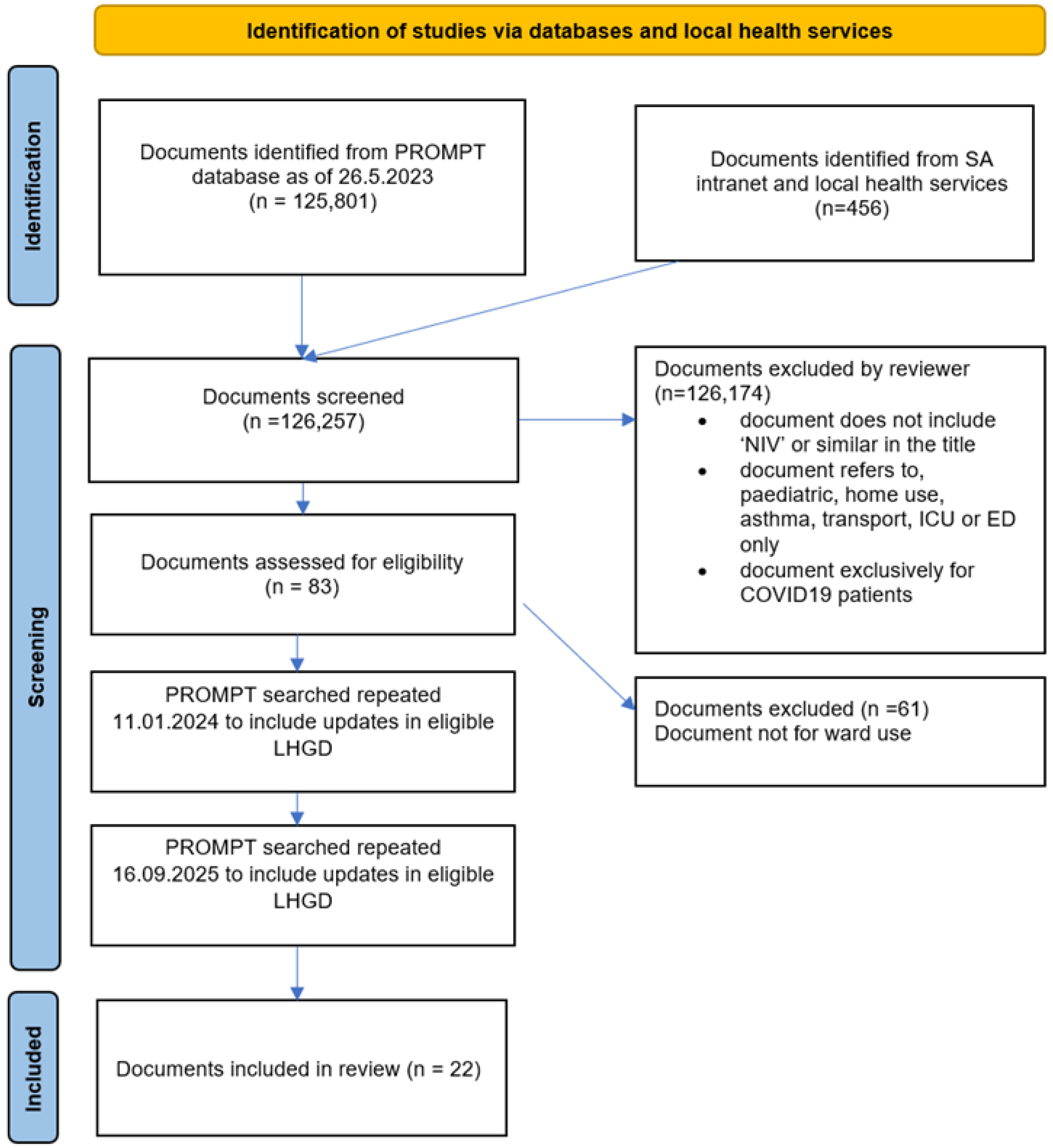
The search of PROMPT detected 125,801 documents, with an additional 456 documents identified from South Australian Health services. Twenty-two documents met the inclusion criteria and were included in this study. No new or amended LHGDs were identified during the updated search on 11 January 2024, and the subsequent updated search on 16 September 2025 identified 17 documents as unchanged, while six had updated version numbers, including one with a revised title but no substantive content changes. Additionally, three documents had been modified to limit implementation support provided (Figure 1).
Figure 1.
PRIMA diagram.
3.1. Characteristics of Included Documents
Of 22 LHGDs, most (n = 17, 77.3%) were from Victorian health services and over half (n = 13, 59.1%) were from metropolitan hospitals, with seven documents from rural (31.8%) and two from regional (9.1%) hospitals. The LHGD types comprised local guidelines (n = 12, 54.5%), procedures (n = 7, 31.8%) and policies (n = 3, 13.6%). The most frequently specified target audience for the documents were nurses (n = 10, 45.5%), followed by doctors (n = 9, 40.9%) and physiotherapists (n = 4, 18.2%). Nine (40.9%) documents did not specify a target audience, with five (22.7%) reporting being relevant for “all clinical staff”. The LHGDs that listed more than one clinical discipline as the target audience (i.e., nurses and doctors) did not specify which discipline (medical, nursing or physiotherapy) was responsible for patient reassessment after NIV initiation.
International clinical practice guidelines for NIV use to treat hypercapnic ARF were rarely referenced. Four documents (18.2%) referenced the 2016 BTS/Intensive Care Society (ICS) guideline for NIV management of adults with hypercapnic ARF [23]. Two LHGD (9.1%) referenced the 2017 European Respiratory Society/American Thoracic Society (ERS/ATS) acute NIV guideline for the management of ARF [21]. One document (4.5%) referenced the Australian State of New South Wales Agency of Clinical Innovationߣs acute NIV clinical practice guidelines from 2014 [28]. None of the LHGDs referenced the 2015 Thoracic Society of Australia and New Zealand (TSANZ) Acute Oxygen Guidelines [29], the updated 2021 TSANZ Acute Oxygen Position Statement [30], or the 2022 ERS clinical practice guidelines for high-flow oxygen, which included recommendations for NIV and HFNO [31].
Seven documents (n = 31.8%) included HFNO recommendations in NIV LHGDs; however, they lacked specific recommendations on safe initiation, monitoring, and weaning of HFNO. One document (4.5%) recommended HFNO as the preferred modality for weaning from NIV.
3.2. Considerations for NIV Initiation
All LHGDs provided indications for using NIV, with the most frequent being for the management of an acute exacerbation of COPD with hypercapnic ARF (n = 16, 72.7%) and acute pulmonary oedema (n = 12, 54.5%) (Table 1). Eleven documents (50%) included a definition for hypercapnia based on the ABG, partial pressure of carbon dioxide (PaCO2). Of these, eight (36.4%) recommended PaCO2 > 45 mmHg together with pH < 7.35 as a basis to consider NIV initiation (Table 1).
Table 1.
Recommended indication for NIV.
The majority of LHGDs (n = 19, 86.4%) described contraindications to NIV implementation, with the most frequently cited being imminent cardiac or respiratory arrest (n = 20, 90.9%), a person’s inability to protect their own airway or manage secretions (n = 17, 77.3%), untreated pneumothorax (n = 16, 72.7%), facial injury or burns (n = 15, 68.2%) and altered conscious state (n = 9, 40.9%) (Supplementary Table S1). Less than half of the LHGDs (n = 9, 40.9%) recommended reviewing patient goals of care when initiating NIV. The majority (n = 17, 77.3%) advised communicating with the patient the need to initiate NIV therapy; however, none provided guidance on communicating with non-English speaking patients in these situations (Table 1).
3.3. NIV Initiation and Maintenance Recommendations
Most LHGDs (n = 17, 77.3%) required an ABG to have been measured before NIV initiation. Three (13.6%) documents recommended venous blood gas (VBG) measurement as a suitable alternative to assess carbon dioxide levels before NIV implementation. Almost half of the documents (n = 9) specified a target SpO2 range at NIV initiation with or without co-prescribed oxygen, and most (n = 13, 59.1%) recommended SpO2 monitoring and documentation (Table 2). The SpO2 target level recommendations varied, with almost a third of LHGDs recommending the lower SpO2 level range of greater than 88% (n = 7) and the upper-level SpO2 range of greater than 92% (n = 7) (Table 1). The LHGDs did not include recommendations on ventilation modes, inspiratory time or cycling parameters, nor specify tidal volume or minute ventilation targets. Recommendations regarding which physiological and ventilator observations should be undertaken whilst on NIV and the frequency varied (Table 2). None of the LHGDs included specific recommendations regarding monitoring work of breathing, respiratory distress or dyspnoea assessment.
Table 2.
Recommendations for NIV implementation and monitoring.
Most LHGD recommended that NIV therapy should be initiated and prescribed by senior (n = 14, 63.6%) or junior (n = 3, 13.6%) doctors, with very few documents recommending initiation by senior nurses (n = 4, 18.2%) or senior physiotherapists (n = 1, 4.5%). Thirteen LHGD (59.1%) did not propose use of an NIV prescription form, with very few suggesting a digital (n = 5, 22.7%) or paper (n = 4, 18.2%) prescription. Recommendations for NIV initiation and maintenance prescription regarding ventilation parameters varied widely and did not include ventilation modes, inspiratory time or cycling parameters, nor specify tidal volume or minute ventilation targets. Registered nurses (n = 11, 50.0%) were most often described as physically applying NIV to patients, with some documents specifying specialist respiratory nurses 31.8% (n = 7), nurse consultants (n = 2, 9.1%), enrolled nurses (n = 1, 4.5%) or nurse practitioners (n= 1, 4.5%).
Just over half the LHGDs (n = 12, 54.5%) recommended NIV implementation on general wards, while few specified respiratory wards (n = 5, 22.7%) or respiratory care units (n = 4, 18.2%) as the setting for managing patients on NIV (Table 2). Most LHDGs recommended an initial registered nurse-to-patient ratio of one-to-one (n = 15, 68.2%); however, eight (36.4%) did not state the nurse-to-patient ratio required.
Most LHGDs (n = 14, 63.6%) highlighted potential adverse effects, including pressure sores (n = 14, 63.6%), aerophagia (n = 12, 54.5%), hypotension (n = 6, 27.3%) and barotrauma or pneumothorax (n = 6, 27.3%) (Supplementary Table S1). Twelve (54.5%) documents provided strategies to prevent pressure injuries; however, hydration and nutrition recommendations were rarely provided (n = 5, 22.7%).
3.4. Recognising and Addressing Clinical Deterioration
Maximum ventilation parameters (e.g., inspiratory and expiratory pressures) (n = 2, 9.1%), oxygen parameters (e.g., litres per minute) (n = 2, 9.1%) and types of ventilators (n = 14, 63.6%) that could be safely implemented in the ward setting were provided inconsistently. Nine LHGD (40.9%) specified criteria for review by medical staff (such as persistent tachypnoea or hypoxia), yet less than half (n = 9, 40.9%) specified criteria for escalation of care to an intensive care unit. Local early warning systems to recognise clinical deterioration were often not stated (n = 9, 40.9%). Among the LHGDs that included patient deterioration systems, the most common were clinical review criteria (n = 9, 40.9%), followed by escalation criteria for medical emergency team response (n = 8, 36.4%). Additionally, 9 documents (40.9%) outlined criteria for considering palliative care referral.
3.5. Weaning
Guidance to support weaning patients from NIV was rarely specified (n = 7, 31.8%), with clinical improvement (n = 5, 22.7%), improved work of breathing and respiratory rate (n = 4, 18.2%), normalised PaCO2 (n = 3, 13.6%) and normalized pH (n = 3, 13.6%) being the most recommended indications for weaning (Table 3). Nearly sixty percent (n = 13) of LHDGs specified target SpO2 ranges of 88–92% when weaning from NIV with or without prescribed oxygen. No LHGDs specified targets for ventilator parameters (e.g., inspiratory and expiratory pressures) or oxygen parameters (e.g., litres per minute) prior to considering weaning. Most did not specify (n = 15, 68.2%) guidance on the approach to weaning or the physiological parameters to monitor. When provided, the LHGD recommended a reduction in NIV hours during the day or the day and night (n = 5, 22.7%). Four (18.2%) documents recommended HFNO be used as a weaning aid.
Table 3.
Recommendations for weaning NIV.
Following the review of the LHGDs and their alignment with current international recommendations for NIV, the authors developed a guidance template based on expert opinion comprising essential information for implementing ward-based NIV in adults with ARF (Table 4) [21,23]. This core framework aims to standardise practice and enhance the quality of care in ward settings.
Table 4.
NIV LHGD template.
4. Discussion
To our knowledge, this scoping review is the first to examine hospital guidance supporting the implementation of ward-delivered acute NIV to adults with hypercapnic ARF. Information was insufficient or varied between LHGDs in several key areas, including definitions for hypercapnia, oxygen saturation targets, NIV prescription recommendations, NIV initiation, maintenance and weaning, and addressing clinical deterioration. These deficiencies and variations in recommendations could impact clinical decision-making and contribute to variations in patient care. Importantly, despite the absence of Australian NIV clinical practice guidelines, international guidelines were referenced rarely [21,23].
The BTS/ICS acute NIV clinical practice guideline recommends obtaining an ABG before NIV initiation to confirm acute respiratory acidosis (pH < 7.35 and PaCO2 > 48 mmHg) and on NIV commencement with controlled oxygen therapy to stipulate a target SpO2 range for people with COPD exacerbations of 88–92% and as a practice recommendation to be applied to all causes of hypercapnic ARF [23]. Similarly, the more recent ERS/ATS acute NIV clinical practice guideline recommends NIV use for people with COPD exacerbations and acute respiratory acidosis (pH < 7.35 and PaCO2 > 45 mmHg) with a high certainty of evidence [21]. However, half of the LHGDs lacked a definition for hypercapnia based on ABG parameters (pH and PaCO2), and when definitions were provided, most were inconsistent with international guidelines. Notably, although international guidelines [21] do not recommend NIV for hypercapnic ARF in people with asthma exacerbations, nearly a quarter of LHGDs listed this as an indication for acute NIV use [11,12]. This is particularly concerning, as ward-delivered NIV in asthma exacerbations carries a high risk of unrecognised treatment failure and clinical deterioration [33].
To treat hypercapnic ARF, controlled oxygen is often co-prescribed with NIV, with target oxygen saturations of 88–92% recommended in people with COPD and/or those suspected of being susceptible to oxygen-induced hypercapnia [23,30]. In our study, target SpO2 recommendations varied considerably across the LHGDs; while most advised a range of 88–92% during NIV for hypercapnic ARF, irrespective of co-prescribed oxygen, more than one-fifth of the documents recommended maintaining SpO2 above 94% without offering a clinical rationale to support this recommendation.
The lack of consistency in recommendations for controlled oxygen management in the setting of hypercapnic ARF is of clinical concern and potential practice implications, as liberal oxygen administration, resulting in SpO2 levels above 94–96%, has been associated with increased in-hospital mortality among acutely ill patients [34]. To reduce the clinical uncertainty of variable SpO2 targets for different conditions, and to mitigate the risks associated with over-oxygenation, utilisation of a consistent target SpO2 range of 88–92% is recommended for all cases of hypercapnic ARF receiving NIV, irrespective of whether supplemental oxygen is co-administered [23,35].
National and international clinical guidelines for oxygen and NIV recommend formal written prescriptions including target SpO2 ranges and titration of the therapies to treatment goals [21,23,30,32,36]. While Australia has a standardised national medication chart to ensure accurate and safe prescribing and drug administration in hospitals, a standardised prescription format for acute oxygen and/or NIV is lacking for hospitalised patients [36]. This may contribute to variable oxygen and NIV prescription practices in hospitals and patient harm [37,38,39,40,41]. Most LHDGs did not recommend either paper or digital NIV prescription; however, implementation of a standardised prescription for oxygen, NIV and other respiratory support systems (e.g., CPAP) could enhance clinical care quality and safety.
Despite over two decades of safe implementation of ward NIV treatment, failure may occur; thus, early recognition and timely escalation of care (e.g., to ICU for mechanical ventilation) or provision of palliative care are essential [5,7,8,22,42]. The GOLD 2025 report recommends immediate transfer to a respiratory care unit or ICU for advanced respiratory management if PaO2 remains low or pH falls below 7.25 despite NIV during an acute COPD exacerbation; however, the 2017 Cochrane systematic reviews concluded that the magnitude of benefit for NIV in reducing mortality is similar when NIV is applied on the ward or in the ICU [9,22]. The BTS/ICS NIV guideline recommends continuous monitoring combined with early establishment of patient care preferences and a clear plan for either mechanical ventilation or supportive care [23]. In our study, there was substantial variation in monitoring recommendations, with most recommending intermittent monitoring of observations and SpO2. Similarly, less than half the LHGDs specified criteria for medical review, treatment escalation or palliative care. While early warning scores are recommended in some oxygen guidelines to support recognition of clinical deterioration [30,32], recommendations regarding early warning scores and clinical deterioration systems varied widely across LHGDs.
A standardised core LHGD template for ward-based NIV could help reduce variation, allowing local adaptation to suit specific health service needs. In the UK, the BTS developed a national NIV audit tool to improve care, reduce morbidity and mortality, and track outcomes [20,43]. A similar approach could be adopted in Australia to support NIV implementation, evaluate patient outcomes, and assess clinician education and training. We propose piloting the new LHGD template across three health networks in metropolitan and regional health services in Victoria, auditing the NIV implementation and outcomes before and after the standardised LHGD implementation. This pilot will assess validity and feasibility before considering national rollout.
Although hospitals are required to develop LHGDs based on national and international clinical practice to support safe and consistent NIV implementation, our findings reveal significant variation in recommendations, many of which are not guideline-concordant. In the absence of clear local evidence-based guidance, NIV is often used less frequently and inconsistently across hospital settings [11,13]. Real-world practice also differs substantially from randomised trial evidence and guideline recommendations, with delays in initiation and limited monitoring contributing to lower success rates, higher failure rates, increased mortality, and uncertain efficacy in complex cases, particularly in ward environments [12,13,14,15,16,18,19,20]. In the UK national audits, the inpatient mortality dropped in 2019 to 26% from 34% in 2013, largely due to improvements in NIV implementation approaches, including patient selection, timely access to NIV and a respiratory nurse or physiotherapist providing specialist service leadership [19]. In Australia, currently, there are no national NIV audits; however, real-world ward-delivered NIV studies report in-hospital mortality for COPD at 11% [8], rising to 22% [44] for multifactorial respiratory failure. A prospective clinical audit of exacerbations of COPD hospital admissions in five states of Australia identified that 34% of eligible patients did not receive NIV, concluding that NIV is underutilised and may contribute to mortality [45]. These findings underscore an urgent need for local clinical guidance documents to be developed consistently based on guideline evidence and in a standardised manner to prevent the perpetuation of the well-documented global variation in NIV implementation and patient care. Importantly, there is a lack of evidence-based guidance regarding how NIV should be practically implemented in hospitals. Research and guidance are required to determine clinical roles (i.e., which disciplines can prescribe, initiate, and review NIV) and optimal ventilation parameters and monitoring strategies.
It is important to highlight that whilst this study found wide variation in the NIV LHDGs, it remains unknown how clinicians use LHDGs in practice, particularly clinicians who work in multiple health services. Prior research suggests such guidelines are often underutilised due to limited awareness and/or reliance on clinical experience [40,46]. Leveraging digital health records to embed LHGDs could enable real-time, automated clinical decision support for NIV [47]. Future research could investigate clinicians’ use and understanding of LHGDs in everyday practice to identify factors that hinder or facilitate their adoption. Additionally, conducting national audits of NIV utilisation and associated patient outcomes is essential for identifying clinical care targets that support improvements in quality and safety.
Strengths and Limitations
This is the first study to evaluate acute NIV LHGDs to determine whether key recommendations align with clinical guidelines, offer sufficient technical detail to guide clinical decisions, and support effective implementation. The study employed a well-defined scoping review protocol to achieve these aims. The PROMPT database, an LHGD sharing platform accessed by over 100 health services across metropolitan, rural, and regional areas in Australia’s most populous states (population > 15 million), was used in this study. However, as not all services use PROMPT, the LHGDs identified may not fully represent all ward-based NIV guidance documents nationally. It is unlikely that including additional LHGDs would alter this result, given the significant variation between LHGDs.
5. Conclusions
There was substantial variation in the structure and content of LHGDs for ward-based NIV across Australian hospitals, including inconsistencies in initiation, monitoring, weaning, and detection of patient deterioration. Variation and limited alignment with major clinical guidelines may impact care quality and safety.
Supplementary Materials
The following supporting information can be downloaded at: https://www.mdpi.com/article/10.3390/jcm14228152/s1, Table S1: Further characteristics of included LHGD.
Author Contributions
Conceptualisation, C.B. and N.S.; methodology, C.B. and N.S.; validation, C.B.; formal analysis, C.B.; investigation, C.B.; resources, N.S.; data curation, C.B.; writing—original draft preparation, C.B.; writing—review and editing, C.B., I.C., A.W., E.D. and N.S. supervision, N.S.; project administration, C.B. and N.S. All authors have read and agreed to the published version of the manuscript.
Funding
This research received no external funding. C.B. is supported by the Australian Government Research Training Program Scholarship.
Institutional Review Board Statement
Not applicable.
Informed Consent Statement
Not applicable.
Data Availability Statement
The data used are not publicly available to maintain the anonymity of the health services that were included in the study.
Acknowledgments
We thank Melody Feng (MF) and Ashlea Chin (AC) for their contribution to this study. This article is a revised and expanded version of a paper entitled “Non-invasive ventilation implementation guidance in Australian hospitals: a systematic review approach”, which was presented at the European Respiratory Society conference, Vienna, Austria, September 2024 [48] and the Thoracic Society of Australia and New Zealand, Gold Coast, Australia, March 2024 [49].
Conflicts of Interest
The authors declare no conflicts of interest.
References
- Chen, L.; Rackley, C.R. Diagnosis and Epidemiology of Acute Respiratory Failure. Crit. Care Clin. 2024, 40, 221–233. [Google Scholar] [CrossRef] [Scilit]
- Wong, A.-K.I.; Kamaleswaran, R.; Tabaie, A.; Reyna, M.A.; Josef, C.; Robichaux, C.; de Hond, A.A.H.; Steyerberg, E.W.; Holder, A.L.; Nemati, S.; et al. Prediction of Acute Respiratory Failure Requiring Advanced Respiratory Support in Advance of Interventions and Treatment: A Multivariable Prediction Model from Electronic Medical Record Data. Crit. Care Explor. 2021, 3, e0402. [Google Scholar] [CrossRef] [Scilit]
- Roca, O.; Riera, J.; Torres, F.; Masclans, J.R. High-flow oxygen therapy in acute respiratory failure. Respir. Care 2010, 55, 408–413. [Google Scholar] [PubMed]
- Wang, J.-C.; Peng, Y.; Dai, B.; Hou, H.-J.; Zhao, H.-W.; Wang, W.; Tan, W. Comparison between high-flow nasal cannula and conventional oxygen therapy in COVID-19 patients: A systematic review and meta-analysis. Ther. Adv. Respir. Dis. 2024, 18, 17534666231225323. [Google Scholar] [CrossRef] [Scilit]
- Buchan, C.; Khor, Y.H.; Disler, R.; Naughton, M.T.; Smallwood, N. Ward-delivered nasal high-flow oxygen and non-invasive ventilation are safe for people with acute respiratory failure: A cohort study. Intern. Med. J. 2025, 55, 645–654. [Google Scholar] [CrossRef] [Scilit]
- Criner, G.J.; Gayen, S.; Zantah, M.; Dominguez Castillo, E.; Naranjo, M.; Lashari, B.; Pourshahid, S.; Gangemi, A. Clinical review of non-invasive ventilation. Eur. Respir. J. 2024, 64, 2400396. [Google Scholar] [CrossRef] [Scilit]
- Plant, P.K.; Owen, J.L.; Elliott, M.W. Early use of non-invasive ventilation for acute exacerbations of chronic obstructive pulmonary disease on general respiratory wards: A multicentre randomised controlled trial. Lancet 2000, 355, 1931–1935. [Google Scholar] [CrossRef] [Scilit]
- Parker, K.; Perikala, V.; Aminazad, A.; Deng, Z.; Borg, B.; Buchan, C.; Toghill, J.; Irving, L.B.; Goldin, J.; Charlesworth, D.; et al. Models of care for non-invasive ventilation in the Acute COPD Comparison of three Tertiary hospitals (ACT3) study. Respirology 2018, 23, 492–497. [Google Scholar] [CrossRef] [Scilit]
- Osadnik, C.R.; Tee, V.S.; Carson-Chahhoud, K.V.; Picot, J.; Wedzicha, J.A.; Smith, B.J. Non-invasive ventilation for the management of acute hypercapnic respiratory failure due to exacerbation of chronic obstructive pulmonary disease. Cochrane Database Syst. Rev. 2017, 2017, 7. [Google Scholar] [CrossRef] [Scilit]
- Renda, T.; Scala, R.; Corrado, A.; Ambrosino, N.; Vaghi, A. Adult Pulmonary Intensive and Intermediate Care Units: The Italian Thoracic Society (ITS-AIPO) Position Paper. Respiration 2021, 100, 1027–1037. [Google Scholar] [CrossRef] [Scilit]
- Abualhamael, S.A.; Alasmi, A.T.; Alqurayqiri, A.F.; Alzahrani, A.A.; Alsehli, A.D.; Althikra, A.H.; Alsadi, S.O.; Almaghrabi, M.Z.; Alhamdi, T.S.; Alsehli, M.D. Role of Non-invasive Ventilation (NIV) in Managing Acute Exacerbations of Chronic Obstructive Pulmonary Disease (COPD): A Systematic Review. Cureus 2024, 16, e67418. [Google Scholar] [CrossRef] [Scilit] [PubMed]
- Cabrini, L.; Esquinas, A.; Pasin, L.; Nardelli, P.; Frati, E.; Pintaudi, M.; Matos, P.; Landoni, G.; Zangrillo, A. An International Survey on Noninvasive Ventilation Use for Acute Respiratory Failure in General Non-Monitored Wards. Respir. Care 2015, 60, 586–592. [Google Scholar] [CrossRef] [Scilit]
- Skoczyński, S.; Scala, R.; Navalesi, P. Survey on accessibility and real-life application of noninvasive ventilation. ERJ Open Res. 2018, 4, 00062–02018. [Google Scholar] [CrossRef] [Scilit]
- Schwartz, J.; Basancelebi, B.; Mina, B.A.; Esquinas, A. An International Survey of Noninvasive Ventilation (NIV) Use for Acute Respiratory Failure: A Follow Up Survey. Am. J. Respir. Crit. Care Med. 2024, 209, A3810. [Google Scholar] [CrossRef] [Scilit]
- Crimi, C.; Noto, A.; Princi, P.; Esquinas, A.; Nava, S. A European survey of noninvasive ventilation practices. Eur. Respir. J. 2010, 36, 362–369. [Google Scholar] [CrossRef] [Scilit]
- Ozsancak Ugurlu, A.; Habesoglu, M.A. Epidemiology of NIV for Acute Respiratory Failure in COPD Patients: Results from the International Surveys vs. the “Real World”. COPD J. Chronic Obstr. Pulm. Dis. 2017, 14, 429–438. [Google Scholar] [CrossRef] [Scilit]
- Titlestad, I.L.; Olsen, F.; Sandqvist, H.M.; Pourbazargan, M.M.; Fretheim, H.H.; Lassen, A.T.; Vestbo, J. Are patients with COPD treated with NIV in accordance with national guidelines? An internal audit. Eur. Clin. Respir. J. 2014, 1, 24506. [Google Scholar] [CrossRef] [Scilit]
- Digby, G.C.; Keenan, S.P.; Parker, C.M.; Sinuff, T.; Burns, K.E.; Mehta, S.; Ronco, J.J.; Kutsogiannis, D.J.; Rose, L.; Ayas, N.T.; et al. Noninvasive Ventilation Practice Patterns for Acute Respiratory Failure in Canadian Tertiary Care Centres: A Descriptive Analysis. Can. Respir. J. 2015, 22, 331–340. [Google Scholar] [CrossRef] [Scilit]
- British Thoracic Society. National Report: Adult Non-Invasive Ventilation Audit; British Thoracic Society Reports: London, UK, 2019. [Google Scholar]
- Juniper, M.C.; Ellis, G.; Protopapa, K.L.; Smith, N. Inspiring Change: A report on acute non-invasive ventilation. Br. J. Hosp. Med. 2017, 78, 497–502. [Google Scholar] [CrossRef] [Scilit]
- Rochwerg, B.; Brochard, L.; Elliott, M.W.; Hess, D.; Hill, N.S.; Nava, S.; Navalesi, P.; Antonelli, M.; Brozek, J.; Conti, G.; et al. Official European Respiratory Society and American Thoracic Society clinical practice guidelines: Noninvasive ventilation for acute respiratory failure. Eur. Respir. J. 2017, 50, 1602426. [Google Scholar] [CrossRef] [Scilit]
- Global Initiative for Chronic Obstructive Lung Disease. Global Strategy for the Diagnosis, Management, And Prevention of Chronic Obstructive Pulmonary Disease (2025 Report); GOLD COPD: 2025. Available online: https://goldcopd.org/2025-gold-report/ (accessed on 16 September 2025).
- Davidson, A.C.; Banham, S.; Elliott, M.; Kennedy, D.; Gelder, C.; Glossop, A.; Church, A.C.; Creagh-Brown, B.; Dodd, J.W.; Felton, T.; et al. British Thoracic Society and Intensive Care Society guideline for the ventilatory management of acute hypercapnic respiratory failure in adults. Thorax 2016, 71, ii1–ii35. [Google Scholar] [CrossRef] [Scilit]
- British Thoracic Society Standards of Care Committee. Non-invasive ventilation in acute respiratory failure. Thorax 2002, 57, 192–211. [Google Scholar] [CrossRef] [Scilit] [PubMed]
- Australian Commission on Safety and Quality in Health Care. National Safety and Quality Health Service Standards Guideline for Hospitals. Available online: https://www.safetyandquality.gov.au/publications-and-resources/resource-library/nsqhs-standards-guide-hospitals (accessed on 29 June 2024).
- Australian Commission on Safety and Quality in Health Care. Action 1.07: Policies and Procedures. Available online: https://www.safetyandquality.gov.au/standards/nsqhs-standards/clinical-governance-standard/patient-safety-and-quality-systems/action-107#:~:text=Action%201.07%20states,-The%20health%20service&text=Set%20out%2C%20review%2C%20and%20maintain,legislation%2C%20regulation%20and%20jurisdictional%20requirements (accessed on 29 June 2024).
- Mak, S.; Thomas, A. Steps for Conducting a Scoping Review. J. Grad. Med. Educ. 2022, 14, 565–567. [Google Scholar] [CrossRef] [Scilit]
- NSW Agency for Clinical Innovation. Non-Invasive Ventilation Guidelines for Adult Patients with Acute Respiratory Failure; NSW Agency for Clinical Innovation: St Leonards, NSW, Australia, 2014. [Google Scholar]
- Beasley, R.; Chien, J.; Douglas, J.; Eastlake, L.; Farah, C.; King, G.; Moore, R.; Pilcher, J.; Richards, M.; Smith, S.; et al. Thoracic Society of Australia and New Zealand oxygen guidelines for acute oxygen use in adults: ‘Swimming between the flags’. Respirology 2015, 20, 1182–1191. [Google Scholar] [CrossRef] [Scilit]
- Barnett, A.; Beasley, R.; Buchan, C.; Chien, J.; Farah, C.S.; King, G.; McDonald, C.F.; Miller, B.; Munsif, M.; Psirides, A.; et al. Thoracic Society of Australia and New Zealand Position Statement on Acute Oxygen Use in Adults: ‘Swimming between the flags’. Respirology 2022, 27, 262–276. [Google Scholar] [CrossRef] [Scilit]
- Oczkowski, S.; Ergan, B.; Bos, L.; Chatwin, M.; Ferrer, M.; Gregoretti, C.; Heunks, L.; Frat, J.-P.; Longhini, F.; Nava, S.; et al. ERS clinical practice guidelines: High-flow nasal cannula in acute respiratory failure. Eur. Respir. J. 2022, 59, 2101574. [Google Scholar] [CrossRef] [Scilit]
- OߣDriscoll, B.R.; Howard, L.S.; Earis, J.; Mak, V. British Thoracic Society Guideline for oxygen use in adults in healthcare and emergency settings. BMJ Open Respir. Res. 2017, 4, e000170. [Google Scholar] [CrossRef] [Scilit]
- Manglani, R.; Landaeta, M.; Maldonado, M.; Hoge, G.; Basir, R.; Menon, V. The use of non- invasive ventilation in asthma exacerbation—A two year retrospective analysis of outcomes. J. Community Hosp. Intern. Med. Perspect. 2021, 11, 727–732. [Google Scholar] [CrossRef] [Scilit]
- Chu, D.K.; Kim, L.H.; Young, P.J.; Zamiri, N.; Almenawer, S.A.; Jaeschke, R.; Szczeklik, W.; Schünemann, H.J.; Neary, J.D.; Alhazzani, W. Mortality and morbidity in acutely ill adults treated with liberal versus conservative oxygen therapy (IOTA): A systematic review and meta-analysis. Lancet 2018, 391, 1693–1705. [Google Scholar] [CrossRef] [Scilit]
- Siemieniuk, R.A.C.; Chu, D.K.; Kim, L.H.-Y.; Güell-Rous, M.-R.; Alhazzani, W.; Soccal, P.M.; Karanicolas, P.J.; Farhoumand, P.D.; Siemieniuk, J.L.K.; Satia, I.; et al. Oxygen therapy for acutely ill medical patients: A clinical practice guideline. BMJ 2018, 363, k4169. [Google Scholar] [CrossRef] [Scilit]
- Australian Commission on Safety and Quality in Health Care. NIMC User Guide; Australian Commission on Safety and Quality in Health Care: Sydney, Australia, 2019. Available online: https://www.safetyandquality.gov.au/publications-and-resources/resource-library/national-inpatient-medication-chart-nimc-user-guide (accessed on 16 September 2025).
- Deshpande, S.; Datey, N.; Liacos, A.; Joosten, S.A.; Leong, P. Acute oxygen use in hospitalised patients with chronic obstructive pulmonary disease is guideline discordant. Intern. Med. J. 2021, 51, 780–783. [Google Scholar] [CrossRef] [Scilit] [PubMed]
- Kamran, A.; Chia, E.; Tobin, C. Acute oxygen therapy: An audit of prescribing and delivery practices in a tertiary hospital in Perth, Western Australia. Intern. Med. J. 2018, 48, 151–157. [Google Scholar] [CrossRef] [Scilit]
- McDonald, V.; Cousins, J.; Wark, P. Acute oxygen therapy: A review of prescribing and delivery practices. Int. J. Chronic Obstr. Pulm. Dis. 2016, 11, 1067–1075. [Google Scholar] [CrossRef] [Scilit]
- Cousins, J.L.; Wark, P.A.; Hiles, S.A.; McDonald, V.M. Understanding Clinicians’ Perceived Barriers and Facilitators to Optimal Use of Acute Oxygen Therapy in Adults. Int. J. Chronic Obstr. Pulm. Dis. 2020, 15, 2275–2287. [Google Scholar] [CrossRef] [Scilit]
- Smallwood, N.; Holland, A.E. Over-oxygenation in the acute hospital setting: An implementation failure in need of an implementation science solution. Intern. Med. J. 2021, 51, 633–635. [Google Scholar] [CrossRef] [Scilit]
- Ferreyro, B.L.; Dianti, J.; Munshi, L. Defining Failure of Noninvasive Ventilation for Acute Respiratory Distress Syndrome: Have We Succeeded? Ann. Am. Thorac. Soc. 2022, 19, 167–169. [Google Scholar] [CrossRef] [Scilit]
- British Thoracic Society. NIV QI Tool. Available online: https://www.brit-thoracic.org.uk/quality-improvement/clinical-resources/non-invasive-ventilation/ (accessed on 2 February 2025).
- Smith, D.B.; Tay, G.T.P.; Hay, K.; Antony, J.; Bell, B.; Kinnear, F.B.; Curtin, D.L.; Douglas, J. Mortality in acute non-invasive ventilation. Intern. Med. J. 2017, 47, 1437–1440. [Google Scholar] [CrossRef] [Scilit]
- Cousins, J.L.; Wood-Baker, R.; Wark, P.A.B.; Yang, I.A.; Gibson, P.G.; Hutchinson, A.; Sajkov, D.; Hiles, S.A.; Samuel, S.; McDonald, V.M. Management of acute COPD exacerbations in Australia: Do we follow the guidelines? ERJ Open Res. 2020, 6, 00270–02019. [Google Scholar] [CrossRef] [Scilit]
- Foley, C.M. A study of the relationship between hospital policy and nursing practice. Ph.D Thesis, University of Tasmania, Hobart, TAS, Australia, 2020. [Google Scholar]
- OߣDriscoll, R.; Bakerly, N.D. Automated audit of hospital oxygen use devised during the COVID-19 pandemic. BMJ Open Respir. Res. 2023, 10, e001866. [Google Scholar] [CrossRef] [Scilit]
- Buchan, C.; Chukwu, I.; Walker, A.; Manoharan, D.; Dabscheck, E.; Smallwood, N. Non-invasive ventilation implementation guidance in Australian hospitals: A systematic review approach. Eur. Respir. J. 2024, 64, PA2958. [Google Scholar] [CrossRef] [Scilit]
- TSANZ Abstracts. Respirology 2024, 29, 25–273. [CrossRef] [Scilit]

Disclaimer/Publisher’s Note: The statements, opinions and data contained in all publications are solely those of the individual author(s) and contributor(s) and not of MDPI and/or the editor(s). MDPI and/or the editor(s) disclaim responsibility for any injury to people or property resulting from any ideas, methods, instructions or products referred to in the content. |
© 2025 by the authors. Licensee MDPI, Basel, Switzerland. This article is an open access article distributed under the terms and conditions of the Creative Commons Attribution (CC BY) license (https://creativecommons.org/licenses/by/4.0/).