Article

Transversus abdominis Plane Block for Improved Early Postoperative Pain Management after Periacetabular Osteotomy: A Randomized Clinical Trial


by
Jannis Löchel
1,*,†,
Viktor Janz
2,†,
Vincent Justus Leopold
1,
Michael Krämer
3 and
Georgi I. Wassilew
2
1
Charité—Universitätsmedizin Berlin, Corporate Member of Freie Universität Berlin, Humboldt-Universität zu Berlin, Berlin Institute of Health, Center for Musculoskeletal Surgery, Augustenburger Platz 1, 13353 Berlin, Germany
2
Department for Orthopaedic Surgery, University of Greifswald, Ferdinand-Sauerbruch-Straße, 17475 Greifswald, Germany
3
Charité—Universitätsmedizin Berlin, Clinic for Anesthesiology and Intensive Care, Charitéplatz 1, 10117 Berlin, Germany
*
Author to whom correspondence should be addressed.
Co-First/Equal Authorship.
J. Clin. Med. 2021, 10(3), 394; https://doi.org/10.3390/jcm10030394
Submission received: 29 November 2020 / Revised: 13 January 2021 / Accepted: 14 January 2021 / Published: 21 January 2021

Abstract

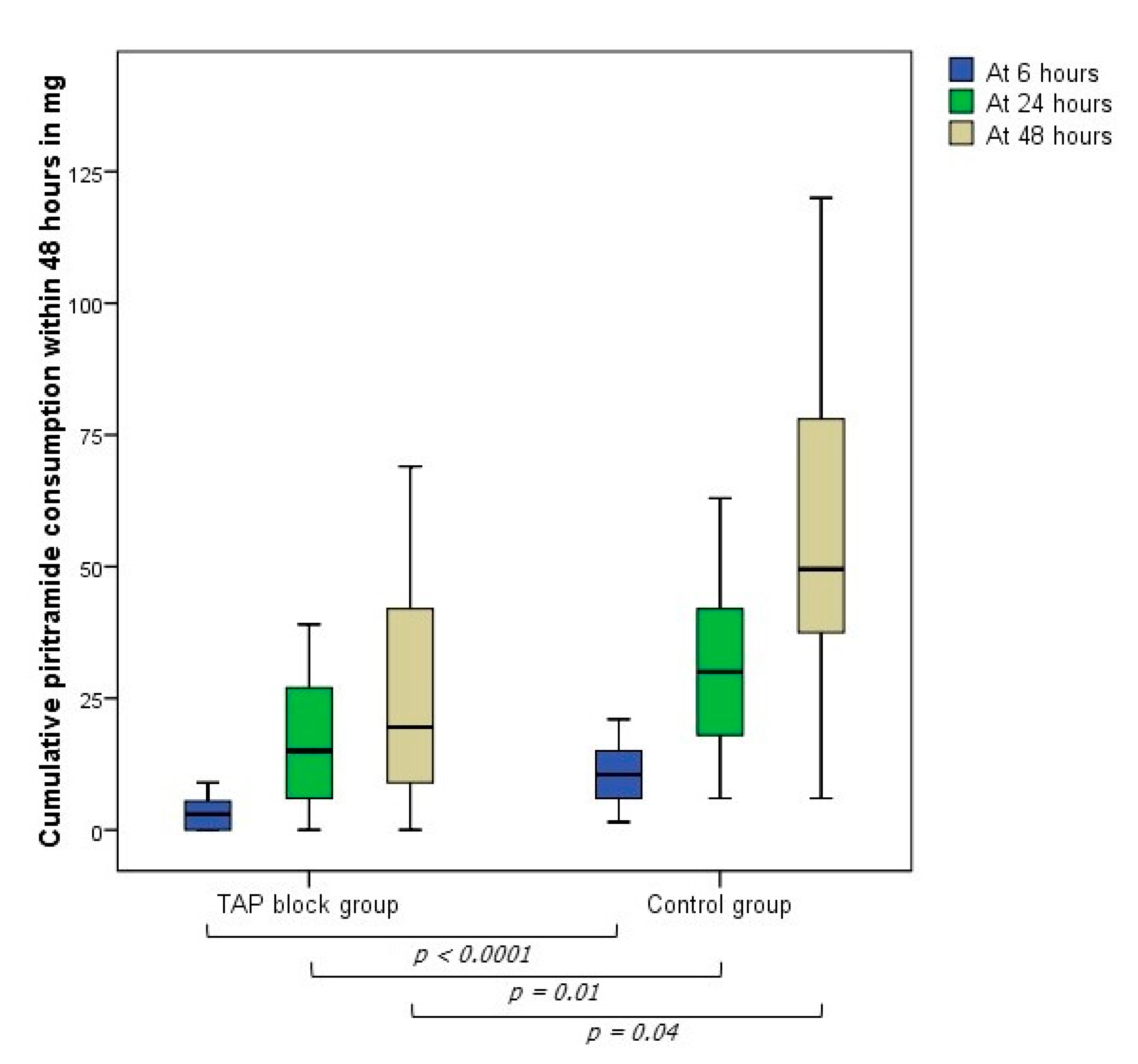
Background: Patients undergoing periacetabular osteotomy (PAO) may experience significant postoperative pain due to the extensive approach and multiple osteotomies. The aim of this study was to assess the efficacy of the transversus abdominis plane (TAP) block on reducing opioid consumption and improving clinical outcome in PAO patients. Patients and Methods: We conducted a two-group randomized-controlled trial in 42 consecutive patients undergoing a PAO for symptomatic developmental dysplasia of the hip (DDH). The study group received an ultrasound-guided TAP block with 20 mL of 0.75% ropivacaine prior to surgery. The control group did not receive a TAP block. All patients received a multimodal analgesia with nonsteroidal anti-inflammatory drugs (NSAID) (etoricoxib and metamizole) and an intravenous patient-controlled analgesia (PCA) with piritramide (1.5 mg bolus, 10 min lockout-time). The primary endpoint was opioid consumption within 48 h after surgery. Secondary endpoints were pain scores, assessment of postoperative nausea and vomiting (PONV), measurement of the quality of recovery using patient-reported outcome measure and length of hospital stay. Forty-one patients (n = 21 TAP block group, n = 20 control group) completed the study, per protocol. One patient was lost to follow-up. Thirty-three were women (88.5%) and eight men (19.5%). The mean age at the time of surgery was 28 years (18–43, SD ± 7.4). All TAP blocks were performed by an experienced senior anaesthesiologist and all operations were performed by a single, high volume surgeon. Results: The opioid consumption in the TAP block group was significantly lower compared to the control group at 6 (3 mg ± 2.8 vs. 10.8 mg ± 5.6, p < 0.0001), 24 (18.4 ± 16.2 vs. 30.8 ± 16.4, p = 0.01) and 48 h (29.1 mg ± 30.7 vs. 54.7 ± 29.6, p = 0.04) after surgery. Pain scores were significantly reduced in the TAP block group at 24 h after surgery. There were no other differences in secondary outcome parameters. No perioperative complication occurred in either group. Conclusion: Ultrasound-guided TAP block significantly reduces the perioperative opioid consumption in patients undergoing PAO.
Keywords: periacetabular osteotomy; pain management; TAP block; postoperative analgesia periacetabular osteotomy; pain management; TAP block; postoperative analgesia