


Abstract
Sulfonated poly(ethersulfone) (SPES)/poly(vinyl alcohol) (PVA)-blend membranes were developed as proton-conducting materials to investigate the relationship between polymer composition, thermal treatment, water uptake, ion-exchange capacity (IEC), mechanical properties, and proton transport. SPES was blended with PVA in DMSO at different weight ratios and subjected to thermal treatment to improve membrane stability. Increasing the PVA content progressively decreased the IEC, as a result of dilution of the sulfonated SPES phase by the non-sulfonated PVA component, while the homogeneous membrane morphology indicated good compatibility between the two polymers. Thermal treatment improved the mechanical and dimensional stability of the SPES-PVA membranes, with the extent of improvement depending strongly on composition. In particular, the SPES50-PVA50 membrane exhibited the most favourable balance of mechanical properties, water uptake, swelling, and proton transport, whereas the SPES70-PVA30 membrane showed the highest proton conductivity, reaching 69 mS cm−1 at 80 °C, but also exhibited the highest water uptake and swelling. The activation energies of the thermally treated membranes were in the range of (8 ± 2) kJ mol−1, with the SPES50-PVA50 membrane showing the lowest value (5.6 kJ mol−1), indicating favourable proton transport. Overall, the results demonstrate that SPES-PVA composition and thermal treatment provide effective means of controlling the balance between ionic functionality, hydration, dimensional stability, mechanical properties, and proton transport in sulfonated polymer membranes.
1. Introduction
Nafion has excellent proton conductivity and exhibits high hydrolytic and oxidative stability [1]. However, perfluorinated polymers have several major drawbacks, such as high cost, low conductivity at high temperatures (>100 °C), low relative humidity, and high methanol permeability, which can limit their practical use in electrochemical devices [2,3,4]. Furthermore, the synthesis, disposal and degradation of perfluorinated ionomers raise environmental concerns because they can release persistent and toxic byproducts such as polyfluoroalkyl substances (PFAS) into aquatic systems, which have been linked to endocrine disruption and adverse effects on the immune system [5]. These challenges have motivated the development of alternative membranes based on hydrocarbon polymers. Sulfonated aromatic polymers (SAPs) have emerged as high-performance alternative materials. In these polymers, a sulfonic acid group (–SO3H) is introduced onto the aromatic polymer backbone, enabling proton conduction [6,7,8]. Common examples of SAPs include sulfonated poly(ether ether ketone) (SPEEK) [9,10], sulfonated polysulfone (SPSU), sulfonated poly(phenylsulfone) (SPPSU), and sulfonated poly(ether sulfone) (SPES) [11].
Several studies on proton exchange membranes (PEMs) prepared via crosslinking and polymer blending approaches have been reported in the literature. For example, sulfonated poly(ether ether sulfone) (SPEES) blended with 2-acrylamido-2-methyl-1-propanesulfonic acid (AMPS) [12] and poly(2-acrylamido-2-methyl-1-propanesulfonic acid) (PMPS) [13] has been investigated to improve ionic conductivity and membrane stability. In these systems, PMPS intercalation within the SPEES matrix enhanced proton transport due to the increased density of sulfonic acid groups and improved hydrophilic channel formation. Similarly, crosslinked poly(arylene ether sulfone) (PAES) membranes containing poly(ethylene glycol) (PEG) have been reported to exhibit improved phase separation and proton conduction [14]. Other approaches include SPEEK/PEG [15] membranes crosslinked using CDI (1,4-cyclohexane dimethanol) [15,16], as well as SPES-PEG [17].
Poly(vinyl alcohol) (PVA) is well known for its excellent chemical stability, superior film-forming ability, favourable mechanical properties, and low cost. In addition, PVA exhibits excellent alcohol barrier characteristics, making it an attractive material for membrane applications [18,19]. PVA has been widely utilized in polyelectrolyte systems through blending with alkaline composite polymer electrolytes, Nafion, and heteropoly acids [20,21,22,23,24,25,26]. More importantly, PVA can form crosslinked network structures through reactions between its hydroxyl groups (–OH) and carboxylic acid groups (–COOH), as well as through acetal or hemiacetal formation with aldehyde groups (–CHO) [27,28,29,30,31,32,33,34]. SPPSU/PVA- [18] and sulfonated poly(phthalazinone ether sulfone ketone) SPPESK/PVA-blend [19] membranes were developed to balance proton conductivity with mechanical and dimensional stability.
These crosslinking and blending strategies are mainly aimed at overcoming the excessive swelling and poor mechanical durability commonly observed in highly sulfonated PEM materials while maintaining sufficient proton conductivity for fuel cell applications. Compared to smaller molecules like glycol and glycerol, PVA offers several distinct advantages as a crosslinker for SPPESK [19]: PVA’s long polymeric chains not only facilitate effective crosslinking but also allow a greater number of SPPESK chains to interconnect, forming a larger three-dimensional network structure, significantly improving its dimensional and hydrolytic stability. However, comparatively little attention has been devoted to the direct crosslinking of sulfonated polymers with PVA for PEM applications.
Recent studies on SPPSU/SPES membranes have demonstrated that crosslinking by sulfone groups can occur when membranes cast from DMSO are subjected to thermal treatment [35,36,37]. The SPES100 and SPPSU30/SPES70 reinforced membranes exhibited partial dissolution in water and sulfuric acid, indicating inadequate chemical and structural stability due to their high SPES content. The inability of SPES to undergo effective crosslinking under these conditions, owing to the deactivated aromatic rings, has been well documented in the literature [38,39].
Therefore, in the present work, PVA was incorporated into SPES as a network-forming component in varying proportions. The membrane stabilization was controlled by varying the thermal treatment time. The resulting membranes were systematically investigated in terms of water uptake, swelling ratio, ion-exchange capacity (IEC), mechanical properties, and ionic conductivity.
2. Experimental
2.1. Materials
Poly(ethersulfone) (PES) (Victrex, Thornton, UK, MW = 67,080 g/mol) was purchased from Solvay (Rosignano, Italy). Polyvinyl alcohol (PVA) (MW = 85,000–124,000 g/mol), sulfuric acid, chlorosulfonic acid, dimethyl sulfoxide (DMSO), ethanol and other chemicals were used as received from Merck-Sigma-Aldrich (Milano, Italy).
2.2. Synthesis of SPES
SPES is prepared according to reference [10]. Briefly, 10 g (32 meq) of polyethersulfone was dissolved in 50 mL of chlorosulfonic acid (ClSO3H; Aldrich 99%) at room temperature and stirred for 2 days. The resulting solution was then stirred at 0 °C for 4 h. Next, 150 mL of sulfuric acid (H2SO4; Aldrich 95–97%) was slowly added to the mixture, which was then stirred for an additional 30 min. The polymer was subsequently precipitated by pouring the solution into ice-cold water under continuous stirring. After standing overnight, the precipitate was filtered and washed using a dialysis tubing cellulose membrane (Sigma Aldrich, Milano, Italy) until the rinse water reached pH = 7. To determine the degree of functionalization, a portion of the resulting powder was soaked for 24 h in 10 mL of a 1.5 M NaCl solution, exchanging the protons for sodium ions. Finally, the obtained solution was titrated using a 0.02 M NaOH solution.
2.3. Preparation of SPES-PVA Membranes
SPES-PVA membranes were prepared using different weight percentages of SPES (between 10 and 90%) and PVA: SPES100, SPES90, SPES70, SPES50, SPES30, and SPES10. The mixture of SPES and PVA was dissolved in DMSO at 80 °C. The solution was cast into a Petri dish and heated to dryness for 15–17 h at 50 °C. The membranes were peeled off and heated at different temperatures and times to optimize the properties. The thermal treatment conditions were selected based on preliminary screening experiments in which different temperature/time combinations were explored. The final protocol, consisting of 2 h at 120 °C followed by 3.3 h at 100 °C, was selected because it provided mechanically stable and flexible membranes with satisfactory structural integrity.
2.4. Water Uptake and Dimensional Swelling
For water uptake and dimensional swelling, the membranes were dried in an oven at 100 °C for 24 h to obtain the dry state (indicated with D) and were equilibrated for 24 h at 25 °C in ultrapure water to obtain the wet state (indicated with W).
The water uptake WU was quantified using the following equation:
For dimensional swelling (S), length and width were measured. Dimensional swelling was calculated from Equation (2):
where Aw and AD are the areas of the wet and dry membranes, respectively.
2.5. Ion Exchange Capacity
A piece of membrane was dried for 72 h over P2O5 and weighed. It was then soaked in 10 mL of a 2 M NaCl solution and equilibrated for 48 h to replace the protons with sodium ions. The solution was then titrated with a 0.01 M NaOH solution.
The IEC was defined as milliequivalents of sulfonic acid groups per gram of dried membrane (meq g−1) and was calculated from Equation (3) [11]:
IEC = (VNaOH · MNaOH) / WD
Here, V is the volume and M the molarity of NaOH solution; WD is the weight of dry membrane.
2.6. Proton Conductivity
Through-plane proton conductivity of the membranes was measured by electrochemical impedance spectroscopy (EIS) in the frequency range from 1 Hz to 6 MHz with a sinusoidal voltage amplitude of 20 mV using a Biologic (Seyssinet-Pariset, France) VSP300 potentiostat. Prior to measurements, the membranes were immersed in 1 M H2SO4 for 5 h at 25 °C, subsequently washed abundantly, and finally kept in ultrapure H2O for 24 h at 25 °C with a final neutral pH to ensure complete humidification before the measurement. The membranes were mounted in a Swagelok cell equipped with two stainless steel electrodes with a contact area of A = 0.264 cm2. The conductivity (σ) was calculated from the bulk resistance (R) extracted from the high frequency intercept in complex plane impedance spectra according to Equation (4):
where L is the membrane thickness.
2.7. Mechanical Properties
The mechanical properties of the membranes were evaluated using a Testometric M250-2.5 CT tensile testing machine (Rochdale, UK). Membrane samples were cut into rectangular strips 5 mm wide and 50 mm long, with an effective gauge length of around 5 mm (measured specifically for each sample). The thickness of each sample was measured at five different positions using a Mitutoyo (Roissy, France) 293–230 micrometer, and the average value was used for all calculations. The samples were mounted using mechanical clamps, and tensile measurements were carried out at a crosshead speed of 5 mm min−1. Stress–strain curves were recorded, and Young’s modulus was determined from the slope of the linear elastic region of each curve.
3. Results and Discussion
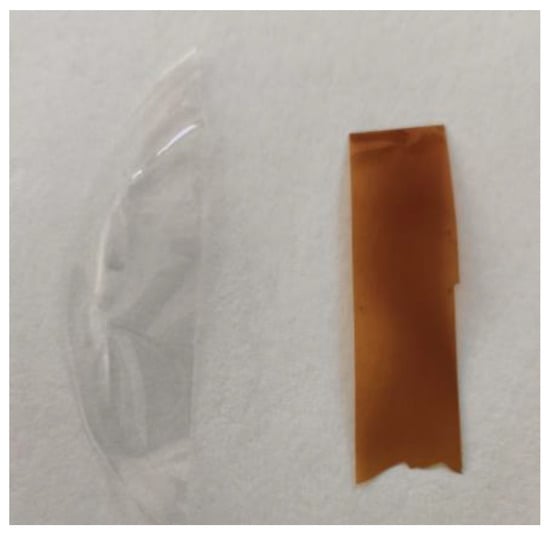
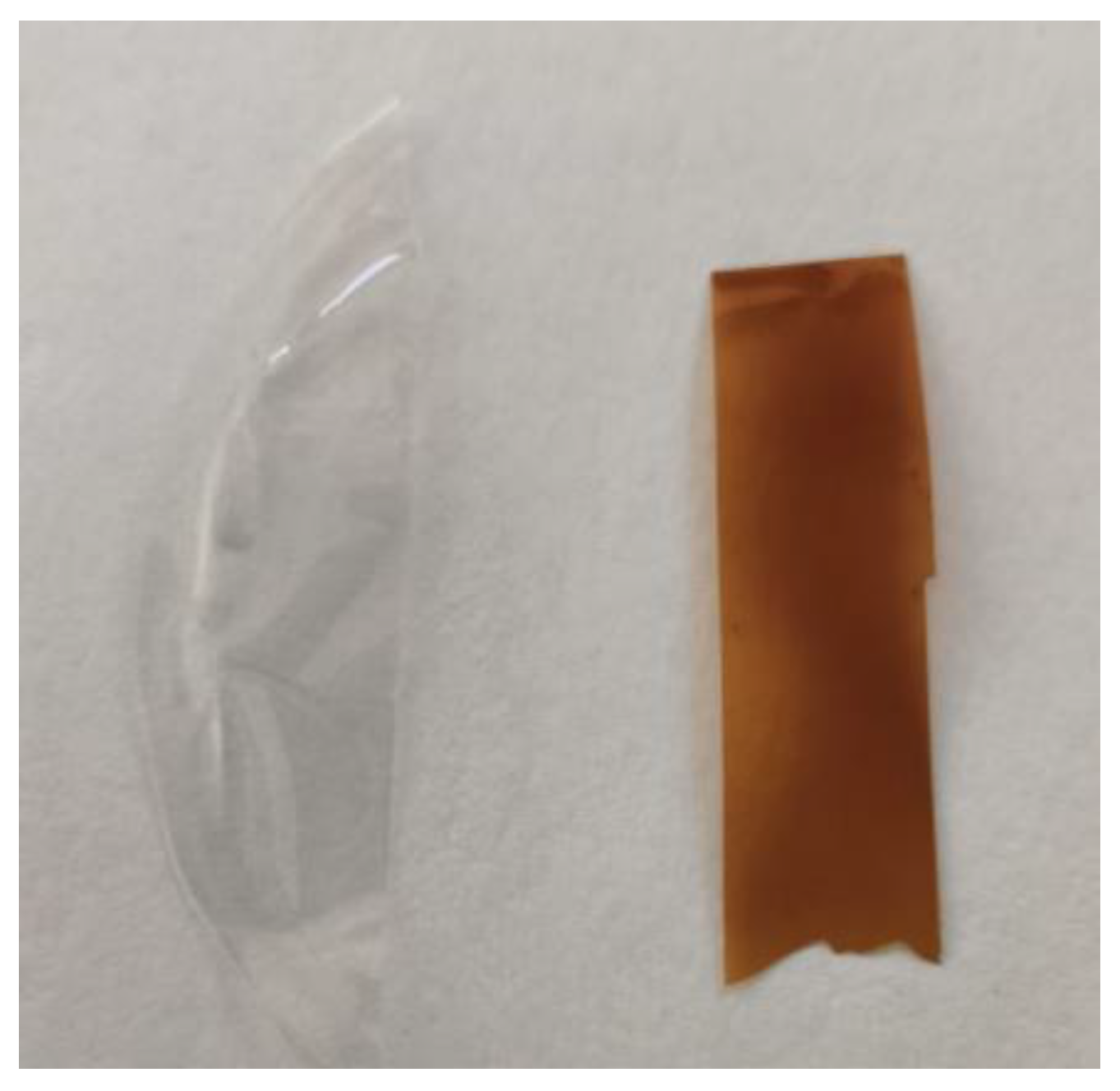
A series of SPES/PVA-blend membranes with different compositions was prepared to investigate the effect of PVA on membrane formation and properties. All casting solutions were optically homogeneous, and the resulting membranes exhibited a uniform morphology, demonstrating good compatibility and miscibility between the two polymers in DMSO. This compatibility is attributed to strong intermolecular hydrogen bonding between the sulfonic acid (–SO3H) groups of SPES and the hydroxyl (–OH) groups of PVA, which suppresses macro-phase separation and promotes a well-integrated polymer network. In contrast, SPES100 and the SPES90 composition failed to produce mechanically stable membranes, indicating that a minimum PVA content is required to obtain self-supporting films. Following thermal treatment, all membranes remained flexible, whereas their colour changed from transparent to dark brown, except for the SPES10 membrane. Photographs of SPES50 before and after heat treatment are shown in Figure 1.
Figure 1.
SPES50 membranes before (left) and after (right) heat treatment.
From a functional perspective, this homogeneous structure is expected to play a critical role in leading membrane properties. The presence of interconnected ionic domains facilitates efficient ion transport, particularly at intermediate compositions where a balance between hydrophilic (SPES-rich) and mechanically robust (PVA-rich) phases is achieved. At higher SPES content, enhanced ionic conductivity is anticipated due to the increased density of sulfonic acid groups; however, excessive swelling may compromise mechanical integrity.
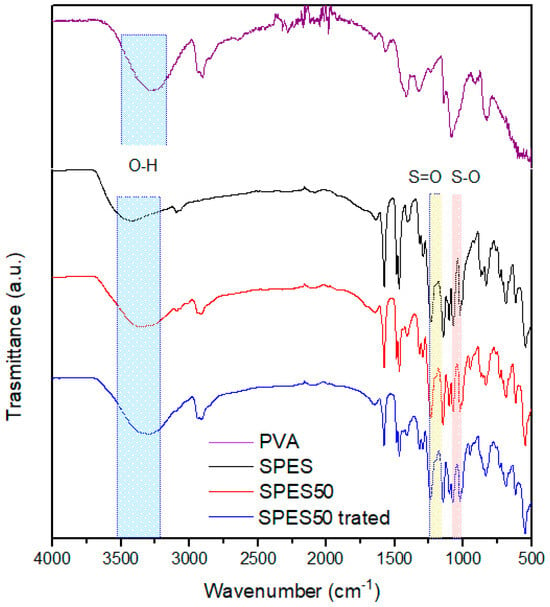
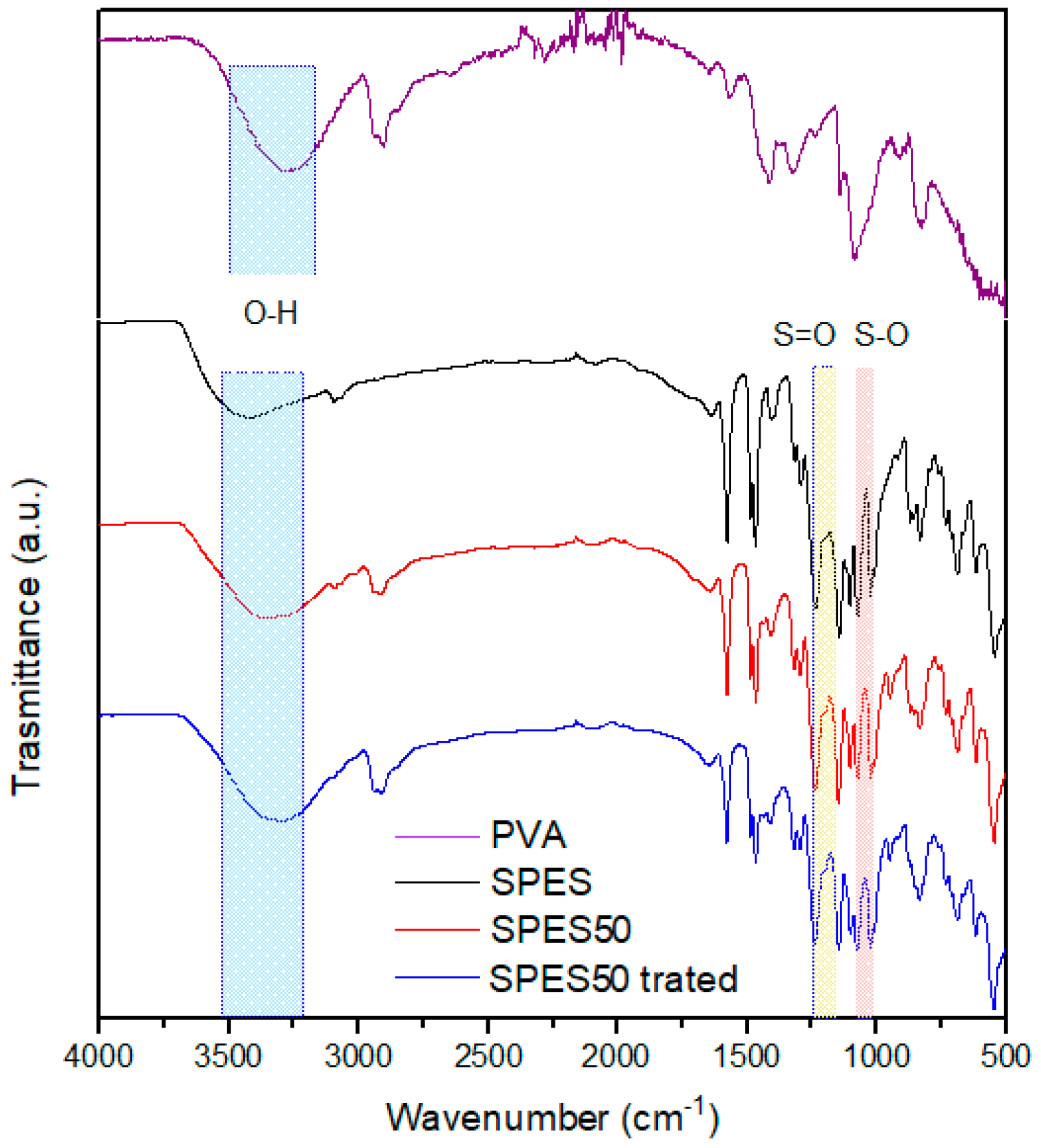
In the present SPES-PVA system, this interaction is supported by spectroscopic evidence from the ATR-FTIR presented in Figure 2. This analysis reveals characteristic absorption bands of both pristine SPES and PVA, together with the spectral changes observed for the SPES-PVA membrane after thermal treatment. Pristine PVA exhibits a broad –OH stretching band centered at approximately 3300 cm−1, characteristic of hydroxyl groups involved in extensive intermolecular hydrogen bonding, together with the C–O stretching vibration in the 1080–1140 cm−1 region. In contrast, pristine SPES shows the broad –OH stretching band of the sulfonic acid groups at approximately 3460 cm−1, the characteristic S=O stretching vibrations of the sulfone groups in the 1180–1250 cm−1 region, and the S–O stretching vibrations of the sulfonic acid groups at approximately 1030–1080 cm−1.
Figure 2.
ATR-FTIR spectra of PVA, SPES, and SPES50 before and after treatment.
For the SPES50 membrane, the broad absorption band in the 3200–3600 cm−1 region shows noticeable changes after thermal treatment. The untreated membrane exhibits relatively weak absorption, whereas after thermal treatment, this band becomes broader. This broad feature arises from the overlap of the hydroxyl stretching vibrations of PVA and the –OH groups associated with the sulfonic acid functionalities of SPES. The increased intensity, broadening, and slight shift in this band indicate enhanced intermolecular hydrogen bonding between the SPES–SO3H and PVA–OH groups, accompanied by a modification of the local chemical environment of the sulfonic acid groups. Small changes in the intensity and position of the S=O and S–O stretching bands are also observed, further supporting stronger interactions between the two polymer components. Although these spectral changes do not constitute direct evidence of covalent crosslink formation, they are consistent with the formation of a more constrained and stabilized SPES/PVA network during thermal treatment, which contributes to the improved dimensional stability and reduced swelling of the SPES/PVA membranes.
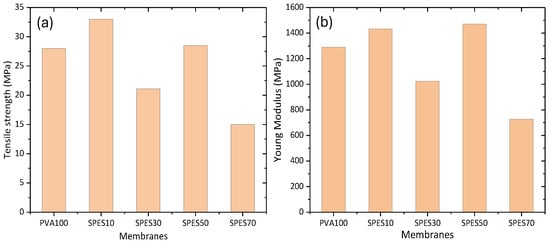
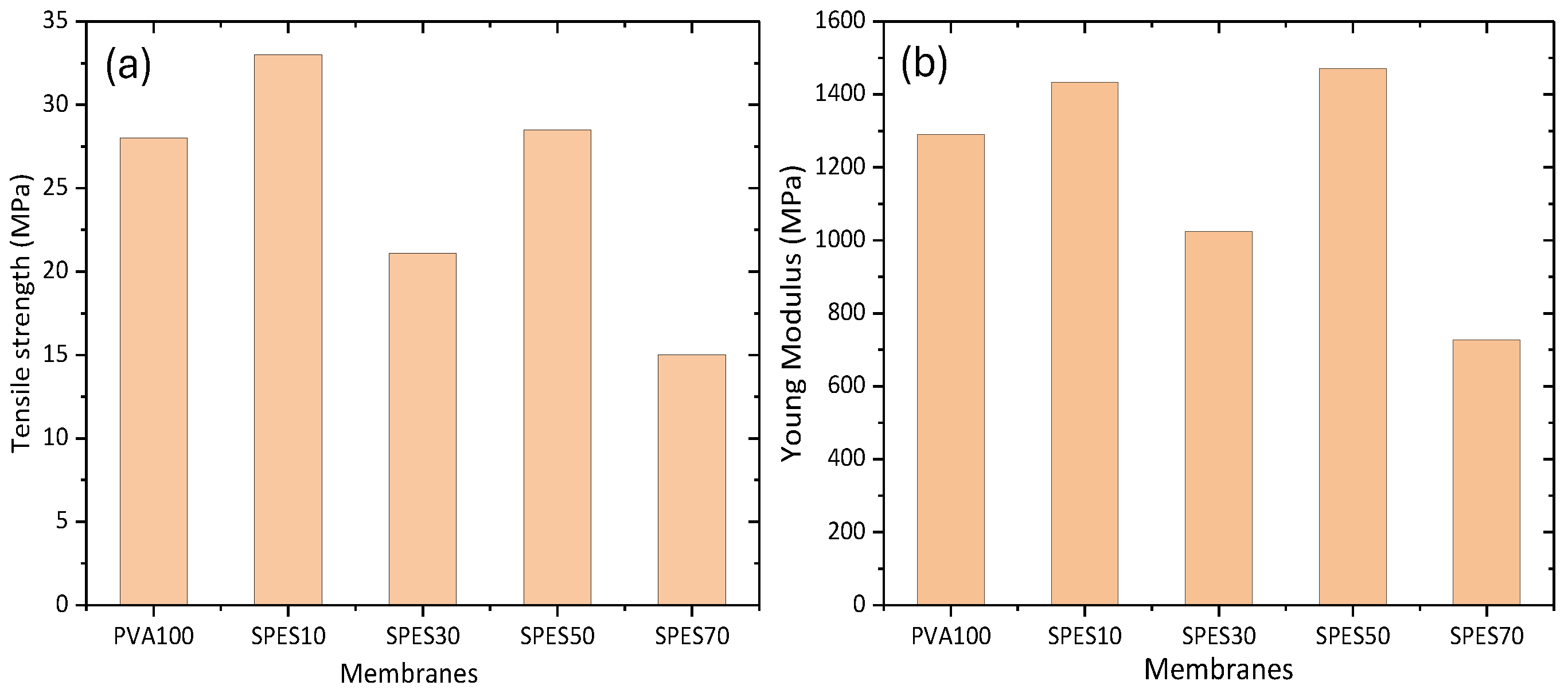
Figure 3a,b presents the mechanical properties of the thermally treated SPES-PVA membranes. Thermal treatment results in an overall improvement in mechanical stability compared with the corresponding untreated membranes, although the mechanical response does not vary monotonically with composition. The non-linear dependence of the mechanical properties on composition suggests that the mechanical response is governed by a balance between the two polymer components and their intermolecular interactions. Although the membranes exhibit homogeneous morphology without evidence of macroscopic phase separation, changes in the SPES-PVA ratio can modify the local organization and the extent of interactions between the –SO3H groups of SPES and the –OH groups of PVA. The intermediate SPES50 composition provides a favourable balance between these functionalities, which may promote stronger intermolecular cohesion and restrict polymer-chain mobility during thermal treatment. At a lower PVA content, as in SPES70, the amount of PVA available to contribute to network stabilization is limited, whereas at higher PVA contents the progressive dilution of SPES reduces the concentration of sulfonic acid groups available for specific SPES–PVA interactions. Thus, increasing the PVA content does not necessarily result in a proportional increase in mechanical strength.
Figure 3.
(a) Tensile strength and (b) Young’s Modulus of SPES-PVA membranes.
Overall, the mechanical results indicate that the intermediate SPES-PVA composition provides the most favourable balance between intermolecular interactions, matrix cohesion, and chain mobility. These results are consistent with the formation of a more constrained and stabilized polymer network during thermal treatment, although the present data do not allow the contribution of specific covalent crosslinks to be quantified.
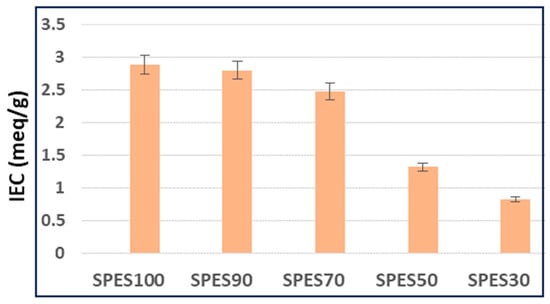
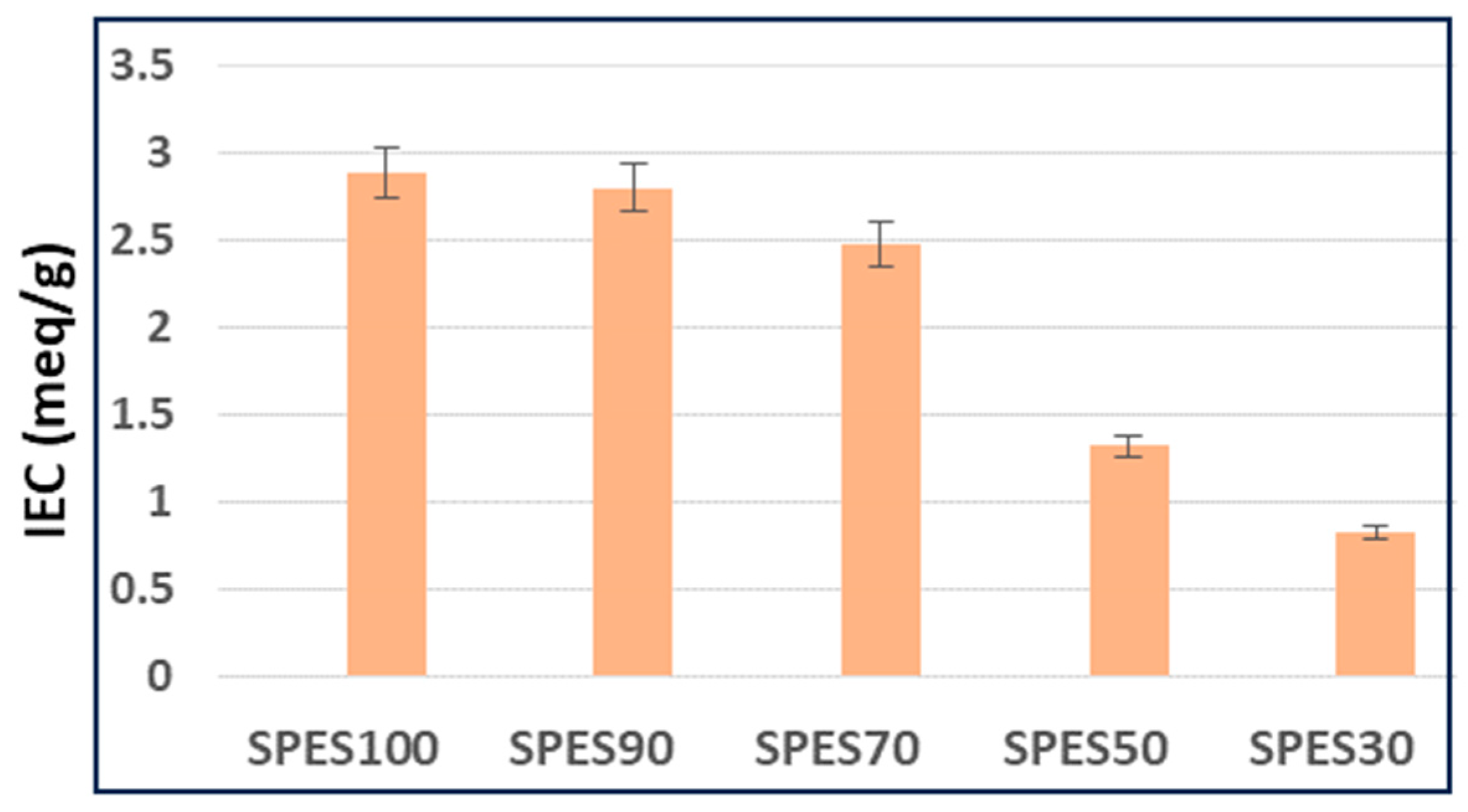
The IEC of the SPES-PVA membranes is shown in Figure 4. As expected, the IEC decreases progressively with increasing PVA content owing to the dilution of the sulfonic acid groups by the non-ionic PVA phase. The theoretical IEC values were calculated by multiplying the IEC of SPES100 (2.89 meq g−1) by the SPES mass fraction in each blend. The comparison shows that the experimental IEC values are close to the theoretical values for SPES50 and SPES30 membranes, whereas higher experimental values are obtained for SPES90 and SPES70.
Figure 4.
IEC for SPES-PVA membranes.
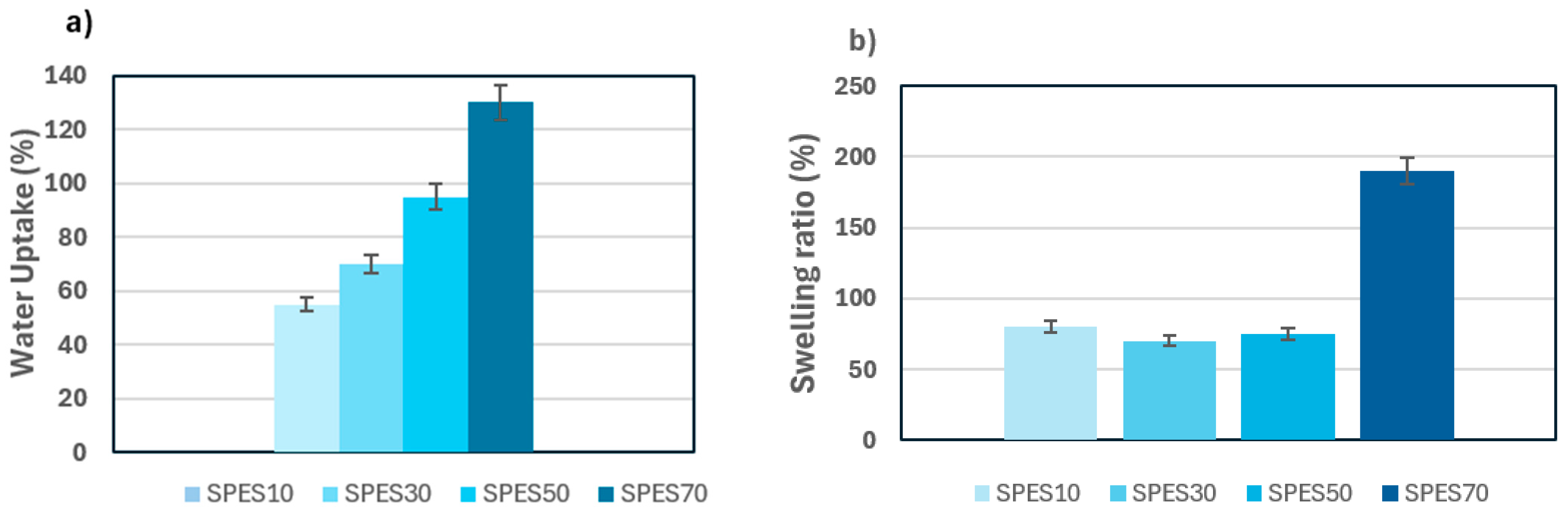
Water uptake (WU) and swelling ratio (S) of the SPES-PVA membranes are presented in Figure 5. Both parameters strongly depend on the membrane composition and reflect the balance between the hydrophilic character of SPES and the stabilizing effect of the PVA network. As the SPES content increases, the membranes exhibit progressively higher water uptake due to the greater concentration of hydrophilic sulfonic acid groups, which promote water absorption. Consequently, the SPES70 membrane shows the highest water uptake (129%) and swelling ratio (195%), indicating a highly hydrated structure but also a significant dimensional expansion. This behaviour suggests that, at this composition, the high concentration of sulfonic acid groups promotes water-induced expansion to an extent that cannot be fully counterbalanced by the 30 wt% PVA content. Conversely, increasing the PVA content effectively suppresses both water uptake and swelling. For example, the SPES10 membrane exhibits a water uptake of only 55% and a swelling ratio of 85%, demonstrating the beneficial effect of the denser polymer network in restricting water absorption and limiting dimensional changes. This behaviour is attributed to the combined effects of intermolecular hydrogen bonding between SPES and PVA and the thermally induced network formation, which reduce polymer chain mobility and constrain the expansion of the hydrophilic domains. Importantly, thermal treatment-induced stabilization does not completely prevent water-induced swelling, which remains strongly dependent on the relative proportions of the two polymers. Among the investigated compositions, the SPES50 membrane provides the most balanced behaviour, exhibiting moderate water uptake and controlled swelling while maintaining good dimensional stability. These results indicate that the SPES-PVA composition can be tailored to regulate the hydration level of the membrane without excessive dimensional deformation.
Figure 5.
(a) Water uptake and (b) swelling ratio for SPES-PVA membranes.
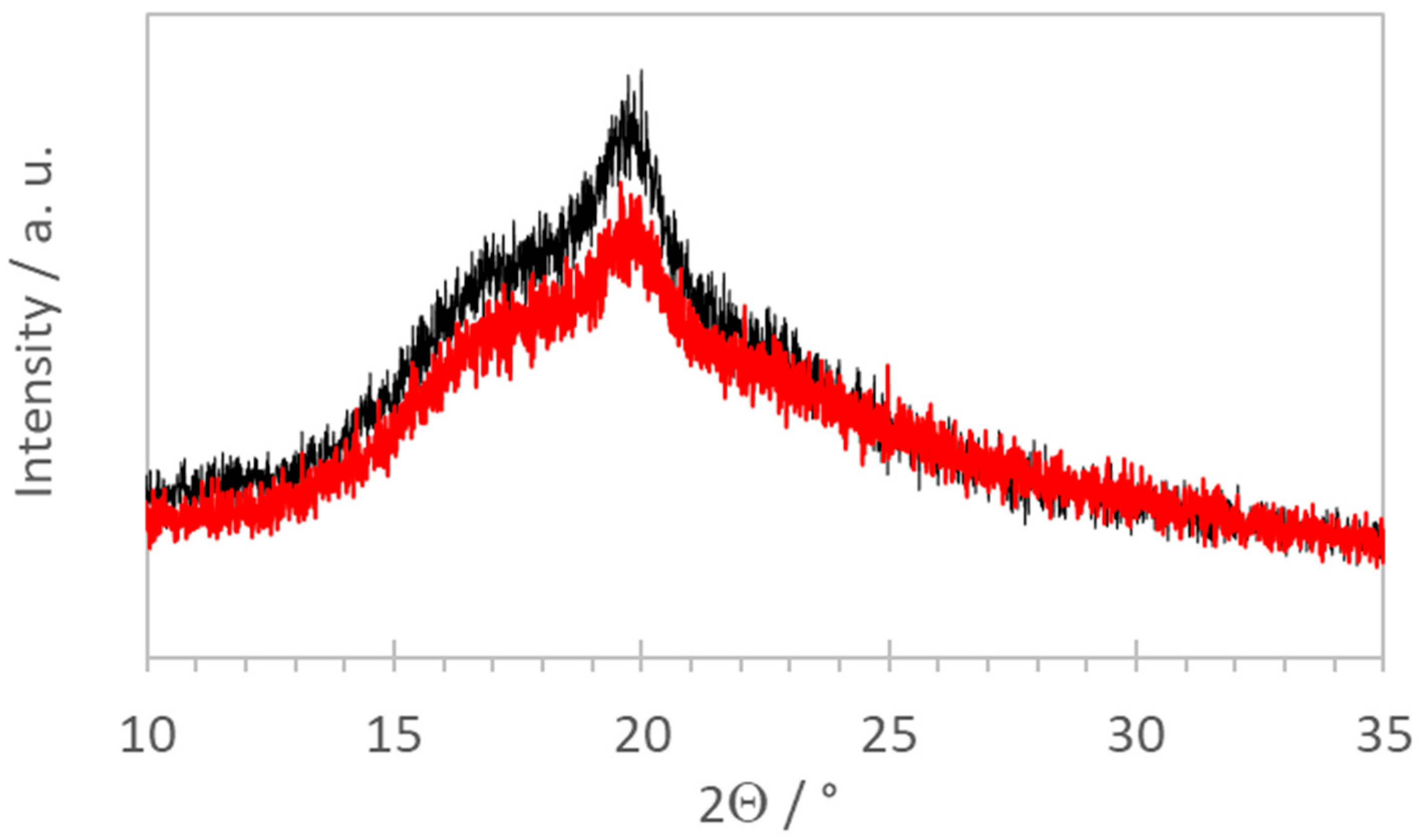
Figure 6 shows the XRD pattern of SPES50 membranes before and after thermal treatments. One recognizes a broad amorphous peak between approximately 15 and 25°, corresponding to SPES and PVA. A small signal around 19°, reported in the literature for crystalline PVA [40], might indicate a small amount of ordered PVA domains, which is higher in the untreated blend than after the thermal treatments. Crystallisation of PVA can therefore be discarded as origin of the lower water uptake and better mechanical properties observed after the thermal treatments.
Figure 6.
X-Ray diffraction pattern of SPES50. Black curve before and red curve after thermal treatments.
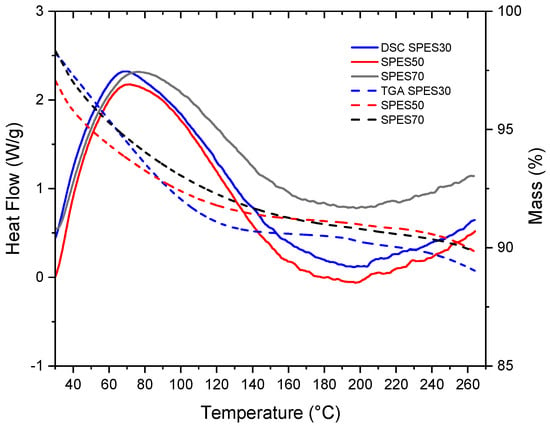
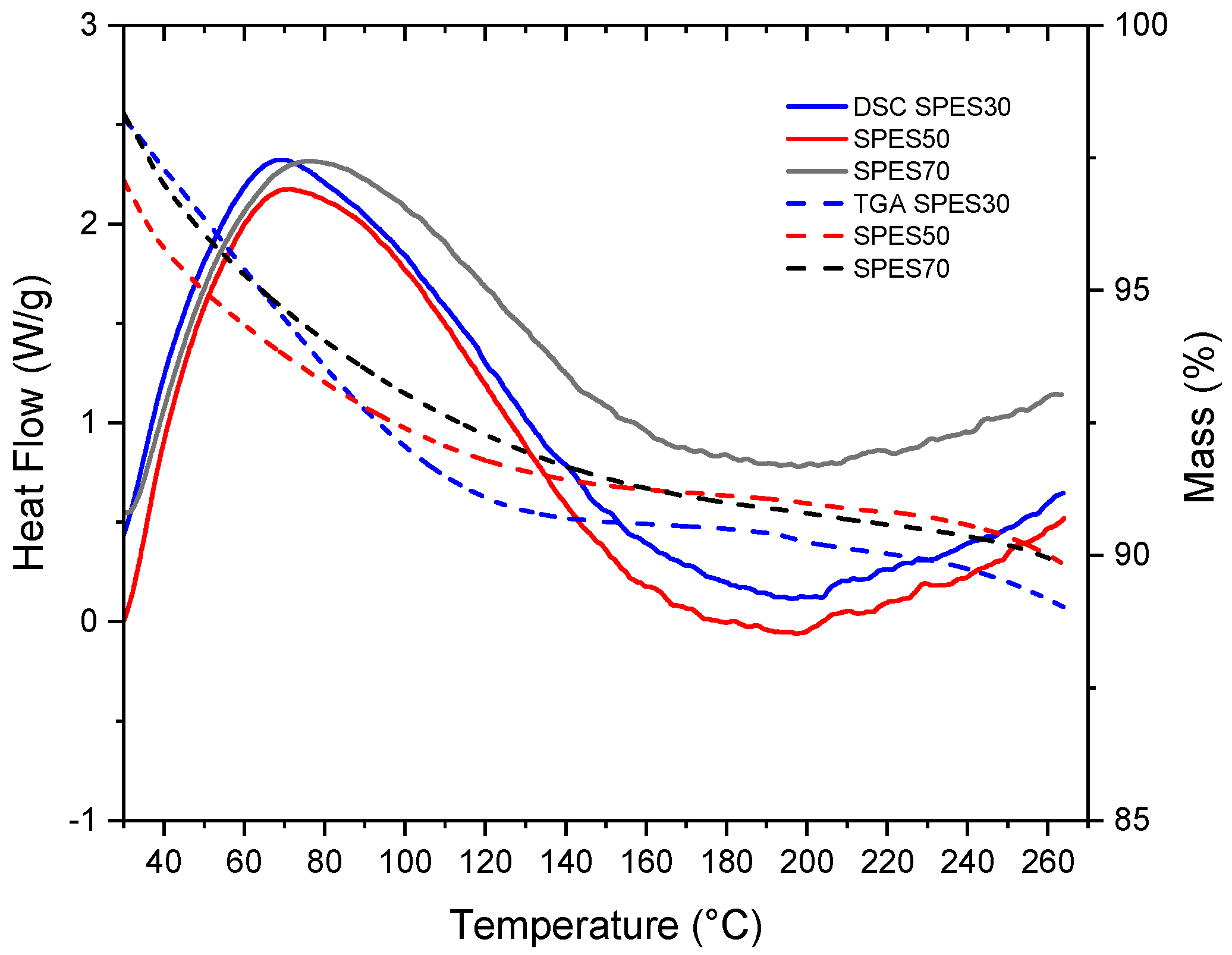
In Figure 7, the first broad endothermic DSC peak around 30–130 °C is associated with a significant mass loss in TGA. It can therefore be unambiguously attributed to the evaporation of water sorbed by the polymers, which are both hydrophilic. A second smaller mass loss is observed above 200 °C and is accompanied by a small endothermic signal, probably attributable to the start of the thermal decomposition of PVA and/or the loss of sulfonic acid groups of SPES. Similar decomposition temperatures were reported in the literature [11,41]. No clear melting peak of PVA can be observed, consistent with the low PVA crystallinity observed by XRD after thermal treatments of the blends.
Figure 7.
DSC and TGA analysis of SPES/PVA membranes.
In the present SPES-PVA system, the presence of PVA introduces additional hydroxyl (–OH) groups, which can participate in hydrogen bonding with SPES and potentially influence the local microenvironment of the sulfonic acid groups. This cooperative interaction not only improves miscibility, as evidenced by the homogeneous morphology, but may also assist in restricting excessive chain mobility during thermal treatment, thereby promoting the formation and stabilization of the network structure. As a result, the combined effects of DMSO-mediated interactions, thermal activation, and SPES–PVA intermolecular hydrogen bonding contribute to the development of a compact network structure. This structural evolution is consistent with the observed improvements in dimensional stability and controlled swelling behavior, while maintaining sufficient ionic pathways for effective proton transport.
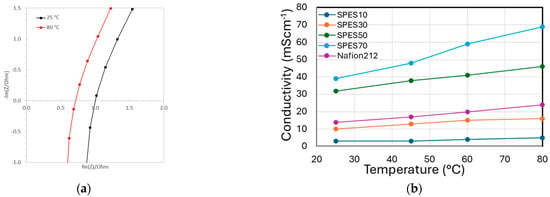
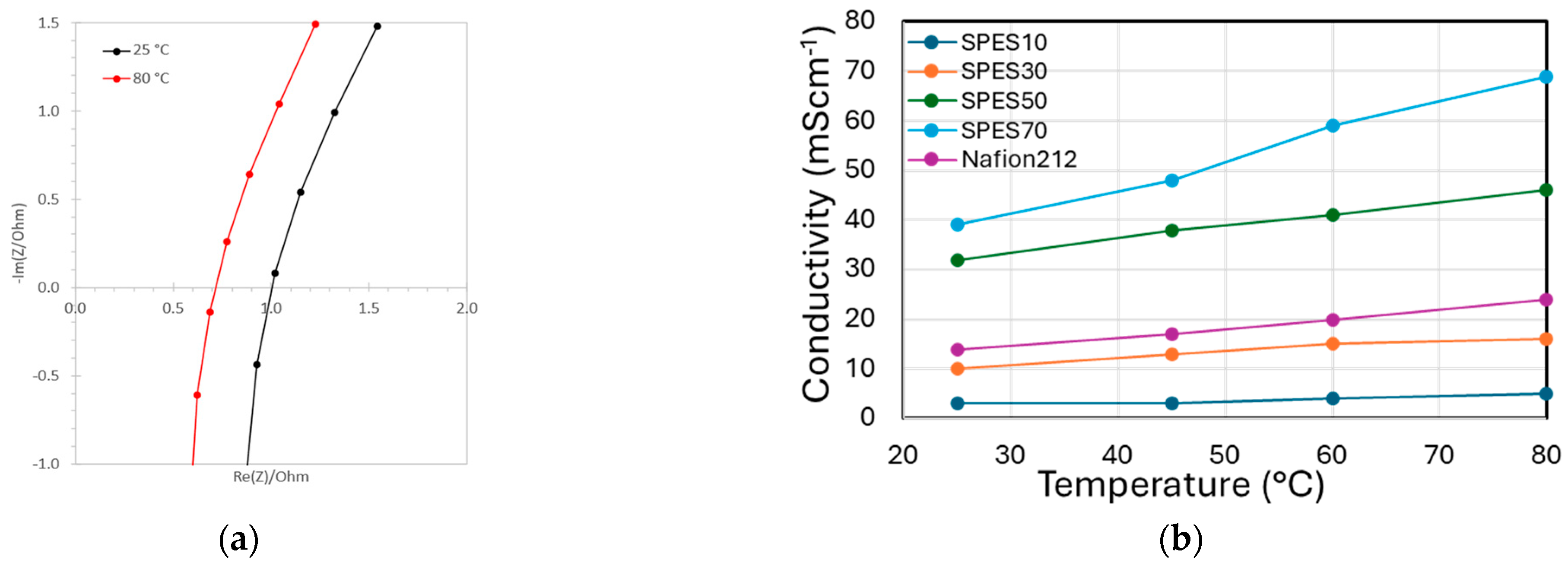
The proton conductivity of the SPES-PVA membranes was determined from Nyquist impedance plots (Figure 8); it strongly depends on membrane composition, increasing with SPES content due to the higher density of sulfonic acid groups. Accordingly, the SPES10 membrane exhibited conductivities of only 3 mS cm−1 at 25 °C and 5 mS cm−1 at 80 °C despite its excellent dimensional stability. Notably, the intermediate SPES50 membrane demonstrated an optimal balance, achieving a conductivity of 46 mS cm−1 at 80 °C while maintaining controlled swelling behaviour. SPES70 achieved a conductivity of 69 mS cm−1 at 80 °C but, as discussed above, it also exhibited the highest water uptake and swelling ratio, highlighting the trade-off between conductivity and dimensional stability.
Figure 8.
(a) Nyquist impedance plots of SPES50 membranes. (b) Temperature dependence of proton conductivity for SPES-PVA membranes.
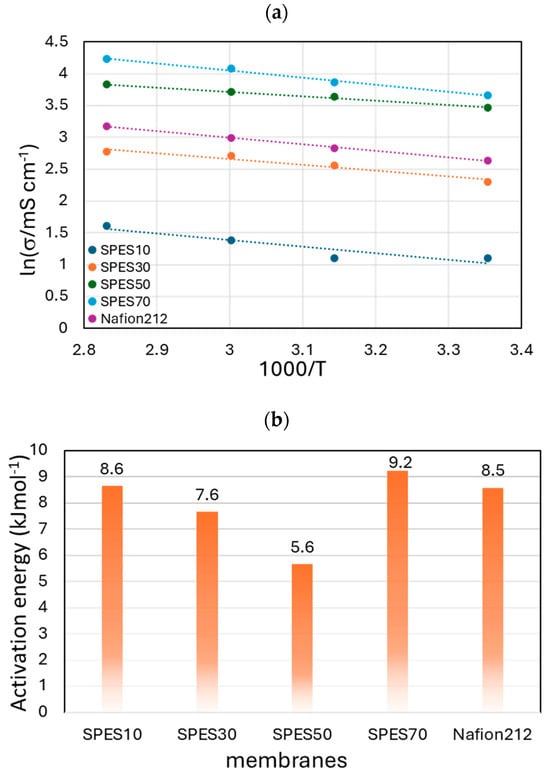
The apparent activation energy (Ea) of proton conductivity provides information on proton transport. It was determined from the temperature dependence of through-plane proton conductivity using the Arrhenius Equation (5). A lower activation energy indicates more efficient proton transport, improving overall performance.
where σ is the proton conductivity, σ0 is the pre-exponential factor, R is the gas constant, and T is the absolute temperature.
The Arrhenius plots of through-plane proton conductivity for the PVA-containing crosslinked membranes are presented in Figure 9a and activation energies in Figure 9b. The Ea values are quite low. However, such low apparent activation energies have previously been reported for hydrocarbon SPEEK/PVA-based membranes. In particular, activation energies in the range of 2.7–5.2 kJ mol−1 have been measured for SPEEK/PVA-based nanofibrous membranes, while values as low as 1.4 kJ mol−1 were found for a SPEEK/PVA/GO composite membrane [42].
Figure 9.
(a) Arrhenius plots of SPES/PVA membranes and (b) activation energies.
The apparent activation energy reflects the combined effects of proton mobility, membrane hydration, and the local polymer environment. In hydrated polymer electrolytes, hydrogen-bonded water and ionic domains can facilitate proton transport, while changes in polymer-chain mobility and water content with temperature may also contribute to the measured temperature dependence of conductivity. The particularly low apparent activation energy observed for SPES50 may therefore be associated with its balanced combination of ionic functionality, hydration, and network stabilization, which favours proton transport without the excessive swelling observed at higher SPES content.
4. Conclusions
In this work, SPES-PVA membranes were prepared by blending sulfonated SPES with PVA and applying a thermal treatment to improve membrane stability. The resulting membranes exhibited improved mechanical integrity and lower swelling compared with pristine SPES, while maintaining proton-conducting functionality. The combined FTIR, mechanical, thermoanalytic, water uptake, swelling, and solubility results are consistent with the formation of a stabilized SPES-PVA network through intermolecular interactions during thermal treatment, although the present data do not allow the contribution of specific covalent crosslinks to be established. The membrane properties were strongly dependent on composition. Among the compositions investigated, SPES70 exhibited the highest proton conductivity, reaching 69 mS cm−1 at 80 °C, but also showed high water uptake and swelling. SPES50 provided the most favourable overall balance among the investigated membranes, combining high tensile strength and Young’s modulus with controlled water uptake and swelling, appreciable proton conductivity (46 mS cm−1 at 80 °C), and the lowest apparent activation energy (5.6 kJ mol−1). These results highlight the importance of balancing ionic functionality, hydration, and structural stabilization rather than maximizing the SPES content alone.
Overall, controlled SPES-PVA blending combined with thermal treatment provides a viable approach for obtaining mechanically stable, fluorine-free proton-conducting membranes. The present results also indicate that further optimization of composition and thermal treatment conditions could be used to tailor the balance between mechanical stability, dimensional control, and proton transport for specific proton-exchange membrane applications.
Author Contributions
Conceptualization, M.M., L.P., and P.K.; investigation, M.M., L.P., and R.N.; writing—review and editing, M.M., P.K., and M.L.D.V.; project administration, L.P. All authors have read and agreed to the published version of the manuscript.
Funding
This work was supported by the French government under the France 2030 investment plan, as part of the “Initiative d’Excellence d’Aix-Marseille Université”, A*MIDEX project, ION-MEET, AMX-22-IN1-41. It was also partially funded by the “Ministero dell’Ambiente e della Sicurezza Energetica (MASE)” and the “Next Generation EU program (PNRR–M2C2, Investment Line 3.5)” through the Light-PEM project.
Institutional Review Board Statement
Not applicable.
Informed Consent Statement
Not applicable.
Data Availability Statement
The raw data supporting the conclusions of this article will be made available by the authors on request.
Acknowledgments
M.M., L.P., and P.K. gratefully acknowledge the support received from the French government under the France 2030 investment plan, as part of the “Initiative d’Excellence d’Aix-Marseille Université”—A*MIDEX project “ION-MEET”, AMX-22-IN1-41.
Conflicts of Interest
The authors declare no conflicts of interest.
References
- Alberti, G.; Casciola, M.; Massinelli, L.; Bauer, B. Polymeric Proton Conducting Membranes for Medium Temperature Fuel Cells (110–160 °C). J. Membr. Sci. 2001, 185, 73–81. [Google Scholar] [CrossRef] [Scilit]
- Casciola, M.; Alberti, G.; Sganappa, M.; Narducci, R. On the Decay of Nafion Proton Conductivity at High Temperature and Relative Humidity. J. Power Sources 2006, 162, 141–145. [Google Scholar] [CrossRef] [Scilit]
- Tazi, B.; Savadogo, O. Parameters of PEM Fuel-Cells Based on New Membrane Fabricated from Nafion, Silicotungstic Acid and Thiophene. Electrochim. Acta 2000, 45, 4329–4339. [Google Scholar] [CrossRef] [Scilit]
- Inzelt, G.; Pineri, M.; Schultze, J.W.; Vorotyntsev, M.A. Electron and Proton Conducting Polymers: Recent Developments and Prospects. Electrochim. Acta 2000, 45, 2403–2421. [Google Scholar] [CrossRef] [Scilit]
- Zhang, Y.; Zhou, Y.; Dong, R.; Song, N.; Hong, M.; Li, J.; Yu, J.; Kong, D. Emerging and Legacy Per- and Polyfluoroalkyl Substances (PFAS) in Fluorochemical Wastewater along Full-Scale Treatment Processes: Source, Fate, and Ecological Risk. J. Hazard. Mater. 2024, 465, 133270. [Google Scholar] [CrossRef] [Scilit] [PubMed]
- Wang, F.; Hickner, H.; Kim, Y.-S.; Zawodzinski, T.; McGrath, J. Direct polymerization of sulfonated poly(arylene ether sulfone) random (statistical) copolymers: Candidates for new proton exchange membranes. J. Memb. Sci. 2002, 197, 231–242. [Google Scholar] [CrossRef] [Scilit]
- Rozière, J.; Jones, D.J. Non-Fluorinated Polymer Materials for Proton Exchange Membrane Fuel Cells. Annu. Rev. Mater. Res. 2003, 33, 503–555. [Google Scholar] [CrossRef] [Scilit]
- Nolte, R.; Ledjeff, K.; Bauer, M.; Mülhaupt, R. Partially Sulfonated Poly(Arylene Ether Sulfone)—A Versatile Proton Conducting Membrane Material for Modern Energy-Conversion Technologies. J. Membr. Sci. 1993, 83, 211–220. [Google Scholar] [CrossRef] [Scilit]
- Bauer, B.; Jones, D.J.; Rozière, J.; Tchicaya, L.; Alberti, G.; Casciola, M.; Massinelli, L.; Peraio, A.; Besse, S.; Ramunni, E. Electrochemical Characterisation of Sulfonated Polyetherketone Membranes. J. New Mater. Electrochem. Syst. 2000, 3, 93–98. [Google Scholar]
- Kaliaguine, S.; Mikhailenko, S.D.; Wang, K.P.; Xing, P.; Robertson, G.; Guiver, M. Properties of SPEEK Based PEMs for Fuel Cell Application. Catal. Today 2003, 82, 213–222. [Google Scholar] [CrossRef] [Scilit]
- Di Vona, M.L.; Sgreccia, E.; Tamilvanan, M.; Khadhraoui, M.; Chassigneux, C.; Knauth, P. High Ionic Exchange Capacity Polyphenylsulfone (SPPSU) and Polyethersulfone (SPES) Cross-Linked by Annealing Treatment: Thermal Stability, Hydration Level and Mechanical Properties. J. Membr. Sci. 2010, 354, 134–141. [Google Scholar] [CrossRef] [Scilit]
- Manohar, M.; Kim, D. Synergistic Effect of 2-Acrylamido-2-methyl-1-propanesulfonic Acid on the Enhanced Conductivity for Fuel Cell at Low Temperature. Membranes 2020, 10, 426. [Google Scholar] [CrossRef] [Scilit] [PubMed]
- Manohar, M.; Sharma, P.P.; Kim, D. Intercalated Poly(2-Acrylamido-2-Methyl-1-Propanesulfonic Acid) into Sulfonated Poly(1,4-Phenylene Ether-Ether-Sulfone) Based Proton Exchange Membrane: Improved Ionic Conductivity. Molecules 2021, 26, 161. [Google Scholar] [CrossRef] [Scilit] [PubMed]
- Oh, H.J.; Freeman, B.D.; McGrath, J.E.; Lee, C.H.; Paul, D.R. Thermal Analysis of Disulfonated Poly(Arylene Ether Sulfone) Plasticized with Poly(Ethylene Glycol) for Membrane Formation. Polymer 2014, 55, 235–247. [Google Scholar] [CrossRef] [Scilit]
- Kumari, M.; Sodaye, H.S.; Bindal, R.C. Cross-Linked Sulfonated Poly(Ether Ether Ketone)-Polyethylene Glycol/Silica Organic–Inorganic Nanocomposite Membrane for Fuel Cell Application. J. Power Sources 2018, 398, 137–148. [Google Scholar] [CrossRef] [Scilit]
- Gupta, D.; Choudhary, V. Studies on Novel Heat Treated Sulfonated Poly(Ether Ether Ketone) [SPEEK]/Diol Membranes for Fuel Cell Applications. Int. J. Hydrogen Energy 2011, 36, 8525–8535. [Google Scholar] [CrossRef] [Scilit]
- Tripathi, B.P.; Dubey, N.C.; Stamm, M. Polyethylene Glycol Cross-Linked Sulfonated Polyethersulfone Based Filtration Membranes with Improved Antifouling Tendency. J. Membr. Sci. 2014, 453, 263–274. [Google Scholar] [CrossRef] [Scilit]
- Kim, J.-D.; Matsushita, S.; Tamura, K. Crosslinked Sulfonated Polyphenylsulfone-Vinylon (CSPPSU-Vinylon) Membranes for PEM Fuel Cells from SPPSU and Polyvinyl Alcohol (PVA). Polymers 2020, 12, 1354. [Google Scholar] [CrossRef] [Scilit] [PubMed]
- Gu, S.; He, G.; Wu, X.; Guo, Y.; Liu, H.; Peng, L.; Xiao, G. Preparation and Characteristics of Crosslinked Sulfonated Poly(Phthalazinone Ether Sulfone Ketone) with Poly(Vinyl Alcohol) for Proton Exchange Membrane. J. Membr. Sci. 2008, 312, 48–58. [Google Scholar] [CrossRef] [Scilit]
- Lewandowski, A.; Skorupska, K.; Malinska, J. Novel Poly(Vinyl Alcohol) KOH-H2O Alkaline Polymer Electrolyte. Solid State Ion. 2000, 133, 265–271. [Google Scholar] [CrossRef] [Scilit]
- Yang, C.C. Chemical Composition and XRD Analyses for Alkaline Composite PVA Polymer Electrolyte. Mater. Lett. 2003, 58, 33–38. [Google Scholar] [CrossRef] [Scilit]
- Wu, G.M.; Lin, S.J.; Yang, C.C. Preparation and Characterization of PVA/PAA Membranes for Solid Polymer Electrolytes. J. Membr. Sci. 2006, 275, 127–133. [Google Scholar] [CrossRef] [Scilit]
- Shao, Z.G.; Wang, X.; Hsing, I.M. Composite Nafion/Polyvinyl Alcohol Membranes for the Direct Methanol Fuel Cell. J. Membr. Sci. 2002, 210, 147–153. [Google Scholar] [CrossRef] [Scilit]
- Wu, Q.; Wang, H.; Yin, C.; Meng, G. Preparation and Performance of PVA Films Composited with 12-Tungstogermanic Heteropolyacid. Mater. Lett. 2001, 50, 61–65. [Google Scholar] [CrossRef] [Scilit]
- Cui, Y.; Mao, J.; Wu, Q. Preparation and Conductivity of Polyvinyl Alcohol (PVA) Films Composited with Molybdotungstovanadogermanic Heteropoly Acid. Mater. Chem. Phys. 2004, 85, 416–419. [Google Scholar] [CrossRef] [Scilit]
- Lin, C.W.; Thangamuthu, R.; Yang, C.J. Proton-Conducting Membranes with High Selectivity from Phosphotungstic Acid-Doped Poly(Vinyl Alcohol) for DMFC Applications. J. Membr. Sci. 2005, 253, 23–31. [Google Scholar] [CrossRef] [Scilit]
- Kim, D.S.; Guiver, M.D.; Nam, S.Y.; Yun, T.I.; Seo, M.Y.; Kim, S.J.; Hwang, H.S.; Rhim, J.W. Preparation of Ion Exchange Membranes for Fuel Cell Based on Crosslinked Poly(Vinyl Alcohol) with Poly(Styrene Sulfonic Acid-Co-Maleic Acid). J. Membr. Sci. 2006, 281, 156–162. [Google Scholar] [CrossRef] [Scilit]
- Kim, D.S.; Guiver, M.D.; Seo, M.Y.; Cho, H.I.; Kim, D.H.; Rhim, J.W.; Moon, G.Y.; Nam, S.Y. Influence of Silica Content in Crosslinked PVA/PSSA-MA/Silica Hybrid Membrane for Direct Methanol Fuel Cell (DMFC). Macromol. Res. 2007, 15, 412–417. [Google Scholar] [CrossRef] [Scilit]
- Rajendran, S.; Sivakumar, M.; Subadevi, R. Investigations on the Effect of Various Plasticizers in PVA-PMMA Solid Polymer Blend Electrolytes. Mater. Lett. 2004, 58, 641–649. [Google Scholar] [CrossRef] [Scilit]
- Sivakumar, M.; Subadevi, R.; Rajendran, S.; Wu, N.L.; Lee, J.Y. Electrochemical Studies on [(1 − x)PVA − xPMMA] Solid Polymer Blend Electrolytes Complexed with LiBF4. Mater. Chem. Phys. 2006, 97, 330–336. [Google Scholar]
- Kang, M.S.; Choi, Y.J.; Moon, S.H. Water-Swollen Cation-Exchange Membranes Prepared Using Poly(Vinyl Alcohol) (PVA)/Poly(Styrene Sulfonic Acid-Co-Maleic Acid) (PSSA-MA). J. Membr. Sci. 2002, 207, 157–170. [Google Scholar] [CrossRef] [Scilit]
- Kang, M.S.; Kim, J.H.; Won, J.; Moon, S.H.; Kang, Y.S. Highly Charged Proton Exchange Membranes Prepared by Using Water Soluble Polymer Blends for Fuel Cells. J. Membr. Sci. 2005, 247, 127–135. [Google Scholar] [CrossRef] [Scilit]
- Qiao, J.; Hamaya, T.; Okada, T. New Highly Proton-Conducting Membrane Poly(Vinylpyrrolidone) (PVP) Modified Poly(Vinyl Alcohol)/2-Acrylamido-2-Methyl-1-Propanesulfonic Acid (PVA-PAMPS) for Low Temperature Direct Methanol Fuel Cells (DMFCs). Polymer 2005, 46, 10809–10816. [Google Scholar] [CrossRef] [Scilit]
- Hamaya, T.; Inoue, S.; Qiao, J.; Okada, T. Novel Proton-Conducting Polymer Electrolyte Membranes Based on PVA/PAMPS/PEG400 Blend. J. Power Sources 2006, 156, 311–314. [Google Scholar] [CrossRef] [Scilit]
- Maranesi, B.; Hou, H.; Polini, R.; Sgreccia, E.; Alberti, G.; Narducci, R.; Knauth, P.; Di Vona, M.L. Cross-Linking of Sulfonated Poly(Ether Ether Ketone) by Thermal Treatment: How Does the Reaction Occur? Fuel Cells 2013, 13, 107–117. [Google Scholar] [CrossRef] [Scilit]
- Celso, F.; Mikhailenko, S.D.; Kaliaguine, S.; Duarte, U.L.; Mauler, R.S.; Gomes, A.S. SPEEK Based Composite PEMs Containing Tungstophosphoric Acid and Modified with Benzimidazole Derivatives. J. Membr. Sci. 2009, 336, 118–127. [Google Scholar] [CrossRef] [Scilit]
- Kim, J.; Ohira. Crosslinked sulfonated polyphenylsulfone (CSPPSU) membranes for elevated-temperature PEM water electrolysis. Membranes 2021, 11, 861. [Google Scholar] [CrossRef] [Scilit] [PubMed]
- Kim, J.-D.; Ohira, A.; Nakao, H. Chemically Crosslinked Sulfonated Polyphenylsulfone (CSPPSU) Membranes for PEM Fuel Cells. Membranes 2020, 10, 31. [Google Scholar] [CrossRef] [Scilit] [PubMed]
- Pasquini, L.; Manohar, M.; Narducci, R.; Sgreccia, E.; Di Vona, M.L.; Knauth, P. SPPSU/SPES Membranes Reinforced with Electrospun PPSU Mats and Sulfone-Crosslinked: Toward Fluorine-Free Proton Exchange Materials. Membranes 2026, 16, 128. [Google Scholar] [CrossRef] [Scilit] [PubMed]
- Fong, R.J.; Robertson, A.; Mallon, P.E.; Thompson, R.L. The Impact of Plasticizer and Degree of Hydrolysis on Free Volume of Poly(vinyl alcohol) Films. Polymers 2018, 10, 1036. [Google Scholar] [CrossRef] [Scilit] [PubMed]
- Holland, B.J.; Hay, J.N. The thermal degradation of poly(vinyl alcohol). Polymer 2001, 42, 6775–6783. [Google Scholar] [CrossRef] [Scilit]
- Reyes-Rodriguez, J.L.; Escorihuela, J.; García-Bernabé, A.; Giménez, E.; Solorza-Feria, O.; Compañ, V. Proton conducting electrospun sulfonated polyether ether ketone graphene oxide composite membranes. RSC Adv. 2017, 7, 53481–53491. [Google Scholar] [CrossRef] [Scilit]
Disclaimer/Publisher’s Note: The statements, opinions and data contained in all publications are solely those of the individual author(s) and contributor(s) and not of MDPI and/or the editor(s). MDPI and/or the editor(s) disclaim responsibility for any injury to people or property resulting from any ideas, methods, instructions or products referred to in the content. |
© 2026 by the authors. Licensee MDPI, Basel, Switzerland. This article is an open access article distributed under the terms and conditions of the Creative Commons Attribution (CC BY) license.