


Abstract
Objective: To describe the distribution of non-vaccine serotypes (NVTs) causing pediatric IPD in China, we conducted a retrospective multi-center pooled analysis of non-PCV13 Streptococcus pneumoniae isolates from 2009 to 2024. Methods: We pooled individual-level data from 863 pediatric IPD cases across the Chinese mainland (2009–2024). After deduplication and laboratory re-verification, 103 unique non-PCV13 isolates from 15 cities were included for serotyping, genotyping, and antimicrobial susceptibility testing. Data from the late-PCV13 period (2020–2024) were compared with pre- (2009–2016) and early-PCV13 periods (2017–2019). Results: Among 863 IPD strains, 121 (14.0%) were non-PCV13; 103 unique isolates were analyzed. The proportion of non-PCV13 isolates increased from 7.5% (2009–2016) to 11.0% (2017–2019) and 17.8% (2020–2024) (p < 0.01) among characterised isolates. These isolates comprised 36 serotypes, dominated by 15A (13.6%), 15B (8.7%), 15C (7.8%), and 23A (7.8%). PCV20-extended serotypes accounted for only 19.4%. Twenty-two serotypes emerged post-PCV13 introduction. Sixty-six sequence types (STs) were identified, led by ST11972 (8.7%), ST8589 (7.8%), and ST9396 (4.9%). Erythromycin and clindamycin resistance rates were 94.2% and 90.3%, respectively. Conclusions: Among available pediatric IPD isolates in mainland China, the relative proportion of non-PCV13 serotypes increased over time, although this trend cannot currently be accurately quantified or confirmed as being related to changes in population-level IPD incidence or to vaccine-driven serotype replacement. The considerable serotype and genotype diversity poses substantial challenges for expanded vaccine formulations and future surveillance.
1. Introduction
Streptococcus pneumoniae frequently colonizes the nasopharynx of humans and invades the original sterility causing invasive pneumococcal disease (IPD), including meningitis, bacteremia, and severe pneumonia, particularly among young children [1,2]. Before the introduction of pneumococcal conjugated vaccines (PCVs), serotypes 1, 5, 6A, 6B, 14, 19 F, and 23 F were the predominant causes of IPD in children under five years of age globally [1,2]. Nations and regions that have incorporated PCVs into their National Immunization Program (NIP) have experienced a notable decline in pneumococcal infections, especially those attributable to vaccine-targeted serotypes (VTs) [3,4]. The World Health Organization (WHO) recommends the inclusion of PCVs in routine childhood immunization schedules worldwide [5]. However, the persistence of certain VTs, the emergence and expansion of non-vaccine serotypes (NVTs), and increasing antimicrobial resistance continue to pose substantial challenges for pneumococcal disease control [6,7,8]. Serotype replacement after PCV introduction has been widely reported [9], although the magnitude and composition of NVTs vary across settings, and the long-term implications for disease burden remain incompletely understood.
In mainland China, the 13-valent pneumococcal conjugated vaccine (PCV13) became available in October 2016 through the private market and has not yet been incorporated into the National Immunization Program. The recommended schedule for infants is a “3p + 1” regimen, with primary doses at 2, 4, and 6 months of age and a booster dose between 12 and 15 months [10]. No catch-up vaccination campaign has been implemented for children aged 2 to 5 years. Two PCV13 vaccines are currently available in China, including a domestically produced vaccine approved in late 2019; its introduction has reduced vaccination costs and improved accessibility [11,12]. PCV13 coverage among Chinese infants remained low in the early post-licensure period: in 2019, 12.05% of children aged 0–15 months had received at least one dose and 5.99% had completed the full series. Coverage increased in subsequent years, reaching 21.99% and 12.30% in 2020, and 35.44% and 16.13% in 2021, respectively. Nevertheless, substantial regional disparities persisted, with one-dose coverage ranging from 6.03% to 59.57% across different areas [13].
Previous studies in mainland China have reported considerable variation in PCV13 coverage among pneumococcal isolates. A meta-analysis indicated that, prior to 2004, the theoretical vaccine coverage of circulating serotypes was relatively low, with PCV13 covering approximately 29.6% of isolates [14]. In contrast, hospital-based surveillance in Beijing during 2013–2017 reported PCV13 coverage exceeding 80%, particularly among IPD isolates [15]. These divergent findings highlight the limitations of single-center studies and the absence of a comprehensive national IPD surveillance system, which hinders accurate assessment of temporal changes in VT and NVT distribution. To address this gap, we conducted a pooled analysis of 863 pediatric IPD cases and corresponding S. pneumoniae isolates reported in mainland China from 2009 to 2024. By harmonizing individual-level isolate data across studies, this analysis provides a more comprehensive description of the epidemiological landscape of pediatric IPD. The main aim of this work was to characterize serotype distribution, assess changes in the proportion of non-PCV13 serotypes across different periods, and examine associated antimicrobial resistance patterns. Our findings indicate a rising burden of non-PCV13 serotypes in Chinese pediatric IPD, underscoring the need for continued surveillance and informing future vaccine policy decisions.
2. Materials and Methods
2.1. Study Setting and Design
We conducted a pooled analysis of individual-level data from seven studies conducted across the Chinese mainland between 2009 and 2024. These studies were all based on pediatric IPD strains collected from 15 geographically diverse sites in China: Beijing, Shenzhen, Zhejiang, Sichuan, Hunan, Hebei, Henan, Shandong, Jiangsu, Liaoning, Shanxi, Jiangxi, Inner Mongolia, Tibet, and Qinghai. Some of them have reported the main data previously (Table 1).
Table 1.
The 863 pediatric IPD cases (six single-centers and one multi-centers) in the Chinese mainland (2009–2024).
The present study design and methodology align with a phased evaluation of PCV13 implementation: the pre-PCV13 period (2009–2016, before vaccine licensure in October 2016), the early post-introduction period (2017–2019, characterized by limited self-paid use), and the expanded-use period (2020–2024, following domestic PCV13 availability and inclusion in local immunization programs). IPD strains was defined those S. pneumoniae isolated from a normally sterile site in clinical tests. To ensure data quality and avoid overrepresentation, we performed rigorous deduplication: only one isolate per patient was retained, and all strains underwent re-verification of serotype and viability through standardized laboratory re-culturing and identification.
2.2. Research Subjects
This study was based on 863 pediatric IPD cases reported in mainland China between 2009 and 2024. Among these cases, 121 (14.0%) S. pneumoniae isolates belonged to non-PCV13 serotypes. Isolates were excluded when they were unavailable owing to inadequate preservation or transportation, or when multiple isolates were recovered from the same patient. After these exclusions, 103 unique non-PCV13 S. pneumoniae isolates were included in the final analytical cohort (Table 1).
2.3. Identification
All isolates were inoculated onto Columbia agar (with 5% sheep blood) and incubated aerobically at 37 °C in 5% CO2 for 18 h. Identification was confirmed by the optochin sensitivity test and the bile solubility test; isolates positive in both tests were included in the study.
2.4. Serotyping and Multi-Locus Sequence Typing (MLST)
Serotypes were determined using the Quellung reaction with Pneumotest kits (Statens Serum Institute, Copenhagen, Denmark). Serotyping was interpreted based on Quellung reaction under phase-contrast microscopy with an oil-immersion lens (magnification, 100×), as described previously [21]. MLST was determined by sequencing and comparing the polymerase chain reaction products of housekeeping genes aroE, gdh, gki, recP, spi, xpt, and ddl (Supplementary Table S1). The resulting sequences were aligned with all known alleles at each locus. Novel alleles and allele profiles were submitted to the pneumococcal MLST database for assignment. Genetic relationships among strains were investigated using goeBURST v1.2.12, and strains were assigned to clonal complexes (CCs) according to a strict clonal definition requiring the sharing of six of the seven alleles [22].
2.5. Determination of Antimicrobial Susceptibility
To ensure data consistency, all isolates were retrieved and antimicrobial susceptibility testing was performed uniformly in this study. The minimum inhibitory concentrations (MICs) of penicillin, amoxicillin/clavulanic acid, cefuroxime, ceftriaxone, levofloxacin, imipenem, linezolid, sulfamethoxazole–trimethoprim (SXT), clindamycin, vancomycin, and erythromycin were determined for all 103 isolates using E-test strips (AB Biodisk, Solna, Sweden). S. pneumoniae ATCC 49619 (American Type Culture Collection, Manassas, VA, USA) was used as the quality-control reference strain. Breakpoints were interpreted according to the 2019 Clinical and Laboratory Standards Institute (CLSI) criteria [23]. Multidrug resistance (MDR) was defined as resistance to three or more antimicrobial classes. For the calculation of MDR, oral penicillin resistance was used to define the penicillin-resistant class.
2.6. Statistical Analysis
All analyses were based on individual-level data pooled from the included studies. To ensure comparability, variables—including age, sex, geographic location, year isolated, and clinical sources—were harmonized using standardized definitions across all datasets. The primary outcome was the proportion of non-PCV13 serotypes among all typed S. pneumoniae isolates. We also analyzed the coverage of the upcoming higher-valency PCV vaccines, including those currently available for adults: PCV15 and PCV20, and PCV21, PCV24 under investigation. The former includes PCV15 [24] (PCV13 + 22F and 33F), PCV20 [25,26] (PCV13 + 8, 10A, 11A, 12F, 15B, 22F and 33F), PCV24 [27] (PCV13 + 2, 8, 9N, 10A, 11A, 12F, 15B, 17F, 20, 22F and 33F), and PCV21 [28] has only three serotypes (3, 6A and 19A) in common with PCV13 + 7F, 8, 9N, 10A, 11A, 12F, 15A, 16F, 17F, 20, 22F, 23A, 23B, 24F, 31, 33F, 35B and deOAc15B. V116 is licensed for adults only, and that PCV15 and PCV20 have been licensed for children.
Antimicrobial susceptibility and MLST data were analyzed using WHONET 5.6 as recommended by the WHO. Categorical variables were compared using the χ2 test or Fisher’s exact test, as appropriate, with SPSS software version 26.0 (SPSS Inc., Cary, NC, USA). A two-sided p value < 0.01 was considered statistically significant.
3. Results
A total of 103 non-PCV13 isolates of 863 S. pneumoniae strain that caused pediatric IPD in 15 cities in China from 2009 to 2024 were analyzed. During the study period, the proportion of non-PCV13 increased from 7.5% (19/252) in 2009–2016 (before the introduction of PCV13) to 11.0% (40/364) in the early post-introduction period (2017–2019) and 17.8% (44/247) in the expanded-use period (2020–2024) (p < 0.01, Table 2). Overall, the highest non-PCV13 proportion (25.8%) was found in the oldest age group of 5–18-year-olds, while the non-PCV13 proportion was 10.7% in children less than 2 years old and 10.3% in children 2 to 5 years old (p < 0.01, Table 2). Among the certain vaccination status of 342 cases, only 4 children were confirmed to have been vaccinated with PCV13 (Supplementary Table S2). PCV13 coverage among the cases was low, although the true coverage cannot be reliably estimated because vaccination status was unknown for most cases.
Table 2.
Isolates of 103 non-PCV13 serotypes of 863 Streptococcus pneumoniae isolates causing pediatric IPD in the Chinese mainland from 2009 to 2024.
3.1. Serotype Distribution
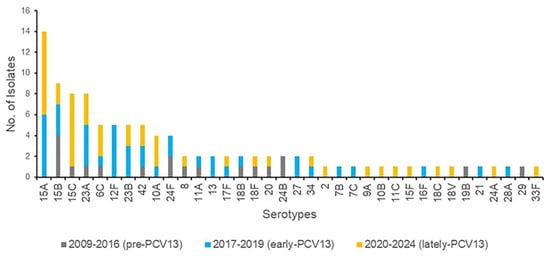
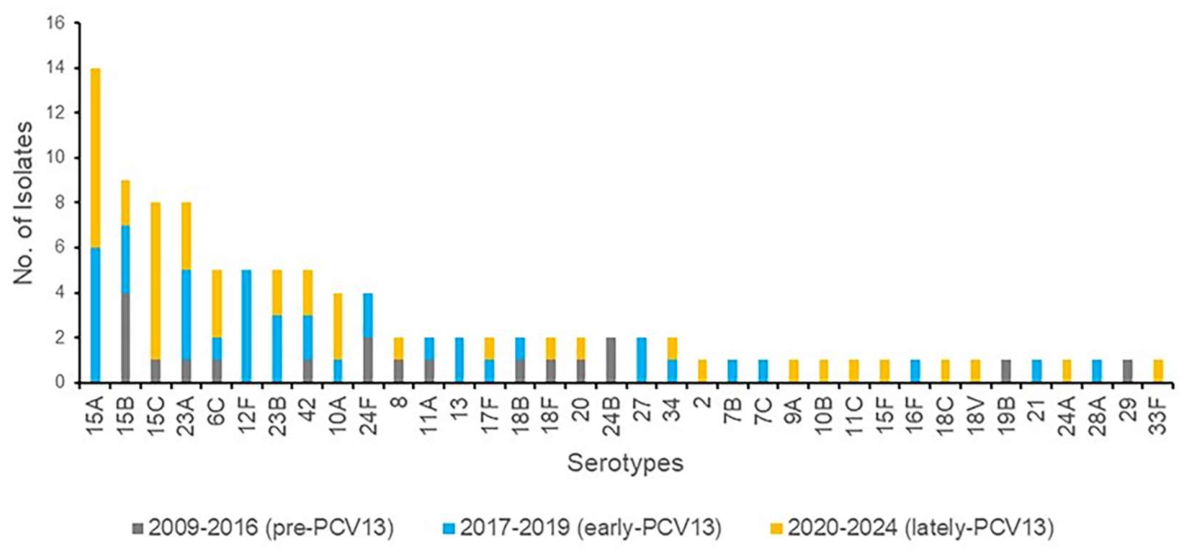
A total of 36 different serotypes were identified among 103 non-PCV13 S. pneumoniae isolates, in which the most common non-PCV13 serotypes were 15A (14/103, 13.6%), 15B (9/103, 8.7%), 15C (8/103, 7.8%) and 23A (8/103, 7.8%). Of 863 S. pneumoniae strains causing IPD, 15A, 15B, 15C and 23A accounted for 1.6%, 1.0%, 0.9% and 0.9%, respectively. Based on the PCV13, the additional serotypes of PCV15 accounted for 0.97% of this collection (1/103); the additional serotypes of PCV20 were found for 15B (8.7%), 12F (4.9%), 10A (3.9%) and 11A (1.9%), accounting for 19.4%. The additional 11 serotypes of PCV24 accounted for 26.2% of this collection (27/103). Of 14 serotypes not included in PCV13 but included in PCV21(V116) accounted for 55.3% (57/103) in this study. Some epidemic non-PCV13 serotypes may vary in different periods, such as 15A, 12F, 23B, 10A and 13, which were not isolated in 2009–2016 but isolated after the introduction of PCV13 (Figure 1).
Figure 1.
Serotype distribution of 103 non-PCV13 S. pneumoniae in pediatric IPD from 2009 to 2024, China.
3.2. MLST
Among the 103 isolates studied, 64 known ST types and 2 new STs (each containing 1 strain) were identified by MLST analysis. No new allele sequences were found in this study, and the new STs (ST19337 and ST19339) were all new combinations of known alleles (Supplementary Table S3). The common STs and their isolated strains were ST11972 (9 strains, 8.7%), ST8589 (8 strains, 7.8%) and ST9396 (5 strains, 4.9%). These genotypes accounted for 21.4% of 103 non-PCV13 strains and 2.5% of 863 isolates. EBURST analyzed the phylogenetic relationship between strains, including 12 clonal groups (CC) and 27 STs that existed alone (Singletons). The most common clonal group was CC6011 (16, 15.5%), followed by CC2758 (9, 8.7%), CC3397 (8, 7.8%) and CC230 (7, 6.8%), respectively. Serotype15A was dominated by ST11972 (9/14, 64.3%), serotype 12F was dominated by ST6945 (3/5, 60.0%), serotypes 15B by ST3397 (2/7, 28.5%), and serotype 23A was dominated by ST5242 (2/8, 25.0%).
3.3. Antimicrobial Susceptibility Results
The antimicrobial susceptibility and MIC distribution to penicillin, amoxicillin/clavulanic acid, cefuroxime, ceftriaxone, levofloxacin, imipenem, linezolid, SXT, clindamycin, vancomycin and erythromycin of 103 non-PCV13 S. pneumoniae isolates are listed in Table 3. All strains were susceptible to linezolid and vancomycin, and the susceptibility rate to levofloxacin was 97.1%. However, the resistance rates of S. pneumoniae to erythromycin, clindamycin and SXT were 94.2%, 90.3% and 60.2%, respectively. The analysis was combined with genotypes; the dominant serotypes of β-lactam antibiotic non-susceptible strains were 15A-ST11972 (17.3%, 9/52), 23A-ST9396 (3.8%, 2/52), 23B-ST9396 (5.8%, 3/52) and 15A-ST63 (3.8%, 2/52).
Table 3.
Antimicrobial susceptibility test results of 103 non-PCV13 serotype Streptococcus pneumoniae strains causing invasive infection in China from 2009 to 2024.
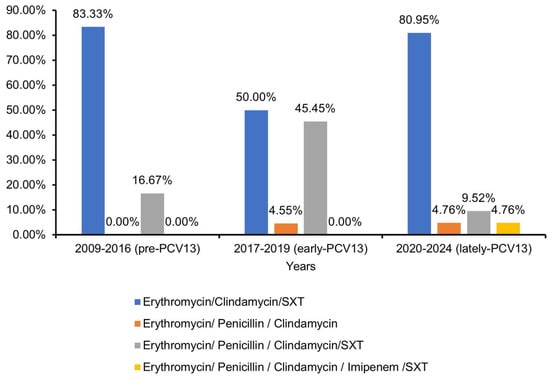
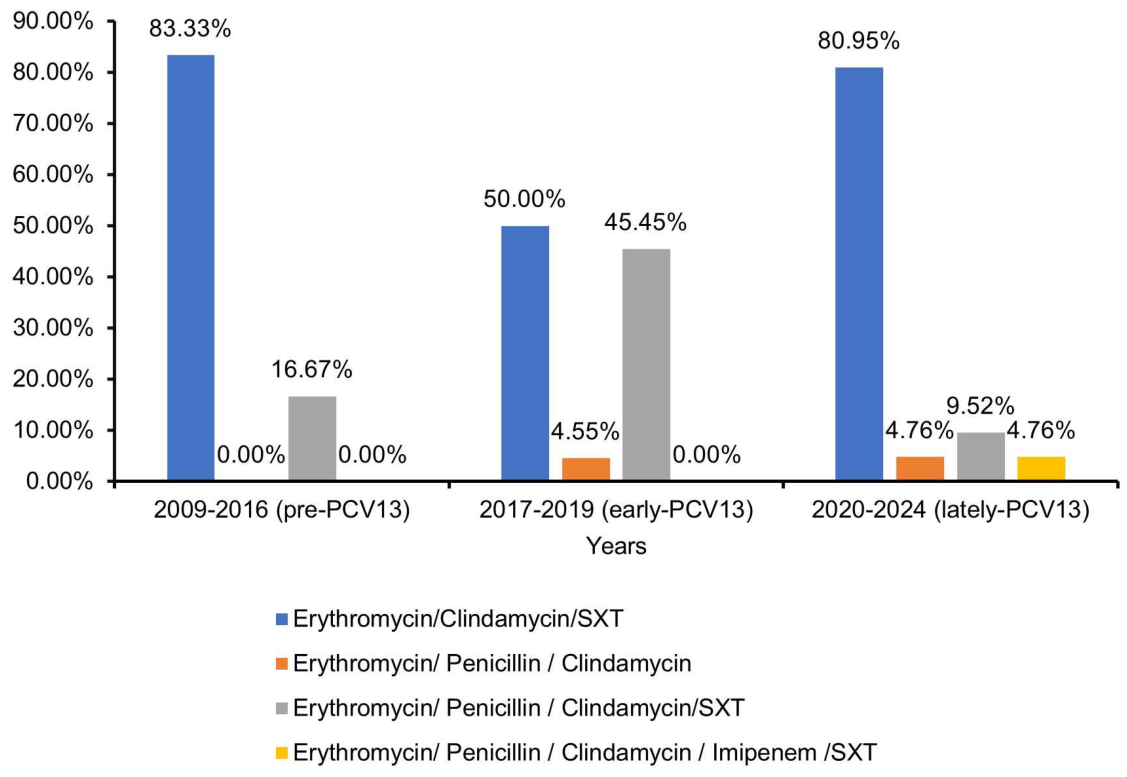
MDR strains comprised 53.4% (55/103) of the study population, with resistance to erythromycin, clindamycin, and SXT being the predominant pattern. This phenotype was commonly associated with serotypes 15C (6/38), 15B (4/38), and 6C (4/38), as well as ST8589 (8/38). The four-drug resistance pattern (erythromycin, penicillin, clindamycin, and SXT) was primarily found in serotypes 23A (2/14) and 23B (2/14), suggesting a potential link with ST9396 (4/14). In contrast, resistance to erythromycin, penicillin, and clindamycin was restricted to serotype 15A (2/2) and ST11972 (2/2). A broader resistance profile, including imipenem, was identified in a single 15C-ST13392 isolate. Following the introduction of PCV13, the diversity of MDR patterns increased (Figure 2). Notably, the period from 2020 to 2024 saw the emergence of imipenem-resistant strains and a novel pentad-resistance pattern (erythromycin, penicillin, clindamycin, imipenem, and SXT).
Figure 2.
MDR patterns of 103 non-PCV13 S. pneumoniae in pediatric IPD from 2009 to 2024, China.
4. Discussion
The present findings indicate that PCV13 serotypes have remained predominant in IPD isolates throughout the study period (86.0%), which means the dominance of VT of isolates has not been fundamentally altered by the introduction of PCV13. This is largely attributable to two factors: first, the vaccine has not been incorporated into China’s NIP, resulting in persistently low coverage among age-eligible children [13]. Second, vaccination rates are substantially higher in developed regions, where uptake is driven primarily by families with better economic means, a demographic that does not represent the groups at highest risk for IPD.
Non-PCV7 S. pneumoniae 19A and 3 were the most prevalent serotypes in Chinese children and adults, respectively [29]. In a multicenter study of 1138 Chinese children with IPD from 2012 to 2017 [30], 81 strains were serotyped, of which 6.2% were non-PCV13. In another multicenter study on pediatric IPD from 2019 to 2024 [20], non-PCV13 isolates accounted for 15.9% (61/384). We focus more on the number and proportion of non-PCV13 isolates causing pediatric IPD in the Chinese mainland, which have gradually increased. The observed increase in the proportion of non-PCV13 serotypes should be interpreted with caution. Because the seven source studies differed in recruitment periods and geographical coverage, the composition of contributing sites changed over time. In particular, pre-PCV13 isolates were contributed mainly by Beijing and Shenzhen, whereas later periods included additional regions. Given that serotype distributions vary by region, the increase in the non-PCV13 proportion may partly reflect the addition of sites with different serotype distributions rather than a uniform nationwide shift. We therefore no longer present this increase as a single unqualified temporal trend but as a change in the relative distribution of serotypes among available isolates.
The increase in the proportion of non-PCV13 serotypes from 7.5% to 17.8% should not be interpreted as direct evidence of vaccine-driven serotype replacement. Individual vaccination status was unavailable for most patients, and our analysis did not estimate population-level IPD incidence. However, previous studies have focused primarily on the proportional representation of NVT, without providing in-depth characterization of these strains. The present study offers the first comprehensive analysis of serotype distribution, MLST, and antibiotic resistance profiles among non-PCV13 isolates causing IPD in Chinese mainland. The observed pattern may be compatible with serotype replacement, but it could also reflect changes in geographic coverage, surveillance intensity, clinical practices, or isolate availability. Further studies with individual vaccination data and population-based incidence estimates are needed to clarify the contribution of PCV13.
The present results reveal 36 different serotypes were identified among 103 non-PCV13 S. pneumoniae isolates, in which the most common non-PCV13 serotypes were 15A (14/103, 13.6%), 15B (9/103, 8.7%), 15C (8/103, 7.8%) and 23A (8/103, 7.8%). This distribution of NVTs is different from those [31] reported internationally for non-PCV13 serotypes (22F, 12F, 33F, 24F,15C, 15B, 23B, 10A and 38). We compared the serotype coverage of several newly developed higher-valent vaccines. V116 demonstrated the highest coverage, protecting against 6.6% of 863 S. pneumoniae strains causing IPD, but still failed to fully cover the emerging non-PCV13 serotypes. PCV13 is generally considered a cost-effective intervention in China, and its broader use could help prevent a substantial proportion of IPD cases while potentially easing the healthcare burden. However, 22 serotypes, including 15A, 12F, 23B, 10A, and 13, have emerged post-PCV13 (2017–2024) and were not detected during 2009–2016. With the ongoing promotion of PCV13, the diversity of circulating non-PCV13 serotypes is likely to continue increasing. Given the rich diversity of non-PCV13 strains, it will be a huge challenge to achieve a higher coverage of higher valence PCV throughout China. Based on the present data, it remains uncertain which additional serotypes should be included in PCV13. Although several higher-valency pneumococcal conjugate vaccines have been developed or are already available, their cost-effectiveness, necessity, and rationale remain to be further evaluated, particularly for children in China. At present, improving coverage of PCV13 vaccination may be a more immediate priority.
Additionally, antibiotic-selective pressures may give some explanation for the emergence of NVTs associated with different pneumococcal lineages in certain countries [32,33]. Consistent with previous studies [28,34], most strains in this study were resistant to erythromycin and clindamycin, with a 35.9% non-susceptibility rate to imipenem. However, from 2020 to 2024, a novel MDR profile characterized by Erythromycin/Penicillin/Clindamycin/Imipenem/SXT emerged. Notably, Imipenem-resistant strains also emerged during this period, though their detection occurred later than similar reports from Taiwan [35].
Recent evidence from other pediatric pathogens underscores that circulating strains and seroprevalence patterns can change over time, even in settings with established immunization programs. For example, the 2024 resurgence of pertussis highlights ongoing diagnostic and public health challenges and the potential role of maternal vaccination strategies in protecting young infants [36]. Similarly, seroepidemiological studies conducted before adolescent SARS-CoV-2 vaccination have shown that pediatric exposure and antibody profiles evolve across epidemic waves and age groups [37]. These examples reinforce the need for continued, pathogen-specific surveillance to inform vaccine policy. In the context of pneumococcal disease, our findings of substantial serotype and genotype diversity among non-PCV13 isolates support ongoing monitoring rather than definitive conclusions about the optimal valency of pneumococcal conjugate vaccines.
This study has several limitations. First, pre-PCV13 isolates were available only from Shenzhen and Beijing, as systematic surveillance of S. pneumoniae was not yet established elsewhere in the Chinese mainland. The participating surveillance sites also differed between study periods, with the 2009–2016 period represented mainly by Beijing and Shenzhen. A key strength, however, is that all isolates were obtained and tested under standardized protocols, helping to ensure consistency across the study period. Second, blood culture sampling practices and the proportion of suspected IPD cases from which an isolate was obtained are likely to have varied across hospitals and over time, which may affect the comparability of case ascertainment between periods. Third, the vaccination status of most IPD cases was unknown, precluding assessment of PCV13’s impact on non-PCV13 serotype prevalence. This limitation stems from the separation between the clinical medical system and the vaccination registration system in the Chinese mainland, as well as the unreliability of parental recall. Future studies will seek to verify vaccination history through official immunization records. Fourth, because only viable stored isolates could be characterised, the analysed subset may not be fully representative of all reported paediatric IPD cases. The pre-PCV13 period was represented by only two cities (Shenzhen and Beijing) and non-PCV13 proportions varied substantially by age, so age–site–period confounding cannot be fully removed. Fifth, the absence of whole-genome sequencing limits our ability to fully resolve clonal dynamics and microevolutionary trends among non-PCV13 lineages. Future surveillance in China should prioritize the integration of whole-genome sequencing with centralized bioinformatic pipelines to align with global frameworks such as the GPSC. Taken together, these factors could bias period-to-period comparisons in either direction, and we have therefore interpreted temporal changes with caution rather than assuming that such biases do not operate.
5. Conclusions
During the study period, the number and proportion of non-PCV13 isolates in pediatric IPD isolates in the Chinese mainland gradually climbed, yet they remained insufficient to contest the unequivocal dominance of PCV13 serotypes. The results revealed significant diversity of serotype and genetic type within the non-PCV13 isolates. The several common non-PCV13 serotypes did not dominate, and additional types in expanded PCVs were rare, posing challenges for expanded formula decisions in China. These results provide evidence to guide serotype surveillance and antimicrobial usage, and to underpin policies favoring the introduction of PCV13.
Supplementary Materials
The following supporting information can be downloaded at https://www.mdpi.com/article/10.3390/vaccines14110997/s1. Table S1. Amplification primers of 7 housekeeping genes of Streptococcus pneumoniae. Table S2. Vaccination of 12 children with pneumococcal vaccine before non-vaccinated serotype pneumococcal infection. Table S3. STs of Streptococcus pneumoniae in this study. Figure S1: Flow diagram of participant selection in this retrospective multicenter study (2009–2024).
Author Contributions
Conceptualization, D.Y., X.K. and K.-H.Y.; methodology, Q.-Q.D., W.S., D.Y., W.G., L.Y. and K.-H.Y.; software, Q.-Q.D. and W.S.; formal analysis, Q.-Q.D., D.Y. and K.-H.Y.; investigation, Q.-Q.D., W.S., C.-Z.H., L.-J.W., F.D. and K.-H.Y.; data curation, Q.-Q.D., W.S., C.-Z.H., L.-J.W., W.G., L.Y. and F.D.; writing—original draft preparation, Q.-Q.D., W.S., C.-Z.H., L.-J.W., D.Y., X.K. and K.-H.Y.; writing—review and editing, Q.-Q.D., W.S., C.-Z.H., L.-J.W., W.G., L.Y., F.D., D.Y., X.K. and K.-H.Y.; supervision, F.D., D.Y., X.K. and K.-H.Y.; project administration, Q.-Q.D., W.S., C.-Z.H., L.-J.W., W.G., L.Y., F.D. and K.-H.Y.; funding acquisition, D.Y. and K.-H.Y. All authors have read and agreed to the published version of the manuscript.
Funding
This research was funded by Funding for Reform and Development of Beijing Municipal Health Commission (EYGF-WSW-04).
Institutional Review Board Statement
Not applicable. The study involved the analysis of bacterial strains and did not directly involve human participants or animal subjects. The study was approved by the ethics committee of each hospital.
Informed Consent Statement
Informed consent for participation is not required as per the fact that this study involved only the analysis of bacterial strains. The study was approved by the ethics committee of each hospital. Because no human subjects were enrolled and no identifiable human data or biological samples were used, informed consent for participation was not applicable.
Data Availability Statement
The datasets used and analyzed during the current study are available from the corresponding author on reasonable request.
Acknowledgments
Thanks to the Shenzhen Children’s Hospital, Shenzhen Bao’an Women’s and Children’s Hospital, Capital Institute of Pediatrics, Hangzhou Children’s Hospital, Zhongjiang County People ‘s Hospital, Qinghai Women’s and Children’s Hospital, Hunan Children’s Hospital, Henan Children’s Hospital, Children’s Hospital of Hebei Province, Children’s Hospital of Nanjing Medical University, Dalian Children’s Hospital, Children’s Hospital Affiliated to Shandong University, Baoding Children’s Hospital, Xian Children’s Hospital, Children’s Hospital of Jiangxi Province, Changchun Children’s Hospital, Urumqi Children’s Hospital, People’s Hospital of Liaocheng, Children’s Hospital of Shanxi Province, Maternal and Child Health Care Hospital of the Inner Mongolia autonomous region, and Anhui Provincial Children’s Hospital, which completed research on the pneumococcal serotyping platform in our laboratory; their work results provided resources for this study.
Conflicts of Interest
The authors declare no conflicts of interest.
Abbreviations
The following abbreviations are used in this manuscript:
| IPD | invasive pneumococcal disease |
| PCVs | Pneumococcal conjugate vaccines |
| WHO | World Health Organization |
| NIP | National Immunization Program |
| VTs | vaccine-targeted serotypes |
| NVTs | non-vaccine serotypes |
| PCV13 | 13-Valent pneumococcal conjugate vaccine |
| PCV15 | 15-Valent pneumococcal conjugate vaccine |
| PCV20 | 20-Valent pneumococcal conjugate vaccine |
| PCV21 | 21-Valent pneumococcal conjugate vaccine |
| PCV24 | 24-Valent pneumococcal conjugate vaccine |
| MLST | multi-locus sequence typing |
| MIC | minimum inhibitory concentration |
| STs | sequence types |
| CCs | Clonal Complexes |
| CLSI | Clinical and Laboratory Standards Institute |
| SXT | Sulfamethoxazole–trimethoprim |
| MDR | Multi-drug resistant |
| CDC | Center of Disease Control and Prevention |
References
- O’Brien, K.L.; Wolfson, L.J.; Watt, J.P.; Henkle, E.; Deloria-Knoll, M.; McCall, N.; Lee, E.; Mulholland, K.; Levine, O.S.; Cherian, T.; et al. Burden of disease caused by Streptococcus pneumoniae in children younger than 5 years: Global estimates. Lancet 2009, 374, 893–902. [Google Scholar] [CrossRef] [Scilit] [PubMed]
- Quan-Cheng, K.; Jian-Guo, W.; Xiang-Hua, L.; Zhen-Zhen, L. Inappropriate use of antibiotics in children in China. Lancet 2016, 387, 1273–1274. [Google Scholar] [CrossRef] [Scilit] [PubMed]
- Moore, M.R.; Link-Gelles, R.; Schaffner, W.; Lynfield, R.; Lexau, C.; Bennett, N.M.; Petit, S.; Zansky, S.M.; Harrison, L.H.; Reingold, A.; et al. Effect of use of 13-valent pneumococcal conjugate vaccine in children on invasive pneumococcal disease in children and adults in the USA: Analysis of multisite, population-based surveillance. Lancet Infect. Dis. 2015, 15, 301–309. [Google Scholar] [CrossRef] [Scilit] [PubMed]
- Moore, M.R.; Link-Gelles, R.; Schaffner, W.; Lynfield, R.; Holtzman, C.; Harrison, L.H.; Zansky, S.M.; Rosen, J.B.; Reingold, A.; Scherzinger, K.; et al. Effectiveness of 13-valent pneumococcal conjugate vaccine for prevention of invasive pneumococcal disease in children in the USA: A matched case-control study. Lancet Respir. Med. 2016, 4, 399–406. [Google Scholar] [CrossRef] [Scilit] [PubMed]
- World Health Organization. Pneumococcal conjugate vaccines in infants and children under 5 years of age: WHO position paper–February 2019. Wkly. Epidemiol. Rec. 2019, 94, 85–104. [Google Scholar]
- Oligbu, G.; Collins, S.; Djennad, A.; Sheppard, C.L.; Fry, N.K.; Andrews, N.J.; Borrow, R.; Ramsay, M.E.; Ladhani, S.N. Effect of Pneumococcal Conjugate Vaccines on Pneumococcal Meningitis, England and Wales, July 1, 2000-June 30, 2016. Emerg. Infect. Dis. 2019, 25, 1708–1718. [Google Scholar] [CrossRef] [Scilit] [PubMed]
- Hausdorff, W.P.; Feikin, D.R.; Klugman, K.P. Epidemiological differences among pneumococcal serotypes. Lancet Infect. Dis. 2005, 5, 83–93. [Google Scholar] [CrossRef]
- Kaplan, S.L.; Barson, W.J.; Lin, P.L.; Romero, J.R.; Bradley, J.S.; Tan, T.Q.; Hoffman, J.A.; Givner, L.B.; Mason, E.O.J. Early trends for invasive pneumococcal infections in children after the introduction of the 13-valent pneumococcal conjugate vaccine. Pediatr. Infect. Dis. J. 2013, 32, 203–207. [Google Scholar] [CrossRef] [Scilit] [PubMed]
- Lima, J.L.C.; da Silva, A.B.; Cabral, A.S.; de Miranda, F.M.; da Silva, L.D.; da Silva, A.R.A.; Teixeira, L.M.; Neves, F.P.G. Changes in population genetic structure of serotype 19A Streptococcus pneumoniae after universal childhood use of the 10-valent pneumococcal conjugate vaccine in Brazil. Vaccine 2025, 45, 126588. [Google Scholar] [CrossRef] [Scilit] [PubMed]
- Chinese Preventive Medicine Association; Vaccine and Immunology Branch of the Chinese Preventive Medicine Association. Expert Consensus on Immunoprophylaxis of Pneumococcal Diseases (2020 Edition). Zhonghua Liu Xing Bing Xue Za Zhi 2020, 41, 1945–1979. (In Chinese) [Google Scholar] [PubMed]
- Wang, J.; Wang, Y.; Xu, R.; Zhang, T.; Jiang, Y.; Wang, Y.; Wang, Y.; Du, Y.; Sun, W.; Deng, K.; et al. 13-Valent pneumococcal conjugate vaccines vaccination innovative strategy in Weifang City, China: A case study. Infect. Dis. Poverty 2023, 12, 110. [Google Scholar] [CrossRef] [Scilit] [PubMed]
- Wang, C.P.; Lin, Y.T.; Du, Y.Z.; Zhang, T.; Wang, Y.Y.; Wang, Y.J.; Wang, J.-C.; Xu, R.-Y.; Wang, Z.-S.; Wang, Y.; et al. Impact of innovative immunization strategy on PCV13 vaccination coverage among children under 5 years in Weifang city, China: A retrospective study. Vaccine 2024, 42, 1136–1144. [Google Scholar] [CrossRef] [Scilit] [PubMed]
- Liu, L.; Zhang, Z.; Zhang, X.; Xu, C.; Song, Y.; Li, L.; Ye, J.; Wang, Z.; Liang, H.; Zhang, W.; et al. Coverage of 13-Valent Pneumococcal Conjugate Vaccine Among Children 0-15 Months of Age-9 Provinces, China, 2019–2021. China CDC Wkly. 2023, 5, 379–384. [Google Scholar] [CrossRef] [Scilit] [PubMed]
- Chen, K.; Zhang, X.; Shan, W.; Zhao, G.; Zhang, T. Serotype distribution of Streptococcus pneumoniae and potential impact of pneumococcal conjugate vaccines in China: A systematic review and meta-analysis. Hum. Vaccines Immunother. 2018, 14, 1453–1463. [Google Scholar] [CrossRef] [Scilit] [PubMed]
- Liu, Y.; Dong, F.; Shi, W.; Liu, G.; Qian, S.Y.; Xu, B.P.; Wang, Q.; Meng, Q.H.; Shen, K.L.; Yao, K.H. Serotype analysis of Streptococcus pneumoniae isolates from hospitalized children in Beijing Children ‘s Hospital from 2013 to 2017. Zhonghua Quan Ke Yi Xue 2018, 16, 514–517+625. (In Chinese) [Google Scholar]
- Bao, Y.; Wang, Q.; Yao, K.; Xie, G.; Gao, W.; Huang, L.; Liu, X.; Zhu, C.; Chen, H.; Wang, H.; et al. The changing phenotypes and genotypes of invasive pneumococcal isolates from children in Shenzhen during 2013–2017. Vaccine 2019, 37, 7248–7255. [Google Scholar] [CrossRef] [Scilit] [PubMed]
- Shi, W.; Li, J.; Dong, F.; Qian, S.; Liu, G.; Xu, B.; Zhou, L.; Xu, W.; Meng, Q.; Wang, Q.; et al. Serotype distribution, antibiotic resistance pattern, and multilocus sequence types of invasive Streptococcus pneumoniae isolates in two tertiary pediatric hospitals in Beijing prior to PCV13 availability. Expert Rev. Vaccines 2019, 18, 89–94. [Google Scholar] [CrossRef] [Scilit] [PubMed]
- Wang, Q.; Shi, W.; Li, Y.; Gao, W.; Yuan, L.; Dong, F.; Yao, K. Serotype distribution of Streptococcus pneumoniae isolated from children hospitalized in Beijing children’s hospital (2013–2019). Vaccine 2020, 38, 7858–7864. [Google Scholar] [CrossRef] [Scilit] [PubMed]
- Du, Q.Q.; Zeng, H.L.; Yuan, L.; Tang, P.; Gao, W.; Xu, J.J.; Shi, W.; Leng, T.; Hu, K.-X.; Yao, K.-H. One cross-sectional investigation revealed that non-vaccine serotypes of Streptococcus pneumoniae could be identified more frequently in elderly Chinese people. Vaccine 2021, 39, 3304–3309. [Google Scholar] [CrossRef] [Scilit] [PubMed]
- Ning, X.; Li, L.; Liu, J.; Wang, F.; Tan, K.; Li, W.; Zhou, K.; Jing, S.; Lin, A.; Bi, J.; et al. Invasive pneumococcal diseases in Chinese children: A multicentre hospital-based active surveillance from 2019 to 2021. Emerg. Microbes Infect. 2024, 13, 2332670. [Google Scholar] [CrossRef] [Scilit] [PubMed]
- Sørensen, U.B. Typing of pneumococci by using 12 pooled antisera. J. Clin. Microbiol. 1993, 31, 2097–2100. [Google Scholar] [CrossRef] [Scilit] [PubMed]
- Francisco, A.P.; Bugalho, M.; Ramirez, M.; Carriço, J.A. Global optimal eBURST analysis of multilocus typing data using a graphic matroid approach. BMC Bioinform. 2009, 10, 152. [Google Scholar] [CrossRef] [Scilit] [PubMed]
- Clinical and Laboratory Standards Institute. Performance Standards for Antimicrobial Susceptibility Testing, 29th ed.; CLSI Supplement M100; Clinical and Laboratory Standards Institute: Wayne, PA, USA, 2019. [Google Scholar]
- McFetridge, R.; Meulen, A.S.; Folkerth, S.D.; Hoekstra, J.A.; Dallas, M.; Hoover, P.A.; Marchese, R.D.; Zacholski, D.M.; Watson, W.J.; Stek, J.E.; et al. Safety, tolerability, and immunogenicity of 15-valent pneumococcal conjugate vaccine in healthy adults. Vaccine 2015, 33, 2793–2799. [Google Scholar] [CrossRef] [Scilit] [PubMed]
- Thompson, A.; Lamberth, E.; Severs, J.; Scully, I.; Tarabar, S.; Ginis, J.; Jansen, K.U.; Gruber, W.C.; Scott, D.A.; Watson, W. Phase 1 trial of a 20-valent pneumococcal conjugate vaccine in healthy adults. Vaccine 2019, 37, 6201–6207. [Google Scholar] [CrossRef] [Scilit] [PubMed]
- Hurley, D.; Griffin, C.; Young, M.; Scott, D.A.; Pride, M.W.; Scully, I.L.; Ginis, J.; Severs, J.; Jansen, K.U.; Gruber, W.C.; et al. Safety, Tolerability, and Immunogenicity of a 20-valent pneumococcal conjugate vaccine (PCV20) in adults 60 to 64 years of age. Clin. Infect. Dis. 2021, 73, e1489–e1497. [Google Scholar] [CrossRef] [Scilit] [PubMed]
- McGuinness, D.; Kaufhold, R.M.; McHugh, P.M.; Winters, M.A.; Smith, W.J.; Giovarelli, C.; He, J.; Zhang, Y.; Musey, L.; Skinner, J.M. Immunogenicity of PCV24, an expanded pneumococcal conjugate vaccine, in adult monkeys and protection in mice. Vaccine 2021, 39, 4231–4237. [Google Scholar] [CrossRef] [Scilit] [PubMed]
- Platt, H.; Omole, T.; Cardona, J.; Fraser, N.J.; Mularski, R.A.; Andrews, C.; Daboul, N.; Gallagher, N.; Sapre, A.; Li, J.; et al. Safety, tolerability, and immunogenicity of a 21-valent pneumococcal conjugate vaccine, V116, in healthy adults: Phase 1/2, randomised, double-blind, active comparator-controlled, multicentre, US-based trial. Lancet Infect. Dis. 2023, 23, 233–246. [Google Scholar] [CrossRef] [Scilit] [PubMed]
- Li, M.; Wang, Y.; Zhang, H.; Liu, Y.; Chen, X.; Yang, H.; Ma, P.; Wang, D.-C.; Zhang, B.-C.; Dong, A.-Y.; et al. Serotype distribution and clinical characteristics associated with streptococcus pneumoniae among Chinese children and adults with invasive pneumococcal disease: A multicenter observational study. Hum. Vaccines Immunother. 2021, 17, 146–156. [Google Scholar] [CrossRef] [Scilit] [PubMed]
- Zhu, L.; Li, W.H.; Wang, X.H.; Tan, K.; Fang, Q.F.; Zhu, Q.X.; Wu, K.K.; Yang, Q.Z.; Lin, A.W.; Deng, H.L.; et al. A multicenter clinical study of 1 138 children with invasive pneumococcal disease from 2012 to 2017. Zhonghua Er Ke Za Zhi 2018, 56, 915–922. (In Chinese) [Google Scholar] [PubMed]
- Balsells, E.; Guillot, L.; Nair, H.; Kyaw, M.H. Serotype distribution of Streptococcus pneumoniae causing invasive disease in children in the post-PCV era: A systematic review and meta-analysis. PLoS ONE 2017, 12, e0177113. [Google Scholar] [CrossRef] [Scilit] [PubMed]
- Lo, S.W.; Gladstone, R.A.; van Tonder, A.J.; Lees, J.A.; du Plessis, M.; Benisty, R.; Givon-Lavi, N.; A Hawkins, P.; E Cornick, J.; Kwambana-Adams, B.; et al. Pneumococcal lineages associated with serotype replacement and antibiotic resistance in childhood invasive pneumococcal disease in the post-PCV13 era: An international whole-genome sequencing study. Lancet Infect. Dis. 2019, 19, 759–769. [Google Scholar] [CrossRef] [Scilit] [PubMed]
- Nakano, S.; Fujisawa, T.; Ito, Y.; Chang, B.; Matsumura, Y.; Yamamoto, M.; Suga, S.; Ohnishi, M.; Nagao, M. Whole-Genome Sequencing Analysis of Multidrug-Resistant Serotype 15A Streptococcus pneumoniae in Japan and the Emergence of a Highly Resistant Serotype 15A-ST9084 Clone. Antimicrob. Agents Chemother. 2019, 63, e02579-18. [Google Scholar] [CrossRef] [Scilit] [PubMed]
- Zhou, M.; Wang, Z.; Zhang, L.; Kudinha, T.; An, H.; Qian, C.; Jiang, B.; Wang, Y.; Xu, Y.; Liu, Z.; et al. Serotype Distribution, Antimicrobial Susceptibility, Multilocus Sequencing Type and Virulence of Invasive Streptococcus pneumoniae in China: A Six-Year Multicenter Study. Front. Microbiol. 2021, 12, 798750. [Google Scholar] [CrossRef] [Scilit] [PubMed]
- Lee, M.C.; Kuo, K.C.; Lee, C.H.; Hsieh, Y.C.; Tsai, M.H.; Huang, C.T.; Huang, Y.-C. The antimicrobial susceptibility in adult invasive pneumococcal disease in the era of pneumococcus vaccination: A hospital-based observational study in Taiwan. J. Microbiol. Immunol. Infect. 2020, 53, 836–844. [Google Scholar] [CrossRef] [Scilit] [PubMed]
- Leontari, K.; Lianou, A.; Tsantes, A.G.; Filippatos, F.; Iliodromiti, Z.; Boutsikou, T.; Paliatsou, S.; Chaldoupis, A.E.; Ioannou, P.; Mpakosi, A.; et al. Pertussis in Early Infancy: Diagnostic Challenges, Disease Burden, and Public Health Implications Amidst the 2024 Resurgence, with Emphasis on Maternal Vaccination Strategies. Vaccines 2025, 13, 276. [Google Scholar] [CrossRef] [Scilit] [PubMed]
- Filippatos, F.; Tatsi, E.B.; Dellis, C.; Efthymiou, V.; Margeli, A.; Papassotiriou, I.; Syriopoulou, V.; Michos, A. Seroepidemiology of SARS-CoV-2 in pediatric population during a 16-month period prior to vaccination. J. Med. Virol. 2022, 94, 2174–2180. [Google Scholar] [CrossRef] [Scilit] [PubMed]

Disclaimer/Publisher’s Note: The statements, opinions and data contained in all publications are solely those of the individual author(s) and contributor(s) and not of MDPI and/or the editor(s). MDPI and/or the editor(s) disclaim responsibility for any injury to people or property resulting from any ideas, methods, instructions or products referred to in the content. |
© 2026 by the authors. Licensee MDPI, Basel, Switzerland. This article is an open access article distributed under the terms and conditions of the Creative Commons Attribution (CC BY) license.