


Abstract
Immunosuppressive therapy increases the risk of pneumococcal disease. This risk can be mitigated by pneumococcal vaccination. The objective of this study was to investigate the immunogenicity of the 13-valent pneumococcal conjugate vaccine (PCV13), followed by the 23-valent pneumococcal polysaccharide vaccine (PPSV23), in adults with and without immunosuppressive therapy. We performed a prospective cohort study among adults using conventional immunomodulators (cIM), biological immunomodulators (bIM), combination therapy, and controls during 12 months. The primary outcome was seroprotection, defined as the proportion of patients with a postimmunization IgG concentration of ≥1.3 µg/mL for at least 70% (17/24) of the serotypes of PCV13 + PPSV23. We included 214 participants. For all 24 vaccine serotypes, IgG levels increased significantly in both treatment subgroups and controls, with peak seroprotection rates of 44% (combination therapy), 58% (cIM), 57% (bIM), and 82% (controls). By month 12, seroprotection had decreased to 24%, 48%, 39%, and 63%, respectively. Although pneumococcal vaccination with PCV13 + PPSV23 was immunogenic in all treatment groups, impaired vaccination responses were observed in patients using immunosuppressive medication. Apart from the obvious recommendation to administer vaccines before such medication is started, alternative vaccination strategies, such as additional PCV13 doses or higher-valent pneumococcal vaccines, should be investigated.
1. Introduction
The risk of invasive pneumococcal disease (IPD) is increased in patients with autoimmune diseases (6.5-fold) and in solid organ transplant recipients (47-fold), compared with the general population [1]. Immunosuppressive therapy, the cornerstone of the treatment of these patients aiming at the suppression of autoimmunity and the prevention of graft rejection, increases the susceptibility to and severity of pneumococcal infections [2,3,4]. In addition, the response to vaccination is generally impaired [5,6]. Pneumococcal vaccination with the 13-valent pneumococcal conjugate vaccine (PCV13), followed 2 months later by the 23-valent polysaccharide vaccine (PPSV23), is currently recommended for patients with autoimmune diseases and solid organ transplant recipients in most countries [7,8]. Recall antipneumococcal responses have been demonstrated in healthy elderly when the two vaccines were used in series [9]. However, data regarding the strength and duration of seroprotection resulting from this combined vaccination in patients using immunosuppressive agents are scarce, with most studies focusing on underlying diagnoses rather than the type of immunosuppressive medication [10]. In addition, most prior studies tended to focus on the immunogenicity of PCV serotypes rather than the immunogenicity of serotypes exclusive to PPSV23 [11,12], which have become predominant in recent years, due to serotype replacement [13,14].
Therefore, the main objective of the present study was to investigate the immune response to the recommended vaccination schedule of PCV13, followed 2 months later by PPSV23, for all 24 serotypes included in PCV13 and PPSV23, in adults using immunosuppressive medication and controls during 12 months.
2. Materials and Methods
We performed a prospective interventional cohort study at the Amsterdam UMC, location AMC, between August 2018 and December 2021 (NL7193).
2.1. Study Population
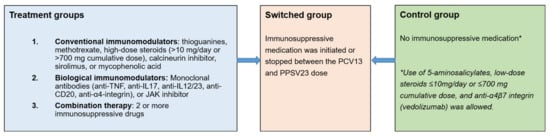
The following categories of consecutive adults visiting the Amsterdam UMC Center of Tropical Medicine and Travel Medicine’s vaccination clinic to receive their routine, or travel, vaccinations were asked to participate: (1) patients using conventional immunomodulators (cIM), (2) patients using biological immunomodulators (bIM), (3) patients using combination therapy, and (4) controls using no systemic immunosuppressive treatments (Figure 1). Low-dose prednisolone <10 mg/day or <700 mg cumulative was not considered immunosuppressive [15]. If a patient switched to a different medication category within 2 weeks after enrollment, the patient was assigned to that new category for final analysis. If immunosuppressive treatment was initiated or stopped between 2 weeks after enrollment until 2 weeks after PPSV23 administration, the patient was assigned to the ‘switched group’ (Figure 1).
Figure 1.
Study groups. TNF = tumor necrosis factor, IL = interleukin, JAK = Janus kinase, PCV13 = 13-valent pneumococcal conjugate vaccine, PPSV23 = 23-valent pneumococcal polysaccharide vaccine.
The following exclusion criteria were applied: previous vaccination with any PCV, vaccination with PPSV23 in the past 5 years, diagnosis of a primary immune deficiency disorder, hemophilic disorder precluding intramuscular vaccination, allergy to any of the components of the pneumococcal vaccines, pregnancy, not being able or willing to consent.
2.2. Sample Size
The power calculation was based on expected differences in seroprotection rates after vaccination between patients using immunosuppressive medication and controls. Based on previous studies, we expected that in our population, no more than 60% of patients using immunosuppressive medication and 90% of controls would achieve seroprotection [5]. A Fisher’s exact test with a 0.05 two-sided significance level will have 80% power to detect this difference when the sample size in each medication group is 36 (nQuery, version 7.0; Statsols, Cork, Ireland). To compensate for an expected 15% dropout and 20% medication switches, we planned to recruit at least 49 individuals per medication group.
2.3. Study Procedures
Participants received one dose of PCV13, followed by one dose of PPSV23, with a 2-month interval. PCV13 or Prevenar 13® (Pfizer, New York, NY, USA) includes purified capsular polysaccharide of 13 serotypes of Streptococcus pneumoniae (1, 3, 4, 5, 6A, 6B, 7F, 9V, 14, 19A, 19F, 18C, and 23F) conjugated to a nontoxic variant of diphtheria toxin known as CRM197. PPSV23 or Pneumovax 23® (Merck Sharp & Dohme, Kenilworth, NJ, USA) contains purified capsular polysaccharide of 23 serotypes (1, 2, 3, 4, 5, 6B, 7F, 8, 9N, 9V, 10A, 11A, 12F, 14, 15B, 17F, 18C, 19F, 19A, 20, 22F, 23F, and 33F). Some participants concomitantly received other recommended vaccinations, such as hepatitis B, influenza, or travel vaccines. All vaccines were administered intramuscularly. Prior to the first vaccination (T0), baseline clinical and demographical data were collected. Serum samples were collected at baseline and at 2, 4, 6, and 12 months after enrollment, and were frozen at −80 °C until further analysis. Serotype-specific pneumococcal IgG serum concentrations were measured using a 26-plex multiplex immunoassay as described previously [16]. After each vaccination, participants were asked to record adverse events (AEs) through an online questionnaire. Serious adverse events (SAEs) were recorded throughout the study period.
2.4. Outcomes and Analysis
The primary outcome of this study was the overall seroprotection rate 2 months after the full vaccination schedule (month 4), defined as the proportion of patients with a postimmunization IgG concentration of ≥1.3 µg/mL for at least 70% (17/24) of the serotypes of PCV13 + PPSV23 in the different medication groups [17].
Secondary outcomes were: (1) seroprotection rates for each individual serotype and for the group of serotypes in PCV13 (1, 3, 4, 5, 6A, 6B, 7F, 9V, 14, 19A, 19F, 18C, and 23F) and PPVS23-unique serotypes (2, 8, 9N, 10A, 11A, 12F, 15B, 17F, 20, 22F, 33F); (2) serotype-specific geometric mean concentrations (GMC) of IgG for all 24 serotypes and geometric mean fold rises (GMFRs) compared with baseline; (3) clinical and laboratory predictors for the primary outcome; and (4) dynamics of seroprotection rates and GMCs over time. Sensitivity analyses were performed to see whether the results would change if patients using anti-CD20 therapy were excluded from the analysis, as this therapy is known to impair immune responses more profoundly.
For all analyses, we used SPSS (IBM, Chicago, IL, USA) version 25.0 or higher. Antibody concentrations were analyzed on a log-transformed scale and presented as GMC. To detect changes in serotype-specific protection rates and GMC of IgG over time, generalized linear mixed models (GLMM, covariance structure first order autoregression) including the variables ‘time point’ and ‘immunosuppressive medication group at baseline’ were used. To identify predictors for the primary outcome, we performed a multivariable logistic regression analysis including sex and age as fixed variables and using stepwise backward selection based on likelihood ratio and p < 0.05 for the following predefined variables: body mass index, Charlson comorbidity index, smoking (current smoker yes/no), alcohol use (>7/week, yes/no), illicit drug use (any type, yes/no), type of immunosuppressive medication (any cIM, high-dose steroids, methotrexate, thiopurine, calcineurin inhibitor, mycophenolate mofetil, any bIM, TNF-alpha inhibitor, bIM/non-TNF-alpha, anti-CD20 therapy, ustekinumab), number of immunosuppressive drugs, underlying diagnosis (rheumatoid arthritis, Crohn’s disease, ulcerative colitis, psoriasis, solid organ transplantation), impaired kidney function, use of mucosal agents (5-aminosalicylates/vedolizumab), low-dose prednisolone. We used a two-sided alpha level of 0.05 for significance of statistical tests. Missing data were excluded from analysis. All analyses were performed per protocol: all participants who had pre- and postvaccination serum samples collected were included in the final analysis.
2.5. Ethical Considerations
The study was conducted according to the principles of the Declaration of Helsinki and in accordance with the Medical Research Involving Human Subjects Act (WMO). The research ethics committee of the Amsterdam UMC, location AMC, in 2018, provided ethical clearance (NL65687.018.18). All participants provided written informed consent for the study.
3. Results
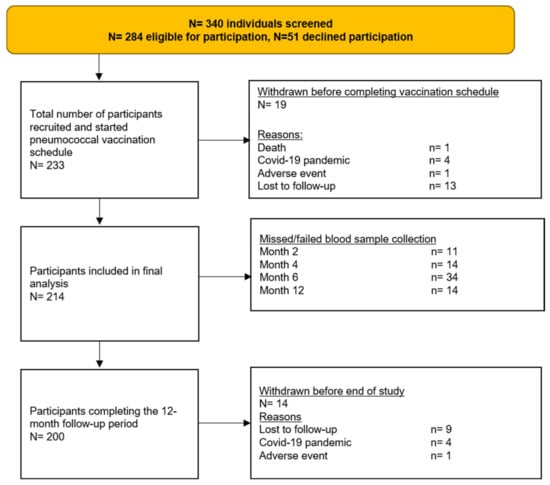
Between August 2018 and December 2020, 233 individuals were recruited, of which 214 were included in the final analysis, and 200 completed the study (Figure 2, Table 1). There were several differences across the five medication groups, including age distribution, underlying diagnosis, Charlson comorbidity index, kidney function, and the type and number of immunosuppressive agents (Table 1).
Figure 2.
Study flow diagram.
Table 1.
Baseline characteristics.
3.1. Seroprotection Rates
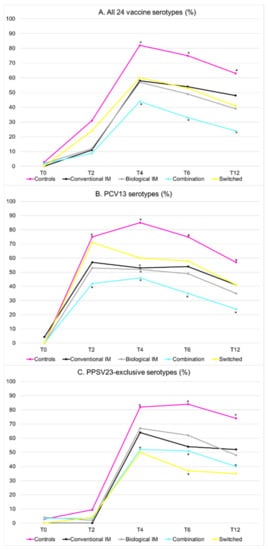
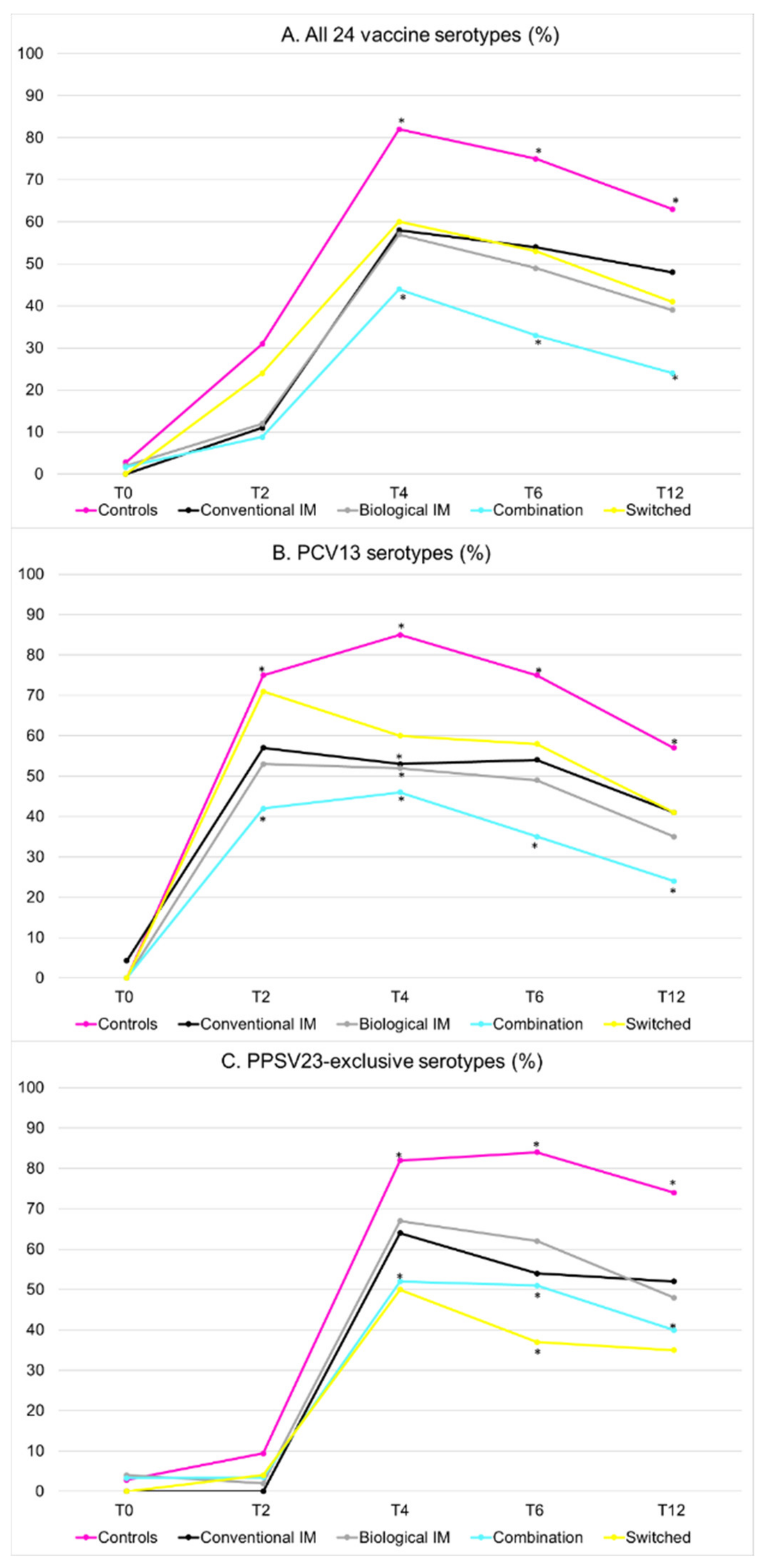
Overall seroprotection rates at month 4 ranged between 44% (combination therapy group) and 82% (control group). Seroprotection rates in the cIM, bIM, and switched groups (58%, 57%, and 60%, respectively) did not statistically differ from each other (Figure 3A, Table 2). Results were similar when only PCV13- or PPSV23-exclusive serotypes were considered, except that seroprotection was significantly higher for PCV13 serotypes in the switched group (60%) compared with the other medication groups (46%–53%) (Figure 3B,C, Table 2). Results were also similar when participants using anti-CD20 therapy were excluded from the analysis (Table S1). The protection for PPSV23-unique serotypes was slightly higher compared with PCV13 serotypes for the bIM, cIM, and combination therapy groups, but this difference was not significant (data not shown).
Figure 3.
(A) Seroprotection rates over time for all 24 vaccine serotypes; (B) Seroprotection rates over time for serotypes included in PCV13; (C) Seroprotection rates over time for serotypes exclusive to PPSV23. IM = immunomodulator. T = time point in months from enrollment. * Highlights seroprotection rates that differ significantly from the other groups at that time point.
Table 2.
Seroprotection rates.
The protection rate was highly serotype specific and ranged from 15% to 97% for the individual serotypes, with poor immunogenicity for serotypes 3 and 12F in all participants and for serotypes 4 and 5 in patients using any category of immunosuppressive drugs (Table S2). Individual protection rates increased significantly over time for all vaccine serotypes (Table S2).
3.2. Predictors of Seroconversion
In univariable analysis, impaired kidney function, greater number of drugs at baseline, and the use of methotrexate were significantly associated with impaired seroprotection at month 4 (Table 3). In the multivariable model, significant negative predictors of the primary outcome at month 4 were: solid organ transplantation (adjusted odds ratio (aOR), 0.40; 95% confidence interval (CI), 0.17–0.97), use of methotrexate at baseline (aOR, 0.38; 95% CI, 0.17–0.81), and anti-CD20 therapy (aOR, 0.09; 95% CI, 0.01–0.81) (Table 3).
Table 3.
Seroprotection rates and predictors for overall seroprotection 4 months after enrollment (T4).
When considering all time points, the immunosuppressive treatment group had a significant impact on protection rates for the following vaccine serotypes: 4, 5, 9V, 12F, 19A, 20, 23F (Table S2). Both time point and medication groups were statistically significant predictors for overall response rate during 12 months (Table S3).
3.3. Waning Immunity
For all time points, the overall seroprotection rate was higher compared with baseline; however, at month 12, protection rates dropped to 63% in controls and to 28% in patients using combination therapy and ranged between 39% and 48% in the cIM, bIM, and switched groups (Table 2 and Table S3).
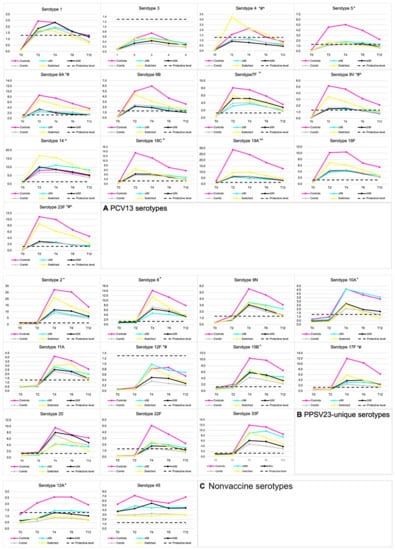
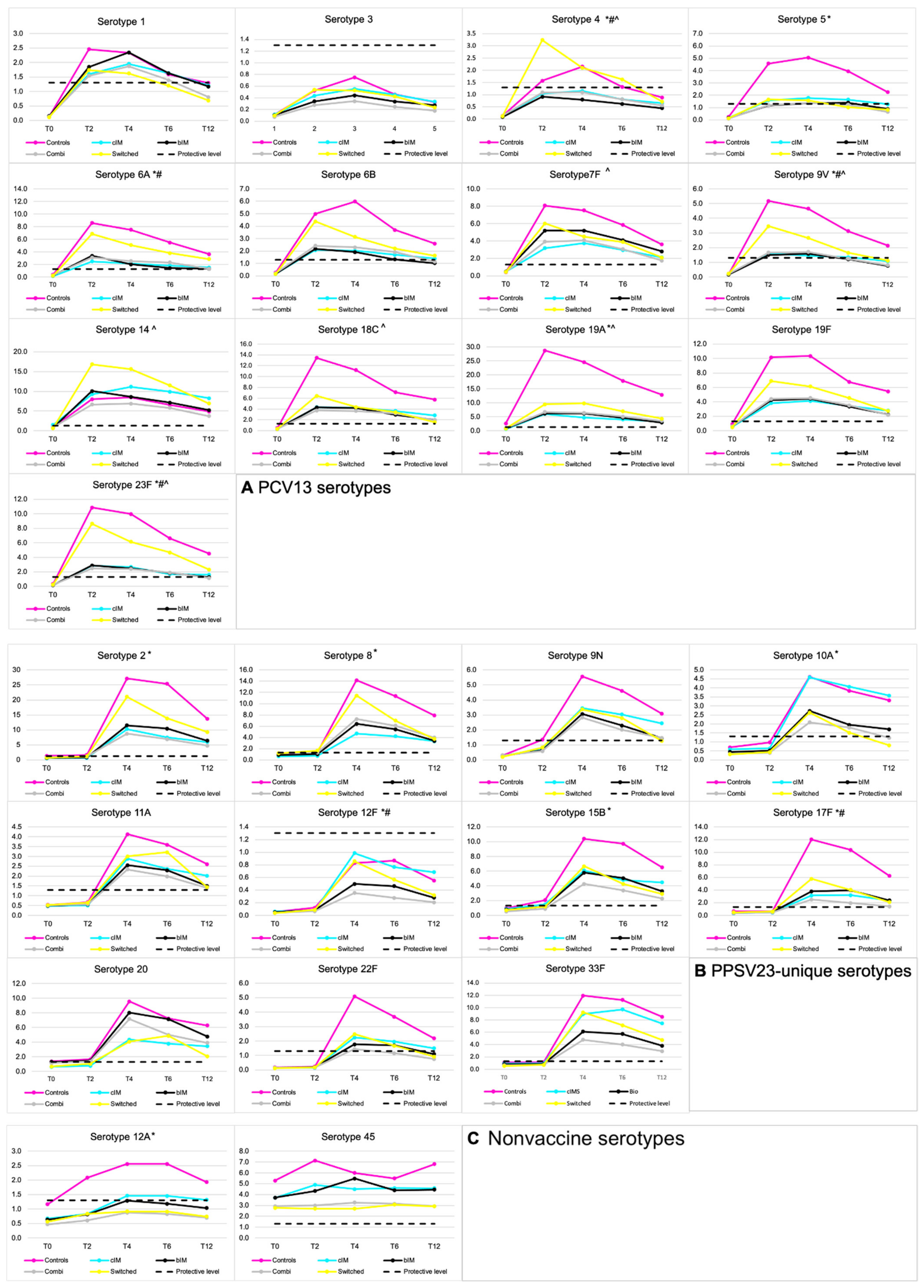
For all vaccine serotypes, GMCs increased significantly over time. Peak concentrations for PCV13 serotypes were achieved at T2 or T4 and exceeded the protective cut-off, except for serotype 3. Peak GMFRs ranged from 3.9 to 31. Between T4 and T12, GMCs declined but remained significantly higher compared with baseline (GMFRs between 2.4 and 14). For several serotypes, GMCs dropped below the protective cut-off by the end of the follow-up for at least one of the study groups (serotypes 1,4, 5, 6B, 9V, 23F) (Figure 4A, Supplementary Materials Table S4).
Figure 4.
Serotype-specific GMCs over time for serotypes present in PCV13 (A), PPSV23 only (B), and two nonvaccine control serotypes (C). * Indicates statistically significant effect (p < 0.05) of treatment groups on geometric mean concentrations. # Indicates significant interaction effect of time point * treatment group on geometric mean concentration. ^ Indicates the presence of PPSV23 hyporesponse (absence of significant increase following PPSV23). cIM = conventional immunomodulator. bIM = biological immunomodulator. PCV13 = 13-valent pneumococcal conjugate vaccine. PPSV23 = 23-valent pneumococcal polysaccharide vaccine. T = time point in months from enrollment.
For PPSV23-unique serotypes, peak concentrations were achieved at T4 and exceeded the protective cut-off for all serotypes except 12F, with peak GMFRs ranging from 4.7 to 32. Between T4 and T12, GMCs declined but remained higher compared with baseline, with GMFRs between 2.9 and 12. At month 12, GMCs remained above the protective level for all PPSV23-unique serotypes in all treatment groups except for serotypes 10A and 22F (Figure 4B, Supplementary Materials Table S4).
3.4. Safety
No cases of IPD or pneumococcal pneumonia occurred during the study period. No SAEs related to vaccination occurred (Table S5). Vaccination was well tolerated as only mild side effects were reported after vaccination in 38% of the participants. Overall, 7% of the participants reported exacerbations of their underlying autoimmune diseases during the study period of 12 months, but these were not temporally associated with vaccination.
4. Discussion
In this prospective study, the immunogenicity of the recommended pneumococcal vaccination schedule combining PCV13 and PPSV23 among patients using immunosuppressive medication was investigated. Vaccination was safe and immunogenic with seroprotection rates and GMCs increasing significantly for all pneumococcal serotypes in both treatment groups and controls. However, in all treatment groups, the peak seroprotection rates following vaccination (44%–60%) were impaired compared with controls (82%), and GMCs were lower for 12/24 (50%) of vaccine serotypes. Our data are in line with a prior study investigating the recommended vaccination schedule among patients with inflammatory bowel disease (IBD: protection of 81% in controls and 52%–63% in medication groups) [5] and a small study in rheumatoid arthritis patients (protection of 55%–63%). Both studies used the same correlate of protection as the present study. Much higher protection rates (>87%) are reported in studies using the 0.35 µg/mL WHO cut-off [11,12]. However, data from clinical studies have pointed out that the WHO cut-off is likely too low, leading to an overestimation of vaccine efficacy against IPD, especially in adults [16,17,18,19,20].
4.1. The Effect of Different Immunosuppressive Agents on Seroprotection
We found that patients on combination therapy had the lowest protection rate (44%), while protection rates did not significantly differ between patients on cIM and bIM monotherapy. This has been reported in previous studies among patients with IBD [5,21]. The use of methotrexate was an independent predictor of poor seroprotection after vaccination in this study, corresponding with findings from prior research [10,22,23]. This may be due to the broad and less specific mechanism of action of methotrexate, limiting the expansion of all lymphocyte populations by inhibiting folic acid metabolism [24]. In line with previous literature, the use of anti-CD20 therapy, resulting in B-cell depletion, was evidently associated with a very poor humoral response to vaccination (6%) [10,12]. The history of pneumococcal vaccination has been found to be protective against severe bacterial infections in patients using rituximab (OR, 0.11; 95% CI, 0.03–0.41), emphasizing the importance of vaccination prior to initiation of anti-CD20 therapy [25]. Last, the poor seroprotection in solid organ transplant recipients likely has a multifactorial cause, such as the use of triple immunosuppressive therapy, higher rates of comorbidities, and an impaired kidney function, the latter of which increases both the risk of pneumococcal infections and nonresponse to vaccination [4,26]. Vaccination of patients on the waiting list for transplantation should thus be recommended.
Interestingly, we found significantly higher short-term responses for PCV13 serotypes for the switched group compared with other treatment groups, although responses were still lower than for controls during the entire study. This is relevant, as there is not always enough time to postpone immunosuppressive treatment until after the entire pneumococcal vaccination schedule has been completed. Based on our results, we would then recommend to only administer PPSV23 instead of the combined schedule.
4.2. Different Pneumococcal Vaccination Schedules
PCV induces immunological memory, contrary to PPSV23 that only elicits a (T-cell-independent) plasma cell response. However, contrary to expectations, prior studies have demonstrated that the immunogenicity of a single PCV dose in patients using immunosuppressive drugs is relatively similar to that of PPSV23 [5,26]. This may be due to immunosuppressive medication impairing T-helper cell responses needed for an adequate response to PCV. The value of PCV in immunocompromised patients could be to overcome initial low responses by the administration of multiple doses of PCV to enhance immune maturation and development of memory B cells [16,27,28]. It would be of interest to investigate whether an additional PCV13 dose improves the primary response to pneumococcal vaccination in solid organ transplant recipients and patients using combination therapy or methotrexate, as these were at risk of nonresponse to vaccination in the present study. Considering the increase in incidence of non-PCV13 serotypes as a cause of IPD, this strategy may be expanded to include a novel 20-valent pneumococcal conjugate vaccine that was recently approved by the Food and Drug Administration. Another 24-valent candidate vaccine is under investigation. Future studies should focus on the immunogenicity, duration of seroprotection, and cost-effectiveness of these novel vaccines as a single dose, in multiple doses, or in series with PPSV23 among patients using immunosuppressive drugs, as compared with PCV13/PPSV23 and PPSV23 alone.
The benefits of the PCV13/PPSV23 combined vaccination schedule compared with PPSV23 alone are controversial. In a randomized controlled trial directly comparing PPSV23 with PCV7/PPSV23 in liver transplant recipients, priming with PCV7 did not enhance the immunogenicity for seven serotypes contained in both vaccines [11]. On the other hand, a retrospective clinical study among U.S. veterans with inflammatory bowel disease demonstrated a protective effect against pneumococcal disease of PCV+PPSV23 and PCV alone, but not of PPSV23 [29]. In addition, in the present study, we also report higher seroprotection rates compared with studies investigating single PCV/PPSV23 vaccination, despite hyporesponsiveness (i.e., the absence of an IgG increase following PPSV23 vaccination) for 7/13 PCV13 serotypes. A meta-analysis including 764 patients with autoimmune diseases using immunosuppressive drugs reported a response rate (≥2-fold increase for serotype 6B + 23F) of 26% for PCV and 37% for PPSV23 [10]. When using the same definition of protection in a post hoc analysis, we found a protection rate of 77%–82%. Taken together, clinical and seroprotection data point towards superiority of the combined schedule.
4.3. Duration of Protection
The duration of protection is lower in patients using immunosuppressive drugs versus controls, mainly due to a lower primary response to vaccination, as waning of protection occurred at the same rate in all medication groups and controls (10%–19% decrease in protection by month 12). Further decay of protection (3 years after initial vaccination) is currently being investigated in the same cohort. Data on duration of protection after pneumococcal vaccination among patients using immunosuppressive drugs are scarce. One study in organ transplant recipients reported a decrease in protection of 21% over 3 years (n = 47), without differences between PCV and PPSV23 [30]. Another study in rheumatoid arthritis patients reported that within 2 years after PCV13 + PPSV23, neutralizing antibody titers had decreased significantly and even below baseline levels [31]. Altogether, evidence suggests that seroprotection following vaccination may not last for 5 years, and that a single dose of PCV in series with PPSV23 may not improve the duration of protection. If the combined vaccination schedule were to be maintained, accelerating the PPSV23 booster vaccination to 3 instead of 5 years could be considered, especially for patients with predictors for nonresponse at the time of vaccination, such as solid organ transplant recipients. Alternatively, strategies to augment the primary response to vaccination, such as additional PCV doses, should be investigated. Lastly, monitoring of pneumococcal IgG levels from 1 year after vaccination and antibody-directed booster vaccinations may be an option, although this might not be feasible in all settings.
A limitation of this study was that it was not powered to assess clinical endpoints. In addition, correlates of protection for IPD remain controversial. The correlate of protection used in this study was rather conservative and may have led to an underestimation of protection. We therefore also analyzed and reported GMC data.
5. Conclusions
Pneumococcal vaccination with PCV13 followed by PPSV23 was safe and immunogenic in patients using immunosuppressive medication and controls, with seroprotection rates and GMCs increasing significantly for all vaccine serotypes. However, as seroprotection was significantly impaired in patients using immunosuppressive medication, vaccination prior to the start of immunosuppressive treatment or organ transplantation is highly recommended. In addition, due to waning immunity, an earlier-than-5-year PPSV23 booster should be considered. Future studies must elucidate whether additional doses of PCV13 or higher-valent pneumococcal vaccines are beneficial for patients at risk of poor protection after vaccination, such as solid organ transplant recipients.
Supplementary Materials
The following supporting information can be downloaded at: https://www.mdpi.com/article/10.3390/vaccines10050795/s1, Table S1. Seroprotection rates excluding anti-CD20 therapy (sensitivity analysis); Table S2. Serotype specific seroprotection rates for each time point and results of generalized linear mixed model including time point, use of immunosuppressive medication at baseline and the interaction term of the two variables; Table S3. Factors associated with seroprotection (all serotypes) over time (multivariable generalized linear mixed model); Table S4. Geometric mean concentrations and geometric mean fold rises compared to baseline; Table S5. Overview of serious adverse events.
Author Contributions
A.V., M.P.G., G.J.d.B., A.G., H.M.G.G. and B.M. conceived the study and wrote the study protocol. G.R.D., P.I.S., F.J.B. and H.M.G.G. were responsible for participant flow and follow-up of patients. H.M.G.G. performed data collection. B.M. and H.M.G.G. were responsible for the laboratory analyses. M.W.T. and H.M.G.G. performed the statistical analyses. H.M.G.G. and A.G. wrote the first version of the manuscript. All authors have read and agreed to the published version of the manuscript.
Funding
This work was supported by a public research grant of The Netherlands Organisation for Health Research and Development (ZonMw), grant number 522004005. The funder of the study had no role in the study design, data collection, data analysis, data interpretation, or writing of the report. The corresponding author had full access to all the data in the study and had final responsibility for the decision to submit for publication.
Institutional Review Board Statement
The study was conducted in accordance with the Declaration of Helsinki, and approved by the Ethics Committee of the Amsterdam University Medical Centers, Location AMC (protocol code NL65687.018.18 date of approval 25 June 2018).
Informed Consent Statement
Informed consent was obtained from all subjects involved in the study.
Data Availability Statement
Data available with corresponding author upon reasonable request.
Acknowledgments
The authors would like to thank the analysts Erik Beij, Ben de Jong, and Anne Reiners from the Department of Immunology at the St. Antonius Hospital Nieuwegein for the assistance with the laboratory assessments. In addition, the authors thank the nurses working at the Center for Tropical Medicine and Travel Medicine for the administration of vaccines to the study population.
Conflicts of Interest
None of the authors report competing interests.
References
- Van Aalst, M.; Lötsch, F.; Spijker, R.; van der Meer, J.T.; Langendam, M.W.; Goorhuis, A.; Grobusch, M.P.; de Bree, G.J. Incidence of invasive pneumococcal disease in immunocompromised patients: A systematic review and meta-analysis. Travel Med. Infect. Dis. 2018, 24, 89–100. [Google Scholar] [CrossRef] [Scilit] [PubMed]
- Shigayeva, A.; Rudnick, W.; Green, K.; Chen, D.K.; Demczuk, W.; Gold, W.L.; Johnstone, J.; Kitai, I.; Krajden, S.; Lovinsky, R.; et al. Invasive Pneumococcal Disease Among Immunocompromised Persons: Implications for Vaccination Programs. Clin. Infect. Dis. 2016, 62, 139–147. [Google Scholar] [CrossRef] [Scilit] [PubMed]
- Schurder, J.; Goulenok, T.; Jouenne, R.; Dossier, A.; Van Gysel, D.; Papo, T.; Sacre, K. Pneumococcal infection in patients with systemic lupus erythematosus. Jt. Bone Spine 2018, 85, 333–336. [Google Scholar] [CrossRef] [Scilit] [PubMed]
- Di Pasquale, M.F.; Sotgiu, G.; Gramegna, A.; Radovanovic, D.; Terraneo, S.; Reyes, L.F.; Rupp, J.; González del Castillo, J.; Blasi, F.; Aliberti, S.; et al. Prevalence and Etiology of Community-acquired Pneumonia in Immuno-compromised Patients. Clin. Infect. Dis. 2019, 68, 1482–1493. [Google Scholar] [CrossRef] [Scilit] [PubMed]
- Van Aalst, M.; Garcia Garrido, H.M.; Van Der Leun, J.; Meek, B.; Van Leeuwen, E.M.; Löwenberg, M.; D’haens, G.R.; Ponsioen, C.Y.; Grobusch, M.P.; Goorhuis, A.; et al. Immunogenicity of the currently recommended pneumococcal vaccination schedule in patients with inflammatory bowel disease. Clin. Infect. Dis. 2020, 70, 595–604. [Google Scholar] [CrossRef] [Scilit] [PubMed]
- Garcia Garrido, H.M.; Veurink, A.M.; Leeflang, M.; Spijker, R.; Goorhuis, A.; Grobusch, M.P. Hepatitis A vaccine immunogenicity in patients using immunosuppressive drugs: A systematic review and meta-analysis. Travel Med. Infect. Dis. 2019, 32, 101479. [Google Scholar] [CrossRef] [Scilit] [PubMed]
- Lopez, A.; Mariette, X.; Bachelez, H.; Belot, A.; Bonnotte, B.; Hachulla, E.; Lahfa, M.; Lortholary, O.; Loulergue, P.; Paul, S.; et al. Vaccination recommendations for the adult immunosuppressed patient: A systematic review and comprehensive field synopsis. J. Autoimmun. 2017, 80, 10–27. [Google Scholar] [CrossRef] [Scilit] [PubMed]
- Rubin, L.G.; Levin, M.J.; Ljungman, P.; Davies, E.G.; Avery, R.; Tomblyn, M.; Bousvaros, A.; Dhanireddy, S.; Sung, L.; Keyserling, H.; et al. 2013 IDSA clinical practice guideline for vaccination of the immunocompromised host. Clin. Infect. Dis. 2014, 58, 309–318. [Google Scholar] [CrossRef] [Scilit]
- Jackson, L.A.; Gurtman, A.; van Cleeff, M.; Frenck, R.W.; Treanor, J.; Jansen, K.U.; Scott, D.A.; Emini, E.A.; Gruber, W.C.; Schmoele-Thoma, B. Influence of initial vaccination with 13-valent pneumococcal conjugate vaccine or 23-valent pneumococcal polysaccharide vaccine on anti-pneumococcal responses following subsequent pneumococcal vaccination in adults 50 years and older. Vaccine 2013, 31, 3594–3602. [Google Scholar] [CrossRef] [Scilit]
- Van Aalst, M.; Langedijk, A.C.; Spijker, R.; de Bree, G.J.; Grobusch, M.P.; Goorhuis, A. The effect of immunosuppressive agents on immunogenicity of pneumococcal vaccination: A systematic review and meta-analysis. Vaccine 2018, 36, 5832–5845. [Google Scholar] [CrossRef] [Scilit]
- Kumar, D.; Chen, M.H.; Wong, G.; Cobos, I.; Welsh, B.; Siegal, D.; Humar, A. A Randomized, Double-Blind, Placebo-Controlled Trial to Evaluate the Prime-Boost Strategy for Pneumococcal Vaccination in Adult Liver Transplant Recipients. Clin. Infect. Dis. 2008, 47, 885–892. [Google Scholar] [CrossRef] [Scilit] [PubMed]
- Nguyen, M.T.; Lindegaard, H.; Hendricks, O.; Jørgensen, C.S.; Kantsø, B.; Friis-Møller, N. Initial Serological Response after Prime-boost Pneumococcal Vaccination in Rheumatoid Arthritis Patients: Results of a Randomized Controlled Trial. J. Rheumatol. 2017, 44, 1794–1803. [Google Scholar] [CrossRef] [Scilit]
- European Centre for Disease Prevention and Control. Invasive Pneumococcal Disease. In ECDC: Annual Epidemiological Report for 2018; ECDC: Stockholm, Sweden, 2020; Available online: https://www.ecdc.europa.eu/sites/default/files/documents/AER_for_2018_IPD.pdf (accessed on 16 March 2022).
- Ladhani, S.N.; Collins, S.; Djennad, A.; Sheppard, C.L.; Borrow, R.; Fry, N.K.; Andrews, N.J.; Miller, E.; Ramsay, M.E. Rapid increase in non-vaccine serotypes causing invasive pneumococcal disease in England and Wales, 2000–2017: A prospective national observational cohort study. Lancet Infect. Dis. 2018, 18, 441–451. [Google Scholar] [CrossRef] [Scilit]
- Stuck, A.E.; Minder, C.E.; Frey, F.J. Risk of Infectious Complications in Patients Taking Glucocorticosteroids. Clin. Infect. Dis. 1989, 11, 954–963. [Google Scholar] [CrossRef] [Scilit]
- Garrido, H.M.G.; Haggenburg, S.; Schoordijk, M.C.E.; Meijer, E.; Tanck, M.W.T.; Hazenberg, M.D.; Rutten, C.E.; de Bree, G.J.; Nur, E.; Meek, B.; et al. Immunogenicity of a 5-dose pneumococcal vaccination schedule following allogeneic hematopoietic stem cell transplantation. Am. J. Hematol. 2022. Online ahead of print. [Google Scholar] [CrossRef] [Scilit]
- Orange, J.S.; Ballow, M.; Stiehm, E.R.; Ballas, Z.; Chinen, J.; De La Morena, M.; Kumararatne, D.; Harville, T.O.; Hesterberg, P.; Koleilat, M.; et al. Use and interpretation of diagnostic vaccination in primary immunodeficiency: A working group report of the Basic and Clinical Immunology Interest Section of the American Academy of Allergy, Asthma & Immunology. J. Allergy Clin. Immunol. 2012, 130 (Suppl. S3), S1–S24. [Google Scholar] [CrossRef] [Scilit]
- Andrews, N.J.; Waight, P.A.; Burbidge, P.; Pearce, E.; Roalfe, L.; Zancolli, M.; Slack, M.; Ladhani, S.N.; Miller, E.; Goldblatt, D. Serotype-specific effectiveness and correlates of protection for the 13-valent pneumococcal conjugate vaccine: A postlicensure indirect cohort study. Lancet Infect. Dis. 2014, 14, 839–846. [Google Scholar] [CrossRef] [Scilit]
- Bonten, M.J.M.; Huijts, S.M.; Bolkenbaas, M.; Webber, C.; Patterson, S.; Gault, S.; van Werkhoven, C.H.; Van Deursen, A.M.M.; Sanders, E.A.M.; Verheij, T.J.M.; et al. Polysaccharide Conjugate Vaccine against Pneumococcal Pneumonia in Adults. N. Engl. J. Med. 2015, 372, 1114–1125. [Google Scholar] [CrossRef] [Scilit]
- Sorensen, R.U.; Leiva, L.E.; Javier, F.C.; Sacerdote, D.M.; Bradford, N.; Butler, B.; Giangrosso, P.A.; Moore, C. Influence of age on the response to Streptococcus pneumoniae vaccine in patients with recurrent infections and normal immunoglobulin concentrations. J. Allergy Clin. Immunol. 1998, 102, 215–221. [Google Scholar] [CrossRef] [Scilit]
- Fiorino, G.; Peyrin-Biroulet, L.; Naccarato, P.; Szabò, H.; Sociale, O.R.; Vetrano, S.; Fries, W.; Montanelli, A.; Repici, A.; Malesci, A.; et al. Effects of immunosuppression on immune response to pneumococcal vaccine in inflammatory bowel disease: A prospective study. Inflamm. Bowel Dis. 2012, 18, 1042–1047. [Google Scholar] [CrossRef] [Scilit]
- Kapetanovic, M.C.; Nagel, J.; Nordstrom, I.; Saxne, T.; Geborek, P.; Rudin, A. Methotrexate reduces vaccine-specific immunoglobulin levels but not numbers of circulating antibody-producing B cells in rheumatoid arthritis after vaccination with a conjugate pneumococcal vaccine. Vaccine 2017, 35, 903–908. [Google Scholar] [CrossRef] [Scilit]
- Kapetanovic, M.C.; Roseman, C.; Jonsson, G.; Truedsson, L.; Saxne, T.; Geborek, P. Antibody response is reduced following vac-cination with 7-valent conjugate pneumococcal vaccine in adult methotrexate-treated patients with established arthritis, but not those treated with tumor necrosis factor inhibitors. Arthritis Rheum. 2011, 63, 3723–3732. [Google Scholar] [CrossRef] [Scilit] [PubMed]
- Brown, P.M.; Pratt, A.; Isaacs, J. Mechanism of action of methotrexate in rheumatoid arthritis, and the search for biomarkers. Nat. Rev. Rheumatol. 2016, 12, 731–742. [Google Scholar] [CrossRef] [Scilit] [PubMed]
- Heusele, M.; Clerson, P.; Guery, B.; Lambert, M.; Launay, D.; Lefevre, G.; Morell-Dubois, S.; Maillard, H.; Le Gouellec, N.; Hatron, P.Y.; et al. Risk factors for severe bacterial infections in patients with systemic autoimmune diseases receiving rituximab. Clin. Rheumatol. 2014, 33, 799–805. [Google Scholar] [CrossRef] [Scilit]
- Kumar, D.; Rotstein, C.; Miyata, G.; Arlen, D.; Humar, A. Randomized, double-blind, controlled trial of pneumococcal vaccination in renal transplant recipients. J. Infect. Dis. 2003, 187, 1639–1645. [Google Scholar] [CrossRef] [Scilit]
- Barton, M.; Wasfy, S.; Dipchand, A.I.; Hébert, D.; Ng, V.; Solomon, M.; Fecteau, A.; Stephen, D.; Allen, U. Seven-valent pneumococcal conjugate vaccine in pediatric solid organ transplant recipients: A prospective study of safety and immunogenicity. Pedr. Infect. Dis. J. 2009, 28, 688–692. [Google Scholar] [CrossRef] [Scilit]
- Cordonnier, C.; Ljungman, P.; Juergens, C.; Maertens, J.; Selleslag, D.; Sundaraiyer, V.; Giardina, P.C.; Clarke, K.; Gruber, W.C.; Scott, D.A.; et al. Immunogenicity, safety, and tolerability of 13-valent pneumococcal conjugate vaccine followed by 23-valent pneumococcal polysaccharide vaccine in recipients of allogeneic hematopoietic stem cell transplant aged >/=2 years: An open-label study. Clin. Infect. Dis. 2015, 61, 313–323. [Google Scholar] [CrossRef] [Scilit]
- Love, B.L.; Finney, C.J.; Gaidos, J.K.J. Effectiveness of Conjugate and Polysaccharide Pneumococcal Vaccines for Prevention of Severe Pneumococcal Disease Among Inflammatory Bowel Disease Patients. J. Crohn’s Colitis 2021, 15, 1279–1283. [Google Scholar] [CrossRef] [Scilit]
- Kumar, D.; Welsh, B.; Siegal, D.; Chen, M.H.; Humar, A. Immunogenicity of pneumococcal vaccine in renal transplant recipients—Three year follow-up of a randomized trial. Am. J. Transpl. 2007, 7, 633–638. [Google Scholar] [CrossRef] [Scilit]
- Bahuaud, M.; Beaudouin-Bazire, C.; Husson, M.; Molto, A.; Launay, O.; Batteux, F.; Dougados, M. Immunogenicity and persistence of a prime-boost re-vaccination strategy for pneumococcal vaccines in patients with rheumatoid arthritis. Hum. Vaccines Immunother. 2018, 14, 1464–1470. [Google Scholar] [CrossRef] [Scilit]

Publisher’s Note: MDPI stays neutral with regard to jurisdictional claims in published maps and institutional affiliations. |
© 2022 by the authors. Licensee MDPI, Basel, Switzerland. This article is an open access article distributed under the terms and conditions of the Creative Commons Attribution (CC BY) license (https://creativecommons.org/licenses/by/4.0/).