


Abstract
Background: Human papillomavirus (HPV) vaccines can effectively prevent cervical cancer; however, HPV vaccine implementation in China lags nearly a decade behind many countries. Rural areas face particularly low cervical cancer screening rates and even more limited vaccine uptake. As vaccination coverage increases among the predominantly adult female population, the prevalence and genotype distribution of HPV are expected to shift. This study aimed to provide real-world evidence on vaccination coverage and its relationship with HPV infection patterns in a resource-limited suburban Chinese population. Methods: This retrospective study analyzed outpatient HPV testing data from a suburban county hospital in China from 2018 to 2024. Vaccination histories were verified through the national immunization information system, supplemented by on-site questionnaire surveys. HPV genotyping was performed for 21 HPV types. Age-stratified analyses (≤45 and ≥46 years) were conducted to evaluate genotype-specific trends, and odds ratios (ORs) with 95% confidence intervals (CIs) were calculated to assess vaccine protective effects. Results: Among 19,057 eligible outpatient females aged ≤45 years, the HPV vaccination rate increased from 0.34% in 2018 to 57.47% in 2024 (χ2 = 4986.046, p < 0.001), with a full-course vaccination rate of 93.38%. Nine-valent vaccine-type HPV positivity decreased from 10.95% in 2018 to 6.72% in 2024 (relative reduction 38.7%, 95% CI 18.5–53.8), and non-vaccine-type positivity decreased from 13.38% to 6.21% (relative reduction 53.6%, 95% CI 40.1–64.1); the larger decline in non-vaccine types suggests that temporal changes in the tested population also contribute to these trends. Among females aged ≤45 years, vaccine-covered types (HPV-16, -33, -45, -52, -58) and non-vaccine types (HPV-39, -53, -73, -51, -56, -59, -68) showed significant declining trends (p < 0.05). Vaccinated females had significantly lower positivity rates for HPV-6, -11, -16, -33, -52, and -45 compared with unvaccinated females (OR range: 0.333–0.838), with smaller reductions for HPV-18 and for the non-vaccine types HPV-73, -39, and -59 that warrant further investigation. The predominant high-risk types among unvaccinated females were HPV-52 (3.36%), HPV-16 (2.32%), and HPV-58 (1.90%). Conclusions: HPV vaccination coverage among outpatient females increased substantially from 2018 to 2024, accompanied by declines in positivity for vaccine and non-vaccine types; because non-vaccine-type positivity also fell substantially, these ecological trends cannot be attributed to vaccination alone. After adjustment for age and calendar year, vaccination remained associated with lower positivity for vaccine-covered genotypes, whereas no association was observed for non-vaccine types; the findings for individual non-vaccine genotypes therefore do not provide evidence of cross-protection. High-prevalence genotypes including HPV-53, -39, -51, -66, -68, and -56 remain uncovered by current vaccines, highlighting the need for next-generation higher-valency vaccines that address locally prevalent genotypes.
1. Introduction
Human papillomavirus (HPV) infection is the primary causative agent of cervical cancer and other mucosal diseases, including genital warts. High-risk HPV types, particularly HPV-16 and HPV-18, are responsible for approximately 70% of cervical cancer cases worldwide; the nine-valent vaccine, which also covers HPV-31, -33, -45, -52, and -58, accounts for close to 90% of cases. Since the first HPV vaccine was licensed in 2006, vaccines have been widely deployed globally as a key preventive measure against HPV-related diseases. Clinical trials have confirmed their efficacy and safety, and accumulating real-world evidence from high-income and low- and middle-income settings has further documented population-level impact. Nevertheless, real-world data from suburban and rural China—where vaccination rollout has been relatively recent and predominantly targets adult women—remain essential for refining local cervical cancer prevention strategies and achieving global cervical cancer elimination.
The year 2025 marks a pivotal moment in China’s HPV prevention landscape. The country officially incorporated HPV vaccination into the National Immunization Program [1], recommending that girls born after 10 November 2011, receive HPV vaccination upon reaching age 13. Prior to this policy, the primary vaccine recipients were adult women aged ≤45 years. This study selected outpatient populations from a suburban county public hospital in China, whose attendees predominantly reside in the local county, providing a stable population with regular cervical cancer screening access and subsequent clinical management. The study population represents the real-world situation in resource-limited rural China.
HPV vaccination was introduced relatively late in China, and the vaccinated population skewed older, with pre-vaccination HPV testing not routinely performed. This study analyzed the relationship between female HPV vaccination and population HPV infection patterns in a suburban hospital setting, using the national health information system to verify vaccination histories supplemented by on-site outpatient questionnaires. Detailed study endpoints and analytical approaches are described in Section 2.
2. Materials and Methods
2.1. Study Population
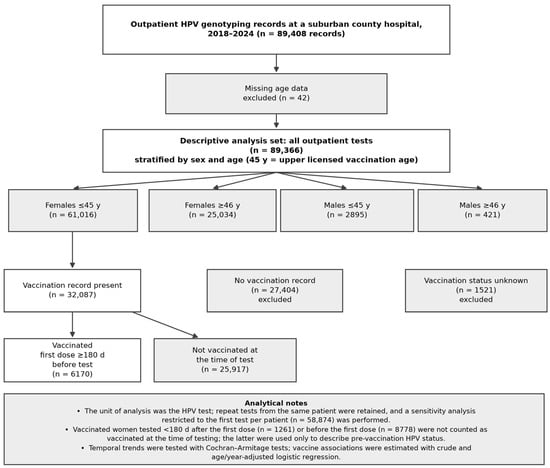
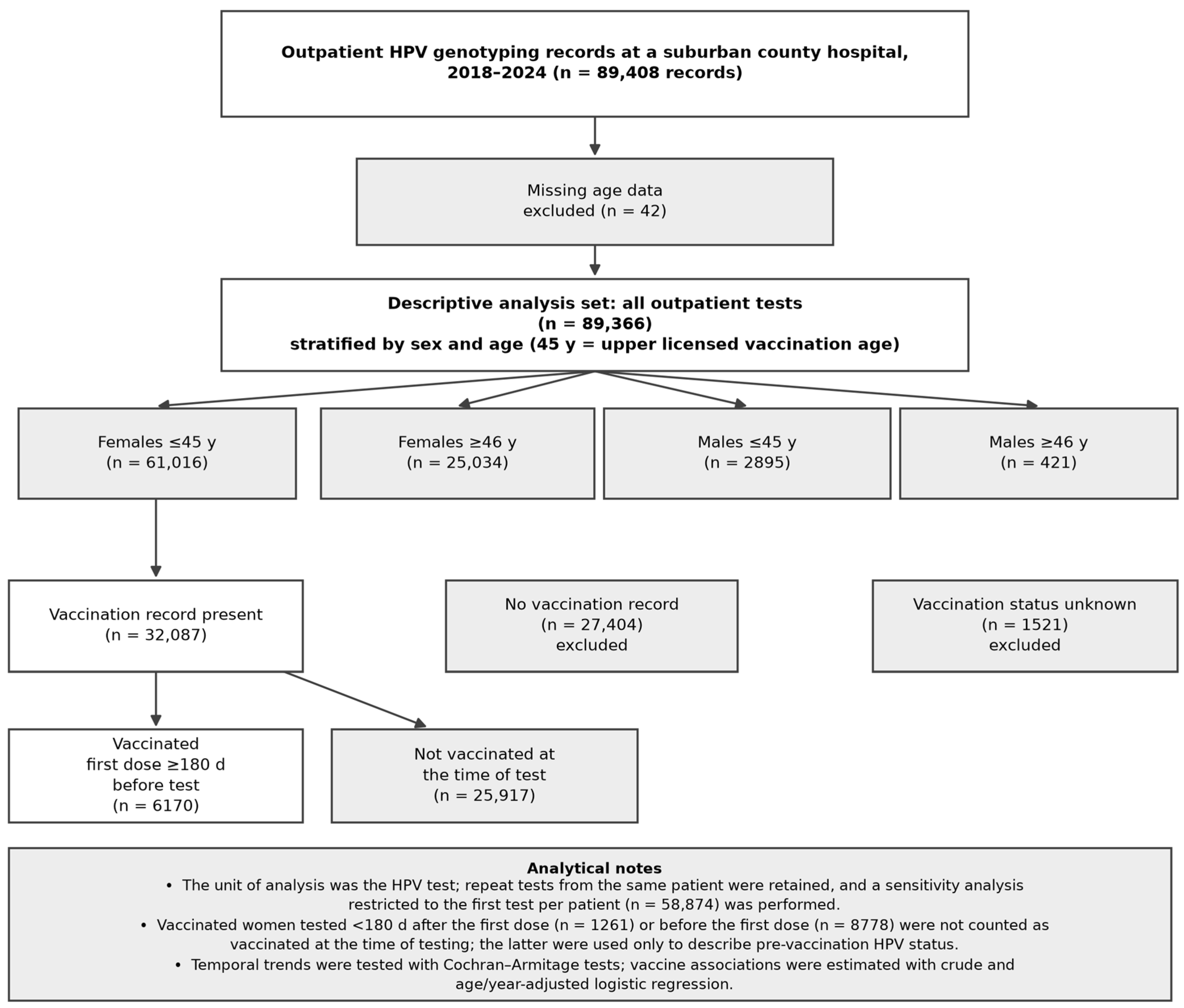
This study was approved by the Ethics Committee of Jiangning Hospital Affiliated with Nanjing Medical University (Approval No. 2021-03-004-K01). The study comprised two interconnected populations: (1) a retrospective cohort of all outpatients who underwent HPV genotyping at the hospital between January 2018 and December 2024 and (2) a prospective vaccination safety surveillance cohort recruited from HPV vaccine recipients at the hospital’s vaccination clinic in 2020, who provided oral informed consent for anonymous survey participation (Figure 1). Inclusion criteria for the HPV testing cohort were: (a) outpatient visit at the study hospital; (b) HPV genotyping performed during the study period; and (c) age ≥ 16 years. Exclusion criteria were: (a) missing age data (n = 42); (b) for vaccination analyses, absence of any vaccination record in the immunization information system or an indeterminate vaccination status. The unit of analysis for the descriptive analyses was the HPV test; 14,990 of the 61,016 tests in females aged ≤45 years were repeat tests (24.6%), and a sensitivity analysis restricted to the first test per patient was performed. The primary vaccine effectiveness analysis was restricted to females aged ≤45 years. Male outpatient data were included only for descriptive trend analysis and were not included in vaccine effectiveness analyses.
Figure 1.
Flow chart of study population selection and analytical groups (HPV testing cohort, 2018–2024).
2.2. Methods
2.2.1. Calculation of HPV Vaccination Rate and Determination of Vaccination History
Vaccination status was defined as follows: females aged ≤45 years with HPV vaccination records in the health information system were classified as “vaccinated”; those with other vaccination records but no HPV vaccination records were classified as “unvaccinated”; those with no vaccination records of any kind were excluded from both groups. The vaccination rate was calculated as (number of vaccinated individuals)/(vaccinated + unvaccinated) × 100%. Vaccination history was defined as having a clear HPV vaccination record with the first dose administered ≥180 days prior to HPV testing. Those with <180 days since the first dose, or whose test preceded the first dose, were not counted as vaccinated at the time of testing and were retained in the reference group. Individuals with no vaccination record of any kind were excluded from both groups.
2.2.2. Active Surveillance of Adverse Events and Questionnaire on Incomplete Vaccination
Recipients were observed for local and systemic suspected adverse reactions within 30 min post-vaccination, followed by telephone or online follow-up within 2 weeks. The health information system was queried for complete dose records, and telephone follow-up was conducted after one year to verify incomplete vaccination status and reasons.
2.2.3. HPV Genotyping and Age Stratification
HPV genotyping was performed using a commercially available PCR-based kit (Jiangsu Shuoshi Biotechnology Co., Ltd., Taizhou, China) that detects 21 types: 6, 11, 81, 26, 53, 66, 73, 82, 16, 18, 31, 33, 52, 58, 45, 35, 39, 51, 56, 59, and 68. Cervical exfoliated cell samples were collected by trained clinicians using standard cervical sampling brushes. For male patients, urethral or anal swabs were collected by clinicians according to clinical indications. All samples were transported to the hospital’s central laboratory within 4 h of collection and processed within 24 h. Subjects were divided into two age groups (≤45 and ≥46 years). Only data from 2018 to 2024 were analyzed.
2.2.4. Data Processing and Quality Control
Pre-surveys and pilot analyses were conducted before the main investigation. Surveyors received standardized training. Laboratory quality control for HPV genotyping followed national standards. The study used blinding—neither participants nor surveyors knew group assignments. Data were entered into Excel (Microsoft Corp., Redmond, WA, USA) and statistically analyzed using SPSS 26.0 (IBM Corp., Armonk, NY, USA). Continuous variables are presented as mean ± standard deviation (SD) and compared using Student’s t-test or one-way ANOVA, as appropriate. Categorical variables are presented as frequencies and percentages and compared using Pearson’s χ2 test or Fisher’s exact test where expected cell counts were <5. Temporal trends in HPV positivity rates across study years were assessed using the Cochran–Armitage trend test (χ2 trend). Vaccine effectiveness was estimated using crude (unadjusted) odds ratios (ORs) with 95% confidence intervals (CIs), calculated by comparing HPV positivity rates between vaccinated (≥180 days post-first dose) and unvaccinated females. Age- and year-adjusted odds ratios (aORs) were estimated by multivariable logistic regression with continuous age and calendar year as covariates. A sensitivity analysis restricted to the first test per patient was also conducted, and age-standardized positivity rates were obtained by direct standardization to the pooled 2018–2024 age distribution of females aged ≤45 years. Genotype-specific comparisons were performed for individual HPV types, without formal adjustment for multiple testing. Additional models adjusted for vaccine product and for categorical time since vaccination, product-specific models compared each vaccine type with unvaccinated women, and separate models examined the probability that a test was a repeat test (Section 3.5). All statistical tests were two-sided, and the significance level was set at α = 0.05.
3. Results
3.1. Vaccination Status of Outpatient Females
3.1.1. Vaccination Age Distribution
From 2018 to 2024, 8082 eligible females received HPV vaccination. Mean age at first dose differed significantly across vaccine products (F = 417.889, p < 0.001; Table 1), with the lowest mean age among Gardasil 9 recipients, a pattern that is likely related to the expansion of the Gardasil 9 indicated age range in China in 2022.
Table 1.
Age distribution of female HPV vaccine recipients, 2018–2024.
3.1.2. Vaccination Rate and First-Dose Vaccine Type Composition
From 2018 to 2024, 19,057 outpatient females aged ≤45 years underwent HPV testing, of whom 8082 were vaccinated (vaccination rate: 42.41%). The annual vaccination rates were 0.34% (1/293), 5.71% (155/2714), 10.77% (646/5999), 20.06% (1526/7606), 34.98% (1929/5514), 52.13% (2980/5716), and 57.47% (1984/3452), showing a significant increasing trend (χ2 = 4986.046, p < 0.001). Gardasil predominated before 2022, while Gardasil 9 became dominant after 2023. The domestically produced Cecolin® vaccine reached its highest share in 2022 (Table 2).
Table 2.
First-dose vaccine type composition among outpatient females, 2018–2024.
3.1.3. Active Surveillance of Adverse Events
In 2020, 1242 women were actively monitored for suspected adverse reactions following the first HPV vaccine dose. No serious local or systemic adverse reactions occurred within 30 min. Within 2 weeks, common local reactions included mild soreness, pain, and swelling; systemic reactions primarily included fatigue, fever, dizziness, and headache. Two cases developed fever reaching 38.5 °C, and two cases experienced noticeable muscle cramping and paresthesia. One case developed systemic filiform warts. Three cases discontinued vaccination due to adverse reactions. The general adverse reaction rate was 55.6% (690/1242), and the serious adverse reaction rate was 0.40% (5/1242).
3.1.4. Full-Course Vaccination and Incomplete Vaccination Analysis
The full-course vaccination rate was 93.38% (7547/8082), with a mean completion time of 215.87 ± 50.391 days (range: 123–947 days). The incomplete vaccination rate (≥1 year without full course) was 6.62% (535/8082). Vaccine type switching occurred in 28 cases (0.35%), predominantly switching to Gardasil 9. Among 54 incomplete vaccination cases, the main reasons were: forgetting due to work/study (61.11%, 33/54), unexpected pregnancy (22.22%, 12/54), and discontinuation due to adverse events (5.56%, 3/54).
3.2. Annual HPV Positivity Rates
From 2018 to 2024, 89,366 outpatient HPV tests were analysed (the unit of analysis was the test, and repeat tests from the same patient were retained), with an overall positivity rate of 16.59% (14,829/89,366). Annual sample sizes were 574 (2018), 6041 (2019), 12,970 (2020), 16,937 (2021), 18,503 (2022), 17,472 (2023), and 16,869 (2024), with corresponding positivity rates of 24.91%, 20.58%, 15.72%, 15.32%, 17.09%, 17.76%, and 15.08%, showing a significant declining trend (χ2trend = 20.251, p < 0.001). Among those aged ≤45 years, the positivity rate was 15.63% (9992/63,911) with a declining trend (χ2trend = 4.295, p = 0.038); among those aged ≥46 years, the positivity rate was 19.00% (4837/25,455) with a declining trend (χ2trend = 27.617, p < 0.001).
3.2.1. HPV Positivity Among Outpatients Aged ≤45 Years
The HPV positivity rate among females aged ≤45 years was 13.96% (8516/61,016), with annual rates of 21.41%, 18.15%, 14.20%, 13.12%, 14.23%, 14.84%, and 11.56%, showing a significant declining trend (χ2 trend= 59.037, p < 0.001). In the same age group, 2895 males were tested with a positivity rate of 50.98% (1476/2895), with annual rates showing a declining trend (χ2trend = 7.659, p = 0.006).
Among females aged ≤45 years, bivalent, quadrivalent, 9-valent vaccine-type, and non-vaccine-type positivity rates all showed significant temporal trends (p < 0.05). Positivity for nine-valent vaccine types and for non-vaccine types both declined markedly between 2018 and 2024, and the relative reduction was at least as large for non-vaccine types as for vaccine types. Because a decline of similar magnitude was observed for types that are not covered by any licensed vaccine, this trend cannot be attributed to vaccination alone and most plausibly reflects concurrent changes in the tested population and in the reduction in high-risk groups along with the expansion of screening. Genotypes with declining trends included vaccine-covered types (HPV-16, -33, -45, -52, -58) and non-vaccine types (HPV-39, -53, -73, -51, -56, -59, -68). Among males in the same age group, HPV-6, -11, -16, and -58 showed significant declining trends (p < 0.05) (Table 3).
Table 3.
HPV positivity rates among outpatients aged ≤45 years by genotype, 2018–2024 (abbreviated).
3.2.2. HPV Positivity Among Outpatients Aged ≥46 Years
The HPV positivity rate among females aged ≥46 years was 18.24% (4567/25,034), with a declining trend (χ2 = 51.467, p < 0.001). Genotypes with declining trends included vaccine-covered types (HPV-16, -33, -52) and non-vaccine types (HPV-81, -51, -56, -68, -82). Among males aged ≥46 years, the positivity rate was 64.13% (270/421) with no significant temporal trend (χ2 = 2.252, p = 0.133), though non-vaccine types HPV-56 and -66 showed declining trends.
The top 10 HPV genotypes by positivity rate among females aged ≤45 years were: HPV-52 (2.88%), HPV-16 (2.01%), HPV-58 (1.72%), HPV-53 (1.40%), HPV-39 (1.06%), HPV-81 (1.04%), HPV-51 (0.95%), HPV-66/68 (0.93%), and HPV-56 (0.90%). Among males aged ≤45 years: HPV-6 (15.47%), HPV-11 (10.19%), HPV-52 (7.50%), HPV-16 (7.22%), and HPV-51 (5.42%). High-risk types including HPV-53, -39, -51, -66, -68, and -56 are not covered by current vaccines. Full data available in Supplementary Table S4.
3.3. Multiple HPV Infection Composition, 2018–2024
Most infections were single-type, and multiple infections were more common among males than among females and among those aged ≥46 years than among those aged ≤45 years in both sexes (p < 0.001) (Table 4).
Table 4.
Multiple HPV infection rates, 2018–2024.
3.4. Vaccination and HPV Positivity Among Eligible Outpatient Females, 2018–2024
Among 6170 tests from vaccinated females performed ≥180 days after the first dose (median interval from the first dose to testing 664.5 days, IQR 411.3–1033.0 days; median interval from the last dose to testing 457 days, IQR 194–828 days), the HPV positivity rate was 13.01% (803/6170), compared with 15.57% (4035/25,917) among tests from females who were not vaccinated at the time of testing (Table 5). Positivity was significantly lower in vaccinated females for overall HPV and for bivalent, quadrivalent and nine-valent vaccine types, with a smaller but still significant reduction for non-nine-valent types (all p < 0.05; Table 5) and the largest reduction for quadrivalent types. These crude comparisons indicate a consistent inverse association between vaccination and vaccine-type positivity, but they do not account for age or calendar year; adjusted estimates are therefore presented in Section 3.5.
Table 5.
HPV positivity rates by vaccination history among eligible outpatient females, 2018–2024 (abbreviated).
Among nine-valent vaccine-covered types, HPV-6, -11, -16, -33, -52 and -45 were significantly less frequent in vaccinated females, whereas the reduction for HPV-18 did not reach significance. Among non-nine-valent types, borderline or significant reductions were observed for HPV-73, -39 and -59 (Table 5); taken at face value these findings would suggest cross-protection, but they were not robust to adjustment for age and calendar year (Section 3.5) and should therefore be regarded as hypothesis-generating rather than as evidence of cross-protection. Table 6 summarizes the change in HPV positivity between 2018 and 2024 for each vaccine-type group.
Table 6.
Change in HPV positivity among females aged ≤45 years, 2018 versus 2024.
3.5. Sensitivity, Standardized, and Adjusted Analyses
Because the unit of analysis was the test rather than the patient, the 61,016 tests contributed by females aged ≤45 years included 14,990 repeat tests (24.6%); the remaining 46,026 were first tests and each corresponded to a different woman. In a sensitivity analysis restricted to first tests, overall positivity was 13.83% (6367/46,026), practically identical to the 13.96% obtained when all tests were analysed, and the 2018 and 2024 estimates were essentially unchanged (21.57% and 12.00%).
Direct standardization to the pooled 2018–2024 age distribution of females aged ≤45 years attenuated the temporal trends only slightly: nine-valent vaccine-type positivity decreased from 10.62% to 6.87% (relative reduction 35.3%) and non-vaccine-type positivity from 13.00% to 6.34% (51.2%), indicating that the changes were not explained by shifts in the age composition of the tested population.
In multivariable logistic regression adjusted for age and calendar year, vaccination ≥180 days before testing remained associated with lower overall HPV positivity and lower nine-valent vaccine-type positivity (Table 7, Models 1a and 1b), indicating that the crude associations were not explained by the age or calendar-year composition of the tested population. After adjustment, significant associations persisted for HPV-6, HPV-11, HPV-16 and HPV-45, but not for HPV-18, HPV-33, HPV-52 or HPV-58, and no association was observed for non-vaccine types overall or for any individual non-vaccine genotype examined (HPV-39, -51, -53, -56, -59, -68 and -73) (Table 7). As 19 endpoints were examined without formal multiplicity correction, isolated borderline findings should not be interpreted as evidence of cross-protection.
Table 7.
Multivariable logistic regression models of HPV positivity and retesting behaviour among females aged ≤45 years, 2018–2024.
Additional models examined whether these associations depended on vaccine product or on the interval since vaccination (Table 7). Adjustment for vaccine product did not materially change the estimates (overall HPV aOR 0.835, 95% CI 0.760–0.916; nine-valent vaccine-type aOR 0.749, 95% CI 0.666–0.844). When time since the first dose was modelled categorically, the association strengthened with increasing interval: compared with unvaccinated women, aORs for overall HPV were 1.043 (0.889–1.223) at 180–365 days, 0.877 (0.767–1.002) at 366–730 days, 0.801 (0.677–0.947) at 731–1095 days and 0.579 (0.476–0.705) beyond 1095 days (p for trend < 0.001); the corresponding aORs for nine-valent vaccine types were 1.041 (0.857–1.264), 0.768 (0.647–0.912), 0.630 (0.501–0.791) and 0.539 (0.418–0.695) (p for trend < 0.001). In product-specific models, quadrivalent vaccination was associated with lower quadrivalent-type positivity (aOR 0.717, 95% CI 0.616–0.834), whereas nine-valent vaccination was not associated with nine-valent-type positivity (0.972, 0.876–1.079) and bivalent or domestic bivalent vaccination was not associated with HPV-16/18 positivity (1.228, 0.856–1.762); the null nine-valent estimate is consistent with the shorter interval since nine-valent uptake in this population, because protection only became apparent after approximately one year.
One further analyse explored differential retesting (Table 7). Vaccinated women also contributed a much larger proportion of repeat tests than unvaccinated women (72.5% vs. 17.9%; aOR 10.65, 95% CI 10.05–11.28), indicating that testing frequency differs by vaccination status. Because the test-level analysis weights all tests equally, this differential retesting is a potential source of selection bias, although the first-test sensitivity analysis gave a nearly identical overall positivity (13.83% vs. 13.96%), suggesting that the main estimates are not materially driven by repeat testing.
Finally, the timing of vaccination relative to testing was examined. Among vaccinated women the median interval from the first dose to testing was 664.5 days (IQR 411.3–1033.0). Pre-vaccination results were available for 8778 tests performed before the first dose; their positivity (18.00%, 1580/8778) was higher than that of post-vaccination tests (13.01%, 803/6170); this pattern is consistent with the selective exclusion of already-infected women from the post-vaccination group and indicates that a single post-vaccination test cannot by itself establish protection. Tests performed 0–179 days after the first dose had an intermediate positivity rate (15.31%, 193/1261).
4. Discussion
4.1. Vaccination Coverage Among Outpatient Females
4.1.1. Vaccination Rate
The vaccination rate among outpatient females in this study increased from 0.34% in 2018 to 57.47% in 2024, consistent with national trends. According to the Chinese Center for Disease Control and Prevention, the national first-dose vaccination rate reached 57.47% by June 2025, with a full-course rate of approximately 48.2%. Despite substantial progress, coverage remains far below that of most Western countries. The European Centre for Disease Prevention and Control (ECDC) reported that Norway, Sweden, Iceland, and Australia have achieved ≥90% coverage [2]. Previous research has identified factors influencing vaccination behavior, including acceptable vaccine cost, awareness of HPV reinfection, information channels, and education level [3]. Cognitive disparities remain a critical barrier, with lower awareness in less economically developed regions and persistent urban–rural gaps.
4.1.2. Vaccine Safety and Incomplete Vaccination Rate
The overall adverse reaction rate in this study (55.6% general, 0.40% serious) is consistent with global safety data. An 18-year analysis of the U.S. VAERS database confirmed that HPV vaccine safety has improved with each iteration, with low rates of serious adverse events [4]. The incomplete vaccination rate of 6.62% was primarily attributable to forgetting (61.11%), unexpected pregnancy (22.22%), and discontinuation due to adverse reactions (5.56%) [5]. Timely reminders and health education can improve full-course completion rates.
The WHO recommended single-dose vaccination in 2022, and Australia implemented universal single-dose free vaccination for males and females aged 9–25 in 2023. China currently implements a two-dose schedule for ages 9–14. The single-dose approach represents a critical lever for improving global coverage and should be accelerated, particularly in rural and low-income populations [6].
4.1.3. Vaccine Type Composition and Domestic Vaccine Development
Gardasil dominated before 2022 and Gardasil 9 after 2023, reflecting supply–demand dynamics and public preference for higher-valent vaccines. Chinese domestic HPV vaccines have progressed rapidly, with Cecolin® and others receiving marketing approval. The preference for Gardasil 9 reflects both supply constraints and the broader protection offered by nine-valent vaccines, which cover approximately 90% of cervical cancer-causing HPV types compared with approximately 70% for bivalent vaccines. A domestically produced nine-valent HPV vaccine (Cecolin® 9) received marketing approval in China in 2025, and additional higher-valency vaccines are currently in development both domestically and internationally.
4.2. HPV Positivity Among Outpatients
4.2.1. Temporal Trends in HPV Positivity
The overall declining trend in HPV positivity, particularly among females aged ≤45 years, aligns with global evidence. A 10-year follow-up study of 889 Chinese women confirmed that Gardasil provides durable protection lasting at least 10 years [7]. A systematic review of real-world Gardasil studies showed approximately 90% reduction in HPV infection and genital warts among pre-exposure recipients, and 45–85% reduction in cervical lesions [8]. However, the public health potential of vaccination remains incompletely realized, underscoring the need for continued coverage expansion.
4.2.2. Optimal Vaccination Timing and Vaccination of Older Women
Vaccination at younger ages confers greater protection, with pre-sexual debut vaccination providing optimal benefit [9,10]. Chinese data show that 15–19-year-old sexually active females have high-risk HPV infection rates of 30.55% [11], supporting early vaccination. For older women, cost-effectiveness remains debated. U.S. studies suggest diminishing returns with increasing vaccination age [12,13], while Chinese research indicates that bivalent vaccination before age 23 (rural) or 25 (urban) is cost-effective [14]. Given the low cervical cancer screening coverage in this region, vaccination should still be encouraged for eligible women aged ≤45 years.
4.2.3. Gender-Neutral Vaccination in China
Gender-neutral vaccination is critical for interrupting HPV transmission [15]. The U.S., Australia, and other countries have incorporated males into vaccination programs, with some achieving ≥80% adolescent coverage [2]. In this study, male positivity rates exceeded female rates across all age groups. Among males aged ≤45 years, certain vaccine-type positivity rates declined as female vaccination coverage increased, suggesting a herd immunity effect. With Gardasil and Gardasil 9 approved for Chinese males in 2025, the foundation for gender-neutral vaccination has been established, though boys still require self-funded vaccination, creating a policy gap with Australia, Canada, and the UK.
4.3. HPV Genotype Distribution: Global Commonalities and Chinese Characteristics
4.3.1. Genotype Differences and Vaccination Strategy
This study found HPV-52 and HPV-58 as the predominant high-risk types, with single-type infections predominating and double infections most common among multiple infections. This contrasts sharply with U.S. data where HPV-16 and HPV-18 account for >70% of high-risk infections, with HPV-52 and -58 rates < 1% [16]. The Chinese “HPV-52-dominant” pattern provides epidemiological justification for transitioning from bivalent/quadrivalent to 9-valent coverage and supports molecular epidemiological research on genotype co-infection in Asian populations.
4.3.2. Vaccine Escape and Next-Generation Vaccines
The 2023 ICO/IARC report identified HPV-51 and -53 as the most common high-risk types in cytologically normal populations, not covered by current vaccines [17]. This study additionally found high prevalence of HPV-39, -56, -66, and -68 as uncovered types. As vaccine coverage increases, genotype replacement and vaccine escape phenomena may emerge, necessitating continued monitoring and development of next-generation vaccines. The observed reductions in certain non-vaccine types (HPV-73, -39, -59) in vaccinated individuals should be interpreted cautiously and warrant further investigation in larger studies, as they may reflect confounding or chance findings rather than true cross-protection.
4.4. Herd Immunity and Population-Level Effects
In September 2025, Albert Einstein College of Medicine researchers demonstrated that HPV vaccination achieves cross-population protection through reduced transmission, with strong herd immunity effects in high-risk communities [18]. Denmark’s national vaccination program reduced anogenital wart incidence in both males and females [19]. Systematic reviews of 14 high-income countries confirmed consistent herd immunity effects [20,21]. In this study, as female vaccination coverage increased, vaccine-type and some non-vaccine-type positivity declined in both sexes, with males aged ≤45 years showing declining HPV-6, -11, and -16 rates—consistent with, but not proof of, herd protection in an ecological analysis.
4.5. Rationale for the Methodological Choices
Several analytical decisions warrant comment. The analysis was restricted to females aged ≤45 years because all HPV vaccines licensed in China are indicated for this age range and because the indication for Gardasil 9 was extended from 16–26 to 9–45 years on 30 August 2022, so that age 46 years marks the boundary between the vaccine-eligible and largely ineligible populations. The observation window was confined to 2018–2024 because Gardasil and Gardasil 9 were approved for Chinese male adolescents only in January and April 2025, respectively, and male vaccination would otherwise have confounded the ecological comparison of positivity between the sexes. Requiring at least 180 days between the first dose and testing ensured that vaccine-induced immune responses had time to develop, consistent with previous real-world studies; applying this definition as a time-varying exposure also avoided discarding tests performed before vaccination, which were retained in the reference group. Because testing was analysed at the level of the test rather than the patient, and because vaccinated women were retested far more often than unvaccinated women, a sensitivity analysis restricted to the first test per patient was performed. Finally, as 19 endpoints were compared without formal multiplicity correction, genotype-level associations are interpreted as exploratory rather than as evidence of cross-protection.
5. Limitations and Future Directions
This study has several limitations. First, HPV vaccination in the study population was relatively recent, and pre-vaccination HPV status was not determined for stratified analysis, potentially underestimating vaccine effectiveness. Second, the male sample size was relatively small, limiting statistical power for genotype-specific trend analyses in males. Third, the study used HPV infection rates ≥180 days post-vaccination as an indirect indicator rather than cervical lesions or persistent infection as endpoints, and the 180-day threshold may not capture the earliest protective effects of vaccination. Fourth, given the large sample size, some statistically significant differences may have limited clinical relevance, and findings should be interpreted with attention to effect sizes rather than statistical significance alone. Fifth, multiple genotype comparisons were performed without formal correction for multiple testing; borderline associations, particularly for non-vaccine types, should be considered exploratory. Sixth, this was a single-center study in a suburban Chinese hospital, and the findings may not be generalizable to other regions or populations. Seventh, the unit of analysis was the test rather than the patient, so women tested repeatedly contributed more than once; a sensitivity analysis restricted to the first test per patient gave nearly identical estimates. Eighth, the number of tests performed in 2018 was small (n = 574), and testing indications, sampling and referral patterns changed appreciably over the study period; these secular changes cannot be separated from vaccine effects in an ecological analysis, and no information on sexual behaviour, screening history or pre-existing lesions was available for adjustment. In addition, vaccinated women contributed a substantially larger share of repeat tests than unvaccinated women (72.5% vs. 17.9%), so differential retesting remains a potential source of selection bias. Future studies should expand sample sizes, extend follow-up periods, adopt multi-center collaborative approaches, standardize detection methods, and conduct stratified analyses based on pre-vaccination infection status. Health economic evaluations of different vaccination strategies (single-dose vs. multi-dose, different valency vaccines) should be conducted to provide evidence for optimizing vaccination strategies. Integration of vaccination and screening data using big data technology can enable precision management of high-risk populations, supporting the implementation of the “Acceleration of Cervical Cancer Elimination Action Plan (2023–2030).”
6. Conclusions
This 7-year real-world study demonstrates that HPV vaccination coverage among suburban Chinese outpatient females increased substantially from 0.34% to 57.47% (2018–2024), accompanied by declines in vaccine-type (from 10.95% to 6.72%; relative reduction 38.7%) and non-vaccine-type (from 13.38% to 6.21%; 53.6%) HPV positivity, although the parallel decline in non-vaccine types indicates that these ecological trends cannot be attributed to vaccination alone. Vaccination conferred significant protection against HPV-6, -11, -16, -33, -52, and -45 infections (OR: 0.333–0.838) and smaller but significant reductions in HPV-18 (OR 0.683) and in the non-vaccine types HPV-73, -39 and -59 that may warrant further investigation of potential cross-protective effects. The predominant HPV genotypes (HPV-52, -58) differ from Western patterns, and high-prevalence types including HPV-53, -39, -51, -66, -68, and -56 remain uncovered by current vaccines, underscoring the need for next-generation higher-valency vaccines that address the full spectrum of locally prevalent high-risk HPV types. These findings from a single suburban Chinese hospital provide preliminary real-world evidence for optimizing cervical cancer prevention strategies in similar resource-limited settings and have implications for addressing the second age-related incidence peak of cervical cancer. Further multi-center studies are needed to confirm these findings and assess their generalizability.
Supplementary Materials
The following supporting information can be downloaded at https://www.mdpi.com/article/10.3390/vaccines14121010/s1, Tables S1–S8: Full HPV genotype-specific positivity data by year, age group, and sex (available as supplementary files).
Author Contributions
Conceptualization, H.Z.; data curation, X.C.; formal analysis, Y.F.; investigation, N.J., C.Z., M.G., J.W. and S.C.; writing—original draft preparation, Y.F. and X.C.; writing—review and editing, Y.F., X.C. and E.F.; supervision, E.F.; project administration, E.F. All authors have read and agreed to the published version of the manuscript.
Funding
Yangtze River Delta Regional Leading Talents Research Project on Immunization (Project No. CSJP005); Scientific Research Project of Jiangsu Maternal and Child Health Association (Project No. FYX202345); 2024 Medical–Industrial Cross Transformation Fund—Artificial Intelligence Special Project of Jiangsu Provincial People’s Hospital (Project No. RG202408).
Institutional Review Board Statement
The study was conducted in accordance with the Declaration of Helsinki and approved by the Ethics Committee of the Affiliated Jiangning Hospital of Nanjing Medical University (Approval No. 2021-03-004-K01).
Informed Consent Statement
Informed consent was obtained from all survey participants.
Data Availability Statement
Data available on request due to privacy/ethical restrictions.
Conflicts of Interest
The authors declare no conflicts of interest.
References
- National Health Commission of the People’s Republic of China. Implementation Plan for Including HPV Vaccine In National Immunization Program [Policy Document]. 30 October 2025. Available online: https://www.gov.cn/zhengce/zhengceku/202510/content_7046467.htm (accessed on 12 November 2026).
- European Centre for Disease Prevention and Control. Vaccine Schedule: HPV; ECDC: Solna, Sweden, 2024; Available online: https://vaccine-schedule.ecdc.europa.eu/Scheduler/ByDisease?SelectedCountryIdByDisease=-1&SelectedDiseaseId=38 (accessed on 12 November 2026).
- Chen, X.; Ren, J.; Feng, E.; Shi, Y.H.; Zhang, H.X. Knowledge related to human papillomavirus vaccine and factors influencing vaccination behavior among medical interns. J. Nanjing Med. Univ. Soc. Sci. 2023, 23, 579–583. [Google Scholar]
- Centers for Disease Control Prevention HPV Vaccine Safety Monitoring 2006–2024 [Report], U.S. Department of Health and Human Services. 9 July 2024. Available online: https://www.cdc.gov/hpv/hcp/vaccination-considerations/safety-and-effectiveness-data.html (accessed on 12 November 2026).
- Chen, X.; Miao, C.; Ren, J.; Feng, E.; Dai, J. Active monitoring of adverse reactions to human papilloma virus vaccination and countermeasures to improve the overall vaccination rate. J. Women Child. Health Guide 2023, 2, 51–53. [Google Scholar]
- Wen, T.; Hong, Y.; Pan, C.; Hu, S.Y.; Zhao, F.H. Clinical evaluation and cost-effectiveness of single-dose preventive human papillomavirus vaccination. Chin. J. Viral Dis. 2025, 15, 236–243. [Google Scholar]
- Pan, C.; Xu, X.; Wen, T.; Wang, M.Y.; Ma, J.F.; Han, J.X.; Li, S.H.; Hu, S.Y.; Qiao, Y.L.; Zhao, F.H. Evaluation of the 10-year protective effect and immunogenicity of quadrivalent HPV vaccination. Chin. J. Prev. Med. 2024, 58, 1508–1513. [Google Scholar] [CrossRef] [Scilit] [PubMed]
- Garland, S.M.; Kjaer, S.K.; Muñoz, N.; Block, S.L.; Brown, D.R.; DiNubile, M.J.; Lindsay, B.R.; Kuter, B.J.; Perez, G.; Dominiak-Felden, G.; et al. Efficacy and effectiveness of the quadrivalent human papillomavirus vaccine: A systematic review of 10-year real-world studies. Chin. J. Viral Dis. 2018, 8, 329–335+346. [Google Scholar]
- Wu, S.; Ploner, A.; Astorga Alsina, A.M.; Deng, Y.; Schollin, L.A.; Lei, J. Effectiveness of quadrivalent human papillomavirus vaccination against high-grade cervical lesions by age and doses: A population-based cohort study. Lancet Reg. Health Eur. 2025, 49, 101178. [Google Scholar] [CrossRef] [Scilit] [PubMed]
- Zhong, G.H.; Bi, Z.F.; Chu, K.; Zhang, L.; Chen, L.; Zhu, K.-X.; Quan, J.-L.; Nie, C.; Chen, Q.; Qiu, L.-X.; et al. Immunogenicity comparison of an Escherichia coli-produced 9-valent human papillomavirus vaccine and Gardasil9 in Chinese women aged 18–26 years: Three-year follow-up data from a randomised clinical trial. Lancet Reg. Health West. Pac. 2025, 62, 101671. [Google Scholar] [CrossRef] [Scilit] [PubMed]
- Wang, R.; Guo, X.L.; Wisman, G.B.; Schuuring, E.; Wang, W.-F.; Zeng, Z.-Y.; Zhu, H.; Wu, S.-W. Nationwide prevalence of human papillomavirus infection and viral genotype distribution in 37 cities in China. BMC Infect. Dis. 2015, 15, 257. [Google Scholar] [CrossRef] [Scilit] [PubMed]
- Laprise, J.F.; Chesson, H.W.; Markowitz, L.E.; Drolet, M.; Martin, D.; Bénard, É.; Brisson, M. Effectiveness and cost-effectiveness of human papillomavirus vaccination through age 45 years in the United States. Ann. Intern. Med. 2020, 172, 22–29. [Google Scholar] [CrossRef] [Scilit] [PubMed]
- Kim, J.J.; Simms, K.T.; Killen, J.; Smith, M.A.; Burger, E.A.; Sy, S.; Regan, C.; Canfell, K. Human papillomavirus vaccination for adults aged 30 to 45 years in the United States: A cost-effectiveness analysis. PLoS Med. 2021, 18, e1003534. [Google Scholar] [CrossRef] [Scilit] [PubMed]
- Liu, Y.J.; Zhang, Q.; Hu, S.Y.; Zhao, F.H. Effect of vaccination age on cost-effectiveness of human papillomavirus vaccination against cervical cancer in China. BMC Cancer 2016, 16, 164. [Google Scholar] [CrossRef] [Scilit] [PubMed]
- Foerster, V.; Khangura, S.; Severn, M. HPV Vaccination in Men: A Review of Clinical Effectiveness, cost-Effectiveness, and Guidelines; Canadian Agency for Drugs and Technologies in Health: Ottawa, ON, Canada, 2017. [Google Scholar] [PubMed]
- Winer, R.L.; Lee, S.K.; Hughes, J.P.; Adam, D.E.; Kiviat, N.B.; Koutsky, L.A. Genital human papillomavirus infection: Incidence and risk factors in a cohort of female university students. Am. J. Epidemiol. 2003, 157, 218–226. [Google Scholar] [CrossRef] [Scilit] [PubMed]
- ICO/IARC Information Centre on HPV and Cancer. Human Papillomavirus and Related Diseases in the World [Internet]. 10 March 2023. Available online: https://hpvcentre.net/ (accessed on 10 November 2024).
- DeSieghardt, A.; Ding, L.; Ermel, A.; Franco, E.L.; Dagnall, C.; Brown, D.R.; Yao, S.; Kahn, J.A. Population-level effectiveness and herd protection 17 years after HPV vaccine introduction. JAMA Pediatr. 2025, 179, 1326–1334. [Google Scholar] [CrossRef] [Scilit] [PubMed]
- Sandø, N.; Kofoed, K.; Zachariae, C.; Fouchard, J. A reduced national incidence of anogenital warts in young Danish men and women after introduction of a national quadrivalent human papillomavirus vaccination programme for young women—An ecological study. Acta Derm. Venereol. 2014, 94, 288–292. [Google Scholar] [CrossRef] [Scilit] [PubMed]
- Chow, E.P.F.; Carter, A.; Vickers, T.; Fairley, C.K.; McNulty, A.; Guy, R.J.; Regan, D.G.; E Grulich, A.; Callander, D.; Khawar, L.; et al. Effect on genital warts in Australian female and heterosexual male individuals after introduction of the national human papillomavirus gender-neutral vaccination programme: An analysis of national sentinel surveillance data from 2004–18. Lancet Infect. Dis. 2021, 21, 1747–1756. [Google Scholar] [CrossRef] [Scilit] [PubMed]
- Brisson, M.; Bénard, É.; Drolet, M.; A Bogaards, J.; Baussano, I.; Vänskä, S.; Jit, M.; Boily, M.-C.; A Smith, M.; Berkhof, J.; et al. Population-level impact, herd immunity, and elimination after human papillomavirus vaccination: A systematic review and meta-analysis of predictions from transmission-dynamic models. Lancet Public Health 2016, 1, e8–e17. [Google Scholar] [CrossRef] [Scilit] [PubMed]

Disclaimer/Publisher’s Note: The statements, opinions and data contained in all publications are solely those of the individual author(s) and contributor(s) and not of MDPI and/or the editor(s). MDPI and/or the editor(s) disclaim responsibility for any injury to people or property resulting from any ideas, methods, instructions or products referred to in the content. |
© 2026 by the authors. Licensee MDPI, Basel, Switzerland. This article is an open access article distributed under the terms and conditions of the Creative Commons Attribution (CC BY) license.