


Abstract
Background: Respiratory syncytial virus (RSV) is an important cause of respiratory disease and hospitalization in infants. Maternal RSV prefusion F (RSVpreF) vaccination and infant nirsevimab offer distinct preventive strategies. This study evaluated pregnant women’s awareness of RSV and these interventions, information sources, maternal vaccination receipt, and prevention preferences. Methods: This cross-sectional study included 355 pregnant women recruited consecutively at a private hospital. Data were collected using a structured questionnaire. Access to vaccination services and the content of prior healthcare counseling were not directly assessed. Maternal vaccination receipt was assessed at ≥24 weeks of gestation. Modified Poisson regression with robust standard errors was used to evaluate factors associated with maternal vaccination receipt. Results: RSV awareness was 70.1%, and 53.2% recognized RSV-related complications. Awareness of maternal RSVpreF vaccination and its perceived availability were 52.4% and 47.0%, respectively, among all participants. Among 222 women at ≥24 weeks of gestation, 60 (27.0%) had received maternal vaccination. Of the 130 vaccine-aware women in this gestational-age group, 60 (46.2%) had been vaccinated, indicating that awareness did not consistently translate into vaccination uptake. Insufficient information was the most frequently reported reason for nonvaccination. Awareness of nirsevimab and its perceived availability were 32.7% and 26.5%, respectively. Among 249 RSV-aware women, 48.6% selected neither intervention, 43.8% maternal vaccination, and 7.6% nirsevimab. Higher education (aPR, 2.10; 95% CI, 1.25–3.52), previous childbirth (aPR, 3.05; 95% CI, 1.94–4.81), and gestational age (aPR, 1.06; 95% CI, 1.01–1.11) were associated with vaccination receipt; unmeasured access and counseling factors may also influence uptake. Conclusions: Limited awareness of RSV prevention strategies and the frequent selection of neither intervention highlight the importance of balanced, evidence-based antenatal counseling.
1. Introduction
Among infants and young children, respiratory syncytial virus (RSV) is a major cause of acute lower respiratory tract infections and associated hospitalizations, particularly due to bronchiolitis and pneumonia. According to global estimates for 2019, RSV was responsible for approximately 33 million episodes of acute lower respiratory tract infection and 3.6 million hospitalizations among children younger than 5 years [1]. The disease burden is also substantial in Türkiye. RSV was detected in 37.9% of children younger than 2 years hospitalized for lower respiratory tract infections, while a multicenter prospective study conducted across 44 neonatal intensive care units found that RSV accounted for 19.6% of hospitalizations for acute lower respiratory tract infections among neonates [2,3]. These findings highlight the importance of preventing severe RSV disease during early infancy.
Current strategies for preventing severe RSV disease during early infancy include maternal RSV prefusion F (RSVpreF) vaccination and nirsevimab, a long-acting monoclonal antibody administered directly to infants. Maternal RSVpreF vaccination confers passive immunity during the first months of life through the transplacental transfer of maternal RSV-specific antibodies, whereas nirsevimab provides prolonged passive protection through direct administration to the infant. Antibody-based approaches are also being investigated for the prevention and treatment of other viral infections, highlighting their broader potential in infectious disease management [4,5].
Maternal RSVpreF vaccination has been shown to reduce severe RSV-related lower respiratory tract disease in infants, whereas nirsevimab has been shown to prevent RSV-related lower respiratory tract infections requiring medical attention and RSV-related hospital admissions in healthy term and late preterm infants [6,7,8]. The World Health Organization (WHO) recommends both approaches as options for preventing severe RSV disease in infants [9].
In Türkiye, the maternal RSVpreF vaccine was licensed in December 2024 and authorized for administration between 24 and 36 weeks of gestation [10,11]. In contrast, the U.S. Food and Drug Administration (FDA) recommends maternal RSVpreF vaccination between 32 and 36 weeks of gestation [12]. The long-acting monoclonal antibody nirsevimab received marketing authorization in March 2025 in Türkiye. It is indicated for the prophylaxis of RSV-induced lower respiratory tract disease in infants entering their first RSV season and certain high-risk children entering their second RSV season [13]. During the study period, neither maternal RSVpreF vaccination nor infant nirsevimab was routinely covered by Türkiye’s public healthcare system. The reported retail prices were TRY 6112.51 for Abrysvo and TRY 23,034.65 for Beyfortus (100 mg), indicating substantial differences in the potential financial burden of these preventive strategies. Maternal RSVpreF vaccination and infant nirsevimab involve distinct healthcare pathways and counseling opportunities: maternal vaccination is administered during pregnancy, whereas nirsevimab is administered directly to the infant after birth. These differences may influence when and from whom families receive information and how they make prevention decisions. In Türkiye, substantial out-of-pocket costs and the absence of routine public reimbursement may further restrict access, particularly for families with limited financial resources. Consequently, awareness of or preference for an intervention may not necessarily translate into its receipt. Understanding pregnant women’s awareness, perceived availability, and prevention preferences in this context may inform antenatal counseling and public-health discussions regarding equitable access to RSV prevention.
The acceptance and use of maternal RSVpreF vaccination and nirsevimab may be influenced by several factors, including awareness and knowledge of RSV, perceived disease risk, healthcare provider recommendations, accessibility, and cost. Recent studies have emphasized the importance of both the content and source of information provided to pregnant women in shaping immunization decisions. In Ireland, the desire to protect infants from RSV-related illness was a major factor associated with willingness to receive maternal vaccination [14]. Similarly, a Canadian study identified healthcare-provider recommendations, safety, and efficacy as important considerations in the acceptance of RSV immunization [15].
Following the authorization of maternal RSVpreF vaccination and infant nirsevimab in Türkiye, evidence jointly examining pregnant women’s awareness, information sources, and preferences concerning both preventive strategies remains limited. Antenatal care provides an opportunity to discuss maternal vaccination and, when it has not been administered, nirsevimab for eligible infants after birth. Differences in prior information, access, and cost may further influence prevention preferences, highlighting the relevance of evaluating both strategies concurrently. To our knowledge, this is among the first studies in Türkiye to jointly evaluate pregnant women’s awareness of both strategies, prevention preferences, and maternal vaccination uptake. Accordingly, this study aimed to assess pregnant women’s awareness and knowledge of RSV and its complications, awareness of maternal RSVpreF vaccination and infant nirsevimab, information sources, prevention preferences, self-reported maternal vaccination receipt, and factors associated with vaccination.
2. Methods
2.1. Study Design and Population
This single-center, cross-sectional study was conducted at the obstetrics and gynecology outpatient clinic of a private hospital in Bursa, Türkiye, between 1 and 31 August 2026. Eligible pregnant women attending the clinic during the study period were invited to participate using consecutive sampling. Women aged 18 and older who could read and understand Turkish were included in the study. Pre-existing attitudes toward vaccination were not considered an exclusion criterion.
Written informed consent was obtained from all participants before questionnaire administration. The study was approved by the Non-Interventional Scientific Research Ethics Committee (Approval No. 07/19; 20 July 2026), and institutional permission was obtained before data collection. The study was conducted in accordance with the Declaration of Helsinki.
An a priori sample-size calculation was performed using G*Power version 3.1.9.7, based on a chi-square test examining associations between RSV-related awareness and sociodemographic characteristics. The sample size was calculated based on the study’s awareness objective, without specific power considerations for maternal vaccination uptake or adjusted regression analyses. Assuming an effect size of 0.20, a significance level of 0.05, and 80% statistical power, the minimum required sample size was 197 participants. To account for potentially incomplete questionnaires, the initial recruitment target was approximately 220 participants. The final study population comprised 355 pregnant women.
2.2. Questionnaire and Data Collection
Data were collected using a structured questionnaire developed by the investigators following a review of the relevant literature. The questionnaire was not adapted from an existing validated instrument, and no formal validity or reliability assessment, expert review, or pilot testing was conducted before data collection. The original questionnaire was administered in Turkish, and a complete English translation, including all questions and response options, is provided in Supplementary File S1. During face-to-face data collection, an independent observer distributed the questionnaires, which participants completed independently without guidance or intervention. Completion time was approximately 5–10 min.
Using the questionnaire, we captured key sociodemographic and obstetric data; general awareness and knowledge of RSV; previous RSV-related experiences; awareness of maternal RSV vaccination and nirsevimab; perceptions regarding the availability of these preventive interventions in Türkiye; and sources of information. Participants were also asked about self-reported receipt of maternal RSV vaccination during the current pregnancy, reasons for nonvaccination, and their preferred strategy for protecting their infants against RSV. No standardized information or comparative counseling regarding RSV, maternal RSVpreF vaccination, or infant nirsevimab was provided by study personnel before or during questionnaire administration. Information sources were self-reported; the questionnaire did not assess the content or completeness of previously received information, participants’ knowledge of comparative costs or reimbursement arrangements, or whether both interventions had been systematically offered.
2.3. Assessed Metrics and Outcomes
The primary outcome was self-reported receipt of maternal RSVpreF vaccination during the current pregnancy among participants at ≥24 weeks of gestation. Women surveyed before 24 weeks of gestation were excluded from the assessment of vaccination uptake, consistent with the authorized maternal RSVpreF vaccination window in Türkiye, which begins at 24 weeks. Gestational age was therefore categorized as <24 or ≥24 weeks for descriptive analyses and was additionally included as a continuous variable in regression models to account for differences in vaccination opportunity. The primary analysis included participants at ≥24 weeks of gestation, irrespective of prior maternal RSV vaccination awareness. A secondary analysis was conducted among participants reporting prior awareness of maternal RSV vaccination.
Secondary outcomes included awareness of RSV and its associated complications; awareness of maternal RSVpreF vaccination and nirsevimab; perceived availability of these preventive interventions in Türkiye; major sources of information; and reasons for not receiving maternal RSVpreF vaccination. Preferences for RSV prevention were analyzed as selections of maternal RSV vaccination, infant nirsevimab administration, or neither strategy. The primary preference analysis included participants reporting prior RSV awareness, while an additional descriptive analysis included all participants with a recorded selection of one of these three strategies, irrespective of prior RSV awareness.
Awareness and knowledge were assessed using separate questionnaire items without a composite scoring system (Supplementary File S1). General RSV awareness was classified as absent among participants who had never heard of RSV and as present among those reporting some knowledge or familiarity with the virus. Recognition of RSV-associated complications was assessed separately using a multiple-response item covering bronchiolitis, pneumonia, and intensive care admission, with an additional “do not know” option. Awareness of maternal RSVpreF vaccination and infant nirsevimab, as well as their perceived availability in Türkiye, was evaluated independently using separate yes/no questions. Maternal vaccination receipt was self-reported, while prevention preferences were assessed by asking participants to select maternal vaccination, infant nirsevimab, or neither intervention. All measures were analyzed as distinct outcomes without constructing a composite awareness or knowledge score.
2.4. Statistical Analysis
Depending on their distributional characteristics, continuous variables are presented as mean ± standard deviation or median with interquartile range (IQR). Categorical variables are reported as counts and percentages. The 95% confidence intervals (CIs) for key proportions were calculated using the Wilson score method. Percentages were calculated using available responses for each questionnaire item. A post hoc exploratory descriptive analysis of prevention preferences was conducted among participants reporting prior awareness of both maternal RSV vaccination and nirsevimab.
Factors associated with maternal RSVpreF vaccination receipt were examined using modified Poisson regression with robust standard errors. Crude associations were assessed using separate univariable models and reported as prevalence ratios (PRs) with 95% CIs. For comparisons with no vaccination events in the reference category, crude PRs were not estimated, and Fisher’s exact test was used.
The primary multivariable analysis included participants at ≥24 weeks of gestation, irrespective of prior maternal vaccine awareness. Maternal age and gestational age at questionnaire completion were modeled as continuous variables, per one-year and one-week increase, whereas higher education, previous childbirth, and healthcare-worker occupation were included as categorical covariates. Covariates were selected based on their relevance to vaccination receipt: maternal age and education as demographic characteristics, previous childbirth as an indicator of obstetric experience, healthcare-worker occupation as a potential source of vaccination-related information, and gestational age to account for differences in vaccination opportunity. Results were expressed as adjusted prevalence ratios (aPRs) with 95% CIs. Multicollinearity was assessed using variance inflation factors.
Logistic regression using the same covariates was performed as a sensitivity analysis, with results expressed as adjusted odds ratios (aORs) and 95% CIs. The multivariable modified Poisson model was also repeated as a secondary analysis among participants reporting prior maternal RSV vaccine awareness.
Two-tailed testing was applied throughout, with statistical significance set at p < 0.05. Data processing and analytical procedures were carried out using R software version 4.5.1 (R Foundation for Statistical Computing, Vienna, Austria) alongside GraphPad Prism version 10.0 (GraphPad Software, San Diego, CA, USA).
3. Results
The study cohort comprised 355 pregnant women, with a mean age of 29.0 ± 4.6 years and a median gestational age of 27 weeks (IQR, 20–33). Of these, 133 (37.5%) were at <24 weeks and 222 (62.5%) at ≥24 weeks of gestation. Overall, 60.0% had attained higher education, and 69.6% had no previous children (Table 1).
Table 1.
Sociodemographic and obstetric characteristics of the participants.
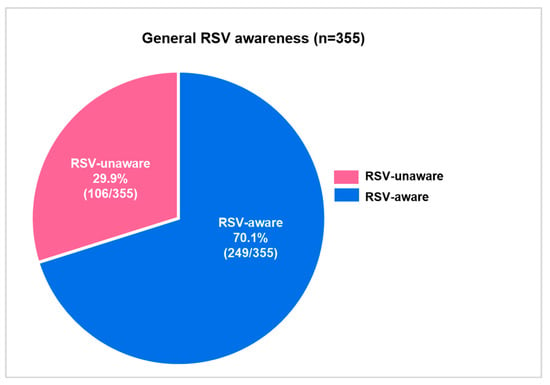
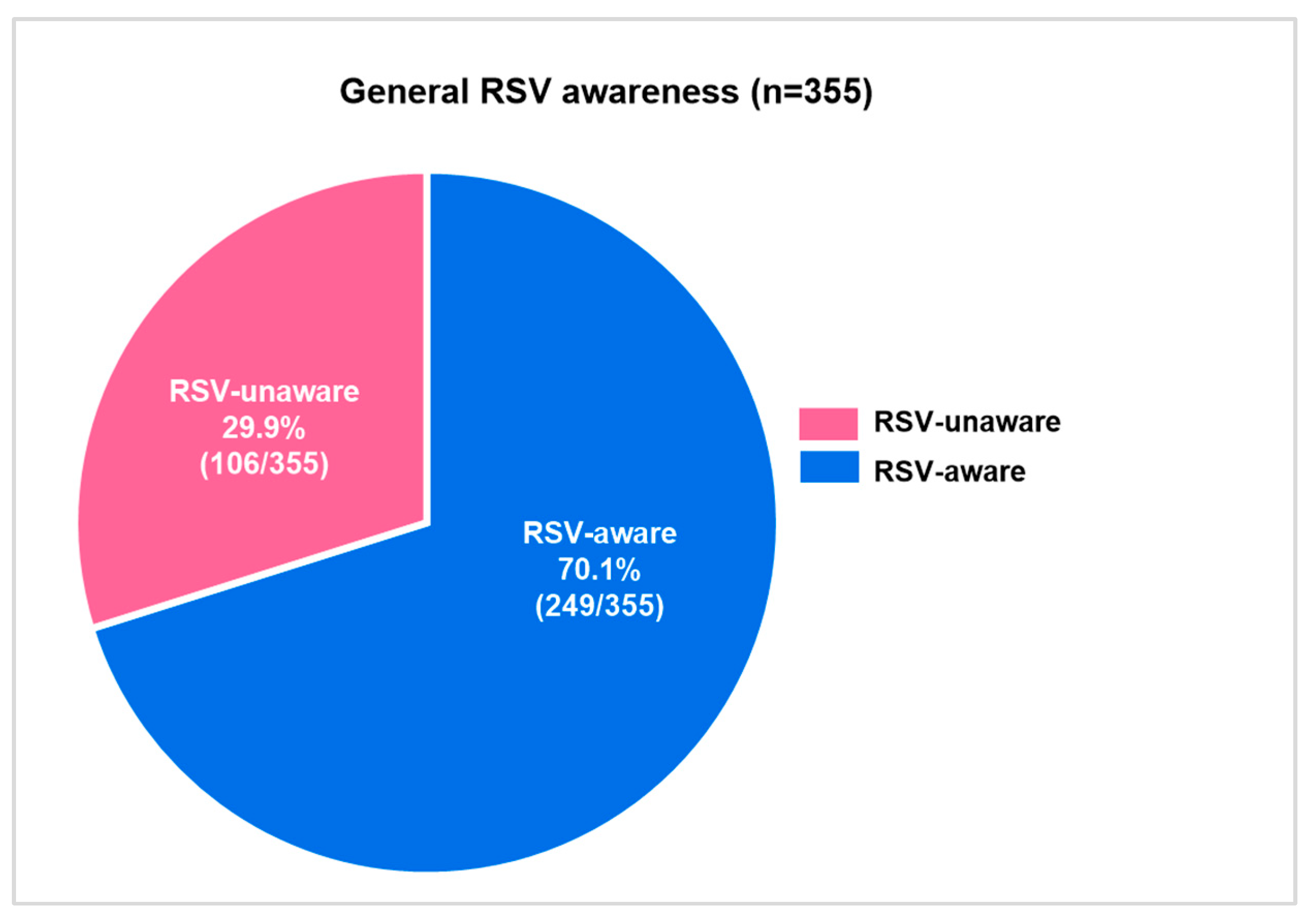
Overall awareness of RSV was 70.1% (95% CI, 65.2–74.7), whereas reported knowledge of RSV-associated complications was 53.2% (95% CI, 48.0–58.4) (Figure 1). Among the 105 participants with previous children and available data on RSV history, 27.6% reported a history of RSV infection in at least one child, of whom 55.2% reported RSV-related hospitalization. The most frequently reported source of information about RSV was obstetricians and gynecologists (39.0%), followed by social media (23.7%) (Table 2).
Figure 1.
General RSV awareness among pregnant women.
Table 2.
RSV awareness, maternal vaccination receipt, infant nirsevimab awareness, information sources, reported maternal vaccination barriers, and prevention preferences.
Awareness of maternal RSV vaccination was 52.4% (95% CI, 47.2–57.5), whereas awareness of its perceived availability in Türkiye was 47.0% (95% CI, 41.9–52.2). Among 222 participants at ≥24 weeks of gestation, 60 (27.0%; 95% CI, 21.6–33.2) had received maternal RSVpreF vaccination. Among the 130 participants reporting prior awareness of maternal RSV vaccination, 60 (46.2%) had received the vaccine (Table 2). Obstetricians and gynecologists were the most frequently reported source of information about maternal RSV vaccination (51.1%). Among unvaccinated participants reporting a reason for nonreceipt, insufficient information was the most frequently cited reason, followed by concerns about adverse effects, perceived lack of necessity, and cost (Table 2).
Awareness of nirsevimab was 32.7% (95% CI, 28.0–37.7), whereas awareness of its perceived availability in Türkiye was 26.5% (95% CI, 22.2–31.3). Pediatricians were the most frequently reported source of information about nirsevimab (49.1%), followed by family and friends (20.7%), family physicians (18.1%), and social media (12.1%) (Table 2).
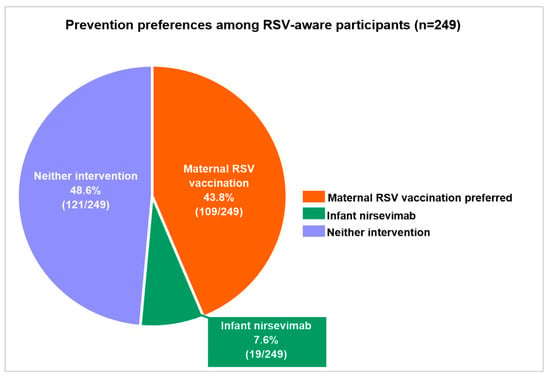
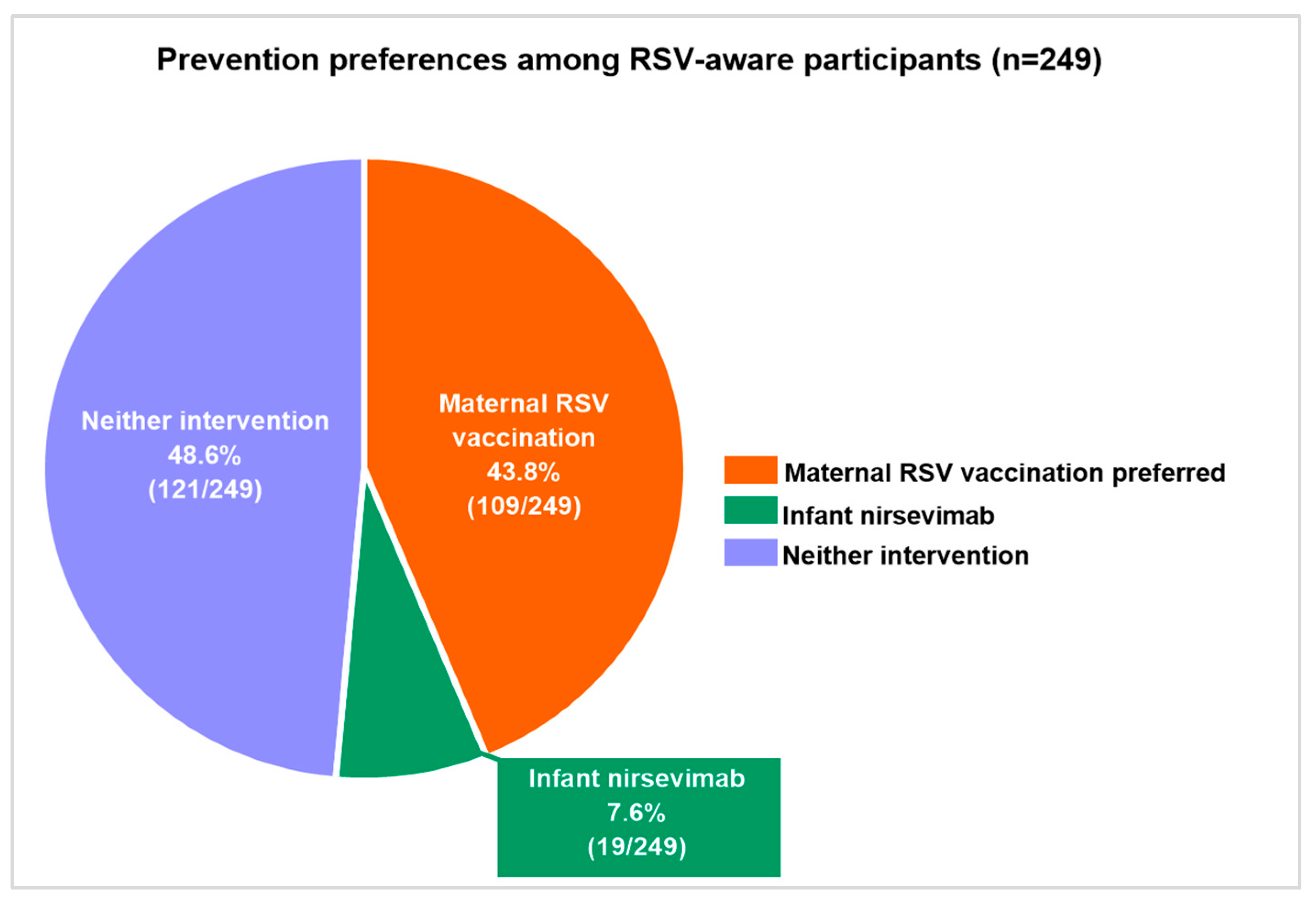
Among RSV-aware participants (n = 249), the largest proportion selected neither (48.6%; 95% CI, 42.5–54.8), followed by maternal RSV vaccination (43.8%; 95% CI, 37.8–50.0) and infant nirsevimab (7.6%; 95% CI, 4.9–11.6) (Table 2 and Figure 2). In a post hoc exploratory analysis of 104 participants aware of both maternal RSV vaccination and nirsevimab, 74.0% selected maternal vaccination, 16.3% selected nirsevimab, and 9.6% selected neither intervention. An additional descriptive analysis including all participants with a recorded prevention choice, irrespective of prior RSV awareness (n = 254), showed that 49.6% selected neither intervention, 42.9% selected maternal RSV vaccination, and 7.5% selected infant nirsevimab (Supplementary Table S1).
Figure 2.
Prevention preferences among participants reporting prior RSV awareness.
In univariable analyses, higher education (PR, 1.78; 95% CI, 1.05–3.03; p = 0.033), previous childbirth (PR, 2.56; 95% CI, 1.65–3.97; p < 0.001), healthcare-worker occupation (PR, 1.78; 95% CI, 1.04–3.06; p = 0.036), and reported knowledge of RSV-associated complications (PR, 9.37; 95% CI, 3.52–24.92; p < 0.001) were associated with maternal RSV vaccination receipt (Supplementary Table S2).
In the primary multivariable analysis, higher education (aPR, 2.10; 95% CI, 1.25–3.52; p = 0.005), previous childbirth (aPR, 3.05; 95% CI, 1.94–4.81; p < 0.001), and gestational age (aPR, 1.06; 95% CI, 1.01–1.11; p = 0.028) were associated with maternal RSV vaccination receipt after adjustment. Maternal age and healthcare-worker occupation were not significantly associated with vaccination receipt (Table 3). Variance inflation factors ranged from 1.03 to 1.16, indicating no substantial multicollinearity among the included covariates.
Table 3.
Multivariable analysis of factors associated with maternal RSVpreF vaccination receipt among participants at ≥24 weeks of gestation.
The logistic-regression sensitivity analysis supported the primary findings, with significant associations for higher education (aOR, 3.14; 95% CI, 1.45–6.80; p = 0.004), previous childbirth (aOR, 5.60; 95% CI, 2.71–11.60; p < 0.001), and gestational age (aOR, 1.09; 95% CI, 1.00–1.19; p = 0.044). Maternal age and healthcare-worker occupation were not statistically significant (Supplementary Table S3). In the secondary analysis restricted to 130 vaccine-aware participants, previous childbirth (aPR, 2.36; 95% CI, 1.59–3.50; p < 0.001), healthcare-worker occupation (aPR, 1.60; 95% CI, 1.09–2.33; p = 0.015), and gestational age (aPR, 1.05; 95% CI, 1.00–1.10; p = 0.034) were associated with vaccination receipt (Supplementary Table S4).
4. Discussion
Our study showed that although general awareness of RSV among pregnant women was relatively high, knowledge of RSV-related complications and newly available preventive strategies was more limited. Nearly half of RSV-aware participants selected neither preventive intervention, although maternal RSVpreF vaccination was selected more frequently than infant nirsevimab. Higher education, previous childbirth, and gestational age were associated with maternal vaccination receipt in the primary adjusted analysis. Together, these findings highlight differences between awareness, stated prevention preferences, and vaccination behavior.
Having heard of RSV does not necessarily imply an understanding of its clinical significance or potential disease burden in infants. Similarly, an Australian study reported relatively high RSV awareness but more limited knowledge of disease severity [16]. A recent study among pregnant and postpartum women in Shanghai also found that lower RSV knowledge was associated with lower perceived disease severity [17]. Obstetricians and gynecologists were the most frequently reported sources of information about RSV (39.0%), suggesting that antenatal care represents an important opportunity for RSV education. Social media was the second most frequently reported source (23.7%), indicating that nonphysician sources also play an important role in health-information seeking. However, the accuracy and scientific quality of social media content may vary considerably. A study conducted in Türkiye reported that parents sometimes incorporated online health information into decision-making without seeking physician advice [18]. Accessible, evidence-based information delivered through both clinical and digital channels may therefore help address gaps in RSV-related knowledge.
Awareness of maternal RSVpreF vaccination was moderate, whereas awareness of its perceived availability in Türkiye was somewhat lower. Among participants at ≥24 weeks of gestation, 27.0% had received maternal RSV vaccination, compared with 46.2% among those who were already aware of the vaccine. These findings highlight the importance of distinguishing prior awareness from vaccination receipt. Gestational age at survey participation is also relevant, as participants assessed earlier in the eligible period had less time to receive vaccination. Gestational age was associated with vaccination receipt in the adjusted analysis. Nevertheless, unequal vaccination opportunity remains an important consideration when interpreting uptake in this cross-sectional study.
Among unvaccinated women reporting a reason for nonreceipt, insufficient information was the most frequently cited reason. Concerns about adverse effects, perceptions that vaccination was unnecessary, and cost were additional important barriers. Similarly, a German study reported limited awareness and low uptake of maternal RSV vaccination, with insufficient information identified as one of the leading reasons for nonvaccination [19]. In an Irish study, low perceived risk of RSV disease was also identified as an important barrier to vaccination acceptance during pregnancy [14]. These findings suggest that maternal vaccination decisions may involve informational, attitudinal, and practical considerations rather than a single dominant barrier.
The associations of higher education and previous childbirth with maternal RSV vaccination receipt suggest that access to health information and prior parenting experience may play a role in vaccination decisions. Previous studies have similarly identified RSV knowledge, perceived disease risk, and parenting experience as factors associated with maternal vaccination acceptance [20,21,22]. The persistent association with previous childbirth among vaccine-aware participants may reflect greater familiarity with childhood illness and preventive healthcare. Gestational age was associated with vaccination receipt in both the primary and vaccine-aware analyses, whereas healthcare-worker occupation was associated with receipt only in the vaccine-aware subgroup. These findings warrant cautious interpretation given the distinct analytical populations. The logistic-regression sensitivity analysis supported the principal associations, although imprecision in some estimates warrants caution.
Healthcare-professional communication remains relevant to understanding RSV prevention decisions, but the present study cannot establish whether information provided by physicians increased maternal vaccination receipt. Information sources and vaccination status were assessed concurrently, and the content or completeness of previously received counseling was not evaluated. Reverse causation and confounding by healthcare access, health literacy, socioeconomic circumstances, perceived RSV risk, and previous vaccination behavior therefore cannot be excluded. The prior literature similarly indicates the importance of healthcare-provider guidance in maternal immunization decisions [14,15]. Prospective studies are needed to determine whether structured counseling improves informed decision-making and maternal RSV vaccination uptake.
Awareness of nirsevimab was lower than awareness of maternal RSVpreF vaccination, suggesting that this intervention was less familiar to the surveyed pregnant women. Previous research has also documented limited familiarity with monoclonal antibody-based RSV prevention among parents [23]. Nevertheless, clinical evidence supports the effectiveness of nirsevimab in preventing RSV-related hospitalization during infancy [8]. Given that pediatricians were the most frequently reported source of information about nirsevimab in our study, introducing information about this preventive option during antenatal care may help parents consider postnatal RSV prevention before delivery. Such discussions should address both preventive strategies, while recognizing their different administration pathways, eligibility considerations, and timing.
Among RSV-aware participants, neither intervention was the most frequently selected option (48.6%), while maternal vaccination was selected more frequently than nirsevimab (43.8% vs. 7.6%), consistent with previous studies [15,24]. Maternal vaccination was also selected more frequently than nirsevimab among participants aware of both interventions (74.0% vs. 16.3%) and in the expanded preference analysis (42.9% vs. 7.5%). However, awareness of both strategies does not necessarily indicate comparable knowledge of their benefits, safety, or costs, particularly given the higher overall awareness of maternal vaccination (52.4% vs. 32.7%). Selection of neither intervention should not be equated with vaccine hesitancy. Although inadequate information was the most frequently reported reason for maternal vaccination nonreceipt, concerns about adverse effects, perceived lack of necessity, and cost were also identified. Reasons for maternal vaccination nonreceipt and prevention preferences were assessed using different questionnaire items and denominators; therefore, the reported reasons for nonreceipt cannot be assumed to explain selection of neither intervention. Vaccine hesitancy was not directly assessed as a distinct construct.
Financial accessibility and healthcare-system organization are additional considerations when interpreting prevention preferences and implementation. Differences in cost, reimbursement arrangements, and access to services may influence preventive decisions, although their specific contributions were not measured in this study. In contrast, organized infant immunization programs have achieved high nirsevimab coverage in some settings. A systematic review and meta-analysis estimated population-level nirsevimab uptake at 90.1% in Spain during the 2023–2024 RSV season [25]. These findings illustrate the importance of implementation context and should not be directly compared with stated preferences in our antenatal survey. The accessibility and organization of preventive services must therefore be considered when interpreting differences between intervention preferences and real-world uptake.
Our findings have important public health implications. Limited awareness of preventive strategies, reported barriers to maternal vaccination, and the frequent selection of neither intervention underscore the relevance of balanced, evidence-based RSV counseling during antenatal care. Such counseling should address not only the disease burden associated with RSV but also the effectiveness, safety, timing, and accessibility of maternal RSVpreF vaccination and nirsevimab. Integrating these topics into routine antenatal counseling may help address information gaps and support informed preventive decisions. Whether such counseling improves vaccination coverage or infant immunoprophylaxis uptake requires prospective evaluation.
Certain limitations of this study warrant consideration. The single-center private-hospital setting may limit generalizability, while the cross-sectional design precludes causal inference. Additionally, the investigator-developed questionnaire did not undergo formal validation, which may have introduced measurement bias in the assessment of awareness, knowledge, and prevention preferences. Women attending private healthcare institutions may differ from those receiving antenatal care in public settings in socioeconomic characteristics and access to preventive services. This study did not directly assess how costs and healthcare delivery pathways influenced participants’ prevention preferences or access to these interventions. Differences in gestational age resulted in unequal opportunities for vaccination, and maternal vaccination receipt was self-reported without verification. Prevention preferences were assessed without standardized comparative counseling and therefore should not be interpreted as fully informed decisions or predictors of subsequent preventive behavior. Reasons for maternal vaccination nonreceipt and RSV prevention preferences were assessed using different questionnaire items and denominators. Therefore, reported reasons for nonvaccination cannot be assumed to explain the selection of neither intervention, and vaccine hesitancy was not systematically assessed. The absence of follow-up also prevented assessment of whether stated preferences translated into preventive behavior. Future multicenter prospective studies should examine factors influencing prevention preferences after balanced counseling and assess whether these preferences translate into verified maternal vaccination or infant immunoprophylaxis uptake.
5. Conclusions
This study demonstrates that although general awareness of RSV among pregnant women was relatively high, familiarity with its complications and available preventive strategies remained limited. Although selection of neither intervention was the most frequent response among RSV-aware participants, maternal RSVpreF vaccination was selected more frequently than infant nirsevimab. Higher education, previous childbirth, and gestational age were associated with maternal RSVpreF vaccination receipt in the adjusted analysis, although differences in vaccination opportunity across gestation should be considered when interpreting these findings. Insufficient information, concerns about adverse effects, perceived lack of necessity, and cost were the principal reported barriers to vaccination. These findings support structured, evidence-based antenatal counseling to address knowledge gaps regarding both preventive strategies, although its impact on informed decision-making and subsequent uptake requires prospective evaluation.
Supplementary Materials
The following supporting information can be downloaded at: https://www.mdpi.com/article/10.3390/vaccines14110949/s1. Supplementary File S1: Questionnaire assessing pregnant women’s knowledge, awareness, and attitudes regarding maternal RSV vaccination and infant nirsevimab; Table S1: Distribution of recorded RSV prevention choices by prior RSV awareness in the overall study cohort (N = 355); Table S2: Participant characteristics and univariable associations with maternal RSVpreF vaccination receipt among participants at ≥24 weeks of gestation; Table S3: Logistic-regression sensitivity analysis of the primary multivariable model; Table S4: Secondary multivariable analysis among maternal RSV vaccine-aware participants at ≥24 weeks of gestation.
Author Contributions
Conceptualization, A.G. and A.S.S.; Methodology, A.G.; Software, A.G.; Validation, A.G., A.S.S. and F.G.; Formal Analysis, A.G.; Investigation, F.G.; Resources, A.S.S. and F.G.; Data Curation, A.S.S.; Writing—Original Draft Preparation, A.G. and A.S.S.; Writing—Review & Editing, A.G. and A.S.S.; Visualization, A.G. and A.S.S.; Supervision, A.G. and A.S.S.; Project Administration, A.G. and A.S.S. All authors have read and agreed to the published version of the manuscript.
Funding
This research received no external funding.
Institutional Review Board Statement
The study was conducted in accordance with the Declaration of Helsinki and approved by the Non-Interventional Scientific Research Ethics Committee (Approval No. 07/19; 20 July 2026).
Informed Consent Statement
Written informed consent was obtained from all participants involved in the study.
Data Availability Statement
The data presented in this study are available from the corresponding author upon reasonable request. The data are not publicly available due to privacy and institutional restrictions.
Conflicts of Interest
The authors declare no conflicts of interest.
References
- Li, Y.; Wang, X.; Blau, D.M.; Caballero, M.T.; Feikin, D.R.; Gill, C.J.; Madhi, S.A.; Omer, S.B.; Simões, E.A.F.; Campbell, H.; et al. Global, regional, and national disease burden estimates of acute lower respiratory infections due to respiratory syncytial virus in children younger than 5 years in 2019: A systematic analysis. Lancet 2022, 399, 2047–2064. [Google Scholar] [CrossRef] [Scilit] [PubMed]
- Hacımustafaoğlu, M.; Çelebi, S.; Bozdemir, S.E.; Özgür, T.; Özcan, I.; Güray, A.; Çakır, D. RSV frequency in children below 2 years hospitalized for lower respiratory tract infections. Turk. J. Pediatr. 2013, 55, 130–139. [Google Scholar] [PubMed]
- Alan, S.; Erdeve, O.; Cakir, U.; Akduman, H.; Zenciroglu, A.; Akcakus, M.; Tunc, T.; Gokmen, Z.; Ates, C.; Atasay, B.; et al. Outcome of the respiratory syncytial virus related acute lower respiratory tract infection among hospitalized newborns: A prospective multicenter study. J. Matern. Fetal Neonatal Med. 2016, 29, 2186–2193. [Google Scholar] [CrossRef] [Scilit] [PubMed]
- Wang, W.; Li, J.-X.; Long, S.-Q.; Liu, Z.-N.; Li, X.-P.; Peng, Z.-H.; Zheng, J.-D.; Liao, Y.-H. Emerging strategies for monkeypox: Antigen and antibody applications in diagnostics, vaccines, and treatments. Mil. Med. Res. 2025, 12, 69. [Google Scholar] [CrossRef] [Scilit] [PubMed]
- Wang, W.; Gao, Q.; Li, Y.; Guo, H.; Zheng, J.; Fu, Y.; Liao, Y. Advanced strategies for the diagnosis, treatment, and vaccination of monkeypox. J. Nanobiotechnol. 2026, 24, 363. [Google Scholar] [CrossRef] [Scilit] [PubMed]
- Kampmann, B.; Madhi, S.A.; Munjal, I.; Simões, E.A.F.; Pahud, B.A.; Llapur, C.; Baker, J.; Pérez Marc, G.; Radley, D.; Shittu, E.; et al. Bivalent prefusion F vaccine in pregnancy to prevent RSV illness in infants. N. Engl. J. Med. 2023, 388, 1451–1464. [Google Scholar] [CrossRef] [Scilit] [PubMed]
- Hammitt, L.L.; Dagan, R.; Yuan, Y.; Baca Cots, M.; Bosheva, M.; Madhi, S.A.; Muller, W.J.; Zar, H.J.; Brooks, D.; Grenham, A.; et al. Nirsevimab for prevention of RSV in healthy late-preterm and term infants. N. Engl. J. Med. 2022, 386, 837–846. [Google Scholar] [CrossRef] [Scilit] [PubMed]
- Drysdale, S.B.; Cathie, K.; Flamein, F.; Knuf, M.; Collins, A.M.; Hill, H.C.; Kaiser, F.; Cohen, R.; Pinquier, D.; Felter, C.T.; et al. Nirsevimab for prevention of hospitalizations due to RSV in infants. N. Engl. J. Med. 2023, 389, 2425–2435. [Google Scholar] [CrossRef] [Scilit] [PubMed]
- World Health Organization. WHO position paper on immunization to protect infants against respiratory syncytial virus disease, May 2025. Wkly. Epidemiol. Rec. 2025, 100, 193–218. [Google Scholar]
- Pfizer PFE İlaçları A.Ş. ABRYSVO 0.5 mL IM Enjeksiyonluk Çözelti Hazırlamak İçin Toz ve Çözücü: Kısa Ürün Bilgisi [Turkish Summary of Product Characteristics]. Available online: https://labeling.pfizer.com/ShowLabeling.aspx?id=21377 (accessed on 27 July 2026).
- European Medicines Agency. Abrysvo: EPAR—Product Information, Annex I: Summary of Product Characteristics. Available online: https://www.ema.europa.eu/en/medicines/human/EPAR/abrysvo (accessed on 27 July 2026).
- U.S. Food and Drug Administration. ABRYSVO (Respiratory Syncytial Virus Vaccine): Prescribing Information. Available online: https://www.fda.gov/media/168889/download (accessed on 27 July 2026).
- Sanofi Pasteur Aşı Ticaret A.Ş. BEYFORTUS 100 mg Enjeksiyonluk Çözelti İçeren Kullanıma Hazır Enjektör: Kısa Ürün Bilgisi [Turkish Summary of Product Characteristics]. Available online: https://www.sanofi.com/assets/countries/turkey/docs/products/prescription-products/B/2025-11-25-Beyfortus-100-mg-KUB.pdf (accessed on 27 July 2026).
- McCormack, S.; Thompson, C.; Nolan, M.; Imcha, M.; Dee, A.; Saunders, J.; Philip, R.K. Maternal awareness, acceptability and willingness towards respiratory syncytial virus (RSV) vaccination during pregnancy in Ireland. Immun. Inflamm. Dis. 2024, 12, e1257. [Google Scholar] [CrossRef] [Scilit] [PubMed]
- Gagnon, D.; Gubany, C.; Ouakki, M.; Malo, B.; Paquette, M.; Brousseau, N.; Papenburg, J.; Dubé, E. Factors influencing acceptance of RSV immunization for newborns among pregnant individuals: A mixed-methods study. Vaccine 2025, 55, 127062. [Google Scholar] [CrossRef] [Scilit] [PubMed]
- Holland, C.; Baker, M.; Bates, A.; Hughes, C.; Richmond, P.C.; Carlson, S.; Moore, H.C. Parental awareness and attitudes towards prevention of respiratory syncytial virus in infants and young children in Australia. Acta Paediatr. 2024, 113, 786–794. [Google Scholar] [CrossRef] [Scilit] [PubMed]
- Liu, W.M.; Yang, D.D.; Zhou, C.P.; Wu, Y.F.; Yang, L.B.; Deng, P.F. Survey on awareness of respiratory syncytial virus and influencing factors among pregnant and postpartum women in Pudong New Area of Shanghai. Zhonghua Liu Xing Bing. Xue Za Zhi 2026, 47, 681–689. [Google Scholar] [CrossRef] [Scilit] [PubMed]
- Genis, C.; Emeksiz, Z.S. The impact of social media on parental decision-making in the management of pediatric allergic diseases. Turk. Arch. Pediatr. 2026, 61, 593–600. [Google Scholar] [CrossRef] [Scilit] [PubMed]
- Baumgartner, M.K.; Hanslik, G.; Schneider, M.; Franitza, M.; Schneider, M.; Rieger, H.; von Andrian, H.C.; Conrad, M.L.; Fahlbusch, F.B. Navigating parental hesitancy in public health: The case for RSV immunization in newborns. J. Perinatol. 2025, 45, 981–985. [Google Scholar] [CrossRef] [Scilit] [PubMed]
- Machida, M.; Inoue, S.; Furuse, Y.; Oka, E.; Ueda, Y.; Fukushima, S.; Tabuchi, T. Exploring the knowledge and attitude toward respiratory syncytial virus vaccine and associated factors among pregnant women in Japan during the early post-marketing phase. Vaccine 2025, 61, 127434. [Google Scholar] [CrossRef] [Scilit] [PubMed]
- Meng, X.; Li, S.; Li, M.; Guo, C.; Wang, P.; Chen, X.; Zhang, D.; Zhong, Y. Willingness to receive maternal RSV vaccination among pregnant women and those planning pregnancy in Southern China: A cross-sectional study and predictive nomogram. Vaccines 2026, 14, 160. [Google Scholar] [CrossRef] [Scilit] [PubMed]
- Favre, G.; Pfund, A.; Gerbier, E.; Anselem, O.; Balaya, V.; Ceccaldi, P.F.; Chalouhi, G.; Ducarme, G.; Garabedian, C.; Guerby, P.; et al. Acceptability and preferences regarding RSV immunisation during pregnancy: A cross-sectional study in diverse global settings. Vaccine 2026, 88, 128783. [Google Scholar] [CrossRef] [Scilit] [PubMed]
- Mortensen, G.L.; Harrod-Lui, K. Parental knowledge about respiratory syncytial virus and attitudes to infant immunization with monoclonal antibodies. Expert Rev. Vaccines 2022, 21, 1523–1531. [Google Scholar] [CrossRef] [Scilit] [PubMed]
- Wang, B.; Andraweera, P.; Chen, G.; Ong, J.J.; Lassi, Z.; Marshall, H. Respiratory syncytial virus (RSV) vaccine choices during pregnancy. Public Health 2026, 251, 106114. [Google Scholar] [CrossRef] [Scilit] [PubMed]
- Trusinska, D.; Lee, B.; Ferdous, S.; Kwok, H.H.Y.; Gordon, B.; Gao, J.; Ma, L.; Xiong, H.; Sheikh, S.A.; Schwarze, J.; et al. Real-world uptake of nirsevimab, RSV maternal vaccine, and RSV vaccines for older adults: A systematic review and meta-analysis. eClinicalMedicine 2025, 84, 103281. [Google Scholar] [CrossRef] [Scilit] [PubMed]

Disclaimer/Publisher’s Note: The statements, opinions and data contained in all publications are solely those of the individual author(s) and contributor(s) and not of MDPI and/or the editor(s). MDPI and/or the editor(s) disclaim responsibility for any injury to people or property resulting from any ideas, methods, instructions or products referred to in the content. |
© 2026 by the authors. Licensee MDPI, Basel, Switzerland. This article is an open access article distributed under the terms and conditions of the Creative Commons Attribution (CC BY) license.