


Abstract
Background/Objectives: Human papillomavirus (HPV) vaccination and cervical cancer screening are key components of cervical cancer prevention; however, awareness may not translate into preventive practice. This study aimed to assess HPV knowledge, HPV vaccine awareness and uptake, Pap smear testing history, and sociodemographic factors associated with HPV knowledge among women attending a gynecology outpatient clinic in Türkiye. Methods: This cross-sectional study included 403 women aged 18–49 years who attended the Gynecology and Obstetrics Outpatient Clinic of Konya City Hospital between July and October 2025. Following a brief explanation of the study, participants independently completed self-administered questionnaires, including a demographic questionnaire and the validated Turkish HPV Knowledge Scale (HPV-KS). Group comparisons were performed using the Mann–Whitney U and Kruskal–Wallis tests, with Bonferroni-adjusted post hoc comparisons where appropriate. An exploratory multivariable binary logistic regression analysis was performed to identify factors independently associated with having any HPV knowledge (HPV-KS > 0). Results: The median total HPV-KS score was 8 (Q1–Q3: 0–15). Overall, 52.6% of participants had heard of HPV and 44.2% had heard of the HPV vaccine, whereas 18.9% reported previous Pap smear testing and only 3.2% reported HPV vaccination. Knowledge of HPV vaccine availability/use was particularly limited, with a median score of 0 (Q1–Q3: 0–1). Total HPV-KS scores were significantly higher among women with university education, employment, urban residence, contraceptive use, previous Pap smear testing, and prior awareness of HPV or the HPV vaccine (p < 0.05). In the multivariable analysis, compared with university graduates, participants with primary-level education (aOR = 0.26, 95% CI: 0.14–0.49) and high-school education (aOR = 0.41, 95% CI: 0.25–0.70) had lower odds of having any HPV knowledge, whereas employment (aOR = 2.45, 95% CI: 1.41–4.23) and previous Pap smear testing (aOR = 4.38, 95% CI: 2.05–9.36) were associated with higher odds. Conclusions: HPV and vaccine awareness exceeded reported vaccination and Pap smear testing uptake, although awareness itself remained limited. Particularly low knowledge of HPV vaccine availability/use highlights an actionable knowledge gap. Educational and healthcare-contact factors were associated with HPV knowledge, supporting accessible counseling that provides practical information on vaccine eligibility, schedules, access, and cervical cancer prevention.
1. Introduction
Human papillomavirus (HPV) is a common sexually transmitted infection, and persistent infection with oncogenic HPV types is the principal cause of cervical cancer [1,2]. HPV vaccination and cervical screening are established strategies for reducing the burden of HPV-related disease. HPV vaccination is a key primary-prevention strategy for cervical cancer and other HPV-related diseases [1,2]. The World Health Organization (WHO) cervical cancer elimination strategy includes a target of fully vaccinating 90% of girls against HPV by age 15 by 2030 [1]. According to GLOBOCAN 2024 estimates, 2577 new cervical cancer cases and 1003 cervical cancer deaths occurred in Türkiye, with an age-standardized incidence rate of 4.5 per 100,000 women [3]. National cervical cancer screening is provided through public health services, and HPV DNA testing is used within the national screening program for women aged 30–65 years [4]. In addition to the national screening program, the Turkish Ministry of Health conducts cervical cancer awareness and educational activities through Cancer Early Diagnosis, Screening and Education Centers (KETEM) and primary healthcare services. Nationwide awareness activities are also organized during Cervical Cancer Awareness Month in January to promote cervical cancer prevention and participation in screening programs [5]. Women younger than 30 years are not included in this population-based national screening program. In clinical practice, international guidelines may inform cervical screening decisions outside the national program. For example, the American College of Obstetricians and Gynecologists (ACOG) recommends cervical cytology (Pap smear) every three years for women aged 21–29 years [6].
In Türkiye, the quadrivalent HPV vaccine (Gardasil) was licensed in 2007, whereas the nine-valent vaccine (Gardasil 9) was licensed in 2019 and became commercially available in January 2023. HPV vaccination was not included in the national routine immunization schedule and was generally accessed on a self-funded basis during the study period [7]. During the study period, HPV vaccination was not included in Türkiye’s routine national immunization schedule. Therefore, international recommendations, including those of the Centers for Disease Control and Prevention (CDC), may guide vaccination decisions. The CDC recommends routine HPV vaccination at ages 11–12 years, with vaccination possible from age 9. Two doses administered 6–12 months apart are recommended for immunocompetent individuals initiating vaccination before age 15, whereas three doses are recommended for those initiating vaccination at ages 15–26 years or for immunocompromised individuals. Catch-up vaccination is recommended through age 26, while vaccination at ages 27–45 years is based on shared clinical decision-making [8].
Despite the availability of screening services, participation remains suboptimal in some groups [9,10,11]. Knowledge about HPV and vaccination is relevant to preventive decision-making, and Turkish studies continue to report low HPV vaccination uptake [10,12,13,14]. Studies from different settings also show persistent gaps in HPV and cervical cancer knowledge [15,16,17,18,19]. Recent evidence from Türkiye further demonstrates that HPV awareness does not consistently translate into vaccination behavior. In a 2025 cross-sectional study involving 320 women aged 18–49 years, Abay et al. reported a mean HPV-KS total score of 13.01 ± 7.34 (out of 33), while 51.2% of participants reported knowledge about the HPV vaccine and 90.9% had not received HPV vaccination [20]. Similarly, a 2025 study of 655 women aged 18–45 years attending a gynecology and obstetrics outpatient clinic reported that 54.8% were aware of the HPV vaccine, whereas only 7.0% had been vaccinated [12]. Another 2025 study involving 478 women attending a gynecology outpatient clinic compared HPV knowledge and health beliefs according to HPV diagnosis and identified differences in HPV knowledge, vaccine awareness, cervical screening, and vaccination status [21]. However, these studies also highlight a more specific unanswered question. Previous research has predominantly examined overall HPV knowledge, vaccine awareness or acceptance, health beliefs, or vaccination status [12,20,21]. Less attention has been directed toward identifying where within HPV-related knowledge the transition from awareness to preventive action may fail. The validated Turkish HPV-KS separately assesses general HPV knowledge, HPV testing knowledge, HPV vaccine knowledge, and knowledge of HPV vaccine use [22]. Evaluating these distinct domains together with reported preventive practices may help distinguish general awareness from the more actionable knowledge required to understand and use preventive services. Women attending gynecology outpatient clinics are particularly relevant to this question because routine contact with healthcare services provides opportunities for vaccination counseling and screening education [16,23].
The primary objective of this study was to assess HPV knowledge using the validated HPV Knowledge Scale (HPV-KS) and examine its associations with sociodemographic characteristics and cervical cancer preventive practices among women attending a gynecology outpatient clinic. Secondary objectives were to describe HPV and HPV vaccine awareness, HPV vaccination uptake, and cervical screening history and to explore the knowledge–practice gap in this population.
2. Materials and Methods
2.1. Study Design and Participants
The study was designed as a cross-sectional, descriptive investigation. The research was conducted at the Gynecology and Obstetrics Outpatient Clinic of Konya City Hospital from July 2025 to October 2025. Konya City Hospital is a tertiary-level healthcare institution that accepts both referred patients and individuals seeking care directly without a referral. The hospital serves populations from Konya city center and surrounding districts, including urban and rural communities. Its obstetrics and gynecology outpatient clinics provide care for a broad range of obstetric and gynecological conditions. Thus, the study setting was not restricted to patients referred for specialized tertiary care. Participants were recruited using a non-probability convenience sampling approach. Eligible women attending the outpatient clinic were invited to participate according to daily outpatient workload and researcher availability. Both researchers provided face-to-face information about the study, and women who voluntarily agreed to participate completed the questionnaire after their outpatient visits, before leaving the hospital. The study included volunteer women aged 18–49 who accepted to participate in the research during their visit to the outpatient clinic, were literate, and signed the informed consent form. Those who had previously been diagnosed with HPV and were still undergoing treatment, those with severe mental or communication disorders, those who were illiterate, and those who did not complete the survey were excluded. Apart from the predefined exclusion criteria, other gynecological diseases or conditions were not used as exclusion criteria. Specific gynecological diagnoses and reasons for outpatient attendance were not systematically recorded.
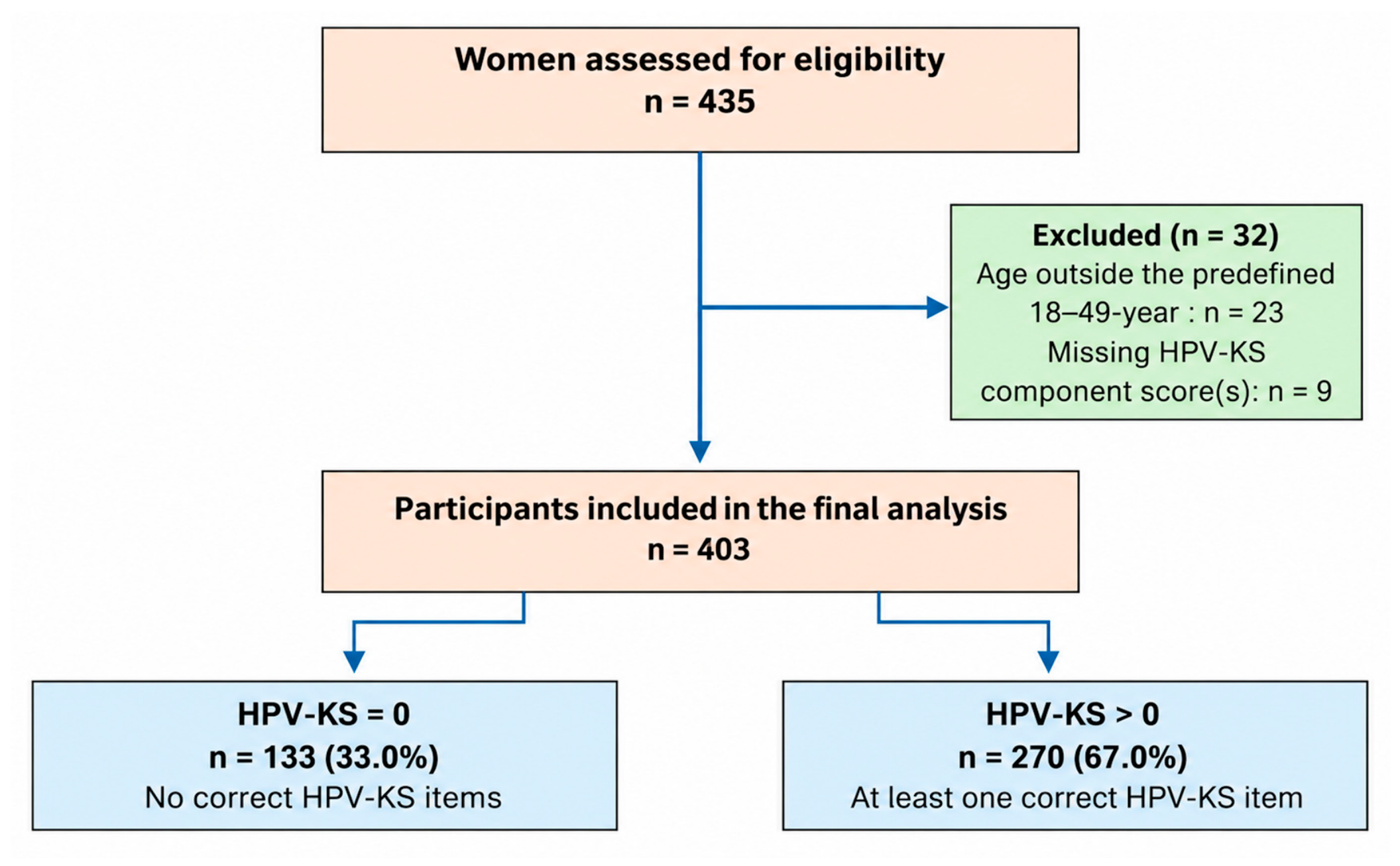
Participant confidentiality was maintained throughout the study, and the confidentiality of the data was maintained. During the study period, 435 women were assessed for eligibility. Of these, 32 were excluded: 23 were outside the predefined age range of 18–49 years, and nine had missing data for one or more HPV-KS components. Consequently, 403 participants were included in the final study sample. The total number of women approached and the number and reasons for refusals were not systematically recorded; therefore, formal participation and response rates could not be calculated. The participant selection process is presented in Figure 1.
Figure 1.
Flow diagram of participant selection and the exploratory HPV-KS grouping.
The research was conducted in accordance with the principles of the Declaration of Helsinki.
2.2. Data Collection and HPV Knowledge Scale
The study population consisted of all women aged 18–49 who applied to the polyclinic and voluntarily agreed to participate during the research period. Following face-to-face information provided by both researchers, participants completed the questionnaires themselves (self-administered) after their outpatient visits, before leaving the hospital. Data were collected using a researcher-developed demographic information form (Table S1) and the validated Turkish version of the HPV Knowledge Scale (HPV-KS) [22]. The demographic information form gathered data regarding age, marital status, education level, employment status, residential area (rural/urban), parity, sexual activity status, contraceptive methods, history of Pap smear testing (history of Pap smear testing was defined as self-reported receipt of at least one Pap smear test at any time before the survey (yes/no), without specifying the timing or frequency of testing), and HPV testing, HPV vaccination status, family history of cancer, and prior awareness of HPV and its vaccine.
The validated Turkish HPV-KS consists of 33 items in four sections assessing general HPV knowledge, HPV testing knowledge, HPV vaccine knowledge, and knowledge of HPV vaccine use. Responses are scored as yes, no, or I do not know; correct answers receive 1 point, and incorrect or I do not know responses receive 0 points. Total scores range from 0 to 33, with higher scores indicating greater HPV-related knowledge. In the original Turkish validation study involving 920 participants, the 33-item HPV-KS demonstrated excellent internal consistency (Cronbach’s α = 0.96), with subscale coefficients ranging from 0.72 to 0.93. The content validity index was 0.96, and the four-factor structure explained 64.56% of the total variance [22]. The questionnaire required approximately 5–10 min to complete.
The study was conducted in accordance with the Declaration of Helsinki and approved by the Karatay University Ethics Committee (Decision No. 2025/021; 16 June 2025). Written informed consent was obtained from all participants.
2.3. Sample Size and Statistical Analysis
The minimum required sample size was calculated using a 95% confidence level and a 5% margin of error. The assumed proportion of 50% (p = 0.50) was used as a conservative estimate of the population proportion because no sufficiently reliable prior estimate was available for the primary proportion of interest in the target population. This assumption maximizes the required sample size under the specified confidence level and margin of error and does not imply that 50% of participants were expected to have adequate HPV knowledge. The minimum required sample size was estimated as 385 participants. To account for potential incomplete or invalid questionnaires, recruitment of at least 400 participants was planned. Following data screening and application of the eligibility criteria, 403 participants were included in the final analysis, exceeding the minimum required sample size.
Statistical analyses were performed using SPSS version 27.0 (IBM Corp., Armonk, NY, USA). Continuous numerical variables included age and the HPV-KS total and subscale scores. Their distributions were assessed using the Kolmogorov–Smirnov and Shapiro–Wilk tests, together with descriptive measures and graphical examination. Normality was evaluated to characterize the distributions of numerical variables and guide the selection of tests for group comparisons, rather than as a prerequisite for binary logistic regression. Normally distributed continuous variables were presented as mean ± standard deviation (SD), whereas non-normally distributed variables were presented as median and interquartile range (IQR; Q1–Q3). Categorical variables were summarized as frequencies (n) and percentages (%). As HPV-KS scores showed departures from normality, comparisons of HPV-KS total scores between two independent groups were performed using the Mann–Whitney U test, whereas comparisons among three or more independent groups were performed using the Kruskal–Wallis test. When the Kruskal–Wallis test indicated a statistically significant difference, we performed post hoc pairwise comparisons with Bonferroni adjustment.
An exploratory multivariable binary logistic regression analysis was performed to identify factors independently associated with having any HPV knowledge, defined as an HPV-KS total score > 0 versus a score of 0. To assess the robustness of the findings to the choice of outcome cutoff, a sensitivity analysis was performed using the observed sample median HPV-KS score of 8 as an alternative threshold (≤8 vs. >8). This cutoff was selected to provide a data-driven alternative to the original 0 versus > 0 categorization and was not intended to represent a validated threshold for adequate HPV knowledge. The same covariates as in the primary multivariable logistic regression model were included. Age, educational status, employment status, marital status, place of residence, contraceptive use, history of Pap smear testing, and family history of cervical cancer were entered simultaneously into the model. Covariates were selected based on their clinical and conceptual relevance to HPV knowledge and cervical cancer prevention. Multicollinearity was assessed using variance inflation factors (VIFs); sexual activity was excluded from the final model because of its substantial overlap with marital status. Adjusted odds ratios were interpreted as associations rather than causal effects.
HPV awareness and HPV vaccine awareness were not included because of their conceptual overlap with the HPV knowledge outcome, while HPV vaccination status was not included because of the small number of vaccinated participants. The regression analysis was performed using complete cases (n = 403). Results were reported as adjusted odds ratios (aORs) with 95% confidence intervals (CIs). We evaluated overall model significance using the likelihood-ratio test and assessed model calibration using the Hosmer–Lemeshow goodness-of-fit test. McFadden’s pseudo-R2 was also reported as a measure of model fit. All statistical tests were two-sided, and a p-value < 0.05 was considered statistically significant.
3. Results
A total of 403 women were included in the final analysis. The mean age of the participants was 29.29 ± 7.01 years. Most participants were married (79.4%, n = 320), lived in urban areas (86.8%, n = 350), and were sexually active (81.9%, n = 330). More than half had a university education (51.9%, n = 209), while 29.8% (n = 120) had completed high school and 18.4% (n = 74) had primary-level education. Among participants with available employment data, 133 (33% of the total sample) were employed, and 270 (67.0%) were unemployed.
Overall, 52.6% (n = 212) of the participants had previously heard of HPV, and 44.2% (n = 178) had heard of the HPV vaccine. In contrast, preventive practices were considerably less frequent. Only 18.9% (n = 76) reported a history of Pap smear testing, and 3.2% (n = 13) had received HPV vaccination. Contraceptive use was reported by 31.0% (n = 125) of the participants (Table 1).
Table 1.
Sociodemographic characteristics, HPV awareness, and preventive practices of the study participants (n = 403).
3.1. HPV Knowledge Scale Scores
The median total HPV-KS score was 8.00 (IQR: 0.00–15.00), with a mean score of 8.65 ± 8.46 out of a possible 33 points. For the individual domains, the median general HPV knowledge score was 6.00 (IQR: 0.00–9.00) out of 16, whereas the median HPV testing knowledge score was 0.00 (IQR: 0.00–2.00) out of 6. The median HPV vaccine knowledge score was 1.00 (IQR: 0.00–2.00) out of 5, and the median HPV vaccine availability/use knowledge score was 0.00 (IQR: 0.00–1.00) out of 6 (Table 2).
Table 2.
HPV Knowledge Scale (HPV-KS) total and subscale scores among the study participants (n = 403).
3.2. HPV Knowledge According to Sociodemographic and Preventive Characteristics
Total HPV-KS scores differed significantly according to educational status (p < 0.001). Median scores were 0 (IQR: 0–9) among participants with primary-level education, 4 (IQR: 0–12.75) among high-school graduates, and 11 (IQR: 3–17.5) among university graduates. Bonferroni-adjusted post hoc comparisons showed that university graduates had significantly higher HPV-KS scores than both primary-school and high-school graduates, whereas the difference between the primary-school and high-school groups was not statistically significant after adjustment.
Participants living in urban areas had higher HPV-KS scores than those living in rural areas [8 (IQR: 0–15) vs. 2 (IQR: 0–10), p = 0.016]. Similarly, employed participants had higher scores than unemployed participants [12 (IQR: 4.5–20) vs. 5 (IQR: 0–12), p < 0.001]. HPV-KS scores were also higher among women reporting contraceptive use [10 (IQR: 1–18) vs. 6 (IQR: 0–14), p = 0.008] and among those with a history of Pap smear testing [11 (IQR: 5–18.25) vs. 6 (IQR: 0–14), p < 0.001].
As expected, marked differences were observed according to previous HPV-related awareness. Participants who had heard of HPV had substantially higher HPV-KS scores than those who had not [14 (IQR: 10–20) vs. 0 (IQR: 0–2), p < 0.001]. Similarly, participants who had heard of the HPV vaccine had higher scores than those who had not [15 (IQR: 11–20) vs. 0 (IQR: 0–5), p <0.001]. No statistically significant differences in total HPV-KS scores were observed according to marital status (p = 0.678), sexual activity (p = 0.912), or family history of cervical cancer (p = 0.114) (Table 3).
Table 3.
Comparison of HPV-KS total scores according to sociodemographic and clinical characteristics.
3.3. Multivariable Analysis of Factors Associated with Having Any HPV Knowledge
An exploratory multivariable binary logistic regression analysis was performed to examine factors associated with having any HPV knowledge, defined as an HPV-KS total score > 0. The analysis included 403 participants, of whom 270 (67.0%) had an HPV-KS score > 0 and 133 (33.0%) had a score of 0.
After simultaneous adjustment for the covariates included in the model, educational status, employment status, and history of Pap smear testing were significantly associated with having any HPV knowledge. Compared with university graduates, participants with primary-level education had significantly lower odds of having an HPV-KS score > 0 (aOR = 0.26, 95% CI: 0.14–0.49, p < 0.001), as did those with high-school education (aOR = 0.41, 95% CI: 0.25–0.70, p = 0.001). Employed participants had higher odds of having any HPV knowledge than unemployed participants (aOR = 2.45, 95% CI: 1.41–4.23, p = 0.001). Similarly, participants with a history of Pap smear testing had higher odds of having an HPV-KS score > 0 than those without such a history (aOR = 4.38, 95% CI: 2.05–9.36, p < 0.001). Age, marital status, place of residence, contraceptive use, and family history of cervical cancer were not significantly associated with the binary HPV knowledge outcome after adjustment (all p > 0.05; Table 4).
Table 4.
Multivariable Binary Logistic Regression Analysis of Factors Associated with Having Any HPV Knowledge (HPV-KS > 0).
HPV awareness and HPV vaccine awareness were not entered into the model because of their conceptual overlap with the HPV knowledge outcome. HPV vaccination status was not included because only 13 participants were vaccinated.
To assess the robustness of these findings, a sensitivity analysis was performed using the median HPV-KS score of 8 as an alternative cutoff (≤8 vs. >8). Of the 403 participants, 217 (53.8%) scored ≤8 and 186 (46.2%) scored > 8. In the adjusted model, educational status (overall p < 0.001), employment status (aOR = 2.49, 95% CI: 1.55–4.00, p < 0.001), and history of Pap smear testing (aOR = 2.73, 95% CI: 1.46–5.09, p = 0.002) remained significantly associated with HPV-KS scores > 8. These findings were consistent with the principal associations observed in the primary analysis (Supplementary Table S2).
4. Discussion
This study identified a clear discrepancy between HPV awareness and preventive practice among women attending a gynecology outpatient clinic. The median total HPV-KS score was 8 (Q1–Q3: 0–15), indicating a broad distribution of HPV-related knowledge with a substantial proportion of participants demonstrating very limited knowledge. HPV-KS scores differed significantly according to education, employment, place of residence, contraceptive use, history of Pap smear testing, and prior awareness of HPV or the HPV vaccine. In the exploratory multivariable analysis, university education, employment, and a history of Pap smear testing remained independently associated with having any HPV knowledge (HPV-KS > 0). From a vaccination perspective, the most notable finding was that vaccine awareness (44.2%) greatly exceeded reported HPV vaccination uptake (3.2%), while knowledge of HPV vaccine availability/use had a median score of 0.
Consistent with our outcomes, a prior study conducted in Türkiye reported an average HPV Knowledge Scale score of 11.80 ± 8.02, concluding that the overall level of knowledge among the participants was fundamentally inadequate [24]. Similarly, in a clinic-based investigation conducted with women visiting a gynecology outpatient clinic in Karabük, the mean knowledge score was restricted to a low level of 4.69 ± 4.02 out of a maximum of 15 points [23]. Similarly, studies from Iran, Bahrain and China, together with evidence from Brazil, have reported gaps in HPV-related knowledge, vaccine awareness, and preventive practices, suggesting that these challenges are not unique to Türkiye [19,25,26,27]. Although the specific evaluation metrics and scoring systems vary across contemporary literature, the consensus underscores that a significant proportion of Turkish women possess insufficient comprehension regarding HPV. This pervasive pattern emphasizes the urgent necessity for systematic, targeted educational protocols within women’s healthcare infrastructures in Türkiye.
The HPV-KS subscale findings help characterize this gap. Participants demonstrated greater general HPV knowledge than knowledge of HPV testing, vaccination, and vaccine use. The median score of 0 for knowledge of HPV vaccine availability/use suggests that recognizing the vaccine does not necessarily imply understanding practical aspects of vaccination. HPV testing knowledge was also particularly limited, with a median score of 0 (Q1–Q3: 0–2). For vaccination programs, this distinction is important because awareness campaigns alone may be insufficient to support informed vaccine uptake.
Recent evidence reinforces the distinction between awareness and actionable vaccination knowledge. A 2025 systematic review identified knowledge gaps, misinformation, access barriers, and insufficient communication as recurring obstacles to HPV vaccination program implementation [28]. In a 2025 cross-sectional study of women aged 30–64 years in Shenzhen, vaccination-related knowledge coexisted with persistent barriers related to cost, safety concerns, and misconceptions, indicating that information alone may not be sufficient to ensure vaccine uptake [29]. Education was significantly associated with total HPV-KS scores, consistent with previous studies [13,30,31,32]. Median HPV-KS scores increased from 0 (Q1–Q3: 0–9) among women with primary-level education to 4 (Q1–Q3: 0–12.75) among high-school graduates and 11 (Q1–Q3: 3–17.5) among university graduates. Post hoc comparisons showed that university graduates had significantly higher scores than both primary-school and high-school graduates. Furthermore, in the exploratory multivariable analysis, university education was independently associated with having any HPV knowledge compared with primary-level education (aOR = 3.88, 95% CI: 2.05–7.30). Women with lower educational attainment may therefore benefit from vaccination information that is concise, accessible, and focused on practical decisions rather than technical terminology.
Employed women also had higher HPV-KS scores, in line with previous reports [30,31,32,33]. This association persisted in the exploratory multivariable analysis, in which employed women had higher odds of having any HPV knowledge than unemployed women (aOR = 2.45, 95% CI: 1.41–4.23). However, the cross-sectional design does not establish whether employment itself explains this difference, and unmeasured socioeconomic factors may contribute. Marital status was not significantly associated with HPV-KS scores. Although urban residents had higher HPV-KS scores than rural residents in the univariable analysis, place of residence was not independently associated with having any HPV knowledge in the multivariable model. This difference underscores the importance of distinguishing unadjusted group comparisons from adjusted associations.
The observed HPV awareness (52.6%) and HPV vaccine awareness (44.2%) were substantially higher than actual vaccine uptake but also indicate that a considerable proportion of women attending gynecologic care had not previously heard of HPV or its vaccine. These estimates are broadly compatible with previous Turkish studies reporting variable levels of vaccine awareness [16,34,35]. Participants with a history of Pap smear testing had higher HPV-KS scores than those without previous testing, and this association remained significant after adjustment. Women with a history of Pap smear testing had more than fourfold higher odds of having any HPV knowledge (aOR = 4.38, 95% CI: 2.05–9.36). This finding may reflect greater previous exposure to preventive health information or healthcare interactions, although the cross-sectional design prevents determination of the direction of this relationship. Participants who had previously heard of HPV or the HPV vaccine also had markedly higher HPV-KS scores. These awareness variables were not included in the multivariable model because they conceptually overlap with the HPV knowledge outcome. Nevertheless, the large univariable differences emphasize that simple awareness and detailed knowledge are closely related while remaining distinct constructs.
This pattern is also consistent with recent international data. In a 2026 multicenter study of 1907 adult women attending lower genital tract clinics in Spain, HPV vaccination uptake was 48.8%, and HPV knowledge and adequate physician-provided information were associated with vaccination likelihood [36]. Although the healthcare setting and vaccination context differ from those in Türkiye, these findings support the importance of clinical encounters as opportunities for vaccine counseling. Similarly, a 2026 study from Algeria reported substantial cervical cancer awareness but persistent HPV knowledge gaps and very low vaccination uptake; lower knowledge was associated with more hesitant or reluctant attitudes toward HPV vaccination [37].
Despite HPV awareness among approximately half of the participants, only 18.9% of participants reported previous Pap smear testing, and 3.2% reported HPV vaccination. This awareness–practice discrepancy is particularly relevant to vaccines and public health because improving vaccine uptake requires more than recognition of HPV. Clear information on who should be vaccinated, how vaccination is scheduled, and how vaccination services can be accessed may help convert awareness into informed action. Previous Turkish studies have also reported low HPV vaccination uptake [38,39,40]. In Türkiye, HPV vaccination remains outside the routine national childhood immunization schedule and is available on an optional basis. These findings support the need for continued evaluation of barriers to HPV vaccination and for practical, evidence-based counseling within primary care and women’s health services.
Taken together with recent Turkish evidence showing that HPV knowledge is related to vaccine acceptance among women [12], the present findings suggest that the educational challenge extends beyond increasing recognition of HPV. Interventions should also address the transition from awareness to informed preventive action by providing practical information on vaccine indications, dosing, access, and expected benefits. The particularly low HPV vaccine availability/use knowledge score in our cohort adds a clinically relevant dimension by identifying an operational knowledge gap among women already in contact with gynecologic healthcare services. The combination of low practical vaccine knowledge, limited Pap smear testing, and very low vaccination uptake suggests that gynecologic encounters may represent an important opportunity not only to raise awareness but also to provide actionable preventive information.
Strengths and Limitations
This study used a validated Turkish HPV knowledge instrument and self-administered questionnaires in a clinical population. An additional strength is the simultaneous evaluation of HPV knowledge, vaccine awareness, and self-reported preventive practices, allowing the knowledge–practice gap to be examined within the same clinical population. The final sample of 403 participants also exceeded the prespecified minimum sample size of 385. Furthermore, in addition to univariable comparisons of HPV-KS scores, an exploratory multivariable analysis was performed to examine factors independently associated with having any HPV knowledge.
However, the single-center cross-sectional design limits generalizability and precludes causal inference. Because the number and characteristics of women who declined participation were not systematically recorded, formal participation and response rates could not be calculated, and potential non-response bias could not be assessed. Preventive practices, including vaccination and pap smear history, were self-reported and may be affected by recall or reporting bias. Although the questionnaires were self-administered, social desirability bias cannot be entirely excluded for self-reported preventive practices. Potential confounders such as income, healthcare access, and detailed sources of HPV information were not fully evaluated. In addition, the specific reasons for outpatient attendance and participants’ previous healthcare visits were not recorded. Therefore, we could not determine whether participants had previously received HPV-related counseling or assess the potential influence of earlier healthcare encounters on their knowledge and preventive practices.
Neither the original 0 versus > 0 categorization nor the median-based cutoff of 8 represents a validated threshold for adequate HPV knowledge. Therefore, the regression findings should be interpreted as associations with having any measurable HPV knowledge rather than with an established threshold of adequate knowledge. Residual confounding from unmeasured socioeconomic and healthcare-related factors also remains possible. The small number of vaccinated participants (n = 13) also limits detailed analysis of factors associated with vaccine uptake and precluded inclusion of vaccination status as an outcome or explanatory variable in more detailed multivariable analyses.
5. Conclusions
Among women attending a gynecology outpatient clinic in Türkiye, just over half had previously heard of HPV and fewer than half had heard of the HPV vaccine, while reported HPV vaccination and Pap smear testing remained uncommon. Knowledge of HPV vaccine availability/use was particularly limited, with a median score of 0. These findings highlight a knowledge–practice gap relevant to HPV vaccination programs.
University education, employment, and a history of Pap smear testing were independently associated with having any HPV knowledge in the exploratory multivariable analysis, suggesting that educational and healthcare-contact factors may contribute to disparities in HPV-related knowledge. HPV prevention strategies should move beyond general awareness and provide actionable information on vaccine eligibility, schedules, access, and cervical screening. Counseling during primary care and gynecology visits may provide an important opportunity to support informed HPV vaccination decisions.
Supplementary Materials
The following supporting information can be downloaded at https://www.mdpi.com/article/10.3390/vaccines14110936/s1. Table S1: Participant Information Questionnaire; Table S2. Sensitivity analysis: multivariable binary logistic regression of factors associated with HPV-KS scores above the sample median (>8).
Author Contributions
Conceptualization, Ü.E. and M.G.B.; methodology, Ü.E. and M.G.B.; investigation, Ü.E. and M.G.B.; data curation, Ü.E. and M.G.B.; formal analysis, Ü.E.; writing—original draft preparation, Ü.E.; writing—review and editing, Ü.E. and M.G.B.; supervision, Ü.E.; project administration, Ü.E. All authors have read and agreed to the published version of the manuscript.
Funding
This research received no external funding.
Institutional Review Board Statement
The study was conducted in accordance with the Declaration of Helsinki and approved by the Karatay University Ethics Committee (Decision No. 2025/021; 16 June 2025).
Informed Consent Statement
Written informed consent was obtained from all participants involved in the study.
Data Availability Statement
The data presented in this study are available from the corresponding author upon reasonable request. The data are not publicly available because they contain participant-level research information.
Acknowledgments
During the preparation of this manuscript, the authors used ChatGPT (GPT-6, OpenAI, San Francisco, CA, USA) for the purposes of language editing and refining the presentation of the manuscript. The authors reviewed and edited the output and take full responsibility for the content of this publication.
Conflicts of Interest
The authors declare no conflicts of interest.
Abbreviations
| HPV | Human papillomavirus |
| HPV-KS | Human Papillomavirus Knowledge Scale |
| WHO | World Health Organization |
| SPSS | Statistical Package for the Social Sciences |
References
- World Health Organization. Global Strategy to Accelerate the Elimination of Cervical Cancer as a Public Health Problem, 1st ed.; World Health Organization: Geneva, Switzerland, 2020. [Google Scholar]
- Brisson, M.; Bénard, É.; Drolet, M.; Bogaards, J.A.; Baussano, I.; Vänskä, S.; Jit, M.; Boily, M.-C.; Smith, M.A.; Berkhof, J.; et al. Population-Level Impact, Herd Immunity, and Elimination after Human Papillomavirus Vaccination: A Systematic Review and Meta-Analysis of Predictions from Transmission-Dynamic Models. Lancet Public Health 2016, 1, e8–e17. [Google Scholar] [CrossRef] [Scilit]
- Sung, H.; Filho, A.M.; Laversanne, M.; Ferlay, J.; Siegel, R.L.; Soerjomataram, I.; Jemal, A.; Bray, F. Global Cancer Statistics 2024: GLOBOCAN Estimates of Incidence and Mortality Worldwide for 34 Cancers in 186 Countries. CA Cancer J. Clin. 2026, 76, e70090. [Google Scholar] [CrossRef] [Scilit]
- Republic of Türkiye Ministry of Health, General Directorate of Public Health. Cancer Screening. Ministry of Health. Available online: https://hsgm.saglik.gov.tr/tr/kanser-taramalari.html (accessed on 16 October 2026).
- 1-31 Ocak Serviks Kanseri Farkındalık Ayı. Available online: https://hsgm.saglik.gov.tr/tr/haberler-kanser/1-31-ocak-serviks-kanseri-farkindalik-ayi.html (accessed on 16 October 2026).
- American College of Obstetricians & Gynecologists’ Committee on Clinical Consensus–Gynecology. ACOG Committee Statement No. 28: Screening for Cervical Cancer. Obstet. Gynecol. 2026, 148, e63–e67. [Google Scholar] [CrossRef] [Scilit]
- Koçak, C.; Çelebi Erkiliç, M. Insan papilloma virüsü (hpv) enfeksiyonlari ve hpv aşilamasinda güncel yaklaşimlar. Toplum Hekim. 2024, 39, 293–306. [Google Scholar]
- CDC Human Papillomavirus (HPV) Vaccination: Information for Health Care Providers. Available online: https://www.cdc.gov/vaccines/hcp/by-disease/hpv.html (accessed on 16 October 2026).
- Tuncer, H.A.; Tuncer, S.F. Women’s Knowledge, Awareness and Attitudes toward Newly Implemented National HPV-Based Screening in Turkey. J. Cancer Policy 2019, 22, 100205. [Google Scholar] [CrossRef] [Scilit]
- Sarıca Cevik, H.; Ozturk Emiral2, G.; Deprem, C.; Nese Canoler, S.O.S.; Icoz Kilicarslan, A.O.N. Evaluation of Human Papillomavirus Knowledge Level and Vaccination Beliefs of Women Applying for Cervical Cancer Screening. Euras J. Fam. Med. 2024, 13, 177–186. [Google Scholar] [CrossRef] [Scilit]
- Issa, T.; Babi, A.; Azizan, A.; Alibekova, R.; Khan, S.A.; Issanov, A.; Chan, C.K.; Aimagambetova, G. Factors Associated with Cervical Cancer Screening Behavior of Women Attending Gynecological Clinics in Kazakhstan: A Cross-Sectional Study. Women’s Health 2021, 17, 17455065211004135. [Google Scholar] [CrossRef] [Scilit]
- Ozdemir, C.Y.; Marangoz, B.; Cicekli, N.; Savaş, M.; Ozdemir, N.; Arıöz, D.A.; Arioz, D.T. HPV Vaccine Awareness and Vaccination Status among Women of Reproductive Age in Türkiye: A Cross-Sectional Study. Hum. Vaccines Immunother. 2025, 21, 2586826. [Google Scholar] [CrossRef] [Scilit]
- Yılmaz, T.; Dinç Kaya, H.; Günaydın, S.; Günay, Ü. The Level of Knowledge About Human Papillomavirus and Attitude Towards Vaccination Among Young Women in Turkey. Cyprus J. Med. Sci. 2021, 6, 14–21. [Google Scholar] [CrossRef] [Scilit]
- Özdemir, J.; Yücel, M.; Kızılkaya, S.; Yıldırım, G.; Özyiğit, I.İ.; Yuluğkural, Z. Hpv, hpv vaccination worldwide and current status of hpv vaccination in turkey: A literature review. Turk. Med. Stud. J. 2022, 9, 48–54. [Google Scholar] [CrossRef] [Scilit]
- Amer, A.A.; Altabbaa, H.; Ramadan, M.S.; Abdul-Hafez, H.A.; Said, H.S.; Khan, M.; Al-Jabri, M.M.; Haj-Salim, D.J.; Razzouk, Q.; Amer, M.A.S.; et al. A Multinational Cross-Sectional Study on Human Papillomavirus and Cervical Cancer Knowledge, Vaccination Attitudes, and Risk Factors in the Middle East. Sci. Rep. 2025, 16, 1128. [Google Scholar] [CrossRef] [Scilit]
- Tiiti, T.A.; Bogers, J.; Lebelo, R.L. Knowledge of Human Papillomavirus and Cervical Cancer among Women Attending Gynecology Clinics in Pretoria, South Africa. Int. J. Environ. Res. Public. Health 2022, 19, 4210. [Google Scholar] [CrossRef] [Scilit]
- Ducray, J.F.; Kell, C.M.; Basdav, J.; Haffejee, F. Cervical Cancer Knowledge and Screening Uptake by Marginalized Population of Women in Inner-City Durban, South Africa: Insights into the Need for Increased Health Literacy. Women’s Health 2021, 17, 17455065211047141. [Google Scholar] [CrossRef] [Scilit]
- Patel, H.; Jeve, Y.B.; Sherman, S.M.; Moss, E.L. Knowledge of Human Papillomavirus and the Human Papillomavirus Vaccine in European Adolescents: A Systematic Review. Sex. Transm. Infect. 2016, 92, 474–479. [Google Scholar] [CrossRef] [Scilit]
- Fathi, P.-S.; Sofian, M.; Almasi-Hashiani, A.; Sadat Larijani, M.; Ashrafian, F.; Ramezani, A. Insufficient Knowledge of Human Papillomavirus among Reproductive-Aged Women from Arak, Iran. BMC Women’s Health 2025, 25, 238. [Google Scholar] [CrossRef] [Scilit]
- Abay, H.; Çakmak, B.; Alagöz, F.M.; Uzunlar, Ö. The Relationship between Human Papillomavirus (HPV) Knowledge and HPV Vaccine Acceptance among Women and Affecting Factors in Türkiye. Cancer Causes Control 2025, 36, 1249–1262. [Google Scholar] [CrossRef] [Scilit]
- Tandoğan, Ö.; Yakıt Ak, E.; Şen, M.A.; Akdemir, A.; Gülen Sabancilar, G.; Yaraşır, E. Analysis of Knowledge and Beliefs of Women With and Without HPV Diagnosis About the Virus and Vaccine. Int. J. Clin. Pract. 2025, 2025, 5520955. [Google Scholar] [CrossRef] [Scilit]
- Demir Bozkurt, F.; Özdemir, S. Validity and Reliability of a Turkish Version of the Human Papillomavirus Knowledge Scale: A Methodological Study. J. Turk. Ger. Gynecol. Assoc. 2023, 24, 177–186. [Google Scholar] [CrossRef] [Scilit]
- Yurtçu, E.; Doğan, R.A.; Karaaslan, B.; Mutlu, S. Relationship between Awareness of Cervical Cancer and HPV Infection and Attitudes towards HPV Vaccine among Women Aged 15–49 Years: A Cross-Sectional Study. Sao Paulo Med. J. 2022, 140, 349–355. [Google Scholar] [CrossRef] [Scilit]
- Yildirim, D.; Çiriş Yıldız, C.; Dokumaci, D. Knowledge and Practices about Cervical Cancer and Human Papilloma Virus among Women and the Influencing Factors. Int. J. Health Promot. Educ. 2026, 64, 439–449. [Google Scholar] [CrossRef] [Scilit]
- Alzahrani, R.; Alghamdi, M.A.; Mahmud, A.M.A.; Alsobyani, F.; Taurin, S.; Bakhiet, M. HPV Awareness and Vaccine Knowledge Gaps among Adults in Bahrain: A Community-Based Study. Discov. Public Health 2025, 22, 238. [Google Scholar] [CrossRef] [Scilit]
- Li, M.; Liang, L.; Chen, X.; Zhu, Z.; Fang, C.; Zhou, R. Bridging Knowledge Gaps: An Observational Study on HPV Awareness and Misconceptions among Young Adults in China. PLoS ONE 2025, 20, e0337518. [Google Scholar] [CrossRef] [Scilit]
- Braga, A.; Martins, C.A.D.O.; Paiva, G.; Barboza, É.D.A.; Chagas, M.; Callado, G.Y.; Araujo Júnior, E.; De Rezende-Filho, J.; Guimarães, I.C.C.D.V.; Granese, R.; et al. Global Perspectives on HPV Vaccination: Achievements, Challenges, and Lessons from the Brazilian Experience. Vaccines 2025, 13, 1106. [Google Scholar] [CrossRef] [Scilit]
- Cangelosi, G.; Sacchini, F.; Mancin, S.; Petrelli, F.; Amendola, A.; Fappani, C.; Sguanci, M.; Morales Palomares, S.; Gravante, F.; Caggianelli, G. Papillomavirus Vaccination Programs and Knowledge Gaps as Barriers to Implementation: A Systematic Review. Vaccines 2025, 13, 460. [Google Scholar] [CrossRef] [Scilit]
- Ouyang, Z.; Zhu, M.; Chen, Z.; Ni, W.; Lai, L.; Lin, B.; Jiang, L.; Jing, Y.; Fan, J. HPV Infection Prevalence, Vaccination-Related Knowledge, Attitudes, and Barriers Among Women Aged 30–64 in Shenzhen, China: A Cross-Sectional Study. Vaccines 2025, 13, 561. [Google Scholar] [CrossRef] [Scilit]
- Karakuş Selçuk, A.; Yanıkkerem, E.; Esmeray, N. Factors Associated with Awareness of Gynecological Cancer Among Turkish Women: A Descriptive and Cross-Sectional Study. Mediterr. Nurs. Midwifery 2024, 4, 129–138. [Google Scholar] [CrossRef] [Scilit]
- Ezer, B.; Uygun, T.; Uğraklı, S. Measuring the knowledge level of laboratory workers about human papillomavirus and vaccines: A cross-sectional study. Genel Tıp Derg. 2025, 35, 481–486. [Google Scholar] [CrossRef] [Scilit]
- Yuan, X.; Lu, L.; Jiang, R.; Yu, Y.; Zhou, J.; Wang, L.; Du, Y. Human Papilloma Virus (HPV)-Related Information Acquisition and Seeking Behavior among Infected Women: A Single Center Cross-Sectional Survey in Shanghai, China. Glob. Health Med. 2024, 6, 212–217. [Google Scholar] [CrossRef] [Scilit]
- Artan, Y.; Yıldırım, Y.; Türeyen, A. Bireylerin Human Papilloma Virüs Hakkındaki Bilgi Düzeyleri ve Etkileyen Faktörlerin İncelenmesi. İzmir Katip Çelebi Üniversitesi Sağlık Bilim. Fakültesi Derg. 2026, 11, 86–91. [Google Scholar] [CrossRef] [Scilit]
- Alsancak, A.; Yazıcı, B.B.; Sakar, H.H.; Bala, N.B.; Uçarer, S.; Bakar, C. Üniversite Öğrencilerinin Human Papilloma Virus (HPV) ve HPV Aşısı Hakkındaki Tutumları ve Bilgi Düzeyleri. Halk Sağlığı Araşt. Uygulamaları Derg. 2026, 2, 30–34. [Google Scholar] [CrossRef]
- Varer Akpinar, C.; Alanya Tosun, S. Knowledge and Perceptions Regarding Human Papillomavirus (HPV) and Willingness to Receive HPV Vaccination among University Students in a North-Eastern City in Turkey. BMC Women’s Health 2023, 23, 299. [Google Scholar] [CrossRef] [Scilit]
- De La Fuente-Valero, J.; Rejas-Gutiérrez, J.; Del Pino, M.; González-Granados, C.; Oliva-Sánchez, R.; Procas-Ramón, B.; Ramírez-Mena, M.; Cohen-Castiel, A.; Calvo-Torres, J.; Fasero, M.; et al. Health Outcome Determinants of Human Papillomavirus Vaccination in Adult Women in Spain. Vaccines 2026, 14, 460. [Google Scholar] [CrossRef] [Scilit]
- Lounis, M.; Bencherit, D.; Abed, M.; Aissa, Z.B.; Gaafazi, Z. Awareness and Knowledge Levels of Cervical Cancer and HPV and Attitudes Toward HPV Vaccination in Algeria. Vaccines 2026, 14, 676. [Google Scholar] [CrossRef] [Scilit]
- Agadayi, E.; Karademir, D.; Karahan, S. Knowledge, Attitudes and Behaviors of Women Who Have or Have Not Had Human Papillomavirus Vaccine in Turkey about the Virus and the Vaccine. J. Community Health 2022, 47, 650–657. [Google Scholar] [CrossRef] [Scilit]
- Erbıyık, H.I.; Palalıoğlu, R.M. HPV Infection, HPV Vaccines and Cervical Cancer Awareness: A Multi-Centric Survey Study in Istanbul, Turkey. Women Health 2021, 61, 771–782. [Google Scholar] [CrossRef] [Scilit]
- Mirza, A.; Çöl, M. Bir tip fakültesinde intern doktorlarin hpv enfeksiyonu ve aşisi hakkindaki bilgi, tutum ve davranişlari. Eskişeh. Türk Dünya. Uygul. Araşt. Merk. Halk Sağlığı Derg. 2023, 8, 183–193. [Google Scholar] [CrossRef] [Scilit]

Disclaimer/Publisher’s Note: The statements, opinions and data contained in all publications are solely those of the individual author(s) and contributor(s) and not of MDPI and/or the editor(s). MDPI and/or the editor(s) disclaim responsibility for any injury to people or property resulting from any ideas, methods, instructions or products referred to in the content. |
© 2026 by the authors. Licensee MDPI, Basel, Switzerland. This article is an open access article distributed under the terms and conditions of the Creative Commons Attribution (CC BY) license.