


Abstract
Background: Two-dose COVID-19 vaccine coverage exceeded 95% of Australian adults, yet only about one in three received a booster during 2023, according to Australian Government vaccination coverage data. The survey period marked Australia’s transition from emergency pandemic response to recurring COVID-19 vaccination. This study aimed to identify factors associated with Australian adults’ intention to receive annual COVID-19 boosters. Methods: We surveyed 2582 Australian residents aged ≥18 years between 9 and 25 January 2023 via a global market research panel. The outcome was intention to receive an annual booster (yes versus no or unsure). Predictors were identified by multivariable logistic regression with backward stepwise selection and bootstrap validation; free-text explanations underwent inductive content analysis. Results: Overall, 62.3% of respondents intended to receive an annual COVID-19 booster if needed, 15.7% were unsure, and 22.0% did not intend to do so. Only 9.4% knew that a newly available bivalent vaccine existed. The strongest independent predictors were ≥3 prior doses [adjusted odds ratio (aOR) 4.26, 95% CI 3.31–5.49], perceiving vaccines as effective (aOR 4.22, 3.44–5.18) and knowing the bivalent vaccine was available (aOR 4.06, 2.47–6.68). Believing the pandemic was not over, age ≥ 65 years, perceiving COVID-19 as worse than influenza and having ≥1 comorbidity were also independently associated with intention. Among non-intenders, the most commonly reported reasons were perceived vaccine ineffectiveness (46.4%) and the belief that boosters were unnecessary (34.6%), while safety concerns were less frequently reported. Conclusions: Intention to receive an annual booster was shaped less by safety fears than by beliefs about effectiveness and awareness of availability. Awareness that a bivalent vaccine existed was among the strongest correlates of intention, yet fewer than one in ten adults had it, making awareness a modifiable system-level target.
1. Introduction
Coronavirus disease 2019 (COVID-19) continues to cause substantial illness and death, and ongoing viral evolution produces new variants that remain a threat to public health. Receiving a COVID-19 booster reduces the likelihood of serious illness [1], hospitalisation [2] and death attributed to severe acute respiratory syndrome coronavirus 2 (SARS-CoV-2) infection by more than 80% [3]. Because vaccine-derived protection wanes, sustained booster uptake is central to the success of vaccination programs, and understanding why people accept or decline boosters can inform program design [4,5].
In Australia, booster recommendations changed substantially during 2022. A first booster dose was recommended for all adults [6] and from July 2022 the Australian Technical Advisory Group on Immunisation (ATAGI) recommended a second booster (“winter dose”) for adults aged 50 years and over and for people at higher risk of severe disease. Adults aged 30 to 49 years could also consider this dose, at least three months after their previous dose or infection [7]. Bivalent mRNA vaccines targeting the ancestral strain and the Omicron BA.1 subvariant became available as booster doses for adults from October 2022 (Moderna) and December 2022 (Pfizer) [8]. At that time, ATAGI expressed no preference for bivalent over original vaccines. Recommendations in January 2023 were therefore based on dose number and the interval since the last dose, not on a recurring annual schedule. In February 2023, ATAGI advised a single 2023 booster dose for adults at least six months after their last dose or infection, and noted that regular doses would likely be needed in future, similar to influenza vaccination [9]. Throughout this period, COVID-19 vaccines, including boosters, were provided free of charge to everyone in Australia under the Australian Government’s COVID-19 Vaccine Program, so decisions about boosters were not influenced by health insurance or ability to pay [10].
Despite high coverage of the primary course, booster uptake in Australia stalled. More than 95% of Australian adults had received two doses of a COVID-19 vaccine by late 2021, but booster uptake plateaued, and by 22 December 2022 booster coverage among adults aged 30 years and over was 33.2% [11]. Data from the Australian Immunisation Register showed that although booster coverage rose between February and May 2023 among people aged 18–64, 65–74 and 75 years and over, the number of booster doses administered fell from approximately 40,000 to approximately 10,000 per day between May and November 2023 [11]. National tracking during the 2021–2022 booster rollout found that about one in four Australians were hesitant to receive a booster [12], and comparable national data have not been published since. In Australia, female gender, living in a disadvantaged area, lower perceived risk of COVID-19 and higher religiosity have been associated with greater vaccine hesitancy. Higher household income, older age, more social distancing and greater confidence in government have been associated with greater intention to vaccinate [13]. Trust in government has also been shown to increase intention to vaccinate [14], and low perceived risk of COVID-19 may further reduce intention [15].
Internationally, a 2023 review of COVID-19 vaccine and booster hesitancy identified mistrust in government, a lack of safety information and concerns about side effects as the most common reasons for hesitancy. It also found that acceptance was shaped by misinformation, political context and cultural values [16]. Concerns about vaccine effectiveness and safety, the speed of vaccine development and approval, and potential side effects have been reported across several countries [17,18]. A 2024 systematic review found that education, ethnicity, comorbidity, perceived risk of adverse effects, income, gender and prior experience of side effects influenced booster intention among healthcare workers and students [19]. Persistent hesitancy may lower population protection and increase the risk of severe disease as new variants emerge [20,21]. Internationally, a 2023 review of COVID-19 vaccine and booster hesitancy identified mistrust in government, a lack of safety information and concerns about side effects as the most common reasons for hesitancy. It also found that acceptance was shaped by misinformation, political context and cultural values [16]. Concerns about vaccine effectiveness and safety, the speed of vaccine development and approval, and potential side effects have been reported across several countries [17,18]. A 2024 systematic review found that education, ethnicity, comorbidity, perceived risk of adverse effects, income, gender and prior experience of side effects influenced booster intention among healthcare workers and students [19]. Persistent hesitancy may lower population protection and increase the risk of severe disease as new variants emerge [20,21].
COVID-19 vaccination in Australia is now moving from an emergency program to routine care. From 1 October 2026, COVID-19 vaccines are funded under the National Immunisation Program (NIP), replacing the stand-alone National COVID-19 Vaccine Program [10]. Funded vaccination is no longer universal. It is limited to groups at highest risk of severe disease: adults aged 75 years and over (one dose every six months), and adults aged 65 to 74 years, Aboriginal and Torres Strait Islander people aged 50 to 74 years, and adults with severe immunocompromise (one dose every 12 months) [10]. Other adults may purchase the vaccine privately after discussion with their healthcare provider. Uptake among those for whom vaccination remains recommended is low and falling. In the 12 months to 6 September 2026, only 8.0% of Australian adults received a COVID-19 vaccine, down from 10.3% in the preceding 12 months [22]. Among adults aged 75 years and over, for whom six-monthly vaccination is recommended, 24.8% had been vaccinated in the previous six months and 29.9% in the previous 12 months, the largest decline of any age group (from 35.9%) [22]. Coverage in the previous 12 months was 18.4% among adults aged 65 to 74 years and 2.9% among those aged 18 to 64 years. It was lower again among Aboriginal and Torres Strait Islander adults aged 65 to 74 years (13.5%) and 75 years and over (22.7%) [22]. COVID-19 nevertheless remains a substantial cause of severe disease. A total of 68,533 cases were notified between 1 January and 6 September 2026, and 1725 deaths were attributed to COVID-19 in 2025 [22]. Since February 2026, deaths involving COVID-19 have again exceeded those involving influenza [22]. At sentinel hospitals in 2026, 63.2% of adults admitted with COVID-19 were aged 65 years and over, and 15.9% of patients admitted to intensive care with COVID-19 died in hospital [22]. Recent Australian survey data show self-reported booster uptake falling from 50.8% in 2023 to 19.1% in 2024, even in a sample enriched for people with chronic conditions [23].
Intention is the most proximal modifiable determinant of uptake, yet no Australian study has characterised booster intention at the point at which COVID-19 vaccination shifted from an emergency campaign to a potentially recurring program. The determinants of intention at that point, namely awareness of available vaccines, perceived vaccine effectiveness, perceived risk and prior uptake, are the same factors likely to shape uptake under the targeted NIP, in which eligible adults must know that they are eligible and when a dose is due. No comparable national data on the determinants of booster intention have been published since. Using data from a national online survey conducted in January 2023, we aimed to quantify intention to receive an annual COVID-19 booster among Australian adults, identify its independent predictors, and characterise the reasons participants gave for intending, declining or being unsure. These findings provide a baseline against which future intention and uptake can be compared, and identify modifiable targets for communication as COVID-19 vaccination becomes part of routine adult immunisation.
2. Methodology
In this cross-sectional study, we analysed self-reported survey data on participants’ vaccination history and future vaccination intentions collected through an online survey conducted in Australia between 9 and 25 January 2023. The survey was part of a larger population study that assessed participants’ experiences, knowledge, and perceptions regarding mask-wearing and COVID-19 risk-mitigation behaviours. Participants eligible for the survey were identified by a global market research company (Dynata) [24]. People aged ≥18 years or older living in Australia at the time of the survey were eligible to participate in the study. After providing consent, each participant answered questions on sociodemographic background, health history, including their health status before and after being diagnosed with COVID-19, knowledge, attitudes, beliefs, and behaviours towards face masks, vaccination, and other risk mitigation strategies, including preventive measures at the individual level, during the COVID-19 pandemic. Quotas were not set to match state or territory population shares, and responses were not weighted to population benchmarks.
All survey questions and response options were written and reviewed closely by authors (R.M., D.A., H.S). The survey was piloted with the Chief Health Officers of Victoria and New South Wales (NSW) at the time. A soft launch of the survey was completed by 169 participants between 4 and 5 January 2023 to test the flow and functionality and to refine the final wording of the questions. The regular quality checks included verifying participation limits, screening questions, digital fingerprinting, and capturing and removing participants who provided illogical responses or did not spend sufficient time on the surveys. Details on the survey are available elsewhere [25].
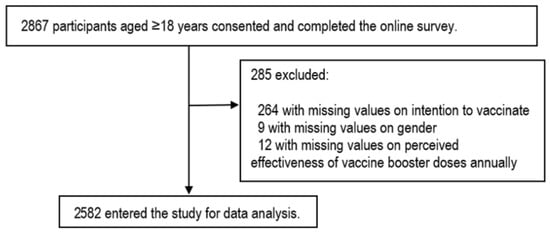
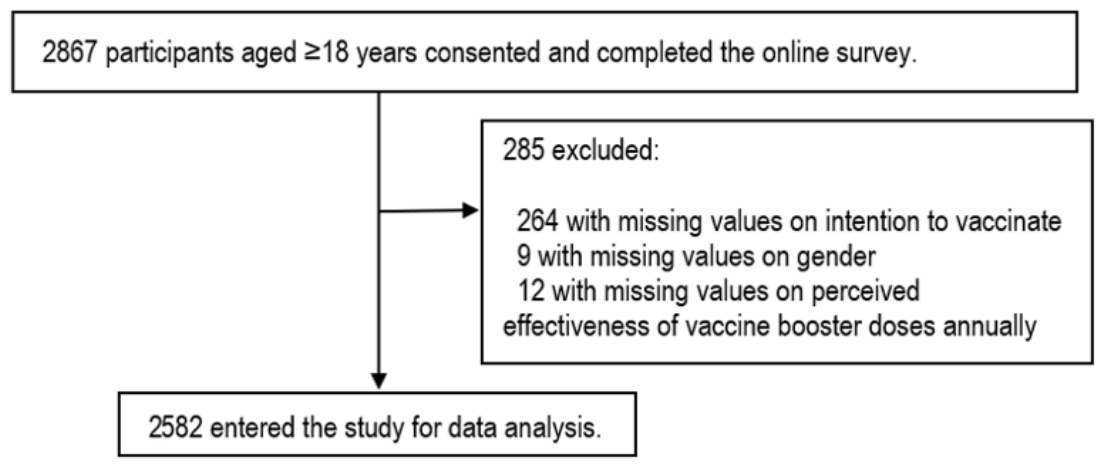
This study focused on the analysis of data on intention to vaccinate. Of 2867 respondents who completed the survey, 285 (9.9%) were excluded due to missing data on the outcome or one or more sociodemographic variables, leaving an analytic sample of 2582 participants (Figure 1). A small amount of item-level missing data on “COVID-19 vaccination status” and “perceived severity of COVID-19 in relation to influenza” remained within the analytic sample; these were reported as a separate category in the descriptive analysis in Table 1 and used but not reported as a separate category in the regression models.
Figure 1.
Exclusion criteria and number of participants.
Table 1.
Baseline characteristics of participants by intention to receive an annual COVID-19 booster.
2.1. Quantitative Analysis
The outcome was intention to receive an annual COVID-19 booster (binary variable), which was defined as the intention to vaccinate when a participant responded “Yes” to the question, “If a booster is needed every year, would you get it?” versus “No” or “Unsure.”
The predictors considered were perceived effectiveness of the COVID-19 vaccine, perceived severity of COVID-19 compared with influenza, perceived susceptibility to COVID-19 (whether the participant agreed that the pandemic was over), presence of at least one comorbidity, past COVID-19 vaccination status, knowledge of the availability of the bivalent COVID-19 vaccine, prior COVID-19 infection, source of information on COVID-19, and sociodemographic variables (Supplementary Table S1 provides details and coding of the predictors).
A generalised linear model (GLM) with a binary outcome variable, which is a binary logistic regression model, provided unadjusted and adjusted odds ratios (unadORs and adORs, respectively) for intention to vaccinate. To fit the binary logistic regression model, we applied a backward stepwise selection to the full model to obtain a reduced (final) model. The full model included all the predictors such as age, gender, state/territory, born in Australia, other language spoken, employment, education, COVID-19 vaccination, comorbidity, prior COVID-19 infection, sources of information on COVID-19, perceived severity of COVID-19 in relation to influenza, perception as whether pandemic is over, perceived effectiveness of vaccines, and knowledge of availability of the bivalent COVID-19 vaccine. Previous COVID-19 infection was assessed through self-reported survey responses, distinguishing between test-confirmed infection, no previous infection, and suspected infection based on symptoms without testing. Using backward stepwise selection, we set the statistical retention criterion at a p-value < 0.10 for each category of a multi-categorical variable at each step, and fitted a final model [26]. The final model included age, gender, COVID-19 vaccination, comorbidity, perceived severity of COVID-19 in relation to influenza, perception of whether the pandemic is over, perceived effectiveness of vaccines, and knowledge of the availability of the bivalent COVID-19 vaccine. Gender was retained because one category met the p < 0.10 retention threshold, although neither category reached conventional statistical significance in the final model. To establish internal validity and confirm results within the same dataset, we used bootstrapping, which draws subsamples with replacement from the entire dataset, and validated the multivariate results in the final model [27]. As a diagnostic test, we examined the assumption of linearity on the logit scale of age as a continuous variable, using the Box-Tidwell test [26], and found that this was violated, and for this reason we categorised age into three categories for data analysis. We did not test linearity for all predictors, because none of them was on a continuous scale. Another assumption was the absence of multicollinearity. We assessed multicollinearity by computing variance inflation factors (VIFs) in the final model and found a mean VIF of 2, with a minimum of 1 and a maximum of 5. We retained all the predictors of the final model, as these VIF values did not suggest strong collinearity in the final model. We also examined the goodness of fit of the final model using the Pearson chi-square test and obtained a p-value of 0.72, indicating that our model fit the data well. Quantitative data analysis was performed using STATA version 17 [28]. Reporting follows the STROBE statement for cross-sectional studies.
2.2. Qualitative Analysis
A content analysis method was employed. We analysed the reasons that participants provided for the open-ended options for the question on intention to vaccinate: “If a booster is needed every year, would you get it?” with the response options of “Yes (please explain why)”, “No (please explain why)”, or “Unsure (please explain why)”. We performed a content analysis to manually code the reasons for the three response options using NVivo version 12. Responses could be assigned more than one code, so category percentages within each response group sum to more than 100%. Responses were coded manually in NVivo version 12 (QSR International), which was used to store, organise and retrieve responses and their assigned codes. Word frequency queries were run during familiarisation to identify commonly used terms; these informed, but did not determine, the initial codes. No automated coding, machine-learning classification or generative artificial intelligence (AI) tools were used to code, categorise or interpret the data. All codes and categories were assigned by the researchers, as described below.
We followed the content analysis steps suggested by Thomas [29]. This exploratory process employed a bottom-up approach to create categories that emerged from the data. We started by familiarising ourselves with the data, generating initial codes and then grouping codes into broader categories. Coding quality was ensured through an iterative process: one researcher (DAH) independently coded the data, and the coding was then cross-checked by two researchers (ET and MK). Any discrepancies were discussed collectively until a consensus was reached. This consensus-based approach ensured consistency and rigour in developing the final coding framework and categories.
3. Results
3.1. Sociodemographic Statistics
Of 2582 participants, 74.3% had received ≥3 doses of the COVID-19 vaccine by January 2023, and 62.3% (1608/2582) reported they intended to get a COVID-19 booster; 22.0% (569/2582) reported they did not intend to get an annual booster, and 15.7% (405/2582) were unsure. Only 9.4% (242/2582) of respondents reported awareness of bivalent COVID-19 vaccines, although the survey did not distinguish between specific vaccine formulations. More than 54.5%, (1408/2582) obtained information on COVID-19 from reliable sources such as Government, WHO, doctors, or websites, and 24.3% (628/2582) received information on COVID-19 from social media. A total of 58.0% (1497/2582) had at least one comorbidity. The sample was not proportionally distributed across states and territories relative to the Australian population (Table 1); this is addressed in the Limitations. Details on sociodemographic, source of information on COVID-19, whether the participant has had COVID-19 infection, perceived severity of COVID-19, and susceptibility to COVID-19 are in Table 1.
3.2. Multivariate Results
Intention to vaccinate was significantly higher among older participants aged 65–74 and ≥75 years than among those aged 18–64 years. Likewise, intention to vaccinate was significantly greater in those who perceived COVID-19 was worse than influenza, in those who perceived that pandemic was not over, in those with comorbidity, in those who received ≥3 doses of COVID-19 vaccines, in those with knowledge of the availability of the bivalent COVID-19 vaccine, and in those who perceived that COVID-19 vaccines were effective; but it was significantly lower in those who were unvaccinated for COVID-19 (aOR 0.29, 95% CI 0.16–0.53) (details in Table 2). The three strongest independent predictors were having received ≥3 prior doses (aOR 4.26, 95% CI 3.31–5.49), perceiving vaccines as effective (aOR 4.22, 95% CI 3.44–5.18), and knowing that the bivalent vaccine was available (aOR 4.06, 95% CI 2.47–6.68). Table 2 presents the final (reduced) model; unadjusted odds ratios for all candidate predictors are provided in Supplementary Table S2.
Table 2.
Predictors of intention to receive an annual COVID-19 booster.
Results on the category of missing values for COVID-19 vaccination status, and perceived severity of COVID-19 in relation to influenza are not reported.
3.3. Qualitative Results
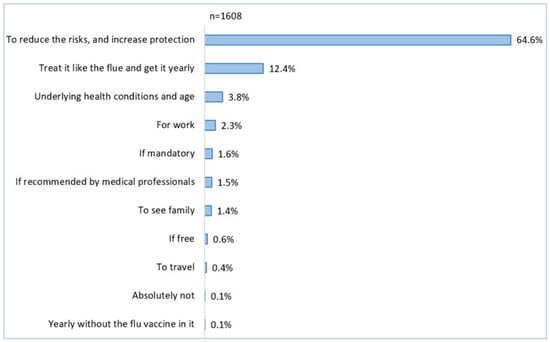
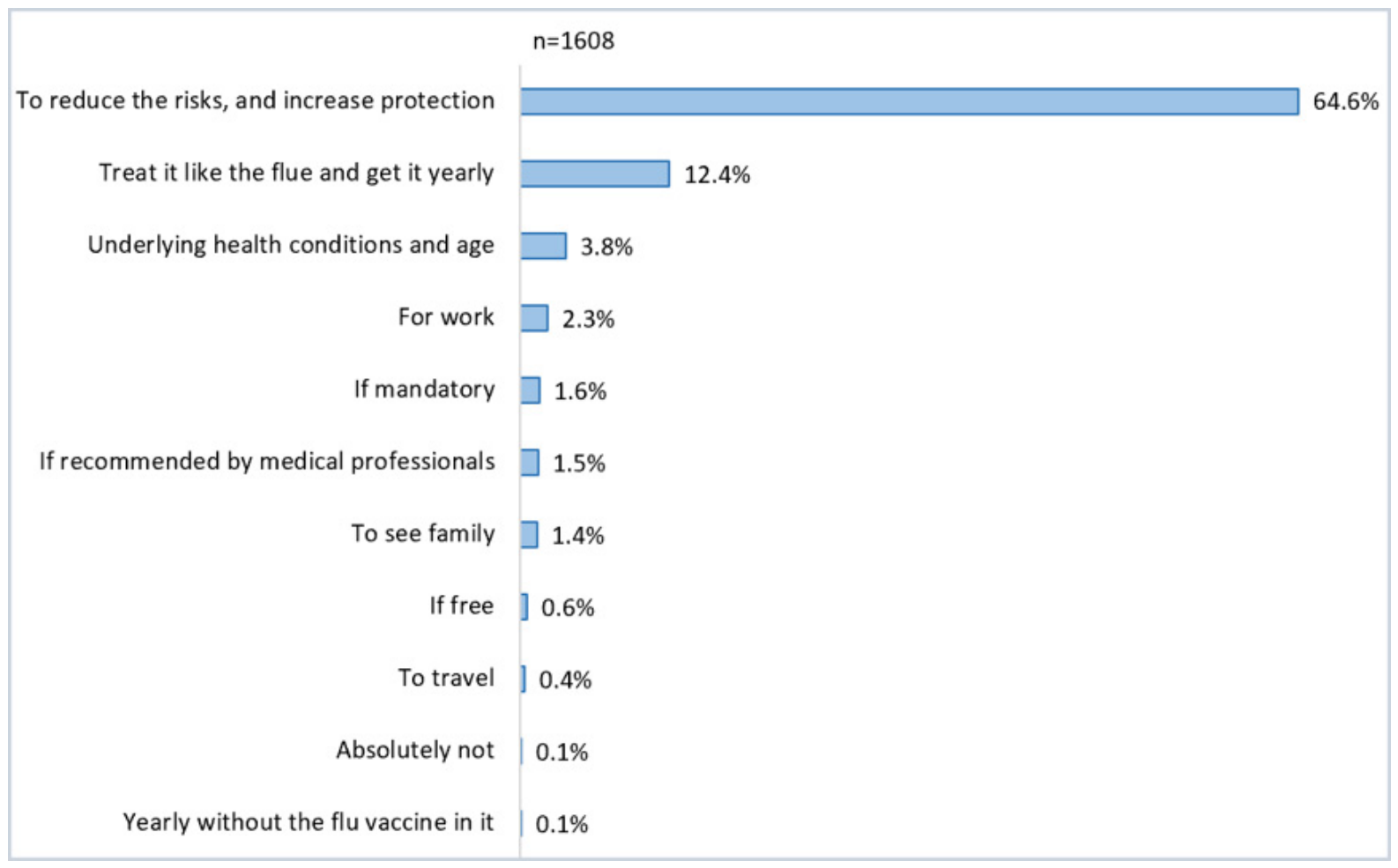
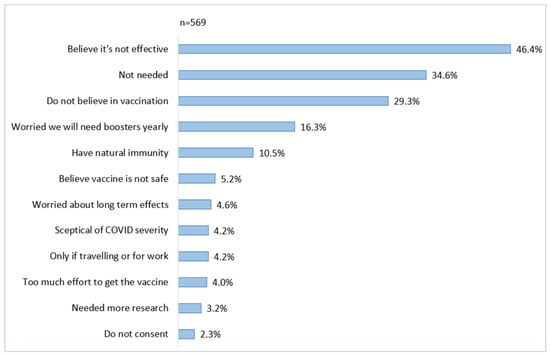
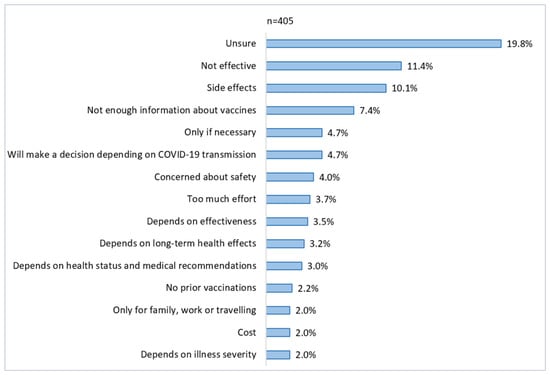
Our content analysis of willingness to get an annual booster are shown in Figure 2, Figure 3 and Figure 4. Because responses could be assigned more than one code, percentages within each group sum to more than 100%. Of 1608 participants who intended to get a booster, 64.6% (n = 1039) indicated their reason was to “reduce risks, increase protection”, 12.4% (n = 199) said to “treat it like the flu and get vaccinated yearly”, and 3.8% (n = 61) indicated “for my underlying health conditions and age” (Figure 2). Of 569 participants (22.0%) who responded they did not intend to get a booster, 46.4% (n = 264) believed “it’s not effective”, 34.6% (n = 197) stated “it is not needed”, and 29.3% (n = 167) did not believe “in vaccination” (Figure 3). Of 405 participants who responded ‘Unsure’, 19.8% (n = 80) were “undecided”, 11.4% (n = 46) believed “it is not effective”, and 10.1% (n = 41) were “concerned about side effects” (Figure 4).
Figure 2.
The reasons participants provided when they responded “Yes” to the question “If a booster is needed every year, would you get it?”.
Figure 3.
The reasons participants provided when they responded “No” to the question “If a booster is needed every year, would you get it?”.
Figure 4.
The reasons participants provided when they responded “Unsure” to the question “If a booster is needed every year, would you get it?”.
4. Discussion
4.1. Intention and Hesitancy in Context
In this study, 15.7% of participants were unsure about boosters rather than opposed to them. Vaccine hesitancy is best understood as a continuum between acceptance and refusal [30], and evidence suggests that people who are undecided are more open to change than those who are firmly opposed. In a longitudinal cohort of US adults, around two-thirds of those who were vaccine hesitant in 2020 had been vaccinated or had become willing by 2021 [31]. Similarly, in a national US panel, 54% of adults who initially wanted to “wait and see” had been vaccinated six months later, often citing conversations with family, friends and their doctors. By contrast, about three-quarters of those who said they would definitely not be vaccinated, or would be vaccinated only if required, remained unvaccinated [32]. In Australia, booster-resistant adults were distinguished from booster-hesitant adults by greater reactance and stronger conspiracy beliefs [33]. Both characteristics are associated with resistance to persuasion, and corrective vaccine messages have been shown to reduce intention among people with the least favourable vaccine attitudes [34]. Our free-text data are consistent with this distinction. Among those unsure or not intending to vaccinate, the most commonly cited barriers were perceived ineffectiveness and the belief that vaccination was not needed, with safety concerns far less common. However, the reasons given by unsure participants were largely conditional or informational, such as being undecided, wanting more information, or depending on effectiveness or transmission. Non-intenders more often expressed a settled rejection, such as not believing in vaccination. Unsure adults are therefore likely to be more responsive to health promotion than outright refusers, although messages emphasising personal benefit can also reduce hesitancy among more strongly hesitant people [35].
Our finding on the proportion of people who did not intend to vaccinate was slightly lower than data from the Vaccine Hesitancy Tracker, which reported around 25% of Australians to be vaccine-hesitant [36]. In a study of COVID-19 vaccine acceptance across 23 countries in 2022, booster hesitancy among vaccinated individuals was 12.1%, ranging from 1.1% in China to 28.9% in Russia [37]. Despite our findings that more than half of participants obtained COVID-19-related information from reliable sources, the role of misinformation and anti-vaccination sentiment on social media and other media should be considered. A rise in disinformation and misinformation about COVID-19 vaccines was seen on social media and in other media, without counteracting messaging from governments, and this occurred despite the accumulation of large, robust safety studies [38]. In mid-2023, worldwide, the majority of people were willing to receive a COVID-19 vaccine booster [39]. In Australia, by 30 April 2022, over 95% of people aged 16 years or older had received at least two doses of the COVID-19 vaccines [40]. However, despite the intention to get a booster [33], data show that by the end of 2023, only one in three adults received a booster [41]. Yet after 2021, there was minimal public messaging about the importance of boosters, despite clear evidence that vaccine efficacy wanes by 3–6 months and boosters are needed [42]. Even in high-risk settings like aged care, vaccination rates fell in 2023 and 2024 [43].
4.2. Interpreting Intention to Receive an Annual Booster
Our outcome measured intention to receive a booster if one were needed every year, rather than intention to receive the next available dose. This framing has two implications. First, it captured acceptance of a recurring commitment, which is a higher threshold than acceptance of a single dose. The 62.3% who intended to vaccinate may therefore be a conservative estimate of willingness to receive a single booster, and some participants who would have accepted one further dose may have answered “No” or “Unsure” because of the annual framing. Second, the framing is visible in participants’ own explanations. Among non-intenders, 16.3% (n = 93) were “worried we will need boosters yearly”, indicating that for a meaningful minority the objection was to an open-ended schedule rather than to vaccination itself. This finding may reflect concerns about repeated vaccination rather than opposition to receiving an immediate booster and should be interpreted in light of the survey question’s wording. Conversely, 12.4% of intenders said they would “treat it like the flu and get vaccinated yearly”, suggesting that the annual framing was acceptable, or even reassuring, when anchored to a familiar seasonal program. At the time of the survey, Australian booster recommendations were based on the interval since the last dose rather than on an annual schedule. Shortly after data collection, ATAGI advised a 2023 booster dose at least six months after the last dose or infection, and noted that regular doses would likely be needed, similar to influenza vaccination, but did not set an annual schedule. Participants were therefore asked to anticipate a schedule that did not yet exist. That framing is, however, close to the program that has since emerged, in which funded doses are offered every 6 or 12 months to defined risk groups [14]. These findings may inform the planning of future recurring vaccination schedules by highlighting the importance of distinguishing willingness to receive an additional booster from willingness to receive repeated doses over time. Clear communication about the rationale for recommended vaccination intervals may help address uncertainty surrounding recurring vaccination, although the effectiveness of such approaches requires further evaluation.
4.3. Quantitative Analysis Findings
Our findings in terms of perceived ineffectiveness of COVID-19 vaccines are consistent with the previous literature showing higher hesitancy among those who reported concerns about vaccine effectiveness [44,45,46]. There is sufficient evidence supporting the safety and effectiveness of COVID-19 vaccines [36]; however, concerns remain about booster dose uptake [45,47]. Our findings on the positive association of intention to vaccinate and existing comorbidities are consistent with previous studies [48,49]. Likewise, a positive association of perceived risk of COVID-19 and intention to vaccinate [50,51], and higher likelihood of vaccine acceptance among those with better knowledge of COVID-19 [52,53], as well as higher odds of vaccine acceptance for boosters in older people [54], have been reported previously. Research shows a reduced risk of COVID-19 death among Australians aged 65 years or older who received COVID-19 vaccine boosters [55].
4.4. Qualitative Analysis Findings
Our content analysis revealed that the most common reasons for intending to get a booster were to reduce risk and increase protection, to treat boosters like annual influenza vaccines, and to protect themselves due to age or comorbidities. These themes align with findings from recent studies, which show that perceived personal protection and social responsibility motivate booster acceptance [56,57,58]. However, the emergence of treating boosters like an annual influenza vaccine has not been seen in the current literature. Among those who were unsure or did not intend to vaccinate, the dominant reasons were perceived vaccine ineffectiveness, the belief that boosters were unnecessary, and a lack of trust in vaccination, while safety concerns were less prominent. Recent systematic reviews have identified similar reasons with a common belief that vaccine boosters were unnecessary [59,60]. Moreover, this aligns with recent studies showing that misinformation and declining trust in health authorities have contributed to growing perceptions of limited vaccine effectiveness [61,62,63]. The rise in disinformation and misinformation on mass media and digital platforms has increased significantly over the last decade, negatively impacting public opinion and people’s willingness to get vaccinated [64]. This rise in disinformation on social media, coupled with reduced government-led counter-messaging, may have amplified these perceptions despite robust evidence for vaccine safety and effectiveness.
4.5. Practical Implications
These findings highlight opportunities to inform public health strategies aimed at improving COVID-19 booster vaccination uptake in Australia. Notably, only 9.4% of participants reported awareness of bivalent COVID-19 vaccines, despite awareness being one of the three strongest independent predictors of intention to receive annual boosters, although the survey did not distinguish between specific vaccine formulations. The low reported awareness of bivalent vaccine availability suggests a potential gap in public awareness and highlights the importance of providing timely and accessible information about updated vaccine formulations, eligibility criteria and recommended vaccination schedules.
Public health communication strategies could be tailored to address concerns about vaccine effectiveness and the perceived necessity of recurring booster doses, particularly among individuals who remain undecided about vaccination. Tailored communication campaigns addressing vaccine effectiveness, safety and the necessity of ongoing boosters may help address informational barriers. Public health authorities could consider integrating clearer communication about vaccine availability and eligibility into existing adult immunisation programmes. Primary care providers and other trusted healthcare professionals could play an important role in communicating updated vaccination recommendations and supporting informed decision-making, particularly among populations at increased risk of severe COVID-19, including older adults and individuals with comorbidities.
Although these findings reflect vaccination intentions in January 2023, they may provide insights for the development of communication strategies for recurring COVID-19 vaccination and other adult immunisation programmes. However, given the cross-sectional nature of the study, further research is needed to determine whether these communication strategies translate into increased vaccination uptake.
4.6. Strengths of This Study
This study has several strengths. It represents one of the largest surveys (n = 2582) examining predictors of COVID-19 booster intentions in Australia during the post-mandate period. It integrates both qualitative and quantitative data, allowing for a more nuanced understanding not only of who is hesitant but also of why. Free-text responses were coded manually by one researcher and independently cross-checked by two others, with discrepancies resolved by consensus, which strengthened the rigour and transparency of the qualitative findings. Finally, this study provides a baseline measure of booster intention at the precise point when Australia transitioned from emergency pandemic response to long-term COVID-19 management, against which subsequent changes in intention and uptake can be compared.
4.7. Limitations and Future Directions
There are several limitations to our study. First, the study relied on self-reported data, which may be subject to selection, recall, or social desirability bias. Because the participants were sampled from an existing commercial panel (Dynata) for online survey on mask wearing, and protective behaviours related to COVID-19, and because the panel recruitment was at the discretion of individuals who were invited for the survey, the likelihood of selection bias for a nationally representative sample may be substantial, and we were not able to evaluate the extent of such bias in this study. These could have led to either under- or over-reporting of the information provided by the survey participants. Second, our sample was not proportionally representative of the Australian population by state or territory; the more populous states were under-represented, and the smaller jurisdictions over-represented (Table 1), and results were not weighted to population benchmarks. There were substantial differences when we compared the estimated prevalence on key demographic characteristics in our study with those of the national estimates. For example, according to the 2021 Census, 31.7% of Australians had at least one long-term health condition, and 22.3% spoke another language in addition to English, and in our study, the estimates, respectively, were 58.0% and 10.4%. In terms of tertiary education, according to the 2021 Census, 66.2% of Australians were attending for university or higher degree and 33.6% were attending vocational education (TAFE or private training providers), while in our study 70.1% of participants were attending university or higher education, and we have included those who were attending TAFE course as part of university or higher education. A closer estimate between our study and that of national level can be on whether the participant was born in Australia (21.3% in our study vs. 27.6% of Australians were born overseas), which may be due to chance rather than any measure on sample representativeness. This may limit the external validity and generalisability of our findings at the national level. The study sample included a relatively high proportion of tertiary-educated participants and individuals reporting comorbidities, which may not reflect the broader Australian population. This potential selection bias should be considered when interpreting and generalising the findings. Third, there may be residual confounding that we were unable to identify in our study. Fourth, the question “If a booster is needed every year, would you get it?” asked two dimensions—(i) whether a participant would get a booster, and (ii) whether the participant would get it yearly. The wording of such double-barrelled wording may have affected the validity of intention to receive a booster. It is possible that more participants would have responded “Yes” if this question had asked, “If a booster is needed, would you get it?” Fifth, intention is an imperfect proxy for behaviour; the gap between the 62.3% who intended to vaccinate and the approximately one in three adults who received a booster during 2023 illustrates this directly. Sixth, participants were recruited from a commercial online panel, which under-represents people with limited digital access and may over-represent those willing to engage with health surveys. Seventh, the data were collected in January 2023 and attitudes to COVID-19 vaccination have continued to evolve; our findings should be read as a baseline for the transition to routine COVID-19 vaccination rather than as a description of current intention. Nevertheless, no national data on the determinants of booster intention have been published for 2026, and the determinants identified here remain directly relevant to the targeted program commencing in October 2026.
Future research could explore the effectiveness of specific interventions to increase vaccine acceptance and the long-term effects of COVID-19 vaccine hesitancy on public health outcomes. Further studies could investigate the impact of cultural and political factors on vaccine hesitancy, providing a more comprehensive understanding of the complex issue.
5. Conclusions
This study examined predictors of intention to receive an annual COVID-19 booster among Australian adults in early 2023. Intention to vaccinate was strongly associated with perceiving COVID-19 as more severe than influenza, believing the pandemic was not over, perceiving vaccines as effective, that a bivalent vaccine was available, being older, having comorbidities, and having received ≥3 prior COVID-19 vaccine doses. However, despite generally high stated intention, actual booster uptake in 2023 and 2024 remained low, and fewer than one in ten participants knew that a bivalent vaccine was available. Our findings suggest that awareness of booster availability may be an important consideration for future public health communication strategies. Further research is needed to determine whether improving awareness translates into increased vaccination uptake. Strengthening communication about new booster availability and directing it to the substantial minority who are unsure, rather than to outright refusers, is likely to be a more efficient lever for improving uptake in any recurring COVID-19 vaccination program. As funded COVID-19 vaccination narrows to higher-risk groups from October 2026, ensuring that eligible adults know what is available to them, and when, will be central to maintaining protection. Although these findings reflect attitudes in early 2023, they may inform future research and programme planning by highlighting the importance of public understanding and acceptance of recurring vaccination schedules. Further studies using contemporary data are needed to assess preferences for different booster intervals and evaluate strategies to support informed vaccination decisions and uptake.
Supplementary Materials
The following supporting information can be downloaded at https://www.mdpi.com/article/10.3390/vaccines14110923/s1. Supplementary Table S1: Description of predictors and their coding; Supplementary Table S2: Full model on predictors of intention to vaccinate for annual booster doses of COVID-19 vaccines.
Author Contributions
E.T.: conceptualisation, methodology, data curation, quantitative data analysis, writing—original draft, writing—review and editing; M.K.: Conceptualisation, methodology, data curation, quantitative data analysis, writing—original draft, writing—review and editing; D.A.H.: methodology, data curation, qualitative analysis, writing—original draft, writing—review and editing; V.C.: methodology, writing—review and editing; H.S.: conceptualisation, design of survey questions, methodology, writing—review and editing; D.A.: conceptualisation, design of survey questions, methodology, writing—review and editing; C.R.M.: conceptualisation, design of survey questions, methodology, writing—review and editing. All authors have read and agreed to the published version of the manuscript.
Funding
This research is funded by the NHMRC Centre of Research Excellence (CRE) for mitigating airborne threats to health (BREATHE) (Grant Number: RG203873).
Institutional Review Board Statement
The UNSW Human Research Ethics Committee approved the survey (approval number HC220737, 2 December 2022).
Informed Consent Statement
All participants provided informed consent electronically before commencing the survey.
Data Availability Statement
Because of privacy and ethical considerations, the authors do not have permission to share individual-level data from this study. Aggregate data are available from the corresponding author on reasonable request.
Acknowledgments
The authors acknowledge the NHMRC Centre of Research Excellence (CRE) for funding this work. The authors also acknowledge the participants for their time and efforts in this study.
Conflicts of Interest
The authors declare no conflicts of interest. The analyses, interpretations, statements and conclusions in this paper are those of the authors and do not necessarily represent the views of the NHMRC Centre of Research Excellence (CRE).
References
- Park, H.J.; Gonsalves, G.S.; Tan, S.T.; Kelly, J.D.; Rutherford, G.W.; Wachter, R.M.; Schechter, R.; Paltiel, A.D.; Lo, N.C. Comparing frequency of booster vaccination to prevent severe COVID-19 by risk group in the United States. Nat. Commun. 2024, 15, 1883. [Google Scholar] [CrossRef] [Scilit] [PubMed]
- Zhou, G.; Dael, N.; Verweij, S.; Balafas, S.; Mubarik, S.; Oude Rengerink, K.; Pasmooij, A.M.G.; van Baarle, D.; Mol, P.G.; de Bock, G.H. Effectiveness of COVID-19 vaccines against SARS-CoV-2 infection and severe outcomes in adults: A systematic review and meta-analysis of European studies published up to 22 January 2024. Eur. Respir. Rev. 2025, 34, 240222. [Google Scholar] [CrossRef] [Scilit] [PubMed]
- Henry, D.A.; Jones, M.A.; Stehlik, P.; Glasziou, P.P. Effectiveness of COVID-19 vaccines: Findings from real world studies. Med. J. Aust. 2021, 215, 149–151.e1. [Google Scholar] [CrossRef] [Scilit] [PubMed]
- Zhu, Y.; Liu, S.; Zhang, D. Effectiveness of COVID-19 vaccine booster shot compared with non-booster: A meta-analysis. Vaccines 2022, 10, 1396. [Google Scholar] [CrossRef] [Scilit] [PubMed]
- Andrews, N.; Stowe, J.; Kirsebom, F.; Toffa, S.; Sachdeva, R.; Gower, C.; Ramsay, M.; Lopez Bernal, J. Effectiveness of COVID-19 booster vaccines against COVID-19-related symptoms, hospitalization and death in England. Nat. Med. 2022, 28, 831–837. [Google Scholar] [CrossRef] [PubMed]
- Australian Technical Advisory Group on Immunisation (ATAGI); Australian Government Department of Health (Australia). ATAGI Recommendations on the Use of a Booster Dose of COVID-19 Vaccine. 2022. Available online: https://transplant.org.au/wp-content/uploads/2022/05/atagi-recommendations-on-the-use-of-a-booster-dose-of-covid-19-vaccine.pdf (accessed on 13 October 2026).
- Australian Technical Advisory Group on Immunisation (ATAGI); Australian Government Department of Health (Australia). ATAGI Updated Recommendations for a Winter Dose of COVID-19 Vaccine. 2022. Available online: https://www.health.gov.au/news/atagi-updated-recommendations-for-a-winter-dose-of-covid-19-vaccine (accessed on 13 October 2026).
- Australian Technical Advisory Group on Immunisation (ATAGI). ATAGI Recommendations on Use of the Pfizer Bivalent (Original/Omicron BA.1) COVID-19 Vaccine; Australian Government Department of Health and Aged Care: Canberra, Australia, 2022; Available online: https://nitag-resource.org/node/139363 (accessed on 13 October 2026).
- Australian Technical Advisory Group on Immunisation (ATAGI); Australian Government Department of Health and Aged Care (Australia). ATAGI 2023 Booster Advice. 2022. Available online: https://www.nitag-resource.org/sites/default/files/2023-02/ATAGI%202023%20booster%20advice%20.pdf (accessed on 13 October 2026).
- Australian Government Department of Health. COVID-19 Vaccines: Update for Immunisation Providers. Australian Government Department of Health (Australia): Canberra, Australia, 2026. Available online: https://www.health.gov.au/resources/publications/covid-19-vaccines-update-for-immunisation-providers (accessed on 17 September 2026).
- Department of Health and Aged Care. COVID-19 Vaccine Rollout Update—10 November 2023. Available online: https://www.health.gov.au/ministers/the-hon-mark-butler-mp/media/new-covid-19-vaccines-available-to-target-current-variants (accessed on 1 December 2023).
- Melbourne Institute: Applied Economic; Social Research; University of Melbourne (Australia). Vaccine Hesitancy Tracker. 2021. Available online: https://melbourneinstitute.unimelb.edu.au/data/taking-the-pulse-of-the-nation/vaccination-report (accessed on 17 September 2026).
- Edwards, B.; Biddle, N.; Gray, M.; Sollis, K. COVID-19 vaccine hesitancy and resistance: Correlates in a nationally representative longitudinal survey of the Australian population. PLoS ONE 2021, 16, e0248892. [Google Scholar] [CrossRef] [Scilit] [PubMed]
- Trent, M.; Seale, H.; Chughtai, A.A.; Salmon, D.; MacIntyre, C.R. Trust in government, intention to vaccinate and COVID-19 vaccine hesitancy: A comparative survey of five large cities in the United States, United Kingdom, and Australia. Vaccine 2022, 40, 2498–2505. [Google Scholar] [CrossRef] [Scilit] [PubMed]
- Tran, M.-H. COVID-19 vaccination hesitancy in Australia: A public health issue. Front. Public Health 2024, 12, 1282986. [Google Scholar] [CrossRef] [Scilit] [PubMed]
- Shah, A.; Coiado, O.C. COVID-19 vaccine and booster hesitation around the world: A literature review. Front. Med. 2023, 9, 1054557. [Google Scholar] [CrossRef] [Scilit] [PubMed]
- Jiang, T.; Zhou, X.; Wang, H.; Dong, S.; Wang, M.; Akezhuoli, H.; Zhu, H. COVID-19 vaccination intention and influencing factors among different occupational risk groups: A cross-sectional study. Hum. Vaccines Immunother. 2021, 17, 3433–3440. [Google Scholar] [CrossRef] [Scilit] [PubMed]
- Szilagyi, P.G.; Thomas, K.; Shah, M.D.; Vizueta, N.; Cui, Y.; Vangala, S.; Kapteyn, A. Likelihood of COVID-19 vaccination by subgroups across the US: Post-election trends and disparities. Hum. Vaccines Immunother. 2021, 17, 3262–3267. [Google Scholar] [CrossRef] [Scilit] [PubMed]
- Zioga, S.; Katsiroumpa, A.; Kitsaki, M.; Moisoglou, I.; Gallos, P.; Kolisiati, A.; Galanis, P. Factors Affecting the Intention of Healthcare Workers and Students to Receive COVID-19 Booster Dose Vaccination: A Systematic Review. Int. J. Caring Sci. 2024, 17, 814. [Google Scholar]
- Mangla, S.; Zohra Makkia, F.T.; Pathak, A.K.; Robinson, R.; Sultana, N.; Koonisetty, K.S.; Karamehic-Muratovic, A.; Nguyen, U.-S.D.; Rodriguez-Morales, A.J.; Sanchez-Duque, J.A. COVID-19 vaccine hesitancy and emerging variants: Evidence from six countries. Behav. Sci. 2021, 11, 148. [Google Scholar] [CrossRef] [Scilit] [PubMed]
- Alrabadi, N.; Bany-Melhem, S.; Alzoubi, K.H.; Alzoubi, O.O.; Masadeh, M.; Abuhammad, S.; Harun, S.N. COVID-19 vaccination hesitancy: A review of the literature and recommendations. Curr. Rev. Clin. Exp. Pharmacol. Former. Curr. Clin. Pharmacol. 2024, 19, 26–41. [Google Scholar] [CrossRef] [Scilit] [PubMed]
- Australian Centre for Disease Control. Australian Respiratory Surveillance Report: 24 August to 6 September 2026. Available online: https://www.cdc.gov.au/resources/collections/australian-respiratory-surveillance-reports (accessed on 17 September 2026).
- Wiblin, S.; Kunasekaran, M.; MacIntyre, R.; Seale, H. Behavioural Drivers of COVID-19 Vaccination and Antiviral Uptake in Australia: A Cross-Sectional Analysis Using the COM-B Framework. Vaccines 2026, 14, 495. [Google Scholar] [CrossRef] [Scilit] [PubMed]
- Dynata. Dynata: World’s Largest First Party Data Platform 2023. Available online: https://www.dynata.com/ (accessed on 17 September 2026).
- Tawfiq, E.; Chen, R.; Honeyman, D.A.; Dawson, R.; Kunasekaran, M.; Notaras, A.; Gurdasani, D.; Skouteris, H.; Ayton, D.; MacIntyre, C.R. Long Covid Symptom Clusters, Correlates and Predictors in a Highly Vaccinated Australian Population in 2023. Health Expect. Int. J. Public Particip. Health Care Health Policy 2025, 28, e70273. [Google Scholar] [CrossRef] [Scilit] [PubMed]
- Stoltzfus, J.C. Logistic regression: A brief primer. Acad. Emerg. Med. 2011, 18, 1099–1104. [Google Scholar] [CrossRef] [Scilit] [PubMed]
- Kohavi, R. A study of cross-validation and bootstrap for accuracy estimation and model selection. In Proceedings of the International Joint Conference on Artificial Intelligence; Morgan Kaufmann: San Francisco, CA, USA, 1995; pp. 1137–1145. [Google Scholar]
- STATA, version 17.0. StataCorp LLC: College Station, TX, USA, 2021.
- Thomas, D.R. A general inductive approach for analyzing qualitative evaluation data. Am. J. Eval. 2006, 27, 237–246. [Google Scholar] [CrossRef] [Scilit]
- MacDonald, N.E. Vaccine hesitancy: Definition, scope and determinants. Vaccine 2015, 33, 4161–4164. [Google Scholar] [CrossRef] [Scilit] [PubMed]
- Siegler, A.J.; Luisi, N.; Hall, E.W.; Bradley, H.; Sanchez, T.; Lopman, B.A.; Sullivan, P.S. Trajectory of COVID-19 Vaccine Hesitancy Over Time and Association of Initial Vaccine Hesitancy With Subsequent Vaccination. JAMA Netw. Open 2021, 4, e2126882. [Google Scholar] [CrossRef] [Scilit] [PubMed]
- KFF (United States of America). KFF COVID-19 Vaccine Monitor: In Their Own Words, Six Months Later. 2021. Available online: https://www.kff.org/covid-19/vaccine-monitor-some-who-were-hesitant-to-get-a-vaccine-in-january-say-they-changed-their-mind-because-of-family-friends-and-their-personal-doctors/ (accessed on 13 October 2026).
- Kleitman, S.; Fullerton, D.J.; Law, M.K.; Blanchard, M.D.; Campbell, R.; Tait, M.-A.; Schulz, J.; Lee, J.; Stankov, L.; King, M.T. The psychology of COVID-19 booster hesitancy, acceptance and resistance in Australia. Vaccines 2023, 11, 907. [Google Scholar] [CrossRef] [Scilit] [PubMed]
- Nyhan, B.; Reifler, J.; Richey, S.; Freed, G.L. Effective messages in vaccine promotion: A randomized trial. Pediatrics 2014, 133, e835–e842. [Google Scholar] [CrossRef] [Scilit] [PubMed]
- Freeman, D.; Loe, B.S.; Yu, L.M.; Freeman, J.; Chadwick, A.; Vaccari, C.; Shanyinde, M.; Harris, V.; Waite, F.; Rosebrock, L.; et al. Effects of different types of written vaccination information on COVID-19 vaccine hesitancy in the UK (OCEANS-III): A single-blind, parallel-group, randomised controlled trial. Lancet Public Health 2021, 6, e416–e427. [Google Scholar] [CrossRef] [Scilit] [PubMed]
- COVID-19 Critical Intelligence Unit. Vaccine Hesitancy. 2021. Available online: https://aci.health.nsw.gov.au/__data/assets/pdf_file/0008/649169/Evidence-Check-Vaccine-hesitancy.pdf (accessed on 17 September 2026).
- Lazarus, J.V.; Wyka, K.; White, T.M.; Picchio, C.A.; Gostin, L.O.; Larson, H.J.; Rabin, K.; Ratzan, S.C.; Kamarulzaman, A.; El-Mohandes, A. A survey of COVID-19 vaccine acceptance across 23 countries in 2022. Nat. Med. 2023, 29, 366–375. [Google Scholar] [CrossRef] [Scilit] [PubMed]
- Faksova, K.; Walsh, D.; Jiang, Y.; Griffin, J.; Phillips, A.; Gentile, A.; Kwong, J.; Macartney, K.; Naus, M.; Grange, Z. COVID-19 vaccines and adverse events of special interest: A multinational Global Vaccine Data Network (GVDN) cohort study of 99 million vaccinated individuals. Vaccine 2024, 42, 2200–2211. [Google Scholar] [CrossRef] [Scilit] [PubMed]
- Roy, D. Global disparities in COVID-19 vaccine booster dose (VBD) acceptance and hesitancy: An updated narrative review. Vaccine X 2024, 18, 100480. [Google Scholar] [CrossRef] [Scilit] [PubMed]
- Australian Government, Department of Health, Disability and Ageing. COVID-19 Vaccine Rollout Update: 30 April 2022. Available online: https://www.health.gov.au/resources/publications/covid-19-vaccine-rollout-update-30-april-2022 (accessed on 18 September 2025).
- Australian Government, Department of Health, Disability and Ageing. COVID-19 Vaccine Rollout Update: 8 December 2023. Available online: https://www.health.gov.au/resources/publications/covid-19-vaccination-vaccination-data-30-april-2022?language=en (accessed on 18 September 2025).
- Feikin, D.R.; Higdon, M.M.; Abu-Raddad, L.J.; Andrews, N.; Araos, R.; Goldberg, Y.; Groome, M.J.; Huppert, A.; O’Brien, K.L.; Smith, P.G. Duration of effectiveness of vaccines against SARS-CoV-2 infection and COVID-19 disease: Results of a systematic review and meta-regression. Lancet 2022, 399, 924–944. [Google Scholar] [CrossRef] [Scilit] [PubMed]
- Australian Government, Department of Health and Aged Care. Residential Aged Care Residents COVID-19 Vaccination Rates Data. Available online: https://www.health.gov.au/resources/collections/residential-aged-care-residents-covid-19-vaccination-rates-data (accessed on 5 December 2024).
- Yadete, T.; Batra, K.; Netski, D.M.; Antonio, S.; Patros, M.J.; Bester, J.C. Assessing acceptability of COVID-19 vaccine booster dose among adult Americans: A cross-sectional study. Vaccines 2021, 9, 1424. [Google Scholar] [CrossRef] [Scilit] [PubMed]
- Batra, K.; Sharma, M.; Dai, C.-L.; Khubchandani, J. COVID-19 booster vaccination hesitancy in the United States: A multi-theory-model (MTM)-based national assessment. Vaccines 2022, 10, 758. [Google Scholar] [CrossRef] [Scilit] [PubMed]
- Neumann-Böhme, S.; Varghese, N.E.; Sabat, I.; Barros, P.P.; Brouwer, W.; van Exel, J.; Schreyögg, J.; Stargardt, T. Once we have it, will we use it? A European survey on willingness to be vaccinated against COVID-19. Eur. J. Health Econ. 2020, 21, 977–982. [Google Scholar] [CrossRef] [Scilit] [PubMed]
- Rzymski, P.; Poniedziałek, B.; Fal, A. Willingness to receive the booster COVID-19 vaccine dose in Poland. Vaccines 2021, 9, 1286. [Google Scholar] [CrossRef] [Scilit] [PubMed]
- Fathalla Aboelsaad, I.A.; Hafez, D.M.; Almaghraby, A.; Abdulmoneim, S.A.; El-ganainy, S.O.; Hamdy, N.A.; Deghidy, E.A.; El-Deen, A.E.-S.N.; Adel Elrewany, E.M.; Taha Khalil, A.H. Systematic review and meta-analysis on COVID-19 vaccine hesitancy. medRxiv 2021. [Google Scholar] [CrossRef] [Scilit]
- Wake, A.D. The willingness to receive COVID-19 vaccine and its associated factors:“vaccination refusal could prolong the war of this pandemic”–a systematic review. Risk Manag. Healthc. Policy 2021, ume 14, 2609–2623. [Google Scholar] [CrossRef] [Scilit] [PubMed]
- Choukou, M.-A.; Sanchez-Ramirez, D.C.; Pol, M.; Uddin, M.; Monnin, C.; Syed-Abdul, S. COVID-19 infodemic and digital health literacy in vulnerable populations: A scoping review. Digit. Health 2022, 8, 20552076221076927. [Google Scholar] [CrossRef] [Scilit] [PubMed]
- Zhang, Q.; Lin, X.; English, A.S.; Talhelm, T. Beyond perceived risk: COVID-19 vaccination more strongly linked to individual risk perception in wheat areas than rice areas. Int. J. Intercult. Relat. 2024, 103, 102075. [Google Scholar] [CrossRef] [Scilit]
- Dye, T.D.; Barbosu, M.; Siddiqi, S.; Ramos, J.G.P.; Murphy, H.; Alcántara, L.; Pressman, E. Science, healthcare system, and government effectiveness perception and COVID-19 vaccination acceptance and hesitancy in a global sample: An analytical cross-sectional analysis. BMJ Open 2021, 11, e049716. [Google Scholar] [CrossRef] [Scilit] [PubMed]
- Leigh, J.P.; FitzGerald, E.A.; Moss, S.J.; Brundin-Mather, R.; Dodds, A.; Stelfox, H.T.; Dubé, È.; Fiest, K.M.; Halperin, D.; Ahmed, S.B. Factors affecting hesitancy toward COVID-19 vaccine booster doses in Canada: A cross-national survey. Can. J. Public Health 2024, 115, 26–39. [Google Scholar] [CrossRef] [Scilit] [PubMed]
- Lu, P.-j.; Srivastav, A.; Vashist, K.; Black, C.L.; Kriss, J.L.; Hung, M.-C.; Meng, L.; Zhou, T.; Yankey, D.; Masters, N.B. COVID-19 booster dose vaccination coverage and factors associated with booster vaccination among adults, United States, March 2022. Emerg. Infect. Dis. 2023, 29, 133. [Google Scholar] [CrossRef] [Scilit] [PubMed]
- Liu, B.; Scaria, A.; Stepien, S.; Macartney, K. Effectiveness of COVID-19 vaccine boosters for reducing COVID-19 mortality among people aged 65 years or older, Australia, August 2023–February 2024: A retrospective observational cohort study. Med. J. Aust. 2025, 223, 418–422. [Google Scholar] [CrossRef] [Scilit] [PubMed]
- Moore, R.; Purvis, R.S.; Willis, D.E.; Li, J.; Langner, J.; Gurel-Headley, M.; Kraleti, S.; Curran, G.M.; Macechko, M.D.; McElfish, P.A. “Every Time It Comes Time for Another Shot, It’sa Re-Evaluation”: A Qualitative Study of Intent to Receive COVID-19 Boosters among Parents Who Were Hesitant Adopters of the COVID-19 Vaccine. Vaccines 2024, 12, 171. [Google Scholar] [CrossRef] [Scilit] [PubMed]
- Yu, H.; Bonett, S.; Oyiborhoro, U.; Aryal, S.; Kornides, M.; Glanz, K.; Villarruel, A.; Bauermeister, J. Factors associated with the COVID-19 booster vaccine intentions of young adults in the United States. Hum. Vaccines Immunother. 2024, 20, 2383016. [Google Scholar] [CrossRef] [Scilit] [PubMed]
- El Tantawi, M.; Elwan, A.H.; Hassan, R.; Mohamed, N.F.; Elsheikh, E.I.; Hassan, H.A.; Abdelwahab, S.F. Assessing vaccinated persons’ intention to take the COVID-19 boosters using a combined theoretical framework: An online survey in Egypt. Sci. Rep. 2024, 14, 22795. [Google Scholar] [CrossRef] [Scilit] [PubMed]
- Limbu, Y.; Huhmann, B. Why Some People Are Hesitant to Receive COVID-19 Boosters: A Systematic Review. Trop. Med. Infect. Dis. 2023, 8, 159. [Google Scholar] [CrossRef] [Scilit] [PubMed]
- Pourrazavi, S.; Fathifar, Z.; Sharma, M.; Allahverdipour, H. COVID-19 vaccine hesitancy: A Systematic review of cognitive determinants. Health Promot. Perspect. 2023, 13, 21. [Google Scholar] [CrossRef] [Scilit] [PubMed]
- Kisa, S.; Kisa, A. A comprehensive analysis of COVID-19 misinformation, public health impacts, and communication strategies: Scoping review. J. Med. Internet Res. 2024, 26, e56931. [Google Scholar] [CrossRef] [Scilit] [PubMed]
- Grygarová, D.; Kožený, J.; Tišanská, L.; Havlík, M.; Horáček, J. Trust in official information as a key predictor of COVID-19 vaccine acceptance: Evidence from a Czech longitudinal survey study. BMC Public Health 2025, 25, 770. [Google Scholar] [CrossRef] [Scilit] [PubMed]
- Kisa, A.; Kisa, S. Health conspiracy theories: A scoping review of drivers, impacts, and countermeasures. Int. J. Equity Health 2025, 24, 93. [Google Scholar] [CrossRef] [Scilit] [PubMed]
- Bianchi, F.P.; Tafuri, S. Spreading of misinformation on mass media and digital platforms regarding vaccines. A systematic scoping review on stakeholders, policymakers, and sentiments/behavior of Italian consumers. Hum. Vaccines Immunother. 2023, 19, 2259398. [Google Scholar] [CrossRef] [Scilit] [PubMed]

Disclaimer/Publisher’s Note: The statements, opinions and data contained in all publications are solely those of the individual author(s) and contributor(s) and not of MDPI and/or the editor(s). MDPI and/or the editor(s) disclaim responsibility for any injury to people or property resulting from any ideas, methods, instructions or products referred to in the content. |
© 2026 by the authors. Licensee MDPI, Basel, Switzerland. This article is an open access article distributed under the terms and conditions of the Creative Commons Attribution (CC BY) license.