


Abstract
Background/Objectives: Hepatitis B virus (HBV) infection remains an important occupational concern for healthcare students exposed to blood and body fluids. This study aimed to characterize hepatitis B surface antibody (anti-HBs) concentrations according to reported vaccination history among Romanian dental students and to assess the early serological response to a booster dose in participants with baseline anti-HBs concentrations < 10 mIU/mL who completed follow-up. Methods: This cross-sectional study with a prospective follow-up component included 155 dental students. HBsAg and quantitative anti-HBs were assessed alongside demographic characteristics and self-reported vaccination history. Anti-HBs concentrations were categorized as <10, 10–100, and >100 mIU/mL. The association between vaccination history and anti-HBs category was evaluated using the Fisher–Freeman–Halton test with Monte Carlo estimation. An exploratory multivariable logistic regression examined the association of recent immunization, age, and sex with anti-HBs concentrations ≥ 10 mIU/mL. Results: At baseline, 130/155 participants (83.9%; 95% CI, 77.3–88.8%) had anti-HBs < 10 mIU/mL, whereas 25/155 (16.1%; 95% CI, 11.2–22.7%) had concentrations ≥ 10 mIU/mL. Vaccination history was significantly associated with anti-HBs category (Monte Carlo p < 0.001; Pearson χ2(12) = 96.865; Cramer’s V = 0.559). In the restricted regression sample (n = 111; 21 outcomes), recent immunization was strongly associated with anti-HBs ≥ 10 mIU/mL after adjustment for age and sex (aOR, 28.45; 95% CI, 7.52–107.61; p = 8.09 × 10⁻⁷), while age and sex were not significantly associated with the outcome. Of the 130 participants with baseline anti-HBs < 10 mIU/mL, 12 received a booster dose and completed repeat testing approximately one month later; all 12 achieved anti-HBs concentrations > 100 mIU/mL. Conclusions: Most participants had anti-HBs concentrations below the conventional protective threshold, particularly in the absence of recent vaccination. The uniform post-booster response among participants who completed follow-up is consistent with preserved vaccine-induced immune memory despite low baseline antibody concentrations. These findings highlight the importance of documented HBV vaccination and appropriate assessment of hepatitis B immunity among healthcare students at occupational risk.
1. Introduction
Hepatitis B virus (HBV) remains a major blood-borne pathogen responsible for acute and chronic liver disease worldwide. Universal hepatitis B vaccination has significantly reduced HBV transmission and its associated morbidity. In Romania, universal infant hepatitis B vaccination was introduced into the National Immunization Programme in 1995 [1,2,3]. Under the current national schedule, the primary vaccination series is completed during infancy, with the final routine dose administered at 11 months of age. Routine booster doses are not recommended for immunocompetent individuals following a complete primary vaccination series.
Dental students are particularly relevant to occupational HBV prevention because their clinical training involves exposure to blood, contaminated sharp instruments, and other potentially infectious biological materials. As many students received hepatitis B vaccination during infancy or early childhood, documentation of their initial post-vaccination antibody response may no longer be available. This creates challenges for occupational immunization assessment, especially when students begin performing procedures associated with potential HBV exposure. Verification of vaccination records and appropriate serological evaluation are therefore essential components of preventive occupational health practice [4,5].
Anti-HBs concentrations are widely used to assess the serological response to hepatitis B vaccination. A concentration of ≥10 mIU/mL, measured 1–2 months after completion of the primary vaccination series, is generally accepted as evidence of an adequate vaccine response. However, antibody concentrations may decline over time without necessarily indicating loss of immune memory or clinical protection [4,6,7,8]. Consequently, low anti-HBs concentrations measured years after vaccination must be interpreted in the context of previous vaccination records and documented serological responses. Decisions regarding additional testing or vaccination should follow established recommendations rather than relying exclusively on a single antibody measurement.
Although the long-term persistence of vaccine-induced anti-HBs antibodies and post-booster serological responses have been investigated in various healthcare populations, contemporary data specifically addressing Romanian dental students remain limited [6,7,8,9,10,11,12,13].
2. Materials and Methods
2.1. Study Design and Setting
This observational study consisted of a cross-sectional assessment of hepatitis B serological status combined with a prospective post-booster follow-up component. The study was conducted between October 2025 and March 2026 among undergraduate dental students enrolled at the Faculty of Dental Medicine, Carol Davila University of Medicine and Pharmacy, Bucharest, Romania.
The study was presented to fourth-year dental students undertaking their infectious diseases clinical rotation during the recruitment period. All students attending these rotations were informed about the study and invited to participate voluntarily. Students who chose to enroll provided written informed consent, completed the study questionnaire, and underwent blood sampling. This constituted convenience sampling with voluntary participation rather than consecutive recruitment. Only enrolled participants were entered into the study database; the total number informed but not enrolled was not systematically recorded, and a participation rate could not be calculated.
All baseline and follow-up serological analyses were performed in the same accredited laboratory at the National Institute of Infectious Diseases “Prof. Dr. Matei Balș”, Bucharest, Romania.
The cross-sectional component evaluated the distribution of hepatitis B surface antibody (anti-HBs) concentrations and their association with demographic characteristics and self-reported hepatitis B vaccination history. The prospective component assessed the early serological response to a hepatitis B booster dose among participants with baseline anti-HBs concentrations below 10 mIU/mL who completed follow-up testing.
The study is reported in accordance with the Strengthening the Reporting of Observational Studies in Epidemiology (STROBE) Statement.
2.2. Study Population, Recruitment, and Ethical Considerations
The study included 155 undergraduate dental students enrolled at the Faculty of Dental Medicine. Eligible participants were undergraduate dental students aged ≥18 years who provided written informed consent, completed the study questionnaire, and underwent baseline serological testing. Participation was voluntary, and participants could withdraw at any time without consequences. Completion of post-booster follow-up was not required for inclusion in the cross-sectional analysis. Participants with baseline anti-HBs < 10 mIU/mL were included in the prospective follow-up description only if they received a booster dose and subsequently underwent repeat anti-HBs testing. The study was conducted in accordance with the Declaration of Helsinki and approved by the Ethics Committee of the National Institute of Infectious Diseases “Prof. Dr. Matei Balș”, Bucharest, Romania (approval no. C08659/3 July 2025). Personal data were anonymized before statistical analysis in accordance with the General Data Protection Regulation.
2.3. Data Collection
Demographic, clinical and vaccination-related data were collected using a standardized self-administered questionnaire completed by all participants at enrollment. Recorded variables included age, sex, self-reported hepatitis B vaccination history, previous booster vaccination, reported vaccination schedule, chronic medical conditions, and previous biological exposure incidents.
Self-reported hepatitis B vaccination history was classified into the following mutually exclusive categories:
- Primary vaccination completed during childhood;
- Complete hepatitis B vaccination series within the previous five years;
- Booster vaccination within the previous five years;
- Revaccination performed more than ten years before enrollment; incomplete hepatitis B vaccination series consisting of two documented doses;
- No previous hepatitis B vaccination;
- Unknown vaccination history.
Vaccination history was obtained using the standardized questionnaire and was corroborated with vaccination booklets when these were available. Participants for whom vaccination history could not be adequately established or documented were classified as having unknown vaccination status. Documentary verification was not recorded as a separate database variable; therefore, the exact number of histories confirmed by written records versus participant recall cannot be reconstructed retrospectively. Previous biological exposure incidents were categorized as occupational or non-occupational exposure according to the circumstances reported by each participant.
2.4. Laboratory Testing
Peripheral venous blood samples were collected under standardized conditions and used for routine serological testing. Serum was analyzed in the same accredited laboratory at the National Institute of Infectious Diseases “Prof. Dr. Matei Balș”, Bucharest, Romania. PBMCs were not isolated or stored; therefore, antigen-specific B- or T-cell populations could not be assessed.
Serological testing included hepatitis B surface antigen (HBsAg), quantitative antibodies against hepatitis B surface antigen (anti-HBs), antibodies against hepatitis C virus (anti-HCV), and combined human immunodeficiency virus antigen/antibody testing (HIV Ag/Ab). All assays were performed according to the manufacturers’ instructions.
Quantitative anti-HBs testing was performed using the VITROS Anti-HBs assay on the VITROS 5600 Integrated System (QuidelOrtho Corporation, San Diego, CA, USA), an immunometric assay based on chemiluminescent signal detection. According to the manufacturer’s Instructions for Use (Version 9.0), the reportable measurement range is 4.23–1000 mIU/mL. Results below the lower reportable limit were not interpreted as precise quantitative concentrations and were classified as <10 mIU/mL for the predefined analyses. Laboratory quality control was performed according to the manufacturer’s instructions and the laboratory’s standard operating procedures using appropriate control materials.
For descriptive analyses, anti-HBs concentrations were categorized into mutually exclusive groups:
- Anti-HBs < 10 mIU/mL: below the conventional seroprotective threshold;
- Anti-HBs 10–100 mIU/mL;
- Anti-HBs > 100 mIU/mL.
For binary analyses, anti-HBs was classified as <10 versus ≥10 mIU/mL. Values exactly equal to 10 mIU/mL and 100 mIU/mL were assigned to the 10–100 mIU/mL category.
An anti-HBs concentration below 10 mIU/mL measured several years after primary immunization was not considered, by itself, proof of loss of immune memory or complete absence of clinical protection.
Total anti-HBc was not included in the original study protocol and was not measured in the cohort. Stored serum samples are not available for additional retrospective testing. Consequently, previous resolved or asymptomatic natural HBV infection could not be excluded, and detectable anti-HBs could not be attributed unequivocally to vaccination. HBsAg negativity was interpreted as the absence of detectable hepatitis B surface antigen.
2.5. Follow-Up After Booster Vaccination
Participants with baseline anti-HBs concentrations <10 mIU/mL were informed of their results, advised to receive a hepatitis B booster dose, and invited to repeat anti-HBs testing approximately one month later.
At the time of analysis, 12 of the 130 eligible participants had received a single adult dose of recombinant hepatitis B vaccine, administered intramuscularly, and completed repeat testing approximately one month after booster administration. All 12 reported childhood hepatitis B vaccination without subsequent hepatitis B vaccine doses before the baseline assessment. Vaccine lot numbers were recorded in participants’ vaccination booklets. No adverse events were reported by these 12 participants; adverse events were not assessed through systematic safety surveillance.
Post-booster anti-HBs concentrations were measured using the same assay and laboratory procedures as at baseline. Baseline anti-HBs concentrations in the 12 follow-up participants ranged from 0 to 5.5 mIU/mL (median, 0.25; IQR, 0–3.20), whereas post-booster concentrations ranged from 467 to 890 mIU/mL (median, 631.50; IQR, 565.25–708.50). All 12 had post-booster anti-HBs > 100 mIU/mL.
2.6. Statistical Analysis
Statistical analyses were performed using Pyton (version 3.15.5) with SciPy (version 1.17.0) (IBM Corp., Armonk, NY, USA). Continuous variables were summarized descriptively as means with standard deviation (SD) or as medians with interquartile ranges (IQR), depending on data distribution, whereas categorical variables were presented as absolute frequencies and percentages.
The primary binary analytical outcome was anti-HBs ≥ 10 mIU/mL versus <10 mIU/mL. Anti-HBs concentrations were also analyzed using three categories (<10, 10–100, and >100 mIU/mL), according to the objective of each analysis.
Associations between categorical variables were initially evaluated using Pearson’s chi-square test. When expected cell counts were small, Fisher’s exact test (2 × 2 tables) or the Fisher–Freeman–Halton test (R × C tables) was used, as appropriate. For the vaccination history × anti-HBs-category table, the Fisher–Freeman–Halton test with Monte Carlo estimation was the primary inferential analysis because 16 of 21 expected cell frequencies were <5. The Monte Carlo procedure used 1,000,000 random tables with fixed marginal totals and random seed 46030082. Pearson’s χ2 and Cramer’s V were reported as complementary test and effect size statistics. Wilson 95% confidence intervals were calculated for the principal serological proportions.
An exploratory binary logistic regression was performed with anti-HBs ≥ 10 mIU/mL as the outcome. To improve model stability, the regression was restricted to participants vaccinated only during childhood without subsequent doses and participants classified as having recent hepatitis B immunization. Recent immunization comprised a complete vaccination series within the previous five years, a booster within the previous five years, or an incomplete series consisting of two documented doses. Participants with unknown vaccination history, no previous vaccination, revaccination >10 years before enrollment, and other sparse categories were excluded. One participant retained in the descriptive childhood vaccination category had a reported booster in 2009 and was excluded from the regression reference group. Age and sex were included as covariates.
Adjusted odds ratios (aORs) with 95% confidence intervals (CIs) were reported. The final regression included 111 participants and 21 anti-HBs ≥ 10 mIU/mL outcomes. Given the limited number of outcome events and the wide confidence interval for recent immunization, the model was interpreted as exploratory. Chronic-condition status was not added to this model because only 10 participants reported chronic conditions, the conditions were heterogeneous, and detailed information on potentially immunomodulatory treatment was not collected systematically.
Missing data were minimal and were handled by complete-case analysis. All tests were two-sided and p < 0.05 was considered statistically significant. No formal sample size calculation was performed because this was an exploratory observational study using a voluntary convenience sample.
3. Results
3.1. Characteristics of the Study Population
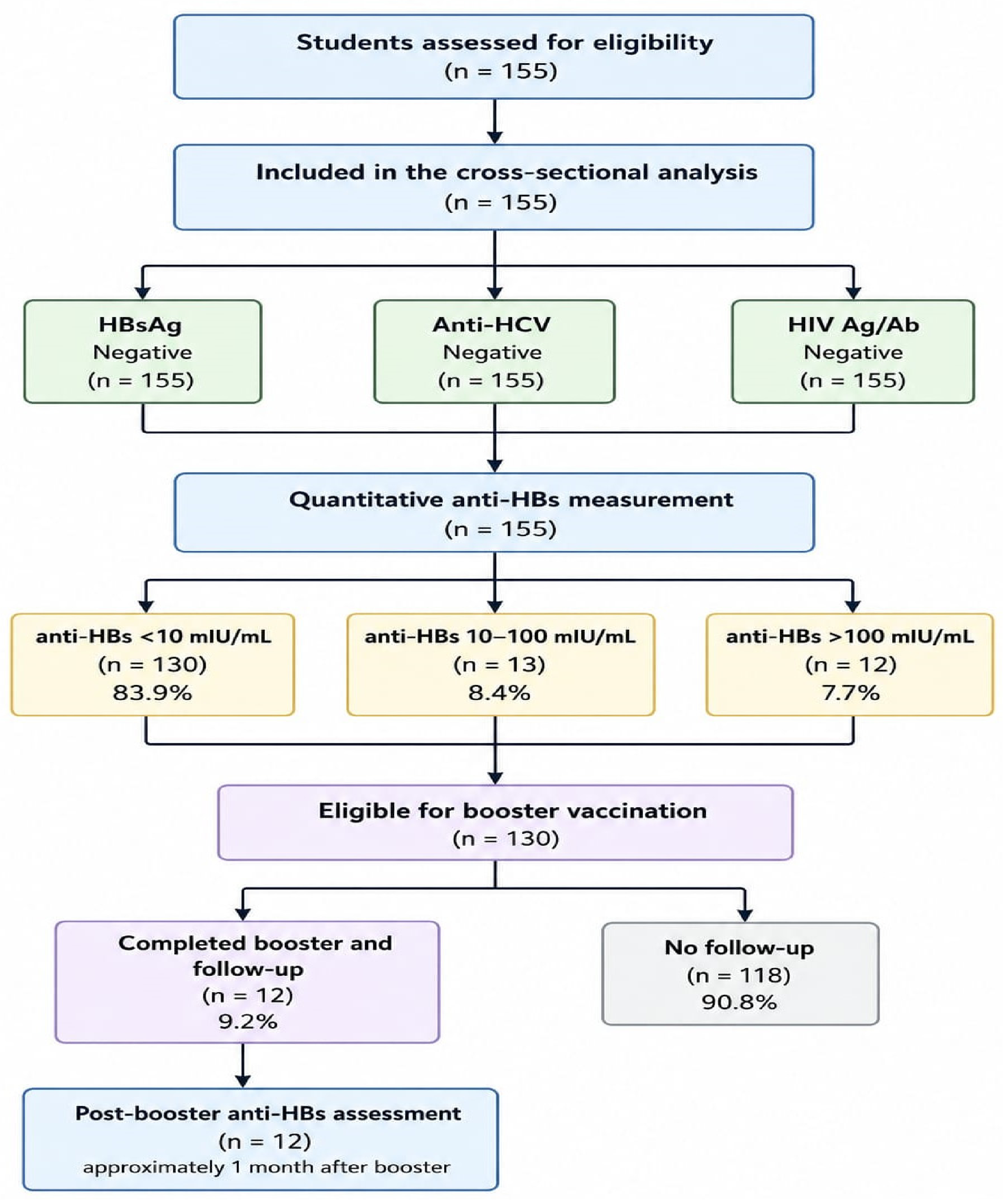
A total of 155 undergraduate dental students were enrolled. The mean age was 22.49 ± 1.08 years (median, 22 years; IQR, 22–23; range, 20–29 years). The cohort included 116 women (74.8%) and 39 men (25.2%). Ten participants (6.5%) reported at least one chronic medical condition: autoimmune thyroiditis (n = 4), polycystic ovary syndrome (n = 2), ankylosing spondylitis (n = 1), multiple sclerosis (n = 1), epilepsy (n = 1), and sinus tachycardia (n = 1). In an exploratory comparison, anti-HBs ≥ 10 mIU/mL was present in 5/10 participants (50.0%) with a chronic condition and 20/145 (13.8%) without a reported chronic condition (Fisher’s exact p = 0.011). Because the chronic condition subgroup was small and clinically heterogeneous, this finding was not interpreted as an independent causal effect and chronic condition status was not added to the main multivariable model (See Table 1 and Figure 1).
Table 1.
Baseline demographic characteristics of the study population.
Figure 1.
Study flow diagram.
3.2. Baseline Serological Findings
All participants tested negative for HBsAg, anti-HCV, and HIV Ag/Ab at enrollment. Quantitative anti-HBs testing showed that 130 participants (83.9%; 95% CI, 77.3–88.8%) had concentrations < 10 mIU/mL, 13 (8.4%) had concentrations of 10–100 mIU/mL, and 12 (7.7%) had concentrations > 100 mIU/mL. Overall, 25 participants (16.1%; 95% CI, 11.2–22.7%) had anti-HBs ≥ 10 mIU/mL. Among the 12 participants with baseline anti-HBs > 100 mIU/mL, 2 reported childhood vaccination only, 4 had completed a hepatitis B vaccination series within the previous five years, 3 had received a booster within the previous five years, and 3 had an incomplete series consisting of two documented doses (see Figure 1).
3.3. Association Between Vaccination History and Anti-HBs Concentrations
Vaccination history was significantly associated with anti-HBs concentration category. Because 16 of 21 expected cell frequencies were <5, the Fisher–Freeman–Halton test with Monte Carlo estimation was used as the primary inferential analysis and showed a significant association (p < 0.001; 1,000,000 random tables; random seed 46030082). Pearson’s χ2 yielded χ2(12) = 96.865 (p = 2.28 × 10⁻¹⁵), and Cramer’s V was 0.559. Participants vaccinated only during childhood constituted the largest group with anti-HBs < 10 mIU/mL, whereas anti-HBs ≥ 10 mIU/mL was more frequent among participants with more recent immunization (see Table 2 and Table 3).
Table 2.
Distribution of anti-HBs concentrations according to self-reported hepatitis B vaccination history.
Table 3.
Association between hepatitis B vaccination history and anti-HBs concentration categories.
In the exploratory multivariable logistic regression (n = 111; 21 anti-HBs ≥ 10 mIU/mL outcomes), recent hepatitis B immunization remained associated with anti-HBs ≥ 10 mIU/mL after adjustment for age and sex (aOR, 28.45; 95% CI, 7.52–107.61; p = 8.09 × 10⁻⁷).
The wide confidence interval indicates substantial uncertainty in the magnitude of this association.
Neither age (aOR, 0.88; 95% CI, 0.46–1.69; p = 0.707) nor female sex (aOR, 0.82; 95% CI, 0.21–3.19; p = 0.780) was significantly associated with anti-HBs ≥ 10 mIU/mL (see Table 4).
Table 4.
Multivariable logistic regression analysis of factors associated with anti-HBs ≥ 10 mIU/mL.
3.4. Post-Booster Follow-Up
Among the 130 participants with baseline anti-HBs < 10 mIU/mL, 12 received a booster dose and completed repeat anti-HBs testing approximately one month later. Their baseline concentrations ranged from 0 to 5.5 mIU/mL (median, 0.25; IQR, 0–3.20), and post-booster concentrations ranged from 467 to 890 mIU/mL (median, 631.50; IQR, 565.25–708.50). All 12 had post-booster anti-HBs > 100 mIU/mL. These findings are restricted to the selected follow-up subgroup. Because total anti-HBc was not measured and PBMCs were not collected, the observed response cannot be attributed exclusively to vaccination and does not constitute direct evidence of preserved HBV-specific cellular immune memory or clinical protection.
3.5. Main Findings
The principal findings were the high prevalence of anti-HBs < 10 mIU/mL, the association between recent immunization and anti-HBs ≥ 10 mIU/mL in the restricted exploratory model, and the post-booster increase in anti-HBs among the 12 participants who completed follow-up. These findings describe circulating antibody concentrations and serological responses; they do not establish long-term clinical protection or directly demonstrate HBV-specific cellular immune memory.
4. Discussion
The present study provides contemporary data on anti-HBs concentrations and post-booster serological responses among Romanian dental students, a population with repeated occupational exposure to blood and potentially infectious biological materials during clinical training.
The most notable finding was the high prevalence of anti-HBs concentrations below 10 mIU/mL at baseline, observed in 83.9% of participants. Recent immunization was associated with a higher likelihood of anti-HBs ≥ 10 mIU/mL in an exploratory model adjusted for age and sex, while all 12 participants who completed post-booster follow-up achieved anti-HBs concentrations > 100 mIU/mL approximately one month after a single booster dose.
The high proportion of participants with anti-HBs < 10 mIU/mL is consistent with previous reports demonstrating that circulating anti-HBs concentrations decline over time following primary HBV vaccination, particularly after vaccination during infancy [6,7,14,15,16]. However, a low or undetectable anti-HBs concentration many years after vaccination should not be interpreted as evidence of absent clinical protection, as immunological memory may persist despite waning circulating antibody levels. For healthcare personnel, particularly those without documented evidence of a previous adequate response, management should take into account vaccination history, current serological findings, and the nature of occupational exposure [4,8,16,17,18,19,20].
The occupational context is particularly relevant for dental students, who are repeatedly exposed to blood, body fluids, and sharp instruments during clinical training. Previous studies have similarly reported low or undetectable anti-HBs concentrations several years after primary vaccination, together with substantial increases following a booster or challenge dose [6,7,8,9,10,11,12,13,14,15,18,19]. In our study, the association between vaccination timing and current anti-HBs concentrations was consistent with this pattern. Participants who had been vaccinated more recently had higher odds of anti-HBs ≥ 10 mIU/mL than those vaccinated only during childhood, whereas age and sex were not significantly associated with the outcome. Nevertheless, the wide confidence interval around the estimate indicates limited precision, and the odds ratio should therefore be interpreted as an exploratory association rather than a precise estimate of effect [18].
The post-booster findings provide additional descriptive information—all 12 participants who returned for follow-up developed anti-HBs concentrations > 100 mIU/mL approximately one month after a single booster dose, indicating a marked serological response in this subgroup. However, the follow-up population was small and self-selected, and these findings cannot be generalized to the entire cohort. Furthermore, the absence of total anti-HBc testing and cellular immune assays prevents definitive differentiation between vaccine-induced responses and responses potentially related to previous natural HBV infection and does not allow conclusions regarding preserved HBV-specific memory B- or T-cell responses or long-term clinical protection [18].
The principal contribution of this study is the provision of contemporary regional data on HBV serological status and reported vaccination history among Romanian dental students. Laboratory analyses were standardized and performed in a single accredited laboratory using the same analytical platform for baseline and follow-up samples, supporting comparability of the serological measurements. The study also provides preliminary prospective information on the response to a booster dose in a subgroup of participants, although the small number completing follow-up substantially limits the strength of this evidence.
The scientific significance of the present study extends beyond the description of antibody concentrations to the identification of challenges in documenting and assessing hepatitis B immunization status among future healthcare professionals.
Several limitations should be acknowledged. First, this was a single-center study based on voluntary convenience sampling. The number of students who were informed about the study but did not enroll was not systematically recorded; consequently, a participation rate could not be calculated and self-selection bias cannot be excluded. Women represented 74.8% of the cohort, which may further limit the generalizability of the findings. Second, vaccination history was obtained using a standardized questionnaire and corroborated with vaccination booklets when available. However, documentary verification was not recorded as a separate database variable, preventing retrospective determination of the proportion of vaccination histories confirmed by written records versus participant recall and leaving the possibility of recall bias. Third, no anti-HBs measurement obtained 1–2 months after completion of the primary childhood vaccination series was available. Therefore, the current low anti-HBs concentrations cannot distinguish between waning circulating antibodies and an initially inadequate primary vaccine response. Fourth, total anti-HBc was not measured, and stored serum samples were unavailable, preventing exclusion of previous resolved or asymptomatic natural HBV infection and limiting definitive attribution of anti-HBs to vaccination. Fifth, PBMCs were not collected or stored, precluding assessment of HBV-specific memory B- and T-cell responses. Sixth, only 12 of 130 eligible participants completed post-booster follow-up, introducing substantial potential for selection bias and limiting the generalizability of the observed serological response. Finally, only 10 participants reported chronic medical conditions. These conditions were heterogeneous, and treatment information potentially relevant to immune responses was not systematically collected; therefore, the exploratory comparison according to chronic medical conditions should be interpreted cautiously.
From an occupational health perspective, these findings highlight a potential gap between childhood HBV vaccination and subsequent occupational exposure among individuals entering healthcare professions. The high prevalence of low circulating anti-HBs concentrations in dental students does not, by itself, demonstrate inadequate protection or establish a need for universal booster vaccination. Rather, it raises the question of whether vaccination history, previous vaccine response, and serological status should be more consistently assessed in healthcare students and professionals at increased risk of exposure to blood and potentially infectious biological materials. Further studies involving other healthcare professions and occupational settings are needed to determine whether the pattern observed in dental students is representative of the broader healthcare workforce in Romania. Such research could provide a more comprehensive assessment of HBV immunity across different levels of occupational exposure and help to establish whether standardized national recommendations for vaccination documentation, serological assessment, and occupational HBV prevention are warranted. In this context, the present study may serve as an initial step toward a broader evaluation of HBV protection among Romanian healthcare workers and toward evidence-based occupational vaccination strategies [18,19,20].
5. Conclusions
This study found a high prevalence of anti-HBs concentrations < 10 mIU/mL among Romanian dental students, most of whom reported childhood hepatitis B vaccination. All participants were HBsAg-negative at enrollment. In the restricted exploratory regression, recent immunization was associated with anti-HBs ≥ 10 mIU/mL, whereas age and sex were not significantly associated with the outcome.
Among the small, self-selected subgroup of 12 participants who completed post-booster follow-up, all had anti-HBs concentrations > 100 mIU/mL approximately one month after a single booster dose. This observation is limited to the selected follow-up subgroup. Because total anti-HBc was not measured and PBMCs were not collected, previous natural HBV infection cannot be excluded and the study cannot establish that the response was exclusively vaccine-induced or directly demonstrate preserved cellular immune memory or long-term clinical protection.
The scientific and practical significance of these findings lies in highlighting the challenges of assessing occupational HBV immunization status in young adults vaccinated during childhood and the importance of reliable vaccination documentation and appropriate serological evaluation before clinical training.
Given the occupational risk associated with dental practice, documented hepatitis B vaccination and appropriate post-vaccination assessment before clinical exposure remain important. Future multicenter prospective studies should include HBsAg, anti-HBs, and total anti-HBc at baseline and, when immune-memory mechanisms are an objective, direct assessment of antigen-specific B- and T-cell responses.
Author Contributions
Conceptualization: B.R.B., G.J., M.M.M., A.T. and E.G. Methodology: B.R.B., M.M.M. and G.J. Data Curation: B.R.B., E.G. and A.T. Software: B.R.B., A.T. and M.M.M. Formal analysis: B.R.B. and R.N. Investigation: B.R.B., E.G. and G.J. Writing—original draft preparation: B.R.B. and A.T. Writing—review and editing: B.R.B., M.M.M. and R.N. Sources: M.M.M. and E.G. Data curation: G.J., A.T., B.R.B. and E.G. Visualization: M.M.M., A.T. and E.G. Supervision M.M.M. and G.J. All authors have read and agreed to the published version of the manuscript.
Funding
This research received no external funding.
Institutional Review Board Statement
The study was conducted in accordance with the Declaration of Helsinki and approved by the Ethics Committee of the National Institute for Infectious Diseases Prof. Dr. “Matei Balș”, Bucharest, Romania (approval no. C08659/3 July 2025).
Informed Consent Statement
Written informed consent was obtained from all participants prior to study enrollment.
Data Availability Statement
The data presented in this study are available on request from the corresponding author. The data are not publicly available because they contain confidential information.
Acknowledgments
Publication of this paper was supported by the University of Medicine and Pharmacy Carol Davila through the institutional program Publish not Perish.
Conflicts of Interest
The authors declare no conflicts of interest.
References
- World Health Organization. Global Hepatitis Report 2026; World Health Organization: Geneva, Switzerland, 2026; Available online: https://www.who.int/publications/i/item/9789240122383 (accessed on 10 September 2026).
- World Health Organization. Global Health Sector Strategies on, Respectively, HIV, Viral Hepatitis and Sexually Transmitted Infections for the Period 2022–2030; World Health Organization: Geneva, Switzerland, 2022; Available online: https://www.who.int/publications/i/item/9789240053779 (accessed on 10 September 2026).
- Institutul Național de Sănătate Publică. Programul Național de Vaccinare/Calendarul Național de Vaccinare; INSP: Bucharest, Romania. Available online: https://insp.gov.ro/ (accessed on 10 September 2026).
- Schillie, S.; Murphy, T.V.; Sawyer, M.; Ly, K.; Hughes, E.; Jiles, R.; de Perio, M.A.; Reilly, M.; Byrd, K.; Ward, J.W. CDC guidance for evaluating health-care personnel for hepatitis B virus protection and for administering postexposure management. MMWR Recomm. Rep. 2013, 62, 1–19. [Google Scholar]
- Dincă, F.I.; Dimitriu, B.-A.; Săndulescu, O.; Sîrbu, V.D.; Săndulescu, M. Knowledge, attitudes, and practices of dental students from Romania regarding self-perceived risk and prevention of infectious diseases. Dent. J. 2024, 12, 97. [Google Scholar] [CrossRef] [Scilit]
- Rahmani, A.; Montecucco, A.; Vitturi, B.K.; Debarbieri, N.; Dini, G.; Durando, P. Long-term effectiveness of hepatitis B vaccination in the protection of healthcare students in highly developed countries: A systematic review and meta-analysis. Vaccines 2022, 10, 1841. [Google Scholar] [CrossRef] [Scilit]
- Simons, B.C.; Spradling, P.R.; Bruden, D.J.T.; Zanis, C.; Case, S.; Choromanski, T.L.; Apodaca, M.; Brogdon, H.D.; Dwyer, G.; Snowball, M.; et al. A longitudinal hepatitis B vaccine cohort demonstrates long-lasting hepatitis B virus cellular immunity despite loss of antibody against hepatitis B surface antigen. J. Infect. Dis. 2016, 214, 273–280. [Google Scholar] [CrossRef] [Scilit]
- Schillie, S.; Vellozzi, C.; Reingold, A.; Harris, A.; Haber, P.; Ward, J.W.; Nelson, N.P. Prevention of hepatitis B virus infection in the United States: Recommendations of the Advisory Committee on Immunization Practices. MMWR Recomm. Rep. 2018, 67, 1–31. [Google Scholar] [CrossRef] [Scilit]
- Lingawi, H.S.; Afifi, I.K. Seroprotection of hepatitis B vaccine in dental students two decades after infant immunization and the possible need for revaccination. Eur. J. Dent. 2023, 17, 143–149. [Google Scholar] [CrossRef] [Scilit]
- Bini, C.; Grazzini, M.; Chellini, M.; Mucci, N.; Arcangeli, G.; Tiscione, E.; Bonanni, P. Is hepatitis B vaccination performed at infant and adolescent age able to provide long-term immunological memory? An observational study on healthcare students and workers in Florence, Italy. Hum. Vaccin. Immunother. 2018, 14, 450–455. [Google Scholar] [CrossRef] [Scilit]
- Bianchi, F.P.; Gallone, M.S.; Gallone, M.F.; Larocca, A.M.V.; Vimercati, L.; Quarto, M.; Tafuri, S. HBV seroprevalence after 25 years of universal mass vaccination and management of non-responders to the anti-hepatitis B vaccine: An Italian study among medical students. J. Viral Hepat. 2019, 26, 136–144. [Google Scholar] [CrossRef] [Scilit]
- Saveanu, C.I.; Dărăbăneanu, G.; Bobu, L.I.; Anistoroaei, D.; Bamboi, I.; Ciortescu, I.; Saveanu, A.E. A cross-sectional questionnaire-based survey on blood-borne infection control among Romanian dental students. Medicina 2022, 58, 1268. [Google Scholar] [CrossRef] [Scilit]
- Phattraprayoon, N.; Kakheaw, J.; Soonklang, K.; Cheirsilpa, K.; Ungtrakul, T.; Auewarakul, C.; Mahanonda, N. Duration of hepatitis B vaccine-induced protection among medical students and healthcare workers following primary vaccination in infancy and rate of immunity decline. Vaccines 2022, 10, 267. [Google Scholar] [CrossRef] [Scilit]
- Haber, P.; Schillie, S. Chapter 10. Hepatitis B. In Epidemiology and Prevention of Vaccine-Preventable Diseases (The Pink Book), 14th ed.; Hall, E., Wodi, A.P., Hamborsky, J., Morelli, V., Schillie, S., Eds.; Centers for Disease Control and Prevention: Washington, DC, USA, 2021. Available online: https://www.cdc.gov/pinkbook/hcp/table-of-contents/chapter-10-hepatitis-b.html (accessed on 10 September 2026).
- Holmberg, S.D.; Suryaprasad, A.; Ward, J.W. Updated CDC recommendations for the management of hepatitis B virus-infected health-care providers and students. MMWR Recomm. Rep. 2012, 61, 1–12. [Google Scholar]
- West, D.J.; Calandra, G.B. Vaccine induced immunologic memory for hepatitis B surface antigen: Implications for policy on booster vaccination. Vaccine 1996, 14, 1019–1027. [Google Scholar] [CrossRef] [Scilit]
- Centers for Disease Control and Prevention. CIinical Testing and Diagnosis for Hepatitis B. Available online: https://www.cdc.gov/hepatitis-b/hcp/diagnosis-testing/index.html (accessed on 10 September 2026).
- Păcurar, D.; Dinulescu, A.; Jugulete, G.; Păsărică, A.-S.; Dijmărescu, I. Hepatitis B in pediatric population: Observational retrospective study in Romania. Life 2024, 14, 348. [Google Scholar] [CrossRef] [Scilit]
- Jugulete, G.; Merisescu, M.M.; Bastian, A.E.; Zurac, S.; Stoicescu, S.M.; Luminos, M.L. Severe form of A1H1 influenza in a child—Case presentation. Rom. J. Leg. Med. 2018, 26, 387–391. [Google Scholar]
- Jugulete, G.; Merisescu, M.; Bastian, A.E.; Luminos, M. CIinical aspects and medico-legal implications of purpura fulminans in children. Rom. J. Leg. Med. 2017, 25, 364–368. [Google Scholar]

Disclaimer/Publisher’s Note: The statements, opinions and data contained in all publications are solely those of the individual author(s) and contributor(s) and not of MDPI and/or the editor(s). MDPI and/or the editor(s) disclaim responsibility for any injury to people or property resulting from any ideas, methods, instructions or products referred to in the content. |
© 2026 by the authors. Licensee MDPI, Basel, Switzerland. This article is an open access article distributed under the terms and conditions of the Creative Commons Attribution (CC BY) license.