


Abstract
Background: Human papillomavirus includes more than 200 types, classified by cancer risk. Since 2006, the vaccine has effectively prevented human papillomavirus infection and associated cancers; however, coverage among adults remains low. Furthermore, research examining human papillomavirus vaccination among adults with a cancer history is limited. Objective: To estimate vaccination uptake for human papillomavirus among U.S. adults aged 20–47 and compare uptake by cancer history. Methods: This study used data from the National Health and Nutrition Examination Survey from 2011 to 2023. The final analytic sample included 13,511 adults aged 20–47 with self-reported vaccination status and cancer history. The data were weighted to account for the complex survey design and produce nationally representative estimates. Results: Among eligible adults, 84.7% were unvaccinated, 2.9% were under-vaccinated, and 12.4% had completed the vaccine series. Among eligible adults with a self-reported cancer history, the majority were unvaccinated. Vaccination completion differed by sociodemographic and healthcare-related factors. Conclusions: Human papillomavirus vaccination remained low among eligible U.S. adults, including those with a self-reported cancer history. These findings support efforts to improve adult vaccination coverage and prevent human papillomavirus infections and associated cancers.
1. Introduction
Human papillomavirus (HPV) is a non-enveloped, double-stranded DNA virus with more than 200 types, classified as low-risk (non-oncogenic) or high-risk (oncogenic) [1,2]. In the United States (U.S.), the estimated annual incidence and prevalence are approximately 13 million and 42 million infections, respectively [3]. Transmission can occur through skin-to-skin contact, mucosa-to-mucosa, autoinoculation, and vertical transmission from mother to child, with some, if not most, individuals remaining asymptomatic [4,5,6,7]. Progression from infection to cancer occurs primarily through persistent infection, defined as the repeated presence of the same HPV type across multiple visits over a period of time [8,9,10]. HPV has been detected in cancers of the cervix, anus, penis, vulva, vagina, oral cavity, larynx, and oropharynx [1,8,11,12,13,14,15]. From 2012 to 2016, an estimated 43,999 HPV-associated cancers occurred annually in the U.S., with 79% attributable to HPV and 92% caused by vaccine-targeted types, with oropharyngeal cancer accounting for the largest proportion from 2014 to 2018 [16,17].
HPV is an important cause of the increasing incidence of oral and oropharyngeal squamous cell carcinoma and other associated cancers, with disparities in disease burden and multiple risk factors, including tobacco and alcohol [18,19,20,21,22]. HPV has additionally been investigated in colorectal and esophageal cancers, although findings remain inconsistent and causality is unconfirmed [23,24,25,26,27,28,29,30,31,32,33,34,35]. Cervical cancer is largely preventable and predominantly caused by HPV, particularly types 16 and 18, yet it continues to cause over 4000 U.S. deaths annually, with persistent racial disparities in survival and mortality [36,37,38,39,40]. HPV DNA has also been detected in some ovarian and uterine cancers, although findings remain inconsistent [41,42,43,44,45,46,47]. Associations between HPV and prostate and testicular cancers remain uncertain. HPV has been detected in prostate tissues and semen, but current evidence does not establish a causal relationship [48,49,50,51,52,53,54,55,56].
The most effective preventive strategy against HPV-associated cancers and infections is Gardasil-9, the only FDA-approved HPV vaccine since 2016–2017, which protects against nine HPV types [57,58]. The HPV vaccine was first approved in 2006 for girls and young women aged 9–26 and was later expanded to include males and adults up to 45 [57,58,59,60,61]. Based on guidelines, if the first dose was received before the 15th birthday, then the recommendation is two doses; however, if the first dose is given on the 15th birthday or later, then the recommendation is three doses [60]. Despite its effectiveness, vaccination coverage remains low, with the female population having higher uptake than the male population [62,63,64]. Low HPV vaccination uptake has also been reported among cancer survivors [65,66,67].
Previous studies demonstrated that HPV vaccination uptake and series completion vary based on age, gender, demographic, socioeconomic, and healthcare-related determinants among adolescents and adults [15,18,62,63,68,69]. Socioeconomic determinants, including race/ethnicity, education, income, and marital status, have also been associated with HPV vaccination initiation, uptake, or series completion [70,71,72,73,74,75]. Meanwhile, healthcare-related determinants, includes health insurance, healthcare access, communication with healthcare providers, and financial barriers to care [70,72,73,76,77,78,79].
Much of the HPV vaccination literature has focused on adolescents and young adults through age 26, while other studies have examined vaccination uptake and associated factors in the broader population rather than specifically among adults with a history of cancer [67,71,80]. Among cancer survivors, the available literature has largely centered on childhood to young adult cancer survivors or select cancer populations [65,81,82]. However, more recent studies have begun to examine HPV vaccination among adult cancer survivors, though evidence remains limited [65,66,67].
Thus, there remains a need to comprehensively assess HPV vaccine series completion among adults, including those with a history of cancer. Using the National Health and Nutrition Examination Survey (NHANES), the objective is to estimate the prevalence of the HPV vaccine series completion among U.S. adults aged 20–47 and examine differences by cancer history. The hypothesis is that adults with a history of HPV-associated cancers would demonstrate higher HPV vaccine uptake than adults without such histories. The aim is to inform public health strategies to increase uptake, address gender-based disparities, and reduce the preventable burden of HPV among adults [64,83,84,85,86,87].
2. Methods
2.1. Study Population
The study population included 34,048 U.S. adults aged 20 or older who participated in NHANES from 2011 to 2023 (Table 1). Adults younger than 20 were excluded because NHANES collects cancer history information beginning at age 20. The population was then restricted to adults aged 20–47 years (n = 15,117). Of these, 13,514 had reported their HPV vaccination status, and 13,511 reported their cancer history, resulting in a final analytical sample of 13,511 participants aged 20–47.
Table 1.
Number of participants excluded from the original sample of adults aged 20 years and older, by population selection criteria, National Health and Nutrition Examination Survey 2011–2023.
2.2. Study Variables
The primary outcome was any HPV vaccination based on self-report of ever receiving the HPV vaccine (yes/no). The number of doses received was included to define HPV vaccination completion, with participants reporting zero doses categorized as unvaccinated, one dose as under-vaccinated, and 2 or 3 doses as fully vaccinated. Fully vaccinated was defined based on guidelines from the Advisory Committee on Immunization Practices (ACIP) and the World Health Organization (WHO), which consider two and three doses as complete. This classification is supported by clinical trials demonstrating that adolescents younger than 15 who received two doses had immune responses non-inferior to those aged 15 or older who received three doses [88,89,90,91].
Vaccine eligibility was operationally defined based on the age range captured by NHANES HPV vaccination question of ever receiving the HPV vaccine and the possibility of prior HPV vaccination, rather than current age eligibility alone. The study population, therefore, included adults up to 47, as NHANES collected HPV vaccination history among adults up to age 49, extending beyond the current recommended age range [79,92]. HPV vaccination has also been evaluated among adults older than 45 in selected clinical populations, despite falling outside current U.S. licensing and ACIP recommendations [93,94]. The primary independent variable was self-reported cancer history, based on self-reported responses to whether a health professional had ever told the participant they had cancer (yes/no).
Participants’ self-reported cancer histories of interest were classified using three analytic approaches. First, cancers were categorized by sex specificity into three groups: non-gender-specific cancers (oral/oropharyngeal, colon, rectal (rectum), and esophageal), female-specific cancers (cervical, ovarian, and uterine), and male-specific cancers (prostate and testicular cancer). Cancers that affect both women and men were defined as non-gender-specific. Second, cancers were categorized according to their association with HPV: HPV-associated or cancers with uncertain HPV association with respect to HPV’s oncogenic properties (Supplementary Table S1). Third, the HPV-associated cancers and the cancers with uncertain HPV association were evaluated separately among participants aged 20 to 26 and 27 to 47 to assess the odds of being fully vaccinated against HPV (2 or 3 doses) across the age groups affected by the expansion of the recommended age range for HPV vaccination.
Additional covariates included income, education, health insurance, marital status, race/ethnicity, healthcare access, and gender. Covariates were selected based on their established or plausible associations with HPV vaccination and cancer history. Age, gender, race/ethnicity, and marital status were considered potential demographic confounders, while income and education represented socioeconomic factors, and health insurance and healthcare access represented healthcare-related factors that may influence HPV vaccination completion.
2.3. Statistical Analyses
Statistical analyses were conducted among the study population of U.S. adults aged 20–47, where SAS version 9.4 was used to conduct all analyses. Participants with responses of “missing,” “don’t know,” or “refused” for self-reported HPV vaccination, including the number of doses received, self-reported cancer history, cancer type, or other covariates included in the study, were recoded as missing and excluded from the analysis. NHANES weights, strata, and primary sampling units were incorporated to account for complex survey design, oversampling, and nonresponse and to produce nationally representative estimates. Weighted frequencies, percentages, and 95% confidence intervals (CI) were calculated using PROC SURVEYFREQ to summarize HPV vaccination status and participant characteristics.
Bivariate associations between HPV vaccination status and participant characteristics were assessed using Rao-Scott chi-square tests, with p-values obtained from the Rao-Scott chi-square test. Multivariable survey-weighted logistic regression models were conducted using PROC SURVEYLOGISTIC to evaluate associations between cancer history and the odds of being fully vaccinated, while adjusting for covariates. Domain analysis was used within the regression models to account for the complex survey design. Adjusted odds ratios and 95% CI were reported, with p-values for individual model effects obtained from Wald F tests. Statistical significance was defined as p < 0.05.
3. Results
The final analytic sample consisted of 13,511 U.S. adults aged 20–47, representing over 105.9 million U.S. adults. Most adults were in the 30–39 age group (n = 4988; weighted n = 37.7 million). The majority were non-Hispanic White, married or living with a partner. Approximately one-third had a college education or higher (32.9%) (Table 2).
Table 2.
Descriptive statistics of U.S. adult ages 20–47, National Health and Nutrition Examination Survey 2011–2023.
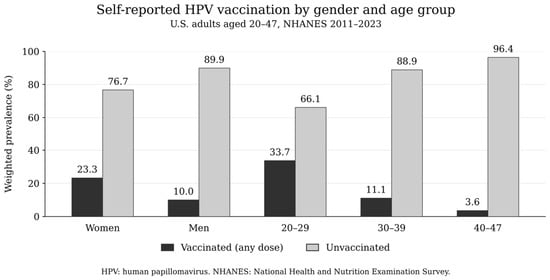
Among adults who reported their HPV vaccination status, a large proportion of women and men were unvaccinated, representing approximately 43.5 million women and 46.3 million men. Any HPV vaccination prevalence was higher among women than men (23.3% vs. 10.0%, respectively). Any vaccination prevalence also decreased with increasing age, from 33.7% among adults aged 20–29 to 11.1% among those aged 30–39, and 3.6% among adults aged 40–47. These weighted prevalence estimates represent approximately 12.9 million adults aged 20–29, 4.2 million adults aged 30–39, and 1.1 million adults aged 40–47 (Figure 1).
Figure 1.
Weighted prevalence of self-reported HPV vaccination status by gender and age group among U.S. adults aged 20-47, NHANES 2011–2023.
Weighted bivariate analysis showed that gender (p < 0.0001), age (p < 0.0001), marital status (p < 0.0001), race/ethnicity (p < 0.0001), income (p = 0.038), education (p < 0.0001), healthcare access (p < 0.0001), health insurance (p < 0.0001), self-reported female-specific cancer history (p = 0.0003) were significantly associated with HPV vaccination completion. The number of HPV vaccine doses received was associated with gender (p < 0.0001), age (p = 0.0004), race/ethnicity (p < 0.0001), education (p < 0.0001), and health insurance (p = 0.0002). Participants who reported never receiving the HPV vaccine history were retained in the dose-based analyses and were categorized as zero doses. This conservative assumption allowed for a more comprehensive representation of vaccine uptake in the eligible adult population.
Among women, age group and self-reported female-specific cancer history were significantly associated with HPV vaccination completion. Women aged 27–47 had 83% lower odds of being fully vaccinated compared with women aged 20–26 (OR = 0.17; 95% CI: 0.14–0.20), while women without a self-reported female-specific cancer history had higher odds of being fully vaccinated than those with a history (OR = 3.17; 95% CI: 1.47–6.85). After adjustment for sociodemographic and healthcare-related factors, these associations remained significant (age group: OR = 0.16; 95% CI: 0.13–0.19; female-specific cancer history: OR = 2.73; 95% CI: 1.28–5.84). Race/ethnicity was significantly associated with HPV vaccination completion (p = 0.014). Compared with non-Hispanic White women, non-Hispanic Black women had 32% lower odds of being fully vaccinated (OR = 0.68; 95% CI: 0.54–0.87). No significant differences were observed for Hispanic, non-Hispanic Asian, or Other/Multiracial women. Health insurance, education, and marital status were also significantly associated with vaccination completion, whereas income and healthcare access were not significantly associated (Table 3).
Table 3.
Association between age group, self-reported female-specific cancer history, and HPV vaccination completion among U.S. women aged 20–47, National Health and Nutrition Examination Survey, 2011–2023.
Among men, age group was significantly associated with HPV vaccination completion, whereas self-reported male-specific cancer history was not significantly associated. Men aged 27–47 had 78% lower odds of being fully vaccinated compared with men aged 20–26 (OR = 0.22; 95% CI: 0.16–0.29). After adjustment for sociodemographic and healthcare-related factors, age remained significantly associated with vaccination completion (OR = 0.23; 95% CI: 0.15–0.34), while male-specific cancer history remained non-significant (OR = 0.23; 95% CI: 0.03–1.75). Health insurance and education were also significantly associated with vaccination completion. Race/ethnicity was not significantly associated with HPV vaccination completion (p = 0.133). However, compared with non-Hispanic White men, non-Hispanic Asian men had 51% lower odds of being fully vaccinated (OR = 0.49; 95% CI: 0.26–0.91). No significant differences were observed for Hispanic, non-Hispanic Black, or Other/Multiracial men. Marital status, income, and healthcare access were not significantly associated with vaccination completion (Table 4).
Table 4.
Association between age group, self-reported male-specific cancer history, and HPV vaccination completion among U.S. men aged 20–47, National Health and Nutrition Examination Survey, 2011–2023.
For adults with and without a self-reported non-gender-specific cancer history, age group was significantly associated with HPV vaccination completion, whereas non-gender-specific cancer history was not. Adults aged 27–47 had 81% lower odds of being fully vaccinated compared with adults aged 20–26 (OR = 0.19; 95% CI: 0.17–0.23). After adjustment for sociodemographic and healthcare-related factors, age remained significantly associated with vaccination completion (OR = 0.18; 95% CI: 0.15–0.22), while non-gender-specific cancer history remained non-significant (OR = 1.31; 95% CI: 0.81–2.13). Gender, health insurance, education, race/ethnicity, and marital status were also significantly associated with HPV vaccination completion. Women had higher odds of being fully vaccinated compared with men (OR = 4.21; 95% CI: 3.41–5.19). Compared with non-Hispanic White adults, non-Hispanic Asian and non-Hispanic Black adults each had 31% lower odds of being fully vaccinated (OR = 0.69; 95% CI: 0.56–0.87 and OR = 0.69; 95% CI: 0.56–0.86, respectively). No significant differences were observed for Hispanic or Other/Multiracial adults; income and healthcare access were also not significantly associated with vaccination completion (Table 5).
Table 5.
Association between age group, self-reported non-gender-specific cancer history, and HPV vaccination completion among U.S. adults aged 20–47, National Health and Nutrition Examination Survey, 2011–2023.
Descriptive analyses provided further detail on HPV vaccination completion according to self-reported female-specific, male-specific, and non-gender-specific cancer history. Vaccination completion was 5.3% among women with a female-specific cancer history compared with 18.6% among those without, 16.5% among men with a male-specific cancer history compared with 5.7% among those without, and 16.5% among adults with a non-gender-specific cancer history compared with 12.4% among those without (Supplementary Tables S2–S4). Additional regression analyses examined HPV vaccination completion according to self-reported overall cancer history, self-reported HPV-associated cancer history, and self-reported history of cancers with uncertain HPV association. None of the cancer history measures were significantly associated with HPV vaccination completion. Age remained significantly associated with HPV vaccination completion across all three cancer history analyses, including when evaluated by age group (Supplementary Tables S5–S7).
Age-stratified analyses compared adults aged 20–26 and 27–47 to reflect the expansion of the recommended age range for HPV vaccination. Adults aged 27–47 had lower odds of being fully vaccinated than adults aged 20–26 (OR = 0.19; 95% CI: 0.17–0.23) (Supplementary Table S8). Age group remained significantly associated with vaccination completion when accounting for self-reported overall cancer history, HPV-associated cancer history, and history of cancers with uncertain HPV association (Supplementary Tables S9–S11). Self-reported overall cancer history and history of cancers with uncertain HPV association remained non-significant before or after adjustments for sociodemographic and healthcare-related factors. In contrast, after adjustments, adults without a self-reported HPV-associated cancer history had higher odds of being fully vaccinated than those with an HPV-associated cancer history (OR = 3.57; 95% CI: 1.29–9.94) (Supplementary Table S9). Given the small sample sizes for several cancer groups, the results should be interpreted with caution.
4. Discussion
The results show that HPV vaccine uptake and completion remain low among U.S. adults aged 20–47, despite the availability of the HPV vaccine since 2006 and the expansion of age eligibility in 2018 [6,57,63,71]. Eligible adults with and without the self-reported cancer histories of interest were predominantly unvaccinated, highlighting continued gaps in HPV vaccination among adults at risk for HPV infection and associated cancers [16,61,68]. Gender differences were also evident, consistent with the early vaccine rollout targeting girls and young women [6,59,62,63]. This timing difference may have contributed to lower vaccination uptake among men, as routine HPV vaccination was recommended for girls beginning in 2006 but not for boys until 2011 [6,59,62,63].
The low HPV vaccination uptake observed in this study is consistent with prior research documenting persistent gaps in adult vaccination coverage [62,63,65,68,73]. Demographic and healthcare-related factors, including gender, age, health insurance, healthcare access, education, marital status, and race/ethnicity, were associated with vaccination completion, although specific associations varied across analyses [77,78]. Provider recommendations and HPV-related discussions may also influence vaccination uptake and completion by addressing barriers such as limited awareness, stigma, and vaccine cost [81,82].
Differences in vaccination recommendations by age and gender may help contextualize the variation observed across age groups [68,69,75,79]. Adults aged 27–47 had substantially lower odds of being fully vaccinated than adults aged 20–26, and age remained significantly associated with vaccination completion across the cancer history analyses. Similarly, vaccination prevalence was highest among adults aged 20–29 and declined among those aged 30–39 and 40–47, consistent with differences in opportunities to initiate and complete the vaccine series over time [62,63,73,95].
The associations between cancer history and HPV vaccination completion varied by cancer classification. The variation in associations across cancer classifications suggests that HPV vaccination completion among adults with a cancer history may differ by cancer type and age group. However, these findings should be interpreted with caution, given the small sample sizes for several cancer groups. Furthermore, individuals may experience persistent HPV infection, reinfection, or acquisition of a new HPV type, and survivors of HPV-associated cancers may also face risks of subsequent HPV-associated malignancies [1,5,96,97,98,99]. These findings add to the limited evidence on HPV vaccination completion among adults with a history of cancer, particularly across different cancer classifications and age groups.
It is important to note that the cross-sectional design of NHANES does not allow the timing of HPV vaccination relative to cancer diagnosis to be determined. Therefore, it cannot be established whether vaccination occurred before or after the reported cancer diagnosis, and the findings should be interpreted as associations rather than evidence of a temporal relationship. Continued research is needed to better understand HPV vaccination initiation and completion among adults with and without a history of cancer and to address barriers related to awareness, healthcare access, cost, and misconceptions that HPV primarily affects women [18,65,77,78,84,95,100,101,102].
5. Limitations
Currently, NHANES does not capture all HPV-associated cancers, particularly anal, penile, vulvar, and vaginal cancer, limiting the ability to comprehensively assess the association between HPV vaccination completion and related cancer outcomes. Information on the specific HPV vaccine received was also not consistently available across the study period. In earlier survey cycles, vaccine type was collected inconsistently by sex, with this information primarily collected among women, and vaccine type was no longer captured beginning with the 2021–2023 cycle. As a result, HPV vaccine type could not be consistently evaluated across the 2011–2023 study period, which also limited the researchers’ ability to characterize participants’ self-reported HPV vaccination history further. Relevant to the risk of HPV exposure was the removal of the Sexual Behavior data file, which contained self-reported information on participants’ sexual behaviors. The Sexual Behavior data file was removed from public access during the COVID-19 pandemic and remains unavailable.
Therefore, sexual behavior factors relevant to HPV exposure could not be incorporated into the analyses. Data from 2024 were also unavailable for inclusion. Self-reports of HPV vaccination and cancer history, and the inability to verify cancer diagnoses, introduce biases, including recall, survivorship, social desirability, and nonresponse bias.
Moreover, the cross-sectional design of NHANES prevents causal inferences, which, in the case of this study, meant that the timing of HPV vaccination relative to cancer diagnosis could not be determined. Therefore, it was not possible to establish whether vaccination occurred before or after the reported cancer diagnosis. Residual confounding was possible because certain variables were unavailable or became unavailable over time among the cycles used in this study. As aforementioned, due to the small sample sizes of adults with a self-reported cancer history, results should be interpreted with caution. However, irrespective of these limitations, the use of NHANES weights allowed the findings to be generalized to the U.S. adult population aged 20 to 47.
6. Conclusions
The findings underscore the continued need to improve HPV vaccination initiation, continued uptake, and completion among U.S. adults. Efforts should focus on increasing awareness that HPV affects both women and men and addressing barriers related to healthcare access, insurance coverage, and vaccine cost. Strengthening vaccination and screening efforts may help reduce the preventable burden associated with HPV-related disease and support efforts to improve population health. Continued surveillance and improved data capture are needed, particularly for rare or underrepresented HPV-associated cancers. Future research is needed to better understand gender-specific barriers and the impact of the expanded age recommendations, and to expand on these findings through trend analysis, if possible, and to further investigate potential associations between HPV and other cancers, given its oncogenic properties.
Supplementary Materials
The following supporting information can be downloaded at https://www.mdpi.com/article/10.3390/vaccines14100892/s1. Table S1: Recoded cancer categories based on reported NHANES cancer type, National Health and Nutrition Examination Survey 2011–2023; Table S2: HPV vaccination completion status of women, ages 20–47, by self-reported female-specific cancer history, National Health and Nutrition Examination Survey 2011–2023; Table S3: HPV vaccination completion status of men, ages 20–47, by self-reported male-specific cancer history, National Health and Nutrition Examination Survey 2011–2023; Table S4: HPV vaccination completion status of U.S. adults, ages 20–47, by self-reported non-gender-specific cancer history, National Health and Nutrition Examination Survey 2011–2023; Table S5: Association between self-reported overall cancer history and HPV vaccination completion among U.S. adults aged 20–47, National Health and Nutrition Examination Survey 2011–2023; Table S6: Association between self-reported HPV-associated cancer history and HPV vaccination completion among U.S. adults aged 20–47, National Health and Nutrition Examination Survey 2011–2023; Table S7: Association between self-reported history of cancers with uncertain HPV association and HPV vaccination completion among U.S. adults aged 20–47, National Health and Nutrition Examination Survey 2011–2023; Table S8: Association between age group (20–26 vs. 27–47) and HPV vaccination completion among U.S. adults aged 20–47, National Health and Nutrition Examination Survey 2011–2023; Table S9: Association between age group, self-reported overall cancer history, and HPV vaccination completion among U.S. adults aged 20–47, National Health and Nutrition Examination Survey 2011–2023; Table S10: Association between age group, self-reported HPV-associated cancer history, and HPV vaccination completion among U.S. adults aged 20–47, National Health and Nutrition Examination Survey 2011–2023; Table S11: Association between age group, self-reported history of cancers with uncertain HPV association, and HPV vaccination completion among U.S. adults aged 20–47, National Health and Nutrition Examination Survey 2011–2023.
Author Contributions
Conceptualization, J.S.; methodology, J.S. and T.M.J.; software, J.S. and T.M.J.; validation, T.M.J.; formal analysis, J.S.; investigation, J.S.; resources, J.S. and T.M.J.; data curation, J.S. and T.M.J.; writing—original draft preparation, J.S.; writing—review and editing, J.S. and T.M.J.; visualization, J.S. and T.M.J.; supervision, T.M.J.; project administration, J.S. and T.M.J. All authors have read and agreed to the published version of the manuscript.
Funding
This research received no external funding.
Institutional Review Board Statement
Not applicable.
Informed Consent Statement
Not applicable.
Data Availability Statement
The original data presented in the study are openly available at https://wwwn.cdc.gov/nchs/nhanes/ accessed on 12 January 2026.
Acknowledgments
The authors have reviewed and edited the output and take full responsibility for the content of this publication.
Conflicts of Interest
The authors declare no conflicts of interest.
Abbreviations
The following abbreviations are used in this manuscript:
| HPV | Human Papillomavirus |
| OPSCC | Oropharyngeal Squamous Cell Carcinoma |
| CI | Confidence Interval |
| FDA | Food and Drug Administration |
| NHANES | National Health and Nutrition Examination Survey |
| OR | Odds Ratio |
References
- National Cancer Institute. HPV and Cancer. 9 May 2025. Available online: https://www.cancer.gov/about-cancer/causes-prevention/risk/infectious-agents/hpv-and-cancer (accessed on 10 July 2026).
- de Sanjose, S.; Brotons, M.; Pavon, M.A. The natural history of human papillomavirus infection. Best Pract. Res. Clin. Obstet. Gynaecol. 2018, 47, 2–13. [Google Scholar] [CrossRef] [Scilit] [PubMed]
- Centers for Disease Control and Prevention. About HPV. 3 July 2024. Available online: https://www.cdc.gov/hpv/about/index.html (accessed on 10 July 2026).
- Sasidharanpillai, S.; Bhat, P.; Kamath, V.; Arunkumar, G. Possible non-sexual modes of transmission of human papilloma virus. J. Obstet. Gynaecol. Res. 2017, 43, 429–435. [Google Scholar] [CrossRef] [Scilit] [PubMed]
- Wierzbicka, M.; San Giorgi, M.R.M.; Dikkers, F.G. Transmission and clearance of human papillomavirus infection in the oral cavity and its role in oropharyngeal carcinoma—A review. Rev. Med. Virol. 2023, 33, e2337. [Google Scholar] [CrossRef] [Scilit] [PubMed]
- Meites, E.; Gee, J.; Unger, E.; Markowitz, L. Chapter 11: Human Papillomavirus. Centers for Disease Control and Prevention. In Pink Book; CDC: Atlanta, GA, USA, 2021. Available online: https://www.cdc.gov/pinkbook/hcp/table-of-contents/chapter-11-human-papillomavirus.html (accessed on 10 July 2026).
- Bosch, F.X.; Broker, T.R.; Forman, D.; Moscicki, A.B.; Gillison, M.L.; Doorbar, J.; Stern, P.L.; Stanley, M.; Arbyn, M.; Poljak, M.; et al. Comprehensive Control of Human Papillomavirus Infections and Related Diseases. Vaccine 2013, 30, I1–I31. [Google Scholar] [CrossRef] [PubMed]
- Sycuro, L.K.; Xi, L.F.; Hughes, J.P.; Feng, Q.; Winer, R.L.; Lee, S.; O’reilly, S.; Kiviat, N.B.; Koutsky, L.A. Persistence of Genital Human Papillomavirus Infection in a Long-Term Follow-Up Study of Female University Students. J. Infect. Dis. 2008, 198, 971–978. [Google Scholar] [CrossRef] [Scilit] [PubMed][Green Version]
- Hoffman, S.R.; Le, T.; Lockhart, A.; Sanusi, A.; Santo, L.D.; Davis, M.; McKinney, D.A.; Brown, M.; Poole, C.; Willame, C.; et al. Patterns of persistent HPV infection after treatment for cervical intraepithelial neoplasia (CIN): A systematic review. Int. J. Cancer 2017, 41, 8–23. [Google Scholar] [CrossRef] [Scilit] [PubMed]
- Okami, K. Clinical features and treatment strategy for HPV-related oropharyngeal cancer. Int. J. Clin. Oncol. 2016, 21, 827–835. [Google Scholar] [CrossRef] [Scilit] [PubMed]
- Saraiya, M.; Unger, E.; Thompson, T.D.; Lynch, C.F.; Hernandez, B.Y.; Lyu, C.W.; Steinau, M.; Watson, M.; Wilkinson, E.J.; Hopenhayn, C.; et al. US Assessment of HPV Types in Cancers: Implications for Current and 9-Valent HPV Vaccines. J. Natl. Cancer Inst. 2015, 107, djv086. [Google Scholar] [CrossRef] [Scilit] [PubMed]
- Dunne, E.F.; Unger, E.; Sternberg, M.; McQuillan, G.; Swan, D.C.; Patel, S.S.; Markowitz, L.E. Prevalence of HPV Infection Among Females in the United States. J. Am. Med. Assoc. 2007, 297, 813–819. [Google Scholar] [CrossRef] [Scilit] [PubMed]
- So, K.A.; Lee, I.H.; Lee, K.H.; Hong, S.R.; Kim, Y.J.; Seo, H.H.; Kim, T.J. Human papillomavirus genotype-specific risk in cervical carcinogenesis. J. Gynecol. Oncol. 2019, 30, e52. [Google Scholar] [CrossRef] [Scilit] [PubMed]
- Wiginton, K. Human Papillomavirus (HPV). WebMD. 15 September 2024. Available online: https://www.webmd.com/sexual-conditions/hpv-genital-warts/hpv-virus-information-about-human-papillomavirus (accessed on 10 July 2026).
- Han, J.J.; Beltran, T.H.; Song, J.W. Prevalence of Genital Human Papillomavirus Infection and Human Papillomavirus Vaccination Rates Among US Adult Men National Health and Nutrition Examination Survey (NHANES) 2013–2014. JAMA Oncol. 2017, 3, 810–816. [Google Scholar] [CrossRef] [Scilit] [PubMed]
- Senkomago, V.; Henley, S.J.; Thomas, C.C.; Mix, J.M.; Markowitz, L.E.; Saraiya, M. Human Papillomavirus–Attributable Cancers—United States, 2012–2016. Morb. Mortal. Wkly. Rep. 2019, 68, 724–728. [Google Scholar] [CrossRef] [Scilit] [PubMed]
- National Center for Chronic Disease Prevention and Health Promotion (U.S.). Division of Cancer Prevention and Control. Cancers Associated with Human Papillomavirus, United States—2014–2018. Centers for Disease Control and Prevention Stacks. 2021. Available online: https://stacks.cdc.gov/view/cdc/114751 (accessed on 10 July 2026).
- Osazuwa-Peters, N.; Boakye, E.A.; Mohammed, K.A.; Tobo, B.B.; Geneus, C.J.; Schootman, M. Not just a woman’s business! Understanding men and women’s knowledge of HPV, the HPV vaccine, and HPV-associated cancers. Prev. Med. 2017, 99, 299–304. [Google Scholar] [CrossRef] [Scilit] [PubMed]
- American Cancer Society. Oral Cavity and Oropharyngeal Cancer Causes, Risk Factors, and Prevention. 23 March 2026. Available online: https://www.cancer.org/cancer/types/oral-cavity-and-oropharyngeal-cancer/causes-risks-prevention.html (accessed on 10 July 2026).
- Hashibe, M.; Brennan, P.; Benhamou, S.; Castellsagué, X.; Chen, C.; Curado, M.P.; Dal Maso, L.; Daudt, A.W.; Fabianova, E.; Wünsch-Filho, V.; et al. Alcohol Drinking in Never Users of Tobacco, Cigarette Smoking in Never Drinkers, and the Risk of Head and Neck Cancer: Pooled Analysis in the International Head and Neck Cancer Epidemiology Consortium. J. Natl. Cancer Inst. 2007, 99, 777–789. [Google Scholar] [CrossRef] [Scilit] [PubMed]
- Tranby, E.P.; Heaton, L.J.; Tomar, S.L.; Kelly, A.L.; Fager, G.L.; Backley, M.; Frantsve-Hawley, J. Oral Cancer Prevalence, Mortality, and Costs in Medicaid and Commercial Insurance Claims Data. Cancer Epidemiol. Biomark. Prev. 2022, 31, 1849–1857. [Google Scholar] [CrossRef] [Scilit] [PubMed]
- Bui, T.C.; Markham, C.M.; Ross, M.W.; Mullen, P.D. Examining the Association between Oral Health and Oral HPV Infection. Cancer Prev. Res. 2013, 6, 917–924. [Google Scholar] [CrossRef] [Scilit] [PubMed]
- Mammas, I.N.; Sourvinos, G.; Zaravino, A.; Spandidos, D.A. Vaccination against Human Papilloma Virus (HPV): Epidemiological Evidence of HPV in Non-genital Cancers. Pathol. Oncol. Res. 2011, 17, 103–119. [Google Scholar] [CrossRef] [Scilit] [PubMed]
- Centers for Disease Control and Prevention. Colorectal Cancer Statistics. 2025. Available online: https://www.cdc.gov/colorectal-cancer/statistics/ (accessed on 15 July 2026).
- U.S. Cancer Statistics Working Group. U.S. Cancer Statistics Data Visualizations Tool. U.S. Department of Health and Human Services, Centers for Disease Control and Prevention and National Cancer Institute Working Group 31. United States Cancer Statistics: Data Visualizations. 2026. Available online: https://www.cdc.gov/cancer/dataviz (accessed on 15 July 2026).
- Al Moustafa, A.E.; Al-Antary, N.; Yasmeen, A. High-Risk Human Papillomavirus and Colorectal Carcinogenesis. In Human Papillomavirus-Research in a Global Perspective; IntechOpen: London, UK, 2016; 318p. [Google Scholar] [CrossRef] [Scilit] [PubMed]
- Damin, D.; Ziegelmann, P.; Damin, A. Human papillomavirus infection and colorectal cancer risk: A meta-analysis. Colorectal Dis. 2013, 15, e420–e428. [Google Scholar] [CrossRef] [Scilit] [PubMed]
- Khan, S.; Hayat, A.; Khan, I.; Rehman, M. Assessment of Possible HPV Association in Colorectal Cancer. Res. Sq. 2022. preprint posted online. [Google Scholar] [CrossRef] [Scilit] [PubMed]
- Ibragimova, M.K.; Tsyganov, M.M.; Litviakov, N.V. Human papillomavirus and colorectal cancer. Med. Oncol. 2018, 35, 140. [Google Scholar] [CrossRef] [Scilit] [PubMed]
- Santos, N.C.; Tocantins, P.D.B.; Leão-Cordeiro, J.A.B.; Ataides, F.S.; De Oliveira Rosa Marques, L.; Silva, A.M.T.C. The Human Papillomavirus in Colorectal Cancer. J. Med. Sci. 2022, 42, 1–7. [Google Scholar] [CrossRef] [Scilit] [PubMed]
- Watanabe, M. Risk factors and molecular mechanisms of esophageal cancer: Differences between the histologic subtypes. J. Cancer Metastasis Treat. 2015, 1, 1–7. [Google Scholar] [CrossRef] [Scilit]
- Hussain, S.; Rani, J.; Tulsyan, S.; Sisodiya, S.; Chikara, A.; Nazir, S.U.; Srivastava, A.; Khan, A.; Dash, N.R.; Saraya, A.; et al. Influence of HPV infection in esophageal cancer: A systematic review and meta-analysis. Gene Rep. 2022, 28, 101640. [Google Scholar] [CrossRef] [Scilit]
- Wang, J.; Zhao, L.; Yan, H.; Che, J.; Huihui, L.; Jun, W.; Liu, B.; Cao, B. A Meta-Analysis and Systematic Review on the Association between Human Papillomavirus (Types 16 and 18) Infection and Esophageal Cancer Worldwide. PLoS ONE 2016, 11, e0159140. [Google Scholar] [CrossRef] [Scilit] [PubMed]
- Liyanage, S.S.; Rahman, B.; Ridda, I.; Newall, A.T.; Tabrizi, S.N.; Garland, S.M.; Segelov, E.; Seale, H.; Crowe, P.J.; Moa, A.; et al. The Aetiological Role of Human Papillomavirus in Oesophageal Squamous Cell Carcinoma: A Meta-Analysis. PLoS ONE 2013, 8, e69238. [Google Scholar] [CrossRef] [Scilit] [PubMed]
- Bucchi, D.; Stracci, F.; Buonora, N.; Masanotti, G. Human papillomavirus and gastrointestinal cancer: A review. World J. Gastroenterol. 2016, 22, 7415–7430. [Google Scholar] [CrossRef] [Scilit] [PubMed]
- American Cancer Society. Key Statistics for Cervical Cancer. 12 January 2026. Available online: https://www.cancer.org/cancer/types/cervical-cancer/about/key-statistics.html (accessed on 10 July 2026).
- Johnson, C.A.; James, D.; Marzan, A.; Armaos, M. Cervical Cancer: An Overview of Pathophysiology and Management. Semin. Oncol. Nurs. 2019, 35, 166–174. [Google Scholar] [CrossRef] [Scilit] [PubMed]
- National Cancer Institute Surveillance Epidemiology and End Results Program. Cancer Stat Facts: Cervical Cancer. Available online: https://seer.cancer.gov/statfacts/html/cervix.html (accessed on 15 July 2026).
- Matz, M.; Weir, H.W.; Alkhalawi, E.; Coleman, M.P.; Allemani, C.; US CONCORD Working Group. Disparities in cervical cancer survival in the United States by race and stage at diagnosis: An analysis of 138,883 women diagnosed between 2001 and 2014 (CONCORD-3). Gynecol. Oncol. 2024, 163, 305–311. [Google Scholar] [CrossRef] [Scilit] [PubMed]
- Spencer, J.C.; Kim, J.J.; Tiro, J.A.; Feldman, S.J.; Kobrin, S.C.; Skinner, C.S.; Wang, L.; McCarthy, A.M.; Atlas, S.J.; Pruitt, S.L.; et al. Racial and Ethnic Disparities in Cervical Cancer Screening from Three U.S. Healthcare Settings. Am. J. Prev. Med. 2023, 65, 667–677. [Google Scholar] [CrossRef] [Scilit] [PubMed]
- Shanmughapriya, S.; SenthilKumar, G.; Vinodhini, K.; Das, B.; Vasanthi, N.; Natarajaseenivasan, K. Viral and bacterial aetiologies of epithelial ovarian cancer. Eur. J. Clin. Microbiol. Infect. Dis. 2012, 31, 2311–2317. [Google Scholar] [CrossRef] [Scilit] [PubMed]
- Rosa, M.I.; Silva, G.D.; de Azedo Simões, P.W.T.; Souza, M.V.; Panatto, A.P.R.; Simon, C.S.; Madeira, K.; Medeiros, L.R. The Prevalence of Human Papillomavirus in Ovarian Cancer: A Systematic Review. Int. J. Gynecol. Cancer 2013, 23, 437–441. [Google Scholar] [CrossRef] [Scilit] [PubMed]
- Stewart, C.; Ralyea, C.; Lockwood, S. Ovarian Cancer: An Integrated Review. Semin. Oncol. Nurs. 2019, 35, 151–156. [Google Scholar] [CrossRef] [Scilit] [PubMed]
- Cazzaniga, M.; Cardinali, M.; Di Pierro, F.; Bertuccioli, A. Ovarian Microbiota, Ovarian Cancer and the Underestimated Role of HPV. Int. J. Mol. Sci. 2022, 23, 16019. [Google Scholar] [CrossRef] [Scilit] [PubMed]
- Wu, P.J.; Tsai, S.C.S.; Huang, J.Y.; Lee, M.S.; Wang, P.H.; Lin, F.C.F. From Infection to Malignancy: Tracing the Impact of Human Papillomavirus on Uterine Endometrial Cancer in a Nationwide Population-Based Cohort Study. Viruses 2023, 15, 2314. [Google Scholar] [CrossRef] [Scilit] [PubMed]
- Olesen, T.B.; Svahn, M.F.; Faber, M.T.; Duun-Henriksen, A.K.; Junge, J.; Norrild, B.; Kjaer, S.K. Prevalence of Human Papillomavirus in endometrial cancer: A systematic review and meta-analysis. Gynecol. Oncol. 2014, 134, 206–215. [Google Scholar] [CrossRef] [Scilit] [PubMed]
- Karadayi, N.; Gecer, M.; Kayahan, S.; Yamuc, E.; Onak, N.K.; Korkmaz, T.; Yavuzer, D. Association between human papillomavirus and endometrial adenocarcinoma. Med. Oncol. 2013, 30, 597. [Google Scholar] [CrossRef] [Scilit] [PubMed]
- Yang, L.; Xie, S.; Feng, X.; Chen, Y.; Zheng, T.; Dai, M.; Zhou, C.K.; Hu, Z.; Li, N.; Hang, D. Worldwide Prevalence of Human Papillomavirus and Relative Risk of Prostate Cancer: A Meta-analysis. Sci. Rep. 2015, 5, 14667. [Google Scholar] [CrossRef] [Scilit] [PubMed]
- Glenn, W.K.; Ngan, C.C.; Amos, T.; Edwards, R.J.; Swift, J.; Lutze-Mann, L.; Shang, F.; Whitaker, N.J.; Lawson, J.S. High risk human papilloma viruses (HPVs) are present in benign prostate tissues before development of HPV associated prostate cancer. Infect. Agents Cancer 2017, 12, 46. [Google Scholar] [CrossRef] [Scilit] [PubMed]
- Russo, G.I.; Calogero, A.E.; Condorelli, R.A.; Scalia, G.; Morgia, G.; La Vignera, S. Human papillomavirus and risk of prostate cancer: A systematic review and meta-analysis. Aging Male 2018, 23, 132–138. [Google Scholar] [CrossRef] [Scilit] [PubMed]
- Lawson, J.S.; Glenn, W.K. Evidence for a causal role by human papillomaviruses in prostate cancer—A systematic review. Infect. Agents Cancer 2020, 15, 41. [Google Scholar] [CrossRef] [Scilit] [PubMed]
- Bello, R.O.; Willis-Powell, L.; James, O.; Sharma, A.; Marsh, E.; Ellis, L.; Gaston, K.; Siddiqui, Y. Does Human Papillomavirus Play a Causative Role in Prostate Cancer? A Systematic Review Using Bradford Hill’s Criteria. Cancers 2023, 15, 3897. [Google Scholar] [CrossRef] [Scilit] [PubMed]
- Tsydenova, I.A.; Ibragimova, M.K.; Tsyganov, M.M.; Litviakov, N.V. Human papillomavirus and prostate cancer: Systematic review and meta-analysis. Sci. Rep. 2023, 13, 16597. [Google Scholar] [CrossRef] [Scilit] [PubMed]
- Garolla, A.; Vitagliano, A.; Muscianisi, F.; Valente, U.; Ghezzi, M.; Andrisani, A.; Ambrosini, G.; Foresta, C. Role of Viral Infections in Testicular Cancer Etiology: Evidence from a Systematic Review and Meta-Analysis. Front. Endocrinol. 2019, 10, 355. [Google Scholar] [CrossRef] [Scilit] [PubMed]
- Sarier, M. Association between Human Papillomavirus and Urological Cancers: An Update. In Molecular Mechanisms in Cancer; IntechOpen: London, UK, 2021. [Google Scholar] [CrossRef] [Scilit]
- Garolla, A.; Pizzol, D.; Bertoldo, A.; Ghezzi, M.; Carraro, U.; Ferlin, A.; Foresta, C. Testicular cancer and HPV semen infection. Front. Endocrinol. 2012, 3, 172. [Google Scholar] [CrossRef] [Scilit] [PubMed]
- Centers for Disease Control and Prevention. Grading of Recommendations Assessment, Development and Evaluation (GRADE) for Use of HPV Vaccine in Adults Ages 27 Through 45 Years. 2024. Available online: https://www.cdc.gov/acip/grade/hpv-adults.html (accessed on 13 July 2026).
- Stewart, J. Gardasil 9 FDA Approval History. 2020. Available online: https://www.drugs.com/history/gardasil-9.html (accessed on 13 July 2026).
- Stewart, J. Gardasil FDA Approval History. 2020. Available online: https://www.drugs.com/history/gardasil.html (accessed on 13 July 2026).
- Centers for Disease Control and Prevention. Human Papillomavirus (HPV) Vaccination: Information for Health Care Providers. 2021. Available online: https://www.cdc.gov/vaccines/hcp/by-disease/hpv.html (accessed on 13 July 2026).
- Centers for Disease Control and Prevention. Cancers Linked with HPV Each Year. 2025. Available online: https://www.cdc.gov/cancer/hpv/cases.html (accessed on 13 July 2026).
- Lewis, R.M.; Markowitz, L.E. Human papillomavirus vaccination coverage among females and males, National Health and Nutrition Examination Survey, United States, 2007–2016. Vaccine 2018, 36, 2567–2573. [Google Scholar] [CrossRef] [Scilit] [PubMed]
- Lu, P.J.; Hung, M.C.; Lewis, R.M.; Srivastav, A.; Brewer, S.K.; Black, C.L.; Singleton, J.A.; Markowitz, L.E. Human Papillomavirus Vaccination Coverage Among Adults Aged 27–45 Years in the U.S., 3 Years After the Recommendation for Shared Clinical Decision Making. Am. J. Prev. Med. 2026, 70, 108180. [Google Scholar] [CrossRef] [Scilit] [PubMed]
- Han, J.; Zhang, L.; Chen, Y.; Zhang, Y.; Wang, L.; Cai, R.; Li, M.; Dai, Y.; Dang, L.; Chen, H.; et al. Global HPV vaccination programs and coverage rates: A systematic review. eClinicalMedicine 2025, 84, 103290. [Google Scholar] [CrossRef] [Scilit] [PubMed]
- Dagli, C.S.; Tobo, B.B.; Nair, M.; Al-Antary, N.; Tam, S.H.; Osazuwa-Peters, N.; Boakye, E.A. Human Papillomavirus Vaccination in Adult Survivors of Childhood, Adolescent, and Young Adult Cancers: A Missed Opportunity. Cureus 2024, 16, e76177. [Google Scholar] [CrossRef] [Scilit] [PubMed]
- Issanov, A.; Karim, M.E.; Aimagambetova, G.; Dummer, T.J.B. Does Vaccination Protect against Human Papillomavirus-Related Cancers? Preliminary Findings from the United States National Health and Nutrition Examination Survey (2011–2018). Vaccines 2022, 10, 2113. [Google Scholar] [CrossRef] [Scilit] [PubMed]
- Desai, M.; Sharma, S.V.; Domgue, J.F.; Yu, R.; Chan, W.; Darkoh, C.; Shete, S. Association of Receipt of Human Papillomavirus Vaccination and Personal History of Cancer Diagnosis in the United States: A Cross-Sectional Study Using NHIS Data. Cancers 2026, 18, 2945. [Google Scholar] [CrossRef] [Scilit] [PubMed]
- Patel, E.U.; Grabowski, M.K.; Eisenberg, A.L.; Packman, Z.R.; Gravitt, P.E.; Tobian, A.A.R. Increases in Human Papillomavirus Vaccination Among Adolescent and Young Adult Males in the United States, 2011–2016. J. Infect. Dis. 2018, 218, 109–113. [Google Scholar] [CrossRef] [Scilit] [PubMed]
- Dubiel, L.J.; Vinekar, K.S.; Than, C.T.; Chawla, N.; Hoggatt, K.J.; Yano, E.M.; Danan, E.R. Human Papillomavirus (HPV) Vaccination Rates Among U.S. Military Veteran Females and Males and Non-Veterans in the National Health Interview Survey. Mil. Med. 2025, 190, e1152–e1158. [Google Scholar] [CrossRef] [Scilit] [PubMed]
- Okoli, G.N.; Neilson, C.J.; Moon, A.G.; Supron, H.K.; Soos, A.E.; Grewal, A.; Etsell, K.; Alessi-Severini, S.; Richardson, C.; Harper, D.M. Exploration of individual socioeconomic and health-related characteristics associated with human papillomavirus vaccination initiation and vaccination series completion among adult females: A comprehensive systematic evidence review with meta-analysis. Vaccine 2024, 42, 125994. [Google Scholar] [CrossRef] [Scilit] [PubMed]
- Akpan, I.N.; Taskin, T.; Wheldon, C.W.; Rossheim, M.E.; Thompson, E.L. Human papillomavirus vaccination uptake among 27-to-45-year-olds in the United States. Prev. Med. 2024, 182, 107951. [Google Scholar] [CrossRef] [Scilit] [PubMed]
- Díaz-Cortés, H.; Hedges, M.S.; Pacheco-Spann, L.M.; Findley, V.; Leyva, S.C.; Moran, K.M.; DeStephano, C.C.; Li, Z.; Colon-Otero, G. A feasibility study assessing knowledge, vaccine hesitancy, and completion rates of free HPV vaccination in low-income uninsured adults. Prev. Oncol. Epidemiol. 2024, 2, 2332260. [Google Scholar] [CrossRef] [Scilit] [PubMed]
- Wong, T.Y.; Adzibolosu, N.K.; Mattei, L.H.; Speak, A.C.; Morris, R.T.; Polan, R.M. Disparities in contemporary human papilloma virus vaccination uptake among adult women living in the United States: An All of Us Research Program study. Gynecol. Oncol. 2024, 191, 100–105. [Google Scholar] [CrossRef] [Scilit] [PubMed]
- Boakye, E.A.; Babatunde, O.A.; Wang, M.; Osazuwa-Peters, N.; Jenkins, W.; Lee, M.; Kim, M. Geographic Variation in Human Papillomavirus Vaccination Initiation and Completion Among Young Adults in the U.S. Am. J. Prev. Med. 2021, 60, 387–396. [Google Scholar] [CrossRef] [Scilit] [PubMed]
- Du, P.; Camacho, F.; McCall-Hosenfeld, J.; Lengerich, E.; Meyers, C.M.; Christensen, N.D. Human Papillomavirus Vaccination Among Adults and Children in 5 US States. J. Public Health Manag. Pract. 2015, 21, 573–583. [Google Scholar] [CrossRef] [Scilit] [PubMed]
- Lin, M.E.; Ayo-Ajibola, O.; Yun, J.; Gallagher, T.J.; Castellanos, C.X.; West, J.D.; Kim, I.; Chen, S.; Kokot, N.C.; Chambers, T.N. HPV Vaccination Knowledge and Decision-Making Among Adults 27 to 45 Years: A Large Online Survey. Laryngoscope Investig. Otolaryngol. 2025, 10, e70182. [Google Scholar] [CrossRef] [Scilit] [PubMed]
- Krishna, S.; Polonijo, A.N. Perceived barriers and facilitators to HPV vaccination: Insights from focus groups with unvaccinated mid-adults in a U.S. medically underserved area. Hum. Vaccines Immunother. 2024, 20, 2422681. [Google Scholar] [CrossRef] [Scilit] [PubMed]
- Muthukrishnan, M.; Loux, T.; Shacham, E.; Tiro, J.A.; Arnold, L.D. Barriers to human papillomavirus (HPV) vaccination among young adults, aged 18–35. Prev. Med. Rep. 2022, 29, 101942. [Google Scholar] [CrossRef] [Scilit] [PubMed]
- Suk, R.; Liao, K.; Bauer, C.X.; Basil, C.; Li, M. Human Papillomavirus Vaccine Administration Trends Among Commercially Insured US Adults Aged 27–45 Years Before and After Advisory Committee on Immunization Practices Recommendation Change, 2007–2020. JAMA Health Forum 2022, 3, e224716. [Google Scholar] [CrossRef] [Scilit] [PubMed]
- McLendon, L.; Puckett, J.; Green, C.; James, J.; Head, K.J.; Lee, H.Y.; Pierce, J.Y.; Beasley, M.; Daniel, C.L. Factors associated with HPV vaccination initiation among United States college students. Hum. Vaccines Immunother. 2020, 17, 1033–1043. [Google Scholar] [CrossRef] [Scilit] [PubMed]
- Waters, A.R.; Weir, C.; Kramer, H.S.; Berghuijs, K.M.v.T.; Wu, Y.; Kepka, D.; Kirchhoff, A.C. Implementation Barriers and Considerations for Recommending and Administering the Human Papillomavirus (HPV) Vaccination in Oncology Settings. J. Cancer Surviv. 2024, 18, 1481–1491. [Google Scholar] [CrossRef] [Scilit] [PubMed]
- Edler, M.; Fernandez, A.; Anderson, K.; Pierce, J.Y.; Scalici, J.; Daniel, C.L. HPV vaccination, knowledge, and attitudes among young cervical cancer survivors in the Deep South. Vaccine 2019, 37, 550–557. [Google Scholar] [CrossRef] [Scilit] [PubMed]
- Berber, L.; Foy, O.; Cantu, J., Jr.; Ehrenpreis, E.D. Patients with Newly Diagnosed Cervical Cancer Should Be Screened for Anal Human Papillomavirus (HPV) and Anal Dysplasia: Results of Cost and Quality Analysis. Pathogens 2025, 14, 1007. [Google Scholar] [CrossRef] [Scilit] [PubMed]
- Zhang, S.; Grant, L.H.; Geipel, J.; Cui, Z.; Keysar, B. The Impact of Informational Intervention on HPV Vaccination Intention among Heterosexual Men. Vaccines 2023, 11, 1653. [Google Scholar] [CrossRef] [Scilit] [PubMed]
- Daniels, V.; Prabhu, V.S.; Palmer, C.; Samant, S.; Kothari, S.; Roberts, C.; Elbasha, E. Public health impact and cost-effectiveness of catch-up 9-valent HPV vaccination of individuals through age 45 years in the United States. Hum. Vaccines Immunother. 2021, 17, 1943–1951. [Google Scholar] [CrossRef] [Scilit] [PubMed]
- Felsher, M.; Fisher-Borne, M.; Malik, T.; Santpurkar, N.; Martin, S.; Zaidi, O.; Wang, W.; Palmer, C. Cost-effectiveness modeling for gender-neutral human papillomavirus vaccines: A systematic literature review. Hum. Vaccines Immunother. 2025, 21, 2516322. [Google Scholar] [CrossRef] [Scilit] [PubMed]
- Clay, P.A.; Thompson, T.D.; Markowitz, L.E.; Ekwueme, D.U.; Saraiya, M.; Chesson, H.W. Updated estimate of the annual direct medical cost of screening and treatment for human papillomavirus associated disease in the United States. Vaccine 2023, 41, 2376–2381. [Google Scholar] [CrossRef] [Scilit] [PubMed]
- Dobson, S.R.M.; McNeil, S.; Dionne, M.; Dawar, M.; Ogilvie, G.S.; Krajden, M.; Sauvageau, C.; Scheifele, D.W.; Kollmann, T.R.; Halperin, S.A.; et al. Immunogenicity of 2 Doses of HPV Vaccine in Younger Adolescents vs 3 Doses in Young Women A Randomized Clinical Trial. J. Am. Med. Assoc. 2013, 309, 1793–1802. [Google Scholar] [CrossRef] [Scilit] [PubMed]
- The FUTURE II Study Group. Quadrivalent Vaccine against Human Papillomavirus to Prevent High-Grade Cervical Lesions. N. Engl. J. Med. 2007, 356, 1915–1927. [CrossRef] [Scilit] [PubMed]
- Iversen, O.E.; Miranda, M.J.; Ulied, A.; Soerdal, T.; Lazarus, E.; Chokephaibulkit, K.; Block, S.L.; Skrivanek, A.; Azurah, A.G.N.; Fong, S.M.; et al. Immunogenicity of the 9-Valent HPV Vaccine Using 2-Dose Regimens in Girls and Boys vs a 3-Dose Regimen in Women. J. Am. Med. Assoc. 2016, 316, 2411–2421. [Google Scholar] [CrossRef] [Scilit] [PubMed]
- Paavonen, J.; Naud, P.; Salmerón, J.; Wheeler, C.M.; Chow, S.-N.; Apter, D.; Kitchener, H.; Castellsague, X.; Teixeira, J.C.; Skinner, S.R.; et al. Efficacy of human papillomavirus (HPV)-16/18 AS04-adjuvanted vaccine against cervical infection and precancer caused by oncogenic HPV types (PATRICIA): Final analysis of a double-blind, randomised study in young women. Lancet 2009, 374, 301–314. [Google Scholar] [CrossRef] [Scilit] [PubMed]
- Centers for Disease Control and Prevention. Continuous NHANES. Available online: https://wwwn.cdc.gov/nchs/nhanes/continuousnhanes/default.aspx (accessed on 13 July 2026).
- Ivancic, R.; Freeman, T.; de Silva, B.; Forrest, A.; Kim, B.; Matrka, L. Adjuvant Human Papillomavirus Vaccination in Recurrent Respiratory Papilloma Patients Older than 45. Laryngoscope 2024, 134, 3226–3229. [Google Scholar] [CrossRef] [Scilit] [PubMed]
- Schwarz, T.F.; Galaj, A.; Spaczynski, M.; Wysocki, J.; Kaufmann, A.M.; Poncelet, S.; Suryakiran, P.V.; Folschweiller, N.; Thomas, F.; Lin, L.; et al. Ten-year immune persistence and safety of the HPV-16/18 AS04-adjuvanted vaccine in females vaccinated at 15–55 years of age. Cancer Med. 2017, 6, 2723–2731. [Google Scholar] [CrossRef] [Scilit] [PubMed]
- Klosky, J.L.; Hudson, M.M.; Chen, Y.; Connelly, J.A.; Wasilewski-Masker, K.; Sun, C.-L.; Francisco, L.; Gustafson, L.; Russell, K.M.; Sabbatini, G.; et al. Human Papillomavirus Vaccination Rates in Young Cancer Survivors. J. Clin. Oncol. 2017, 35, 3582–3590. [Google Scholar] [CrossRef] [Scilit] [PubMed]
- Kofler, B.; Borena, W.; Dudas, J.; Innerhofer, V.; Dejaco, D.; Steinbichler, T.B.; Widmann, G.; von Laer, D.; Riechelmann, H. Post-Treatment HPV Surface Brushings and Risk of Relapse in Oropharyngeal Carcinoma. Cancers 2020, 12, 1069. [Google Scholar] [CrossRef] [Scilit] [PubMed]
- Damgacioglu, H.; Curtis, C.; Sonawane, K.; Clifford, G.; Palefsky, J.M.; Chiao, E.Y.; Sigel, K.; Deshmukh, A.A. Anal Cancer Incidence Among Women with a History of Cervical Cancer by Age and Time Since Diagnosis. JAMA Netw. Open 2025, 8, e2531362. [Google Scholar] [CrossRef] [Scilit] [PubMed]
- Fakhry, C.; Blackford, A.L.; Neuner, G.; Xiao, W.; Jiang, B.; Agrawal, A.; Gillison, M.L. Association of Oral Human Papillomavirus DNA Persistence with Cancer Progression After Primary Treatment for Oral Cavity and Oropharyngeal Squamous Cell Carcinoma. JAMA Oncol. 2019, 5, 985–992. [Google Scholar] [CrossRef] [Scilit]
- Suk, R.; Mahale, P.; Sonawane, K. Trends in Risks for Second Primary Cancers Associated with Index Human Papillomavirus–Associated Cancers. JAMA Netw. Open 2018, 1, e181999. [Google Scholar] [CrossRef] [Scilit] [PubMed]
- Osazuwa-Peters, N.; Simpson, M.C.; Rohde, R.L.; Challapalli, S.D.; Massa, S.T.; Boakye, E.A. Differences in Sociodemographic Correlates of Human Papillomavirus-Associated Cancer Survival in the United States. Cancer Control 2021, 28, 10732748211041894. [Google Scholar] [CrossRef] [Scilit] [PubMed]
- Quist, K.M.; Fontenot, H.B.; Zimet, G.; Lim, E.; Matsunaga, M.; Liebermann, E.; Allen, J.D. HPV Vaccine Awareness, Past Behaviors, and Future Intentions Among a Diverse Sample of Fathers Aged 27 to 45 Years: A National Survey. Am. J. Mens. Health 2024, 18. [Google Scholar] [CrossRef] [Scilit] [PubMed]
- Merck & Co., Inc. Cost Information. 2025. Available online: https://www.gardasil9.com/patient-a/cost/ (accessed on 13 July 2026).

Disclaimer/Publisher’s Note: The statements, opinions and data contained in all publications are solely those of the individual author(s) and contributor(s) and not of MDPI and/or the editor(s). MDPI and/or the editor(s) disclaim responsibility for any injury to people or property resulting from any ideas, methods, instructions or products referred to in the content. |
© 2026 by the authors. Licensee MDPI, Basel, Switzerland. This article is an open access article distributed under the terms and conditions of the Creative Commons Attribution (CC BY) license.