
Article

Onset of Oral Lichenoid Lesions and Oral Lichen Planus Following COVID-19 Vaccination: A Retrospective Analysis of about 300,000 Vaccinated Patients
1
Department of Oral and Maxillofacial Surgery, Charité—Universitätsmedizin Berlin, Corporate Member of Freie Universität Berlin, Humboldt-Universität zu Berlin, and Berlin Institute of Health, Augustenburger Platz 1, 13353 Berlin, Germany
2
Department of Periodontology, Oral Medicine and Oral Surgery, Charité—Universitätsmedizin Berlin, Corporate Member of Freie Universität Berlin, Humboldt-Universität zu Berlin, and Berlin Institute of Health, Aßmannshauser Str. 4–6, 14197 Berlin, Germany
3
Institute of Physiology and Science-IT, Charité—Universitätsmedizin Berlin, Corporate Member of Freie Universität Berlin, Humboldt-Universität zu Berlin, and Berlin Institute of Health, Philippstr. 12, 10115 Berlin, Germany
*
Author to whom correspondence should be addressed.
Vaccines 2022, 10(3), 480; https://doi.org/10.3390/vaccines10030480

Submission received: 16 February 2022 / Revised: 14 March 2022 / Accepted: 18 March 2022 / Published: 20 March 2022
(This article belongs to the Special Issue Big Data Analytics in Pandemic)

Abstract

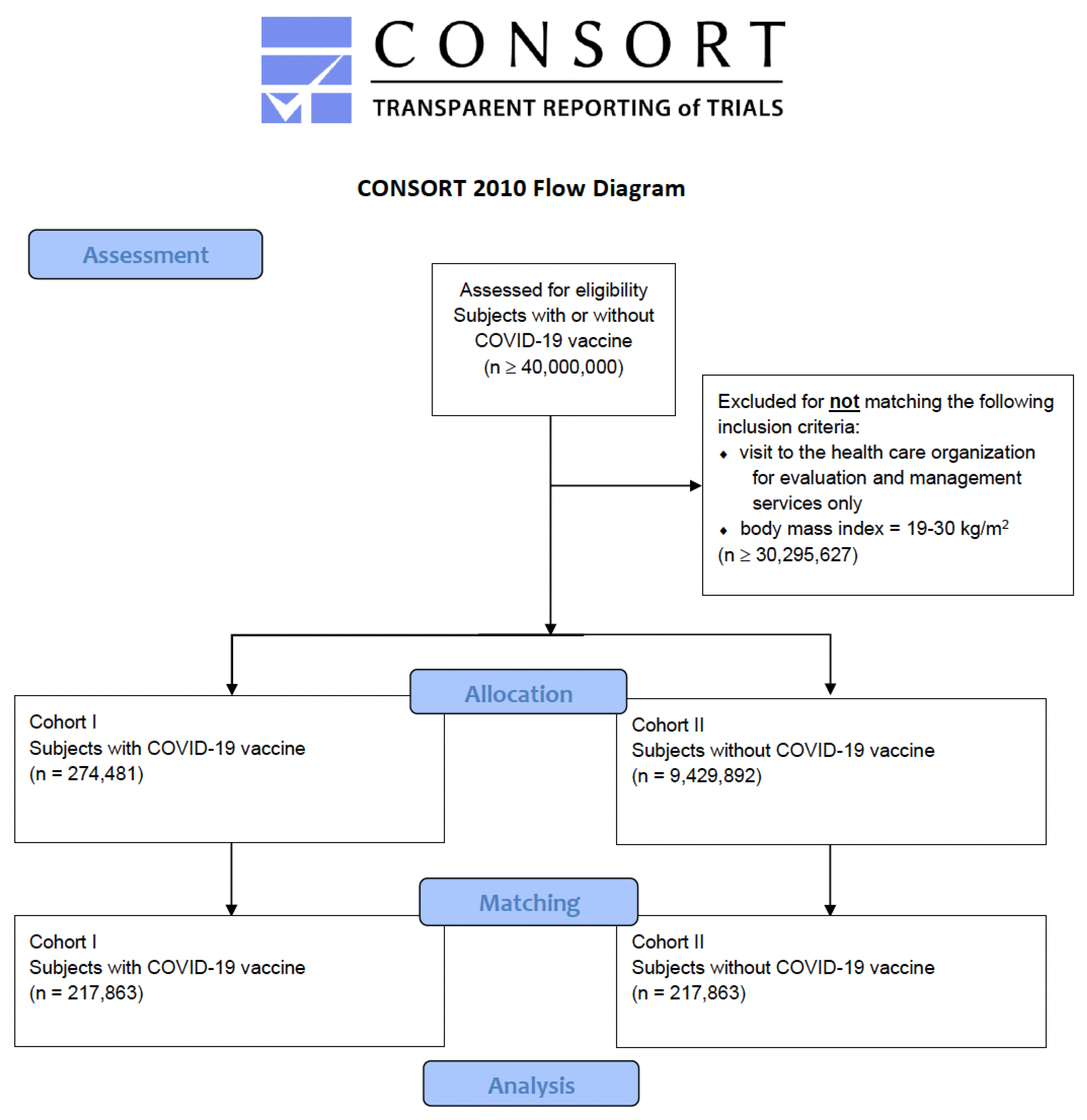
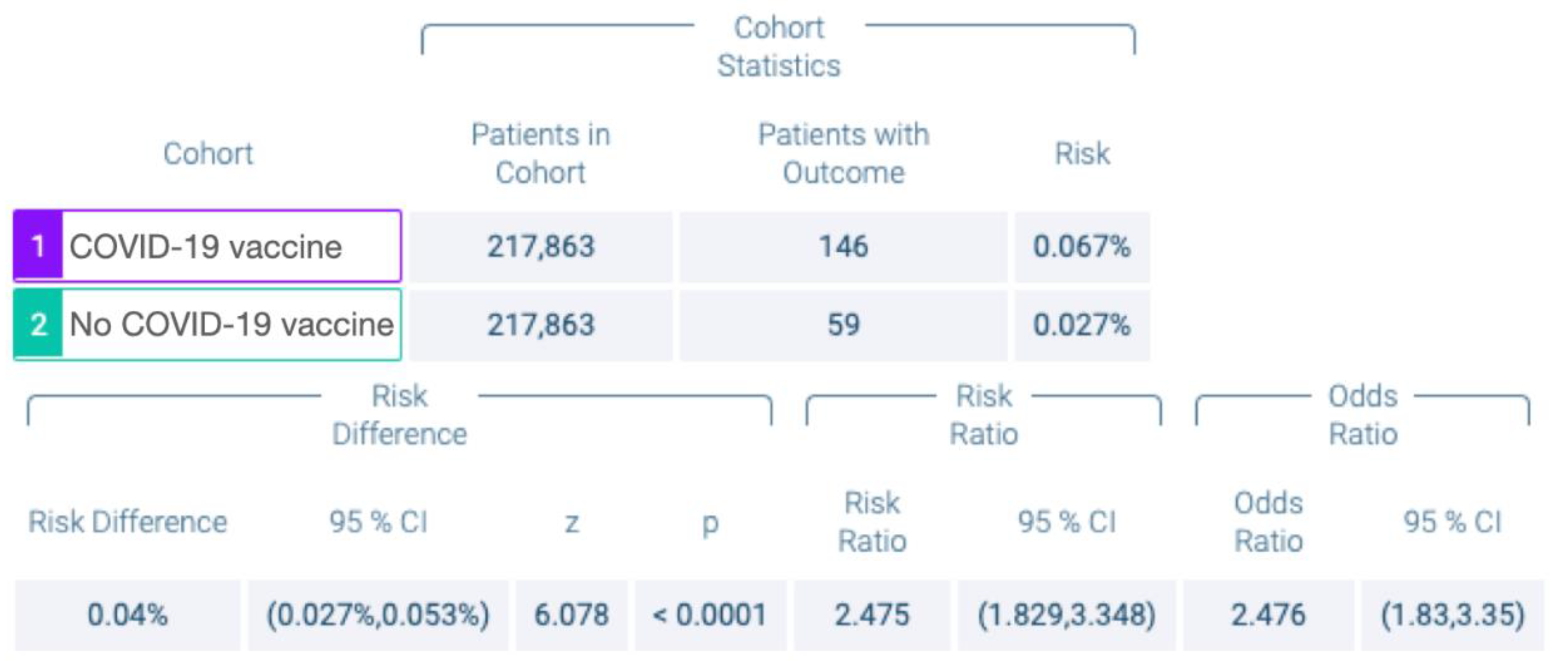
Introduction: Onset of oral lichenoid lesions (OLL) or oral lichen planus (OLP) can be rare adverse reactions to vaccines. Recently, the first solitary cases were reported after COVID-19 vaccination. The aim of the present study was to assess if an increased frequency of OLL/OLP can be found after COVID-19 vaccination within a large real-world cohort. It was assumed that the incidence of OLL/OLP was significantly higher in subjects who received COVID-19 vaccine (cohort I) compared to individuals who were not vaccinated (cohort II). Patients and Methods: Initial cohorts of 274,481 vaccinated and 9,429,892 not vaccinated patients were retrieved from the TriNetX database (TriNetX, Cambridge, Massachusetts, USA), and matched for age, gender and the frequency of use of non-steroidal anti-inflammatory drugs, beta blockers, and angiotensin-converting enzyme inhibitors. Results: After matching each cohort, we accounted for 217,863 patients. Among cohort I, 146 individuals had developed OLL/OLP within 6 days after COVID-19 vaccination (88 and 58 subjects had received mRNA- and adenovirus vector-based vaccines), whereas in cohort II, 59 patients were newly diagnosed with OLL/OLP within 6 days after having visited the clinic for any other reason. The risk of developing OLL/OLP was calculated as 0.067% vs. 0.027%, for cohorts I and II, whereby the risk difference was highly significant (p < 0.001; log-rank test). RR and OR were 2.475 (95% CI = 1.829; 3.348) and 2.476 (95% CI = 1.830; 3.350), respectively. Discussion: The hypothesis was confirmed. Accordingly, the obtained results suggest that the onset of OLL/OLP is a rare adverse drug reaction to COVID-19 vaccines, especially to mRNA vaccines. Thus far, it remains unknown if specific components of the formulations cause a type IV hypersensitive reaction corresponding to OLL, or if the immune response post vaccination triggers a T cell-driven autoimmune reaction directed against the basal layer of keratinocytes of the oral mucosa in terms of OLP. Although OLL and OLP are both classified as premalignant lesions, spontaneous remission may be expected over time, at least in the case of OLL. Therefore, the presented findings should not place any limitation toward the use of COVID-19-vaccines in broad levels of the population.
Keywords: oral lichenoid lesion; oral lichen planus; adverse drug reaction; COVID-19 vaccine; SARS-CoV-2; real-world data oral lichenoid lesion; oral lichen planus; adverse drug reaction; COVID-19 vaccine; SARS-CoV-2; real-world data