


Abstract
Allium cepa L. (onion) is a globally important vegetable crop and functional food recognized for its rich diversity of antioxidant phytochemicals, including flavonoids, organosulfur compounds, phenolic acids, anthocyanins, saponins, and polysaccharides. Onion-derived phytochemicals have demonstrated antioxidant and redox-modulating activities in chemical, cellular, and animal studies. However, onion-specific applications of artificial intelligence and structure-based computational methods remain limited. This review therefore discriminates established experimental evidence from computational predictions and proposes an AI-assisted framework for future candidate prioritization and validation. AI and machine-learning approaches can support data integration and candidate prioritization, whereas molecular docking, molecular dynamics simulations, and endpoint free-energy calculations provide structure-based hypotheses that require experimental validation. We critically narrate the principles, workflows, validation methods, and current applications of molecular docking and MD simulations in predicting protein–ligand interactions, binding affinity, conformational stability, and molecular recognition of onion-derived compounds against oxidative stress and disease-related molecular targets. Beyond recent progress on AI-assisted molecular docking and molecular dynamics simulations, we also discuss the inherent limitations and trade-offs in these techniques. The review further discusses complementary approaches, including AI-assisted ADMET prediction, network pharmacology, and multi-omics integration, together with the limitations, challenges, and future opportunities associated with these computational techniques.
1. Introduction
Onion (Allium cepa L.) is an important vegetable crop and a rich source of phytochemicals, with potential antioxidant and health-promoting properties [1]. Its bulbs and outer tissues contain several classes of bioactive compounds, including flavonoids, anthocyanins, and organosulfur compounds. Important onion phytochemicals include quercetin and its glycosides, kaempferol, isorhamnetin, cyanidin derivatives, S-alk(en)yl-L-cysteine sulfoxides (ACSOs), thiosulfinates, sulfides, and Onionin A [2,3,4,5]. Functional foods contribute to the maintenance of physiological functions and reduce the risk of chronic diseases, and onion fulfills this definition owing to its exceptional abundance of antioxidant compounds [6,7]. Unlike many vegetables whose nutritional value is primarily derived from vitamins and minerals, onion contains numerous secondary metabolites that remain biologically active after consumption and exert antioxidant and redox-modulating activities [8,9,10]. However, their composition varies substantially according to genotype, bulb color, tissue, cultivation environment, maturity, storage, and processing conditions and their outer scales and other processing by-products are often enriched in flavonoids such as quercetin [11,12,13,14,15,16].
Oxidative stress arises from an imbalance between reactive oxygen species (ROS) production and endogenous antioxidant defense mechanisms, resulting in oxidative damage to lipids, proteins, DNA, and other cellular components. Persistent oxidative stress is a major contributor to the development of cardiovascular diseases, diabetes, cancer, neurodegenerative disorders, chronic inflammation, and ageing-related complications [17]. Consequently, identifying natural antioxidants capable of restoring redox homeostasis has become a major objective in food science, nutrition, and pharmaceutical research. Studies have demonstrated antioxidant properties of onion extracts and individual phytochemicals using different experimental approaches. Chemical assays such as DPPH, ABTS, FRAP, and related methods have been widely used to estimate radical-scavenging capacity. Quercetin and related flavonoids are among the most extensively investigated onion compounds, while anthocyanins contribute to the antioxidant properties of red and purple onions [18,19]. Onion extracts and compounds also occurring in onion have shown radical-scavenging, antioxidant-enzyme-modulating, and anti-inflammatory activities in chemical and preclinical experimental systems. However, evidence from chemical assays, cell models, animal experiments, and human intervention studies should not be interpreted as equivalent. In particular, the extent to which compound-level findings can be translated to the effects of dietary onion consumption remains insufficiently established [20,21,22].
Traditional discovery of bioactive phytochemicals relies heavily on labor-intensive phytochemical isolation, biochemical characterization, and experimental validation, making the process expensive and time-consuming. Furthermore, differences in onion genotype, tissue, growing conditions, extraction methods, and analytical platforms further complicate comparisons among studies. Consequently, a clear evidence-based framework is needed to distinguish compound occurrence, biological activity, computational prediction, and experimental target validation. Machine-learning and deep-learning approaches can support germplasm stratification, metabolite annotation, candidate prioritization, target prediction, and preliminary pharmacokinetic assessment. Their performance, however, depends on data quality, training-set representativeness, external validation, and the applicability domain of each model. In onion research, these approaches may help integrate phenotypic, metabolomic, and genomic information and generate testable candidates for downstream structural and biological validation [23,24,25,26,27,28,29,30].
Following data-driven candidate prioritization, structure-based computational approaches can evaluate the plausibility of compound–target interactions. Molecular docking predicts candidate binding poses, whereas molecular dynamics simulations examine the temporal stability and conformational behavior of selected complexes. These physics-based approaches can be complemented by AI-enabled structure prediction, target prediction, scoring functions, ADMET models, and multi-omics integration [23,31,32,33]. Despite remarkable advances in artificial intelligence, digital phenotyping, metabolomics, molecular docking, and molecular dynamics simulations, these technologies have rarely been discussed within a unified framework for discovering antioxidant phytochemicals from onion. Previous reviews have examined onion phytochemistry, antioxidant activity, or selected computational approaches separately; however, integrated evaluations that distinguish experimental evidence from computational prediction and source-specific evidence remain limited [24]. This review aims to: provide insights into the current evidence on the antioxidant and redox-modulating activities of onion (Allium cepa L.) phytochemicals; assess the gaps and limitations in current onion phytochemical research; and develop an integrated AI assisted discovery framework for onion bioactive compounds.
2. Literature Search and Evidence Classification
2.1. Review Approach
This study is conducted as a structured narrative review to synthesize current knowledge on antioxidant phytochemicals from onion (Allium cepa L.) and to evaluate the emerging application of artificial intelligence (AI) as well as computational approaches for their discovery and mechanistic characterization. A narrative approach was selected because the available literature encompasses diverse evidence types, including phytochemical identification and quantification, chemical antioxidant assays, cell-based and animal studies, human evidence, molecular target prediction, molecular docking, molecular dynamics (MD) simulations, network pharmacology, and AI-assisted prediction [34]. The review therefore emphasizes qualitative comparison, critical interpretation, and integration of experimental and computational evidence.
2.2. Literature Search Strategy
Relevant studies in the literature were identified through searches of major scientific databases, including Web of Science, Scopus, PubMed, and Google Scholar (Table S1). Additional relevant publications were identified by examining the reference lists of key articles and recent review papers. Searches focused on publications addressing onion phytochemicals, antioxidant activity, digital phenotyping, artificial intelligence, machine learning, metabolomics, molecular target prediction, molecular docking, molecular dynamics simulations, network pharmacology, and ADMET prediction. Search terms were combined using Boolean operators (AND, OR) and adapted to the requirements of each database (Table 1). Searches were made between June and August, 2026, and updated during manuscript preparation to incorporate recent studies relevant to AI assisted phytochemical discovery and computational analysis (Table S1).
During the preparation of this manuscript, the authors used ChatGPT (OpenAI, GPT-6) free version to assist with improving academic language, clarity, and the organization of selected sections. The authors critically reviewed, revised, and verified all AI-assisted outputs and take full responsibility for the accuracy, originality, and integrity of the final manuscript. The chemical structures presented in Figures were obtained from the PubChem database (https://pubchem.ncbi.nlm.nih.gov/ [accessed 20 September 2026]). Moreover, some icons for Figures were generated from Gemini free version and subsequently modified and edited in Microsoft PowerPoint.
Table 1.
Literature search: databases, coverage, and included records.
2.3. Eligibility and Study Selection
A structured literature search was conducted using Web of Science, Scopus, PubMed, and Google Scholar, from which 928 records were initially retrieved (Table S1). Two reviewers (L.T. and S.K.) independently screened titles and abstracts followed by full-text assessment. Disagreements were resolved through discussion and, when necessary, consultation with a third and fourth authors (S.C. and B.H.). Reasons for full-text exclusion were recorded prospectively. After removal of 295 duplicate records and preliminary screening, 633 unique articles remained for subsequent title and abstract screening. These records were subsequently screened based on publication year from 2020 onwards, relevance to the review objectives, and availability of information addressing onion phytochemicals, antioxidant and redox activities, molecular mechanisms, and AI-assisted or computational approaches. Studies that did not directly contribute to the scope of the review were excluded. Following this screening and relevance assessment, 183 articles were selected as the principal evidence base for this narrative review.
2.4. Multi-Dimensional Evidence-Level Classification Framework
To distinguish experimentally demonstrated effects from computational predictions, evidence and source-attribution codes were assigned according to redefined criteria. Coding decisions were independently checked by a second author, and disagreements were resolved by consensus: (i) Evidence Domains: O1: onion occurrence (detection/quantification in onion tissue); A1–A4: chemical assay (A1), cellular ROS (A2), animal models (A3), and human clinical trials (A4); C1–C3: target prediction/AI (C1), molecular docking (C2), and MD/free-energy analysis (C3); M1: direct target validation (biochemical/cellular target mechanism). (ii) Source Attribution: S1: whole onion/onion extract; S2: compound isolated directly from onion; S3: compound quantified in onion but tested from a commercial/external source; S4: database-assigned constituent; and S5: general evidence for a compound that also occurs in onion. Evidence levels were assigned on the basis of the specific study and compound rather than inferred from evidence available for structurally related compounds. Computational predictions were not considered equivalent to experimental validation. In particular, molecular docking and molecular dynamics were interpreted as hypothesis-generating approaches unless supported by independent experimental evidence. The evidence was synthesized thematically rather than statistically. The synthesis was organized heading relevant interconnected stages: (i) onion germplasm and digital phenotyping; (ii) phytochemical profiling and antioxidant activity; (iii) antioxidants mechanisms and AI-assisted compound prioritization and target prediction; (iv) molecular docking, molecular dynamics, and related computational analyses; and (v) experimental validation and translation toward functional or therapeutic applications.
3. Antioxidant Phytochemicals: Diversity and Evidence
3.1. Flavonoids and Phenolic Compounds
Quercetin is the predominant flavonol in many onion cultivars, although its abundance and glycoside composition vary by genotype, tissue, and environmental conditions. Its catechol structure and hydroxyl groups contribute to radical scavenging, metal coordination, and redox-dependent biological activity. However, mechanistic findings obtained using commercially sourced quercetin should be distinguished from evidence generated using onion-derived quercetin or onion extracts [35,36]. Onion also contains saponins and fructans, which may influence inflammation, metabolic processes, and gut microbial composition; however, their principal biological functions differ from the direct antioxidant activity. Collectively, these diverse phytochemicals contribute to the nutritional and functional properties of onion and may support human health through a range of protective and physiological mechanisms [37,38,39,40,41,42].
3.2. Organosulfur Compounds and Other Bioactive Constituents
Onion (Allium cepa L.) is a rich source of diverse bioactive phytochemicals, including organosulfur compounds such as thiosulfinates, sulfides, disulfides and cysteine derivatives which collectively contribute to its antioxidant, anti-inflammatory, antimicrobial, cardioprotective, and chemo-preventive properties, thereby promoting human health and disease prevention. These organosulfur compounds represent the most distinctive phytochemicals responsible for onion’s characteristic flavor, aroma, and broad spectrum of biological activities, making them the primary focus of extensive scientific investigation [43].
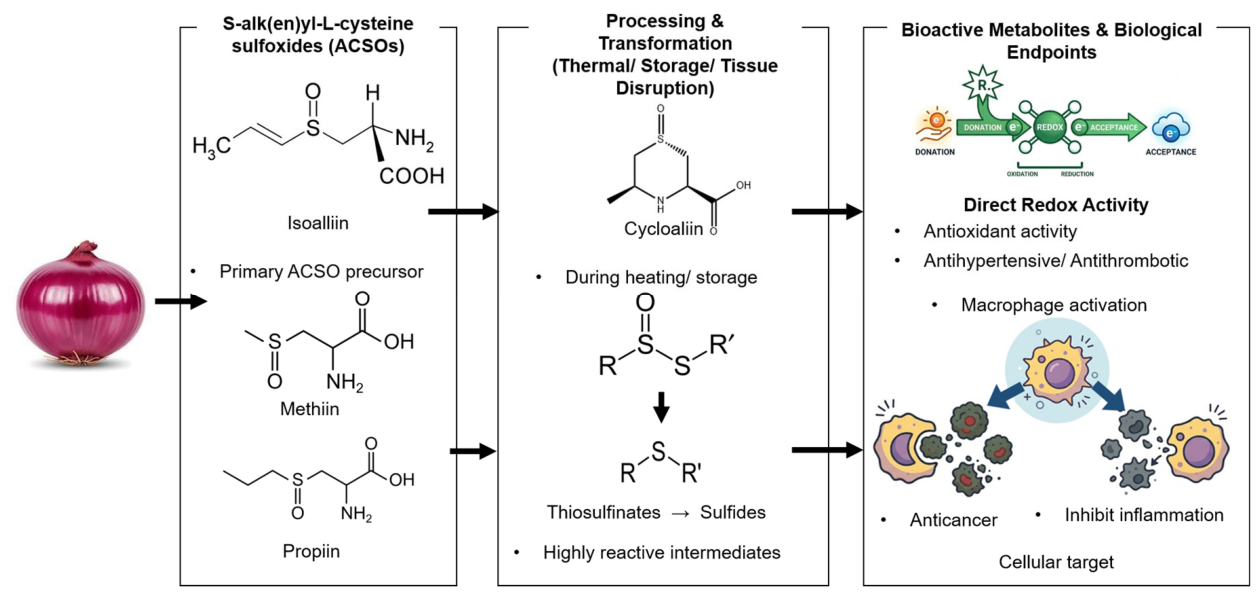
The predominant organosulfur compounds in onion are S-alk(en)yl-L-cysteine sulfoxides (ACSOs), the non-volatile sulfur-containing precursors that give rise to onion’s characteristic pungency and many of its health-promoting properties [44,45]. The major ACSOs include isoalliin (trans-(+)-S-(1-propenyl)-L-cysteine sulfoxide), accounting for approximately 70–80% of total ACSOs; methiin (S-methyl-L-cysteine sulfoxide); and smaller quantities of propiin (Figure 1). Beyond their contribution to flavor, ACSOs exhibit important physiological functions. For example, Wang et al. [46] demonstrated that isoalliin stimulates dark-phase and daily feeding behavior in mice through activation of neuropeptide signaling within the arcuate nucleus, suggesting potential therapeutic applications for appetite regulation. During thermal processing or prolonged storage, isoalliin undergoes spontaneous cyclization to form cycloalliin, a more stable sulfur amino acid with documented antioxidant, antihypertensive, anti-inflammatory, and antithrombotic activities. Among these metabolites, thiosulfinates are highly reactive sulfur compounds that exhibit high antioxidant activity. Although relatively unstable, thiosulfinates serve as key intermediates that subsequently decompose into more stable sulfides, including diallyl sulfides and related polysulfides [4,38,47]. Another notable sulfur-containing metabolite is Onionin A, a unique sulfur-containing cyclic sulfide predominantly isolated from onion bulbs. Thiosulfinates and Onionin A have been investigated for antioxidant, anti-inflammatory, immunomodulatory, and anticancer-related activities. However, these effects have been evaluated using different experimental endpoints and should not be interpreted as interchangeable evidence [38,48].
Figure 1.
Classification of major organosulfur constituents in onion and their biological functions.
3.3. Sources of Evidence Heterogeneity and Context-Dependent Biological Effects
It is imperative to see why various studies find different results while investigating onion-related phytochemicals? This may be due to source attribution including but not limited to: variations in plant variety and bulb color (yellow, red, and white onions contain different levels of flavonoids and sulfur compounds), growing conditions (soil type/growing media, sun exposure, temperature, and rainfall change plant chemistry), harvesting time, extraction methods, sample processing/compound isolation methods, measurement/compound quantification and analysis tools [12,49,50,51]. The comparative evidence summarized in Table 2 demonstrates that the biological activity and phytochemical composition of onion are highly context-dependent, which may explain apparently inconsistent findings among studies. In human research, onion peel extract (OPE) significantly enhanced natural killer (NK) cell activity only among participants with higher Wisconsin Upper Respiratory Symptom Survey (WURSS-21) symptom scores, while circulating cytokine concentrations were unaffected regardless of symptom status, suggesting that baseline immune status and the sensitivity of individual immune endpoints may influence the response [52]. Similarly, comparisons of onion peel extract with isolated quercetin indicate that the biological effects of the whole onion matrix may not be attributable to quercetin alone. Extract composition, gastrointestinal transformation, metabolite formation, bioavailability, and potential additive or synergistic interactions can modify antioxidant, anti-inflammatory, and intestinal-barrier effects [42,53]. Variation is also evident across experimental models. Although quercetin can modulate inflammatory and PI3K/Akt/mTOR-related signaling, the magnitude and downstream consequences may differ owing to cell type, stimulus, dose, exposure duration, and cellular metabolic characteristics [54]. Multiple study reports showed that cultivar, bulb color, geographical origin, and growing environment substantially influence onion metabolite profiles at the phytochemical level, suggesting that onions with similar visual characteristics may still differ considerably in flavonoid, anthocyanin, and organosulfur composition [2,11,49,55]. Importantly, methodological differences also contribute to variation: GC–MS preferentially captures volatile and sulfur-containing compounds, whereas LC/UPLC-MS provides broader coverage of polar and semi-polar metabolites. Collectively, these findings support viewing onion as a complex phytochemical matrix, in which biological outcomes depend on genotype, environment, processing, compound interactions, analytical methodology, dose, model, and physiological context rather than on the concentration of a single antioxidant compound alone [2,11,52,54,56].
Our study reveals that the available evidence varies considerably among onion phytochemicals (Table 2). Quercetin and its derivatives are among the most extensively investigated, with onion-specific studies reporting antioxidant activity in isolated compounds and fractions, including spiraeoside, and cellular protection by onion-peel-derived quercetin oxidation metabolites [19,53,57]. However, human evidence mainly concerns whole onion-peel extract rather than individual compounds [52]; therefore, clinical effects cannot be attributed specifically to quercetin. Furthermore, kaempferol derivatives, anthocyanins, and phenolic acids contribute to onion’s antioxidant potential, particularly in pigmented cultivars and outer tissues, although evidence is largely based on phytochemical profiling and extract-level assays [18,20,22]. Organosulfur compounds also show potential redox-related activity; notably, S-alk(en)yl-cysteine sulfoxides have been reported to scavenge reactive carbonyl compounds, an activity distinct from conventional radical scavenging (Table 2). On the other study, flavonoids were reported as the most abundant compounds out of 103 diverse onion metabolites extracted from root and peel extracts [51]. Overall, our study generated strong evidence especially on onion extracts and selected flavonoids, while human findings remain largely extract-level and computational predictions require experimental validation.
Table 2.
Multi-Dimensional Evidence Matrix for Major Antioxidant Phytochemicals of Onion (Allium cepa L.).
3.4. Integration of Experimental Evidence with Computational and AI-Assisted Candidate Prioritization
Integrating experimental, computational, and artificial intelligence methods transforms how researchers analyze onion (Allium cepa L.) phytochemicals for multi-layered purposes [64,65,66]. This synergy bridges raw laboratory extraction with predictive modeling to map health benefits, such as antioxidant, anti-diabetic, and anti-cancer properties of these crucial onion phytochemicals [56]. In vitro assays have demonstrated chemical radical-scavenging activity and inhibition of metabolic enzymes such as α-glucosidase and α-amylase [11,63,67]. Quercetin 4′-O-glucoside produced a favorable predicted docking pose and docking score against the selected target. This result represents a structure-based hypothesis and requires biochemical confirmation. Computational methods can complement these findings by generating hypotheses regarding possible ligand–target interactions and by prioritizing candidates for further testing [56,66]. However, docking predictions do not independently confirm enzyme inhibition or biological efficacy. Protein-structure prediction tools such as AlphaFold may provide structural models for targets lacking experimentally resolved structures. These models can support subsequent docking studies, but their suitability depends on model confidence, binding-site accuracy, and appropriate structural validation [68,69]. The approaches, methodological categories, and potential applications to onion research are summarized in Table 3.
Table 3.
Classification of AI/ML, computational chemistry, database/network analysis, and experimental approaches.
4. Redox Mechanisms and Biologically Relevant Targets
Oxidative stress and redox imbalance are increasingly recognized as fundamental regulators of inflammatory cell death. Beyond their classical reputation for causing cellular damage, reactive oxygen species (ROS) serve as context-dependent signaling molecules that govern the initiation, amplification, and resolution of regulated necrotic pathways [81]. Many phytochemicals influence endogenous antioxidant defenses, redox-sensitive signaling pathways, inflammation, mitochondrial function, and cellular stress responses including radical-scavenging activity [5,60].
4.1. Direct Ros/Rns Scavenging and Redox Modulation
The destructive effects of oxidative stress become particularly evident in its impact on fundamental cellular structures. Excessive free radicals can indiscriminately attack lipids, proteins, and nucleic acids, leading to cumulative molecular damage and disruption of normal cellular function. In this context, the phytochemicals present in onion may provide important antioxidant protection by scavenging reactive free radicals and reducing oxidative damage [82]. Organosulfur compounds characteristic of Allium species may provide additional redox-modulating activity, suggesting that the antioxidant potential of onion is a result of multiple interacting phytochemicals classes rather than a single dominant compound [60]. Importantly, antioxidant capacity measured by chemical assays such as DPPH, ABTS, and FRAP does not necessarily predict biological antioxidant efficacy, meaning a compound showing strong antioxidant activity in a laboratory chemical test does not necessarily mean it will provide strong antioxidant protection inside a living organism or human body. Nevertheless, computational chemistry and molecular simulation approaches progressively provide opportunities to examine hydrogen-atom transfer, electron-transfer potential, molecular stability, and structure–activity relationships at the molecular level [83]. While integrating molecular simulation and the ML method may offer a one-step-ahead approach for the molecular design of novel antioxidants [84].
4.2. Metal Chelation and Prevention of Oxidative Damage
Metal chelation prevents oxidative damage by binding redox-active transition metals (such as iron and copper) to decrease their redox potential and block vacant coordination sites. These processes are particularly relevant because localized iron and copper dysregulation can contribute to lipid, protein, DNA, and mitochondrial damage [85,86]. This inhibits the Fenton and Haber–Weiss reactions, stopping the catalytic breakdown of hydrogen peroxide into destructive hydroxyl radicals [87]. However, metal binding can have either antioxidant or pro-oxidant consequences depending on the metal, chemical environment, concentration, and cellular compartment indicating metal chelation by onion phytochemicals should be regarded as a context-dependent mechanism rather than an intrinsically protective process [88,89]. For an AI-assisted discovery framework, metal-binding interactions represent a potentially useful additional target for computational screening.
4.3. Activation of Endogenous Antioxidant Defense Pathways
Beyond direct radical scavenging, an important mechanism of phytochemical-mediated antioxidant protection is activation of endogenous cellular defense systems primarily by triggering the Nrf2-Keap1-ARE signaling pathway. Under oxidative stress, activation of the Keap1–Nrf2 signaling pathway promotes Nrf2 nuclear translocation and the expression of antioxidant and cytoprotective genes, thereby enhancing cellular defense against oxidative damage, inflammation, and apoptosis [90]. Quercetin has been shown to activate the endogenous antioxidant defense system, particularly through modulation of the Keap1/Nrf2/HO-1 signaling pathway, thereby enhancing antioxidant enzyme expression and strengthening cellular protection against oxidative stress [91].
4.4. Modulation of Oxidative Stress–Inflammation Signaling
The oxidative stress concept has been defined by an imbalance between oxidants and antioxidants in favor of the oxidants [92]. Oxidative stress and inflammation are closely interconnected processes. Excessive ROS can activate redox-sensitive transcription factors and kinases, including NF-κB and mitogen-activated protein kinases (MAPKs), which promote the production of inflammatory mediators. Conversely, inflammatory responses can increase ROS generation, creating a self-amplifying cycle of oxidative and inflammatory damage. Onion phytochemicals may interfere with this cycle through simultaneous antioxidant and anti-inflammatory mechanisms. Allium cepa-focused network pharmacology and molecular docking study by Omoboyede et al. [74] identified multiple potential targets and pathways associated with the anti-inflammatory effects of onion, supporting a multi-target rather than single-target mode of action. Similarly, Zhang et al. [93] reported that quercetin modulates Nrf2, NF-κB, MAPK, and other signaling pathways involved in oxidative stress and inflammation, thereby potentially influencing the progression of non-communicable diseases. Studies also highlight the practicality of onion as a model system for evaluating antioxidant and protective effects of bioactive compounds for modulating oxidative stress [94].
4.5. Mitochondrial Protection and Cellular Redox Homeostasis
Mitochondria generate energy via oxidative phosphorylation while producing ROS. Hence, they are both major sources and important targets of ROS. Oxidative stress increases inner membrane permeability, causing a loss of mitochondrial membrane potential. Excessive mitochondrial ROS can impair the electron transport chain, promote lipid and protein oxidation, disrupt mitochondrial membrane potential, and trigger apoptosis. Consequently, preservation of mitochondrial function represents an important component of cellular antioxidant protection. Experimental evidence has shown that quercetin protected rat-derived H9c2 cardiomyocytes against D-galactose-induced cellular senescence, reducing ROS production and improving mitochondrial function and mitochondria–ER contact sites [95,96]. These findings suggest that antioxidant phytochemicals may protect cells not simply by removing ROS but by maintaining the systems responsible for ROS production and mitochondrial quality control.
4.6. Biological and Health Relevance of Onion Phytochemicals
Plant-derived antioxidants, particularly polyphenols, flavonoids, carotenoids, and sulfur-containing metabolites, act as multifunctional regulators of cellular redox homeostasis rather than merely scavenging free radicals [47,97]. Onion phytochemicals, particularly quercetin and its glycosides, kaempferol, isorhamnetin, anthocyanins, and organosulfur compounds, appear to exert antioxidant and anti-inflammatory effects through multiple interconnected molecular targets and signaling pathways rather than a single mechanism [3,6,54,65,98]. For example, quercetin and its glycosides are among the predominant onion flavonoids and can scavenge reactive oxygen species, inhibit lipid peroxidation, chelate transition metals, and enhance endogenous antioxidant defenses, including superoxide dismutase, catalase, and glutathione peroxidase [38,60,99].
Onion constituents may also contribute to glucose homeostasis by improving insulin sensitivity, stimulating glucose uptake, inhibiting carbohydrate-digesting enzymes, activating AMP-activated protein kinase, and protecting pancreatic β-cells against oxidative injury [3,38,74,100]. For example, Uttarawichien et al. [101] reported that onion peel extract inhibited proliferation, migration, invasion, and angiogenesis of HT-29 colorectal cancer cells through suppression of the L1CAM/NF-κB pathway. Importantly, the absorption, metabolism, bioavailability, tissue distribution, and glycosylation of quercetin and other onion phytochemicals can substantially influence their biological exposure and may limit direct extrapolation from in-vitro findings to human outcomes [93]. Consequently, onion represents a promising functional food and source of bioactive compounds (Table 4).
Table 4.
Onion antioxidant phytochemicals and their relevance for different targets.
5. Phenomics and Metabolomics Integration
For antioxidant-oriented onion improvement, germplasm characterization should connect agronomic traits with quantitatively measured flavonoids, anthocyanins, organosulfur compounds, and antioxidant-related biological endpoints across multiple environments [106]. Onion (Allium cepa L.) germplasm represents substantial variation in bulb size, shape, color, maturity, dry matter, pungency, antioxidant capacity, flavonoid concentration, organosulfur compounds, and other nutritional attributes [2,13,107]. Thus, systematic characterization of diverse germplasm is an essential first step for identifying accessions with superior agronomic performance and enhanced phytochemical profiles, which can subsequently serve as parents or targets for functional breeding. Genotype–phenotype–metabolite associations provide an important link between onion genetic diversity, observable traits, and antioxidant phytochemical composition [2,18].
5.1. Digital Phenotyping for Onion Breeding
Onion (Allium cepa L.) breeding is challenged by the complex inheritance and strong genotype × environment (G × E) interactions governing economically important traits, including bulb yield, bulb size and shape, maturity, storage longevity, disease resistance, nutritional quality, and antioxidant composition [13,108,109]. Current onion digital-phenotyping studies have primarily focused on agronomic and yield-related traits. Direct prediction of antioxidant–metabolite concentrations from imaging or spectral data remains insufficiently validated and requires paired imaging and quantitative metabolomic datasets with independent external validation. Nevertheless, digital phenotyping using RGB and hyperspectral imaging, combined with AI-based image analysis, enables rapid, non-destructive, and high-throughput extraction of quantitative traits for efficient screening of onion germplasm and reliable candidate genotype identification [110,111]. Moreover, machine-learning models have already been combined with UAV multispectral and hyperspectral data for yield prediction, including random forest, support vector machine, XGBoost, multilayer perceptron, and deep-learning approaches [51,112,113]. AI-assisted digital phenotyping integrates computer vision, automated imaging, non-destructive sensors, robotics, unmanned aerial vehicles (UAVs), and machine-learning (ML) algorithms with image-analysis pipelines for calibration, segmentation, feature extraction, and classification, enabling rapid and objective quantification of standardized plant traits and high-throughput characterization of onion germplasm at high spatial and temporal resolution [50,113,114,115]. Machine-learning approaches, including random forests, support vector machines, and ensemble models, as well as deep-learning architectures such as convolutional neural networks (CNNs) and vision transformers, can be used to extract phenotypic information from imaging and spectral data regardless of agronomic and metabolite related traits [113,116,117,118,119,120].
5.2. Metabolomics
Metabolomics plays a crucial role for comprehensive characterization of onion (Allium cepa L.) phytochemical diversity, providing sensitive and high-resolution identification of metabolites associated with antioxidant capacity, nutritional quality, flavor, stress tolerance, and other health-promoting properties. Cheng et al. [49] detected 243 volatile features across the three specified onion groups. Of the annotated volatiles, sulfur-containing compounds accounted for approximately 51–64%, whereas organic acids and their derivatives accounted for approximately 4–19%. Because most assignments were based on mass-spectral matching, they should be described as annotations unless confirmed with authentic standards. Multivariate analyses further demonstrated distinct volatile-metabolite profiles among onion types and identified 19 key metabolite biomarkers contributing to their differentiation. Similarly, an integrative approach, combining ultra-performance liquid chromatography-mass spectrometry (UPLC-MS) and gas chromatography–mass spectrometry (GC–MS) was employed by Sharaf El-Din et al. [55], aiming to profile the metabolome of four Egyptian onion cultivars and UPLC-MS analysis annotated 93 metabolites, several previously unreported metabolites such as flavonoids, nitrogenous compounds, and fatty acids while the GC–MS analysis identified 24 silylated primary metabolites. Likewise, Aquino et al. [71] developed and optimized an online comprehensive two-dimensional liquid chromatography (LC × LC) approach for in-depth characterization of the phytochemical profile of Allium cepa PDO leaf extract. The approach enabled the annotation of 147 compounds spanning diverse chemical classes, including flavonoids, saponins, phenylpropanoids, isoprenoids, terpenes, dipeptides, fatty acids, and other lipids, demonstrating the chemical richness of onion leaves and the potential of advanced chromatographic platforms for comprehensive phytochemical profiling.
Untargeted metabolomics is particularly valuable for onion germplasm characterization because it can support discovery of previously unrecognized metabolic features without requiring predefined candidate compounds [55,121]. Multivariate statistics, chemometrics, machine learning, and molecular networking can identify metabolites that discriminate cultivars, geographical origins, tissues, or growing environments and subsequently associate these metabolites with desirable biological or agronomic traits. For instance, untargeted UPLC–TIMS–QTOF MS profiling of onions collected from 56 cultivation sites across South Korea detected thousands of molecular features and identified distinct regional chemotypes. These findings highlight the capacity of metabolomics to establish phenotype–metabolite associations and identify candidate biochemical markers for antioxidant capacity, bulb quality, and nutritional value [49,121]. Integration with phenotypic, genomic, and environmental data can improve identification of stable antioxidant-associated metabolites and prioritize candidates for mechanistic validation [50,122,123,124].
5.3. Genomics and Genotype-by-Environment Interactions
Genomics and genotype-by-environment interactions (GEI) provide the mechanistic and statistical framework required to determine whether desirable phenotypic and metabolic traits are genetically controlled, environmentally induced, or produced by interactions between genotype and environment. The availability of chromosome-level onion genome assemblies has substantially strengthened this capacity. The study by Fujito et al. [125] on construction of a high-density linkage map and graphical representation of the arrangement of transcriptome-based unigene markers on the chromosomes of Allium cepa has provided insights into bulb development and the evolution of genes associated with Allium-specific flavor metabolism (Table 5). Choi et al. [113] presented an innovative approach to onion breeding by integrating machine learning (ML) with genomic selection (GS). Their workflow first developed primary prediction models using top-ranked GWAS-associated SNPs, evaluated feature importance to identify the most informative markers, and subsequently incorporated the optimal features into secondary models to improve genomic prediction and selection efficiency.
Although genomic resources and prediction models are expanding in onion, direct validation for antioxidant-metabolite traits remains limited. Onion phytochemical composition is strongly influenced by soil characteristics, nutrient availability, temperature, moisture status, photoperiod, and other environmental factors. Onion yield, nutritional composition, phytochemical accumulation, and antioxidant traits are significantly influenced by genotype, environment, and their interactions, while agronomic factors such as irrigation, fertilization, and soil conditions further contribute to variation in bulb yield and metabolite accumulation [12,107,126]. This is particularly important for antioxidant breeding because a genotype exhibiting high quercetin, anthocyanin, or organosulfur content in one environment may not maintain the same concentration elsewhere. Consequently, environment-aware genomic and metabolomic selection is required to identify both high-performing and chemically stable germplasm [12]. Taken together, the integration of digital phenotyping, metabolomics, genomics, and GEI analysis creates a powerful germplasm-to-metabolite pipeline: diverse onion germplasm is first characterized using high-throughput imaging and spectral technologies; digital traits are then integrated with LC-MS/GC-MS/NMR metabolomic profiles; genomic information is used to identify markers, loci, candidate genes, and genomic relationships; and multi-environment experiments determine the stability and environmental sensitivity of important phenotypic and metabolic traits [113,121].
Table 5.
Summary of digital phenotyping and multi-omics approaches for integrating onion genotype, phenotype, and metabolite information to facilitate AI-assisted discovery and prioritization of antioxidant phytochemicals.
6. AI for Compound Annotation, Activity Prediction, and Prioritization
Artificial intelligence (AI) is increasingly transforming the interpretation of complex metabolomic datasets by integrating chemical, spectral, genomic, and biological information to accelerate compound annotation and bioactivity-guided prioritization [131]. In natural-product research, conventional compound identification remains challenging because plant extracts contain chemically diverse metabolites, many of which occur at low abundance and generate overlapping or incomplete mass-spectral signals. The pharmaceutical research and development process is persistently challenged by high financial costs, protracted timelines, and remarkably low success rates due to various bottlenecks [29]. AI-assisted annotation addresses this bottleneck by learning relationships between molecular structures and MS/MS fragmentation patterns, enabling rapid dereplication and improved ranking of candidate structures. For example, MassKG combines knowledge-based fragmentation with deep-learning-based molecular generation to support the annotation of natural products and the exploration of previously uncharacterized chemical space [83,132]. Beyond structural annotation, machine learning (ML) can connect metabolite features with experimentally measured biological activities, allowing potentially bioactive compounds to be identified before labor-intensive isolation and validation. Recent LC–MS/MS metabolomics studies have shown that machine learning (ML)-based bioactivity classification can discriminate natural products according to their biological activities, thereby facilitating the identification of novel bioactive compounds and reducing the recurrent rediscovery of previously characterized metabolites [133]. Activity-annotated molecular networking further illustrates this concept by integrating metabolite abundance with bioassay data to prioritize candidate active molecules directly from crude extracts [134].
These approaches provide a powerful framework for onion research on prioritizing flavonoids, sulfur-containing compounds, anthocyanins, and other phytochemicals according to predicted antioxidant, anti-inflammatory, antimicrobial, or metabolic activities. AI models can integrate chemical descriptors, molecular fingerprints, spectral features, predicted targets, and multi-omics evidence to generate ranked candidate lists for downstream molecular docking, molecular dynamics, and experimental validation [23,127,135]. Leaf extracts profiling of A. cepa marked 147 metabolites using comprehensive two-dimensional LC-HRMS and linked flavonoids, isoprenoids, and phenylpropanoids with radical-scavenging activity through a coupled DPPH assay [71]. Collectively, these approaches demonstrate that metabolomics can move onion characterization beyond conventional measurements of individual compounds toward comprehensive assessment of metabolic diversity and phytochemical quality [72,136]. For example, comparative GC–MS and UPLC–MS profiling of four onion cultivars identified 93 annotated secondary metabolites and 24 primary metabolites, revealing substantial cultivar-dependent differences in organosulfur and volatile metabolite profiles [55]. Similarly, UPLC–ESI–MS/MS profiling of onion peel and root tissues identified diverse amino acids, peptides, phenolic acids, flavonoids, saponins, and fatty acids, demonstrating the potential of onion processing by-products as important sources of bioactive compounds. UPLC–HRMS/MS annotated 75 metabolites, including organosulfur compounds, flavonoids, spirostane steroids, and porphyrins, while complementary 1D- and 2D-NMR analyses identified 34 additional metabolites. These diverse metabolite profiles can provide informative features for machine-learning models to classify compounds, predict antioxidant activity, elucidate structure–activity relationships, and prioritize promising candidates for molecular docking and experimental validation [106].
7. Computational Target Predication and Structure-Based Evaluation
Structure-based virtual screening encompasses the computational workflow from selection and preparation of a three-dimensional protein target and phytochemical library to docking-based identification and prioritization of potential protein–ligand interactions, followed by dynamic and free-energy analyses of the most promising complexes [73,74,137]. Once candidate antioxidant compounds have been prioritized through metabolomic profiling, cheminformatics, or network-pharmacology analysis, structure-based methods can evaluate whether these compounds can plausibly interact with selected protein targets [138,139]. Machine-learning, deep-learning, graph neural network (GNN), and transformer-based approaches can identify complex relationships within heterogeneous datasets and provide candidate activity, target, and pathway predictions [75].
7.1. Computational Target Identification and Prioritization
Computational target prediction provides an initial framework for identifying potential molecular targets and biological pathways associated with onion-derived bioactive compounds. By integrating compound-related molecular information with protein structure databases, computational prediction, and network-based approaches, candidate compound–target relationships can be prioritized for subsequent structural evaluation [140]. Studies also agree that when experimental protein structures are unavailable, computational structure prediction provides a viable alternative, with the incorporation of even limited experimental data potentially improving prediction accuracy and reliability [141]. Nevertheless, predicted compound–target associations should be considered preliminary hypotheses, as their reliability depends on chemical-space coverage, prediction models, biological context, and experimental evidence [69,130]. Accordingly, target prioritization should consider the relevance of proposed proteins to antioxidant and inflammatory pathways, the availability and quality of structural information, and evidence from biochemical or cellular studies. Their integration can strengthen candidate prioritization, but experimental validation remains essential [67,69,142,143,144,145,146].
7.2. Molecular Docking
Molecular docking is the principal structure-based method for predicting how a phytochemical may fit within a protein-binding site [32,147]. Conventional docking, however, is constrained by simplified scoring functions and rigid receptor models that inadequately represent protein flexibility and solvent effects [148]. Furthermore, AI-predicted protein structures from AlphaFold and RoseTTAFold have expanded docking to proteins lacking experimentally resolved structures, enabling rapid virtual screening of extensive phytochemicals libraries [149,150]. It can therefore provide information about binding orientation, hydrogen bonding, hydrophobic interactions, π–π interactions, electrostatic contacts, salt bridges, and other non-covalent interactions [151]. Docking can generate structural hypotheses regarding possible ligand orientations and non-covalent contacts within a selected binding site. Such predictions may assist candidate prioritization but do not independently demonstrate binding affinity, target engagement, pathway modulation, or therapeutic efficacy [98]. Modern AI-assisted docking is expected to be integrated with digital phenotyping, metabolomics, pharmacophore modeling, molecular dynamics simulations, MM/PBSA and MM/GBSA free-energy calculations, network pharmacology, and AI-based ADMET prediction, creating comprehensive in silico workflows that may improve prediction reliability, reduce screening costs, and accelerate nutraceutical and pharmaceutical discovery [152,153].
Classical docking approaches are categorized as rigid, semi-flexible, and flexible docking according to molecular flexibility [154]. Rigid docking assumes fixed receptor and ligand conformations, offering high computational efficiency but limited biological realism, whereas semi-flexible docking permits ligand flexibility while maintaining a rigid or partially flexible receptor, making it the preferred approach for large-scale virtual screening [155]. The study by Lu et al. [156] reported that a combination of a hybrid All-Atom/United-Atom/Coarse-Grained model with Simulated Annealing yielded remarkable accuracy in induced fit docking, even for challenging cases where the docked poses significantly deviate from crystal structure. AI-assisted docking is increasingly integrated with molecular dynamics simulations to evaluate the structural stability of docked complexes under physiological conditions, while MM/PBSA and MM/GBSA calculations provide more accurate estimates of binding free energy than conventional docking scores [157,158].
In AutoDock Vina 1.2.0, which supports the AutoDock4.2 scoring function, simultaneous docking of multiple ligands is widely used because of its computational efficiency and empirical scoring function, while AutoDock4 provides an alternative scoring framework based on an empirical free-energy function [159]. Binding-site selection should preferably be guided by experimentally resolved co-crystallized ligands, known active-site residues, or validated structural information. Docking reliability can be assessed through native-ligand redocking, comparison with crystallographic binding poses, and RMSD calculations, with values below approximately 2 Å commonly used as a practical criterion for pose reproduction [160].
7.3. Molecular Dynamics Simulation and Free-Energy Analysis
MD simulations evaluate the conformational behavior of a modeled protein–ligand complex over the selected simulation timescale. Metrics such as RMSD, RMSF, radius of gyration, solvent-accessible surface area, and hydrogen-bond occupancy can describe structural behavior, but they do not establish binding affinity, target engagement, or biological activity. No universal RMSD or RMSF cutoff can establish complex stability across all protein–ligand systems. Instead, acceptance should be based on the method used, absence of unexplained structural drift, reproducibility among replicas, retention of biologically plausible binding-site interactions, and consistency among complementary structural and interaction metrics. Large ligand displacement, persistent loss of key interactions, substantial protein structural disruption, or inconsistent behavior among replicas should trigger further investigation and cautious interpretation [161]. Apparent stability during a simulation should therefore be interpreted as supportive computational evidence rather than biological validation [148,162,163]. Unlike rigid docking, MD incorporates solvent molecules, temperature, pressure, ionic strength, and atomic fluctuations, enabling the characterization of induced-fit effects, allosteric changes, hydrogen-bond dynamics, and long-range interactions [164]. Recently, artificial intelligence has further enhanced MD through machine learning, graph neural networks, transformers, and deep neural network-based force fields that accelerate conformational sampling, improve free-energy landscapes, and predict rare molecular events [67,122,165,166]. Following MD simulations, Molecular Mechanics/Poisson–Boltzmann Surface Area (MM/PBSA) and Molecular Mechanics/Generalized Born Surface Area (MM/GBSA) are widely used to estimate protein–ligand binding free energy (ΔG_bind) by combining molecular mechanics with implicit solvent models [167,168,169].
There are various types of software to study protein structure, function, and dynamics, and GROMACS and AMBER are commonly employed with established protein force fields, such as AMBER14SB or CHARMM36m, and compatible ligand parameterization methods. For example, Song et al. [170] investigated quercetin–protein complexes using GROMACS 2022, AMBER14SB for proteins, GAFF2 with AM1-BCC ligand charges, TIP3P water, and 100-ns production simulations performed in triplicate and molecular docking showed strong binding to AKT1 (5.8 kcal/mol) and TNF (7.2 kcal/ mol), with stable complexes over 100 ns simulations. Biswas et al. [171] also suggest that a one-size-fits-all approach to MD simulations is not necessarily the best approach, and depending on the intended measurements and research question, it may sometimes be advantageous to prioritize longer trajectories over multiple replicas emphasizing simulation duration; the replicate number should be justified according to system complexity, sampling convergence, and the properties being investigated rather than treated as universal requirements. MM/PBSA and MM/GBSA analyses can provide complementary estimates of binding energetics, although their predictions remain sensitive to force-field selection, conformational sampling, solvation models, and other computational assumptions [144,167].
8. Onion-Specific Computational and Experimental Evidence
The integration of metabolomics, molecular docking, molecular dynamics, network pharmacology, and experimental validation is beginning to provide a more mechanistic understanding of the biological potential of Allium cepa L. phytochemicals. However, favorable docking scores alone do not establish target engagement, cellular activity, or therapeutic efficacy and therefore require appropriate experimental validation. A critical distinction is therefore necessary between compounds identified in onion and subsequently evaluated computationally, compounds retrieved from phytochemical databases as constituents of onion, and compounds whose biological effects have been experimentally demonstrated using onion extracts or isolated onion metabolites. This distinction is particularly important because favorable docking scores alone do not establish target engagement, cellular activity, or therapeutic efficacy, recalling for experimental validation [66].
8.1. Computational Evidence for Onion Phytochemical Compounds
Flavonoids remain the most extensively investigated class of onion (Allium cepa L.) phytochemicals in computational studies, particularly quercetin and its glycosides, kaempferol, isorhamnetin, and myricetin [60,172]. Their prominence is consistent with their widespread occurrence in onion bulbs and skins and their frequently reported antioxidant and other biological activities. Importantly, metabolomic studies indicate that the distribution and abundance of these compounds vary substantially among cultivars, tissues, and growing environments. Kim et al. [173], for example, reported higher antioxidant activity in onion peel and roots than in bulbs, with quercetin and caffeic acid particularly abundant in the peel, highlighting the potential of underutilized onion tissues as sources of bioactive compounds. Among computationally investigated flavonoids, spiraeoside (quercetin-4-O-β-D-glucoside) provides a useful example of how in silico predictions can complement experimental evidence. Durmaz et al. [174] combined biochemical enzyme-inhibition assays with docking analysis. Spiraeoside showed experimentally measured inhibitory activity, while docking generated a possible structural explanation for its interaction with the selected enzymes. At a broader systems level, network-pharmacology studies have extended this approach beyond individual protein targets by linking onion phytochemicals with interconnected inflammatory and signaling pathways [175]. Omoboyede et al. [74], for instance, analyzed 69 onion bioactive compounds and identified 66 shared inflammation-associated targets, with EGFR, MMP9, CASP3, and CCL5 emerging as prominent network nodes. Collectively, these studies illustrate a progression from compound identification and single-target docking toward integrated, multi-target computational analysis, although experimental validation remains essential for distinguishing biologically meaningful interactions from computational predictions [71,172].
AI-assisted computational approaches have increasingly reinforced the identification and prioritization of onion (Allium cepa L.) phytochemicals with potential biological activities. Molecular docking, molecular dynamics (MD) simulations, MM/PBSA or MM/GBSA calculations, ADMET prediction, network pharmacology, and machine-learning approaches can integrate chemical, structural, and pharmacological information to prioritize promising candidates [63]. An integrated computational study further identified quercetin, isorhamnetin, kaempferol, and stigmasterol as promising A. cepa constituents targeting angiotensin-converting enzyme, based on molecular docking, ADMET profiling, molecular dynamics (MD) simulations, and MM/GBSA binding-energy analyses [66]. These findings demonstrate the value of computational approaches for mechanistic hypothesis generation and compound prioritization; however, experimental validation remains essential to establish biological activity, bioavailability, efficacy, and safety [172].
8.2. Experimental Evidence for Onion Phytochemical Compounds
Experimental confirmation of antioxidant or enzyme-inhibitory activity should be distinguished from direct validation of a predicted molecular target. Target-level validation requires methods such as binding assays, enzyme kinetics, target-engagement assays, genetic perturbation, or pathway-specific rescue experiments. Elattar et al. [65], for example, integrated UPLC–MS/MS profiling, chemometric analysis, in vitro antiviral assays, molecular docking, and molecular dynamics simulations across onion cultivars. Several identified metabolites, including kaempferol, caffeic acid, and chlorogenic acid, showed promising associations with SARS-CoV-2-related targets, while experimental analyses provided biological support for their antiviral potential. This integrated strategy is particularly valuable because it connects compounds actually detected in onion tissues with experimentally measurable activity rather than relying solely on predicted structures. The study by Durmaz et al. [174] also affirmed that molecular docking subsequently provided structural explanations for experimentally observed interactions. Studies of onion extracts integrating experimental and computational approaches have demonstrated significant antioxidant activity, highlighting the biological relevance of their phenolic-rich phytochemical profiles [65,172,173].
9. ADMET, Bioavailability, and Translational Relevance
ADMET (absorption, distribution, metabolism, excretion, and toxicity), bioavailability, and translational relevance are critical cornerstones of drug discovery because they dictate whether a molecular compound is safely processed by the body, reaches its target in active form, and successfully transitions from animal models to human clinical trials. In this regard, ADMET prediction provides an important bridge between computational identification of promising onion (Allium cepa L.) phytochemicals and their potential translational application. However, translational requirements depend on the intended product. Dietary onion, standardized extracts, nutraceutical formulations, and isolated pharmaceutical leads require different assessments of exposure, composition, efficacy, safety, and pharmacokinetics. AI- and machine-learning-based platforms can rapidly evaluate physicochemical properties, gastrointestinal absorption, metabolic stability, cytochrome P450 interactions, toxicity risks, and drug-likeness, thereby helping prioritize compounds with favorable pharmacokinetic profiles. This is particularly relevant for onion flavonoids such as quercetin and its glycosides, whose biological potential may vary among phytochemicals compounds [172].
9.1. Physicochemical Properties and Drug-likeness
Physicochemical properties and drug-likeness are important determinants of whether onion-derived phytochemicals can progress from computationally predicted bioactivity toward biologically relevant and therapeutically useful candidates. Lipinski’s Rule of Five may be useful when an isolated onion constituent is being considered as an oral small-molecule drug lead [176]. It should not be used to exclude compounds intended for dietary, nutraceutical, local, prodrug, metabolite-mediated, or formulation-enabled applications [177]. Many compounds, especially quercetin glycosides and other polyphenols, may violate one or more Ro5 criteria because of their relatively high molecular weight, polarity, and hydrogen-bonding capacity, yet they can still exhibit significant biological activities. Thus, Ro5 should be considered an initial drug-likeness screening tool and interpreted alongside bioavailability, metabolic transformation, pharmacokinetic properties, and experimental evidence of biological activity. Therefore, drug-likeness should ideally be integrated with predicted gastrointestinal absorption, bioavailability, metabolic liability, toxicity, and target-binding evidence using other predictions such as SwissADME, pkCSM, ADMETlab, and related machine-learning models [73,78,176].
9.2. AI/ML-Based ADMET Prediction
AI and machine-learning approaches extend conventional QSAR methods by capturing complex nonlinear relationships through diverse architectures, including deep neural networks, graph neural networks, transformers, and ensemble models [80]. Their development is supported by experimentally validated databases such as ChEMBL, PubChem BioAssay, DrugBank, Tox21, and ToxCast, enabling improved prediction of bioactivity and ADMET properties [146]. However, predictive reliability depends on dataset quality, chemical-space coverage, endpoint definition, data leakage prevention, applicability-domain assessment, and external validation, particularly for structurally diverse natural products [6]. Explainable AI further improves interpretability by identifying molecular features associated with favorable pharmacokinetic and toxicity profiles [178].
9.3. Gastrointestinal Absorption and Oral Bioavailability
Oral bioavailability, one of the most important translational barriers for onion phytochemicals, is strongly influenced by their chemical form, food matrix, and formulation [168,179]. It depends on dissolution, gastrointestinal stability, intestinal permeability, enzymatic transformation, transporter activity, gut microbial metabolism, hepatic first-pass metabolism, and systemic elimination. Where experimentally detected metabolites are available, their concentrations and tissue exposure should guide computational prioritization. Predictions involving hypothetical metabolites without exposure evidence should be labeled exploratory [180]. Interestingly, quercetin-3-O-oligoglucosides demonstrated substantially greater bioavailability than quercetin aglycone, while specific lipid-based and advanced delivery formulations markedly increased systemic exposure [179]. These findings indicate that improvements in solubility or chemical stability alone do not necessarily translate into enhanced bioavailability and highlight the importance of chemical form, matrix, and delivery system in determining phytochemical absorption and systemic availability.
Computational prioritization should therefore be interpreted in the context of exposure, metabolism, and experimental validation. A computationally favorable compound would additionally possess adequate physicochemical properties, gastrointestinal absorption, metabolic stability, systemic exposure, target-site availability, and an acceptable safety profile. Accordingly, ADMET, bioavailability, and translational relevance are critical cornerstones of drug discovery because they determine whether a compound or its active metabolites are safely processed by the body, reach relevant tissues in biologically meaningful concentrations, and retain sufficient activity to support translation from experimental models toward human applications [57,181]. Thus, future computational workflows should, where data permit, extend docking and molecular dynamics analyses beyond native onion compounds to physiologically relevant metabolites, particularly glucuronides and sulfates, and integrate these predictions with experimental bioavailability, metabolite profiling, and tissue-distribution evidence.
10. Limitations and Proposed Minimum Evidence Requirements
Many studies evaluate complex onion extracts without sufficiently characterizing their active constituents. This limits reproducibility and makes it difficult to attribute an observed effect to a specific compound or combination of compounds. One of the most significant limitations is the insufficient experimental validation of computational predictions. Although virtual screening, docking, and MD simulations efficiently prioritize candidate compounds, relatively few predicted ligand–target interactions are confirmed through in vitro, in vivo, or clinical studies, limiting confidence in their biological relevance [164]. Reproducibility also remains a concern because differences in protein structures, ligand preparation, scoring functions, force fields, receptor conformations, simulation protocols, and binding free-energy calculations frequently generate inconsistent results across studies. The lack of standardized computational workflows and benchmark datasets further complicates comparisons and meta-analyses, emphasizing the need for transparent, harmonized, and reproducible pipelines integrating docking, MD simulations, MM/PBSA or MM/GBSA analyses, ADMET prediction, and systems pharmacology [182]. In some cases, onion phytochemicals evaluation studies primarily used complex onion extracts, often without detailed analysis of the specific active compounds leading to limited information dissemination to the audiences regardless of each phytochemical/compound revisions [183].
The rationale is that computational benchmarks and machine-learning models can only approximate the complexity of real biological systems. Their predictions are influenced by the quality, diversity, and representativeness of the training and benchmark datasets and may not fully capture factors such as molecular dynamics in physiological environments, bioavailability, metabolism, toxicity, target engagement, and complex biological interactions. Consequently, strong benchmark performance does not necessarily translate into biological efficacy or practical applicability. Experimental validation is therefore indispensable for determining whether computationally predicted compounds, targets, or mechanisms are reproducible and biologically meaningful under real-world conditions. This is particularly important in phytochemical research, where complex matrices, structural diversity, metabolism, and synergistic interactions can substantially affect biological outcomes. Thus, as emphasized by Xiong et al. [162], advanced ML-based methods should be regarded primarily as tools for hypothesis generation and candidate prioritization, with experimental studies serving as the critical step for confirming their practical validity.
11. Proposed Integrated Workflow
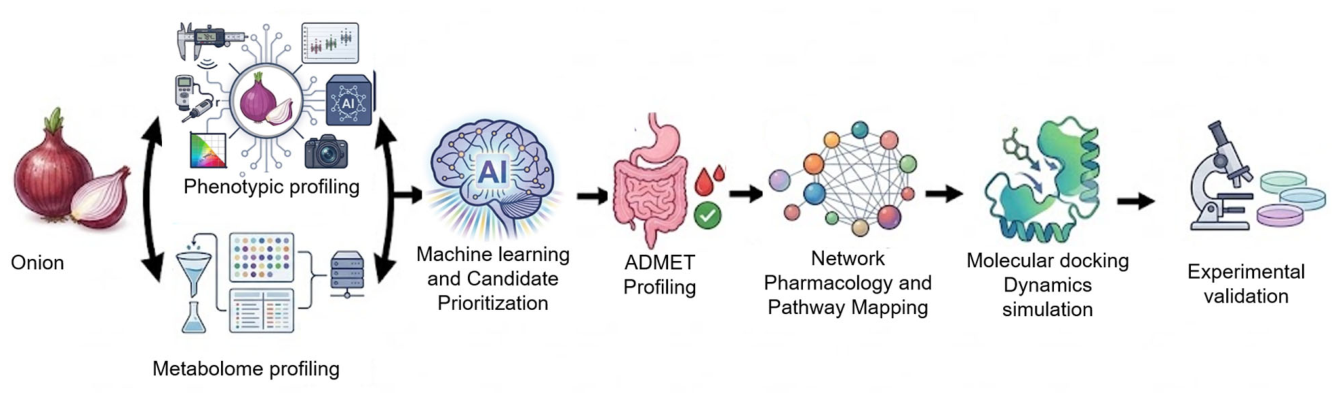
In AI-integrated antioxidant phytochemicals discovery, the workflow begins with diverse onion germplasm, where AI-based digital phenotyping employing computer vision, hyperspectral imaging, and machine learning has expanded rapid, non-destructive characterization of agronomic and biochemical traits [2,11]. AI-assisted metabolomics then accelerates metabolite annotation, feature extraction, and biomarker discovery by leveraging data generated from high-throughput analytical platforms, including LC–MS, GC–MS, UPLC–MS/MS, and NMR [70]. Future progress will depend heavily on the generation of high-quality, interoperable datasets that comply with the FAIR (Findable, Accessible, Interoperable, and Reusable) principles. Standardized digital phenotyping, metabolomics, transcriptomics, genomics, and phytochemical databases should incorporate comprehensive metadata, including plant species and cultivar or genotype, tissue and developmental stage, geographical and environmental conditions, experimental and sampling protocols, analytical platforms and instrument parameters, compound identities and standardized chemical identifiers, genomic and transcriptomic accession numbers, phenotypic trait definitions and measurement units, sample-processing and quality-control procedures, data provenance, and relevant software, database, and version information. For computational datasets, metadata should additionally document protein or target identifiers, structural database accession numbers, docking and molecular-dynamics software and parameter settings, ADMET prediction platforms, and analysis workflows. Such standardized metadata will facilitate robust machine-learning model development while improving data discoverability, reproducibility, interoperability, provenance tracking, and cross-platform data sharing [144,184]. Equally important is the development of explainable AI (XAI), which provides interpretable predictions by identifying the molecular descriptors, structural features, and biological pathways responsible for model decisions [123,178]. Unlike conventional “black-box” algorithms, XAI enhance scientific confidence, facilitate hypothesis generation, and support regulatory acceptance of AI-assisted antioxidant phytochemicals discovery [123,185]. Studies have established quantitative antioxidant activity endpoints for onion-derived extracts and individual phytochemicals. For example, quercetin-rich small onion skin extract exhibited DPPH and ABTS IC50 values of 62.27 and 53.65 µg/mL, respectively [49], while onion-derived spiraeoside demonstrated a DPPH IC50 value of 28.51 µg/mL [72,175,186]. Nevertheless, these experimentally determined values do not establish universal decision thresholds for AI-based prioritization of antioxidant or anti-inflammatory compounds. Although machine learning has been applied to predict onion anthocyanin content [187], validated onion-specific thresholds linking predicted phytochemical profiles to biological efficacy remain an important research gap.
In general, an integrated workflow should be considered to provide a comprehensive strategy for phytochemical discovery in onion by systematically combining AI-assisted digital phenotyping, metabolomics, structural biology, machine learning, molecular docking and dynamics, and systems pharmacology. The workflow should therefore culminate in rigorous experimental validation through appropriate biochemical, cellular, and, where applicable, in vivo assays to confirm antioxidant activity, molecular targets, mechanisms of action, and biological relevance. Such iterative integration of computational predictions with experimental evidence can enhance the reliability, efficiency, and translational potential of antioxidant phytochemical discovery, eventually facilitating the identification and development of functionally validated onion-derived compounds for nutraceutical and pharmaceutical applications (Figure 2).
Figure 2.
Integrated AI-enabled workflow for the discovery of antioxidant phytochemicals from Allium cepa L.
12. Conclusions
Onion (Allium cepa L.) represents a valuable reservoir of structurally diverse phytochemicals with considerable potential for antioxidant, nutraceutical, and pharmaceutical applications. However, the discovery and utilization of these compounds remain constrained by complex phytochemical diversity, environmental and genetic variation, limited bioavailability, and incomplete understanding of their molecular mechanisms. Recent advances in digital phenotyping, metabolomics, artificial intelligence (AI), machine learning, molecular docking, molecular dynamics simulations, ADMET prediction, and network pharmacology provide powerful opportunities to overcome these limitations. In particular, AI-assisted integration of phenotypic, chemical, structural, and pharmacological information can facilitate the rapid identification and prioritization of promising antioxidant candidates from vast onion germplasms. Computational approaches can further provide valuable mechanistic insights by predicting protein–ligand interactions, binding stability, pharmacokinetic properties, toxicity, and multi-target effects. Experimental validation should therefore remain the essential endpoint of the proposed integrated workflow, encompassing in vitro, in vivo, pharmacokinetic, and, where appropriate, clinical investigations.
Supplementary Materials
The following supporting information can be downloaded at https://www.mdpi.com/article/10.3390/antiox15111499/s1, Table S1: Database-specific search strategies and literature search parameters.
Author Contributions
Conceptualization, Writing—Original Draft and Editing, and Investigation, L.T. and S.-H.K.; Supervision, S.-H.K.; Draft Review and Editing, H.P.; Draft Review and Editing, S.C.; Draft Review and Editing, B.-K.H.; Funding Acquisition, S.-H.K. All authors have read and agreed to the published version of the manuscript.
Funding
This research was carried out with the support of the “Research Program for Agricultural Science and Technology Development (Project NO. PJ01745401)”, National Institute of Agricultural Sciences, Rural Development Administration (RDA), Republic of Korea, and by the 2026 RDA Fellowship Program of the National Institute of Agricultural Sciences, Rural Development Administration, Republic of Korea.
Institutional Review Board Statement
Not applicable.
Informed Consent Statement
Not applicable.
Data Availability Statement
No new data were created or analyzed in this study. Data sharing is not applicable to this article.
Acknowledgments
This work was supported by the Korea-Africa Food and Agriculture Cooperation Initiative (KAFACI), which provided financial assistance for the first author’s research training at National Agrobiodiversity Center, National Institute of Agricultural Sciences, RDA, Republic of Korea. The authors express their sincere gratitude to the National Agrobiodiversity Center, RDA, for providing office facilities and an excellent research environment for the first author during the course of this work. The authors also gratefully acknowledge the Ethiopian Institute of Agricultural Research (EIAR) for supporting the first author’s training at the host institution, the RDA, Republic of Korea. We also acknowledge the use of the PubChem database (https://pubchem.ncbi.nlm.nih.gov/ [accessed 20 September 2026]) for chemical structures for Figure 1, ChatGPT (OpenAI, GPT-6) free version for language editing, and Gemini Flash for generating certain icons for Figure 2.
Conflicts of Interest
The authors declare no conflicts of interest.
Abbreviations
| ABTS | 2,2′-Azino-bis(3-ethylbenzothiazoline-6-sulfonic acid) |
| AChE/BChE | Acetylcholinesterase/Butyrylcholinesterase |
| ACSO | S-alk(en)yl-L-cysteine sulfoxides |
| ADMET | Absorption, Distribution, Metabolism, Excretion, and Toxicity |
| AI | Artificial Intelligence |
| CADD | Computer-Aided Drug Design |
| CAT/GPx | Catalase/Glutathione Peroxidase |
| DPPH | 2,2-Diphenyl-1-picrylhydrazyl |
| ELISA | Enzyme-Linked Immunosorbent Assay |
| FRAP | Ferric-Reducing Antioxidant Power |
| GC–MS | Gas Chromatography–Mass Spectrometry |
| GNNs | Graph Neural Networks |
| GROMACS | GROningen MAchine for Chemical Simulations |
| HPLC-DAD-MS | High-Performance Liquid Chromatography–Diode-Array Detection–Mass Spectrometry |
| LC–MS/UPLC–MS | Liquid Chromatography–Mass Spectrometry/Ultra-Performance Liquid Chromatography–Mass Spectrometry |
| MAPK | Mitogen Activated Protein Kinases |
| MM/GBSA | Molecular Mechanics/Generalized Born Surface Area |
| MM/PBSA | Molecular Mechanics/Poisson–Boltzmann Surface Area |
| NAD(P)H | Nicotinamide Adenine Dinucleotide (Phosphate), Reduced Form |
| NMR | Nuclear Magnetic Resonance Spectroscopy |
| NOX activity | NADPH Oxidase Activity |
| ORAC | Oxygen Radical Absorbance Capacity |
| QSAR/ML | Quantitative Structure–Activity Relationship/Machine Learning |
| RMSF | Root Mean Square Fluctuation |
| RMSD | Root Mean Square Deviation |
| RNS | Reactive Nitrogen Species |
| ROS | Reactive Oxygen Species |
| SOD | Superoxide Dismutase |
| UPLC–MS/MS | Ultra-Performance Liquid Chromatography–Tandem Mass Spectrometry |
References
- Essa, M.M.; Bishir, M.; Bhat, A.; Chidambaram, S.B.; Al-Balushi, B.; Hamdan, H.; Govindarajan, N.; Freidland, R.P.; Qoronfleh, M.W. Functional foods and their impact on health. J. Food Sci. Technol. 2023, 60, 820–834. [Google Scholar] [CrossRef] [Scilit]
- Kim, S.H.; Iwar, K.; Han, J.; Choi, I.; Lee, J.; Ochar, K. Variability of bulb morpho-geometrical properties in onion (Allium cepa L.) germplasm collections, using digital imaging tools. PeerJ 2025, 13, e19583. [Google Scholar] [CrossRef] [Scilit]
- Elattar, M.M.; Darwish, R.S.; Hammoda, H.M.; Dawood, H.M. An ethnopharmacological, phytochemical, and pharmacological overview of onion (Allium cepa L.). J. Ethnopharmacol. 2024, 324, 117779. [Google Scholar] [CrossRef] [Scilit]
- Gupta, A.J.; Gorrepati, K.; Bibwe, B.; Kaldate, S.; Volaguthala, S.; Mahajan, V. Studies on biochemical and nutraceutical profiling of 43 Indian onion (Allium cepa L.) genotypes. J. Food Meas. Charact. 2025, 19, 6614–6624. [Google Scholar] [CrossRef] [Scilit]
- Gorrepati, K.; Krishna, R.; Singh, S.; Shirsat, D.V.; Soumia, P.S.; Mahajan, V. Harnessing the nutraceutical and therapeutic potential of Allium spp.: Current insights and future directions. Front. Nutr. 2024, 11, 1497953. [Google Scholar] [CrossRef] [Scilit]
- Lee, H.; Kim, J.; Kim, J.W.; Lee, Y. Recent advances in AI-based toxicity prediction for drug discovery. Front. Chem. 2025, 13, 1632046. [Google Scholar] [CrossRef] [Scilit]
- Ferreira, S.M.; Santos, L. Influence of Free and Microencapsulated Extracts from Onion Peels on the Performance of Fortified Fresh Cheese. Foods 2026, 15, 1048. [Google Scholar] [CrossRef] [Scilit]
- Mitra, R.; Ghosh, S.; Mukherjee, G.; Acharya Chowdhury, A. Secondary Metabolites: Treasure Trove for Future Medicine. In Plant Specialized Metabolites. Reference Series in Phytochemistry; Mérillon, J.M., Ramawat, K.G., Eds.; Springer: Cham, Switzerland, 2023; pp. 57–101. [Google Scholar] [CrossRef] [Scilit]
- Muscolo, A.; Maffia, A.; Marra, F.; Battaglia, S.; Oliva, M.; Mallamaci, C.; Russo, M. Unlocking the health secrets of Onions: Investigating the phytochemical power and beneficial properties of different varieties and their parts. Molecules 2025, 30, 1758. [Google Scholar] [CrossRef] [Scilit]
- Patil, V.M.; Gupta, S.P.; Masand, N.; Balasubramanian, K. Experimental and computational models to understand protein-ligand, metal-ligand and metal-DNA interactions pertinent to targeted cancer and other therapies. Eur. J. Med. Chem. Rep. 2024, 10, 100133. [Google Scholar] [CrossRef] [Scilit]
- He, C.; Mkunga, J.J.; Zhang, D.; Choudhary, M.I.; Zhai, W.; Xie, X.; Fei, L.; Shan, C.; Yang, X.; Cai, W. Characterization of antioxidant qualities and exploration of mechanisms in different colored onions: Insights from metabolomics and systems biology. Food Chem. X 2026, 36, 103955. [Google Scholar] [CrossRef] [Scilit]
- Imran, M.; Kang, H.; Kim, E.H.; Lee, S.G.; Park, H.M.; Choi, H.; Kim, S.H.; Lee, S.; Oh, S. Correction: Environmental and genetic effects on phytochemical and nutritional composition of onion (Allium cepa L.) varieties in South Korea. Front. Plant Sci. 2025, 16, 1690012. [Google Scholar] [CrossRef] [Scilit]
- Ochar, K.; Im, D.; Kim, S.H. Digital image-based morphometrics and mixed effects inference resolve environment sensitive and stable traits in onion (Allium cepa L.). Sci. Rep. 2026, 16, 9158. [Google Scholar] [CrossRef] [Scilit]
- Chakraborty, A.J.; Uddin, T.M.; Matin Zidan, B.M.R.; Mitra, S.; Das, R.; Nainu, F.; Dhama, K.; Roy, A.; Hossain, M.J.; Khusro, A.; et al. Allium cepa: A Treasure of Bioactive Phytochemicals with Prospective Health Benefits. Evid. Based Complement Altern. Med. 2022, 2022, 4586318. [Google Scholar] [CrossRef] [Scilit]
- Stoica, F.; Rațu, R.N.; Veleșcu, I.D.; Stanciuc, N.; Rapeanu, G. A comprehensive review on bioactive compounds, health benefits, and potential food applications of onion (Allium cepa L.) skin waste. Trends Food Sci. Technol. 2023, 141, 104173. [Google Scholar] [CrossRef] [Scilit]
- Vaidyanathan, R.; Sreedevi, S.M.; Ravichandran, K.; Vinod, S.M.; Krishnan, Y.H.; Babu, L.K.; Parthiban, P.S.; Basker, L.; Perumal, T.; Rajaraman, V.; et al. Molecular docking approach on the binding stability of derivatives of phenolic acids (DPAs) with Human Serum Albumin (HSA): Hydrogen-bonding versus hydrophobic interactions or combined influences? Jcis Open 2023, 12, 100096. [Google Scholar] [CrossRef] [Scilit]
- Jomova, K.; Alomar, S.Y.; Alwasel, S.H.; Nepovimova, E.; Kuca, K.; Valko, M. Several lines of antioxidant defense against oxidative stress: Antioxidant enzymes, nanomaterials with multiple enzyme-mimicking activities, and low-molecular-weight antioxidants. Arch. Toxicol. 2024, 98, 1323–1367. [Google Scholar] [CrossRef] [Scilit]
- Gorrepati, K.; Kumar, A.; Ahammed Shabeer, T.P.; Khan, Z.; Satpute, P.; Anandhan, S.; Arunachalam, T.; Yalamalle, V.R.; Mahajan, V.; Singh, M. Characterization and evaluation of antioxidant potential of onion peel extract of eight differentially pigmented short-day onion (Allium cepa L.) varieties. Front. Sustain. Food Syst. 2024, 8, 1469635. [Google Scholar] [CrossRef] [Scilit]
- Nile, A.; Nile, S.H.; Cespedes-Acuña, C.L.; Oh, J.W. Spiraeoside extracted from red onion skin ameliorates apoptosis and exerts potent antitumor, antioxidant and enzyme inhibitory effects. Food Chem. Toxicol. 2021, 154, 112327. [Google Scholar] [CrossRef] [Scilit]
- Matrella, M.L.; Valletti, A.; Marra, F.; Mallamaci, C.; Cocco, T.; Muscolo, A. Phytochemicals from red onion, grown with eco-sustainable fertilizers, protect mammalian cells from oxidative stress, increasing their viability. Molecules 2022, 27, 6365. [Google Scholar] [CrossRef] [Scilit]
- Galavi, A.; Hosseinzadeh, H.; Razavi, B.M. The effects of Allium cepa L. (onion) and its active constituents on metabolic syndrome: A review. Iran. J. Basic Med. Sci. 2021, 24, 3–16. [Google Scholar] [CrossRef] [Scilit]
- Fredotović, Z.; Puizina, J.; Nazlić, M.; Maravić, A.; Ljubenkov, I.; Soldo, B.; Vuko, E.; Bajić, D. Phytochemical characterization and screening of antioxidant, antimicrobial and antiproliferative properties of Allium × cornutum Clementi and two varieties of Allium cepa L. peel extracts. Plants 2021, 10, 832. [Google Scholar] [CrossRef] [Scilit]
- Khan, M.; Jays, J. Deep learning driven de novo smiles generation and in silico validation of potential therapeutics for hepatocellular carcinoma. Discov. Chem. 2026, 3, 62. [Google Scholar] [CrossRef] [Scilit]
- Kittelson, K.S.; Martins, A.C.F.; Santos, R.P.; Celante, G.; Gomes, R.D.S. Reproducibility, validation, and failure modes across classical and AI-assisted molecular docking. J. Comput Aided Mol. Des. 2026, 40, 137. [Google Scholar] [CrossRef] [Scilit]
- Lam, J.H.; Katritch, V. Navigating structure-based drug discovery with emerging innovations in physics- and knowledge-based approaches. npj Drug Discov. 2025, 2, 29. [Google Scholar] [CrossRef] [Scilit]
- Nag, S.; Baidya, A.T.K.; Mandal, A.; Mathew, A.T.; Das, B.; Devi, B.; Kumar, R. Deep learning tools for advancing drug discovery and development. 3 Biotech 2022, 12, 110. [Google Scholar] [CrossRef] [Scilit]
- Lee, B.T.; Lee, B.; Kwon, J.Y.; Weber, T.; Kim, H.U. AI and mechanistic modeling for characterizing biosynthetic pathways of natural products. Nat. Prod. Rep. 2026, 43, 787–802. [Google Scholar] [CrossRef] [Scilit]
- Welzel, C.; Ertaylan, G.; Babina, I.S.; Gilbert, S. Regulating complexity in AI-enabled omics and multi-omics technologies for precision medicine. npj Digit. Med. 2026, 9, 247. [Google Scholar] [CrossRef] [Scilit]
- Zhou, X.; Tao, W. Artificial intelligence in drug discovery from advanced molecular representation to pipeline applications. Front. Bioinform. 2026, 6, 1755843. [Google Scholar] [CrossRef] [Scilit]
- Kroll, A.; Rousset, Y. Recent advances and future trends for protein–small molecule interaction predictions with protein language models. Curr. Opin. Struct. Biol. 2025, 93, 103070. [Google Scholar] [CrossRef] [Scilit]
- Ghosh, S.; Basu, S.; Kayal, T.; Ashok, G.; Ramaiah, S.; Anbarasu, A. Computational advancements to facilitate therapeutic application of phytochemicals: Where do we stand? Discov. Appl. Sci. 2025, 7, 491. [Google Scholar] [CrossRef] [Scilit]
- Agu, P.C.; Afiukwa, C.A.; Orji, O.U.; Ezeh, E.M.; Ofoke, I.H.; Ogbu, C.O.; Ugwuja, E.I.; Aja, P.M. Molecular docking as a tool for the discovery of molecular targets of nutraceuticals in diseases management. Sci. Rep. 2023, 13, 13398. [Google Scholar] [CrossRef] [Scilit]
- Rennie, M.L.; Oliver, M.R. Emerging frontiers in protein structure prediction following the AlphaFold revolution. J. R. Soc. Interface 2025, 22, 20240886. [Google Scholar] [CrossRef] [Scilit]
- Ghosh, A.; Choudhury, S. Understanding different types of review articles: A primer for early career researchers. Indian J. Psychiatry 2025, 67, 535–541. [Google Scholar] [CrossRef] [Scilit]
- Sobhy, R.; Khalifa, I.; Rahaman, A.; Zeng, X.A.; Nawaz, A.; Walayat, N. Quercetin: The Biological Effects, Chemical Steadiness, Metabolism, and Delivery Systems. In Handbook of Dietary Flavonoids; Xiao, J., Ed.; Springer: Cham, Switzerland, 2023; pp. 1–33. [Google Scholar] [CrossRef] [Scilit]
- Aghababaei, F.; Hadidi, M. Recent Advances in Potential Health Benefits of Quercetin. Pharmaceuticals 2023, 16, 1020. [Google Scholar] [CrossRef] [Scilit]
- Kuljarusnont, S.; Iwakami, S.; Iwashina, T.; Tungmunnithum, D. Flavonoids and Other Phenolic Compounds for Physiological Roles, Plant Species Delimitation, and Medical Benefits: A Promising View. Molecules 2024, 29, 5351. [Google Scholar] [CrossRef] [Scilit]
- Zhao, X.X.; Lin, F.J.; Li, H.; Li, H.B.; Wu, D.T.; Geng, F.; Ma, W.; Wang, Y.; Miao, B.H.; Gan, R.Y. Recent Advances in Bioactive Compounds, Health Functions, and Safety Concerns of Onion (Allium cepa L.). Front. Nutr. 2021, 8, 669805. [Google Scholar] [CrossRef] [Scilit]
- Metrani, R.; Singh, J.; Acharya, P.; Jayaprakasha, G.K.; Patil, B.S. Comparative Metabolomics Profiling of Polyphenols, Nutrients and Antioxidant Activities of Two Red Onion (Allium cepa L.) Cultivars. Plants 2020, 9, 1077. [Google Scholar] [CrossRef] [Scilit]
- Kandemir, O.; Kucukler, S.; Ozdemir, S.; Dalkılıç, E.; Sag, S.; Caglayan, C.; Kandemir, F.M. Protective effects of quercetin against vincristine-induced nephrotoxicity via modulation of oxidative stress, inflammation, and apoptosis in rats. J. Biochem. Mol. Toxicol. 2025, 39, e70516. [Google Scholar] [CrossRef] [Scilit]
- Shen, L.; Luo, H.; Fan, L.; Tian, X.; Tang, A.; Wu, X.; Dong, K.; Su, Z. Potential Immunoregulatory Mechanism of Plant Saponins: A Review. Molecules 2024, 29, 113. [Google Scholar] [CrossRef] [Scilit]
- Trigueros, E.; Benito-Román, Ó.; Oliveira, A.P.; Videira, R.A.; Pinto, E.; Andrade, P.B.; Sanz, M.T.; Beltrán, S. Non-edible onion skin waste as a source of bioactive agents for functional foods development: Chemical composition and multifunctional bioactivity. Food Chem. X 2025, 29, 102794. [Google Scholar] [CrossRef] [Scilit]
- Tang, Y.; Lv, D.; Tao, Y. Onion (Allium cepa L.) Organosulfur Compounds: From Traditional Use to Modern Pharmacological Insights. Food Sci. Nutr. 2026, 14, e71519. [Google Scholar] [CrossRef] [Scilit]
- Sagar, N.A.; Pareek, S.; Benkeblia, N.; Xiao, J. Onion (Allium cepa L.) bioactives: Chemistry, pharmacotherapeutic functions, and industrial applications. Food Front. 2022, 3, 380–412. [Google Scholar] [CrossRef] [Scilit]
- Qin, L.; Ma, H.; Zhang, X.; Zhang, Z.; Wang, Y. Metabolomics and transcriptomics analyses provide insights into S-alk (en)yl cysteine sulfoxides (CSOs) accumulation in onion (Allium cepa). Sci. Hortic. 2023, 310, 111727. [Google Scholar] [CrossRef] [Scilit]
- Wang, L.; Han, W.; Iwasaki, Y.; Yermek, R.; Sharp, G.W.; Seino, Y.; Yada, T. Onion component, isoalliin, stimulates feeding and activates the arcuate nucleus neuropeptide Y, ghrelin and Ninjin’yoeito responsive neurons. Neuropeptides 2021, 89, 102180. [Google Scholar] [CrossRef] [Scilit]
- Singh, D.D.; Yadav, D.K.; Shin, D. Phytochemicals and REDOX modulation: Molecular mechanisms, clinical relevance, and therapeutic perspectives. Antioxidants 2026, 15, 272. [Google Scholar] [CrossRef] [Scilit]
- Mito, R.; Iriki, T.; Fujiwara, Y.; Pan, C.; Ikeda, T.; Nohara, T.; Suzuki, M.; Sakagami, T.; Komohara, Y. Onionin A inhibits small-cell lung cancer proliferation through suppressing STAT3 activation induced by macrophages-derived IL-6 and cell–cell interaction with tumor-associated macrophage. Hum. Cell 2023, 36, 1068–1080. [Google Scholar] [CrossRef] [Scilit]
- Cheng, K.; Xiao, J.; He, J.; Yang, R.; Pei, J.; Jin, W.; Abd El-Aty, A.M. Unraveling volatile metabolites in pigmented onion (Allium cepa L.) bulbs through HS-SPME/GC–MS-based metabolomics and machine learning. Front. Nutr. 2025, 12, 1582576. [Google Scholar] [CrossRef] [Scilit]
- Khoulali, C.; Pastor, J.M.; Galeano, J.; Vissenberg, K.; Miedes, E. Cell Wall–Based Machine Learning Models to Predict Plant Growth Using Onion Epidermis. Int. J. Mol. Sci. 2025, 26, 2946. [Google Scholar] [CrossRef] [Scilit]
- Elattar, M.M.; Hammoda, H.M.; Ghareeb, D.A.; Abdulmalek, S.A.; Abdelrahim, F.A.; Seif, I.A.K.; Dawood, H.M.; Darwish, R.S. Insights into bioactive constituents of onion (Allium cepa L.) waste: A comparative metabolomics study enhanced by chemometric tools. BMC Complement. Med. Ther. 2024, 24, 271. [Google Scholar] [CrossRef] [Scilit]
- Cho, H.; Kim, S.; Lee, S.H.; Park, Y. Effect of onion (Allium cepa L.) peel extract on natural killer cell and cytokines in a randomized, double-blind, placebo-controlled trial. Nutr. Res. Pract. 2024, 18, 33–45. [Google Scholar] [CrossRef] [Scilit]
- Fuentes, J.; Costa de Camargo, A.; Atala, E.; Gotteland, M.; Olea-Azar, C.; Speisky, H. Quercetin oxidation metabolite present in onion peel protects Caco-2 cells against the oxidative stress, NF-κB activation, and loss of epithelial barrier function induced by NSAIDs. J. Agric. Food Chem. 2021, 69, 2157–2167. [Google Scholar] [CrossRef] [Scilit]
- Balogun, O.; Brownmiller, C.R.; Lee, S.O.; Kang, H.W. Onion peel extract prevents intestinal inflammation via AMPK-activated protein kinase activation in Caco-2/HT-29 cells. Nutrients 2024, 16, 3609. [Google Scholar] [CrossRef] [Scilit]
- Sharaf El-Din, M.G.; Fahmy, H.A.; Ragab, N.A.; Khalifa, M.R.; Zahran, H.; Soliman, N.R.; Farag, M.A. Comprehensive metabolome classification of four onion (Allium cepa) cultivars via GC–MS and UPLC-MS: Insights into chemical diversity and remote antimicrobial activity against foodborne pathogens. Food Res. Int. 2025, 221, 117367. [Google Scholar] [CrossRef] [Scilit]
- Kumar, M.; Barbhai, M.D.; Hasan, M.; Dhumal, S.; Singh, S.; Pandiselvam, R.; Rais, N.; Natta, S.; Senapathy, M.; Sinha, N.; et al. Onion (Allium cepa L.) peel: A review on the extraction of bioactive compounds, its antioxidant potential, and its application as a functional food ingredient. J. Food Sci. 2022, 87, 4289–4311. [Google Scholar] [CrossRef] [Scilit]
- Fan, K.; Li, Y.; Fu, Q.; Wang, J.; Lin, Y.; Qiu, L.; Ran, L.; Yang, J.; Yang, C. Bio-assay-guided isolation of fractions and constituents with antioxidant and lipid-lowering activity from Allium cepa. Antioxidants 2023, 12, 1448. [Google Scholar] [CrossRef] [Scilit]
- Esakki, A.; Ramadoss, R.; Ananthapadmanabhan, L.; Sundar, S.; Panneerselvam, S.; Ramani, P. Quantification of the anti-diabetic effect of Allium cepa. Cureus 2024, 16, e59174. [Google Scholar] [CrossRef] [Scilit]
- Trigueros, E.; Benito-Román, Ó.; Oliveira, A.P.; Videira, R.A.; Andrade, P.B.; Sanz, M.T.; Beltrán, S. Onion (Allium cepa L.) Skin Waste Valorization: Unveiling the Phenolic Profile and Biological Potential for the Creation of Bioactive Agents through Subcritical Water Extraction. Antioxidants 2024, 13, 205. [Google Scholar] [CrossRef] [Scilit]
- Lee, H.J.; Lee, I.Y.; Park, J.H.; Joo, N. Comparison of phytochemicals and antioxidant activities of onion (Allium cepa L.) bulbs, onion leaves, and green onion (Allium fistulosum L.) leaves. Int. J. Food Prop. 2025, 28, 2507121. [Google Scholar] [CrossRef] [Scilit]
- Majumdar, G.; Mandal, S. Evaluation of broad-spectrum antibacterial efficacy of quercetin by molecular docking, molecular dynamics simulation and in vitro studies. Chem. Phys. Impact 2024, 8, 100501. [Google Scholar] [CrossRef] [Scilit]
- Hada, A.; Nozaki, C.; Tamura, N.; Matsui, K.; Matsuoka, Y.; Shibata, D.; Mano, J. S-Alk(en)yl-cysteine sulfoxides in Allium species are excellent acrolein scavengers: Implications for secondary antioxidants in plants. Biosci. Biotechnol. Biochem. 2026, 90, 195–205. [Google Scholar] [CrossRef] [Scilit]
- Drioiche, A.; Alsfouk, B.A.; Al Kamaly, O.; Bouqbis, L.; Elomri, A.; Zair, T. Allium cepa L. Peels: Phytochemical Characterization and Bioactive Potential in Infectious and Metabolic Contexts (In Vivo, In Vivo, and In Silico). Pharmaceutics 2026, 18, 476. [Google Scholar] [CrossRef] [Scilit]
- Zemnou, C.T.; Ngakam, R.; Tepap, S.S.D.; Simo, F.B.N.; Zanchi, F.B.; Seukep, A.J.; Kouam, A.F.; Huy, N.T. Integrating experimental biology, computational methods, and artificial Intelligence in anticancer drug discovery: Bridging the translational Gap. Comput. Biol. Med. 2026, 213, 111832, Correction in Comput. Biol. Med. 2026, 213, 111845. https://doi.org/10.1016/j.compbiomed.2026.111832. [Google Scholar] [CrossRef] [Scilit]
- Elattar, M.M.; Hammoda, H.M.; Ghareeb, D.A.; El-Hosseny, M.F.; Seadawy, M.G.; Çelik, İ.; Darwish, R.S.; Dawood, H.M. An integrated strategy combining UPLC-MS/MS, chemometrics, molecular docking, and molecular dynamics simulation for metabolic profiling of onion (Allium cepa L.) cultivars and unravelling potential anti-COVID-19 metabolites. S. Afr. J. Bot. 2023, 162, 885–900. [Google Scholar] [CrossRef] [Scilit]
- Micheal, I.O. Integrated in silico discovery of novel angiotensin-converting enzyme inhibitors from Allium cepa phytoconstituents: Molecular docking, ADMET profiling, molecular dynamics, and MMGBSA studies. In Silico Res. Biomed. 2026, 2, 100505. [Google Scholar] [CrossRef] [Scilit]
- Fahim, A.M. Advances in computer-aided drug design: From molecular docking to artificial intelligence-driven therapeutic discovery. ASPET Discov. 2026, 2, 100024. [Google Scholar] [CrossRef] [Scilit]
- Peng, C.; Ni, W.; Liu, Q.; Hu, G.; Zheng, W. A comprehensive benchmarking of the AlphaFold3 for predicting biomacromolecules and their interactions. Brief. Bioinform. 2025, 26, bbaf616. [Google Scholar] [CrossRef] [Scilit]
- Abramson, J.; Adler, J.; Dunger, J.; Evans, R.; Green, T.; Pritzel, A.; Ronneberger, O.; Willmore, L.; Ballard, A.J.; Bambrick, J.; et al. Accurate structure prediction of biomolecular interactions with AlphaFold 3. Nature 2024, 630, 493–500. [Google Scholar] [CrossRef] [Scilit]
- Lai, Y.; Koelmel, J.P.; Walker, D.I.; Price, E.J.; Papazian, S.; Manz, K.E.; Castilla-Fernández, D.; Bowden, J.A.; Nikiforov, V.; David, A.; et al. High-resolution mass spectrometry for human exposomics: Expanding chemical space coverage. Environ. Sci. Technol. 2024, 58, 12784–12822. [Google Scholar] [CrossRef] [Scilit]
- Aquino, G.; Sommella, E.M.; Salviati, E.; Manfra, M.; Auriemma, G.; Campiglia, P.; Pepe, G.; Basilicata, M.G. Advancing profiling of secondary antioxidant metabolites in Allium cepa PDO leaf extract: Online comprehensive two-dimensional liquid chromatography with high-resolution mass spectrometry and pre-column DPPH assay. J. Chromatogr. A 2025, 1749, 465877. [Google Scholar] [CrossRef] [Scilit]
- Rumpf, J.; Burger, R.; Schulze, M. Statistical evaluation of DPPH, ABTS, FRAP, and Folin–Ciocalteu assays to assess the antioxidant capacity of lignins. Int. J. Biol. Macromol. 2023, 233, 123470. [Google Scholar] [CrossRef] [Scilit]
- Fu, L.; Shi, S.; Yi, J.; Wang, N.; He, Y.; Wu, Z.; Peng, J.; Deng, Y.; Wang, W.; Wu, C.; et al. ADMETlab 3.0: An updated comprehensive online ADMET prediction platform enhanced with broader coverage, improved performance, API functionality and decision support. Nucleic Acids Res. 2024, 52, W422–W431. [Google Scholar] [CrossRef] [Scilit]
- Omoboyede, V.; Onile, O.S.; Oyeyemi, B.F.; Aruleba, R.T.; Fadahunsi, A.I.; Oke, G.A.; Onile, T.A.; Ibrahim, O.; Adekiya, T.A. Unravelling the anti-inflammatory mechanism of Allium cepa: An integration of network pharmacology and molecular docking approaches. Mol. Divers. 2024, 28, 727–747. [Google Scholar] [CrossRef] [Scilit]
- Liu, T.T.; Zeng, K.W. Recent advances in target identification technology of natural products. Pharmacol. Ther. 2025, 269, 108833. [Google Scholar] [CrossRef] [Scilit]
- Bastin, A.; Teimouri, M.; Faramarz, S.; Shabani, M.; Doustimotlagh, A.H.; Sadeghi, A. In vitro and molecular docking analysis of quercetin as an anti-inflammatory and antioxidant. Curr. Pharm. Des. 2023, 29, 883–891. [Google Scholar] [CrossRef] [Scilit]
- Mishra, D.; Maurya, R.R.; Kumar, K.; Munjal, N.S. Structurally modified compounds of hydroxychloroquine, remdesivir and tetrahydrocannabinol against main protease of SARS-CoV-2, a possible hope for COVID-19: Docking and molecular dynamics simulation studies. J. Mol. Liq. 2021, 335, 116185. [Google Scholar] [CrossRef] [Scilit]
- Bakchi, B.; Krishna, A.D.; Sreecharan, E.; Ganesh, V.B.J.; Niharika, M.; Maharshi, S.; Puttagunta, S.B.; Sigalapalli, D.K.; Bhandare, R.R.; Shaik, A.B. An overview on applications of SwissADME web tool in the design and development of anticancer, antitubercular and antimicrobial agents: A medicinal chemist’s perspective. J. Mol. Struct. 2022, 1259, 132712. [Google Scholar] [CrossRef] [Scilit]
- Chang, W.L.; Liu, P.Y.; Yeh, S.L.; Lee, H.J. Effects of Dried Onion Powder and Quercetin on Obesity-Associated Hepatic Menifestation and Retinopathy. Int. J. Mol. Sci. 2022, 23, 11091. [Google Scholar] [CrossRef] [Scilit]
- Zhang, J.; Li, H.; Zhang, Y.; Huan, J.; Ren, L.; Zhang, C.; Zou, Q.; Zhang, Y. Computational toxicology in drug discovery: Applications of artificial intelligence in ADMET and toxicity prediction. Brief. Bioinform. 2025, 26, bbaf708. [Google Scholar] [CrossRef] [Scilit]
- Chen, X.; Xiong, Z.; Xie, Y.; Ruan, K.; Huang, G.; Mao, J. Crosstalk between ion homeostasis and lipid peroxidation: Mechanisms and translational opportunities in regulated cell death. Pharmacol. Res. 2026, 230, 108308. [Google Scholar] [CrossRef] [Scilit]
- Guo, B.; Chou, F.; Huang, L.; Yin, F.; Fang, J.; Wang, J.-B.; Jia, Z. Recent insights into oxidative metabolism of quercetin: Catabolic profiles, degradation pathways, catalyzing metalloenzymes and molecular mechanisms. Crit. Rev. Food Sci. Nutr. 2024, 64, 1312–1339. [Google Scholar] [CrossRef] [Scilit]
- Zhu, B.; Li, Z.; Jin, Z.; Zhong, Y.; Lv, T.; Ge, Z.; Li, H.; Wang, T.; Lin, Y.; Liu, H.; et al. Knowledge-based in silico fragmentation and annotation of mass spectra for natural products with MassKG. Comput. Struct. Biotechnol. J. 2024, 23, 3327–3341. [Google Scholar] [CrossRef] [Scilit]
- Li, S.; Du, H.; Zhang, X.; Zhang, H.; Hou, T.; Pan, P. Computational and AI-driven ecosystem for structure-based covalent drug discovery. Acc. Chem. Res. 2026, 59, 969–978. [Google Scholar] [CrossRef] [Scilit]
- Hosseinpour Mashkani, S.M.; Bishop, D.P.; Westerhausen, M.T.; Adlard, P.A.; Golzan, S.M. Alterations in zinc, copper, and iron levels in the retina and brain of Alzheimer’s disease patients and the APP/PS1 mouse model. Metallomics 2024, 16, mfae053. [Google Scholar] [CrossRef] [Scilit]
- Lamačová, L.J.; Trnka, J. Chelating mitochondrial iron and copper: Recipes, pitfalls and promise. Mitochondrion 2024, 78, 101903. [Google Scholar] [CrossRef] [Scilit]
- Igarashi, K.; Shoji, Y.; Sekine-Suzuki, E.; Ueno, M.; Matsumoto, K.-I.; Nakanishi, I.; Fukui, K. Importance of Locations of Iron Ions to Elicit Cytotoxicity Induced by a Fenton-Type Reaction. Cancers 2022, 14, 3642. [Google Scholar] [CrossRef] [Scilit]
- Walencik, P.K.; Choińska, R.; Gołębiewska, E.; Kalinowska, M. Metal–Flavonoid Interactions—From Simple Complexes to Advanced Systems. Molecules 2024, 29, 2573. [Google Scholar] [CrossRef] [Scilit]
- Guo, W.; Wu, C.; Li, G.; Wang, Y.; He, S.; Huang, J.; Gao, X.; Yue, X. Mechanism insight into the high-efficiency catalytic killing of E. coli by metal–phenolic network as a nanozyme. RSC Adv. 2024, 14, 15106–15111. [Google Scholar] [CrossRef] [Scilit]
- Aranda-Rivera, A.K.; Cruz-Gregorio, A.; Amador-Martínez, I.; Medina-Campos, O.N.; Garcia-Garcia, M.; Bernabe-Yepes, B.; León-Contreras, J.C.; Hernández-Pando, R.; Aparicio-Trejo, O.E.; Sánchez-Lozada, L.G.; et al. Sulforaphane protects from kidney damage during the release of unilateral ureteral obstruction (RUUO) by activating nuclear factor erythroid 2-related factor 2 (Nrf2): Role of antioxidant, anti-inflammatory, and antiapoptotic mechanisms. Free Radic. Biol. Med. 2024, 212, 49–64. [Google Scholar] [CrossRef] [Scilit]
- Cheng, M.; Yuan, C.; Ju, Y.; Liu, Y.; Shi, B.; Yang, Y.; Jin, S.; He, X.; Zhang, L.; Min, D. Quercetin attenuates oxidative stress and apoptosis in brain tissue of APP/PS1 double transgenic AD mice by regulating Keap1/Nrf2/HO-1 pathway to improve cognitive impairment. Behav. Neurol. 2024, 2024, 5698119. [Google Scholar] [CrossRef] [Scilit]
- Ramos-González, E.J.; Bitzer-Quintero, O.K.; Ortiz, G.G.; Hernández-Cruz, J.J.; Ramírez-Jirano, L.J. Relationship between inflammation and oxidative stress and its effect on multiple sclerosis. Neurología 2024, 39, 292–301. [Google Scholar] [CrossRef] [Scilit]
- Zhang, L.; Xu, L.Y.; Tang, F.; Liu, D.; Zhao, X.L.; Zhang, J.N.; Xia, J.; Wu, J.J.; Yang, Y.; Peng, C.; et al. New perspectives on the therapeutic potential of quercetin in non-communicable diseases: Targeting Nrf2 to counteract oxidative stress and inflammation. J. Pharm. Anal. 2024, 14, 100930. [Google Scholar] [CrossRef] [Scilit]
- Kalefetoglu Macar, T.; Macar, O.; Kınalıoglu, K.; Yalcın, E.; Cavusoglu, K. Modulation of aluminum-induced genotoxicity and oxidative stress in Allium cepa L. by Ramalina pollinaria (Westr.) Ach. extract. Sci. Rep. 2025, 15, 38254. [Google Scholar] [CrossRef] [Scilit]
- Jiménez, R.; Zúñiga-Muñoz, A.; Álvarez-León, E.; García-Niño, W.R.; Navarrete-Anastasio, G.; Soria-Castro, E.; Pérez-Torres, I.; Lira-Silva, E.; Pavón, N.; Cruz-Gregorio, A.; et al. Quercetin preserves mitochondria-endoplasmic reticulum contact sites improving mitochondrial dynamics in aged myocardial cells. Biogerontology 2025, 26, 29. [Google Scholar] [CrossRef] [Scilit]
- Li, F.; Li, D.; Yan, X.; Zhu, F.; Tang, S.; Liu, J.; Yan, J.; Chen, H. Quercetin promotes the repair of mitochondrial function in H9c2 cells through the miR-92a-3p/Mfn1 axis. Curr. Pharm. Biotechnol. 2024, 25, 1858–1866. [Google Scholar] [CrossRef] [Scilit]
- Paravati, M.R.; Procopio, A.C.; Milanović, M.; Scarlata, G.G.M.; Milosevic, N.; Ruzic, M.; Milic, N.; Abenavoli, L. Onion Polyphenols as Multi-Target-Directed Ligands in MASLD: A Preliminary Molecular Docking Study. Nutrients 2024, 16, 1226. [Google Scholar] [CrossRef] [Scilit]
- Kim, J.S.; Lee, E.B.; Choi, J.H.; Jung, J.; Jeong, U.Y.; Bae, U.J.; Jang, H.H.; Park, S.Y.; Cha, Y.S.; Lee, S.H. Antioxidant and Immune Stimulating Effects of Allium cepa Skin in the RAW264.7 Cells and in the C57BL/6 MouseImmunosuppressed by Cyclophosphamide. Antioxidants 2023, 12, 892. [Google Scholar] [CrossRef] [Scilit]
- Ren, F.; Zhou, S. Phenolic Components and Health Beneficial Properties of Onions. Agriculture 2021, 11, 872. [Google Scholar] [CrossRef] [Scilit]
- Lee, H.S.; Kwon, Y.J.; Seo, E.B.; Kim, S.K.; Lee, H.; Lee, J.T.; Chang, P.S.; Choi, Y.J.; Lee, S.-H.; Ye, S.-K. Anti-inflammatory effects of Allium cepa L. peel extracts via inhibition of JAK-STAT pathway in LPS-stimulated RAW264. 7 cells. J. Ethnopharmacol. 2023, 317, 116851. [Google Scholar] [CrossRef] [Scilit]
- Uttarawichien, T.; Khumsri, W.; Suwannalert, P.; Sibmooh, N.; Payuhakrit, W. Onion Peel Extract Inhibits Cancer Cell Growth and Progression through the Roles of L1CAM, NF-κB, and Angiogenesis in HT-29 Colorectal Cancer Cells. Prev. Nutr. Food Sci. 2021, 26, 330–337. [Google Scholar] [CrossRef] [Scilit]
- Sherif, A.E.; Sajid-ur-Rehman, M.; Asif, M.; Qadeer, I.; Khan, K.R. Anti-inflammatory, analgesic, and antipyretic potential of Oxystelma esculentum (L. f.) Sm. using in vitro, in vivo, and in silico studies. Front. Pharmacol. 2024, 14, 1326968. [Google Scholar] [CrossRef] [Scilit]
- Noreng, S.; Ota, N.; Sun, Y.; Ho, H.; Johnson, M.; Arthur, C.P.; Schneider, K.; Lehoux, I.; Davies, C.W.; Mortara, K.; et al. Structure of the core human NADPH oxidase NOX2. Nat. Commun. 2022, 13, 6079. [Google Scholar] [CrossRef] [Scilit]
- Jiang, J.; Yang, Y.; Wang, F.; Mao, W.; Wang, Z.; Liu, Z. Quercetin inhibits breast cancer cell proliferation and survival by targeting Akt/mTOR/PTEN signaling pathway. Chem. Biol. Drug Des. 2024, 103, e14557. [Google Scholar] [CrossRef] [Scilit]
- Zhang, J.; Guo, J.; Qian, Y.; Yu, L.; Ma, J.; Gu, B.; Tang, W.; Li, Y.; Li, H.; Wu, W. Quercetin induces apoptosis through downregulating P4HA2 and inhibiting the PI3K/Akt/mTOR axis in hepatocellular carcinoma cells: An in vitro study. Cancer Rep. 2025, 8, e70220. [Google Scholar] [CrossRef] [Scilit]
- Otify, A.M.; Hegazi, N.M.; Baky, M.H.; Wessjohann, L.A.; Nicolescu, A.; Mocan, A.; Farag, M.A. Comprehensive metabolome profiling highlights the biochemical basis of antioxidant capacity in 7 edible and inedible Allium species. RSC Adv. 2026, 6, 46734–46751. [Google Scholar] [CrossRef] [Scilit]
- Gupta, A.J.; Aribenchi, K.V.; Benke, A.; Kaldate, S.; Hulagannavar, P.; Kale, R.; Mahajan, V. Stability and adaptability assessment of red onion genotypes using AMMI, GGE, BLUP, and multivariate indices. Front. Plant Sci. 2025, 16, 1694946. [Google Scholar] [CrossRef] [Scilit]
- Gupta, A.J.; Khade, Y.P.; Benke, A.P.; Mainkar, P.; Gedam, P.A.; Mahajan, V.; Singh, M. Assessing onion genotypes stability and potential in diverse Indian environments. Cogent Food Agric. 2024, 10, 2360606. [Google Scholar] [CrossRef] [Scilit]
- Gupta, A.J.; Khar, A.; Aribenchi, K.V.; Kaldate, S.; Bhandari, H.R.; Gedam, P.A.; Khade, Y.P.; Kale, R.B.; Mahajan, V. Assessment of stability and yield performance of onion (Allium cepa L.) genotypes across diverse Indian environments. Sci. Rep. 2026, 16, 548. [Google Scholar] [CrossRef] [Scilit]
- Murphy, K.M.; Ludwig, E.; Gutierrez, J.; Gehan, M.A. Deep learning in image-based plant phenotyping. Annu. Rev. Plant Biol. 2024, 75, 771–795. [Google Scholar] [CrossRef] [Scilit]
- Hall, R.D.; D’Auria, J.C.; Silva Ferreira, A.C.; Gibon, Y.; Kruszka, D.; Mishra, P.; van de Zedde, R. High-throughput plant phenotyping: A role for metabolomics? Trends Plant Sci. 2022, 27, 549–563. [Google Scholar] [CrossRef] [Scilit]
- Su, Y.; Long, J.; Chen, J.; Zhou, R.; Liu, Z.; Deng, H.; Yuan, Y. Non-destructive yield estimation of onion and garlic using UAV-based hyperspectral imaging and hybrid machine learning models. BMC Plant Biol. 2026, 26, 1068. [Google Scholar] [CrossRef] [Scilit]
- Choi, J.; Cho, S.; Choi, S.; Jung, M.; Lim, Y.J.; Lee, E.; Lim, J.; Park, H.Y.; Shin, Y. Genotype-Driven Phenotype Prediction in Onion Breeding: Machine Learning Models for Enhanced Bulb Weight Selection. Agriculture 2024, 14, 2239. [Google Scholar] [CrossRef] [Scilit]
- Aggarwal, N.; Rathore, M.; Jan, F.; Sharma, D.; Kumar, S.; Thudi, M.; Jighly, A.; Varshney, R.K.; Mir, R.R. Harnessing artificial intelligence in plant breeding: Innovations in digital phenotyping and breeding methodologies. Theor. Appl. Genet 2026, 139, 188. [Google Scholar] [CrossRef] [Scilit]
- Danilevicz, M.F.; Bayer, P.E.; Nestor, B.J.; Bennamoun, M.; Edwards, D. Resources for image-based high-throughput phenotyping in crops and data sharing challenges. Plant Physiol. 2021, 187, 699–715. [Google Scholar] [CrossRef] [Scilit]
- Vaz, J.M.; Balaji, S. Convolutional neural networks (CNNs): Concepts and applications in pharmacogenomics. Mol. Divers. 2021, 25, 1569–1584. [Google Scholar] [CrossRef] [Scilit]
- Nesar, S.B.; Nugent, P.W.; Zidack, N.K.; Whitaker, B.M. Unmanned Aerial Vehicle-Based Hyperspectral Imaging for Potato Virus Y Detection: Machine Learning Insights. Remote Sens. 2025, 17, 1735. [Google Scholar] [CrossRef] [Scilit]
- Wayal, S.M.; Parab, S.; Raj, A.; Khandagale, K.; Bhegde, S.; Dawale, M.; Bhangare, I.; Khaire, M.; Kadam, Y.; Shaikh, Z.; et al. UAV multispectral sensing and data-driven modeling for precision onion yield prediction. Front. Plant Sci. 2026, 16, 1696730. [Google Scholar] [CrossRef] [Scilit]
- Thingujam, D.; Gouli, S.; Cooray, S.P.; Chandran, K.B.; Givens, S.B.; Gandhimeyyan, R.V.; Tan, Z.; Wang, Y.; Patam, K.; Greer, S.A.; et al. Climate-Resilient Crops: Integrating AI, Multi-Omics, and Advanced Phenotyping to Address Global Agricultural and Societal Challenges. Plants 2025, 14, 2699. [Google Scholar] [CrossRef] [Scilit]
- Zhang, S.; Chen, S.; Fu, Z.; Li, F.; Chen, Q.; Ma, J.; Chen, Y.; Chen, L.; Chen, J. Integration of digital phenotyping, GWAS, and transcriptomic analysis revealed a key gene for bud size in tea plant (Camellia sinensis). Hortic. Res. 2025, 12, uhaf051. [Google Scholar] [CrossRef] [Scilit]
- Jang, H.; Choi, M.; Choi, S.H.; Bong, Y.S.; Jang, K.S. Geographical differentiation of onions (Allium cepa) cultivated in South Korea revealed by untargeted metabolomics and chemometric analysis. Food Chem. 2025, 495, 146568. [Google Scholar] [CrossRef] [Scilit]
- Zhou, J.; Cui, G.; Hu, S.; Zhang, Z.; Yang, C.; Liu, Z.; Wang, L.; Li, C.; Sun, M. Graph neural networks: A review of methods and applications. AI Open 2020, 1, 57–81. [Google Scholar] [CrossRef] [Scilit]
- Agrawal, R.; Gupta, T.; Gupta, S.; Chauhan, S.; Patel, P.; Hamdare, S. Fostering trust and interpretability: Integrating explainable AI (XAI) with machine learning for enhanced disease prediction and decision transparency. Diagn. Pathol. 2025, 20, 105. [Google Scholar] [CrossRef] [Scilit]
- Shanmugam, Y.; Ravikumar, L. Multi-omics biomarkers as emerging determinants in precision disease diagnosis and therapeutic monitoring. Adv. Biomark. Sci. Technol. 2026, 8, 464–478. [Google Scholar] [CrossRef] [Scilit]
- Fujito, S.; Akyol, T.Y.; Mukae, T.; Wako, T.; Yamashita, K.-I.; Tsukazaki, H.; Hirakawa, H.; Tanaka, K.; Mine, Y.; Sato, S.; et al. Construction of a high-density linkage map and graphical representation of the arrangement of transcriptome-based unigene markers on the chromosomes of onion, Allium cepa L. BMC Genom. 2021, 22, 481. [Google Scholar] [CrossRef] [Scilit]
- Beye, N.F.; Vodounnou, F.N.S.; Kane, A.; Tiréra, H.; Diop, R.; Ndao, S.; Sow, A.; Dème, E.H.; Sylla, P.M.D.D.; Ayessou, N.C.; et al. Effect of cultivation practices on the quality of onion bulbs (Allium cepa L.) produced at two sites in northern Senegal: Evaluation of morphological and physicochemical parameters. J. Agric. Food Res. 2024, 15, 101022. [Google Scholar] [CrossRef] [Scilit]
- Wang, B.; Liu, Q.; Zhao, W.; Zhang, T.; Zhang, D.; Sutcharitchan, C.; Li, S. Revolutionizing drug discovery from natural products: The roles of artificial intelligence and multi-omics in accelerating innovation. Acta Pharm. Sin. B 2026, 16, 4103–4127. [Google Scholar] [CrossRef] [Scilit]
- Reinhardt, J.K.; Craft, D.; Weng, J.-K. Toward an integrated omics approach for plant biosynthetic pathway discovery in the age of AI. Trends Biochem. Sci. 2025, 50, 311–321. [Google Scholar] [CrossRef] [Scilit]
- Kundu, B.K.; Tanti, B. Decoding plant physiology through systems biology: Integrative multi-omics and computational perspectives for next-generation crop design. Plant Commun. 2026, 7, 101668. [Google Scholar] [CrossRef] [Scilit]
- Meng, F.; Zhang, G.; Xiao, W.; Mao, Y.; Shu, Y.; Yang, X.; Xu, G.; Tang, X.; Zhang, M.; Liu, Z.; et al. MedMeta: An AI-enabled and genomics-based database for functional profiling of secondary metabolites in medicinal species. Engineering 2025. [Google Scholar] [CrossRef] [Scilit]
- Kim, S.; Kim, D.; Ko, J.; Zan, X.; Wong, K.L.; Mao, Y.; Kaur, L.; Nam, H.; Lee, J.W. Transforming cutting-edge healthcare: Emerging trends in metabolomics and drug design using artificial intelligence and big data methodologies. Digit. Health 2026, 12, 20552076261458965. [Google Scholar] [CrossRef] [Scilit]
- Frokaer, E.E.; Hansen, M. Large-scale generation of in silico-based spectral libraries to annotate dark chemical space features in non-target analysis. Anal. Bioanal. Chem. 2025, 417, 6107–6119. [Google Scholar] [CrossRef] [Scilit]
- Brittin, N.J.; Anderson, J.M.; Braun, D.R.; Rajski, S.R.; Currie, C.R.; Bugni, T.S. Machine learning-based bioactivity classification of natural products using LC-MS/MS metabolomics. J. Nat. Prod. 2025, 88, 361–372. [Google Scholar] [CrossRef] [Scilit]
- Wang, W.; Li, A.; He, F.; Dai, J.; He, L.; Zou, D. Activity-annotated molecular networking accelerates active molecule screening from natural products. J. Chromatogr. A 2025, 1757, 466170. [Google Scholar] [CrossRef] [Scilit]
- Muthuraj, R.; Chandrasekaran, J. Nature meets machine: The AI renaissance in natural product drug discovery. Nat. Prod. Bioprospecting 2026, 16, 37. [Google Scholar] [CrossRef] [Scilit]
- Alanazi, S. Recent advances in liquid chromatography-mass spectrometry (LC-MS) applications in biological and applied sciences. Anal. Sci. Adv. 2025, 6, e70024. [Google Scholar] [CrossRef] [Scilit]
- Hasan, M.N.; Sharma, S.; Mallen, J.J.; Saha, A. MnM-W-MMGBSA: A computational strategy to improve relative binding free energies of protein–protein interaction systems. J. Phys. Chem. B 2025, 129, 12685–12701. [Google Scholar] [CrossRef] [Scilit]
- Zhu, H.; Terashi, G.; Farheen, F.; Nakamura, T.; Kihara, D. AI-based quality assessment methods for protein structure models from cryo-EM. Curr. Res. Struct. Biol. 2025, 9, 100164. [Google Scholar] [CrossRef] [Scilit]
- Amorim, A.M.B.; Piochi, L.F.; Gaspar, A.T.; Preto, A.J.; Rosário-Ferreira, N.; Moreira, I.S. Advancing drug safety in drug development: Bridging computational predictions for enhanced toxicity prediction. Chem. Res. Toxicol. 2024, 37, 827–849. [Google Scholar] [CrossRef] [Scilit]
- Chakraborti, S.; Chakraborty, M.; Bose, A.; Srinivasan, N.; Visweswariah, S.S. Identification of potential binders of Mtb universal stress protein (Rv1636) through an in silico approach and insights into compound selection for experimental validation. Front. Mol. Biosci. 2021, 8, 599221. [Google Scholar] [CrossRef] [Scilit]
- Seffernick, J.T.; Lindert, S. Hybrid methods for combined experimental and computational determination of protein structure. J. Chem. Phys. 2020, 153, 240901. [Google Scholar] [CrossRef] [Scilit]
- Stokes, J.M.; Yang, K.; Swanson, K.; Jin, W.; Cubillos-Ruiz, A.; Donghia, N.M.; MacNair, C.R.; French, S.; Carfrae, L.A.; Bloom-Ackermann, Z.; et al. A deep learning approach to antibiotic discovery. Cell 2020, 180, 688–702.e1-e13. [Google Scholar] [CrossRef] [Scilit]
- Ramirez-Velasquez, I.; Bedoya-Calle, A.H.; Velez, E.; Caro-Lopera, F.J. Shape theory applied to molecular docking and automatic localization of ligand binding pockets in large proteins. ACS Omega 2022, 7, 45991–46002. [Google Scholar] [CrossRef] [Scilit]
- Zare, F.; Ataollahi, E.; Mardaneh, P.; Sakhteman, A.; Keshavarz, V.; Solhjoo, A.; Emami, L. A combination of virtual screening, molecular dynamics simulation, MM/PBSA, ADMET, and DFT calculations to identify a potential DPP4 inhibitor. Sci. Rep. 2024, 14, 7749. [Google Scholar] [CrossRef] [Scilit]
- Baek, M.; DiMaio, F.; Anishchenko, I.; Dauparas, J.; Ovchinnikov, S.; Lee, G.R.; Wang, J.; Cong, Q.; Kinch, L.N.; Schaeffer, R.D.; et al. Accurate prediction of protein structures and interactions using a three-track neural network. Science 2021, 373, 871–876. [Google Scholar] [CrossRef] [Scilit]
- Borkakoti, N.; Thornton, J.M. AlphaFold2 protein structure prediction: Implications for drug discovery. Curr. Opin. Struct. Biol. 2023, 78, 102526. [Google Scholar] [CrossRef] [Scilit]
- Deepasree, D.; Venugopal, S. Molecular docking and molecular dynamic simulation studies to identify potential terpenes against Internalin A protein of Listeria monocytogenes. Front. Bioinform. 2024, 4, 1463750. [Google Scholar] [CrossRef] [Scilit]
- Curion, F.; Theis, F.J. Machine learning integrative approaches to advance computational immunology. Genome Med. 2024, 16, 80. [Google Scholar] [CrossRef] [Scilit]
- Akdel, M.; Pires, D.E.V.; Porta Pardo, E.; Jänes, J.; Zalevsky, A.O.; Mészáros, B.; Bryant, P.; Good, L.L.; Laskowski, R.A.; Pozzati, G.; et al. A structural biology community assessment of AlphaFold 2 applications. Nat. Struct. Mol. Biol. 2022, 29, 1056–1067. [Google Scholar] [CrossRef] [Scilit]
- Krishna, R.; Wang, J.; Ahern, W.; Sturmfels, P.; Venkatesh, P.; Kalvet, I.; Lee, G.R.; Morey-Burrows, F.S.; Anishchenko, I.; Humphreys, I.R.; et al. Generalized biomolecular modeling and design with RoseTTAFold All-Atom. Science 2024, 384, eadl2528. [Google Scholar] [CrossRef] [Scilit]
- Younas, M.; Zubair, M.; Yousaf Shani, M.; Ahmad, S.; Arshad, I.; Jarecki, W.; Azmat, M.; Farid, G.; Yasin Ashraf, M.; Zhu, L. Molecular Docking of Phytochemicals Involved in Apoptotic Pathway and Their Interactions with CASP3, CASP9, and BAX in HepG2 Cell Line. Plants 2026, 15, 1822. [Google Scholar] [CrossRef] [Scilit]
- Jiang, J.; Li, D.; Wang, G.; Wei, G.W. Recent advances in machine learning predictions of protein-ligand binding affinities. Curr. Opin. Struct. Biol. 2026, 96, 103193. [Google Scholar] [CrossRef] [Scilit]
- Ozel, H.B.; Topcu, K.S.B.; Dere, S.; Genc, N.; Kisa, D. In vitro and in silico-based assessment of biological activity of endemic Allium species: LC-MS/MS analysis of onions. Food Biosci. 2024, 59, 104209. [Google Scholar] [CrossRef] [Scilit]
- Kameswaran, S.; Swapna, B.; Ramakrishna, M.; Ramesh, B.; Bangeppagari, M. Different tools for modern drug discovery research. In Traditional Resources and Tools for Modern Drug Discovery: Ethnomedicine and Pharmacology; Das Talukdar, A., Patra, J.K., Das, G., Nath, D., Eds.; Springer Nature: Singapore, 2024; pp. 55–76. [Google Scholar] [CrossRef] [Scilit]
- Mohanty, M.; Mohanty, P.S. Molecular docking in organic, inorganic, and hybrid systems: A tutorial review. Monatsh Chem. 2023, 154, 683–707. [Google Scholar] [CrossRef] [Scilit]
- Lu, D.; Luo, D.; Zhang, Y.; Wang, B. A Robust Induced Fit Docking Approach with the Combination of the Hybrid All-Atom/United-Atom/Coarse-Grained Model and Simulated Annealing. J. Chem. Theory Comput. 2024, 20, 6414–6423. [Google Scholar] [CrossRef] [Scilit]
- Xu, D.; Tang, Y.; Luo, J.; Wen, C. Computational approaches to multimodal data integration in rheumatoid arthritis: From data landscape to clinical translation. Brief. Bioinform. 2026, 27, bbag073. [Google Scholar] [CrossRef] [Scilit]
- Adediwura, V.A.; Koirala, K.; Do, H.N.; Wang, J.; Miao, Y. Understanding the impact of binding free energy and kinetics calculations in modern drug discovery. Expert Opin. Drug Discov. 2024, 19, 671–682. [Google Scholar] [CrossRef] [Scilit]
- Eberhardt, J.; Santos-Martins, D.; Tillack, A.F.; Forli, S. AutoDock Vina 1.2.0: New docking methods, expanded force field, and Python bindings. J. Chem. Inf. Model. 2021, 61, 3891–3898. [Google Scholar] [CrossRef] [Scilit]
- Raut, R.; Anwar, S.; Alromaihi, R.A.; Alrumaihi, F. Computational Investigation of Cinnamon Phytochemicals Targeting Key Cancer Signaling Pathways: Molecular Docking, ADMET and Molecular Dynamics Simulations Analysis. Curr. Issues Mol. Biol. 2026, 48, 807. [Google Scholar] [CrossRef] [Scilit]
- Soares, T.A.; Cournia, Z.; Naidoo, K.; Amaro, R.; Wahab, H.; Merz, K.M. Guidelines for reporting molecular dynamics simulations in JCIM publications. J. Chem. Inf. Model. 2023, 63, 3227–3229. [Google Scholar] [CrossRef] [Scilit]
- Xiong, G.L.; Ye, W.L.; Shen, C.; Lu, A.P.; Hou, T.J.; Cao, D.S. Improving structure-based virtual screening performance via learning from scoring function components. Brief. Bioinform. 2021, 22, bbaa094. [Google Scholar] [CrossRef] [Scilit]
- Pavan, M.; Menin, S.; Bassani, D.; Sturlese, M.; Moro, S. Qualitative estimation of protein–ligand complex stability through thermal titration molecular dynamics simulations. J. Chem. Inf. Model. 2022, 62, 5715–5728. [Google Scholar] [CrossRef] [Scilit]
- Stavrogiannis, C.; Sofos, F.; Karakasidis, T.E. Machine Learning-Enhanced Molecular Dynamics: Current State, Challenges and Perspectives. Arch. Comput. Methods Eng. 2026, 33, 6125–6147. [Google Scholar] [CrossRef] [Scilit]
- Cui, T.; Zhou, Y.; Wang, T. Recent advances in artificial intelligence–driven biomolecular dynamics simulations based on machine learning force fields. Curr. Opin. Struct. Biol. 2025, 95, 103191. [Google Scholar] [CrossRef] [Scilit]
- Subhaswaraj, P.; Siddhardha, B. Molecular docking and molecular dynamic simulation approaches for drug development and repurposing of drugs for severe acute respiratory syndrome-Coronavirus-2. In Computational Approaches for Novel Therapeutic and Diagnostic Designing to Mitigate SARS-CoV-2 Infection; Academic Press: Cambridge, MA, USA, 2022; pp. 207–246. [Google Scholar] [CrossRef] [Scilit]
- Yau, M.Q.; Liew, C.W.Y.; Toh, J.H.; Loo, J.S.E. A head-to-head comparison of MM/PBSA and MM/GBSA in predicting binding affinities for the CB1 cannabinoid ligands. J. Mol. Model. 2024, 30, 390. [Google Scholar] [CrossRef] [Scilit]
- Roux, B.; Chipot, C. Editorial Guidelines for Computational Studies of Ligand Binding Using MM/PBSA and MM/GBSA Approximations Wisely. J. Phys. Chem. B 2024, 128, 12027–12029. [Google Scholar] [CrossRef] [Scilit]
- Jiang, D.; Du, H.; Zhao, H.; Deng, Y.; Wu, Z.; Wang, J.; Zeng, Y.; Zhang, H.; Wang, X.; Wang, E.; et al. Assessing the performance of MM/PBSA and MM/GBSA methods: Prediction reliability of binding affinities and binding poses for RNA–ligand complexes. Phys. Chem. Chem. Phys. 2024, 26, 10323–10335. [Google Scholar] [CrossRef] [Scilit]
- Song, X.; Guo, T.; Li, Y.; Liu, J.; Niu, S.; Zheng, D.; Xue, H.; Sun, J.; Bai, F.; Wang, Z.; et al. Molecular and metabolic mechanisms of quercetin in liver fibrosis: An integrated network pharmacology, metabolomics, and molecular dynamics study. Front. Pharmacol. 2026, 17, 1838052. [Google Scholar] [CrossRef] [Scilit]
- Biswas, A.; Eisert-Sasse, R.K.; Okafor, C.D. Impact of replicas and simulation length on in silico behaviors of a protein domain. ChemPhysChem 2025, 26, e202400783. [Google Scholar] [CrossRef] [Scilit]
- Maeda, N.; Hashimoto, A.; Morita, R.; Munemasa, S.; Murata, Y.; Nakamura, Y.; Nakamura, T. Comparison of bioavailability of quercetin and its structural analogs in mice. Arch. Biochem. Biophys. 2026, 779, 110775. [Google Scholar] [CrossRef] [Scilit]
- Kim, Y.; Kim, Y.J.; Shin, Y. Comparative Analysis of Polyphenol Content and Antioxidant Activity of Different Parts of Five Onion Cultivars Harvested in Korea. Antioxidants 2024, 13, 197. [Google Scholar] [CrossRef] [Scilit]
- Durmaz, L.; Kiziltas, H.; Karagecili, H.; Alwasel, S.; Gulcin, İ. Potential antioxidant, anticholinergic, antidiabetic and antiglaucoma activities and molecular docking of spiraeoside as a secondary metabolite of onion (Allium cepa). Saudi Pharm. J. 2023, 31, 101760. [Google Scholar] [CrossRef] [Scilit]
- Yadav, P.K.; Sailo, L.; Pradhan, K.; Yadav, E.; Sawant, S.D. Network pharmacology-assisted evaluation of Allium cepa bulb phytochemicals in alopecia: Validation by molecular docking and molecular dynamics. ChemistrySelect 2026, 11, e73697. [Google Scholar] [CrossRef] [Scilit]
- Karoui, S.; Khaoua, O.; Benbellat, N.; Antonczak, S.; Messaoudi, A. Molecular docking, molecular dynamics, pkCSM drug-likeness profiles, toxicity, and DFT study of the antioxidant and anticancer activities of three flavonoid derivatives. ChemistrySelect 2024, 9, e202401776. [Google Scholar] [CrossRef] [Scilit]
- Lin, X.; Li, X.; Lin, X. A Review on Applications of Computational Methods in Drug Screening and Design. Molecules 2020, 25, 1375. [Google Scholar] [CrossRef] [Scilit]
- Ali, S.; Abuhmed, T.; El-Sappagh, S.; Muhammad, K.; Alonso-Moral, J.M.; Confalonieri, R.; Guidotti, R.; Del Ser, J.; Díaz-Rodríguez, N.; Herrera, F. Explainable artificial intelligence (XAI): What we know and what is left to attain trustworthy artificial intelligence. Inf. Fusion 2023, 99, 101805. [Google Scholar] [CrossRef] [Scilit]
- Liu, L.; Barber, E.; Kellow, N.J.; Williamson, G. Improving quercetin bioavailability: A systematic review and meta-analysis of human intervention studies. Food Chem. 2025, 477, 143630. [Google Scholar] [CrossRef] [Scilit]
- Chernukha, I.; Fedulova, L.; Vasilevskaya, E.; Kulikovskii, A.; Kupaeva, N.; Kotenkova, E. Antioxidant effect of ethanolic onion (Allium cepa) husk extract in ageing rats. Saudi J. Biol. Sci. 2021, 28, 2877–2885. [Google Scholar] [CrossRef] [Scilit]
- Vu, L.T.; Vu, L.T.; Vu, L.T.K.; Pho, H.T.T.; Nguyen, Q.H.; Nguyen, L.T.N.; Nguyen, Y.T.H.; Nguyen, H.D.; Chu, M.H. Mechanistic insights into daidzin from Glycine max against breast cancer via network pharmacology and multi-level molecular modeling. PLoS ONE 2026, 21, e0355672. [Google Scholar] [CrossRef] [Scilit]
- Son, A.; Kim, W.; Park, J.; Lee, W.; Lee, Y.; Choi, S.; Kim, H. Utilizing molecular dynamics simulations, machine learning, Cryo-EM, and NMR spectroscopy to predict and validate protein dynamics. Int. J. Mol. Sci. 2024, 25, 9725. [Google Scholar] [CrossRef] [Scilit]
- Hosek, J.; Nykodýmová, D.; Štefanová, I.; Bittnerová, P.; Nejezchlebová, M.; Smištík, O.; Treml, J.; Kubec, R. Onion thiolanes as multifunctional molecules: A story about recently discovered compounds from a well-known vegetable. Food Funct. 2025, 16, 7094–7103. [Google Scholar] [CrossRef] [Scilit]
- Lopez, E.; Gorla, G.; Etxebarria-Elezgarai, J.; Amigo, J.M.; Seifert, A. The importance of choosing a proper validation strategy in predictive models. Part 2: Recipes for (avoiding) overfitting—A tutorial. Anal. Chim. Acta 2026, 1384, 344838. [Google Scholar] [CrossRef] [Scilit]
- Chi, J.; Shu, J.; Li, M.; Mudappathi, R.; Jin, Y.; Lewis, F.; Boon, A.; Qin, X.; Liu, L.; Gu, H. Artificial intelligence in metabolomics: A current review. TrAC Trends Anal. Chem. 2024, 178, 117852. [Google Scholar] [CrossRef] [Scilit]
- Brahimi, A.; El Ouardi, M.; Kaouachi, A.; Boudboud, A.; Hajji, L.; Hajjaj, H.; Mazouz, H. Characterization of the biochemical potential of Moroccan onions (Allium cepa L.). Int. J. Food Sci. 2022, 2022, 2103151. [Google Scholar] [CrossRef] [Scilit]
- Tziolas, N.; Ordoudi, S.A.; Tavlaridis, A.; Karyotis, K.; Zalidis, G.; Mourtzinos, I. Rapid Assessment of Anthocyanins Content of Onion Waste through Visible-Near-Short-Wave and Mid-Infrared Spectroscopy Combined with Machine Learning Techniques. Sustainability 2021, 13, 6588. [Google Scholar] [CrossRef] [Scilit]
Disclaimer/Publisher’s Note: The statements, opinions and data contained in all publications are solely those of the individual author(s) and contributor(s) and not of MDPI and/or the editor(s). MDPI and/or the editor(s) disclaim responsibility for any injury to people or property resulting from any ideas, methods, instructions or products referred to in the content. |
© 2026 by the authors. Licensee MDPI, Basel, Switzerland. This article is an open access article distributed under the terms and conditions of the Creative Commons Attribution (CC BY) license.