


Abstract
Schizophrenia (SCZ) remains one of the most disabling psychiatric disorders, in large part because current antipsychotics (APs) inadequately address negative symptoms and cognitive deficits. Converging evidence implicates a set of interconnected mechanisms, NMDAR hypofunction, oxidative stress, and a possible low-grade neuroimmune activation, that converge on parvalbumin-positive GABAergic interneuron dysfunction, the likely substrate of these refractory symptom domains. N-Acetylcysteine (NAC) is an adjunctive candidate because it may act on several of these pathways: it replenishes glutathione (GSH), restores redox balance, and modulates glutamatergic transmission, while its immunomodulatory effects remain poorly characterized in SCZ. This comprehensive review synthesizes evidence from preclinical models and clinical trials, showing that NAC produces replicated but modest benefits for negative symptoms and cognitive function, with inconsistent effects on positive symptoms. Notably, null findings in clinical-high-risk and treatment-resistant populations, together with a single exploratory subgroup analysis in early psychosis in which a peripheral redox index (erythrocyte glutathione peroxidase activity) was associated with positive-symptom response, raise the hypothesis that NAC efficacy may depend on a pre-existing, measurable antioxidant deficit. Adequately powered, biomarker-enriched trials that stratify patients by redox status are therefore needed to determine whether NAC is an effective targeted therapy for a mechanistically defined SCZ subgroup. Such trials would resolve whether the modest effect sizes observed in unselected populations reflect true but limited efficacy or dilution by enrolment of redox-normal patients unlikely to benefit.
1. Introduction
Current antipsychotic (AP) treatments for schizophrenia (SCZ) remain largely refractory to negative symptoms and cognitive impairments, with benefits primarily confined to positive symptoms [1]. Mechanistically, positive symptomatology is associated with dopaminergic metabolism [2], whereas negative and cognitive deficits are more closely linked to glutamatergic metabolism [3]. These limitations reflect, at least in part, the clinical heterogeneity and severity of SCZ, underscoring the need for innovative therapeutic strategies [4,5].
Etiopathogenesis of SCZ has long been conceptualized within the dopamine hypothesis, which has remained the dominant explanatory model for more than 50 years [4,5,6]. Despite decades of research, therapeutic advances have been modest, highlighting the need to explore novel pathophysiological mechanisms and treatment strategies beyond dopaminergic modulation [4,7]. Converging lines of evidence point to impairments in both serotonergic and glutamatergic systems, supporting their role as key contributors to the varied pathophysiological mechanisms in SCZ [8,9,10]. Specifically, glutamatergic dysfunction has emerged as a central mechanistic framework, centered on the N-methyl-d-aspartate receptor (NMDAR) hypofunction hypothesis in parvalbumin-positive GABAergic interneurons (PVIs). This hypothesis stems from findings that NMDAR antagonists like phencyclidine and ketamine induce an SCZ-like state in healthy individuals, producing not only positive symptoms, but also negative symptoms and cognitive deficits [11,12]. This pharmacological model has been supported by both rodent [13] and human studies [14], demonstrating increased glutamate levels in the prefrontal cortex (PFC) and reduced dendritic complexity [12]. Moreover, oxidative stress has been identified as an additional interconnected pathway contributing to glutamatergic dysfunction via PVIs [15]. This is characterized by increased oxidative damage and reduced capacity of intracellular redox modulatory systems [16], which may contribute to direct impairment of NMDAR function [17]. Therefore, a growing body of evidence suggests that these alterations have a profound impact on PVIs, which are particularly vulnerable to oxidative stress [18] due to their high metabolic demands and low antioxidant capacity [15], ultimately affecting the generation of gamma oscillations underlying cognitive and perceptual processes [19].
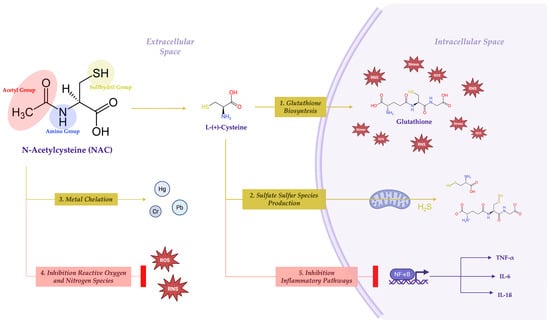
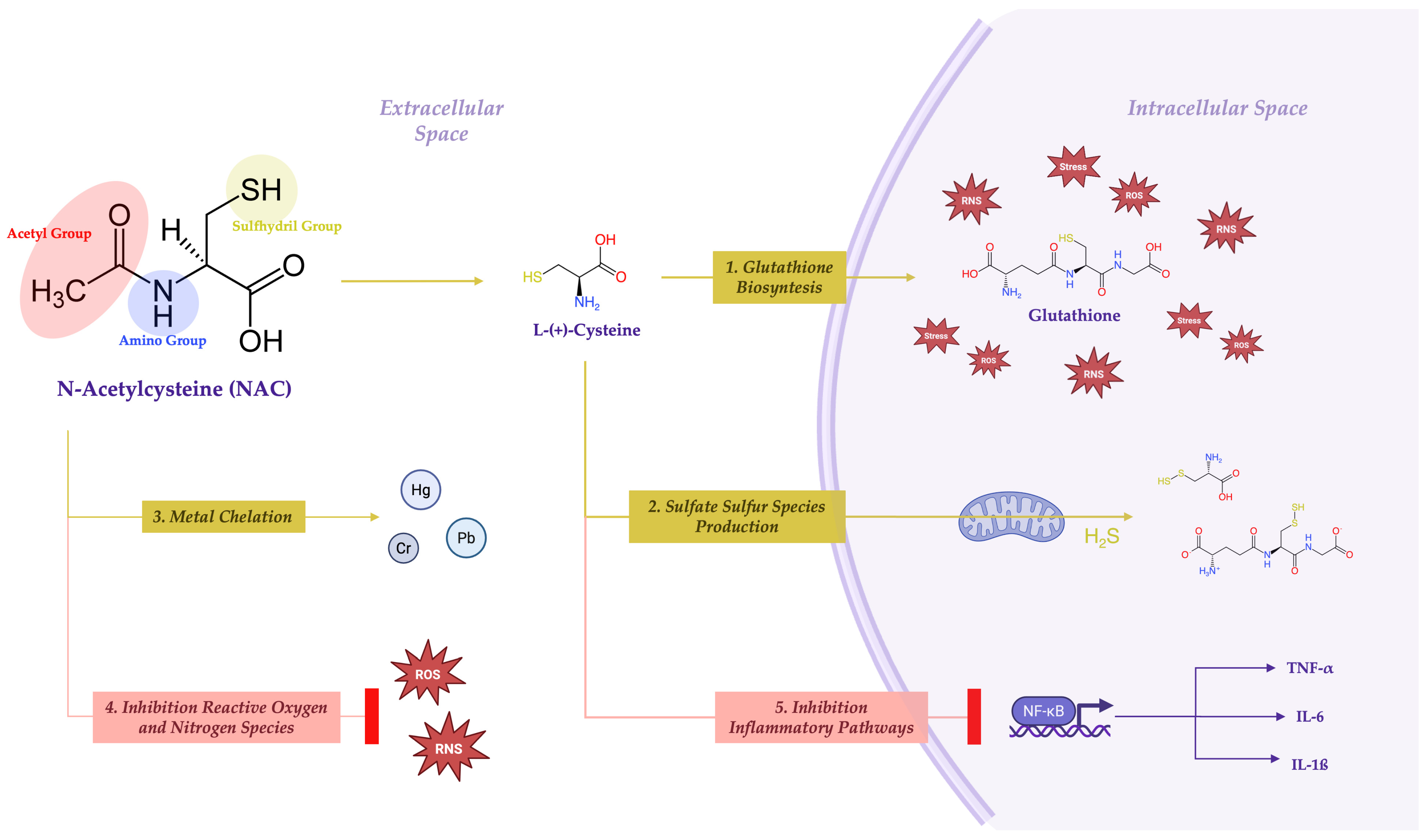
The redox system, particularly glutathione (GSH), is associated with glutamate function, and vice versa. GSH is synthesized in the cytosol of all mammalian cells in a tightly regulated manner. The major determinants of GSH synthesis are the availability of cysteine, the sulfur amino acid precursor, and the activity of the rate-limiting enzyme, glutamate cysteine ligase [20]. Hence, given the interplay between redox imbalance and glutamatergic dysfunction, antioxidant therapy has gained attention as a potential strategy to target core mechanisms underlying SCZ [21,22]. Within this framework, several antioxidant compounds have been investigated as potential adjunctive treatments, such as omega-3 fatty acids [23], vitamin C [24], and sulforaphane [25], among others [26,27]. However, clinical findings across this class remain heterogeneous and often inconsistent, which limits confidence in any broad therapeutic effect [22,28]. This variability highlights the importance of targeting specific pathophysiological pathways, as reflected in the investigation of compounds with defined mechanisms such as omega-3 fatty acids [29,30] and novel negative-symptom interventions [31]. N-Acetylcysteine (NAC) represents one such candidate, having been evaluated in several clinical trials that demonstrated modest efficacy in ameliorating negative symptoms and cognitive deficits [32], both inadequately addressed by AP [1]. Nevertheless, findings are not entirely consistent across studies regarding positive symptoms [33]. These beneficial interactions, particularly in negative and cognitive symptoms, likely result from NAC’s chemical structure and function (Figure 1), acting primarily as a direct and indirect antioxidant through GSH synthesis [34,35], and restoration of redox balance [36,37,38]. Moreover, NAC has been shown to modulate glutamatergic neurotransmission [39] and exert neuroimmune modulatory effects, thereby acting at the intersection of multiple biological systems implicated in SCZ [34]. Collectively, current findings indicate that NAC may represent a promising therapeutic strategy, particularly when redox imbalance is present [40]. However, further research is needed, as the available clinical data suggest only modest overall benefit and possible value in selected subgroups [34,39] and symptoms [33].
Figure 1.
N-Acetylcysteine: Mechanisms of Action in Redox Modulation, Glutathione Biosynthesis, and Anti-inflammatory Effects. NAC features an acetyl group (CH3CO-) attached to the amino nitrogen (-NH-); however, the key structural element, responsible for most of its biological activity, relies on the free sulfhydryl group (-SH) attached to the cysteine part of the molecule. This molecule shows direct antioxidant efficacy by: (1.) acting as a precursor of L-cysteine and, consequently, of GSH to replenish the intracellular GSH pool in conditions of oxidative stress, (2.) increasing sulfate sulfur species production inside cells, which provides additional protective effects independently of GSH replenishment, (3.) combining its sulfhydryl portion to redox active metal ions, forming complexes that are easily excreted by the body, (4.) interacting through its thiol group with RONS, such as NO2 and •OH, and (5.) inactivating the NF-κB, which plays a critical role in the inflammatory cascade and immune response. Abbreviations: Cr: Chromium, Hg: Mercury, IL-1ß: Interleukin-1 beta, IL-6: Interleukin-6, NAC: N-Acetylcysteine, NF-κB: Nuclear Factor Kappa-light-chain-enhancer of activated B cells, Pb: Lead, RNS: Reactive Nitrogen Species, ROS: Reactive Oxygen Species, TNF-α: Tumor Necrosis Factor-Alpha. While NAC also displays biochemical effects beyond redox-related mechanisms, including the reduction of disulfide bonds, the present figure highlights its most relevant functions linked to redox regulation.
This narrative review aims to explore the therapeutic potential of NAC in SCZ. Specifically, it examines its effects on glutamatergic signaling and related NMDAR hypofunction, oxidative stress, and low-grade neuroimmune activation, as well as its efficacy in improving negative symptoms and cognitive deficits.
Search Strategy
A structured but non-systematic literature search was conducted, aimed at identifying the most relevant evidence on NAC as an adjunctive treatment in SCZ, with particular attention to glutamate dysfunction, oxidative stress, and their interaction in the pathophysiology of the disorder. Searches were conducted in PubMed, Scopus, and Web of Science from database inception to May 2026, using combinations of the terms «N-Acetylcysteine, schizophrenia, psychosis, negative symptoms, cognition, oxidative stress, glutathione, glutamatergic dysfunction, NMDAR hypofunction, PVIs, neuroinflammation, and redox imbalance». Particular focus was placed on original research, clinical trials, meta-analyses, and high-quality preclinical and translational studies that addressed the mechanistic rationale or therapeutic effects of NAC in SCZ. Studies were included if they provided information relevant to glutamatergic dysfunction, oxidative stress, redox imbalance, NAC mechanisms of action, or clinical outcomes such as negative symptoms, cognitive performance, or overall symptom burden. Articles were excluded if they were unrelated to SCZ, lacked primary or clearly relevant secondary evidence, or provided insufficient methodological detail.
2. NMDAR Hypofunction and Glutamate Impairments in SCZ
The NMDAR hypofunction hypothesis is supported by the finding that NMDAR antagonists induce an SCZ-like state in healthy individuals [11,12]. NMDAR hypofunction also underscores the need to consider mechanisms beyond dopamine dysfunction, given the limited effects of APs on negative symptoms and cognitive deficits [41].
This hypothesis centers on the NMDAR, one of the main ionotropic glutamate receptors expressed in PVIs [41], a class of fast-spiking GABAergic interneurons that regulate excitatory neuronal signaling. Suppression of these inhibitory neurons leads to disinhibition of excitatory neurons, which may contribute to the clinical manifestations of the disease [42]. Moreover, PVIs are among the most abundant cortical interneuron populations and have electrophysiological properties associated with high metabolic demand [18,43]. These cells are responsible for synchronizing the firing of pyramidal neurons, primarily in the PFC and hippocampus, thereby supporting the generation of gamma-band oscillations (30–100 Hz) critical to optimal cognitive function [41,44]. These oscillations contribute to acute synaptic plasticity and longer-term structural adaptations [41,45]. Because PVIs mature extensively during adolescence and do not reach full maturity until adulthood, this developmental period may represent a window of increased vulnerability to adverse insults [46]. In this context, stressors or preexisting abnormalities during adolescence may have particularly deleterious effects on PVI development and function [42,47]. Recent preclinical evidence further supports this developmental vulnerability, showing that NAC administered during or after adolescent stress attenuated subsequent behavioral alterations, oxidative damage, and PVI deficits in adult rats [48].
In this framework, NMDAR hypofunction reduces inhibitory control over pyramidal neuron activity [11,49]. Reduced cortical PVI labeling may reflect a loss of parvalbumin expression rather than frank interneuron death [47]. As a result, cortical neurons become disinhibited, leading to excessive glutamatergic output [9], and a paradoxical state of cortical hyperexcitability with disrupted excitation–inhibition balance [50]. Additionally, pyramidal neurons project to the ventral tegmental area via glutamatergic pathways, thereby contributing to subcortical hyperdopaminergia [44], which has been associated with positive symptoms in SCZ [3]. In light of these observations, dysfunction of cortical PVIs has been proposed as a contributing factor in neurodevelopmental disorders, such as SCZ [18]. Together, these findings are consistent with the gamma-frequency synchrony disturbances observed in SCZ [50], which contribute to working memory deficits [51], poorer performance on cognitive tasks [52], and impaired daily functioning [51].
These findings have led to the prevailing view that PVIs are dysfunctional in SCZ, although the causes and mechanisms remain incompletely understood [53]. An emerging hypothesis proposes the involvement of oxidative damage [47,54] and neuroimmune alterations during development, which could contribute to interneuron dysfunction and, thereby, PVI impairment [55].
3. Oxidative Stress and Altered Neuroimmune Activity in SCZ: Neuronal Vulnerability
Oxidative stress, resulting from aberrant redox control, has emerged as an attractive hypothesis for explaining, at least in part, the pathophysiology of SCZ [56,57], and the mechanisms associated with NMDAR dysfunction during early postnatal development [15,58]. Increased reactive oxygen species (ROS) production, when not adequately neutralized by antioxidant defenses [59], may have detrimental effects on macromolecules, ultimately altering gene expression [56]. Conversely, GSH helps maintain cellular redox homeostasis by scavenging reactive species and supporting antioxidant and detoxification pathways, thereby limiting oxidative damage [16].
During early adolescence, PVIs are highly plastic in terms of excitatory drive and neuronal activity [17,60]. Their susceptibility to oxidative stress in early development may have lasting consequences in adulthood [17]. This vulnerability is supported by experimental evidence from Gclm knockout mice, which exhibit a 60–70% reduction in brain glutathione levels. In this model, PVIs show increased susceptibility to oxidative stress, an effect that can be prevented by NAC administration [61]. Neurons also have relatively weak antioxidant protection, demonstrated by lower catalase content and reduced GSH levels compared with hepatocytes [62]. In addition, neurons contain substantial amounts of redox-active metals, such as iron, zinc, copper, and manganese, which can catalyze ROS formation [56]. Therefore, a dysregulated stress response may lay the foundation for impaired neuronal metabolism [15,57] and increased ROS generation, thereby contributing to oxidative stress and cellular damage [17]. Collectively, these findings indicate that disruption of NMDAR function during postnatal development may affect the normal maturation of PVIs through oxidative-stress-related mechanisms, perpetuating vicious feed-forward mechanisms [15,17,63], and modulating synaptic activity and plasticity [62]. Moreover, this imbalance may trigger the formation of oxidative radicals that can induce dendritic atrophy through local apoptosis, leading to some of the structural and functional alterations that are seen in psychosis [62]. Consequently, cognitive dysfunction has been associated with an imbalance in the generation and clearance of ROS and reactive nitrogen species [57]. Beyond PVIs, redox imbalance may also affect other vulnerable neural compartments, including oligodendrocytes and white matter, which are essential for efficient circuit connectivity [64].
Oxidative stress may further amplify SCZ-related pathology by engaging neuroimmune pathways, particularly through apoptotic activation and downstream cytokine dysregulation [58,65]. At a molecular level, oxidative stress can activate the nuclear factor kappa light-chain-enhancer of activated B cells (NF-κB), a rapid-acting transcriptional activator of inflammation responsible for promoting free-radical production [58,66], abnormal cytokine profiles [65], and altered IL-6, IL-8, and TNF-α levels [67], thereby contributing to apoptotic mechanisms [16]. These changes have been associated with executive dysfunction and clinical SCZ symptomatology [44,65]. Notably, it has been demonstrated that neuroinflammation is an unfortunate term for SCZ [68]. This pathology may involve, at most, a very-low-grade inflammatory state, distinct from the classical epidemiological definition of inflammation. Nevertheless, features consistent with low-grade neuroinflammation in SCZ may reflect context-dependent neuroimmune mechanisms that are adaptive, maladaptive, or compensatory [68].
Supporting these interlinked hypotheses, multiple human studies have reported impairments in oxidative stress markers in both peripheral blood and central nervous system tissue in SCZ [16,59]. Moreover, rodent models have similarly shown that dysregulated ROS production reduces sociability, impairs cognition, decreases PVI labeling, and produces electrophysiological and transcriptional changes relevant to SCZ [60]. In individuals with SCZ, downregulation of antioxidant synthesis pathways and increased ROS production have been observed across multiple groups [17,64], consistent with reduced GSH levels in the PFC and post-mortem SCZ brains, where they correlate with more severe negative symptoms [17]. Overall, lower antioxidant levels and higher ROS values appear to be core features of the disorder and are not fully explained by disease progression or medication, supporting redox imbalance as a primary characteristic of SCZ [64]. Interestingly, executive dysfunction in SCZ also correlates with higher ROS levels and lower antioxidant-related protein levels, directly linking redox imbalance to cognitive impairment [65].
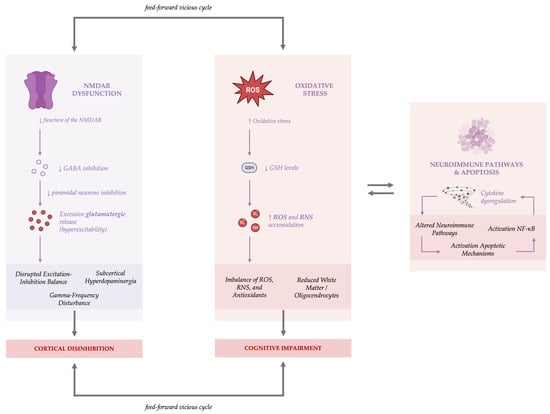
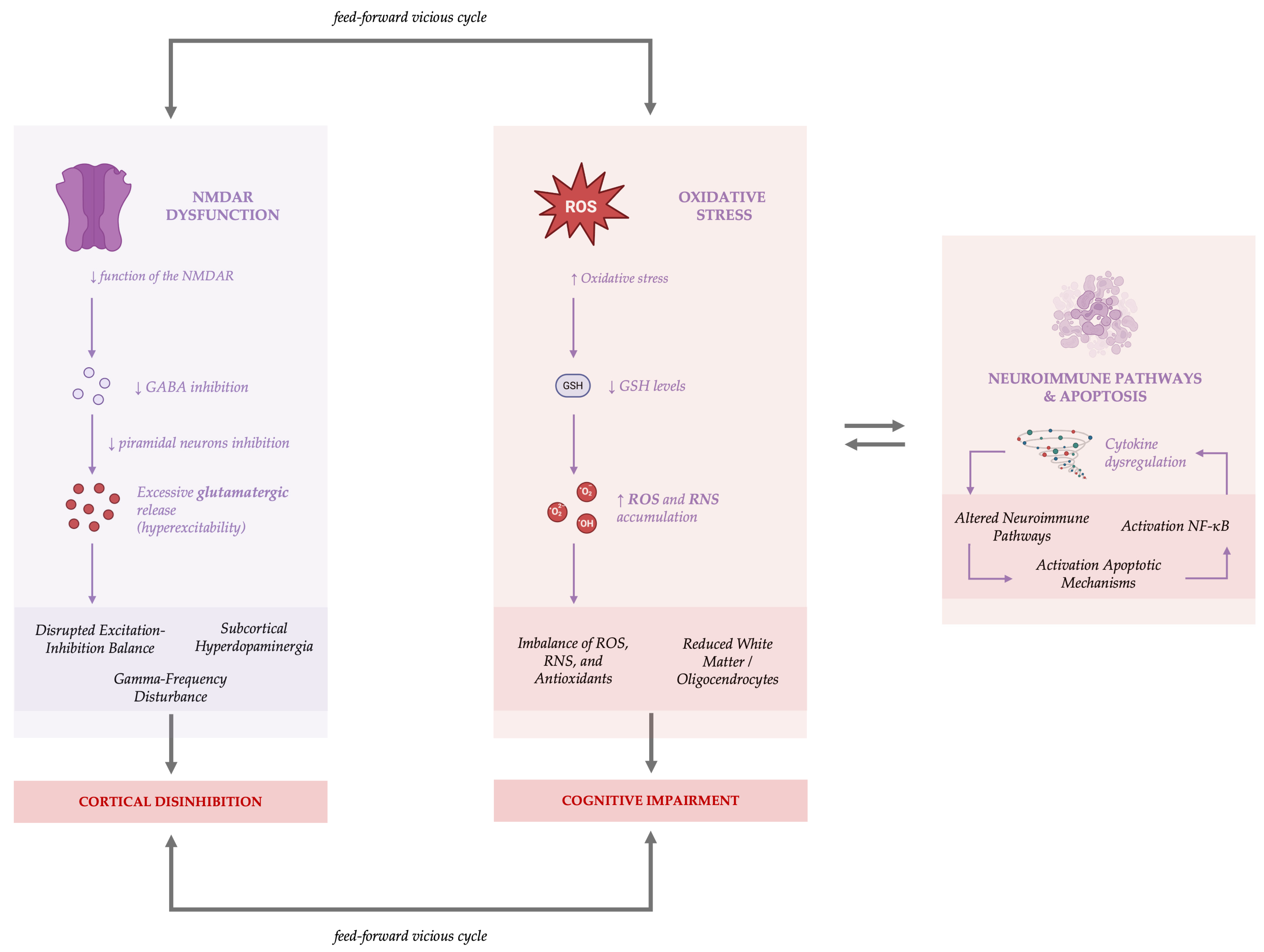
Therefore, current evidence suggests that oxidative stress and NMDAR hypofunction may contribute to cortical oxidative damage, GSH deficiency, and reduced antioxidant activity through transcriptional regulation [62]. Additionally, this intertwined pattern appears to be mechanistically interdependent rather than sequential, forming bidirectional, self-amplifying vicious circles in which either can initiate the pathological cascade and each can worsen the other through positive feed-forward loops [17] (Figure 2). However, although the exact molecular framework is not yet fully established, preliminary results suggest NAC antioxidant therapy as a potential intervention to improve cognitive and negative functioning in individuals with SCZ [32].
Figure 2.
Integrative model of PVI dysfunction in SCZ. The schematic depicts a feed-forward pathological cascade in which NMDAR dysfunction in parvalbumin interneurons reduces GABAergic inhibitory tone, resulting in pyramidal neuron disinhibition, excessive glutamatergic release, disruption of the excitation–inhibition balance, and subcortical hyperdopaminergia. In parallel, oxidative stress, characterized by reduced GSH levels and accumulation of RONS, interacts with dysregulated neuroimmune pathways and apoptosis, further contributing to white matter and oligodendrocyte reduction, and ultimately cognitive impairment. Abbreviations: ↑ indicates an increase; ↓ indicates a decrease, GABA: Gamma-Aminobutyric Acid, GSH: Glutathione, NMDAR: N-methyl-D-aspartate Receptor, O2−: Superoxide, O22−: Peroxide, RONS: Reactive Oxygen and Nitrogen Species, ROS: Reactive Oxygen Species. Neuroimmune activation and local apoptotic processes remain incompletely understood and are currently supported by limited evidence. For this reason, they are not extensively discussed in the present review; however, they have been included in the figure for illustrative purposes.
4. Implications of N-Acetylcysteine in the Glutamate Hypothesis and Redox Imbalance
Based on genetic studies [69], in vivo [70], and in vitro cellular models [71], NAC has been proposed as a potential therapeutic agent in SCZ. Its effects are primarily attributed to its role as a precursor of GSH, which in turn supports modulation of glutamatergic and dopaminergic systems, reduces oxidative stress, and stabilizes neuroimmune activity [72].
Consistent with these mechanisms, several clinical trials have evaluated NAC in SCZ (Table 1), reporting moderate benefits, particularly for negative symptoms [73,74], which are largely refractory to current APs [1,41]. Neurobiological studies further support these findings: compared with the placebo group, NAC treatment has been associated with increased GSH levels (F = 4.86, p = 0.035) and a trend toward reduced glutamate levels (F = 4.04, p = 0.054) after 8 weeks, both of which are implicated in SCZ pathophysiology [75]. In contrast, an acute magnetic resonance spectroscopy (MRS) challenge study found that a single 2400 mg dose of NAC produced no change in cortical GSH or glutamate levels in the dACC or mPFC of patients with SCZ [76], consistent with the possibility that central target engagement by NAC may require sustained, long-term administration rather than acute dosing to restore redox balance. In addition, neuroimaging studies using magnetic resonance imaging have provided preliminary evidence that NAC modulates functional connectivity within brain networks relevant to SCZ, including reduced resting-state connectivity in PFC regions [77]. These neurochemical and circuit-level changes may underlie observed functional enhancements [78]. Converging preclinical and clinical findings reinforce this model: in Gclm knockout mice, PVIs are highly vulnerable to oxidative stress due to GSH deficiency, whereas in patients, NAC administration increases prefrontal GABA levels and improves cognitive function, suggesting restoration of inhibitory circuitry through redox modulation [79].
Clinically, longer-term NAC administration has been associated with significant improvements in symptom severity [78]. A 52-week study reported reductions in PANSS total (F = 14.7, p < 0.001), negative (F = 5.1, p = 0.024), and disorganized thought factor scores (F = 13.7, p < 0.001) [78]. Similarly, NAC at 2000 mg/day significantly improved PANSS negative (p = 0.018), general (p = 0.035), and total (p = 0.009) scores at week 24 compared with baseline [80]. NAC may also impact cognitive function, particularly in individuals with more chronic illness [81]. Improvements in working memory were observed after 24 weeks of treatment (U = 98.5, p = 0.027) [81]. Moreover, in a single early psychosis trial (2700 mg/day, 6 months), three separate analyses of the same cohort each reported a distinct outcome: NAC was associated with functional connectivity [82], reflected in verbal fluency (F = 5.75, p = 0.023), trail-making tests (F = 4.28, p = 0.048), processing speed (F = 5.85, p = 0.022) [40], and, for the first time, with enhanced white matter integrity after treatment [83]. In the same trial, a peripheral redox index based on blood cells’ glutathione peroxidase activity identified a subgroup of early-psychosis patients in whom positive symptoms improved with NAC [40]. Other studies have also reported reductions in positive symptomatic scores (F = 5.47, df = 1, p = 0.02), along with improvements in negative symptoms, general psychopathology, and total score compared with placebo [33]. In individuals at high risk of psychosis, NAC showed a non-significant trend toward reduced transition risk [84], alongside improvements in prodromal symptoms [85]. Additionally, preliminary results from a 2400 mg/day NAC administered for 8 weeks found increased neural synchronization in SCZ [86], a disturbance that has been linked to NMDAR hypofunction [87]. Consistent with this, individuals with SCZ also showed improved auditory cortical functioning (p = 0.025) [88].
Despite these promising findings, results remain heterogeneous, and some studies show no benefit in specific clinical conditions [40,75,88,89]. A consistent observation is that positive symptomatology may not substantially benefit from NAC treatment [74,78], as many trials have not demonstrated significant improvements in PANSS positive scores [74,78], although findings are not entirely consistent across studies [33]. Additionally, NAC has not demonstrated efficacy in treatment-resistant populations [90], and molecular findings regarding GSH and glutamate levels are, to a small extent, heterogeneous [76]. Furthermore, the immunological effects of NAC remain largely unexplored, as no clinical trials have specifically assessed immune responses and apoptosis to treatment in SCZ.
Therefore, adequately powered, real-world studies with longer follow-up periods are needed to clarify the clinical role of NAC and to identify subgroups most likely to benefit. While NAC is generally considered safe and well-tolerated [33], some adverse events have been reported, most commonly involving the gastrointestinal system, although these have not been deemed clinically significant [91]. In this context, NAC remains a candidate treatment whose clinical role would be best clarified by adequately powered, biomarker-informed trials.
Table 1.
Studies addressing NAC treatment in people living with SCZ, Schizoaffective Disorder, or high-risk populations.
5. Discussion
This review synthesizes evidence that NAC targets a set of interconnected mechanisms, glutamatergic signaling and related NMDAR hypofunction [41], oxidative stress [54], and a possible low-grade neuroimmune activation [68], that converge on PVI dysfunction in SCZ. By potentially addressing these pathways simultaneously, NAC offers a mechanistic rationale that is distinct from dopaminergic APs, which do not directly target redox or glutamatergic systems [1].
Among antioxidant compounds investigated in SCZ, NAC has one of the strongest mechanistic rationales and the most replicated clinical evidence [33,34]. Several features distinguish it from agents such as omega-3 fatty acids [23], vitamin C [24], and sulforaphane [25], among others [26,27]. First, NAC is a precursor of GSH rather than a simple free-radical scavenger [92]. Second, it modulates glutamatergic transmission [77], thereby engaging two core pathophysiological pathways implicated in SCZ, redox imbalance and glutamate dysfunction, that other antioxidants address only partially or not at all [54]. Third, it crosses the blood–brain barrier and increases brain GSH levels, as confirmed by magnetic resonance spectrometry [75]. Finally, it has pragmatic advantages including oral bioavailability, a well-tolerated safety profile at doses up to 3600 mg/day, and low cost [78]. Consistent with this mechanistic profile, NAC has received a provisional recommendation for use in SCZ from the World Federation of Societies of Biological Psychiatry and the Canadian Network for Mood and Anxiety Treatments [93].
Results from several clinical trials demonstrate that negative symptoms and cognitive deficits appear to respond favorably to NAC treatment [78,81], whereas positive symptoms show modest and inconsistent improvement [33,74]. Although the overall literature suggests greater benefit for negative and cognitive symptoms, one trial reported a positive-symptom improvement confined to a post-hoc redox-defined subgroup [40], a single, as-yet-unreplicated finding. This positions NAC as one of the few adjunctive agents with replicated benefit for symptom domains that are largely refractory to current APs [1]. Importantly, all reviewed clinical trials administered NAC as an add-on to ongoing AP medication. This reinforces that NAC should be understood strictly as an adjunctive strategy: it adds value where APs fall short, rather than replacing them where they already work [94]. Its therapeutic value lies in covering the domains that APs leave undertreated [44], while they continue to manage positive symptoms effectively [95]. However, the evidence base remains limited. Results are not fully consistent across studies [40,75], and the factors that predict treatment response are not yet well understood. Not all studies report significant results associated with NAC treatment. Some trials have yielded negative findings for their primary endpoints. This heterogeneity in outcomes mirrors the broader controversy in the literature regarding NAC efficacy in SCZ [40,75,88,89]. Null findings can be explained by brief exposure to NAC (60–120 min), which may have been insufficient to produce detectable biological or clinical effects [76]. NAC did not either show benefit in clinical high-risk individuals [84] or in treatment-resistant populations [90]. One possible explanation, which we advance as a hypothesis rather than an established mechanism, is that its efficacy may depend on a specific redox state present in the early-to-mid stages of chronic SCZ but not yet established in at-risk individuals or exhausted in refractory illness. It is important to note that this stage-dependent account is, at present, derived largely from a single post-hoc subgroup analysis [40] and from the pattern of null results across populations; it has not been tested directly. The biomarker-stratified trial we propose below is intended precisely to test it, by measuring redox status prospectively rather than inferring it from illness stage. In the meantime, NAC may still be effective in a specific subpopulation of patients. Studies reporting negative results may have enrolled heterogeneous populations with varying redox status, which would increase within-group variability and dilute any signal that exists in a subgroup.
Heterogeneity across studies may partly reflect the fact that previous trials enrolled unselected SCZ populations. One promising way forward is biomarker-stratified enrichment [40]. In that trial (63 early-psychosis patients), NAC produced no significant effect on positive or negative symptoms in the sample as a whole; in an exploratory, post-hoc subgroup analysis, however, patients with high baseline erythrocyte glutathione peroxidase activity showed a link between change in redox status and improvement in positive symptoms, whereas the unstratified sample showed none. We emphasize that this is a single, unreplicated, hypothesis-generating result, not an established predictive effect. It is precisely this exploratory status that motivates the trial we propose: a prospective, biomarker-stratified design is the appropriate way to test whether the redox-defined subgroup signal is real, rather than to assume it [40]. Such a design has not yet been applied prospectively in chronic SCZ. We propose a multicenter, double-blind, randomized, placebo-controlled trial in which patients with stable SCZ, and at least moderate negative symptoms (PANSS negative ≥18), are screened for erythrocyte glutathione peroxidase activity, glutathione disulfide (GSSG) as an index of oxidative load, and total antioxidant capacity at baseline. Incorporating GSSG is supported by recent redox-metabolomic evidence that, in drug-naïve first-episode SCZ, GSSG is an independent correlate of cognitive impairment, whereas GSH and the GSH-to-GSSG ratio show weaker and less stable associations [96]; measuring the oxidized pool alongside antioxidant capacity would therefore index the redox imbalance more completely and is particularly relevant to the trial’s cognitive secondary endpoints. Only patients whose redox index falls below the screening population median, indicating a measurable antioxidant deficit, would be randomized to NAC 2400 mg/day or a matching placebo for 24 weeks. The primary endpoint would be the change in PANSS negative subscale score, a domain where NAC has shown replicated but modest benefit across prior trials at similar doses and durations [78,80,81]. Secondary endpoints would include working memory assessed by digit span backwards [81], processing speed [40], and resting-state functional connectivity within the default mode and salience networks [77], providing a bridge between peripheral biomarkers, brain-circuit outcomes, and clinically meaningful symptom improvement. This design would test two linked hypotheses: that NAC efficacy may be confined to patients with a pre-existing redox imbalance, and that the effect is largest for negative symptoms and cognition, precisely the domains where current APs are inadequate. An adequately powered, biomarker-enriched trial of this kind would either confirm NAC as a targeted therapy for a mechanistically defined subgroup or clarify that its modest effect size in unselected populations does not justify routine clinical use.
The findings reported here must be interpreted considering several methodological limitations that constrain the conclusions that can be drawn from the current evidence base. First, the sample sizes of the included clinical trials were small, ranging from 17 to 140 participants, which limits statistical power to detect moderate effect sizes and precludes robust subgroup analyses. Second, there was substantial heterogeneity across studies in NAC dosing (1200 to 3600 mg/day), treatment duration (60 min to 52 weeks), and baseline patient characteristics (early psychosis, chronic SCZ, treatment-resistant populations, and clinical high-risk states), making direct comparisons across trials difficult and potentially contributing to the inconsistency of findings across symptom domains. Third, most trials did not include prospective measurement of mechanistic biomarkers, such as erythrocyte glutathione peroxidase activity, plasma GSH levels, or in vivo brain GSH concentrations, making it impossible to confirm that NAC engaged its intended molecular target or to distinguish true non-response from inadequate target engagement [73]. Without such biomarkers, negative trial results are difficult to interpret: they may reflect a lack of efficacy, an insufficient dose for the individual patient, or enrollment of patients without a pre-existing redox imbalance. Fourth, as a narrative rather than a systematic review, this synthesis carries an inherent risk of selection bias in the identification and interpretation of studies, which a pre-registered systematic review with meta-analysis would mitigate. In addition, the immunological and anti-apoptotic mechanisms of NAC, which are hypothesized to contribute to its therapeutic effects, remain largely unexplored in clinical settings, as none of the trials reviewed assessed immune markers or apoptotic pathways as outcomes. An additional limitation of NAC is its relatively low systemic bioavailability and limited brain penetration. N-acetylcysteine amide, a more lipophilic derivative with enhanced membrane permeability and preclinical evidence of improved CNS penetration, may represent a future strategy to improve central delivery [37]. These limitations are precisely the gaps that the biomarker-enriched trial design outlined above aims to address, by selecting individuals with measurable redox imbalance, standardizing dose and duration, and incorporating mechanistic biomarkers as parallel endpoints.
6. Conclusions
NAC targets glutamatergic pathways related to NMDAR hypofunction, oxidative stress, and a possible low-grade neuroimmune activation, a network of mechanisms that converges on PVI dysfunction in SCZ. Negative symptoms and cognitive deficits, which remain largely refractory to APs, appear to respond favorably to NAC, whereas its benefit for positive symptoms is modest and inconsistent. Null findings in clinical-high-risk and treatment-resistant populations suggest that its efficacy may depend on a pre-existing redox imbalance. A biomarker-enriched trial evaluating NAC in patients with measurable antioxidant deficits could either establish it as a targeted therapy for a mechanistically defined subgroup or confirm that its modest effects in unselected populations do not justify routine use.
Author Contributions
C.M.: study conception, coordination, design, supervision, and funding. A.M.C.: formal analysis, supervision, validation, critical revision. E.R.-C.: literature search, manuscript drafting, design. A.P.-T. and P.Á.: drafting, validation and critical revision. All authors have read and agreed to the published version of the manuscript.
Funding
This research was partially funded by Fundació Privada Cellex- Fundació de Recerca Clínic Barcelona- Institut d’Investigacions Biomèdiques August Pi I Sunyer. Grant number [CP042187], Principal Investigator: Morén C.
Institutional Review Board Statement
Not applicable.
Informed Consent Statement
Not applicable.
Data Availability Statement
No new data were created or analyzed in this study.
Conflicts of Interest
The authors declare no conflicts of interest.
Abbreviations
The following abbreviations are used in this manuscript:
| AP | Antipsychotic |
| BACS | Brief Assessment of Cognition in Schizophrenia |
| CGI-S | Clinical Global Impressions-Severity |
| Cr | Chromium |
| dACC | Dorsal Anterior Cingulate Cortex |
| GABA | Gamma-Aminobutyric Acid |
| GSH | Glutathione |
| GSSG | Glutathione Disulfide |
| Hg | Mercury |
| •OH | Hydroxyl Radicals |
| IL-1ß | Interleukin-1 Beta |
| IL-6 | Interleukin-6 |
| mPFC | Medial Prefrontal Cortex |
| MRI | Magnetic Resonance Image |
| MRS | Magnetic Resonance Spectroscopy |
| NAC | N-Acetylcysteine |
| NMDAR | N-Methyl-d-Aspartate Receptor |
| NF-κB | Nuclear Factor Kappa-light-chain-enhancer of activated B cells |
| NO2 | Nitrogen Dioxide |
| O2− | Superoxide |
| O22− | Peroxide |
| PANSS | Positive and Negative Syndrome Scale |
| Pb | Lead |
| PFC | Prefrontal Cortex |
| PVIs | Parvalbumin-positive GABAergic Interneurons |
| RONS | Reactive Oxygen and Nitrogen Species |
| ROS | Reactive Oxygen Species |
| SCZ | Schizophrenia |
| SSD | Schizophrenia Spectrum Disorder |
| SZA | Schizoaffective Disorder |
| TNF-α | Tumor Necrosis Factor-Alpha |
References
- Siafis, S.; Tzachanis, D.; Samara, M.; Papazisis, G. Antipsychotic Drugs: From Receptor-binding Profiles to Metabolic Side Effects. Curr. Neuropharmacol. 2018, 16, 1210–1223. [Google Scholar] [CrossRef] [Scilit] [PubMed]
- Stahl, S.M. Beyond the dopamine hypothesis of schizophrenia to three neural networks of psychosis: Dopamine, serotonin, and glutamate. CNS Spectr. 2018, 23, 187–191. [Google Scholar] [CrossRef] [Scilit] [PubMed]
- Howes, O.D.; Shatalina, E. Integrating the Neurodevelopmental and Dopamine Hypotheses of Schizophrenia and the Role of Cortical Excitation-Inhibition Balance. Biol. Psychiatry 2022, 92, 501–513. [Google Scholar] [CrossRef] [Scilit] [PubMed]
- Jauhar, S.; Johnstone, M.; McKenna, P.J. Schizophrenia. Lancet 2022, 399, 473–486. [Google Scholar] [CrossRef] [Scilit] [PubMed]
- McCutcheon, R.A.; Reis Marques, T.; Howes, O.D. Schizophrenia—An Overview. JAMA Psychiatry 2020, 77, 201. [Google Scholar] [CrossRef] [Scilit] [PubMed]
- Howes, O.D.; Onwordi, E.C. The synaptic hypothesis of schizophrenia version III: A master mechanism. Mol. Psychiatry 2023, 28, 1843–1856. [Google Scholar] [CrossRef] [Scilit] [PubMed]
- Salahuddin, N.H.; Schütz, A.; Pitschel-Walz, G.; Mayer, S.F.; Chaimani, A.; Siafis, S.; Priller, J.; Leucht, S.; Bighelli, I. Psychological and psychosocial interventions for treatment-resistant schizophrenia: A systematic review and network meta-analysis. Lancet Psychiatry 2024, 11, 545–553. [Google Scholar] [CrossRef] [Scilit] [PubMed]
- Okubo, R.; Okada, M.; Motomura, E. Dysfunction of the NMDA Receptor in the Pathophysiology of Schizophrenia and/or the Pathomechanisms of Treatment-Resistant Schizophrenia. Biomolecules 2024, 14, 1128. [Google Scholar] [CrossRef] [Scilit] [PubMed]
- Merritt, K.; Egerton, A.; Kempton, M.J.; Taylor, M.J.; McGuire, P.K. Nature of Glutamate Alterations in Schizophrenia: A Meta-analysis of Proton Magnetic Resonance Spectroscopy Studies. JAMA Psychiatry 2016, 73, 665. [Google Scholar] [CrossRef] [Scilit] [PubMed]
- Osugo, M.; Whitehurst, T.; Erritzoe, D.; Carr, R.; Ashok, A.H.; Maccioni, L.; Onwordi, E.C.; Rutigliano, G.; Rahaman, N.; Arumuham, A.; et al. Role of Serotonin in the Neurobiology of Schizophrenia and Association with Negative Symptoms. JAMA Psychiatry 2026, 83, 185. [Google Scholar] [CrossRef] [Scilit] [PubMed]
- Nakazawa, K.; Sapkota, K. The origin of NMDA receptor hypofunction in schizophrenia. Pharmacol. Ther. 2020, 205, 107426. [Google Scholar] [CrossRef] [Scilit] [PubMed]
- Kruse, A.O.; Bustillo, J.R. Glutamatergic dysfunction in Schizophrenia. Transl. Psychiatry 2022, 12, 500. [Google Scholar] [CrossRef] [Scilit] [PubMed]
- Enomoto, T.; Noda, Y.; Nabeshima, T. Phencyclidine and genetic animal models of schizophrenia developedin relation to the glutamate hypothesis. Methods Find. Exp. Clin. Pharmacol. 2007, 29, 291. [Google Scholar] [CrossRef] [Scilit] [PubMed]
- Coyle, J.T. The GABA-glutamate connection in schizophrenia: Which is the proximate cause? Biochem. Pharmacol. 2004, 68, 1507–1514. [Google Scholar] [CrossRef] [Scilit] [PubMed]
- Cuenod, M.; Steullet, P.; Cabungcal, J.H.; Dwir, D.; Khadimallah, I.; Klauser, P.; Conus, P.; Do, K.Q. Caught in vicious circles: A perspective on dynamic feed-forward loops driving oxidative stress in schizophrenia. Mol. Psychiatry 2022, 27, 1886–1897. [Google Scholar] [CrossRef] [Scilit] [PubMed]
- Perkins, D.O.; Jeffries, C.D.; Do, K.Q. Potential Roles of Redox Dysregulation in the Development of Schizophrenia. Biol. Psychiatry 2020, 88, 326–336. [Google Scholar] [CrossRef] [Scilit] [PubMed]
- Hardingham, G.E.; Do, K.Q. Linking early-life NMDAR hypofunction and oxidative stress in schizophrenia pathogenesis. Nat. Rev. Neurosci. 2016, 17, 125–134. [Google Scholar] [CrossRef] [Scilit] [PubMed]
- Moissidis, M.; Abbasova, L.; Selten, M.; Alis, R.; Bernard, C.; Domínguez-Canterla, Y.; Oozeer, F.; Qin, S.; Kelly, A.; Mòdol, L.; et al. A postnatal molecular switch drives activity-dependent maturation of parvalbumin interneurons. Cell 2025, 188, 5555–5575.e26. [Google Scholar] [CrossRef] [Scilit] [PubMed]
- Sohal, V.S. Transforming Discoveries About Cortical Microcircuits and Gamma Oscillations into New Treatments for Cognitive Deficits in Schizophrenia. Am. J. Psychiatry 2022, 179, 267–276. [Google Scholar] [CrossRef] [Scilit] [PubMed]
- Lu, S.C. Regulation of glutathione synthesis. Mol. Asp. Med. 2009, 30, 42–59. [Google Scholar] [CrossRef] [Scilit] [PubMed]
- Trubalski, M.; Markiewicz-Gospodarek, A.; Żerebiec, M.; Poleszak, J.; Szczotka, M.; Markiewicz, R.; Łoza, B.; Szymańczyk, S. Oxidative Stress-Mediated Neuroinflammation in the Pathophysiology of Schizophrenia. Int. J. Mol. Sci. 2025, 26, 11139. [Google Scholar] [CrossRef] [Scilit] [PubMed]
- Magalhães, P.V.S.; Dean, O.; Andreazza, A.C.; Berk, M.; Kapczinski, F. Antioxidant treatments for schizophrenia. Cochrane Database Syst. Rev. 2016, 2, 2016. [Google Scholar] [CrossRef] [Scilit] [PubMed]
- Lin, C.Y.; Lee, J.A.; Peng, T.R.; Tsai, P.Y.; Huang, P.H.; Lee, M.C.; Chen, S.M. Effect of n-3 polyunsaturated fatty acids on the treatment of schizophrenia: An updated systematic review and meta-analysis. BMC Psychiatry 2025, 25, 1076. [Google Scholar] [CrossRef] [Scilit] [PubMed]
- Dakhale, G.N.; Khanzode, S.D.; Khanzode, S.S.; Saoji, A. Supplementation of vitamin C with atypical antipsychotics reduces oxidative stress and improves the outcome of schizophrenia. Psychopharmacology 2005, 182, 494–498. [Google Scholar] [CrossRef] [Scilit] [PubMed]
- Huang, J.; Chen, A.; Jin, H.; Liu, F.; Hei, G.; Teng, Z.; Xiao, J.; Wu, R.; Zhao, J.; Davis, J.M.; et al. Efficacy and Safety of Sulforaphane Added to Antipsychotics for the Treatment of Negative Symptoms of Schizophrenia: A Randomized Controlled Trial. J. Clin. Psychiatry 2025, 86, 24m15272. [Google Scholar] [CrossRef] [Scilit] [PubMed]
- Abd Elkader, H.T.A.E.; Abdou, H.M.; Khamiss, O.A.; Essawy, A.E. Anti-anxiety and antidepressant-like effects of astragaloside IV and saponins extracted from Astragalus spinosus against the bisphenol A-induced motor and cognitive impairments in a postnatal rat model of schizophrenia. Environ. Sci. Pollut. Res. 2021, 28, 35171–35187. [Google Scholar] [CrossRef] [Scilit] [PubMed]
- Khan, A.N.; Jawarkar, R.D.; Zaki, M.E.A.; Al Mutairi, A.A. Natural compounds for oxidative stress and neuroprotection in schizophrenia: Composition, mechanisms, and therapeutic potential. Nutr. Neurosci. 2024, 27, 1306–1320. [Google Scholar] [CrossRef] [Scilit] [PubMed]
- Ng, F.; Berk, M.; Dean, O.; Bush, A.I. Oxidative stress in psychiatric disorders: Evidence base and therapeutic implications. Int. J. Neuropsychopharmacol. 2008, 11, 851–876. [Google Scholar] [CrossRef] [Scilit] [PubMed]
- Irving, C.B.; Mumby-Croft, R.; Joy, L.A. Polyunsaturated fatty acid supplementation for schizophrenia. Cochrane Database Syst. Rev. 2006. [Google Scholar] [CrossRef] [Scilit] [PubMed]
- Hsu, M.C.; Huang, Y.S.; Ouyang, W.C. Beneficial effects of omega-3 fatty acid supplementation in schizophrenia: Possible mechanisms. Lipids Health Dis. 2020, 19, 159. [Google Scholar] [CrossRef] [Scilit] [PubMed]
- Glenthøj, L.B.; Nielsen, M.Ø.; Nordentoft, M. Treatment trials for negative symptoms in schizophrenia. Curr. Opin. Psychiatry 2026, 39, 216–221. [Google Scholar] [CrossRef] [Scilit] [PubMed]
- Yolland, C.O.; Hanratty, D.; Neill, E.; Rossell, S.L.; Berk, M.; Dean, O.M.; Castle, D.J.; Tan, E.J.; Phillipou, A.; Harris, A.W.; et al. Meta-analysis of randomised controlled trials with N-acetylcysteine in the treatment of schizophrenia. Aust. N. Z. J. Psychiatry 2020, 54, 453–466. [Google Scholar] [CrossRef] [Scilit] [PubMed]
- Sepehrmanesh, Z.; Heidary, M.; Akasheh, N.; Akbari, H.; Heidary, M. Therapeutic effect of adjunctive N-acetyl cysteine (NAC) on symptoms of chronic schizophrenia: A double-blind, randomized clinical trial. Prog. Neuro-Psychopharmacol. Biol. Psychiatry 2018, 82, 289–296. [Google Scholar] [CrossRef] [Scilit] [PubMed]
- Tenório, M.C.D.S.; Graciliano, N.G.; Moura, F.A.; Oliveira, A.C.M.D.; Goulart, M.O.F. N-Acetylcysteine (NAC): Impacts on Human Health. Antioxidants 2021, 10, 967. [Google Scholar] [CrossRef] [Scilit] [PubMed]
- Raghu, G.; Berk, M.; Campochiaro, P.A.; Jaeschke, H.; Marenzi, G.; Richeldi, L.; Wen, F.-Q.; Nicoletti, F.; Calverley, P.M.A. The Multifaceted Therapeutic Role of N-Acetylcysteine (NAC) in Disorders Characterized by Oxidative Stress. Curr. Neuropharmacol. 2021, 19, 1202–1224. [Google Scholar] [CrossRef] [Scilit] [PubMed]
- Pedre, B.; Barayeu, U.; Ezeriņa, D.; Dick, T.P. The mechanism of action of N-acetylcysteine (NAC): The emerging role of H2S and sulfane sulfur species. Pharmacol. Ther. 2021, 228, 107916. [Google Scholar] [CrossRef] [Scilit] [PubMed]
- Qu, H.Q.; Kao, C.; Hakonarson, H. Redefining the role of the thiol-based agent N-acetylcysteine in human health and disease and elucidating potential advantages of its amide derivative. RSC Med. Chem. 2026, 17, 2183–2196. [Google Scholar] [CrossRef] [Scilit] [PubMed]
- Samuni, Y.; Goldstein, S.; Dean, O.M.; Berk, M. The chemistry and biological activities of N-acetylcysteine. Biochim. Biophys. Acta (BBA) -Gen. Subj. 2013, 1830, 4117–4129. [Google Scholar] [CrossRef] [Scilit] [PubMed]
- Chakraborty, S.; Shankaranarayana Rao, B.S.; Tripathi, S.J. The neuroprotective effects of N-acetylcysteine in psychiatric and neurodegenerative disorders: From modulation of glutamatergic transmission to restoration of synaptic plasticity. Neuropharmacology 2025, 278, 110527. [Google Scholar] [CrossRef] [Scilit] [PubMed]
- Conus, P.; Seidman, L.J.; Fournier, M.; Xin, L.; Cleusix, M.; Baumann, P.S.; Ferrari, C.; Cousins, A.; Alameda, L.; Gholam-Rezaee, M.; et al. N-acetylcysteine in a Double-Blind Randomized Placebo-Controlled Trial: Toward Biomarker-Guided Treatment in Early Psychosis. Schizophr. Bull. 2018, 44, 317–327. [Google Scholar] [CrossRef] [Scilit] [PubMed]
- Uno, Y.; Coyle, J.T. Glutamate hypothesis in schizophrenia. Psychiatry Clin. Neurosci. 2019, 73, 204–215. [Google Scholar] [CrossRef] [Scilit] [PubMed]
- Okur, Z.; Scheiffele, P. Molecular programs specifying properties and plasticity of parvalbumin interneuron innervation. Curr. Opin. Neurobiol. 2025, 93, 103060. [Google Scholar] [CrossRef] [Scilit] [PubMed]
- Marín, O. Parvalbumin interneuron deficits in schizophrenia. Eur. Neuropsychopharmacol. 2024, 82, 44–52. [Google Scholar] [CrossRef] [Scilit] [PubMed]
- Parellada, E.; Gassó, P. Glutamate and microglia activation as a driver of dendritic apoptosis: A core pathophysiological mechanism to understand schizophrenia. Transl. Psychiatry 2021, 11, 271. [Google Scholar] [CrossRef] [Scilit] [PubMed]
- Coyle, J.T. Glutamate and Schizophrenia: Beyond the Dopamine Hypothesis. Cell. Mol. Neurobiol. 2006, 26, 363–382. [Google Scholar] [CrossRef] [Scilit] [PubMed]
- Becerra-Hernández, L.V.; Ortiz-Muñoz, D.; Sánchez-Escobar, A.; González-Acosta, C.A.; Buriticá-Ramírez, E.; Martínez-Cerdeño, V. Cortical parvalbumin-positive neurons: Functional and ontogenetic characteristics and their relationship to brain pathologies. Brain Res. 2026, 1874, 150141. [Google Scholar] [CrossRef] [Scilit] [PubMed]
- Sullivan, E.M.; O’Donnell, P. Inhibitory Interneurons, Oxidative Stress, and Schizophrenia. Schizophr. Bull. 2012, 38, 373–376. [Google Scholar] [CrossRef] [Scilit] [PubMed]
- Freitas, Í.S.; Guimarães, F.S.; Gomes, F.V. Protective Effects of N-Acetylcysteine Against Schizophrenia-Related Behavioral and Parvalbumin Interneuron Deficits Induced by Adolescent Stress. Schizophr. Bull. Open 2025, 6, sgaf029. [Google Scholar] [CrossRef] [Scilit] [PubMed]
- Gonzalez-Burgos, G.; Lewis, D.A. NMDA Receptor Hypofunction, Parvalbumin-Positive Neurons, and Cortical Gamma Oscillations in Schizophrenia. Schizophr. Bull. 2012, 38, 950–957. [Google Scholar] [CrossRef] [Scilit] [PubMed]
- Nakazawa, K.; Zsiros, V.; Jiang, Z.; Nakao, K.; Kolata, S.; Zhang, S.; Belforte, J.E. GABAergic interneuron origin of schizophrenia pathophysiology. Neuropharmacology 2012, 62, 1574–1583. [Google Scholar] [CrossRef] [Scilit] [PubMed]
- Koshiyama, D.; Miyakoshi, M.; Thomas, M.L.; Joshi, Y.B.; Molina, J.L.; Tanaka-Koshiyama, K.; Sprock, J.; Braff, D.L.; Swerdlow, N.R.; Light, G.A. Unique contributions of sensory discrimination and gamma synchronization deficits to cognitive, clinical, and psychosocial functional impairments in schizophrenia. Schizophr. Res. 2021, 228, 280–287. [Google Scholar] [CrossRef] [Scilit] [PubMed]
- Brennan, A.M.; Williams, L.M.; Harris, A.W.F. Intrinsic, task-evoked and absolute gamma synchrony during cognitive processing in first onset schizophrenia. J. Psychiatr. Res. 2018, 99, 10–21. [Google Scholar] [CrossRef] [Scilit] [PubMed]
- Yao, Y.; Li, Q. The Role of Parvalbumin Interneurons in Autism Spectrum Disorder. J. Neurosci. Res. 2024, 102, e25391. [Google Scholar] [CrossRef] [Scilit] [PubMed]
- Steullet, P.; Cabungcal, J.H.; Coyle, J.; Didriksen, M.; Gill, K.; Grace, A.A.; Hensch, T.K.; LaMantia, A.-S.; Lindemann, L.; Maynard, T.M.; et al. Oxidative stress-driven parvalbumin interneuron impairment as a common mechanism in models of schizophrenia. Mol. Psychiatry 2017, 22, 936–943. [Google Scholar] [CrossRef] [Scilit] [PubMed]
- Nayak, U.; Manikkath, J.; Arora, D.; Mudgal, J. Impact of neuroinflammation on brain glutamate and dopamine signalling in schizophrenia: An update. Metab. Brain Dis. 2025, 40, 119. [Google Scholar] [CrossRef] [Scilit] [PubMed]
- Bitanihirwe, B.K.Y.; Woo, T.U.W. Oxidative stress in schizophrenia: An integrated approach. Neurosci. Biobehav. Rev. 2011, 35, 878–893. [Google Scholar] [CrossRef] [Scilit] [PubMed]
- Morén, C.; Olivares-Berjaga, D.; Martínez-Pinteño, A.; Bioque, M.; Rodríguez, N.; Gassó, P.; Martorell, L.; Parellada, E. Mitochondrial Oxidative Phosphorylation System Dysfunction in Schizophrenia. Int. J. Mol. Sci. 2025, 26, 4415. [Google Scholar] [CrossRef] [Scilit] [PubMed]
- Beeraka, N.M.; Avila-Rodriguez, M.F.; Aliev, G. Recent Reports on Redox Stress-Induced Mitochondrial DNA Variations, Neuroglial Interactions, and NMDA Receptor System in Pathophysiology of Schizophrenia. Mol. Neurobiol. 2022, 59, 2472–2496. [Google Scholar] [CrossRef] [Scilit] [PubMed]
- Cecerska-Heryć, E.; Polikowska, A.; Serwin, N.; Michalczyk, A.; Stodolak, P.; Goszka, M.; Zoń, M.; Budkowska, M.; Tyburski, E.; Podwalski, P.; et al. The importance of oxidative biomarkers in diagnosis, treatment, and monitoring schizophrenia patients. Schizophr. Res. 2024, 270, 44–56. [Google Scholar] [CrossRef] [Scilit] [PubMed]
- Santos-Silva, T.; Lopes, C.F.B.; Hazar Ülgen, D.; Guimarães, D.A.; Guimarães, F.S.; Alberici, L.C.; Sandi, C.; Gomes, F.V. Adolescent Stress-Induced Ventral Hippocampus Redox Dysregulation Underlies Behavioral Deficits and Excitatory/Inhibitory Imbalance Related to Schizophrenia. Schizophr. Bull. 2025, 51, 501–512. [Google Scholar] [CrossRef] [Scilit] [PubMed]
- Cabungcal, J.H.; Steullet, P.; Kraftsik, R.; Cuenod, M.; Do, K.Q. Early-Life Insults Impair Parvalbumin Interneurons via Oxidative Stress: Reversal by N-Acetylcysteine. Biol. Psychiatry 2013, 73, 574–582. [Google Scholar] [CrossRef] [Scilit] [PubMed]
- Ermakov, E.A.; Dmitrieva, E.M.; Parshukova, D.A.; Kazantseva, D.V.; Vasilieva, A.R.; Smirnova, L.P. Oxidative Stress-Related Mechanisms in Schizophrenia Pathogenesis and New Treatment Perspectives. Oxidative Med. Cell. Longev. 2021, 2021, 8881770. [Google Scholar] [CrossRef] [Scilit] [PubMed]
- Hasam-Henderson, L.A.; Gotti, G.C.; Mishto, M.; Klisch, C.; Gerevich, Z.; Geiger, J.R.P.; Kovács, R. NMDA-receptor inhibition and oxidative stress during hippocampal maturation differentially alter parvalbumin expression and gamma-band activity. Sci. Rep. 2018, 8, 9545, Correction in Sci. Rep. 2018, 8, 13170. https://doi.org/10.1038/s41598-018-31011-6. [Google Scholar] [CrossRef] [Scilit] [PubMed]
- Maas, D.A.; Vallès, A.; Martens, G.J.M. Oxidative stress, prefrontal cortex hypomyelination and cognitive symptoms in schizophrenia. Transl. Psychiatry 2017, 7, e1171. [Google Scholar] [CrossRef] [Scilit] [PubMed]
- Wu, Z.W.; Yu, H.H.; Wang, X.; Guan, H.Y.; Xiu, M.H.; Zhang, X.Y. Interrelationships Between Oxidative Stress, Cytokines, and Psychotic Symptoms and Executive Functions in Patients with Chronic Schizophrenia. Psychosom. Med. 2021, 83, 485–491. [Google Scholar] [CrossRef] [Scilit] [PubMed]
- Barron, H.; Hafizi, S.; Andreazza, A.; Mizrahi, R. Neuroinflammation and Oxidative Stress in Psychosis and Psychosis Risk. Int. J. Mol. Sci. 2017, 18, 651. [Google Scholar] [CrossRef] [Scilit] [PubMed]
- Zhu, S.; Zhao, L.; Fan, Y.; Lv, Q.; Wu, K.; Lang, X.; Li, Z.; Yi, Z.; Geng, D. Interaction between TNF-α and oxidative stress status in first-episode drug-naïve schizophrenia. Psychoneuroendocrinology 2020, 114, 104595. [Google Scholar] [CrossRef] [Scilit] [PubMed]
- Llorca-Bofí, V.; Parellada, E.; Morén, C.; Sellgren, C.M.; Bioque, M. Neuroinflammation: An unfortunate term to describe schizophrenia. Mol. Psychiatry 2026, 31, 3336–3344. [Google Scholar] [CrossRef] [Scilit] [PubMed]
- Pósfai, B.; Cserép, C.; Hegedüs, P.; Szabadits, E.; Otte, D.M.; Zimmer, A.; Watanabe, M.; Freund, T.F.; Nyiri, G. Synaptic and cellular changes induced by the schizophrenia susceptibility gene G72 are rescued by N-acetylcysteine treatment. Transl. Psychiatry 2016, 6, e807. [Google Scholar] [CrossRef] [Scilit] [PubMed]
- Chen, H.H.; Stoker, A.; Markou, A. The glutamatergic compounds sarcosine and N-acetylcysteine ameliorate prepulse inhibition deficits in metabotropic glutamate 5 receptor knockout mice. Psychopharmacology 2010, 209, 343–350. [Google Scholar] [CrossRef] [Scilit] [PubMed][Green Version]
- Miyake, N.; Miyamoto, S. Effectiveness of N-acetylcysteine in the treatment of schizophrenia. Nihon Shinkei Seishin Yakurigaku Zasshi 2016, 36, 29–35. [Google Scholar] [PubMed]
- Berk, M.; Malhi, G.S.; Gray, L.J.; Dean, O.M. The promise of N-acetylcysteine in neuropsychiatry. Trends Pharmacol. Sci. 2013, 34, 167–177. [Google Scholar] [CrossRef] [Scilit] [PubMed]
- Deepmala; Slattery, J.; Kumar, N.; Delhey, L.; Berk, M.; Dean, O.; Spielholz, C.; Frye, R. Clinical trials of N-acetylcysteine in psychiatry and neurology: A systematic review. Neurosci. Biobehav. Rev. 2015, 55, 294–321. [Google Scholar] [CrossRef] [Scilit] [PubMed]
- Farokhnia, M.; Azarkolah, A.; Adinehfar, F.; Khodaie-Ardakani, M.-R.; Hosseini, S.-M.; Yekehtaz, H.; Tabrizi, M.; Rezaei, F.; Salehi, B.; Sadeghi, S.-M.; et al. N-Acetylcysteine as an Adjunct to Risperidone for Treatment of Negative Symptoms in Patients with Chronic Schizophrenia: A Randomized, Double-Blind, Placebo-Controlled Study. Clin. Neuropharmacol. 2013, 36, 185–192. [Google Scholar] [CrossRef] [Scilit] [PubMed]
- Yang, Y.S.; Maddock, R.J.; Zhang, H.; Lee, J.; Hellemann, G.; Marder, S.R.; Green, M.F. N-Acetylcysteine effects on glutathione and glutamate in schizophrenia: A preliminary MRS study. Psychiatry Res. Neuroimaging 2022, 325, 111515. [Google Scholar] [CrossRef] [Scilit] [PubMed]
- Girgis, R.R.; Baker, S.; Mao, X.; Gil, R.; Javitt, D.C.; Kantrowitz, J.T.; Gu, M.; Spielman, D.M.; Ojeil, N.; Xu, X.; et al. Effects of acute N-acetylcysteine challenge on cortical glutathione and glutamate in schizophrenia: A pilot in vivo proton magnetic resonance spectroscopy study. Psychiatry Res. 2019, 275, 78–85. [Google Scholar] [CrossRef] [Scilit] [PubMed]
- McQueen, G.; Lay, A.; Lally, J.; Gabay, A.S.; Collier, T.; Lythgoe, D.J.; Barker, G.J.; Stone, J.M.; McGuire, P.; MacCabe, J.H.; et al. Effect of single dose N-acetylcysteine administration on resting state functional connectivity in schizophrenia. Psychopharmacology 2020, 237, 443–451. [Google Scholar] [CrossRef] [Scilit] [PubMed]
- Breier, A.; Liffick, E.; Hummer, T.A.; Vohs, J.L.; Yang, Z.; Mehdiyoun, N.F.; Visco, A.C.; Metzler, E.; Zhang, Y.; Francis, M.M. Effects of 12-month, double-blind N-acetyl cysteine on symptoms, cognition and brain morphology in early phase schizophrenia spectrum disorders. Schizophr. Res. 2018, 199, 395–402. [Google Scholar] [CrossRef] [Scilit] [PubMed]
- Dwir, D.; Cabungcal, J.H.; Xin, L.; Giangreco, B.; Parietti, E.; Cleusix, M.; Jenni, R.; Klauser, P.; Conus, P.; Cuénod, M.; et al. Timely N-Acetyl-Cysteine and Environmental Enrichment Rescue Oxidative Stress-Induced Parvalbumin Interneuron Impairments via MMP9/RAGE Pathway: A Translational Approach for Early Intervention in Psychosis. Schizophr. Bull. 2021, 47, 1782–1794. [Google Scholar] [CrossRef] [Scilit] [PubMed]
- Berk, M.; Copolov, D.; Dean, O.; Lu, K.; Jeavons, S.; Schapkaitz, I.; Anderson-Hunt, M.; Judd, F.; Katz, F.; Katz, P.; et al. N-Acetyl Cysteine as a Glutathione Precursor for Schizophrenia—A Double-Blind, Randomized, Placebo-Controlled Trial. Biol. Psychiatry 2008, 64, 361–368. [Google Scholar] [CrossRef] [Scilit] [PubMed]
- Rapado-Castro, M.; Dodd, S.; Bush, A.I.; Malhi, G.S.; Skvarc, D.R.; On, Z.X.; Berk, M.; Dean, O.M. Cognitive effects of adjunctive N-acetyl cysteine in psychosis. Psychol. Med. 2017, 47, 866–876. [Google Scholar] [CrossRef] [Scilit] [PubMed]
- Mullier, E.; Roine, T.; Griffa, A.; Xin, L.; Baumann, P.S.; Klauser, P.; Cleusix, M.; Jenni, R.; Alemàn-Gómez, Y.; Gruetter, R.; et al. N-Acetyl-Cysteine Supplementation Improves Functional Connectivity Within the Cingulate Cortex in Early Psychosis: A Pilot Study. Int. J. Neuropsychopharmacol. 2019, 22, 478–487. [Google Scholar] [CrossRef] [Scilit] [PubMed]
- Klauser, P.; Xin, L.; Fournier, M.; Griffa, A.; Cleusix, M.; Jenni, R.; Cuenod, M.; Gruetter, R.; Hagmann, P.; Conus, P.; et al. N-acetylcysteine add-on treatment leads to an improvement of fornix white matter integrity in early psychosis: A double-blind randomized placebo-controlled trial. Transl. Psychiatry 2018, 8, 220. [Google Scholar] [CrossRef] [Scilit] [PubMed]
- Wasserthal, S.; Muthesius, A.; Hurlemann, R.; Ruhrmann, S.; Schmidt, S.J.; Hellmich, M.; Schultze-Lutter, F.; Klosterkötter, J.; Müller, H.; Meyer-Lindenberg, A.; et al. N-Acetylcysteine and a Specialized Preventive Intervention for Individuals at High Risk for Psychosis: A Randomized Double-Blind Multicenter Trial. Schizophr. Bull. Open 2024, 5, sgae005. [Google Scholar] [CrossRef] [Scilit] [PubMed]
- Miyake, N.; Miyamoto, S.; Yamashita, Y.; Ninomiya, Y.; Tenjin, T.; Yamaguchi, N. Effects of N-Acetylcysteine on Cognitive Functions in Subjects with an At-Risk Mental State: A Case Series. J. Clin. Psychopharmacol. 2016, 36, 87–88. [Google Scholar] [CrossRef] [Scilit] [PubMed]
- Yang, Y.S.; Davis, M.C.; Wynn, J.K.; Hellemann, G.; Green, M.F.; Marder, S.R. N-acetylcysteine improves EEG measures of auditory deviance detection and neural synchronization in schizophrenia: A randomized, controlled pilot study. Schizophr. Res. 2019, 208, 479–480. [Google Scholar] [CrossRef] [Scilit] [PubMed]
- Steullet, P.; Cabungcal, J.H.; Monin, A.; Dwir, D.; O’DOnnell, P.; Cuenod, M.; Do, K. Redox dysregulation, neuroinflammation, and NMDA receptor hypofunction: A “central hub” in schizophrenia pathophysiology? Schizophr. Res. 2016, 176, 41–51. [Google Scholar] [CrossRef] [Scilit] [PubMed]
- Lavoie, S.; Murray, M.M.; Deppen, P.; Knyazeva, M.G.; Berk, M.; Boulat, O.; Bovet, P.; Bush, A.I.; Conus, P.; Copolov, D.; et al. Glutathione Precursor, N-Acetyl-Cysteine, Improves Mismatch Negativity in Schizophrenia Patients. Neuropsychopharmacology 2008, 33, 2187–2199. [Google Scholar] [CrossRef] [Scilit] [PubMed]
- Soheilipour, A.; Rajabi, F.; Maracy, M.R.; Salimi, H. Investigating the Effect of N-Acetyl Cysteine on Positive, Negative, and Cognitive Symptoms of Patients with Schizophrenia: A Clinical Trial. Iran. J. Psychiatry Behav. Sci. 2025, 19, e139236. [Google Scholar] [CrossRef] [Scilit]
- Neill, E.; Rossell, S.L.; Yolland, C.; Meyer, D.; Galletly, C.; Harris, A.; Siskind, D.; Berk, M.; Bozaoglu, K.; Dark, F.; et al. N-Acetylcysteine (NAC) in Schizophrenia Resistant to Clozapine: A Double-Blind, Randomized, Placebo-Controlled Trial Targeting Negative Symptoms. Schizophr. Bull. 2022, 48, 1263–1272. [Google Scholar] [CrossRef] [Scilit] [PubMed]
- Minarini, A.; Ferrari, S.; Galletti, M.; Giambalvo, N.; Perrone, D.; Rioli, G.; Galeazzi, G.M. N-acetylcysteine in the treatment of psychiatric disorders: Current status and future prospects. Expert Opin. Drug Metab. Toxicol. 2017, 13, 279–292. [Google Scholar] [CrossRef] [Scilit] [PubMed]
- Kumar, P.; Liu, C.; Suliburk, J.; Hsu, J.W.; Muthupillai, R.; Jahoor, F.; Minard, C.G.; Taffet, G.E.; Sekhar, R.V. Supplementing Glycine and N-Acetylcysteine (GlyNAC) in Older Adults Improves Glutathione Deficiency, Oxidative Stress, Mitochondrial Dysfunction, Inflammation, Physical Function, and Aging Hallmarks: A Randomized Clinical Trial. J. Gerontol. Ser. A 2023, 78, 75–89. [Google Scholar] [CrossRef] [Scilit] [PubMed]
- Sarris, J.; Ravindran, A.; Yatham, L.N.; Marx, W.; Rucklidge, J.J.; McIntyre, R.S.; Akhondzadeh, S.; Benedetti, F.; Caneo, C.; Cramer, H.; et al. Clinician guidelines for the treatment of psychiatric disorders with nutraceuticals and phytoceuticals: The World Federation of Societies of Biological Psychiatry (WFSBP) and Canadian Network for Mood and Anxiety Treatments (CANMAT) Taskforce. World J. Biol. Psychiatry 2022, 23, 424–455. [Google Scholar] [CrossRef] [Scilit] [PubMed]
- Willborn, R.J.; Hall, C.P.; Fuller, M.A. Recycling N-acetylcysteine: A review of evidence for adjunctive therapy in schizophrenia. Ment. Health Clin. 2019, 9, 116–123. [Google Scholar] [CrossRef] [Scilit] [PubMed]
- Haddad, P.M.; Correll, C.U. The acute efficacy of antipsychotics in schizophrenia: A review of recent meta-analyses. Ther. Adv. Psychopharmacol. 2018, 8, 303–318. [Google Scholar] [CrossRef] [Scilit] [PubMed]
- Jiang, F.; Tian, Q.; Xu, L.; Yang, Q.; Wang, P.; Ji, L.; Cao, J.; Zhang, X.; Yang, Y.; Zhang, X. Glutathione-related redox imbalance and cognitive impairment in drug-naïve, first-episode schizophrenia: A focus on GSSG. Schizophr 2026. [Google Scholar] [CrossRef] [Scilit] [PubMed]
Disclaimer/Publisher’s Note: The statements, opinions and data contained in all publications are solely those of the individual author(s) and contributor(s) and not of MDPI and/or the editor(s). MDPI and/or the editor(s) disclaim responsibility for any injury to people or property resulting from any ideas, methods, instructions or products referred to in the content. |
© 2026 by the authors. Licensee MDPI, Basel, Switzerland. This article is an open access article distributed under the terms and conditions of the Creative Commons Attribution (CC BY) license.