


Highlights
What are the main findings?
- Combining cognitive remediation and physical exercise seems to provide better cognitive results than each intervention by itself.
- This observation was found for global cognitive composite scores and some cognitive domains, such as verbal memory and executive function.
What are the implications of the main findings?
- Future guidelines could recommend combining cognitive remediation and physical exercise for better cognitive outcomes, as this is not yet the current standard clinical practice.
- Potential shared molecular mechanisms should be studied, as both cognitive remediation and physical exercise can increase the expression of brain-derived neurotrophic factor (BDNF).
Abstract
Cognitive impairment is a clinically important feature of schizophrenia that affects community functioning and responds poorly to pharmacological treatment. Cognitive remediation (CR) and physical exercise (PE) can each improve cognition, but whether their combination provides additive benefits remains uncertain. This systematic review examined cognitive outcomes of interventions combining CR and PE in adults with schizophrenia or other psychotic spectrum disorders. The protocol was registered in PROSPERO (ID: 639266). PubMed was searched for eligible studies, and findings were synthesized narratively because of heterogeneity in designs, interventions, comparators, and outcome measures. Risk of bias was assessed using RoB 2 for randomized trials and ROBINS-I for non-randomized studies. Eleven reports representing 10 underlying studies met the eligibility criteria. Combined CR and PE was associated with improvements in global cognitive performance and in domains including executive function, verbal memory, working memory, and processing speed. Some studies reported benefits over CR alone or PE alone, while three-arm trials provided the most direct, although not uniformly consistent, evidence of superiority over both monotherapies. Four randomized reports raised some concerns regarding risk of bias; three were judged to be at high risk, and all four non-randomized reports were judged to be at serious risk. The single-database search, methodological heterogeneity, and risk-of-bias concerns limit the certainty and generalizability of the findings. Combined CR and PE may provide additional cognitive benefits, but adequately powered trials with appropriate comparators and standardized outcomes are needed to establish additivity.
1. Introduction
Schizophrenia is a severe psychiatric disorder characterized by psychotic symptoms, such as delusions and hallucinations; negative symptoms, such as avolition and anhedonia; and cognitive impairments affecting executive function, processing speed, learning, and memory [1,2]. An appropriate treatment plan includes not only antipsychotic medication but also psychological therapies, social support, and rehabilitation strategies. Nevertheless, there remains a pressing need for more effective treatments and improved delivery of services [2,3].
Cognitive deficits in schizophrenia have been demonstrated across different regions of the world, despite linguistic and cultural differences [4,5]. These deficits are particularly relevant because they substantially affect community functioning and remain an important clinical target that has proven difficult to address through pharmacological treatment alone [6,7].
Cognitive remediation (CR) is a non-pharmacological intervention that has demonstrated efficacy in treating cognitive deficits in schizophrenia [8,9]. CR can be delivered individually through computer-based programs or in group formats. It aims to improve cognitive performance through repeated practice targeting specific cognitive domains, known as a restorative approach, or through the use of cognitive strategies and environmental accommodations to compensate for cognitive impairment, known as a compensatory approach [10,11]. The overall effect of cognitive remediation on cognition has been reported to be small to moderate (d = 0.29; 95% CI, 0.24–0.34), although its effects may vary across cognitive domains [9].
Physical exercise (PE) is another non-pharmacological approach for addressing cognitive deficits in people with schizophrenia [8]. It can be considered an evidence-based adjunctive intervention because it provides consistent benefits for people living with mental disorders. In schizophrenia, physical activity is recommended as part of rehabilitation programs to improve symptom severity and overall quality of life [12]. Evidence also supports the efficacy of physical activity, particularly aerobic exercise, in improving cognitive functioning in people with schizophrenia [13].
In recent years, some authors have suggested combining physical exercise and cognitive remediation to obtain greater benefits [12,14,15], based on the improvements that each intervention has individually shown in the cognitive functioning of people with schizophrenia. Shared molecular mechanisms of CR and PE, such as the promotion of brain-derived neurotrophic factor (BDNF) expression [16], provide further neurobiological support for this combined approach.
Deste et al. previously provided a qualitative critical review of physical exercise, both alone and in combination with cognitive remediation, and discussed seven studies examining combined interventions [12]. However, that review did not employ a systematic study-selection process or formally assess the risk of bias of the included studies. The present review extends this earlier work by following a registered protocol, applying explicit eligibility criteria and PRISMA-based study selection, incorporating more recent evidence, including two three-arm randomized trials published in 2025, and evaluating the included reports using design-specific risk-of-bias tools.
For the purposes of this review, superiority of CR + PE over both CR alone and PE alone was regarded as the most direct evidence of an additive effect. Superiority over only one of these interventions was interpreted as an incremental benefit relative to that particular comparator and was not, by itself, considered sufficient to establish additivity. Synergy would require evidence that the effect of combining CR and PE exceeded that expected from their individual effects, generally assessed through a formal interaction analysis.
Using the PICO framework, the review question was whether, among adults with schizophrenia or other psychotic spectrum disorders (population), combined cognitive remediation and physical exercise (intervention), compared with cognitive remediation alone, physical exercise alone, or another active or non-active condition (comparators), produces greater improvements in global or domain-specific cognitive performance (outcomes). We hypothesized that combined CR and PE would outperform CR alone and PE alone on global cognitive composite scores and on specific cognitive domains, particularly executive function and verbal memory.
2. Materials and Methods
2.1. Protocol and Registration
This systematic review was conducted in accordance with the Preferred Reporting Items for Systematic Reviews and Meta-Analyses (PRISMA 2020) guidelines [17]. The PRISMA checklist has been published as Supplementary Material (Supplementary File S1). The review protocol was registered in the International Prospective Register of Systematic Reviews PROSPERO (registration ID: 639266).
2.2. Eligibility Criteria
Eligible studies had to include adults aged 18 years or older diagnosed with schizophrenia, schizoaffective disorder, or another psychotic spectrum disorder. Studies with mixed diagnostic samples were eligible only when data for participants with a psychotic spectrum disorder were reported separately and could be independently extracted. Studies were required to evaluate an intervention combining cognitive remediation and physical exercise and to include either a comparator group—such as standard treatment, no additional intervention, or an alternative therapy—or a pre–post assessment of the intervention group. We excluded studies conducted exclusively in participants without a psychotic spectrum disorder, studies involving pediatric populations or participants younger than 18 years, and studies evaluating pharmacological interventions or non-pharmacological interventions that did not include both cognitive remediation and physical exercise. Additionally, reporting cognitive outcomes was an inclusion criterion.
2.3. Information Sources and Search Strategy
A systematic literature search was conducted in PubMed to identify studies evaluating interventions combining cognitive remediation and physical exercise in individuals with schizophrenia or other psychotic spectrum disorders. No language restrictions were applied. The search strategy combined terms related to schizophrenia and psychotic disorders with terms for cognitive remediation and physical exercise. The search string was ((“Schizophrenia”[Title/Abstract]) OR (“Schizophrenia”[MeSH Terms]) OR (“Psychotic Disorders”[Title/Abstract]) OR (“Psychotic Disorders”[MeSH Terms]) OR (“Psychosis”[Title/Abstract])) AND ((“Cognitive Remediation”[MeSH Terms]) OR (“Cognitive Rehabilitation”[Title/Abstract]) OR (“Cognitive Remediation”[Title/Abstract]) OR (“Cognitive Training”[Title/Abstract]) OR (“Cognitive Enhancement”[Title/Abstract])) AND ((“Exercise”[MeSH Terms]) OR (“Exercise”[Title/Abstract]) OR (“Physical Exercise”[Title/Abstract]) OR (“Exercise Therapy”[MeSH Terms]) OR (“Exercise Therapy”[Title/Abstract]) OR (“Resistance Training”[MeSH Terms])).
2.4. Selection Process
Two reviewers independently screened titles and abstracts and assessed full-text articles for eligibility; disagreements were resolved through consultation with a third reviewer. No automation tools were used during screening.
2.5. Data Extraction
Data extraction was conducted independently by two reviewers using a standardized table; as all items were numeric or explicitly reported, no discrepancies arose. No automation tools were used. From each eligible study, the data extracted included title, authors, and year of publication; study design, sample size, and study duration. The reported findings in the revised research studies were included for this manuscript if they included cognitive outcomes, even if this was not the primary outcome for a given study.
2.6. Synthesis Methods
Because of substantial heterogeneity in study designs, comparator conditions, intervention characteristics, and cognitive outcome measures, calculation of a pooled effect estimate was not considered appropriate. The findings were therefore examined through a structured narrative synthesis based on the cognitive changes and between-group differences reported in the included studies.
Reports were organized according to their principal comparison: combined cognitive remediation and physical exercise (CR + PE) versus CR alone, CR + PE versus PE alone, and three-arm designs comparing CR + PE with the individual interventions. Within these groups, findings were summarized for global cognitive composite scores and for the individual cognitive domains assessed by the included studies.
The comparisons were interpreted according to the evidence permitted by each design. Two-arm comparisons could indicate whether adding one intervention provided an incremental benefit relative to the available comparator but could not, by themselves, establish additivity. Three-arm designs including CR + PE, CR alone, and PE alone provided the most direct evidence concerning whether the combined intervention performed better than both interventions delivered separately. This grouping was used to structure the narrative synthesis and did not imply that every included report was capable of directly testing additivity. Synergy, which would require a formal statistical interaction analysis, was not formally evaluated.
2.7. Risk-of-Bias Assessment
Risk of bias was assessed at the report level using design-appropriate tools. Randomized controlled trials were evaluated using the Cochrane Risk of Bias 2 (RoB 2) tool. Non-randomized studies were evaluated using the Risk of Bias in Non-Randomized Studies of Interventions (ROBINS-I) tool. Domain-level judgments and an overall risk-of-bias judgment were assigned to each report (see Supplementary Material File S2).
3. Results
3.1. Study Selection
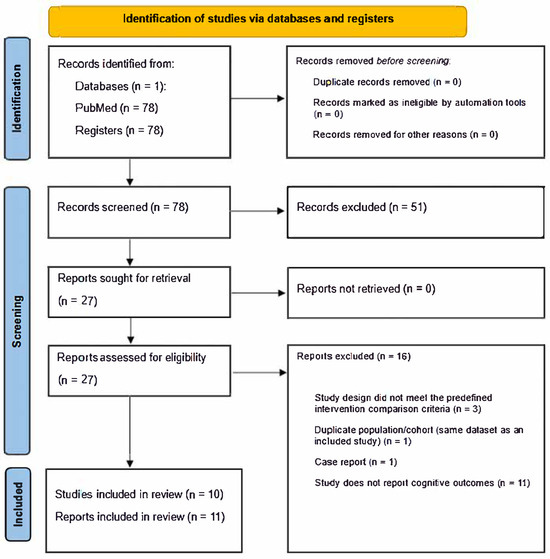
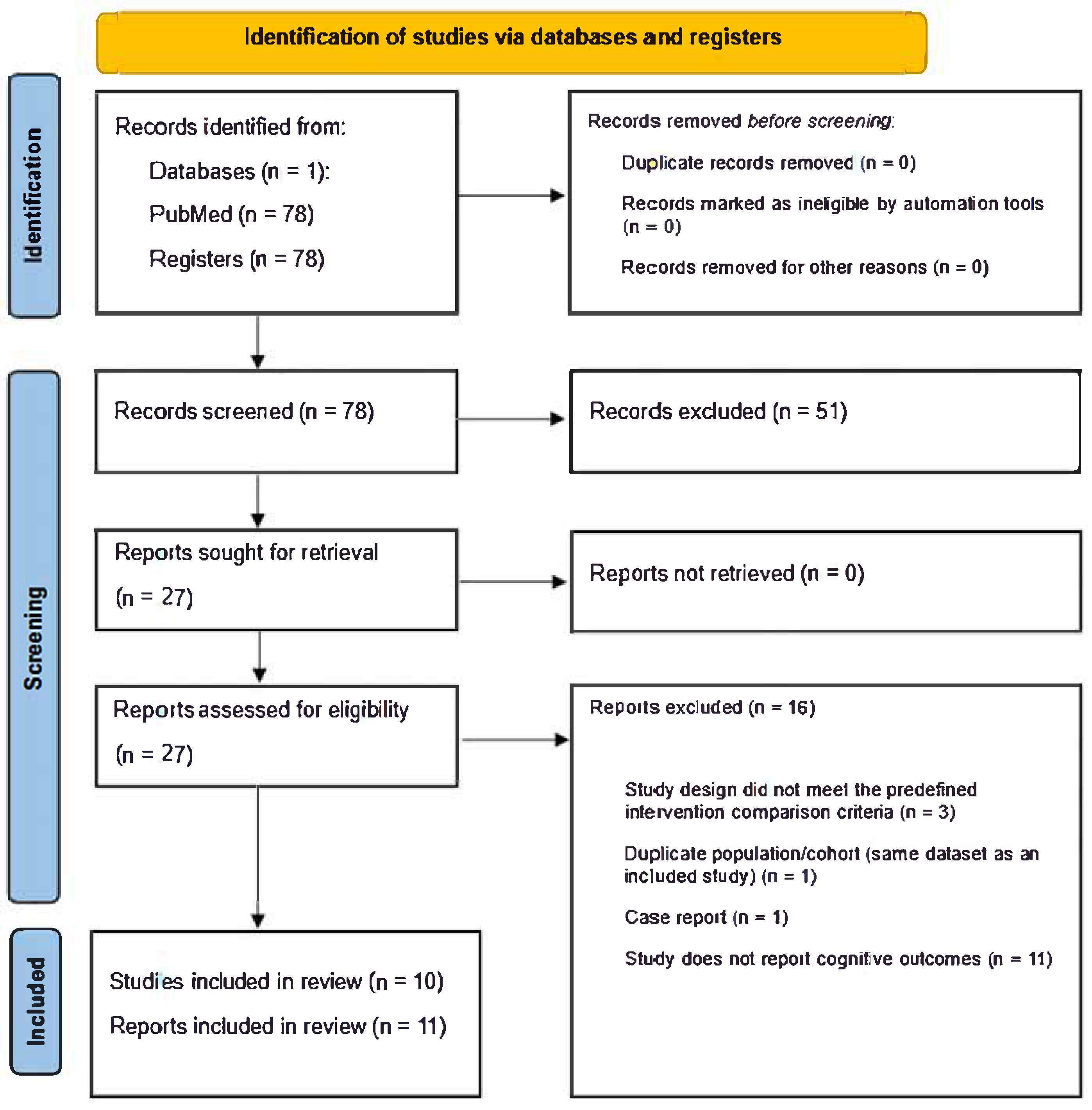
The PubMed search identified 78 records, all of which underwent title and abstract screening; no duplicates were identified. Fifty-one records were excluded at this stage, and 27 reports were sought for retrieval, all of which were found and went for full-text eligibility assessment. Of these, 11 reports representing 10 underlying studies met the eligibility criteria and were included in the synthesis. Takahashi et al. [18] and Malchow et al. [19] reported different outcomes from the same underlying trial cohort. The characteristics of the in-cluded reports are summarized in Table 1. The PRISMA 2020 flow diagram summa-rizing study identification, screening, eligibility assessment, and inclusion is shown in Figure 1.
Table 1.
Characteristics of the included studies.
Figure 1.
PRISMA flowchart.
3.2. Combined CR and PE Versus CR Alone
Nuechterlein et al. studied the impact of a 6-month program of cognitive training & exercise (CT&E) compared to cognitive training alone (CT) in 47 first-episode schizophrenia outpatients [20]. For the MATRICS Consensus Cognitive Battery (MCCB) overall composite score, significant improvement was found in the CT&E group compared to the CT-only group (F = 3.33, p = 0.04). During the first 3 months, cognitive improvement was substantially greater in the CT&E group (mean gain of 6.5 T-score points compared to 2.2 in the CT group; p = 0.012, Cohen’s f = 0.43). In the CT&E group, the baseline-covaried MCCB score went from 22.9 (0.9) at baseline to 29.4 (1.0) at 3 months and 29.7 (1.0) at 6 months. In the CT group, the baseline-covaried MCCB score went from 22.9 (0.9) at baseline to 25.1 (1.0) at 3 months and 28.1 (1.0) at 6 months. Improvement in muscular endurance over three months (measured by the number of sit-ups) showed a trend toward correlating with cognitive improvement at three months (MCCB overall composite score: r = 0.28, n = 40, p < 0.08). In a previous pilot study, the same group of authors [14] found a notable effect on the MATRICS (MCCB) global composite score, where the CT&E group showed improvement with a large effect size compared to the CT-only group (Cohen’s f = 0.48). When exploring this in several cognitive domains, considerable differences were found for social cognition (Cohen’s f = 0.65) and working memory (Cohen’s f = 0.50), and moderate differences were found for processing speed (Cohen’s f = 0.38) and attention/vigilance (Cohen’s f = 0.33).
In a randomized controlled trial of exercise on augmenting the effects of cognitive remediation in persons with severe mental illness, McGurk et al. explored whether adding a 30 h aerobic exercise program over 10 weeks to an equally intensive cognitive remediation program (CR + E) improved cognitive functioning more than cognitive remediation alone (CR-Only). Thirty-four participants with schizophrenia or bipolar disorder were randomly assigned to CR + E or CR-Only, and cognitive functioning was assessed at baseline and post-treatment [21]. Both groups (CR + E and CR-Only) showed significant improvement in global cognitive function as measured by the MATRICS Consensus Cognitive Battery (MCCB), but there were no significant differences between the groups. The cognitive composite score (MCCB) for the CR + E group improved from 33.85 (SD = 6.64) to 40.15 (SD = 5.01), while the CR-Only group improved from 34.06 (SD = 8.01) to 42.66 (SD = 3.15). However, on the Trail Making Test Part B, both groups showed an increase in response time (indicating a decline in performance), although the trend suggests that the CR + E group experienced less deterioration compared to the CR-Only group (p = 0.099, η2 = 0.10).
A German group led by Oertel-Knöchel studied two disease groups (n = 22 major depression patients; n = 29 schizophrenia patients) that were matched for age, gender, duration of disease, and years of education and received cognitive training combined either with aerobic physical exercise or with mental relaxation training [22]. They found an improvement in speed of processing in patients with schizophrenia (F(46) = 37.55, p < 0.001) but no significant intervention effect (p > 0.05). However, the effect size was larger in the group that combined cognitive training with exercise (d = 0.57), in comparison with the relaxation group (d = 0.43) and the control group (d = 0.50). In working memory, a significant improvement was observed in patients with schizophrenia (F(46) = 9.34, p < 0.05), with a significant intervention group effect (F(46) = 10.23, p = 0.02) and a significant time-by-intervention effect in the group that combined cognitive remediation with aerobic exercise (t = 18.82, p < 0.001). Visual learning improved in both major depression and schizophrenia patients. The effect size was larger in the group that combined cognitive remediation with exercise (d = 0.91), whereas it was moderate in the group that combined cognitive remediation with relaxation (d = 0.47) and small in the control group (d = 0.25) [22].
Takahashi et al. investigated 23 healthy controls (HC-EX group), 21 schizophrenia patients who performed aerobic exercise (SCZ-EX group), and 21 schizophrenia patients who played table soccer (SCZ-EXCONT group). The 12-week exercise intervention was combined with computer-assisted cognitive remediation training from week 6 to week 12 [18]. In executive function, they found that TMT-B completion time in the SCZ-EX group showed no significant changes (Pre = 65.3 s, Post = 63.2 s, p = 0.917). Conversely, in the SCZ-EXCONT group, TMT-B completion time improved significantly after the intervention (Pre = 81.1 s, Post = 70.2 s, p = 0.039). In processing speed, no significant differences were found in TMT-A completion time in the SCZ-EX group (Pre = 30.3 s, Post = 30.2 s, p = 0.626). In the SCZ-EXCONT group, there was a significant improvement in TMT-A performance following the intervention (Pre = 34.1 s, Post = 28.4 s, p = 0.001). In terms of short-term memory, no significant differences were found in short-term memory scores in the SCZ-EX group (Pre = 13.5, Post = 13.8, p = 0.681). In the SCZ-EXCONT group, there was a significant improvement in scores following the intervention (Pre = 12, Post = 13.6, p = 0.047).
Malchow et al. evaluated the effects of an enriched environment paradigm consisting of bicycle ergometer training and add-on computer-assisted cognitive remediation training [19]. For short-term memory (STM), significant effects of time (F = 4.6; df = 2, 53; p = 0.015) and significant time × group interactions (F = 2.7; df = 4, 108; p = 0.034) were observed. For long-term memory (LTM), a significant effect of time was found (F = 11.0; df = 2, 53; p < 0.0005). The ET + CR improved from 21.9 ± 5.6 to +12.7% at 3 months vs. 6 weeks (p = 0.030). No improvements were observed in the CR group. Significant improvement was observed in the total score of the Wisconsin Card Sorting Test (WCST) in the ET + CR group (baseline score: 34.5 ± 6.8), with improvement also observed at 3 months compared to 6 weeks (Z = −2.6, p = 0.008) but no significant improvements in the CR group.
3.3. Combined CR and PE Versus PE Alone
Dai et al. recruited a group of ninety-six patients with schizophrenia and cognitive impairment, who were randomly assigned to the control, aerobic exercise (AE), and computerized cognitive remediation therapy combined with aerobic exercise (CAE) groups [23]. Processing speed was assessed using the Trail Making Test-A (TMT-A) and the Symbol Coding Test (SCT). No significant differences were found among the three groups during the first 4 weeks. At 8 weeks, a significant overall difference among the groups was found for the TMT-A (F = 5.768, p = 0.005, η2 = 0.127) and the SCT (F = 5.148, p = 0.008, η2 = 0.115). The CAE group showed significant improvements compared to the AE group (TMT-A: p = 0.04; SCT: p = 0.008) and the control group (TMT-A: p = 0.002; SCT: p < 0.001). No significant differences were found between the AE group and the control group. Changes from baseline to week 8 differed significantly among the three groups (TMT-A: F = 7.937, p < 0.001, η2 = 0.167; SCT: F = 8.882, p < 0.001, η2 = 0.184), confirming that CAE showed the greatest improvement in processing speed.
Cognitive flexibility was assessed using the Stroop Word Test (SWT) and Stroop Colour Test (SCoT). No significant differences were found among the three groups during the first 4 weeks. At 8 weeks, a significant overall difference was found among the groups in the SWT (F = 3.657, p = 0.030, η2 = 0.085) and SCoT (F = 5.300, p = 0.007, η2 = 0.118), indicating that the groups evolved differently. At 8 weeks, the CAE group showed significant improvement in both tests compared to the AE group (SWT: p = 0.009; SCoT: p = 0.033) and the control group (SWT: p < 0.001; SCoT: p = 0.001). Again, no significant differences were observed between the AE group and the control group. Changes from baseline to week 8 were significantly different among the three groups (SWT: F = 9.934, p < 0.001, η2 = 0.201; SCoT: F = 7.514, p = 0.001, η2 = 0.160), with CAE showing the most pronounced improvements. At 12 weeks, improvements in processing speed and cognitive flexibility were maintained in the CAE group, with significant differences compared to the other groups and no significant differences between the AE and control groups [23].
A French group led by Dubreucq et al. conducted a quasi-experimental study evaluating the effects of an exercise-enriched, integrated social cognitive remediation (SCR) intervention, called Remed Rugby (RR), compared with an active control group practicing Touch Rugby (TR) [24]. Moderate improvements in verbal abstraction were observed in the RR group compared to the TR group (p = 0.008, d = 0.554). Additionally, significant improvements were found in immediate memory (BEMRI.NB, p = 0.008) and delayed memory (BEMRD.NB, p = 0.021) in the RR group. Delayed memory showed improvement post-treatment (p = 0.036), whereas immediate memory did not show a significant change post-treatment (p = 0.158). Furthermore, improvements were found in cognitive flexibility and processing speed, reflected in reduced completion times on the Trail Making Test A (p = 0.006 post-treatment, p = 0.001 at follow-up, p = 0.02 post-treatment change) and Trail Making Test B (p = 0.043 post-treatment, p = 0.008 at follow-up, p = 0.04 post-treatment change). Also, a significant improvement was observed in information encoding—assessed via the WAIS-IV Coding subscale—with statistically significant differences post-treatment (p < 0.001) and at follow-up (p < 0.001). Significant improvement was evident at the post-treatment follow-up (p = 0.015).
3.4. Combined Cognitive Remediation and Physical Exercise in a Three-Arm Design
Shimada et al. studied the effect of aerobic exercise (AE) versus cognitive remediation (CR) versus a combination of both (AE + CR) among patients with schizophrenia in a three-arm, randomized controlled study [25]. They found that the group that combined CR and AE showed significantly greater improvement than both CR alone and AE alone. The adjusted difference was 0.98 versus EA (95% CI: 0.14 to 1.82; p = 0.017) and 0.90 versus CR (95% CI: 0.13 to 1.68; p = 0.019). There were no differences between the CR and AE groups (estimate = −0.08; 95% CI: −0.79 to 0.63; p = 0.831). In verbal memory, a greater improvement was observed in the AE + CR group compared to AE and CR alone. The adjusted difference in change was significant versus AE alone, with an estimate of 0.79 (95% CI: 0.31 to 1.27; p < 0.001), and versus CR alone, with an estimate of 0.44 (95% CI: 0.00 to 0.88; p = 0.048). The comparison between CR and AE did not reach significance, although it showed a trend favoring CR (estimate = −0.35; 95% CI: −0.75 to 0.06; p = 0.090). In working memory, the combined group showed significantly greater improvement than the cognitive remediation-only group, with an adjusted difference of 0.97 (95% CI: 0.35 to 1.59; p = 0.001). Comparison against aerobic exercise alone showed a trend favoring the combined treatment, though without statistical significance (estimate = 0.43; 95% CI: −0.08 to 0.95; p = 0.096). A trend favoring AE over CR was also observed, without reaching significance (estimate = 0.54; 95% CI: −0.08 to 1.15; p = 0.096).
In verbal fluency, absolute improvements were observed in all three groups, with the greatest numerical gain in the combined intervention. However, there were no significant differences between the groups. All three groups also showed numerical improvements in motor speed, but no significant differences were observed between the interventions. CR showed the greatest absolute change, although this did not translate into statistical superiority. In attention and processing speed, the combined intervention showed significantly greater improvement than CR alone, with an adjusted difference of 0.93 (95% CI: 0.14 to 1.71; p = 0.016). Compared with aerobic exercise alone, a trend favoring the combined treatment was observed, though it did not reach statistical significance (estimate = 0.69; 95% CI: −0.05 to 1.43; p = 0.071). There were no differences between AE and CR (estimate = 0.23; 95% CI: −0.44 to 0.90; p = 0.490). For executive function, the combination of AE and CR showed significantly greater improvement than either treatment by itself. Compared with AE, the adjusted difference was 1.22 (95% CI: 0.35 to 2.10; p = 0.004), whereas compared with CR, it was 1.28 (95% CI: 0.35 to 2.21; p = 0.004). There were no differences between AE and CR (estimate = 0.05; 95% CI: −0.74 to 0.85; p = 0.892) [25].
However, another study exploring possible synergistic benefits of physical and cognitive exercise in schizophrenia found some results favoring physical exercise alone [26]. In particular, a significant group effect was found for processing speed (Processing Speed Index—PSI) (F [2, 81] = 14.78, p < 0.001), with a significant improvement in the physical exercise (PE) group compared to the cognitive training (CT) and combined PE + CT groups (p < 0.01). No significant differences were observed between the CT and PE + CT groups. The PE group, with a baseline score of 74.34 ± 11.84, showed an increase of approximately 10 points in PSI, reaching a value close to 85 post-intervention. The CT group, with a baseline score of 72.61 ± 12.35, showed an increase of around 4–5 points, reaching a level close to 77 post-intervention. The PE + CT group, with a baseline score of 72.88 ± 11.22, exhibited an increase of approximately 6 points, with a post-intervention value close to 79. Another significant group effect was found for working memory (Working Memory Index—WMI) (F [2, 81] = 11.40, p < 0.01), where both the PE and PE + CT groups showed significant improvement compared to the CT-only group (p < 0.001). The PE group started with a baseline value of 83.63 ± 9.05, which increased by approximately 4 points, reaching values close to 88 post-intervention. The CT group, with a baseline score of 81.48 ± 10.21, showed an increase of around 3 points, reaching a level close to 84 post-intervention. The PE + CT group, with a baseline score of 81.77 ± 8.97, showed an increase of nearly 6 points, with post-intervention values around 87.
However, at the 2-month follow-up, only the PE + CT group sustained improvements in working memory and processing speed, with a significant group effect (F [3, 78] = 22.19–23.81, p < 0.001). In contrast, improvements in the PE and CT groups partially diminished, with scores returning to levels close to baseline. The PE + CT group at the 2-month follow-up maintained greater stability in improvements, with PSI values around 80 and WMI values near 87. This study found that participants with high motivation showed greater improvements in processing speed and working memory across all groups. The relationship between initial motivation and change in WMI was significant in the CT group (r = 0.22, p < 0.05) and the PE + CT group (r = 0.26, p < 0.01) [26].
Agostoni et al. carried out a randomized, multicenter, single-blind clinical trial with three parallel arms: cognitive remediation (CR), aerobic exercise (AE), and cognitive remediation plus aerobic exercise (CR + AE). The combined intervention produced significantly greater improvements than CR alone in attention, working memory, and verbal learning and greater improvements than AE alone in processing speed, working memory, and verbal learning. The authors concluded that “Two is Better Than One” [27].
3.5. Risk of Bias
Risk of bias was assessed in all 11 included reports. Among the seven randomized reports, four received an overall risk-of-bias judgment of “some concerns” [18,20,21,26], while three were judged to be at high risk [19,22,27]. The most consistent source of concern was the selection of the reported result, as the available information was insufficient to exclude selection among multiple eligible outcomes or analyses. The high-risk judgments were driven mainly by limitations related to missing outcome data. Bias due to deviations from intended interventions was judged to be low in all seven randomized reports, while bias in outcome measurement was low in six and raised some concerns in only one [18]. All four non-randomized reports were judged to be at serious risk of bias according to ROBINS-I criteria [14,23,24,25], principally because of potential confounding.
4. Discussion
This systematic review addresses a clinically relevant question: Is the combination of physical exercise and cognitive remediation better than each of these interventions by itself? This will contribute to a broader question, which is how to appropriately treat cognitive symptoms in patients with schizophrenia, considering the information currently available. This is important, considering the clinical relevance of cognitive symptoms for community functioning and quality of life, particularly since usual pharmacological treatments for schizophrenia lack significant effects for improving cognitive symptoms.
Cognitive impairment in primary psychotic disorders is ubiquitous, with approximately 80% of patients exhibiting clinically significant impairment. However, even in the absence of clinically significant cognitive impairment, it has been argued that all individuals with a primary psychotic disorder perform at a level below what would be expected had they never developed a psychotic illness [10]. Therefore, helping these patients could have a significant impact on public health.
After reviewing all selected papers, in most cases, the combined intervention was superior to both cognitive remediation and physical exercise as individual interventions. This was the case for composite scores but also for several cognitive domains, such as verbal memory, executive function, working memory, and attention/processing speed. In several studies, it was not clear whether physical exercise or cognitive remediation was better as individual interventions. In most cases, they produced comparable cognitive improvements, with no significant differences between them in any domain. However, it was clear that the combination was better [26].
Potential shared molecular mechanisms must be considered, as both cognitive remediation and physical exercise can increase the expression of brain-derived neurotrophic factor (BDNF) [16]. As Jahshan et al. have explained [28], given that cognitive remediation may depend on intact neuroplasticity to produce cognitive gains, it is reasonable to combine it with strategies that harness patients’ neuroplastic potential. Future reviews could deepen the investigation into how the combination of physical exercise and cognitive remediation may have additive effects in the increase in BDNF levels or other biological markers at the molecular, neurophysiological, or neuroimaging levels.
This review has several strengths. It provides an updated synthesis focused specifically on the potential additive cognitive effects of combining cognitive remediation and physical exercise in people with schizophrenia spectrum disorders. The review followed a registered protocol, applied explicit eligibility criteria and PRISMA-based study selection, and incorporated recent evidence, including two three-arm randomized trials published in 2025. Methodological quality was evaluated at the report level using design-specific risk-of-bias tools, with detailed assessments provided in the Supplementary Materials. The synthesis also distinguished between three-arm designs capable of directly examining additivity and studies providing comparator-specific or indirect evidence.
Several limitations should nevertheless be acknowledged. The literature search was restricted to PubMed, and publication bias was not formally assessed; therefore, relevant studies or selectively unpublished findings may have been missed. The included reports differed substantially in design, patient characteristics, intervention content and duration, comparator conditions, and the cognitive domains and instruments used to assess outcomes. This heterogeneity precluded a meaningful meta-analysis, necessitated a narrative synthesis, and limited the comparability and generalizability of the findings. Furthermore, only a subset of the included studies directly compared CR + PE with both CR alone and PE alone. Much of the available evidence can therefore demonstrate only an incremental benefit relative to a particular comparator rather than definitive evidence of additivity.
The evidence was also affected by a variable risk of bias. Among the seven randomized reports, four received an overall judgment of “some concerns,” while three were judged to be at high risk. All four non-randomized reports were judged to be at serious risk, principally because of potential confounding. Antipsychotic treatment was not consistently accounted for and may have influenced cognitive performance and participation in physical exercise. The findings should therefore be interpreted cautiously and considered suggestive rather than definitive.
Despite these limitations, the results summarized in this review may help researchers design future studies aimed at determining which characteristics of physical activity, including exercise type, duration, and frequency, are best suited to particular forms of cognitive remediation, such as compensatory or restorative approaches targeting executive or perceptual functioning. Another important direction is the identification of clinical indicators or biomarkers that could help select the most appropriate combination of exercise and cognitive remediation for each patient, supporting a more personalized approach.
This systematic review could also be useful for policymakers and clinicians who are involved in defining future treatment guidelines. Current practice should match up-to-date knowledge, and a better understanding of the additive effects of cognitive remediation and physical exercise for improving cognition in schizophrenia could positively impact the lives of many patients suffering from cognitive symptoms.
Supplementary Materials
The following supporting information can be downloaded at https://www.mdpi.com/article/10.3390/brainsci16090933/s1, File S1: PRISMA 2020 checklist; File S2: Risk of bias assessments.
Author Contributions
Conceptualization, D.B., J.P.E. and R.R.N.; methodology, D.B., B.C. and R.R.N.; investigation, D.B., J.P.E. and R.A.; data curation, D.B., J.P.E. and R.A.; writing—original draft preparation, D.B., B.C. and R.R.N.; writing—review and editing, D.B., J.P.E., R.A., B.C., K.V. and R.R.N.; visualization, D.B.; supervision, K.V. and R.R.N.; project administration, D.B. and R.R.N.; funding acquisition, R.R.N. All authors have read and agreed to the published version of the manuscript.
Funding
This research was funded by Agencia Nacional de Investigación y Desarrollo (ANID) Fondecyt de Iniciación 11231216.
Institutional Review Board Statement
Not applicable.
Informed Consent Statement
Not applicable.
Data Availability Statement
The original contributions presented in this study are included in the article, and the references can be found in publicly available databases.
Conflicts of Interest
The authors declare no conflicts of interest.
References
- American Psychiatric Association. Diagnostic and Statistical Manual of Mental Disorders, 5th ed.; American Psychiatric Association: Washington, DC, USA, 2013. [Google Scholar] [CrossRef] [Scilit]
- Kahn, R.S.; Sommer, I.E.; Murray, R.M.; Meyer-Lindenberg, A.; Weinberger, D.R.; Cannon, T.D.; O’Donovan, M.; Correll, C.U.; Kane, J.M.; van Os, J.; et al. Schizophrenia. Nat. Rev. Dis. Primers 2015, 1, 15067. [Google Scholar] [CrossRef] [Scilit] [PubMed]
- Owen, M.; Sawa, A.; Mortensen, P. Schizophrenia. Lancet 2016, 388, 86–97. [Google Scholar] [PubMed]
- Schaefer, J.; Giangrande, E.; Weinberger, D.R.; Dickinson, D. The global cognitive impairment in schizophrenia: Consistent over decades and around the world. Schizophr. Res. 2013, 150, 42–50. [Google Scholar] [CrossRef] [Scilit] [PubMed] [PubMed Central]
- Czepielewski, L.S.; Alliende, L.M.; Castañeda, C.P.; Castro, M.; Guinjoan, S.M.; Massuda, R.; Berberian, A.A.; Fonseca, A.O.; Gadelha, A.; Bressan, R.; et al. Effects of socioeconomic status in cognition of people with schizophrenia: Results from a Latin American collaboration network with 1175 subjects. Psychol. Med. 2022, 52, 2177–2188. [Google Scholar] [CrossRef] [Scilit] [PubMed]
- Kuo, S.S.; Almasy, L.; Gur, R.C.; Prasad, K.; Roalf, D.R.; Gur, R.E.; Nimgaonkar, V.L.; Pogue-Geile, M.F. Cognition and community functioning in schizophrenia: The nature of the relationship. J. Abnorm. Psychol. 2018, 127, 216–227. [Google Scholar] [CrossRef] [Scilit] [PubMed] [PubMed Central]
- Keefe, R.S.; Bilder, R.M.; Davis, S.M.; Harvey, P.D.; Palmer, B.W.; Gold, J.M.; Meltzer, H.Y.; Green, M.F.; Capuano, G.; Stroup, T.S.; et al. CATIE Investigators; Neurocognitive Working Group. Neurocognitive effects of antipsychotic medications in patients with chronic schizophrenia in the CATIE Trial. Arch. Gen. Psychiatry 2007, 64, 633–647. [Google Scholar] [CrossRef] [Scilit] [PubMed]
- Bowie, C.R.; Bell, M.D.; Fiszdon, J.M.; Johannesen, J.K.; Lindenmayer, J.P.; McGurk, S.R.; Medalia, A.A.; Penadés, R.; Saperstein, A.M.; Twamley, E.W.; et al. Cognitive remediation for schizophrenia: An expert working group white paper on core techniques. Schizophr. Res. 2020, 215, 49–53. [Google Scholar] [CrossRef] [Scilit] [PubMed]
- Vita, A.; Barlati, S.; Ceraso, A.; Nibbio, G.; Ariu, C.; Deste, G.; Wykes, T. Effectiveness, Core Elements, and Moderators of Response of Cognitive Remediation for Schizophrenia: A Systematic Review and Meta-analysis of Randomized Clinical Trials. JAMA Psychiatry 2021, 78, 848–858. [Google Scholar] [CrossRef] [Scilit] [PubMed] [PubMed Central]
- McCleery, A.; Nuechterlein, K.H. Cognitive impairment in psychotic illness: Prevalence, profile of impairment, developmental course, and treatment considerations. Dialogues Clin. Neurosci. 2019, 21, 239–248. [Google Scholar] [CrossRef] [Scilit] [PubMed] [PubMed Central]
- Medalia, A.; Choi, J. Cognitive remediation in schizophrenia. Neuropsychol. Rev. 2009, 19, 353–364. [Google Scholar] [CrossRef] [Scilit] [PubMed]
- Deste, G.; Corbo, D.; Nibbio, G.; Italia, M.; Dell’Ovo, D.; Calzavara-Pinton, I.; Lisoni, J.; Barlati, S.; Gasparotti, R.; Vita, A. Impact of Physical Exercise Alone or in Combination with Cognitive Remediation on Cognitive Functions in People with Schizophrenia: A Qualitative Critical Review. Brain Sci. 2023, 13, 320. [Google Scholar] [CrossRef] [Scilit] [PubMed]
- Yang, Y.; Yuan, Y.; Zhang, H.; Fu, X.; Wang, T.; Wang, J.; Fang, C.C. Optimal exercise dose and type for improving schizophrenia symptoms in adults: A systematic review and Bayesian network meta-analysis. Neurosci. Biobehav. Rev. 2024, 167, 105896. [Google Scholar] [CrossRef] [Scilit] [PubMed]
- Nuechterlein, K.H.; Ventura, J.; McEwen, S.C.; Gretchen-Doorly, D.; Vinogradov, S.; Subotnik, K.L. Enhancing cognitive training through aerobic exercise after a first schizophrenia episode: Theoretical conception and pilot study. Schizophr. Bull. 2016, 42, S44–S52. [Google Scholar] [CrossRef] [Scilit] [PubMed]
- Campos, C.; Rocha, N.B.F.; Lattari, E.; Nardi, A.E.; Machado, S. Exercise induced neuroplasticity to enhance therapeutic outcomes of cognitive remediation in schizophrenia: Analyzing the role of brain-derived neurotrophic factor. CNS Neurol. Disord. Drug Targets 2017, 16, 638–651. [Google Scholar] [CrossRef] [Scilit] [PubMed]
- Nieto, R.R.; Carrasco, A.; Corral, S.; Castillo, R.; Gaspar, P.A.; Bustamante, M.L.; Silva, H. BDNF as a Biomarker of Cognition in Schizophrenia/Psychosis: An Updated Review. Front. Psychiatry 2021, 12, 662407. [Google Scholar] [CrossRef] [Scilit] [PubMed]
- Page, M.J.; McKenzie, J.E.; Bossuyt, P.M.; Boutron, I.; Hoffmann, T.C.; Mulrow, C.D.; Shamseer, L.; Tetzlaff, J.M.; Akl, E.A.; Brennan, S.E.; et al. The PRISMA 2020 statement: An updated guideline for reporting systematic reviews. BMJ 2021, 372, n71. [Google Scholar] [CrossRef] [Scilit] [PubMed]
- Takahashi, S.; Keeser, D.; Rauchmann, B.S.; Schneider-Axmann, T.; Keller-Varady, K.; Maurus, I.; Dechent, P.; Wobrock, T.; Hasan, A.; Schmitt, A.; et al. Effect of aerobic exercise combined with cognitive remediation on cortical thickness and prediction of social adaptation in patients with schizophrenia. Schizophr. Res. 2020, 216, 397–407. [Google Scholar] [CrossRef] [Scilit] [PubMed]
- Malchow, B.; Keller, K.; Hasan, A.; Dörfler, S.; Schneider-Axmann, T.; Hillmer-Vogel, U.; Honer, W.G.; Schulze, T.G.; Niklas, A.; Wobrock, T.; et al. Effects of Endurance Training Combined With Cognitive Remediation on Everyday Functioning, Symptoms, and Cognition in Multiepisode Schizophrenia Patients. Schizophr. Bull. 2015, 41, 847–858. [Google Scholar] [CrossRef] [Scilit] [PubMed] [PubMed Central]
- Nuechterlein, K.H.; McEwen, S.C.; Ventura, J.; Subotnik, K.L.; Turner, L.R.; Boucher, M.; Casaus, L.R.; Distler, M.G.; Hayata, J.N. Aerobic exercise enhances cognitive training effects in first-episode schizophrenia: Randomized clinical trial demonstrates cognitive and functional gains. Psychol. Med. 2023, 53, 4751–4761. [Google Scholar] [CrossRef] [Scilit] [PubMed]
- McGurk, S.R.; Otto, M.W.; Fulford, D.; Cutler, Z.; Mulcahy, L.P.; Talluri, S.S.; Qiu, W.Q.; Gan, Q.; Tran, I.; Turner, L.; et al. A randomized controlled trial of exercise on augmenting the effects of cognitive remediation in persons with severe mental illness. J. Psychiatr. Res. 2021, 139, 38–46. [Google Scholar] [CrossRef] [Scilit] [PubMed]
- Oertel-Knöchel, V.; Mehler, P.; Thiel, C.; Steinbrecher, K.; Malchow, B.; Tesky, V.; Ademmer, K.; Prvulovic, D.; Banzer, W.; Zopf, Y.; et al. Effects of aerobic exercise on cognitive performance and individual psychopathology in depressive and schizophrenia patients. Eur. Arch. Psychiatry Clin. Neurosci. 2014, 264, 589–604. [Google Scholar] [CrossRef] [Scilit] [PubMed]
- Dai, Y.; Ding, H.; Lu, X.; Wu, X.; Xu, C.; Jiang, T.; Ming, L.; Xia, Z.; Song, C.; Shen, H.; et al. CCRT and aerobic exercise: A randomised controlled study of processing speed, cognitive flexibility, and serum BDNF expression in schizophrenia. Schizophrenia 2022, 8, 84. [Google Scholar] [CrossRef] [Scilit] [PubMed]
- Dubreucq, J.; Gabayet, F.; Ycart, B.; Faraldo, M.; Melis, F.; Lucas, T.; Arnaud, B.; Bacconnier, M.; Bakri, M.; Cambier, G.; et al. Improving social function with real-world social-cognitive remediation in schizophrenia: Results from the RemedRugby quasi-experimental trial. Eur. Psychiatry 2020, 63, e41. [Google Scholar] [CrossRef] [Scilit] [PubMed]
- Shimada, T.; Ito, S.; Yamanushi, A.; Koizumi, A.; Kobayashi, M. Effect of aerobic exercise versus cognitive remediation versus a combination of both on cognition among patients with schizophrenia: A three-arm, randomized controlled study. Psychiatry Res. 2025, 348, 116454. [Google Scholar] [CrossRef] [Scilit] [PubMed]
- Choi, J.; Taylor, B.; Fiszdon, J.M.; Kurtz, M.M.; Tek, C.; Dewberry, M.J.; Haber, L.C.; Shagan, D.; Assaf, M.; Pearlson, G.D. The synergistic benefits of physical and cognitive exercise in schizophrenia: Promoting motivation to enhance community effectiveness. Schizophr. Res. Cogn. 2019, 19, 100147. [Google Scholar] [CrossRef] [Scilit] [PubMed] [PubMed Central]
- Agostoni, G.; Repaci, F.; Bechi, M.; Calzavara Pinton, I.; Buonocore, M.; Spangaro, M.; Sapienza, J.; Martini, F.; D’Antoni, E.; Giglio, B.; et al. Two is Better Than One: Potentiating Cognitive Remediation With Aerobic Exercise to Improve Cognition in Schizophrenia With a Randomized Controlled Trial. Actas Esp. Psiquiatr. 2025, 53, 648–657. [Google Scholar] [CrossRef] [Scilit] [PubMed] [PubMed Central]
- Jahshan, C.; Rassovsky, Y.; Green, M.F. Enhancing neuroplasticity to augment cognitive remediation in schizophrenia. Front. Psychiatry 2017, 8, 191. [Google Scholar] [CrossRef] [Scilit] [PubMed]

Disclaimer/Publisher’s Note: The statements, opinions and data contained in all publications are solely those of the individual author(s) and contributor(s) and not of MDPI and/or the editor(s). MDPI and/or the editor(s) disclaim responsibility for any injury to people or property resulting from any ideas, methods, instructions or products referred to in the content. |
© 2026 by the authors. Licensee MDPI, Basel, Switzerland. This article is an open access article distributed under the terms and conditions of the Creative Commons Attribution (CC BY) license.