Bimanual Force Production at 90-Degree Relative Phase with Lissajous Feedback

 and
and 
Abstract
1. Introduction
2. Materials and Methods
2.1. Participants
2.2. Apparatus
2.3. Sensitivity of Force Circles
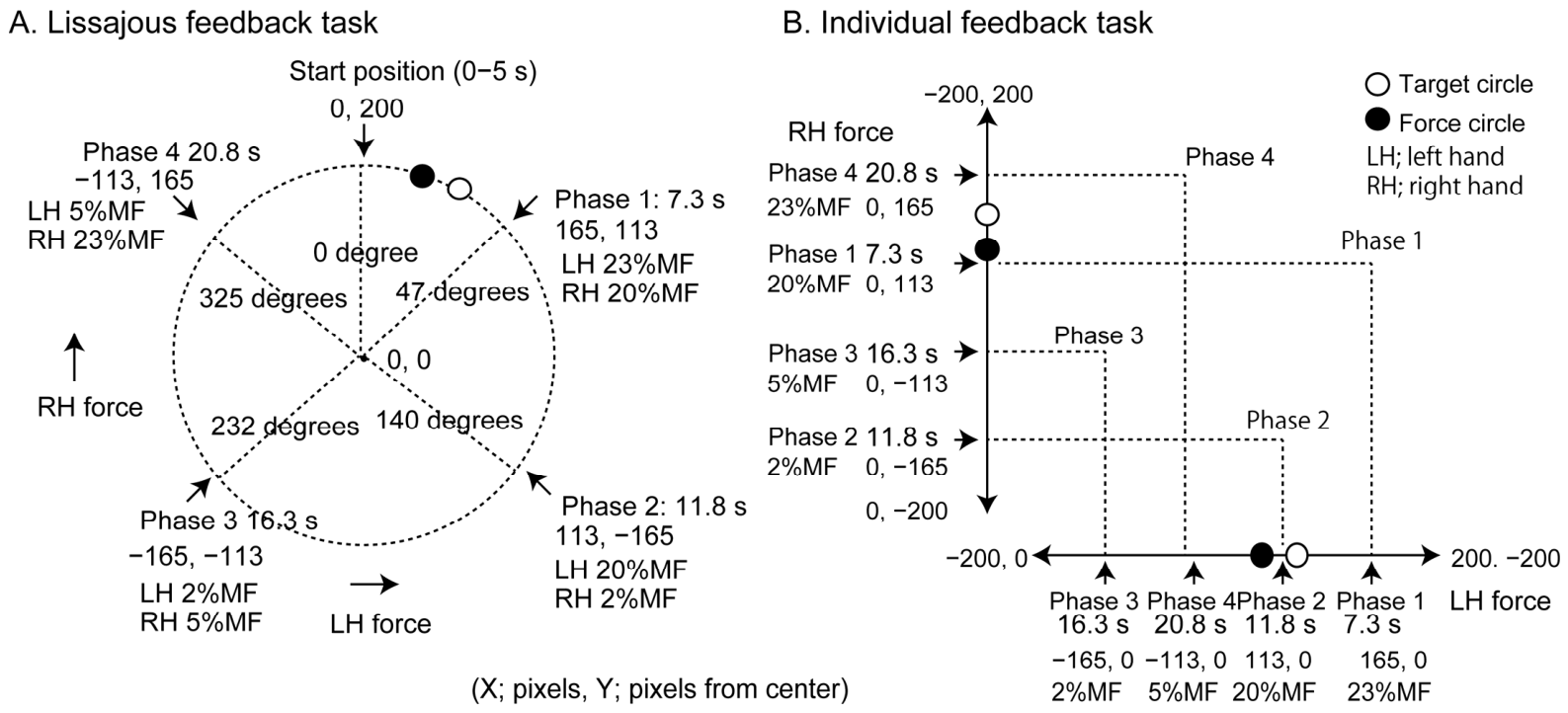
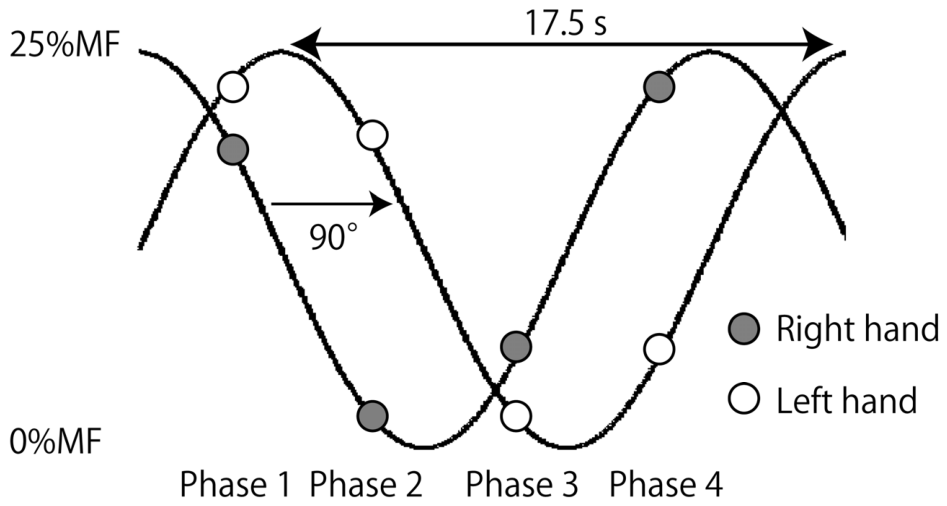
2.4. Lissajous Feedback Task
2.5. Individual Feedback Task
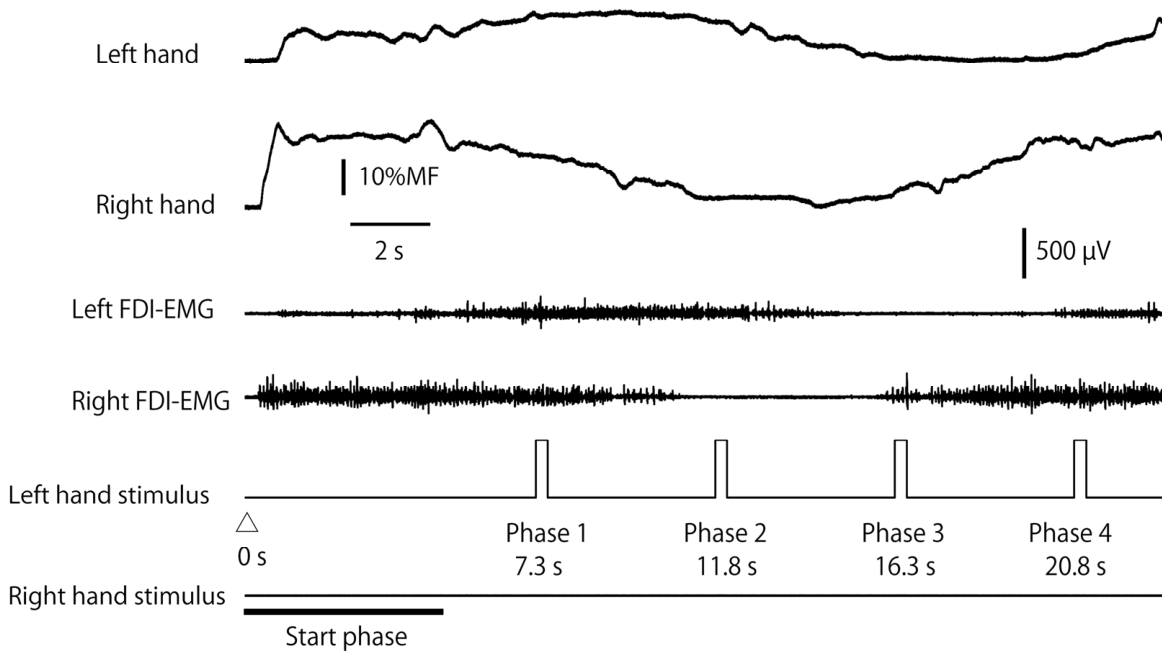
2.6. Tactile Stimulation
2.7. Study Design
2.8. Data Analysis
3. Results
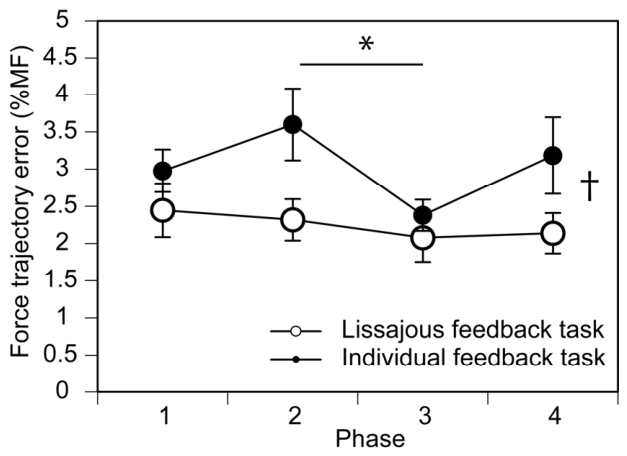
3.1. Force Trajectory Error
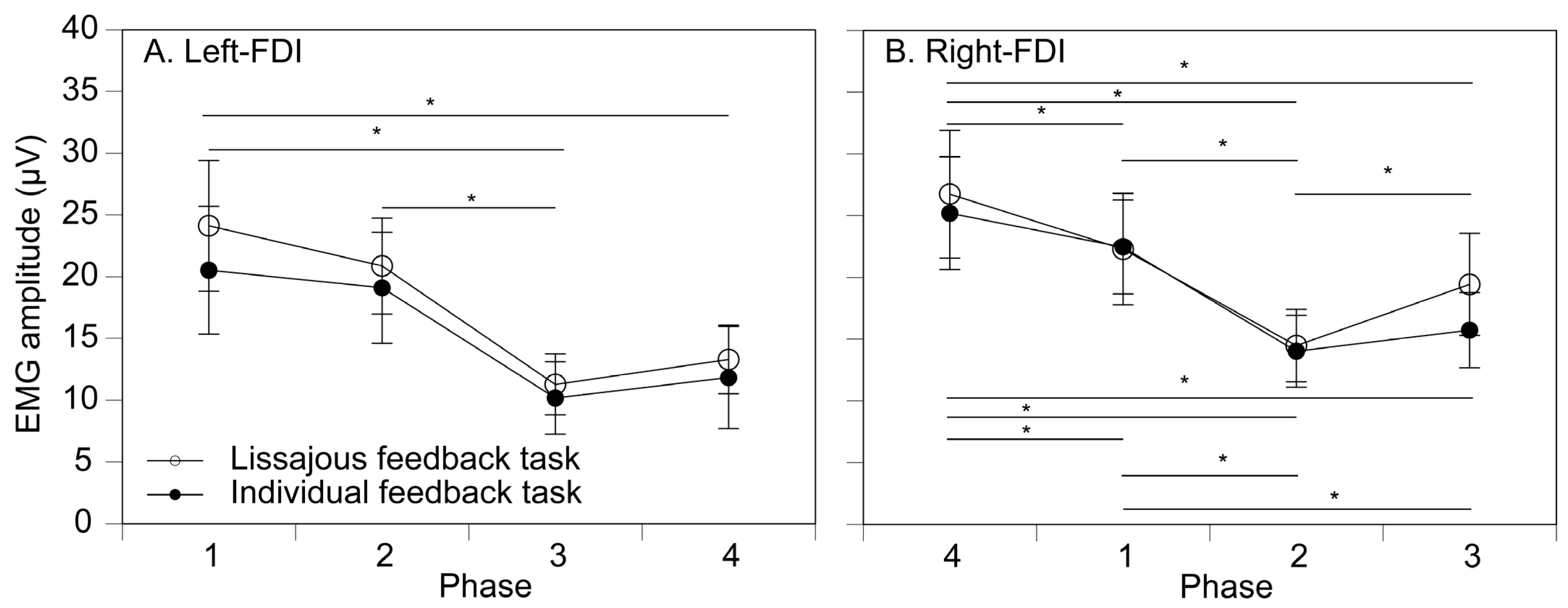
3.2. Post-Stimulus EMG Amplitude
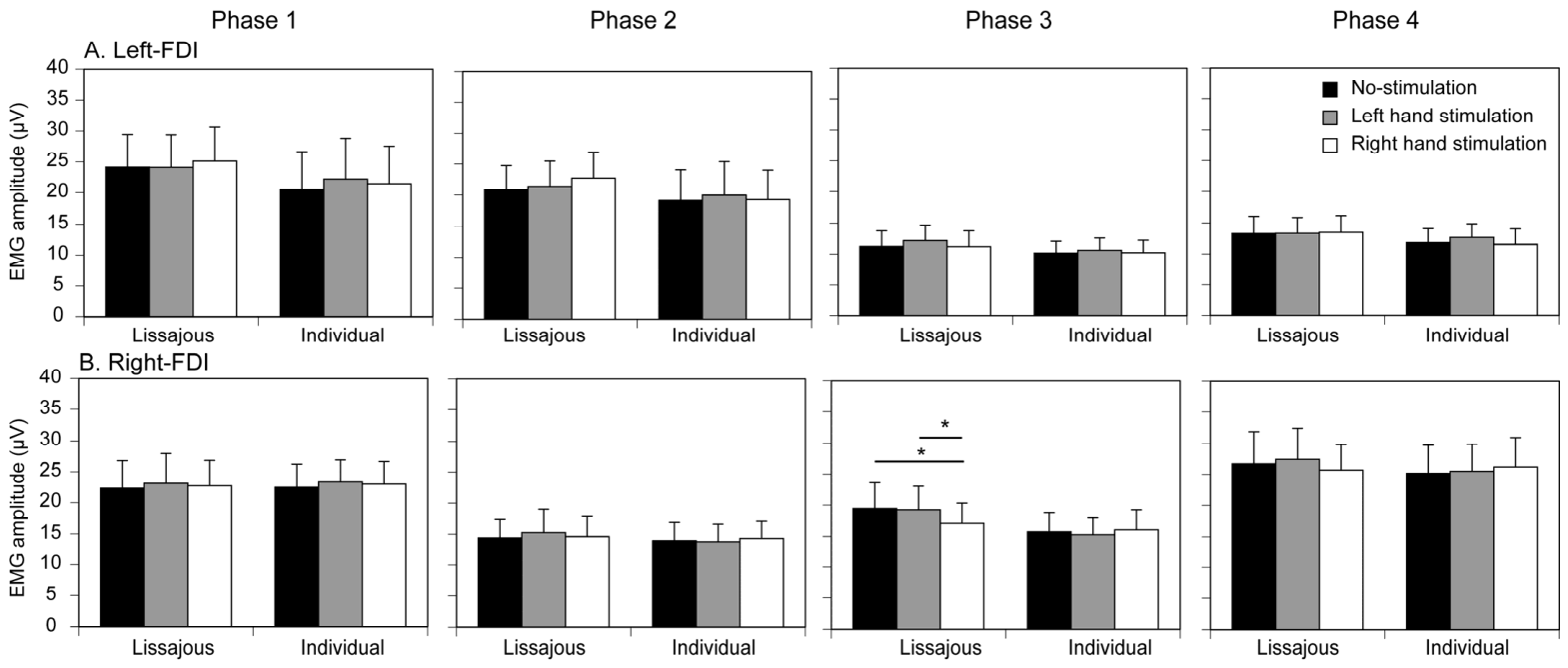
3.3. Tactile Stimulus Effect on Post-Stimulus EMG
4. Discussion
4.1. Summary
4.2. Masking of Tactile Stimulus-Induced Inhibition
4.3. Task Difficulty
4.4. Intermanual Difference
4.5. Phase Dependency
4.6. Limitations
5. Conclusions
Author Contributions
Funding
Institutional Review Board Statement
Informed Consent Statement
Data Availability Statement
Conflicts of Interest
Abbreviations
| SAI | Short-latency afferent inhibition |
| EMG | Electromyography |
| FDI | First dorsal interosseous muscle |
| MF | Maximal force |
References
- Yamanishi, J.I.; Kawato, M.; Suzuki, R. Two coupled oscillators as a model for the coordinated finger tapping by both hands. Biol. Cybern. 1980, 37, 219–225. [Google Scholar] [CrossRef] [Scilit]
- Tuller, B.; Kelso, J.A.S. Environmentally-specified patterns of movement coordination in normal and split-brain subjects. Exp. Brain Res. 1989, 75, 306–316. [Google Scholar] [CrossRef] [Scilit]
- Zanone, P.G.; Kelso, J.A. Evolution of behavioral attractors with learning: Nonequilibrium phase transitions. J. Exp. Psychol. Hum. Percept. Perform. 1992, 18, 403–421. [Google Scholar] [CrossRef]
- James, E.; Layne, C.S.; Newell, K.M. Distributional properties of relative phase in bimanual coordination. Mot. Control 2010, 14, 478–489. [Google Scholar] [CrossRef] [Scilit]
- Schöner, G.; Kelso, J.S. Dynamic pattern generation in behavioral and neural systems. Science 1988, 239, 1513–1520. [Google Scholar] [CrossRef] [Scilit] [PubMed]
- Kennerley, S.W.; Diedrichsen, J.; Hazeltine, E.; Semjen, A.; Ivry, R.B. Callosotomy patients exhibit temporal uncoupling during continuous bimanual movements. Nat. Neurosci. 2002, 5, 376–381. [Google Scholar] [CrossRef] [Scilit] [PubMed]
- Kovacs, A.J.; Buchanan, J.J.; Shea, C.H. Bimanual 1:1 with 90° continuous relative phase: Difficult or easy? Exp. Brain Res. 2009, 193, 129–136. [Google Scholar] [CrossRef] [Scilit] [PubMed]
- Kovacs, A.J.; Shea, C.H. Amplitude differences, spatial assimilation, and integrated feedback in bimanual coordination. Exp. Brain Res. 2010, 202, 519–525. [Google Scholar] [CrossRef] [Scilit]
- Kovacs, A.J.; Buchanan, J.J.; Shea, C.H. Perceptual and attentional influences on continuous 2:1 and 3:2 multi-frequency bimanual coordination. J. Exp. Psychol. Hum. Percept. Perform. 2010, 36, 936–949. [Google Scholar] [CrossRef] [Scilit]
- Kovacs, A.J.; Buchanan, J.J.; Shea, C.H. Impossible is nothing: 5:3 and 4:3 multi-frequency bimanual coordination. Exp. Brain Res. 2010, 201, 249–259. [Google Scholar] [CrossRef] [Scilit]
- Kovacs, A.J.; Shea, C.H. The learning of 90° continuous relative phase with and without Lissajous feedback: External and internally generated bimanual coordination. Acta Psychol. 2011, 136, 311–320. [Google Scholar] [CrossRef] [Scilit]
- Verschueren, S.M.P.; Swinnen, S.P.; Dom, R.; De Weerdt, W. Interlimb coordination in patients with Parkinson’s disease: Motor learning deficits and the importance of augmented information feedback. Exp. Brain Res. 1997, 113, 497–508. [Google Scholar] [CrossRef] [Scilit] [PubMed]
- Swinnen, S.P.; Wenderoth, N. Two hands, one brain: Cognitive neuroscience of bimanual skill. Trends Cogn. Sci. 2004, 8, 18–25. [Google Scholar] [CrossRef] [Scilit]
- Swinnen, S.P.; Gooijers, J. Bimanual coordination. In Brain Mapping: An Encyclopedic Reference; Elsevier: Amsterdam, The Netherlands, 2015; Volume 2, pp. 475–482. [Google Scholar] [CrossRef] [Scilit]
- Weinrich, M.; Neto, O.P.; Wang, Y.; Balthazor, B.; Kennedy, D.M. Bimanual coordination and neuromuscular synchronization in Parkinson’s disease and healthy adults. Exp. Brain Res. 2025, 243, 104. [Google Scholar] [CrossRef] [Scilit]
- Panzer, S.; Kennedy, D.; Leinen, P.; Pfeifer, C.; Shea, C. Bimanual coordination associated with left-and right-hand dominance: Testing the limb assignment and limb dominance hypothesis. Exp. Brain Res. 2021, 239, 1595–1605. [Google Scholar] [CrossRef] [Scilit] [PubMed]
- McCulloch, A.T.; Park, I.; Wright, D.L.; Buchanan, J.J. Off-line learning in a rhythmic bimanual task: Early feedback dependency is reduced over wakefulness. Psychol. Res. 2021, 85, 1503–1514. [Google Scholar] [CrossRef] [Scilit]
- Wolpert, D.M.; Ghahramani, Z. Computational principles of movement neuroscience. Nat. Neurosci. 2000, 3, 1212–1217. [Google Scholar] [CrossRef] [Scilit]
- Dupin, L.; Hayward, V.; Wexler, M. Direct coupling of haptic signals between hands. Proc. Natl. Acad. Sci. USA 2015, 112, 619–624. [Google Scholar] [CrossRef] [Scilit]
- Kelso, J.A.; Tuller, B. Converging evidence in support of common dynamical principles for speech and movement coordination. Am. J. Physiol. Regul. Integr. Comp. Physiol. 1984, 246, R928–R935. [Google Scholar] [CrossRef] [Scilit]
- Maertens de Noordhout, A.; Rothwell, J.C.; Day, B.L.; Dressler, D.; Nakashima, K.; Thompson, P.D.; Marsden, C.D. Effect of digital nerve stimuli on responses to electrical or magnetic stimulation of the human brain. J. Physiol. 1992, 447, 535–548. [Google Scholar] [CrossRef] [Scilit] [PubMed]
- Tokimura, H.; Di Lazzaro, V.; Tokimura, Y.; Oliviero, A.; Profice, P.; Insola, A.; Rothwell, J.C. Short latency inhibition of human hand motor cortex by somatosensory input from the hand. J. Physiol. 2000, 523, 503–513. [Google Scholar] [CrossRef] [Scilit]
- Oda, H.; Tsujinaka, R.; Fukuda, S.; Sawaguchi, Y.; Hiraoka, K. Tactile perception of right middle fingertip suppresses excitability of motor cortex supplying right first dorsal interosseous muscle. Neuroscience 2022, 494, 82–93. [Google Scholar] [CrossRef] [Scilit]
- Oldfield, R.C. The assessment and analysis of handedness: The Edinburgh inventory. Neuropsychologia 1971, 9, 97–113. [Google Scholar] [CrossRef] [Scilit]
- Cohen, J. Statistical Power Analysis for the Behavioral Sciences, 2nd ed.; Lawrence Erlbaum Associates: Hillsdale, NJ, USA, 1988. [Google Scholar]
- Asmussen, M.J.; Jacobs, M.F.; Lee, K.G.; Zapallow, C.M.; Nelson, A.J. Short-latency afferent inhibition modulation during finger movement. PLoS ONE 2013, 8, e60496. [Google Scholar] [CrossRef] [Scilit] [PubMed]
- Angel, R.W.; Malenka, R.C. Velocity-dependent suppression of cutaneous sensitivity during movement. Exp. Neurol. 1982, 77, 266–274. [Google Scholar] [CrossRef] [Scilit]
- Chapman, C.E.; Bushnell, M.C.; Miron, D.; Duncan, G.H.; Lund, J.P. Sensory perception during movement in man. Exp. Brain Res. 1987, 68, 516–524. [Google Scholar] [CrossRef] [Scilit] [PubMed]
- Post, L.J.; Zompa, I.C.; Chapman, C.E. Perception of vibrotactile stimuli during motor activity in human subjects. Exp. Brain Res. 1994, 100, 107–120. [Google Scholar] [CrossRef] [Scilit]
- Williams, S.R.; Chapman, C.E. Time course and magnitude of movement-related gating of tactile detection in humans. II. Effects of stimulus intensity. J. Neurophysiol. 2000, 84, 863–875. [Google Scholar] [CrossRef] [Scilit] [PubMed]
- Colino, F.L.; Binsted, G. Time course of tactile gating in a reach-to-grasp and lift task. J. Mot. Behav. 2016, 48, 390–400. [Google Scholar] [CrossRef] [Scilit]
- Gertz, H.; Voudouris, D.; Fiehler, K. Reach-relevant somatosensory signals modulate tactile suppression. J. Neurophysiol. 2017, 117, 2262–2268. [Google Scholar] [CrossRef] [Scilit]
- Voudouris, D.; Fiehler, K. Enhancement and suppression of tactile signals during reaching. J. Exp. Psychol. Hum. Percept. Perform. 2017, 43, 1238–1250. [Google Scholar] [CrossRef] [Scilit]
- Fraser, L.E.; Fiehler, K. Predicted reach consequences drive time course of tactile suppression. Behav. Brain Res. 2018, 350, 54–64. [Google Scholar] [CrossRef] [Scilit]
- Voudouris, D.; Broda, M.D.; Fiehler, K. Anticipatory grasping control modulates somatosensory perception. J. Vis. 2019, 19, 4. [Google Scholar] [CrossRef] [Scilit]
- Hlushchuk, Y.; Hari, R. Transient suppression of ipsilateral primary somatosensory cortex during tactile finger stimulation. J. Neurosci. 2006, 26, 5819–5824. [Google Scholar] [CrossRef] [Scilit] [PubMed]
- Helmich, R.C.G.; Bäumer, T.; Siebner, H.R.; Bloem, B.R.; Münchau, A. Hemispheric asymmetry and somatotopy of afferent inhibition in healthy humans. Exp. Brain Res. 2005, 167, 211–219. [Google Scholar] [CrossRef] [Scilit] [PubMed]
- Nijem, R.M.; Galpin, A.J. Unilateral versus bilateral exercise and the role of the bilateral force deficit. Strength Cond. J. 2014, 36, 113–118. [Google Scholar] [CrossRef] [Scilit]
- Hamill, P.V.; Drizd, T.A.; Johnson, C.L.; Reed, R.B.; Roche, A.F. NCHS Growth Curves for Children Birth-18 Years; Department of Health Education and Welfare: Washington, DC, USA, 1977.
- Thomas, J.R.; French, K.E. Gender differences across age in motor performance: A meta-analysis. Psychol. Bull. 1985, 98, 260. [Google Scholar] [CrossRef]
- de Poel, H.J.; Peper, C.L.; Beek, P.J. Handedness-related asymmetry in coupling strength in bimanual coordination: Furthering theory and evidence. Acta Psychol. 2007, 124, 209–237. [Google Scholar] [CrossRef] [Scilit] [PubMed]
- Serrien, D.J.; Ivry, R.B.; Swinnen, S.P. The missing link between action and cognition. Prog. Neurobiol. 2007, 82, 95–107. [Google Scholar] [CrossRef] [Scilit]


Disclaimer/Publisher’s Note: The statements, opinions and data contained in all publications are solely those of the individual author(s) and contributor(s) and not of MDPI and/or the editor(s). MDPI and/or the editor(s) disclaim responsibility for any injury to people or property resulting from any ideas, methods, instructions or products referred to in the content. |
© 2026 by the authors. Licensee MDPI, Basel, Switzerland. This article is an open access article distributed under the terms and conditions of the Creative Commons Attribution (CC BY) license.
Share and Cite
Hamada, N.; Fukuda, S.; Gao, H.; Oda, H.; Kunimura, H.; Kawasaki, T.; Hiraoka, K. Bimanual Force Production at 90-Degree Relative Phase with Lissajous Feedback. Brain Sci. 2026, 16, 462. https://doi.org/10.3390/brainsci16050462
Hamada N, Fukuda S, Gao H, Oda H, Kunimura H, Kawasaki T, Hiraoka K. Bimanual Force Production at 90-Degree Relative Phase with Lissajous Feedback. Brain Sciences. 2026; 16(5):462. https://doi.org/10.3390/brainsci16050462
Chicago/Turabian StyleHamada, Naoki, Shiho Fukuda, Han Gao, Hitoshi Oda, Hiroshi Kunimura, Taku Kawasaki, and Koichi Hiraoka. 2026. "Bimanual Force Production at 90-Degree Relative Phase with Lissajous Feedback" Brain Sciences 16, no. 5: 462. https://doi.org/10.3390/brainsci16050462
APA StyleHamada, N., Fukuda, S., Gao, H., Oda, H., Kunimura, H., Kawasaki, T., & Hiraoka, K. (2026). Bimanual Force Production at 90-Degree Relative Phase with Lissajous Feedback. Brain Sciences, 16(5), 462. https://doi.org/10.3390/brainsci16050462