Neural Oscillatory and Network Signatures of Age-Related Cognitive Decline Under Motor-Cognitive Dual-Task Conditions
Abstract
1. Introduction
2. Materials and Methods
2.1. Participants
2.2. Experimental Design
2.3. EEG Data Acquisition, Processing and Analysis
2.3.1. Acquisition
2.3.2. Preprocessing
2.3.3. Power Spectral Density
2.3.4. Brain Functional Networks
2.3.5. Participant Characteristics and Behavioral Metrics
2.3.6. Statistical Analysis
3. Results
3.1. Demographic Data
3.2. Task Performance
3.3. Power Spectral Density
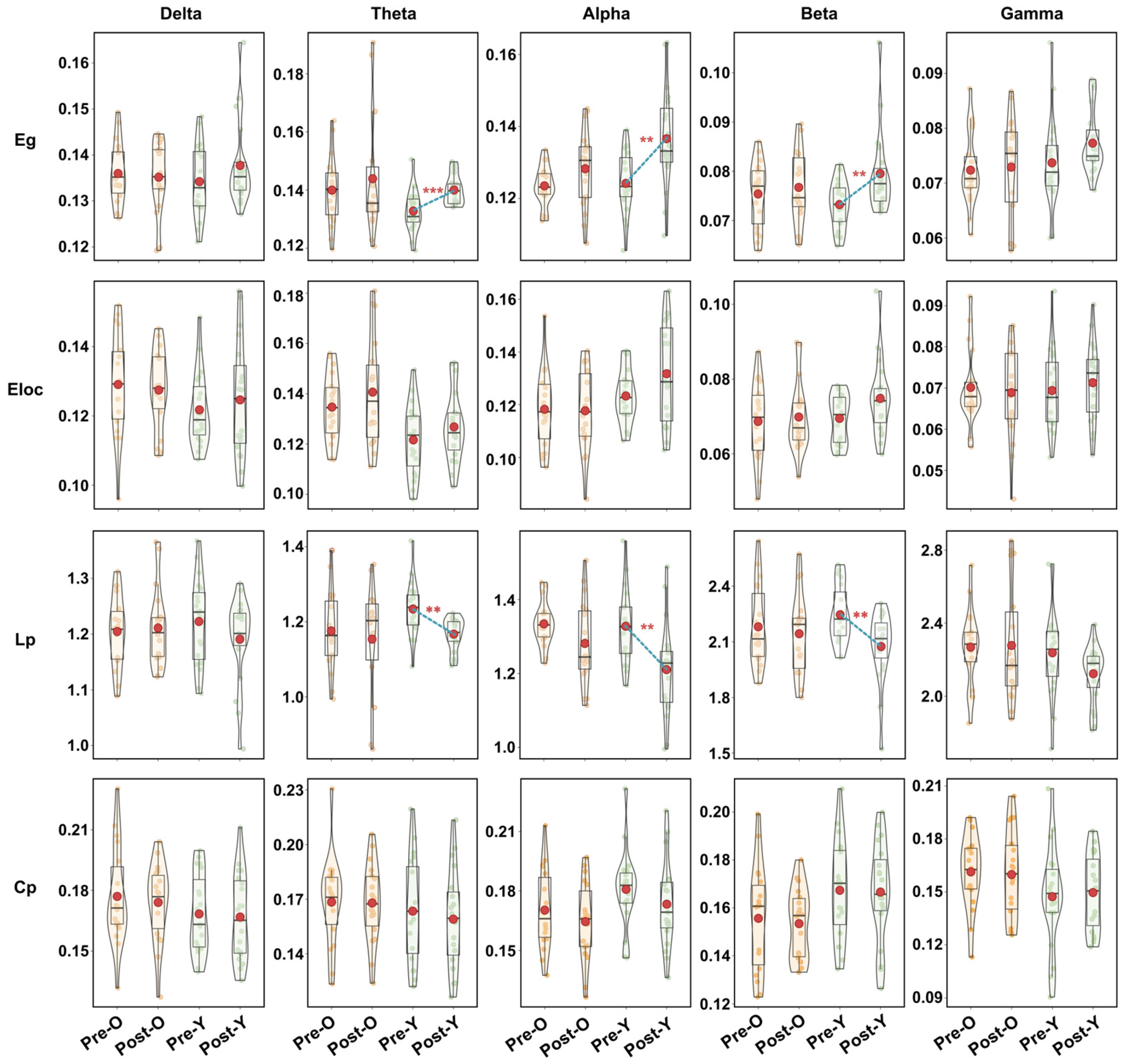
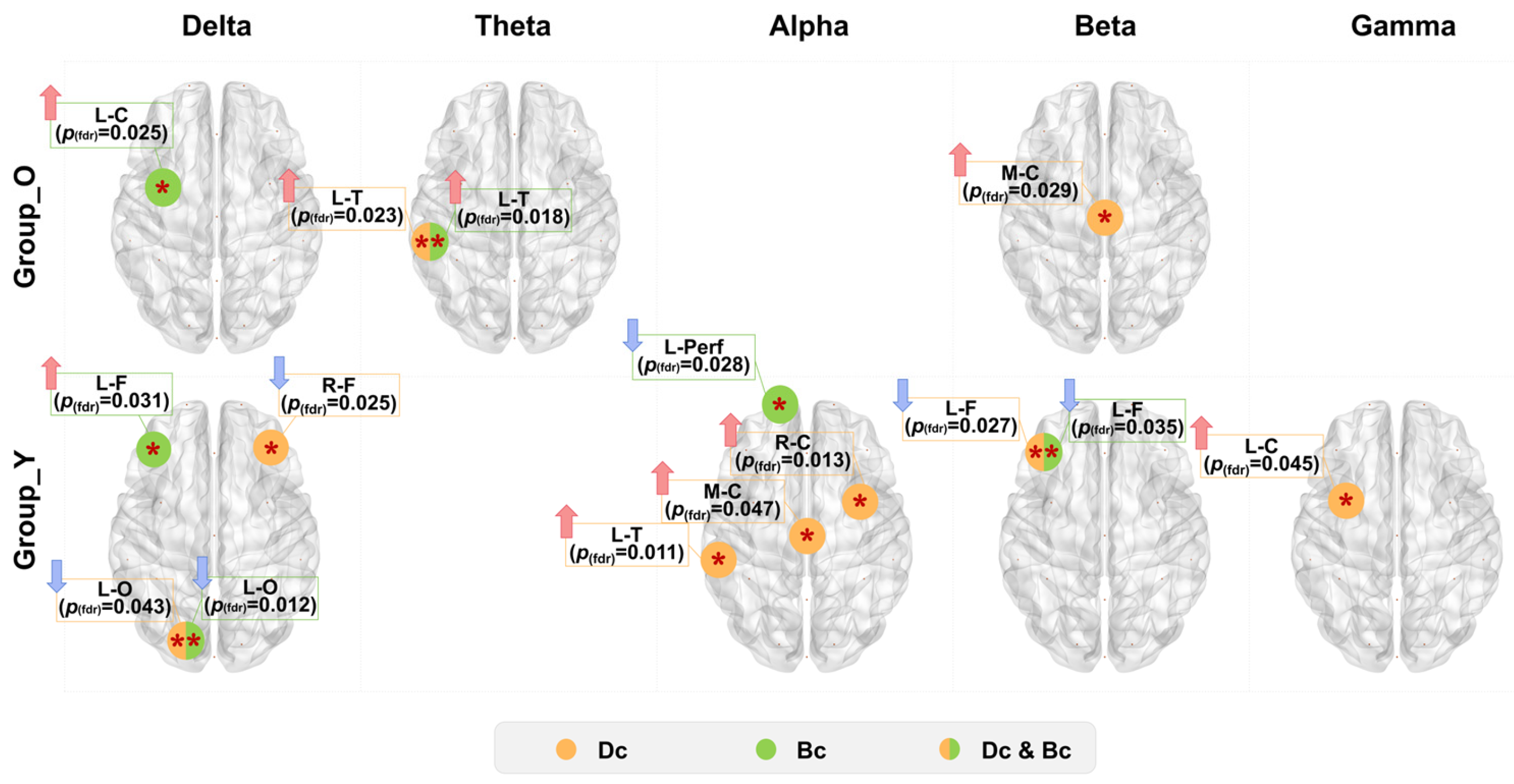
3.4. Functional Connectivity
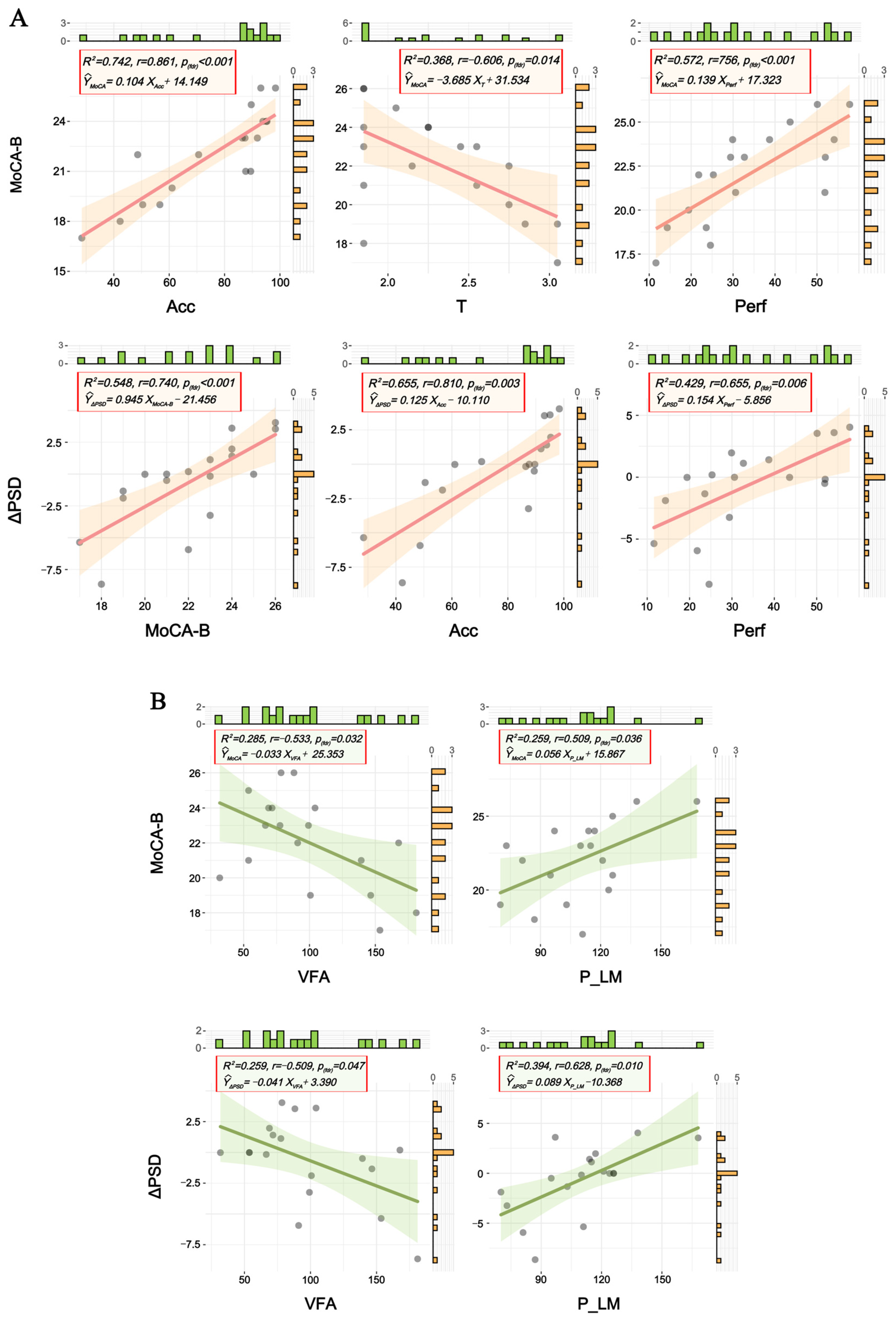
3.5. Correlation Analysis
4. Discussion
4.1. Task Performance
4.2. Power Spectral Density
4.3. Functional Connectivity
4.4. Correlation Analysis
4.5. Limitations
5. Conclusions
Supplementary Materials
Author Contributions
Funding
Institutional Review Board Statement
Informed Consent Statement
Data Availability Statement
Acknowledgments
Conflicts of Interest
Abbreviations
| EEG | electroencephalography |
| MMSE | Mini-Mental State Examination |
| MoCA | Montreal Cognitive Assessment |
| MoCA-B | Montreal Cognitive Assessment—BeiJing |
| fMRI | functional Magnetic Resonance Imaging |
| PET | Positron Emission Tomography |
| DT | Dual Task |
| RHR | Resting Heart Rate |
| BMI | Body Mass Index |
| SMI | Muscle Mass Index |
| P_LM | Lower Limb Extensor Peak Torque |
| VFA | Visceral Fat Area |
| BIA | Bioelectrical Impedance Analysis |
| PSD | Power Spectral Density |
| wPLI | Weighted Phase Lag Index |
| Eg | Global Efficiency |
| Eloc | Local Efficiency |
| Lp | Characteristic Path Length |
| Cp | Clustering Coefficient |
| Dc | Degree Centrality |
| Bc | Betweenness Centrality |
| Acc | Accuracy Rate |
| T | Mean Response Time |
| Perf | Performance Index |
| NBS | Network Based Statistic |
| FDR | False Discovery Rate |
References
- Mooraj, Z.; Salami, A.; Campbell, K.L.; Dahl, M.J.; Kosciessa, J.Q.; Nassar, M.R.; Werkle-Bergner, M.; Craik, F.I.; Lindenberger, U.; Mayr, U.; et al. Toward a functional future for the cognitive neuroscience of human aging. Neuron 2025, 113, 154–183. [Google Scholar] [CrossRef] [Scilit] [PubMed]
- Gallou-Guyot, M.; Mandigout, S.; Bherer, L.; Perrochon, A. Effects of exergames and cognitive-motor dual-task training on cognitive, physical and dual-task functions in cognitively healthy older adults: An overview. Ageing Res. Rev. 2020, 63, 101135. [Google Scholar] [CrossRef] [Scilit] [PubMed]
- Parvin, E.; Mohammadian, F.; Amani-Shalamzari, S.; Bayati, M.; Tazesh, B. Dual-Task Training Affect Cognitive and Physical Performances and Brain Oscillation Ratio of Patients With Alzheimer’s Disease: A Randomized Controlled Trial. Front. Aging Neurosci. 2020, 12, 605317. [Google Scholar] [CrossRef] [Scilit] [PubMed]
- Wang, J.; Wang, W.; Ren, S.; Shi, W.G.; Hou, Z.-G. Neural Correlates of Single-Task Versus Cognitive-Motor Dual-Task Training. IEEE Trans. Cogn. Dev. Syst. 2022, 14, 532–540. [Google Scholar] [CrossRef] [Scilit]
- Vandenheever, D.; Lambrechts, M. Dual-task changes in gait and brain activity measured in a healthy young adult population. Gait Posture 2023, 103, 119–125. [Google Scholar] [CrossRef] [Scilit]
- Sinaei, E.; Nami, M.; Saadat, Z. Cortical Activity During Postural Recovery Under Dual-task Conditions: A Quantitative EEG Study. Basic Clin. Neurosci. J. 2025, 16, 777–786. [Google Scholar] [CrossRef] [Scilit]
- Ding, Q.; Ou, Z.T.; Yao, S.T.; Wu, C.; Chen, J.; Shen, J.; Lan, Y.; Xu, G. Cortical activation and brain network efficiency during dual tasks: An fNIRS study. NeuroImage 2024, 289, 120545. [Google Scholar] [CrossRef] [Scilit]
- Miura, H.; Ono, Y.; Suzuki, T.; Ogihara, Y.; Imai, Y.; Watanabe, A.; Tokikuni, Y.; Sakuraba, S.; Sawamura, D. Regional brain activity and neural network changes in cognitive-motor dual-task interference: A functional near-infrared spectroscopy study. NeuroImage 2024, 297, 120714. [Google Scholar] [CrossRef] [Scilit]
- Cannon, J.; McCarthy, M.M.; Lee, S.; Lee, J.; Börgers, C.; Whittington, M.A.; Kopell, N. Neurosystems: Brain rhythms and cognitive processing. Eur. J. Neurosci. 2014, 39, 705–719. [Google Scholar] [CrossRef] [Scilit]
- Halgren, M.; Ulbert, I.; Bastuji, H.; Fabó, D.; Erőss, L.; Rey, M.; Devinsky, O.; Doyle, W.K.; Mak-McCully, R.; Halgren, E.; et al. The generation and propagation of the human alpha rhythm. Proc. Natl. Acad. Sci. USA 2019, 116, 23772–23782. [Google Scholar] [CrossRef] [Scilit]
- Palacino, F.; Manganotti, P.; Benussi, A. Targeting neural oscillations for cognitive enhancement in Alzheimer’s disease. Medicina 2025, 61, 547. [Google Scholar] [CrossRef] [Scilit] [PubMed]
- Uchida, K.; Sugimoto, T.; Tange, C.; Nishita, Y.; Shimokata, H.; Saji, N.; Kuroda, Y.; Matsumoto, N.; Kishino, Y.; Ono, R.; et al. Association between abdominal adiposity and cognitive decline in older adults: A 10-year community-based study. J. Nutr. Health Aging 2024, 28, 100175. [Google Scholar] [CrossRef] [Scilit] [PubMed]
- Zhai, Y.-J.; Li, F.; Lin, C.-Y.; Wu, F.; Qiu, H.-N.; Li, J.-B.; Lin, J.-N. The mediating role of body surface area-adjusted basal metabolic rate: Effects of low muscle mass and central obesity on cognitive impairment in Chinese patients with type 2 diabetes mellitus. Front. Endocrinol. 2025, 15, 1513035. [Google Scholar] [CrossRef] [Scilit] [PubMed]
- Gurholt, T.P.; Borda, M.G.; Parker, N.; Fominykh, V.; Kjelkenes, R.; Linge, J.; van der Meer, D.; Sønderby, I.E.; Duque, G.; Westlye, L.T.; et al. Linking sarcopenia, brain structure and cognitive performance: A large-scale UK Biobank study. Brain Commun. 2024, 6, fcae083. [Google Scholar] [CrossRef] [Scilit]
- Duranti, E.; Villa, C. From brain to muscle: The role of muscle tissue in neurodegenerative disorders. Biology 2024, 13, 719. [Google Scholar] [CrossRef] [Scilit]
- Shookster, D.; Lindsey, B.; Cortes, N.; Martin, J.R. Accuracy of Commonly Used Age-Predicted Maximal Heart Rate Equations. Int. J. Exerc. Sci. 2020, 13, 1242–1250. [Google Scholar] [CrossRef] [Scilit]
- Mann, T.; Lamberts, R.P.; Lambert, M.I. Methods of Prescribing Relative Exercise Intensity: Physiological and Practical Considerations. Sports Med. 2013, 43, 613–625. [Google Scholar] [CrossRef] [Scilit]
- Vinck, M.; Oostenveld, R.; van Wingerden, M.; Battaglia, F.; Pennartz, C.M.A. An improved index of phase synchronization for electrophysiological data in the presence of volume-conduction, noise and sample-size bias. NeuroImage 2011, 55, 1548–1565. [Google Scholar] [CrossRef] [Scilit]
- Delorme, A.; Makeig, S. EEGLAB: An open source toolbox for analysis of single-trial EEG dynamics including independent component analysis. J. Neurosci. Methods 2004, 134, 9–21. [Google Scholar] [CrossRef] [Scilit]
- Welch, P.D. The use of fast Fourier transform for the estimation of power spectra: A method based on time averaging over short, modified periodograms. IEEE Trans. Audio Electroacoust. 1967, 15, 70–73. [Google Scholar] [CrossRef] [Scilit]
- Wang, J.; Wang, X.; Xia, M.; Liao, X.; Evans, A.; He, Y. GRETNA: A graph theoretical network analysis toolbox for imaging connectomics. Front. Hum. Neurosci. 2015, 9, 386. [Google Scholar] [CrossRef] [Scilit] [PubMed]
- Shapiro, S.S.; Wilk, M.B. An analysis of variance test for normality (complete samples). Biometrika 1965, 52, 591–611. [Google Scholar] [CrossRef] [Scilit]
- Mann, H.B.; Whitney, D.R. On a test of whether one of two random variables is stochastically larger than the other. Ann. Math. Stat. 1947, 18, 50–60. [Google Scholar] [CrossRef] [Scilit]
- Wilcoxon, F. Individual comparisons by ranking methods. In Breakthroughs in Statistics: Methodology and Distribution; Springer: New York, NY, USA, 1992; pp. 196–202. [Google Scholar]
- Zalesky, A.; Fornito, A.; Bullmore, E.T. Network-based statistic: Identifying differences in brain networks. NeuroImage 2010, 53, 1197–1207. [Google Scholar] [CrossRef] [Scilit] [PubMed]
- Benjamini, Y.; Yekutieli, D. The control of the false discovery rate in multiple testing under dependency. Ann. Stat. 2001, 29, 1165–1188. [Google Scholar] [CrossRef] [Scilit]
- Maquestiaux, F.; Ruthruff, E. Testing the over-reliance on central attention (ORCA) hypothesis: Do older adults have difficulty automatizing especially easy tasks? J. Exp. Psychol. Gen. 2021, 150, 1722–1740. [Google Scholar] [CrossRef] [Scilit]
- Contemori, G.; Saccani, M.S.; Bonato, M. Cognitive-Cognitive Dual-task in aging: A cross-sectional online study. PLoS ONE 2024, 19, e0302152. [Google Scholar] [CrossRef] [Scilit]
- Stern, Y.; Arenaza-Urquiljo, E.M.; Bartrés-Faz, D.; Belleville, S.; Cantillon, M.; Chetelat, G.; Ewers, M.; Franzmeier, N.; Kempermann, G.; Kremen, W.S.; et al. Whitepaper: Defining and investigating cognitive reserve, brain reserve, and brain maintenance. Alzheimer’s Dement. 2020, 16, 1305–1311. [Google Scholar] [CrossRef] [Scilit]
- Oosterhuis, E.J.; Slade, K.; May, P.J.C.; Nuttall, H.E. Toward an Understanding of Healthy Cognitive Aging: The Importance of Lifestyle in Cognitive Reserve and the Scaffolding Theory of Aging and Cognition. J. Gerontol. Ser. B 2023, 78, 777–788. [Google Scholar] [CrossRef] [Scilit]
- Springer, S.D.; Okelberry, H.J.; Willett, M.P.; Johnson, H.J.; Meehan, C.E.; Schantell, M.; Embury, C.M.; Rempe, M.P.; Wilson, T.W. Age-related alterations in the oscillatory dynamics serving verbal working memory processing. Aging 2023, 15, 14574–14590. [Google Scholar] [CrossRef] [Scilit]
- Pavlov, Y.G.; Kotchoubey, B. Oscillatory brain activity and maintenance of verbal and visual working memory: A systematic review. Psychophysiology 2022, 59, e13735. [Google Scholar] [CrossRef] [Scilit] [PubMed]
- Jensen, O. Distractor inhibition by alpha oscillations is controlled by an indirect mechanism governed by goal-relevant information. Commun. Psychol. 2024, 2, 36. [Google Scholar] [CrossRef] [Scilit] [PubMed]
- Van Diepen, R.M.; Foxe, J.J.; Mazaheri, A. The functional role of alpha-band activity in attentional processing: The current zeitgeist and future outlook. Curr. Opin. Psychol. 2019, 29, 229–238. [Google Scholar] [CrossRef] [Scilit] [PubMed]
- Foxe, J.J.; Snyder, A.C. The role of alpha-band brain oscillations as a sensory suppression mechanism during selective attention. Front. Psychol. 2011, 2, 154. [Google Scholar] [CrossRef] [Scilit]
- Strobach, T. The dual-task practice advantage: Empirical evidence and cognitive mechanisms. Psychon. Bull. Rev. 2020, 27, 3–14. [Google Scholar] [CrossRef] [Scilit]
- Jiang, Y.; Zhang, X.; Guo, Z.; Jiang, N. Altered EEG Theta and Alpha Band Functional Connectivity in Mild Cognitive Impairment During Working Memory Coding. IEEE Trans. Neural Syst. Rehabil. Eng. 2024, 32, 2845–2853. [Google Scholar] [CrossRef] [Scilit]
- Patelaki, E.; Foxe, J.J.; Mantel, E.P.; Kassis, G.; Freedman, E.G. Paradoxical improvement of cognitive control in older adults under dual-task walking conditions is associated with more flexible reallocation of neural resources: A Mobile Brain-Body Imaging (MoBI) study. NeuroImage 2023, 273, 120098. [Google Scholar] [CrossRef] [Scilit]
- Ocklenburg, S.; Guo, Z.V. Cross-hemispheric communication: Insights on lateralized brain functions. Neuron 2024, 112, 1222–1234. [Google Scholar] [CrossRef] [Scilit]
- Hasanzadeh, F.; Habeck, C.; Gazes, Y.; Stern, Y. A neural implementation of cognitive reserve: Insights from a longitudinal fMRI study of set-switching in aging. Neurobiol. Aging 2025, 145, 76–83. [Google Scholar] [CrossRef] [Scilit]
- Michail, G.; Senkowski, D.; Niedeggen, M.; Keil, J. Memory load alters perception-related neural oscillations during multisensory integration. J. Neurosci. 2021, 41, 1505–1515. [Google Scholar] [CrossRef] [Scilit]
- Greene, B.; Tobyne, S.; Jannati, A.; McManus, K.; Osman, J.G.; Banks, R.; Kher, R.; Showalter, J.; Bates, D.; Pascual-Leone, A. The Dual Task Ball Balancing Test and Its Association With Cognitive Function: Algorithm Development and Validation. J. Med. Internet Res. 2024, 26, e49794. [Google Scholar] [CrossRef] [Scilit]
- Salzman, T.; Laurin, E.; Thibault, C.; Farrell, P.; Fraser, S. A systematic review and meta-analysis of dual-task outcomes in subjective cognitive decline. Alzheimer’s Dement. Diagn. Assess. Dis. Monit. 2025, 17, e70054. [Google Scholar] [CrossRef] [Scilit] [PubMed]
- Juul Rasmussen, I.; Qvist Thomassen, J.; Frikke-Schmidt, R. Impact of metabolic dysfunction on cognition in humans. Curr. Opin. Lipidol. 2021, 32, 55–61. [Google Scholar] [CrossRef] [Scilit] [PubMed]
- Farruggia, M.C.; Small, D.M. Effects of adiposity and metabolic dysfunction on cognition: A review. Physiol. Behav. 2019, 208, 112578. [Google Scholar] [CrossRef] [Scilit] [PubMed]
- Shichkova, P.; Coggan, J.S.; Markram, H.; Keller, D. Brain Metabolism in Health and Neurodegeneration: The Interplay Among Neurons and Astrocytes. Cells 2024, 13, 1714. [Google Scholar] [CrossRef] [Scilit]
- Na, D.; Zhang, Z.; Meng, M.; Li, M.; Gao, J.; Kong, J.; Zhang, G.; Guo, Y. Energy Metabolism and Brain Aging: Strategies to Delay Neuronal Degeneration. Cell. Mol. Neurobiol. 2025, 45, 38. [Google Scholar] [CrossRef] [Scilit]
- Gao, X.; Chen, Y.; Cheng, P. Unlocking the potential of exercise: Harnessing myokines to delay musculoskeletal aging and improve cognitive health. Front. Physiol. 2024, 15, 1338875. [Google Scholar] [CrossRef] [Scilit]
- Ho, M.C.; Fu, H.L.; Kao, S.C.; Moreau, D.; Liang, W.; Kuo, H.; Wang, C. Quadriceps Strength and Temporal Preparation in Elderly Adults: The Mediating Role of Beta Oscillation. Eur. J. Neurosci. 2025, 61, e70101. [Google Scholar] [CrossRef] [Scilit]
- Silva, A.F.; Assis, G.; Silva, R.M.; Murawska-Ciałowicz, E.; Zurek, G.; Carvalho, J.; Roriz, M.S.; Azevedo, J.A.; Sampaio, A.; Bento, T.; et al. The differential effect of strength, cognitive and aerobic training combinations on cognitive performance and functional abilities in elderly with cognitive decline: The Fit4Alz project. J. Prev. Alzheimer’s Dis. 2025, 12, 100267. [Google Scholar] [CrossRef] [Scilit]



| Group O | Group Y | 2 U or t | p | |
|---|---|---|---|---|
| Gender (male/female) | 9/9 | 10/9 | U = 175.000 | 0.875 |
| Age (years) | 66.722 ± 6.086 | 23.105 ± 1.729 | t = −30.010 | <0.001 |
| Years of Education (years) | 10.111 ± 3.660 | 16.474 ± 1.349 | U = 175.000 | <0.001 |
| Height (cm) | 169.460 ± 7.601 | 170.460 ± 9.324 | t = 0.300 | 0.767 |
| BMI (kg/m2) | 24.608 ± 4.185 | 23.769 ± 3.277 | t = −0.297 | 0.769 |
| SMI (kg/m2) | 7.350 ± 0.578 | 6.924 ± 0.789 | t = −1.866 | 0.070 |
| VFA (cm2) | 98.533 ± 42.518 | 83.642 ± 36.440 | t = −1.146 | 0.260 |
| 1 P_LM (Nm) | 109.781 ± 24.070 | 126.753 ± 46.731 | t = 1.377 | 0.177 |
| Group | Band | Electrode | W or t | p | 1 p(fdr) | 2 d or 3 | Power |
|---|---|---|---|---|---|---|---|
| O | Gamma | PO4 | W = 179 | <0.001 | 0.030 | = 0.936 | 90.0% |
| T6 | W = 179 | <0.001 | 0.030 | = 0.935 | 90.0% | ||
| Y | Delta | PZ | W = 190 | <0.001 | 0.015 | > 0.999 | 96.9% |
| T6 | W = 190 | <0.001 | 0.015 | > 0.999 | 96.9% | ||
| Theta | C4 | t = 2.857 | 0.005 | 0.021 | d = 0.655 | 77.1% | |
| Alpha | FZ | W = 169 | 0.003 | 0.025 | = 0.889 | 84.6% | |
| F3 | W = 159 | 0.010 | 0.027 | = 0.867 | 73.1% | ||
| FC1 | W = 171 | 0.002 | 0.012 | = 0.900 | 86.4% | ||
| FC2 | W = 190 | <0.001 | 0.003 | > 0.999 | 96.9% | ||
| FC5 | W = 162 | 0.007 | 0.047 | = 0.853 | 76.9% | ||
| CZ | W = 164 | 0.005 | 0.026 | = 0.863 | 79.3% | ||
| C3 | W = 184 | <0.001 | 0.005 | = 0.968 | 94.8% | ||
| C4 | W = 164 | 0.005 | 0.003 | = 0.863 | 79.3% | ||
| T3 | W = 165 | 0.005 | 0.027 | = 0.868 | 80.4% | ||
| T4 | W = 152 | 0.022 | 0.047 | = 0.800 | 63.1% | ||
| CP5 | W = 179 | <0.001 | 0.008 | = 0.942 | 92.2% | ||
| CP6 | t = 2.094 | 0.025 | 0.047 | d = 0.421 | 41.1% | ||
| T5 | W = 162 | <0.001 | 0.036 | = 0.853 | 76.9% | ||
| PO4 | W = 148 | 0.033 | 0.038 | = 0.779 | 56.8% | ||
| Beta | FC2 | W = 177 | <0.001 | 0.045 | = 0.932 | 91.0% | |
| T5 | W = 173 | 0.002 | 0.045 | = 0.911 | 88.1% |
Disclaimer/Publisher’s Note: The statements, opinions and data contained in all publications are solely those of the individual author(s) and contributor(s) and not of MDPI and/or the editor(s). MDPI and/or the editor(s) disclaim responsibility for any injury to people or property resulting from any ideas, methods, instructions or products referred to in the content. |
© 2026 by the authors. Licensee MDPI, Basel, Switzerland. This article is an open access article distributed under the terms and conditions of the Creative Commons Attribution (CC BY) license.
Share and Cite
Guo, M.; Wang, Q.; Li, M.; Sun, L.; Wang, T.; Xu, G.; Wang, L. Neural Oscillatory and Network Signatures of Age-Related Cognitive Decline Under Motor-Cognitive Dual-Task Conditions. Brain Sci. 2026, 16, 335. https://doi.org/10.3390/brainsci16030335
Guo M, Wang Q, Li M, Sun L, Wang T, Xu G, Wang L. Neural Oscillatory and Network Signatures of Age-Related Cognitive Decline Under Motor-Cognitive Dual-Task Conditions. Brain Sciences. 2026; 16(3):335. https://doi.org/10.3390/brainsci16030335
Chicago/Turabian StyleGuo, Miaomiao, Qi Wang, Mengfan Li, Liang Sun, Tian Wang, Guizhi Xu, and Lei Wang. 2026. "Neural Oscillatory and Network Signatures of Age-Related Cognitive Decline Under Motor-Cognitive Dual-Task Conditions" Brain Sciences 16, no. 3: 335. https://doi.org/10.3390/brainsci16030335
APA StyleGuo, M., Wang, Q., Li, M., Sun, L., Wang, T., Xu, G., & Wang, L. (2026). Neural Oscillatory and Network Signatures of Age-Related Cognitive Decline Under Motor-Cognitive Dual-Task Conditions. Brain Sciences, 16(3), 335. https://doi.org/10.3390/brainsci16030335