Eye Tracking for Rehabilitation and Training in Paediatric Neurodevelopmental Disorders: A Systematic Review
 , , ,
, , ,
Highlights
- Gaze-contingent eye-tracking interventions leverage the coupling between oculomotor control and fronto-striatal executive networks, producing improvements in attention, inhibitory control, social orienting, and visual processing in paediatric neurodevelopmental disorders.
- Eye-tracking systems modulate core neurocognitive functions (e.g., attentional control, joint attention, visuomotor integration) that cut across diagnostic categories.
- Targeting oculomotor–executive integration during developmental windows of heightened neural plasticity may enhance rehabilitation efficacy and early intervention strategies.
- Methodologically robust studies with standardised protocols and longitudinal designs are essential to clarify neural mechanisms and long-term transfer effects.
Abstract
1. Introduction
2. Materials and Methods
2.1. Search Strategy
2.2. Eligibility Criteria
2.3. Selection Process
2.4. Data Extraction and Synthesis
3. Results
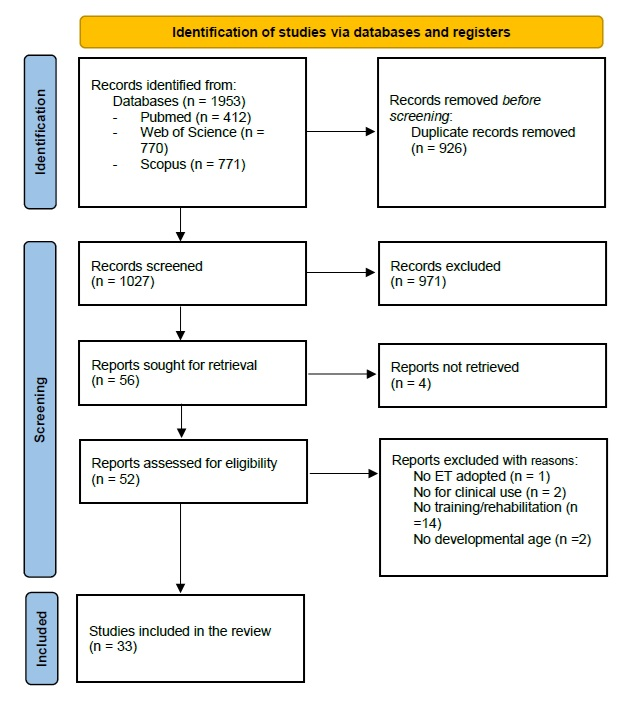
3.1. Study Selection
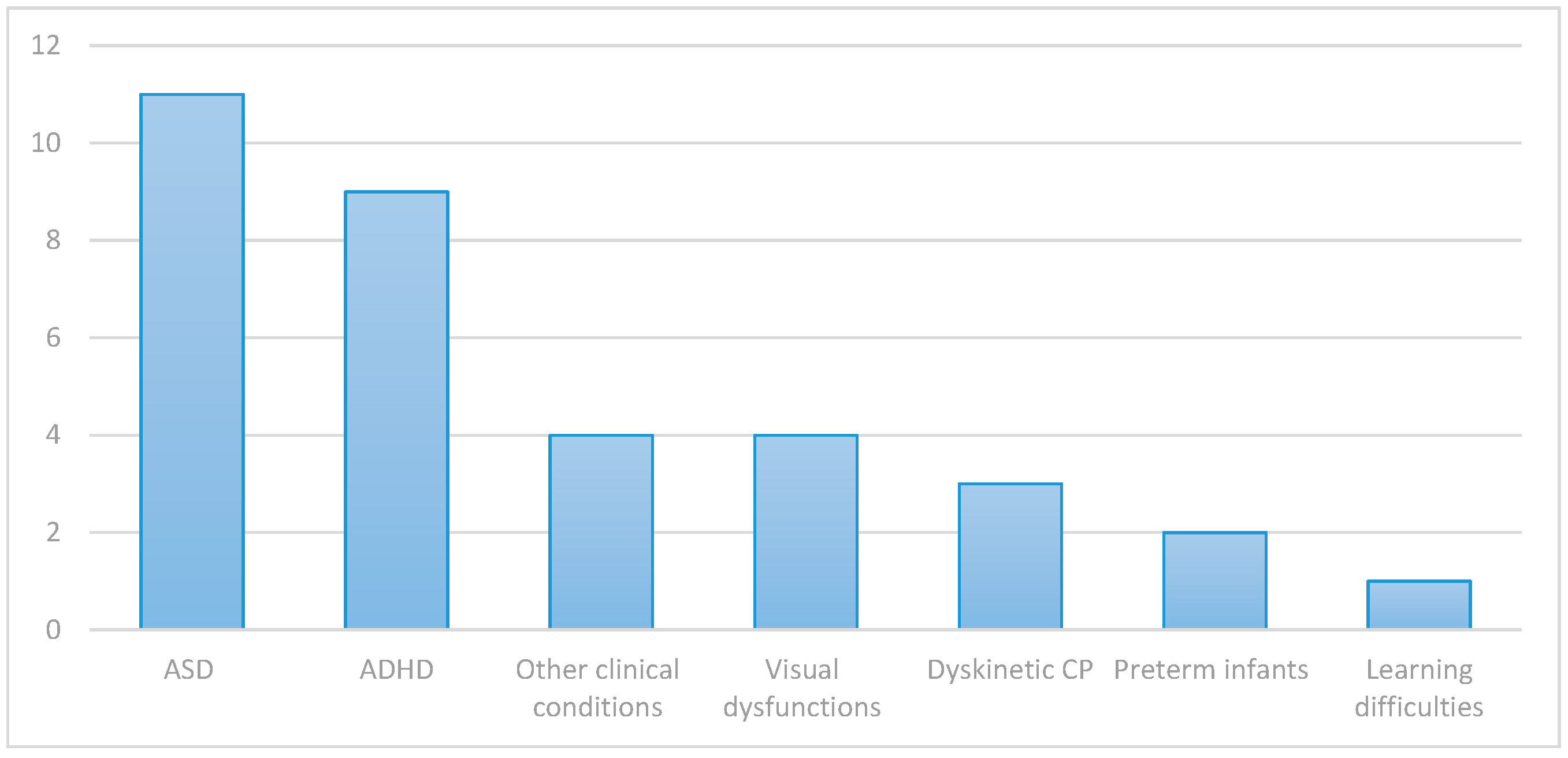
3.2. Clinical Populations and Study Designs
3.3. Intervention Characteristics
3.4. Functional Domains Targeted by Interventions
3.4.1. Attention and Executive Functions
3.4.2. Cognitive and Learning Enhancement
3.4.3. Social Cognition and Gaze Behaviour
3.4.4. Communication and Participation
3.4.5. Vision Rehabilitation
4. Discussion
4.1. Principal Findings
4.2. Eye Tracking as a Tool for Neuropsychological Rehabilitation and Learning Enhancement
4.3. Eye Tracking as a Tool Aimed at Enhancing Social Cognition and Communication in Neurodevelopmental Disorders
4.4. Eye Tracking as a New Avenue for Participation in Complex Motor Disorders
4.5. Eye Tracking for Visual Function Rehabilitation
4.6. Limitations of Current Research
4.7. Future Directions and Clinical Implications
5. Conclusions
Supplementary Materials
Author Contributions
Funding
Data Availability Statement
Acknowledgments
Conflicts of Interest
Appendix A. Highlights of the Included Studies
| Reference/Study and Year | Study Design | Population | Primary Outcome | Outcome Measure | Intervention | Main Results |
| [36] Arnold et al. (2025) | Clinical trial (experiment 2) | 33 participants (mean age: 142 months) with special educational needs | To evaluate whether eye-gaze training prior to use in the digitised reading test would improve word recognition scores for nonverbal children | WISC-IV; modified word recognition test with eye-gaze facility (EG-MNSRT) | Two online eye-gaze games presented in 10 min slots | No significant differences between the reading performance of those who did and did not participate in eye-gaze training and no impact of diagnosis, verbal IQ, perceptual reasoning IQ, or receptive vocabulary ability |
| [43] Bekteshi et al. (2020) | Clinical trial | 10 children (4.4–13.6 years) with dyskinetic cerebral palsy | To investigate the operational competences screen navigation and dwell function underlying eye-gaze performance and the relation of dystonia and choreoathetosis with eye-gaze performance in children with dyskinetic cerebral palsy | Task performance (sum of targets reached in 90 s); fixation count (total number of eye-gaze fixations in 90 s); eye movement accuracy | 6 video games in a standardised order and a duration of 90 s for each game, chosen from the Sensory Eye Fx (Tobii Dynavox, Danderyd, Sweden) | Significant improvement in eye-gaze task performance and within-subject correlations between eye movement accuracy and task performance and between fixation count and eye movement accuracy |
| [14] Borgestig et al. (2017) | Non-experimental multiple-case study (before, after and follow-up design) | 10 children (1–15 years) with severe physical impairments without speaking ability | To establish the impact of a gaze-based assistive technology (AT) intervention on activity repertoire, autonomous usage, and goal attainment in children with severe physical impairments | Computer usage diaries; Goal Attainment Scaling (GAS) | 9–10-month intervention with eye-gaze ET and assistive technology software with different tasks and activities | All sustained usage in daily activities and all attained goals. Proved efficacy in guiding parents and teachers to support children performing activities with the AT |
| [42] Mei et al. (2018) | Conference paper | 10 children with ASD | To investigate the effectiveness of an approach using a Customisable Virtual Human (CVH) and Virtual Reality (VR) compared to NCVH conditions in training joint attention in children with ASD | Reaction time of joint attention and time gazing at regions of interest (ROIs) | To play the with Customisable Virtual Human (CVH) device with a VR game interface combined with ET | CVH may be more effective in preventing atypical attention patterns that are common in ASD |
| [29] Yu et al. (2024) | Randomised controlled trial | 24 children with ASD. Mean ages: control group (CG)—3.71 (0.75); avatar-uncustomised group (AUG)—6.17 (1.26); avatar-customised group (ACG)—4.24 (1.80) | To evaluate the effectiveness of the Hide-and-Seek Virtual Reality System (HSVRS) in improving gaze fixation among children with ASD | Subjective questionnaires completed by the participants’ parents and objective eye-gaze data | 5 repeated trials over a period of 7 days. Participants were asked to play a game of hide and seek using our HSVRS | No significant differences in the questionnaire scores between the 3 groups. Significant improvements in two-group comparison (AUG-CG, ACT-CG). Significant difference in face fixation proportion and background fixation proportions between the AUG and the ACG |
| [34] Chan et al. (2022) | Randomised controlled trial | 53 primary school students with learning difficulty/neurodevelopmental disorders (experimental group, n = 27; control group, n = 26) | To examine the effects of eye-tracking training as an after-school programme to enhance learning and memory | Matrix Reasoning and Similarities subtests of the Wechsler Intelligence Scale for Children-Fourth Edition; Hong Kong List Learning Test (HKLLT); Chinese Word Reading Test; Chinese Passage Read | Six modules of ET training, each trial lasting 5 or 10 min. 20 weekly sessions of after-school training, 50 min per session, for 8 months | Improved memory and faster learning in the experimental group. Students with poorer learning scores at baseline demonstrated a greater degree of improvement in learning |
| [21] Chan et al. (2024) | Clinical trial | 40 students (6–11 years) with neurodevelopmental disorders (experimental group, n = 20; control group, n = 20) | To explore whether after-school eye-tracking training can improve visuospatial working memory (VSWM) and cognitive flexibility performance | Digital visual memory span test (D-VMST) to assess VSWM and Five-Point Test to assess cognitive flexibility | Six modules of ET training aimed at improving attention and inhibitory control. Each trial of training lasts 5 or 10 min | Significant improvement in VSWM and flexible thinking in the experimental group |
| [49] Chukoskie et al. (2018) | Clinical trial | 8 children (mean age: 13.9) with ASD | To demonstrate the feasibility of home-based training with an ET | Spatial Attention Task (E-Task), Gap–Overlap Saccade Task | 8-week training (30 min per day, 5 times per week). Games on a laptop with ET designed with principles to train fixation, speed and accuracy of eye movements and control of visuospatial attention | Feasibility of training is demonstrated |
| [45] Demirtas et al. (2025) | Multiple-probe study | 3 children (12–13 years) with ASD | To evaluate the effectiveness of a self-monitoring strategy intervention package on eye contact performance of children with autism spectrum disorder (ASD) through self-monitoring, goal setting, and reinforcement | Visual analysis and Tau-U | Participants wore eye-tracking devices and used self-monitoring to observe their eye movements during a 5 min face-to-face conversation, 5 days a week during school hours. Four 5 min sessions a day | The intervention package significantly improved participants’ eye contact performances |
| [39] Donmez & Cagiltay (2019) | Single-subject case study | One subject with low vision (age not specified) | To present the design and development procedure of three prototype eye movement games and a final product enhanced with the experience from the prototype ones for students with low vision | Qualitative interview | Three prototype eye movement games and a final product game supported by ET | The subject enjoyed the study and the serious games |
| [28] García-Baos et al. (2019) | Randomised controlled trial | 28 children with ADHD (8–15 years) | To assess whether the eye-tracking approach of the RECOGNeyes game has potential therapeutic benefits for children with ADHD | Frog Task Word recognition task | RECOGNeyes with eye tracker for 3 weeks (3 times a week) at home | Participants from the ET group showed significant improvement in impulsivity, reaction time, and fixation gaze control |
| [35] Garcia-Zapirain et al. (2017) | Clinical trial | 19 children (mean age: 10.88 years) with ADHD | To develop and test a dual system for the rehabilitation of cognitive functions in children with ADHD, an arithmetical game-based application that makes use of an eye tracker and a hand tracker for interaction with it | SUS questionnaire, QUIS questionnaire | The system is made up of the ET, the gesture recognition device on one side and then the client side. On the client side, the user interacts with a Natural User Interface by using sensors | Globally quite positive user evaluation of the proposed multimodal rehabilitation system |
| [23] Goodwin et al. (2016) | Study protocol | 50 infants (10–14 months) at familial risk of ADHD | To test the potential efficacy of the INTERSTAARS cognitive trial | Eye-tracking, observational, parent-report and neurophysiological measures | 9 weekly home-based attention training sessions targeting attention control with gaze-contingent animations via ET technology | Study protocol |
| [44] Hall & Britton (2024) | Clinical trial | 65 patients with Fragile X Syndrome, FXS (n = 33), or non-syndromic autism (n = 32) | To examine potential differences in social learning between individuals with FXS and individuals with non-syndromic ASD by administering the behavioural treatment probe devised by Gannon et al. | Heart rate; social gaze | Blocks of looking while listening trials alternated with blocks of looking while speaking trials with reinforcing method (token) | Improvements in social gaze following the treatment probe for males with FXS; improvements in social gaze more modest for males with non-syndromic ASD; no effect of the treatment probe on heart rates in either group |
| [26] Iannizzotto et al. (2020) | Clinical trial | 12 girls at late primary and secondary school ages with Rett syndrome | To investigate new ways to facilitate access to eye-gaze-based interaction for the specific case of simplified communication and to investigate the efficacy of SWYG software for telerehabilitation and remote school tasks | To answer 8 questions by means of the eye gaze | Remote eye-tracking architecture composed of SWYG (Speak With Your Gaze) and Video Conferencing System (VCS) | Promising preliminary results |
| [30] Janmohammadi et al. (2020) | Randomised controlled trial | 39 boys (6–10 years) with ADHD (experimental group, n = 20; control group, n = 19) | To determine the efficacy of a visual tracking/pursuit paradigm based on visual fixation (gaze) and head control, and control of eye movement speed, in addition to conventional therapy for ADHD | Conner’s Parent Rating Scale; Continuous Performance Task-2; Test of Visual-Motor Skills-Revised | A 5-week (2 sessions per week, 30 min per session) ET intervention based on the isolation of neck and eye movement | The training led to decrease in and inhibition of unwanted saccadic eye movements. Visual tracking interventions could modify behaviour (Conner’s Parent Rating Scale results) |
| [47] Karlsson et al. (2019) | Clinical trial | 5 subjects (3–5 years) with dyskinetic cerebral palsy | To trial two eye-gaze control devices in goal achievement, communication, and participation outcomes | Preschool Language Scale-4 (PLS-4); Focus on the Outcomes of Communication Under Six (FOCUS©); Young Children’s Participation and Environment Measure (YC-PEM); Cerebral Palsy Quality of Life Questionnaire—Child version; Dimensions of Mastery Questionnaire (DMQ); Canadian Occupational Performance Measure (COPM); Goal Attainment Scale (GAS); Responsive Augmentative and Alternative Communication Style Scale Version 3 (RAACS) | Two eye-gaze control technology systems, each for 6 weeks, with an intervening 6-week washout period and an assessment at the end of each period | Improvements in goal achievement (GAS, COPM) and performance |
| [31] Lee et al. (2021) | Clinical trial | 32 children (6–12 years) with ADHD (experimental group, n = 16; control group, n = 16) | To examine the effect of an eye-tracking training programme on inhibitory control in children with ADHD | Conners’ Parent Rating Scale-Revised: Short Form; Eriksen Flanker Test; Cantonese version of Category Fluency Test; Five-Point Test; Children’s Color Trails Test | Six modules (10 min each) of ET training aimed at improving attention and impulse control | Significant improvement in inhibitory control in the experimental group after training |
| [40] Lee et al. (2020) | Pilot study | 18 participants (6–12 years) with ADHD (experimental group, n = 9; control group, n = 9) | To investigate the effectiveness of computerised eye-tracking training on improving saccadic eye movements in children with ADHD | Saccade latency and accuracy in an anti-saccade task and in a pro-saccade task before and after training | ET training aimed at improving inhibitory control, mental flexibility, and attention. 2 weeks of 8 training sessions, 10 min each | Significant decrease in saccade latency (anti-saccade task) and significant increase in saccade accuracy (pro-saccade task) after the training |
| [27] Donmez & Cagiltay (2024) | Design-based research study | 36 participants (2–18 years, mean age: 11 years) with low vision | To investigate the design processes for developing eye training materials for children with low vision (CLV) using computer game applications based on eye movement tracking to enhance their vision skills | Participation of subjects enrolled, their parents, ophthalmologists, special education teachers, and faculty members from the field of instructional technology and special education | 20 min home-based computer game based on eye movement tracking | The training programme may provide objective feedback about the experience of CLV and promote self-training for visual improvement anywhere and anytime |
| [24] Perra et al. (2020) | Study protocol feasibility | Very preterm (VP) infants with corrected age of 12 months (+/− 1 month) | To assess the feasibility of a study protocol for computerised Attention Control Training (ACT) for VP infants | Battery of tests and tools about general cognitive and motor development, their attention, and their social cognition abilities | Task of search of targets during an interactive stimuli presentation contingent on infants’ direction of gaze | Study protocol |
| [32] Perra et al. (2021) | Randomised trial | 12 very preterm infants (12 months +/− 1 month) | To test the feasibility of delivering the computerised Attention Control Training (ACT) to very preterm (VP) infants | Number and duration of participation of VP infants that completed training/control sessions and VP infants’ engagement; acceptability and completion assessments; quality of eye-tracking data and feedback from parents (questionnaire and semi-structured interviews) | The ACT intervention group watched interactive cartoons for at least 240 s on a computer screen connected to an eye tracker which recorded the infants’ eye movements | VP infants engaged in the ACT games and increased their performance during training. All completed most of the tasks with parents’ positive feedback |
| [48] Puttemans et al. (2025) | Multiple-case study | Three children aged 7, 12, and 13 years with dyskinetic cerebral palsy | To explore the effects of a four-week intensive eye-tracking intervention on children with dyskinetic cerebral palsy | Goal attainment (GAS), AAV Profile: A Continuum of Learning scale; heart rate variability (HRV); Psychosocial Impact of Assistive Devices Scale (PIADS) | 4-week intervention with ET divided into two sequential parts of 2 weeks each (intervention phase 1 and intervention phase 2) | A structured, tailored, four-week intensive eye-tracking intervention can yield successful results |
| [33] Psotta et al. (2023) | Randomised double-blind controlled trial | 57 children (9–12 years) with ADHD (experimental group, n = 30; control group, n = 27) | To investigate the effects of quiet eye training (QET)-based visuomotor intervention on different aspects of attention in children with ADHD | d2-R Test of Attention; Reaction Test of Alertness (RTA) of the Vienna Test System (VTS); the throwing/catching task of the MABC-2 Test; eye movement pattern; catch performance; arm movement time | 5-week QT-based visuomotor training (1 session per week, 35 min per session) | Focused attention in children with ADHD can be improved by a short-term QET-based visuomotor intervention |
| [22] Scherf et al. (2018) | Study protocol | 34 adolescents (10–18 years) with ASD | To assess intervention feasibility and effectiveness in improving sensitivity in eye-gaze cues and social visual attention to faces of the proposed serious game | Performance accuracy, gaze shifts between the face and target and non-target objects and the ratio of average gaze time to the target object versus average gaze time to non-target objects Social Skills Improvement System (SSIS); Social Responsiveness Scale, 2nd Edition (SRS-2) | To play an eye-gaze computer game at home for 30 min, 3 times a week | Study protocol |
| [25] Scherf et al. (2024) | Study protocol for randomised controlled trial | 40 participants (experimental group, n = 20; control group, n = 20) with ASD | To investigate whether the improved behavioural sensitivity to eye-gaze cues was facilitated by increasing visual attention to faces and/or to the target objects of the directed gaze | Behavioural accuracy, eye-tracking metrics of social visual attention | Serious game training based on referential understanding of the observer’s visual behaviour. 30 min sessions at home, 3 times a week over 10 weeks | Study protocol |
| [41] Shamir et al. (2023) | Conference article | 18 children (5–9 years) with ASD | To present a new technological intervention’s impact on eye contact | Eye contact duration time for the eyes and face, and total gazing time in seconds (pre- and post-intervention) | Eye contact tasks completed by working with the computer game (C-Me). 30 min sessions twice a week over 3 consecutive weeks (total of 6 meetings) | The technological intervention effectively promoted eye contact among all participants |
| [50] Sosnowski et al. (2022) | Randomised controlled trial | 54 children (4–14 years) with ASD (experimental group, n = 25; control group, n = 29) | To determine feasibility, acceptability, and efficacy of a video game-based digital therapeutic combining applied behaviour analysis techniques and gaze-contingent eye tracking to target emotion recognition in youth with autism spectrum disorder (ASD) | Ekman-60 emotion recognition test | A 6-week (3–5 sessions per week, 15 min per session) intervention with Lookware™ digital therapeutic | Significant improvements in emotion recognition from pre- to post-intervention |
| [46] Tang et al. (2022) | Randomised controlled trial (2 × 2 ×2 design) | 56 participants with ASD or typically developing | To analyse whether storytelling with social contextual information improves visual attention or gaze direction in children with ASD | Eye-tracker data (total fixation duration, TFD, total visit duration, TVD, total fixation count, TFC) and Trial Making Test | 8 sessions across 4 weeks, 2 sessions per week, 30 min per session | Storytelling with social contextual information improved gaze behaviour at faces or eyes in ASD and TD when both assessed with photos displayed on a screen, but not in ASD regarding screen-based videos |
| [33] Valtr et al. (2023) | Randomised controlled trial | 106 participants (8–12 years) with ADHD (experimental group, n = 54; control group, n = 52) | To investigate the effects of quiet eye training (QET) on the neuropsychological functioning and fine motor performance of children with attention deficits | Reaction test of alertness, GNG inhibition test, MLS test: right and left hand (neuropsychological tests) | 5-week training (five 35 min training sessions, one session per week) based on stimulation of attention and goal-directed gazing while practising in targeting tasks | Notable impact of the intervention on: processing time and inhibitory control, focused attentional state, processing time and attentional engagement, alertness, and potential fine motor precision |
| [51] Wang et al. (2020) | Randomised controlled trial | 35 3-year-old children with ASD (experimental group) and 41 3-year-old typically developing children (control group) | To examine the feasibility of GCET social attentional training aimed at improving attention to faces and the preliminary efficacy of the training | Participants’ data quality and successful completion of task batteries | SR Eyelink 1000 Plus 500 Hz eye-tracking system and social video displayed on screen. Training duration not specified | The study provides support for training feasibility |
| [37] Wygnanski-Jaffe et al. (2023) | Prospective, multicentre, randomised, masked, controlled, noninferiority pivotal trial | 103 subjects (4–<9 years) with amblyopia | To compare a novel binocular eye-tracking-based home treatment (CureSight; NovaSight, Ltd.) with patching in improving visual outcomes | Amblyopia Treatment Study diplopia assessment, CTS software, E-ETDRS, Randot Preschool Stereoacuity test and a symptom survey | CureSight treatment uses combined anaglyph glasses and an ET. Participants used the device for 90 min/day, 5 days per week for 16 weeks (120 h). The patching group received 2 h of patching 7 days/week (224 h) | The intervention is not inferior to patching and has higher rates of parent preference |
| [38] Zhu et al. (2023) | Pilot study | 34 participants (4–9 years) with unilateral anisometropic amblyopia | To assess visual acuity (VA) and stereoacuity (SA) improvements in children with amblyopia treated with either binocular dichoptic treatment or patching treatment | Electronic Early Treatment Diabetic Retinopathy Study (E-ETDRS) protocol for distance visual acuity (DVA); Pediatric Eye Disease Investigator Group (PEDIG); Amblyopia Treatment Study (ATS) near-acuity test for near visual acuity (NVA); Titmus stereoacuity test for stereoacuity | Group 1: full treatment group using CureSight device for 90 min per day, 5 days a week for 12 weeks. Group 2: part-time treatment group with CureSight 3 days a week. Group 3: patching treatment group (PTG; n = 14) wore a patch over the dominant eye 2 h per day, 7 days per week for 12 weeks | VA and SA after binocular dichoptic treatment produced a similar therapeutic outcome to patching |
References
- Luna, B.; Velanova, K.; Geier, C.F. Development of eye-movement control. Brain Cogn. 2008, 68, 293–308. [Google Scholar] [CrossRef] [Scilit]
- Klin, A.; Jones, W.; Schultz, R.; Volkmar, F. The enactive mind, or from actions to cognition: Lessons from autism. Philos. Trans. R. Soc. Lond. B Biol. Sci. 2003, 358, 345–360. [Google Scholar] [CrossRef] [Scilit] [PubMed]
- Nelson, C.A. The development and neural bases of face recognition. Infant. Child Dev. 2001, 10, 3–18. [Google Scholar] [CrossRef] [Scilit]
- Sweeney, J.A.; Takarae, Y.; Macmillan, C.; Luna, B.; Minshew, N.J. Eye movements in neurodevelopmental disorders. Curr. Opin. Neurol. 2004, 17, 37–42. [Google Scholar] [CrossRef] [Scilit]
- Johnson, B.P.; Lum, J.A.G.; Rinehart, N.J.; Fielding, J. Ocular motor disturbances in autism spectrum disorders: Systematic review and comprehensive meta-analysis. Neurosci. Biobehav. Rev. 2016, 69, 260–279. [Google Scholar] [CrossRef] [Scilit]
- Goto, Y.; Hatakeyama, K.; Kitama, T.; Sato, Y.; Kanemura, H.; Aoyagi, K.; Sugita, K.; Aihara, M. Saccade eye movements as a quantitative measure of frontostriatal network in children with ADHD. Brain Dev. 2010, 32, 347–355. [Google Scholar] [CrossRef] [Scilit]
- Munoz, D.P.; Armstrong, I.T.; Hampton, K.A.; Moore, K.D. Altered Control of Visual Fixation and Saccadic Eye Movements in Attention-Deficit Hyperactivity Disorder. J. Neurophysiol. 2003, 90, 503–514. [Google Scholar] [CrossRef] [Scilit]
- Black, M.H.; Chen, N.T.; Iyer, K.K.; Lipp, O.V.; Bölte, S.; Falkmer, M.; Tan, T.; Girdler, S. Mechanisms of facial emotion recognition in autism spectrum disorders: Insights from eye tracking and electroencephalography. Neurosci. Biobehav. Rev. 2017, 80, 488–515. [Google Scholar] [CrossRef] [Scilit]
- World Health Organization. International Classification of Functioning, Disability and Health; World Health Organization: Geneva, Switzerland, 2001. [Google Scholar]
- Chahrour, M.; Zoghbi, H.Y. The story of Rett syndrome: From clinic to neurobiology. Neuron 2007, 56, 422–437. [Google Scholar] [CrossRef] [Scilit] [PubMed]
- Baxter, P.; Morris, C.; Rosenbaum, P.; Paneth, N.; Leviton, A.; Goldstein, M.; Bax, M.; Colver, A.; Gilles, F.H.; Graham, H.K.; et al. The Definition and Classification of Cerebral Palsy. Dev. Med. Child Neurol. 2007, 49, 1–44. [Google Scholar] [CrossRef] [Scilit]
- Fazzi, E.; Signorini, S.G.; LA Piana, R.; Bertone, C.; Misefari, W.; Galli, J.; Balottin, U.; Bianchi, P.E. Neuro-ophthalmological disorders in cerebral palsy: Ophthalmological, oculomotor, and visual aspects. Dev. Med. Child Neurol. 2012, 54, 730–736. [Google Scholar] [CrossRef] [Scilit]
- Monbaliu, E.; Himmelmann, K.; Lin, J.-P.; Ortibus, E.; Bonouvrié, L.; Feys, H.; Vermeulen, R.J.; Dan, B. Clinical presentation and management of dyskinetic cerebral palsy. Lancet Neurol. 2017, 16, 741–749. [Google Scholar] [CrossRef] [Scilit]
- Borgestig, M.; Rytterström, P.; Hemmingsson, H. Gaze-based assistive technology used in daily life by children with severe physical impairments—parents’ experiences. Dev. Neurorehabil. 2017, 20, 301–308. [Google Scholar] [CrossRef] [Scilit]
- Signorini, S.; Luparia, A.; Cappagli, G.; Perotto, E.; Antonini, M.; Morelli, F.; Aprile, G.; Ballante, E.; Figini, S.; Borgatti, R. Visual Function Score: A New Clinical Tool to Assess Visual Function and Detect Visual Disorders in Children. Front. Pediatr. 2022, 10, 868974. [Google Scholar] [CrossRef] [Scilit]
- Sakki, H.E.A.; Dale, N.J.; Sargent, J.; Perez-Roche, T.; Bowman, R. Is there consensus in defining childhood cerebral visual impairment? A systematic review of terminology and definitions. Br. J. Ophthalmol. 2018, 102, 424–432. [Google Scholar] [CrossRef] [Scilit] [PubMed]
- Snider, L.; Majnemer, A.; Darsaklis, V. Virtual reality as a therapeutic modality for children with cerebral palsy. Dev. Neurorehabil. 2010, 13, 120–128. [Google Scholar] [CrossRef] [Scilit]
- Sanpablo, A.I.P.; Armenta-García, J.-A.; Muñiz, A.F.; Peñaloza, A.M.; Mendoza-Arguilés, A.; Rodríguez, M.D. Integration of persuasive elements into exergames: Application in the development of a novel gait rehabilitation system for children with musculoskeletal conditions. J. Biomed. Inform. 2022, 132, 104130. [Google Scholar] [CrossRef] [Scilit]
- Hemphill, S.; Nguyen, A.; Kwong, J.; Rodriguez, S.T.; Wang, E.; Caruso, T.J. Virtual Reality Facilitates Engagement in Physical Therapy in the Pediatric CVICU. Pediatr. Phys. Ther. 2021, 33, E7–E9. [Google Scholar] [CrossRef] [Scilit]
- Lim, J.Z.; Mountstephens, J.; Teo, J. Eye-Tracking Feature Extraction for Biometric Machine Learning. Front. Neurorobot. 2022, 15, 796895. [Google Scholar] [CrossRef] [Scilit] [PubMed]
- Chan, A.S.; Leung, P.; Pang, T.W.; Sze, S.L. Eye-tracking training improves visuospatial working memory of children with attention-deficit/hyperactivity disorder and autism spectrum disorder. Autism Res. 2024, 17, 2244–2260. [Google Scholar] [CrossRef] [Scilit] [PubMed]
- Scherf, K.S.; Griffin, J.W.; Judy, B.; Whyte, E.M.; Geier, C.F.; Elbich, D.; Smyth, J.M. Improving sensitivity to eye gaze cues in autism using serious game technology: Study protocol for a phase I randomised controlled trial. BMJ Open 2018, 9, e023682. [Google Scholar] [CrossRef] [Scilit]
- Goodwin, A.; Salomone, S.; Bolton, P.; Charman, T.; Jones, E.J.H.; Pickles, A.; Robinson, E.; Smith, T.; Sonuga-Barke, E.J.S.; Wass, S.; et al. Attention training for infants at familial risk of ADHD (INTERSTAARS): Study protocol for a randomised controlled trial. Trials 2016, 17, 608. [Google Scholar] [CrossRef] [Scilit]
- Perra, O.; Wass, S.; McNulty, A.; Sweet, D.; Papageorgiou, K.; Johnston, M.; Patterson, A.; Bilello, D.; Alderdice, F. Training attention control of very preterm infants: Protocol for a feasibility study of the Attention Control Training (ACT). Pilot. Feasibility Stud. 2020, 6, 17. [Google Scholar] [CrossRef] [Scilit]
- Scherf, K.S.; Griffin, J.W.; Geier, C.F.; Smyth, J.M. Social visual attention as a treatment outcome: Evaluating the social games for autistic adolescents (SAGA) intervention. Sci. Rep. 2024, 14, 619. [Google Scholar] [CrossRef] [Scilit] [PubMed]
- Iannizzotto, G.; Nucita, A.; Fabio, R.A.; Caprì, T.; Bello, L.L. Remote eye-tracking for cognitive telerehabilitation and interactive school tasks in times of COVID-19. Information 2020, 11, 296. [Google Scholar] [CrossRef] [Scilit]
- Donmez, M.; Cagiltay, K. Eye training games for children with low vision: A design-based research study. Educ. Technol. Soc. 2024, 27, 406–416. [Google Scholar] [CrossRef]
- García-Baos, A.; D’aMelio, T.; Oliveira, I.; Collins, P.; Echevarria, C.; Zapata, L.P.; Liddle, E.; Supèr, H. Novel interactive eye-tracking game for training attention in children with attention-deficit/hyperactivity disorder. Prim. Care Companion J. Clin. Psychiatry 2019, 21, 19m02428. [Google Scholar] [CrossRef] [Scilit]
- Yu, C.; Wang, S.; Zhang, D.; Zhang, Y.; Cen, C.; You, Z.; Zou, X.; Deng, H.; Li, M. HSVRS: A Virtual Reality System of the Hide-and-Seek Game to Enhance Gaze Fixation Ability for Autistic Children. IEEE Trans. Learn. Technol. 2024, 17, 2011–2024. [Google Scholar] [CrossRef] [Scilit]
- Janmohammadi, S.; Haghgoo, H.A.; Farahbod, M.; Overton, P.G.; Pishyareh, E. Effect of a visual tracking intervention on attention and behavior of attention deficit hyper activity children. J. Eye Mov. Res. 2020, 12, 68. [Google Scholar] [CrossRef] [Scilit]
- Lee, T.L.; Yeung, M.K.; Sze, S.L.; Chan, A.S. Eye-tracking training improves inhibitory control in children with attention-deficit/hyperactivity disorder. Brain Sci. 2021, 11, 314. [Google Scholar] [CrossRef] [Scilit]
- Perra, O.; Wass, S.; McNulty, A.; Sweet, D.; Papageorgiou, K.A.; Johnston, M.; Bilello, D.; Patterson, A.; Alderdice, F. Very preterm infants engage in an intervention to train their control of attention: Results from the feasibility study of the Attention Control Training (ACT) randomised trial. Pilot Feasibility Stud. 2021, 7, 66. [Google Scholar] [CrossRef] [Scilit]
- Psotta, R.; Valtr, L.; Dostál, D. The Effects of Quiet Eye Training on Attention in Children with ADHD. J. Hum. Kinet. 2023, 89, 53–63. [Google Scholar] [CrossRef] [Scilit]
- Chan, A.S.; Lee, T.L.; Sze, S.L.; Yang, N.S.; Han, Y.M.Y. Eye-tracking training improves the learning and memory of children with learning difficulty. Sci. Rep. 2022, 12, 13974. [Google Scholar] [CrossRef] [Scilit] [PubMed]
- Garcia-Zapirain, B.; de la Torre Díez, I.; López-Coronado, M. Dual System for Enhancing Cognitive Abilities of Children with ADHD Using Leap Motion and eye-Tracking Technologies. J. Med. Syst. 2017, 41, 111. [Google Scholar] [CrossRef] [Scilit] [PubMed]
- Arnold, S.; Reed, P. Eye-Gaze Training Does Not Impact Performance on a Nonverbal Test of Reading Abilities for Children with Special Educational Needs. J. Dev. Phys. Disabil. 2025, 37, 947–960. [Google Scholar] [CrossRef] [Scilit]
- Wygnanski-Jaffe, T.; Kushner, B.J.; Moshkovitz, A.; Belkin, M.; Yehezkel, O.; Gan, R.; Spierer, A.; Zitzer, N.; Cohen, D.; Shpigelman, A.; et al. An Eye-Tracking–Based Dichoptic Home Treatment for Amblyopia: A Multicenter Randomized Clinical Trial. Ophthalmology 2023, 130, 274–285. [Google Scholar] [CrossRef] [Scilit]
- Zhu, W.; Tian, T.; Yehezkel, O.; Wygnanski-Jaffe, T.; Moshkovitz, A.; Lin, J.; Hu, C.; Liu, R. A Prospective Trial to Assess the Efficacy of Eye-Tracking-Based Binocular Treatment versus Patching for Children’s Amblyopia: A Pilot Study. Semin. Ophthalmol. 2023, 38, 761–767. [Google Scholar] [CrossRef] [Scilit]
- Donmez, M.; Cagiltay, K. Development of eye movement games for students with low vision: Single-subject design research. Educ. Inf. Technol. 2019, 24, 295–305. [Google Scholar] [CrossRef] [Scilit]
- Lee, T.L.; Yeung, M.K.; Sze, S.L.; Chan, A.S. Computerized eye-tracking training improves the saccadic eye movements of children with attention-deficit/hyperactivity disorder. Brain Sci. 2020, 10, 1016. [Google Scholar] [CrossRef] [Scilit]
- Shamir, A.; Tova, O.; Horovitz, S.; Munits, N.; Amon, M.; Eden, S. A Metacognitive Technological Intervention for Promoting Eye Contact Among Children With ASD: Preliminary Research Evidence. Commun. Disord. Q. 2023, 45, 32–41. [Google Scholar] [CrossRef] [Scilit]
- Mei, C.; Zahed, B.T.; Mason, L.; Ouarles, J. Towards Joint Attention Training for Children with ASD-a VR Game Approach and Eye Gaze Exploration. In 25th IEEE Conference on Virtual Reality and 3D User Interfaces, VR 2018—Proceedings; Institute of Electrical and Electronics Engineers Inc.: New York, NY, USA, 2018; pp. 289–296. [Google Scholar] [CrossRef] [Scilit]
- Bekteshi, S.; Konings, M.; Vanmechelen, I.; Deklerck, J.; Ortibus, E.; Aerts, J.-M.; Hallez, H.; Karlsson, P.; Dan, B.; Monbaliu, E. Eye Gaze Gaming Intervention in Children with Dyskinetic Cerebral Palsy: A Pilot Study of Task Performance and Its Relation with Dystonia and Choreoathetosis. Dev. Neurorehabil. 2020, 23, 548–556. [Google Scholar] [CrossRef] [Scilit]
- Hall, S.S.; Britton, T.C. Differential Effects of a Behavioral Treatment Probe on Social Gaze Behavior in Fragile X Syndrome and Non-Syndromic Autism Spectrum Disorder. J. Autism Dev. Disord. 2024, 54, 2719–2732. [Google Scholar] [CrossRef] [Scilit] [PubMed]
- Demirtaş, Ş.; Aykut, Ç. An Evaluation of the Effectiveness of Self-monitoring Intervention Package for Increasing Eye Contact in Children with Autism Using Wearable Eye Tracking. J. Behav. Educ. 2025, 22, 169–282. [Google Scholar] [CrossRef] [Scilit]
- Tang, W.Y.F.; Fong, K.N.K.; Chung, R.C.K. The Effects of Storytelling With or Without Social Contextual Information Regarding Eye Gaze and Visual Attention in Children with Autistic Spectrum Disorder and Typical Development: A Randomized, Controlled Eye-Tracking Study. J. Autism Dev. Disord. 2022, 52, 1257–1267. [Google Scholar] [CrossRef] [Scilit]
- Karlsson, P.; Bech, A.; Stone, H.; Vale, C.; Griffin, S.; Monbaliu, E.; Wallen, M. Eyes on communication: Trialling eye-gaze control technology in young children with dyskinetic cerebral palsy. Dev. Neurorehabil. 2019, 22, 134–140. [Google Scholar] [CrossRef] [Scilit]
- Puttemans, F.; Copermans, E.; Karlsson, P.; Ortibus, E.; Dan, B.; Monbaliu, E.; Bekteshi, S. An intensive eye-tracking intervention in children with dyskinetic cerebral palsy: A multiple case study. Disabil. Rehabil. Assist. Technol. 2025, 20, 867–877. [Google Scholar] [CrossRef] [Scilit] [PubMed]
- Chukoskie, L.; Westerfield, M.; Townsend, J. A novel approach to training attention and gaze in ASD: A feasibility and efficacy pilot study. Dev. Neurobiol. 2018, 78, 546–554. [Google Scholar] [CrossRef] [Scilit] [PubMed]
- Sosnowski, D.W.; Stough, C.O.; Weiss, M.J.; Cessna, T.; Casale, A.; Foran, A.; Erwinski, M.; Wilson, J.; Farber, S.A.; Farber, M.A. Brief Report: A Novel Digital Therapeutic that Combines Applied Behavior Analysis with Gaze-Contingent Eye Tracking to Improve Emotion Recognition in Children with Autism Spectrum Disorder. J. Autism Dev. Disord. 2022, 52, 2357–2366. [Google Scholar] [CrossRef] [Scilit]
- Wang, Q.; Wall, C.A.; Barney, E.C.; Bradshaw, J.L.; Macari, S.L.; Chawarska, K.; Shic, F. Promoting social attention in 3-year-olds with ASD through gaze-contingent eye tracking. Autism Res. 2020, 13, 61–73. [Google Scholar] [CrossRef] [Scilit]
- Iosa, M.; Verrelli, C.M.; Gentile, A.E.; Ruggieri, M.; Polizzi, A. Gaming Technology for Pediatric Neurorehabilitation: A Systematic Review. Front. Pediatr. 2022, 10, 775356. [Google Scholar] [CrossRef] [Scilit]
- Morris, L.S.; Kundu, P.; Dowell, N.; Mechelmans, D.J.; Favre, P.; Irvine, M.A.; Robbins, T.W.; Daw, N.; Bullmore, E.T.; Harrison, N.A.; et al. Fronto-striatal organization: Defining functional and microstructural substrates of behavioural flexibility. Cortex 2016, 74, 118–133. [Google Scholar] [CrossRef] [Scilit]
- Munoz, D.P.; Everling, S. Look away: The anti-saccade task and the voluntary control of eye movement. Nat. Rev. Neurosci. 2004, 5, 218–228. [Google Scholar] [CrossRef] [Scilit]
- Mahone, E.M.; Mostofsky, S.H.; Lasker, A.G.; Zee, D.; Denckla, M.B. Oculomotor Anomalies in Attention-Deficit/Hyperactivity Disorder: Evidence for Deficits in Response Preparation and Inhibition. J. Am. Acad. Child Adolesc. Psychiatry 2009, 48, 749–756. [Google Scholar] [CrossRef] [Scilit]
- Ogourtsova, T.; Boychuck, Z.; O’Donnell, M.; Ahmed, S.; Osman, G.; Majnemer, A. Telerehabilitation for Children and Youth with Developmental Disabilities and Their Families: A Systematic Review. Phys. Occup. Ther. Pediatr. 2023, 43, 129–175. [Google Scholar] [CrossRef] [Scilit] [PubMed]
- American Psychiatric Association. Diagnostic and Statistical Manual of Mental Disorders; American Psychiatric Association Publishing: Washington, DC, USA, 2022. [Google Scholar] [CrossRef] [Scilit]
- Wang, S.; Jiang, M.; Duchesne, X.M.; Laugeson, E.A.; Kennedy, D.P.; Adolphs, R.; Zhao, Q. Atypical Visual Saliency in Autism Spectrum Disorder Quantified through Model-Based Eye Tracking. Neuron 2015, 88, 604–616. [Google Scholar] [CrossRef] [Scilit] [PubMed]
- Stephenson, L.J.; Edwards, S.G.; Bayliss, A.P. From Gaze Perception to Social Cognition: The Shared-Attention System. Perspect. Psychol. Sci. 2021, 16, 553–576. [Google Scholar] [CrossRef] [Scilit] [PubMed]
- Mundy, P. A review of joint attention and social-cognitive brain systems in typical development and autism spectrum disorder. Eur. J. Neurosci. 2018, 47, 497–514. [Google Scholar] [CrossRef] [Scilit]
- Rizzo, A.; Koenig, S.T. Is clinical virtual reality ready for primetime? Neuropsychology 2017, 31, 877–899. [Google Scholar] [CrossRef] [Scilit]
- Beukelman, J.L. Augmentative and Alternative Communication: Supporting Children and Adults with Complex Communication Needs; Brookes Publishing Company: Baltimore, MD, USA, 2020. [Google Scholar]
- Romski, M.A.; Sevcik, R.A. Breaking the Speech Barrier: Language Development Through Augmented Means; Brookes Publishing Company: Baltimore, MD, USA; Maple Press Distribution Center: York, PA, USA, 1996. [Google Scholar]
- Cleary, M.; Moody, A.D.; Buchanan, A.; Stewart, H.; Dutton, G.N. Assessment of a computer-based treatment for older amblyopes: The Glasgow Pilot Study. Eye 2009, 23, 124–131. [Google Scholar] [CrossRef] [Scilit]
- Sakki, H.; Bowman, R.; Sargent, J.; Kukadia, R.; Dale, N. Visual function subtyping in children with early-onset cerebral visual impairment. Dev. Med. Child Neurol. 2021, 63, 303–312. [Google Scholar] [CrossRef] [Scilit]
- Philip, S.S.; Dutton, G.N. Identifying and characterising cerebral visual impairment in children: A review. Clin. Exp. Optom. 2014, 97, 196–208. [Google Scholar] [CrossRef] [Scilit]
- Page, M.J.; McKenzie, J.E.; Bossuyt, P.M.; Boutron, I.; Hoffmann, T.C.; Mulrow, C.D.; Shamseer, L.; Tetzlaff, J.M.; Akl, E.A.; Brennan, S.E.; et al. The PRISMA 2020 statement: An updated guideline for reporting systematic reviews. BMJ 2021, 372, n71. [Google Scholar] [CrossRef] [Scilit] [PubMed]



| Attention and EFs | Cognitive and Learning | Social Cognition | Participation and Communication | Visual Function | Fine v-m Coordination | |
|---|---|---|---|---|---|---|
| ASD | X | X | X | X | ||
| ADHD | X | X | X | X | ||
| Dyskinetic CP | X | X | ||||
| Learning difficulty | X | X | ||||
| Preterm infants | X | X | X | |||
| Other complex disabilities | X | X | X | |||
| Visual dysfunctions | X | X |
Disclaimer/Publisher’s Note: The statements, opinions and data contained in all publications are solely those of the individual author(s) and contributor(s) and not of MDPI and/or the editor(s). MDPI and/or the editor(s) disclaim responsibility for any injury to people or property resulting from any ideas, methods, instructions or products referred to in the content. |
© 2026 by the authors. Licensee MDPI, Basel, Switzerland. This article is an open access article distributed under the terms and conditions of the Creative Commons Attribution (CC BY) license.
Share and Cite
Catalano, G.; Abbondio, S.; Nicotra, R.; Berselli, V.; Guarischi, M.; Vezzali, V.; Signorini, S. Eye Tracking for Rehabilitation and Training in Paediatric Neurodevelopmental Disorders: A Systematic Review. Brain Sci. 2026, 16, 337. https://doi.org/10.3390/brainsci16030337
Catalano G, Abbondio S, Nicotra R, Berselli V, Guarischi M, Vezzali V, Signorini S. Eye Tracking for Rehabilitation and Training in Paediatric Neurodevelopmental Disorders: A Systematic Review. Brain Sciences. 2026; 16(3):337. https://doi.org/10.3390/brainsci16030337
Chicago/Turabian StyleCatalano, Guido, Sara Abbondio, Roberta Nicotra, Valentina Berselli, Marta Guarischi, Valentina Vezzali, and Sabrina Signorini. 2026. "Eye Tracking for Rehabilitation and Training in Paediatric Neurodevelopmental Disorders: A Systematic Review" Brain Sciences 16, no. 3: 337. https://doi.org/10.3390/brainsci16030337
APA StyleCatalano, G., Abbondio, S., Nicotra, R., Berselli, V., Guarischi, M., Vezzali, V., & Signorini, S. (2026). Eye Tracking for Rehabilitation and Training in Paediatric Neurodevelopmental Disorders: A Systematic Review. Brain Sciences, 16(3), 337. https://doi.org/10.3390/brainsci16030337