


Highlights
What are the main findings?
- In a nationwide cohort of 25,097 adults undergoing craniotomy, albumin given on the day of surgery was associated with higher 30-day and in-hospital mortality after propensity score overlap weighting with hospital fixed effects.
- The cumulative dose of albumin, in total or by 20% and 5% preparation, showed no dose–response relationship with either endpoint.
What are the implications of the main findings?
- The association may reflect residual confounding by indication or a direct adverse effect; these could not be distinguished, and the findings should be regarded as hypothesis-generating.
- Routine albumin administration in craniotomy is not supported by outcome data, and its effect on survival warrants prospective evaluation.
Abstract
Background/Objectives: Albumin is commonly given during craniotomy to support intravascular volume and limit cerebral oedema, but randomised data in traumatic brain injury have suggested harm. Its association with survival after craniotomy is unknown. Methods: Using Korean National Health Insurance Service claims, we identified adults who underwent craniotomy in 2022–2023. Exposure was albumin prescription on the day of surgery, and the primary endpoint was 30-day mortality. We used propensity score overlap weighting with hospital fixed effects. Results: Of 25,097 patients, 3168 (12.6%) received albumin. In the overlap-weighted cohort, albumin was associated with higher 30-day mortality (6.6% vs. 3.8%; odds ratio [OR] 1.81, 95% confidence interval [CI] 1.44–2.29; absolute difference 2.9 percentage points, 95% CI 0.9–4.8) and in-hospital mortality (OR 1.96, 95% CI 1.53–2.52). The association was observed for intracranial neoplasm, cerebrovascular disease and traumatic brain injury. Albumin dose was not associated with mortality (OR per 10 g 0.99, 95% CI 0.96–1.01). Conclusions: Perioperative albumin was associated with higher mortality after craniotomy, without a dose–response relationship. Residual confounding by indication and a direct adverse effect could not be distinguished. These findings should not change practice or be cited as evidence of harm, but they provide no support for routine albumin use.
1. Introduction
Albumin is widely used in neuroanaesthesia, both as a volume expander and to maintain colloid oncotic pressure in the belief that this limits cerebral oedema, and the practice is reinforced by observational data linking low or falling serum albumin to worse outcomes after craniotomy [1,2,3]. The safety of exogenous albumin in the injured brain is nonetheless uncertain. In the SAFE-TBI analysis, resuscitation with albumin rather than saline was associated with higher mortality in patients with traumatic brain injury [4], and subsequent analysis attributed this to raised intracranial pressure, plausibly resulting from albumin leaking across a disrupted blood–brain barrier [5].
That evidence concerns fluid resuscitation in the intensive care unit and has not been extended to the operating theatre. Most craniotomies are performed for tumour or cerebrovascular disease rather than trauma, yet these patients also have disrupted blood–brain barrier function and are exposed to surgical retraction and oedema, so the same mechanism could apply. Whether albumin given around the time of craniotomy affects survival has not been examined in a large cohort, and its use varies considerably between hospitals, which itself complicates observational comparison.
We therefore examined the association between albumin administration on the day of craniotomy and 30-day and in-hospital mortality in a nationwide cohort. To address confounding by indication and between-hospital variation in practice, we used propensity score overlap weighting with hospital fixed effects, and we assessed whether any association was dose-dependent.
2. Materials and Methods
2.1. Study Design and Data Source
This retrospective cohort study used nationwide administrative claims held by the National Health Insurance Service (NHIS) of South Korea. As the country’s sole public insurer, the NHIS covers almost the entire resident population and maintains linked, person-level records of diagnoses, prescribed medications, procedures and health service use over time. Comorbidities were ascertained from ICD-10 codes recorded either as the principal diagnosis or within the first three additional diagnosis fields of each claim, an approach that limits misclassification arising from incidental or rule-out coding in administrative data [6].
Approval was obtained from the Institutional Review Board of Seoul National University Bundang Hospital (X-2508-992-902) and from the NHIS data review committee (NHIS-2026-04-1-009). Because the analysis involved only de-identified records, the requirement for individual informed consent was waived. The study was conducted in accordance with the Declaration of Helsinki and is reported following the STROBE recommendations for observational studies [7].
2.2. Study Population
We identified all adults (aged ≥ 18 years) who underwent surgery under general anaesthesia between 1 January 2022 and 31 December 2023. Procedures performed under regional anaesthesia or monitored anaesthesia care were excluded, and for patients with more than one operation during the study period only the first was retained. From this population we selected patients who underwent craniotomy, defined by national procedure codes for intracranial neurosurgical procedures. According to the specific procedure codes, surgical indication was classified as intracranial neoplasm, cerebrovascular disease or traumatic brain injury. Because a single operation could carry codes from more than one category, these indications were not mutually exclusive and were entered as separate indicator variables in all models.
2.3. Exposure Definition
The exposure of interest was perioperative albumin administration, defined as any prescription claim for human albumin solution (5% or 20%) recorded on the day of surgery. Because claims data do not record the time of administration within a day, albumin given before, during or immediately after the operation on that date could not be distinguished; we therefore use the term perioperative rather than intraoperative throughout. Patients were classified as having received albumin or not, and this binary indicator served as the primary exposure. For dose–response analyses, the cumulative volume of albumin prescribed on the day of surgery was calculated in total and separately for 20% and 5% preparations, converted to grams (100 mL of 20% albumin = 20 g; 100 mL of 5% albumin = 5 g) and expressed per 10 g.
2.4. Study Endpoints
The primary endpoint was all-cause mortality within 30 days of surgery, ascertained from the date of death recorded in the NHIS database, which is linked to the national death registry. The secondary endpoint was in-hospital mortality, defined as death occurring before discharge from the index hospitalisation.
2.5. Covariates
Covariates were grouped by the time window in which they were measured. Demographic and socioeconomic variables were taken as of the index date, comorbidities from claims in the 12 months before surgery, and surgical and anaesthetic variables from claims filed for the index operation and the day on which it took place.
Demographic variables were age and sex. Socioeconomic status was represented by household income and place of residence. Income was expressed in quartiles of insurance premium (Q1 lowest to Q4 highest), with beneficiaries of the Medical Aid programme, which covers people exempt from premiums because of low income, treated as a separate group; a further category was assigned where income could not be determined. Residence was coded as urban for Seoul and the metropolitan cities and rural for all other areas.
Comorbidity burden was summarised with the Charlson Comorbidity Index, calculated from ICD-10 codes recorded in the preceding year, and its 17 constituent conditions were also entered individually (Supplementary S1). Two further indicators of baseline health status were included. The first was registered disability, which in South Korea is certified by a specialist physician for welfare purposes and graded as mild-to-moderate or severe according to functional limitation (Supplementary S2). The second was the preoperative ASA physical status, dichotomised as ASA 1–2 or ASA ≥ 3.
Surgical complexity was represented by the total relative value unit (TRVU) assigned to the index procedure. TRVUs are published annually by the Health Insurance Review and Assessment Service and combine physician work (36.1%), practice expense (62.1%) and professional liability (1.8%) into a single weight [8]. Patients were grouped into quartiles of TRVU derived from the full surgical population (Q1 ≤ 2532, Q2 2532.01–6503, Q3 6503.01–13,815, Q4 > 13,815), with a separate category for missing values. Emergency surgery was identified from anaesthesia billing codes.
Variables describing the conduct of anaesthesia and surgery on the day of the index operation were obtained from the corresponding claims. These comprised the number of units of packed red cells transfused, use of any vasopressor, and the total duration of anaesthesia in hours. Administration of individual anaesthetic agents was recorded as binary indicators for etomidate, thiopental, ketamine, propofol, midazolam, remifentanil, nitrous oxide and volatile inhalational agents. Fluid therapy was characterised by the cumulative volume (ml) of saline-based crystalloid, balanced crystalloid, dextrose-containing fluid and hydroxyethyl starch 130/0.4 prescribed on the day of surgery, each entered as a continuous variable.
2.6. Statistical Analysis
Continuous variables are summarised as mean (SD) and categorical variables as number (%). Differences between patients who did and did not receive albumin were assessed with standardised mean differences (SMD), with values above 0.10 taken to indicate meaningful imbalance; hypothesis tests were not used for baseline comparisons.
The primary analysis used propensity score overlap weighting, which targets the average treatment effect in the population of patients for whom either treatment decision was clinically plausible [9]. The propensity score for albumin administration was estimated with a logistic regression model containing all covariates described above together with hospital fixed effects, so that the score reflected within-hospital variation in practice rather than differences between institutions. Hospitals in which albumin was administered to none or all of their patients provided no within-hospital contrast and were necessarily excluded from this model. Each patient was then weighted by the probability of the treatment they did not receive (1—propensity score for those given albumin; propensity score for those not given albumin). Balance in the weighted cohort was checked with SMDs. The association between albumin and each endpoint was estimated with weighted logistic regression, and standard errors were clustered by hospital to account for the correlation of outcomes within institutions. Results are presented as odds ratios (OR) with 95% confidence intervals (CI). The absolute difference in weighted 30-day mortality was estimated with a weighted linear probability model with hospital-clustered standard errors.
Three sets of additional analyses were performed. First, the association was re-estimated with conventional multivariable logistic regression including the same covariates and hospital fixed effects, without weighting; hospitals in which the endpoint occurred in no patient were excluded because they contribute no information to a fixed-effects model. Second, to examine dose–response, the binary exposure was replaced in the same model by the cumulative albumin dose on the day of surgery expressed per 10 g, first as a total and then as separate terms for 20% and 5% preparations entered simultaneously. Third, to examine the association by surgical indication, the fixed-effects model was repeated separately in patients with intracranial neoplasm, cerebrovascular disease and traumatic brain injury, omitting the indicator that defined each subgroup; because indications were not mutually exclusive, patients with more than one indication contributed to each relevant subgroup.
There were no missing data for the analysed variables other than household income and TRVU, for which an “unknown” category was retained rather than imputed. All tests were two-sided with p < 0.05 taken as significant. Analyses were performed in R version [4.5.1] (R Foundation for Statistical Computing, Vienna, Austria) using the fixest package [10].
3. Results
3.1. Study Population
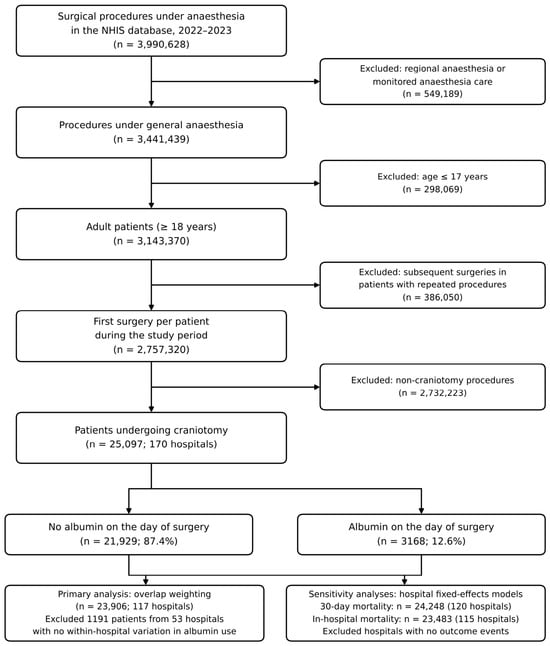
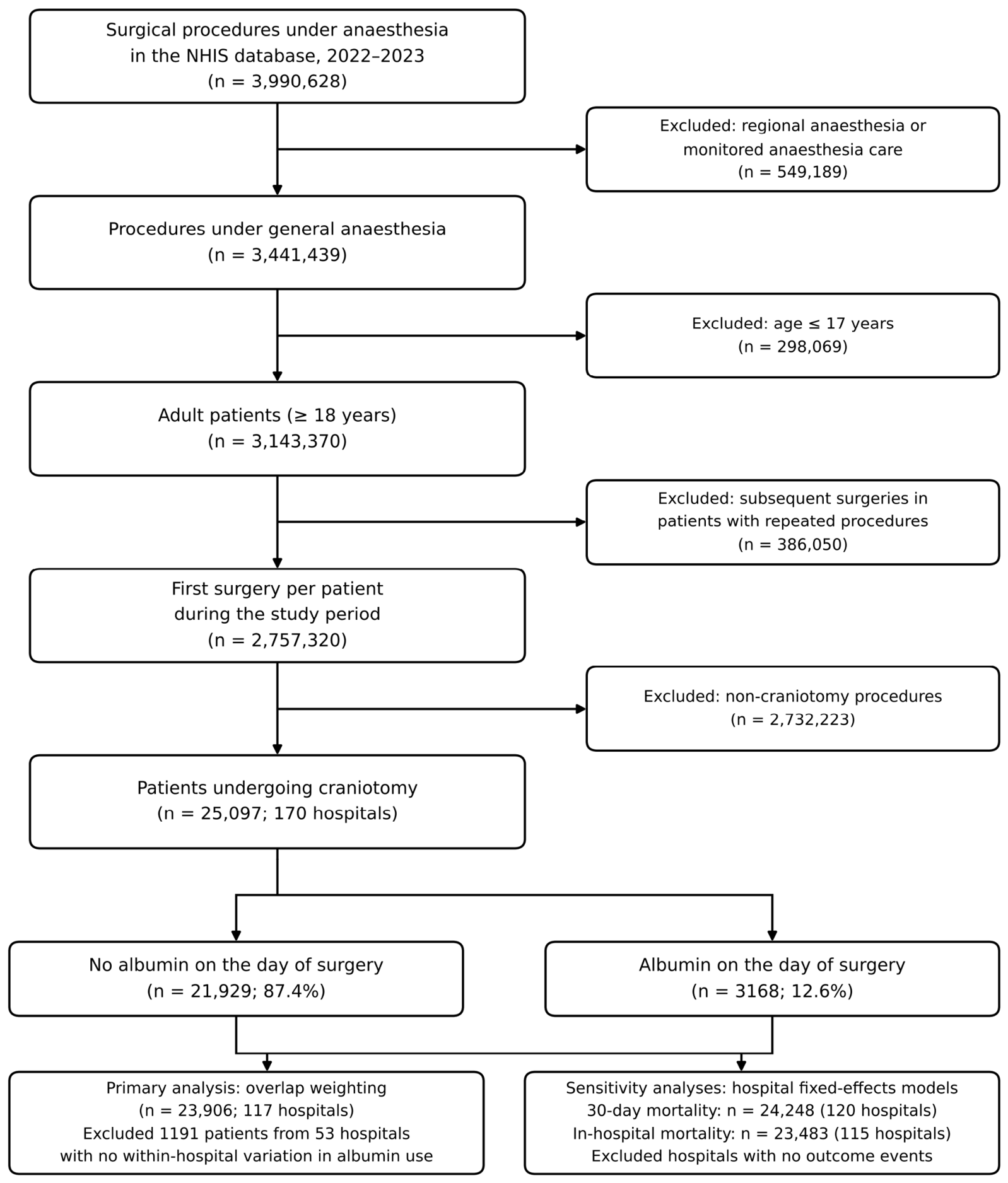
Of 3,990,628 surgical procedures performed under anaesthesia in 2022–2023, 25,097 adults underwent craniotomy at 170 hospitals and formed the study cohort (Figure 1). Albumin was administered on the day of surgery to 3168 patients (12.6%). Compared with those not given albumin, these patients were older (mean age 62.7 vs. 60.0 years), more often underwent emergency surgery (8.8% vs. 2.3%), were more frequently ASA ≥ 3 (15.1% vs. 3.0%) and operated on for traumatic brain injury (9.4% vs. 3.4%), received more packed red cells (mean 2.8 vs. 0.5 units) and had a longer duration of anaesthesia (6.7 vs. 5.0 h); they also received larger volumes of saline-based crystalloid and hydroxyethyl starch (Supplementary S3). Crude 30-day mortality was 8.7% in the albumin group and 1.8% in the no-albumin group, and in-hospital mortality was 8.5% and 1.4%, respectively.
Figure 1.
Flow of patient selection and derivation of the analytic cohorts. NHIS, National Health Insurance Service.
After exclusion of 1191 patients from 53 hospitals in which albumin was given to none or all patients, 23,906 patients from 117 hospitals were available for the primary analysis. Thirty-day mortality among the excluded patients was 6.6% (79/1191), compared with 2.5% (590/23,906) in the analysed cohort. Baseline imbalance in this cohort was substantial before weighting, with SMDs exceeding 0.10 for 26 of the covariates, whereas after overlap weighting all SMDs were below 0.001 (Table 1).
Table 1.
Baseline Characteristics of Patients Undergoing Craniotomy According to Perioperative Albumin Administration, Before and After Overlap Weighting.
3.2. Primary Analysis
In the overlap-weighted cohort, 30-day mortality was 6.6% among patients who received albumin and 3.8% among those who did not, an absolute difference of 2.9 percentage points (95% CI 0.9–4.8). Albumin administration was associated with higher odds of 30-day mortality (OR 1.81, 95% CI 1.44–2.29; p < 0.001) and of in-hospital mortality (weighted rates 6.0% vs. 3.1%; OR 1.96, 95% CI 1.53–2.52; p < 0.001) (Table 2).
Table 2.
Association Between Perioperative Albumin Administration and Postoperative Mortality After Craniotomy.
3.3. Sensitivity Analyses
Multivariable logistic regression with hospital fixed effects, applied to the full eligible cohort after exclusion of hospitals with no deaths (24,248 patients from 120 hospitals for 30-day mortality and 23,483 patients from 115 hospitals for in-hospital mortality), yielded larger estimates in the same direction (OR 2.83, 95% CI 2.04–3.93 and OR 3.42, 95% CI 2.51–4.67, respectively; both p < 0.001) (Table 3; full models in Supplementary S4).
Table 3.
Sensitivity Analysis: Association Between Perioperative Albumin Administration and Postoperative Mortality Using Multivariable Logistic Regression With Hospital Fixed Effects.
3.4. Dose–Response Analysis
Within the same fixed-effects models, no association was found between the cumulative dose of albumin and either endpoint. The OR per 10 g of total albumin was 0.99 (95% CI 0.96–1.01) for 30-day mortality and 1.00 (95% CI 0.98–1.03) for in-hospital mortality. When 20% and 5% preparations were modelled separately, the OR per 10 g of 20% albumin was 0.97 (95% CI 0.94–1.00; p = 0.063) for 30-day mortality and 1.00 (95% CI 0.97–1.03) for in-hospital mortality, and the corresponding ORs for 5% albumin were 1.01 (95% CI 0.98–1.03) and 1.01 (95% CI 0.97–1.04) (Table 4; full models in Supplementary S5).
Table 4.
Dose–Response Analysis of Perioperative Albumin Dose and Postoperative Mortality Using Multivariable Logistic Regression With Hospital Fixed Effects.
3.5. Analysis by Surgical Indication
When analysed by surgical indication, albumin administration was associated with higher 30-day mortality in patients with intracranial neoplasm (OR 4.03, 95% CI 2.33–6.97), cerebrovascular disease (OR 2.55, 95% CI 1.65–3.95) and traumatic brain injury (OR 2.44, 95% CI 1.07–5.54). For in-hospital mortality, the corresponding ORs were 7.35 (95% CI 3.57–15.16), 3.59 (95% CI 2.29–5.61) and 2.39 (95% CI 0.90–6.36) (Table 5).
Table 5.
Association Between Perioperative Albumin Administration and Postoperative Mortality According to Surgical Indication.
4. Discussion
In this nationwide cohort of 25,097 adults undergoing craniotomy, albumin administration on the day of surgery was associated with higher odds of 30-day and in-hospital mortality after overlap weighting on a propensity score that incorporated hospital fixed effects. Conventional multivariable regression with hospital fixed effects gave estimates in the same direction but of larger magnitude. In contrast, the cumulative dose of albumin was not associated with either endpoint, whether examined in total or separately for 20% and 5% preparations.
The direction of the association is consistent with the SAFE-TBI analysis, in which albumin resuscitation was associated with higher mortality than saline in patients with traumatic brain injury [4], and with the post hoc finding that this excess was accompanied by higher intracranial pressure [5]. The present cohort differs in that traumatic brain injury accounted for only 4% of operations, with most patients undergoing surgery for intracranial neoplasm or cerebrovascular disease. Nevertheless, the association was present in each surgical indication and was not confined to trauma. In the 1051 patients operated on for traumatic brain injury, the group most comparable to SAFE-TBI, the direction of the association was the same as in that trial, although the estimates were imprecise and these patients, who underwent surgery, differed from those resuscitated in the intensive care unit in SAFE-TBI. Disruption of the blood–brain barrier is also a feature of these conditions [11], and the same mechanism, extravasation of albumin into oedematous brain with a consequent rise in intracranial pressure, is at least biologically plausible. Our findings should be distinguished from the observational literature linking low or falling serum albumin to worse outcomes after craniotomy [1,3]. Those studies examined endogenous albumin as a marker of nutritional and inflammatory state, not the effect of administering exogenous albumin, and a low concentration may identify patients at risk without implying that its correction is beneficial. Indeed, the large trials in the critically ill and in acute ischaemic stroke found no benefit of albumin and, in stroke, an excess of pulmonary oedema [12,13].
Two explanations are compatible with these findings, and our data cannot distinguish between them. The first is residual confounding by indication [14]. Albumin is often given in response to haemorrhage, haemodynamic instability or brain swelling, which are themselves associated with death and are not recorded in claims data. Patients who received albumin were transfused more, had longer anaesthesia and were more often operated on as emergencies, and the estimate from overlap weighting, which focuses on patients for whom either decision was plausible, was smaller than that from conventional regression in the full eligible cohort. The second is a direct adverse effect. Albumin crossing a disrupted blood–brain barrier may worsen cerebral oedema and raise intracranial pressure, as proposed for the excess mortality in SAFE-TBI [5], and in ALIAS Part 2 symptomatic intracranial haemorrhage within 24 h occurred in 4% of patients given high-dose albumin compared with 2% given saline [13]. Consistent with these concerns, the European Society of Intensive Care Medicine recommends against colloids, including albumin, as maintenance fluids in acute brain injury and suggests against 4% and 20% albumin for resuscitation [15], and its 2024 guideline makes a conditional recommendation for isotonic saline over albumin in traumatic brain injury [16]. The absence of a dose–response relationship does not separate these explanations: once transfusion and fluid volumes, which rise with blood loss, as does the albumin dose, are adjusted for, a gradient would be difficult to detect even if albumin were harmful, and a threshold effect is biologically plausible. Because the timing of administration, serum albumin concentration and intraoperative brain swelling were unknown, we can neither demonstrate nor exclude harm.
These considerations limit the inferences that can be drawn. Our results do not establish that albumin is harmful in craniotomy. They do indicate that the use of albumin in this setting is not supported by evidence of benefit, that patients who receive it have substantially higher mortality than would be expected from measurable characteristics, and that the direction of the signal is the same as that seen in the only randomised data available for the injured brain [4]. Given the widespread use of albumin in neuroanaesthesia [2], prospective evaluation is needed.
Resolving this question requires information that claims data cannot provide. A prospective multicentre registry recording the timing of albumin relative to incision and closure, the preparation and dose, serum albumin concentration, blood loss and intraoperative brain swelling would allow the indication for albumin to be separated from its effect. Because use varies widely between hospitals, comparisons of high- and low-use institutions would provide a complementary design that is less susceptible to confounding by indication. Given the signal in traumatic brain injury and current guidance against albumin in acute brain injury [15,16], a pragmatic trial would more appropriately compare restricted albumin use with usual care than randomise patients to receive albumin.
This study has several strengths. It used complete national data from 170 hospitals, which limits selection bias and allows practice variation between institutions to be modelled directly. By estimating the propensity score with hospital fixed effects, comparisons were made between patients treated at the same institution, removing confounding by hospital-level factors such as case-mix, resources and prescribing culture. The two analytical approaches yielded consistent conclusions.
The limitations are largely those of administrative data. Albumin was identified from prescriptions on the day of surgery, so administration before induction, during the operation and in the early postoperative period could not be separated. Some patients may therefore have received albumin in response to early postoperative deterioration, so that the deterioration led to albumin rather than the reverse. Albumin given in the intensive care unit on the evening of surgery, for example to a patient with postoperative haemorrhage, hypotension or rising intracranial pressure, would be counted as exposure, and its inclusion would bias the estimate away from the null; because the claims do not record the location or time of administration, we could not identify these patients, and reverse causation cannot be excluded. Clinical variables that drive the decision to give albumin, including blood loss, serum albumin concentration, intracranial pressure and preoperative neurological status, were unavailable, and this is the principal source of the residual confounding discussed above. Patients who received albumin differed markedly from those who did not: they received on average 2.8 vs. 0.5 units of red cells, had anaesthesia lasting 1.7 h longer, and were about four times as likely to undergo emergency surgery and five times as likely to be classified as ASA ≥ 3. These differences suggest that albumin was often given during more complicated or catastrophic operations, and although these variables were balanced by weighting, they are coarse proxies for the severity of the underlying event. For the same reason, we could not determine whether the association is specific to albumin or reflects the severity of illness in patients who receive it, because claims data provided no suitable negative-control exposure or outcome sharing the indication structure of albumin. Comorbidities and the ASA classification were derived from claims and are subject to coding error. The overlap-weighted analysis excluded hospitals in which albumin was never or always given, and the fixed-effects models excluded hospitals without deaths. Patients treated at the hospitals excluded from the primary analysis had higher 30-day mortality (6.6%) than those analysed (2.5%), so our estimates apply to institutions with variable albumin practice and may not be generalisable to all hospitals. Finally, mortality was the only outcome examined; effects on neurological recovery, length of stay or complications were not assessed, and the study period of two years precluded evaluation of longer-term survival.
5. Conclusions
In this nationwide cohort, albumin administration on the day of craniotomy was associated with higher 30-day and in-hospital mortality, without a dose–response relationship. Residual confounding by indication and a direct adverse effect could not be distinguished. These observational findings should not by themselves change clinical practice and should not be cited as evidence that albumin is harmful. Equally, they provide no support for the routine use of albumin in craniotomy, and they indicate a need for prospective studies that record the timing and indication of albumin administration.
Supplementary Materials
The following supporting information can be downloaded at https://www.mdpi.com/article/10.3390/brainsci16111144/s1: Supplementary S1. ICD-10 codes used to define comorbidities. Supplementary S2. Classification of disabilities in South Korea. Supplementary S3. Baseline Characteristics of the Full Eligible Cohort According to Perioperative Albumin Administration. Supplementary S4. Full Estimates From the Multivariable Logistic Regression Models With Hospital Fixed Effects for 30-Day and In-Hospital Mortality. Supplementary S5. Full Estimates From the Dose–Response Models of Perioperative Albumin Dose and Postoperative Mortality.
Author Contributions
Conceptualization, H.-W.C. and T.K.O.; methodology, T.K.O.; software, T.K.O.; validation, H.-W.C., I.-A.S., S.-H.H. and T.K.O.; formal analysis, T.K.O.; investigation, H.-W.C.; resources, I.-A.S.; data curation, T.K.O.; writing—original draft preparation, H.-W.C.; writing—review and editing, I.-A.S., S.-H.H. and T.K.O.; visualization, H.-W.C.; supervision, I.-A.S. and T.K.O.; project administration, T.K.O. All authors have read and agreed to the published version of the manuscript.
Funding
This research received no external funding.
Institutional Review Board Statement
Approval was obtained from the Institutional Review Board of Seoul National University Bundang Hospital (X-2508-992-902) and from the NHIS data review committee (NHIS-2026-04-1-009). The study was conducted in accordance with the Declaration of Helsinki and is reported following the STROBE recommendations for observational studies.
Informed Consent Statement
Because the analysis involved only de-identified records, the requirement for individual informed consent was waived.
Data Availability Statement
Data will be available upon reasonable request to the corresponding author.
Conflicts of Interest
The authors declare no conflicts of interest.
Abbreviations
The following abbreviations are used in this manuscript:
ASA, American Society of Anesthesiologists; BBB, blood–brain barrier; CCI, Charlson Comorbidity Index; CI, confidence interval; HES, hydroxyethyl starch; ICD-10, International Classification of Diseases, 10th Revision; NHIS, National Health Insurance Service; OR, odds ratio; SD, standard deviation; SMD, standardised mean difference; STROBE, Strengthening the Reporting of Observational Studies in Epidemiology; TBI, traumatic brain injury; TRVU, total relative value unit.
References
- Dasenbrock, H.H.; Liu, K.X.; Chavakula, V.; Devine, C.A.; Gormley, W.B.; Claus, E.B.; Smith, T.R.; Dunn, I.F. Body habitus, serum albumin, and the outcomes after craniotomy for tumor: A National Surgical Quality Improvement Program analysis. J. Neurosurg. 2017, 126, 677–689. [Google Scholar] [CrossRef] [Scilit] [PubMed]
- Tommasino, C. Fluids and the neurosurgical patient. Anesthesiol. Clin. N. Am. 2002, 20, 329–346. [Google Scholar] [CrossRef] [Scilit] [PubMed]
- Xiao, Y.; Zhao, Y.; Cheng, X.; Hao, P.; Tian, Y.; He, J.; Wang, W.; Chen, L.; Feng, Y.; Li, T.; et al. Association Between Postoperative Decrease of Albumin and Outcomes in Patients Undergoing Craniotomy for Brain Tumors. World Neurosurg. 2024, 190, e554–e569. [Google Scholar] [CrossRef] [Scilit] [PubMed]
- The SAFE Study Investigators; Australian; New Zealand Intensive Care Society Clinical Trial Group; Australian Red Cross Blood Service; The George Institute for International Health; Myburgh, J.; Cooper, D.J.; Finfer, S.; Bellomo, R.; Norton, R.; et al. Saline or albumin for fluid resuscitation in patients with traumatic brain injury. N. Engl. J. Med. 2007, 357, 874–884. [Google Scholar] [CrossRef] [Scilit] [PubMed]
- Cooper, D.J.; Myburgh, J.; Heritier, S.; Finfer, S.; Bellomo, R.; Billot, L.; Murray, L.; Vallance, S.; the SAFE-TBI Investigators; the Australian and New Zealand Intensive Care Society Clinical Trials Group. Albumin resuscitation for traumatic brain injury: Is intracranial hypertension the cause of increased mortality? J. Neurotrauma 2013, 30, 512–518. [Google Scholar] [CrossRef] [Scilit] [PubMed]
- Lee, J.; Lee, J.S.; Park, S.-H.; Shin, S.A.; Kim, K. Cohort profile: The national health insurance service–national sample cohort (NHIS-NSC), South Korea. Int. J. Epidemiol. 2017, 46, e15. [Google Scholar] [CrossRef] [Scilit] [PubMed]
- Von Elm, E.; Altman, D.G.; Egger, M.; Pocock, S.J.; Gøtzsche, P.C.; Vandenbroucke, J.P. The Strengthening the Reporting of Observational Studies in Epidemiology (STROBE) statement: Guidelines for reporting observational studies. Lancet 2007, 370, 1453–1457. [Google Scholar] [CrossRef] [Scilit] [PubMed]
- Oh, T.K.; Song, I.A.; Choi, Y. The Association Between Total Relative Value Unit and 90-Day Mortality After Noncardiac Surgery: A Hospital Data Registry Study. Surg. Innov. 2020, 27, 461–467. [Google Scholar] [CrossRef] [Scilit] [PubMed]
- Li, F.; Morgan, K.L.; Zaslavsky, A.M. Balancing covariates via propensity score weighting. J. Am. Stat. Assoc. 2018, 113, 390–400. [Google Scholar] [CrossRef] [Scilit]
- Bergé, L.R. Efficient estimation of maximum likelihood models with multiple fixed-effects: The R package FENmlm. 2026. Available online: https://hal.science/hal-05654564v1 (accessed on 12 October 2026). [PubMed]
- Sarkaria, J.N.; Hu, L.S.; Parney, I.F.; Pafundi, D.H.; Brinkmann, D.H.; Laack, N.N.; Giannini, C.; Burns, T.C.; Kizilbash, S.H.; Laramy, J.K.; et al. Is the blood-brain barrier really disrupted in all glioblastomas? A critical assessment of existing clinical data. Neuro Oncol. 2018, 20, 184–191. [Google Scholar] [CrossRef] [Scilit] [PubMed]
- Finfer, S.; Bellomo, R.; Boyce, N.; French, J.; Myburgh, J.; Norton, R.; Investigators, S.S. A comparison of albumin and saline for fluid resuscitation in the intensive care unit. N. Engl. J. Med. 2004, 350, 2247–2256. [Google Scholar] [CrossRef] [Scilit] [PubMed]
- Ginsberg, M.D.; Palesch, Y.Y.; Hill, M.D.; Martin, R.H.; Moy, C.S.; Barsan, W.G.; Waldman, B.D.; Tamariz, D.; Ryckborst, K.J.; ALIAS and Neurological Emergencies Treatment Trials (NETT) Investigators. High-dose albumin treatment for acute ischaemic stroke (ALIAS) Part 2: A randomised, double-blind, phase 3, placebo-controlled trial. Lancet Neurol. 2013, 12, 1049–1058. [Google Scholar] [CrossRef] [Scilit] [PubMed]
- Psaty, B.M.; Koepsell, T.D.; Lin, D.; Weiss, N.S.; Siscovick, D.S.; Rosendaal, F.R.; Pahor, M.; Furberg, C.D. Assessment and control for confounding by indication in observational studies. J. Am. Geriatr. Soc. 1999, 47, 749–754. [Google Scholar] [CrossRef] [Scilit] [PubMed]
- Oddo, M.; Poole, D.; Helbok, R.; Meyfroidt, G.; Stocchetti, N.; Bouzat, P.; Cecconi, M.; Geeraerts, T.; Martin-Loeches, I.; Quintard, H.; et al. Fluid therapy in neurointensive care patients: ESICM consensus and clinical practice recommendations. Intensive Care Med. 2018, 44, 449–463. [Google Scholar] [CrossRef] [Scilit] [PubMed]
- Arabi, Y.M.; Belley-Cote, E.; Carsetti, A.; De Backer, D.; Donadello, K.; Juffermans, N.P.; Hammond, N.; Laake, J.H.; Liu, D.; Maitland, K.; et al. European Society of Intensive Care Medicine clinical practice guideline on fluid therapy in adult critically ill patients. Part 1: The choice of resuscitation fluids. Intensive Care Med. 2024, 50, 813–831. [Google Scholar] [CrossRef] [Scilit] [PubMed]

Disclaimer/Publisher’s Note: The statements, opinions and data contained in all publications are solely those of the individual author(s) and contributor(s) and not of MDPI and/or the editor(s). MDPI and/or the editor(s) disclaim responsibility for any injury to people or property resulting from any ideas, methods, instructions or products referred to in the content. |
© 2026 by the authors. Licensee MDPI, Basel, Switzerland. This article is an open access article distributed under the terms and conditions of the Creative Commons Attribution (CC BY) license.