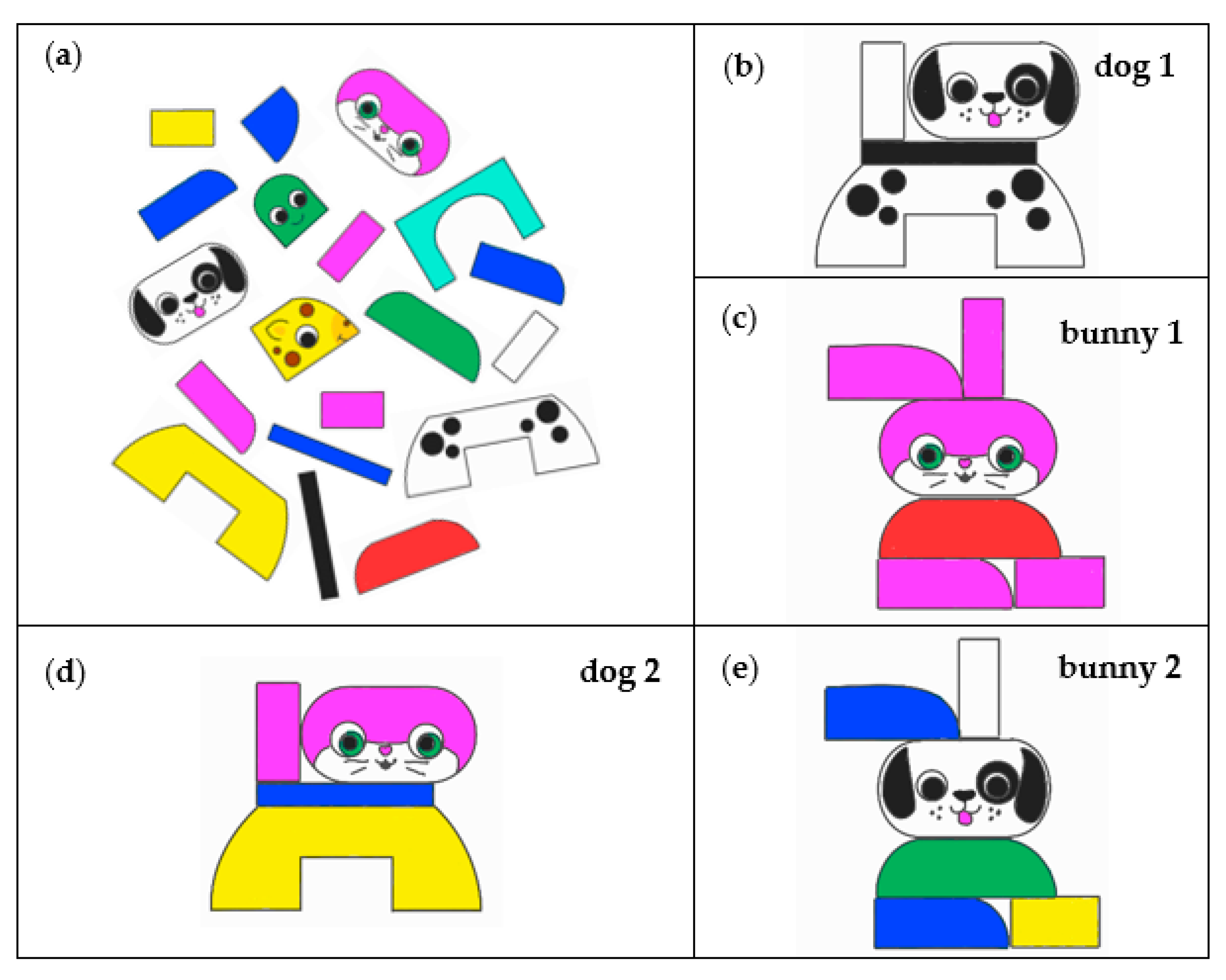
“Try to Build This Bunny as Fast as Possible without Using Red or Pink Bricks”: How Simple Assembly Tasks Might Aid in Detecting People with Mild Cognitive Impairment and Dementia
Abstract
1. Introduction
2. Materials and Methods
2.1. Participants
2.2. Neurocognitive Tests, Assembly Task, and Symptom Measures
2.3. Statistical Analyses
- CNT vs. mild DEM;
- CNT vs. mild Alzheimer’s disease;
- CNT vs. mild dementia (no Alzheimer’s disease);
- CNT vs. MCI;
- CNT vs. MCI or mild dementia as the dependent variables.
3. Results
3.1. Sample Characteristics
3.2. Validity of the Assembly Tasks
3.3. Diagnostic Performance of the MMST, the FAB-D, and the Assembly Tasks
4. Discussion
5. Conclusions
Author Contributions
Funding
Institutional Review Board Statement
Informed Consent Statement
Data Availability Statement
Acknowledgments
Conflicts of Interest
References
- ICD-11 for Mortality and Morbidity Statistics. Available online: https://icd.who.int/browse11/l-m/en (accessed on 26 May 2023).
- Dementia. Available online: https://www.who.int/news-room/fact-sheets/detail/dementia (accessed on 26 May 2023).
- Nichols, E.; Steinmetz, J.D.; Vollset, S.E.; Fukutaki, K.; Chalek, J.; Abd-Allah, F.; Abdoli, A.; Abualhasan, A.; Abu-Gharbieh, E.; Akram, T.T.; et al. Estimation of the Global Prevalence of Dementia in 2019 and Forecasted Prevalence in 2050: An Analysis for the Global Burden of Disease Study. Lancet Public Health 2022, 7, e105–e125. [Google Scholar] [CrossRef] [PubMed]
- Pimouguet, C.; Lavaud, T.; Dartigues, J.F.; Helmer, C. Dementia Case Management Effectiveness on Health Care Costs and Resource Utilization: A Systematic Review of Randomized Controlled Trials. J. Nutr. Health Aging 2010, 14, 669–676. [Google Scholar] [CrossRef] [Scilit] [PubMed]
- Banerjee, S.; Wittenberg, R. Clinical and Cost Effectiveness of Services for Early Diagnosis and Intervention in Dementia. Int. J. Geriatr. Psychiatry 2009, 24, 748–754. [Google Scholar] [CrossRef] [Scilit] [PubMed]
- Getsios, D.; Blume, S.; Ishak, K.J.; Maclaine, G.; Hernández, L. An Economic Evaluation of Early Assessment for Alzheimer’s Disease in the United Kingdom. Alzheimers Dement. 2012, 8, 22–30. [Google Scholar] [CrossRef] [Scilit] [PubMed]
- Brooker, D.; La Fontaine, J.; Evans, S.; Bray, J.; Saad, K. Public Health Guidance to Facilitate Timely Diagnosis of Dementia: ALzheimer’s COoperative Valuation in Europe Recommendations. Int. J. Geriatr. Psychiatry 2014, 29, 682–693. [Google Scholar] [CrossRef] [Scilit]
- Banich, M.T. Executive Function: The Search for an Integrated Account. Curr. Dir. Psychol. Sci. 2009, 18, 89–94. [Google Scholar] [CrossRef] [Scilit]
- Jones, D.T.; Graff-Radford, J. Executive Dysfunction and the Prefrontal Cortex. Contin. Lifelong Learn. Neurol. 2021, 27, 1586–1601. [Google Scholar] [CrossRef] [Scilit]
- Rabinovici, G.D.; Stephens, M.L.; Possin, K.L. Executive Dysfunction. Contin. Lifelong Learn. Neurol. 2015, 21, 646–659. [Google Scholar] [CrossRef] [Scilit]
- Reinvang, I.; Grambaite, R.; Espeseth, T. Executive Dysfunction in MCI: Subtype or Early Symptom. Int. J. Alzheimers Dis. 2012, 2012, 936272. [Google Scholar] [CrossRef] [Scilit]
- Tiel, C.; Sudo, F.K.; Calmon, A.B. Neuropsychiatric Symptoms and Executive Function Impairments in Alzheimer’s Disease and Vascular Dementia: The Role of Subcortical Circuits. Dement. Neuropsychol. 2019, 13, 293–298. [Google Scholar] [CrossRef] [Scilit]
- Johns, E.K.; Phillips, N.A.; Belleville, S.; Goupil, D.; Babins, L.; Kelner, N.; Ska, B.; Gilbert, B.; Inglis, G.; Panisset, M.; et al. Executive Functions in Frontotemporal Dementia and Lewy Body Dementia. Neuropsychology 2009, 23, 765–777. [Google Scholar] [CrossRef] [Scilit] [PubMed]
- Kirova, A.-M.; Bays, R.B.; Lagalwar, S. Working Memory and Executive Function Decline across Normal Aging, Mild Cognitive Impairment, and Alzheimer’s Disease. Biomed. Res. Int. 2015, 2015, 748212. [Google Scholar] [CrossRef] [Scilit] [PubMed]
- Park, J.E. Apraxia: Review and Update. J. Clin. Neurol. 2017, 13, 317–324. [Google Scholar] [CrossRef] [Scilit] [PubMed]
- Ahmed, S.; Baker, I.; Thompson, S.; Husain, M.; Butler, C.R. Utility of Testing for Apraxia and Associated Features in Dementia. J. Neurol. Neurosurg. Psychiatry 2016, 87, 1158–1162. [Google Scholar] [CrossRef] [Scilit] [PubMed]
- Vakkila, E.; Jehkonen, M. Apraxia and Dementia Severity in Alzheimer’s Disease: A Systematic Review. J. Clin. Exp. Neuropsychol. 2023, 45, 84–103. [Google Scholar] [CrossRef] [Scilit] [PubMed]
- Bartolo, A.; Osiurak, F. One Century after Liepmann’s Work on Apraxia: Where Do We Go Now? Cortex 2022, 154, 333–339. [Google Scholar] [CrossRef] [Scilit] [PubMed]
- Tranel, D.; Kemmerer, D.; Adolphs, R.; Damasio, H.; Damasio, A.R. Neural Correlates of Conceptual Knowledge for Actions. Cogn. Neuropsychol. 2003, 20, 409–432. [Google Scholar] [CrossRef] [Scilit]
- McKhann, G.M.; Knopman, D.S.; Chertkow, H.; Hyman, B.T.; Jack, C.R.; Kawas, C.H.; Klunk, W.E.; Koroshetz, W.J.; Manly, J.J.; Mayeux, R.; et al. The Diagnosis of Dementia Due to Alzheimer’s Disease: Recommendations from the National Institute on Aging-Alzheimer’s Association Workgroups on Diagnostic Guidelines for Alzheimer’s Disease. Alzheimers Dement. 2011, 7, 263–269. [Google Scholar] [CrossRef] [Scilit]
- Rascovsky, K.; Hodges, J.R.; Knopman, D.; Mendez, M.F.; Kramer, J.H.; Neuhaus, J.; van Swieten, J.C.; Seelaar, H.; Dopper, E.G.P.; Onyike, C.U.; et al. Sensitivity of Revised Diagnostic Criteria for the Behavioural Variant of Frontotemporal Dementia. Brain 2011, 134, 2456–2477. [Google Scholar] [CrossRef] [Scilit]
- Gorno-Tempini, M.L.; Hillis, A.E.; Weintraub, S.; Kertesz, A.; Mendez, M.; Cappa, S.F.; Ogar, J.M.; Rohrer, J.D.; Black, S.; Boeve, B.F.; et al. Classification of Primary Progressive Aphasia and Its Variants. Neurology 2011, 76, 1006–1014. [Google Scholar] [CrossRef] [Scilit]
- Goetz, C.G.; Emre, M.; Dubois, B. Parkinson’s Disease Dementia: Definitions, Guidelines, and Research Perspectives in Diagnosis. Ann. Neurol. 2008, 64 (Suppl. S2), S81–S92. [Google Scholar] [CrossRef] [Scilit] [PubMed]
- McKeith, I.G.; Dickson, D.W.; Lowe, J.; Emre, M.; O’Brien, J.T.; Feldman, H.; Cummings, J.; Duda, J.E.; Lippa, C.; Perry, E.K.; et al. Diagnosis and Management of Dementia with Lewy Bodies: Third Report of the DLB Consortium. Neurology 2005, 65, 1863–1872. [Google Scholar] [CrossRef] [Scilit] [PubMed]
- Román, G.C.; Tatemichi, T.K.; Erkinjuntti, T.; Cummings, J.L.; Masdeu, J.C.; Garcia, J.H.; Amaducci, L.; Orgogozo, J.M.; Brun, A.; Hofman, A. Vascular Dementia: Diagnostic Criteria for Research Studies. Report of the NINDS-AIREN International Workshop. Neurology 1993, 43, 250–260. [Google Scholar] [CrossRef] [Scilit] [PubMed]
- Dubois, B.; Feldman, H.H.; Jacova, C.; Hampel, H.; Molinuevo, J.L.; Blennow, K.; DeKosky, S.T.; Gauthier, S.; Selkoe, D.; Bateman, R.; et al. Advancing Research Diagnostic Criteria for Alzheimer’s Disease: The IWG-2 Criteria. Lancet Neurol. 2014, 13, 614–629. [Google Scholar] [CrossRef] [Scilit] [PubMed]
- Folstein, M.F.; Folstein, S.E.; McHugh, P.R. “Mini-Mental State”. A Practical Method for Grading the Cognitive State of Patients for the Clinician. J. Psychiatr. Res. 1975, 12, 189–198. [Google Scholar] [CrossRef] [Scilit] [PubMed]
- Aebi: Validierung Der Neuropsychologischen Testbatterie...-Google Scholar. Available online: https://scholar.google.com/scholar_lookup?title=Validierung+der+Neuropsychologischen+Testbatterie+CERAD-NP:+Eine+Multi-Center+Studie.+PhD+thesis&author=C+Aebi&publication_year=2002& (accessed on 25 June 2023).
- Trapp, W.; Röder, S.; Heid, A.; Billman, P.; Daiber, S.; Hajak, G. Sensitivity and Specificity of the Bamberg Dementia Screening Test’s (BDST) Full and Short Versions: Brief Screening Instruments for Geriatric Patients That Are Suitable for Infectious Environments. BMC Med. 2021, 19, 65. [Google Scholar] [CrossRef] [Scilit]
- Benke, T.; Karner, E.; Delazer, M. FAB-D: German Version of the Frontal Assessment Battery. J. Neurol. 2013, 260, 2066–2072. [Google Scholar] [CrossRef] [Scilit] [PubMed]
- Yesavage, J.A.; Sheikh, J.I. 9/Geriatric Depression Scale (GDS): Recent Evidence and Development of a Shorter Version. Clin. Gerontol. 1986, 5, 165–173. [Google Scholar] [CrossRef] [Scilit]
- Miyake, A.; Friedman, N.P.; Emerson, M.J.; Witzki, A.H.; Howerter, A.; Wager, T.D. The Unity and Diversity of Executive Functions and Their Contributions to Complex “Frontal Lobe” Tasks: A Latent Variable Analysis. Cogn. Psychol. 2000, 41, 49–100. [Google Scholar] [CrossRef] [Scilit]
- Trzepacz, P.T.; Hochstetler, H.; Wang, S.; Walker, B.; Saykin, A.J. Alzheimer’s Disease Neuroimaging Initiative Relationship between the Montreal Cognitive Assessment and Mini-Mental State Examination for Assessment of Mild Cognitive Impairment in Older Adults. BMC Geriatr. 2015, 15, 107. [Google Scholar] [CrossRef] [Scilit]
- Trapp, W.; Heid, A.; Röder, S.; Wimmer, F.; Hajak, G. “Mmm, Smells like Coffee!”: How a Brief Odor Identification Test Could Help to Identify People with Mild Cognitive Impairment and Dementia. Brain Sci. 2023, 13, 1052. [Google Scholar] [CrossRef] [Scilit] [PubMed]
- Zhang, J.; Wang, G.; Yang, X.; Gao, K. Efficacy and Safety of Electroconvulsive Therapy plus Medication versus Medication Alone in Acute Mania: A Meta-Analysis of Randomized Controlled Trials. Psychiatry Res. 2021, 302, 114019. [Google Scholar] [CrossRef] [Scilit] [PubMed]
- Zappullo, I.; Conson, M.; Zoccolotti, P.; Trojano, L.; Senese, V.P. “Building Blocks and Drawing Figures Is Not the Same”: Neuropsychological Bases of Block Design and Rey Figure Drawing in Typically Developing Children. Child. Neuropsychol. 2021, 27, 371–389. [Google Scholar] [CrossRef] [Scilit] [PubMed]
- Caldwell, M.P.; Cheung, H.; Cheung, S.-K.; Li, J.-B.; Carrey Siu, T.-S. Visuospatial Perspective-Taking in Social-Emotional Development: Enhancing Young Children’s Mind and Emotion Understanding via Block Building Training. BMC Psychol. 2022, 10, 264. [Google Scholar] [CrossRef] [Scilit] [PubMed]
- Conson, M.; Siciliano, M.; Zappullo, I.; Baiano, C.; Trojano, L.; Salzano, S.; Santangelo, G. Measuring Mindreading in Preschoolers: The Perspective Battery (PERBAT). Clin. Neuropsychol. 2023, 24, 1–20. [Google Scholar] [CrossRef] [Scilit] [PubMed]
- Arevalo-Rodriguez, I.; Smailagic, N.; Roqué-Figuls, M.; Ciapponi, A.; Sanchez-Perez, E.; Giannakou, A.; Pedraza, O.L.; Bonfill Cosp, X.; Cullum, S. Mini-Mental State Examination (MMSE) for the Early Detection of Dementia in People with Mild Cognitive Impairment (MCI). Cochrane Database Syst. Rev. 2021, 7, CD010783. [Google Scholar] [CrossRef] [Scilit]
- Nasreddine, Z.S.; Phillips, N.A.; Bédirian, V.; Charbonneau, S.; Whitehead, V.; Collin, I.; Cummings, J.L.; Chertkow, H. The Montreal Cognitive Assessment, MoCA: A Brief Screening Tool for Mild Cognitive Impairment. J. Am. Geriatr. Soc. 2005, 53, 695–699. [Google Scholar] [CrossRef] [Scilit]
- Hsieh, S.; Schubert, S.; Hoon, C.; Mioshi, E.; Hodges, J.R. Validation of the Addenbrooke’s Cognitive Examination III in Frontotemporal Dementia and Alzheimer’s Disease. Dement. Geriatr. Cogn. Disord. 2013, 36, 242–250. [Google Scholar] [CrossRef] [Scilit]
- Brown, J.; Pengas, G.; Dawson, K.; Brown, L.A.; Clatworthy, P. Self Administered Cognitive Screening Test (TYM) for Detection of Alzheimer’s Disease: Cross Sectional Study. BMJ 2009, 338, b2030. [Google Scholar] [CrossRef] [Scilit]


| CNT (n = 46) | MCI (n = 62) | DEM (n = 89) | Analysis of Variance | |
|---|---|---|---|---|
| mean (SD) | mean (SD) | mean (SD) | F(2,194) (p) | |
| Age | 69.65 (10.03) | 70.55 (9.58) | 69.06 (8.72) | 0.470 (0.626) |
| Years of education | 13.48 (1.97) | 13.79 (2.12) | 13.18 (1.75) | 1.793 (0.169) |
| GDS | 4.28 (3.42) | 4.52 (3.52) | 4.48 (3.98) | 0.060 (0.942) |
| MMSE | 28.39 (1.20) | 28.03 (1.34) | 25.16 (2.62) | 56.003 (<0.0005) |
| FAB-D | 17.11 (1.16) | 15.76 (2.06) | 12.56 (3.18) | 59.513 (<0.0005) |
| Dog 1 | 18.41 (10.74) | 26.60 (15.29) | 40.70 (25.15) | 21.767 (<0.0005) |
| Dog 2 | 25.48 (20.28) | 40.39 (30.65) | 70.99 (55.43) | 20.314 (<0.0005) |
| Bunny 1 | 32.67 (18.27) | 42.10 (24.37) | 60.60 (34.30) | 16.694 (<0.0005) |
| Bunny 2 | 56.67 (28.14) | 88.29 (43.17) | 125.43 (51.93) | 37.968 (<0.0005) |
| Assembly Test | |||||
|---|---|---|---|---|---|
| Dog 1 | Dog 2 | Bunny 1 | Bunny 2 | ||
| r (p) | r (p) | r (p) | r (p) | ||
| MMSE | −0.36 (<0.0005) | −0.46 (<0.0005) | −0.33 (<0.0005) | −0.36 (<0.0005) | |
| CERAD-Plus | Verbal learning | −0.27 (<0.0005) | −0.34 (<0.0005) | −0.26 (<0.0005) | −0.34 (<0.0005) |
| Verbal recall | −0.27 (<0.0005) | −0.30 (<0.0005) | −0.24 (<0.0005) | −0.33 (<0.0005) | |
| Verbal recognition | −0.18 (0.011) | −0.25 (0.001) | −0.15 (0.033) | −0.18 (0.011) | |
| TMT A | −0.54 (<0.0005) | −0.47 (<0.0005) | −0.58 (<0.0005) | −0.55 (<0.0005) | |
| TMT B | −0.51 (<0.0005) | −0.52 (<0.0005) | −0.46 (<0.0005) | −0.63 (<0.0005) | |
| FAB-D | −0.45 (<0.0005) | −0.52 (<0.0005) | −0.42 (<0.0005) | −0.56 (<0.0005) | |
| Dependent Variable | Variables in the Equation | β | SE (β) | p | OR | −2 Log- Likelihood | Nagelkerkes’s R2 |
|---|---|---|---|---|---|---|---|
| CNT vs. DEM | MMSE | −1.004 | 0.245 | <0.0005 | 2.732 | 58.809 | 0.791 |
| FAB-D | −1.075 | 0.237 | <0.0005 | 2.933 | |||
| CNT vs. DEM (Alzheimer’s disease) | MMSE | −1.253 | 0.321 | <0.0005 | 3.497 | 38.343 | 0.836 |
| FAB-D | −1.153 | 0.365 | 0.002 | 3.165 | |||
| CNT vs. DEM (other types of dementia) | AT 4 (bunny2) | 0.038 | 0.013 | 0.003 | 1.039 | 29.768 | 0.859 |
| FAB-D | −1.195 | 0.329 | <0.0005 | 3.300 | |||
| CNT vs. MCI | AT 4 (bunny2) | 0.022 | 0.002 | <0.0005 | 1.022 | 118.859 | 0.311 |
| FAB-D | −0.422 | 0.004 | 0.047 | 1.524 | |||
| CNT vs. (MCI or DEM) | MMSE | −0.465 | 0.150 | 0.002 | 1.592 | 130.803 | 0.520 |
| AT 4 (bunny2) | 0.021 | 0.006 | 0.001 | 1.022 | |||
| FAB-D | −0.545 | 0.142 | <0.0005 | 1.724 |
Disclaimer/Publisher’s Note: The statements, opinions and data contained in all publications are solely those of the individual author(s) and contributor(s) and not of MDPI and/or the editor(s). MDPI and/or the editor(s) disclaim responsibility for any injury to people or property resulting from any ideas, methods, instructions or products referred to in the content. |
© 2023 by the authors. Licensee MDPI, Basel, Switzerland. This article is an open access article distributed under the terms and conditions of the Creative Commons Attribution (CC BY) license (https://creativecommons.org/licenses/by/4.0/).
Share and Cite
Trapp, W.; Heid, A.; Röder, S.; Wimmer, F.; Weiß, H.; Hajak, G. “Try to Build This Bunny as Fast as Possible without Using Red or Pink Bricks”: How Simple Assembly Tasks Might Aid in Detecting People with Mild Cognitive Impairment and Dementia. Brain Sci. 2023, 13, 1693. https://doi.org/10.3390/brainsci13121693
Trapp W, Heid A, Röder S, Wimmer F, Weiß H, Hajak G. “Try to Build This Bunny as Fast as Possible without Using Red or Pink Bricks”: How Simple Assembly Tasks Might Aid in Detecting People with Mild Cognitive Impairment and Dementia. Brain Sciences. 2023; 13(12):1693. https://doi.org/10.3390/brainsci13121693
Chicago/Turabian StyleTrapp, Wolfgang, Andreas Heid, Susanne Röder, Franziska Wimmer, Helmar Weiß, and Göran Hajak. 2023. "“Try to Build This Bunny as Fast as Possible without Using Red or Pink Bricks”: How Simple Assembly Tasks Might Aid in Detecting People with Mild Cognitive Impairment and Dementia" Brain Sciences 13, no. 12: 1693. https://doi.org/10.3390/brainsci13121693
APA StyleTrapp, W., Heid, A., Röder, S., Wimmer, F., Weiß, H., & Hajak, G. (2023). “Try to Build This Bunny as Fast as Possible without Using Red or Pink Bricks”: How Simple Assembly Tasks Might Aid in Detecting People with Mild Cognitive Impairment and Dementia. Brain Sciences, 13(12), 1693. https://doi.org/10.3390/brainsci13121693