Article

Tinnitus and Metacognitive Beliefs—Results of a Cross-Sectional Observational Study

1
Tinnitus Center, European Hospital, 00149 Rome, Italy
2
University Clinic of Medical Psychology, Medical University of Innsbruck, 6020 Innsbruck, Austria
3
Department of Applied Clinical and Biotechnological Sciences, University of Aquila, 67100 L’Aquila, Italy
*
Author to whom correspondence should be addressed.
Brain Sci. 2021, 11(1), 3; https://doi.org/10.3390/brainsci11010003

Submission received: 31 October 2020 / Revised: 14 December 2020 / Accepted: 21 December 2020 / Published: 23 December 2020
(This article belongs to the Special Issue Tinnitus Subtyping)

Abstract

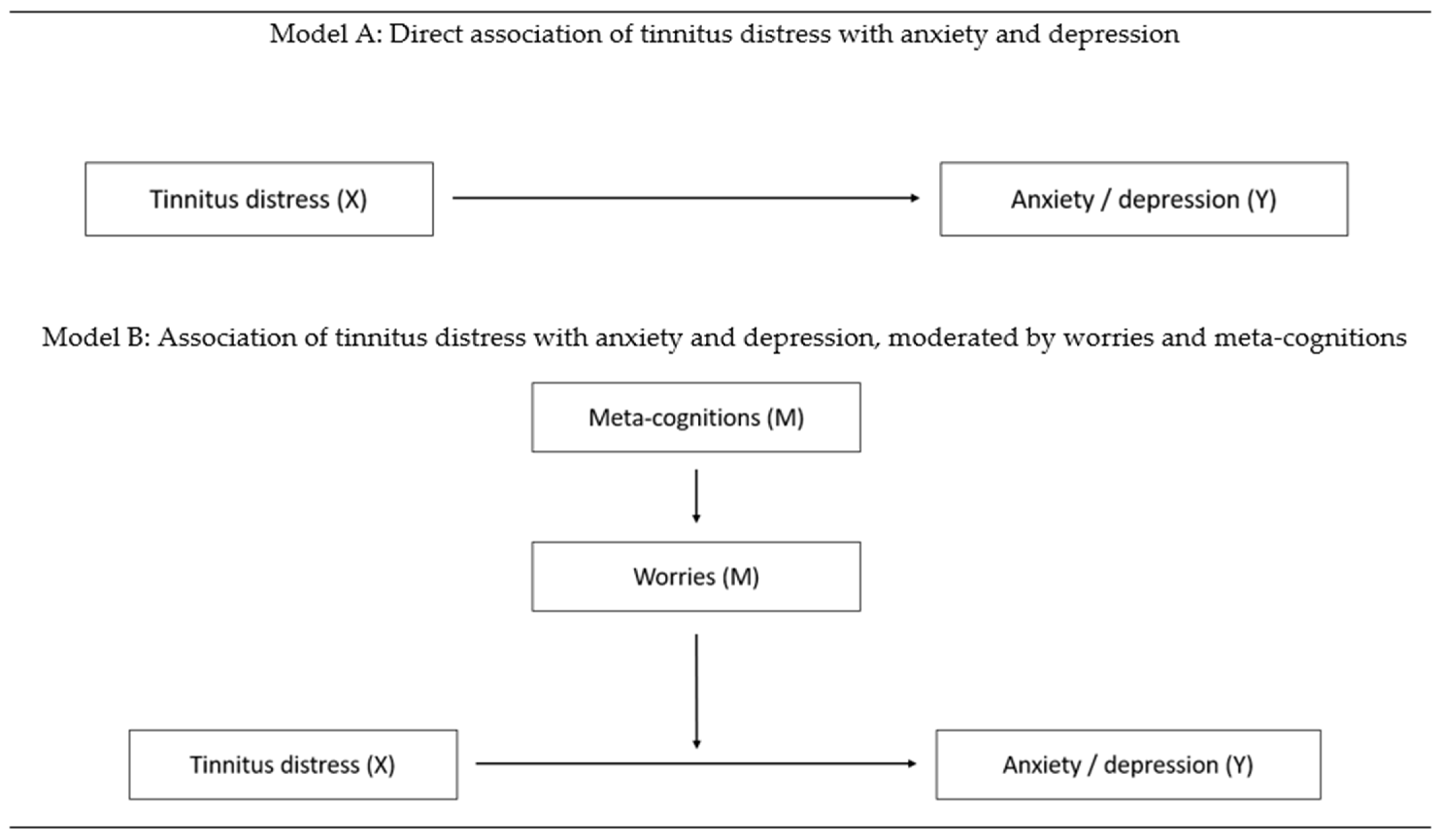
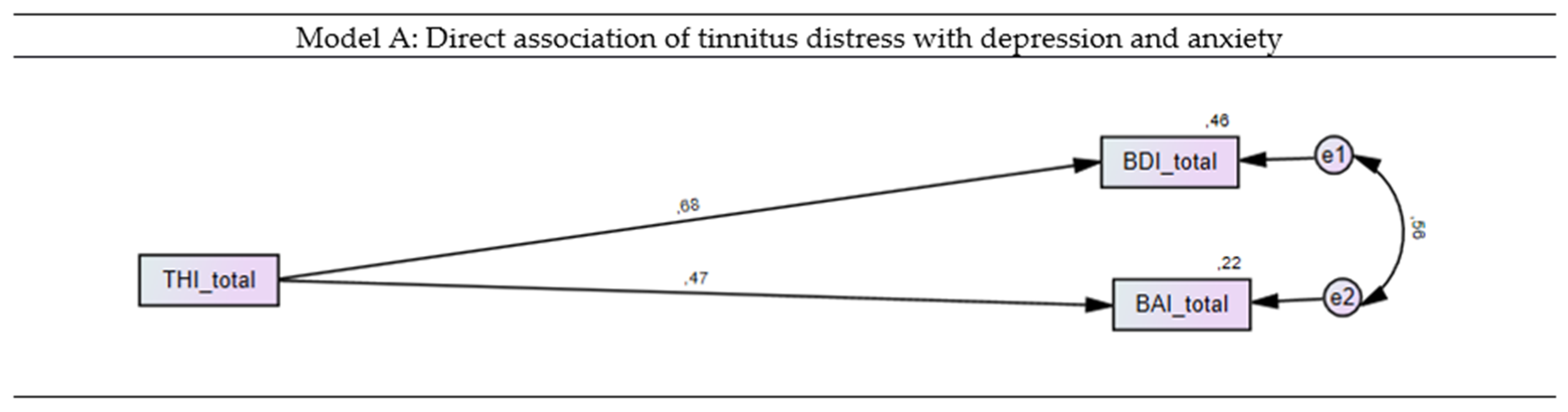
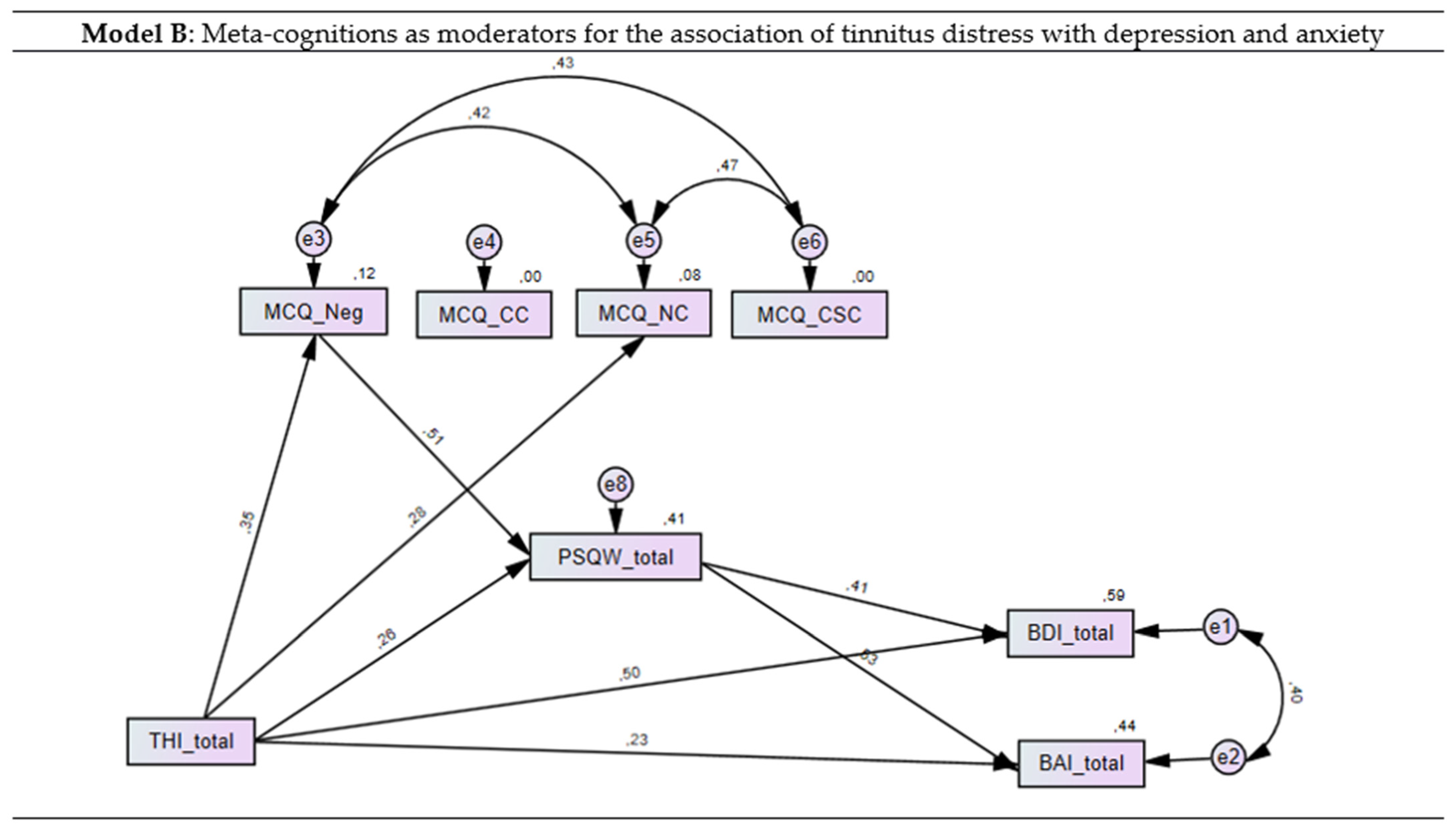
Recent research has highlighted the role of metacognitions as a moderator for psychological distress in patients with chronic diseases. The present study investigates the role of metacognitions and worry in the association between tinnitus distress, anxiety, and depression. A cross-sectional study was carried out with a sample of tinnitus-outpatients who completed the Tinnitus-Handicap Inventory, Beck Anxiety Inventory, Beck Depression Inventory, Metacognition Questionnaire-30, Penn-State-Worry-Questionnaire. Associations of metacognitions, worries, tinnitus distress, anxiety and depression were investigated using structural equation models (SEMs). A sample of n = 107 patients was included in the study. In the first SEM, tinnitus distress significantly predicted depression (β = 0.68, p < 0.001) and anxiety (β = 0.47, p < 0.001). In the second model, worries and meta-cognitions were added as moderators. The explained variance substantially increased for depression (46 to 53%) and anxiety (22 to 35%) and the association of tinnitus distress with depression (β = 0.57, p < 0.001) and anxiety was weakened (β = 0.32, p < 0.001). Negative beliefs significantly predicted worries (β = 0.51, p < 0.001) and explained 41% of its variance. A good model fit for the final model was found (comparative fit index (CFI) = 0.98; (Tucker Lewis index) TLI = 0.96; root mean square error of approximation (RMSEA) = 0.067). Anxiety and depression in tinnitus patients might be influenced by worries, which is mainly predicted by negative beliefs about uncontrollability and danger of worries. Thus, psychotherapeutic approaches focused on alterations of metacognitions in patients with tinnitus should be investigated in future studies.3 (List three to ten pertinent keywords specific to the article yet reasonably common within the subject discipline.)
Keywords: tinnitus; tinnitus distress; metacognition; worry; anxiety; depression tinnitus; tinnitus distress; metacognition; worry; anxiety; depression