


Featured Application
This systematic review provides a mechanism-informed framework for the design of transcranial electrical stimulation (tES) protocols in cognitive enhancement and neurorehabilitation. By demonstrating that stimulation effects depend on brain state, stimulation timing, priming conditions, baseline performance, and prior stimulation history, the review highlights that tES should be applied in combination with cognitive training, behavioral tasks, psychotherapy, or physical exercise rather than as a stand-alone intervention. These findings support the development of state-dependent, task-coupled, and individualized neuromodulation protocols aimed at improving learning, memory, and executive functions. In clinical and rehabilitation settings, such approaches may help reduce interindividual variability, improve reproducibility of stimulation effects, and optimize neuroplasticity-based interventions for neurological and psychiatric populations.
Abstract
Transcranial electrical stimulation (tES) has been widely investigated for cognitive enhancement and neurorehabilitation; however, its cognitive effects remain highly variable across studies and individuals. Increasing evidence suggests that this variability may be explained by state-dependent and history-dependent plasticity mechanisms rather than stimulation parameters alone. This systematic review aimed to synthesize experimental human studies investigating how stimulation protocols interact with brain state, baseline performance, and prior stimulation history to influence cognitive outcomes. Following PRISMA 2020 guidelines, systematic searches were conducted in PubMed, Scopus, and Web of Science, resulting in 27 eligible experimental studies published between 2008 and 2024. Across cognitive domains such as working memory, declarative memory, perceptual learning, inhibitory control, and creativity, stimulation effects were consistently modulated by baseline performance, task engagement, emotional or physiological state, stimulation timing, and prior stimulation exposure. These findings suggest that transcranial electrical stimulation may be better conceptualized as a state-dependent modulator of neural plasticity rather than a direct cognitive enhancement technique. Overall, the review indicates that protocol-dependent factors such as timing, priming, baseline state, and stimulation history play a critical role in shaping cognitive outcomes. Future research should therefore prioritize state-dependent, task-coupled, and individualized stimulation protocols to improve reproducibility and to better understand variability in cognitive and clinical outcomes.
Keywords:
tES; tDCS; tRNS; metaplasticity; cognition; neurorehabilitation; state-dependent stimulation 1. Introduction
Metaplasticity refers to the brain’s dynamic ability to regulate the degree and direction of synaptic plasticity as a function of prior neuronal activity. Often described as the “plasticity of synaptic plasticity” [1], it constitutes a higher-order regulatory mechanism that stabilizes learning processes by maintaining neural circuits within an optimal dynamic range of responsiveness. Through homeostatic control of long-term depression (LTD) and long-term potentiation (LTP), metaplastic mechanisms prevent excessive excitation or depression while preserving adaptive flexibility in response to changing internal and environmental demands [2].
Although metaplasticity has been extensively characterized in preclinical models, particularly in hippocampal and cortical preparations, its translation to human cognition remains comparatively underexplored. Increasing evidence suggests that the cognitive effects of non-invasive brain stimulation (NIBS) techniques are shaped not only by stimulation parameters but also by baseline neural activity, prior stimulation exposure, and ongoing task engagement—factors conceptually consistent with metaplastic regulation [3,4]. Cantone et al. [3] conceptualize metaplasticity as an activity-dependent modulation of subsequent synaptic plasticity, emphasizing its adaptive and regulatory function. Two core properties characterize this phenomenon: (1) priming, whereby prior neural activation establishes a modified physiological state that influences subsequent plastic responses, and (2) activity-dependent responsiveness, in which the magnitude or direction of later plastic change depends on this prior state. Together, these mechanisms function as a homeostatic gain-control system that stabilizes yet flexibly tunes neuroplastic adaptation.
At the human systems level, two partially overlapping yet conceptually distinct regulatory principles can be delineated: state-dependent modulation and history-dependent (metaplastic) regulation. State-dependence refers to variation in stimulation effects as a function of the current functional neural state, including task engagement, affective or physiological context, baseline performance, and ongoing oscillatory dynamics. In contrast, metaplasticity denotes history-dependent modulation of plasticity thresholds, whereby prior neural activity or stimulation shifts the responsiveness of a network to subsequent plasticity-inducing events. Importantly, although metaplastic effects are necessarily state-sensitive, they specifically reflect prior activity-dependent threshold shifts rather than modulation by concurrent neural state alone. Preserving this distinction is essential for theoretical precision and for interpreting variability in neuromodulation outcomes.
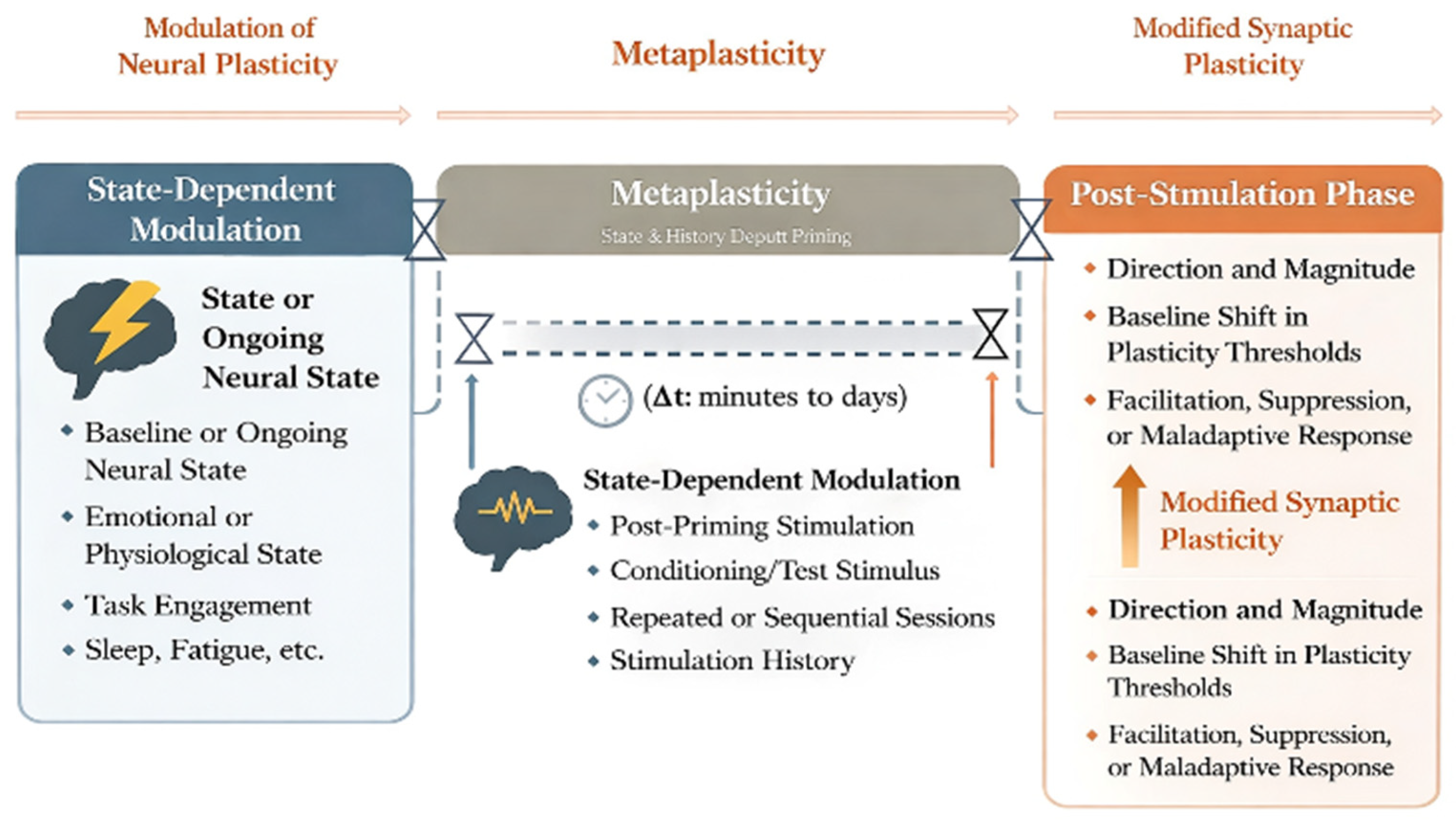
Figure 1 schematically illustrates this conceptual distinction. The left panel represents an initial priming or preconditioning event that induces a shift in neural responsiveness. The interval (Δt) reflects the temporal window during which plastic thresholds are modified. The right panel depicts the subsequent conditioning or test stimulus, whose effect is shaped by the prior activity-dependent shift. In contrast, purely state-dependent modulation occurs when stimulation interacts with the current functional state without an experimentally induced history-dependent threshold shift.
Figure 1.
Conceptual framework of state-dependent and history-dependent (metaplastic) modulation of synaptic plasticity. Prior neural activity or priming events can modify plasticity thresholds over time (Δt), while the ongoing brain state at the time of stimulation influences the direction and magnitude of subsequent plastic changes and behavioral outcomes. Arrows represent the temporal progression of modulation effects, dashed lines indicate the time interval between stimulation phases (Δt), and color-coded panels distinguish conceptual stages (state-dependent modulation, meta-plasticity, and post-stimulation phase).
Non-invasive transcranial electrical stimulation (tES) techniques—including transcranial direct current stimulation (tDCS), transcranial alternating current stimulation (tACS), and transcranial random noise stimulation (tRNS)—provide experimental tools to probe these regulatory mechanisms in humans. These methods apply weak electrical currents to the scalp to modulate cortical excitability and network dynamics and are widely used in cognitive enhancement and neurorehabilitation research.
tDCS delivers a constant low-intensity current (typically 1–2 mA) between anodal and cathodal electrodes [5]. Early models proposed polarity-specific effects, with anodal stimulation associated with depolarization and increased cortical excitability and cathodal stimulation associated with relative hyperpolarization [6,7]. However, subsequent research has shown that these effects are highly state-dependent and influenced by baseline neural activity, task engagement, stimulation intensity and duration, cortical orientation, and individual variability. As a result, polarity effects cannot be considered fixed or uniform across cognitive and behavioral paradigms. tACS applies sinusoidal currents at specific frequencies and phases and is often described as entraining endogenous neural oscillations [8,9,10,11]. However, stimulation effects appear to depend on the interaction between stimulation frequency and ongoing endogenous oscillatory activity, as well as brain state and task engagement. Therefore, tACS is better understood as modulating ongoing oscillatory activity rather than producing uniform frequency entrainment effects. tRNS delivers rapidly fluctuating currents across a broad frequency spectrum and is proposed to enhance cortical responsiveness via stochastic resonance mechanisms [12,13,14]. By introducing controlled neural noise, tRNS may lower activation thresholds in suboptimally engaged networks, potentially interacting with baseline performance and task demands in a state-dependent manner.
Despite the mechanistic diversity of these modalities, cognitive outcomes across tES studies remain markedly variable. Identical stimulation parameters can yield facilitatory, null, or even detrimental effects, suggesting that variability cannot be attributed solely to differences in current intensity or montage [15,16,17]. Ongoing task engagement, affective context, stimulation timing relative to learning phases, polarity sequencing, repetition, and inter-session intervals may all shift the direction or magnitude of plastic change. Taken together, tES should not be conceptualized as a uniform cognitive enhancer, but rather as a state-sensitive modulator of ongoing plasticity processes. Whether stimulation enhances, suppresses, or leaves cognition unchanged depends on its interaction with transient neural dynamics and prior activity-dependent adaptations.
Given the conceptual overlap and frequent conflation between state-dependent modulation and metaplasticity in the human literature, a systematic synthesis grounded in clear operational definitions is warranted. The present systematic review aims to examine how protocol-specific characteristics of tDCS, tRNS, and tACS shape cognitive outcomes through explicit manipulation of neural state and/or stimulation history. By distinguishing acute neuromodulatory effects from state- and history-dependent regulatory mechanisms, this review seeks to establish a mechanistically informed framework for interpreting variability in tES outcomes.
This review explores whether variability in cognitive effects of tES may be partly explained by state-dependent and history-dependent plasticity mechanisms. Clarifying these mechanisms is essential for optimizing stimulation protocols and for advancing precision-oriented neuromodulation in both experimental and translational contexts.
2. Materials and Methods
2.1. Protocol Registration
This systematic review was prospectively registered in the International Prospective Register of Systematic Reviews (PROSPERO; registration number: CRD420251071720). The review process adhered to the PRISMA 2020 (Preferred Reporting Items for Systematic Reviews and Meta-Analyses) guidelines to uphold standards of transparency, methodological rigor, and reproducibility. The PRISMA 2020 checklist is provided in the Supplementary Materials.
2.2. Eligibility Criteria
Studies were included in this systematic review if they met predefined eligibility criteria established a priori. Eligible studies involved human participants of any age, including healthy individuals as well as clinical populations presenting cognitive impairment or neurological or psychiatric conditions.
Interventions were required to involve transcranial electrical stimulation techniques, including tDCS, tACS, or tRNS. Only studies implementing protocol-dependent designs were considered eligible. Eligible designs were required to include an explicit manipulation of neural state and/or stimulation history capable of modulating subsequent cognitive effects. To ensure reproducibility, eligible studies were required to include at least one of the following design features: manipulation of baseline performance or baseline brain state; task engagement during stimulation; manipulation of stimulation timing relative to task or learning phase (e.g., online vs. offline stimulation); affective or physiological priming; repeated or multi-session stimulation; polarity sequencing; or manipulation of inter-session intervals. These design features were considered consistent with state-dependent or history-dependent (metaplastic) modulation frameworks.
Eligible studies were required to assess behavioral and/or neurophysiological markers of cognitive function (e.g., memory, attention, executive functions, or learning). Only experimental studies published in peer-reviewed journals were included, encompassing randomized controlled trials, crossover designs, and quasi-experimental designs. Studies published in English were considered eligible. Studies were excluded if they involved animal models; if cognition was not the primary outcome; if the design did not include a manipulation capable of altering subsequent plastic responses (i.e., if stimulation was applied solely to assess immediate excitability or acute behavioral change without testing state- or history-dependent modulation); or if modulation relied primarily on other techniques (e.g., TMS) or pharmacological interventions. Review articles, meta-analyses, conference abstracts, and other non-original research papers were not considered eligible. To improve reproducibility and reduce conceptual ambiguity, included studies were operationally classified into state-dependent and history-dependent (metaplastic) designs. State-dependent effects were defined as modulation of stimulation effects by the ongoing brain state at the time of stimulation, including baseline performance, task engagement, emotional or physiological state, or stimulation timing relative to task performance. History-dependent (metaplastic) effects were defined as modulation of stimulation effects by prior neural activation or prior stimulation history, including priming protocols, repeated stimulation sessions, polarity sequencing, or manipulation of inter-session intervals affecting plasticity thresholds. Studies including both features were classified as mixed designs.
2.3. Search Strategy
A comprehensive literature search was conducted across the electronic databases PubMed, Scopus, and Web of Science, which were selected to ensure broad coverage of biomedical, psychological, and cognitive neuroscience research. The search included all records from database inception until 25 March 2026, which was the final search date for this review. No temporal restrictions were applied.
The search strategy combined controlled vocabulary terms (e.g., Medical Subject Headings [MeSH] in PubMed) and free-text keywords to maximize both sensitivity and specificity. The search was structured around three main conceptual domains: (1) the intervention, including transcranial electrical stimulation, transcranial direct current stimulation (tDCS), transcranial alternating current stimulation (tACS), and transcranial random noise stimulation (tRNS); (2) the underlying mechanisms, including metaplasticity, homeostatic plasticity, synaptic plasticity, priming, state-dependent, and history-dependent effects; and (3) cognitive outcomes, including cognition, memory, working memory, executive function, attention, and learning. An example Boolean search string used in PubMed was as follows: (“transcranial direct current stimulation” OR tDCS OR “transcranial alternating current stimulation” OR tACS OR “transcranial random noise stimulation” OR tRNS) AND (metaplasticity OR “homeostatic plasticity” OR “synaptic plasticity” OR priming OR “state-dependent” OR “history-dependent”) AND (cognition OR memory OR “working memory” OR attention OR “executive function” OR learning). Search syntax was adapted for each database using the appropriate field tags and indexing terms. The full database-specific search strategies, including field tags and search dates, are provided in the Supplementary Materials to ensure reproducibility. In addition to the electronic database searches, the reference lists of all included studies and relevant review articles were manually screened to identify additional eligible publications. All retrieved records were imported into reference management software, and duplicate records were removed prior to the screening process.
2.4. Study Selection
All records retrieved from the database searches were imported into the Rayyan systematic review platform (https://rayyan.ai, Accessed on 2 April 2026) (Qatar Computing Research Institute, Doha, Qatar) for screening and management. Duplicate entries were identified automatically by the software and subsequently verified manually. Titles and abstracts were independently screened by two reviewers using Rayyan’s blinded review function to minimize selection bias. Full-text versions were obtained for all studies deemed potentially eligible and were independently assessed against the predefined inclusion and exclusion criteria. Any discrepancies between reviewers at either the title/abstract or full-text screening stages were resolved through discussion, and consensus was reached in all cases; when necessary, a third reviewer was consulted to adjudicate unresolved disagreements.
In total, 243 records were identified through systematic database searches (PubMed, n = 46; Scopus, n = 97; Web of Science, n = 100). After removal of 71 duplicate records, 202 unique references were retained for title and abstract screening (Figure 2).
Figure 2.
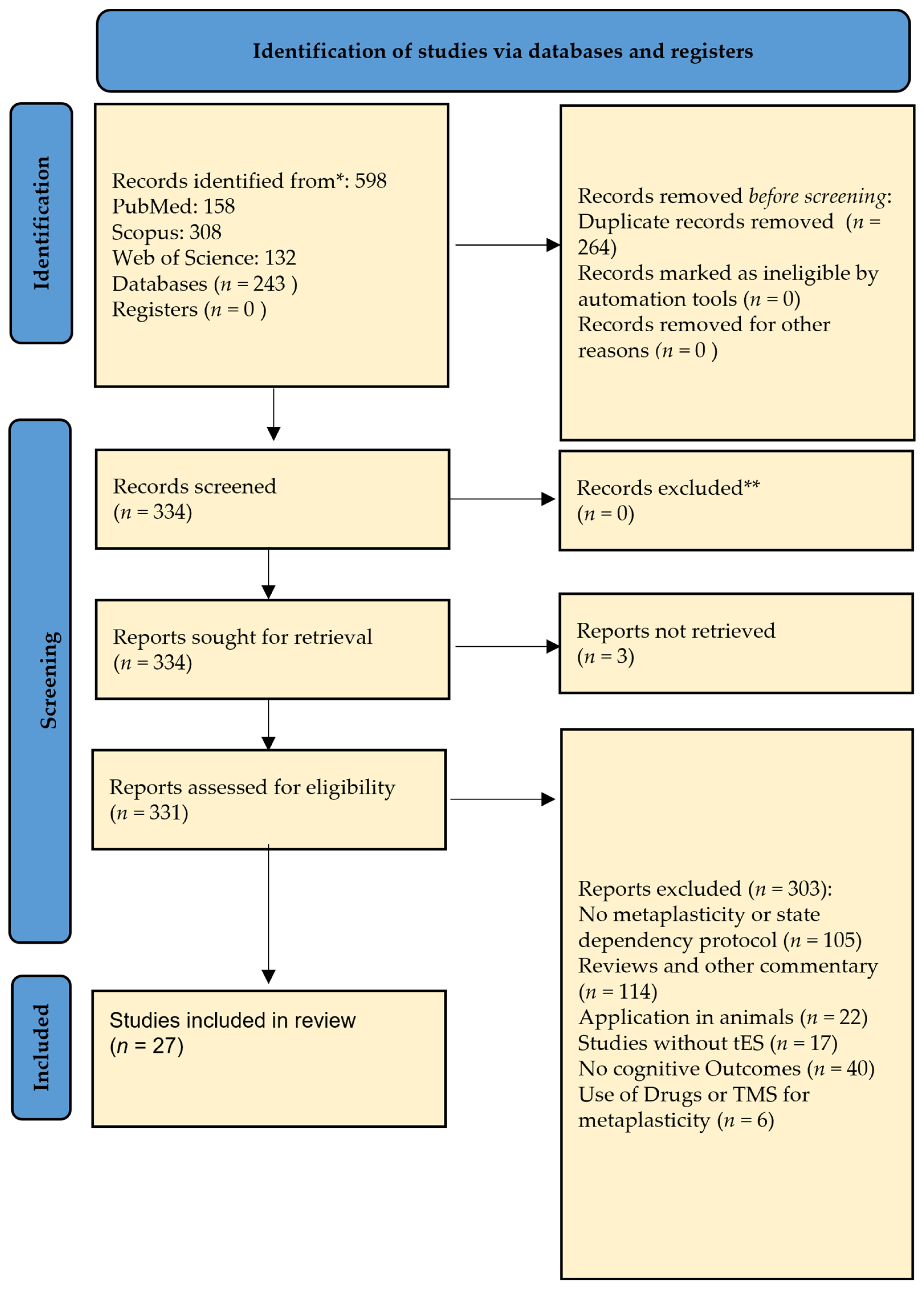
PRISMA 2020 flow diagram illustrating the identification, screening, eligibility assessment, and inclusion of studies in the systematic review.
2.5. Data Extraction
Data extraction was conducted independently by two reviewers using a standardized data extraction form developed specifically for this review. Extracted information included study characteristics (authors, year of publication, and study design), sample characteristics (sample size and population type), stimulation parameters (tES modality, stimulation intensity and duration, electrode montage, and timing of stimulation), metaplasticity-related features (such as priming paradigms, repeated sessions, polarity sequencing, or timing manipulations), cognitive domains assessed and corresponding outcome measures, main behavioral and/or neurophysiological findings, and the nature of control or comparator conditions. Any discrepancies identified during data extraction were resolved through discussion, with consensus achieved between reviewers; a third reviewer was consulted when necessary.
2.6. Risk of Bias Assessment
Risk of bias was assessed independently by two reviewers using tools appropriate to the study design. Randomized controlled trials were evaluated using the Cochrane Risk of Bias (RoB 2) tool [18]. Disagreements in risk-of-bias judgments were resolved through discussion until consensus was reached.
2.7. Data Synthesis
Given the substantial heterogeneity in stimulation protocols, experimental designs, cognitive domains, outcome measures, and metaplasticity-related strategies across studies, a quantitative meta-analysis was not performed. Instead, a qualitative narrative synthesis was conducted.
Studies were first grouped according to stimulation modality (e.g., tDCS, tACS, tRNS), experimental design characteristics, and cognitive domain assessed (e.g., working memory, declarative memory, attention, executive functions, learning, creativity). In addition, studies were classified according to whether they primarily investigated state-dependent effects, history-dependent (metaplastic) effects, or mixed designs, based on the predefined operational criteria described in the Section 2.2. Within these categories, findings were synthesized according to the type of modulation strategy employed, including baseline-dependent modulation, task engagement during stimulation, stimulation timing (online vs. offline), priming protocols, repeated stimulation sessions, polarity sequencing, and manipulation of inter-session intervals. Particular emphasis was placed on identifying patterns consistent with state-dependent and metaplasticity frameworks.
Findings were not treated as equivalent across studies. Greater interpretative weight was given to studies employing larger sample sizes, randomized or double-blind designs, adequate control conditions, and lower risk-of-bias ratings. Evidence from small-sample, exploratory, or high risk-of-bias studies was interpreted cautiously and primarily used to inform mechanistic interpretations rather than definitive conclusions.
In addition to grouping studies by stimulation modality and modulation strategy, the narrative synthesis aimed to identify consistent patterns across studies regarding when stimulation effects were enhanced, reduced, or reversed depending on baseline performance, task engagement, priming conditions, repetition, or stimulation timing. The objective of the synthesis was therefore mechanism-oriented rather than effect-size oriented, focusing on whether protocol-dependent factors systematically influenced cognitive outcomes in a direction consistent with state-dependent and metaplasticity frameworks. This approach allowed the identification of converging patterns across heterogeneous experimental paradigms, even when outcome measures and cognitive tasks differed across studies. Accordingly, the purpose of this review was not to estimate pooled effect sizes or to evaluate clinical efficacy, but rather to identify protocol-dependent factors and experimental conditions that modulate cognitive outcomes. The proposed framework should therefore be interpreted as conceptual and hypothesis-generating, intended to guide future experimental and translational research rather than to provide clinical recommendations.
2.8. Assessment of Reporting Bias
Potential reporting bias was assessed qualitatively by examining the availability of study protocols (when accessible), evaluating selective outcome reporting, and assessing the consistency between reported methods and results across studies. Any discrepancies in risk-of-bias judgments were resolved through consensus discussion.
2.9. Certainty of Evidence
The certainty of evidence for cognitive outcomes was intended to be assessed using the GRADE (Grading of Recommendations Assessment, Development and Evaluation) framework, where feasible following the literature search. This evaluation would have addressed study limitations, inconsistency across results, indirectness of evidence, imprecision in estimates, and potential publication bias. However, the studies identified through the search made such an assessment unreliable and ultimately impractical.
3. Results
3.1. Search Results and Study Selection
A total of 598 records were identified through database searches, including PubMed (n = 158), Scopus (n = 308), and Web of Science (n = 132). After removal of duplicate records (I = 264), 334 records remained for screening based on titles and abstracts. Full-text articles were sought for all screened records, and 3 reports were not retrieved, resulting in 331 reports assessed for eligibility. Following full-text review, 303 articles were excluded for not meeting the inclusion criteria, mainly due to the absence of metaplasticity or state-dependency protocols, being reviews or other commentary articles, involving animal studies, not using transcranial electrical stimulation, lacking cognitive outcomes, or using pharmacological or TMS metaplasticity protocols. Ultimately, 27 studies met all predefined eligibility criteria and were included in the final qualitative synthesis. The study selection process is illustrated in the PRISMA 2020 flow diagram (Figure 2).
3.2. Characteristics of Included Studies and State-Dependent and Metaplasticity-Related Cognitive Outcomes
A total of 27 studies published between 2008 and 2024 were included in this systematic review and examined metaplasticity, state-dependent, history-dependent, or mixed effects of transcranial electrical stimulation (tES) on cognitive functions (Table 1). Across studies, tDCS was the most frequently used stimulation modality, followed by tACS, tRNS, and high-definition (HD) stimulation protocols, applied either as standalone interventions or in combination with cognitive tasks, behavioral priming, physical exercise, stress induction, or repeated-session designs. Most studies employed within-subject crossover or randomized sham-controlled designs, and the majority were conducted in healthy young adults, with sample sizes typically ranging from approximately 10 to over 100 participants. Stimulation targets were predominantly located in prefrontal and parietal regions, particularly the dorsolateral prefrontal cortex (DLPFC) and posterior parietal cortex (PPC), reflecting their central role in executive functions, working memory, attention, and learning.
Table 1.
Summary of Included Studies Examining State-Dependent and History-Dependent Modulation of Cognitive Outcomes by Transcranial Electrical Stimulation.
The included studies were categorized according to the primary mechanism investigated: state-dependent effects (e.g., brain state, task engagement, timing of stimulation), metaplastic or history-dependent effects (e.g., priming, sequential stimulation, intensity or timing interactions), and mixed designs combining both mechanisms. Overall, the findings consistently indicated that the behavioral and neurophysiological effects of tES were strongly dependent on ongoing brain state, prior stimulation history, task engagement, baseline performance, and individual differences, rather than producing uniform polarity-dependent effects. The results are therefore summarized thematically according to four main mechanisms: (1) timing- and task-dependent effects, (2) priming and stimulation history (metaplasticity), (3) baseline performance and individual differences, and (4) neutral, null, or maladaptive effects.
3.2.1. Timing- and Task-Dependent Effects
Several studies demonstrated that the cognitive effects of transcranial electrical stimulation varied depending on the timing of stimulation relative to task performance, cognitive phase, or ongoing neural activity. Across studies, stimulation delivered during task performance (online stimulation) often produced different effects compared to stimulation delivered before or after task performance (offline stimulation). For example, Oldrati et al. [33] reported enhanced visuospatial learning only when anodal tDCS was applied during cognitive training, whereas offline stimulation produced no benefit. Similarly, Pirulli et al. [38] demonstrated that perceptual learning outcomes depended on stimulation timing, with high-frequency tRNS facilitating learning when applied online, while anodal tDCS produced stronger effects when administered offline. Task-phase specificity was also observed in memory paradigms. Javadi et al. showed that stimulation improved memory performance only when applied during early encoding, whereas stimulation delivered after encoding had no effect. Javadi and Walsh [29] further reported polarity- and phase-specific effects during encoding but not during retrieval, indicating that stimulation effects depend on the cognitive process targeted.
Task difficulty and cognitive demand also influenced stimulation outcomes. Nozari et al. [36] demonstrated that cathodal stimulation impaired performance under high cognitive demand but improved performance under low demand, indicating that stimulation effects interact with task difficulty. Similarly, Hill et al. [25] showed that concurrent task performance influenced the physiological and behavioral effects of stimulation. Neurophysiological studies further supported task-dependent modulation. Li et al. [32] demonstrated that stimulation applied during task performance versus rest produced different network-level connectivity changes, suggesting that stimulation interacts with ongoing neural activity rather than producing uniform excitatory or inhibitory effects. Duration-dependent effects were also reported. Ohn et al. [37] showed that working memory improvements emerged only after longer stimulation durations and persisted after stimulation ended, suggesting time-dependent plasticity mechanisms rather than immediate stimulation effects.
In sum, these findings indicate that stimulation timing, task engagement, cognitive phase, and ongoing neural activity are critical determinants of cognitive outcomes following transcranial electrical stimulation.
3.2.2. Priming and Stimulation History
Several studies indicated that cognitive outcomes following transcranial electrical stimulation varied as a function of prior cognitive, emotional, physiological, or stimulation history, supporting the role of metaplastic and history-dependent mechanisms in neuromodulation. Across these studies, stimulation effects were not determined solely by stimulation parameters, but rather by the neural and cognitive state preceding stimulation.
Cognitive priming effects were reported by Colombo et al. [21], who observed enhanced creative performance only when anodal tDCS was preceded by divergent-thinking priming. No facilitation was observed following convergent priming or in the absence of priming, indicating that stimulation effects were contingent on the preceding cognitive state and the activation of task-relevant neural networks prior to stimulation. Emotional priming effects were demonstrated by De Smet et al. [23], who showed that experimentally induced stress enhanced the effect of tDCS on emotional working-memory updating, whereas no stimulation-related effects were observed under neutral conditions or for non-emotional working-memory performance. These findings suggest that emotional and physiological states prior to stimulation can modulate responsiveness to neuromodulation and influence subsequent cognitive outcomes. Physiological priming was examined by Yue et al. [45], who reported improvements in inhibitory control following high-intensity interval exercise. In this paradigm, concurrent tDCS did not yield additional behavioral benefits beyond those associated with exercise alone, suggesting that prior physiological activation may influence or saturate plasticity-related mechanisms.
Evidence for stimulation history effects was provided by Carvalho et al. [20], who demonstrated that working-memory outcomes varied depending on polarity sequencing and inter-session intervals. Repeated anodal stimulation was associated with attenuation of behavioral effects, whereas cathodal preconditioning followed by subsequent stimulation was associated with performance enhancement, consistent with history-dependent modulation and homeostatic metaplasticity mechanisms. Additional evidence for non-linear interactions between stimulation protocols was reported by Wu et al. [44], who showed that combined tDCS and tRNS produced distinct and sometimes conflicting effects on brain connectivity and cognitive performance, suggesting non-linear interactions between stimulation modalities and further supporting metaplasticity mechanisms.
These findings suggest that prior neural activation, cognitive or emotional priming, physiological state, and stimulation history can significantly influence the direction and magnitude of tES-induced effects. These results support the concept that neuromodulation outcomes are shaped not only by stimulation parameters and current brain state, but also by prior plasticity history, consistent with metaplasticity frameworks.
3.2.3. Baseline Performance and Individual Differences
Several studies reported that the cognitive and neurophysiological effects of transcranial electrical stimulation varied as a function of baseline performance, individual cognitive capacity, or initial neural state prior to stimulation. Across studies, stimulation effects were not uniform across participants and often depended on baseline task performance or individual characteristics. Baseline performance effects were reported by Benwell et al. [19] and Learmonth et al. [31], who showed that stimulation effects differed according to participants’ initial performance levels. In these studies, performance improvements were primarily observed in low-performing participants, whereas high-performing participants showed smaller improvements, no change, or performance reductions. Individual differences in cognitive capacity and task difficulty were also reported to influence stimulation outcomes. Hsu et al. [26] highlighted substantial interindividual variability in responsiveness to tDCS, and Hu et al. [27] showed that stimulation effects on working memory depended on cognitive load and task demands. Baseline neural and physiological state was also found to influence stimulation effects. Dubreuil-Vall et al. [24] reported that tDCS effects on executive function and physiological measures depended on the initial cognitive and physiological state of participants. Nguyen et al. [34] demonstrated that learning improvements following tACS depended on brain state conditions during stimulation. Similarly, Wei et al. [43] showed that stimulation effects on visual perception depended on pre-stimulus alpha activity. Some studies reported dissociations between behavioral and neurophysiological effects. Nikolin et al. [35] observed modulation of working memory maintenance processes at the neural level without clear behavioral improvements. Additionally, Nozari et al. [36] and Pirulli et al. [39] showed that cathodal stimulation could produce either beneficial or detrimental behavioral effects depending on task conditions and performance level. In sum, the included studies consistently indicated that stimulation effects varied as a function of baseline performance, individual differences, task difficulty, and initial neural state.
3.2.4. Neutral, Null and Maladaptive Cognitive Effects
Several studies reported neutral, null, or even negative effects of transcranial electrical stimulation on cognitive performance, indicating that stimulation does not consistently lead to performance improvements and may, under some conditions, impair performance.
Null effects were reported by de Lara et al. [22], who found that anodal tDCS over the left DLPFC did not significantly affect the encoding or retrieval of verbal declarative memory compared to sham stimulation. Similarly, some studies reported no significant behavioral improvements despite neurophysiological modulation or task engagement during stimulation.
Other studies reported performance impairments associated with stimulation. Pyke et al. [40] showed that electrical brain stimulation applied during retrieval-based learning impaired long-term memory performance compared to control conditions. These findings suggest that stimulation timing relative to cognitive processes may influence whether stimulation facilitates or interferes with performance.
Studies examining cathodal stimulation also reported mixed behavioral outcomes. Nozari et al. [36] demonstrated that cathodal stimulation could either improve or impair performance depending on task conditions and cognitive demands. Similarly, Pirulli et al. [39] reported that cathodal stimulation was not always detrimental and could sometimes enhance performance depending on task timing and perceptual learning conditions. More recent studies also reported potentially conflicting effects across stimulation modalities. Wu et al. [44] showed that tDCS and tRNS produced distinct and sometimes opposing effects on brain connectivity, cortical inhibition, and visuospatial memory performance, indicating that different stimulation modalities may lead to different cognitive and neurophysiological outcomes.
In sum, the included studies indicated that transcranial electrical stimulation may produce facilitatory, neutral, or detrimental effects depending on task timing, stimulation modality, cognitive demands, and individual characteristics.
3.3. Risk of Bias
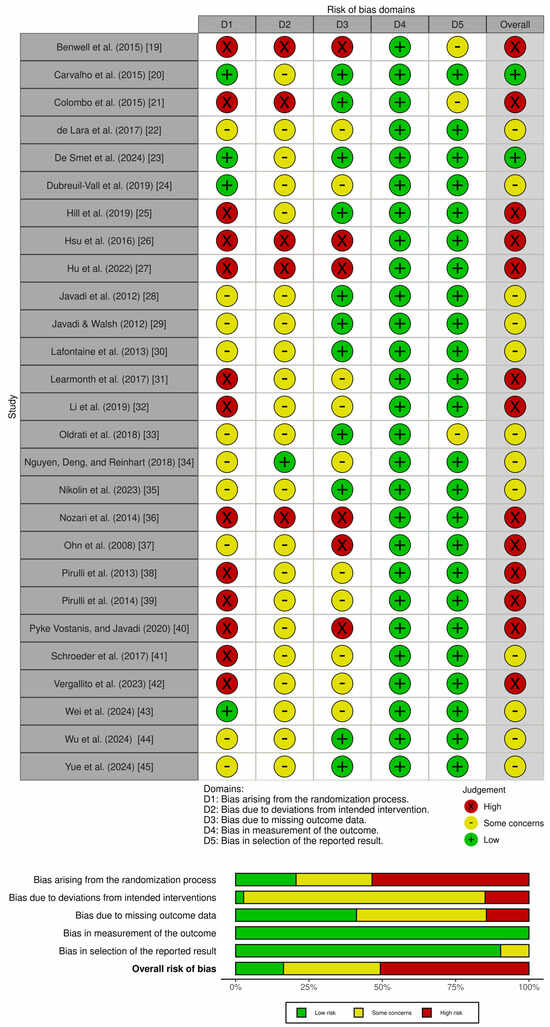
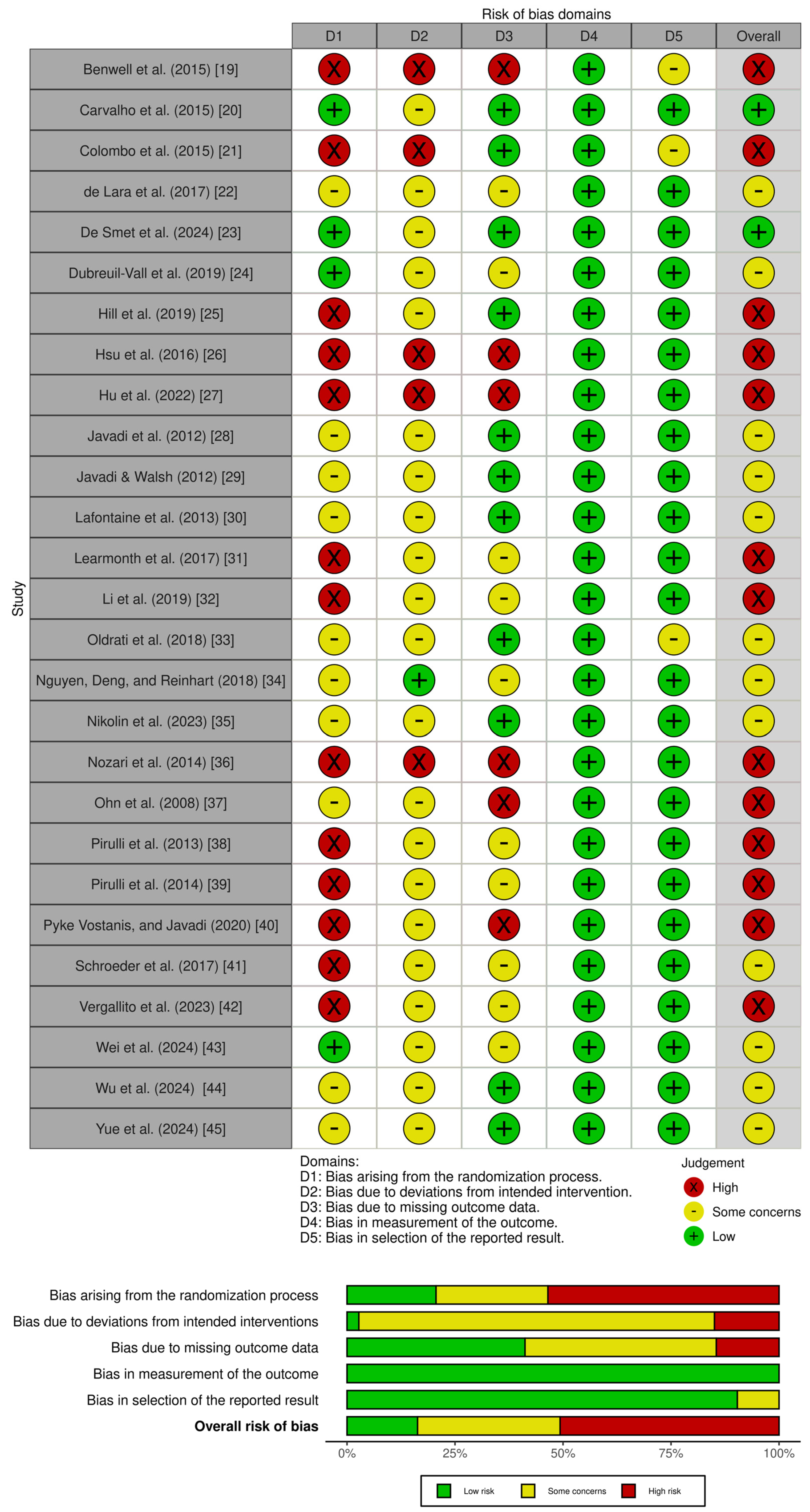
The methodological quality of the included studies was evaluated using the Cochrane Risk of Bias 2 (RoB 2) tool across its predefined domains, as summarized in Figure 3. The figure presents both the study-level risk-of-bias assessments and the overall distribution of risk across domains. Across domains, most studies were rated as low risk of bias in the measurement of outcomes (D4) and in the selection of the reported results (D5). In contrast, higher levels of bias were observed in the randomization process (D1), where several studies were classified as high risk due to insufficient reporting or unclear randomization procedures. Bias due to deviations from intended interventions (D2) was frequently rated as having some concerns, and bias due to missing outcome data (D3) showed mixed ratings across studies. The methodological quality varied across studies, with a relatively small number of studies classified as low risk of bias, while many studies were rated as having some concerns or high risk of bias. Risk-of-bias assessments were considered during the narrative synthesis, with greater interpretative weight given to studies with lower risk of bias and more rigorous experimental designs, while findings from studies with higher risk of bias were interpreted more cautiously.
Figure 3.
Assessment of Risk of Bias based on the ROB 2.
4. Discussion
Building on the empirical patterns summarized in Table 1, this Discussion interprets how stimulation timing, priming conditions, stimulation history, baseline neural state, and individual differences interact to shape cognitive outcomes across transcranial electrical stimulation (tES) studies within a state-dependent and metaplasticity framework. Overall, the findings of this systematic review indicate that the cognitive effects of tES are neither uniform nor inherently facilitatory. Across the included studies, outcomes consistently reflected interactions between stimulation parameters and the functional neural context at the time of application, as well as prior neural and stimulation history. Rather than producing fixed excitatory or inhibitory behavioral effects, stimulation outcomes varied depending on task engagement, stimulation timing relative to learning phases, priming conditions, baseline performance, and prior stimulation exposure. These convergent patterns are consistent with metaplasticity frameworks, in which both prior and ongoing neural activity constrain the direction and magnitude of plastic change. Importantly, the variability observed across studies does not appear random but rather systematic and interpretable when analyzed within a state-dependent and history-dependent framework. Identical stimulation parameters frequently produced facilitatory, null, or even detrimental effects depending on contextual and temporal factors, suggesting that stimulation interacts with ongoing plasticity processes rather than acting as an independent driver of cognitive change. This perspective supports the conceptualization of tES as a state-sensitive modulator of neural plasticity rather than a general cognitive enhancer.
Although tES was defined broadly to include tDCS, tACS, and tRNS, the empirical evidence included in this review is still dominated by tDCS-based paradigms, with fewer studies investigating tRNS and a smaller but emerging number examining tACS within state-dependent frameworks. This distribution reflects the current state of the literature rather than methodological restrictions of the review. Consequently, conclusions drawn here are primarily grounded in tDCS evidence, while findings related to tACS and tRNS should be considered preliminary and indicative of important directions for future research. Interpretation of the findings must also consider the substantial methodological heterogeneity across studies, including differences in study design, sample size, stimulation protocols, cognitive domains, and analytical approaches. Many studies employed single-session designs and small experimental samples, whereas only a subset implemented repeated stimulation, priming sequences, or multi-condition protocols explicitly designed to probe metaplastic mechanisms. Within-subject crossover designs increased sensitivity to state- and history-dependent effects but limited generalizability beyond controlled experimental settings, whereas between-subject and factorial designs improved ecological validity but were often constrained by statistical power. This methodological diversity precluded quantitative aggregation and required a qualitative, mechanism-oriented synthesis.
From a conceptual perspective, the present findings challenge the traditional view of tES as a purely additive, polarity-dependent, or dose-dependent intervention. Instead, tES should be conceptualized as a dynamic, state-contingent modulator of ongoing plasticity processes, capable of enhancing, attenuating, or interfering with cognitive performance depending on its temporal and contextual integration with neural activity and behavior. Within this framework, tDCS, tACS, and tRNS are better understood as modulators of plasticity probability and network dynamics rather than direct drivers of cognitive improvement. Adopting a metaplasticity-informed framework may therefore facilitate the development of more reliable, flexible, and individualized neuromodulation protocols. These findings also challenge simplified models of polarity-specific effects (anodal = excitatory; cathodal = inhibitory) and uniform oscillatory entrainment models, reinforcing the view that stimulation effects are strongly dependent on brain state, task engagement, network activity, and stimulation history.
4.1. Timing- and State-Dependent Modulation of Cognitive Function
Across the reviewed literature, cognitive effects reported in the included tES studies—predominantly tDCS-based—were strongly dependent on stimulation timing relative to task engagement, as summarized in Section 3.2.1. Several studies directly compared online and offline stimulation and demonstrated that identical stimulation protocols can produce different outcomes depending on whether stimulation is applied during or outside task performance.
Oldrati et al. [33] showed that visuospatial learning gains were observed only when anodal tDCS was applied during cognitive training, whereas offline stimulation produced no improvement. Similarly, Pirulli et al. [38] demonstrated that perceptual learning outcomes depended on stimulation timing, with high-frequency tRNS facilitating learning when applied online, while anodal tDCS produced stronger effects when delivered offline. Additional evidence for timing-dependent effects was reported by Pirulli et al. [39], who showed that cathodal stimulation improved perceptual learning when applied offline but not when applied during task performance, suggesting homeostatic and metaplastic mechanisms.
Task-phase specificity was also demonstrated in memory paradigms. Javadi et al. [28] reported improved declarative memory only when stimulation coincided with early encoding phases, whereas stimulation delivered after encoding had no effect. Similarly, Javadi and Walsh [29] showed polarity- and phase-specific effects during encoding but not during retrieval. Task difficulty and cognitive demand also influenced stimulation outcomes. Nozari et al. [36] demonstrated that cathodal stimulation impaired performance under high cognitive demand but improved performance under low demand, indicating that stimulation effects interact with ongoing neural activity. Neurophysiological studies further supported task-dependent modulation. Li et al. [32] showed that stimulation applied during task performance versus rest produced different network-level connectivity changes, indicating that stimulation interacts with ongoing brain activity rather than producing uniform excitatory or inhibitory effects. Duration-dependent effects were also reported by Ohn et al. [37], who showed that working memory improvements emerged only after longer stimulation durations and persisted after stimulation ended. Taken together, these findings indicate that stimulation timing, task engagement, cognitive phase, and ongoing neural activity are critical determinants of cognitive outcomes following transcranial electrical stimulation.
4.2. Priming and History-Dependent Effects
Across the reviewed studies, the cognitive impact of tES depended critically on prior cognitive, emotional, physiological, or stimulation history, as summarized in Section 3.2.2. These findings support metaplastic and history-dependent mechanisms in neuromodulation. Cognitive priming effects were reported by Colombo et al. [21], who showed that stimulation enhanced creative performance only when preceded by divergent-thinking priming, whereas identical stimulation following convergent thinking or no priming yielded no effect. Emotional priming produced similar state-dependent modulation. De Smet et al. [23] demonstrated that stress priming enhanced the effects of tDCS on emotional working memory updating, whereas no stimulation-related effects were observed under neutral conditions. Emotional and affective state modulation of tDCS effects has also been supported by meta-analytic evidence showing that mood moderates prefrontal tDCS effects on executive functions [46].
Physiological priming was examined by Yue et al. [45], who reported improvements in inhibitory control following high-intensity interval exercise, whereas concurrent tDCS did not produce additional behavioral benefits beyond exercise alone. These findings suggest that prior physiological activation may influence plasticity mechanisms and stimulation responsiveness. Evidence for stimulation history effects was provided by Carvalho et al. [20], who demonstrated that working memory outcomes varied depending on polarity sequencing and inter-session intervals. Repeated anodal stimulation resulted in attenuation of behavioral effects, whereas cathodal preconditioning followed by subsequent stimulation enhanced performance, consistent with homeostatic metaplasticity mechanisms. Additional evidence for non-linear interactions between stimulation modalities was reported by Wu et al. [44], who showed that combined tDCS and tRNS produced distinct and sometimes conflicting effects on brain connectivity and cognitive performance, suggesting non-linear interactions between stimulation modalities and further supporting metaplasticity mechanisms.
Overall, these findings indicate that prior neural activation, cognitive or emotional priming, physiological state, and stimulation history can significantly influence the direction and magnitude of tES-induced effects, consistent with metaplasticity frameworks.
4.3. Baseline Sensitivity and Individual Differences
Across the reviewed studies summarized in Section 3.2.3, cognitive and neural responses to tES varied systematically as a function of baseline cognitive performance, individual cognitive capacity, and initial neural state prior to stimulation, indicating strong baseline-dependent modulation. Benwell et al. [19] and Learmonth et al. [31] demonstrated that stimulation effects differed according to baseline performance levels, with improvements primarily observed in low-performing participants, whereas high-performing participants showed smaller improvements, no change, or performance reductions. Similarly, Hsu et al. [26] reported substantial interindividual variability in responsiveness to tDCS, indicating that stimulation effects depend on individual cognitive and neural characteristics. Individual differences in cognitive capacity and task demands also influenced stimulation outcomes. Hu et al. [27] showed that stimulation effects on working memory depended on cognitive load and working memory capacity. Baseline neural and physiological state was also shown to influence stimulation effects. Dubreuil-Vall et al. [24] demonstrated that baseline electrophysiological markers predicted the magnitude of behavioral and neurophysiological modulation following stimulation. Nguyen et al. [34] showed that learning improvements following tACS depended on brain state during stimulation, and Wei et al. [43] demonstrated that stimulation effects depended on pre-stimulus oscillatory activity and fatigue state.
Some studies reported dissociations between behavioral and neurophysiological effects. Nikolin et al. [35] observed modulation of working memory maintenance processes at the neural level without clear behavioral improvements. Additionally, Nozari et al. [36] and Pirulli et al. [39] showed that cathodal stimulation could produce either beneficial or detrimental behavioral effects depending on task conditions and baseline performance.
Overall, the included studies consistently indicate that stimulation effects vary as a function of baseline performance, individual differences, task difficulty, and initial neural state.
4.4. Beneficial Versus Maladaptive Metaplasticity
As summarized in Section 3.2.4, metaplasticity does not inherently result in cognitive improvement. Several studies demonstrate that tES can produce neutral or even detrimental cognitive outcomes when administered under suboptimal conditions.
Pyke et al. [40] provided a particularly illustrative example, showing that stimulation applied during retrieval-based learning impaired long-term memory retention, suggesting that stimulation delivered at sensitive stages of memory processing may interfere with consolidation mechanisms. Null effects were also reported in memory paradigms by de Lara et al. [22], indicating that stimulation timing alone may be insufficient to produce behavioral enhancement. Further evidence of non-beneficial or opposing effects emerges from studies reporting directionally reversed effects contingent on stimulation parameters or cognitive state. Nozari et al. [36] showed that cathodal stimulation could either improve or impair performance depending on task demands, while Pirulli et al. [39] demonstrated that cathodal stimulation could facilitate perceptual learning under specific timing and intensity conditions, consistent with homeostatic plasticity mechanisms. Wu et al. [44] further showed that different stimulation modalities may produce distinct and sometimes opposing neural and behavioral effects, indicating non-linear interactions between stimulation techniques. Rather than contradicting metaplasticity models, these findings support the idea that tES biases plasticity processes toward either adaptive or maladaptive trajectories depending on timing, task demands, and prior neural state. From a translational perspective, these findings highlight that tES cannot be assumed to be universally beneficial and that inappropriate timing or task conditions may interfere with cognitive processes.
4.5. Implications for Experimental Design and Clinical Applications
The findings of this review suggest that transcranial electrical stimulation should be conceptualized as a state-dependent neuromodulation technique that interacts with ongoing neural activity and plasticity mechanisms rather than directly inducing cognitive enhancement [32,47]. From this perspective, variability in stimulation outcomes may be explained not only by stimulation parameters but also by differences in baseline performance, task engagement, emotional state, physiological activation, and prior stimulation history across studies. These findings have important implications for experimental design. Future studies should systematically control and report variables related to brain state at the time of stimulation, including baseline cognitive performance, task difficulty, timing of stimulation relative to task performance, emotional or stress state, sleep and fatigue, and prior stimulation exposure. Many inconsistencies reported in the literature may therefore reflect uncontrolled variability in these factors rather than the absence of stimulation effects [26,31,47]. Greater methodological standardization and more detailed reporting of these variables may improve the reproducibility and comparability of stimulation studies.
Furthermore, the results of this review support the development of individualized and adaptive stimulation protocols, in which stimulation parameters and timing are adjusted based on individual baseline performance, neural activity, or cognitive state, rather than applying identical stimulation protocols to all participants [19,26,47]. Such approaches are consistent with emerging personalized neuromodulation frameworks and may increase the effectiveness and reliability of stimulation interventions.
From a clinical perspective, these findings suggest that stimulation may be more effective when combined with cognitive training, psychotherapy, or physical exercise rather than applied in isolation, as stimulation may facilitate plasticity during training or therapy rather than directly improving cognitive performance [20,33,45]. This combined-intervention approach may be particularly relevant for rehabilitation and mental health interventions, where stimulation could be used to enhance learning, cognitive training, or emotion regulation processes.
The present review does not demonstrate that stimulation outcomes can be predicted with precision, but rather suggests that variability across studies may be systematically related to protocol-dependent factors such as baseline performance, task engagement, stimulation timing, priming conditions, and stimulation history. The proposed framework should therefore be interpreted as a conceptual and hypothesis-generating model intended to guide future experimental studies designed to test predictive models of state-dependent neuromodulation.
4.6. Limitations
This systematic review has several limitations that should be acknowledged. First, the scope of the review question was deliberately broad, and aimed to capture state-dependent and metaplastic mechanisms across multiple tES modalities, cognitive domains, and experimental paradigms. Although this heterogeneity reflects the diversity of the transcranial electrical stimulation literature and this approach was appropriate for a mechanism-oriented synthesis, it inevitably increased methodological and outcome heterogeneity resulting in included studies being highly heterogeneous in terms of cognitive domains, stimulation parameters, study designs, outcome measures, and experimental protocols, which limited direct comparisons across studies and precluded quantitative meta-analysis. Second, many included studies employed relatively small sample sizes and single-session stimulation protocols, which may limit statistical power and reduce the ability to detect reliable behavioral effects. Single-session designs may also be insufficient to capture cumulative or longer-term plasticity effects associated with repeated stimulation protocols. Third, most included studies focused on transcranial direct current stimulation, whereas fewer studies investigated state-dependent or history-dependent effects using transcranial alternating current stimulation or transcranial random noise stimulation. Therefore, the conclusions of this review may be more applicable to tDCS than to other forms of transcranial electrical stimulation. Fourth, although this review focused on state-dependent, history-dependent, and baseline-dependent effects, many studies did not explicitly manipulate or systematically control brain state variables such as baseline performance, emotional state, fatigue, sleep, or prior stimulation exposure. Consequently, state-dependent mechanisms often had to be inferred rather than directly tested experimentally. Finally, publication bias cannot be excluded, as studies reporting significant stimulation effects may be more likely to be published than studies reporting null findings, potentially contributing to an overestimation of stimulation efficacy in some cognitive domains. Additionally, due to the heterogeneity of study designs and outcomes, no quantitative meta-analysis or GRADE assessment was feasible; therefore, the conclusions of this review should be interpreted as mechanistic and hypothesis-generating rather than as definitive evidence of clinical efficacy. Future reviews would benefit from more focused research questions, targeting specific stimulation modalities, cognitive domains, or predefined mechanistic contrasts. Where methodological development permits, the incorporation of a PICOT-like framework may further enhance the precision, coherence, and evidentiary value of the available knowledge.
4.7. Future Directions
Future research should further investigate state-dependent and history-dependent mechanisms using stimulation modalities beyond tDCS, particularly transcranial alternating current stimulation and transcranial random noise stimulation. Importantly, the absence of eligible tACS studies in the present review should not be interpreted as evidence that tACS cannot produce state-dependent or metaplastic effects. Instead, this likely reflects the current focus of the tACS literature on frequency-specific entrainment and oscillatory modulation rather than on protocol designs explicitly testing state- or history-dependent modulation of stimulation effects. This represents an important direction for future research in neuromodulation and cognitive enhancement.
5. Conclusions
This systematic review examined evidence for metaplasticity, state-dependent, history-dependent, and baseline-dependent effects of transcranial electrical stimulation on cognitive functions. Across studies, the findings consistently indicate that the behavioral and neurophysiological effects of transcranial electrical stimulation are highly variable and cannot be explained by simple polarity-based or linear dose–response models.
Instead, the literature suggests that stimulation effects emerge from complex interactions between stimulation parameters, ongoing brain activity, prior stimulation history, baseline performance, affective and physiological state, and task engagement. These findings support the view that transcranial electrical stimulation should be conceptualized as a state-dependent neuromodulation technique that interacts with ongoing neural activity and plasticity mechanisms rather than directly inducing cognitive enhancement. From this perspective, variability in the transcranial electrical stimulation literature may partly reflect insufficient consideration of brain state, metaplasticity, and individual differences in experimental design. Future research may therefore benefit from moving beyond protocol-centered approaches toward state-dependent, individualized, and adaptive neuromodulation frameworks, in which stimulation is applied in interaction with cognitive, emotional, and physiological states in order to optimize plasticity and behavioral outcomes. Overall, conceptualizing transcranial electrical stimulation as a plasticity-modulating intervention rather than a direct performance-enhancing tool may help explain inconsistencies in the literature and guide the development of more effective experimental protocols and translational applications.
Supplementary Materials
The following supporting information can be downloaded at: https://www.mdpi.com/article/10.3390/app16094558/s1, File S1: PRISMA 2020 Checklist.
Author Contributions
Conceptualization, S.C.; methodology, S.C.; protocol registration, S.C.; literature search, S.C. and J.L.; study selection, S.C. and J.L.; data extraction, S.C. and J.L.; risk of bias assessment, S.C. and J.L.; data synthesis and interpretation, S.C. and J.L.; writing—original draft preparation, S.C.; writing—review and editing, S.C. and J.L.; visualization, J.L.; supervision, S.C. and J.L. All authors have read and agreed to the published version of the manuscript.
Funding
This work was partially conducted at the Psychology Research Centre (CIPsi; PSI/01662), School of Psychology, University of Minho. The Centre is registered under the DOI: https://doi.org/10.54499/UID/01662/2025 (accessed on 19 December 2025).
Institutional Review Board Statement
Not applicable.
Informed Consent Statement
Not applicable.
Data Availability Statement
Not applicable.
Acknowledgments
During the preparation of this manuscript, the authors used ChatGPT (OpenAI, GPT-5, 2025) for assistance in language editing, formatting, and figure preparation. The authors have reviewed and edited all AI-generated content and take full responsibility for the final version of the publication.
Conflicts of Interest
The authors declare no conflicts of interest.
Abbreviations
The following abbreviations are used in this manuscript:
| tES | Transcranial Electrical Stimulation |
| tDCS | Transcranial Direct Current Stimulation |
| tACS | Transcranial Alternating Current Stimulation |
| tRNS | Transcranial Random Noise Stimulation |
| DLPFC | Dorsolateral Prefrontal Cortex |
| NIBS | Non-Invasive Brain Stimulation |
References
- Abraham, W.C.; Bear, M.F. Metaplasticity: The plasticity of synaptic plasticity. Trends Neurosci. 1996, 19, 126–130. [Google Scholar] [CrossRef] [Scilit] [PubMed]
- Hulme, S.R.; Jones, O.D.; Raymond, C.R.; Sah, P.; Abraham, W.C. Mechanisms of heterosynaptic metaplasticity. Philos. Trans. R. Soc. Lond. B Biol. Sci. 2013, 369, 20130148. [Google Scholar] [CrossRef] [Scilit] [PubMed]
- Cantone, M.; Lanza, G.; Ranieri, F.; Opie, G.M.; Terranova, C. Editorial: Non-invasive brain stimulation in the study and modulation of metaplasticity in neurological disorders. Front. Neurol. 2021, 12, 721906. [Google Scholar] [CrossRef] [Scilit]
- Müller-Dahlhaus, F.; Ziemann, U. Metaplasticity in human cortex. Neuroscientist 2014, 21, 185–202. [Google Scholar] [CrossRef] [Scilit] [PubMed]
- Nitsche, M.A.; Paulus, W. Excitability changes induced in the human motor cortex by weak transcranial direct current stimulation. J. Physiol. 2000, 527, 633–639. [Google Scholar] [CrossRef] [Scilit]
- Stagg, C.J.; Nitsche, M.A. Physiological basis of transcranial direct current stimulation. Neuroscientist 2011, 17, 37–53. [Google Scholar] [CrossRef] [Scilit]
- Narmashiri, A.; Akbari, F. The effects of transcranial direct current stimulation on cognitive functions: A systematic review and meta-analysis. Neuropsychol. Rev. 2025, 35, 126–152. [Google Scholar] [CrossRef] [Scilit]
- Carvalho, S.; Leite, J.; Fregni, F. Transcranial Alternating Current Stimulation and Transcranial Random Noise Stimulation. In Neuromodulation, 2nd ed.; Lozano, A.M., Hallett, M., Eds.; Academic Press: Cambridge, MA, USA, 2018; pp. 1611–1617. [Google Scholar] [CrossRef] [Scilit]
- Herrmann, C.S.; Rach, S.; Neuling, T.; Strüber, D. Transcranial alternating current stimulation: A review of the underlying mechanisms and modulation of cognitive processes. Front. Hum. Neurosci. 2013, 7, 279. [Google Scholar] [CrossRef] [Scilit]
- Helfrich, R.F.; Schneider, T.R.; Rach, S.; Trautmann-Lengsfeld, S.A.; Engel, A.K.; Herrmann, C.S. Entrainment of brain oscillations by transcranial alternating current stimulation. Curr. Biol. 2014, 24, 333–339. [Google Scholar] [CrossRef] [Scilit]
- Vasquez, A.; Malavera, A.; Doruk, D.; Morales-Quezada, L.; Carvalho, S.; Leite, J.; Fregni, F. Duration-dependent effects of transcranial pulsed current stimulation (tPCS) indexed by electroencephalography. Neuromodulation 2016, 19, 679–688. [Google Scholar] [CrossRef] [Scilit]
- Moliadze, V.; Antal, A.; Paulus, W. Boosting brain excitability by transcranial high-frequency stimulation in the ripple range. J. Physiol. 2010, 588, 4891–4904. [Google Scholar] [CrossRef] [Scilit]
- Lema, A.; Carvalho, S.; Fregni, F.; Gonçalves, Ó.F.; Leite, J. The effects of direct current stimulation and random noise stimulation on attention networks. Sci. Rep. 2021, 11, 6201. [Google Scholar] [CrossRef] [Scilit] [PubMed]
- Terney, D.; Chaieb, L.; Moliadze, V.; Antal, A.; Paulus, W. Increasing human brain excitability by transcranial high-frequency random noise stimulation. J. Neurosci. 2008, 28, 14147–14155. [Google Scholar] [CrossRef] [Scilit]
- van der Groen, O.; Potok, W.; Wenderoth, N.; Edwards, G.; Mattingley, J.B.; Edwards, D. Using noise for the better: The effects of transcranial random noise stimulation on the brain and behavior. Neurosci. Biobehav. Rev. 2022, 138, 104702. [Google Scholar] [CrossRef] [Scilit] [PubMed]
- Lee, H.K. Metaplasticity framework for cross-modal synaptic plasticity in adults. Front. Synaptic Neurosci. 2023, 14, 1087042. [Google Scholar] [CrossRef] [Scilit]
- Filmer, H.L.; Mattingley, J.B.; Dux, P.E. Modulating brain activity and behaviour with tDCS: Rumours of its death have been greatly exaggerated. Cortex 2020, 123, 141–151. [Google Scholar] [CrossRef] [Scilit]
- McGuinness, L.A.; Higgins, J.P.T. Risk-of-bias visualization (robvis): An R package and Shiny web app for visualizing risk-of-bias assessments. Res. Synth. Methods 2020, 11, 55–61. [Google Scholar] [CrossRef] [Scilit]
- Benwell, C.S.Y.; Learmonth, G.; Miniussi, C.; Harvey, M.; Thut, G. Non-linear effects of transcranial direct current stimulation as a function of individual baseline performance: Evidence from biparietal tDCS influence on lateralized attention bias. Cortex 2015, 69, 152–165. [Google Scholar] [CrossRef] [Scilit]
- Carvalho, S.; Boggio, P.S.; Gonçalves, Ó.F.; Vigário, A.R.; Faria, M.; Silva, S.; Gaudencio do Rego, G.; Fregni, F.; Leite, J. Transcranial Direct Current Stimulation-Based Metaplasticity Protocols in Working Memory. Brain Stimul. 2015, 8, 289–294. [Google Scholar] [CrossRef] [Scilit] [PubMed]
- Colombo, B.; Bartesaghi, N.; Simonelli, L.; Antonietti, A. The Combined Effects of Neurostimulation and Priming on Creative Thinking: A Preliminary tDCS Study on the Dorsolateral Prefrontal Cortex. Front. Hum. Neurosci. 2015, 9, 403. [Google Scholar] [CrossRef] [Scilit]
- de Lara, G.A.; Knechtges, P.N.; Paulus, W.; Antal, A. Anodal tDCS over the left DLPFC did not affect the encoding and retrieval of verbal declarative information. Front. Neurosci. 2017, 11, 452. [Google Scholar] [CrossRef] [Scilit]
- De Smet, S.; Razza, L.B.; Pulopulos, M.M.; De Raedt, R.; Baeken, C.; Brunoni, A.R.; Vanderhasselt, M.A. Stress Priming Transcranial Direct Current Stimulation (tDCS) Enhances Updating of Emotional Content in Working Memory. Brain Stimul. 2024, 17, 434–443. [Google Scholar] [CrossRef] [Scilit] [PubMed]
- Dubreuil-Vall, L.; Chau, P.; Ruffini, G.; Widge, A.S.; Camprodon, J.A. tDCS to the left DLPFC modulates cognitive and physiological correlates of executive function in a state-dependent manner. Brain Stimul. 2019, 12, 1456–1463. [Google Scholar] [CrossRef] [Scilit] [PubMed]
- Hill, A.T.; Rogasch, N.C.; Fitzgerald, P.B.; Hoy, K.E. Impact of Concurrent Task Performance on Transcranial Direct Current Stimulation (tDCS)-Induced Changes in Cortical Physiology and Working Memory. Cortex 2019, 113, 37–57. [Google Scholar] [CrossRef] [Scilit]
- Hsu, T.Y.; Juan, C.H.; Tseng, P. Individual Differences and State-Dependent Responses in Transcranial Direct Current Stimulation. Front. Hum. Neurosci. 2016, 10, 643. [Google Scholar] [CrossRef] [Scilit] [PubMed]
- Hu, Z.; Samuel, I.B.H.; Meyyappan, S.; Bo, K.; Rana, C.; Ding, M. Aftereffects of Frontoparietal Theta tACS on Verbal Working Memory: Behavioral and Neurophysiological Analysis. IBRO Neurosci. Rep. 2022, 13, 469–477. [Google Scholar] [CrossRef] [Scilit]
- Javadi, A.H.; Cheng, P.; Walsh, V. Short Duration Transcranial Direct Current Stimulation (tDCS) Modulates Verbal Memory. Brain Stimul. 2012, 5, 468–474. [Google Scholar] [CrossRef] [Scilit]
- Javadi, A.H.; Walsh, V. Transcranial Direct Current Stimulation (tDCS) of the Left Dorsolateral Prefrontal Cortex Modulates Declarative Memory. Brain Stimul. 2012, 5, 231–241. [Google Scholar] [CrossRef] [Scilit]
- Lafontaine, M.-P.; Théoret, H.; Gosselin, F.; Lippé, S. Transcranial direct current stimulation of the dorsolateral prefrontal cortex modulates repetition suppression to unfamiliar faces: An ERP study. PLoS ONE 2013, 8, e81721. [Google Scholar] [CrossRef] [Scilit]
- Learmonth, G.; Thut, G.; Benwell, C.S.Y.; Harvey, M. The Implications of State-Dependent tDCS Effects in Aging: Behavioural Response Is Determined by Baseline Performance. Neuropsychologia 2015, 74, 108–119. [Google Scholar] [CrossRef] [Scilit]
- Li, L.M.; Violante, I.R.; Leech, R.; Ross, E.; Hampshire, A.; Opitz, A.; Rothwell, J.C.; Carmichael, D.W.; Sharp, D.J. Brain state and polarity dependent modulation of brain networks by transcranial direct current stimulation. Hum. Brain Mapp. 2019, 40, 904–915. [Google Scholar] [CrossRef] [Scilit]
- Oldrati, V.; Colombo, B.; Antonietti, A. Combination of a short cognitive training and tDCS to enhance visuospatial skills: A comparison between online and offline neuromodulation. Brain Res. 2018, 1678, 32–39. [Google Scholar] [CrossRef] [Scilit] [PubMed]
- Nguyen, J.; Deng, Y.; Reinhart, R.M.G. Brain-State Determines Learning Improvements After Transcranial Alternating-Current Stimulation to Frontal Cortex. Brain Stimul. 2018, 11, 723–726. [Google Scholar] [CrossRef] [Scilit]
- Nikolin, S.; Martin, D.; Loo, C.K.; Boonstra, T.W. Transcranial Direct Current Stimulation Modulates Working Memory Maintenance Processes in Healthy Individuals. J. Cogn. Neurosci. 2023, 35, 468–484. [Google Scholar] [CrossRef] [Scilit]
- Nozari, N.; Woodard, K.; Thompson-Schill, S.L. Consequences of cathodal stimulation for behavior: When does it help and when does it hurt performance? PLoS ONE 2014, 9, e84338. [Google Scholar] [CrossRef] [Scilit]
- Ohn, S.H.; Park, C.I.; Yoo, W.K.; Ko, M.H.; Choi, K.P.; Kim, G.M.; Lee, Y.T.; Kim, Y.H. Time-Dependent Effect of Transcranial Direct Current Stimulation on the Enhancement of Working Memory. NeuroReport 2008, 19, 43–47. [Google Scholar] [CrossRef] [Scilit]
- Pirulli, C.; Fertonani, A.; Miniussi, C. The Role of Timing in the Induction of Neuromodulation in Perceptual Learning by Transcranial Electric Stimulation. Brain Stimul. 2013, 6, 683–689. [Google Scholar] [CrossRef] [Scilit] [PubMed]
- Pirulli, C.; Fertonani, A.; Miniussi, C. Is Neural Hyperpolarization by Cathodal Stimulation Always Detrimental at the Behavioral Level? Front. Behav. Neurosci. 2014, 8, 226. [Google Scholar] [CrossRef] [Scilit]
- Pyke, W.; Vostanis, A.; Javadi, A.H. Electrical Brain Stimulation during a Retrieval-Based Learning Task Can Impair Long-Term Memory. J. Cogn. Enhanc. 2021, 5, 218–232. [Google Scholar] [CrossRef] [Scilit]
- Schroeder, P.A.; Nuerk, H.C.; Plewnia, C. Prefrontal neuromodulation reverses spatial associations of non-numerical sequences, but not numbers. Biol. Psychol. 2017, 128, 39–49. [Google Scholar] [CrossRef] [Scilit]
- Vergallito, A.; Varoli, E.; Pisoni, A.; Mattavelli, G.; Del Mauro, L.; Feroldi, S.; Vallar, G.; Romero Lauro, L.J. State-Dependent Effectiveness of Cathodal Transcranial Direct Current Stimulation on Cortical Excitability. NeuroImage 2023, 277, 120242. [Google Scholar] [CrossRef] [Scilit]
- Wei, J.; Alamia, A.; Yao, Z.; Huang, G.; Li, L.; Liang, Z.; Zhang, L.; Zhou, C.; Song, Z.; Zhang, Z. State-dependent tACS effects reveal the potential causal role of prestimulus alpha traveling waves in visual contrast detection. J. Neurosci. 2024, 44, e2023232024. [Google Scholar] [CrossRef] [Scilit]
- Wu, P.J.; Huang, C.H.; Lee, S.Y.; Chang, A.Y.W.; Wang, W.C.; Lin, C.K. The Distinct and Potentially Conflicting Effects of tDCS and tRNS on Brain Connectivity, Cortical Inhibition, and Visuospatial Memory. Front. Hum. Neurosci. 2024, 18, 1415904. [Google Scholar] [CrossRef] [Scilit] [PubMed]
- Yue, T.; Liu, L.; Nitsche, M.A.; Kong, Z.; Zhang, M.; Qi, F. Effects of High-Intensity Interval Training Combined with Dual-Site Transcranial Direct Current Stimulation on Inhibitory Control and Working Memory in Healthy Adults. Hum. Mov. Sci. 2024, 96, 103240. [Google Scholar] [CrossRef] [Scilit] [PubMed]
- Di Rosa, E.; Masina, F.; Pastorino, A.; Galletti, E.; Gambarota, F.; Altoè, G.; Edelstyn, N.; Mapelli, D. Mood moderates the effects of prefrontal tDCS on executive functions: A meta-analysis testing the affective state-dependency hypothesis. J. Affect. Disord. 2024, 351, 920–930. [Google Scholar] [CrossRef] [Scilit]
- Luo, H.; Ye, X.; Cai, H.T.; Wang, M.; Wang, Y.; Liu, Q.; Xu, Y.; Mao, Z.; Cai, Y.; Hong, J.; et al. Frequency-specific and state-dependent neural responses to brain stimulation. Mol. Psychiatry 2025, 30, 2880–2890. [Google Scholar] [CrossRef] [Scilit]

Disclaimer/Publisher’s Note: The statements, opinions and data contained in all publications are solely those of the individual author(s) and contributor(s) and not of MDPI and/or the editor(s). MDPI and/or the editor(s) disclaim responsibility for any injury to people or property resulting from any ideas, methods, instructions or products referred to in the content. |
© 2026 by the authors. Licensee MDPI, Basel, Switzerland. This article is an open access article distributed under the terms and conditions of the Creative Commons Attribution (CC BY) license.