


Featured Application
This method is used for intelligent railway insulator inspection. It detects both physical damage and pollution-flashover. The model is lightweight with only 2.30 M parameters. It runs efficiently on embedded devices for real-time fault detection.
Abstract
To address the challenges of multi-scale defect perception and complex background interference in railway insulator detection, this paper proposes LSD-YOLO, a lightweight multi-scale fusion network based on an improved YOLO11n. The model integrates three core modules: a Large-Small (LS) module for multi-scale receptive field fusion, a Token Statistics Self-Attention (TSSA) module for efficient global context modeling, and a Detail-Preserving Contextual Fusion (DPCF) module for adaptive multi-scale feature fusion. Experiments on a multi-defect insulator dataset constructed from 4C inspection system images and public datasets show LSD-YOLO achieves 86.2% mAP@50, 4.1 percentage points higher than the baseline model. Its precision and recall reach 91.8% and 80.6% respectively, with only 2.30 M parameters. Its comprehensive detection performance outperforms mainstream comparative models. The proposed method enhances the integrated detection ability for both physical defects and pollution-flashover faults of insulators, and provides a reference for intelligent inspection in complex railway scenarios.
1. Introduction
As of the end of 2025, the total operating mileage of railways in China exceeded 165,000 km, of which the high-speed railway operating mileage exceeded 50,000 km, accounting for more than three-quarters of the global total. The high-speed railway network covers 97% of cities with an urban population of over 500,000, and the “eight vertical and eight horizontal” main framework has been basically completed, with transportation scale and efficiency ranking among the top in the world [1]. The safe operation of high-speed railway trains relies on a reliable traction power supply system. As a key component of this system, the safety of the catenary during power supply is crucial. Once a catenary failure occurs, it will directly affect the train operation and may even lead to serious safety accidents [2]. The catenary insulator, as a critical component of the catenary system, primarily ensures electrical insulation and mechanical support. Because it is exposed outdoors for a long time, it continuously faces severe weather and complex mechanical stress, making it prone to typical faults such as surface pollution-flashover [3], foreign object adhesion [4], or physical damage [5]. These faults directly reduce insulation performance, which can then cause traction power supply interruptions, seriously threatening railway operation safety. Therefore, conducting regular and effective condition detection of catenary insulators is an important defense line for ensuring the safe and stable operation of the railway system.
Traditional insulator detection mainly relies on periodic manual inspections [6], which have obvious limitations in efficiency, accuracy, and safety, making it difficult to meet the inspection needs of a large number of insulators along the railway. This situation changed with the release of the “General Technical Specification for High-Speed Railway Power Supply Safety Detection and Monitoring System (6C System)” in 2012 [7]. This specification set higher standards for the safe operation of traction power supply equipment, promoting an upgrade in insulator detection methods. Currently, most railway bureaus use the catenary suspension state detection and monitoring device (4C system). This system uses high-definition cameras installed on inspection vehicles to automatically collect insulator images during nighttime maintenance windows. However, this method has not essentially achieved intelligent detection. It merely shifts part of the field inspection work to indoor manual interpretation. Inspectors face a massive number of images, and their recognition results are easily affected by subjective experience, visual fatigue, and attention fluctuations, leading to low detection efficiency, poor consistency, and difficulty in achieving fully automated monitoring.
With breakthroughs in deep learning technology, insulator defect detection has shifted from being driven by manual experience to being driven by data intelligence. This transformation not only replaces the inefficiency and subjectivity of traditional manual visual inspection with automated, high-precision recognition but also drives the continuous evolution of detection technology towards lightweight design, multi-scale fusion, and overall architectural optimization [8]. Following this trend, researchers have proposed various improved models, gradually building a more efficient and robust detection system.
At the feature extraction level, Wang et al. [9] introduced an attention mechanism into Faster R-CNN [10] to enhance insulator recognition accuracy. Liu et al. [11] proposed an improved YOLOv3 [12] network with Dense-Blocks to refine feature extraction. Tang et al. [13] introduced a small object detection layer and Triplet Attention into YOLOv5s to enhance feature extraction for railway catenary insulator defects. However, these methods primarily rely on fixed receptive fields, struggling to capture both global context and local details—a limitation that is particularly detrimental for detecting flashover traces, which appear as irregular, low-contrast areas requiring multi-scale perception.
At the context modeling level, Yao et al. [14] proposed a GIOU-YOLOv3 method for insulator detection, substituting the original loss function with GIOU loss to refine localization accuracy. Liu et al. [15] modified the loss function of YOLOv5 [16] by implementing dynamic weight adjustments for positive and negative samples to heighten detection accuracy. Nevertheless, existing attention mechanisms suffer from quadratic complexity or insufficient long-range dependency modeling, making them ineffective for capturing global correlations among spatially dispersed flashover areas, leading to high miss rates.
At the feature fusion level, Huang et al. [17] integrated the ECA-Net attention mechanism into the YOLOv5-based feature fusion stage to enhance multi-scale feature representation for insulator defect detection. Jiang et al. [18] developed an improved YOLOv7 [19]-based multi-scale capture strategy for catenary support devices, introducing Focal Loss to address foreground–background imbalance and optimizing feature fusion through the neck network. Recently, Jin et al. [20] integrated LSKA and BiFPN into YOLOv11m to enhance multi-scale feature fusion for catenary defect detection. However, conventional fusion methods employ static concatenation or addition operations that are not content-adaptive, causing loss of critical detail information for small targets such as subtle flashover traces or tiny cracks.
In summary, although researchers have made significant progress in insulator defect detection based on deep learning, several key challenges remain. First, at the feature extraction level, existing methods struggle to construct an adaptive multi-scale representation mechanism, limiting their ability to simultaneously detect physically damaged areas and flashover traces, which differ significantly. Second, at the context modeling level, there is a lack of a feature interaction mechanism that balances global semantic understanding with high computational efficiency, restricting the model’s ability to discriminate small-target defects in complex backgrounds. Finally, at the multi-scale fusion level, conventional feature fusion methods often lose critical detail information, which is essential for small defects, during the integration process, hindering further improvement in localization and classification accuracy.
For a clearer overview, the main existing methods for insulator flashover and tracking detection are compared in Table 1.
Table 1.
Comparison of existing insulator defect detection methods.
To address these limitations and achieve a better trade-off between accuracy and efficiency, this paper proposes LSD-YOLO, a lightweight multi-scale fusion network. The work integrates three complementary building blocks—an LS module [21] for multi-scale receptive field fusion, a C2TSSA module [22] for linear-complexity global context modelling, and a DPCF module [23] for detail-preserving multi-scale feature fusion—into a unified detector. Specifically, the LS module is placed only at the high-resolution P3 layer of the backbone, C2TSSA in deeper backbone layers, and DPCF in the neck network. The resulting LSD-YOLO outperforms existing lightweight models and is validated on a challenging dataset that combines real 4C night images with synthetically transformed daytime images, including a domain consistency analysis.
These improvements collectively enhance the model’s integrated detection capability for both physical defects and electrical faults of insulators, providing an efficient and reliable lightweight solution for complex railway scenarios.
2. YOLO11n Algorithm
YOLO11 [24] is a new generation of object detection algorithm developed by Ultralytics. Building on the strong performance of its predecessors, YOLO11 incorporates significant architectural and training improvements, making it a versatile choice for various computer vision tasks. In addition to traditional object detection, it supports visual tasks such as object tracking, instance segmentation, pose estimation, and oriented bounding box (OBB) object detection. Through improved design, YOLO11 possesses stronger feature extraction capabilities, allowing it to capture key features more accurately even in complex scenes.
Given the high requirements of railway inspection for real-time performance and ease of deployment, this study selects YOLO11n, the lightweight-focused variant within the YOLO11 series, as the baseline model. The YOLO11 series includes five variants with increasing parameter counts: n, s, m, l, x. These variants use differentiated architectural designs to balance accuracy and speed. Among them, YOLO11x, as the flagship model, achieves the highest accuracy but incurs significant computational costs. In contrast, YOLO11n represents the lightweight extreme of the series. By streamlining the structure, it achieves high-speed inference with minimal accuracy loss, making it particularly suitable for embedded deployment.
The macro-level network structure of YOLO11n consists of three parts: Backbone, Neck, and Head. The Backbone core uses the C3k2 module, enhancing feature extraction through Bottleneck Blocks, SPPF, and C2PSA modules. The Neck is located between the backbone network and the head network. It utilizes an optimized PAN-FPN structure, fusing feature maps from different levels through bidirectional paths to enhance multi-scale detection capability. The Head is the decision-making part of the object detection model. It uses a decoupled head design, separating classification and regression tasks to improve inference accuracy and efficiency. This overall architecture achieves a good balance between accuracy and speed in a lightweight design, producing the final detection results.
3. LSD-YOLO: Lightweight Multi-Scale Fusion Network
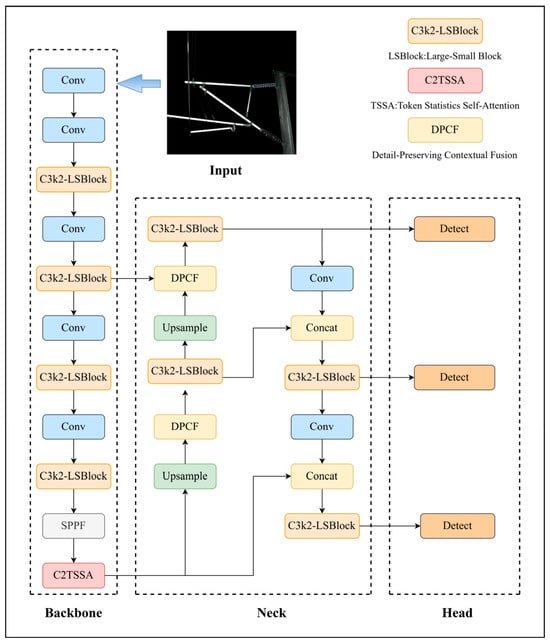
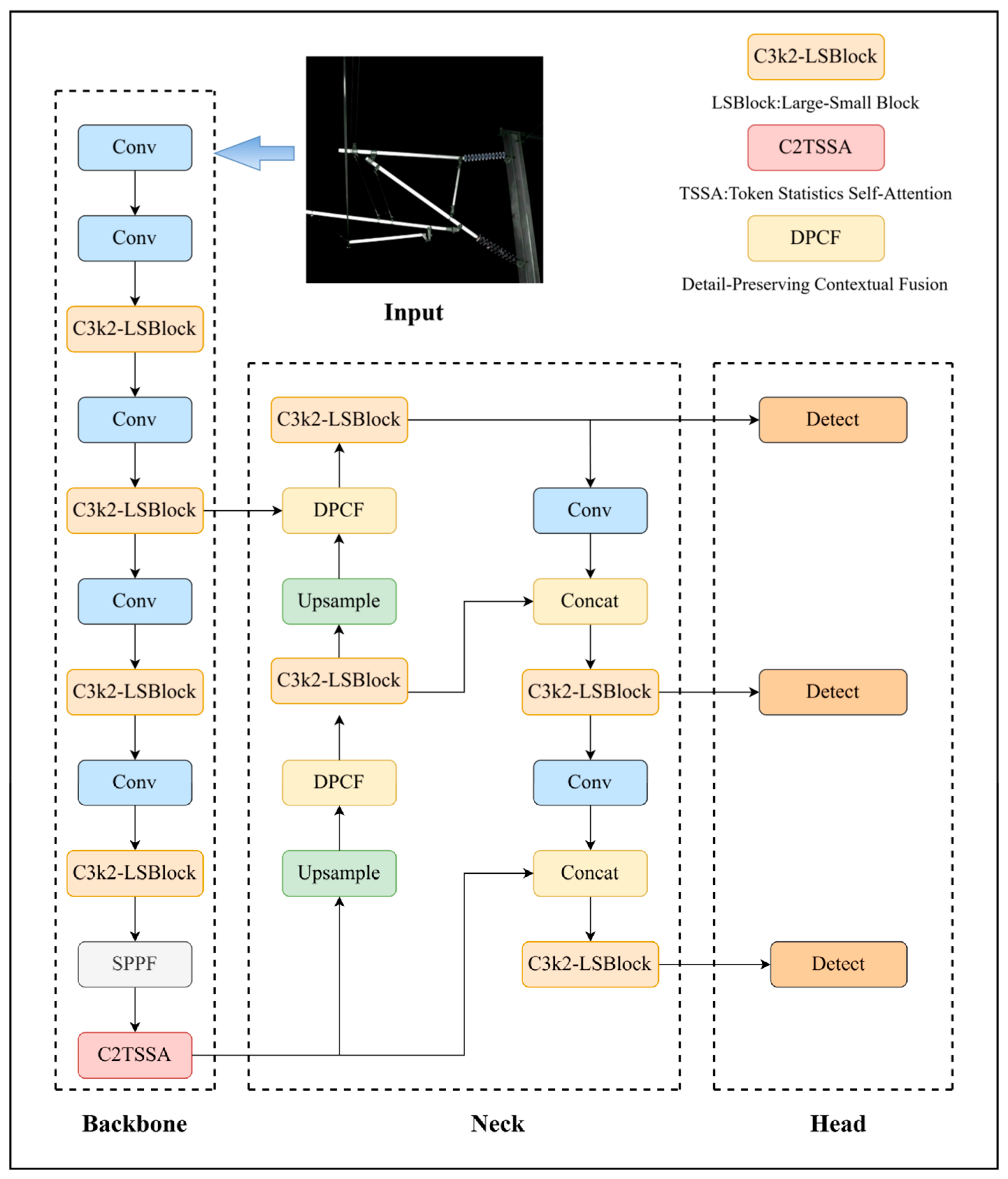
To address the issue of insufficient accuracy of the YOLO algorithm in railway catenary insulator defect detection, which is crucial for ensuring operational safety, this paper proposes an improved YOLO11n algorithm. This algorithm focuses on challenges such as weak small-target detection capability and significant complex background interference. Enhancements are made at three levels: feature extraction, context modeling, and feature fusion. First, an LS module [21] that fuses large and small receptive fields is used to replace the original C3k2 module, strengthening the model’s ability to capture multi-scale defect features. Second, a token statistics-based self-attention mechanism is introduced to achieve efficient global context information interaction while maintaining linear computational complexity. Finally, a detail-preserving contextual fusion module is proposed to optimize the multi-scale feature fusion process through an adaptive gating mechanism, effectively mitigating the loss of detail information from small targets. Experimental results show that the improved algorithm markedly improves the detection performance of small insulator defects in complex railway scenarios, validating its superiority and practicality. The overall structure of LSD-YOLO is shown in Figure 1.
Figure 1.
Architecture of LSD-YOLO. The model integrates LS, C2TSSA, and DPCF modules for multi-scale fusion and global context modeling.
3.1. LS (Large-Small) Module
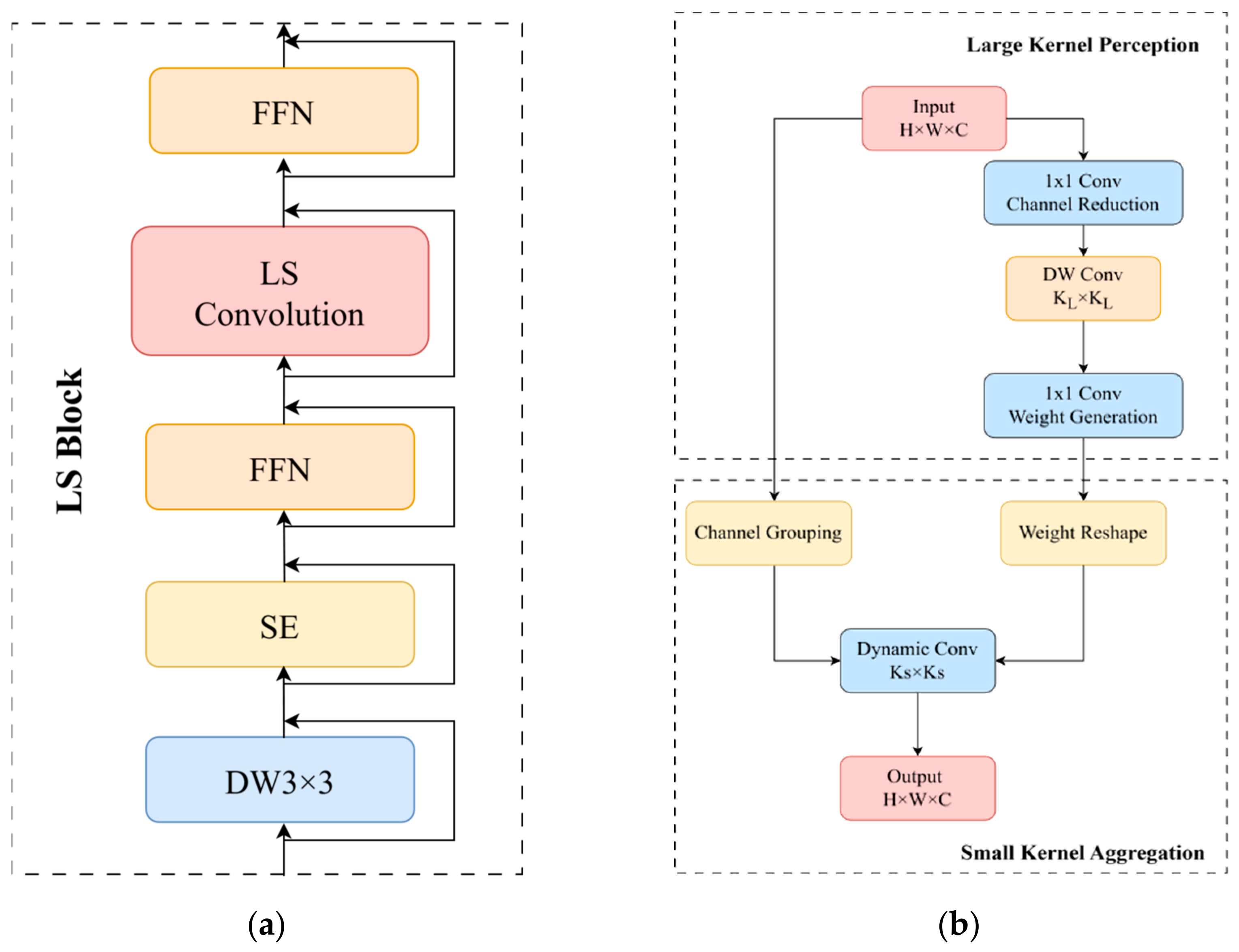
To address the issue that existing methods rely on a single receptive field and struggle to capture both large-scale context and local details simultaneously, this paper incorporates the LS module [21] into the YOLO11n backbone. This module mimics the “see large, then focus small” characteristic of the human visual system. Through a decoupled dual-pathway design with different scales, it enhances the model’s ability to extract multi-scale defect features. The LS module adopts a two-stage processing flow.
In the large-kernel perception stage, the module first compresses the channel dimension using pointwise convolution, then builds a global receptive field through large-kernel depthwise convolution to capture contextual dependencies between the insulator and its surrounding environment, finally generating a content-adaptive dynamic weight matrix. This process can be expressed as:
where represents the dynamic weight vector at position i; is the large-kernel perception function; is the large kernel size; and denotes the large-kernel depthwise convolution operation.
In the small-kernel aggregation stage, the module performs grouped dynamic convolution within a local neighborhood guided by the dynamic weights, achieving optimized fusion of local features under the guidance of global context information. This process can be described as
where is the output feature, is the small kernel size, and is the dynamic convolution kernel weight after grouping and reconstruction.
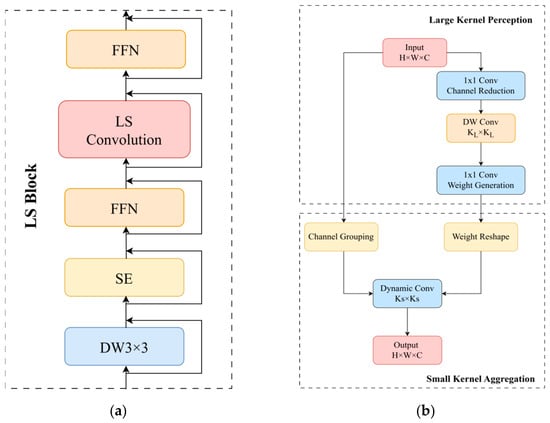
The overall structure of the LS Block and the detailed flow of the LS convolution are shown in Figure 2. With LS convolution as its core, this module efficiently mixes image tokens through the collaboration of the large-kernel perception and small-kernel aggregation stages. The large-kernel perception stage establishes global context awareness, while the small-kernel aggregation stage performs local feature fusion under the guidance of dynamic weights. To further enhance model capability, the LS Block also introduces depthwise convolution (DW) and SE layers [25] to strengthen local inductive bias. In addition, a feed-forward network (FFN) is used for channel mixing, and skip connections are adopted to facilitate optimization.
Figure 2.
Structure of the LS block and detailed flow of the LS convolution in LSD-YOLO. (a) Structure of the LS block. (b) Detailed flow of the LS convolution.
This design substantially improves the model’s multi-scale perception capability while maintaining low computational complexity, making it suitable for low-power, resource-constrained embedded environments and providing feasible support for real-time detection of insulator defects in complex railway scenarios.
In LSD-YOLO, the LS module replaces the original C3k2 module in the backbone’s P3 layer, where high-resolution features are most sensitive to multi-scale defect perception. This strategic placement ensures that both local details and global context are captured early in the feature extraction stage.
3.2. C2TSSA Module
In railway catenary insulator detection, insulator defect targets are characterized by small scale, complex background, and dense spatial distribution. Although traditional self-attention mechanisms can capture global context information, their computational complexity is quadratic with respect to the input size (O(n2d) time and O(n2) memory, where n is the number of tokens and d the feature dimension), which creates a serious bottleneck when processing high-resolution catenary images.
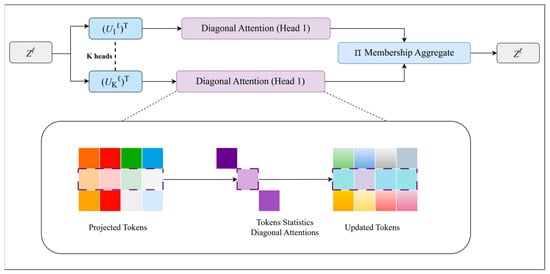
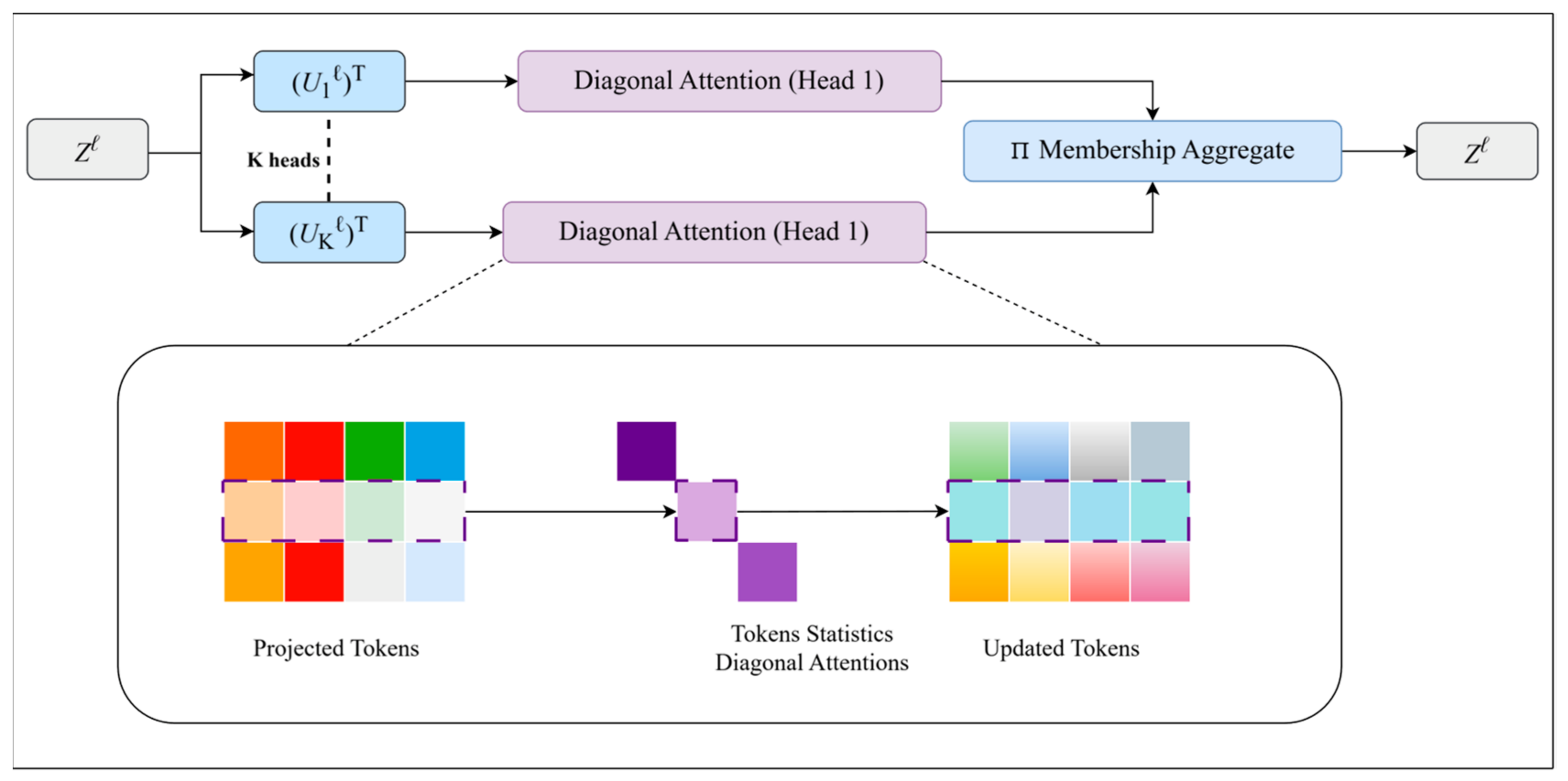
To address this issue, this paper introduces the Token Statistics Self-Attention (TSSA) mechanism [22], the structure of which is shown in Figure 3. The corresponding module that integrates this mechanism into our network is denoted as C2TSSA. TSSA completely avoids the pairwise interaction computation between tokens used in traditional attention. Instead, it constructs attention weights based on second-order statistics of token features. From a theoretical perspective, this variance-based weighting can be seen as a low-rank diagonal approximation of the covariance matrix of the projected features. Unlike methods that approximate the full pairwise similarity matrix (e.g., via Nyström sampling), TSSA uses deterministic statistics over all tokens, resulting in linear complexity. In the specific implementation, TSSA projects input features into multiple low-dimensional semantic subspaces. In each subspace, it constructs a data-dependent diagonal weight matrix based on the variance of the projected features to enhance discriminative features and filter redundant information. This statistics-driven design gives TSSA only linear computational and memory complexity (O(Kpdn) time and O(nd + Kp2) memory, where K is the number of heads, p the subspace dimension, and p≪d), far lower than the quadratic complexity of standard self-attention, making it particularly suitable for high-resolution image processing.
Figure 3.
Structure of the TSSA module in LSD-YOLO.
In this paper, the TSSA module is embedded into the backbone network of YOLO11n. Its processing flow includes: projecting input features into multiple low-dimensional subspaces to extract dominant feature patterns; calculating directional variance within each subspace and constructing a diagonal weighting matrix; adaptively fusing the outputs of multiple attention heads through a soft assignment mechanism; and finally fusing the enhanced features with the original input via cross-scale residual connections [26]. This process can be expressed as:
where represents the output representation of the j feature unit after TSSA enhancement; is the probability that the unit is assigned to the k-th attention head; is the projection matrix of the k-th subspace; is a diagonal matrix reflecting the variance of the projected features; τ is the update step size hyperparameter; and n is the total number of feature units. The above formulation can be interpreted as performing a low-rank diagonal update on the token features, where the diagonal matrix D scales each projected dimension according to its statistical importance, effectively suppressing redundant directions while preserving discriminative ones.
Importantly, spatial relationships are preserved in TSSA because the operation is applied independently to each token without any spatial reordering or mixing across different token positions. The output corresponds exactly to the same spatial location as the input , and the variance-based weighting only scales the feature vector of each token based on group-wise global statistics. No cross-token interaction is introduced beyond the aggregation of second-order statistics for computing the scaling factors. Consequently, the original spatial layout of the feature map is fully retained, and no additional position encoding is required beyond the existing positional embeddings in the YOLO backbone.
This computation realizes efficient attention allocation based on feature statistics, with the core advantage of reducing computational complexity to linear. Therefore, the C2TSSA module provides the model with efficient global context modeling capability without significantly increasing the computational burden, markedly improving the capture and discrimination performance for small insulator defects in complex backgrounds.
The C2TSSA module is embedded into the backbone’s deeper layers, where global context modeling is most critical. By maintaining linear complexity, it enables efficient long-range dependency modeling without compromising the lightweight design.
3.3. DPCF Module
Small defects such as cracks and breakages on insulators and their surfaces occupy a small proportion of the image and have weak features. YOLO11n uses a Feature Pyramid Network (FPN) to fuse multi-scale features, but its core concatenation operation is static and undifferentiated, making it difficult to adaptively balance deep semantic features and shallow detail features under complex background interference, leading to the loss of key target information during fusion.
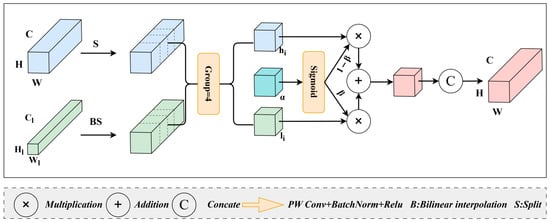
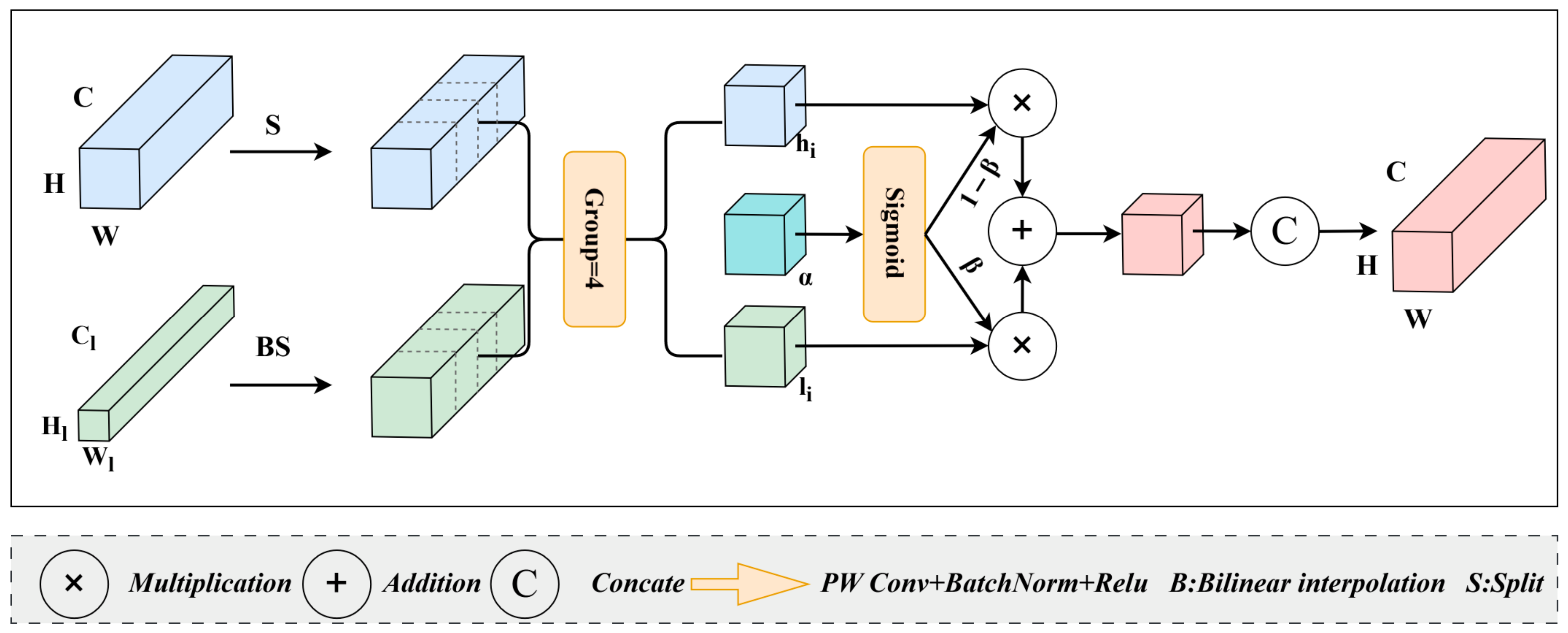
This paper introduces the Detail-Preserving Contextual Fusion (DPCF) module [23], the structure of which is shown in Figure 4. DPCF abandons the traditional static concatenation or addition operation and instead adopts a data-driven, spatially adaptive gating fusion mechanism. First, the high- and low-resolution feature maps are aligned in spatial and channel dimensions and evenly split into multiple feature segments. Then, a gate weight map that depends on the input data is generated for each feature segment to control the fusion ratio of features from different sources. This design enables DPCF to autonomously decide, based on local contextual information, whether to retain more details or rely on semantic context in specific regions, thus achieving precise preservation of small defect features.
Figure 4.
Structure of the DPCF module in LSD-YOLO.
In this paper, the DPCF module is embedded into the neck network of YOLO11n, replacing the original feature concatenation operation. Its specific processing flow is as follows: first, the input high- and low-resolution features are aligned in spatial and channel dimensions; then, the features are evenly split into multiple segments along the channel dimension; spatial gate weights are generated through learnable parameters and normalized using a Sigmoid function, as given by:
where α is a learnable parameter, and is the normalized spatially adaptive gate weight.
Based on these weights, the corresponding feature segments are fused in a weighted manner, which can be computed as:
where is the fused output of the i-th feature segment, and are the low-resolution and high-resolution features of the corresponding segment, respectively, and denotes element-wise multiplication.
This mechanism allows the network to dynamically adjust the fusion strategy according to the input content. When the gate weight approaches 0, the model focuses on retaining detail information from the high-resolution features; when it approaches 1, the model pays more attention to the contextual semantics of the low-resolution features. Finally, the fused features are refined through a convolutional layer to further enhance feature representation capability.
Through a spatially adaptive gating fusion mechanism, the DPCF module achieves a dynamic balance between semantic and detail information in multi-scale features, effectively alleviating the loss of detail information inherent in traditional fusion methods. This design enables the model to maintain high sensitivity to small insulator defects even in complex backgrounds, providing crucial structural support for improving detection accuracy.
In LSD-YOLO, the DPCF module is deployed in the neck network, replacing the original feature concatenation operation. This placement allows adaptive fusion of shallow detail features from the backbone and deep semantic features from the neck, effectively preserving small-target information.
4. Experiments and Analysis
4.1. Dataset
The dataset constructed for this experiment aims to accurately reflect the real-world condition of catenary insulators in complex operational environments. Therefore, a strategy of multi-source data fusion and scene enhancement was adopted. The data primarily came from two sources: the first part consisted of high-resolution catenary images captured by railway bureau 4C inspection vehicles during nighttime patrols. However, the inherent nighttime shooting conditions of this source limit feature representation, making it particularly difficult to capture subtle defects such as pollution-flashover on insulator surfaces. To compensate for this limitation and ensure completeness of defect types in the dataset, a second data source was introduced: the public dataset CPLID [27]. Daytime images containing typical insulator flashover phenomena were selected from CPLID and processed through a series of image transformations to simulate nighttime imaging effects. This processing pipeline included global brightness and contrast adjustments, the introduction of illumination noise, and the application of inverse low-light image enhancement algorithms, thereby generating high-quality nighttime flashover samples with lighting conditions consistent with the 4C inspection vehicle data [28].
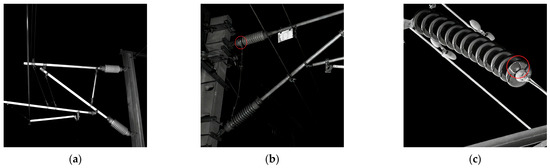
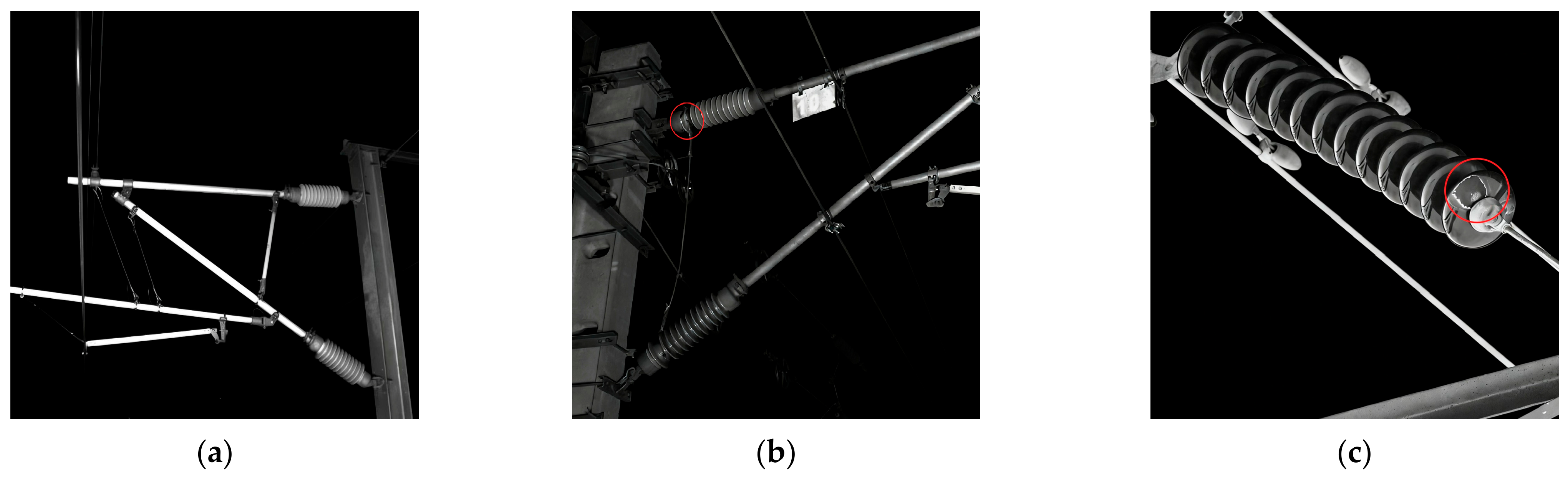
Finally, the integrated dataset was systematically categorized and annotated. All images were classified into three categories based on the physical state of the insulators: normal, defect, and pollution-flashover, as shown in Figure 5. The LabelImg tool was then used to annotate bounding boxes around the insulator targets in the images. The annotation information was saved in YOLO format (.txt files). After rigorous screening and data processing, a total of 2448 valid images were obtained. The dataset was randomly divided into training, validation, and test sets in a ratio of 7:1:2.
Figure 5.
Physical states of insulators: (a) normal, (b) defect, (c) pollution-flashover. The red circles in (b) and (c) highlight defect examples.
To assess whether the synthetic night images introduce a domain gap, we evaluated the LSD-YOLO model separately on real 4C night images and on synthetic night images from the test set. The model achieves an mAP@50 of 85.6% on real images and 86.9% on synthetic images. The small difference of 1.3 percentage points indicates that the synthetic transformation successfully approximates real night conditions and that the model performs well to both data sources.
4.2. Environment Configuration
The software and hardware configurations for the experiments in this paper are shown in Table 2.
Table 2.
Experimental environment configuration for LSD-YOLO.
4.3. Evaluation Metrics
This paper uses precision (P), recall (R), mean average precision (mAP), number of parameters (Params), and floating-point operations (FLOPs) as evaluation metrics for model performance. Both mAP@50 and mAP@50-95 are used for comprehensive assessment. The former focuses on object detection capability, while the latter imposes stricter requirements on localization accuracy. The specific calculation formulas are as follows:
where TP indicates that a positive sample is predicted as positive; FP indicates that a negative sample is predicted as positive.
where FN indicates that a positive sample is predicted as negative.
where N is the total number of classes, and represents the average precision for the i-th class when the threshold is greater than or equal to 0.5.
where N is the total number of classes, M is the number of thresholds (default is 10), is the j-th threshold, is the average precision for the i-th class at the threshold .
4.4. Ablation Experiments
To verify the effectiveness of the proposed improvement modules, systematic ablation experiments were conducted on the railway catenary insulator dataset using YOLO11n as the baseline model. The experimental setup was as follows: ① is the original YOLO11n model; ②–④ represent the separate introduction of the C3k2-LSBlock, C2TSSA, and DPCF modules; ⑤–⑦ represent combinations of two modules; ⑧ is the complete LSD-YOLO. The experimental results are shown in Table 3.
Table 3.
Ablation study results on the railway insulator dataset.
As shown in Table 3, after introducing the C3k2-LSBlock module alone, precision (P) significantly increased to 89.8%, indicating that this module, by fusing different receptive fields, enhances the perception of multi-scale defect features and notably boosts detection accuracy. However, while improving precision, recall (R) slightly decreased, suggesting that while enhancing feature discrimination, it might have affected the detection of some ambiguous or difficult samples. This precision-recall trade-off is a common consequence of enhanced feature discrimination, and it is effectively resolved by the full LSD-YOLO through module synergy. After introducing the C2TSSA module alone, mAP@50 increased to 83.5%, verifying that the token statistics-based self-attention mechanism augments the model’s ability to model global context information while maintaining linear complexity. After introducing the DPCF module alone, mAP@50 further increased to 83.7%, indicating that this module effectively preserves detail information of small targets during multi-scale feature fusion through an adaptive gating mechanism.
Furthermore, the module combination experiments show good complementarity among the improved modules. When C3k2-LSBlock was combined with DPCF (Experiment ⑥), mAP@50 reached 85.5%, an increase of 3.4 percentage points over the baseline. When C2TSSA was combined with DPCF (Experiment ⑦), precision increased to 90.9%, showing the synergistic enhancement effect of the attention mechanism and the detail preservation module. Finally, when all three modules worked together (Experiment ⑧), the model achieved optimal performance across all evaluation metrics, with mAP@50 reaching 86.2%, an increase of 4.1 percentage points over the original YOLO11n, and mAP@50-95 increasing to 57.7%, markedly boosting the detection capability and generalization performance for multi-scale insulator defects.
In summary, the three proposed improvement modules play important roles in enhancing model detection accuracy, strengthening multi-scale feature representation capabilities, and preserving small-target detail information. The significant synergistic effects among the modules validate the effectiveness and practicality of the improvement strategy for the railway catenary insulator detection task.
To estimate the stability of the results, we performed bootstrap resampling (1000 iterations) on the test set predictions. The 95% confidence interval for LSD-YOLO mAP@50 is [85.7%, 86.7%], which does not overlap with the baseline YOLO11n result (82.1%), confirming the improvement is statistically robust. Since both defect types (breakage and flashover) are inherently small objects in our dataset, the overall mAP improvement directly reflects the enhanced small-defect detection capability; therefore, a separate scale-wise breakdown is not provided.
4.5. Comparison Experiments
To verify whether the improved YOLO11n can better detect physical defects of insulators, comparative experiments were conducted with different versions of YOLO and advanced algorithm models. Precision, recall, mAP@50, mAP@50-95, and FLOPs were used as evaluation metrics. The experimental comparison results are shown in Table 4.
Table 4.
Comparison with state-of-the-art lightweight models on the railway insulator dataset.
The comparison experiment results shown in Table 4 indicate that the proposed LSD-YOLO demonstrates significant advantages across all core metrics. Specifically, compared to the original YOLO11n baseline model, LSD-YOLO achieves a mAP@50 of 86.2%, which is 4.1 percentage points higher than the baseline performance (82.1%), representing a relative improvement of approximately 5.0%. At the same time, the model also excels in lightweight design, with 2.30 M parameters and 6.0G FLOPs, both lower than most compared models, striking a favourable trade-off between performance enhancement and computational efficiency. LSD-YOLO outperforms other lightweight YOLO versions across all evaluation metrics. Its mAP@50 is a further 2.7 percentage points higher than that of the next best performer, YOLO12n (83.5%). These results validate the effectiveness of the collaborative design of the LS, C2TSSA, and DPCF modules, showing that their targeted mechanisms for multi-scale feature extraction, global context modeling, and detail-preserving fusion considerably improve the model’s ability to recognize multi-scale insulator defects. In horizontal comparisons with other advanced lightweight models, LSD-YOLO also demonstrates strong competitiveness. Its mAP@50 (86.2%) surpasses Hyper-yolo (84.8%) while maintaining the highest precision (91.8%). Compared to the Transformer-based RT-DETR-R18, LSD-YOLO has a leading advantage of 6.6 percentage points in mAP@50, further indicating that the proposed method is not only effective within the YOLO architecture but also holds a leading position in comprehensive detection performance among current lightweight detection models.
Furthermore, on the mAP@50-95 metric, which more strictly measures localization accuracy, LSD-YOLO ranks first with 57.7%, slightly higher than Hyper-yolo (57.5%) and significantly better than all YOLO series comparison models. While achieving accuracy advantages, the parameter count and computational load of LSD-YOLO remain at low levels, indicating that the proposed modules enhance feature representation capability without introducing excessive redundant computation, which is beneficial for subsequent deployment in resource-constrained environments. This result further confirms the key role of the DPCF module in optimizing multi-scale feature fusion and preserving detail information, allowing the model to maintain excellent bounding box regression accuracy while achieving high recall.
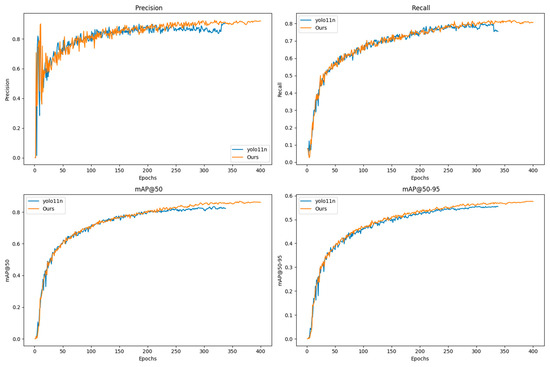
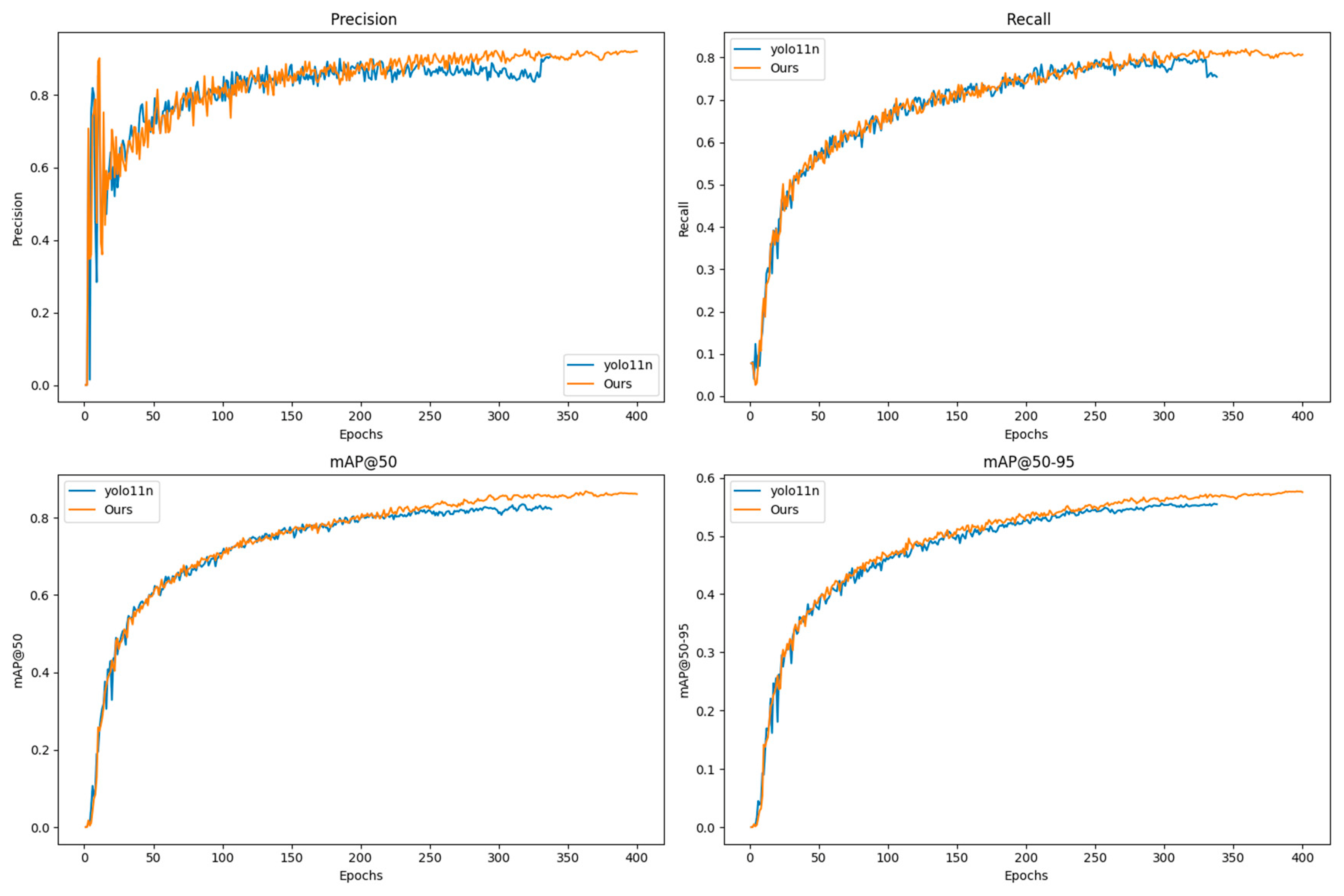
To deeply analyze the impact of the improvement strategy on model training dynamics, Figure 6 shows a comparison of the training curves of key evaluation metrics (Precision, Recall, mAP) for the baseline model and LSD-YOLO during training.
Figure 6.
Training performance comparison between YOLO11n and LSD-YOLO.
The experimental results show that after collaborative optimization with the C3k2-LSBlock, C2TSSA, and DPCF modules, LSD-YOLO demonstrates comprehensive and substantial performance advantages in the insulator defect detection task. As shown in Figure 6, compared to the original YOLO11n baseline model, LSD-YOLO achieves simultaneous and sustained improvements in the four core evaluation metrics: Precision, Recall, mAP@50, and mAP@50-95. The curves for all metrics show a continuous upward trend during training and converge to significantly higher performance plateaus in the later stages of iteration. This dynamic process not only reflects the model’s strong learning capability but also indicates its good convergence stability and generalization potential.
4.6. Deployment Efficiency on Edge Device
To evaluate the practical deployment potential, we benchmarked the inference speed and power consumption on an NVIDIA Jetson Nano (4 GB) in 15 W mode. All models were converted to TensorRT FP16 with an input resolution of 640 × 640. The results are averaged over 1000 inference runs.
We selected YOLOv8n and YOLO11n as the most representative lightweight baselines with comparable parameter counts (2.6–3.0 M). Other models listed in Table 4 have similar FLOPs and are expected to yield comparable FPS trends. The deployment efficiency results are presented in Table 5.
Table 5.
Deployment efficiency comparison on Jetson Nano.
LSD-YOLO achieves 24 FPS, outperforming YOLO11n (23 FPS) and YOLOv8n (20 FPS), while consuming 5.6 W (approximately 7% less than YOLO11n). The lower latency (38.5 ms) and higher throughput confirm the effectiveness of our lightweight design for real-time railway inspection on embedded hardware.
5. Test Results and Visualization Analysis
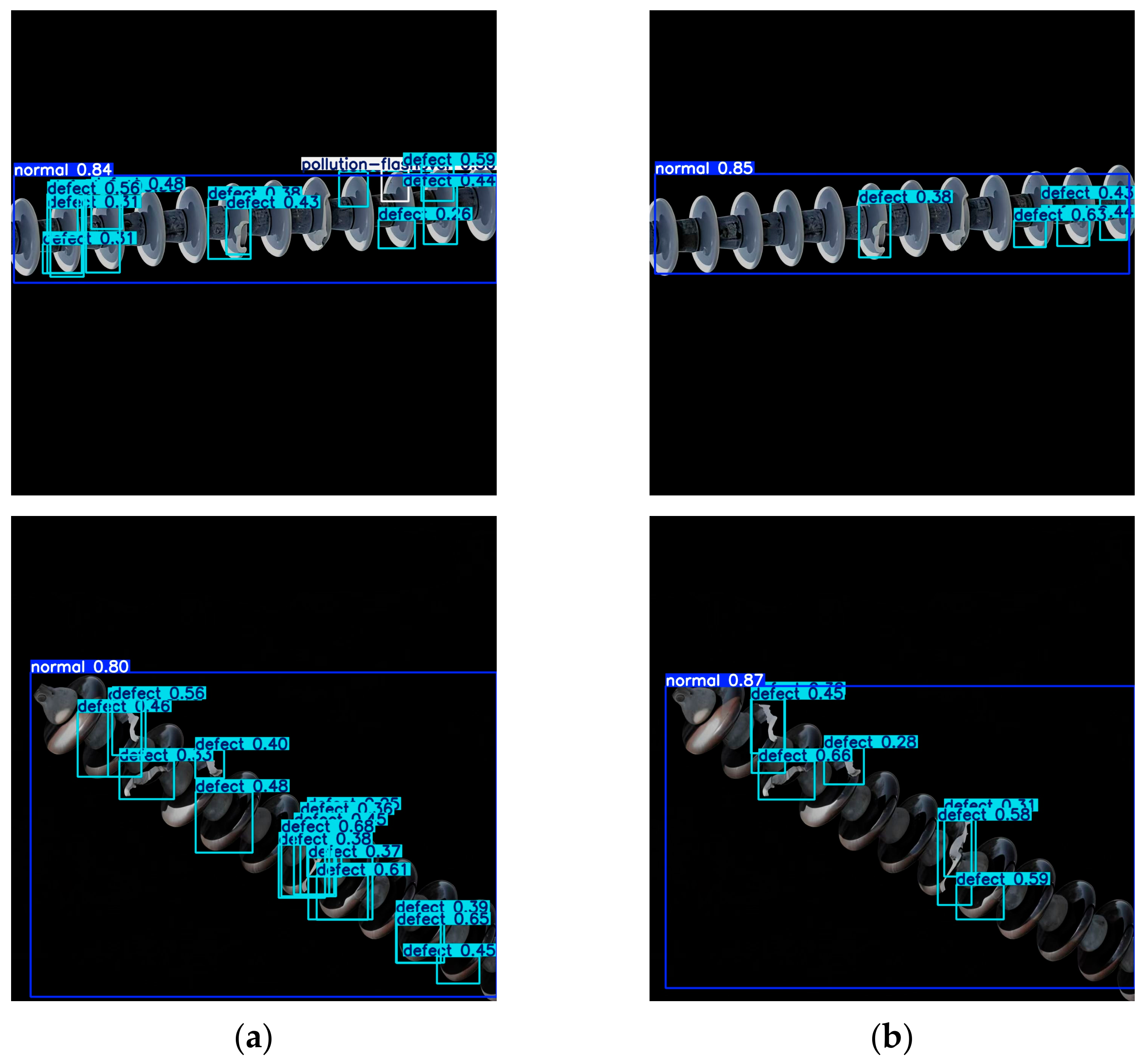
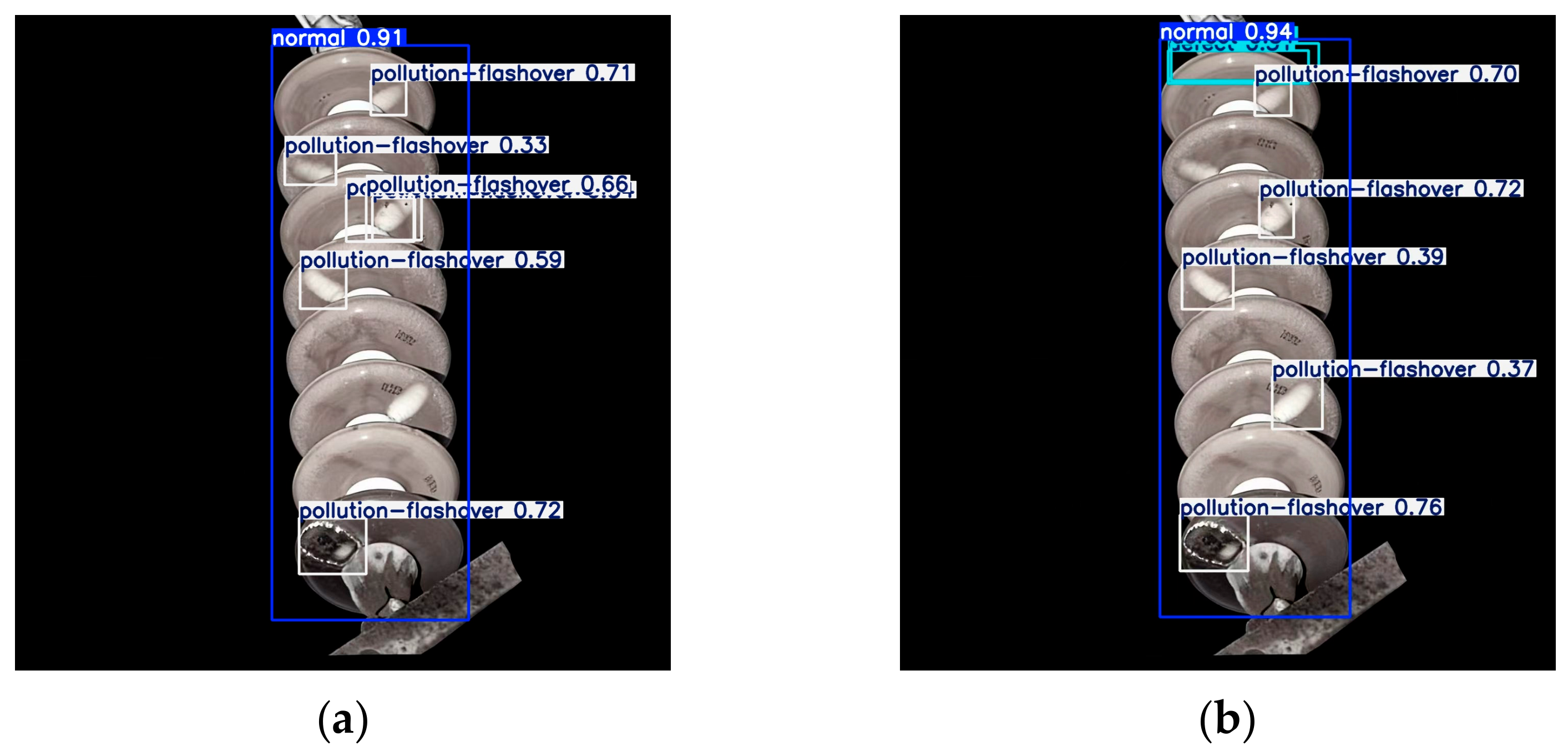
To visually demonstrate the detection performance of LSD-YOLO, representative samples from the test set were selected for visualization comparison. The experimental results are shown in Figure 7 and Figure 8.
Figure 7.
Detection results of insulator breakage defects: (a) YOLO11n, (b) LSD-YOLO.
Figure 8.
Detection results of insulator flashover defects: (a) YOLO11n, (b) LSD-YOLO.
Through the visual comparison analysis, it is evident that LSD-YOLO exhibits significant advantages across multiple dimensions. Compared to the baseline model and other mainstream comparison models, LSD-YOLO not only achieves higher detection confidence but also shows significantly better spatial alignment between predicted bounding boxes and ground truth targets, resulting in more precise localization. In identifying both physical insulator defects and electrical faults (pollution-flashover), LSD-YOLO can clearly and completely detect the targets, effectively suppressing false positives and false negatives in complex backgrounds. This indicates that the proposed method can consistently output reliable visual detection results, providing an intuitive and credible basis for defect determination in actual railway inspections.
6. Conclusions
Aiming at the challenges of multi-scale defect perception, complex background interference, and integrated identification of electrical faults in railway catenary insulator defect detection, this study designed and validated a lightweight detection method based on LSD-YOLO. The main work and conclusions are as follows.
First, this study constructed a systematic enhancement scheme covering feature extraction, context modeling, and detail fusion. By integrating the LS module for multi-scale receptive field fusion, incorporating the C2TSSA module to establish global context associations with linear cost, and using the DPCF module to adaptively preserve fusion details, the model’s feature representation and discrimination capabilities for heterogeneous defects such as physical damage and pollution-flashover in complex scenes were significantly enhanced.
Second, this method achieves collaborative optimization of accuracy and efficiency under lightweight constraints. Experiments show that with only 2.30 M parameters, LSD-YOLO achieves a core detection metric mAP@50 of 86.2%, with precision and recall increasing to 91.8% and 80.6% respectively, effectively achieving a better balance between detection accuracy and inference efficiency, confirming the superiority and practicality of the proposed improvement strategy.
Finally, this study developed a complete technical solution with potential for engineering application. By constructing a dataset that closely mirrors real-world scenes and designing a model oriented towards integrated detection, the limitations of existing methods in terms of defect type coverage are overcome. The proposed LSD-YOLO provides a high-accuracy, high-efficiency, and easily deployable feasible path for intelligent inspection in complex railway environments, offering clear application value.
However, it is worth noting that our model only detects visible defects. It cannot directly quantify degradation, predict end-of-life, or detect early-stage partial discharge (which produces no visible surface changes and requires specialised sensors such as UV cameras). Future work could extend it to a regression-based health monitoring system, as well as further explore the model’s robustness under varying weather conditions and promote the transfer of this lightweight framework to other railway facility condition detection tasks.
Author Contributions
Conceptualization, J.L. and L.Y.; methodology, J.L.; software, J.L. and H.M.; validation, J.L., L.Y. and H.M.; formal analysis, J.L.; investigation, J.L.; resources, H.M.; data curation, L.Y. and H.M.; writing—original draft preparation, J.L.; writing—review and editing, L.Y., H.M. and J.Y.; visualization, J.L.; supervision, L.Y.; project administration, L.Y.; funding acquisition, L.Y. All authors have read and agreed to the published version of the manuscript.
Funding
This work was supported by the Dalian Excellent Youth Science and Technology Talent Project under Grant 2025RY02.
Institutional Review Board Statement
Not applicable.
Informed Consent Statement
Not applicable.
Data Availability Statement
The dataset used in this study is not publicly available due to privacy and institutional restrictions related to the 4C inspection system data. It can be made available from the corresponding author upon reasonable request.
Acknowledgments
The authors would like to express their sincere gratitude to the editors and anonymous reviewers for their valuable comments and suggestions, which significantly improved the quality of this manuscript.
Conflicts of Interest
Author Hexuan Ma was employed by the company CRRC Zhuzhou Electric Locomotive Co., Ltd. The remaining authors declare that the research was conducted in the absence of any commercial or financial relationships that could be construed as a potential conflict of interest.
Abbreviations
The following abbreviations are used in this manuscript:
| LSD-YOLO | Lightweight Multi-Scale Fusion Network for Railway Insulator Defect Detection |
| YOLO | You Only Look Once |
| LS | Large-Small Module |
| TSSA | Token Statistics Self-Attention |
| DPCF | Detail-Preserving Contextual Fusion |
| FPN | Feature Pyramid Network |
| mAP | Mean Average Precision |
| FLOPs | Floating-Point Operations |
| 4C | Catenary Suspension State Detection and Monitoring Device |
| CPLID | Catenary Porcelain Insulator Dataset |
References
- Fan, X.; Zhang, B. A New Milestone! China’s High-Speed Railway Operation Mileage Exceeds 50,000 Kilometers. Xinhua Daily Telegraph, 27 December 2025.
- Li, T.; Hao, T. Damage Detection of Insulators in Catenary Based on Deep Learning and Zernike Moment Algorithms. Appl. Sci. 2022, 12, 5004. [Google Scholar] [CrossRef] [Scilit]
- Sivaraman, M.; Sivadasan, J. Comparison of Pollution Flashover Performance of Various Insulators. In Proceedings of the 2014 International Conference on Circuits, Power and Computing Technologies (ICCPCT), Nagercoil, India, 20–21 March 2014; IEEE: New York, NY, USA, 2014; pp. 148–152. [Google Scholar]
- Han, Y.; Liu, Z.G.; Lee, D.J.; Liu, W.Q.; Chen, J.W.; Han, Z.W. Computer vision-based automatic rod-insulator defect detection in high-speed railway catenary system. Int. J. Adv. Robot. Syst. 2018, 15, 1729881418773943. [Google Scholar] [CrossRef] [Scilit]
- El Haj, Y.; Milman, R.; Kaplan, I.; Ashasi-Sorkhabi, A. Hybrid Algorithm Based on Machine Learning and Deep Learning to Identify Ceramic Insulators and Detect Physical Damages. In Proceedings of the 2021 IEEE Conference on Electrical Insulation and Dielectric Phenomena (CEIDP), Vancouver, BC, Canada, 12–15 December 2021; IEEE: New York, NY, USA, 2021; pp. 235–238. [Google Scholar]
- Arjun, M.; Parida, A.; Singh, P.D.; Chatterjee, D. Health Monitoring of Line Insulators Through Artificial Intelligence-Based Surveillance System. In Proceedings of the 2025 IEEE North-East India International Energy Conversion Conference and Exhibition (NE-IECCE), Silchar, India, 4–6 July 2025; IEEE: New York, NY, USA, 2025; pp. 1–6. [Google Scholar]
- Power Supply Department of Transport Bureau, Ministry of Railways. General Technical Specification for High-Speed Railway Power Supply Safety Detection and Monitoring System (6C System); Power Supply Department of Transport Bureau, Ministry of Railways: Beijing, China, 2012.
- Li, Y.; Zou, G.; Zou, H.; Zhou, C.; An, S. Insulators and Defect Detection Based on the Improved Focal Loss Function. Appl. Sci. 2022, 12, 10529. [Google Scholar] [CrossRef] [Scilit]
- Wang, Y.; Li, Z.; Yang, X.; Luo, N.; Zhao, Y.; Zhou, G. Insulator Defect Recognition Based on Faster R-CNN. In Proceedings of the 2020 International Conference on Computer, Information and Telecommunication Systems (CITS), Hangzhou, China, 5–7 October 2020; IEEE: New York, NY, USA, 2020; pp. 1–4. [Google Scholar]
- Ren, S.; He, K.; Girshick, R.; Sun, J. Faster R-CNN: Towards Real-Time Object Detection with Region Proposal Networks. arXiv 2015, arXiv:1506.01497. [Google Scholar] [CrossRef] [Scilit] [PubMed]
- Liu, C.; Wu, Y.; Liu, J.; Sun, Z. Improved YOLOv3 Network for Insulator Detection in Aerial Images with Diverse Background Interference. Electronics 2021, 10, 771. [Google Scholar] [CrossRef] [Scilit]
- Redmon, J.; Farhadi, A. YOLOv3: An Incremental Improvement. arXiv 2018, arXiv:1804.02767. [Google Scholar] [CrossRef] [Scilit]
- Tang, J.; Yu, M.; Wu, M. Detection of railway catenary insulator defects based on improved YOLOv5s. PeerJ Comput. Sci. 2023, 9, e1474. [Google Scholar] [CrossRef] [Scilit] [PubMed]
- Yao, L.; Yaoyao, Q. Insulator Detection Based on GIOU-YOLOv3. In Proceedings of the 2020 Chinese Automation Congress (CAC), Shanghai, China, 6–8 November 2020; IEEE: New York, NY, USA, 2020; pp. 5066–5071. [Google Scholar]
- Liu, X.; Rao, Z.; Lin, N. Object Detection Method for Foreign Substances on High-Voltage Transmission Lines Based on Deep Learning. In Proceedings of the 18th International Conference on Intelligent Systems and Knowledge Engineering (ISKE), Fuzhou, China, 2023; IEEE: New York, NY, USA, 2023; pp. 580–584. [Google Scholar]
- Cristi, F.; Jocher, S. Pre-Commit.ci. Yolov5. 2020. Available online: https://github.com/ultralytics/yolov5/ (accessed on 11 April 2022).
- Huang, L.; Li, Y.; Wang, W.; He, Z. Enhanced Detection of Subway Insulator Defects Based on Improved YOLOv5. Appl. Sci. 2023, 13, 13044. [Google Scholar] [CrossRef] [Scilit]
- Jiang, D.; Liu, K.; Jia, L.; Qin, Y.; Jiang, Y.; Wang, Z. Automatic Detection Strategy of Multi-Scale Catenary Support Device Based on Improved YOLOv7. IFAC-PapersOnLine 2023, 56, 7597–7602. [Google Scholar] [CrossRef] [Scilit]
- Wang, Z.; Yuan, G.; Zhou, H.; Ma, Y.; Ma, Y.; Chen, D. Improved YOLOv7 model for insulator defect detection. arXiv 2025, arXiv:2502.07179. [Google Scholar] [CrossRef] [Scilit]
- Jin, T.; Shen, Z.; Geng, H. Optimized YOLOv11m for Real-Time High-Speed Railway Catenary Defect Detection. Sci. Rep. 2026, 16, 200. [Google Scholar] [CrossRef] [Scilit] [PubMed]
- Wang, A.; Chen, H.; Lin, Z.; Han, J.; Ding, G. LSNet: See Large, Focus Small. In Proceedings of the IEEE/CVF Conference on Computer Vision and Pattern Recognition, Nashville, TN, USA, 11–17 June 2025; IEEE: New York, NY, USA, 2025; pp. 9718–9729. [Google Scholar]
- Wu, Z.; Ding, T.; Lu, Y.; Wang, Y. Token Statistics Transformer: Linear-Time Attention via Variational Rate Reduction. arXiv 2024, arXiv:2412.17810. [Google Scholar] [CrossRef] [Scilit]
- Xu, W.; Zheng, S.; Wang, C.; Li, J. SAMamba: Adaptive State Space Modeling with Hierarchical Vision for Infrared Small Target Detection. arXiv 2025, arXiv:2505.23214. [Google Scholar] [CrossRef] [Scilit]
- Khanam, R.; Hussain, M. YOLOv11: An Overview of the Key Architectural Enhancements. arXiv 2024, arXiv:2410.17725. [Google Scholar] [CrossRef] [Scilit]
- Hu, J.; Shen, L.; Albanie, S.; Sun, G.; Wu, E. Squeeze-and-Excitation Networks. In Proceedings of the IEEE/CVF Conference on Computer Vision and Pattern Recognition, Salt Lake City, UT, USA, 18–23 June 2018; IEEE: New York, NY, USA, 2018; pp. 7132–7141. [Google Scholar]
- Liu, Y.; Wang, W.; Xu, H.; Zou, L. Steel Surface Defect Detection Algorithm Based on Improved YOLOv11n. In Proceedings of the 6th International Conference on Computer Vision, Image and Deep Learning (CVIDL), Ningbo, China, 2025; IEEE: New York, NY, USA, 2025; pp. 145–148. [Google Scholar]
- Tao, X.; Zhang, D.; Wang, Z.; Liu, X.; Zhang, H.; Xu, D. Detection of Power Line Insulator Defects Using Aerial Images Analyzed with Convolutional Neural Networks. IEEE Trans. Syst. Man Cybern. Syst. 2020, 50, 1486–1498. [Google Scholar] [CrossRef] [Scilit]
- Jiang, H.; Qiu, X.; Chen, J.; Liu, X.; Miao, X.; Zhuang, S. Insulator Fault Detection in Aerial Images Based on Ensemble Learning with Multi-Level Perception. IEEE Access 2019, 7, 61797–61810. [Google Scholar] [CrossRef] [Scilit]
- Feng, Y.; Huang, J.; Du, S.; Li, Z.; Liu, X. Hyper-YOLO: When Visual Object Detection Meets Hypergraph Computation. arXiv 2024, arXiv:2408.04804. [Google Scholar] [CrossRef] [Scilit] [PubMed]
- Hu, Z.; Zhao, Y.; Peng, Y.; Sun, W.; Yin, X.; Chen, J.; Wu, P.; Li, H.; Wang, X.; Jiang, D.; et al. Rio-DETR: DETR for Real-time Oriented Object Detection. arXiv 2026, arXiv:2603.09411. [Google Scholar]

Disclaimer/Publisher’s Note: The statements, opinions and data contained in all publications are solely those of the individual author(s) and contributor(s) and not of MDPI and/or the editor(s). MDPI and/or the editor(s) disclaim responsibility for any injury to people or property resulting from any ideas, methods, instructions or products referred to in the content. |
© 2026 by the authors. Licensee MDPI, Basel, Switzerland. This article is an open access article distributed under the terms and conditions of the Creative Commons Attribution (CC BY) license.