


Abstract
The identification and characterization of air pollutants in metropolitan environments are of paramount global concern due to their significant implications for air quality and public health. This study investigates the chemical composition of fine particulate matter (PM2.5) at two strategically selected urban sites in Seoul, South Korea, during 2020: Gwanghwamun Plaza, representing a high-density central location, and Bokjeong Station, situated in the metropolitan periphery. A key aspect of this research is the detection of terephthalic acid (TPA)—a distinct marker of polyethylene terephthalate (PET) combustion—using high-resolution liquid chromatography–time-of-flight tandem mass spectrometry (LC-ToF-MS/MS). Results from the simultaneous measurement campaign demonstrate that nighttime conditions strongly influence PM2.5 at both sites, with increases observed not only in absolute concentrations (levoglucosan, TPA, As, CO, and NH3) but also in OC-normalized ratios (levoglucosan/OC and TPA/OC). The consistent nighttime enhancement of these ratios suggests that the observed increases cannot be explained solely by reduced planetary boundary layer height but instead indicate relatively stronger emission contributions. These increases are likely influenced by waste incineration activities, wherein PET-based plastics and wood materials are combusted. Furthermore, assessment of the dithiothreitol assay-derived oxidative potential (DTT-OP) underscores the heightened oxidative stress associated with these emissions, posing substantial health risks.
1. Introduction
Airborne particulate matter (PM), including PM2.5, has been classified as a Group 1 carcinogen by the International Agency for Research on Cancer (IARC) of the World Health Organization (WHO). It is associated with numerous health issues, including respiratory and circulatory disorders, cardiovascular diseases, and cancer [1,2]. Regarding the origins of atmospheric PM2.5, contributions from natural sources such as soil are comparatively minor, whereas contributions from direct human activities, particularly combustion, are considerably higher [3]. Among anthropogenic emissions, combustion activities release PM2.5, volatile organic compounds (VOCs), nitrogen oxides (NOx), carbon monoxide (CO), and polycyclic aromatic hydrocarbons (PAHs). These emissions pose a significant risk to human health and adversely affect the natural environment [4,5,6,7]. Specifically, combustion activities are recognized as predominant sources of air pollution compared to other human activities. Globally, various initiatives are underway to control air pollutants from these activities. The Republic of Korea is actively enforcing regulations under the Waste Management Act to curb illegal incineration and manage combustion exhaust gases (https://www.law.go.kr/ accessed on 9 March 2026). Despite these measures, ongoing emissions from combustion activities are still being reported in recent studies [8,9].
This underscores the significant role of combustion in air pollution, despite stringent regulatory controls. Levoglucosan (C6H10O5) is widely used as a molecular marker to assess biomass burning, including wood waste incineration [8,10]. Moreover, terephthalic acid (TPA) (C6H4(CO2H)2) is utilized as an indicator of plastic incineration. TPA is an essential raw material in manufacturing polyester fibers and polyethylene terephthalate (PET), which has been linked to health risks, including bladder cancer [8,11,12,13,14]. During the pyrolysis of PET, TPA and ethylene are produced, with TPA accounting for over 70% of the by-products from PET incineration [15,16]. Thus, TPA not only reflects the synthesis of PET but also acts as an indicator of plastic by-products generated during combustion. Analyzing TPA levels in PM2.5 is a valuable method for evaluating the impact of plastic incineration on air quality [17]. In 2022, South Korea generated 3.6 × 10⁶ tons of plastic waste. Waste management in South Korea featured 47% recycling, 39% incineration, and 13% landfilling (Resource Recycling Information System) (https://www.recycling-info.or.kr/rrs/main.do accessed on 9 March 2026). However, “thermal recycling,” which involves energy recovery through combustion (waste-to-energy), is often classified as incineration rather than recycling under EU standards. When this category is considered, approximately 68% of plastic waste in South Korea is effectively treated through combustion processes. As of 2018, approximately 500 thermal recycling and waste incineration facilities were in operation, potentially contributing to air pollution through combustion-related emissions.
TPA can also form through photochemical reactions, making it difficult to distinguish between primary sources and secondary formation in ambient air. Therefore, analyzing diurnal variations is essential to determine whether TPA originates from combustion or secondary formation. Previous studies have demonstrated that elevated nighttime TPA levels indicate a stronger influence of combustion emissions compared to daytime photochemical processes [9]. Another study near Seoul reported higher health risks from PM1.0, which contains combustion markers such as TPA and exhibits greater carcinogenic potential than PM2.5, with emissions linked to nighttime waste incineration and coal combustion [4]. During the Asia-AQ campaign, PM2.5 sources and oxidative potential in the Seoul metropolitan area were characterized, with PMF results showing that waste PET and wood burning (19%) contributed most to oxidative potential (35%), particularly at night [8]. These findings highlight the importance of addressing combustion sources and incorporating oxidative potential into air quality management.
However, none of the previous studies have conducted a simultaneous measurement campaign at two metropolitan sites. Such an approach is particularly important for understanding spatial variability in incineration sources, rather than relying on a single sampling location. Park et al. [9] presented seasonal and diurnal analyses of PM2.5, TPA, and levoglucosan, showing that nighttime emissions are major contributors to toxic air pollutants. Elevated nighttime TPA and levoglucosan indicate frequent PET and wood waste combustion, while increased arsenic (As) suggests coal or As-containing waste burning at a parking lot near Bokjeong Station in Seoul. As a companion study, this investigation examines the impact of combustion-related activities on the urban atmospheric environment through simultaneous observations at two sites in Seoul: Gwanghwamun Plaza in the city center and Bokjeong Station in the peripheral area. Measurements were conducted during the summer to capture both daily variations and spatial differences in total particulate-associated TPA concentrations. In addition, the dithiothreitol assay-oxidative potential (DTT-OP) of PM2.5 was evaluated to examine the potential human health risks associated with particulate matter in the Seoul metropolitan region.
2. Materials and Methods
2.1. Sampling Location
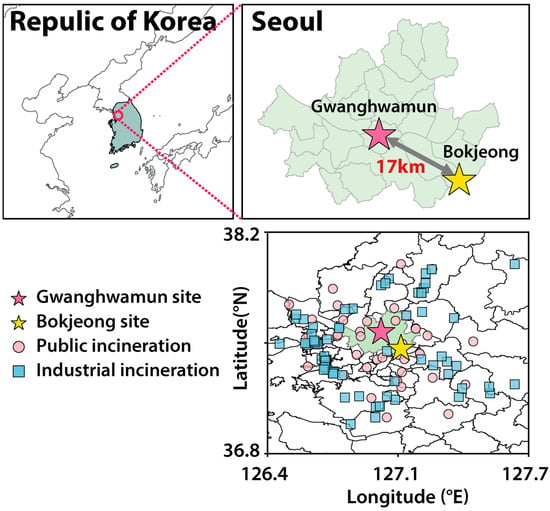
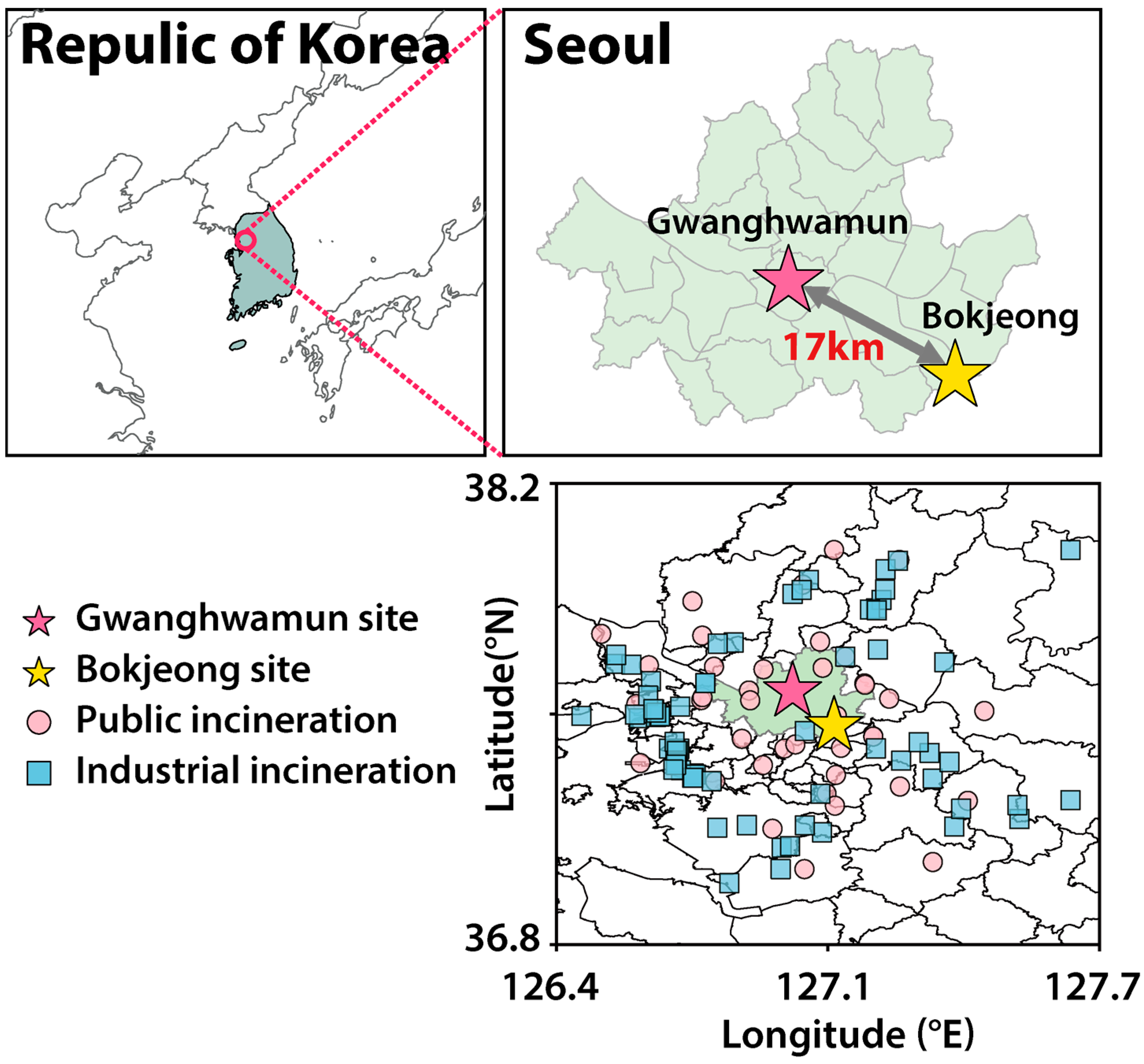
Samples of chemical compounds in PM2.5 were collected at Gwanghwamun Plaza (latitude: 37.5°, longitude: 126.9°) and Bokjeong Station (latitude: 37.4°, longitude: 127.1°) at the same time (the distance between the two sites is 17 km), both situated in Seoul, South Korea (Figure 1). Gwanghwamun Plaza, representing the central region of Seoul, is encompassed by significant administrative and cultural institutions, including the Seoul Government Complex and the Sejong Center for the Performing Arts, as well as bustling commercial zones, resulting in high pedestrian traffic. Consequently, this site appropriately represents areas of dense urban activity [9,17]. Moreover, a vehicular emissions regulation has been applied in this area, restricting vehicles that emit above 0.560 g/km of nitrogen oxides and hydrocarbons, and above 0.050 g/km of particulate matter.
Figure 1.
Measurement Sites at Gwanghwamun Plaza (37.5° N, 126.9° E) and Bokjeong Station (37.4° N, 127.1° E) with Locations of Waste Incineration Facilities in the Seoul–Gyeonggi Metropolitan Area, Republic of Korea.
On the other hand, Bokjeong Station, located near a major highway without vehicular restrictions, effectively illustrates the influence of traffic emissions on air quality. Hence, Gwanghwamun Plaza could be indicative of the impact of secondary pollutants in dense urban areas, whereas Bokjeong Station serves to highlight primary pollutants originating from vehicular emissions. This comparative air quality study was conducted over a 14-day period, from 2 September to 15 September 2020. A total of 448 samples were simultaneously collected on quartz and Teflon filters at the two monitoring sites for subsequent chemical and oxidative potential analyses. The air inlets at both sites were installed at similar heights (approximately 3.3 m at Gwanghwamun and 3.5 m at Bokjeong), minimizing potential bias in pollutant measurements due to sampling height differences.
2.2. Real-Time Monitoring
At Gwanghwamun Plaza, a mobile air observation trailer was deployed, whereas Bokjeong Station utilized a stationary container for the monitoring setup. The array of equipment for examining air pollution included devices for real-time monitoring of PM2.5. Meteorological parameters, including temperature, wind direction, and wind speed, were measured using thermal and ultrasonic sensing instruments. The concentration of PM2.5 was determined using the Model 5014i Beta (ThermoFisher Inc., Waltham, MA, USA), while equivalent Black Carbon (eBC) levels were monitored using the Multi-Angle Absorption Photometer (MAAP, Model 5012, ThermoFisher Inc., Waltham, MA, USA) at 670 nm wavelength. Additionally, the levels of gaseous pollutants, including CO, NO, NO2, SO2, O3, and NH3, were continuously recorded in real-time at both locations. CO was quantified using a non-dispersive infrared CO detector (iQ Series 48, ThermoFisher Inc., Waltham, MA, USA), whereas the concentrations of NO, NO2, and O3 were determined using chemiluminescence detectors (iQ Series 42 for NO and NO2, and iQ Series 49 for O3, ThermoFisher Inc., Waltham, MA, USA). SO2 concentrations were measured with an ultraviolet absorption device (iQ Series 43, ThermoFisher Inc., Waltham, MA, USA), and NH3 levels were assessed using a cavity ring-down spectroscopy device (Los Gatos Research, ABB Inc., Quebec, QC, Canada).
2.3. 3 h Integrated Chemical Analysis
PM2.5 was captured using 47 mm quartz filters (Pallflex, 2500QATUP, Pall Corp., Port Washington, NY, USA) and Teflon filters (PTFE, R2PJ047, Pall Corp., USA). The sampling process utilized a flow rate of 42 L/min over 3 h intervals, controlled by a mass flow controller (VICD240-8SW-AIR-100L, MFC Korea, Incheon, Republic of Korea). Quartz filters were used to analyze organic carbon (OC), elemental carbon (EC), and ionic components. OC and EC were analyzed using the Lab-based OCEC Carbon Aerosol Analyzer (Sunset Laboratory Inc., Tigard, OR, USA). Water-soluble ions and organic carbon were extracted from these filters using 30 mL of distilled water, facilitated by a fluid circulator set at 4 °C (CA-111, Eyela, Tokyo, Japan) and an ultrasonic device (8800, Branson, Brookfield, CT, USA) for 120 min. Subsequently, anionic (NO3−, SO42−) and cationic (NH4+) components were determined using ion chromatography (Metrohm 930, Herisau, Switzerland). Additionally, Teflon filters facilitated the analysis of heavy metals and water-soluble organic compounds such as levoglucosan, phthalic acid (PA), and TPA using energy-dispersive X-ray fluorescence spectrometry (ED-XRF, ARL QUANTX, Thermo Inc., USA). Metal oxide calculations were derived from a previously established formula [8,18].
Levoglucosan, PA, and TPA were analyzed after extracting them from the Teflon filter with 1 mL of MeOH and 5 mL of distilled water, plus 200 μL of an external standard, using a maintained temperature of 4 °C in a fluid circulator and an ultrasonic device for 120 min. The extract was analyzed via LC-ToF-MS/MS (1290 Infinity II, Agilent Technologies; X500R, Sciex NowTM, Santa Clara, CA, USA). The employed column was a Zorbax 300 SB-C18 Rapid Resolution HD (2.1 × 100 mm, 1.8-micron) with an eluent composed of 0.2% formic acid in a mixture of distilled water and acetonitrile in a specified ratio [17,19].
2.4. 3 h Integrated Method for Dithiothreitol Assay-Oxidative Potential Normalized to 9,10-Phenanthrenequinone (QDTT-OP)
The dithiothreitol (DTT) assay is used to assess the oxidative potential of particulate matter, reflecting its ability to generate reactive oxygen species and induce oxidative stress, thereby indicating its potential to cause inflammatory effects in the human body. Dithiothreitol assay-oxidative potential normalized to 9,10-phenanthrenequinone (QDTT-OP) analysis was implemented to explore the human toxicity associated with PM2.5 in the study areas. Incorporating numerous organic and metal components, fine particulate matter possesses significant surface area, enabling deep penetration into lung tissue and resulting in the generation of reactive oxygen species (ROS), correlated with oxidative potential. The DTT-OP assay quantifies the oxidative potential of fine particulate matter by gauging the rate at which DTT decreases. This method proves effective in reflecting human toxicity beyond mere mass concentration measurements of PM2.5 [20]. DTT-OP was assessed using an extracted Teflon filter sample. The extraction process involved utilizing 1 mL of MeOH, 5 mL of distilled water, and 200 μL of an external standard, followed by fluid circulation and ultrasonic treatment for 120 min. The external standard employed for LC-ToF-MS/MS analyses was determined to not impact the DTT-OP outcomes. Subsequently, the analysis was performed with 150 μL of the extracted sample combined with 0.2 mM DTT, 2.26 mM DTNB, and 500 mM potassium phosphate monobasic, with pH adjusted to 7.4 using 100 mM potassium phosphate dibasic. The reaction conditions encompass constant agitation at 37 °C, and absorbance was monitored at 412 nm with a Multiskan SkyHigh (ThermoFisher Inc., Waltham, MA, USA). All experiments were subjected to re-analysis for quality control purposes, ensuring accuracy and precision were maintained within a 5% margin [8].
3. Results
3.1. Characteristics of Air Pollutants in the Study Area
The observed data are summarized in Table 1. Meteorological data from the area indicated an average wind speed of 1.80 m/s at both sites, with an average temperature of 22.78 °C and a relative humidity of 68.76%. No substantial differences in meteorological conditions were observed between Gwanghwamun Plaza and Bokjeong Station. Analysis of gaseous pollutants revealed average concentrations of SO2, NH3, and NO2 to be 0.82 ppb, 8.82 ppb, and 19.68 ppb, respectively, with no significant variations between the two locations. However, the concentration of O3 was appreciably higher at Gwanghwamun Plaza (31.32 ppb) than at Bokjeong Station (19.71 ppb), with O3 levels at Gwanghwamun Plaza exceeding those at Bokjeong Station by more than 1.5 times. The concentrations of CO and NO were found to be 1.6 to 3 times higher at Bokjeong Station than at Gwanghwamun Plaza. O3, serving as an indicator of photochemical reactions, suggests elevated photochemical activity at Gwanghwamun Plaza. This daytime phenomenon may be associated with differences in vehicle mobility patterns between Gwanghwamun Plaza and Bokjeong Station. A companion paper focusing on photochemical reactions and traffic-related emissions at both sites is currently under preparation. All reported differences and correlations were statistically significant (p < 0.001), indicating a very low probability that the observed results occurred by chance.
Table 1.
Results of major compounds at Gwanghwamun Plaza and Bokjeong Station in Seoul, Republic of Korea.
3.2. Major Air Pollutant Sources and Risk Assessment for Gwanghwamun Plaza and Bokjeong Station
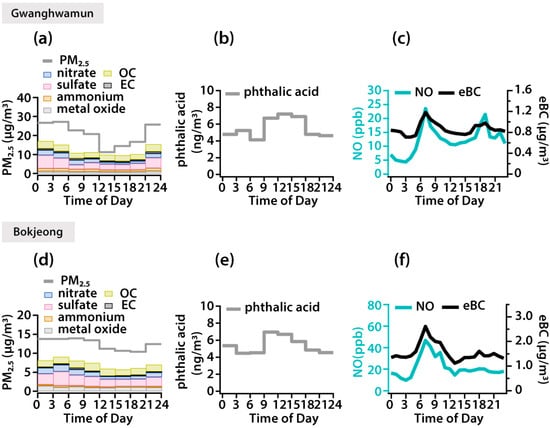
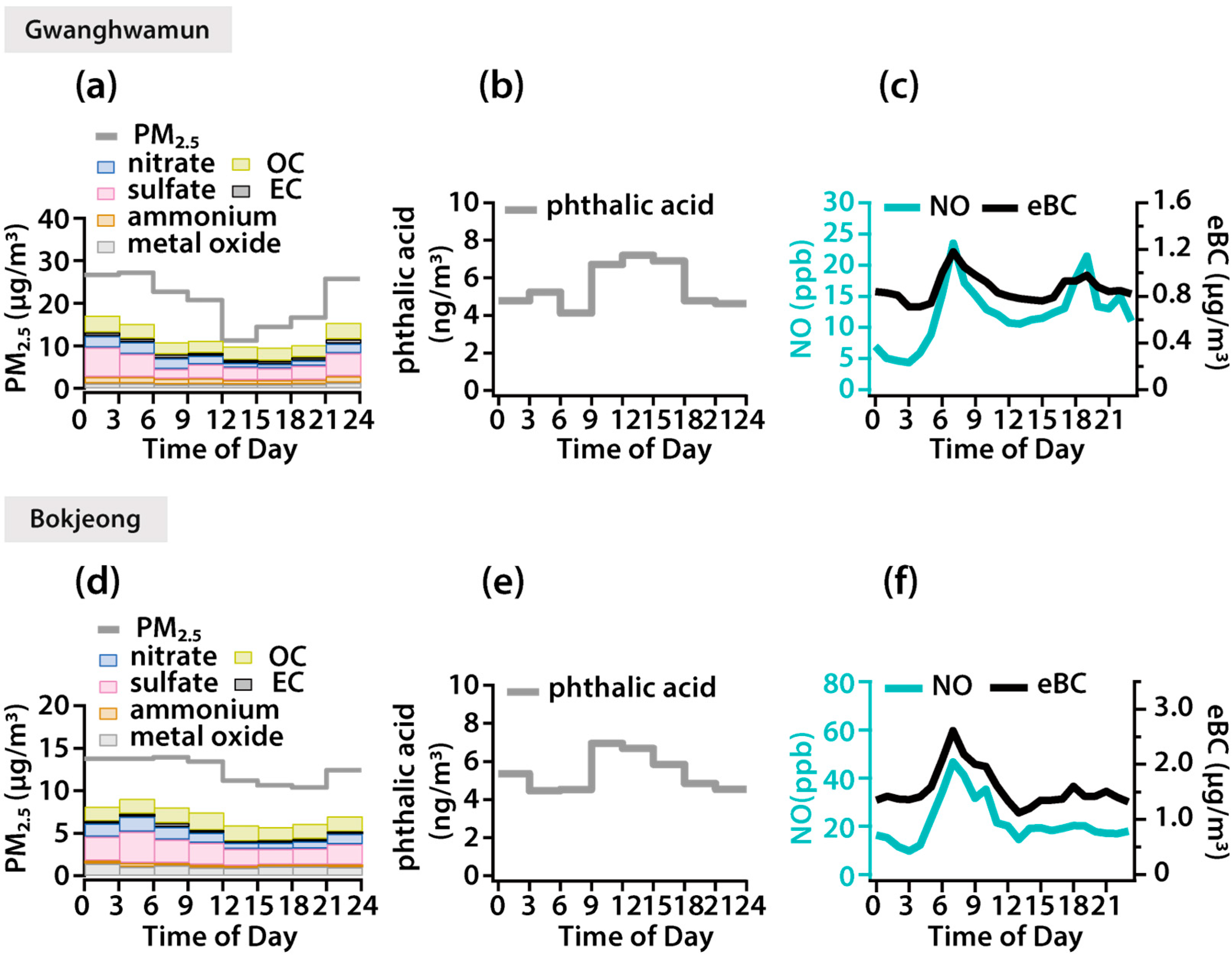
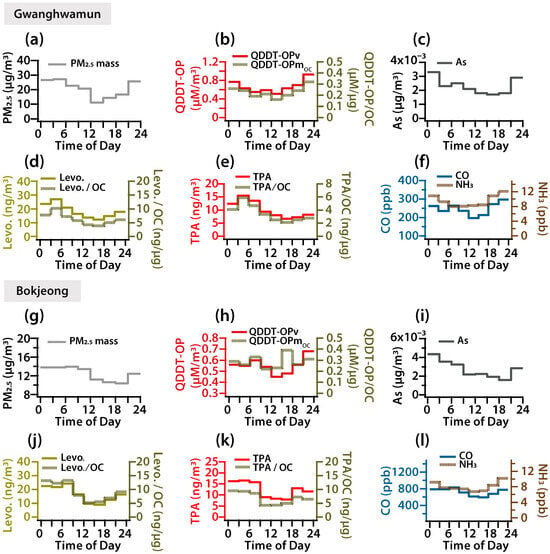
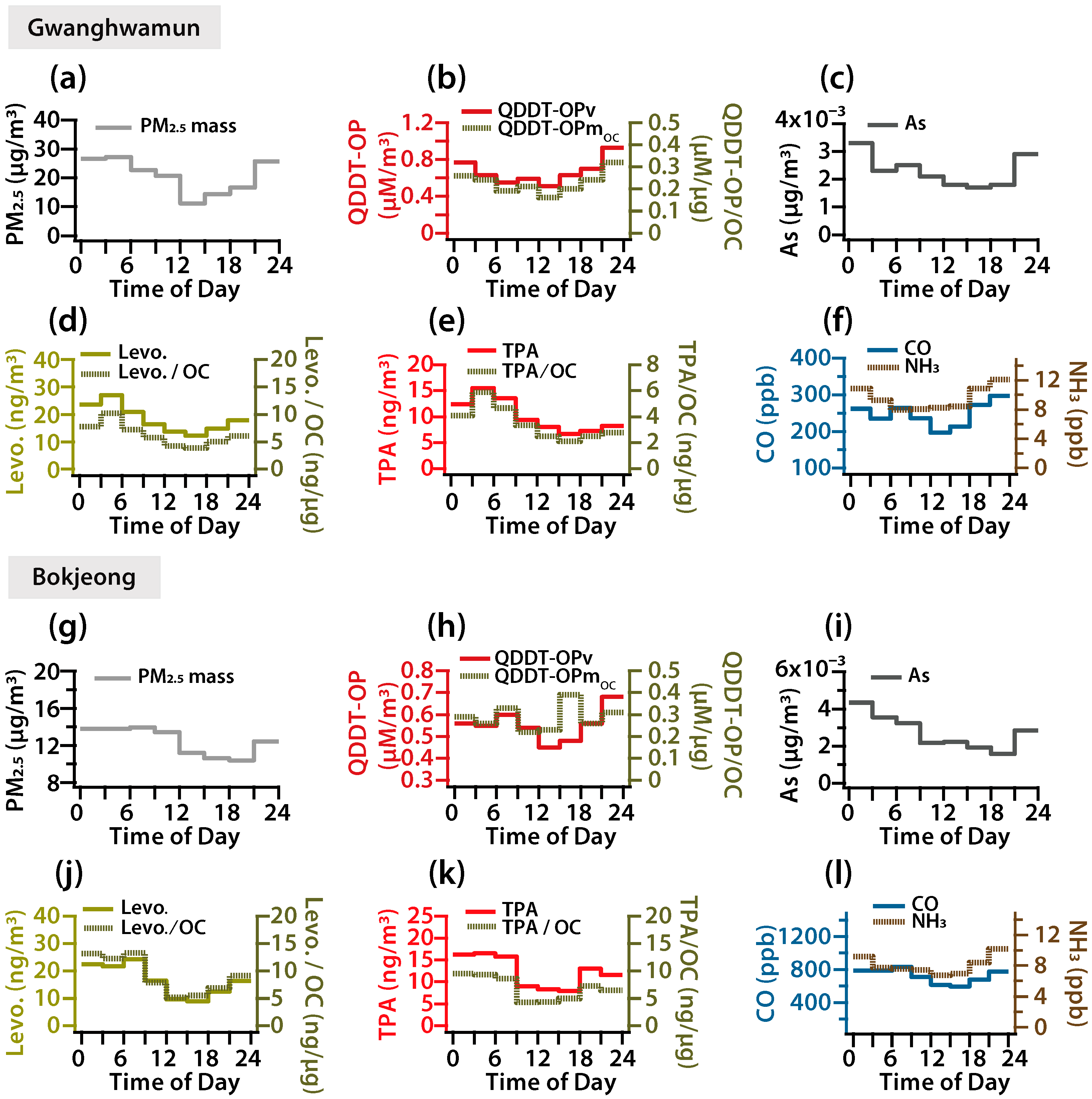
To determine the sources of PM2.5 at Gwanghwamun Plaza and Bokjeong Station, PM2.5 concentrations at both locations tend to rise during the night (9 p.m. to 6 a.m.), with a more noticeable increase at Gwanghwamun Plaza. To further explore the factors influencing PM2.5, an analysis of the daily time-series data of its major components was performed (Figure 2). The results indicate that three principal factors significantly influence PM2.5. Initially, increased concentrations of NO and eBC were noted around 7 a.m. and 6 p.m., coinciding with vehicle emissions during morning and evening rush hours. Secondly, heightened levels of phthalic acid were observed around 2 p.m. Phthalic acid, a significant water-soluble organic acid, plays a critical role in various atmospheric chemical processes and affects the formation of secondary products [4]. This confirms an increase in secondary products due to photochemical reactions occurring around 2 p.m. Lastly, during nighttime (9 p.m. to 6 a.m. the following day), there was an elevation in compounds such as NH3, CO, and trace elements, alongside levoglucosan, TPA, and QDTT-OP. These findings highlight that nighttime emissions substantially impact PM2.5. The primary sources influencing PM2.5 are vehicular emissions during peak traffic hours, secondary formation from photochemical reactions, and elevated nighttime emissions. Daytime PM2.5 is predominantly affected by vehicle emissions and secondary formation from photochemical reactions (Figure 2). While secondary formation most significantly impacts the mass concentration of PM2.5, the human health risk analysis by time suggested that the greatest risk corresponds with nighttime emissions (Figure 3). Consequently, human health risks are more likely influenced by specific compounds or emission sources rather than solely by the absolute mass concentration of PM2.5. Although higher particulate concentrations would typically entail increased QDTT-OP levels, no notable differences were observed between the two monitoring sites, with Gwanghwamun Plaza recording 0.66 µM/m3 and Bokjeong Station at 0.57 µM/m3. A time-series analysis was conducted to evaluate the human health risks associated with different PM2.5 components over time.
Figure 2.
Diurnal variations in PM2.5 major compounds, phthalic acid, NO, and eBC at (a–c) Gwanghwamun Plaza and (d–f) Bokjeong Station in Seoul, Republic of Korea.
Figure 3.
Diurnal variations in PM2.5 mass, QDTT-OP, As, levoglucosan (Levo.), TPA, CO, and NH3 at (a–f) Gwanghwamun Plaza and (g–l) Bokjeong Station in Seoul, Republic of Korea.
This study focused on changes in PM2.5 composition, particularly the relative enrichment of levoglucosan and TPA within OC, rather than total concentration alone, and also examined nighttime variations in gaseous species such as NH3, CO, and NO. As illustrated in Figure 3, both absolute concentrations (e.g., levoglucosan, TPA, As, CO, and NH3) and OC-normalized ratios (levoglucosan/OC and TPA/OC) show clear nighttime enhancements at both sites. The consistent increase in these normalized ratios indicates that the observed nighttime elevations cannot be explained solely by reductions in planetary boundary layer height, but instead reflect relatively stronger emission contributions [21,22]. In addition, QDTT-OP associated with PM2.5 is higher during nighttime than during periods dominated by photochemical activity or traffic emissions. To better identify emission sources linked to elevated health risks, this study focuses on pollutants that increase during nighttime.
At Gwanghwamun Plaza, the increases are quantified at 56% for levoglucosan, 58% for TPA, and 46% for As, while CO and NH3 rose by 15% and 13% respectively. Meanwhile, Bokjeong Station showed a 78% rise in levoglucosan, 57% in TPA, and 77% in As, with CO growing by 23% and NH3 by 18%. Levoglucosan emanates mainly from the burning of materials like wood, paper, and agricultural residues that contain cellulose and hemicellulose. TPA, produced through the thermal decomposition of PET, is a principal byproduct of PET pyrolysis alongside ethylene [11]. Atmospheric emissions of As arise from the combustion of urban solid waste—comprising electronic waste, batteries, fluorescent lights, and wood waste —and coal fuels [23,24,25]. Consequently, the nocturnal increases in levoglucosan, TPA, and As are likely influenced by multiple combustion processes. As shown in Figure 1, the study area includes 46 public and 76 industrial incineration facilities; Thus, the observed As is more cautiously interpreted as indicative of mixed combustion sources (e.g., coal or As-containing waste), particularly from industrial facilities, rather than direct evidence of widespread urban coal use.
Moreover, NH3, which typically rises at night, is emitted from food waste combustion and vehicle exhausts [26,27]. CO is a product of incomplete combustion, generated during the combustion of various carbon-containing materials [28,29]. Thus, gaseous compounds that exhibit high concentrations at night are also characterized by emissions from combustion activities. In conclusion, both the components of PM2.5 and gaseous compounds that increase during nighttime share the common feature of being emitted from combustion activities. Furthermore, the nighttime increase rates of these components were higher at Bokjeong Station compared to Gwanghwamun Plaza.
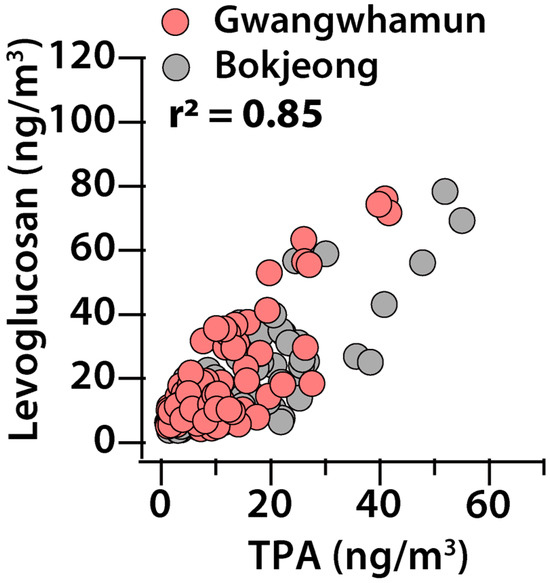
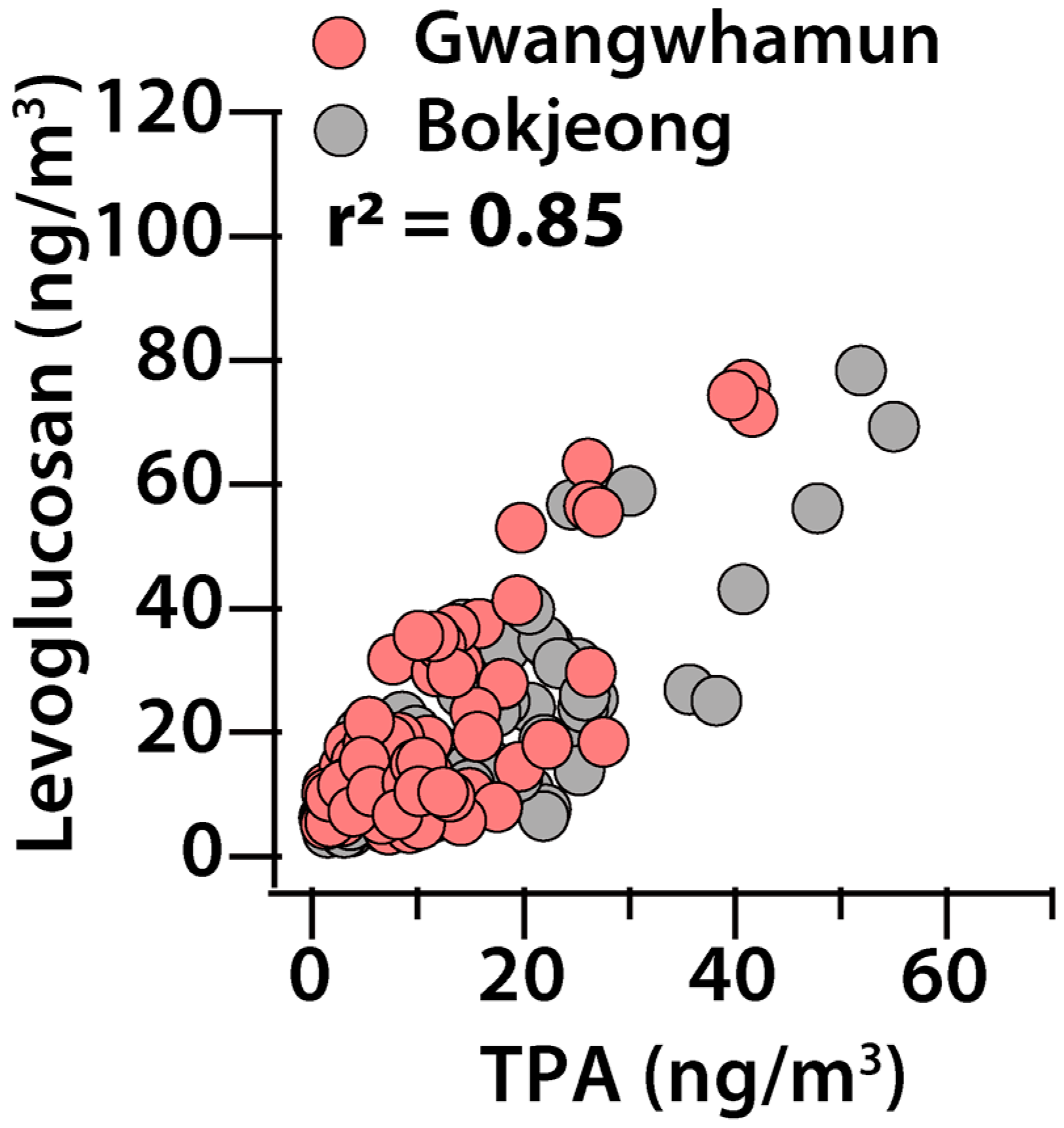
To elucidate the source of increased emissions at night, an investigation into combustion facilities near the study area revealed the presence of 46 public and 76 industrial incineration facilities (Ministry of Environment, 2021) (Figure 1). These facilities incinerate municipal and construction waste from Seoul and Gyeonggi Province. Therefore, it is inferred that TPA and levoglucosan are generated from the combustion of PET and wood waste, which are present in municipal and construction waste. In fact, the total incineration amount of municipal waste around the study area was approximately 2.35 million tons in 2020, accounting for 41.3% of the total waste generated in 2020 (Ministry of Environment, 2021) (Table 2). The primary materials incinerated include paper (26%), plastic waste (23%), and other combustibles (25%), with significant amounts of wood, food waste, and construction debris also being incinerated. Furthermore, the strong correlation between levoglucosan and TPA observed in Figure 4 (r2 = 0.85) indicates a common emission source, supporting the occurrence of mixed waste incineration rather than independent emission sources such as residential wood burning and separate industrial plastic combustion. The presence of As is notably influenced by the combustion of solid waste and the coal fuels utilized in these incineration activities. Similarly, increased concentrations of gaseous compounds such as NH3 and CO at night are influenced by the combustion activities associated with waste incineration. Moreover, the compounds that exhibited an increase at night demonstrated higher growth rates at Bokjeong Station than at Gwanghwamun Plaza, suggesting a greater influence from combustion activities during nighttime at Bokjeong Station.
Table 2.
Seoul’s generation and treatment status of municipal solid waste in 2020.
Figure 4.
Scatter plots illustrating the relationship between TPA and levoglucosan at Gwanghwamun Plaza and Bokjeong Station in Seoul, Republic of Korea.
In conclusion, compounds such as levoglucosan, TPA, As, and certain gaseous materials that intensified during nighttime are discharged from combustion facilities proximally to the study area. The study locales, Gwanghwamun Plaza and Bokjeong Station, depict central and peripheral zones of Seoul, respectively. The comparative analysis between these areas indicates a heightened exposure to nocturnal combustion activities at Bokjeong Station. The significant correlation between levoglucosan and TPA, coupled with the health hazards associated with PM2.5 at elevated concentrations, highlights the impact of nocturnal waste combustion. The study suggests that elevated nocturnal components are strongly influenced by waste combustion, including coal-based fuels, at nearby facilities, resulting in significant health risks and adverse environmental impacts. This investigation emphasizes a crucial aspect: tracing air pollutants emanating from waste combustion activities. Despite deriving from different primary materials—cellulose and PET—both levoglucosan and TPA are byproducts of combustion processes. However, the strong correlation observed between levoglucosan and TPA during the mixed combustion of waste suggests a variety of combustion activities. Consequently, the relationship between levoglucosan and TPA in the atmosphere can be leveraged to evaluate the impact of waste combustion.
Based on the comprehensive outcomes of this research, it was determined that constituents such as levoglucosan, TPA, As, CO, and NH3 exhibit higher concentrations at night. These components are believed to be significantly influenced by nighttime waste combustion utilizing coal fuels, with notable growth rates recorded at Bokjeong Station compared to Gwanghwamun Plaza. This indicates that Bokjeong Station experiences greater effects from nighttime combustion activities. Moreover, the particulate matter generated by these nighttime combustion processes poses considerable health risks. Consequently, this study offers essential data for identifying the sources of plastic waste combustion and for assessing the emissions of air pollutants due to waste combustion. These insights can form the basis for mitigating health-related air pollutants.
4. Conclusions
This study investigated the characteristics and sources of urban air pollutants by examining PM2.5 and gaseous compounds at two sites in Seoul, South Korea: Gwanghwamun Plaza and Bokjeong Station. The results highlight compositional changes in PM2.5, particularly the enrichment of levoglucosan and TPA within OC, along with nighttime increases in gaseous species such as NH3, CO, and NO. Both absolute concentrations and OC-normalized ratios (levoglucosan/OC and TPA/OC) showed consistent nighttime enhancements at both sites, indicating that these increases cannot be explained solely by reduced planetary boundary layer height but instead reflect stronger emission contributions. QDTT-OP associated with PM2.5 was also higher during nighttime than during periods dominated by photochemical activity or traffic emissions, suggesting elevated oxidative potential under nighttime conditions. These increases are consistent with combustion-related processes, particularly nighttime waste incineration involving mixed materials, particularly emissions from mixed waste burning involving wood and PET. The correlation between levoglucosan and TPA supports a common source influence, indicating the role of mixed waste combustion. Overall, this study underscores the importance of controlling combustion-related emissions—particularly nighttime waste burning—and incorporating oxidative potential into air quality management strategies, as these emissions may offset the effectiveness of daytime emission control strategies and contribute to more chemically reactive and potentially harmful particles, thereby increasing health risks in urban environments.
Author Contributions
C.P.: Conceptualization, Writing—Original draft preparation. S.C.: Software, Validation. S.-H.O.: Visualization, Investigation, Software. M.-S.B.: Conceptualization, Supervision, Project administration. All authors have read and agreed to the published version of the manuscript.
Funding
This work was supported by a grant from the National Institute of Environmental Research (NIER), funded by the Ministry of Climate, Energy and Environment (MCEE) of the Republic of Korea (NIER-2024-03-03-002 & RS-2026-25505137).
Institutional Review Board Statement
Not applicable.
Informed Consent Statement
Not applicable.
Data Availability Statement
Data from this study are available from the corresponding author upon reasonable request.
Conflicts of Interest
The authors declare that there is no financial or personal conflict of interest.
References
- Bodor, K.; Szép, R.; Bodor, Z. The human health risk assessment of particulate air pollution (PM2.5 and PM10) in Romania. Toxicol. Rep. 2022, 9, 556–562. [Google Scholar] [CrossRef] [Scilit]
- Das, A.; Habib, G.; Vivekanandan, P.; Kumar, A. Reactive oxygen species production and inflammatory effects of ambient PM2.5-associated metals on human lung epithelial A549 cells: “One year-long study”: The Delhi chapter. Chemosphere 2021, 262, 128305. [Google Scholar] [CrossRef] [Scilit]
- Pope, C.A.; Thun, M.J.; Namboodiri, M.M.; Dockery, D.W.; Evans, J.S.; Speizer, F.E.; Heath, C.W. Particulate air pollution as a predictor of mortality in a prospective study of U.S. adults. Am. J. Respir. Crit. Care Med. 1995, 151, 669–674. [Google Scholar] [CrossRef] [Scilit]
- Song, M.-K.; Choi, J.; Oh, S.-H.; Choe, S.; Yu, G.-H.; Cho, S.-S.; Park, J.; Bae, M.-S. Diurnal dithiothreitol assays for biomass burning source in PM1.0 and PM2.5 during summer and winter. Atmos. Environ. 2023, 313, 120033. [Google Scholar] [CrossRef] [Scilit]
- Ni, H.; Tian, J.; Wang, X.; Wang, Q.; Han, Y.; Cao, J.; Long, X.; Chen, L.-W.A.; Chow, J.C.; Watson, J.G.; et al. PM2.5 emissions and source profiles from open burning of crop residues. Atmos. Environ. 2017, 169, 229–237. [Google Scholar] [CrossRef] [Scilit]
- Sheesley, R.J.; Schauer, J.J.; Meiritz, M.; DeMinter, J.T.; Bae, M.S.; Turner, J.R. Daily variation in particle-phase source tracers in an urban atmosphere. Aerosol Sci. Technol. 2007, 41, 981–993. [Google Scholar] [CrossRef] [Scilit]
- Vreeland, H.; Schauer, J.J.; Russell, A.G.; Marshall, J.D.; Fushimi, A.; Jain, G.; Sethuraman, K.; Verma, V.; Tripathi, S.N.; Bergin, M.H. Chemical characterization and toxicity of particulate matter emissions from roadside trash combustion in urban India. Atmos. Environ. 2016, 147, 22–30. [Google Scholar] [CrossRef] [Scilit]
- Oh, S.-H.; Park, C.; Yu, G.-H.; Jeon, H.; Schauer, J.J.; Bae, M.-S. Diurnal impacts of tire wear and waste burning on fine particulate matter concentrations in a metropolitan area. Environ. Pollut. 2025, 374, 126229. [Google Scholar] [CrossRef] [Scilit]
- Park, C.; Song, M.; Choe, S.; Jeon, H.; Oh, S.-H.; Yu, G.-H.; Bae, M.-S. Seasonal variation in nocturnal molecular marker emissions from waste incineration in Seoul, South Korea. J. Environ. Sci. 2025, 158, 802–811. [Google Scholar] [CrossRef] [Scilit]
- Seo, I.; Lee, K.; Bae, M.-S.; Park, M.; Maskey, S.; Seo, A.; Borlaza, L.J.S.; Cosep, E.M.R.; Park, K. Comparison of physical and chemical characteristics and oxidative potential of fine particles emitted from rice straw and pine stem burning. Environ. Pollut. 2020, 267, 115599. [Google Scholar] [CrossRef] [Scilit]
- Kawamura, K.; Pavuluri, C.M. New directions: Need for better understanding of plastic waste burning as inferred from high abundance of terephthalic acid in South Asian aerosols. Atmos. Environ. 2010, 44, 5320–5321. [Google Scholar] [CrossRef] [Scilit]
- Sidhu, S.; Gullett, B.; Striebich, R.; Klosterman, J.; Contreras, J.; DeVito, M. Endocrine-disrupting chemical emissions from combustion sources: Diesel particulate emissions and domestic waste open burn emissions. Atmos. Environ. 2005, 39, 801–811. [Google Scholar] [CrossRef] [Scilit]
- Simoneit, B.R.T.; Medeiros, P.M.; Didyk, B.M. Combustion products of plastics as indicators for refuse burning in the atmosphere. Environ. Sci. Technol. 2005, 39, 6961–6970. [Google Scholar] [CrossRef] [Scilit] [PubMed]
- Olam, M.; Karaca, H. Characterization of products obtained of waste polyethylene terephthalate by pyrolysis. Environ. Prog. Sustain. Energy 2022, 41, e13835. [Google Scholar] [CrossRef] [Scilit]
- Dhahak, A.; Grimmer, C.; Neumann, A.; Rüger, C.; Sklorz, M.; Streibel, T.; Zimmermann, R.; Mauviel, G.; Burkle-Vitzthum, V. Real-time monitoring of slow pyrolysis of polyethylene terephthalate (PET) by different mass spectrometric techniques. Waste Manag. 2020, 106, 226–239. [Google Scholar] [CrossRef] [Scilit]
- Dhahak, A.; Hild, G.; Rouaud, M.; Mauviel, G.; Burkle-Vitzthum, V. Slow pyrolysis of polyethylene terephthalate: Online monitoring of gas production and quantitative analysis of waxy products. J. Anal. Appl. Pyrolysis 2019, 142, 104664. [Google Scholar] [CrossRef] [Scilit]
- Park, C.; Choe, S.; Song, M.Y.; Shin, S.-K.; Jeon, H.; Ko, D.-H.; Song, M.; Bae, M.-S. Nighttime waste wood burning and its impact on urban air quality: Multi-year measurements in central Seoul, Gwanghwamun, South Korea. Asian J. Atmos. Environ. 2025, 19, 22. [Google Scholar] [CrossRef] [Scilit]
- Khuzestani, R.B.; Schauer, J.J.; Wei, Y.; Zhang, L.; Cai, T.; Zhang, Y.; Zhang, Y. Quantification of the sources of long-range transport of PM2.5 pollution in the Ordos region, Inner Mongolia, China. Environ. Pollut. 2017, 229, 1019–1031. [Google Scholar] [CrossRef] [Scilit]
- Kim, J.E.; Seo, J.H.; Bae, M.S.; Bae, C.S.; Yoo, J.C.; Bang, M.A.; Cho, S.S.; Park, D.H. Antimicrobial constituents from Allium hookeri root. Nat. Prod. Commun. 2016, 11, 237–238. [Google Scholar] [CrossRef] [Scilit]
- Janssen, N.A.H.; Yang, A.; Strak, M.; Steenhof, M.; Hellack, B.; Gerlofs-Nijland, M.E.; Kuhlbusch, T.; Kelly, F.; Harrison, R.; Brunekreef, B.; et al. Oxidative potential of particulate matter collected at sites with different source characteristics. Sci. Total Environ. 2014, 472, 572–581. [Google Scholar] [CrossRef] [Scilit] [PubMed]
- Li, X.; Gao, C.Y.; Gao, Z.; Zhang, X. Atmospheric boundary layer turbulence structure for severe foggy haze episodes in north China in December 2016. Environ. Pollut. 2020, 264, 114726. [Google Scholar] [CrossRef] [Scilit] [PubMed]
- Petenko, I.; Casasanta, G.; Kallistratova, M.; Lyulyukin, V.; Genthon, C.; Sozzi, R.; Argentini, S. Kelvin–Helmholtz billows in the rising turbulent layer during morning evolution of the atmospheric boundary layer at Dome C, Antarctica. Bound.-Layer Meteorol. 2023, 187, 163–192. [Google Scholar] [CrossRef] [Scilit]
- Zhang, W.; Sun, Q.; Yang, X.; Yang, X. Thermal effects on arsenic emissions during coal combustion process. Sci. Total Environ. 2018, 612, 582–589. [Google Scholar] [CrossRef] [Scilit]
- Bagheri, M.; Mirbagheri, S.A. Critical review of fouling mitigation strategies in membrane bioreactors treating water and wastewater. Bioresour. Technol. 2018, 258, 318–334. [Google Scholar] [CrossRef] [Scilit]
- Valizadeh, B.; Abdoli, M.A.; Dobaradaran, S.; Mahmoudkhani, R.; Asl, Y.A. Risk control of heavy metal in waste incinerator ash by available solidification scenarios in cement production based on waste flow analysis. Sci. Rep. 2024, 14, 6252. [Google Scholar] [CrossRef] [Scilit]
- Bray, C.D.; Battye, W.H.; Aneja, V.P.; Schlesinger, W.H. Global emissions of NH3, NOx, and N2O from biomass burning and the impact of climate change. J. Air Waste Manag. Assoc. 2021, 71, 102–114. [Google Scholar] [CrossRef] [Scilit]
- Chen, Z.-L.; Song, W.; Hu, C.-C.; Liu, X.-J.; Chen, G.-Y.; Walters, W.W.; Michalski, G.; Liu, C.-Q.; Fowler, D.; Liu, X.-Y. Significant contributions of combustion-related sources to ammonia emissions. Nat. Commun. 2022, 13, 7710. [Google Scholar] [CrossRef] [Scilit]
- Křůmal, K.; Mikuška, P.; Horák, J.; Hopan, F.; Kuboňová, L. Influence of boiler output and type on gaseous and particulate emissions from the combustion of coal for residential heating. Chemosphere 2021, 278, 130402. [Google Scholar] [CrossRef] [Scilit] [PubMed]
- Kwiecień, J.; Szopińska, K. Mapping carbon monoxide pollution of residential areas in a Polish city. Remote Sens. 2020, 12, 2885. [Google Scholar] [CrossRef] [Scilit]

Disclaimer/Publisher’s Note: The statements, opinions and data contained in all publications are solely those of the individual author(s) and contributor(s) and not of MDPI and/or the editor(s). MDPI and/or the editor(s) disclaim responsibility for any injury to people or property resulting from any ideas, methods, instructions or products referred to in the content. |
© 2026 by the authors. Licensee MDPI, Basel, Switzerland. This article is an open access article distributed under the terms and conditions of the Creative Commons Attribution (CC BY) license.