Research on Multi-UAV Cooperative Formation Control Method Considering Coupling and Communication Delay


Abstract
1. Introduction
1.1. Background and Motivation
1.2. Literature Review
1.2.1. Distributed Architecture and State Observers
1.2.2. Control with Coupling Effects
1.2.3. Control Under Communication Delays
1.3. Contributions and Organization
- (i)
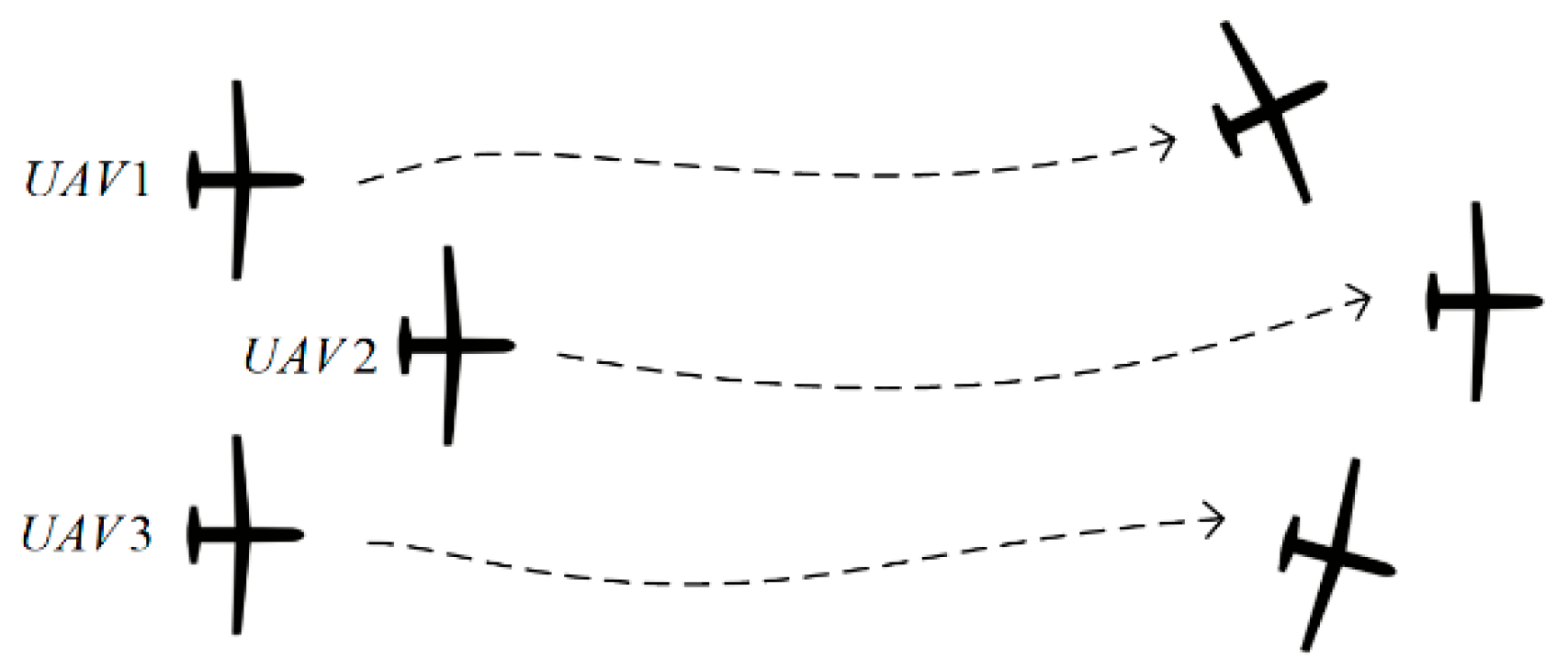
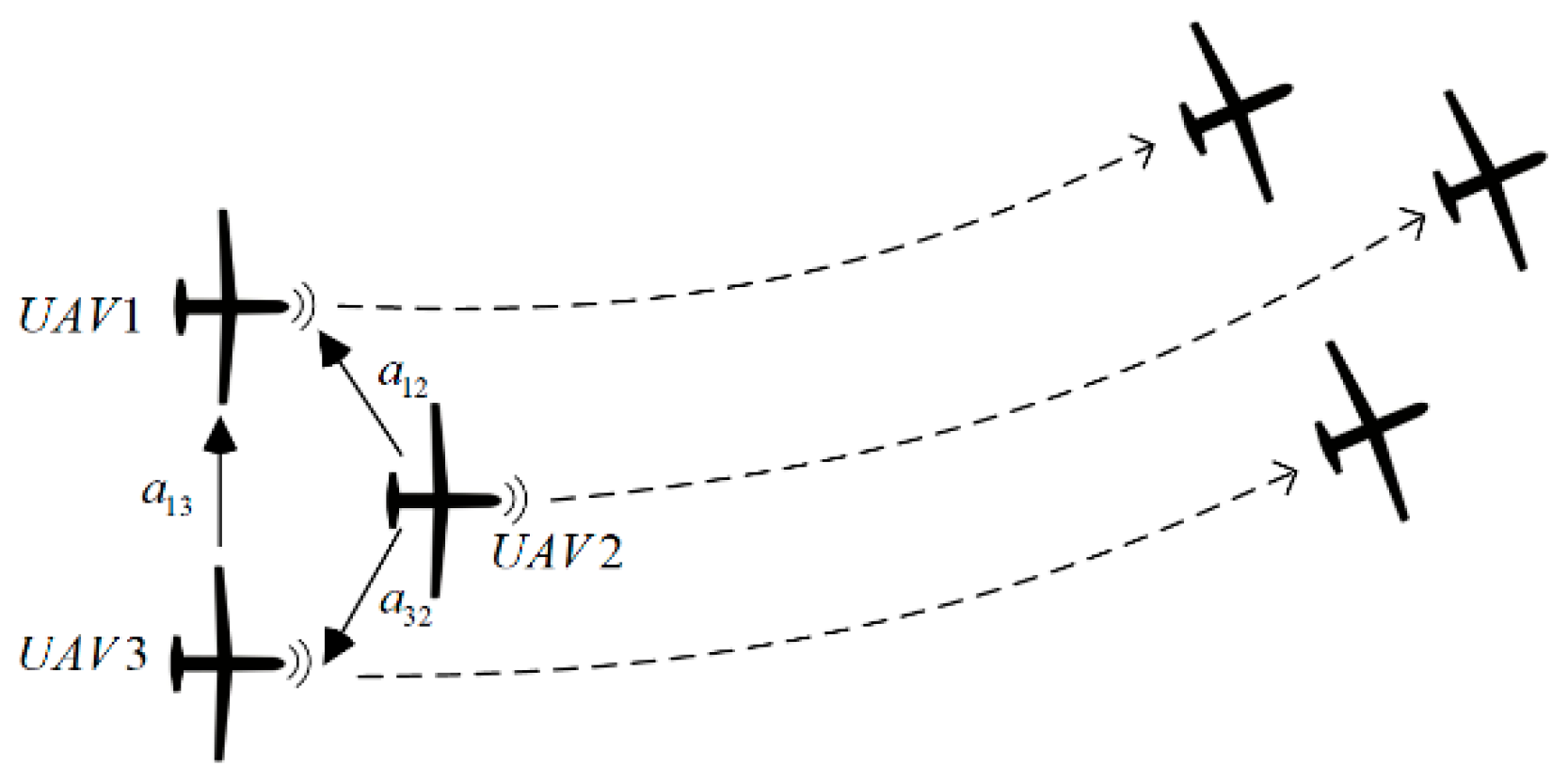
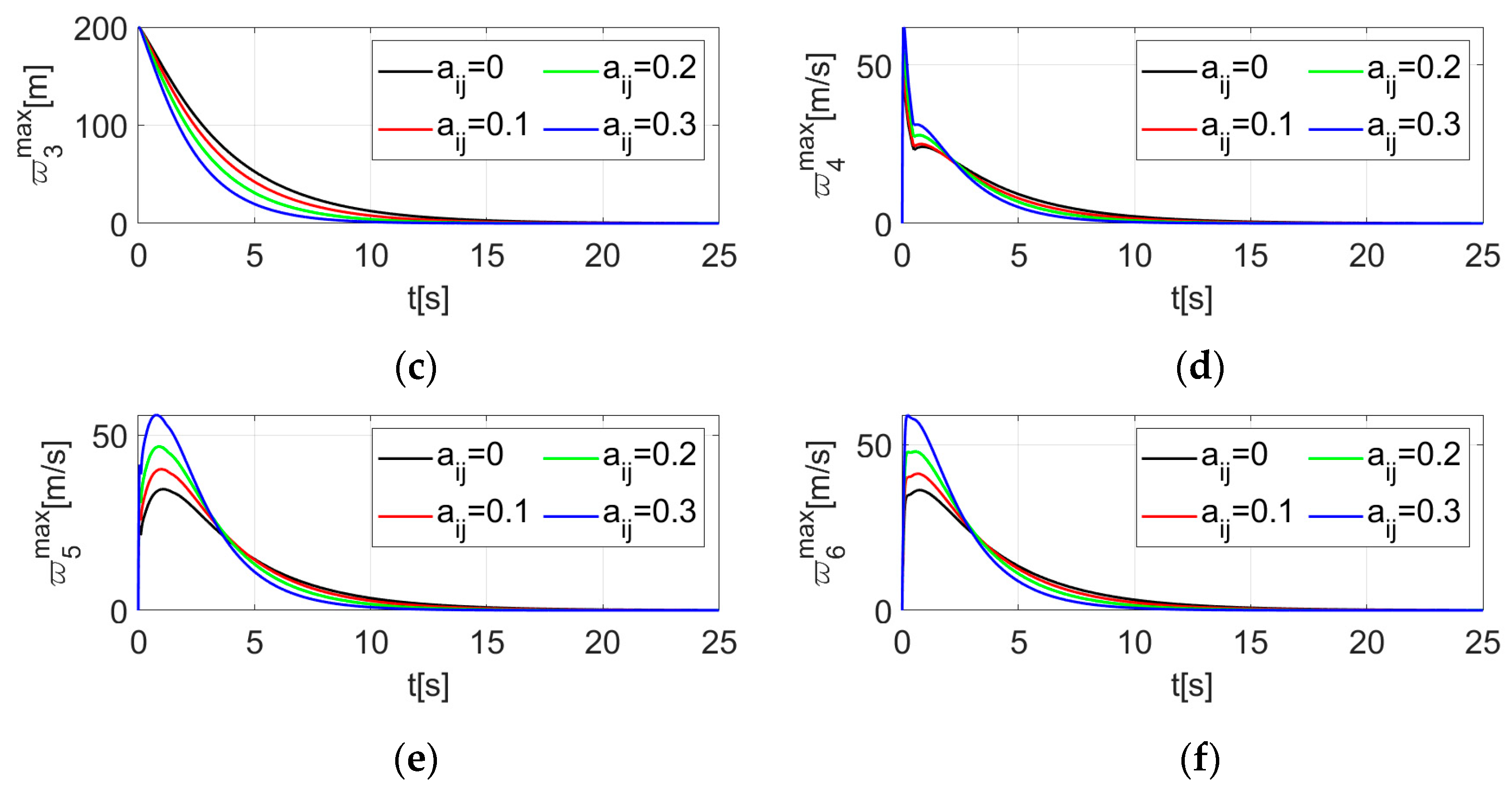
- A theoretical analysis is provided to investigate how the introduction of coupling actively improves the transient response. Unlike traditional paradigms, we mathematically demonstrate that coupling effects inherently accelerate error convergence in multi-UAV formations.
- (ii)
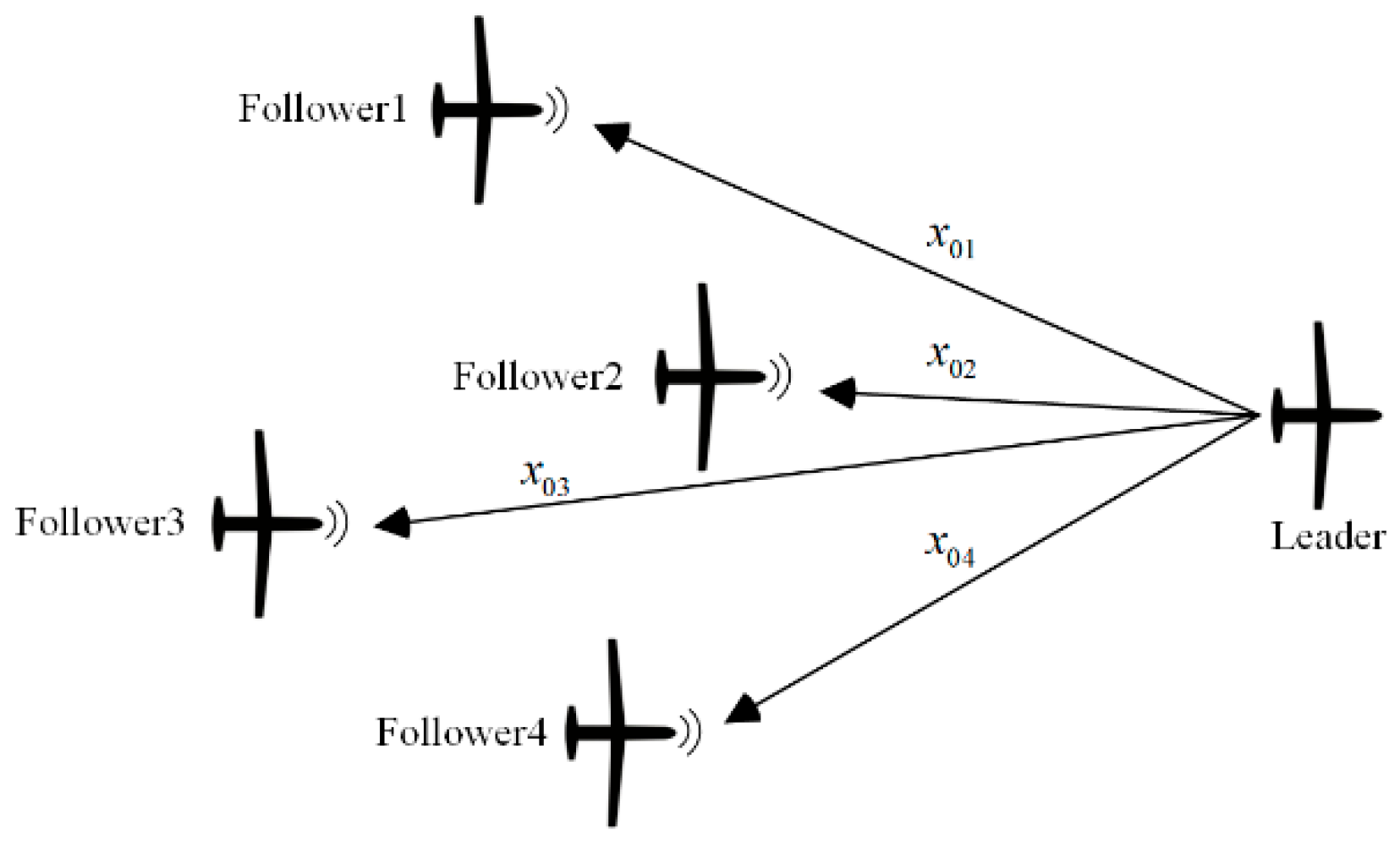
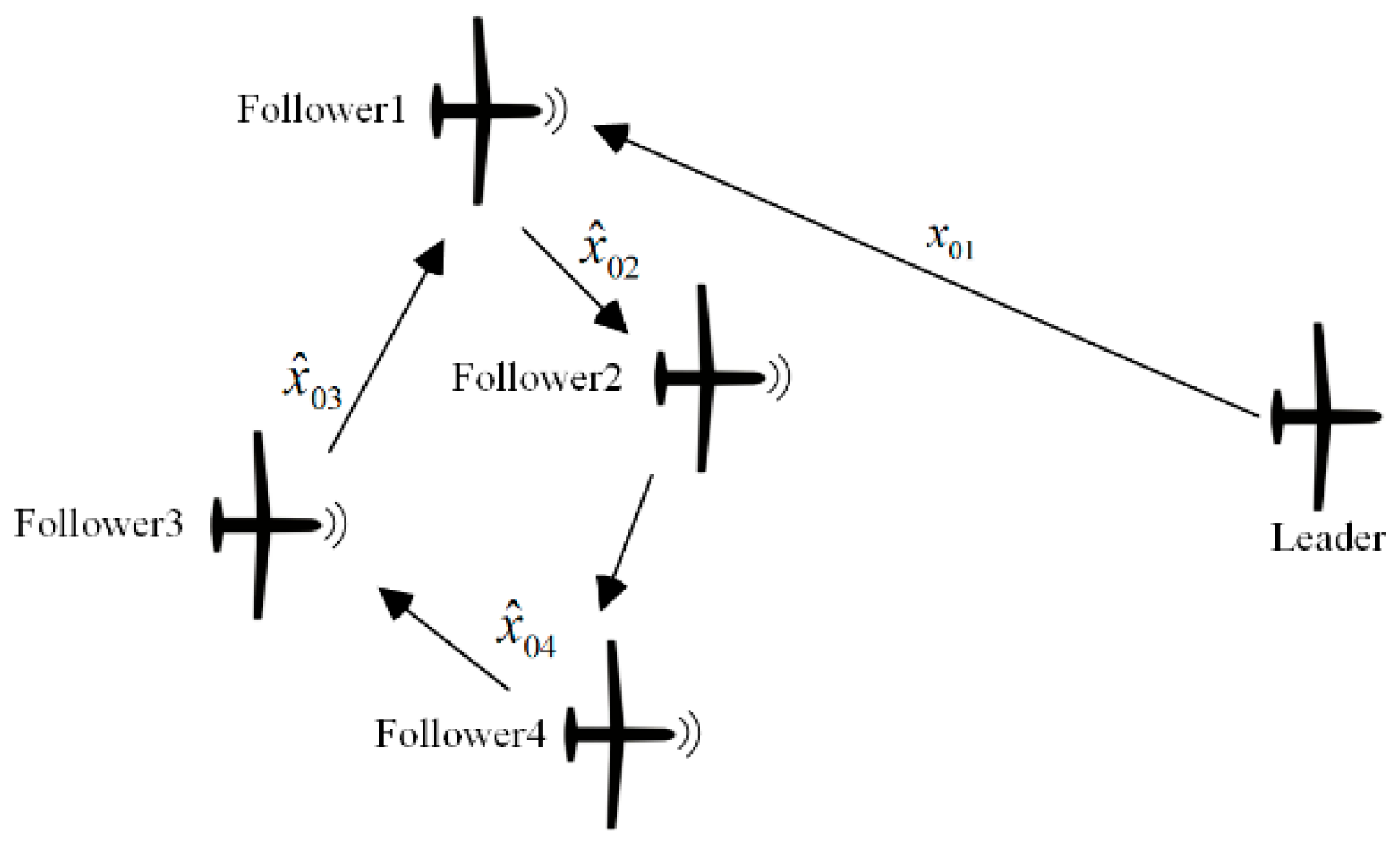
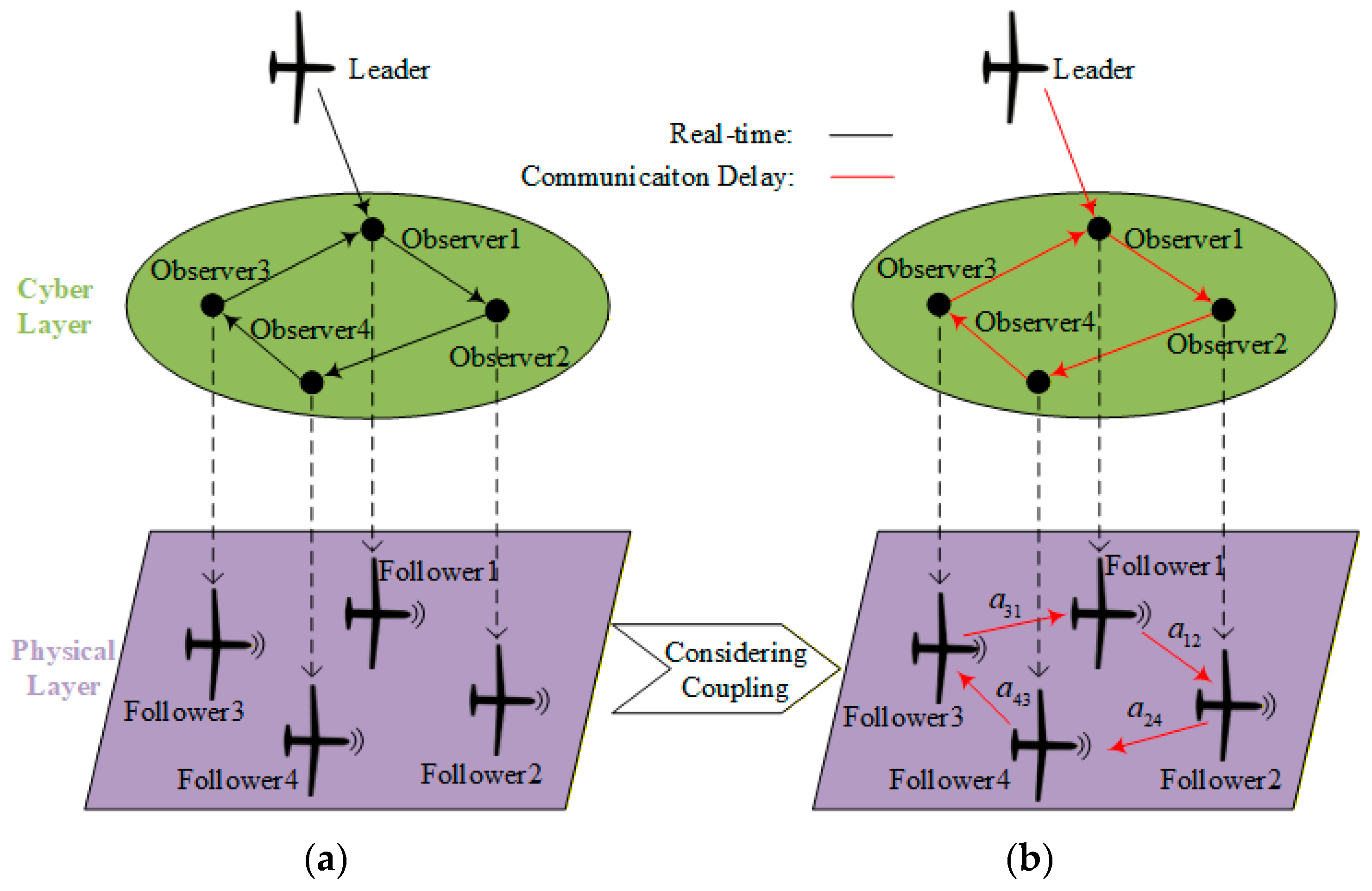
- An integrated architecture combining a leader state observer with a cooperative controller is proposed. Crucially, communication coupling effects are explicitly introduced into the cooperative controller. This combined design not only reduces reliance on direct leader to follower links but also actively utilizes coupling to accelerate formation-tracking convergence.
- (iii)
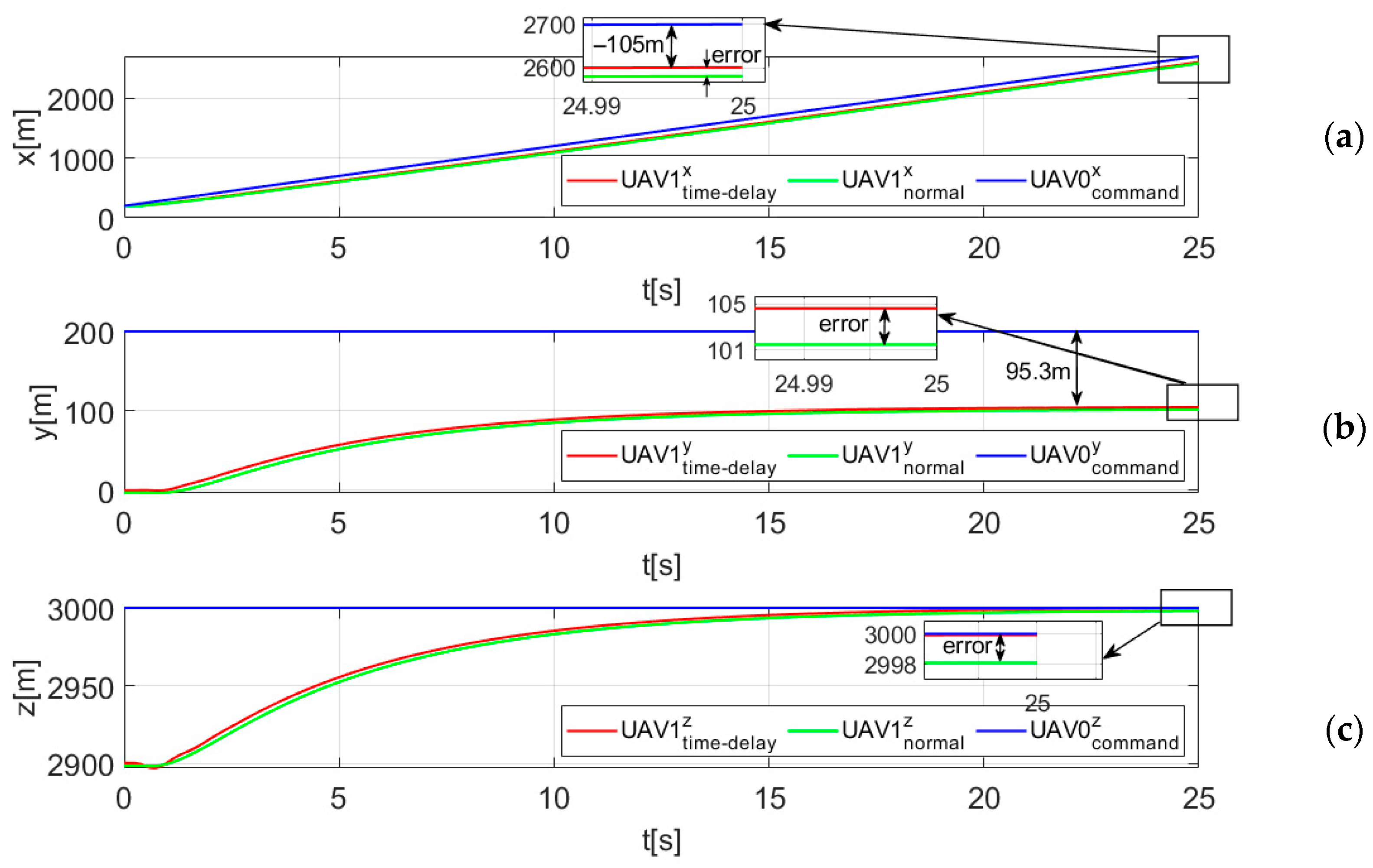
- To accommodate practical scenarios with communication delay, the proposed coupling-aware cooperative formation control method is extended to communication environments with time latency, ensuring reliable execution of formation coordination under delay conditions.
2. Preliminaries and UAV Model
2.1. The UAV Model
2.2. Graph Theory
2.3. Problem Statement
3. Leader State Observer and Formation Control
4. Cooperative Formation Control Considering Communication Coupling and Time Delay
4.1. Cooperative Controller with Communication Coupling and Time Delay
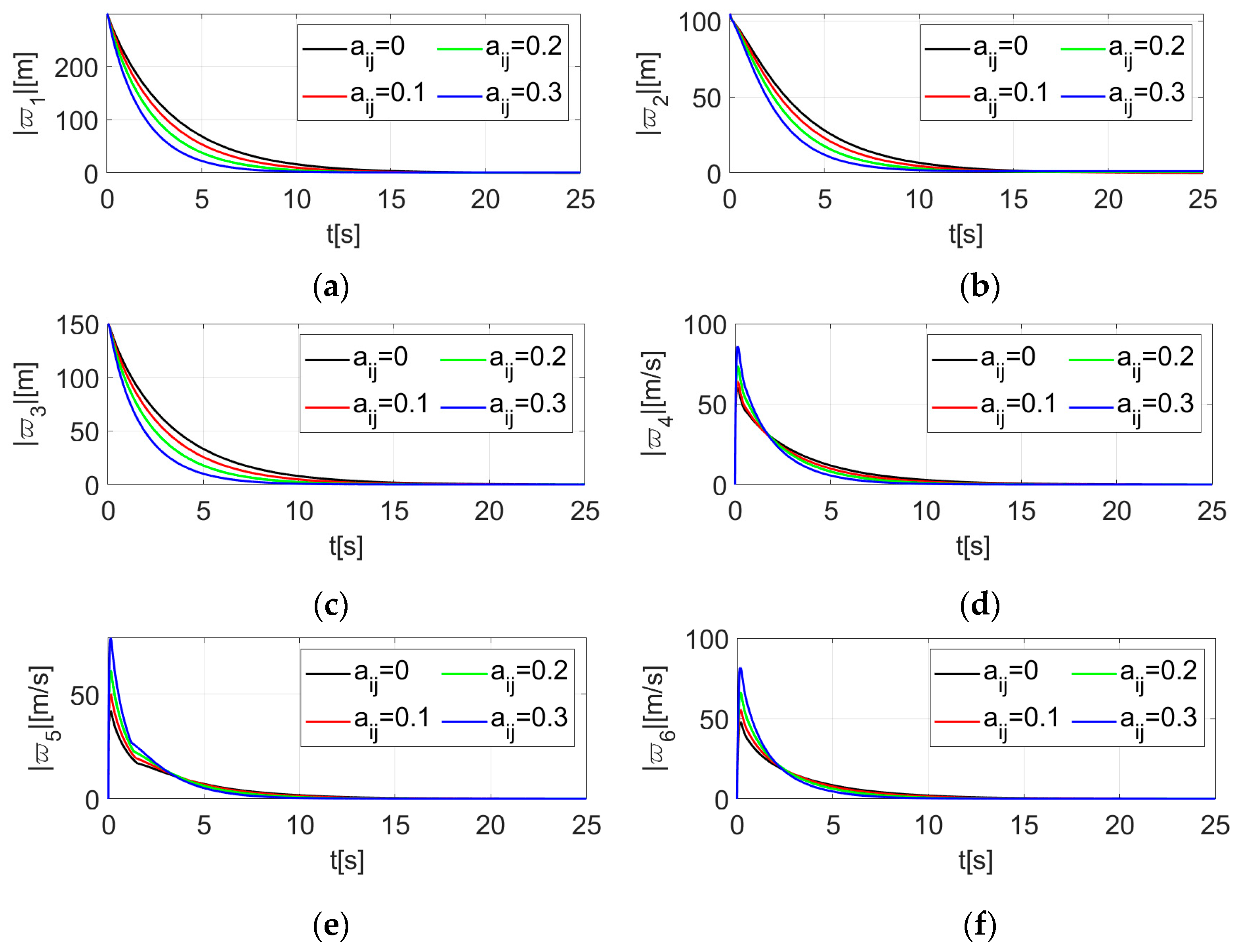
4.2. Impact of Communication Coupling
4.3. Stability Analysis
5. Numerical Simulation
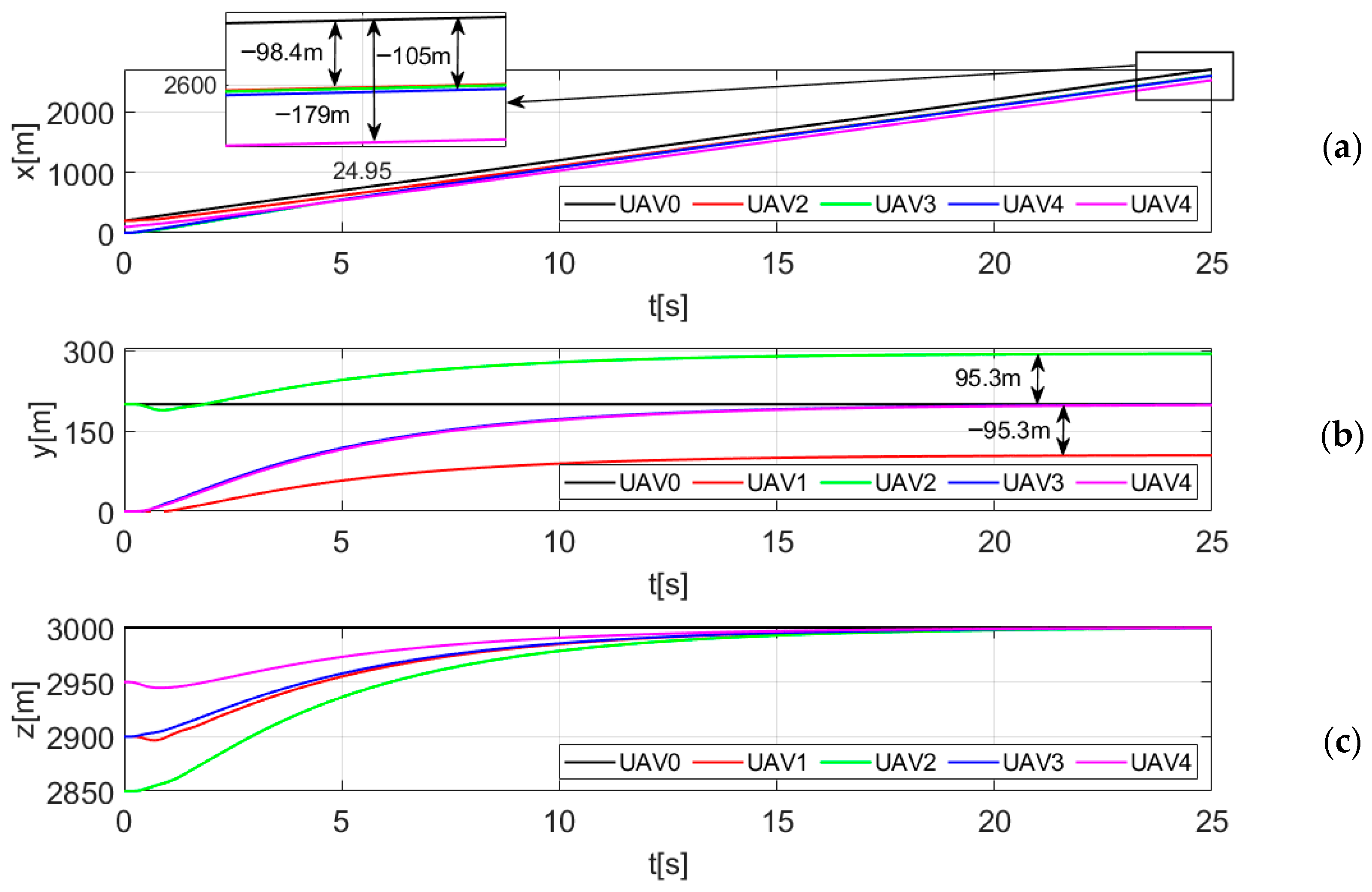
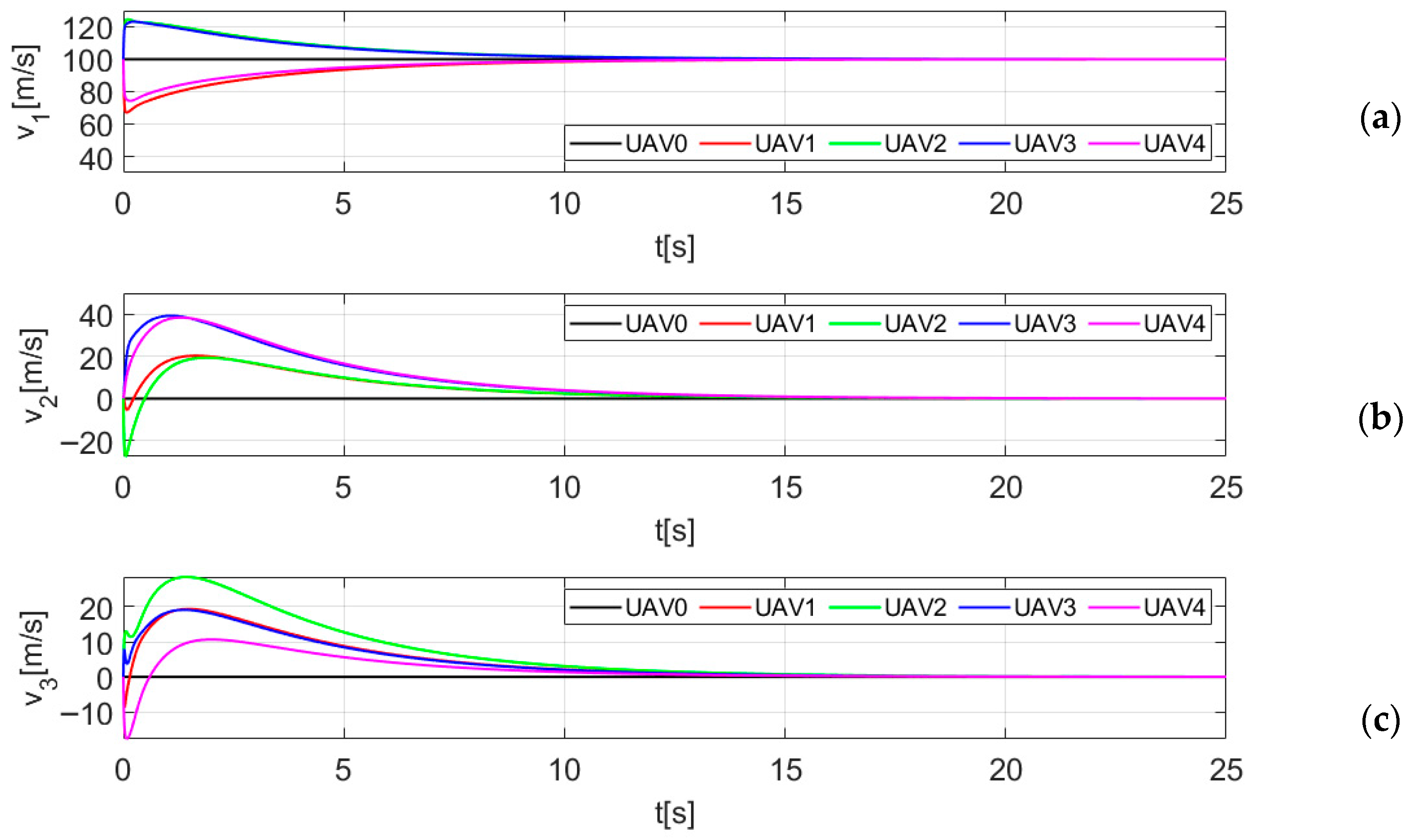
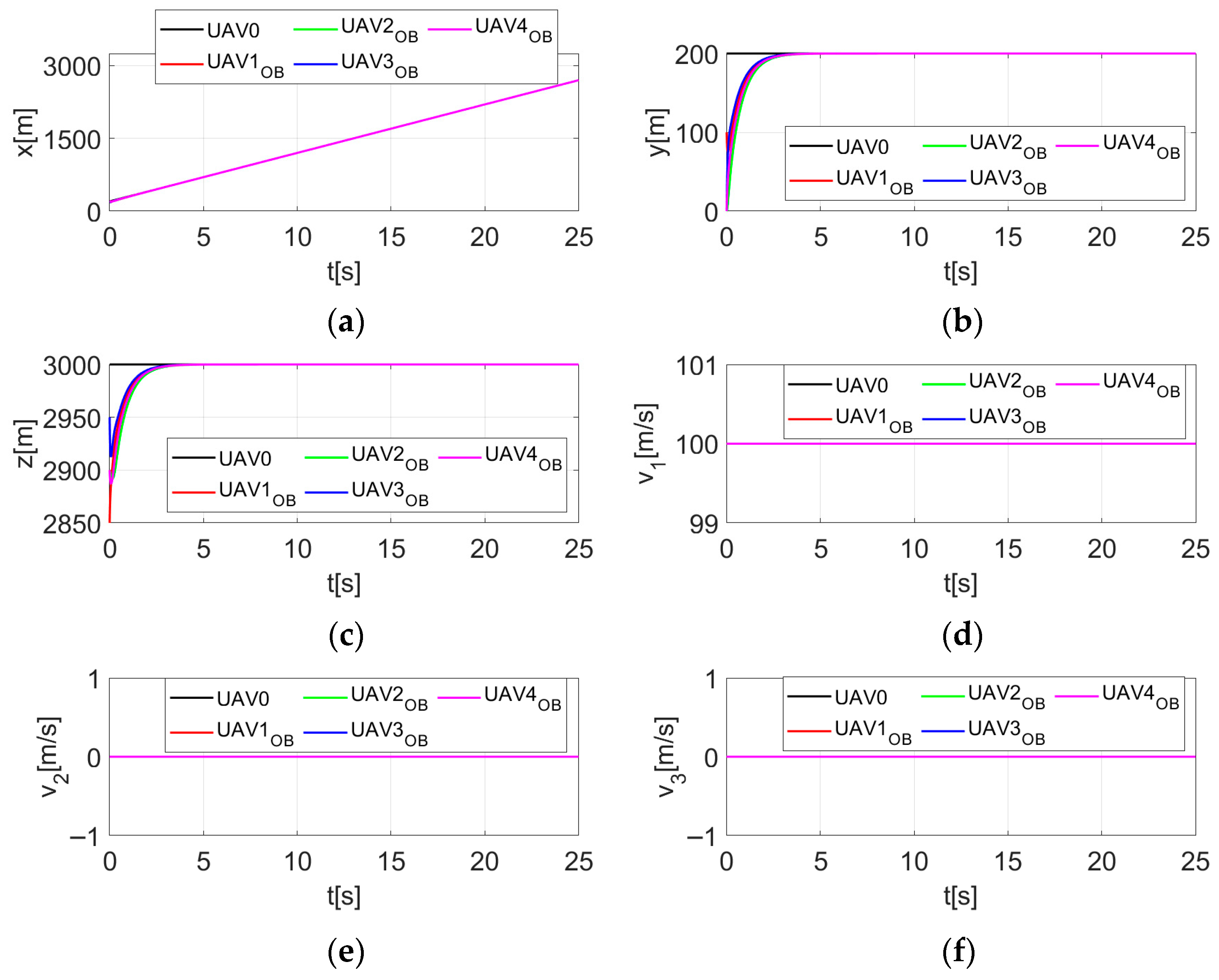
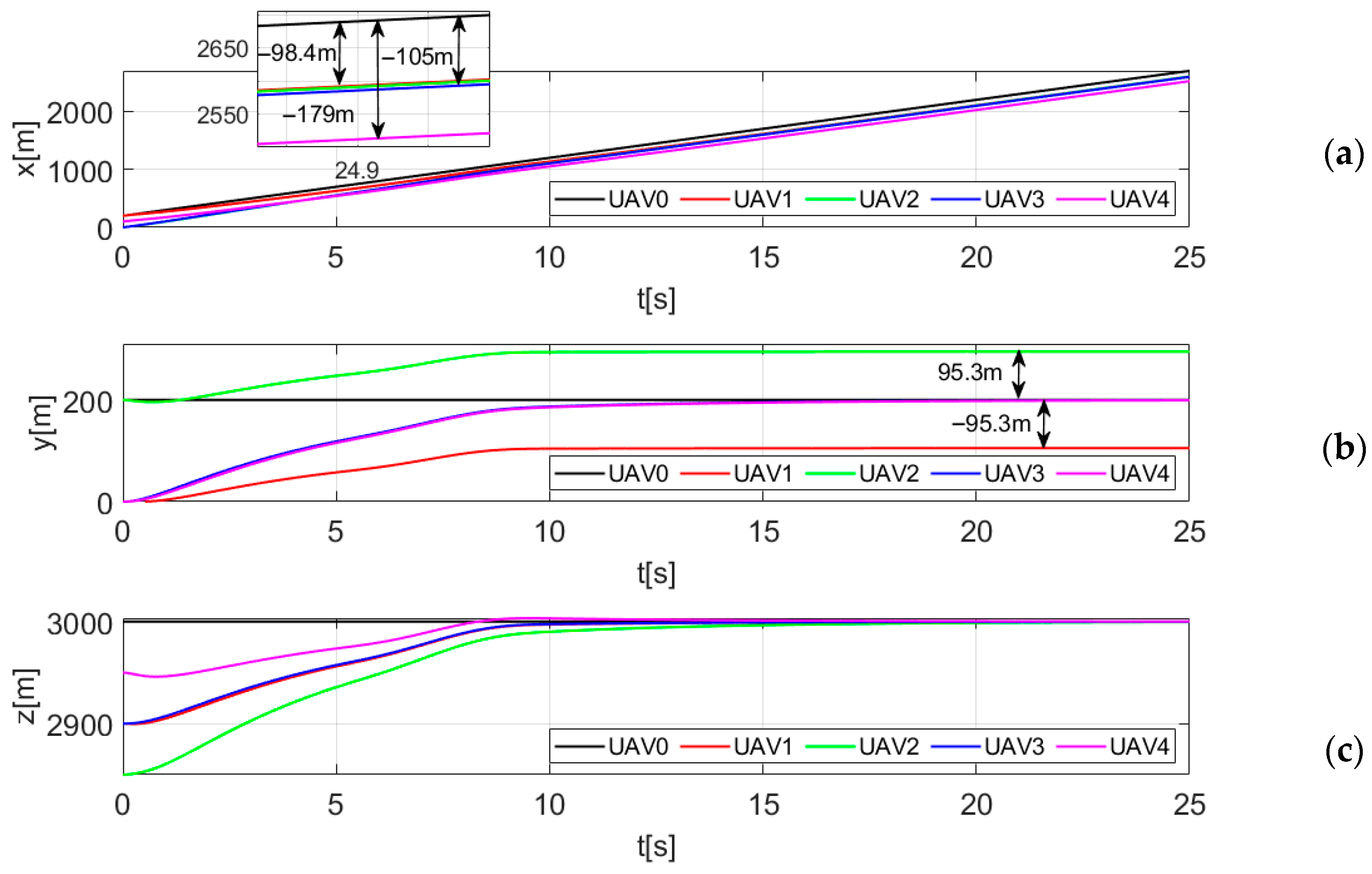
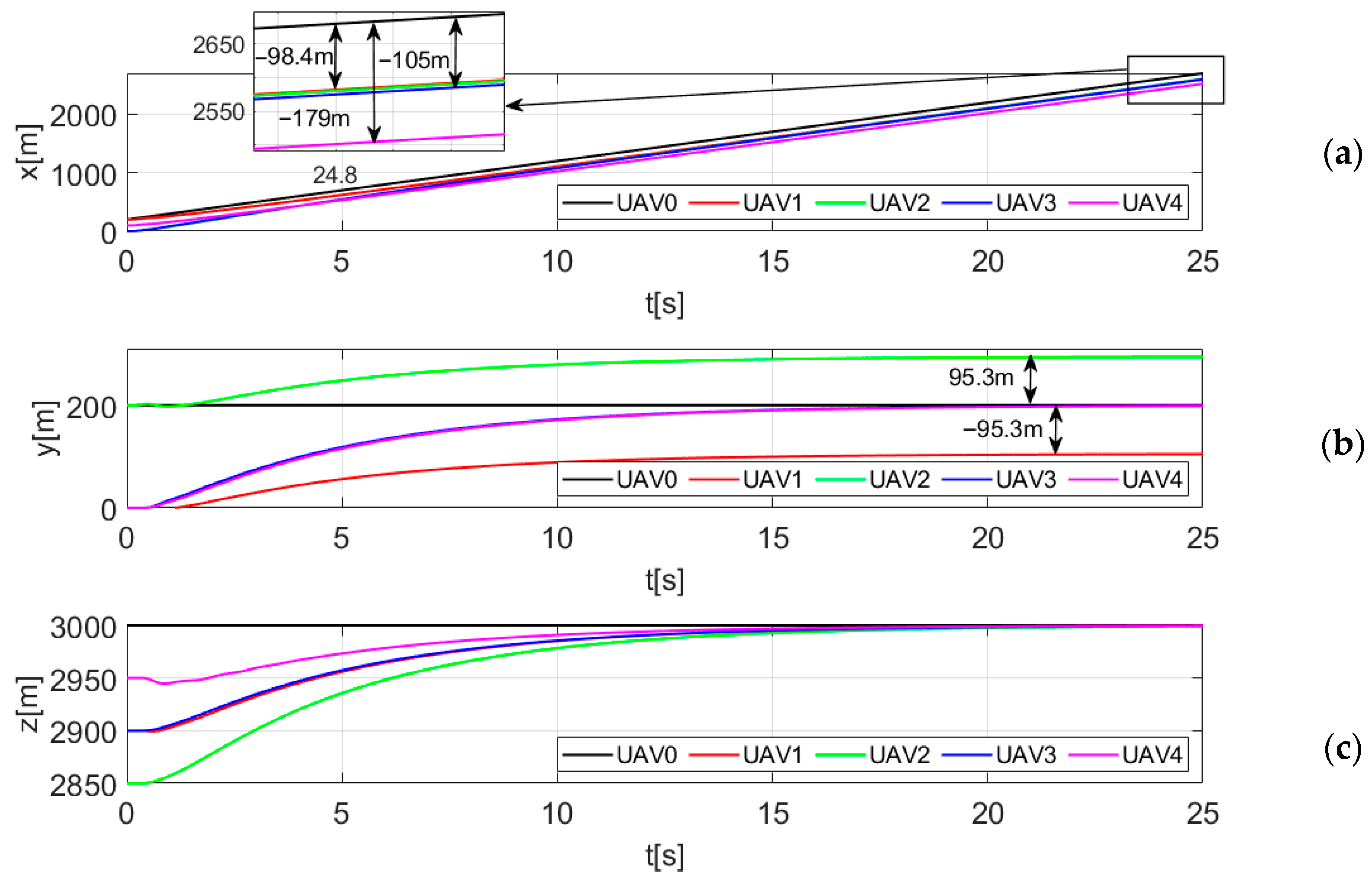
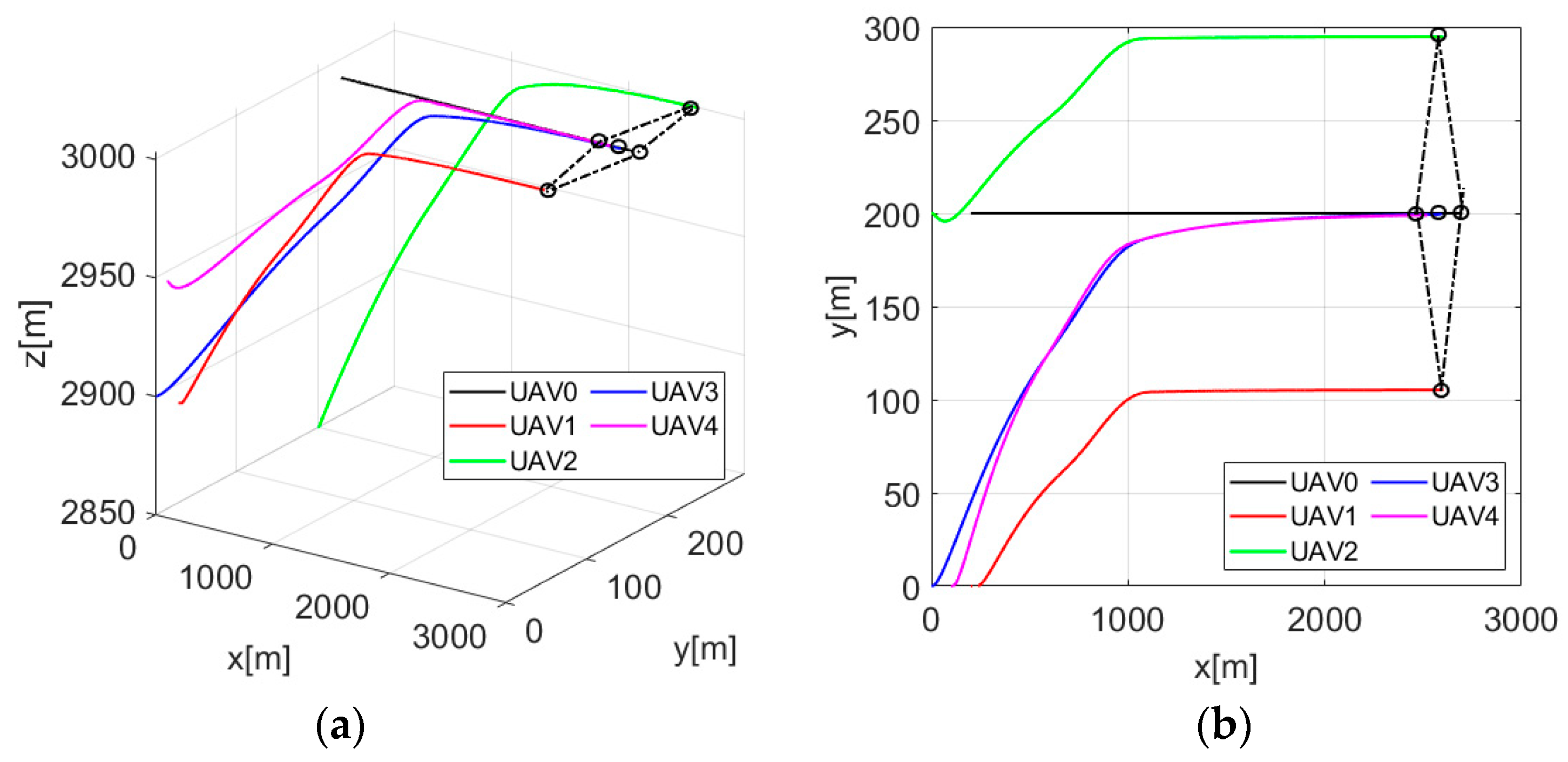
5.1. Simulation Results and Analysis
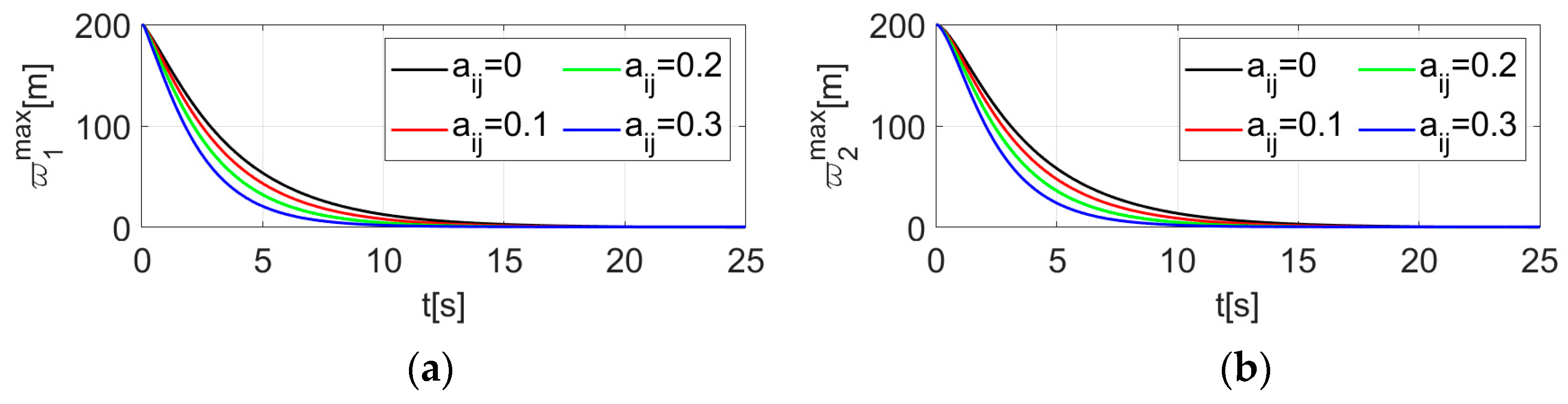
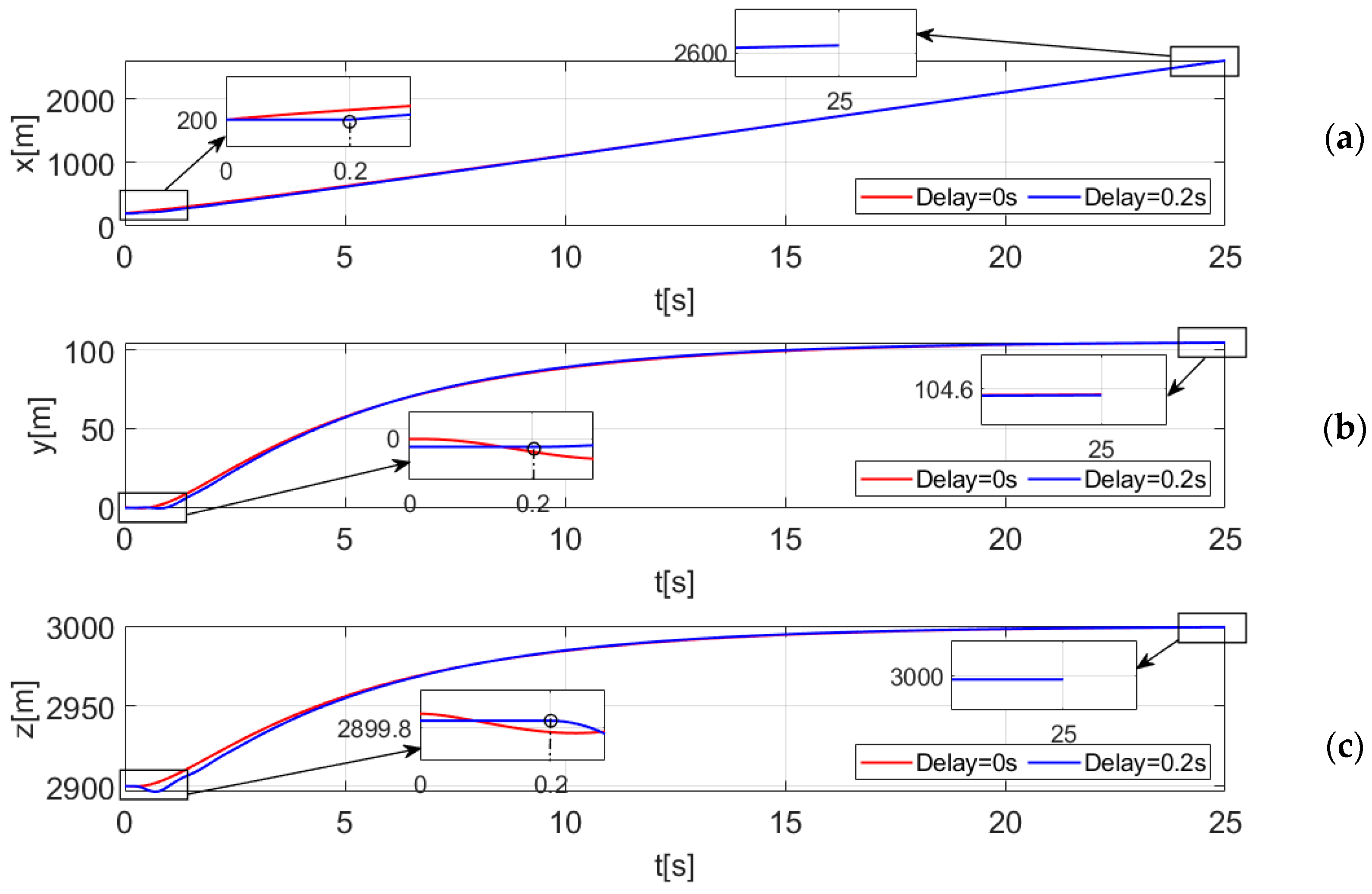
5.2. Coupling and Communication Delay Analysis and Comparison
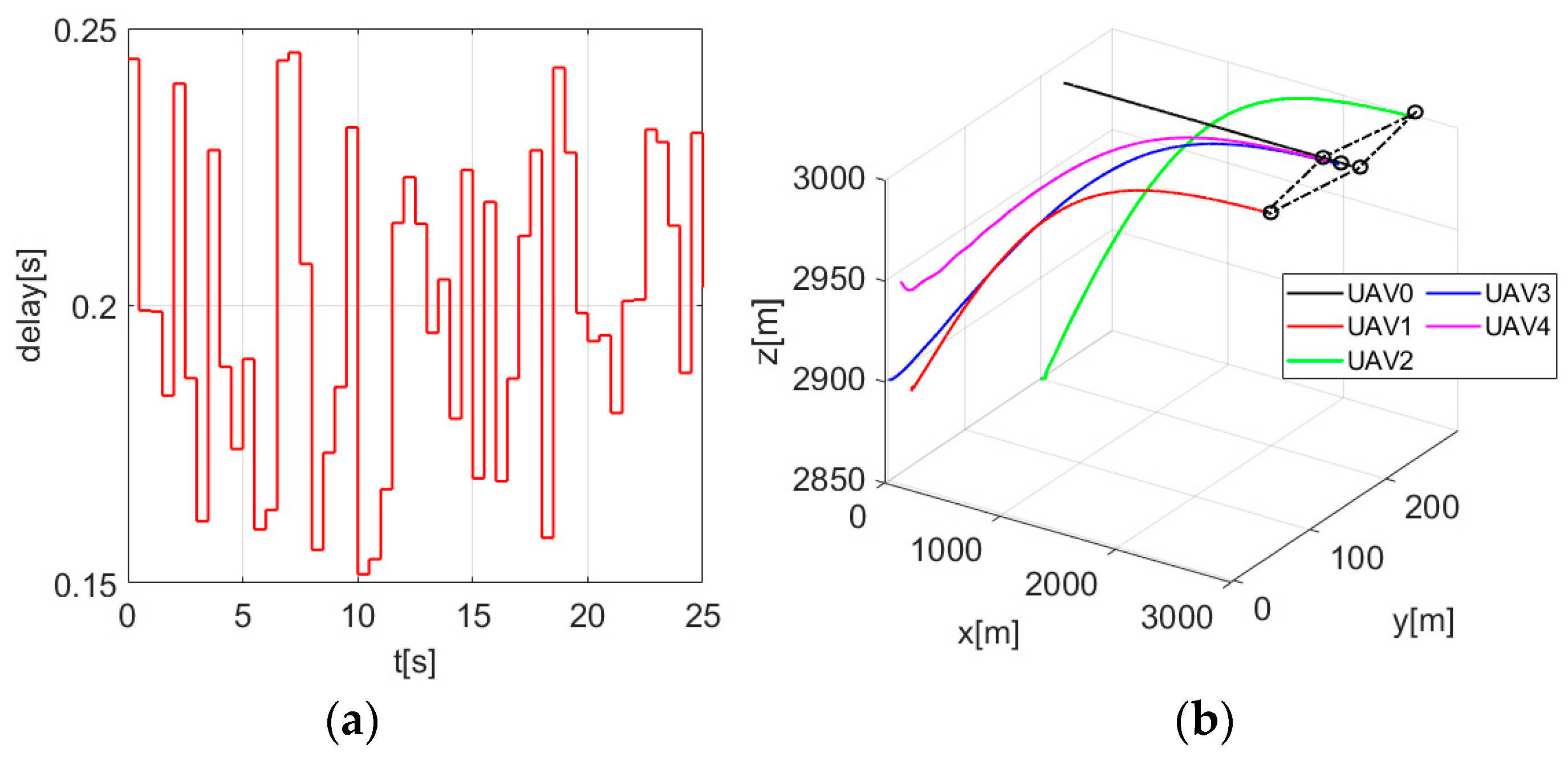
5.3. Robustness Validation Under Disturbances and Delay Variability
6. Conclusions, Limitations, and Future Work
Author Contributions
Funding
Institutional Review Board Statement
Informed Consent Statement
Data Availability Statement
Conflicts of Interest
Appendix A. Detailed Derivation of the UAV Model
Appendix B. Stability Proof of the Leader State Observer
Appendix C. Detailed Matrix Reformulations for the Closed-Loop System
Appendix D. Stability Proof of Theorem 1
References
- Wang, B.; Chen, W.; Wang, J.; Zhang, B.; Zhang, Z.; Qiu, X. Cooperative tracking control of multiagent systems: A heterogeneous coupling network and intermittent communication framework. IEEE Trans. Cybern. 2019, 49, 4308–4320. [Google Scholar] [CrossRef] [Scilit]
- Alharasees, O.; Kale, U.; Rohacs, D. Advancing Sustainable Aviation: Integration of Emerging Energy Technologies in Aviation Infrastructure. In Energy Rationality and Management for Decarbonization; Sogut, M.Z., Koray, M., Eds.; Springer Nature: Cham, Switzerland, 2025; pp. 507–521. [Google Scholar]
- Noh, D.; Sung, C.; Uhm, T.; Lee, W.; Lim, H.; Choi, J.; Lee, K.; Hong, D.; Um, D.; Chung, I.; et al. X-MAS: Extremely Large-Scale Multi-Modal Sensor Dataset for Outdoor Surveillance in Real Environments. IEEE Robot. Autom. Lett. 2023, 8, 1093–1100. [Google Scholar] [CrossRef] [Scilit]
- Hu, W.; Cheng, Y.; Chen, Z. Reset control for consensus of double-integrator multi-agent systems. Automatica 2022, 136, 110057. [Google Scholar] [CrossRef] [Scilit]
- Lee, J.G.; Shim, H. A tool for analysis and synthesis of heterogeneous multi-agent systems under rank-deficient coupling. Automatica 2020, 117, 108952. [Google Scholar] [CrossRef] [Scilit]
- Li, J.; Li, J.; Li, X. K-filter-based distributed adaptive output cluster consensus under cooperative-competitive networks. Inf. Sci. 2023, 648, 119522. [Google Scholar] [CrossRef] [Scilit]
- Peng, X.-J.; He, Y.; Liu, Z.; You, L.; Li, H. Time-varying formation H∞ tracking control and optimization for delayed multi-agent systems with exogenous disturbances. IEEE Trans. Autom. Sci. Eng. 2025, 22, 5637–5647. [Google Scholar] [CrossRef] [Scilit]
- Yao, D.; Li, H.; Lu, R.; Shi, Y. Event-triggered guaranteed cost leader-following consensus control of second-order nonlinear multiagent systems. IEEE Trans. Syst. Man Cybern. Syst. 2022, 52, 2615–2624. [Google Scholar] [CrossRef] [Scilit]
- Luo, S.; Ye, D. Cluster consensus control of linear multiagent systems under directed topology with general partition. IEEE Trans. Autom. Control 2022, 67, 1929–1936. [Google Scholar] [CrossRef] [Scilit]
- Qin, J.; Yu, C. Cluster consensus control of generic linear multi-agent systems under directed topology with acyclic partition. Automatica 2013, 49, 2898–2905. [Google Scholar] [CrossRef] [Scilit]
- Liu, C.; Li, H.; Shi, Y. A unitary distributed subgradient method for multi-agent optimization with different coupling sources. Automatica 2020, 114, 108834. [Google Scholar] [CrossRef] [Scilit]
- Zhang, K.; Zhang, J.; Zhang, H.; Su, R. A distributed H∞ controller for vehicle platoon with the directed graph. Int. J. Robust Nonlinear Control 2025, 35, 4307–4317. [Google Scholar] [CrossRef] [Scilit]
- Liu, Z. Distributed adaptive cluster synchronization for linearly coupled nonidentical dynamical systems. IEEE Trans. Circuits Syst. II Express Briefs 2022, 69, 1193–1197. [Google Scholar] [CrossRef] [Scilit]
- Yan, F.; Gu, G.; Chen, X. A new approach to cooperative output regulation for heterogeneous multi-agent systems. SIAM J. Control. Optim. 2018, 56, 2074–2094. [Google Scholar] [CrossRef] [Scilit]
- Yuan, S.; Yu, C.; Wang, P. Suboptimal linear quadratic tracking control for multi-agent systems. Neurocomputing 2022, 487, 110–118. [Google Scholar] [CrossRef] [Scilit]
- Zhang, J.; Feng, T.; Zhang, H.; Wang, X. The decoupling cooperative control with dominant poles assignment. IEEE Trans. Syst. Man Cybern. Syst. 2022, 52, 1205–1213. [Google Scholar] [CrossRef] [Scilit]
- Lu, K.; Liu, Z.; Wang, Y.; Chen, C.L.P.; Zhang, Y. Adaptive neural design of consensus controllers for nonlinear multiagent systems under switching topologies. IEEE Trans. Syst. Man Cybern. Syst. 2023, 53, 309–320. [Google Scholar] [CrossRef] [Scilit]
- Ma, Q.; Xu, X.; Zhang, R.; Xiong, Q.; Zhang, X.; Zhang, X. Robust consensus control of nonlinear multi-agent systems based on convergence rate estimation. Int. J. Robust Nonlinear Control 2023, 33, 2003–2021. [Google Scholar] [CrossRef] [Scilit]
- Guo, Z.; Yao, L.; Cao, S.; Ding, Y.; Yuan, R.; Huang, L.; Guo, J. Integrated missile guidance and control scheme via coupling effect utilization and transformation mechanism. IEEE Trans. Aerosp. Electron. Syst. 2025, 61, 2068–2077. [Google Scholar] [CrossRef] [Scilit]
- Guo, Z.; Zhou, J.; Guo, J.; Cieslak, J.; Chang, J. Coupling-characterization-based robust attitude control scheme for hypersonic vehicles. IEEE Trans. Ind. Electron. 2017, 64, 6350–6361. [Google Scholar] [CrossRef] [Scilit]
- Liu, Z.; Zhou, J.; Huang, H.; Ding, Y.; Cieslak, J.; Henry, D.; Guo, Z. Formation optimization for multiple UAVs by considering constrained effectiveness and attitude coupling tracking. J. Aerosp. Eng. 2024, 37, 04023098. [Google Scholar] [CrossRef] [Scilit]
- Kang, Y.; Qin, J.; Ma, Q.; Song, W.; Fu, W. On group synchronization for clusters of agents with collectively acyclic intercluster couplings. IEEE Trans. Ind. Electron. 2017, 64, 9560–9568. [Google Scholar] [CrossRef] [Scilit]
- Li, Y.; Hu, C.; Sun, M. DMPC Formation Control via Memory-Based Double Random Processes for UAVs with Communication Delay and Packet Dropout Under Multi-Round Formation Missions. IEEE Trans. Veh. Technol. 2025, 1–16. [Google Scholar] [CrossRef] [Scilit]
- Liu, Y.; Liu, Z.; Wang, G.; Yan, C.; Wang, X.; Huang, Z. Flexible multi-UAV formation control via integrating deep reinforcement learning and affine transformations. Aerosp. Sci. Technol. 2025, 157, 109812. [Google Scholar] [CrossRef] [Scilit]
- Li, W.; Shi, L.; Shi, M.; Yue, J.; Lin, B.; Qin, K. Leader-following containment control of hybrid fractional-order networked agents with nonuniform time delays. IEEE Trans. Signal Inf. Process. Over Netw. 2023, 9, 750–760. [Google Scholar] [CrossRef] [Scilit]
- Wu, J.; Luo, C.; Min, G.; McClean, S. Formation control algorithms for multi-UAV systems with unstable topologies and hybrid delays. IEEE Trans. Veh. Technol. 2024, 73, 12358–12369. [Google Scholar] [CrossRef] [Scilit]
- Khalil, H.K. Nonlinear Systems, 3rd ed.; Prentice Hall: Upper Saddle River, NJ, USA, 2002. [Google Scholar]
- Young, S.M.; Poogyeon, P.; Wook Hyun, K.; Young, S.L. Delay-dependent robust stabilization of uncertain state-delayed systems. Int. J. Control 2010, 74, 1447–1455. [Google Scholar] [CrossRef] [Scilit]
- Chen, C.-T. Linear System Theory and Design, 4th ed.; Oxford University Press: New York, NY, USA, 2013. [Google Scholar]
- Yang, L.; Jan, L. Leader–follower synchronisation of autonomous agents with external disturbances. Int. J. Control 2014, 87, 1914–1925. [Google Scholar] [CrossRef] [Scilit]
- Shinners, S.M. Modern Control System Theory and Application, 2nd ed.; Addison-Wesley: Reading, MA, USA, 1978. [Google Scholar]
- Snell, S.A.; Enns, D.F.; Garrard, W.L. Nonlinear inversion flight control for a supermaneuverable aircraft. J. Guid. Control. Dyn. 1992, 15, 976–984. [Google Scholar] [CrossRef] [Scilit] [PubMed]






| Reference | Control Architecture | Coupling Analysis | Coupling Utilization | Communication Delay |
|---|---|---|---|---|
| [4,5,6,7,8,9,10,11,12,13] | Standard state feedback | Not considered | Unutilized | Not considered |
| [14,15] | Observer-based independent control | Not considered | Unutilized | Not considered |
| [16,17,18,22] | Observer-based output feedback | Not considered | Unutilized | Not considered |
| [19,20,21] | Direct tracking control | Basic | Exploited | Not considered |
| [23,24,25,26] | Cooperative controller | Not considered | Unutilized | Incorporated |
| Proposed | Integrated observer and cooperative controller | Mathematical proof | Exploited | Incorporated |
| UAV ID | fx(m) | fy(m) | fz(m) |
|---|---|---|---|
| UAV 0 | 0 | 0 | 0 |
| UAV 1 | −98.4 | −95.3 | 0 |
| UAV 2 | −98.4 | 95.3 | 0 |
| UAV 3 | −105 | 0 | 0 |
| UAV 4 | −179.3 | 0 | 0 |
| UAV ID | x(m) | y(m) | z(m) |
|---|---|---|---|
| UAV 0 | 200 | 200 | 3000 |
| UAV 1 | 200 | 0 | 2900 |
| UAV 2 | 0 | 200 | 2850 |
| UAV 3 | 0 | 0 | 2900 |
| UAV 4 | 100 | 0 | 2950 |
| Error Indices | Control Methods | x(m) | y(m) | z(m) |
|---|---|---|---|---|
| IAE | Traditional methods | 2947.45 | 3733.19 | 2593.72 |
| Proposed methods | 1848.44 | 3469.69 | 2321.50 | |
| ITAE | Traditional methods | 25,278.20 | 21,745.97 | 13,259.36 |
| Proposed methods | 7806.41 | 16,323.34 | 10,846.91 |
Disclaimer/Publisher’s Note: The statements, opinions and data contained in all publications are solely those of the individual author(s) and contributor(s) and not of MDPI and/or the editor(s). MDPI and/or the editor(s) disclaim responsibility for any injury to people or property resulting from any ideas, methods, instructions or products referred to in the content. |
© 2026 by the authors. Licensee MDPI, Basel, Switzerland. This article is an open access article distributed under the terms and conditions of the Creative Commons Attribution (CC BY) license.
Share and Cite
Liu, Z.; Guo, Z.; Wei, J.; Zhang, Y.; Fan, W.; Fu, Y. Research on Multi-UAV Cooperative Formation Control Method Considering Coupling and Communication Delay. Appl. Sci. 2026, 16, 4049. https://doi.org/10.3390/app16084049
Liu Z, Guo Z, Wei J, Zhang Y, Fan W, Fu Y. Research on Multi-UAV Cooperative Formation Control Method Considering Coupling and Communication Delay. Applied Sciences. 2026; 16(8):4049. https://doi.org/10.3390/app16084049
Chicago/Turabian StyleLiu, Zequn, Zhuxin Guo, Jianing Wei, Yunfei Zhang, Wanlin Fan, and Yanfang Fu. 2026. "Research on Multi-UAV Cooperative Formation Control Method Considering Coupling and Communication Delay" Applied Sciences 16, no. 8: 4049. https://doi.org/10.3390/app16084049
APA StyleLiu, Z., Guo, Z., Wei, J., Zhang, Y., Fan, W., & Fu, Y. (2026). Research on Multi-UAV Cooperative Formation Control Method Considering Coupling and Communication Delay. Applied Sciences, 16(8), 4049. https://doi.org/10.3390/app16084049