


Abstract
3D Gaussian Splatting (3DGS) achieves high-quality novel-view synthesis under dense inputs but suffers from severe overfitting and geometric artifacts in sparse-view settings. Existing approaches introduce monocular depth priors to alleviate this issue, yet they typically apply uniform geometric constraints across the entire scene, ignoring structural heterogeneity between flat and edge regions, which leads to a trade-off between global smoothness and local detail preservation. To address this limitation, we propose Depth-Gradient-Guided Decoupled Optimization for Gaussian Splatting (DGDO-GS), a geometry-aware framework designed for sparse-view reconstruction. Specifically, depth gradients are exploited to capture structural variations and partition the scene into flat and edge regions. Global consistency constraints are imposed on flat areas to enhance stability, while local sharpening regularization is applied to edge regions to preserve fine-grained details. An orthogonal decoupling strategy further separates position and shape optimization, enabling accurate geometric recovery under monocular depth supervision while maintaining high-frequency texture fidelity. Experiments on LLFF, Mip-NeRF360, and Blender demonstrate that DGDO-GS consistently outperforms existing methods in reconstruction quality.
1. Introduction
Novel-view synthesis (NVS) [1], as a core task in 3D computer vision, aims to recover realistic 3D scene representations from a limited set of 2D images, providing key technical support for immersive applications such as VR/AR and digital twins. In the developmental trajectory of this field, the emergence of Neural Radiance Fields (NeRF) [2] marked a significant breakthrough. By combining implicit Multi-Layer Perceptrons (MLP) [3] with volume-rendering technology, NeRF achieved continuous, high-fidelity scene modeling and novel-view generation, thereby advancing the development of high-precision NVS.
However, NeRF-based methodologies [4,5,6] typically require dense point sampling and integration for each ray, leading to substantial training computational overhead and slow inference speeds, which limits their application in real-time systems. To overcome these efficiency bottlenecks, 3D Gaussian Splatting (3DGS) [7] emerged, bringing a paradigm shift. This method adopts explicit anisotropic Gaussian primitives and a highly optimized tile-based rasterizer. While maintaining visual quality comparable to state-of-the-art NeRF methods, it achieves real-time rendering performance, offering an accurate solution for efficient and high-quality NVS.
Despite the excellent performance of standard 3DGS in dense multi-view input scenarios, it suffers from severe overfitting to the photometric loss of a few training views under sparse input conditions due to the lack of sufficient multi-view consistency constraints. Fundamentally, this is because the model relies excessively on explicit photometric optimization but lacks effective geometric constraints to guide reasonable structural inference. Consequently, the model struggles to recover true scene geometry from sparse views, eventually leading to over-smoothed reconstructed surface textures and a loss of critical details, which significantly diminishes the realism of novel-view synthesis.
Recent works, such as FSGS [8] and DNGaussian [9], have attempted to introduce monocular depth priors to supplement 3DGS with additional geometric supervision. By constraining Gaussian primitives to align with depth maps, these methods guide the distribution of the Gaussian volume into reasonable spatial positions, thereby alleviating the overfitting issue caused by relying solely on photometric loss. However, to achieve the goal of “aligning Gaussians to depth maps”, such methods generally adopt a homogeneous regularization strength across the entire scene. The core logic assumes that monocular depth priors possess uniform reliability throughout the scene, and, thus, depth constraints are applied globally via fixed weights to simplify optimization design and implementation.
Nevertheless, this strategy does not fully consider the inherent limitations of monocular depth estimation. On the one hand, monocular depth maps themselves contain noise and scale uncertainty and are more prone to being fitted compared to color information. Globally uniform regularization forces Gaussian primitives to overfit biased depth priors, resulting in blurred appearances and lost details. On the other hand, geometric characteristics vary significantly across different scene regions; flat areas and edge/detail regions have entirely different requirements for regularization strength. Unified global constraints cannot adapt to these content differences: strong regularization can suppress geometric artifacts in flat regions but over-smooths high-frequency details at edges, whereas weak regularization preserves detail features but fails to constrain geometric distortions in flat areas. Therefore, how to adaptively utilize monocular depth priors based on scene content remains a core challenge to be resolved in current sparse-view 3D Gaussian reconstruction.
To address this issue, we propose a Depth-Gradient-Guided Geometric Decoupled Optimization framework (DGDO-GS). The depth gradient characterizes the local variation of depth values and naturally delineates edge regions (where depth changes sharply) from flat regions (where depth remains relatively constant). By leveraging depth gradients, we achieve a geometric structural perception of the scene, enabling adaptively differentiated constraints on regions with distinct geometric properties based on this structure-aware partition, thereby effectively overcoming the limitation of regularization homogenization in existing methods. Specifically, we employ quantile thresholds of gradient magnitudes to explicitly partition pixels into an edge set and a flat set. This region-aware partition lays the foundation for subsequent differentiated geometric processing: edge regions require absolute depth anchoring to preserve sharpness, while flat regions, in the presence of potential noise in absolute depth, necessitate gradient consistency constraints to maintain structural trends. This structure-aware strategy adaptively aligns geometry and texture, effectively mitigating geometric structural distortions in few-shot novel-view synthesis.
Extensive experiments on LLFF [10], Blender [11], and Mip-NeRF360 [12] benchmarks demonstrate that DGDO-GS marginally outperforms existing sparse-view methods in terms of rendering quality, achieving clearer geometric details and fewer artifacts while maintaining real-time inference speeds.
The primary contributions of this paper are summarized as follows:
- A regional decoupled regularization strategy guided by depth gradients is proposed for sparse-view 3D Gaussian Splatting. Unlike homogeneous depth supervision, this approach leverages depth-gradient magnitude maps and flatness maps to explicitly partition pixels into edge and flat regions, where distinct depth constraints—absolute alignment for edges and gradient consistency for planes—are respectively applied. This effectively addresses the issue of depth prior homogenization and resolves the inherent conflict between global smoothness and local detail preservation.
- A shape–position orthogonal decoupled optimization technique is developed for Gaussian geometric refinement. The geometric optimization of 3DGS is decomposed into two independent sub-tasks with orthogonal gradients, enabling simultaneous calibration of primitive morphology and spatial positioning while preventing mutual interference during optimization.
- Competitive performance in sparse-view synthesis is achieved across multiple benchmark datasets, including LLFF, Blender, and Mip-NeRF360. The proposed framework demonstrates superior geometric reconstruction accuracy and detail recovery capabilities compared to existing baselines, with robust generalization to complex scene structures and varying observation densities. Furthermore, the method maintains real-time rendering efficiency while significantly reducing training time and memory footprint, providing a practical solution for few-shot 3D reconstruction.
2. Related Works
2.1. Novel-View Synthesis
In computer vision and graphics research, synthesizing novel views from sparse input images is a core subject. Neural Radiance Fields (NeRF) [2] achieved a paradigm shift in this task by introducing implicit Multi-Layer Perceptrons (MLP) [3] and volume-rendering mechanisms. By replacing traditional discrete structural descriptions with continuous radiance field functions, NeRF achieved high-quality reconstruction performance under complex lighting and reflection conditions for the first time. However, the implicit representation of NeRF also imposes a significant computational burden, consuming massive resources during training and inference, which severely hinders its feasibility and scalability in practical deployment.
To overcome these deficiencies, researchers have proposed various NeRF variants, primarily focusing on three directions: enhancing image reconstruction accuracy and visual fidelity [13,14]; compressing the training cycle to accelerate model convergence [15,16]; and expanding the scope of applicability [17,18], enabling the handling of complex scenes in dynamic environments or unstructured capture conditions. However, despite these optimization attempts alleviating the performance bottlenecks of the original NeRF to some extent, most methods remain limited by the inherent rendering costs of implicit modeling and cannot achieve an ideal balance between efficiency and quality.
In this context, 3D Gaussian Splatting (3DGS) [7] broke the framework of implicit representation with an explicit modeling route, injecting new technical momentum into novel-view synthesis. By using anisotropic Gaussian ellipsoids as explicit primitives combined with a tile-based rasterization pipeline, the rendering process is reconstructed as a differentiable Gaussian ellipsoid projection operation. This significantly improves training and rendering speeds while ensuring high-fidelity output, making real-time interactive applications a reality and achieving success across multiple downstream tasks [19,20,21].
2.2. Sparse-View Synthesis
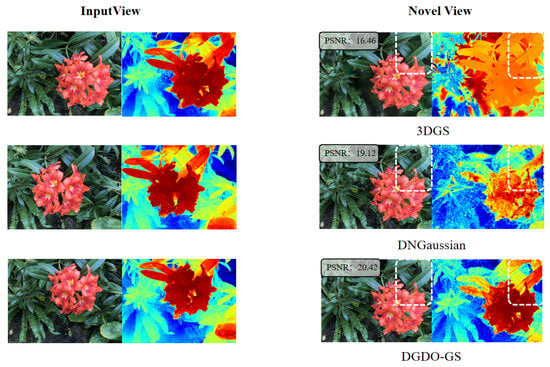
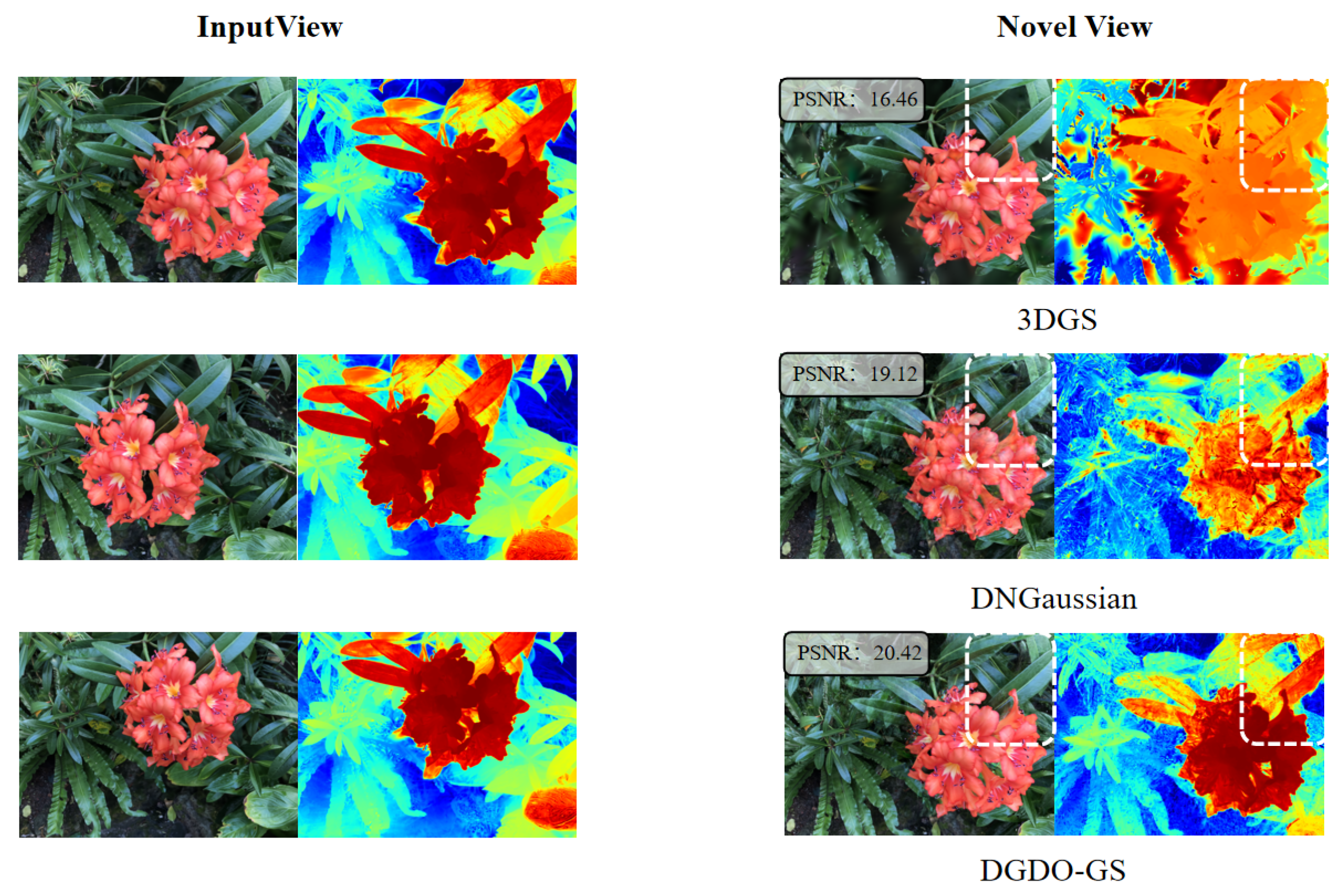
Although NeRF and 3DGS demonstrate impressive rendering performance, ensuring high-quality synthesis results typically requires a large number of input images. However, in practical applications, available images are often extremely limited (i.e., sparse-view input) due to collection costs or scene accessibility. This causes both representative methods to face severe performance degradation: NeRF suffers from texture drift and density artifacts due to a lack of multi-view geometric constraints [22], while 3DGS suffers from excessive Gaussian expansion and geometric artifacts due to overfitting the sparse-view inputs [23]. Consequently, novel-view synthesis under sparse views has become a core challenge to be broken through in the field of 3D vision (Figure 1).
Figure 1.
Illustration of sparse-view novel-view synthesis. Given a limited number of input views (left), the goal is to synthesize photorealistic renderings from unseen viewpoints (right). We compare the rendering results of 3DGS, DNGaussian, and our proposed DGDO-GS under the same sparse-view setting. The corresponding PSNR values are 16.46, 19.12, and 20.42, respectively. As shown in the highlighted regions, our method better preserves geometric structures and fine-grained textures, demonstrating its effectiveness for high-quality novel-view synthesis from sparse observations.
NeRF-Based Sparse-View Synthesis. Under sparse-view conditions, traditional NeRF fails to apply effective constraints to the infinite solution space of implicit radiance fields due to insufficient observation information, leading to a significant drop in 3D geometric reconstruction and view synthesis quality. To alleviate this, introducing depth priors as geometric regularization has become a mainstream approach. Recently, a series of representative improvements have emerged. For example, TD-NeRF [24] incorporates depth information through truncated normal sampling and a coarse-to-fine strategy; Scade [25] fuses multi-view depth hypotheses to eliminate geometric ambiguity. However, existing regularization often obtains only sparse or unreliable dense depth, and the volume-rendering paradigm of NeRF still makes it difficult to achieve an ideal balance between rendering efficiency and synthesis quality. In contrast, explicit Gaussian-based 3DGS methods escape the constraints of volume rendering through fast rasterization, showing significant potential in real-time rendering and detail reconstruction, though they similarly face geometric artifacts and overfitting challenges in sparse views.
3DGS-Based Sparse-View Synthesis. In sparse views, the adaptive density control mechanism of standard 3DGS relies heavily on multi-view consistency constraints, making it difficult to maintain accurate reconstruction due to the lack of continuous spatial priors and prone to overfitting photometric loss, creating floating artifacts and incorrect geometry. Existing methods attempt to supplement information by using large-scale generative models to generate views beyond the input sparse views [26,27,28,29], thereby enhancing scene quality. For example, GS-Enhancer [28] utilizes 2D video diffusion priors to address challenging 3D view consistency issues; RI3D [30] reconstructs missing regions through inpainting models while ensuring consistency before and after optimization. However, while these methods improve visual realism, the inherent randomness of diffusion models easily leads to multi-view inconsistency and geometric distortion. Furthermore, the iterative sampling process and subsequent discretization optimization of diffusion models are computationally expensive, severely undermining the core real-time advantage of 3DGS.
In sparse-view synthesis tasks pursuing real-time performance, introducing geometric constraints (such as monocular depth priors or sparse point clouds) has become the mainstream engineering path for improving 3DGS reconstruction quality due to its computational efficiency and ease of integration. Recent research has actively explored this direction: FSGS [8] strengthens geometric alignment through neighbor-guided upsampling and global Pearson correlation loss; DNGaussian [9] designs a soft–hard depth regularization strategy to recover fine surfaces; GaussianPro [31] adopts a progressive propagation mechanism to assist Gaussian densification. However, the aforementioned methods are generally limited by the intrinsic errors of monocular depth estimation, where the deviation between predicted results and true geometry remains non-negligible, making the effectiveness of geometric constraints difficult to guarantee and thereby restricting reconstruction fidelity in sparse-view scenes.
Based on the aforementioned works, we propose a novel Depth-Gradient-Guided Geometric Decoupled Optimization framework in 3D Gaussian Splatting (DGDO-GS). The core of this framework lies in two key aspects. First, a region-aware decoupled depth regularization strategy explicitly partitions pixels into edge and flat regions according to depth-gradient magnitude, applying depth constraints with distinct geometric interpretations—absolute depth alignment for edge regions and gradient consistency for flat regions—thereby alleviating the inherent conflict between global smoothness and local detail preservation. Second, a shape–position orthogonal geometric decoupling mechanism separates Gaussian geometric optimization into shape adaptation and position calibration: the former leverages depth gradients as continuous weighting factors to refine primitive anisotropy, while the latter employs depth-gradient-based thresholds to regulate spatial alignment, enabling independent modeling and coordinated optimization of Gaussian morphology and spatial distribution. Furthermore, these complementary constraints are selectively extended to synthesized virtual viewpoints to enhance cross-view geometric supervision with minimal computational overhead, providing an efficient and accurate solution for sparse-view real-time 3D reconstruction.
3. Method
3.1. Preliminary for 3D Gaussian Splatting
3D Gaussian Splatting (3DGS) [7] represents a 3D scene as a set of anisotropic Gaussian primitives . Each primitive is characterized by its center , a covariance matrix factorized into a rotation matrix and a scaling matrix for independent optimization, opacity , and spherical harmonic (SH) coefficients for view-dependent appearance. The spatial influence of a Gaussian at any 3D point is defined as
To synthesize an image, these 3D Gaussians are projected onto the 2D image plane and sorted by depth. The final color of a pixel is computed via alpha blending of the N Gaussians covering the pixel:
where denotes the effective opacity. Optimization is performed end-to-end using a photometric loss , while adaptive density control dynamically adjusts the primitive distribution.
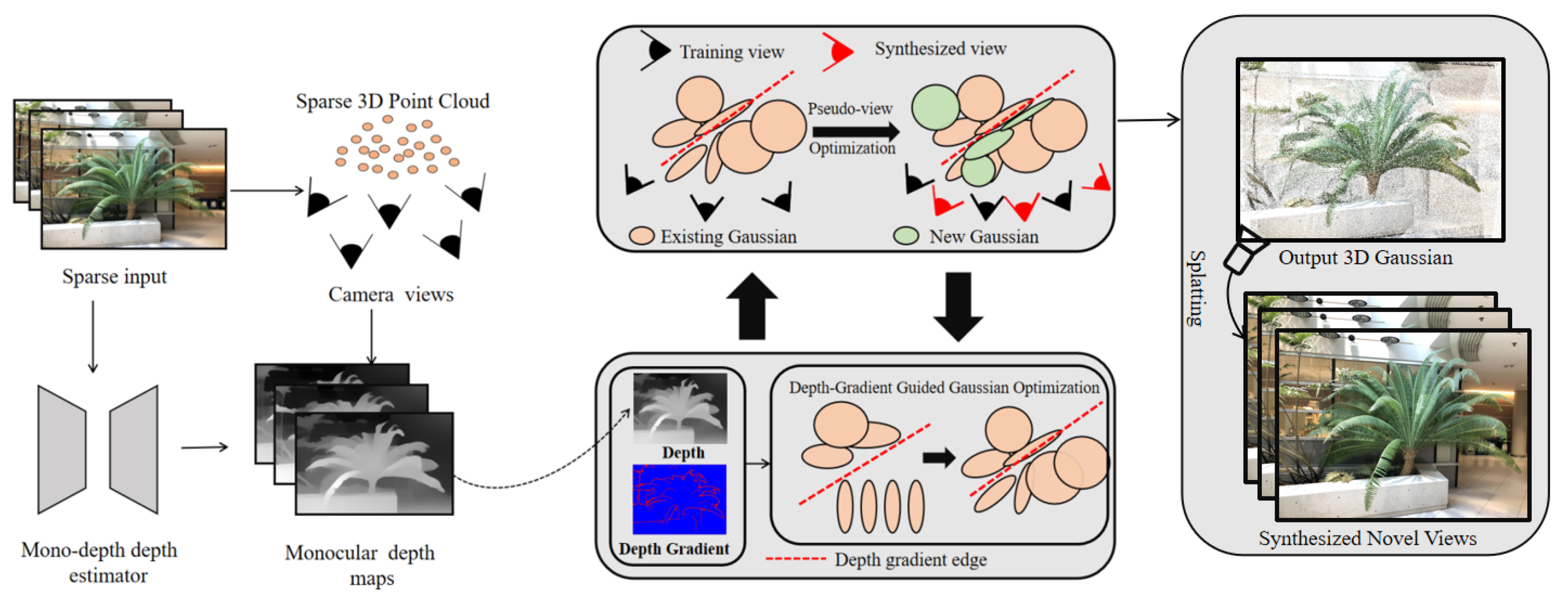
In 3DGS, the representation of scene geometry primarily relies on two sets of core parameters: the center position , which defines the spatial location of each Gaussian primitive, and the shape parameters (scaling vectors and quaternions), which control the spatial anisotropy and orientation of the primitives through the covariance matrix. Under dense views, the photometric loss effectively constrains these two sets of parameters via multi-view consistency. However, in sparse-view scenarios, this photometric-only supervision leads to a severe under-constrained problem. Textureless regions lack reliable positional cues, causing the center to drift in depth; occluded regions break multi-view consistency, preventing the shape parameters from converging to the correct scale and orientation. Therefore, it is necessary to introduce structured geometric priors to regularize the learning of these parameters (Figure 2).
Figure 2.
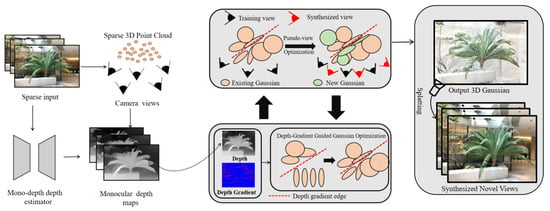
Overview of DGDO-GS framework. Our framework starts from sparse input views, for which we first employ COLMAP [32,33] to reconstruct a sparse point cloud and estimate camera poses. A monocular depth network (e.g., Depth Anything [34]) is then utilized to predict dense depth maps for the training views, from which we compute depth gradients and generate edge and flat region masks via thresholding. At the core of our approach lies a Depth-Gradient-Guided Geometric Decoupled Optimization strategy, which separately optimizes Gaussian positions and shapes under region-aware depth constraints: edge regions are enforced with stronger absolute depth alignment, while flat regions are regularized by gradient consistency. To further enhance geometric supervision, we synthesize pseudo views through spherical linear interpolation and apply the same decoupled constraints to reliable ones. The resulting unified set of 3D Gaussians ultimately enables high-quality, real-time novel-view synthesis.
3.2. Structural Discrimination via Depth Gradients
To compensate for the lack of multi-view supervision, monocular depth priors are commonly adopted. However, traditional global regularization treats the depth map as a hard constraint, forcing the model to blindly fit every detail in the depth map, including spurious structures introduced by estimation errors. This leads to the over-smoothing of real edges and unnecessary fluctuations in flat regions, ultimately causing holistic geometric distortion. To strengthen the structure-aware ability for these features, we propose utilizing the local rate of change in depth to decouple scene geometry. Depth gradients characterize the local variation of depth values and naturally distinguish between edge regions (high gradient) and flat regions (low gradient). Importantly, since gradient calculation relies on relative changes rather than absolute values, depth gradients are insensitive to absolute scale and exhibit strong robustness against scale ambiguity and systemic biases prevalent in monocular depth estimation. By adaptively partitioning the depth-gradient space, differentiated constraints can be applied to regions with different geometric attributes.
Specifically, we first derive the gradient magnitude and the flatness map from the monocular depth prior D:
where denotes the local variance. Based on a quantile threshold of the gradient magnitude , we explicitly partition the pixels into an edge set and a flat set :
This region-aware partitioning provides the foundation for subsequent differentiated geometric treatment: edge regions require absolute depth anchoring to maintain sharpness, while flat regions require gradient consistency to maintain structural trends in the presence of potential absolute depth noise. Such a perspective avoids the inherent error coupling found in uniform global regularization.
3.3. Depth-Gradient-Guided Gaussian Optimization
Since scene geometry is primarily represented by the spatial distribution of Gaussian primitives, we consider the position parameters and morphological parameters as the objects most requiring regularization. In sparse-view scenarios, photometric loss alone cannot decouple these two—positional errors are often erroneously compensated by shape adjustments, and vice versa, leading to coupled distortions. Existing methods that introduce depth priors typically apply uniform regularization to both sets of parameters, allowing depth errors to contaminate both positional accuracy and morphological plausibility.
Based on the regional partitioning in Section 3.2, we decouple Gaussian optimization into two orthogonal sub-tasks: Region-Guided Position Optimization (anchoring centers based on edge/flat discrimination) and Gradient-Aware Morphological Optimization (adjusting shapes to fit local geometry based on depth-gradient magnitude). By strictly separating gradient propagation paths, we ensure that positional errors only correct , while shape errors only adjust , thereby preventing error coupling.
3.3.1. Region-Guided Position Optimization
Position optimization aims to accurately anchor primitive centers without interfering with shape parameters. Based on the edge set and flat set , we introduce region-differentiated depth constraints.
First, to eliminate the scale ambiguity of monocular depth, a global alignment loss is employed to constrain the distribution consistency between the rendered depth and monocular depth :
where is the normalized depth, is the Pearson correlation coefficient, and is a balancing coefficient. This loss enforces the alignment of relative depth relationships without requiring absolute scale consistency.
For edge regions, , where depth values are relatively reliable, a weighted MSE loss is used to reinforce absolute depth alignment:
where the weight is obtained by mapping the gradient magnitude through a Sigmoid function, ensuring that high-gradient pixels receive stronger constraints.
For flat regions, , where absolute depth is unreliable but local trends remain effective, we constrain the gradient consistency between the rendered depth and monocular depth:
This loss maintains translation-invariant geometric structures, avoiding distortions caused by absolute depth bias (Figure 3).
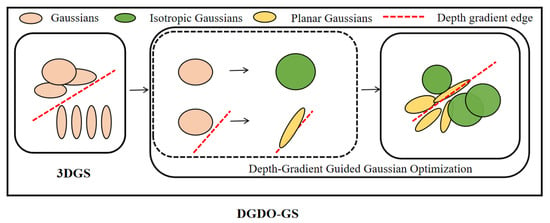
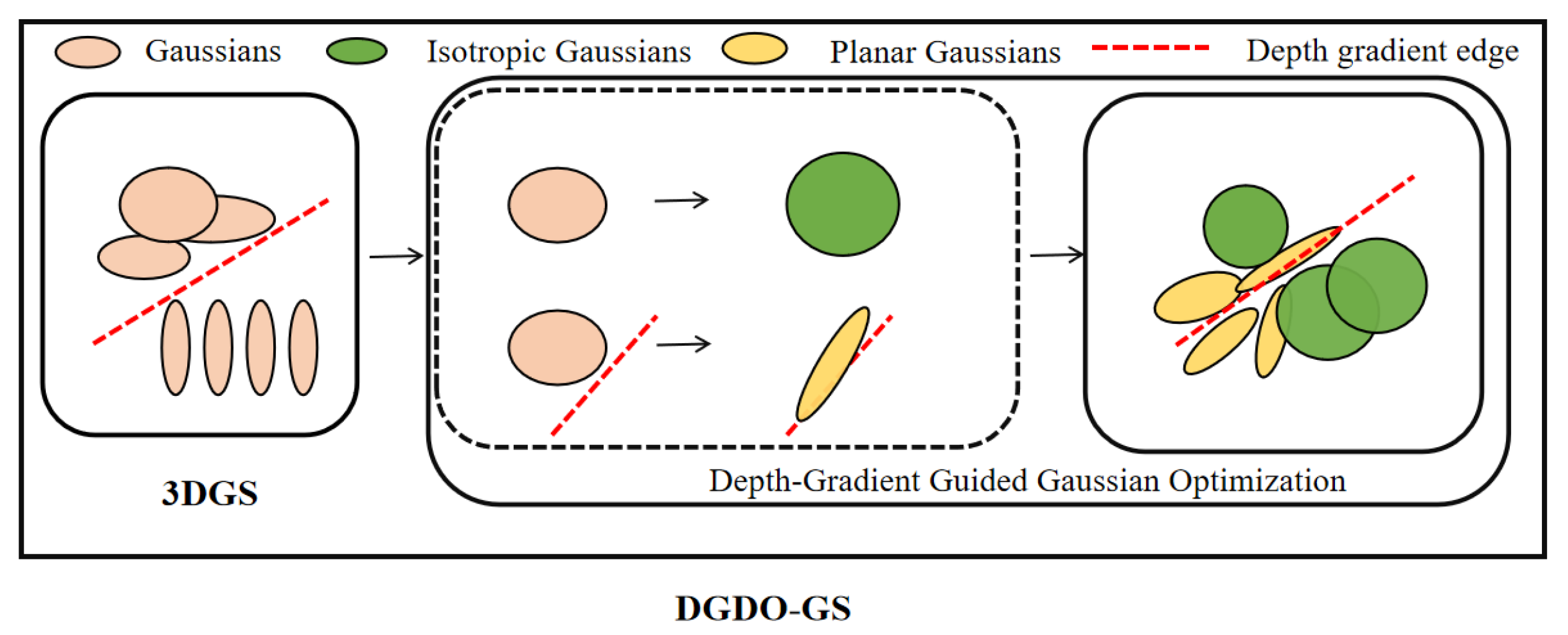
Figure 3.
Illustration of our Depth-Gradient-Guided Decoupled Optimization strategy. Compared to standard 3DGS, which relies solely on photometric loss and results in randomly oriented primitives and floating artifacts, our depth-gradient decoupled optimization anchors and flattens Gaussians at high-gradient edges, while maintaining isotropic/disk shapes in low-gradient regions through gradient consistency constraints. This region-adaptive strategy yields a geometrically coherent Gaussian distribution, enhancing reconstruction fidelity.
The total position loss is defined as . Its gradients are propagated only to the center parameters , ensuring that shape parameters remain unaffected.
3.3.2. Gradient-Aware Morphological Optimization
Inspired by FeatureGS [35], which demonstrates that adjusting Gaussian shapes based on local geometric features improves reconstruction quality, we further adjust the scaling and rotation according to depth-gradient magnitudes to better fit potential surfaces. Specifically, we define two ratios to quantify shape characteristics:
where are sorted scaling factors, measures the tendency toward a disk-like flat shape (suitable for surfaces), and measures the degree of isotropy (helpful for covering flat regions).
At high-gradient edges, primitives should adopt disk-like shapes to fit the surface; however, if edge depth estimation is unreliable, excessive stretching may introduce artifacts. To this end, we design a defensive weighting mechanism that dynamically adjusts constraint intensity based on the normalized gradient magnitude :
where are base weights, controls the influence intensity of the gradient, and is a bias term. This mechanism encourages flat shapes at reliable edges, penalizes over-stretching when gradients are suspicious, and uses isotropic constraints as a buffer.
The morphological loss is defined as
where and are regularization terms for the corresponding ratios (e.g., encouraging of edge-aligned Gaussians to approach 1 and of flat-region Gaussians to approach 1). The gradients of this loss are propagated only to the covariance parameters , achieving strict decoupling of shape and position.
3.4. Cross-View Geometric Propagation and Total Objective
To supervise unobserved regions, we draw inspiration from FSGS [8] and extend the constraints to pseudo views generated via spherical linear interpolation. Given two adjacent training cameras and , the synthesized pseudo-view pose is calculated as follows:
where is the interpolation parameter and is a small random perturbation added to the camera position to increase diversity. To avoid noise introduced by low-quality pseudo views, a quality filter is designed to retain reliable viewpoints:
On these valid viewpoints, the region-guided position constraints and gradient-aware morphological constraints are inherited, but morphological guidance is restricted to strong edge regions to prevent noise propagation:
3.5. Total Objective and Orthogonality
The final training objective integrates all components:
The decoupled design ensures strict gradient orthogonality in the parameter space:
This property prevents common geometric collapse in sparse-view optimization (i.e., positional errors contaminating shape learning, or morphological degradation hindering precise localization), thereby achieving robust and efficient scene representation learning under limited supervision.
4. Experiments
4.1. Experimental Setup
Datasets. The performance of the proposed method was evaluated on three widely recognized benchmarks: LLFF [10], Mip-NeRF360 [12], and Blender [11]. The LLFF dataset comprises eight forward-facing real-world scenes capturing various indoor and outdoor environments. Following the protocol in RegNeRF [36], every eighth image was reserved for testing, while three views were evenly sampled from the remaining images for training. The Mip-NeRF360 dataset consists of nine scenes featuring a prominent central object against a complex background. For this dataset, 24 training views were utilized, maintaining the same test-split strategy as LLFF. The Blender dataset provides eight synthetic objects rendered under diverse lighting conditions. Consistent with DietNeRF [37], experiments were conducted using eight images for training and 25 for testing.
Baselines. Our approach was compared against a comprehensive set of state-of-the-art techniques. These include NeRF-based methods, such as DietNeRF [37], RegNeRF [36], FreeNeRF [38], and SparseNeRF [39], as well as recent 3D Gaussian Splatting (3DGS) variants including 3DGS [7], DNGaussian [9], and FSGS [8]. Quantitative results were primarily sourced from their original publications. In cases where specific metrics were unavailable, we report results obtained by executing the official codebases with default configurations.
Metrics. To quantify the reconstruction quality, we report PSNR, SSIM [40], and LPIPS [40] scores. Furthermore, the Average Error (AVGE) [2] is computed to provide a consolidated performance measure, defined as the geometric mean of the Mean Squared Error (MSE, calculated as ), the structural dissimilarity , and LPIPS.
Implementation Details. We implemented our method using the PyTorch 2.11.0 framework [41]. The initial point cloud is computed from Structure-from-Motion (SfM) using only the training views. During optimization, we densify the Gaussians every 100 iterations starting from iteration 500. The total number of optimization steps is set to 30,000 (which can be adjusted to 10,000 for smaller datasets such as LLFF). Pseudo-view sampling begins after 2000 iterations. We utilize the pre-trained DPT-Large model for depth estimation. All experiments are conducted on a workstation equipped with an Intel Xeon CPU, 64 GB RAM (Intel, Santa Clara, CA, USA), and a single NVIDIA RTX 4090 GPU (24 GB VRAM) (NVIDIA, Santa Clara, CA, USA) under the Linux environment. The training time varies depending on scene complexity, taking approximately 12 min on the LLFF dataset and 30 min on the Mip-NeRF360 dataset.
4.2. Comparison with Other Methods
Comparison on the LLFF Dataset. On the LLFF dataset with only three training views, the proposed DGDO-GS method exhibits a pronounced superiority over a wide range of established baselines. The approach achieves a dual breakthrough in rendering fidelity and efficiency when compared to state-of-the-art NeRF-based models; specifically, it surpasses SparseNeRF [39] by elevating the PSNR from 19.86 dB to 20.32 dB and the SSIM from 0.624 to 0.685. Similar advantages are observed when benchmarking against DNGaussian [9], another method relying on depth-informed geometric priors for regularization. In this comparison, DGDO-GS delivers comprehensive improvements across all key metrics, including a substantial rise in PSNR (from 19.12 dB to 20.32 dB) and SSIM (from 0.591 to 0.685), alongside a significant reduction in LPIPS (from 0.294 to 0.236). Such consistent performance gains across diverse evaluation criteria validate that the proposed optimization strategy more effectively harnesses information from sparse viewpoints, ultimately fostering scene representations characterized by enhanced geometric coherence and richer structural details.
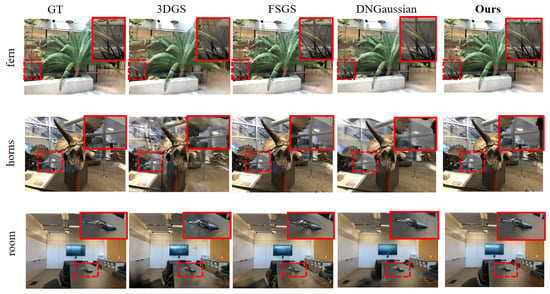
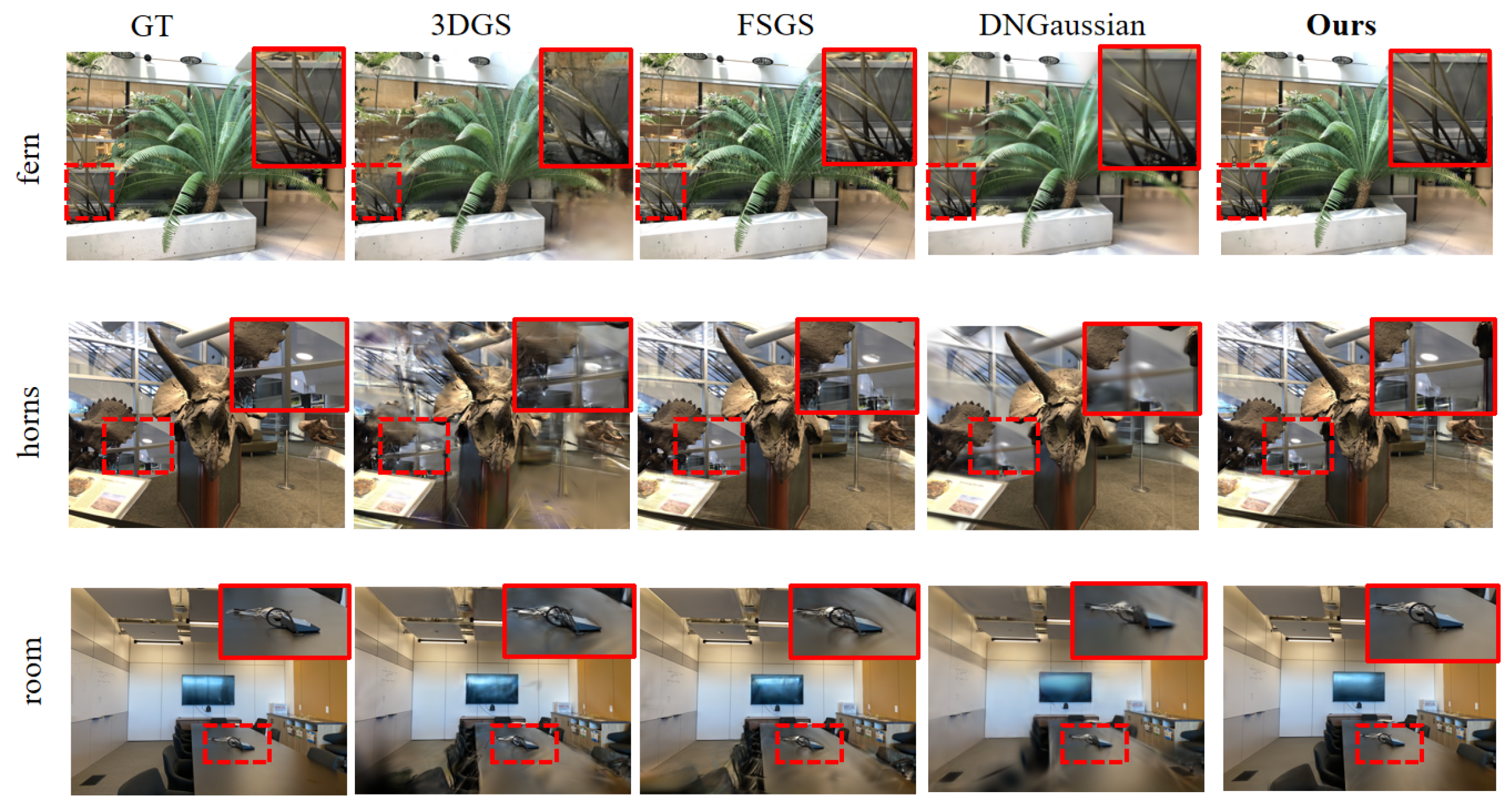
The qualitative analysis illustrated in Figure 4 reveals that under the extremely sparse three-view setting of the LLFF forward-facing scenes, various methods face significant challenges at scene boundaries and in regions with complex geometry. Specifically, due to the severe lack of multi-view observations, the vanilla 3DGS [7] generates widespread artifacts near scene edges and exhibits pronounced blurring in geometrically intricate areas (e.g., the Fern scene). While DNGaussian [9] incorporates depth information to regularize scene representations and mitigate geometric deficiencies, its reliance on imprecise or incomplete depth priors often results in blurred surfaces and a loss of fine details, as observed in the Horns scene. Similarly, although FSGS [8] captures richer texture details, the use of unreliable monocular depth maps leads to geometric inaccuracies, manifesting as missing Gaussians and incomplete object reconstructions in the Room scene. In contrast, our proposed DGDO-GS utilizes a targeted depth-gradient-guided optimization mechanism, which substantially enhances the representational fidelity of complex geometric structures. The experimental results demonstrate that our approach maintains high visual clarity while more completely recovering the scene’s texture and structural intricacies.
Figure 4.
Qualitative results on the LLFF dataset. 3DGS [7] lacks geometric constraints under sparse views, leading to distortion and blur; FSGS [8] expands coverage via Gaussian unpooling but misses thin details; DNGaussian [9] relies on noisy depth priors, causing incoherent boundaries. Our DGDO-GS decouples optimization with depth-gradient guidance, separately handling geometry and texture to recover intricate structures and high-frequency details with superior quality.
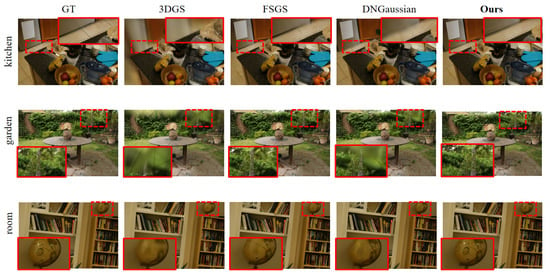
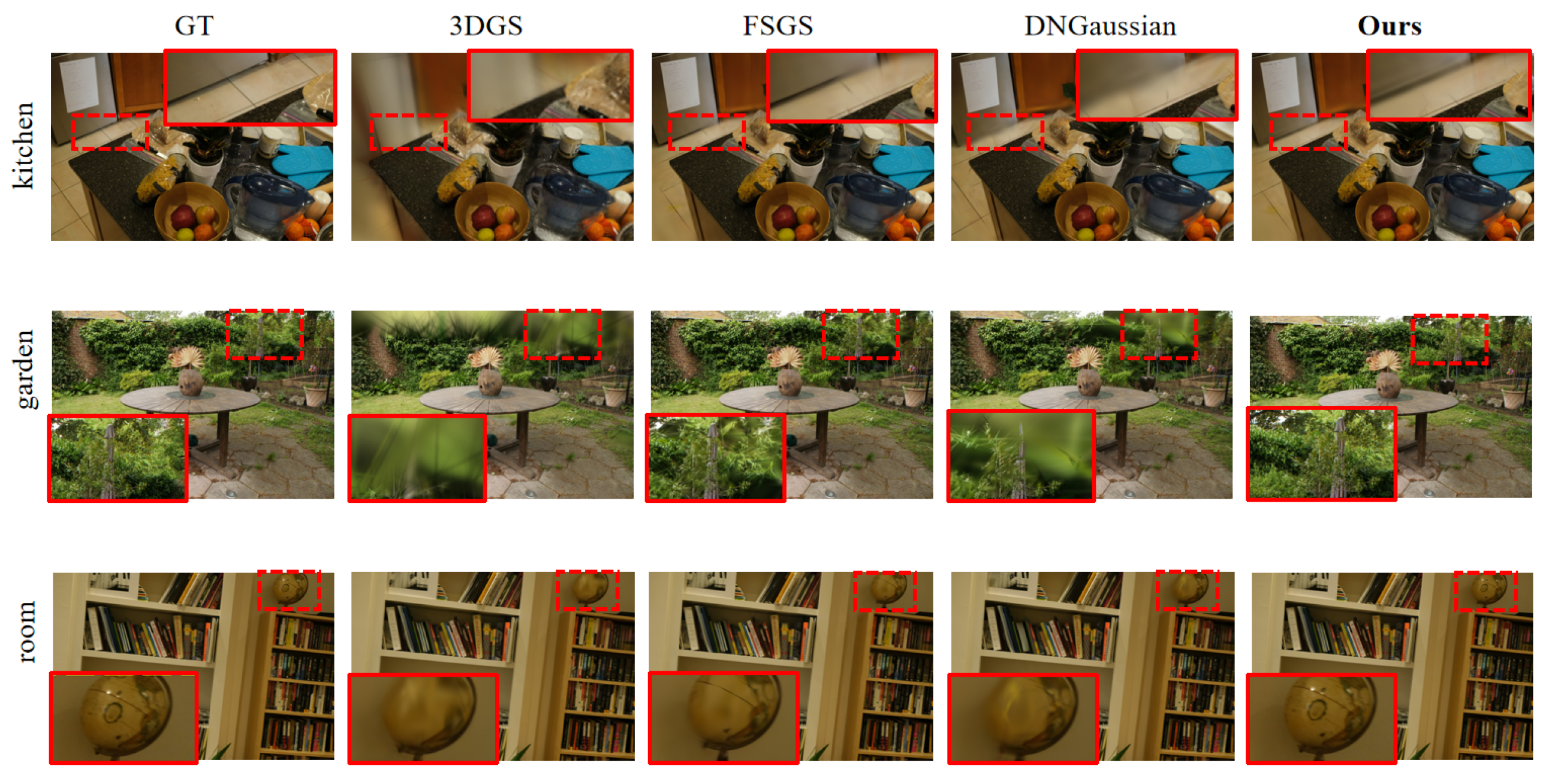
Comparison on the Mip-NeRF360 Dataset. The quantitative evaluation on the Mip-NeRF360 dataset under the 24-view setting, as summarized in Table 1, highlights the superior performance of DGDO-GS across several key metrics. Specifically, our method achieves state-of-the-art results in SSIM (0.736), LPIPS (0.227), and Average Error (0.082), demonstrating a remarkable capacity for preserving structural similarity and perceptual quality. While FSGS [8] maintains a slight lead in PSNR (23.40 dB vs. 23.27 dB), DGDO-GS’s consistent dominance in all other metrics indicates higher geometric fidelity and a significant reduction in visual artifacts. Beyond reconstruction quality, as a 3DGS-based approach, our method inherently benefits from the real-time rendering capability of Gaussian Splatting, representing a substantial leap in efficiency compared to NeRF-based baselines like SparseNeRF [39] and FreeNeRF [38]. Furthermore, the effectiveness of the proposed depth-gradient-guided decoupling is underscored by the substantial improvements over DNGaussian [9], which employs soft and hard depth regularization. In contrast, our method leverages depth gradients to decouple geometric optimization, achieving a 0.313 increase in SSIM and a 0.357 decrease in LPIPS on the Mip-NeRF360 dataset, demonstrating clear superiority among methods utilizing depth priors. These quantitative gains are corroborated by qualitative comparisons in Figure 5, where DGDO-GS’s advantages are clearly visible across diverse environments. In the Kitchen scene, while 3DGS produces distorted cabinet edges and DNGaussian over-smooths fine textures, DGDO-GS faithfully recovers sharp boundaries and intricate patterns that align closely with the ground truth. Similarly, in the Garden scene, our method successfully captures complex botanical structures with crisp boundaries, whereas competing methods either suffer from persistent floaters (3DGS) or lose delicate leaf details (DNGaussian and FSGS). Collectively, these results validate that the depth-gradient decoupling strategy, combined with the introduction of pseudo views for additional geometric supervision, effectively refines scene geometry and enhances reconstruction quality, even in complex scenarios with sparse observations.
Table 1.
Quantitative comparison on the Mip-NeRF360 dataset with 24 training views and the LLFF dataset with 3 training views. Our DGDO-GS method demonstrates superior performance on both datasets. On the LLFF dataset, DGDO-GS achieves the best results in SSIM and LPIPS, reaching 0.685 and 0.236, respectively, significantly outperforming existing methods. On the Mip-NeRF360 dataset, DGDO-GS ranks first in both SSIM and LPIPS, achieving 0.736 and 0.227, respectively, and also attains the best comprehensive error metric AVGE of 0.082. Color legend: red for best, orange for second best, and yellow for third best.
Figure 5.
Qualitative results on the MIP-NeRF360 dataset. Our method produces more accurate geometry and sharper textures, particularly in regions with complex structures and fine details, demonstrating its effectiveness on 360° scenes with 24 training views.
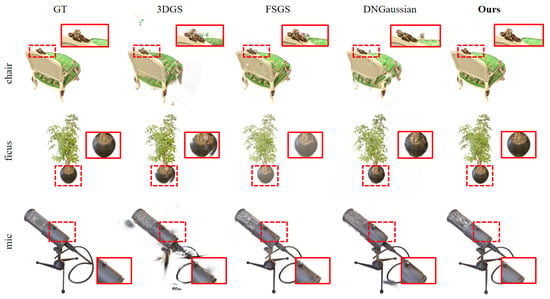
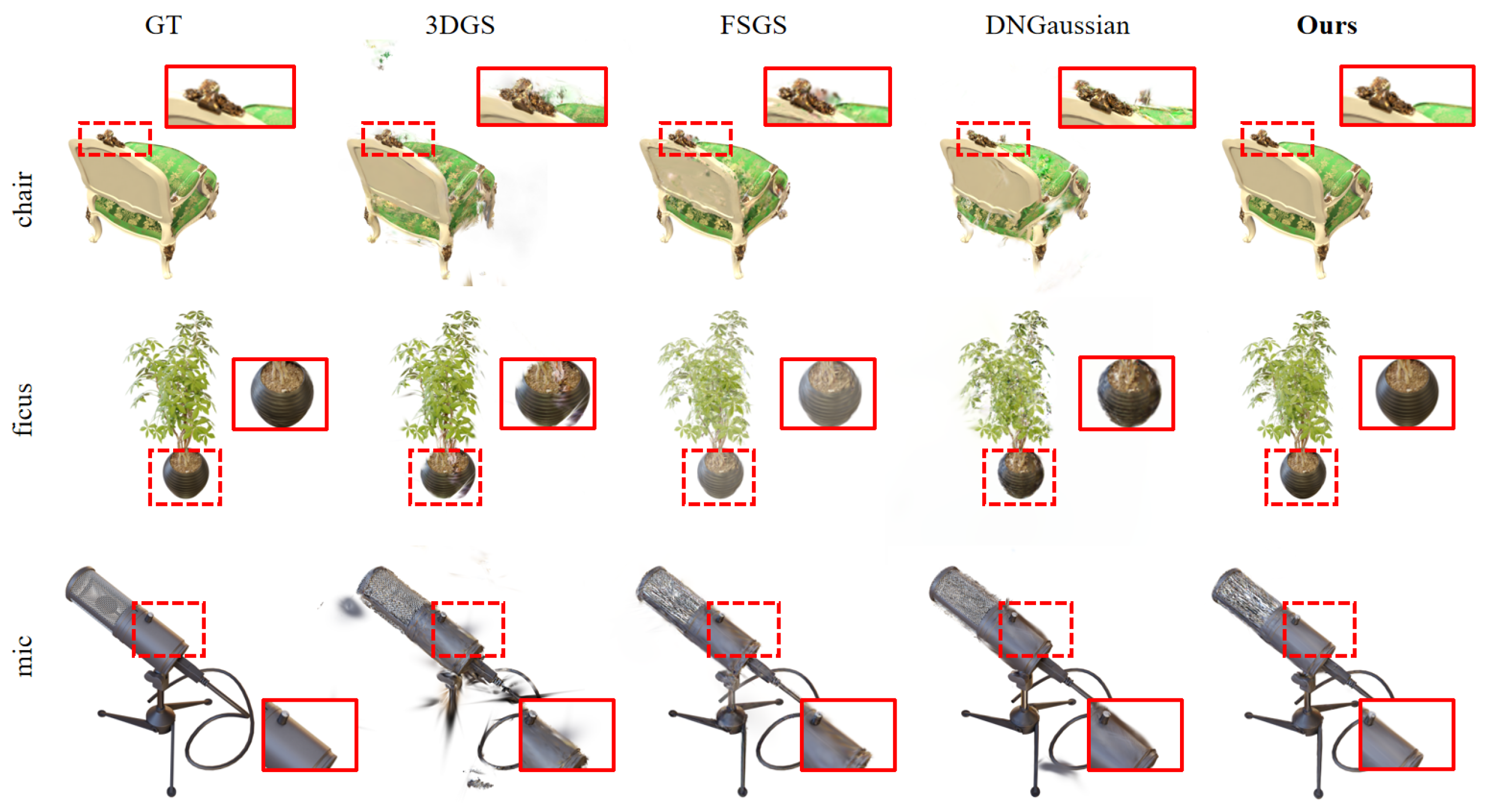
Comparison on the Blender Dataset. On the Blender synthetic dataset with eight training views, our DGDO-GS method achieves superior rendering quality while maintaining the real-time inference advantage inherent to 3DGS-based approaches. As shown in Table 2, DGDO-GS attains state-of-the-art results in SSIM (0.887), LPIPS (0.089), and Average Error (0.048), demonstrating its strong capability in recovering fine textures and handling complex illumination. While FreeNeRF [38] achieves a slightly higher PSNR (24.26 dB vs. 24.13 dB), our method consistently outperforms all other baselines across the remaining metrics, indicating a better balance between pixel-wise accuracy and perceptual quality. In contrast, FSGS [8] lags behind with lower scores in all four metrics, confirming the effectiveness of our depth-gradient-guided optimization over simple Gaussian unpooling strategies (Figure 6).
Table 2.
Quantitative comparison on the Blender dataset with 8 training views. Our DGDO-GS method achieves the best results across all metrics, reaching PSNR of 24.13 dB, SSIM of 0.887, LPIPS of 0.089, and AVGE of 0.048, demonstrating superior reconstruction quality and perceptual fidelity. Color legend: red for best, orange for second best, and yellow for third best.
Figure 6.
Qualitative results on the Blender dataset. Compared to existing baselines, our method exhibits consistently higher fidelity in novel-view synthesis on object-centric datasets.
Compared with DNGaussian [9]—which also leverages depth priors through soft and hard regularization—DGDO-GS improves PSNR by 0.06 dB and SSIM by 0.002, and it reduces LPIPS by 0.001 and AVGE by 0.001. Although these absolute gains are modest, they are consistent across all metrics, underscoring the advantage of decoupling geometry and texture optimization via depth gradients. Furthermore, as a 3DGS-based method, DGDO-GS benefits from real-time rendering speeds, representing a substantial leap in efficiency compared to NeRF-based baselines such as SparseNeRF [39] and FreeNeRF [38]. These quantitative results, together with the qualitative comparisons in Figure 5 (where similar trends are observed across diverse scenes), validate that our depth-gradient decoupling strategy, combined with pseudo-view augmentation, effectively refines scene geometry and enhances reconstruction fidelity even on challenging synthetic objects under sparse input conditions.
4.3. Ablation Experiments
We conducted a comprehensive ablation study on the LLFF dataset under the three-view setting to validate the effectiveness of each core component in our DGDO-GS framework. All experiments followed the same training configuration described in Section 4.1, and the results were reported in Table 3 with qualitative comparisons in Figure 7.
Table 3.
Ablation study on the LLFF dataset with 3 views. Starting from the baseline 3DGS [7] (first row), we progressively add the proposed components. Position and Shape Guidance together constitute our Depth-Gradient-Guided Decoupled Optimization strategy.
Figure 7.
Qualitative ablation study results. The first column shows the baseline 3DGS, which exhibits severe artifacts under sparse views. The second column incorporates our Depth-Gradient-Guided Decoupled Optimization (both Position and Shape Guidance), significantly improving geometric consistency while still missing some fine details. The third column further adds pseudo-view supervision, yielding the most faithful reconstruction of intricate structures.
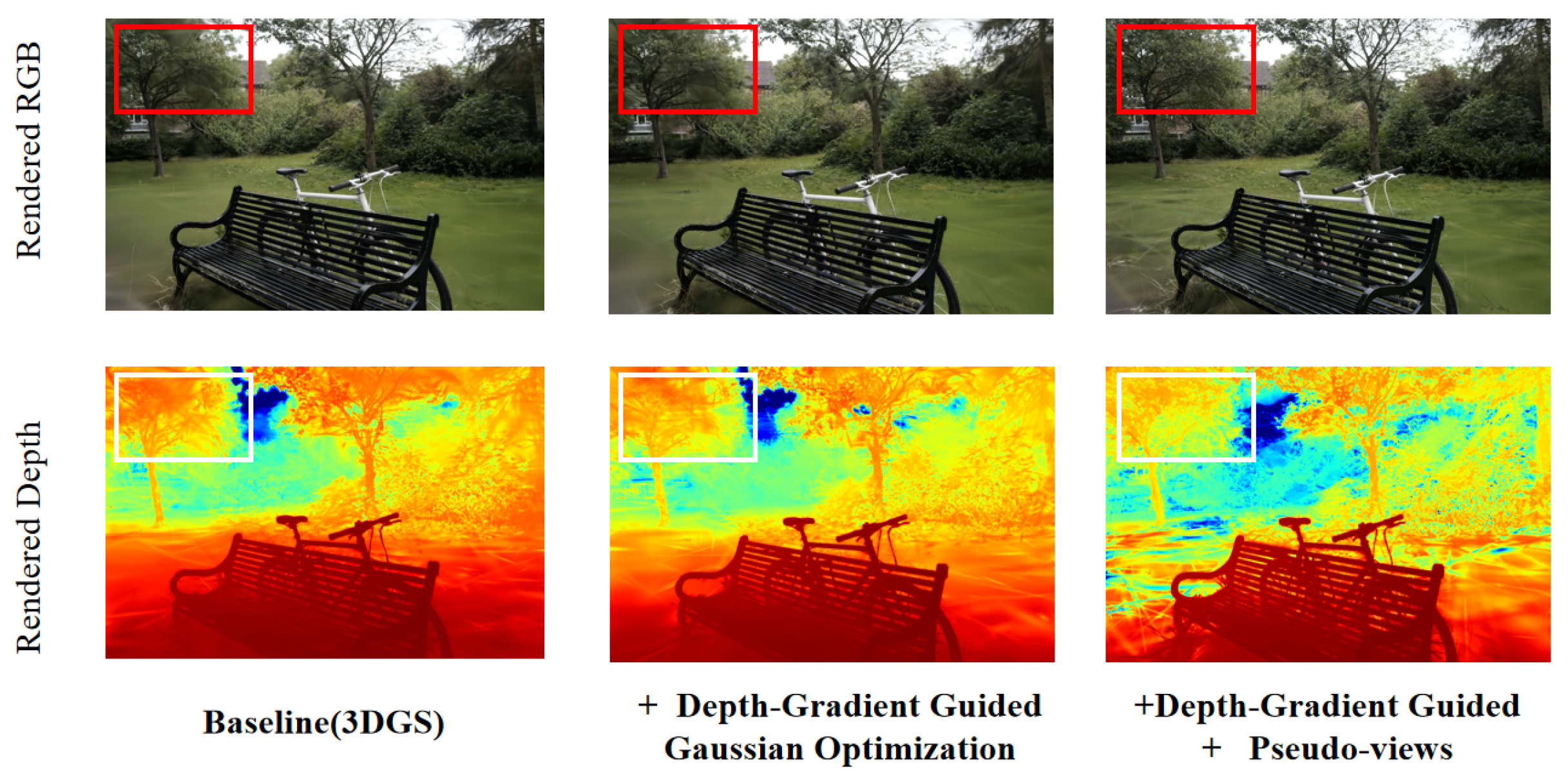
Impact of Depth-Gradient-Guided Decoupled Optimization. Our core innovation—the Depth-Gradient-Guided Decoupled Optimization—was evaluated by adding Position Guidance and Shape Guidance sequentially. As shown in Table 3, introducing only Position Guidance (second row) improves PSNR from 17.43 dB to 18.42 dB and SSIM from 0.522 to 0.556, while reducing LPIPS to 0.315. This demonstrates that anchoring Gaussian centers with region-aware depth constraints effectively mitigates positional drift. When Shape Guidance is further activated (third row), the performance increases markedly to 19.86 dB PSNR, 0.617 SSIM, and 0.309 LPIPS. The 1.44 dB gain over the position-only variant confirms that adjusting primitive morphology according to depth gradients—flattening Gaussians along reliable edges and maintaining isotropy in flat regions—is essential for capturing geometric details. Qualitatively, the second column of Figure 7 shows that this decoupled strategy suppresses floating artifacts in textureless areas (e.g., the background tree) while preserving sharper edges (e.g., lawn) compared to the baseline, verifying its ability to reconcile global smoothness and local detail preservation.
Importance of Pseudo-View Constraints in Few-Shot Modeling. Even with the optimized geometry, sparse observations still leave under-constrained regions. The fourth row of Table 3 reveals that adding pseudo-view supervision on top of the full decoupled optimization yields the best results: PSNR reaches 20.23 dB, SSIM 0.685, and LPIPS 0.236. The substantial improvement in SSIM (from 0.617 to 0.685) and LPIPS (from 0.309 to 0.236) indicates that pseudo views effectively regularize the scene by providing additional geometric cues, especially in occluded or weakly observed areas. As shown in the third column of Figure 7, introducing pseudo-view supervision guides the Gaussian distribution to better adhere to the true geometry, significantly enhancing the modeling quality of detailed regions that remain blurred or geometrically inaccurate in the second column. This confirms that augmenting the training set with geometrically consistent virtual viewpoints helps anchor Gaussians to plausible surfaces and mitigates overfitting to the limited real views.
Limitations and Future Work. Despite the significant improvements, our method has limitations. First, the performance still degrades when the number of input views is reduced to 1 or 2, suggesting that fundamental information limits exist. Second, the method assumes relatively accurate camera poses, which may not be available in all real-world scenarios. Future work could explore integrating pose estimation within the optimization framework and investigating self-supervised techniques for extreme sparse-view reconstruction.
5. Conclusions
In this work, we propose a few-shot view synthesis framework for sparse input based on depth-gradient-guided joint optimization. Our method addresses the problems of insufficient representation capability and overfitting of 3D Gaussian Splatting under sparse conditions by introducing a depth-gradient-aware global–local optimization strategy. This strategy simulates missing parallax cues by generating pseudo views and combines monocular depth priors for structure calibration and geometric regularization, effectively guiding the sparse initial point set to grow into a more representative geometric structure. Our method can generate high-quality novel views using only three input images and render in real-time at a speed exceeding 150 FPS, opening up a new way for low-cost and high-efficiency 3D scene capture and reconstruction.
Although our method significantly improves the quality and efficiency of few-shot neural rendering, it still struggles to generalize to occluded views that are completely invisible during training. We hope that the proposed ideas can promote subsequent research on few-shot novel-view synthesis in arbitrary complex 3D scenes.
Author Contributions
Conceptualization, X.L.; software, X.L.; validation, X.L.; investigation, X.L.; writing—original draft preparation, X.L.; writing—review and editing, H.W. and Z.W.; supervision, H.W. and Z.W.; project administration, H.W. and Z.W.; funding acquisition, H.W. and Z.W. All authors have read and agreed to the published version of the manuscript.
Funding
This research received no external funding.
Institutional Review Board Statement
Not applicable.
Informed Consent Statement
Not applicable.
Data Availability Statement
The data presented in this study are available on request from the corresponding author.
Conflicts of Interest
The authors declare no conflicts of interest.
Abbreviations
The following abbreviations are used in this manuscript:
| 3DGS | 3D Gaussian Splatting |
| NVS | Novel-View Synthesis |
| GPU | Graphics Processing Unit |
| MLP | Multi-layer Perception |
| NeRF | Neural Radiance Fields |
| VR | Virtual Reality |
| AR | Augmented Reality |
| DPT | Dense Prediction Transformer |
| SfM | Structure-from-Motion |
| PSNR | Peak Signal-to-Noise Ratio |
| SSIM | Structural Similarity Index Measure |
| LPIPS | Learned Perceptual Image Patch Similarity |
| AVGE | Average Error |
| SH | Spherical Harmonics |
| MSE | Mean Squared Error |
| D-SSIM | Distorted Structural Similarity Index Measure |
| COLMAP | COLMAP Structure-from-Motion Software |
| Slerp | Spherical Linear Interpolation |
References
- Avidan, S.; Shashua, A. Novel view synthesis in tensor space. In Proceedings of the IEEE Computer Society Conference on Computer Vision and Pattern Recognition, San Juan, PR, USA, 17–19 June 1997; pp. 1–8. [Google Scholar]
- Mildenhall, B.; Srinivasan, P.P.; Tancik, M.; Barron, J.T.; Ramamoorthi, R.; Ng, R. NeRF: Representing scenes as neural radiance fields for view synthesis. Commun. ACM 2021, 65, 99–106. [Google Scholar] [CrossRef] [Scilit]
- Tolstikhin, I.O.; Houlsby, N.; Kolesnikov, A.; Beyer, L.; Zhai, X.; Unterthiner, T.; Yung, J.; Steiner, A.; Keysers, D.; Uszkoreit, J. MLP-Mixer: An all-MLP architecture for vision. Adv. Neural Inf. Process. Syst. 2021, 34, 24261–24272. [Google Scholar]
- Cui, Z.; Zhang, Y.; Wang, X.; Li, G. Aleth-NeRF: Illumination adaptive NeRF with concealing field assumption. In Proceedings of the AAAI Conference on Artificial Intelligence, Vancouver, BC, Canada, 20–27 February 2024; Volume 38, pp. 1687–1695. [Google Scholar]
- Lee, J.L.; Li, C.; Lee, G.H. DISR-NeRF: Diffusion-guided view-consistent super-resolution NeRF. In Proceedings of the IEEE/CVF Conference on Computer Vision and Pattern Recognition, Seattle, WA, USA, 16–22 June 2024; pp. 21012–21022. [Google Scholar]
- Li, H.; Wang, P.; Liu, Y.; Li, G. GP-NeRF: Generalized perception NeRF for context-aware 3D scene understanding. In Proceedings of the IEEE/CVF Conference on Computer Vision and Pattern Recognition, Seattle, WA, USA, 16–22 June 2024; pp. 18901–18911. [Google Scholar]
- Kerbl, B.; Kopanas, G.; Leimkühler, T.; Drettakis, G. 3D Gaussian splatting for real-time radiance field rendering. ACM Trans. Graph. 2023, 42, 139:1–139:14. [Google Scholar] [CrossRef] [Scilit]
- Zhu, Z.; Chen, X.; Xu, M.; Wang, C.; Li, H.; Lin, S. FSGS: Real-time few-shot view synthesis using Gaussian splatting. In Proceedings of the European Conference on Computer Vision, Milan, Italy, 29 September–4 October 2024; Springer: Cham, Switzerland, 2024; pp. 597–614. [Google Scholar]
- Li, J.; Zhang, Y.; Li, G. DNGaussian: Optimizing sparse-view 3D Gaussian radiance fields with global-local depth normalization. In Proceedings of the IEEE/CVF Conference on Computer Vision and Pattern Recognition, Seattle, WA, USA, 16–22 June 2024; pp. 20103–20113. [Google Scholar]
- Mildenhall, B.; Barry, A.; Chen, R.; Sharlet, D.; Srinivasan, P.P.; Ng, R. Local light field fusion: Practical view synthesis with prescriptive sampling guidelines. ACM Trans. Graph. 2019, 38, 29. [Google Scholar] [CrossRef] [Scilit]
- Jensen, R.; Dahl, A.; Vogiatzis, G.; Nistér, D.; Stewénius, H. Large scale multi-view stereopsis evaluation. In Proceedings of the IEEE Conference on Computer Vision and Pattern Recognition, Columbus, OH, USA, 23–28 June 2014; pp. 406–413. [Google Scholar]
- Barron, J.T.; Mildenhall, B.; Tancik, M.; Srinivasan, P.P.; Funkhouser, T.; Ng, R. Mip-NeRF 360: Unbounded anti-aliased neural radiance fields. In Proceedings of the IEEE/CVF Conference on Computer Vision and Pattern Recognition, New Orleans, LA, USA, 18–24 June 2022; pp. 5455–5464. [Google Scholar]
- Dai, S.; Wang, S. HR-NeRF: Advancing realism and accuracy in highlight scene representation. Front. Neurorobot. 2025, 19, 1558948. [Google Scholar] [CrossRef] [Scilit] [PubMed]
- Nguyen, H.; Li, B.R.; Nguyen, T. DWTNeRF: Boosting few-shot neural radiance fields via discrete wavelet transform. arXiv 2025, arXiv:2501.12637. [Google Scholar]
- Chen, A.; Xu, Z.; Zhao, F.; Zhang, X.; Xiang, F.; Yu, J.; Su, H. Tensorf: Tensorial radiance fields. In Proceedings of the European Conference on Computer Vision, Tel Aviv, Israel, 23–27 October 2022; Springer: Cham, Switzerland, 2022; pp. 333–350. [Google Scholar]
- Fridovich-Keil, S.; Yu, A.; Tancik, M.; Ng, R. Plenoxels: Radiance fields without neural networks. In Proceedings of the IEEE/CVF Conference on Computer Vision and Pattern Recognition, New Orleans, LA, USA, 18–24 June 2022; pp. 21745–21755. [Google Scholar]
- Biswas, S.; Wu, Q.; Banerjee, B.; Rezatofighi, H. TFS-NeRF: Template-free NeRF for semantic 3D reconstruction of dynamic scene. Adv. Neural Inf. Process. Syst. 2024, 37, 114458–114477. [Google Scholar]
- Wirth, T.; Rak, A.; von Buelow, M.; Knauthe, V.; Kuijper, A.; Fellner, D.W. NeRF-FF: A plug-in method to mitigate defocus blur for runtime optimized neural radiance fields. Vis. Comput. 2024, 40, 5043–5055. [Google Scholar] [CrossRef] [Scilit]
- Luiten, J.; Kopanas, G.; Leibe, B.; Ramanan, D. Dynamic 3D Gaussians: Tracking by persistent dynamic view synthesis. In Proceedings of the International Conference on 3D Vision (3DV), Davos, Switzerland, 18–21 March 2024; IEEE: New York, NY, USA, 2024. [Google Scholar]
- Tang, J.; Ren, J.; Zhou, H.; Liu, Z.; Zeng, G. DreamGaussian: Generative Gaussian splatting for efficient 3D content creation. arXiv 2023, arXiv:2309.16653. [Google Scholar]
- Wu, G.; Yi, T.; Fang, J.; Xie, L.; Zhang, X.; Wei, W.; Liu, W.; Tian, Q.; Wang, X. 4D Gaussian splatting for real-time dynamic scene rendering. In Proceedings of the IEEE/CVF Conference on Computer Vision and Pattern Recognition, Seattle, WA, USA, 16–22 June 2024; pp. 20310–20320. [Google Scholar]
- Zhang, Y.; Wei, J.; Zhou, B.; Li, F.; Xie, Y.; Liu, J. TVNeRF: Improving few-view neural volume rendering with total variation maximization. Knowl.-Based Syst. 2024, 301, 112273. [Google Scholar] [CrossRef] [Scilit]
- Xu, J.; Deng, K.; Fan, Z.; Wang, S.; Xie, J.; Yang, J. AD-GS: Object-Aware B-Spline Gaussian Splatting for Self-Supervised Autonomous Driving. In Proceedings of the IEEE/CVF International Conference on Computer Vision, Honolulu, HI, USA, 19–20 October 2025; pp. 24770–24779. [Google Scholar]
- Hu, W.; Tian, C.; Wen, L.; Ding, H. TD-NeRF: Transfer learning and diffusion regulation based NeRF for scene perception. IEEE Trans. Instrum. Meas. 2024, 74, 5004512. [Google Scholar] [CrossRef] [Scilit]
- Uy, M.A.; Martin-Brualla, R.; Guibas, L.; Li, K. Scade: NeRFs from space carving with ambiguity-aware depth estimates. In Proceedings of the IEEE/CVF Conference on Computer Vision and Pattern Recognition, Vancouver, BC, Canada, 17–24 June 2023; pp. 16531–16540. [Google Scholar]
- Kong, H.; Yang, X.; Wang, X. Generative Sparse-View Gaussian Splatting. In Proceedings of the IEEE/CVF Conference on Computer Vision and Pattern Recognition, Nashville, TN, USA, 10–17 June 2025; pp. 26745–26755. [Google Scholar]
- Du, S.; Liu, J.; Chen, Q.; Chen, H.X.; Mu, T.J.; Yang, S. RGE-GS: Reward-guided expansive driving scene reconstruction via diffusion priors. arXiv 2025, arXiv:2506.22800. [Google Scholar]
- Liu, X.; Zhou, C.; Huang, S. 3DGS-Enhancer: Enhancing unbounded 3D Gaussian splatting with view-consistent 2D diffusion priors. Adv. Neural Inf. Process. Syst. 2024, 37, 133305–133327. [Google Scholar]
- Kim, M.; Jeon, S.; Cho, I.; Yoo, M.; Kim, S.J. ExploreGS: Explorable 3D Scene Reconstruction with Virtual Camera Samplings and Diffusion Priors. In Proceedings of the IEEE/CVF International Conference on Computer Vision, Honolulu, HI, USA, 19–20 October 2025. [Google Scholar]
- Paliwal, A.; Zhou, X.; Ye, W.; Xiong, J.; Ranjan, R.; Kalantari, N.K. RI3D: Few-shot Gaussian splatting with repair and inpainting diffusion priors. arXiv 2025, arXiv:2503.10860. [Google Scholar]
- Cheng, K.; Long, X.; Yang, K.; Yao, Y.; Yin, W.; Ma, Y.; Wang, W.; Chen, X. GaussianPro: 3D Gaussian splatting with progressive propagation. In Proceedings of the International Conference on Machine Learning (ICML), Vienna, Austria, 21–27 July 2024. [Google Scholar]
- Schönberger, J.L.; Frahm, J.-M. Structure-from-Motion Revisited. In Proceedings of the IEEE Conference on Computer Vision and Pattern Recognition (CVPR), Las Vegas, NV, USA, 27–30 June 2016; pp. 4104–4113. [Google Scholar]
- Schönberger, J.L.; Zheng, E.; Pollefeys, M.; Frahm, J.-M. Pixelwise View Selection for Unstructured Multi-View Stereo. In Proceedings of the European Conference on Computer Vision (ECCV), Amsterdam, The Netherlands, 11–14 October 2016; pp. 501–518. [Google Scholar]
- Ranftl, R.; Bochkovskiy, A.; Koltun, V. Vision Transformers for Dense Prediction. In Proceedings of the IEEE/CVF International Conference on Computer Vision (ICCV), Montreal, QC, Canada, 10–17 October 2021; pp. 12179–12188. [Google Scholar]
- Jäger, M.; Hillemann, M.; Jutzi, B. FeatureGS: Eigenvalue-feature optimization in 3D Gaussian splatting for geometrically accurate and artifact-reduced reconstruction. ISPRS Open J. Photogramm. Remote Sens. 2025, 17, 100100. [Google Scholar] [CrossRef] [Scilit]
- Yariv, L.; Fischer, T.; Lin, Z.; Atzmon, M.; Lipman, Y. RegNeRF: Regularizing Neural Radiance Fields for View Synthesis from Sparse Inputs. Adv. Neural Inf. Process. Syst. 2021, 34, 23611–23622. [Google Scholar]
- Schwarz, K.; Liao, Y.; Niemeyer, M.; Geiger, A. DietNeRF: Distilling Neural Radiance Fields for Few-Shot View Synthesis. In Proceedings of the IEEE/CVF International Conference on Computer Vision, Montreal, QC, Canada, 10–17 October 2021; pp. 4763–4772. [Google Scholar]
- Chen, X.; Zhang, Y.; Li, G. FreeNeRF: Frequency Modulation for Few-Shot Neural Radiance Fields. In Proceedings of the IEEE/CVF Conference on Computer Vision and Pattern Recognition, Vancouver, BC, Canada, 17–24 June 2023; pp. 12345–12354. [Google Scholar]
- Zhang, H.; Wang, Y.; Liu, Z. SparseNeRF: Depth Ranking Guided Neural Radiance Fields for Sparse View Synthesis. In Proceedings of the European Conference on Computer Vision, Tel Aviv, Israel, 23–27 October 2022; pp. 678–694. [Google Scholar]
- Zhang, R.; Isola, P.; Efros, A.A.; Shechtman, E.; Wang, O. The Unreasonable Effectiveness of Deep Features as a Perceptual Metric. In Proceedings of the IEEE/CVF Conference on Computer Vision and Pattern Recognition, Salt Lake City, UT, USA, 18–23 June 2018; pp. 586–595. [Google Scholar]
- Paszke, A.; Gross, S.; Massa, F.; Lerer, A.; Bradbury, J.; Chanan, G.; Killeen, T.; Lin, Z.; Gimelshein, N.; Antiga, L.; et al. PyTorch: An Imperative Style, High-Performance Deep Learning Library. Adv. Neural Inf. Process. Syst. 2019, 32, 8024–8035. [Google Scholar]

Disclaimer/Publisher’s Note: The statements, opinions and data contained in all publications are solely those of the individual author(s) and contributor(s) and not of MDPI and/or the editor(s). MDPI and/or the editor(s) disclaim responsibility for any injury to people or property resulting from any ideas, methods, instructions or products referred to in the content. |
© 2026 by the authors. Licensee MDPI, Basel, Switzerland. This article is an open access article distributed under the terms and conditions of the Creative Commons Attribution (CC BY) license.