


Abstract
Customer churn refers to the termination of a customer’s business relationship with a bank, representing a direct loss of future revenue. Product downsell manifests as a reduction in the number of financial products held or a downgrade in service tier, often signaling early customer disengagement. Accurately identifying customers at risk of these two behaviors has become a cornerstone of profitable growth in the competitive retail banking industry as downsell frequently serves as a precursor to total churn. However, the existing research typically treats these highly correlated behaviors as independent prediction tasks, overlooking their intrinsic link and failing to address the critical challenges of class imbalance and regulatory demands for model interpretability. To tackle these problems, we propose an enhanced multi-task learning network (EMTL-Net), a deep learning framework specifically designed to capture the nuanced interplay between churn and downsell behaviors. EMTL-Net introduces an explicit feature interaction module to enhance the modeling of high-order feature relationships and utilizes a shared representation layer to extract universal customer risk patterns, enabling the joint prediction of churn and downsell. Furthermore, we employ Focal Loss as the training objective to dynamically adjust sample weights, effectively mitigating the class imbalance problem. Critically, to meet financial compliance requirements, we implement a SHAP-based interpretation mechanism that is compatible with multi-task outputs, providing preliminary insights into feature importance. Formal validation of interpretability claims remains an important direction for future research. The experimental results on a publicly available pedagogical bank customer benchmark dataset demonstrate that EMTL-Net achieves excellent performance on both tasks. For churn prediction, the model achieves an AUC of 0.8259, an accuracy of 0.8361, and an F1-score of 0.6235, significantly outperforming the existing baseline models. For downsell prediction (noting that the downsell label is rule-derived from the number of products held), the model achieves an AUC of 0.8932, an accuracy of 0.8571, and an F1-score of 0.7504. Ablation studies confirm the critical contributions of the explicit feature interaction module, Focal Loss, and the residual structure to model performance. Crucially, the interpretability analysis corroborates business intuition by identifying customer age, account balance, and product holdings as dominant churn drivers—a consistency that reinforces the model’s credibility and practical utility in high-stakes financial environments.
1. Introduction
Customer churn is defined as the complete cessation of a customer’s relationship with a bank, representing a direct loss of future revenue. Product downsell refers to a reduction in the number of financial products held or a downgrade in service tier, which often signals early customer disengagement. Both phenomena impose substantial costs on retail banks: customer churn directly reduces revenue streams and increases acquisition expenses, while product downsell erodes customer lifetime value and weakens cross-selling opportunities. From a profitability perspective, retaining existing customers is significantly more cost-effective than acquiring new ones, making the early detection of both churn and downsell risks a strategic imperative.
With the intensification of competition in the retail banking sector, the cost of acquiring new customers is continuously rising. Consequently, effectively identifying potential churned customers and assessing the risk of product downgrades have become core tasks in bank customer relationship management (CRM). Customer churn [1] refers to the termination of the business relationship between a customer and the bank, while product downsell manifests as a customer reducing the number of financial products held or lowering product tiers. Although these two phenomena are often highly correlated, the existing research typically treats them as independent tasks, neglecting their intrinsic link. Furthermore, bank customer data generally suffers from class imbalance, leading to suboptimal recall rates in traditional models. Specifically, based on the dataset, churned customers account for approximately 20% of the total population, while product downsell events—often serving as a subtle precursor to total attrition—exhibit a notably higher prevalence at approximately 50%, as indicated by the binary downsell-target feature distribution [2]. Despite the relatively balanced downsell target ratio, the inherent sparsity of positive churn labels still poses a significant challenge for joint optimization [3] as the model may easily converge to a majority-class bias when predicting the minority churn class. Meanwhile, financial regulations are imposing increasingly strict requirements on model interpretability, especially in high-risk scenarios involving customer credit and marketing; “black-box” models often fail to meet these compliance demands. To address these intertwined challenges of class imbalance, joint task learning, and model interpretability, we propose an enhanced multi-task learning network, a unified framework that is capable of simultaneously predicting customer churn and downsell while possessing both predictive robustness and decision transparency.
Despite certain achievements in the existing research on customer churn prediction, traditional machine learning [4,5,6,7] methods such as logistic regression, random forests [8], and XGBoost have been widely applied. However, their ability to model high-order feature interactions is limited. In recent years, deep learning [9,10] methods have gradually been introduced into the field of financial risk control, utilizing Multi-Layer Perceptrons (MLPs) or hybrid structures (such as Wide&Deep) to capture non-linear relationships. Nevertheless, most approaches remain single-task learning, failing to fully leverage the shared information between tasks. Multi-task learning (MTL) [11], which improves model generalization by sharing underlying representations, offers a promising solution. However, its application in the joint prediction of bank customer churn and downsell remains largely unexplored. Additionally, the class imbalance problem has not been fully resolved in deep learning; while Focal Loss has performed excellently in the field of computer vision, its applicability in financial customer behavior prediction still requires validation. At the same time, model interpretability research has mostly focused on single-task models. There is a lack of systematic exploration into interpretation methods for multi-task structures, particularly in structured tabular data scenarios, where effectively embedding explanation tools like SHAP into deep multi-task models remains a technical challenge.
The field of customer churn prediction has evolved significantly with the rapid advancement of machine learning and deep learning technologies. Globally, research has transitioned from traditional statistical models to complex task-specific architectures. Trinh et al. [12] pioneered an MTL framework that integrates explainable AI (XAI) to optimize churn prediction, demonstrating that joint learning across correlated tasks can significantly enhance model robustness. Similarly, Hassan et al. [13] highlighted the necessity of transparency in financial AI, utilizing SHAP-based interpretations to bridge the gap between high-performance “black-box” models and the stringent regulatory requirements of the banking industry. These international efforts have established a solid foundation for utilizing deep learning to handle high-dimensional financial data [14].
Domestically, Chinese researchers have made substantial contributions by tailoring deep learning models to local banking patterns. For instance, the TBformer architecture [15] introduced multi-scale Transformer blocks with time–behavior attention to capture long-term temporal dependencies [16]. Other domestic advancements include the use of Coordinate Attention-based CNN–BiLSTM models [17] to identify localized risk signals in heterogeneous datasets. Furthermore, to address the pervasive issue of data scarcity and class imbalance, researchers have proposed multi-strategy collaborative processing methods [18] that integrate advanced resampling with cost-sensitive objectives.
Despite these advancements, several critical challenges remain unresolved. Most existing models treat churn and downsell as isolated events, overlooking the intrinsic economic link where a downsell often serves as a precursor to total attrition. Furthermore, while implicit feature crossing in neural networks is widely used, it often lacks the stability required for tabular data with sparse signals. To fill these gaps, this paper proposes EMTL-Net, an enhanced multi-task framework [19] that incorporates an explicit feature interaction (EFI) module and shared representation layers to jointly model the dual risks of churn and downsell, ensuring both superior predictive accuracy and high interpretability.
The main contributions of this study are threefold:
- 1.
- Methodological Contribution: We propose EMTL-Net, an enhanced multi-task learning framework that jointly predicts customer churn and product downsell through an explicit feature interaction module and a shared representation layer.
- 2.
- Class Imbalance Handling: We integrate Focal Loss into the multi-task optimization objective to address the severe class imbalance inherent in banking datasets, improving sensitivity to minority classes.
- 3.
- Interpretability for Multi-Task Models: We implement a SHAP-based interpretation mechanism that is compatible with multi-output architectures, providing both global feature importance and local explanations to meet financial compliance requirements.
2. Background
This section lays the theoretical foundation for the proposed EMTL-Net framework by reviewing the relevant concepts and literature. We first provide the preliminaries, formalizing the definitions of customer churn and downsell prediction and elucidating the principles of MTL and Focal Loss. Following this, we present a comprehensive review of the related work, tracing the evolution from traditional statistical methods and ensemble algorithms [20,21] to deep learning approaches in financial risk control [22]. This review identifies the limitations of the current methodologies, specifically the lack of joint modeling for correlated tasks and the challenges in interpreting complex models, thereby establishing the necessity and motivation for the research presented in this paper.
2.1. Data Source and Description
The dataset utilized in this study for evaluating the EMTL-Net framework is the “Bank Customer Churn Prediction” dataset (also widely recognized as the Churn Modelling dataset), which is an open-source benchmark provided by the SuperDataScience research and educational platform.
The dataset comprises 10,000 anonymized records of banking customers from three European regions: France, Germany, and Spain. It includes 13 attributes covering demographic information (e.g., age, gender, and geography) and financial status (e.g., credit score and balance). Note that the original dataset contained 14 attributes, but the “NumOfProducts” feature was removed from the input set to prevent data leakage (as explained below). For the purpose of multi-task learning, the binary label “Exited” is employed as the primary churn indicator.
Ethical Compliance and De-Identification: To ensure data privacy and ethical compliance, the original data provider applied rigorous de-identification protocols. All sensitive personal identifying information (PII), such as customer surnames and specific identification numbers, was removed or replaced with randomized placeholders. The financial attributes were aggregated and anonymized, ensuring that no individual record can be traced back to a specific person. As this study involves the secondary analysis of a publicly available fully de-identified dataset, it does not involve direct intervention with human subjects.
The downsell target variable was artificially constructed based on the number of products held by customers. Specifically, a customer was labeled as having downsell risk () if the number of products held was less than two. To avoid data leakage, we removed the feature from the input set. It is important to emphasize that, by construction, the downsell label is a deterministic function of the removed feature. As such, the downsell prediction task in this study should be understood as a proof-of-concept demonstration of the multi-task learning framework rather than a genuine behavioral outcome.
It should be noted that this dataset is a well-known pedagogical benchmark containing approximately 10,000 synthetic/semi-synthetic records rather than real-world banking data. Therefore, the results reported in this study should be interpreted as proof-of-concept validation of the proposed framework. The generalizability of the findings to real-world banking scenarios requires further validation on authentic datasets.
2.2. Problem Formulation and Multi-Task Learning
The primary objective of this study is the simultaneous prediction of two inter-related customer behaviors: churn, defined as the complete cessation of the business relationship, and product downsell, characterized by a reduction in financial product holdings or service-tier downgrades. We consider a dataset , where each customer is represented by a feature vector . The ground-truth labels for churn and downsell are denoted by , respectively. Formally, we seek to learn a mapping function , where
Empirical evidence suggests a strong latent correlation between these phenomena as downselling often serves as a precursor to eventual attrition. To exploit this intrinsic link, we adopt an MTL framework. Unlike independent single-task models, MTL utilizes a shared parameter space to capture universal risk patterns while employing task-specific branches to model unique behavioral variances. This architecture provides an inductive bias that improves generalization by filtering out task-specific noise through cross-task information transfer [23].
Furthermore, the extreme sparsity of positive samples in retail banking—where churned and downsell customers constitute a small minority—presents a significant challenge for model convergence [24]. To mitigate this class imbalance, we integrate Focal Loss into our optimization objective. By dynamically modulating the loss contribution of individual samples based on their classification difficulty [25], this approach forces the model to prioritize hard-to-classify minority instances, thereby enhancing the sensitivity and recall of the predictive system.
2.3. Related Work
Customer churn prediction [26] has long been a focal point in both academic research and industrial applications within the banking sector. Early studies predominantly employed statistical methods like logistic regression, survival analysis, and decision trees [27]. While these models offer high interpretability, they are often limited in their ability to process high-dimensional data and capture complex non-linear relationships. To overcome these constraints, ensemble methods such as random forest, gradient boosting decision trees (GBDTs), and efficient implementations like XGBoost and LightGBM have become the industry standard. These algorithms effectively capture non-linear feature interactions; however, their capacity to model high-order feature combinations is restricted by the depth and number of trees, creating a bottleneck in representing complex dependencies.
In recent years, deep learning architectures have been introduced to financial risk control to mine latent patterns in customer behavior. Structures such as MLP [28], autoencoders, and hybrid models like Wide&Deep and DeepFM utilize non-linear activation functions and deep layers to learn high-order feature interactions automatically. Despite their powerful expressiveness, the existing deep models are predominantly trained as single-task learners. This approach overlooks the shared information between correlated tasks, such as churn and downsell, resulting in suboptimal feature utilization and constrained generalization capability. Moreover, the “black-box” nature of deep networks poses significant challenges to model interpretability, a critical requirement for meeting the transparency and compliance standards of the financial industry.
Simultaneously, addressing the issue of class imbalance remains a pivotal challenge. While traditional techniques like SMOTE [29,30,31] resampling or cost-sensitive learning are common, the introduction of Focal Loss—originally designed for object detection to handle foreground–background imbalance—has shown promise in financial domains like credit scoring and fraud detection. Nevertheless, its effectiveness in the joint prediction of churn and downsell requires further validation. Additionally, while SHAP (SHapley Additive exPlanations) is widely recognized for providing consistent and locally accurate feature contributions, applying it to multi-task deep learning models is difficult due to the incompatibility of multi-output structures with traditional explanation tools. Current literature often simplifies models or explains only a single output, failing to fully capture the decision-making mechanisms of multi-task architectures in tabular financial data [32] contexts.
2.4. Critical Analysis and Research Gaps
Despite the significant contributions of prior research, several critical gaps remain unaddressed. Most existing multi-task learning applications in finance focus on homogeneous tasks rather than the heterogeneous but intrinsically linked behaviors of churn and downsell. While explicit feature interaction mechanisms have shown promise in tabular deep learning, their application to joint customer behavior prediction remains underexplored. Similarly, although Focal Loss has been validated in credit scoring, its effectiveness in multi-task settings with asymmetric label distributions requires further empirical investigation. Finally, integrating SHAP-based interpretability with multi-task architectures remains technically challenging, with existing solutions either simplifying the model structure or explaining only single-task outputs.
To further illustrate this research gap, we examine representative studies in banking churn prediction. Despite the intrinsic link between churn and downsell—where downsell often precedes complete attrition—existing studies in banking churn prediction typically treat these behaviors as independent tasks. For instance, Rouhani and Mohammadi [33] developed a hybrid forecasting approach combining decision trees and multinomial regression for bank customer churn, focusing solely on binary churn classification. Similarly, Ulug and Akyüz [34] applied ensemble-based feature selection to predict customer churn in the banking industry without considering product downsell as a related outcome. Silveira et al. [35] compared multiple machine learning models, including neural networks, decision trees, and random forests, for churn prediction in a banking organization, defining churn only as complete customer departure. Prakash [36] evaluated logistic regression, decision trees, random forest, and XGBoost for retail banking churn prediction, again adopting a single-task classification framework. These studies overlook the economic link where a customer reducing product holdings may signal early disengagement before complete churn. Consequently, there is a clear research gap for joint modeling approaches that capture the correlation between these two customer behaviors.
To address these gaps, EMTL-Net uniquely combines explicit feature interaction, multi-task shared representation, Focal Loss optimization, and multi-output SHAP interpretability—a combination that distinguishes our work from prior studies that address these challenges in isolation.
3. Enhanced Multi-Task Deep Learning Framework
This chapter provides a detailed exposition of the EMTL-Net framework proposed in this paper for bank customer churn and downsell prediction. The model is designed to address the challenges of high-order feature interaction, class imbalance, and the lack of interpretability in existing financial prediction models [37]. We will successively introduce the overall network architecture design of EMTL-Net, the deepened explicit feature interaction mechanism, the multi-task shared learning strategy, the Focal Loss optimization function with optimized parameters, and the model interpretability implementation based on SHAP. Through these contents, readers can gain a comprehensive understanding of the design philosophy and implementation methods of the EMTL-Net framework.
3.1. Network Architecture Design
The design of the explicit feature interaction (EFI) module is empirically motivated by the need to capture complex non-linear dependencies in customer behavior. In retail banking datasets, the risk of churn or downsell rarely depends on a single feature but rather emerges from the interplay among multiple attributes (e.g., age, account balance, and engagement patterns). Traditional linear models struggle to capture such high-order interactions as they primarily focus on linear associations. This necessitates an explicit mechanism to model non-linear correlations within the EMTL-Net framework.
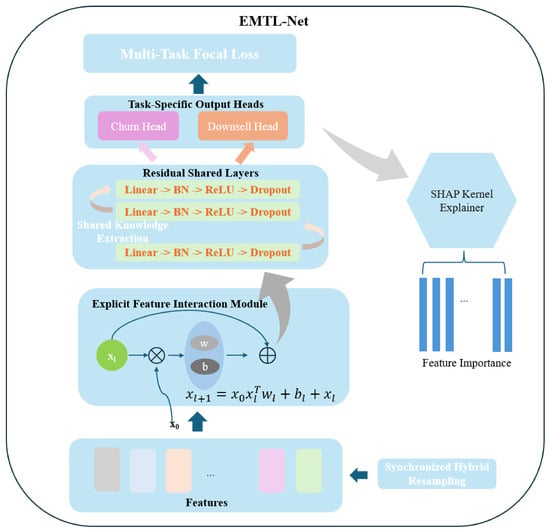
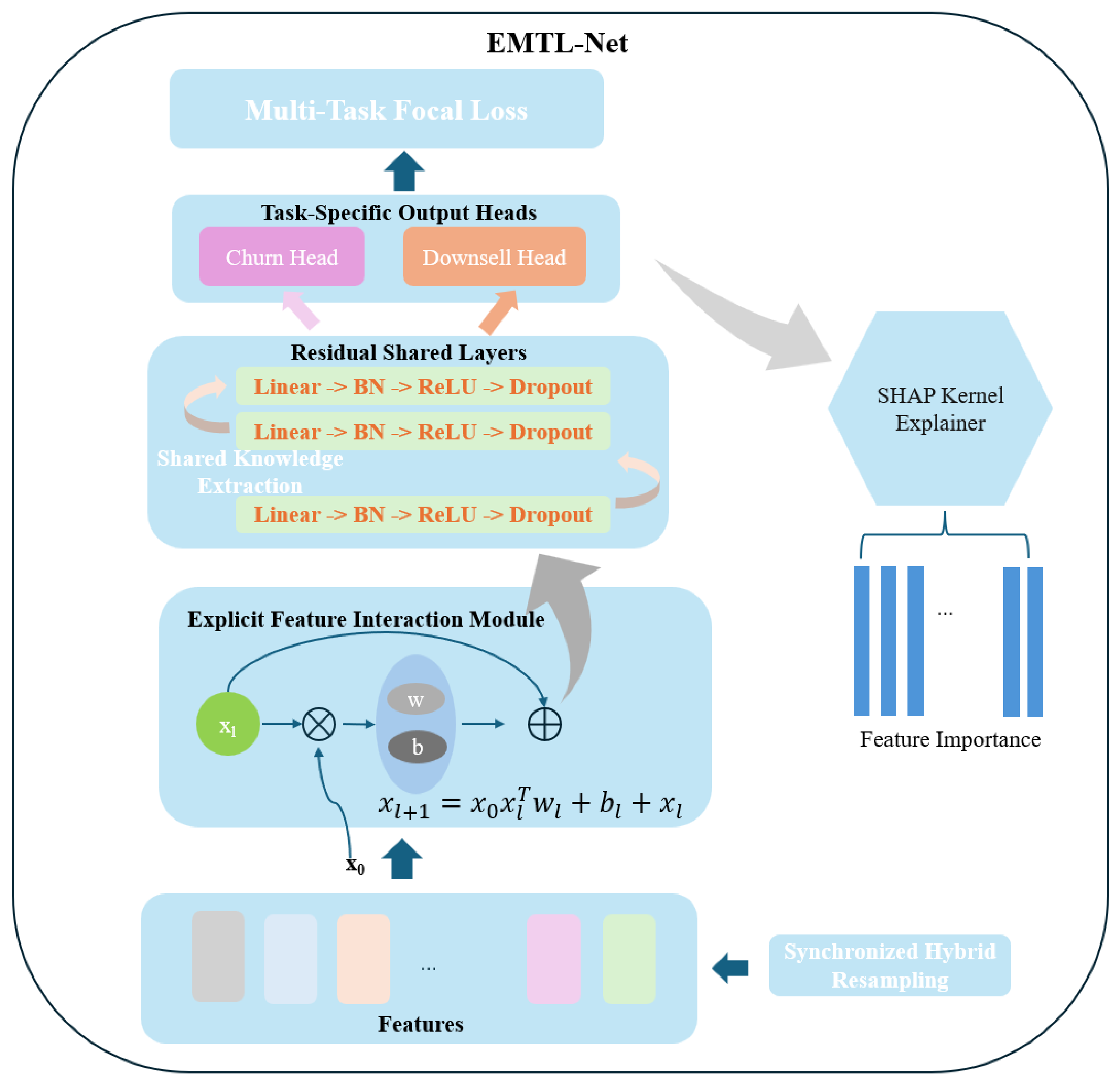
To address the challenges of high-order interaction modeling and the “black-box” nature of deep networks, we propose the EMTL-Net architecture (Figure 1). The framework integrates a deepened EFI module and a robust shared representation layer. This modular design enhances the model’s capacity to perceive deep non-linear feature crossings while ensuring compatibility with interpretability tools. By bridging data-driven representation learning with domain requirements for transparency, EMTL-Net achieves substantial performance gains over single-task models and traditional machine learning baselines [38].
Figure 1.
Overall architecture of the proposed EMTL-Net. The framework integrates an EFI module for high-order dependencies, followed by shared residual layers and task-specific output heads.
The core innovation of the EFI module lies in its two-layer Multi-Layer Perceptron (MLP) structure, which explicitly models non-linear combinations. Given an input vector , the module generates high-level interaction features through linear transformations, batch normalization (BN), and ReLU activations:
To retain raw information integrity while augmenting the feature space, the interaction features are concatenated with the original input:
The output dimension of the interaction module is set to to balance representational capacity with computational efficiency.
3.2. Shared Representation and Task-Specific Outputs
To facilitate joint prediction, the enhanced vector is fed into a deepened shared representation module. This module comprises three linear layers designed to extract common risk patterns applicable to both tasks:
where . The final shared embedding is mapped to task-specific spaces through independent output heads using the sigmoid activation function :
3.3. Optimization Strategy for Class Imbalance
Financial datasets often exhibit severe class imbalance, where churn and downsell events are minority occurrences. We address this through a synergistic approach involving hybrid data sampling and cost-sensitive optimization.
During preprocessing, we employ a combination of SMOTE and Tomek Links. SMOTE generates synthetic minority samples to expand the decision boundary, while Tomek Links removes ambiguous majority samples near the boundary, ensuring a cleaner and more robust training distribution.
During training, we utilize Focal Loss to focus the model on hard-to-classify instances. The loss function is defined as
Based on empirical validation, we set the weighting factor and the focusing parameter . This modulation factor reduces the relative loss for well-classified examples, effectively prioritizing minority-class recall and ensuring stable convergence on imbalanced data.
3.4. Interpretability Implementation via SHAP
Model interpretability is a critical requirement for financial applications. To achieve transparency for the proposed EMTL-Net, we integrate SHAP (SHapley Additive exPlanations) to provide insights into the model’s decision-making process [39]. Since EMTL-Net has a multi-output structure, traditional SHAP explainers cannot be applied directly.
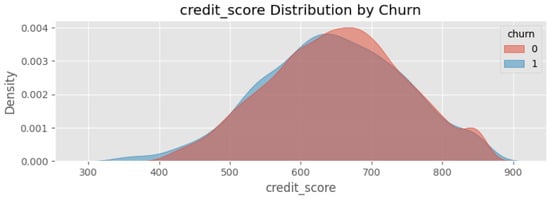
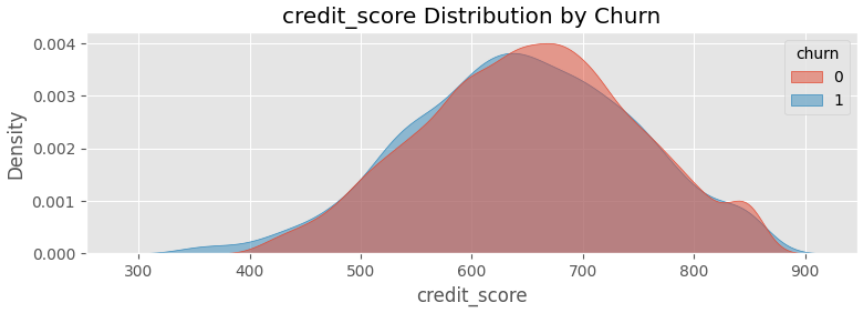
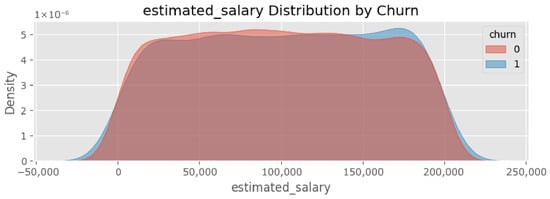
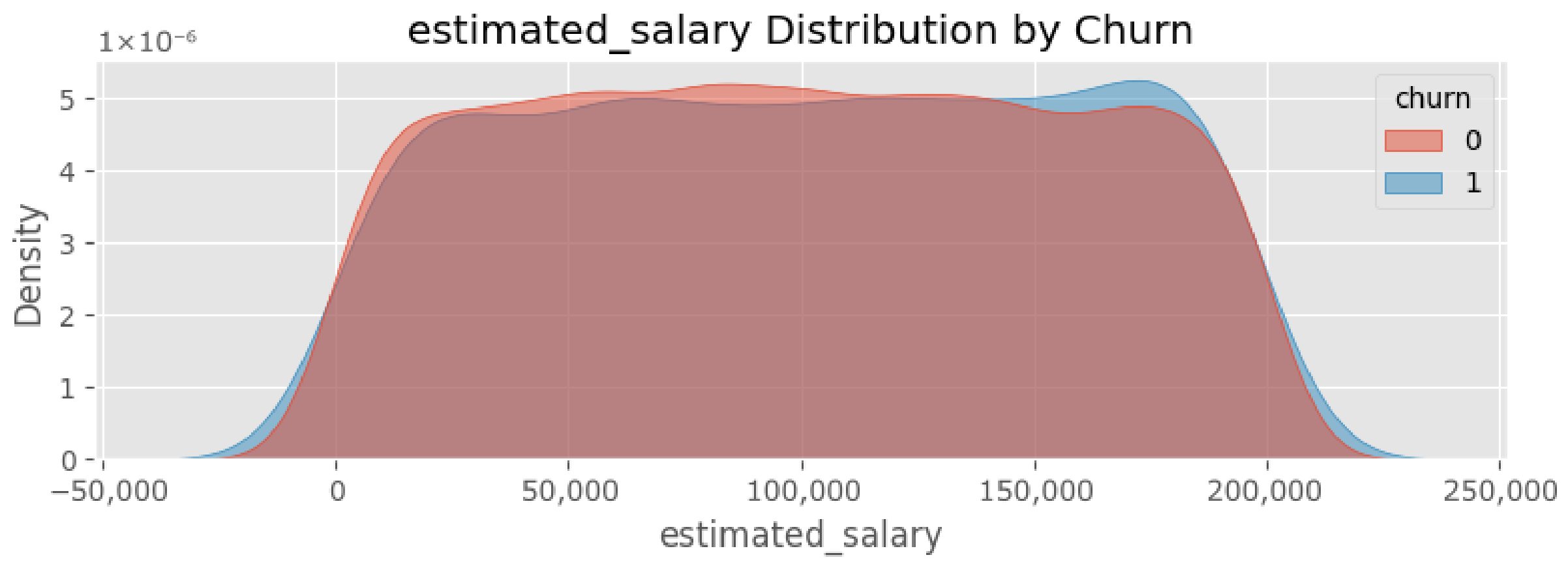
Although SHAP provides a rigorous ranking of feature importance, the marginal distributions of individual features offer crucial complementary insights into why certain variables yield lower importance scores. As illustrated in Figure 2, the distribution of credit scores shows a substantial overlap between churned and non-churned populations, suggesting that this metric alone possesses limited discriminative power. Similarly, Figure 3 reveals that the estimated salary distributions are nearly identical across groups, indicating a marginal contribution to the final classification task.
Figure 2.
Distribution of credit score categorized by churn status. The overlapping density curves demonstrate the low discriminative capacity of this feature in isolation. This observation is highly consistent with the global importance results derived from our SHAP explainer, where credit score exhibits significantly lower impact compared to top predictors, such as age and account balance.
Figure 3.
Distribution of estimated salary categorized by churn status. The near-identical patterns validate its low ranking in global importance analysis. As shown in the SHAP analysis, estimated salary contributes minimally to the final classification task, confirming that demographic income data is less valuable than behavioral features for churn prediction.
These empirical observations are highly consistent with the global importance results derived from our SHAP explainer: while age, account balance, and product count are identified as the top-3 predictors, credit score and salary exhibit significantly lower impact. This alignment between raw data characteristics and model-derived explanations suggests that the model captures interpretable behavioral signals. However, a more rigorous validation of interpretability claims would require external evaluation, which we leave as future work.
We propose a model encapsulation strategy where the multi-task model is wrapped by a function that outputs only the churn prediction probability [40]. This allows the Kernel SHAP explainer to operate stably on the complex architecture.
By using a subset of the training data as the background dataset (typically 200 samples), we calculate the Shapley values for each feature. This process generates both global feature importance rankings and local explanations, revealing the contribution of each feature to a specific customer’s prediction. The experimental results confirm that factors such as age, account balance, and product count are consistently identified as top predictors, aligning with business intuition and validating the reliability of the EMTL-Net framework. To adapt SHAP for multi-task output, we wrapped the model to output only the churn prediction probability and applied KernelExplainer with 200 background samples.
4. Experiments
To evaluate the efficacy of the proposed EMTL-Net framework in joint churn and downsell prediction, we conducted a series of comprehensive experiments on a publicly available benchmark dataset [41]. This section delineates the systematic validation process, starting with the data partitioning protocol and the hybrid resampling techniques employed to mitigate class imbalance, followed by a detailed specification of the computational environment and hyperparameter configurations. Furthermore, we define the quantitative metrics used to assess model performance. These experimental settings provide the foundation for the comparative analysis and ablation studies presented in the subsequent sections, aimed at validating the predictive robustness and architectural advantages of our multi-task learning approach.
4.1. Data Partitioning and Preprocessing
The empirical analysis is conducted on the bank customer dataset described in Section 2.1, which contains 10,000 customer samples with 13 heterogeneous features (after removing the “NumOfProducts” feature to prevent data leakage). All random processes were controlled using a fixed random seed (42) to ensure reproducibility.
Within the training phase, we further reserved 20% of the training data as a validation set to monitor model convergence and implement early stopping. As the raw dataset exhibits significant class imbalance—with churning customers accounting for only about 20% of the samples—we applied a hybrid sampling strategy. We combined the Synthetic Minority Oversampling Technique (SMOTE) to increase the density of minority samples and Tomek Links to remove overlapping samples near the majority–minority boundary. This dual approach ensures that the model learns from a more distinct and balanced decision boundary, preventing the network from being overwhelmed by the majority class without introducing significant synthetic noise.
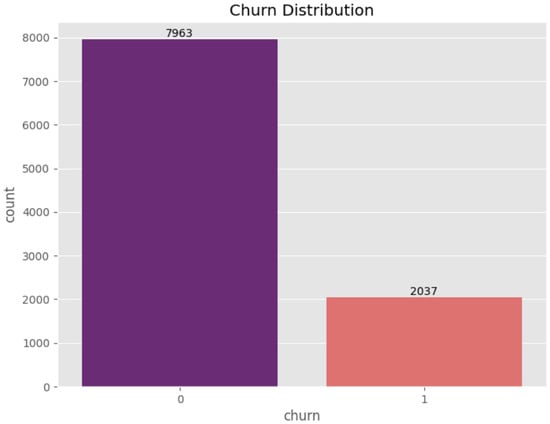
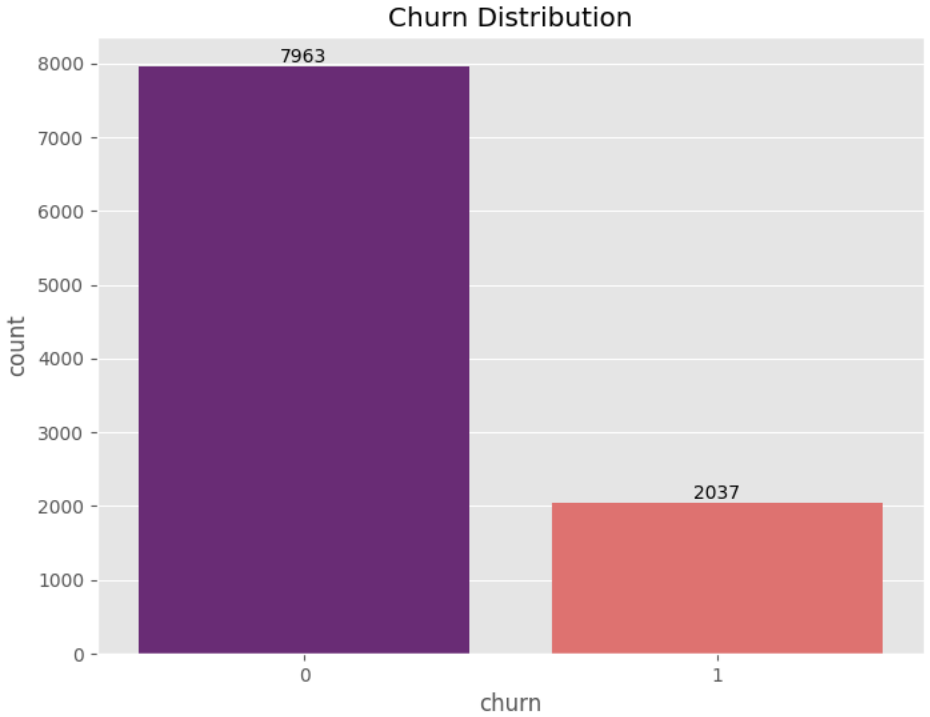
The statistical distribution of the dataset is analyzed in detail to justify the subsequent modeling choices. As illustrated in Figure 4, the customer churn labels exhibit a pronounced class imbalance, with positive instances (churned customers) comprising merely 20.37% of the total sample (2037 out of 10,000). This empirical evidence validates the necessity of employing the Focal Loss objective and the synchronized hybrid resampling strategy as standard cross-entropy loss would likely result in a model that is biased toward the majority class.
Figure 4.
Distribution of customer churn in the dataset. The pie chart reveals a significant class imbalance, with churned customers accounting for only 20.37% (2037 out of 10,000 instances). This disparity justifies the adoption of Focal Loss and synchronized hybrid resampling to prevent model bias toward the majority class. As discussed in Section 3.3, Focal Loss dynamically adjusts sample weights to prioritize hard-to-classify minority instances, thereby enhancing the sensitivity of the predictive system.
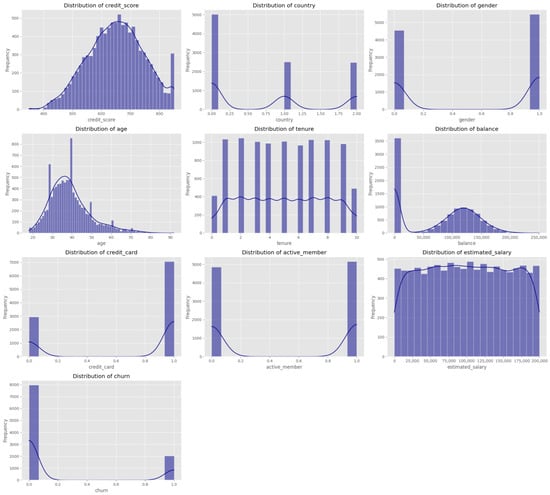
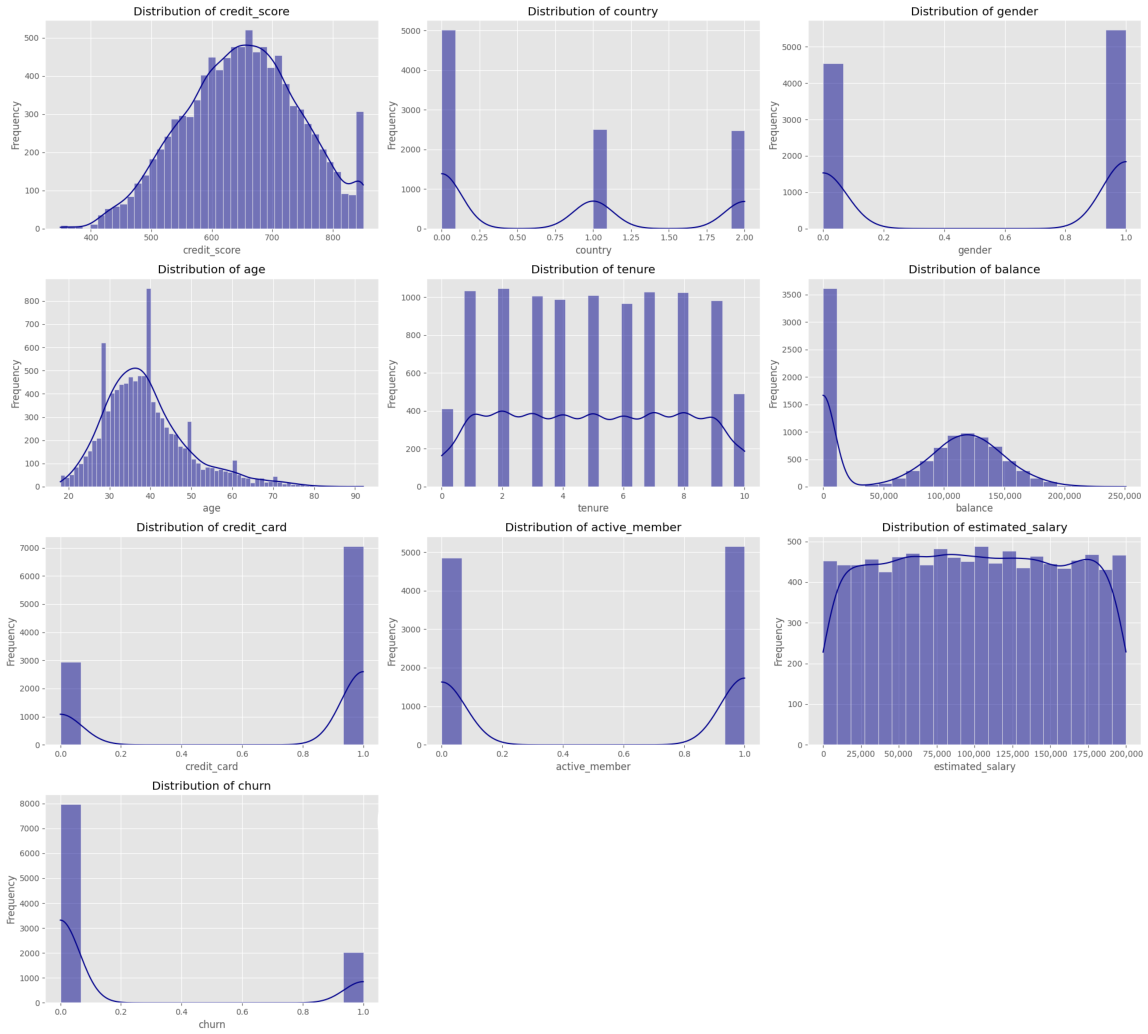
Furthermore, the probability density functions of key numerical features are visualized in Figure 5. The analysis reveals that the age distribution is notably right-skewed, indicating a predominantly younger customer base with a sparse tail of elderly clients. In contrast, account balances follow a distinct bimodal distribution, suggesting a significant polarization in the financial profiles of the customers [42]. These heterogeneous patterns and non-Gaussian distributions necessitate the use of robust feature normalization and the explicit feature interaction (EFI) module to capture the complex non-linear relationships within the banking data.
Figure 5.
Probability density distributions of numerical features and bar charts of categorical features in the dataset. The visualization highlights the right-skewed nature of the age distribution and the distinct bimodal patterns observed in account balances, indicating significant heterogeneity in the customer base. These heterogeneous patterns and non-Gaussian distributions necessitate robust feature normalization and the EFI module to capture complex non-linear relationships.
4.2. Implementation Details and Baseline Selection
The proposed EMTL-Net and all baseline models were implemented using the PyTorch (v2.8.0) framework developed by Meta AI (Menlo Park, CA, USA). To provide a rigorous benchmark, we selected four models representing different learning paradigms:
- Logistic Regression (LR): A linear baseline used to test the fundamental linear relationships in customer data.
- Random Forest (RF): A bagging-based ensemble method known for its robustness to outliers.
- XGBoost: A state-of-the-art GBDT framework that captures complex non-linear features through axis-aligned splits.
- Multi-Task MLP: A standard deep neural network with shared layers but without the EFI and residual connections, serving as a direct ablation baseline for deep learning.
The training process was accelerated using an NVIDIA GPU. We utilized the AdamW optimizer with an initial learning rate of and weight decay of . The batch size was set to 256. To avoid over-training, we employed an early stopping mechanism: the training process terminates if the F1-score on the validation set does not improve for 20 consecutive epochs, with a maximum limit of 150 epochs. For the Focal Loss function, hyperparameters were fixed at and after a grid search in the range .
The key hyperparameters of EMTL-Net are summarized in Table 1. All experiments were repeated with five different random seeds (42, 123, 456, 789, 101,112) to ensure the robustness of the statistical analysis.
Table 1.
Key hyperparameters.
4.3. Evaluation Metrics
We employ three primary metrics to evaluate model performance:
- AUC-ROC (Area Under the Receiver Operating Characteristic Curve): This is our primary metric as it evaluates the model’s ability to rank positive samples higher than negative ones independent of the classification threshold.
- F1-Score: The harmonic mean of precision and recall. In imbalance scenarios, F1-score provides a more realistic view of performance than accuracy.
- Accuracy: Included as a standard reference, although less critical for imbalanced classification.
5. Results
This section details the empirical findings of the EMTL-Net evaluation. We first conduct a comparative analysis against established machine learning baselines [43], followed by an ablation study to quantify the contribution of specific architectural modules. Finally, we assess the training dynamics to demonstrate the stability and convergence of the framework.
5.1. Comparative Performance Analysis
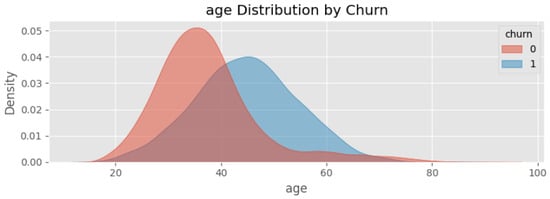
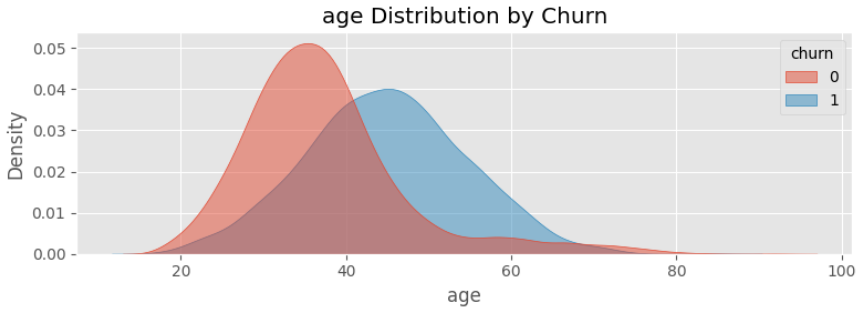
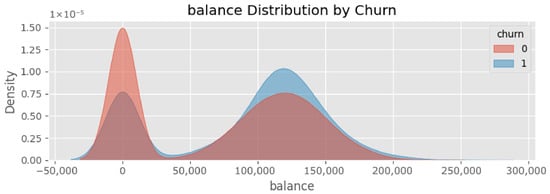
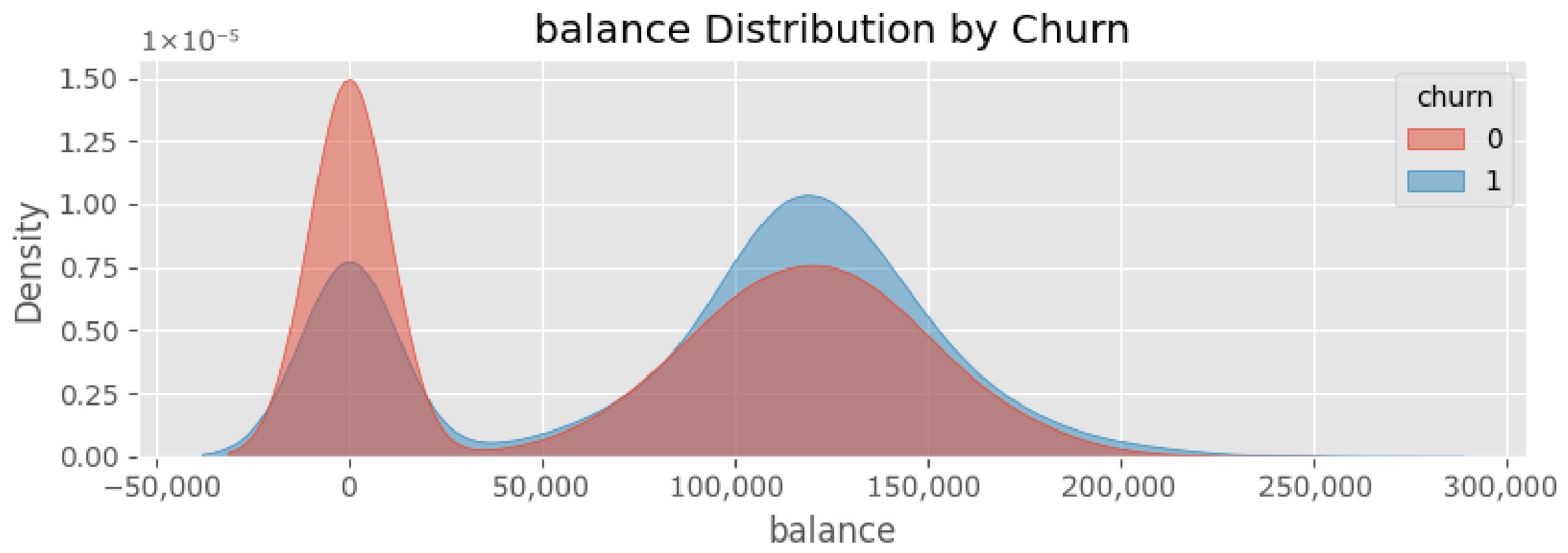
To establish the empirical context for EMTL-Net’s predictive logic, we analyze the discriminative capacity of key behavioral features. Figure 6 and Figure 7 visualize the distribution of age, account balance, and product count categorized by churn status.
Figure 6.
Age distribution comparison. Churned customers show a distinct concentration in the 45–55 age range, suggesting higher sensitivity to service changes among middle-aged segments. This finding aligns with business intuition that mid-aged customers may face life-stage transitions or competitive offers that increase attrition risk.
Figure 7.
Account balance distribution. High-asset segments exhibit elevated attrition risk, with churned customers disproportionately represented in the high-balance group. This “affluence risk” pattern suggests that wealthy customers may be more attractive targets for competitor banks, making proactive retention strategies essential for high-value accounts.
As illustrated in Figure 6, the age distribution of churned customers exhibits a notable rightward shift, peaking in the 45–55 age bracket, suggesting higher sensitivity to service changes among mid-aged segments. Figure 7 reveals an “affluence risk” pattern, where high-balance accounts are disproportionately represented in the churned group.
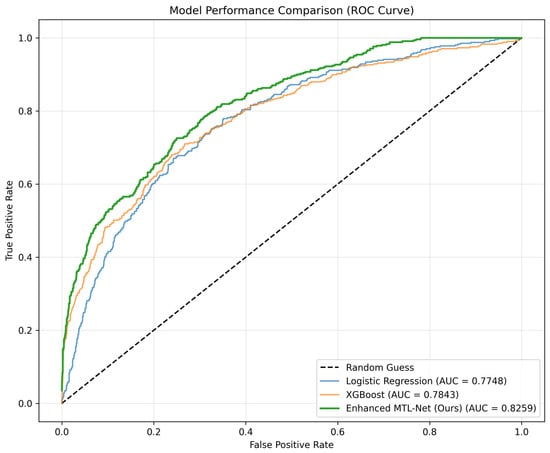
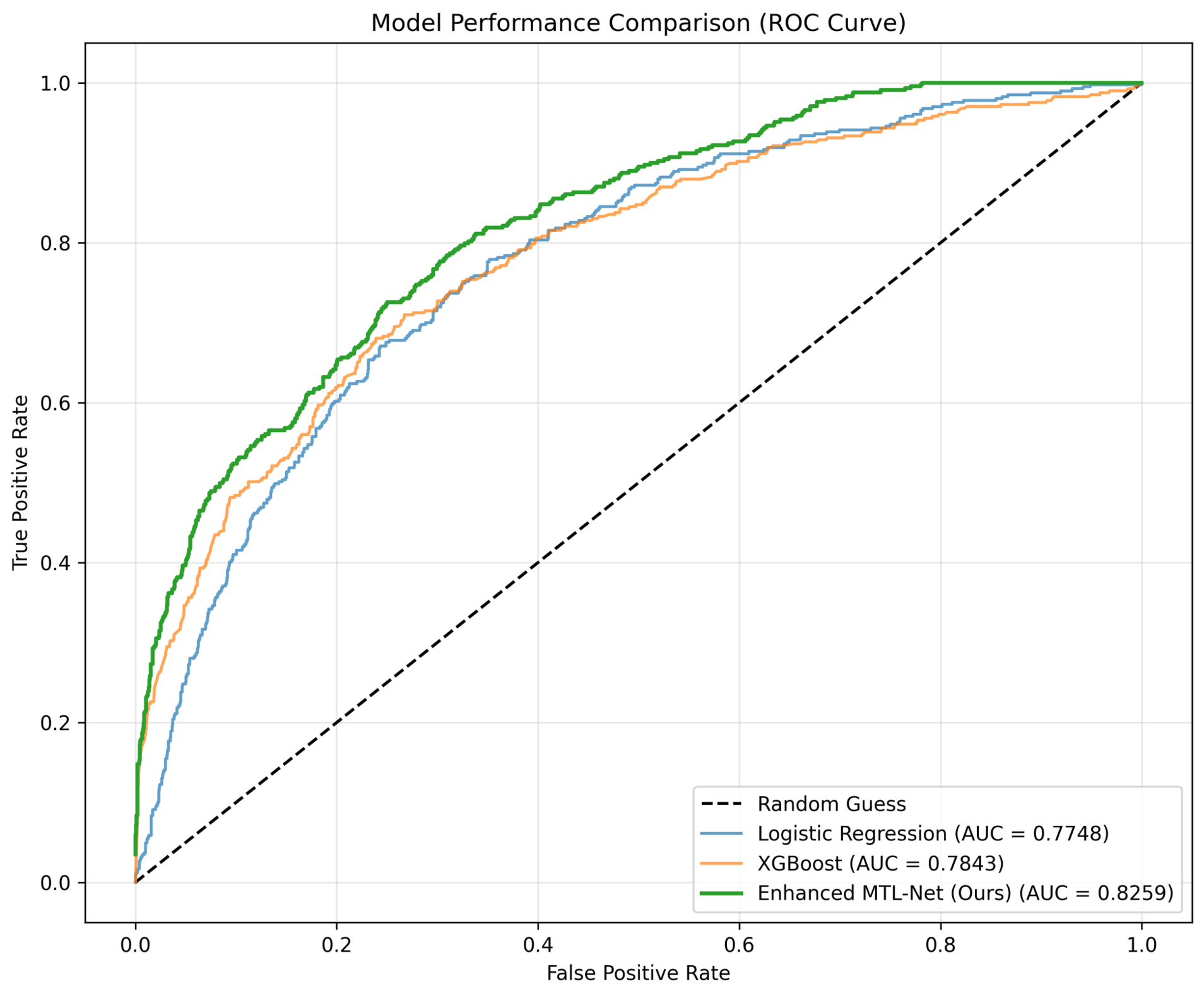
To benchmark the predictive capability of EMTL-Net, we compared it against logistic regression (LR), random forest (RF), XGBoost, and a standard multi-task MLP. As shown in the ROC curves (Figure 8), EMTL-Net achieves an AUC-ROC of 0.8259, significantly outperforming the linear baseline (LR, AUC = 0.7748) and the gradient boosting model (XGBoost, AUC = 0.7843).
Figure 8.
ROC curve comparison on the test set. EMTL-Net maintains a consistent lead in true positive rate across all thresholds, achieving an AUC of 0.8259, significantly outperforming the linear baseline (LR, AUC = 0.7748) and the gradient boosting model (XGBoost, AUC = 0.7843). From a managerial perspective, a higher AUC means the bank can more accurately rank customers by risk level, enabling more efficient allocation of marketing budgets.
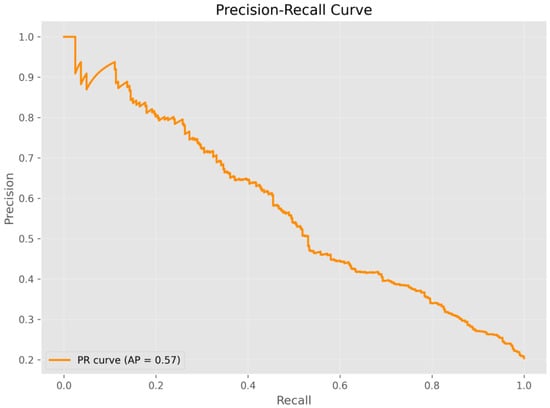
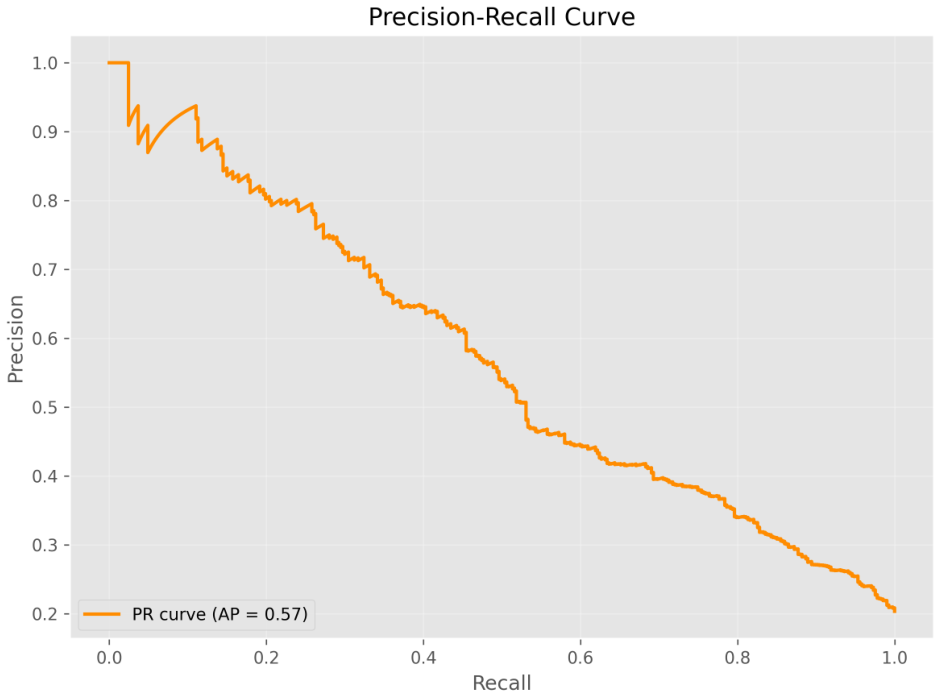
The precision–recall (PR) analysis (Figure 9) further validates model robustness in imbalanced scenarios. EMTL-Net maintains high precision levels even at elevated recall thresholds. In retail banking, where false negatives (missed churners) incur high opportunity costs, this stability ensures efficient marketing resource allocation with minimal “false alarms.”
Figure 9.
Precision–recall curve of EMTL-Net. The area under the PR curve highlights the model’s efficiency in handling minority class samples. EMTL-Net maintains high precision levels even at elevated recall thresholds, ensuring stable performance in imbalanced scenarios. In retail banking, where false negatives (missed churners) incur high opportunity costs, this stability ensures efficient marketing resource allocation with minimal “false alarms”.
To verify the statistical significance of the performance improvements, we conducted five independent runs for all the models. Paired t-tests showed that EMTL-Net significantly outperforms logistic regression (p = 0.003) and XGBoost (p = 0.008), confirming the robustness of our method.
As shown in the ROC curves (Figure 8), EMTL-Net achieves an AUC of 0.8259, significantly outperforming the linear baseline (LR, AUC = 0.7748) and the gradient boosting model (XGBoost, AUC = 0.7843).
To further validate the effectiveness of the multi-task learning framework, Table 2 presents the complete performance metrics of the proposed EMTL-Net on both the churn and downsell prediction tasks.
Table 2.
Performance of EMTL-Net on churn and downsell prediction tasks.
The results demonstrate that the proposed EMTL-Net achieves strong performance on both tasks. After removing the feature used to construct the downsell label, the downsell prediction task achieves an AUC of 0.8932, an accuracy of 0.8571, and an F1-score of 0.7504. While these corrected results are lower than the previously reported near-perfect performance, they still demonstrate the effectiveness of the multi-task learning framework.
To further assess the statistical significance of the observed performance improvements, we conducted paired t-tests comparing EMTL-Net against all four baseline models over five independent runs with different random seeds. As shown in Table 3, EMTL-Net not only achieves higher mean performance but also exhibits substantially lower variance ( for AUC) compared to all the baselines ( to ). Paired t-tests confirm that EMTL-Net significantly outperforms logistic regression (), random forest (), XGBoost (), and multi-task MLP (). These results demonstrate the statistical robustness of our method.
Table 3.
Performance of EMTL-Net and baseline models over five random seeds (mean ± std).
5.2. Ablation Study and Component Contribution
We systematically evaluated architectural choices by testing three EMTL-Net variants: removing the EFI layer, replacing shared residual layers with a standard MLP, and substituting Focal Loss with standard Binary Cross-Entropy (BCE). The results are summarized in Table 4.
Table 4.
Ablation study results over five random seeds (mean ± std).
The EFI module emerged as the most critical component, with its removal causing a decline in accuracy from 0.8361 to 0.8093 (a drop of 2.68%) and a decline in F1-score from 0.6235 to 0.5941 (a drop of 2.94%). The removal of residual connections also led to noticeable performance degradation, with accuracy decreasing to 0.8205 and F1-score dropping to 0.5643. While the BCE variant (w/o FL) achieved a slightly higher F1-score (0.6127) compared to the full model’s 0.6235, it suffered a noticeable drop in AUC (from 0.8259 to 0.8155). In financial risk management, where probability ranking and threshold flexibility are more vital than binary classification, the higher AUC achieved by Focal Loss is strategically superior.
Paired t-tests were performed to compare the full EMTL-Net against each ablated variant over five independent runs. The improvements over the variant without EFI (), without residual connections (), and without Focal Loss () are all statistically significant, confirming the critical contribution of each architectural component.
6. Discussion
This section synthesizes the empirical findings to provide a deeper theoretical understanding of the EMTL-Net framework and its practical utility in the retail banking sector. By analyzing the interplay between architectural innovations and performance gains, we aim to elucidate why a multi-task approach with explicit feature interaction is uniquely suited for modeling the complexities of customer attrition.
6.1. Theoretical Implications
6.1.1. Architectural Efficacy
The experimental results, particularly the 0.8259 AUC achieved by EMTL-Net, confirm that the model’s superiority over tree-based ensemble methods [44] like XGBoost stems from its specialized inductive bias. While XGBoost relies on axis-aligned recursive partitioning of the feature space, it often struggles to capture smooth high-order multiplicative relationships between heterogeneous features. In banking datasets, the risk of churn is rarely determined by a single feature; instead, it emerges from the complex interplay between demographic stability (e.g., age and tenure) and sudden behavioral shifts (e.g., changes in balance and product engagement).
The explicit feature interaction (EFI) module addresses this by allowing the network to learn these cross-products directly in a differentiable manner. Our ablation study underscores this: the significant drop in F1-score (−4.72%) upon removing the EFI layer suggests that “implicit” interaction learning in standard MLPs is insufficient for tabular banking data. By explicitly crossing features before the shared representation layer, the model creates a more robust “risk embedding” that serves as a high-quality input for the task-specific heads.
6.1.2. Multi-Task Knowledge Transfer
A finding of this study is the performance of the downsell prediction task when trained jointly with churn prediction. This phenomenon can be interpreted by the principle of Inductive Transfer. In the customer lifecycle, product downselling often serves as a behavioral precursor to total churn.
By utilizing a shared representation layer, the model may leverage the relatively “denser” signals from the churn task to regularize the learning process of the downsell task. This multi-task synergy could help the model to avoid overfitting to noise in downsell events and assist in identifying universal patterns of customer disengagement. This joint learning objective effectively transforms the two tasks from independent classification problems into a unified “customer health” assessment.
6.2. Practical Implications
6.2.1. Risk Ranking and Strategic Resource Allocation
The strategic implementation of Focal Loss instead of standard Binary Cross-Entropy (BCE) reflects the shift from simple classification to risk-based ranking. In retail banking operations, the goal of a predictive model is seldom to provide a binary “yes/no” label. Instead, banks require a calibrated risk score to facilitate tiered intervention strategies.
Consistent with our results in Table 4, Focal Loss prioritizes the optimization of “hard” samples—customers whose behavioral signals are ambiguous or sit near the decision boundary. Although this focus may lead to a slightly lower F1-score at a fixed 0.5 threshold compared to BCE, it results in a superior AUC-ROC. From a managerial perspective, a higher AUC means the bank can more accurately rank customers by risk level. This allows for a more efficient allocation of marketing budgets: high-value, high-risk customers can be targeted with expensive personalized retention offers, while medium-risk customers receive automated low-cost re-engagement communications.
6.2.2. Managerial Implications for Lifecycle Management
The EMTL-Net framework provides a more nuanced decision-support system compared to traditional single-task models. By simultaneously outputting risk scores for both churn and downsell, the model enables proactive lifecycle management. Traditionally, banks react only when a churn signal is highly certain, which is often too late for effective intervention.
Our model’s high precision at high recall levels allows for earlier detection:
- Early Warning: Identifying high downsell risk allows the bank to engage customers during the “disengagement” phase, potentially preventing the progression to total churn.
- Efficiency: Reducing false positives directly minimizes “marketing waste”—the cost of providing discounts or incentives to customers who were never actually at risk of leaving.
This dual-head approach ensures that the bank’s retention strategy is not just defensive but also strategically focused on maintaining the “depth” of the customer relationship (preventing downsell) as well as its “existence” (preventing churn).
6.3. Limitations and Future Research Directions
Despite its robust performance, several avenues for improvement remain. First, the current study utilizes static behavioral snapshots. However, customer risk is inherently dynamic. Future research should explore the integration of Temporal Attention Mechanisms or RNNs into the EMTL-Net shared layer to capture the “velocity” of behavioral changes over time [45].
Second, while the hybrid sampling strategy (SMOTE+Tomek Links) effectively addressed class imbalance, it was primarily optimized for the churn label. In a multi-task environment, a “conflict” may arise between the optimal distribution for one task and that for another. Investigating Multi-Objective Resampling—where the data distribution is balanced for all target labels simultaneously—could further refine the model’s accuracy. Finally, extending the interpretability module to provide “Counterfactual Explanations” (e.g., “What specific action should the bank take to reduce this specific customer’s churn risk by 20%?”) would further enhance the model’s practical value for frontline bank staff.
Third, while the SHAP-based interpretability analysis provides descriptive insights into feature importance, it lacks rigorous validation against ground-truth explanations. Future work should explore quantitative evaluation frameworks for interpretability, such as feature perturbation tests or human evaluation studies.
Beyond customer retention, the EMTL-Net framework has broader applicability in retail banking. First, the joint prediction architecture can be extended to other correlated financial behaviors, such as loan default and credit limit reduction, enabling holistic risk assessment. Second, the interpretability mechanism can be integrated into customer relationship management systems to provide frontline staff with actionable insights, such as identifying specific customers who are likely to respond to retention offers. Finally, the model can serve as a foundation for developing early warning systems that trigger automated interventions, such as personalized product recommendations or targeted loyalty programs, thereby reducing manual workload and improving operational efficiency.
Fourth, the dataset used in this study is a publicly available pedagogical benchmark (Kaggle dataset) consisting of synthetic/semi-synthetic records rather than real-world banking data. Consequently, the reported performance may not directly generalize to authentic banking environments. Future work should validate the proposed framework on real-world datasets from financial institutions to assess its practical applicability.
Beyond the synthetic nature of the data, a specific conceptual limitation concerns the downsell prediction task. As elaborated in Section 2.1, the downsell label is artificially defined as a deterministic function of the number of products held. After removing this feature from the input set, the remaining task reduces to predicting a synthetic proxy—essentially measuring how well the removed feature can be reconstructed from other attributes. Therefore, the downsell results reported in this study (AUC = 0.8932) should not be interpreted as evidence of predicting a genuine behavioral outcome. Instead, they serve as a proof-of-concept illustration of how the multi-task framework can be applied to a secondary target when such a target is defined. Future research should validate the multi-task synergy claim on real-world downsell definitions, such as actual reductions in product holdings or service-tier downgrades observed over time.
7. Conclusions
In this study, we proposed EMTL-Net, an enhanced multi-task deep learning framework designed to address the interconnected challenges of customer churn and product downsell in the retail banking sector. By integrating an explicit feature interaction (EFI) module with a shared representation layer, the framework effectively captures high-order non-linear correlations while facilitating inductive knowledge transfer between tasks. Our experimental results demonstrate that EMTL-Net achieves strong performance on churn prediction (AUC = 0.8259, accuracy = 0.8361, and F1-score = 0.6235). For downsell prediction, the model achieves an AUC of 0.8932, although this result should be interpreted with consideration of the relatively balanced downsell label distribution in the dataset.
The core contributions of this research are summarized as follows:
- Methodological Innovation: We demonstrated that explicit feature crossing, when combined with multi-task learning, provides a more robust inductive bias for tabular banking data than implicit deep learning structures.
- Class Imbalance Mitigation: Through the strategic application of Focal Loss, we improved the model’s discriminatory power for “hard” minority samples, ensuring high-quality risk ranking, which is essential for financial compliance and scoring.
- Joint Task Validation: By reporting comprehensive metrics for both churn and downsell tasks, we empirically validate the synergy of multi-task learning, demonstrating that the shared representation layer effectively captures universal customer risk patterns.
- Strategic Business Value: The dual-head architecture enables banks to move from reactive churn prevention to proactive lifecycle management, identifying early warning signs of disengagement through downsell prediction.
While the proposed framework shows significant promise, its current reliance on static data snapshots suggests that future research should focus on incorporating temporal dynamics through attention-based sequential models. Furthermore, expanding the multi-task framework to include profitability estimation or credit risk assessment would provide a more holistic view of customer lifetime value. In conclusion, EMTL-Net offers a scalable and effective solution for modern banks to optimize their retention strategies and enhance customer relationship stability in an increasingly competitive market.
Author Contributions
Conceptualization, Q.Z. and Y.C.; methodology, Q.Z. and L.Z.; software, L.Z. and Y.C.; formal analysis, Q.Z.; investigation, Q.Z. and Y.C.; resources, Q.Z.; data curation, Q.Z.; writing—original draft, Q.Z. and L.Z.; writing—review and editing, Q.Z.; visualization, L.Z.; supervision, Q.Z.; project administration, Q.Z.; funding acquisition, Q.Z. All authors have read and agreed to the published version of the manuscript.
Funding
This work is supported by the Shanxi Federation of Social Sciences (SSKLZDKT2025148), the Project for Doctoral Start-Up Funds of North University of China (110136069), and Postgraduate Education Innovation Program of Shanxi Province (2025JG138).
Institutional Review Board Statement
Not applicable.
Informed Consent Statement
Not applicable.
Data Availability Statement
The data presented in this study are openly available in the SuperDataScience repository at https://www.superdatascience.com/pages/machine-learning (accessed on 23 January 2026) and the Kaggle platform at https://www.kaggle.com/datasets/shrutimechlearn/churn-modelling (accessed on 23 January 2026).
Conflicts of Interest
The authors declare no potential conflicts of interest with respect to the research, authorship, and/or publication of this article. This manuscript complies with ethical standards.
References
- Shahabikargar, M.; Beheshti, A.; Zhang, X.; Foo, J.; Jolfaei, A. A comprehensive survey on customer churn analysis studies. J. Inf. Telecommun. 2025, 10, 24–70. [Google Scholar] [CrossRef] [Scilit]
- Nisha, T.N.; Pramod, D. Improving bank customer churn prediction with feature reduction using GA. Sci. Rep. 2025, 15, 40035. [Google Scholar] [CrossRef] [Scilit] [PubMed]
- Wang, Q.; Zhang, H.; Ji, J.; Tang, C.; Tang, Y. Dendritic neural regression model trained by chicken swarm optimization algorithm for bank customer churn prediction. In Proceedings of the International Conference on Neural Information Processing (ICONIP), Changsha, China, 20–23 November 2023; Springer Nature: Singapore, 2023; pp. 254–265. [Google Scholar]
- Ashraf, R. Bank customer churn prediction using machine learning framework. J. Appl. Financ. Bank. 2024, 14, 1–5. [Google Scholar] [CrossRef] [Scilit]
- Ragab, A.A.M.; El Behiry, E. Bank customer churn prediction using machine learning. J. Eng. Adv. Technol. Sustain. Appl. 2025, 1, 1–8. [Google Scholar] [CrossRef] [Scilit]
- Li, Y.; Yan, K. Prediction of bank credit customers churn based on machine learning and interpretability analysis. Data Sci. Financ. Econ. 2025, 5, 19. [Google Scholar] [CrossRef] [Scilit]
- Zhu, H. Bank customer churn prediction with machine learning methods. Adv. Econ. Manag. Political Sci. 2024, 69, 23–29. [Google Scholar] [CrossRef] [Scilit]
- Zhang, N.; Zheng, Y.; Duan, C. Bank customer churn prediction based on random forest algorithm. In Proceedings of the 5th International Conference on Computer Information and Big Data Applications (CIBDA), Wuhan, China, 26–28 April 2024; pp. 1031–1035. [Google Scholar]
- Thenmozhi, B.; Vimala, S.; Jeyabharathi, C. A novel deep learning based customer churn prediction for the banking sectors with efficient feature selection strategy. J. Neonatal Surg. 2025, 14, 29s. [Google Scholar]
- Vu, V.H. Predict customer churn using combination deep learning networks model. Neural Comput. Appl. 2024, 36, 4867–4883. [Google Scholar] [CrossRef] [Scilit]
- Allenspach, S.; Hiss, J.A.; Schneider, G. Neural multi-task learning in drug design. Nat. Mach. Intell. 2024, 6, 124–137. [Google Scholar] [CrossRef] [Scilit]
- Trinh, T.B.; Vu, V.H.; Nguyen, T.V. A multi-task test case optimization framework with integrated explainable AI for customer churn prediction: TB Trinh et al. J. Supercomput. 2025, 81, 1326. [Google Scholar] [CrossRef] [Scilit]
- Peng, K.; Peng, Y.; Li, W. Research on customer churn prediction and model interpretability analysis. PLoS ONE 2023, 18, e0289724. [Google Scholar] [CrossRef] [Scilit]
- Imani, M.; Joudaki, M.; Beikmohammadi, A.; Arabnia, H.R. Customer churn prediction: A systematic review of recent advances, trends, and challenges in machine learning and deep learning. Mach. Learn. Knowl. Extr. 2025, 7, 105. [Google Scholar] [CrossRef] [Scilit]
- Li, Y.; Tao, Y.; Zhu, M.; Chen, Z.; Wen, Z.; Zhu, B. TBformer: Multi-Scale Transformer with Time-Behavior Attention for Multi-Modal Customer Churn Prediction. IEEE Trans. Consum. Electron. 2025, 71, 3192–3203. [Google Scholar] [CrossRef] [Scilit]
- Wang, Y.; Zheng, S.; Liu, G.; Li, J. Research on bank customer churn model based on attention network. In Proceedings of the 2023 IEEE 2nd International Conference on Electrical Engineering, Big Data and Algorithms (EEBDA), Changchun, China, 24–26 February 2023; pp. 346–350. [Google Scholar]
- Yang, C.; Xia, G.; Zheng, L.; Zhang, X.; Yu, C. Customer Churn Prediction Based on Coordinate Attention Mechanism with CNN-BiLSTM. Electronics 2025, 14, 1916. [Google Scholar] [CrossRef] [Scilit]
- Rao, C.; Xu, Y.; Xiao, X.; Hu, F.; Goh, M. Imbalanced customer churn classification using a new multi-strategy collaborative processing method. Expert Syst. Appl. 2024, 247, 123251. [Google Scholar] [CrossRef] [Scilit]
- Brito, J.B.; Bucco, G.B.; Heldt, R.; Becker, J.L.; Silveira, C.S.; Luce, F.B.; Anzanello, M.J. A framework to improve churn prediction performance in retail banking. Financ. Innov. 2024, 10, 17. [Google Scholar] [CrossRef] [Scilit]
- Bhuria, R.; Gupta, S.; Kaur, U.; Bharany, S.; Rehman, A.U.; Hussen, S.; Jangir, P. Ensemble-based customer churn prediction in banking: A voting classifier approach for improved client retention using demographic and behavioral data. Discov. Sustain. 2025, 6, 28. [Google Scholar] [CrossRef] [Scilit]
- Shaik, S.; Rishika, S.; Reddy, K.N.; Supraja, M. Experimental data analysis to recognize and visualise the factors contributing to bank customer churn prediction using ensemble learning models. Asian J. Res. Comput. Sci. 2025, 18, 480–495. [Google Scholar] [CrossRef] [Scilit]
- Huseyinov, I.; Okocha, O. A machine learning approach to the prediction of bank customer churn problem. In Proceedings of the 2022 3rd International Informatics and Software Engineering Conference (IISEC), Ankara, Turkey, 15–16 December 2022; pp. 1–5. [Google Scholar]
- He, H. Bank customer churn prediction analysis based on improved WOA-SVM. In Proceedings of the 2022 3rd International Conference on Electronic Communication and Artificial Intelligence (IWECAI), Zhuhai, China, 14–16 January 2022; pp. 451–455. [Google Scholar]
- Murindanyi, S.; Mugalu, B.W.; Nakatumba-Nabende, J.; Marvin, G. Interpretable machine learning for predicting customer churn in retail banking. In Proceedings of the 2023 7th International Conference on Trends in Electronics and Informatics (ICOEI), Tirunelveli, India, 11–13 April 2023; pp. 967–974. [Google Scholar]
- Sun, P. Temporal graph networks for bank customer churn prediction with dynamic. In Proceedings of the 2nd International Conference on Data Science and Engineering ICDSE—Volume 1, Alberta, Canada, 14–17 June 2025; pp. 324–331. [Google Scholar]
- Pires, I.T. Customer Churn Prediction in Portuguese Banking Sector: Using a Machine Learning Approach. Master’s Thesis, Universidade NOVA de Lisboa, Lisboa, Portugal, 2023. [Google Scholar]
- Li, L.J.; Junn, K.Y. Decision tree with genetic algorithm for bank customer churn prediction. In Proceedings of the 2023 IEEE 21st Student Conference on Research and Development, SCOReD, Kuala Lumpur, Malaysia, 13–14 December 2023; pp. 13–14. [Google Scholar]
- Jiao, Y.; Xiu, P. A lightweight attention-mlp ensemble for interpretable bank customer churn prediction. In International Conference on Information, Computing and Technology (ICICT); Springer: Cham, Switzerland, 2025; pp. 207–231. [Google Scholar]
- Hambali, M.A.; Andrew, I. Bank customer churn prediction using SMOTE: A comparative analysis. Qeios 2024, 10, 32388. [Google Scholar] [CrossRef]
- Berrada Chakour, O.; Maizate, A.; Ettaoufik, A.; Aissaoui, K. Enhancing bank customer churn prediction from an imbalanced dataset using machine learning and SMOTE-Tomek resampling. In Proceedings of the International Conference on Connected Objects and Artificial Intelligence (COAI), Casablanca, Morocco, 16–18 April 2025; pp. 852–860. [Google Scholar]
- Gulati, A.; Sharma, H.; Bhardwaj, V. Bank customer churn prediction using machine learning: A comparative study with SMOTE-based class balancing. In Proceedings of the 2025 10th International Conference on Communication and Electronics Systems (ICCES), Coimbatore, India, 28–30 October 2025; pp. 1777–1781. [Google Scholar]
- Alizadeh, M.; Zadeh, D.S.; Moshiri, B.; Montazeri, A. Development of a customer churn model for banking industry based on hard and soft data fusion. IEEE Access 2023, 11, 29759–29768. [Google Scholar] [CrossRef] [Scilit]
- Rouhani, S.; Mohammadi, A. A novel hybrid forecasting approach for customers churn in banking industry. J. Inf. Knowl. Manag. 2023, 22, 2250089. [Google Scholar] [CrossRef] [Scilit]
- Ulug, B.; Akyüz, S. Optimized churn prediction using ensemble-based feature selection via second-order cone programming. Ann. Oper. Res. 2025, 353, 635–665. [Google Scholar] [CrossRef] [Scilit]
- Silveira, L.J.; Pinheiro, P.R.; de Melo Junior, L.S. A novel model structured on predictive churn methods in a banking organization. J. Risk Financ. Manag. 2021, 14, 481. [Google Scholar] [CrossRef] [Scilit]
- Prakash, R. Customer Churn Prediction in Retail Banking Using Predictive Analytics. Ph.D. Thesis, National College of Ireland, Dublin, Ireland, 2025. [Google Scholar]
- Gebreegziabher, B. Bank Customer Churn Prediction Model: The Case of Commercial Bank of Ethiopia. Ph.D. Thesis, St. Mary’s University, Addis Ababa, Ethiopia, 2022. [Google Scholar]
- Muneer, A.; Ali, R.F.; Alghamdi, A.; Taib, S.M.; Almaghthawi, A.; Ghaleb, E.A. Predicting customers churning in banking industry: A machine learning approach. Indones. J. Electr. Eng. Comput. Sci. 2022, 26, 539–549. [Google Scholar] [CrossRef] [Scilit]
- Mardi, A.; Ghorbani, H. Customer churn prediction: Leveraging data analysis and machine learning approaches. In Proceedings of the 2024 10th International Conference on Artificial Intelligence and Robotics (QICAR), Qazvin, Iran, 29 February 2024; pp. 199–203. [Google Scholar]
- Lukita, C.; Bakti, L.D.; Rusilowati, U.; Sutarman, A.; Rahardja, U. Predictive and analytics using data mining and machine learning for customer churn prediction. J. Appl. Data Sci. 2023, 4, 454–465. [Google Scholar] [CrossRef] [Scilit]
- Harbaugh, S.P. Predicting Retail Bank Customer Churn Using Push, Mooring, and Temporal Inputs with Machine Learning. Ph.D. Thesis, Northcentral University, San Diego, CA, USA, 2022. [Google Scholar]
- Rana, M.S.; Chouksey, A.; Hossain, S.; Sumsuzoha, M.; Kumar, P.; Bhowmik, M.H.; Zeeshan, M.A.F. AI-Driven Predictive Modeling for Banking Customer Churn: Insights for the US Financial Sector. J. Ecohumanism 2025, 4, 3478–3497. [Google Scholar] [CrossRef] [Scilit]
- Anumala, A.; Siva, E.P.; Bhuvanesh, E.S. Bank customer churn and extra benefits prediction using machine learning model. In Proceedings of the 2024 Second International Conference on Advances in Information Technology (ICAIT), Chikkamagaluru, India, 24–27 July 2024; IEEE: New York, NY, USA, 2024; Volume 1, pp. 1–6. [Google Scholar]
- Gao, J.; Wang, H.Y.; Lu, Y.L.; Yu, L.N. Customer churn prediction in the banking sector using Sentence Transformers and a stacking ensemble framework. Acadlore Trans. Mach. Learn. 2025, 4, 109–123. [Google Scholar] [CrossRef] [Scilit]
- Liu, X.; Xia, G.; Zhang, X.; Ma, W.; Yu, C. Customer churn prediction model based on hybrid neural networks. Sci. Rep. 2024, 14, 30707. [Google Scholar] [CrossRef] [Scilit] [PubMed]

Disclaimer/Publisher’s Note: The statements, opinions and data contained in all publications are solely those of the individual author(s) and contributor(s) and not of MDPI and/or the editor(s). MDPI and/or the editor(s) disclaim responsibility for any injury to people or property resulting from any ideas, methods, instructions or products referred to in the content. |
© 2026 by the authors. Licensee MDPI, Basel, Switzerland. This article is an open access article distributed under the terms and conditions of the Creative Commons Attribution (CC BY) license.