1. Introduction
Distal femur fractures (DFF), including periprosthetic distal femur fractures (PPF), represent some of the most difficult injuries encountered in orthopedic trauma due to the intricate nature of fracture types, patient health conditions, and the careful balance needed between stability and early movement. Although other femoral fractures such as trochanteric fractures (TF) are common, the present review specifically focuses on distal femur fractures as a distinct clinical entity. Their occurrence is increasing, especially in older adults, as longevity and activity levels rise. These fractures frequently result from low-energy injuries in elderly patients with weak bones but can also be observed in younger individuals after high-energy trauma. Regardless of the cause, distal femur fractures are linked to considerable morbidity and mortality—reported one-year death rates can be as high as 18–25%, similar to those observed with proximal femoral (hip) and periprosthetic fractures [
1,
2].
Timely surgical treatment is vital as it minimizes the risk of complications related to immobility and decreased survival rates. However, the best fixation method remains a topic of ongoing discussion [
3]. Traditionally, treatment options included nonoperative methods and blade plates, but modern approaches have evolved toward minimally invasive techniques utilizing either retrograde intramedullary nails (rIMN) or anatomically contoured locking plates [
4]. Each of these implants has distinct advantages and disadvantages: retrograde nails facilitate load-sharing and promote early weight-bearing but may be limited by inadequate distal fixation in weak bone or in cases with very distal fracture patterns. In contrast, locking plates provide adaptable fixation and enhanced stability in compromised bone, yet excessive rigidity in the construct may impede healing, often requiring limited weight-bearing [
5].
The growing complexity of cases—including instances of periprosthetic distal femur fractures or poor bone quality—has led to the creation of hybrid methods such as the nail–plate combination construct (NPC) [
3,
4]. The justification for the NPC lies in merging the mechanical benefits of both devices, with the aim of improving fixation strength, lowering the rates of malunion or nonunion, and supporting confident early mobilization, even in the presence of osteoporosis or challenging fracture situations.
Despite substantial technological progress, no universally accepted standard of care exists for distal femur fractures, particularly among the elderly. The selection of fixation is generally influenced by the pattern of the fracture, patient-specific characteristics, and the surgeon’s expertise, rather than strong comparative evidence [
6]. Recent systematic reviews and registry studies have not shown clear superiority between rIMN and locking plates concerning most outcomes, although certain trends suggest that nails are favorable for early weight-bearing and short-term quality of life, while plates may be better for very distal or periprosthetic fractures where nailing could be impractical [
7,
8].
Given these ongoing debates, it is increasingly essential for clinicians to be acquainted with the indications, technical aspects, and developing research related to each fixation technique. This review intends to critically assess the current evidence regarding intramedullary nailing, locking plate fixation, and nail–plate combinations in treating distal femur fractures. By integrating recent findings, we aim to provide an updated framework to guide surgical choices and enhance patient outcomes in this intricate patient group. The research question of the present systematic review was developed according to the PICO framework [
9], as detailed in the
Section 2. Specifically, in adult patients (≥18 years) with distal femur fractures, including periprosthetic and complex fracture patterns (Population),the outcomes of nail–plate combination constructs (Intervention) were compared with those of single fixation constructs, such as retrograde intramedullary nailing or lateral locking plate fixation (Comparison), with respect to fracture union, complications, and clinical outcomes (Outcomes). A preliminary exploratory search of the available literature revealed that existing evidence was heterogeneous, largely retrospective, and characterized by inconsistent outcome reporting, with no clear consensus regarding the optimal fixation strategy. These findings highlighted the need for a systematic synthesis of the available data to better clarify indications, advantages, and limitations of each fixation method.
2. Materials and Methods
2.1. Search Strategy
This systematic review was conducted in accordance with the PRISMA (Preferred Reporting Items for Systematic Reviews and Meta-Analyses) guidelines [
10]. Comprehensive searches were performed across PubMed/MEDLINE, EMBASE, and the Cochrane Database of Systematic Reviews. The search strategy included a combination of keywords such as “nail”, “plate”, “distal”, “femoral”, “femur”, “fracture” using Boolean operators (AND, OR, *) from database inception through June 2025. No restrictions were placed on publication year.
Two independent reviewers conducted the search and screened all titles and abstracts. Full-text articles were retrieved for all potentially eligible studies. Any disagreements were resolved through discussion or adjudication by a third reviewer. Additionally, reference lists of included studies were manually screened to identify further relevant articles.
To ensure reproducibility and methodological rigor, all records retrieved from the databases were imported into a centralized systematic review management platform (Rayyan QCRI) [
11]. Screening of titles and abstracts was performed in a blinded, independent fashion by two reviewers, with conflicts resolved through discussion and consensus. This approach minimized selection bias and allowed transparent documentation of the study selection process.
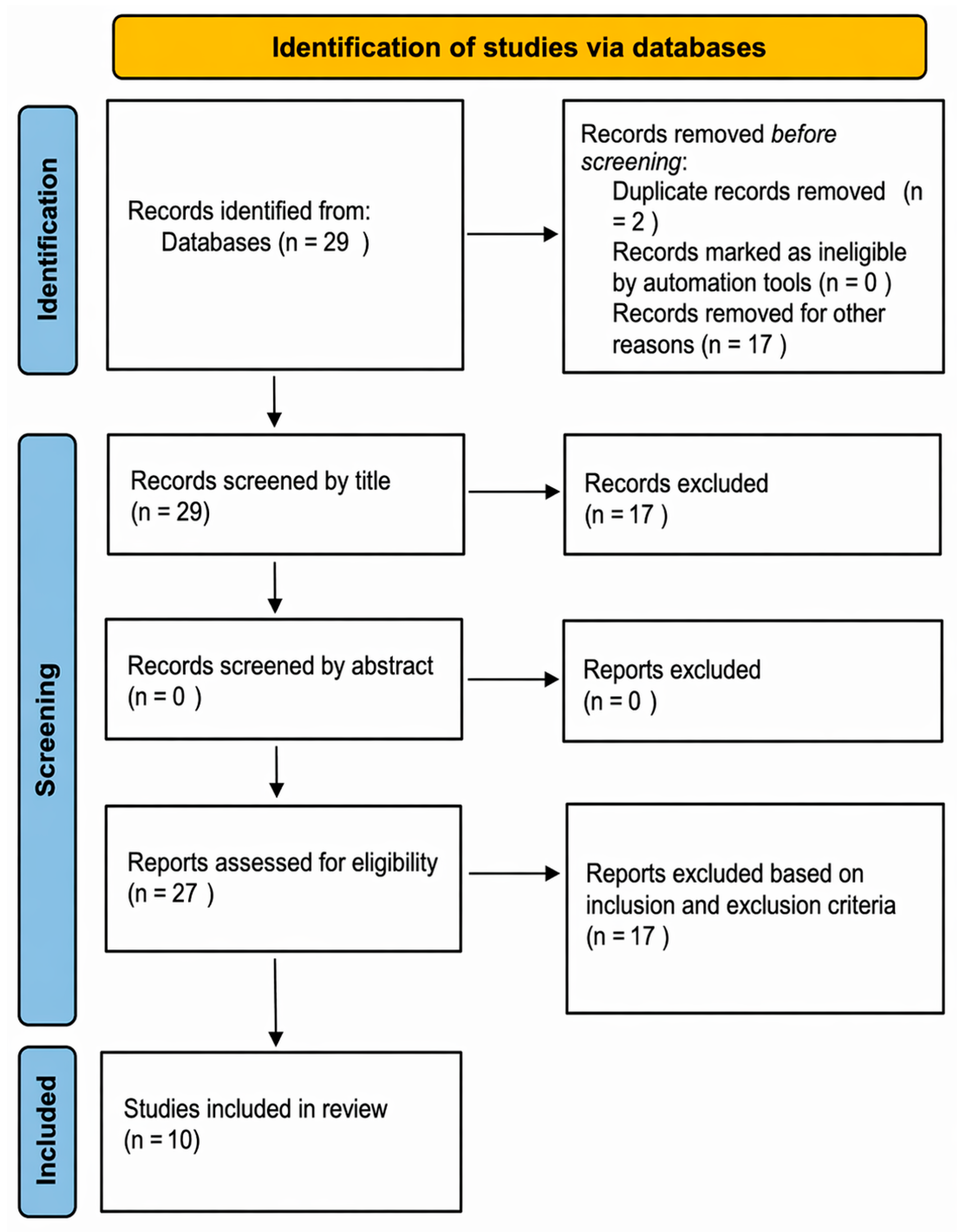
Eligibility criteria, outcomes of interest, and methods for data extraction and analysis were defined before the initiation of the literature search. Although PROSPERO registration is not limited to randomized controlled trials, the protocol for this systematic review was not registered due to local institutional constraints and the exploratory nature of the study design. Nevertheless, all methodological steps—including search strategy, inclusion/exclusion criteria, and data extraction—were prospectively defined and transparently reported in accordance with PRISMA guidelines to ensure reproducibility and methodological rigor, minimizing the risk of selective reporting [
Figure 1].
The research question of the present systematic review was defined according to the PICO framework [
9]. In adult patients (≥18 years) with distal femur fractures, including periprosthetic and complex patterns (Population), nail–plate combination constructs (Intervention) were compared with single fixation constructs, such as retrograde intramedullary nailing or lateral locking plate fixation (Comparison), in terms of fracture union, complications, and clinical outcomes (Outcomes).
2.2. Inclusion and Exclusion Criteria
Eligible studies were original research articles that investigated surgical fixation of distal femur fractures, including periprosthetic distal femur fractures. In line with the PICO framework [
9], inclusion required studies reporting outcomes in adult patients (≥18 years) with distal femur fractures, including complex or periprosthetic patterns (Population), comparing nail–plate combination constructs (Intervention) versus single fixation constructs such as retrograde intramedullary nails or lateral locking plates (Comparison), with reported clinical, radiographic, or functional outcomes (Outcomes).
Inclusion required reporting of postoperative complications, patient outcomes measured via validated instruments, and follow-up. Studies were included regardless of the mechanism of injury (high- or low-energy trauma), when such information was available.
Exclusion criteria were paediatric patients (<18 years), studies focusing on fracture types outside the distal femur (e.g., isolated trochanteric fractures), oncologic fractures, technique papers, reviews, case reports, or duplicate patient cohorts. Studies with overlapping populations were excluded, retaining the study with the longest follow-up. Non-English language studies were also excluded.
We acknowledge that age is a key determinant of bone healing and overall regenerative potential; therefore, only studies involving adult patients (≥18 years) were included, and pediatric populations were excluded to minimize heterogeneity in biological healing capacity.
Studies were included regardless of fracture classification or surgical approach to capture a comprehensive overview of current practices. No specific exclusion was applied based on trauma mechanism; however, studies explicitly reporting ballistic trauma were not identified in the included literature.
2.3. Data Extraction and Quality Assessment
Data extraction was independently performed by two reviewers using a predefined and standardized data extraction form. All extracted data were stored and managed using a centralized review platform (Rayyan QCRI), which facilitated blinded independent extraction and ensured accurate tracking of records and discrepancies [
11]. Extracted data included publication details, study design, sample size, patient demographics, fracture type and localization, surgical technique, union rates, complications, reoperation rates, and reported clinical or functional outcomes. When available, data regarding the mechanism of injury (high-energy vs. low-energy trauma) were also collected. Any discrepancies between reviewers were resolved through discussion and, when necessary, by consultation with a third reviewer. Extracted data were organized in structured tables to allow comparison across studies. Additional data points included operative time, time to union, and type of follow-up imaging when reported. Where outcomes were reported incompletely, authors were contacted to clarify missing information if possible.
2.4. Methodological Quality and Statistical Analysis
The methodological quality and risk of bias of the included studies were independently assessed by two reviewers using the Modified Coleman Methodology Score (MCMS). This scoring system evaluates key methodological domains, including study design, sample size, follow-up adequacy, outcome assessment, and statistical analysis, with total scores ranging from 0 to 100. Given that all included studies were retrospective, an inherent risk of selection bias, reporting bias, and confounding was anticipated. Disagreements in quality assessment were resolved by consensus. Descriptive statistics were used to summarize patient demographics, fracture characteristics, and outcomes. Due to heterogeneity in study design and outcome reporting, no meta-analysis was performed. Trends in union rates, complication frequencies, and functional outcomes were synthesized narratively. Potential sources of bias, including retrospective design and selective reporting, were explicitly considered when interpreting results. Disagreements in quality assessment were resolved by consensus.
4. Discussion
This systematic review provides a comprehensive and critical evaluation of current fixation strategies for distal femur fractures, comparing single-implant constructs with combined nail–plate fixation. Across the included studies, a consistent descriptive trend toward higher union rates was observed in patients treated with nail–plate constructs (NPC). While several studies reported union rates approaching or reaching 100% in the dual-construct cohorts, single-implant fixation demonstrated more variable outcomes, with union rates ranging from 72% to 96.7%. Although these findings may suggest a potential mechanical advantage of combined fixation, they must be interpreted cautiously in light of the methodological heterogeneity and intrinsic limitations of the available evidence. To better interpret the findings, outcomes were stratified according to clinically relevant subgroups. Elderly patients or those with osteoporotic bone tended to benefit more from combined nail–plate constructs (NPC), showing higher union rates and mechanical stability, whereas younger adults with good bone stock achieved comparable outcomes with single constructs. Similarly, periprosthetic distal femur fractures often favored NPC for achieving stable fixation, while isolated distal femur fractures without complicating factors responded well to single implants.
From a biomechanical standpoint, the rationale for combining a retrograde intramedullary nail with a lateral locking plate is sound. The intramedullary nail provides axial load-sharing and central mechanical support, reducing bending moments across the fracture site, whereas the locking plate enhances angular stability and improves resistance to varus collapse, particularly in fractures with metaphyseal comminution or limited distal bone stock [
20]. By integrating these principles, dual constructs theoretically create a more stable mechanical environment that limits excessive micromotion while maintaining alignment. This may be particularly advantageous in osteoporotic bone, highly comminuted fractures, or periprosthetic scenarios, where achieving adequate distal fixation with a single implant can be challenging [
22].
However, increased construct stiffness may not universally translate into improved biological healing. Secondary bone healing relies on controlled interfragmentary strain, and excessive rigidity has been associated in some contexts with delayed callus formation [
23]. Although the studies included in this review did not provide sufficient biomechanical detail to quantify construct stiffness or working length, it remains possible that the benefit observed with NPC is related not only to increased rigidity but also to improved load distribution and reduced mechanical failure in high-risk fracture patterns [
24,
25]. Therefore, the apparent superiority of dual constructs may reflect an optimized balance between stability and biological healing rather than stiffness alone.
Importantly, the higher union rates reported in the NPC cohorts must be interpreted in the context of potential selection bias. In most included studies, combined constructs were preferentially used in complex fracture configurations, including comminuted, osteoporotic, or periprosthetic fractures [
12,
26]. This introduces two competing interpretations. On one hand, if NPC was used in mechanically more demanding fractures and still achieved equal or superior union rates, this may reinforce its mechanical advantage. On the other hand, the absence of randomization and standardized fracture classification prevents adjustment for baseline differences in fracture severity. It remains unclear whether improved outcomes are attributable to the construct itself or to differences in patient selection, surgical expertise, or perioperative management.
Complication patterns further highlight the complexity of this comparison. Infection was the most frequently reported complication in the dual-construct group, whereas delayed union predominated among single-implant cases [
13]. The incidence of surgical infection in NPC patients was approximately 5%, primarily attributed to greater surgical invasiveness and longer operative times. Management strategies included antibiotics, with some cases requiring surgical debridement or implant revision. These findings emphasize the need for careful perioperative management when using dual constructs [
14]. The higher infection rate associated with NPC may reflect greater surgical invasiveness, longer operative times, increased implant surface area, and more extensive soft tissue dissection [
15]. Unfortunately, operative time, blood loss, and soft tissue management were inconsistently reported across studies, limiting the ability to perform a more granular analysis. Additionally, host-related risk factors such as diabetes and smoking—reported in a subset of studies—may have contributed to postoperative complications [
16]. Without standardized reporting of these variables, it is difficult to determine whether infection risk is directly attributable to the implant strategy or to confounding patient factors.
The variability observed in single-construct outcomes also deserves attention. Locking plates may provide excellent angular stability in very distal fractures but can create relatively rigid constructs, potentially increasing stress concentration and risk of nonunion if working length is not optimized [
17]. Conversely, retrograde intramedullary nails allow load-sharing and often facilitate earlier weight-bearing, but distal fixation may be insufficient in short distal segments or periprosthetic fractures. Recent systematic reviews comparing nails and plates alone have not demonstrated clear superiority of one technique over the other, although trends suggest nails may favor early mobilization and short-term function, while plates may be advantageous in very distal or anatomically constrained fractures [
18]. The current findings align with this broader literature, suggesting that implant choice should not be universal but rather tailored to fracture morphology and patient-specific factors.
Another critical limitation of the available evidence is the lack of standardized functional and patient-reported outcomes. Radiographic union, while essential, does not fully capture clinical recovery, postoperative mobility, pain, or return to independence—particularly in elderly patients, where functional status may be more relevant than radiographic consolidation alone [
19]. Follow-up duration in most studies was relatively short, limiting assessment of late complications such as implant failure, hardware irritation, or long-term functional decline. Consequently, while union rates appear favorable with NPC, the true clinical benefit in terms of mobility, quality of life, and long-term survivorship remains insufficiently defined.
The absence of randomized controlled trials represents a major methodological limitation in this field. All included studies were retrospective, with heterogeneous fracture classifications, inconsistent reporting of comorbidities, and variability in rehabilitation protocols. Under these circumstances, performing a quantitative meta-analysis could have generated misleading conclusions due to substantial clinical heterogeneity exceeding statistical comparability. Therefore, the present review synthesizes trends descriptively while explicitly acknowledging the risk of confounding and reporting bias.
Taken together, the current evidence supports a fracture-specific and patient-centered approach to fixation strategy. Combined nail–plate constructs may be particularly beneficial in fractures characterized by metaphyseal comminution, poor bone quality, periprosthetic involvement, or limited distal fixation options. In contrast, single constructs remain appropriate and effective in less complex fracture patterns, in patients with good bone stock, and in scenarios where minimizing surgical invasiveness is a priority [
19]. Rather than representing a universal solution, NPC should be considered a valuable option within a broader decision-making framework that integrates fracture morphology, bone quality, comorbidities, and surgeon expertise.
Future research should move beyond simple implant comparisons and instead focus on identifying fracture- and patient-specific indications for each fixation strategy. Prospective multicenter studies with standardized fracture classification, uniform postoperative rehabilitation, and comprehensive reporting of radiographic, functional, and patient-reported outcomes are necessary to clarify the true clinical advantage of dual constructs. Integrating biomechanical modeling, bone quality assessment, and geriatric risk stratification may further refine surgical decision-making and improve outcomes in this challenging patient population. Additionally, emerging technologies such as 3D printing using PEEK or titanium implants may offer innovative solutions for large bone defects, allowing for patient-specific implant design and improved mechanical support, which could complement conventional fixation strategies in complex cases. By structuring the discussion around these clinical subgroups, the interpretation of results is more closely aligned with the primary aim of the study: evaluating the comparative efficacy of single versus combined fixation constructs in distal femur fractures. This approach allows clinicians to individualize treatment decisions based on patient characteristics, fracture complexity, and bone quality.
Study Limitations
This review has several inherent limitations related to the included studies. All studies were retrospective, increasing the risk of selection bias, uncontrolled confounding, and reporting bias. Populations were heterogeneous with respect to fracture type, localization, fixation strategy, and postoperative rehabilitation protocols, limiting comparability across studies.
Key demographic and clinical variables, including detailed fracture classification, bone quality assessment, operative time, and standardized functional outcomes, were inconsistently reported, restricting deeper analysis of factors influencing union and complications. Additionally, the size of bone defects was rarely quantified or reported in the included studies, preventing any analysis or stratification based on defect size, which may influence the choice of fixation strategy and outcomes.
Sample sizes were relatively small, and follow-up durations were often short, limiting assessment of late mechanical failure and long-term functional recovery. The absence of randomized controlled trials directly comparing single constructs and nail–plate combinations further reduces the strength of causal inferences; observed differences may partially reflect baseline fracture severity rather than intrinsic superiority of a specific fixation method. Furthermore, the exclusion of non-English language studies introduces a potential publication bias and may limit the comprehensiveness of the review. This limitation has been added to emphasize that relevant evidence published in other languages could have influenced overall findings. Finally, the lack of standardized patient-reported outcome measures limits the ability to translate radiographic findings into clinically meaningful conclusions.
Overall, these limitations should be carefully considered when interpreting the trends reported in this review.
5. Conclusions
Distal femur fractures remain a complex clinical challenge, particularly in the presence of osteoporotic bone, periprosthetic involvement, or comminuted fracture patterns. The available evidence suggests that nail–plate combination constructs may provide a mechanical advantage over single implants, achieving higher union rates and potentially reducing the risk of mechanical complications in select cases. However, these benefits are tempered by a higher risk of surgical complications, particularly infections, likely related to increased operative time and invasiveness.
Single constructs, including locking plates and retrograde intramedullary nails, continue to be effective in less complex fractures or in patients with favorable bone quality, where the risk of delayed union or mechanical failure is lower. The choice of fixation should be individualized, taking into account fracture morphology, bone quality, patient comorbidities, and surgeon expertise. In complex distal femur fractures with high mechanical risk, combined nail–plate fixation should be considered, whereas single implants remain appropriate for simpler patterns.
Given the limitations of the current literature, including retrospective designs, heterogeneous fracture patterns, incomplete reporting of outcomes, and lack of functional and patient-reported measures, high-quality prospective studies are urgently needed. Future research should clarify the specific indications for single versus combined fixation, integrate biomechanical and clinical outcomes, and assess long-term functional recovery to optimize treatment strategies and improve patient outcomes.





 ,
,