


Featured Application
The proposed method can be used for nighttime image enhancement in urban monitoring systems, especially under hazy and non-uniform illumination conditions. It is potentially applicable to traffic surveillance, infrastructure inspection, and other low-visibility visual monitoring tasks.
Abstract
As modern urban systems advance, video surveillance has become indispensable for ensuring high-quality urban development. Nighttime images acquired in urban monitoring scenarios are often degraded by haze and non-uniform illumination, resulting in reduced visibility, color distortion, and blurred structural boundaries. To address these issues, this paper proposes a nighttime image dehazing framework that combines mixed-norm variational atmospheric-light estimation with adaptive boundary-constrained transmission refinement. Specifically, an mixed-norm regularization model is introduced to improve atmospheric-light estimation under complex nighttime illumination and suppress halo diffusion and color distortion around strong light sources. In addition, an adaptive boundary-constrained transmission refinement strategy with weighted soft-threshold shrinkage is developed to reduce residual artifacts while preserving structural edges. Experimental results on synthetic and real nighttime haze datasets demonstrate that the proposed method consistently outperforms representative state-of-the-art methods in both visual quality and quantitative metrics, showing superior robustness and restoration performance for nighttime urban monitoring applications.
1. Introduction
With the rapid development of modern cities, image-based monitoring systems have become increasingly important for urban management, public safety, and infrastructure inspection [1]. In practical urban monitoring scenarios, captured images are expected to provide effective visual information for traffic observation, environmental assessment, and structural status analysis. Compared with daytime imaging, nighttime image acquisition is more challenging because of complex artificial illumination, low scene visibility, and severe haze interference. Under such conditions, nighttime images often suffer from reduced visibility, color distortion, and blurred structural boundaries, which significantly limit their practical value in subsequent analysis and interpretation. Therefore, nighttime image dehazing is of considerable importance for improving image quality and enhancing the applicability of urban monitoring systems.
In nighttime hazy scenes, haze particles interact with artificial light sources of different intensities, positions, and color temperatures, giving rise to three major degradations in restored images: glow diffusion, color distortion, and edge artifacts [2]. These degradations not only impair visual quality but also affect the reliability of subsequent image analysis tasks, such as target recognition, scene understanding, and structural observation [3]. Accordingly, the effectiveness of a nighttime dehazing method should be assessed not only by visibility enhancement but also by its ability to suppress glow diffusion, restore color fidelity, and preserve structural details without introducing noticeable artifacts.
Glow suppression is one of the most critical issues in nighttime image dehazing. Li et al. [4] introduced a glow term into the atmospheric scattering model and jointly estimated glow and transmission through variational energy minimization, which effectively reduced scattering halos under multi-colored illumination but showed limited detail recovery in low-illumination regions. Pei and Lee [5] transformed RGB images into the CIE-Lab space for color mapping and then combined the result with an improved dark channel prior and bilateral filtering, improving overall visibility while leaving residual glare in some high-intensity regions. Tang [6] fused Retinex decomposition with the dark channel prior to suppressing glow without introducing obvious color shifts, although the computational complexity of the method limited its practical efficiency. Park et al. [7] estimated local atmospheric light using a weighted-entropy strategy, which improved restoration under non-uniform illumination and helped preserve details in bright regions. Yao et al. [8] modeled the influence of point light sources and refined transmission separately in near-source and non-source regions, achieving better suppression of light-source interference while still facing challenges in extremely bright areas. In addition, the OSFD method [9] extracts atmospheric-light maps using multi-scale local patches and the dark channel prior and then performs Laplacian pyramid fusion based on contrast and saturation features. Although this strategy shows favorable efficiency, it still struggles to fully eliminate the glow around strong light sources.
Color restoration is another key problem in nighttime image dehazing. Because nighttime urban scenes usually contain mixed light sources with different color temperatures, atmospheric-light estimation based only on the brightest regions often introduces global or local color deviation. Pei and Lee’s method [5] improves white balance through Lab-space color mapping, but the sequential “map-then-dehaze” strategy may lead to saturation imbalance. Zhang et al. [10] incorporated gamma correction and color correction before applying the dark channel prior, which alleviated color shifts under non-uniform illumination but did not explicitly address glow suppression. Ancuti and Ancuti [11] fused multiple preprocessed versions of an image, including white-balanced and contrast-enhanced results, through Laplacian pyramid fusion, thereby improving contrast and saturation at the cost of increased computational complexity and occasional noise amplification. Zhu et al. [12] proposed the color attenuation prior, which estimates scene depth through a linear model and then recovers the clear image by inverting transmission. Although this method preserves natural colors well, color deviation may still occur in detailed regions under dense nighttime haze. Zhang et al. [13] introduced the maximum reflectance prior for local atmospheric-light estimation, improving the efficiency of adaptive color correction, whereas its ability to jointly handle glow and artifact suppression remains limited. Cai et al. [14] developed DehazeNet, an end-to-end deep learning model for single-image haze removal based on transmission estimation; however, its performance in real nighttime scenes still depends strongly on the quality and distribution of training data. More recent learning-based studies have further extended nighttime dehazing toward low-light–haze coupled restoration, realistic brightness control, and real-scene adaptation. For example, Bernabel and Agaian [15] proposed NDELS to jointly address nighttime dehazing, low-light enhancement, and light suppression. Lin et al. [16] further introduced a semi-supervised nighttime dehazing baseline with spatial-frequency awareness and realistic brightness constraint for real-world nighttime scenes. Deng et al. [17] proposed NightHaze based on self-prior learning to improve robustness to real nighttime haze, while He et al. [18] explicitly addressed the scarcity of real nighttime hazy data and the synthetic-to-real domain gap through contrastive and adversarial learning. In parallel, recent real-world dehazing studies have also explored stronger adaptation mechanisms, such as coherence-based pseudo labeling with cooperative unfolding [19] and diffusion-prior-guided unpaired training [20]. These studies indicate that learning-based methods have made important progress in nighttime restoration, but they also suggest that robustness to real nighttime haze, complex artificial illumination, and scene-dependent degradation remains a central challenge.
Artifact suppression is also a critical requirement in nighttime urban monitoring, because structural boundaries often carry essential scene information. He et al. [18] showed that priors effective in daytime scenes may misclassify bright nighttime boundaries as dense haze, thereby introducing ringing artifacts. Meng et al. [21] reduced such artifacts through boundary constraints and contextual regularization, while Zhu et al. [12] improved global color recovery but offered limited edge protection. Cai et al. [14] partially alleviated artifact generation through data-driven transmission estimation, although the model remains sensitive to domain shifts in complex nighttime scenes. The OSFD method improves overall visibility through multi-scale fusion, yet artifacts often persist around strong light sources and fine structural regions. Taken together, these studies suggest that nighttime dehazing must jointly address glow suppression, color consistency, and artifact control, rather than optimizing any single aspect in isolation.
Existing nighttime dehazing methods can generally be categorized into three groups: physics-based methods [18,19,20,22,23,24], learning-based methods [14,15,16,17,21,25,26,27,28,29,30], and fusion-based methods [9,11,31,32,33,34]. Physics-based methods explicitly model atmospheric light and transmission, thereby providing good interpretability, but their estimation accuracy is often affected by non-uniform illumination and complex light distributions in nighttime scenes. Recent physics-based work has further refined nighttime imaging models and priors; for example, Lin et al. [24] combined a modified nighttime imaging model with a saturation line prior for joint glow removal, dehazing, and color correction, although the method still relies on hand-crafted model design and may remain sensitive to scene-dependent illumination variation. Learning-based methods can learn complex mappings from hazy images to clear ones, and recent progress has improved their ability to handle coupled nighttime degradations and real-scene adaptation; however, their performance in real nighttime scenes may still be limited by training-data dependence and domain shift. For example, Cong et al. [30] proposed a semi-supervised nighttime dehazing baseline with spatial-frequency-aware modeling and realistic brightness constraints, although its performance still depends on training strategy and data quality, and domain discrepancy in real nighttime haze remains a non-negligible challenge. Fusion-based methods enhance contrast and detail by integrating multiple preprocessed inputs; however, they generally lack unified physical constraints and may introduce color inconsistency or residual artifacts. Recent fusion-oriented work has also explored integrating dehazing and fusion within unified frameworks; for example, Zhao et al. [34] proposed an encoder–decoder framework for dehazing and fusion, although such methods still lack explicit physical constraints and may produce unstable color or structural consistency in complex scenes. For urban monitoring scenarios that emphasize physical interpretability, restoration robustness, and controllable optimization behavior, physics-based formulations still provide a clearer and more flexible basis for targeted modeling of atmospheric light and transmission.
Despite these advantages, existing physics-based nighttime dehazing methods still face two key limitations in urban monitoring scenes. First, atmospheric-light estimation remains easily biased by strong light sources and mixed color temperatures, which often leads to halo diffusion and color deviation in restored images. Second, transmission refinement methods often emphasize smoothness more than structural selectivity, so residual artifacts may persist near bright boundaries and fine urban structures. In practice, these two issues are closely coupled: inaccurate atmospheric-light estimation may aggravate glow and color inconsistency, whereas overly smooth transmission optimization may further weaken structural fidelity in challenging nighttime regions. To address these limitations, the proposed method does not rely on explicit glow decomposition or simple local atmospheric-light heuristics alone. Instead, nighttime atmospheric-light estimation is reformulated as a mixed-norm variational optimization problem, and boundary-constrained transmission is further refined by adaptive weighted soft-threshold shrinkage. The former improves robustness against light-source interference during atmospheric-light estimation, while the latter suppresses residual artifacts without sacrificing structural boundaries. In this way, the proposed method establishes a targeted physics-based nighttime dehazing framework for urban monitoring scenes, jointly addressing the coupled errors of atmospheric-light estimation and transmission refinement toward more stable nighttime restoration.
Motivated by these observations, this paper adopts the atmospheric scattering model as its physical foundation and proposes a nighttime image dehazing framework for urban monitoring scenarios.
Unlike prior physics-based methods that mainly improve either atmospheric-light estimation or transmission smoothing separately, the proposed method explicitly targets the coupling between these two error sources in nighttime urban scenes.
This design makes the proposed framework not merely a combination of existing priors but a joint optimization strategy that improves illumination robustness and structural fidelity in a coordinated manner.
The main contributions of this work are summarized as follows:
- (1)
- A mixed-norm variational formulation is developed for nighttime atmospheric-light estimation under non-uniform illumination. By replacing heuristic light-region-driven estimation with optimization-based atmospheric-light modeling, the proposed method improves robustness to strong light-source interference and alleviates halo diffusion and color deviation in restored nighttime images.
- (2)
- A structure-aware transmission refinement strategy is introduced by integrating boundary-constrained estimation with adaptive weighted soft-threshold shrinkage. Specifically, an adaptive weighting mechanism inspired by the bilateral filtering strategy of Tomasi and Manduchi [29] is incorporated into the boundary constraint to improve edge preservation around urban structures while reducing residual artifacts near bright regions.
- (3)
- Comparative experiments on synthetic and real nighttime haze datasets are conducted to evaluate the proposed framework under both controlled and practical urban monitoring conditions. The results verify its effectiveness in visibility restoration, color fidelity improvement, and structural detail preservation.
The remainder of this paper is organized as follows. Section 2 presents the proposed nighttime dehazing method, including atmospheric-light estimation and transmission refinement. Section 3 describes the experimental setup and comparative results on synthetic and real nighttime haze datasets, together with runtime analysis. Section 4 concludes the paper and discusses the limitations of the current framework.
2. Materials and Methods
The proposed nighttime dehazing framework is organized around two key optimization steps, namely robust nighttime atmospheric-light estimation and structure-aware transmission refinement. Rather than separately treating glow effect, color shift, and edge artifacts as isolated restoration targets, the proposed method addresses these coupled degradations by jointly improving the two most critical components in the nighttime imaging model, i.e., atmospheric-light estimation and transmission optimization.
In the first step, a mixed-norm variational model is introduced for nighttime atmospheric-light estimation under non-uniform illumination. To improve the stability of illumination modeling in complex nighttime scenes, the input hazy image is first decomposed into reflectance and illumination through Retinex decomposition. A smoothed luminance map is then obtained by Gaussian filtering and used for luminance correction so that glow diffusion can be moderated before subsequent optimization. In addition, gradient-based luminance features are extracted to construct an adaptive weight matrix. On this basis, an − mixed-norm regularization term is incorporated into the variational energy functional, and the global illumination map is solved using the Split Bregman method [32]. The estimated serves as the spatially varying atmospheric-light representation for subsequent nighttime image restoration.
In the second step, the transmission map is refined within a boundary-constrained framework to improve structural recovery in nighttime scenes. Specifically, an initial transmission estimate is first obtained under the boundary constraint. Then, an adaptive weight matrix is constructed according to luminance difference, gradient magnitude, and intra-channel standard deviation so that different regions can be assigned different regularization strengths. Based on this design, weighted soft-threshold shrinkage is embedded into the iterative optimization process under the ADMM framework, and the transmission map is progressively refined to obtain . This strategy suppresses residual artifacts near bright regions while preserving boundary and texture information in urban structures.
Finally, the dehazed image is recovered by inverting the nighttime image formation model using the estimated illumination map and the refined transmission.
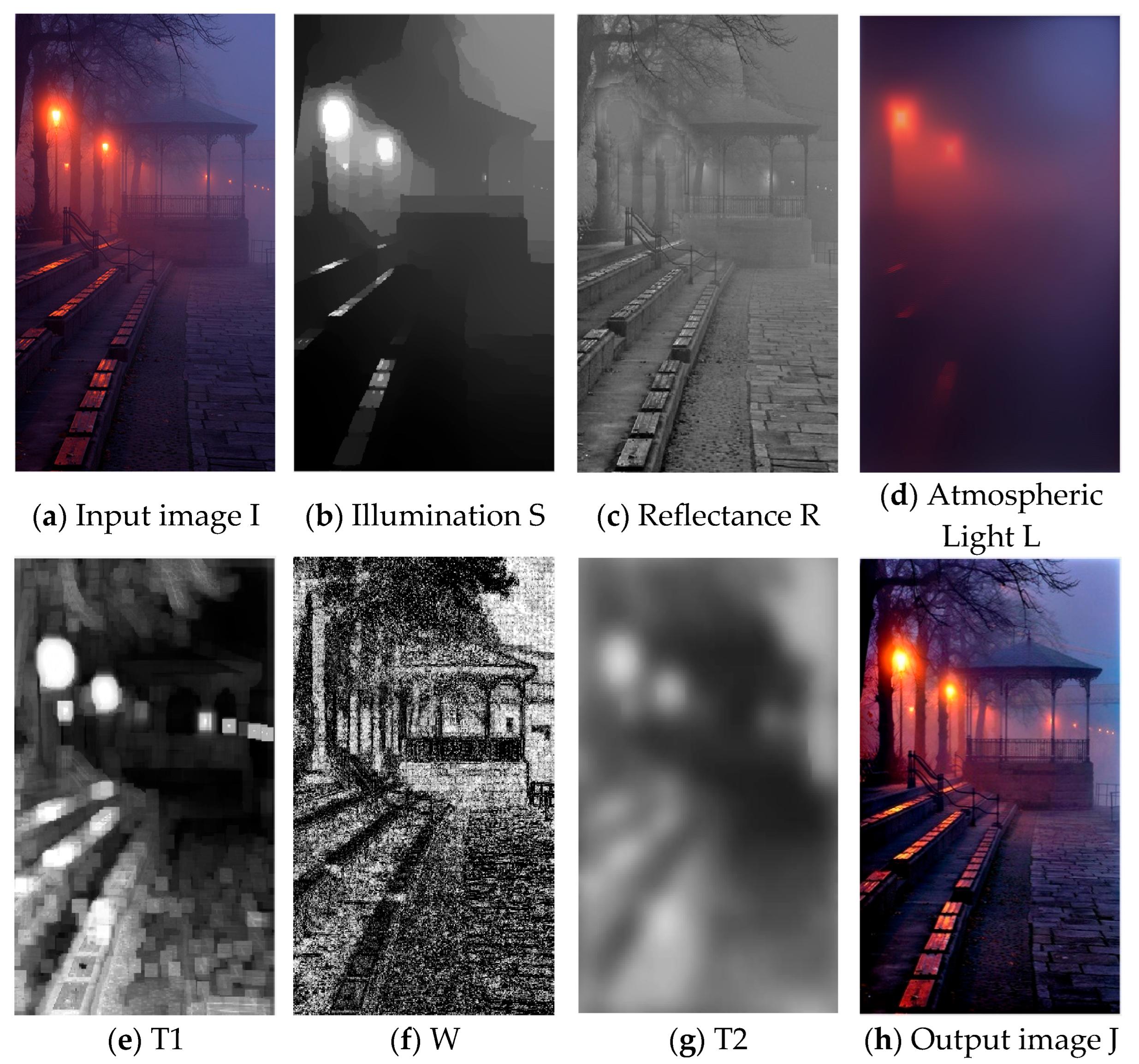
The detailed workflow of the proposed dehazing framework is illustrated in Figure 1. The detailed workflow of the proposed nighttime dehazing framework is illustrated in Figure 2. Representative intermediate results are also shown to clarify the role of each processing stage in the overall restoration process.
2.1. Variational-Based Global Illumination Estimation
2.1.1. The Nighttime Imaging Model
According to the atmospheric optics model [35], the hazy image formation process can be described by the physics-based dichromatic model as follows:
where denotes element-wise multiplication, and , , A, and represent the observed hazy image, the haze-free image, the global uniform atmospheric-light vector, and the scene’s transmission, respectively. The scene transmission is distance-dependent and is computed as follows:
where is the extinction coefficient of the haze and d is the distance from the camera to the scene.
Figure 1.
Overview of proposed nighttime image dehazing framework.
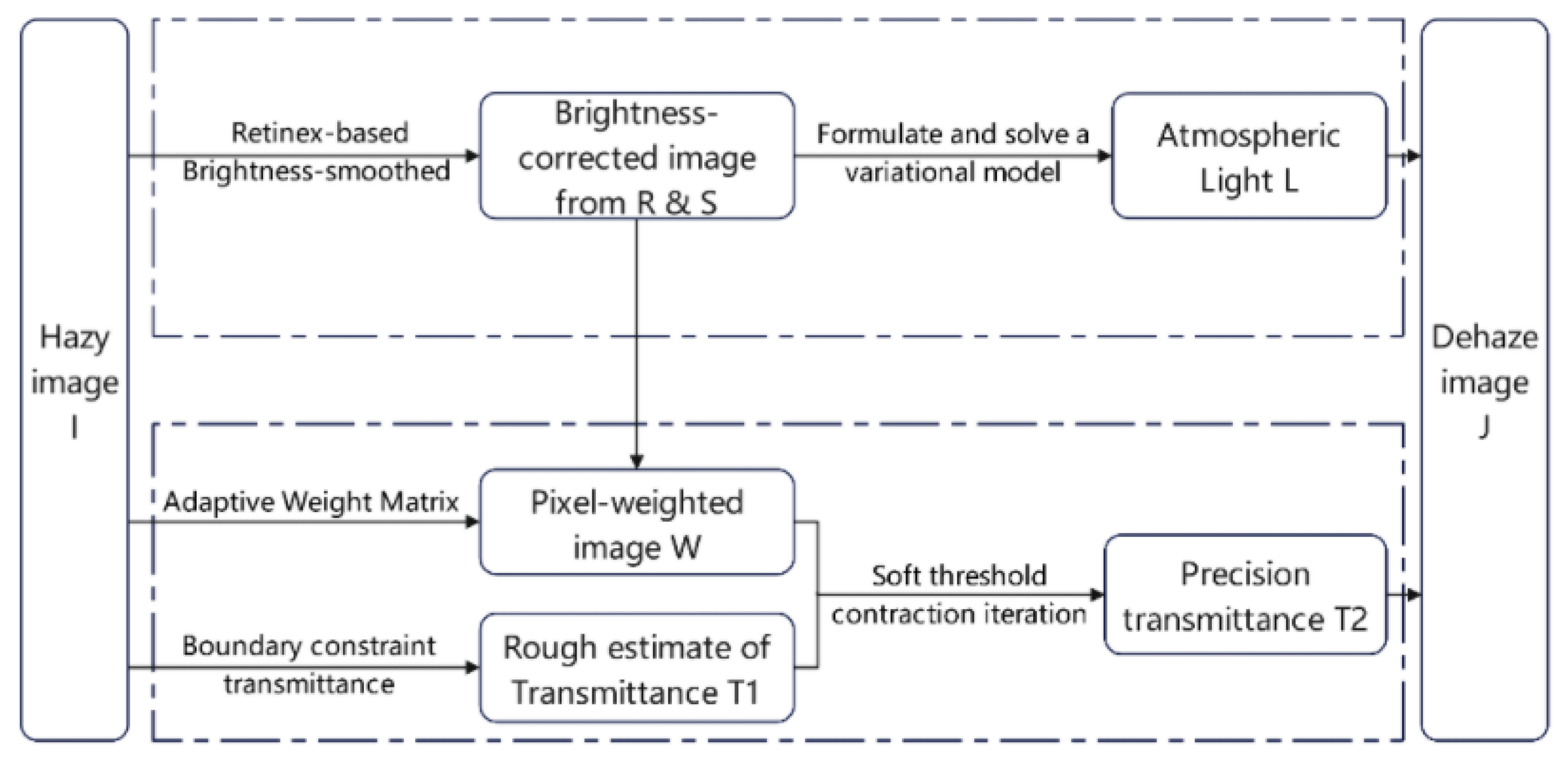
Figure 2.
Examples of images in the flow chart.
In daytime scenes, the sun acts as the dominant light source, providing globally uniform illumination. However, in nighttime haze images, the scene typically contains multiple colored light sources—such as building lights, streetlights, and vehicle headlights. In this case, the atmospheric light A should be replaced by a spatially varying illumination map L. Thus, the image formation becomes the following:
The goal of nighttime image dehazing is to recover the haze-free image J from the observed hazy image I. Since I in Equation (3) depends only on the illumination map L, we must first estimate L.
Based on intrinsic image decomposition theory, the haze-free image can be expressed as the product of illumination L and intrinsic reflectance ρ. Therefore, Equation (4) can be rewritten as follows:
Here, I denotes the observed hazy image, while ρ and t denote the reflectance and transmission, respectively, which can be obtained from prior reflectance decomposition and transmission estimation (or from an initial estimate). L is the global illumination map to be estimated. A naïve derivation directly minimizing tends to amplify both noise and estimation errors. To address such variational optimization problems in dehazing, Fang et al. [13] introduced a variational framework combined with Total Variation (TV) regularization to estimate the hazy-image transmission, preserving image structure while achieving robustness and smoothness.
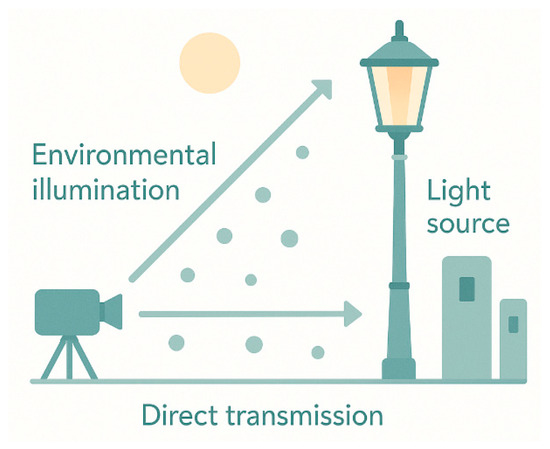
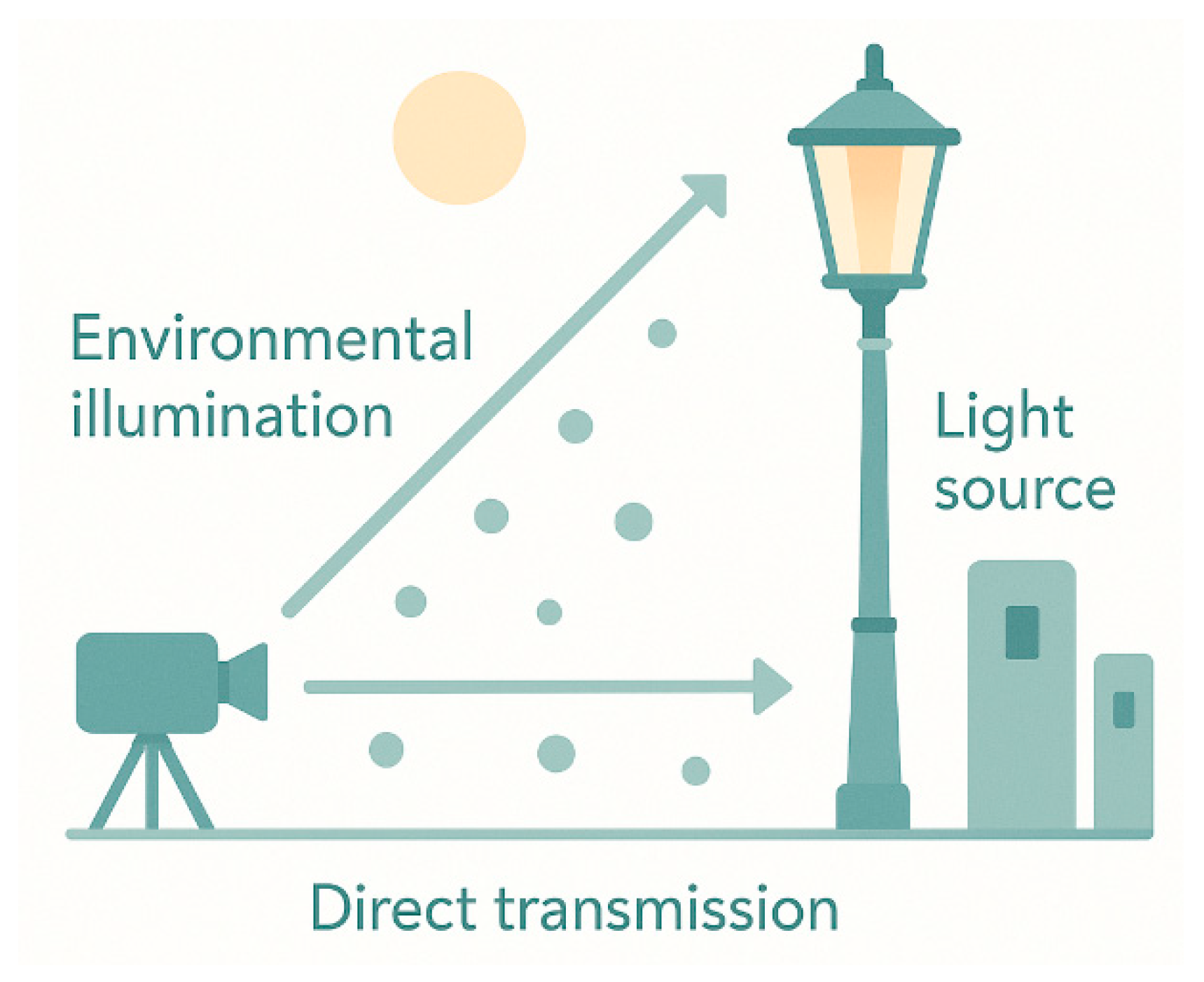
However, nighttime scenes contain complex, often point-type light sources whose spatially non-uniform illumination cannot be accurately modeled by a single edge-preserving regularizer. This misestimation of L leads to residual glow diffusion in the final dehazed image. Therefore, we must balance structure preservation and smoothness to better approximate the true illumination distribution and, in turn, align with human visual perception. The corresponding nighttime atmospheric scattering model is illustrated in Figure 3. Unlike the daytime model with global atmospheric light, the nighttime model replaces it with a spatially varying illumination term to better describe non-uniform artificial lighting conditions.
Figure 3.
Nighttime atmospheric scattering model.
2.1.2. Spatially Varying Illumination Modeling for Color-Consistent Restoration
In nighttime hazy scenes, color distortion is closely related to the illumination assumption adopted in the imaging model. If atmospheric light is treated as a global constant, the estimated illumination is forced to represent the entire image using a single compromise value, which is often insufficient for scenes containing multiple light sources with different intensities and color temperatures. As a result, local regions may suffer from under-correction or over-correction during restoration, leading to visible color inconsistency in the dehazed image. Therefore, improving nighttime color consistency does not simply require an additional color-correction step; instead, it requires replacing the global constant atmospheric-light assumption with a spatially varying illumination representation.
From a mathematical perspective, the global constant atmospheric light in Equation (1) and the pixel-wise spatially varying illumination correspond to two different optimization formulations. Their difference in solution structure is precisely the reason why spatially varying illumination modeling can better support color-consistent nighttime restoration.
Based on Equation (1), if the atmospheric light is assumed to be a constant , the simplified imaging relation can be written as follows:
where denotes the pixel location, denotes the observed intensity at pixel , denotes the global constant atmospheric-light estimate, and denotes the reflectance–transmission coupling coefficient at pixel . Taking the derivative of the energy with respect to and setting it to zero gives,
where denotes the image domain, denotes the least-squares fitting energy, and denotes the optimal constant atmospheric-light value obtained by minimizing .
This yields a single optimal value that best fits all pixels in the image. However, because different pixels usually exhibit significantly different reflectance superposition coefficients and observed intensities , the resulting is only an average global compromise. Such a representation cannot adequately describe local variations in luminance and color temperature caused by individual nighttime light sources and thus often leads to regional color deviation in the restored image.
If the atmospheric light is instead modeled as a spatially varying function , and a smoothness regularizer is introduced into the fitting term, the following variational energy functional can be established,
where denotes the variational energy for spatially varying illumination estimation, is the regularization coefficient, and denotes the spatial gradient of the illumination field.
The first term represents the local fitting constraint associated with the imaging model, and the second term enforces the spatial smoothness of to suppress noise amplification. Taking the variational derivative of with respect to and setting it to zero yields the corresponding Euler–Lagrange equation:
where denotes the Laplacian operator. When the regularization coefficient α → 0, this equation simplifies to the following:
This limiting case corresponds to performing an independent least-squares fitting at each pixel, which allows the illumination estimate to adapt to local chromatic and luminance variations. When , the smoothing term encourages spatial continuity in noisy regions while still allowing necessary transitions around light sources and structural boundaries. In this way, a balance is achieved between local adaptability and spatial smoothness.
Therefore, the variational formulation can be understood as a spatially adaptive illumination estimation process with structural regularization. Rather than performing a separate post hoc color correction, it improves nighttime color consistency by enabling the illumination field to follow local scene variation while maintaining global coherence. This provides the necessary modeling basis for the mixed-norm variational illumination estimation developed in the next subsection.
2.1.3. Construction of a Variational Model Based on − Regularization
To balance structural preservation with image smoothness, we introduce a novel mixed-norm regularization scheme into our variational framework. The procedure is as follows. From Equation (4), we isolate the relevant terms:
where denotes the intrinsic reflectance, denotes the transmission, and denotes the reflectance–transmission coupling coefficient,
where denotes the preliminary illumination obtained by physical inversion. In the ideal noise-free case, should be close to . Based on this relation, the data-fidelity term is defined as,
where denotes the data-fidelity term, controls the confidence in the preliminary illumination, denotes summation over all pixels, and denotes the Frobenius norm. This term constrains the estimated illumination to remain close to the preliminary illumination obtained through physical inversion.
To jointly enforce smoothness and preserve salient structural discontinuities, we introduce a weighted − mixed-norm regularization. The generic − form is written as,
where denotes a generic vector, is its -th component, and is the exponent of the non-convex norm. For directional image gradients, the weighted form is defined as,
where indexes the gradient direction, denotes the pixel location, denotes the directional Sobel operator in the -th direction, denotes discrete convolution, denotes the directional gradient response, and denotes the corresponding adaptive weight. The parameters control the trade-off between smoothness and sparsity, respectively. Compared with a purely convex formulation, the introduced non-convex term is intended to improve structural selectivity rather than to simplify the optimization landscape. Here, the weighted term suppresses small-scale noise and promotes global smoothness, whereas the weighted term is more tolerant of a few large gradients and is therefore beneficial for preserving strong structural discontinuities,
Here, is the data-fidelity term, which constrains the estimated illumination to remain close to the preliminary illumination obtained by physical inversion. The terms and are regularization terms that promote illumination smoothness and edge preservation, respectively. In these expressions, denotes the illumination field to be estimated at pixel , represents the horizontal and vertical directions, denotes the directional Sobel operator, is the discrete convolution operator, and is the adaptive weight computed from the gradient magnitude of the original image. The product is defined element-wise. The resulting optimization problem is solved using the Split Bregman method [32] to obtain the final estimate of the nighttime global illumination map. In the present implementation, the optimization is initialized from the physically inverted preliminary illumination, and the same parameter settings are used across experiments unless otherwise specified.
It should be noted that the introduced regularization with makes the proposed variational model non-convex. Accordingly, the present framework is intended to obtain a stable and practically effective solution rather than to claim global optimality or uniqueness. Compared with purely convex regularization, the non-convex term is more tolerant of a few large gradients, which is beneficial for preserving strong structural discontinuities while suppressing small-scale noise in nighttime scenes. In the present implementation, nighttime atmospheric-light estimation is performed channel by channel using a Bregman-based illumination estimation procedure. For each channel, the preliminary illumination is optimized with and . Two directional gradient filters are used to characterize the main structural variations in the illumination field. The penalty parameter is initialized as and progressively updated by until . Here, controls the sensitivity of the adaptive-weight computation, denotes the penalty parameter in the Split Bregman iterations, and denotes its upper bound. Unless otherwise specified, these parameters are fixed in all experiments. The favorable results obtained under these fixed settings on both synthetic and real nighttime haze data indicate satisfactory empirical stability under the tested conditions.
2.2. Transmission Estimation Based on Boundary Constraint Theory
In daytime scenes, the effectiveness of the boundary constraint method in suppressing artifacts largely stems from its reasonable assumption regarding the distribution of atmospheric light. However, under complex nighttime illumination, this assumption no longer holds. Thus, in addition to refining atmospheric light estimation, corresponding improvements are also required in the computation of transmission. The original formulation of the boundary constraint method based on the radiance cube, as proposed by Meng et al. (2013) at ICCV 2013 [21], is expressed as follows.
where denotes the boundary-constrained lower bound of the transmission at the pixel , Ic(x) and Lc(x) denote the observed intensity and estimated illumination in channel , respectively, indexes the color channel, and and denote the lower and upper radiance bounds, respectively. And here, and denote the upper and lower bounds of the three color channels, and L(x) represents the estimated global illumination. By imposing the bounds and on the transmission function and introducing a smoothness term, the model effectively reduces blocky artifacts in daytime images that are often caused by excessive or insufficient dehazing.
In nighttime scenes, however, images typically contain multiple artificial light sources such as street lamps and headlights, resulting in highly non-uniform brightness and color temperature. When the transmission lower bound tb is directly computed using the daytime constraints [C0, C1], it is often underestimated in highlight regions. Consequently, these regions are erroneously treated as heavy haze, leading to large-scale artifact generation.
Therefore, under multi-source nighttime conditions, it is necessary to adaptively adjust the constraint strength across different regions: stronger smoothness penalties should be applied to flat areas, while more structural details should be preserved along edges and fine textures. To achieve this, a pixel-wise weight matrix W(x) is introduced.
where denotes the pixel-wise adaptive weight at pixel , denotes the intensity of channel , denotes Gaussian smoothing with standard deviation . This design is analogous to the edge-preserving mechanism of bilateral filtering: flat regions (with small grayscale variations) are assigned larger weights, while edge/noise regions (with large variations) are rapidly down-weighted. In this way, the subsequent thresholding step can automatically distinguish noise from true structures [29].
At the k-th iteration, for each directional operator , the local gradient is first computed, followed by weighted thresholding to enforce sparsity:
Here, β is the penalty parameter in the Bregman splitting method, indexes the directional operator, denotes the -th directional gradient filter, denotes the local transmission gradient at pixel , and denotes the auxiliary variable after weighted soft-thresholding. Subsequently, all terms are solved in the frequency domain to update t.
Here, denote the discrete Fourier transform and its inverse, respectively, denotes the boundary-constrained initial transmission, denotes the refined transmission to be solved, denotes the adjoint operator of , denotes the auxiliary variable associated with the -th direction, and indexes the directional filters. This approach leverages FFT to reduce the complexity of subproblems that would otherwise require large-scale linear solvers, thereby achieving a balance between accuracy and computational efficiency [21]. To enhance the spatial correlation of image pixels and prevent over-dehazing, a regularization-based strategy is adopted to optimize the transmission, thereby improving image quality. Specifically, the L2 norm is employed for both the regularization and data fidelity terms to avoid overfitting, while the L1 norm—being more robust to outliers—is used to enhance sensitivity to informative structures. The optimal transmission tr is then obtained by minimizing the following objective function.
where denotes the transmission refinement energy, denotes the reference transmission obtained from the previous optimization stage, denotes the refined transmission to be estimated, denotes the neighborhood of pixel , and denotes the pairwise weighting function between pixels and . In this study, a hybrid function of chromaticity difference and luminance difference is employed, as illustrated in the following figure.
Here, denotes the weight for chromaticity and luminance differences; and represent the color vectors; is a fixed parameter set to 0.5; I(x) and I(y) denote the luminance values; is the luminance sensitivity parameter (typically 0.3); and δ is a small constant (usually 0.0001) introduced to prevent division by zero. The optimal transmission is obtained via least-squares estimation. The parameters , , and δ collectively regulate sensitivity to color and luminance variations as well as numerical stability, enabling the model to preserve boundary and detail recognition under complex illumination. At this stage, the boundary constraint method no longer relies on the assumption of global atmospheric light in daytime scenes, making it suitable for nighttime transmission estimation. The dehazed image can then be recovered using Equation (1).
For transmission refinement, the optimization starts from the boundary-constrained lower bound , with and . The transmission is initialized as , and the adaptive weight matrix is computed using a 5 × 5 Gaussian filter. During weight construction, each image channel is scaled to [0, 255]. After iterative optimization, the refined transmission is clipped to [0.1, 1] to avoid numerical instability during image recovery.
3. Results
3.1. Experimental Setup
This study employs the Real-World Nighttime Hazy (RWNH) dataset and the 3R Synthetic Benchmark Dataset for evaluation [9]. The RWNH dataset contains 440 real nighttime haze images captured under diverse illumination conditions, scene types, and haze densities, making it suitable for qualitative and no-reference evaluation of nighttime dehazing algorithms in complex real-world environments. The 3R Synthetic Benchmark Dataset is generated using the “3R” synthesis pipeline, which reconstructs scene geometry, simulates light propagation and object reflection, and renders haze effects to transform daytime haze-free images into realistic nighttime hazy counterparts. It consists of three subsets, namely NHC (derived from Cityscapes) [36], NHM (derived from Middlebury) [37], and NHR (derived from RESIDE) [38], comprising more than 5000 paired images and their corresponding ground truth. The use of both synthetic and real nighttime haze datasets enables complementary evaluation under controlled and practical conditions, with the former supporting paired quantitative assessment and the latter reflecting the domain difference and greater complexity of real nighttime haze.
The proposed method is compared with several representative nighttime dehazing approaches on both synthetic and real-world nighttime hazy images. The compared methods include glow suppression (GS), the maximum reflectance prior (MRP), the optimal scale fusion dehazing method (OSFD), and a representative learning-based dehazing baseline, DehazeNet, in addition to the proposed approach.
Following related work, two full-reference objective metrics are adopted to evaluate performance on public benchmark datasets: Peak Signal-to-Noise Ratio (PSNR) and Structural Similarity Index (SSIM). For real-world nighttime scenes, two no-reference quality measures are employed: the Naturalness Image Quality Evaluator (NIQE) and the No-Reference Contrast-Distorted Image Quality Assessment (NR-CDIQA). All experiments in this work are conducted in MATLAB R2021b, while the baseline methods are implemented using the authors’ released executable codes, executed on a PC equipped with an Intel Core i7-11700 CPU and 16 GB of memory. In all experiments, the implementation parameters were not separately tuned for different datasets unless otherwise stated. This setting was adopted to evaluate the robustness of the proposed method under different nighttime haze conditions using a unified parameter configuration. The atmospheric-light estimation stage used fixed internal parameters , , , and . The transmission-refinement stage used the parameter set defined in the dehazing function, and the same values were applied across synthetic and real nighttime haze datasets.
3.2. Qualitative Comparison on Synthetic Image Data
To validate the effectiveness of the proposed method, we conducted comparisons with several advanced nighttime dehazing approaches on synthetically generated hazy images. The experiments employed representative synthetic examples with varying haze densities, selected from the integrated dataset combining NHM and NHR with NYU_GT from the D-HAZY dataset, to facilitate a fair comparison.
To further evaluate the performance of the proposed algorithm, comparative experiments were conducted on synthetic images.
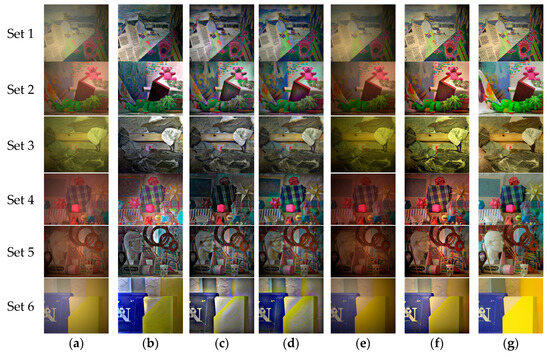
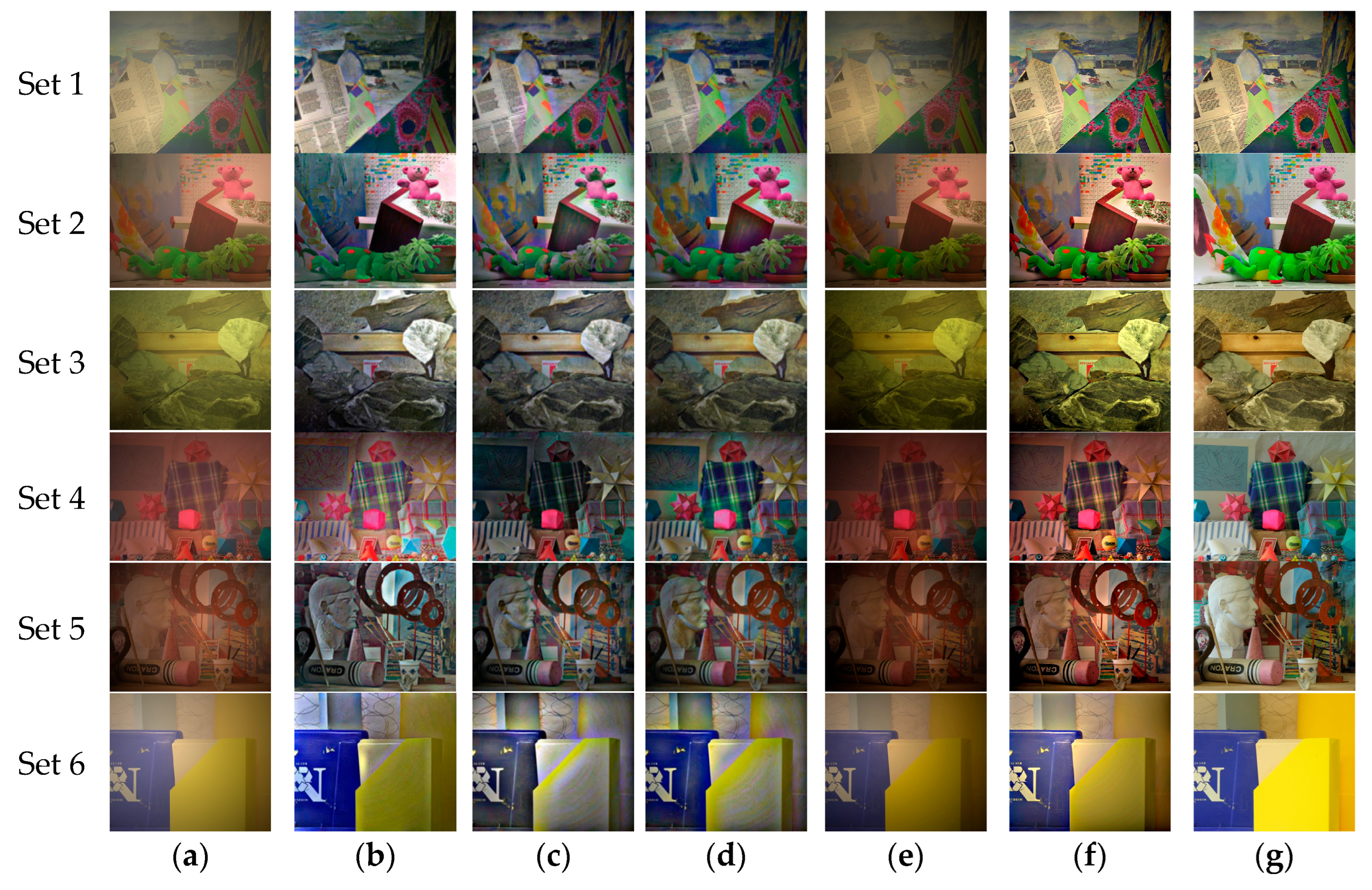
Five representative synthetic examples with varying haze densities were selected from the newly released NHM dataset. As illustrated in Figure 4, GS produces relatively dark outputs due to insufficient brightness compensation. MRP improves visibility, but noticeable color shifts and local distortions remain, especially around the pink target object. OSFD restores structural details more effectively, yet halo artifacts and glow diffusion are still visible around bright regions. Dehaze-Net improves visibility to some extent but still exhibits color bias or residual haze in several scenes under strong illumination variation. By comparison, the proposed method provides a more balanced restoration result, with better glow suppression, more consistent color reproduction, and clearer structural boundaries.
Figure 4.
Comparisons of state-of-the-art nighttime dehazing methods on synthetic images. (a) Hazy images; (b) GS; (c) MRP; (d) OSFD; (e) Dehaze-NET; (f) Ours; (g) clear image.
For quantitative evaluation, Peak Signal-to-Noise Ratio (PSNR) and Structural Similarity Index (SSIM) were adopted. Table 1 reports the corresponding results on six synthetic nighttime haze subsets. The proposed method achieves the highest PSNR on all six subsets and the highest SSIM on four subsets, while tying with DehazeNet on Set 3. Compared with the second-best method, OSFD, the proposed method improves the average PSNR from 14.424 to 15.405 dB, corresponding to a relative gain of 6.80%, and improves the average SSIM from 0.704 to 0.717, corresponding to a relative gain of 1.87%. In addition, the mean ± standard deviation across the six subsets is 15.405 ± 1.775 in PSNR and 0.717 ± 0.103 in SSIM for the proposed method, compared with 14.424 ± 1.316 and 0.704 ± 0.029 for OSFD. Across the six subsets, the proposed method also shows the best overall ranking performance, further indicating stronger robustness across different nighttime haze conditions.
Table 1.
Comparative analysis of objective evaluation metrics in synthetic fog datasets. (Best results in bold).
The results also show that the proposed method is not the best on every individual metric. For example, Set 4 represents a relatively challenging synthetic case with more complex multi-color nighttime illumination, under which the proposed method does not achieve the best SSIM, indicating that local structural similarity may still be affected in such extreme conditions; its SSIM is lower than that of MRP, OSFD, and DehazeNet. This suggests that the proposed transmission refinement is relatively conservative in certain challenging regions with strong nighttime illumination variation, which may slightly reduce local structural similarity while still maintaining more stable overall visibility restoration. Therefore, the results in Figure 4 and Table 1 support not only the effectiveness of the proposed method but also its stronger overall robustness across different nighttime haze conditions.
3.3. Qualitative Comparisons on Real-World Images
To further validate the performance of the proposed framework, comparisons were conducted on real-world nighttime hazy images.
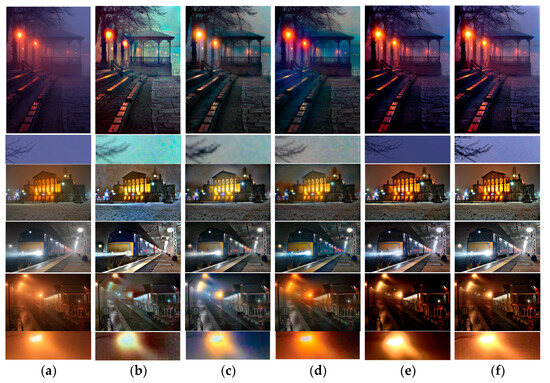
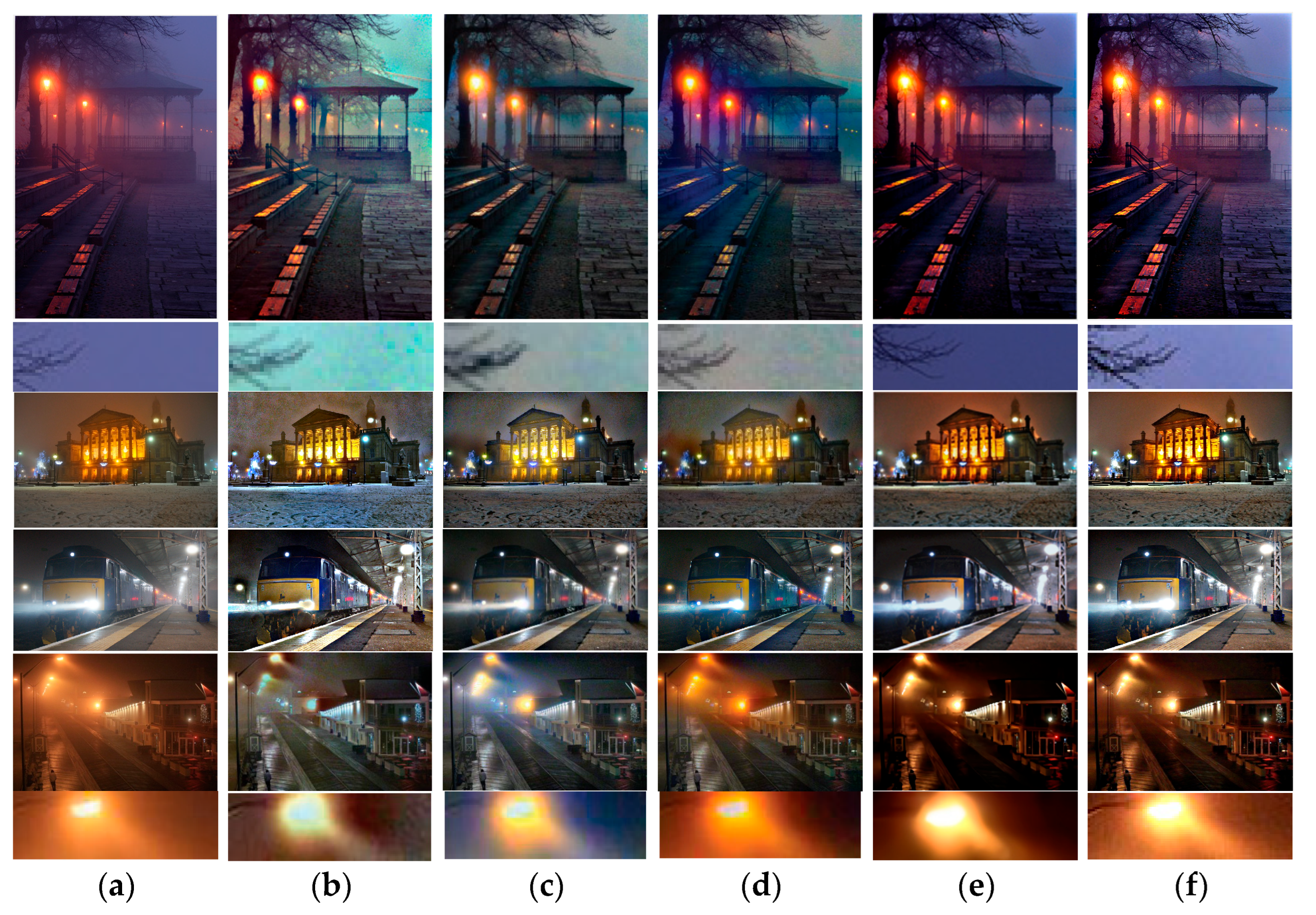
As shown in Figure 5, GS alleviates part of the halo artifacts caused by artificial light sources but fails to recover sufficient fine details. MRP performs poorly in low-light regions and introduces noticeable color distortion in the restored results. OSFD improves structural visibility, yet still suffers from evident color shifts, and in some cases amplifies noise in dark or locally complex regions. DehazeNet enhances scene visibility to some extent, but its restoration remains unstable under strong nighttime illumination variation, with residual color bias or incomplete haze removal still observable in several regions. By comparison, the proposed framework produces more balanced visual results, especially in terms of glow suppression around bright light sources, structural clarity in low-contrast regions, and overall color consistency.
Figure 5.
Visual comparison of different dehazing methods on real-world nighttime hazy scenes. (a) Hazy images; (b) GS; (c) MRP; (d) OSFD; (e) DehazeNet; (f) Ours.
To reduce subjective bias, Table 2 further reports the no-reference evaluation results on the real-world nighttime fog dataset using the Naturalness Image Quality Evaluator (NIQE), which measures perceptual naturalness, and the No-Reference Contrast-Distorted Image Quality Assessment (NR-CDIQA), which evaluates contrast-related image quality without reference images. According to Table 2, the proposed method achieves the best NIQE score of 3.2453 and the best NR-CDIQA score of 3.1413 among the compared methods. These objective results are consistent with the visual observations in Figure 5, indicating that the proposed method provides more stable enhancement under real nighttime haze conditions.
Table 2.
No-reference evaluation on the real-world nighttime fog dataset. (Best results in bold).
Although the numerical gains in the no-reference metrics are not large, they are meaningful in practice because they correspond to more stable glow suppression around strong light sources, less noise amplification in dark regions, and clearer structural information in low-contrast areas, which are important for subsequent nighttime urban monitoring and visual interpretation. In particular, the improvement is reflected not only in general visibility enhancement but also in the suppression of noise amplification, the preservation of meaningful structural information, and more consistent restoration in challenging nighttime scenes.
3.4. Running Time Comparison
To evaluate the computational cost of the proposed framework, we further report the average runtime per image under the same hardware setting. All methods were tested on 50 nighttime hazy images of size 460 × 464 on a PC equipped with an Intel Core i7-11700 CPU and 16 GB of memory, without GPU acceleration.
Table 3 summarizes the average runtime of the compared methods. The proposed method shows competitive computational efficiency under the current CPU-based setting. It is substantially faster than GS and also faster than MRP and DehazeNet, while remaining close to OSFD. It should be noted that DehazeNet is included here as a representative classical learning-based dehazing baseline, and this comparison is intended to provide a reference under a unified evaluation setting rather than to imply an efficiency advantage over all modern deep learning methods.
Table 3.
Average runtime comparison on 50 real nighttime hazy images (460 × 464, CPU only, and best results in bold).
The runtime of the proposed method is mainly determined by two iterative optimization stages, namely nighttime atmospheric-light estimation and transmission refinement. In particular, the atmospheric-light estimation stage performs channel-wise Bregman optimization, whereas the transmission refinement stage further introduces iterative updates with adaptive weighting and shrinkage operations. Although FFT-based solving is adopted to improve the efficiency of the transmission update, the overall framework remains more suitable for quality-oriented nighttime image enhancement than strict real-time deployment.
3.5. Ablation Study
The proposed nighttime dehazing framework consists of three key stages: global illumination estimation, transmission optimization based on boundary constraints, and adaptive weighting combined with weighted soft-thresholding. To demonstrate the contribution of each module, ablation experiments were conducted on real-world nighttime hazy images.
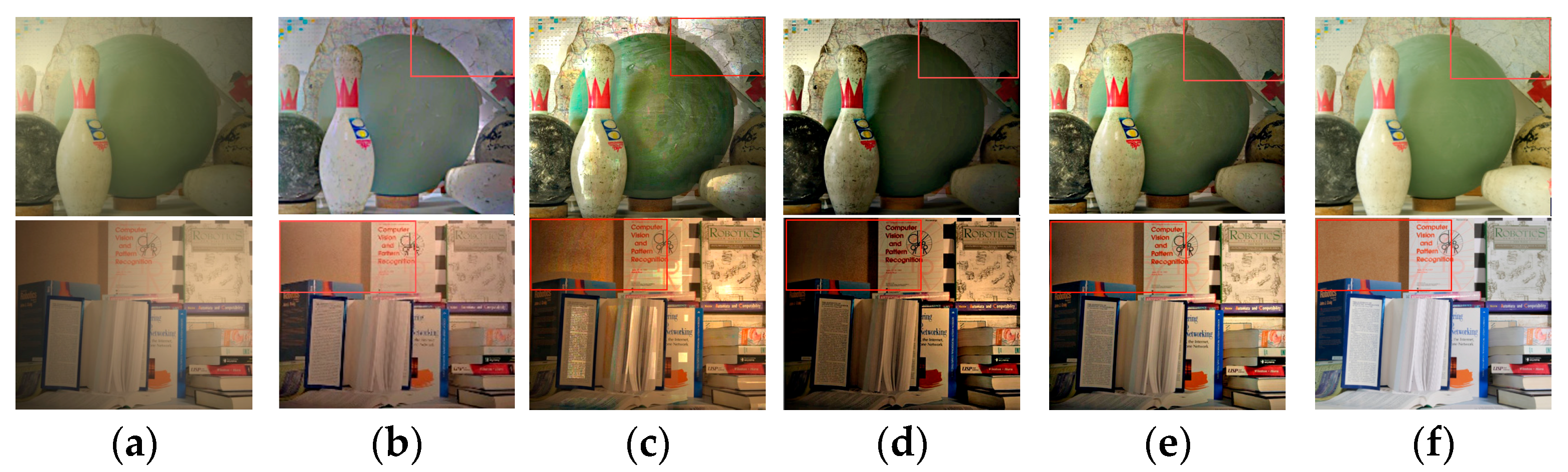
As shown in Figure 6, the dehazing performance of different ablation versions on synthetic datasets exhibits significant differences. Figure 6b shows that without global illumination estimation, the images appear flattened, as the estimated global illumination values are unified under simulated low-light conditions, leading to ambiguous depth relationships and inaccurate subsequent transmission estimation. Figure 6c illustrates that when boundary-constrained transmission initialization is omitted, severe artifacts emerge along the edges of bright regions. Figure 6d shows that removing the weighted soft-thresholding strategy and the adaptive weighting matrix—which simulates adaptive optimization for nighttime conditions—results in excessive sharpening around highlights and shadows, causing exaggerated local contrast that deviates from human visual perception. In contrast, the complete framework in Figure 6e not only effectively removes haze but also preserves edge structures and texture details while ensuring faithful color reproduction, yielding results closest to the haze-free reference in Figure 6f. As illustrated in Table 4, quantitative evaluation on six groups of synthetic images using PSNR and SSIM demonstrates that the pipeline in Figure 6c produces the lowest scores (11.493 and 0.539, respectively), whereas the proposed method achieves the highest average scores of 14.162 and 0.678.
Figure 6.
Ablation study on synthetic nighttime hazy images. (a) Input image. (b) Result without intrinsic-information-based variational atmospheric-light estimation. (c) Result without boundary-constrained transmission initialization. (d) Result without weighted soft-thresholding and adaptive weighting. (e) Result of the complete proposed framework. (f) Ground-truth haze-free image.
Table 4.
Average PSNR and SSIM of different ablation pipelines. (a) Result without intrinsic-information-based variational atmospheric-light estimation. (b) Result without boundary-constrained transmission initialization. (c) Result without weighted soft-thresholding and adaptive weighting. (d) Result of the complete proposed framework. (Best results in bold).
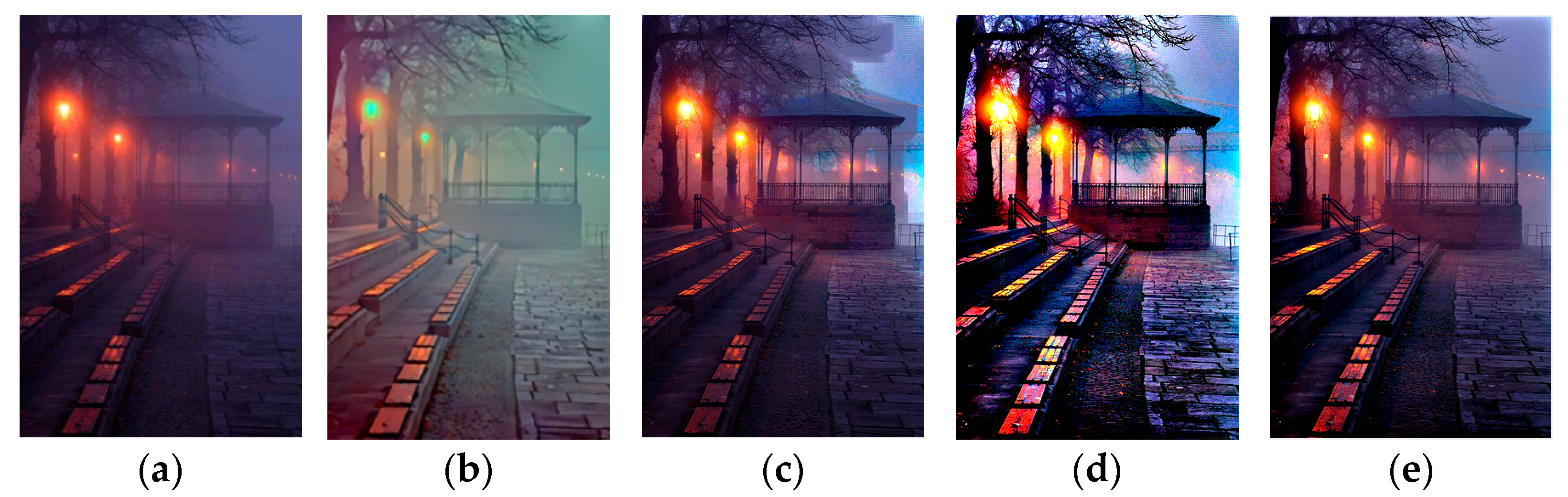
As illustrated in Figure 7, similar patterns are observed in real-world nighttime data. Figure 7b shows that without global illumination estimation, the images exhibit flattened visual effects with severe color distortion and uneven brightness. Figure 7c illustrates that when boundary-constrained transmission initialization is excluded and the classical dark channel prior is employed instead, transmission estimation becomes inaccurate in local regions, leading to residual haze in the foreground, insufficient detail restoration, and visible artifacts along building edges. Figure 7d shows that eliminating the adaptive weighting matrix and the weighted soft-thresholding strategy causes the iterative process to apply uniform dehazing strength across regions, resulting in over-dehazing, artifacts, and ring-like halos around boundaries. By contrast, the complete framework shown in Figure 7e preserves the intrinsic color characteristics of light sources while effectively suppressing low contrast and color shifts caused by haze. It not only enhances global brightness but also achieves fine dehazing along detailed edges, significantly improving visual quality in nighttime scenarios. These results demonstrate that the three modules work in concert, each playing a complementary role, to ensure high-quality restoration of nighttime hazy images.
Figure 7.
Ablation study on real-world nighttime hazy images. (a) Input image. (b) Result without intrinsic-information-based variational atmospheric-light estimation. (c) Result without boundary-constrained transmission initialization. (d) Result without weighted soft-thresholding and adaptive weighting. (e) Result of the complete proposed framework.
4. Conclusions
In this paper, we propose a physics-based nighttime image dehazing framework for urban monitoring scenes. The core idea is to jointly optimize atmospheric-light estimation and transmission refinement under complex nighttime illumination. Specifically, a mixed-norm variational formulation is introduced to improve atmospheric-light estimation beyond heuristic light-region-driven strategies, and a structure-aware transmission refinement scheme is developed by integrating boundary-constrained estimation with adaptive weighted soft-threshold shrinkage. In this way, the proposed framework aims to suppress glow diffusion, alleviate color distortion, and reduce structural artifacts in a coordinated manner.
Experimental results on both synthetic and real nighttime haze datasets show that the proposed method performs favorably in terms of visibility restoration, color consistency, and structural clarity. On synthetic data, the method achieves strong quantitative performance in PSNR and SSIM, while on real nighttime images, it produces balanced visual enhancement and favorable no-reference evaluation results. Nevertheless, several limitations remain. In scenes with extremely strong local illumination, severe color mixing, or very dense haze, atmospheric-light estimation may still be locally biased, leading to incomplete glow suppression or residual color deviation. The proposed transmission refinement is intentionally conservative near bright structural boundaries to avoid over-enhancement and artifact amplification. Although this improves restoration stability, it may reduce local structural similarity in difficult cases, which is consistent with the non-best SSIM result observed on Set 4. In very dark regions, strong noise suppression may also limit the recovery of some fine details. In addition, the iterative optimization framework still involves a non-negligible computational cost, making the current implementation more suitable for quality-oriented nighttime enhancement than strict real-time deployment.
Author Contributions
Conceptualization, X.L. and Y.W.; methodology, Y.W.; software, Y.W.; validation, R.W. and Y.L.; formal analysis, Y.W.; investigation, Y.W.; resources, X.L. and R.W.; data curation, Y.W.; writing—original draft preparation, Y.W.; writing—review and editing, Y.L.; visualization, Y.W.; supervision, X.L. and R.W.; project administration, X.L.; funding acquisition, X.L. All authors have read and agreed to the published version of the manuscript.
Funding
This research received no external funding.
Institutional Review Board Statement
Not applicable.
Informed Consent Statement
Not applicable.
Data Availability Statement
The datasets used in this study are publicly available from the corresponding published sources. Additional data generated during the current study are available from the corresponding author upon reasonable request.
Conflicts of Interest
The authors declare no conflicts of interest.
Abbreviations
The following abbreviations are used in this manuscript:
| DCP | Dark Channel Prior |
| PSNR | Peak Signal-to-Noise Ratio |
| SSIM | Structural Similarity Index Measure |
References
- Murugan, R.A.; Sathyabama, B. Night Vision Object Tracking System Using Correlation Aware LSTM-Based Modified Yolo Algorithm. Intell. Autom. Soft Comput. 2023, 36, 353–368. [Google Scholar] [CrossRef] [Scilit]
- Doan, M.P.; Tran, V.T.; Huynh, H.H.; Huynh, H.X. A scalable IoT video data analytics for smart cities. EAI Endorsed Trans. Context-Aware Syst. Appl. 2019, 6, e3. [Google Scholar] [CrossRef] [Scilit]
- Nayar, S.K.; Narasimhan, S.G. Vision in bad weather. In Proceedings of the Seventh IEEE International Conference on Computer Vision (ICCV), Kerkyra, Greece, 20–27 September 1999; Volume 2, pp. 820–827. [Google Scholar] [CrossRef] [Scilit]
- Li, Y.; Tan, R.T.; Brown, M.S. Nighttime haze removal with glow and multiple light colors. In Proceedings of the IEEE International Conference on Computer Vision (ICCV); IEEE: New York, NY, USA, 2015; pp. 226–234. [Google Scholar] [CrossRef] [Scilit]
- Pei, S.-C.; Lee, T.-Y. Nighttime haze removal using color transfer pre-processing and dark channel prior. In Proceedings of the 2012 19th IEEE International Conference on Image Processing (ICIP); IEEE: New York, NY, USA, 2012; pp. 957–960. [Google Scholar] [CrossRef] [Scilit]
- Tang, Q.; Yang, J.; He, X.; Jia, W.; Zhang, Q.; Liu, H. Nighttime image dehazing based on Retinex and dark channel prior using Taylor series expansion. Comput. Vis. Image Underst. 2021, 202, 103086. [Google Scholar] [CrossRef] [Scilit]
- Park, D.; Han, D.K.; Ko, H. Nighttime image dehazing using local atmospheric selection rule and weighted entropy for visible-light systems. Opt. Eng. 2017, 56, 050501. [Google Scholar] [CrossRef] [Scilit]
- Yao, X.-W.; Zhang, X.; Zhang, Y.; Xing, W.; Zhang, X. Nighttime Image Dehazing Based on Point Light Sources. Appl. Sci. 2022, 12, 10222. [Google Scholar] [CrossRef] [Scilit]
- Zhang, J.; Cao, Y.; Zha, Z.-J.; Tao, D. Nighttime Dehazing with a Synthetic Benchmark. In Proceedings of the 28th ACM International Conference on Multimedia, Seattle, WA, USA, 12–16 October 2020; pp. 2355–2363. [Google Scholar] [CrossRef] [Scilit]
- Zhang, J.; Cao, Y.; Wang, Z. Nighttime haze removal based on a new imaging model. In Proceedings of the 2014 IEEE International Conference on Image Processing (ICIP); IEEE: New York, NY, USA, 2014; pp. 4557–4561. [Google Scholar] [CrossRef] [Scilit]
- Ancuti, C.O.; Ancuti, C. Single image dehazing by multi-scale fusion. IEEE Trans. Image Process. 2013, 22, 3271–3282. [Google Scholar] [CrossRef] [Scilit]
- Zhu, Q.; Mai, J.; Shao, L. A fast single image haze removal algorithm using color attenuation prior. IEEE Trans. Image Process. 2015, 24, 3522–3533. [Google Scholar] [CrossRef] [Scilit] [PubMed]
- Zhang, J.; Cao, Y.; Fang, S.; Kang, Y.; Chen, C.W. Fast haze removal for nighttime image using maximum reflectance prior. In Proceedings of the IEEE Conference on Computer Vision and Pattern Recognition (CVPR); IEEE: New York, NY, USA, 2017; pp. 7016–7024. [Google Scholar] [CrossRef] [Scilit]
- Cai, B.; Xu, X.; Jia, K.; Qing, C.; Tao, D. DehazeNet: An end-to-end system for single image haze removal. IEEE Trans. Image Process. 2016, 25, 5187–5198. [Google Scholar] [CrossRef] [Scilit] [PubMed]
- Bernabel, S.A.; Agaian, S.S. NDELS: A Novel Approach for Nighttime Dehazing, Low-Light Enhancement, and Light Suppression. IEEE Trans. Multimed. 2024, 26, 9292–9303. [Google Scholar] [CrossRef] [Scilit]
- Lin, B.; Jin, Y.; Yan, W.; Ye, W.; Yuan, Y.; Tan, R.T. NightHaze: Nighttime Image Dehazing via Self-Prior Learning. Proc. AAAI Conf. Artif. Intell. 2025, 39, 5209–5217. [Google Scholar] [CrossRef] [Scilit]
- Deng, J.; Chan, P.P.K.; Yeung, D.S. Real-world nighttime image dehazing using contrastive and adversarial learning. Pattern Recognit. 2025, 165, 111596. [Google Scholar] [CrossRef] [Scilit]
- He, K.; Sun, J.; Tang, X. Single image haze removal using dark channel prior. IEEE Trans. Pattern Anal. Mach. Intell. 2011, 33, 2341–2353. [Google Scholar] [CrossRef] [Scilit]
- Fattal, R. Single image dehazing. ACM Trans. Graph. 2008, 27, 72. [Google Scholar] [CrossRef] [Scilit]
- Tarel, J.-P.; Hautière, N. Fast visibility restoration from a single color or gray level image. In Proceedings of the 2009 IEEE 12th International Conference on Computer Vision (ICCV); IEEE: New York, NY, USA, 2009; pp. 2201–2208. [Google Scholar] [CrossRef] [Scilit]
- Meng, G.; Wang, Y.; Duan, J.; Xiang, S.; Pan, C. Efficient Image Dehazing with Boundary Constraint and Contextual Regularization. In Proceedings of the IEEE International Conference on Computer Vision (ICCV); IEEE: New York, NY, USA, 2013; pp. 617–624. [Google Scholar] [CrossRef] [Scilit]
- Ren, W.; Pan, J.; Zhang, H.; Cao, X.; Yang, M.-H. Single Image Dehazing via Multi-scale Convolutional Neural Networks with Holistic Edges. Int. J. Comput. Vis. 2020, 128, 240–259. [Google Scholar] [CrossRef] [Scilit]
- Li, B.; Peng, X.; Wang, Z.; Xu, J.; Feng, D. AOD-Net: All-in-One Dehazing Network. In Proceedings of the IEEE International Conference on Computer Vision (ICCV); IEEE: New York, NY, USA, 2017; pp. 4770–4778. [Google Scholar] [CrossRef] [Scilit]
- Lin, S.; Luo, J.; Zhang, R.; Ning, Z. Nighttime image dehazing based on a modified model and saturation line prior. Digit. Signal Process. 2025, 161, 105113. [Google Scholar] [CrossRef] [Scilit]
- Zhang, H.; Patel, V.M. Densely Connected Pyramid Dehazing Network. In Proceedings of the IEEE/CVF Conference on Computer Vision and Pattern Recognition (CVPR); IEEE: New York, NY, USA, 2018; pp. 3194–3203. [Google Scholar] [CrossRef] [Scilit]
- Chen, D.; He, M.; Fan, Q.; Liao, J.; Zhang, L.; Hou, D.; Yuan, L.; Hua, G. Gated Context Aggregation Network for Image Dehazing and Deraining. In Proceedings of the 2019 IEEE Winter Conference on Applications of Computer Vision (WACV); IEEE: New York, NY, USA, 2019; pp. 1375–1383. [Google Scholar] [CrossRef] [Scilit]
- Galdran, A. Image dehazing by artificial multiple-exposure image fusion. Signal Process. 2018, 149, 135–147. [Google Scholar] [CrossRef] [Scilit]
- Mertens, T.; Kautz, J.; Van Reeth, F. Exposure Fusion. In Proceedings of the 15th Pacific Conference on Computer Graphics and Applications (Pacific Graphics 2007); IEEE: New York, NY, USA, 2007; pp. 382–390. [Google Scholar] [CrossRef] [Scilit]
- Tomasi, C.; Manduchi, R. Bilateral filtering for gray and color images. In Proceedings of the Sixth International Conference on Computer Vision (IEEE Cat. No.98CH36271), Bombay, India, 7 January 1998; pp. 839–846. [Google Scholar] [CrossRef] [Scilit]
- Cong, X.; Gui, J.; Zhang, J.; Hou, J.; Shen, H. A Semi-supervised Nighttime Dehazing Baseline with Spatial-Frequency Aware and Realistic Brightness Constraint. In Proceedings of the IEEE/CVF Conference on Computer Vision and Pattern Recognition (CVPR), Seattle, WA, USA, 16–22 June 2024; pp. 2631–2640. [Google Scholar] [CrossRef] [Scilit]
- Fang, F.; Li, F.; Zeng, T. Single Image Dehazing and Denoising: A Fast Variational Approach. Siam J. Imaging Sci. 2014, 7, 969–996. [Google Scholar] [CrossRef] [Scilit]
- Goldstein, T.; Osher, S. The Split Bregman Method for L1-Regularized Problems. SIAM J. Imaging Sci. 2009, 2, 323–343. [Google Scholar] [CrossRef] [Scilit]
- Mondal, R.; Santra, S.; Chanda, B. Image Dehazing by Joint Estimation of Transmittance and Airlight Using Bi-Directional Consistency Loss Minimized FCN. In Proceedings of the IEEE/CVF Conference on Computer Vision and Pattern Recognition Workshops (CVPRW), Salt Lake City, UT, USA, 18–22 June 2018; pp. 920–928. [Google Scholar] [CrossRef] [Scilit]
- Zhao, A.; Li, L.; Liu, S. UIDF-Net: Unsupervised Image Dehazing and Fusion Utilizing GAN and Encoder–Decoder. J. Imaging 2024, 10, 164. [Google Scholar] [CrossRef] [Scilit]
- Narasimhan, S.G.; Nayar, S.K. Vision and the Atmosphere. Int. J. Comput. Vis. 2002, 48, 233–254. [Google Scholar] [CrossRef] [Scilit]
- Cordts, M.; Omran, M.; Ramos, S.; Rehfeld, T.; Enzweiler, M.; Benenson, R.; Franke, U.; Roth, S.; Schiele, B. The Cityscapes Dataset for Semantic Urban Scene Understanding. In Proceedings of the IEEE Conference on Computer Vision and Pattern Recognition (CVPR), Las Vegas, NV, USA, 27–30 June 2016; pp. 3213–3223. [Google Scholar] [CrossRef] [Scilit]
- Scharstein, D.; Hirschmüller, H.; Kitajima, Y.; Krathwohl, G.; Nešić, N.; Wang, X.; Westling, P. High-Resolution Stereo Datasets with Subpixel-Accurate Ground Truth. In Proceedings of the German Conference on Pattern Recognition (GCPR); Springer: Cham, Switzerland, 2014; pp. 31–42. [Google Scholar] [CrossRef] [Scilit]
- Li, B.; Ren, W.; Fu, D.; Tao, D.; Feng, D.; Zeng, W.; Wang, Z. Benchmarking Single-Image Dehazing and Beyond. IEEE Trans. Image Process. 2019, 28, 492–505. [Google Scholar] [CrossRef] [Scilit] [PubMed]

Disclaimer/Publisher’s Note: The statements, opinions and data contained in all publications are solely those of the individual author(s) and contributor(s) and not of MDPI and/or the editor(s). MDPI and/or the editor(s) disclaim responsibility for any injury to people or property resulting from any ideas, methods, instructions or products referred to in the content. |
© 2026 by the authors. Licensee MDPI, Basel, Switzerland. This article is an open access article distributed under the terms and conditions of the Creative Commons Attribution (CC BY) license.