Review

BIM-Based Digital Twin and Extended Reality for Electrical Maintenance in Smart Buildings: A Structured Review with Implementation Evidence


1
Department of Energy “Galileo Ferraris” (DENERG), Politecnico di Torino, 10129 Turin, Italy
2
Department of Structural, Geotechnical and Building Engineering (DISEG), Politecnico di Torino, 10129 Turin, Italy
*
Author to whom correspondence should be addressed.
Appl. Sci. 2026, 16(8), 3685; https://doi.org/10.3390/app16083685
Submission received: 12 March 2026 / Revised: 7 April 2026 / Accepted: 8 April 2026 / Published: 9 April 2026

Abstract

The current literature on electrical system maintenance highlights three technology domains—Building Information Modeling (BIM), Digital Twin (DT), and extended reality (XR)—that have independently demonstrated strong potential for improving lifecycle information management, predictive analytics, and operational support. However, their convergence remains largely underexplored, particularly in electrical system maintenance. This paper provides a structured review of BIM–DT–XR convergence in electrical system lifecycle management, examining their roles across lifecycle phases and their integration through literature synthesis and cross-domain implementation evidence. BIM is analyzed as a basis for modeling and integrating facility management with electrical asset lifecycles; DT as a framework for dynamic system representation and applications in electrical and power systems; and XR as a means of visualizing and interacting with BIM-DT environments. Cross-domain implementation evidence from an industrial electrical facility and a tertiary smart-building pilot shows that BIM–DT–XR integration is technically feasible at pilot scale. However, the analysis identifies five structural integration gaps: semantic misalignment between building-oriented IFC and grid-oriented CIM ontologies; fragmented standard adoption; inconsistent data governance and naming practices; validation approaches focused on syntactic rather than dynamic model fidelity; and the separation of XR visualization from predictive DT capabilities. The implementation evidence further indicates that real-world deployment remains constrained by data quality limitations, integration complexity, cost factors, and interoperability with legacy systems. The review concludes that, despite the maturity of individual technologies, their effective application depends on advances in semantic alignment, lifecycle data governance, validation of dynamic models, and scalable integration frameworks, enabling the transition toward integrated, interoperable, and lifecycle-aware infrastructures for electrical system maintenance.

1. Introduction

The management of electrical systems in buildings and infrastructure spans the entire project lifecycle, from design, installation, and commissioning through to operation, maintenance, and decommissioning. Electrical assets, such as switchboards, transformers, protection devices, cabling networks, lighting systems, and special installations, require continuous access to accurate, up-to-date information throughout their lifecycle, as this is essential for operational safety, service continuity, asset traceability, regulatory compliance, and cost-effective maintenance planning. Historically, the management of electrical components/assets has been based on paper documents, separate databases and various software applications, resulting in the creation of information silos whereby stakeholders are isolated and unable to coordinate effectively or utilize the information in their decision-making process [1,2]. Recent studies in BIM-enabled facility management further confirm that operation and maintenance workflows remain hindered by fragmented information delivery, heterogeneous asset records, and uneven interoperability between design environments and operational platforms [3,4].
Over the past two decades, Building Information Modeling (BIM) has evolved into a revolutionary method for managing lifecycle information about buildings in an orderly, object-based digital manner [5]. BIM enables the integration of geometric, spatial, and semantic data into parametric models that support multidisciplinary coordination during design and construction phases [6,7]. At the same time, more recent BIM-FM research has shown that the transition from design-oriented BIM models to operation-oriented information environments remains incomplete, particularly when maintenance-relevant asset data must be delivered in forms that are usable across heterogeneous operational workflows [8]. This transition also requires decision-support environments capable of making discrepancies between BIM and FM data legible to operators, for example through graphical interfaces that support comparison, validation, and actionability in lifecycle management [9].
However, despite the maturity of BIM processes for new construction, its adoption in existing buildings remains limited, particularly for operational and maintenance purposes [10]. Given that the connection between existing buildings and their electrical systems is compounded by years of incremental addition/modification/alteration and undocumented maintenance, every existing electrical asset is very difficult to model digitally using BIM because electrical systems contain an enormous quantity of complex interrelationships both internally and with other building systems within the built environment [10,11]. Furthermore, the transition from design-oriented BIM models to operation-oriented facility management platforms continues to face interoperability barriers and misalignment between information supply and demand [1,2]. For electrical systems, this limitation is particularly acute because undocumented retrofits, naming inconsistencies, panel–circuit dependencies, and partial maintenance histories compromise not only geometric completeness but also the reliability of lifecycle asset identification and maintenance decision support.
Digital Twins (DT) technologies have gained traction among different industrial sectors in parallel. The initial development of these technologies reflected the original concept of a virtual copy of a physical object connected by a two-way stream of data transfer [12,13]. Over time, the Digital Twin concept has progressed and moved from developing simple virtual representations to developing more complex variations in DT that incorporate real-time sensors, physics models, machine learning, and predictive analytics into the system [14,15,16]. In power and energy systems, Digital Twins have been proposed for applications ranging from real-time state estimation and dynamic line rating to multi-physics equipment modeling and grid-level self-healing strategies [17,18,19,20].
Recent reviews in the built environment further show that DT implementation remains characterized by definitional ambiguity, heterogeneous architectures, and unresolved challenges in data integration, interoperability, and lifecycle deployment [21,22,23]. The differences between Digital Model, Digital Shadow, and Digital Twin (i.e., the level of automation within the process that connects the physical entity to the digital entity) provide one method for assessing the maturity of DT in various application scenarios [24].
Comprehensive reviews of DT application in maintenance have shown that the most heavily researched areas are predictive and prescriptive maintenance strategies [25,26,27], with manufacturing, energy and aerospace leading DT application by sector.
More recent building-oriented studies also indicate that DT-enabled maintenance is advancing toward Maintenance 4.0 logics, while standardization, validation, and scalable integration with operational building data remain open challenges [28]. In parallel, recent reflections on the Cognitive Digital Twin have emphasized the importance of graphical and interpretative interfaces for supporting the comprehension and management of complex data environments, extending the DT discussion beyond real-time synchronization alone [29].
Extended Reality (XR) technology (which includes AR, VR, and MR) has been shown to add value to BIM models through measurable impacts on construction site inspections, safety training, and access to information while working on the construction site [30,31,32,33]. By using AR-based systems to add digital information to a physical asset, it has been proven that workers can perform maintenance tasks with less cognitive load and higher efficiency [34].
VR environments provide complete immersive simulation space which enables users to create safety plans and validate design components [35]. This operational perspective is also consistent with Coupry et al. [36], who frame BIM-based Digital Twins and XR devices as complementary enablers for maintenance procedures in smart buildings. However, despite these demonstrated gains, XR deployment has predominantly remained at the visualization layer, with limited integration into predictive Digital Twin ecosystems [24,37].
The structural separation between XR-based field interfaces and DT-based analytical cores represents a significant gap in the realization of closed-loop maintenance workflows. Recent reviews on XR in facility management and maintenance further confirm that tracking robustness, ergonomics, software fragmentation, and real-world deployment constraints still limit the transition from visualization support to fully integrated DT-connected operational interfaces [38,39]. At the same time, recent contributions have highlighted the potential of DT-, VR-, and metaverse-oriented environments to support the asset management workforce by expanding training, interaction, and operational assistance in lifecycle-oriented settings [40].
BIM, DT, and XR have each been extensively researched, but their combined application to electrical system management remains largely unexplored. Existing reviews have addressed BIM adoption in existing buildings [10], BIM–facility management integration [1], BIM–IoT convergence [41], Digital Twin applications in power systems [17,18,19,20,42,43,44], XR integration with BIM workflows [30,37,45], and Digital Twin applications in maintenance [24].
Coupry et al. [36] have already highlighted the conceptual proximity between BIM-based Digital Twins and XR-enabled maintenance in smart buildings, yet this convergence has not been critically consolidated around the specific lifecycle requirements of electrical systems. Likewise, more recent studies on DT-enabled maintenance and XR-supported operational interfaces confirm growing cross-domain convergence, but not yet a stable analytical framework focused on electrical asset lifecycle management [28,38,39].
For this reason, the novelty of the present contribution does not lie in claiming that BIM, DT, and XR are individually new, but in examining the structural integration tensions that emerge when these three domains are brought together around a safety-critical and interoperability-intensive maintenance problem. The gap exists because electrical systems possess unique traits which set them apart from other building disciplines. These traits include requirements for safety that match technical standards, protection coordination systems, maintenance record tracking and increasing interaction with grid-level information models such as the Common Information Model (CIM) standardized under IEC 61970/61968 [46,47,48].
Recent studies on IFC–ontology integration and semantic interoperability further confirm that cross-domain model alignment remains an open issue whenever building-centered information structures must interoperate with external semantic frameworks and reusable ontology bridges [49,50].
This study addresses that gap by bringing the three domains into a single analytical framework, examining not only their individual maturity but also the structural tensions that emerge at their intersection. Accordingly, the paper does not simply juxtapose three technology domains but critically examines their convergence through the lenses of information modeling, dynamic synchronization, predictive maintenance support, and operational human–machine interaction.
The review is organized along three analytical dimensions. Section 2 addresses BIM-based modeling and lifecycle information management for electrical assets. Section 3 examines Digital Twin architectures and their applications in electrical and power systems. Section 4 assesses Extended Reality as the visualization and interaction layer within BIM–Digital Twin ecosystems.
To strengthen the practical relevance of the analysis, Section 5 presents cross-domain implementation evidence drawn from two complementary application contexts—an industrial electrical facility and a tertiary smart-building pilot—illustrating transferable integration patterns and context-specific constraints. Section 6 synthesizes the integration issues and gaps in research highlighted above, concentrating specifically on semantic interoperability between building-oriented models and grid-oriented models, and the issues associated with data governance and lifecycle connectivity. Section 7 recommends an organized research program aimed at filling the identified gaps. Section 8 concludes the research.
To guide the analysis, the review is structured around the following research questions:
  • (RQ1) How have BIM, Digital Twin, and Extended Reality been developed in the literature with respect to electrical system lifecycle management?
  • (RQ2) What integration challenges emerge at the intersection of these three domains?
  • (RQ3) To what extent do implementation cases reflect and validate these challenges in real-world applications?
These questions inform both the thematic synthesis of the literature and the interpretation of the implementation evidence discussed in Section 5.
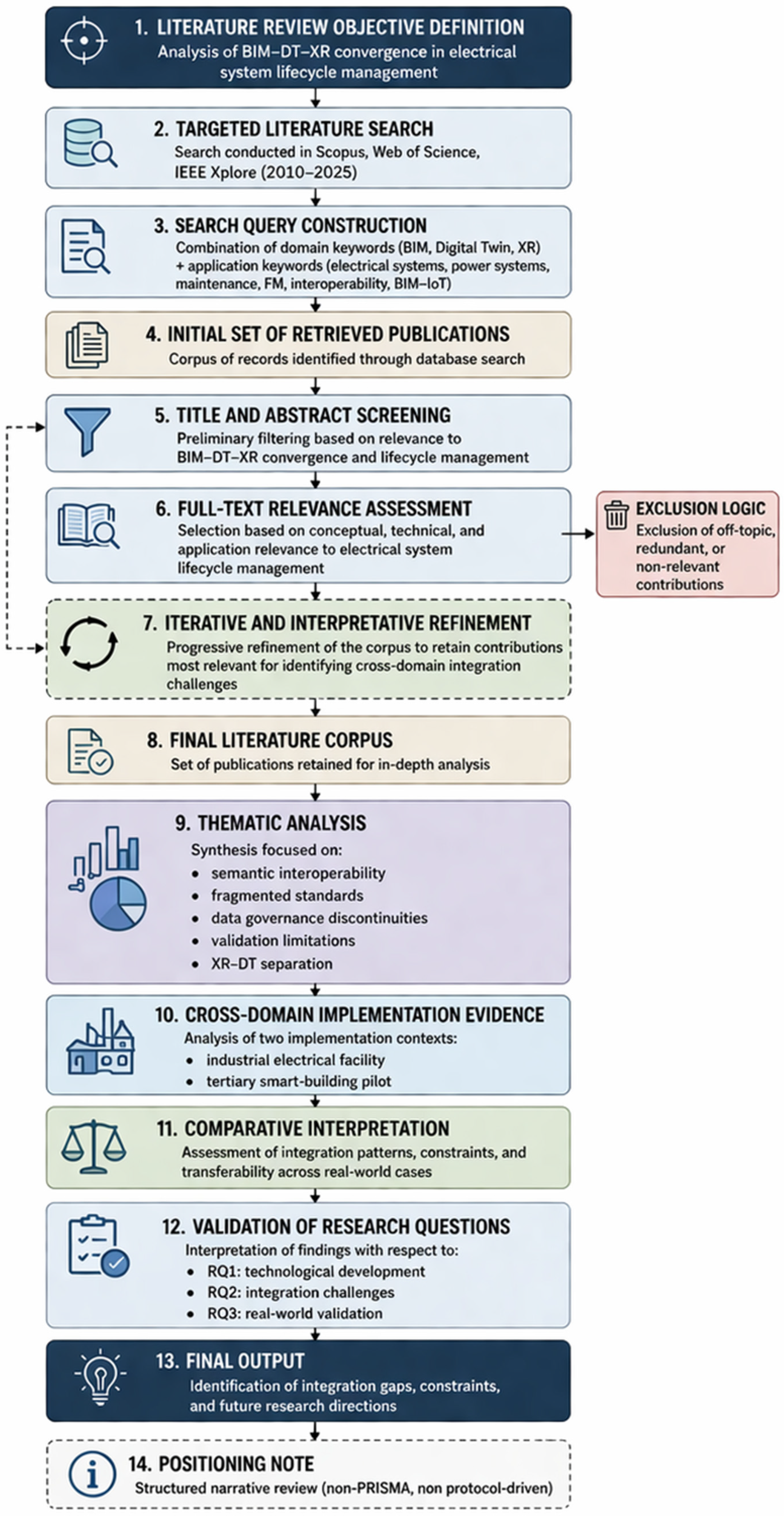
This study adopts a structured narrative review approach. The objective is not to provide an exhaustive or protocol-driven survey of the literature, but to critically interpret the convergence of Building Information Modeling (BIM), Digital Twin (DT), and Extended Reality (XR) in the context of electrical system lifecycle management. The review was developed through targeted searches in major scientific databases, including Scopus, Web of Science, and IEEE Xplore, covering the period 2010–2025. The search strategy combined domain-specific terms related to BIM, DT, and XR with application-oriented keywords such as electrical systems, power systems, maintenance, facility management, interoperability, and BIM–IoT integration.
Sources were selected based on their conceptual, technical, and application relevance to the intersection of these domains. Rather than applying rigid inclusion–exclusion protocols, the selection process followed an iterative and interpretative logic, progressively refining the corpus to retain contributions that were most significant for identifying recurring integration challenges. The analysis was conducted through thematic synthesis, focusing on cross-domain issues such as semantic interoperability, fragmented standards, governance discontinuities, validation limitations, and the separation between XR interfaces and predictive DT cores.
Accordingly, this work is not intended as a systematic review and does not follow protocol-driven frameworks such as PRISMA, as its objective is not to provide an exhaustive or statistically reproducible mapping of the literature. Rather, it provides a structured and critical synthesis designed to identify cross-domain integration challenges and research gaps at the intersection of BIM, DT, and XR for electrical maintenance. This positioning is also consistent with recent review contributions that treat DT, XR, and semantic interoperability as convergent yet still insufficiently consolidated strands within the built environment literature [21,36,51].
The overall workflow adopted in this structured narrative review—from targeted literature search and iterative corpus refinement to thematic synthesis, implementation-based interpretation, and research-question validation—is summarized in Figure 1.
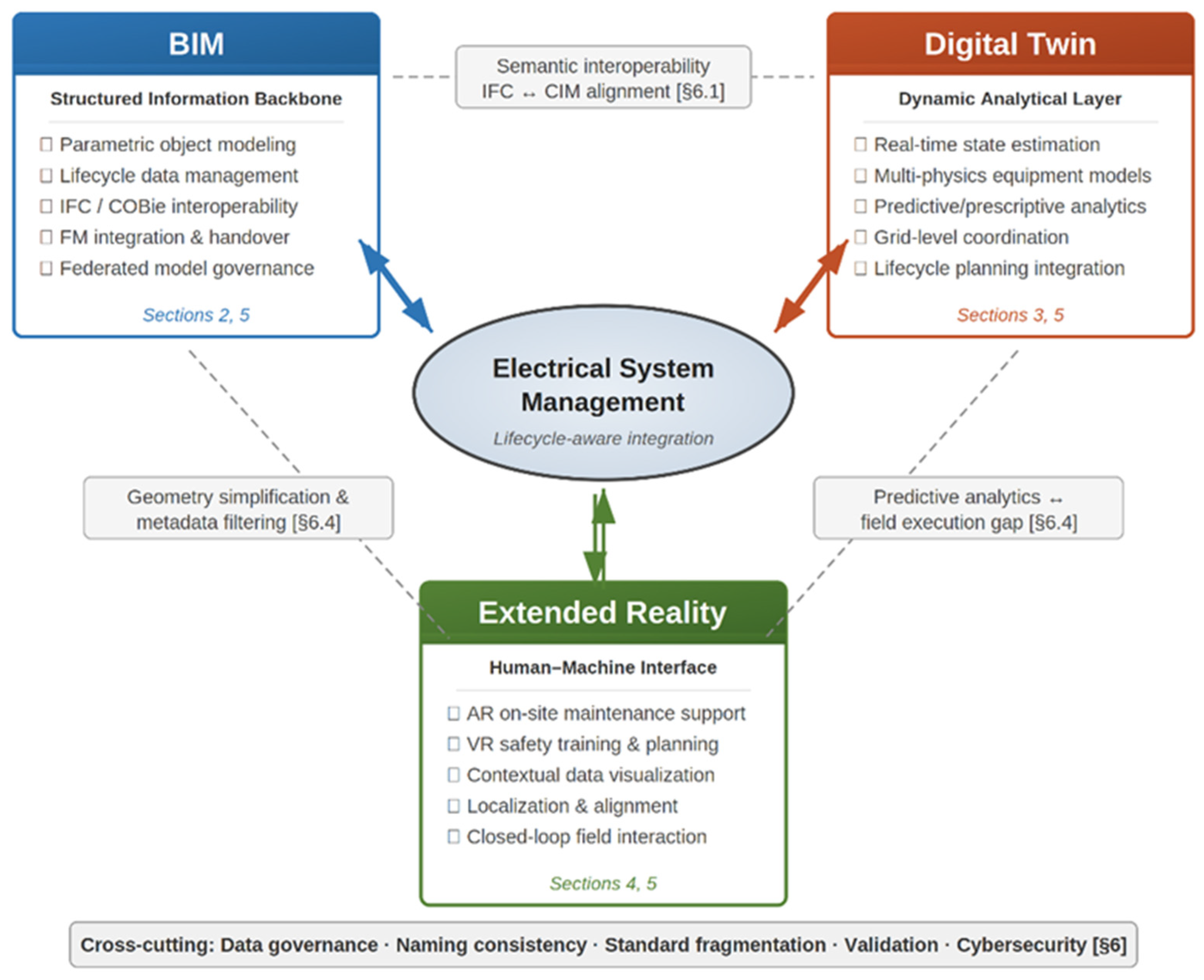
The conceptual scope of the review is illustrated in Figure 2, which positions electrical system management at the intersection of three technology domains—BIM as the structured information backbone, Digital Twin as the dynamic analytical and predictive layer, and Extended Reality as the human–machine operational interface—while highlighting the cross-cutting integration challenges that currently limit their systemic consolidation.
In this sense, the review is framed around convergence rather than coexistence: BIM structures asset knowledge, DT operationalizes dynamic and predictive behavior, and XR mediates field-level access and interaction, but their systemic value depends on whether semantic, organizational, and cybersecurity barriers can be jointly addressed [41].

2. BIM for Electrical Systems

2.1. BIM in Existing Buildings and Lifecycle Context

BIM serves as the standard common to construction projects yet its use in renovation work and building management activities for current structures creates major problems which need to be solved. The BIM Handbook [5] provides comprehensive guidance on BIM procedures across all stages of the building lifecycle and defines the parametric object-based modeling approach that underpins current BIM applications. BIM processes have reached established status in new construction projects although their application to existing buildings still requires development especially for maintenance and restoration and demolition work [10]. A review of more than 180 studies found three main obstacles which prevent BIM adoption within this context; these obstacles include the high expense required to transform building data into semantically rich BIM objects and the challenges associated with maintaining up-to-date information and the need to control uncertainties which affect data and objects and their connections.
These issues are particularly critical for electrical systems. In existing facilities, electrical installations are often modified incrementally throughout operation, yet such changes are not always properly documented. The frequent absence of complete and updated building records further increases the uncertainty associated with digital modeling in existing assets [10]. This condition directly affects the reliability of information related to asset registers, protection coordination records, and maintenance documentation, all of which are essential for the safe and effective management of electrical systems.
A further important distinction concerns BIM understood in a narrow sense—as a digital building model functioning mainly as an information repository—and BIM in a broader sense, which also includes functional, informational, technical, organizational, and legal dimensions [10]. This distinction is especially relevant in the management of electrical systems. Although a narrow BIM model may geometrically represent elements such as switchboards, transformers, and cable routes, effective lifecycle use depends on a broader framework that addresses information delivery, interoperability standards, and the allocation of stakeholder responsibilities.

2.2. BIM and Facility Management: Interoperability and Operational Gaps

The use of BIM (Building Information Modeling) in facility management (FM) processes is still something that looks good on paper, but is not working that well in practice. According to Pärn et al. [1], there has been a surge in interest in using BIM for O&M; however, to date, there is not much empirical evidence to demonstrate the efficacy of BIM–FM integration. The review performed by them revealed that there are still many ongoing issues preventing FM and BIM from being effectively integrated including insufficient long-term above all, strategic alignment between parties, weak data interoperability, and fragmentation of asset-related information. Singh et al. [6] have proposed a theoretical framework that suggests that efficient BIM collaboration should be based on not only technical interoperability between parties but also on organizational and process-level alignment between the parties involved.
A key issue highlighted in [1] is the disparity between the amount of information provided in BIM models and the amount of operational information required to operate the building during the O&M phase. The designers focus primarily on geometric coordination and construction deliverables, while Facility Managers need well-structured semantic data that relate to maintenance schedules, asset performance, warranties and operation history, as outlined by Becerik-Gerber et al. [52], who systematically identified the nine areas of application, along with their data requirements for BIM-enabled FM, confirming a continuing lack of maintenance-related information being delivered. This misalignment directly affects electrical system management, where access to up-to-date component specifications and maintenance records is essential for safe operation. It is also highlighted by Pärn et al. [1] that interoperability between BIM systems and Computer Aided Facility Management (CAFM) remains a significant issue. While there are standards, such as COBie, that provide a framework for the transfer of structured data from one system to another, there are still limitations around the ability of FM with regard to the transfer of semantic data in a holistic manner. Also, Gao and Pishdad-Bozorgi [2] have noted that even though there is currently strong interest in BIM–FM research, there are still barriers to BIM–FM integrations including inadequate handover processes, and limited interoperability between BIM authoring tools and CAFM systems. In the context of electrical systems, this implies that even when equipment data is embedded in BIM, integration with maintenance management systems may require additional manual processing or bespoke workflows.

2.3. BIM–IoT Integration as an Enabler for Operational Data Contextualization

As the use of static Building Information Modeling (BIM) models in a number of operational contexts has expanded, there has been a significant rise in exploring how to pair BIM with real-time data streams. In their 2019 paper, Tang et al. [41] defined BIM as providing geometric and semantic (representing the properties of a building or structure) representations of components of the building, while the Internet of Things (IoT) is created by combining multiple devices that provide dynamic (changing over time) operational data (e.g., environmental conditions, status of equipment, and sensor measurements).
Based upon their review of the literature on BIM-IoT integration, Tang et al. [41] divided the research on the integration of BIM and IoT into categories of application areas that include facility management and building operations. Subsequent studies have reinforced that this convergence is particularly relevant for facility management, as it enables real-time data streams to be contextualized within asset-oriented digital environments rather than treated as isolated monitoring outputs, while also highlighting persistent limitations related to interoperability fragmentation and uneven implementation maturity [53].
Regarding the integration of electrical systems, IoT/BIM integration allows contextualization (i.e., relating data to its surroundings) of real-time measurements (e.g., load/temperature monitoring/diagnostic) to the spatial and semantic attributes of the BIM Model. In smart-building environments, this capability becomes critical for electrical operation and maintenance, where many failure modes and maintenance triggers depend on time-dependent signals rather than static asset descriptions. Typical application scenarios include switchboard and panel thermal monitoring, transformer loading conditions, protection device status tracking, alarm event management, abnormal current or voltage detection, and fault localization within circuits and distribution networks. In these cases, BIM acts as a semantic and spatial backbone that links sensor data to asset identity, system relationships, and maintenance history, enabling more informed and context-aware decision-making.
Tang et al. [41] identified five primary definitions for integrating BIM and IoT system functionality: Application Programming Interface (API) based BIM Tools with Relational Databases; Transformation of BIM based Data to Relational Schema; Creation of Domain Specific Query Languages; Application of Semantic Web Technologies; and Hybrid (Relational and Semantic) Architectures. From the perspective of intelligent electrical maintenance, these architectures are not equally suitable, since smart-building electrical systems generate heterogeneous data streams ranging from relatively low-frequency condition monitoring to high-frequency signals and real-time alarms. API-based BIM tools and relational database approaches are effective for operational monitoring and asset-level queries because of their relative simplicity and efficiency, but they remain limited in managing complex semantic relationships across lifecycle data. Semantic web-based approaches provide stronger support for interoperability, ontology alignment, and lifecycle reasoning, although they may become more demanding when high-frequency electrical data and near real-time response requirements must be handled. In this sense, hybrid architectures appear particularly suitable for electrical maintenance, because they combine performance-oriented handling of time-series measurements and alarms with semantically structured representations of assets, system relationships, and maintenance history, thereby supporting both operational responsiveness and lifecycle interoperability.
Recent implementation-oriented studies demonstrate how such architectures can support maintenance workflows by integrating real-time sensor acquisition, alert systems, and 3D model interaction within a unified decision-support environment, allowing operational anomalies to be directly associated with specific assets and spatial contexts [54]. This approach is directly applicable to electrical maintenance scenarios, such as alert-based inspection of overloaded panels, abnormal thermal behavior of equipment, or recurrent fault signals linked to specific subsystems. More targeted applications focusing on electrical subsystems confirm this trend. For instance, BIM- and IoT-based smart-lighting maintenance systems have shown how electrical assets can be embedded within digital workflows that support inspection planning, intervention management, and operational decision-making, highlighting the importance of aligning digital models with maintenance procedures and organizational practices [55].
However, BIM–IoT integration is still at a relatively early stage of development, with most implementations confined to prototype scenarios and fragmented use cases, as reported in the literature [41]. This limitation is further exacerbated in real-world electrical systems by the frequent presence of incomplete or inconsistent as-built information, which affects the reliability of model–sensor alignment and the continuity of asset identification over time [56].
Interoperability, scalability, and real-time synchronization challenges persist. Additional studies on operational platforms confirm that the main challenge is not the availability of sensor data itself, but its integration into accessible and usable management environments, where multiple data sources can support coordinated inspection and maintenance activities [57].For electrical systems, where operational reliability and safety are critical, these technical constraints must be carefully addressed before BIM-based operational environments can be considered mature. In this sense, the key issue is not only capturing real-time data, but ensuring that such data remain semantically anchored to persistent asset identifiers, interoperable across systems, and interpretable within maintenance workflows [53,55,56].

2.4. Synthesis: Role of BIM in Electrical Lifecycle Management

The results from [1,10,41] demonstrate that BIM serves as a vital part of the solution but does not provide all of what is needed for managing an electric system. The degree of complexity when modeling existing buildings and the degree of uncertainty of actual information is still the biggest inhibitor to doing things correctly [10]. In the context of asset management, semantic interoperability issues or a difference in what information supply and information demand exists, prevent electric systems from being ran efficiently [1]. The combination of BIM and IoT devices enables better electric system performance while creating new architectural and interoperability problems which require resolution [41]. The knowledge-based approach to BIM-based maintenance demonstrated that enriching BIM with case-based reasoning supports the decision-making process of maintaining a system, but Motawa and Almarshad [11] did not study how to scale their system to maintain complex electric systems. Succar [7] proposes a BIM maturity framework comprising three stages—object-based modeling, model-based collaboration, and network-based integration—which provides a useful benchmark for assessing the current state of BIM adoption in electrical system management.
From a practical perspective, BIM serves as an organized information repository for representing electrical assets; however, by itself, BIM is a semi- static entity. Its operational transformation depends on external synchronization mechanisms, interoperable data infrastructures, and standardized information exchange. A further challenge, examined in detail in Section 6, concerns the semantic gap between building-oriented information models (IFC) and grid-oriented ontologies (CIM), which currently limits the scalability of BIM-based electrical asset data toward network-level Digital Twin integration. This transition toward dynamic Digital Twin architectures is examined in the following section.

3. Digital Twin for Electrical and Power Systems

3.1. From Monitoring Platforms to Cyber-Physical Grid Intelligence

The notion of a Digital Twin—originally formalized by Grieves and Vickers [12] as a triad of physical product, virtual representation, and bidirectional data connection—has progressively expanded from manufacturing roots toward infrastructure-scale systems. Glaessgen and Stargel [13] further elaborated on the definition of the DT, specifically defining it as an integrated multi-physics, multi-scale, probabilistic simulation of the physical object using the best available models and sensor updates to replicate the life of that physical object. The transition of the electric grid from a traditional method of monitoring it to one employing DT-enabled cyber-physical intelligence is a transformational, qualitative shift in how the electric grid will be managed, rather than just a new technology. For most of the history of electric grid management, it was primarily accomplished using either Supervisory Control and Data Acquisition (SCADA) systems or Wide Area Monitoring Systems (WAMS) that provide real-time observability to isolated grid variables. These variables typically have been available from either SCADA or WAMS in large blocks of time and space, but lack the detail needed to give a complete picture of the system. However, as emphasized by Zomerdijk et al. [20], such infrastructures provide partial observability and limited predictive capability, particularly under a high penetration of distributed energy resources (DERs) and converter-based generation. Digital Twins extend beyond classical SCADA paradigms by embedding dynamic system models directly into the digital representation, thereby enabling bidirectional synchronization between physical measurements and computational simulations. Although DT, Cyber-Physical Systems (CPS), and IoT share technological foundations, they differ in concept, core element, and application scope, with DT specifically emphasizing bidirectional synchronization and model-based prediction [15]. Yassin et al. [16] argue that modern power systems require measurement tools which can detect fast transients and stability limits and nonlinear system behavior because of their reduced inertia and increased use of power electronic interfaces. A Digital Twin needs to process measurement data while its internal models must undergo continuous updates to match the current operational state of the system. The increasing use of Phasor Measurement Units (PMUs) provides high-resolution synchronized measurements of the voltage and current phasors at each PMU’s location. When PMU measurements are incorporated into a Digital Twin architecture, the state estimation algorithms will produce more accurate estimates of the voltage magnitude and angle at each node than traditional methods of obtaining data from SCADA systems due to PMUs having a higher resolution than the sampling rates of most SCADA measurement devices. However, as noted in [20], measurement noise, synchronization delays, and data latency introduce uncertainty that must be explicitly managed within the twin’s computational core.
Therefore, an operational Digital Twin for power systems can be interpreted as a continuous state estimator augmented by predictive simulation capabilities. This reframing positions the DT not merely as a visualization layer, but as a computationally active entity participating in grid control and planning.

3.2. Real-Time State Estimation and Model Synchronization

One of the key engineering challenges of developing a Digital Twin (DT) of a power system is to have the physical dynamics of the power system accurately reflected digitally. The classical state estimation method uses weighted least squares techniques to combine multiple measurements which contain duplicate data elements for computing system states [58]. However, under high DER penetration and bidirectional flows, distribution networks often lack full observability, requiring pseudo-measurements or probabilistic estimation.
In this context, recent studies highlight that DT architectures increasingly rely on hybrid modeling strategies, in which physics-based representations of network behavior are combined with data-driven models capable of capturing unmodeled dynamics and supporting adaptive estimation under uncertainty [17,59]. Within such frameworks, physics-based components are typically used to enforce network constraints (e.g., Kirchhoff’s laws and power-flow relationships), while data-driven components are employed for anomaly detection, pattern recognition, and the interpretation of incomplete or noisy measurements.
This distinction is particularly relevant for electrical system operation and maintenance, where accurate state estimation must support not only system monitoring but also fault detection, condition assessment, and predictive maintenance strategies. In these scenarios, hybrid DT models enable the identification of abnormal operating conditions, degradation trends, and incipient faults that may not be directly observable through deterministic models alone [60].
Yet, as the authors observe, such integration introduces risks of model drift and overfitting, particularly when data distributions shift due to seasonal or operational changes. These issues become critical in real-world applications, where variations in load profiles, environmental conditions, and system configurations can significantly affect the reliability of data-driven components, requiring continuous model updating and validation.
Zomerdijk et al. [20] further emphasize the importance of uncertainty propagation in DT frameworks. Measurement errors together with communication delays and parameter uncertainty about impedance models create nonlinear pathways which affect power flow equations. A mature DT must therefore incorporate probabilistic modeling or Monte Carlo–based scenario evaluation to prevent deterministic misinterpretation of uncertain states.
More broadly, recent DT research in electrical and power systems confirms that real-time synchronization between physical systems, measurement infrastructures, and digital models requires architectures capable of managing heterogeneous data sources, temporal misalignments, and multi-scale system dynamics [61,62].
This perspective shifts the understanding of DTs from deterministic replicas to probabilistic cyber–physical estimators capable of quantifying confidence intervals around operational states. From a maintenance-oriented perspective, this implies that DT outputs should not be interpreted as exact system representations, but as decision-support tools providing confidence-aware insights for operational and maintenance actions, particularly in safety-critical electrical environments.

3.3. Multi-Physics Modeling of Power Equipment

Digital Twins require better modeling accuracy for power equipment components than grid-level monitoring twins need. The IEEE PES White Paper [19] provides an abundance of examples of Digital Twin models of transformers, circuit breakers, transmission lines and energy storage systems where models of electro-thermal, mechanical and electromagnetic field conditions have been combined to create a complete model of degradation behaviors of the actual asset. For example, Digital Twin transformer models will frequently incorporate a thermal model based on the calculation of the winding hot spot temperature, combined with the use of dissolved gas analysis (DGA) and load history information. This creates an accurate representation of the transformer that can be used to calculate insulation degradation and predict remaining useful life. Twins provide more advanced capabilities than static condition monitoring systems because they enable the simulation of future load conditions. Tao et al. [26] demonstrate that Digital Twin-driven prognostics can integrate real-time sensor data with physics-based degradation models to predict remaining useful life, an approach directly applicable to power equipment condition assessment. Similarly, DTs for transmission lines incorporate spatio-temporal modeling of conductor temperature, sag, and environmental exposure [19]. Together with forecasts of future weather, DTs create dynamic line rating (DLR) and allow us to manage congestion proactively. According to Heluany and Gkioulos [43], one of the most well-established applications of DTs is diagnosing faults in generation assets; however, they note that most studies remain confined to individual asset optimization rather than coordinated system-level integration. The integration of multi-physical equipment twins into higher-level grid twins remains largely unresolved. Interfacing asset-level thermal models with network-level power flow simulations introduces computational and architectural challenges, particularly under real-time constraints.

3.4. Grid-Level Digital Twins and Self-Healing Capabilities

Digital Twins at the grid level do more than just provide information about equipment condition; they help coordinate and improve network-wide resilience. Sifat et al. [18] conceptualize an Electric Digital Twin Grid capable of integrating historical and real-time data to detect overheated lines, anticipate outages, and support self-healing actions. Although their conceptual framework is still in its infancy, it indicates a trend towards the use of predictive operational support. Twin technology needs to create virtual models which allow for dynamic operational testing at near real-time speeds. This requires efficient load flow solvers, dynamic stability simulations, and event-driven modeling. Despite the clear requirements for the Digital Twin to be able to perform these functions, Refs. [17,20] point out that scalability issues continue to be a critical barrier. Large-scale grids can consist of thousands of buses and branches and therefore the computational intensity required for real-time simulation at a high frequency is very significant. Edge-cloud collaborative computing architectures [26,44], may be potential solutions for mitigation of this barrier by distributing the processing load among hierarchical layers. Aghazadeh Ardebili et al. [44] further emphasize the importance of architectural modularity in Smart Energy Systems. Service-oriented architectures and micro-services have the potential to create modular DT components which can operate semi-independently but remain cohesive through the sharing of data. Hence modularity plays an important role in the future of creating broadened ecosystems of twins by integrating microgrids, energy communities and DER clusters with one another across system-level twins.

3.5. Lifecycle Integration and Planning-Phase Twins

The research by Song et al. [42] and Zomerdijk et al. [20] introduces a fundamental innovation which extends Digital Twin capabilities into the domain of long-term planning. Planning studies currently rely on static load flow and probabilistic forecasting, both of which operate independently from operational data streams. The Digital Twin system with planning capabilities uses historical operational data to create demand growth forecasts and DER penetration scenario simulations which help assess investment plans when facing uncertain situations. The integration process requires data persistence layers which can secure multi-year data records and enable simulation through multiple scenarios. Zomerdijk et al. [20] argue that such lifecycle integration necessitates a standardized DT ecosystem architecture capable of reconciling transmission operators, distribution operators, and local energy communities. The system-of-systems perspective connects to the System of Digital Twin Systems (SDTS) concept introduced in [42] which describes multiple Digital Twin Systems working at different hierarchical levels while using common communication standards. The transition to lifecycle-aware Digital Twins changes the twin from its original function as a monitoring tool into a system which supports strategic decision making. Werner et al. [27] propose a holistic approach integrating Digital Twin capabilities within predictive maintenance workflows, emphasizing that effective lifecycle integration requires both data infrastructure maturity and organizational readiness.

3.6. Synthesis: Toward Engineering-Grade Digital Twin Maturity

In the power engineering field, Digital Twin evolution can be described as a progressive maturity pathway, in which model fidelity increases from static parameter replication toward hybrid, multi-phase, and AI-enhanced modeling approaches. This progression entails a transition from the representation of individual components to the integration of coordinated system-level ecosystems. At the same time, temporal integration evolves from real-time monitoring toward lifecycle-oriented predictive capabilities enabled by structured data environments.
Tao et al. [14] propose a five-dimensional Digital Twin framework encompassing physical entity, virtual model, services, data, and connections, providing a structured reference for assessing DT completeness across application domains. Despite significant architectural advancements, several structural limitations persist. Measurement uncertainty and data latency continue to hinder reliable real-time synchronization [20]. In addition, security is not yet fully embedded as a core component of Digital Twin architectures and is still frequently treated as an ancillary function rather than an integral design requirement [43].
Finally, there has been limited work done on establishing a standardization of data models and frameworks for interoperable large-scale deployment [17]. As a result of these realities, the structural architecture of Digital Twins has evolved significantly but has yet to be converted into standardized, interoperable systems with full engineering-quality infrastructures; thus, the evolution continues as an active area of research. Comprehensive reviews of Digital Twin implementations across industrial sectors [16] confirm that manufacturing and energy remain the most active application domains, while construction and building systems represent emerging frontiers. Kritzinger et al. [24] propose a categorical distinction between Digital Model (manual bidirectional data flow), Digital Shadow (automatic physical-to-digital flow), and full Digital Twin (automatic bidirectional flow), providing a useful classification framework for assessing implementation maturity.
Table 1 classifies the principal DT implementations from the reviewed literature along five dimensions: system scope, coupling intensity, modeling approach, lifecycle integration, and latency tolerance/synchronization profile. This additional dimension clarifies the different temporal profiles associated with the DT categories reviewed in this section. The table shows that most advanced systems operate at the component and subsystem levels, while Digital Twin systems operating at ecosystem level currently remain largely conceptual [20,42].
None of the reviewed studies simultaneously combine broad system scope, strong bidirectional physical–digital coupling, advanced AI-enhanced modeling, and full lifecycle integration. This observation suggests the existence of a structural maturity gap in current Digital Twin implementations for power systems.

4. Extended Reality Within BIM–Digital Twin Ecosystems: A Critical Synthesis for Electrical System Management

The use of Extended Reality (XR) technologies through BIM-enabled environments has developed at a fast pace during the last ten years. The literature shows that researchers have studied XR technology through two main approaches which include its use as a BIM workflow extension and its function as a separate visualization tool instead of studying its role as a core element in Digital Twin (DT) systems [25,30,37]. This section provides a synthesis of the existing literature about XR implementation in Architecture Engineering and Construction (AEC) contexts while evaluating the current development stage of these technologies and their limitations for use in maintenance and electrical system management.

4.1. XR and BIM: Maturity, Scope, and Limitations

The systematic reviews which study BIM-based AR applications demonstrate that most XR research work concentrates on construction sites. The study by Chi et al. [32] discovered that AR applications mainly concentrate on design visualization and information retrieval during on-site operations while operational and maintenance tasks receive minimal focus. Wang et al. [33] identify two AR application categories for built environments which show that most systems exist as prototypes without actual performance testing in genuine operational environments. The PRISMA framework served as the basis for Sidani et al. [30] to perform their systematic review of BIM-based AR applications which revealed that construction management and safety and quality control functions represented the main focus for most applications. The review identifies ongoing problems with localization and connectivity and the incomplete integration of non-geometric data although AR has become an accepted technology that assists BIM workflows. The majority of AR systems main function centers on displaying 3D models of assets whereas the system documentation about asset lifecycle and operational data remains inadequately represented [30]. Schiavi et al. [37] investigate BIM data flow architectures which use AR/VR technologies to demonstrate that successful BIM-to-XR integration needs established data processing routes. The study results show that transforming BIM models into XR formats requires both geometry simplification and metadata filtering which results in the loss of certain semantic content. The operational value of electrical maintenance suffers when semantic depth is lost, since it depends on component-level properties such as ratings, inspection history, and protection settings.
In practice, XR tools improve visual access to BIM models but remain front-end overlays rather than fully integrated components of operational information systems.

4.2. Empirical Evidence of Operational Performance Gains

Despite integration challenges, empirical studies demonstrate measurable performance improvements associated with BIM–XR integration. Chua et al. [31] did a study in which they evaluated a mobile BIM–AR artifact for retrieving information while completing construction tasks. They found that participants using the AR-integrated system completed their tasks approximately 50% faster and committed fewer errors compared with participants relying on traditional 2D documentation. However, the study was conducted under controlled laboratory conditions with a limited sample size, and the tasks involved were construction-oriented rather than maintenance-specific, which limits direct generalizability to electrical system O&M contexts.
The evidence indicates that contextualized visualization will reduce the cognitive load on workers during their tasks and would therefore improve the efficiency of workers completing their tasks. Pan and Isnaeni [63] further explore AR–BIM integration in construction inspection.
The case study shows that AR technology enables inspection processes to work without paper documents while enabling better information dissemination. The study reports that virtual overlays do not align correctly with physical objects which creates a major problem for their technology. For electrical systems—where millimetric discrepancies may have safety implications—this issue is particularly critical. Bae et al. [64] developed a high-precision vision-based mobile AR system which enables user position tracing through 3D point cloud reconstruction. The approach established by them enables better location tracking because it eliminates the need for both GPS and fiducial markers. The method requires pre-acquired images along with image processing work which creates limitations for using the method in situations with quickly changing conditions. A further issue concerns the usability of XR systems in safety-critical electrical environments. In real maintenance settings, operators may work under constrained spatial and environmental conditions and may also need to wear personal protective equipment, which can affect field of view, interaction precision, and the practical use of AR/XR devices. These constraints become particularly relevant in substations, switchgear rooms, and other technically dense environments, where limited accessibility, glare, noise, and restricted movement may further reduce interaction robustness. In such contexts, XR performance cannot be assessed only in terms of visualization gains or task efficiency, but must also consider hardware ergonomics, overlay stability, and the compatibility of the interface with field conditions.
Together, these studies confirm that XR technologies can enhance operational efficiency and situational awareness. However, their deployment remains technologically sensitive, ergonomically constrained, and strongly context-dependent, particularly in safety-critical electrical environments.

4.3. VR and Simulation-Based Safety Planning

AR technology serves to enhance operational work in actual locations, whereas VR technology delivers additional advantages through its capacity to create fully immersive simulations. Getuli et al. [35] explore the use of BIM-based immersive VR technology to create construction sites which architects use for their design work and safety assessments. The study results show that users develop better safety information sharing skills through immersive environments and these environments enable users to evaluate spatial limitations through tangible experiences. However, in the context of electrical maintenance in smart buildings, the value of VR extends beyond general safety training and becomes particularly relevant for simulating high-risk operational scenarios that are difficult or unsafe to reproduce in real conditions. These include, for example, maintenance operations within cable tunnels [65] and confined technical spaces [66], interventions in switchgear rooms under fault conditions, and emergency response procedures related to electrical failures or short-circuit events.
This simulation-based approach is particularly relevant for electrical maintenance scenarios involving confined substations, switchgear rooms, or high-risk environments. In cable tunnels [65], VR environments can simulate restricted accessibility, limited visibility, thermal conditions, and the spatial configuration of cable trays and electrical lines, allowing operators to anticipate movement constraints and identify potential hazards before entering the physical environment. Sidani et al. [30] observe that design validation processes and safety training programs use VR applications as their primary assessment tool instead of active operational systems. The distinction shows a common trend in which AR technology supports fieldwork through real-time interactions while VR technology finds its main application in training and planning activities. In fault and emergency scenarios, Nee et al. [66] observe that VR simulations enable the reproduction of abnormal system states, such as overload conditions, arc faults, or equipment failures, allowing operators to rehearse response procedures, evaluate decision sequences, and understand system behavior under stress conditions without exposure to real risk. VR technology enhances pre-operational risk evaluation through its entire lifecycle, while AR technology aids tasks which take place during the execution of projects.
From a technical design perspective, effective VR applications for electrical maintenance require the integration of accurate geometric models (derived from BIM), simulation of system states and fault conditions, representation of environmental constraints (e.g., temperature, accessibility, visibility), and interaction mechanisms that allow users to perform maintenance actions within the virtual environment. These elements are essential to ensure that VR simulations are not only immersive, but also operationally meaningful and transferable to real-world maintenance activities [66].

4.4. XR as an Interface to Digital Twin–Enabled Maintenance

The relationship between XR and Digital Twin–based maintenance remains insufficiently operationalized in current research, yet holds important conceptual value. Errandonea et al. [25] provide a comprehensive review of Digital Twin applications in maintenance contexts, emphasizing predictive, condition-based, and prescriptive maintenance strategies. While XR was not at the center of their inquiry, the review pointed to the increasing reliance on real-time data streams and prognostic analytics in Digital Twin frameworks.
Casini [45] bridges this gap by positioning XR as a key enabler of smart building operation and maintenance. XR technologies enable human performance improvements through their ability to project real-time information which originates from BIM and IoT sources onto actual physical assets. Within this perspective, XR should be interpreted as an operational interface that enables the translation of Digital Twin outputs into actionable maintenance decisions, rather than as a standalone visualization layer. The different roles and levels of integration of XR modalities within BIM–Digital Twin workflows are comparatively synthesized in Table 2. XR functions as the human–machine interface that interprets maintenance decisions when it gets used together with Digital Twin predictive analytics. This role is particularly critical in electrical maintenance scenarios, where operators must interpret real-time system states, alarms, and predictive indicators derived from sensor networks and supervisory systems (e.g., SCADA-like environments), often within safety-critical spaces such as switchgear rooms, substations, and distributed electrical infrastructures. In these contexts, XR systems enable the spatial mapping of Digital Twin data onto physical assets, allowing operators to query asset-specific information, visualize real-time operating conditions, and access predictive maintenance indicators directly in situ. This integration supports operational tasks such as fault localization, condition assessment, and intervention planning by linking sensor data streams, BIM-based asset identities, and DT-based analytical outputs within a unified interaction environment. Palmarini et al. [34] have performed a systematic review of AR applications in maintenance contexts specifically and highlighted hardware-driven limitations, tracking accuracy, and content authoring complexity as the primary barriers for adopting AR technology in the industrial space. Complementary contributions further highlight that XR implementations are frequently deployed as standalone systems or loosely coupled solutions, limiting their ability to access synchronized Digital Twin data and to operate within closed-loop maintenance workflows [66]. Throughout the literature, however, there is a structural disconnect between the analytics of Digital Twins and the deployment of XR [25,34,45]. XR studies examine how well visualizations perform while DT studies investigate predictive modeling and data integration. This fragmentation becomes particularly critical in electrical systems, where maintenance operations depend on the continuous alignment between physical assets, real-time measurements, and predictive models. Without such alignment, XR interfaces risk delivering partial or outdated information, reducing their reliability in safety-critical decision-making processes.
The existing body of research lacks studies showing how XR can be embedded within the full Digital Twin lifecycle architecture. Addressing this gap requires the development of integrated XR–DT–IoT architectures capable of ensuring data consistency, real-time synchronization, and bidirectional interaction between field operators and analytical models. In this perspective, XR should be considered a core component of human–machine interaction within Digital Twin ecosystems, enabling not only data visualization but also operational feedback and decision execution within lifecycle-oriented maintenance processes.

4.5. Structural Gaps and Research Implications

The literature reviewed has identified three structural deficits. In the first instance, a continued lack of interoperability for data exchange between the different platforms (BIM, IoT, XR) exists. This results in a high number of manual adjustments to data pipelines for those systems as well as a limited number of standard methods to achieve that interoperability [37].
The second structural deficit occurs because most XR applications undergo testing in controlled pilot environments instead of testing their performance during actual field operations which experience real-world operational changes; this limitation particularly affects electrical systems which require extensive service and maintenance because their operational requirements exceed existing validation research that uses long-term empirical data [53]. The primary purpose of XR applications is to support construction and inspection work but they do not contribute useful operational value when used in Digital Twin predictive maintenance workflows that follow an integrated lifecycle pattern [18]. This limitation is particularly relevant for electrical maintenance, where real-world validation should also address usability under constrained field conditions, including visibility, accessibility, and interaction robustness in safety-critical spaces. The three structural deficiencies of interoperability fragmentation along with limited real-world validation and predictive DT workflow disconnection affect all fields beyond XR technology. The problems intersect with multiple semantic and governance and standardization issues which have a complete impact on the BIM–DT–XR ecosystem as explained through detailed analysis in Section 6.
Collectively, the reviewed studies indicate that XR technologies have advanced primarily as visualization enhancers rather than as embedded components of predictive Digital Twin ecosystems [15,16,24,25]. Bridging this divide requires tighter integration between semantic data structures, real-time analytics, and field-level interaction mechanisms.

5. Cross-Domain Implementation Evidence of BIM–Digital Twin–XR Integration in Electrical System Management

The literature reviewed in Section 2, Section 3 and Section 4 shows that BIM, DT and XR technologies have progressed rapidly, yet often in partially disconnected strands: BIM-centered asset modeling, DT-centered analytics and synchronization, and XR-centered visualization and interaction.
To strengthen the practical relevance of the review and to contextualize the integration gaps discussed in Section 6, this section reports cross-domain implementation evidence drawn from two complementary application contexts: (i) a published industrial deployment integrating BIM and DT concepts for electrical systems [67], and (ii) a tertiary smart-building pilot (Torre Regione Piemonte, Turin, Italy) where a BIM-based DT is coupled with an AR maintenance interface [9].
The intent is not to present a full experimental evaluation, but to compare transferable implementation patterns, contextual constraints, and recurring governance issues that affect lifecycle-oriented electrical system management.
For transparency, it should be noted that the industrial case [67] is a published contribution by the present authors, and the TRP pilot represents original unpublished implementation work conducted by the same research group. Their inclusion is motivated by the need to provide concrete, first-hand implementation evidence that complements the theoretical gaps identified in the reviewed literature. These two cases are not presented as standalone validation exercises. Rather, they are used as triangulated implementation evidence to test whether the integration issues identified in the literature—such as semantic misalignment, data-governance discontinuities, and the limited operational coupling between XR and Digital Twin environments—also emerge in real application contexts. Their comparative use therefore strengthens the credibility of the analytical synthesis developed in this study by showing how literature-based gaps translate into concrete implementation constraints under different operational conditions.

5.1. Electrical Facility: BIM-Driven Asset Modeling and Maintenance-Oriented Digitalization

The industrial case demonstrated in [67] established a practical method which used BIM technology to manage electrical assets throughout the manufacturing process. The parametric BIM system created in Autodesk Revit enables users to model essential electrical components through semantically enriched objects which contain inspection and maintenance planning attributes.
The project uses a dual data exchange system which lets users synchronize BIM parameters with structured registers through Dynamo scripts which create systematic maintenance field updates and enable users to track all maintenance activities. In addition, the same case study demonstrated how a BIM-based electrical asset registry would provide information required by engineering disciplines within industrial sites (including power calculations, visual inspection of electrical components, clash detection, and lighting simulations) through the use of external tools.
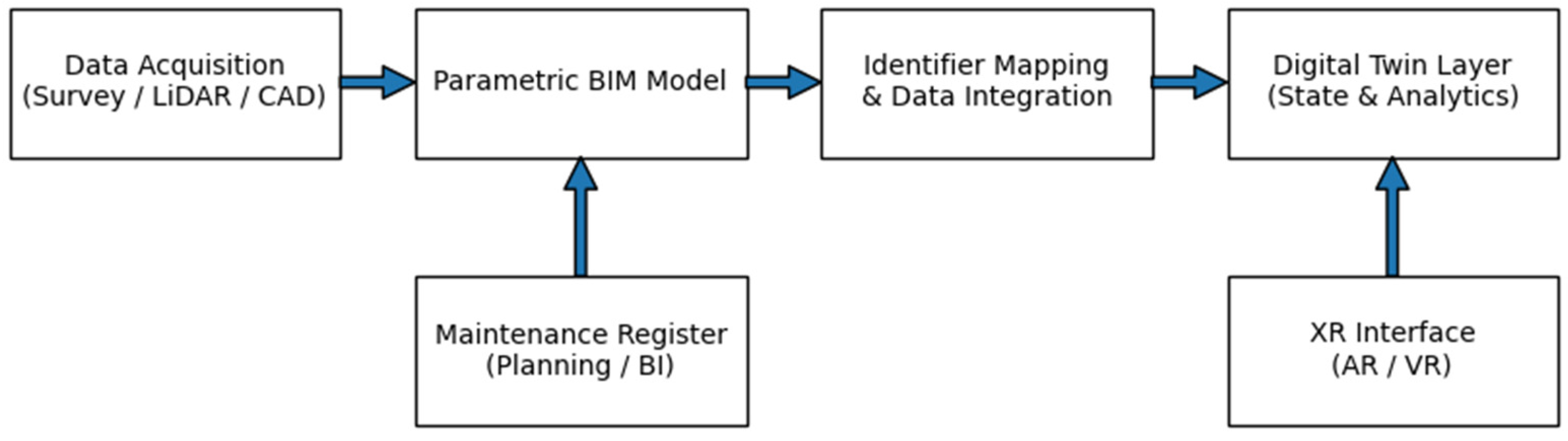
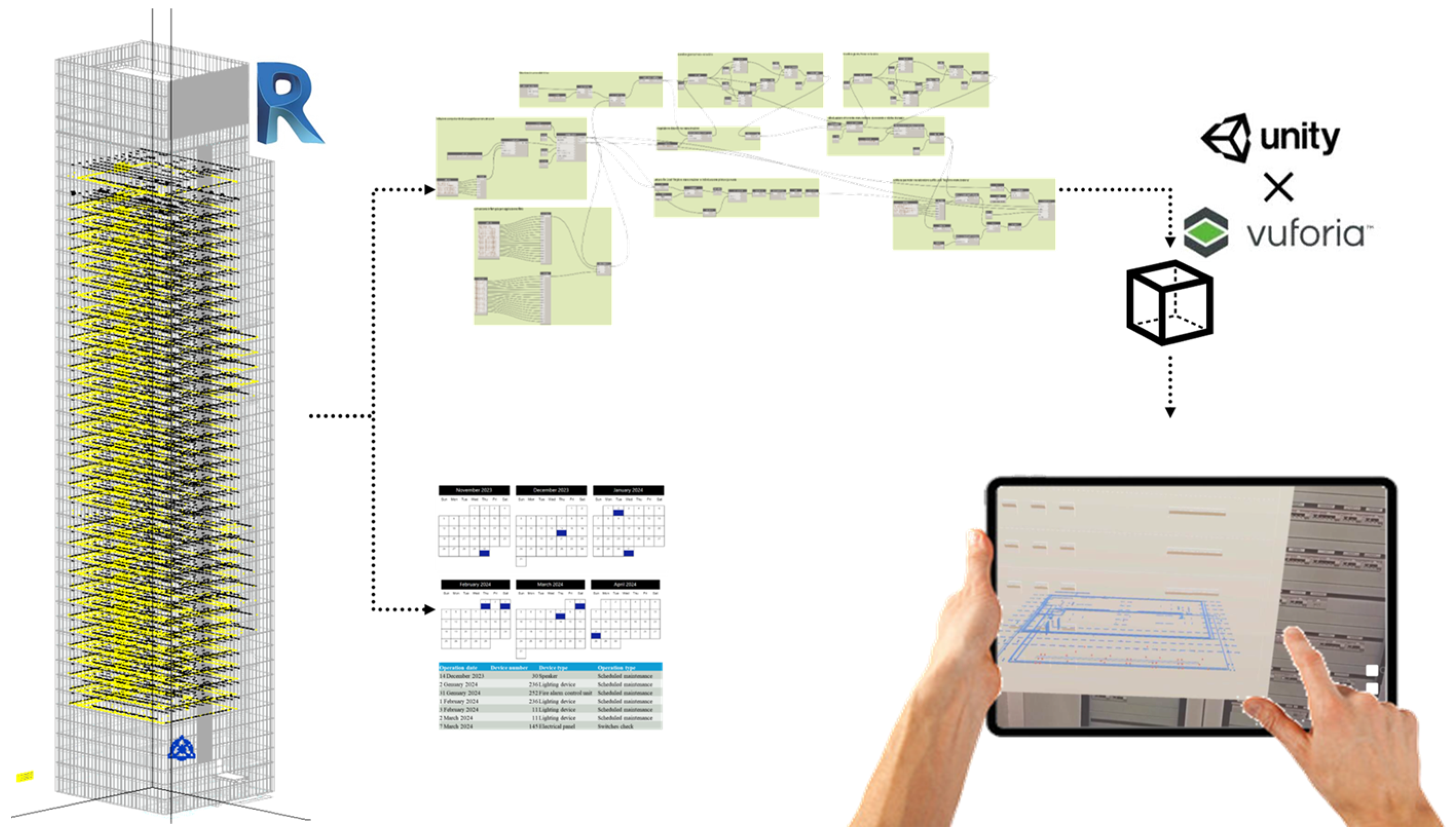
Mixed reality (XR) prototypes were also created to allow users to visualize and interact with the BIM-based digital representation of the assets, thus improving the ability to locate assets and conducting training for safety purposes. Importantly, [67] supports a central claim of the present review: XR interfaces provide operational value only when the underlying data governance is robust—especially regarding identifier consistency and update policies that prevent divergence between the physical installation and its digital representation over time. The overall integration logic underlying both industrial and tertiary implementations can be abstracted as a BIM–Digital Twin–XR pipeline, as illustrated in Figure 3.

5.2. Tertiary Smart Building Pilot: BIM-Based Digital Twin and AR for Electrical Maintenance in Torre Regione Piemonte

The Torre Regione Piemonte (TRP) building in Turin, Italy consists of 42 office floors with advanced building systems that operate under the typical operational constraints of tertiary smart buildings. The BIM environment was developed using a federated approach which models building parts separately through dedicated models for each architectural, structural, mechanical and electrical discipline. The federated model maintains lifecycle consistency between systems through shared instance parameters which include a unique Identifier that follows a predefined nomenclature system for all elements. This Identifier strategy serves as the essential requirement for all DT implementations that need to combine different data sources while sustaining continuous tracking of all assets in the system. From an electrical-system perspective, the TRP model covers three power distribution networks (ordinary, privileged, and security), busbar-fed floor boxes embedded in raised floors, lighting fixtures in suspended ceilings, and dedicated special systems for data networks, fire detection, sound diffusion, and security. The electrical model includes multiple floor-level panels, busbar-fed floor boxes, lighting fixtures, and safety-related systems distributed across 42 office floors, resulting in a high-density asset environment that stresses identifier governance and data synchronization mechanisms. The systems require shared routing infrastructures which include walkways under ceilings and raised floors, leading to increased geometric coordination difficulties and semantic mapping challenges.
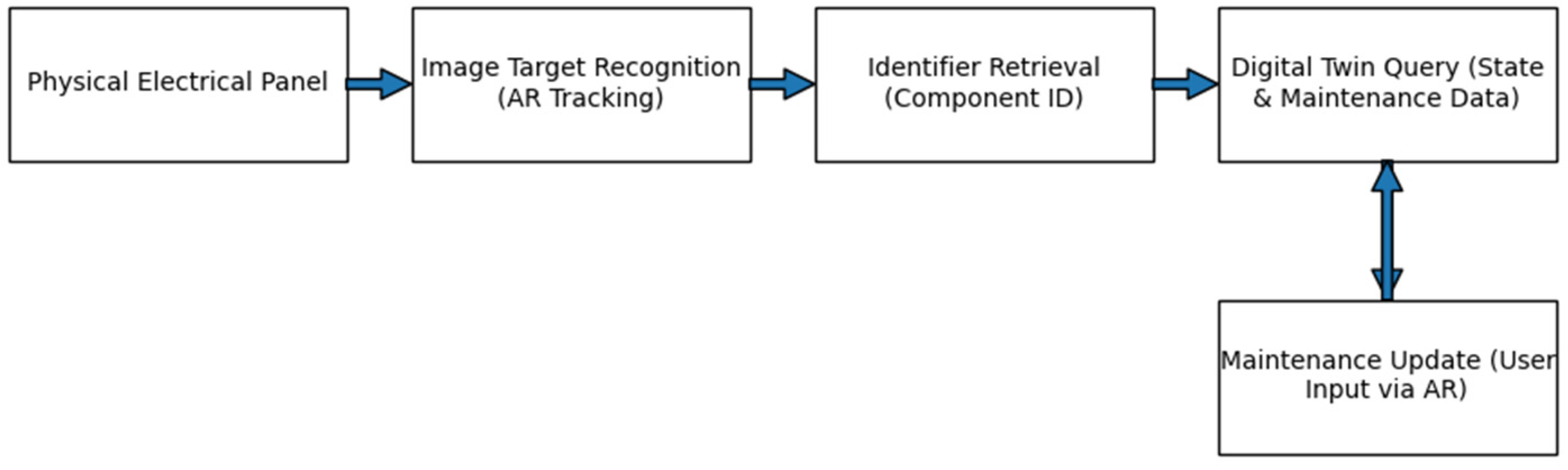
This context is therefore particularly informative for assessing whether BIM-centered registries can support DT-enabled maintenance beyond isolated subsystems. The TRP Digital Twin Workflow is established using BIM primarily as its semantic base with a Digital Twin Layer representing the dynamic maintenance state of electrical components. The workflow proceeds in four steps: (i) extraction of maintenance-relevant BIM attributes via identifier-based queries; (ii) data consolidation from BIM, CAD, and inspection records into a unified representation; (iii) DT instantiation through identifier mapping; and (iv) interactive 3D navigation for asset exploration and maintenance access. Dynamo enables maintenance planning through its ability to extract structured data which transforms into maintenance registers (e.g., spreadsheets) for subsequent processing into scheduling and dashboarding (e.g., calendar-oriented visualization) purposes. The AR application enables two-way data synchronization which permits field updates to be sent back to the BIM-based DT layer thus decreasing the chance of lifecycle discrepancies between the actual installation and its digital counterpart. The research shows that BIM–IoT/DT integration functions as an operational context provider while creating new challenges for organizations to establish interoperability and governance frameworks [28]. The TRP pilot enables users to access a single AR maintenance interface which operates through Unity and Vuforia from their mobile devices (tablets). The AR application uses image targets which engineers place on electrical panels to create overlays which access data linked to the Digital Twin. The selection of image-target anchoring improves spatial alignment strength which protects against localization errors that would disrupt maintenance work in electrical systems that require high safety standards. The TRP electrical maintenance pilot project has developed an architecture which integrates BIM with Digital Twin and XR technologies according to the summary presented in Figure 4.
The interface enables users to view equipment information from different contexts by providing three-dimensional equipment models and showing circuits which connect to the selected panel and displaying maintenance history and maintenance instructions. The design implements an XR pattern which prioritizes maintenance by using AR as an asset data management system instead of an independent AR visual display system. The approach demonstrates how XR devices improve maintenance operations because they enable better access to contextual information while making it easier for workers to comprehend information when BIM/DT data structures function correctly as reliable interoperable systems [25,36,45]. At the same time, TRP also illustrates real-world constraints representative of integration gaps discussed later in this literature review. First, integrating heterogeneous data sources (BIM, CAD-derived datasets, inspection records, and—when available—sensor data) requires explicit mapping rules and validation steps to prevent semantic drift. Second, the scalability of the solution depends on data volume management and update frequency, since building-scale deployments involve thousands of assets and frequent changes. Third, the AR layer introduces additional constraints related to alignment robustness and operational usability, which can become critical in safety-sensitive electrical environments.
The AR-supported maintenance logic adopted in the TRP pilot can be abstracted as the workflow illustrated in Figure 5.

5.3. Comparative Discussion: Transferable Patterns and Context-Specific Constraints

The two implementations demonstrate that BIM–D–-XR integration feasibility depends more on lifecycle management processes and cross-platform semantic interoperability than on the particular modeling capabilities of individual modeling systems.
Although the two cases are not presented as controlled performance-validation experiments, their comparison makes it possible to identify a set of preliminary evaluative dimensions for future operational assessment, including the time required to retrieve asset-specific information, the number of documentary sources unified within a maintenance task, identifier consistency across BIM–DT–XR layers, the traceability of bidirectional updates between field input and digital records, and the robustness of AR alignment during panel-level access.
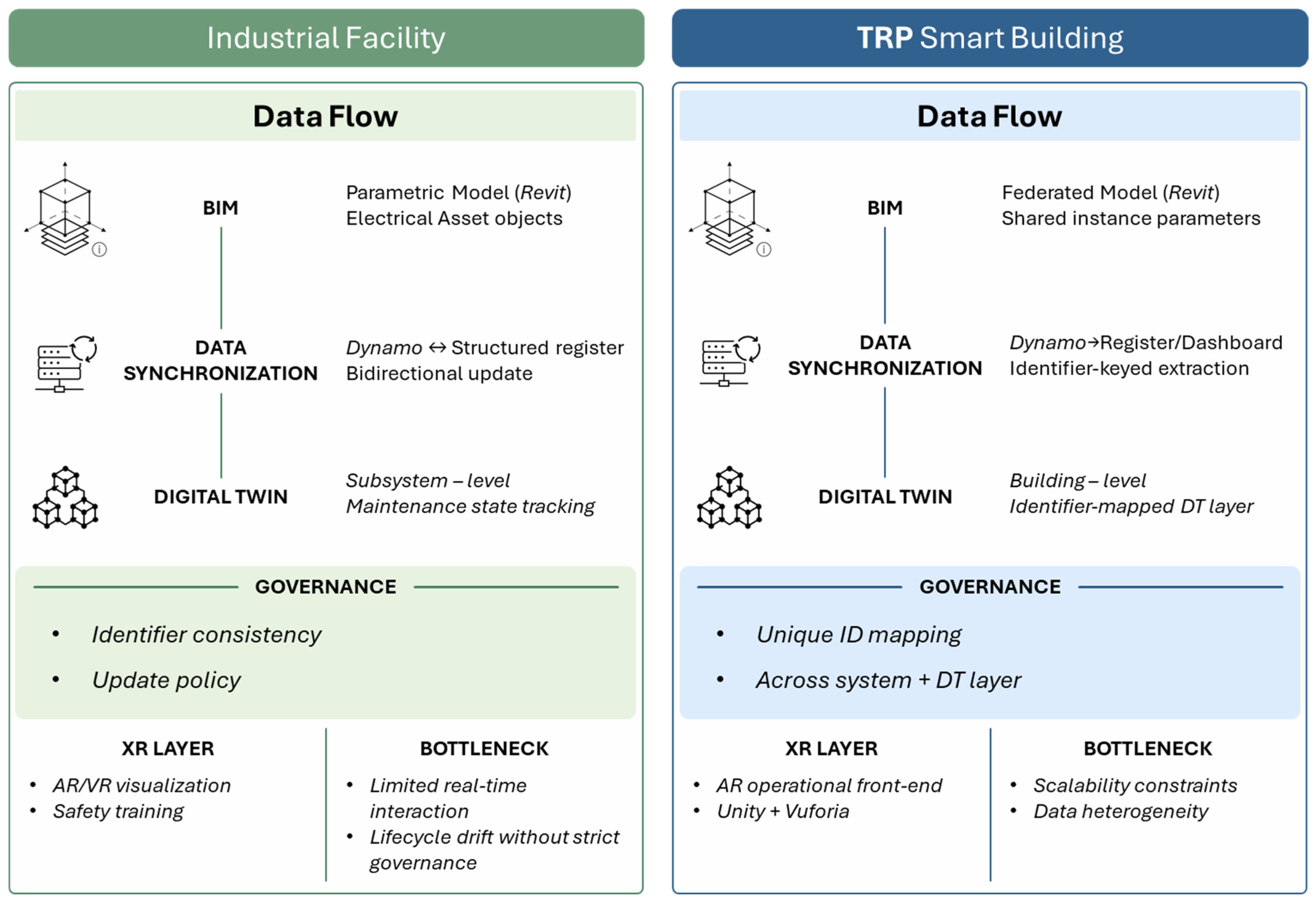
To support a clearer interpretation of the architectural and operational differences between the two contexts, Figure 6 presents a comparative diagram highlighting data flow structures, governance mechanisms, XR interaction roles, and integration bottlenecks for both the industrial facility and the TRP smart-building scenario.
Table 3 provides a structured comparison of their key implementation dimensions, constraints, and transferability implications. In both cases, BIM is the semantic foundation for representing electrical assets and operational performance is predicated on maintaining persistent identifiers, disciplined parameterization, and controlled bidirectional update workflows.
These principles align with the literature on BIM’s role in Facility Management and BIM and IoT integration as there have been sustained about long-term interoperability and the alignment of the information supply and demand in these deployments [1,41].
Although there are similar operational drivers for BIM–DT–XR Implementation, industrial deployments focus on equipment oversight and safety training and therefore place greater burden on the development of engineering and maintenance analysis, whereas TRP pilot deployments place greater burden on navigation of high-density assets and on-site use of AR during maintenance interactions.
Consequently, tertiary smart-building deployments exhibit stronger requirements for scalable federation management, identifier governance across multiple special systems, and human–machine interface robustness.
Hence the differences between implementations lead to integration challenges discussed in Section 6 and require that there be standardization of exchange protocols; that validation goes beyond syntactic compliance; and that closed-loop coupling exists between analytics and XR-based execution interfaces [18,33].
Furthermore, Digital Twin-based maintenance cost evaluation, as demonstrated in railway infrastructure contexts [68], suggests that lifecycle cost analysis should be explicitly integrated within BIM–DT workflows to support evidence-based maintenance scheduling in both industrial and tertiary environments.

5.4. Implications for Lifecycle-Oriented Electrical Asset Management

The review proves its main point through cross-domain evidence which demonstrates that local BIM–DT–XR solutions can work technically yet require specific governance and validation methods for development toward lifecycle-aware interoperable systems. The first requirement for identifier governance mandates its recognition as an essential engineering component which needs to include stable nomenclatures mapping rules and validation routines that prevent semantic drift across BIM, DT and XR layers. Bidirectional synchronization offers significant maintenance advantages yet requires specific procedures to handle conflict resolution and verification and rollback processes. XR should be evaluated as part of a closed operational loop—linking predictive or condition-based maintenance insights to field execution—rather than as an isolated visualization enhancement [25,36,45]. The following section contains research gaps and integration challenges which these implications directly connect to.

6. Integration Challenges and Research Gaps in BIM–Digital Twin–XR Ecosystems for Electrical System Management

The previous sections showed how BIM and Digital Twin and XR technologies evolved quickly in their shared development areas between different domains. A recurring pattern across the literature is the persistence of structural gaps that prevent these technologies from converging into fully integrated systems, that operate throughout electrical system management processes. A critical reading of the reviewed works reveals that the most persistent challenges are not purely technological, but rooted in semantic misalignment, governance fragmentation, and uneven standard adoption.

6.1. Semantic Interoperability Between BIM and Power-System Information Models

The basic problem of semantic interoperability arises from the need to connect BIM building representations with power-system information models which include the Common Information Model (CIM). The BIM environments create their spatial and architectural component representations through object-oriented design according to Section 2 discussion. In contrast, CIM, standardized under IEC 61970 and IEC 61968, provides a domain ontology tailored to power-system networks, assets, and operational data exchange [46]. The Industry Foundation Classes (IFC) standard [69], while providing a comprehensive schema for building data exchange, offers limited native support for electrical power system semantics such as connectivity graphs, protection coordination, or load flow parameters. Kim et al. [46] emphasize that achieving interoperability in smart grids requires semantic consistency across heterogeneous domains. They categorize practical CIM-related issues into three major areas: model extension, harmonization between heterogeneous standards (notably CIM and IEC 61850), and validation. These categories directly reflect the challenges faced when attempting to align building-centric BIM data with grid-centric CIM structures. The review by Xue et al. [48] further clarifies that BIM and CIM evolved independently with different semantic emphases. BIM traditionally organizes information around building elements and their lifecycle attributes, whereas CIM organizes data around electrical connectivity, operational states, and equipment relationships. Although both BIM and CIM are ontological representations, the difference in the scope of their semantics means that in order to introduce the BIM-based electrical asset data generated from the actual build environment into a CIM-based network model, it will require either an ontology-alignment mechanism or a unified modeling approach to do so; both will require extensive technical work and are still being developed at this time [48]. In examining the interoperability gap between BIM, IoT, and building-specific information model Digital Twins, Boje et al. [70] also further illustrate the interoperability issues discovered in this review. The absence of standardized mapping frameworks between BIM object classes and CIM equipment classes represents a structural gap. Most current implementations rely on project-specific transformations or intermediate schemas rather than reusable semantic bridges. This limitation constrains scalability and cross-domain interoperability.

6.2. Fragmentation of Standards and Model Extensions

The process of standard fragmentation creates difficulties which make it impossible to achieve successful system integration. The authors Shen et al. [71] demonstrate that systems integration in AEC/FM remains hampered by fragmented data structures and inconsistent collaboration protocols, challenges that persist over a decade later in BIM–DT ecosystems. The CIM ecosystem spans three IEC standards: IEC 61970 (transmission), IEC 61968 (distribution), and IEC 62325 (market processes) [47]. Within CIM there are also many practical challenges associated with extending models to new business requirements, distributed resources, and advanced monitoring applications [46]. In particular, the extension of models introduces the potential for inconsistent data due to a lack of harmonized design rules within the industry [46]. The need for extending existing or developing new models is most critical to modern electrical systems which must provide new methods for integrating distributed energy resources, advanced metering infrastructure, and edge devices. The CIM provides some guidelines for extending models but does not have an industry recognized method for developing and implementing extensions which will result in interoperability challenges between utilities and/or vendors. Anderson et al. [47] describe how enterprise-level data integration using CIM profiles requires careful down-selection of relevant classes and attributes. This profiling process is vital to preventing models from becoming overly complex while still retaining semantic integrity. However, inconsistent profiling practices across organizations may undermine interoperability, especially when exchanging operational data or Digital Twin state information. When BIM–DT–XR ecosystems are considered, this fragmentation multiplies. XR platforms often rely on simplified geometry and metadata subsets extracted from BIM, while DT platforms operate on CIM-based or custom network models. Without standardized cross-domain alignment mechanisms, these systems remain loosely coupled rather than fully integrated. This fragmentation is not an isolated issue but directly exacerbates semantic misalignment and limits the effectiveness of governance strategies across BIM–DT–XR ecosystems.
Current research and practice are beginning to address this fragmentation through a limited set of recurring strategies. A first direction concerns ontology-alignment mechanisms and reusable semantic bridges capable of relating BIM object structures to CIM-based electrical models, rather than relying exclusively on project-specific transformations [48,70]. A second direction involves more disciplined CIM profiling practices, in which classes and attributes are carefully down-selected to preserve semantic integrity while reducing implementation complexity [47]. A third response concerns the attempt to structure model extensions more explicitly, so as to reduce inconsistency when new monitoring requirements, distributed resources, or edge devices must be incorporated into existing information models [46]. Taken together, these efforts do not yet constitute a unified solution, but they indicate that the field is moving from merely recognizing fragmentation toward developing more reusable alignment and integration strategies across BIM–DT–XR ecosystems.

6.3. Data Governance, Naming Consistency, and Lifecycle Continuity

The main data integration challenge which Anderson et al. [47] identified as their central research focus exists because the essential naming problem requires resolution. Different databases in heterogeneous software environments use distinct identifiers to refer to the same physical assets. The CIM system uses master resource identifiers (mRID) to establish unique identification for resources which allows machine-readable identification to function independently from human-readable identification systems [47]. Identifying electrical systems consistently is essential for both accurate network analysis and maintenance traceability, as well as synchronizing Digital Twins (DT). If a Breaker or Transformer is referenced differently in the BIM model, DT analytics engine and XR interface, then automated data exchange will not work reliably. These issues extend beyond naming consistency to broader lifecycle governance mechanisms, including validation, synchronization, and long-term data integrity. Issues of lifecycle continuity add to the challenges faced by governance. BIM models are typically developed in design and construction phases while CIMs are predominantly in place in operational contexts. As power systems mature through retrofit, replacement of equipment and reconfiguration of the grid; the alignment between building-level and grid-level models must be continuously maintained. Kim et al. [46] underline that validation mechanisms are necessary to ensure that exchanged information conforms to established profiles and standards. Without robust validation workflows, semantic drift between digital representations and physical reality becomes likely.
The governance challenge presented here applies to the Digital Twin’s fidelity as well. For instance, DT systems must maintain continuous synchronization to reflect actual conditions as new measurements are made in real-time (discussed in Section 3). Model validation practices currently focus primarily on syntactic and semantic conformity, while limited attention is given to dynamic accuracy and uncertainty propagation, as highlighted in the literature [46]. This imbalance underscores the need for validation frameworks that incorporate temporal consistency and state estimation accuracy in order to bridge the gap between formal model compliance and real-world system behavior.

6.4. XR Integration: From Visualization Layer to Systemic Component

According to studies outlined in section four, XR technologies have demonstrated substantial efficiency gains for tasks related to inspection and training [30,31,63]. However, there exists a lack of effective integration between these XR technologies and Digital Twin-enabled maintenance ecosystems. Most XR implementations remain confined to geometric overlays derived from BIM, with limited access to operational metadata. There is also a substantial structural separation between the visualization technologies and the predictive Digital Twin infrastructure which creates a significant gap in overall systems integration. Research conducted by Errandonea et al. [25] highlights predictive maintenance and condition monitoring as two primary areas for ongoing future research in the Digital Twin arena. Nevertheless, there is little to no embedding of XR within these newly developed predictive workflows. Similarly, XR studies do not generally include network semantics that are based on Collaborative Integrated Model (CIM) infrastructures or incorporate enterprise-level data integration principles. The result is a partial integration paradigm: BIM–XR systems enhance field visualization, and DT–CIM systems enhance analytics, but full BIM–DT–XR ecosystems remain rare. This separation reduces the systemic potential of Digital Twins for electrical system management, where predictive analytics and field execution should ideally form a closed feedback loop.

6.5. Synthesis of Integration Gaps

Across the reviewed literature and implementation evidence, five recurring integration tensions emerge that limit systemic interoperability:
  • The inability for building-oriented and grid-oriented ontologies to semantically align creates interoperability constraints.
  • The use and extensions of fragmented standards creates friction to enable scalable integrations.
  • Inconsistent profile and naming conventions prevent effective data governance.
  • Validation mechanisms have historically focused primarily on syntactic compliance versus dynamic model fidelity.
  • XR deployment has outpaced systemic integration with predictive Digital Twins.
These gaps confirm that component-level technological maturity has outpaced system-level interoperability. Table 4 synthesizes the identified challenges—spanning semantic alignment, standardization, governance, validation, and XR integration—by linking each gap to its underlying technical causes and corresponding impacts on electrical system management, as derived from the literature [25,45,46,47,48].
The synthesis shows integration issues are across multiple levels of technology, i.e., semantic modeling, standardization, lifecycle governance, and human–machine interaction. Gaps exist across both technical and organization dimensions and will require ongoing co-ordination to advance these challenges. However, these gaps should not be interpreted as independent limitations, but rather as an interconnected and hierarchical system of constraints.
Semantic interoperability—especially the misalignment between BIM (IFC) and power-system ontologies (CIM)—emerges as a foundational condition that directly affects all other integration dimensions. Without a consistent semantic bridge between building-oriented and grid-oriented data structures, downstream processes such as data governance, Digital Twin synchronization, and XR-based interaction cannot be reliably established.
At the same time, weaknesses in data governance frameworks, including inconsistent identifier strategies and fragmented update policies, further amplify interoperability issues and contribute to lifecycle misalignment between physical assets and their digital representations. These limitations propagate upward, reducing the reliability of Digital Twin analytics and constraining the operational integration of XR technologies, which often remain decoupled from real-time system states. The identified gaps should therefore be understood as a layered structure, where semantic interoperability and governance represent enabling conditions, while validation, XR integration, and scalability challenges emerge as dependent and progressively higher-level constraints.
The cross-domain implementation evidence discussed in Section 5 independently corroborates this hierarchical structure of gaps, confirming that identifier governance, bidirectional synchronization, and XR–DT coupling represent recurring practical barriers in both industrial and tertiary deployment contexts [67]. These issues extend beyond naming consistency to broader lifecycle governance mechanisms, including validation, synchronization, and long-term data integrity.
Beyond the structural gaps synthesized above, it is also necessary to consider a set of practical implementation constraints that affect real-world deployment. While Table 5 outlines the key research gaps and directions, additional constraints emerge when considering real-world implementation.
First, input data quality and reliability remain critical, particularly in existing buildings, where incomplete as-built documentation, undocumented retrofits, inconsistent asset naming, and fragmented maintenance records compromise the semantic integrity of BIM models and limit their effective use within Digital Twin environments [1,10].
Second, the integration of heterogeneous data sources requires continuous data curation and validation processes, introducing operational complexity and increasing the risk of inconsistencies between physical assets and their digital representations [28,41].
Third, BIM–DT–XR implementation entails non-negligible technical and organizational costs, especially in high-density or legacy asset environments, where reconstructing reliable digital models and maintaining synchronized data flows require significant effort [1,10].
Finally, integration with existing operational systems remains a key constraint, as non-interoperable platforms and heterogeneous standards often require bespoke solutions, limiting scalability and transferability. These aspects indicate that, beyond structural integration gaps, the transition toward lifecycle-oriented BIM–DT–XR ecosystems is also constrained by data quality, cost, and governance factors, which must be explicitly addressed in both research and practice.

7. Future Research Directions

Addressing the integration challenges identified above requires coordinated advances at the semantic, architectural, and organizational levels. The following directions identify priority areas for the development of lifecycle-aware BIM–DT–XR ecosystems in electrical system management, which are synthesized in the research agenda presented in Table 6.

7.1. Semantic Alignment Between Building and Grid Ontologies

A primary research challenge concerns the establishment of robust semantic alignment mechanisms between BIM-based building models and CIM-based power system ontologies. As discussed in Section 6, building and grid information models have evolved largely independently, generating persistent forms of structural interoperability mismatch [46,48]. Existing mapping strategies remain largely project-specific and therefore do not yet provide a sufficiently transferable basis for cross-domain implementation. Three issues appear particularly relevant. The first is the definition of formal ontology-alignment methodologies capable of linking IFC-based BIM schemas with IEC 61970/61968 CIM structures. The second concerns the development of automated semantic translation pipelines that preserve both geometric meaning and electrical connectivity semantics. The third concerns the design of validation frameworks able to verify the correctness of model transformations across converted instances. This perspective is consistent with the view of Digital Twin common data environments as shared infrastructures for managing heterogeneous sources, stakeholders, and data consumers across federated ecosystems [75]. It is also aligned with ontology-enabled intelligent Digital Twin environments, in which semantic consistency supports not only model translation but also higher-level operational reasoning, allowing applications, data, and expert knowledge to be structured within a coherent ontological framework [76]. In the same direction, the integration of IFC and ontology-based representations continues to highlight the difficulty of constructing scalable and reusable cross-domain semantic bridges [49]. Taken together, these issues suggest that semantic alignment is not merely a conversion problem, but a prerequisite for connecting building-level electrical assets with grid-level Digital Twin systems in a consistent and operationally meaningful manner.

7.2. Lifecycle-Consistent Digital Twin Architectures

The literature shows that Digital Twin technologies have achieved significant analytical progress in power systems, yet they still lack stable connections with design-oriented BIM models and field-based XR systems [17,20,25]. A central research direction therefore concerns lifecycle continuity, especially in relation to the persistence of information across design, operation, retrofit, and end-of-life phases.
In this respect, future architectures should be able to track asset identifiers from design through operational use, synchronize BIM updates with changes occurring in operational CIM-based environments, and incorporate upgrade and retrofit processes within unified digital settings. The challenge is not limited to model linkage, but concerns the creation of governed lifecycle transitions between static design representations and dynamic operational systems. This need is reinforced by bibliometric and review evidence on BIM–DT integration in operation and maintenance, which indicates that lifecycle continuity remains underdeveloped despite the rapid expansion of digital tools for building operations [77]. Reviews of building Digital Twin frameworks similarly identify poor interoperability, non-standardized integration procedures, and low automation as persistent barriers to the transition from monitoring-oriented twins to lifecycle-consistent decision-support architectures [78]. The need for lifecycle-consistent architectures is further reinforced by recent work on common data environments [75], which frames Digital Twin deployment as a data ecosystem problem rather than a standalone modeling exercise. Within this broader perspective, the maturity model proposed by Madni et al. [79] remains useful as an incremental roadmap, moving from pre-Digital Twin conditions to more intelligent Digital Twin configurations capable of supporting lifecycle integration.

7.3. Validation Beyond Syntactic Conformity

The validation of interoperable environments cannot be limited to verifying whether system outputs satisfy data schema requirements and profile definition specifications [26]. In safety-critical electrical contexts, syntactic conformity alone does not provide sufficient assurance regarding the fidelity, reliability, and operational usability of the resulting Digital Twin environment. Three priorities emerge from this limitation. The first is the dynamic validation of Digital Twin state estimation against field measurements. The second is the quantification of uncertainty propagation across multi-level twins. The third is the performance benchmarking of predictive maintenance models integrated with BIM–XR interfaces. This shift from structural compliance to fidelity-oriented validation is supported by verification studies on geometric Digital Twins, which show that models may appear visually acceptable while still exhibiting quality degradation or failing replacement criteria [80]. This concern is further reinforced by framework reviews that identify limited predictive-data integration and weak benchmarking practices among the main constraints on Digital Twin reliability [78].In addition, ontology-enabled intelligent digital twin environments imply that validation should also examine whether applications, reasoning services, and semantic dependencies operate correctly within the structure of the DT environment, rather than limiting assessment to formal schema compliance alone [76].
The transition from validating data structure to validating data fidelity therefore represents a necessary step toward greater confidence in Digital Twin-enabled maintenance processes.

7.4. XR as a Closed-Loop Operational Interface

Although XR technologies have shown consistent value in improving inspection efficiency, situational awareness, and safety-related functions, they are still only partially integrated into predictive Digital Twin systems. In this regard, the prescriptive maintenance perspective described by Ansari et al. [81], which combines predictive analytics with action-oriented recommendations, provides a useful direction for the evolution of BIM–DT–XR ecosystems. The three research areas which show the most value for study include the real-time connection between DT analytical results and XR-based maintenance applications and the creation of assessment criteria which measure the accuracy and safety of XR-based maintenance work and the examination of human cognitive load and other human elements in areas which contain complex electrical systems. Evidence supporting the latter area of investigation can be found in neurophysiological research into AR-assisted industrial tasks. Researchers in this area have developed some initial frameworks that could serve as a starting point for measuring cognitive load during maintenance activity associated with XR technologies, though the direct use of these frameworks for assessing cognitive load while performing electrical maintenance tasks has yet to be established [82]. Accordingly, future research should rely on assessment approaches that combine cognitive-load evaluation with task-performance and safety-oriented usability criteria, so as to verify whether XR systems remain operationally reliable in complex electrical environments. Examples from literature that evaluate DT–MR integration in building maintenance and operation lead to one conclusion—there is potential for immersive interfaces through XR technologies, but they are currently limited by standardization, scalability, and real-time deployment issues [83]. Complementary evidence from implementation-oriented research on 3D interactive building operations further indicates that BIM, IoT-enabled BAS, AI, and mixed reality can be connected within multi-layer DT architectures, supporting both on-site and remote operational workflows [84]. From this perspective, the integration of XR into the predictive maintenance lifecycle should be understood not as an accessory visualization layer, but as a potential closed-loop operational interface between digital analysis and field action.

7.5. Cybersecurity and Data Governance in Integrated Ecosystems

The growing interconnectedness of BIM–DT–XR ecosystems introduces an additional layer of complexity related to cybersecurity and data governance. While interoperability standards can contribute to semantic consistency [46], they do not, by themselves, ensure secure data exchange, protected communication, or security-aware system design. Three issues deserve particular attention: the definition of secure communication protocols for DT-enabled grid monitoring; the development of role-based access control models across BIM–CIM–XR environments; and the design of governance frameworks capable of maintaining mRID consistency and lifecycle asset traceability. This direction is supported by studies on cyber-resilient smart grids, which show that the combination of Digital Twins and shared data spaces requires governance models that are not only interoperable, but also resilient by design [85]. A similar conclusion is reached in reviews of cyber-physical power system Digital Twins, where the integration of monitoring, control, and communication layers is associated with a substantial expansion of the attack surface of DT ecosystems [86]. Accordingly, data governance and cybersecurity should be treated as constitutive components of integrated BIM–DT–XR infrastructures, rather than as secondary layers added after interoperability has been achieved.
The research directions outlined above show that technological maturity alone is not sufficient to achieve fully integrated BIM–Digital Twin–XR ecosystems. Their transition from isolated pilots to scalable infrastructures for electrical system management depends on coordinated advances in semantic alignment, lifecycle governance, validation rigor, human-centered interface design, and cyber-resilient governance. These priorities are summarized in Table 6.

8. Conclusions

Taken individually, BIM, Digital Twin, and XR technologies have reached considerable levels of maturity. With reference to RQ1, this review shows that these domains provide complementary capabilities for electrical system lifecycle management: BIM supports structured information modeling, Digital Twin enables dynamic system representation and predictive analytics, and XR facilitates visualization and interaction within operational environments. However, their convergence into interoperable, lifecycle-consistent infrastructures remains limited. With reference to RQ2, the main barriers do not arise from isolated technological immaturity, but from cross-domain integration gaps. These include semantic misalignment between building-oriented (IFC) and grid-oriented (CIM) ontologies, fragmented standard adoption, inconsistent data governance and naming practices, limited validation of dynamic model fidelity, and the weak coupling of XR interfaces with DT analytical cores. The implementation evidence discussed in Section 5 reinforces these findings. With reference to RQ3, the analyzed cases show that BIM–DT–XR integration is technically feasible at pilot scale, but that its transition toward lifecycle-aware ecosystems still depends on persistent identifier management, controlled synchronization workflows, and stronger governance of data continuity across platforms and phases.
Collectively, the taxonomic classification, comparative analysis, implementation evidence, integration gap synthesis, and research agenda indicate that component-level technological maturity has advanced more rapidly than ecosystem-level interoperability. For electrical systems—where safety-critical maintenance, protection coordination, and interaction with power networks impose stringent requirements—this gap has direct operational consequences.
This study also has some limitations that should be acknowledged. First, as a structured review, it is intended to provide a critical and synthesis-oriented interpretation of BIM–DT–XR convergence rather than an exhaustive protocol-driven survey of the literature. Second, the implementation evidence discussed in Section 5 is based on two pilot contexts—an industrial electrical facility and a tertiary smart-building case—which are useful for testing recurring integration issues but do not cover the full range of electrical maintenance conditions encountered in more complex environments. Third, these cases are not presented as controlled performance-validation experiments and therefore do not support statistically generalizable claims regarding task-time reduction, error reduction, or operational safety gains.
From a practical perspective, three priorities emerge. First, persistent identifiers and consistent nomenclature are needed to ensure asset traceability across BIM, DT, and operational platforms. Second, BIM models must incorporate maintenance-relevant semantic attributes to support predictive and lifecycle-oriented uses beyond design and construction. Third, XR should evolve from a standalone visualization layer to a closed-loop operational interface connected to DT-based analytical workflows.
Overall, effective electrical system lifecycle management depends less on the isolated advancement of BIM, DT, or XR than on the ability to ensure continuity between data structures, analytical models, and user interfaces across lifecycle phases. Future progress therefore requires not only further technological development, but also stronger advances in semantic alignment, lifecycle governance, validation, and scalable integration frameworks.

Author Contributions

Conceptualization and study design, P.D.L.; methodology and original draft preparation, P.D.L.; development and integration of the implementation case studies, P.D.L., M.Z. and M.D.G.; writing—review and editing, M.Z.; technical and scientific revision, M.Z. and M.D.G.; visualization and manuscript preparation, M.Z. All authors have read and agreed to the published version of the manuscript.

Funding

This research received no external funding.

Institutional Review Board Statement

Not applicable.

Informed Consent Statement

Not applicable.

Data Availability Statement

The study is based on a literature review and implementation evidence. No publicly available datasets were generated. Any supporting data are available from the corresponding author upon reasonable request.

Acknowledgments

The authors would like to thank the institutional environment that supported the development of this research.

Conflicts of Interest

The authors declare no conflicts of interest.

Abbreviations

The following abbreviations are used in this manuscript:
ARAugmented Reality
BIMBuilding Information Modeling
CAFMComputer Aided Facility Management
CIMCommon Information Model
CPSCyber-Physical Systems
DERsDistributed Energy Resources
DGADissolved Gas Analysis
DLRDynamic Line Rating
DTDigital Twin
IFCIndustry Foundation Classes
IoTInternet of Things
mRIDMaster Resource Identifiers
PMUsPhasor Measurement Units
SCADASupervisory Control and Data Acquisition
SDTSsSystem of Digital Twin Systems
VRVirtual Reality
WAMSWide Area Monitoring Systems
XRExtended Reality

References

  1. Pärn, E.A.; Edwards, D.J.; Sing, M.C.P. The building information modelling trajectory in facilities management: A review. Autom. Constr. 2017, 75, 45–55. [Google Scholar] [CrossRef] [Scilit]
  2. Gao, X.; Pishdad-Bozorgi, P. BIM-Enabled Facilities Operation and Maintenance: A Review. Adv. Eng. Inform. 2019, 39, 227–247. [Google Scholar] [CrossRef] [Scilit]
  3. Eastman, C.; Teicholz, P.; Sacks, R.; Liston, K. BIM Handbook: A Guide to Building Information Modeling for Owners, Managers, Designers, Engineers and Contractors, 2nd ed.; Wiley: Hoboken, NJ, USA, 2011. [Google Scholar] [CrossRef] [Scilit]
  4. Huan, X.; Kang, B.G.; Xie, J.; Hancock, C. Building information modelling (BIM)-enabled facility management (FM) of nursing homes in China: A systematic review. J. Build. Eng. 2025, 99, 111580. [Google Scholar] [CrossRef] [Scilit]
  5. Gordo-Gregorio, P.; Alavi, H.; Forcada, N. Decoding BIM Challenges in Facility Management Areas: A Stakeholders’ Perspective. Buildings 2025, 15, 811. [Google Scholar] [CrossRef] [Scilit]
  6. Singh, V.; Gu, N.; Wang, X. A Theoretical Framework of a BIM-Based Multi-Disciplinary Collaboration Platform. Autom. Constr. 2011, 20, 134–144. [Google Scholar] [CrossRef] [Scilit]
  7. Succar, B. Building Information Modelling Framework: A Research and Delivery Foundation for Industry Stakeholders. Autom. Constr. 2009, 18, 357–375. [Google Scholar] [CrossRef] [Scilit]
  8. Ehab, A.; Mahdi, M.A.; El-Helloty, A. Enhancing facility maintenance using knowledge-based BIM systems. Sci. Rep. 2025, 15, 43392. [Google Scholar] [CrossRef] [Scilit]
  9. Zucco, M.; Del Giudice, M.; Osello, A. Digital Twin for BIM-FM Data Comparison: A Decision Support System Based on Graphical Interfaces. In Advances in Representation. Digital Innovations in Architecture, Engineering and Construction; Giordano, A., Russo, M., Spallone, R., Eds.; Springer: Cham, Switzerland, 2024; pp. 587–605. [Google Scholar]
  10. Volk, R.; Stengel, J.; Schultmann, F. Building Information Modeling (BIM) for existing buildings—Literature review and future needs. Autom. Constr. 2014, 38, 109–127. [Google Scholar] [CrossRef] [Scilit]
  11. Motawa, I.; Almarshad, A. A Knowledge-Based BIM System for Building Maintenance. Autom. Constr. 2013, 29, 173–182. [Google Scholar] [CrossRef] [Scilit]
  12. Grieves, M.; Vickers, J. Digital Twin: Mitigating Unpredictable, Undesirable Emergent Behavior in Complex Systems. In Transdisciplinary Perspectives on Complex Systems; Springer: Cham, Switzerland, 2017; pp. 85–113. [Google Scholar] [CrossRef] [Scilit]
  13. Glaessgen, E.; Stargel, D. The Digital Twin Paradigm for Future NASA and U.S. Air Force Vehicles. In Proceedings of the 53rd AIAA/ASME/ASCE/AHS/ASC Structures, Structural Dynamics and Materials Conference, Honolulu, HI, USA, 23–26 April 2012. [Google Scholar] [CrossRef] [Scilit]
  14. Tao, F.; Cheng, J.; Qi, Q.; Zhang, M.; Zhang, H.; Sui, F. Digital Twin-Driven Product Design, Manufacturing and Service with Big Data. Int. J. Adv. Manuf. Technol. 2018, 94, 3563–3576. [Google Scholar] [CrossRef] [Scilit]
  15. Lu, Y.; Liu, C.; Wang, K.I.-K.; Huang, H.; Xu, X. Digital Twin-Driven Smart Manufacturing: Connotation, Reference Model, Applications and Research Issues. Robot. Comput. Integr. Manuf. 2020, 61, 101837. [Google Scholar] [CrossRef] [Scilit]
  16. Tao, F.; Zhang, H.; Liu, A.; Nee, A.Y.C. Digital Twin in Industry: State-of-the-Art. IEEE Trans. Ind. Inform. 2019, 15, 2405–2415. [Google Scholar] [CrossRef] [Scilit]
  17. Yassin, M.A.M.; Shrestha, A.; Rabie, S. Digital twin in power system research and development: Principle, scope, and challenges. Energy Rev. 2023, 2, 100039. [Google Scholar] [CrossRef] [Scilit]
  18. Sifat, M.M.H.; Choudhury, S.M.; Das, S.K.; Muyeen, S.M.; El Moursi, M.S.; Benidris, M.; Al Hosani, M. Towards electric digital twin grid: Technology and framework review. Energy AI 2023, 11, 100213. [Google Scholar] [CrossRef] [Scilit]
  19. IEEE Power & Energy Society. Digital Twin for Power Equipment. 2024. Available online: https://resourcecenter.ieee-pes.org (accessed on 2 April 2026).
  20. Zomerdijk, W.; Palensky, P.; AlSkaif, T.; Vergara, P.P. On future power system digital twins: A vision towards a standard architecture. Digit. Twins Appl. 2024, 1, 103–117. [Google Scholar] [CrossRef] [Scilit]
  21. AlBalkhy, W.; Karmaoui, D.; Ducoulombier, L.; Lafhaj, Z.; Linner, T. Digital twins in the built environment: Definition, applications, and challenges. Autom. Constr. 2024, 162, 105368. [Google Scholar] [CrossRef] [Scilit]
  22. Mousavi, Y.; Gharineiat, Z.; Karimi, A.A.; McDougall, K.; Rossi, A.; Gonizzi Barsanti, S. Digital Twin Technology in Built Environment: A Review of Applications, Capabilities and Challenges. Smart Cities 2024, 7, 2594–2615. [Google Scholar] [CrossRef] [Scilit]
  23. Cespedes-Cubides, A.S.; Jradi, M. A review of building digital twins to improve energy efficiency in the building operational stage. Energy Inform. 2024, 7, 11. [Google Scholar] [CrossRef] [Scilit]
  24. Kritzinger, W.; Karner, M.; Traar, G.; Henjes, J.; Sihn, W. Digital Twin in Manufacturing: A Categorical Literature Review and Classification. IFAC-PapersOnLine 2018, 51, 1016–1022. [Google Scholar] [CrossRef] [Scilit]
  25. Errandonea, I.; Beltrán, S.; Arrizabalaga, S. Digital Twin for maintenance: A literature review. Comput. Ind. 2020, 123, 103316. [Google Scholar] [CrossRef] [Scilit]
  26. Tao, F.; Zhang, M.; Liu, Y.; Nee, A.Y.C. Digital Twin Driven Prognostics and Health Management for Complex Equipment. CIRP Ann. 2018, 67, 169–172. [Google Scholar] [CrossRef] [Scilit]
  27. Werner, A.; Zimmermann, N.; Lentes, J. Approach for a Holistic Predictive Maintenance Strategy by Incorporating a Digital Twin. Procedia Manuf. 2019, 39, 1743–1751. [Google Scholar] [CrossRef] [Scilit]
  28. Hu, W.; Ou, Y.; Liu, H.; Ni, P.; Chang, C. Integrating digital twin technologies for maintenance 4.0 in the building industry: A review and conceptual framework. Build. Environ. 2026, 288, 113997. [Google Scholar] [CrossRef] [Scilit]
  29. Del Giudice, M.; Zucco, M.; Iacono, E.; Donato, A.J.; Fratto, A.; Osello, A. Verso il Cognitive Digital Twin: Interfacce grafiche per la comprensione e la gestione dei Big Data. In Proceedings of the 45° Convegno Internazionale dei Docenti delle Discipline della Rappresentazione, Congresso della Unione Italiana per il Disegno, Padova–Venezia, Italy, 12–14 September 2024; pp. 1285–1300. [Google Scholar] [CrossRef] [Scilit]
  30. Sidani, A.; Dinis, F.M.; Duarte, J.; Sanhudo, L.; Calvetti, D.; Baptista, J.S.; Martins, J.P.; Soeiro, A. Recent tools and techniques of BIM-Based Augmented Reality: A systematic review. J. Build. Eng. 2021, 42, 102500. [Google Scholar] [CrossRef] [Scilit]
  31. Chua, M.; Matthews, J.; Love, P.E.D. Integrating mobile Building Information Modelling and Augmented Reality systems: An experimental study. Autom. Constr. 2018, 85, 305–316. [Google Scholar] [CrossRef] [Scilit]
  32. Chi, H.-L.; Kang, S.-C.; Wang, X. Research Trends and Opportunities of Augmented Reality Applications in Architecture, Engineering, and Construction. Autom. Constr. 2013, 33, 116–122. [Google Scholar] [CrossRef] [Scilit]
  33. Wang, X.; Kim, M.J.; Love, P.E.D.; Kang, S.-C. Augmented Reality in Built Environment: Classification and Implications for Future Research. Autom. Constr. 2013, 32, 1–13. [Google Scholar] [CrossRef] [Scilit]
  34. Palmarini, R.; Erkoyuncu, J.A.; Roy, R.; Tober, H. A Systematic Review of Augmented Reality Applications in Maintenance. Robot. Comput. Integr. Manuf. 2018, 49, 215–228. [Google Scholar] [CrossRef] [Scilit]
  35. Getuli, V.; Capone, P.; Bruttini, A.; Isaac, S. BIM-based immersive Virtual Reality for construction workspace planning: A safety-oriented approach. Autom. Constr. 2020, 114, 103160. [Google Scholar] [CrossRef] [Scilit]
  36. Coupry, C.; Noblecourt, S.; Richard, P.; Baudry, D.; Bigaud, D. BIM-Based Digital Twin and XR Devices to Improve Maintenance Procedures in Smart Buildings: A Literature Review. Appl. Sci. 2021, 11, 6810. [Google Scholar] [CrossRef] [Scilit]
  37. Schiavi, B.; Havard, V.; Beddiar, K.; Baudry, D. BIM data flow architecture with AR/VR technologies: Use cases in architecture, engineering and construction. Autom. Constr. 2022, 134, 104054. [Google Scholar] [CrossRef] [Scilit]
  38. Wang, X.; Wang, S.; Xiao, F.; Luo, X. Augmented reality-based knowledge transfer for facility management: A systematic review. J. Build. Eng. 2024, 98, 111186. [Google Scholar] [CrossRef] [Scilit]
  39. Alam, N.; Saha, N.; Gadow, V.; Harik, R.; Ryu, J. Role of extended reality (XR) technologies in maintenance operations: Trends, challenges, and integration in industry 4.0. Manuf. Lett. 2025, 44, 1545–1557. [Google Scholar] [CrossRef] [Scilit]
  40. Ugliotti, F.M.; Osello, A. Digital Twin, Virtual Reality and Metaverse: What technologies to support the asset management workforce? In Book of Abstracts of the RETURN Dissemination Workshop; Zenodo: Geneva, Switzerland, 2024; pp. 273–274. [Google Scholar] [CrossRef]
  41. Tang, S.; Shelden, D.R.; Eastman, C.M.; Pishdad-Bozorgi, P.; Gao, X. A review of building information modeling (BIM) and the internet of things (IoT) devices integration: Present status and future trends. Autom. Constr. 2019, 101, 127–139. [Google Scholar] [CrossRef] [Scilit]
  42. Song, Z.; Hackl, C.M.; Anand, A.; Thommessen, A.; Bianchi, F.D.; Palensky, P. Digital Twins for the Future Power System: An Overview and a Future Perspective. Sustainability 2023, 15, 5259. [Google Scholar] [CrossRef] [Scilit]
  43. Heluany, J.B.; Gkioulos, V. A review on digital twins for power generation and distribution. Int. J. Inf. Secur. 2024, 23, 1171–1195. [Google Scholar] [CrossRef] [Scilit]
  44. Aghazadeh Ardebili, A.; Zappatore, M.; Ramadan, A.I.H.A.; Longo, A.; Ficarella, A. Digital Twins of smart energy systems: A systematic literature review. Energy Inform. 2024, 7, 94. [Google Scholar] [CrossRef] [Scilit]
  45. Casini, M. Extended Reality for Smart Building Operation and Maintenance: A Review. Energies 2022, 15, 3785. [Google Scholar] [CrossRef] [Scilit]
  46. Kim, H.J.; Jeong, C.M.; Sohn, J.-M.; Joo, J.-Y.; Donde, V.; Ko, Y.; Yoon, Y.T. A Comprehensive Review of Practical Issues for Interoperability Using the Common Information Model in Smart Grids. Energies 2020, 13, 1435. [Google Scholar] [CrossRef] [Scilit]
  47. Anderson, A.A.; Stephan, E.G.; McDermott, T.E. Enabling Data Exchange and Data Integration with the Common Information Model: An Introduction for Power Systems Engineers and Application Developers; PNNL-32679; Pacific Northwest National Laboratory: Richland, WA, USA, 2022. [CrossRef] [Scilit]
  48. Xue, F.; Wu, L.; Lu, W. Semantic Enrichment of Building and City Information Models: A Ten-Year Review. Adv. Eng. Inform. 2021, 47, 101245. [Google Scholar] [CrossRef] [Scilit]
  49. Jia, J.; Ma, H.; Zhang, Z. Integration of Industry Foundation Classes and Ontology: Data, Applications, Modes, Challenges, and Opportunities. Buildings 2024, 14, 911. [Google Scholar] [CrossRef] [Scilit]
  50. Okonta, E.D.; Rahimian, F.; Vukovic, V.; Rodriguez, S. Semantic interoperability on IoT: Aligning IFC and Smart Application Reference (SAREF) sensor data models. Autom. Constr. 2025, 178, 106078. [Google Scholar] [CrossRef] [Scilit]
  51. Palihakkara, A.D.; Osorio-Sandoval, C.A.; Tizani, W. A Review of the Application of Ontologies and Semantic Web for Building Information Modelling and Digital Twins Based Construction Management. J. Inf. Technol. Constr. 2025, 30, 1208–1243. [Google Scholar] [CrossRef] [Scilit]
  52. Becerik-Gerber, B.; Jazizadeh, F.; Li, N.; Calis, G. Application Areas and Data Requirements for BIM-Enabled Facilities Management. J. Constr. Eng. Manag. 2012, 138, 431–442. [Google Scholar] [CrossRef] [Scilit]
  53. Mannino, A.; Dejaco, M.C.; Re Cecconi, F. Building Information Modelling and Internet of Things Integration for Facility Management—Literature Review and Future Needs. Appl. Sci. 2021, 11, 3062. [Google Scholar] [CrossRef] [Scilit]
  54. Villa, V.; Naticchia, B.; Bruno, G.; Aliev, K.; Piantanida, P.; Antonelli, D. IoT Open-Source Architecture for the Maintenance of Building Facilities. Appl. Sci. 2021, 11, 5374. [Google Scholar] [CrossRef] [Scilit]
  55. Fialho, B.; Nascimento, N.; Morais, H.; Gomes, J.; Leite, F. Development of a BIM and IoT-Based Smart Lighting Maintenance System Prototype for Universities’ FM Sector. Buildings 2022, 12, 99. [Google Scholar] [CrossRef] [Scilit]
  56. Moretti, N.; Xie, X.; Merino, J.; Brazauskas, J.; Parlikad, A.K. An openBIM Approach to IoT Integration with Incomplete As-Built Data. Appl. Sci. 2020, 10, 8287. [Google Scholar] [CrossRef] [Scilit]
  57. Congiu, E.; Desogus, G.; Frau, C.; Gatto, G.; Pili, S. Web-Based Management of Public Buildings: A Workflow Based on Integration of BIM and IoT Sensors with a Web–GIS Portal. Buildings 2023, 13, 1327. [Google Scholar] [CrossRef] [Scilit]
  58. Abur, A.; Exposito, A.G. Power System State Estimation: Theory and Implementation; CRC Press: Boca Raton, FL, USA, 2004. [Google Scholar] [CrossRef] [Scilit]
  59. Zhou, Y.; Wang, Y.; Li, Z.; Zhang, H. Hybrid Data-Driven Modeling for an AC/DC Power System Based on Dynamic Mode Decomposition. Front. Energy Res. 2022, 10, 830833. [Google Scholar] [CrossRef] [Scilit]
  60. Falekas, P.; Karlis, A. Digital Twin in Electrical Machine Control and Predictive Maintenance. Energies 2021, 14, 5933. [Google Scholar] [CrossRef] [Scilit]
  61. Yassin, H.; Al-Sumaiti, A.S.; El Moursi, M.S.; Turitsyn, K. Digital Twin in Power System Research and Development. Results Eng. 2023, 17, 100948. [Google Scholar] [CrossRef] [Scilit]
  62. Sifat, A.I.; Sayeed, A.; Islam, M.R.; Rahman, M.M. Towards Electric Digital Twin Grid: Technology and Framework Review. Energy Built Environ. 2023, 4, 100059. [Google Scholar] [CrossRef] [Scilit]
  63. Pan, N.-H.; Isnaeni, N.N. Integration of Augmented Reality and Building Information Modeling for Enhanced Construction Inspection—A Case Study. Buildings 2024, 14, 612. [Google Scholar] [CrossRef] [Scilit]
  64. Bae, H.; Golparvar-Fard, M.; White, J. High-precision vision-based mobile augmented reality system for context-aware architectural, engineering, construction and facility management applications. Vis. Eng. 2013, 1, 3. [Google Scholar] [CrossRef] [Scilit]
  65. Fite-Georgel, P. Is There a Reality in Industrial Augmented Reality? In Proceedings of the 2011 10th IEEE International Symposium on Mixed and Augmented Reality, Basel, Switzerland, 26–29 October 2011; pp. 201–210. [Google Scholar] [CrossRef]
  66. Nee, A.Y.C.; Ong, S.K.; Chryssolouris, G.; Mourtzis, D. Augmented Reality Applications in Design and Manufacturing. CIRP Ann. 2012, 61, 657–679. [Google Scholar] [CrossRef] [Scilit]
  67. Di Leo, P.; Del Giudice, M.; Fratto, A.; Osello, A. BIM and Digital Twin for Electrical Systems: A Case Study of an Industrial Building. In Proceedings of the 2024 IEEE International Conference on Industrial Technology (ICIT), Bristol, UK, 25–27 March 2024; pp. 1–6. [Google Scholar] [CrossRef] [Scilit]
  68. Kaewunruen, S.; Xu, N. Digital Twin for Sustainability Evaluation of Railway Station Buildings. Front. Built Environ. 2018, 4, 77. [Google Scholar] [CrossRef] [Scilit]
  69. ISO 16739-1:2018; Industry Foundation Classes (IFC) for Data Sharing in the Construction and Facility Management Industries—Part 1: Data Schema. ISO: Geneva, Switzerland, 2018. Available online: https://www.iso.org/standard/70303.html (accessed on 2 April 2026).
  70. Boje, C.; Guerriero, A.; Kubicki, S.; Rezgui, Y. Towards a Semantic Construction Digital Twin: Directions for Future Research. Autom. Constr. 2020, 114, 103179. [Google Scholar] [CrossRef] [Scilit]
  71. Shen, W.; Hao, Q.; Mak, H.; Neelamkavil, J.; Xie, H.; Dickinson, J.; Thomas, R.; Pardasani, A.; Xue, H. Systems Integration and Collaboration in Architecture, Engineering, Construction, and Facilities Management: A Review. Adv. Eng. Inform. 2010, 24, 196–207. [Google Scholar] [CrossRef] [Scilit]
  72. IEC 61850:2026 SER; Communication Networks and Systems for Power Utility Automation. IEC: Geneva, Switzerland, 2026.
  73. IEC 61970:2026 SER; Energy Management System Application Program Interface (EMS-API). IEC: Geneva, Switzerland, 2026.
  74. IEC 61968; Application Integration at Electric Utilities—System Interfaces for Distribution Management. IEC: Geneva, Switzerland, 2013.
  75. Yan, J.; Lu, Q.; Li, N.; Chen, L.; Pitt, M. Common data environment for digital twins from building to city levels. Autom. Constr. 2025, 174, 106131. [Google Scholar] [CrossRef] [Scilit]
  76. Yoon, S.; Song, J.; Li, J. Ontology-enabled AI agent-driven intelligent digital twins for building operations and maintenance. J. Build. Eng. 2025, 108, 112802. [Google Scholar] [CrossRef] [Scilit]
  77. Elshabshiri, A.; Ghanim, A.; Hussien, A.; Maksoud, A.; Mushtaha, E. Integration of Building Information Modeling and Digital Twins in the Operation and Maintenance of a building lifecycle: A bibliometric analysis review. J. Build. Eng. 2025, 99, 111541. [Google Scholar] [CrossRef] [Scilit]
  78. Zhang, X.; Zheng, J.; Li, P.; Yang, Y.; Ye, Y.; Causone, F.; Shi, X. A review of building digital twins: Framework and enabling technologies. J. Build. Eng. 2025, 111, 113117. [Google Scholar] [CrossRef] [Scilit]
  79. Madni, A.M.; Madni, C.C.; Lucero, S.D. Leveraging Digital Twin Technology in Model-Based Systems Engineering. Systems 2019, 7, 7. [Google Scholar] [CrossRef] [Scilit]
  80. Osadcha, I.; Fernandez, J.B.; Pupeikis, D.; Bocullo, V.; Ali, M.I.; Jurelionis, A. Framework for the Verification of Geometric Digital Twins: Application in a University Environment. Buildings 2025, 15, 3854. [Google Scholar] [CrossRef] [Scilit]
  81. Ansari, F.; Glawar, R.; Nemeth, T. PriMa: A Prescriptive Maintenance Model for Cyber-Physical Production Systems. Int. J. Comput. Integr. Manuf. 2019, 32, 482–503. [Google Scholar] [CrossRef] [Scilit]
  82. Alessa, F.M.; Alhaag, M.H.; Al-Harkan, I.M.; Ramadan, M.Z.; Alqahtani, F.M. A Neurophysiological Evaluation of Cognitive Load during Augmented Reality Interactions in Various Industrial Maintenance and Assembly Tasks. Sensors 2023, 23, 7698. [Google Scholar] [CrossRef] [Scilit]
  83. Shahzad, M.; Tah, J.H.M.; Younas, M.; Almukhtar, A. Technologies and techniques in digital twins for real-time data visualisation in building maintenance: A state-of-the-art review. J. Infrastruct. Intell. Resil. 2025, 4, 100185. [Google Scholar] [CrossRef] [Scilit]
  84. Ma, T.; Xiao, F.; Zhang, C.; Zhang, J.; Zhang, H.; Xu, K.; Luo, X. Digital twin for 3D interactive building operations: Integrating BIM, IoT-enabled building automation systems, AI, and mixed reality. Autom. Constr. 2025, 176, 106277. [Google Scholar] [CrossRef] [Scilit]
  85. Coppolino, L.; Nardone, R.; Petruolo, A.; Romano, L. Building Cyber-Resilient Smart Grids with Digital Twins and Data Spaces. Appl. Sci. 2023, 13, 13060. [Google Scholar] [CrossRef] [Scilit]
  86. Barreto, N.E.M.; Aoki, A.R. Cyber-Physical Power System Digital Twins—A Study on the State of the Art. Energies 2025, 18, 5960. [Google Scholar] [CrossRef] [Scilit]
Figure 1. Literature screening, thematic synthesis, and implementation-based validation process.
Applsci 16 03685 g001
Figure 2. Conceptual scope of the review: BIM, Digital Twin, and Extended Reality as complementary technology domains for electrical system lifecycle management, with cross-domain integration challenges addressed in Section 6. The diagram emphasizes that value does not arise from the coexistence of these domains, but from their effective integration across lifecycle-oriented workflows.
Applsci 16 03685 g002
Figure 3. Simplified BIM–Digital Twin–XR pipeline for electrical maintenance, highlighting identifier-based data integration, Digital Twin analytics, and XR-supported operational feedback.
Applsci 16 03685 g003
Figure 4. BIM–Digital Twin–XR architecture overview of the TRP pilot for electrical maintenance, showing the Revit-based model environment, identifier-based data structuring, maintenance data extraction, and AR visualization through Unity and Vuforia.
Applsci 16 03685 g004
Figure 5. AR-enabled electrical maintenance workflow, showing panel recognition, identifier retrieval, Digital Twin query, and bidirectional maintenance update.
Applsci 16 03685 g005
Figure 6. Comparative BIM–DT–XR architecture for electrical system management in industrial and tertiary smart-building contexts, illustrating differences in data flow configuration, identifier-based governance mechanisms, DT structuring approaches, XR interaction roles, and key integration bottlenecks affecting lifecycle-oriented implementation.
Applsci 16 03685 g006
Table 1. Structured classification of Digital Twins in electrical and power systems.
System ScopeCoupling
Intensity
Modeling
Approach
Lifecycle
Integration
Latency Tolerance/
Synchronization Profile
Representative References
Component-Level
(e.g., transformer, breaker, line)
Real-time monitoring or closed-loopPhysics-based, multi-physical field modelingOperation and maintenanceReal-time/low-latency synchronization[19,42]
Component-Level
(advanced implementations)
Predictive/semi-autonomousHybrid physics + data-driven (AI-supported)Operation + condition-based maintenanceReal-time monitoring with predictive update cycles[17,19]
Subsystem-Level
(substation, plant, microgrid)
Real-time monitoring with coordinationHybrid modelingOperation phaseCoordinated real-time synchronization[18,43]
Grid-Level
(distribution or transmission network)
Closed-loop operational twinHybrid/AI-enhancedOperation + resilience managementOperational real-time synchronization[17,18]
Grid-Level
(advanced conceptual frameworks)
Predictive and scenario-basedAI-enhanced probabilistic modelingOperation + short-term planningScenario-based synchronization with operational updates[17,20]
Ecosystem-Level
(TSO–DSO–market–prosumers)
Bidirectional real-time automatedMulti-layer modular architectureLifecycle-wide integration (design–operation–planning)Multi-timescale synchronization across interconnected layers[20,42]
Smart Energy Systems (SES, CPSS perspective)Modular, service-orientedEdge–cloud collaborative, AI-integratedSystem-level orchestrationDistributed synchronization across modular services[44]
Table 2. Comparative positioning of XR technologies within BIM–Digital Twin workflows for electrical system management.
XR ModalityDominant Application Domain in the LiteratureTypical Lifecycle PhaseIntegration Depth with BIMIntegration with Digital TwinObserved Maturity Level
Augmented Reality (AR)On-site inspection, information retrieval, construction monitoring [30,31,63]Construction/Early O&MPrimarily geometric visualization with partial metadata accessRarely embedded within predictive DT frameworks; mostly visualization layerApplied in pilot and case-based scenarios
Virtual Reality (VR)Safety planning, workspace simulation, immersive training [30,35]Design/Pre-construction/TrainingHigh geometric fidelity through BIM-based simulationLimited operational coupling; typically disconnected from real-time DT dataApplied in structured simulation environments
Mixed Reality (MR)Smart building O&M interface, contextualized visualization [45]Operation and MaintenanceContextual overlay of BIM models and IoT dataConceptually aligned with DT but limited empirical integrationEmerging and conceptually promising
Table 3. Cross-domain comparison of BIM–DT–XR implementation evidence for electrical system management.
DimensionIndustrial FacilityTRP Tertiary Smart Building
Primary objectiveEngineering analyses + maintenance planning + trainingOn-site maintenance support via AR + scalable asset navigation
BIM strategyParametric BIM focused on electrical assetsFederated BIM by discipline with shared parameters
Key governance mechanismIdentifier consistency + bidirectional update policyUnique Identifier mapping across systems and DT data layer
Data integration workflowBIM↔structured register via DynamoBIM extraction (Dynamo)→register/dashboard; DT keyed by Identifier
XR roleAR/VR visualization and training interfaceAR operational front-end for panel-level maintenance
Main bottleneckLifecycle drift without strict update governanceScalability + interoperability with existing operational systems
Validation approachBIM–DT integration evaluated in a controlled industrial implementation contextBIM–DT–XR integration assessed within a real building lifecycle and operational maintenance context
Observed limitationLimited real-time synchronization; Dependence on structured data updates; Potential inconsistencies in asset information over timeComplex integration of heterogeneous data sources; scalability constraints in high-density asset environments; AR alignment and usability limitations in technical spaces
Transferability/scaling implicationHigh control and replicability within similar industrial environments, but limited transferability to heterogeneous building contextsHigher transferability to smart-building scenarios, but increased complexity in scaling across large asset portfolios and maintaining data consistency
Table 4. Cross-domain integration gaps in BIM–Digital Twin–XR ecosystems for electrical system management.
Integration
Dimension
Identified GapTechnical Root CauseImpact on Electrical
System Management
Representative References
Semantic InteroperabilityMisalignment between BIM object schemas and CIM-based power system ontologiesIndependent evolution of building-oriented and grid-oriented information models; lack of standardized ontology alignmentLimited scalability of BIM–CIM integration; difficulty in embedding building-level assets into grid-level Digital Twins[46,48]
Standard HarmonizationFragmented adoption and extension of IEC 61970/61968/61850 standards [72,73,74]Heterogeneous profiling practices; custom model extensions without unified governanceReduced cross-utility interoperability; vendor lock-in and project-specific integration solutions[46,47]
Data Governance and IdentificationInconsistent naming conventions across platformsAbsence of unified global identifiers or inconsistent implementation of mRID-based strategiesSynchronization errors between BIM, DT, and XR systems; compromised lifecycle traceability[47]
Validation and Model FidelityValidation focused on syntactic and profile conformity rather than dynamic consistencyLimited integration of uncertainty propagation and state estimation validation within interoperability frameworksReduced reliability of Digital Twin predictions in safety-critical electrical environments[46]
XR–Digital Twin CouplingXR deployed primarily as visualization layer, not as integrated DT interfaceWeak integration between predictive analytics engines and XR front-end systemsFragmented maintenance workflows; limited realization of closed-loop predictive maintenance[25,45]
Table 5. Hierarchical ranking and interdependence of BIM–Digital Twin–XR integration gaps for electrical system management, highlighting their relative priority, technical complexity, and impact on real-world deployment.
GapMain ConsequenceInterdependenceTechnical DifficultyApplication ImpactPriority/
Urgency
Semantic
Interoperability
Inability to integrate building-level and grid-level data modelsFoundational
(enables all other layers)
HighVery high
(blocks cross-domain integration)
Critical
Standard
Harmonization
Inconsistent model extensions and lack of reusable integration workflowsStrong
(depends on semantic alignment, affects interoperability at scale)
HighHigh
(limits scalability and cross-organization exchange)
High
Data Governance and
Identification
Synchronization errors and loss of lifecycle traceabilityStrong
(depends on interoperability, directly impacts DT and XR)
HighVery High
(compromises lifecycle traceability and operational reliability)
Critical
Validation and Model FidelityLimited reliability of Digital Twin predictions in dynamic conditionsDependent
(requires governance and interoperability)
Medium-highHigh
(affects safety-critical decision-making)
High
XR–DT
Coupling
XR remains a visualization layer with weak integration into DT workflowsDependent
(requires DT reliability and data availability)
MediumMedium–high
(limits operational use in maintenance)
Medium-high
Table 6. Proposed research agenda for BIM–Digital Twin–XR integration in electrical system management.
Research DimensionCore ChallengeRequired AdvancementExpected Impact
Semantic IntegrationBIM–CIM ontology misalignmentStandardized cross-domain semantic mapping frameworksSeamless lifecycle data continuity
Lifecycle GovernanceFragmented design–operation workflowsPersistent identifier management and synchronized model updatesImproved asset traceability and DT reliability
Model ValidationLimited dynamic fidelity assessmentUncertainty-aware validation and benchmarking frameworksIncreased trust in predictive DT systems
XR CouplingVisualization detached from analyticsClosed-loop DT–XR integration modelsSafer and more efficient electrical maintenance
Cybersecurity and GovernanceExpanding attack surface in integrated ecosystemsSecure data exchange protocols and governance policiesResilient digital infrastructure
Disclaimer/Publisher’s Note: The statements, opinions and data contained in all publications are solely those of the individual author(s) and contributor(s) and not of MDPI and/or the editor(s). MDPI and/or the editor(s) disclaim responsibility for any injury to people or property resulting from any ideas, methods, instructions or products referred to in the content.