


Abstract
Employing a 4 (opponent type) × 2 (communication condition) between-subjects design, the study recruited 194 valid human participants to complete three rounds of game tasks. Results revealed: (1) The type of game counterpart exerted a significant main effect on participants’ remaining funds (F(3, 185) = 3.179, p = 0.025). Human participants retained significantly more funds when the counterpart was a real large model compared to other groups. (2) A significant interaction existed between the type of game counterpart and communication conditions (F(3, 185) = 3.318, p = 0.021). Specifically, when the opponent was a fake AI model (presented as human but actually an AI), human participants’ remaining funds were significantly higher under the communication condition than without communication (p = 0.012). This indicates that communication can promote rational decision-making in identity mismatch scenarios by providing additional behavioral cues. In the fake-human group (informed as human but actually AI), a numerical trend toward increased funds was also observed under communication conditions, though it did not reach statistical significance (p = 0.159); (3) The moderating effect of social value orientation did not reach significance. These findings extend the application of the theory of mind in human–machine games, revealing the complex influence mechanism of identity perception and communication dynamics on rational decision-making.
1. Introduction
In recent years, human–AI symbiosis has emerged as a critical research direction, with its core objective being to explore and establish collaborative mechanisms for cooperation and co-evolution between humans and artificial intelligence [1]. With the rapid advancement of AI technology, large language models (LLMs)—as representative AI applications—have permeated various domains of human society. Models such as Anthropic’s Claude and OpenAI’s GPT can now execute complex linguistic tasks, including natural language understanding, text generation, and reasoning [2,3,4]. Consequently, human–AI interactions have evolved into a novel form of social engagement. Within these interactive processes, research examining human trust in AI—represented by large language models—as well as the choice of interaction strategies and willingness to cooperate has increasingly become a prominent research focus in the field of human–computer interaction [5]. The widespread adoption of AI is driving profound shifts in human behavior, decision-making, and social interactions. Particularly in social dilemma games involving cooperation and competition, the intervention of large language models may alter the behavioral patterns of human decision-makers.
When examining human decision-making in human–machine interactions, game theory—as a classical theoretical framework for strategic interaction—provides effective tools for analyzing decision-making processes. Models like the Prisoner’s Dilemma not only reveal behavioral preferences when humans face different opponents but also offer insights into underlying psychological mechanisms [6]. Existing large language models possess relatively sophisticated reasoning and planning capabilities. When individuals encounter opponents with differing characteristics in games, their willingness to cooperate and strategic choices undergo significant shifts [7].
On the other hand, in game studies, Social Value Orientation (SVO)—the social preferences individuals exhibit when allocating resources between self and others—has also been proven effective in predicting human behaviors such as cooperation and decision-making in social interactions. SVO is typically categorized into prosocial and pro-self orientations. In social decision-making contexts, prosocial individuals are more likely to choose cooperative strategies in games, while pro-self individuals tend toward self-serving strategies [8]. However, the influence of SVO on human participants’ behavior in human–machine games remains understudied.
Existing human–machine game studies predominantly focus on binary identity comparisons between humans and large models, with limited research on decision-making differences under scenarios where surface identity aligns or conflicts with actual identity. Moreover, prior work has rarely incorporated real LLMs as experimental opponents, instead relying on simulated or rule-based agents. The present study addresses these gaps in three ways. First, we employ GLM-4, a state-of-the-art large language model, as an actual game opponent rather than a simulated substitute, enhancing ecological validity. Second, we systematically manipulate both the disclosed and actual identity of game opponents across four conditions, enabling direct comparison of identity-consistent and identity-inconsistent scenarios. Third, we examine the moderating role of SVO in human–LLM game interactions, a dimension that has received little attention in prior work. Together, these features allow us to provide a more nuanced account of how identity perception and communication dynamics jointly shape rational decision-making in human–LLM interactions.
Based on the above literature review, this study proposes the following three research hypotheses:
H1.
The type of game opponent significantly influences human participants’ rational decision-making. When participants explicitly know their opponent is a large language model, their decisions align more closely with the rational dominant strategy, thereby securing higher residual funds.
H2.
There is a significant interaction effect between opponent type and communication condition. When the actual identity of the opponent is inconsistent with the disclosed identity (e.g., fake human vs. fake large language model), communication provides additional behavioral cues that promote more rational decision-making. Conversely, when the actual identity is consistent with the disclosed identity (e.g., real human vs. real large language model), the effect of communication is relatively limited.
H3.
An individual’s social value orientation (SVO) moderates the effect of opponent type on rational decision-making. Prosocial individuals are less affected by opponent type, whereas pro-self individuals show greater variation in decision-making across different opponent types.
2. Review
2.1. Game
2.1.1. Game Theory and Nash Equilibrium
The Prisoner’s Dilemma (PD), a classic paradigm of non-zero-sum games formally proposed by Tucker (1950), profoundly reveals the fundamental irreconcilable conflict between individual rationality and collective rationality [9]. Within the framework of a one-shot game, defection remains the dominant strategy for an individual regardless of whether the opponent chooses cooperation or defection. This rational calculation ultimately leads both parties into a low-payoff “lose-lose” dilemma [10]. Nash (1950, 1951) [11,12] provided theoretical support for this phenomenon through the concept of Nash equilibrium. He discovered that mutual defection is the only stable equilibrium in the Prisoner’s Dilemma, as any unilateral strategy change would harm one’s own interests. Subsequently, Fudenberg et al. (1991) [13] and Gibbons (1992) [14] systematically derived this property in classic textbooks, explicitly showing that rational agents cannot spontaneously exhibit cooperative behavior in a one-shot game.
When games transition from one-off to repeated interactions, cooperative behavior gradually emerges. The core mechanism driving this shift lies in the role of the “conditional cooperation” strategy. Axelrod (1984) [15] discovered through multi-round computer game competitions that the “Tit-for-Tat” strategy—centered on “cooperating first, then replicating the opponent’s previous move”—performed most exceptionally. He identified several essential conditions for this strategy’s success: “kindness, provokability, tolerance, and clarity.” Subsequently, Axelrod and Hamilton (1981) argued from an evolutionary perspective that reciprocal conditional cooperation is the key pathway for cooperative emergence in biological and social systems [16]. The Anonymous Theorem further substantiated this: provided participants exhibit sufficient patience, cooperation can form a stable equilibrium strategy [17]. Recent research also confirms that conditional cooperation is indeed the predominant behavioral pattern in repeated human interactions, where individuals dynamically adjust decisions based on opponents’ historical actions rather than rigidly adhering to a single strategy [18].
2.1.2. Influence of Game Objects on Behavior in Game Theory
Recent studies indicate that humans exhibit different behaviors when facing opponents with varying identities in social dilemma experiments. Cross-national experiments revealed that cooperation levels significantly decrease when participants are informed their opponent is a machine rather than a human, confirming the existence of the “human preference” effect [19]. Further studies validated this phenomenon, revealing that even when participants acted indirectly through machines, the perceived identity of opponents significantly influenced strategy selection. Subjects exhibited higher initial trust toward opponents identified as “human” [7].
In game studies, both the perceived and actual identities of opponents exert varying degrees of influence on participants’ behavioral outcomes. Many robots can now enhance cooperation potential by mimicking human behaviors and decision-making patterns. Human subjects also exhibit greater trust and cooperative attitudes toward AI capable of human-like responses. Emotional and affective expressions in physical humanoid agents are also critical factors influencing human–robot collaboration. Becker et al. (2023) [20] and Hsieh (2022) [21] noted that when robots display negative emotions such as sadness or anger, some human cooperative behaviors change: sadness expressed by robots triggers anxiety in human subjects, which actually reduces human cooperative tendencies. When researchers directly disclose the opponent’s identity (i.e., informing subjects whether their game opponent is AI or human), subjects are more inclined to cooperate with human opponents [22]. The identity labels of opponents (e.g., ‘AI’ or ‘human’) significantly influence users’ expectations of LLM behavior, while identity mismatches may lead to trust collapse [23,24].
Recent work has directly examined human cooperation toward LLM opponents in the Prisoner’s Dilemma. Jiang et al. (2026) found that the declared identity of an LLM agent significantly influenced participants’ cooperation rates, with human-labeled agents eliciting higher cooperation than AI-labeled ones, and gender moderating this effect [25]. These findings extend the human preference effect to human–LLM game contexts, reinforcing the importance of identity labeling in strategic interactions.
LLMs themselves also exhibit distinct strategic patterns across game contexts. Lorè and Heydari (2024) found that GPT-4 was more sensitive to game structure while GPT-3.5 was more influenced by contextual framing, and that no model operated entirely independently of context [26]. This susceptibility to framing effects has direct implications for experimental designs employing LLMs as game opponents. Han et al. (2025) further examined LLM behavior as game opponents in networked Prisoner’s Dilemma settings, finding that LLMs failed to replicate human cooperative patterns [27]. Unlike humans, who cooperate more in structured networks due to reciprocity norms, LLMs showed higher cooperation in well-mixed environments and remained largely unresponsive to network context. Their behavior appeared driven by training-embedded tendencies rather than situational social inference. This suggests that in human–LLM game interactions, perceived opponent identity may matter more than the LLM’s actual strategic behavior in shaping human decision-making.
2.1.3. The Impact of Communication on Gameplay
Communication is a crucial element in the game-playing process. Research indicates that when feedback on outcomes is incorporated during gameplay, participants are more likely to cooperate after receiving verbal responses from opponents, indicating suboptimal social outcomes [22]. In human–AI interactions, communication is influenced by various factors, such as human trust and biases toward AI, as well as the anthropomorphic perception of AI [28,29]. Direct or unrestricted communication reduces uncertainty, fosters trust-building, and sustains cooperative behavior over extended periods [30]. In early game phases, communication enables players to signal cooperative intent and establish trust, significantly boosting initial cooperation rates. However, as rounds progress toward conclusion, cooperation rates among participants tend to decline. Compared to groups without communication, individuals in communication-enabled scenarios exhibit higher cooperation rates in initial rounds [31]. This effect often persists across multiple stages, though cooperation rates may decline as the game nears its conclusion. Kagel (2018) [32] posits that communication enables players to convey cooperative intentions and build trust, thereby promoting cooperation in initial rounds. This relates to the self-signaling effect, wherein players encourage reciprocal actions by expressing cooperative intentions. Thus, examining communication’s impact on cooperation rates in Prisoner’s Dilemma experiments holds significant practical relevance.
Previous experiments in behavioral economics, psychology, and neuroeconomics have revealed that both verbal and nonverbal cues are crucial for communication. Zorner et al. (2021) [33] studied human–robot trust mechanisms through an immersive sci-fi- themed investment game, finding that robots exhibiting nonverbal communication behaviors (such as facial expressions and body language) significantly enhanced human trust. In similar game scenarios like auctions and negotiations, large language models can optimize strategies through language generation, reducing uncertainty and fostering trust via communication [34,35].
Emotional context has also been shown to shape cooperation in human–LLM game interactions. Mozikov et al. (2025) demonstrated that anger-primed conditions accelerated mutual defection while positive emotional framing sustained cooperation in repeated Prisoner’s Dilemma tasks [36], suggesting that communication carries affective dimensions that influence strategic decision-making beyond purely informational content.
2.2. Social Value Orientation
In social interactions, individuals consider not only their own outcomes but also those of others. Social Value Orientation (SVO) is a key personality trait determining an individual’s social interaction patterns, explaining the altruistic behaviors observed in economic experiments [37]. The SVO Slider Measure proposed by Murphy et al. (2011) [8] conceptualized SVO as a continuous variable through their SVO Slider Measure. This measure calculates SVO angle values by having participants make choices across a series of resource allocation tasks, then classifies outcomes based on specific numerical thresholds into prosocial or pro-self orientations. This method offers higher resolution and sensitivity than previous approaches (e.g., the Tri-Advantage Scale, circular scales), and demonstrates psychometric reliability and validity [8,38].
SVO predicts cooperative behavior in social dilemmas. Bogaert et al. (2008) [39] found that prosocial participants not only exhibited higher initial cooperation rates but also favored tit-for-tat strategies. However, under different strategies like the “trigger strategy,” prosocial individuals still maintain higher cooperative intentions. This stems from their greater emphasis on others’ interests and willingness to sacrifice short-term gains for long-term cooperation [40]. Meta-analyses reveal that prosocial individuals exhibit more cooperative behavior than egoistic individuals in social dilemmas, both in one-shot and repeated games [41]. Some studies have introduced the K-index as a measure of the severity of a game’s dilemma, investigating how cooperation rates in Prisoner’s Dilemma games are influenced by payoff structures. Results indicate that higher K-index values correlate with higher expected cooperation rates [42]. Additionally, this research explores the roles of trust and social preference, finding that the emergence of trust-based cooperation is closely linked to social preference.
Regarding how SVO influences differences in risk decision-making between self and others, prosocial individuals prioritize others’ interests when making decisions for others, while self-oriented individuals consider others less and exhibit lower risk aversion. The study proposes that SVO further influences cooperative behavior by affecting individuals’ risk-taking propensity and concern for others’ interests [43].
As a stable predictor of cooperative behavior, social value orientation (SVO) exerts systematic effects on human game-theoretic decision-making. Therefore, this study incorporates social value orientation as a moderating variable.
2.3. WoZ Method
The Wizard of Oz (WoZ) method, originally developed for human–computer interaction (HCI) research, is an experimental design technique commonly used to study human behavioral responses when interacting with artificial intelligence or robots [44,45]. In this approach, researchers simulate interactions with humans by mimicking the behavior of an “intelligent” system, while the actions are actually manually controlled by experimenters. This method enables researchers to test and understand how humans interact with seemingly intelligent systems—particularly when users are unaware of human control—without requiring fully developed advanced AI or robotic technology. Through this approach, researchers can control experimental variables and evaluate the impact of different designs on user behavior.
The early applications of the WOZ method in human–computer interaction primarily focused on prototype testing for speech recognition systems, natural language interfaces, and intelligent assistants [46]. With advancements in artificial intelligence technology, the WOZ paradigm has gradually expanded into broader research domains, including social robot interactions [47].
In social psychology and behavioral decision research, the value of the WoZ method lies in its ability to precisely control the behavioral strategies of the “system,” thereby isolating the interference of human counterparty uncertainty on experimental outcomes. Nass et al. (1994) [48] employed the WoZ paradigm in their pioneering “Computers as Social Actors” (CASA) study, revealing that humans automatically activate social responses when interacting with computers, extending social norms like politeness and reciprocity to their attitudes toward computers. This discovery laid the theoretical foundation for subsequent research on human–computer social interaction. Reeves [49] and Nass (1994) [48] further expanded the CASA theory, systematically demonstrating humans’ tendency to make social attributions toward mediated objects. This provided theoretical justification for manipulating opponent identity labels in WoZ studies.
In game theory and cooperative behavior research, the WoZ paradigm is employed to precisely control opponents’ strategy selection, testing how different opponent behaviors influence human cooperative decision-making. Sandoval et al. (2016) [50] employed the WoZ paradigm in human–machine trust studies, systematically manipulating the cooperative strategies of robotic opponents. They found that participants calibrated significantly lower levels of trust toward robotic opponents compared to human opponents, validating the independent influence of opponent identity labels on cooperative behavior. They found that humans systematically trusted human opponents more than automated systems, though this gap narrowed as systems became more anthropomorphized. Hancock et al. (2011) [51] conducted a meta-analysis encompassing 29 human–machine trust studies employing WOZ or similar deception paradigms, finding that humans systematically placed higher trust in human opponents than in automated systems, though this gap narrowed as the anthropomorphism of the system increased.
WoZ studies require experimenters to manipulate systems to impersonate agents. Similarly, we can instruct agents to impersonate humans and engage human subjects in games. In scenarios where real humans simulate the decisions and behaviors of large language models (LLMs), human subjects are led to believe they are interacting with LLMs. Conversely, when large models simulate human decisions and behaviors, human subjects are led to believe they are interacting with human opponents.
3. Method
3.1. Participant Selection and Experimental Design
Sample size calculations were performed using G*Power 3.1 software, resulting in the recruitment of 226 human participants. All participants expressed interest in interacting with large language models, demonstrated proficiency with electronic devices, and had no history of mental illness. Before the experiment began, the experimenter provided a detailed explanation of the experiment’s content, procedures, and precautions. Participants received compensation after completing the experiment.
This study employed a 4 × 2 completely randomized design, with the independent variables being game partner type and communication condition.
The independent variable ①: game opponent type (between-subjects variable), comprised four categories:
Human Scenario: Participants played against a real human opponent; Fake Human Scenario: Participants were informed their opponent was human, but actually played against a large language model; Real Large Model Scenario: Participants played against a large language model; Fake Large Model Scenario: Participants were informed their opponent was AI, but actually played against a human.
Independent variable ② is the communication condition (between-subjects variable), divided into two categories: Communication-allowed condition: opponents permitted to initiate communication between rounds; Communication-prohibited condition: communication between rounds is not permitted.
All levels of the two independent variables were crossed to form 8 mutually exclusive experimental groups: Communication with Real Person + Communication Allowed; Communication with Fake Person + Communication Allowed; Communication with Real Large Model + Communication Allowed; Communication with Fake Large Model + Communication Allowed; Communication with Real Person + Communication Not Allowed; Communication with Fake Person + Communication Not Allowed; Communication with Real Large Model + Communication Not Allowed; Communication with Fake Large Model + Communication Not Allowed. All participants were randomly assigned to one experimental group, ensuring each group received only one “game-partner type × communication condition” treatment. This design simultaneously isolates the main effects of both independent variables and tests for their interaction.
3.2. Experimental Materials
Participants first completed a demographic questionnaire covering age, education level, region, and other background information, followed by the Chinese Social Values Orientation Slider Measure (SVO Slider Measure) [52].
The experiment was conducted via an online dialog platform accessible at http://8.130.137.53:81/ (accessed on 1 July 2024). This platform supports real-time text-based conversations and features user identity management, real-time communication, and decision-recording capabilities. Through this platform, participants interacted with different types of game opponents (human or AI) in a controlled environment, while the system automatically recorded decision data and communication content for subsequent analysis.
This paper selects GLM-4 as the AI opponent type for the following reasons: GLM-4 is a large language model jointly developed by Tsinghua University’s KEG Lab and Zhipu AI, representing a significant achievement in China’s large model domain. It supports Chinese and multiple foreign languages, possesses cross–modal interaction capabilities, and demonstrates outstanding performance in long-text reasoning and general competence. The GLM-4-Plus version matches GPT-4 in performance, with optimized human preference alignment training and real-time reasoning capabilities. It finds broad application in scenarios such as conversational bots, content creation, educational tutoring, and data analysis [53]. GLM-4-Plus was accessed via the official API by a research assistant with a temperature setting of 0.95. The complete prompt structure used to instruct the model is provided in Appendix A.3.
The strategic validity of using LLMs as game opponents is supported by Pan et al. (2026), who demonstrated that state-of-the-art LLMs, including GPT-4, exhibit cooperative tendencies and long-term payoff considerations in repeated Prisoner’s Dilemma settings [54].
3.3. Experimental Procedure
Through an online experimental platform, participants were randomly assigned to one of eight groups and provided with unique login credentials for one-on-one matching with their game opponents. Before the game commenced, we informed participants of their opponent’s type. To help participants establish an initial understanding of their opponents, both sides engaged in a round of self-introductions before the formal game began. The True Large Model group and Fake Large Model group delivered pre-prepared fixed statements: “I am the AI assistant Zhipu Qingyan (ChatGLM--4), a large language model developed based on the language model trained by Zhipu AI-4 in 2023. My task is to provide appropriate responses and support for user inquiries and requests. In this experiment, I am your game opponent.” Other groups conducted free-form introductions with unrestricted content, limited to three rounds of dialog (one round consisting of one party initiating and the other responding).
Drawing from classic game experiment paradigms and adhering to the “short-term memory effect,” this study employs a three-round game design. First, the core game setup references the multi-round interaction framework used by Maggioni and Rossignoli (2023) [22] in human–machine Prisoner’s Dilemma experiments, which confirmed that short-term multi-round designs sufficiently capture human strategic adjustments toward game opponents. Second, Grujić et al. (2012) [55] further validated through iterative Prisoner’s Dilemma experiments with groups of 2 to 5 participants that humans exhibit a pronounced “short-term memory effect” in repeated games. Only the behavior from the immediately preceding round sufficiently explains subsequent cooperation decisions, while information from earlier rounds is statistically insignificant. This pattern remains robust across different group sizes. A three-round design sequentially reveals initial cooperative tendencies, strategic responses, and final decision adjustments. This approach avoids the randomness of single-round games, while effectively mitigating participant fatigue and strategic rigidity associated with lengthy rounds. Furthermore, a systematic review of 90 human–computer interaction experiments revealed that humans exhibit more rational decision-making when interacting with computers/AI. Social–emotional interference is significantly reduced, leading to rapid convergence and stabilization of strategic tendencies. Core decision characteristics can be observed without requiring lengthy rounds. Moreover, most experiments reviewed (e.g., Prisoner’s Dilemma, Public Goods Game) employed short-term multi-round designs. The core rationale is that short interactions avoid the randomness of single-round games while circumventing participant fatigue or strategic rigidity from prolonged rounds. Three rounds suffice to fully observe how game types and communication conditions influence human decision-making, eliminating the need for additional rounds [56].
Therefore, the study structured the game into three rounds: Under communication conditions: After each round’s decision, opponents initiated dialog about the previous outcome or next-round strategy before proceeding to the next round. Settlement occurred after three rounds. Under non-communication conditions: Participants advanced directly to the next decision after each round. Settlement occurred after three rounds. Each round yielded distinct outcomes based on choices. All participants start with 200,000 CNY. In the communication condition, after the outcome of each round was revealed, the opponent sent one text message to the participant expressing their thoughts on the current round’s result. Upon receiving this message, the participant had the option to reply with a single sentence, with no restrictions on content. This constituted one communication exchange per inter-round interval. The opponent always initiated the communication. Following the communication exchange, participants proceeded to make their decision for the next round.
In the non-communication condition, after the outcome of each round was revealed, participants waited for a prompt from the experimenter before making their next decision. Upon receiving the prompt instructing them to proceed to the next round and choose between ‘Confess’ or ‘Deny’, participants then made their selection. No messaging between participants and opponents was permitted during this interval.
After each round, both parties were immediately shown the choices made by both sides (i.e., whether each player chose ‘Confess’ or ‘Deny’) and the resulting payoff for that round. This feedback was visible to both the participant and the opponent before any communication or the next round began, allowing participants to observe their opponent’s behavior and update their strategy accordingly.
The specific payoff structure is presented in Table 1.
Table 1.
Game Rules.
Upon completion of all three rounds and final settlement, participants were fully debriefed regarding the true identity of their opponents, and the scientific rationale for the use of deception was explained to them.
4. Results
This study recruited 226 participants. During data screening, 18 participants who did not complete the entire experimental process and 14 participants with incomplete questionnaires or inconsistent response patterns were excluded. Ultimately, valid data from 194 participants were retained for subsequent analysis. The full dataset is available in the Supplementary Materials (Table S1). Among the valid samples, 80 participants were male (41.24%), and 114 were female (58.76%), with ages ranging from 18 to 45 years (M = 24.3, SD = 5.2). Demographic information of the valid sample is summarized in Table 2.
Table 2.
Demographic Variables.
Unless otherwise noted, all monetary values are reported in units of 10,000 CNY.
Prior to primary analysis, data normality and homogeneity of variance were assessed. Normality tests revealed skewness coefficients ranging from −0.59 to 0.27 and kurtosis coefficients from −1.34 to −0.07 across groups, all within acceptable limits (|skewness| < 2.0, |kurtosis| < 7.0). The overall skewness was −0.09, and kurtosis was −1.06, indicating a near-normal distribution [57]. Although the Shapiro–Wilk test reached significance for some groups, the analysis of variance is robust to minor violations of normality, given the overall skewness and kurtosis within acceptable limits and the large sample size (N = 194).
Levene’s test for homogeneity of variances yielded F(7, 186) = 2.217, p = 0.035, rejecting the null hypothesis of equal variances. Further examination revealed standard deviations ranging from 1.96 to 3.89 across groups, with the maximum-to-minimum variance ratio of 3.94:1 exceeding the empirical threshold of 3:1, indicating moderate heteroscedasticity. Given this, subsequent analyses employed the Heteroskedasticity-Consistent Covariance Matrix (HC3) to robustly correct standard errors, ensuring the validity of statistical inferences under conditions of unequal variance.
4.1. Analysis of Variance for Remaining Funds
A univariate general linear model (GLM) was selected for its ability to simultaneously estimate main effects, interaction effects, and covariate contributions within a single analytical framework, making it appropriate for the present 4 × 2 between-subjects design. Gender was included as a covariate based on prior evidence of gender differences in cooperative behavior and human–AI interaction patterns [25], and to control for potential individual variation that could otherwise inflate error variance in the primary analyses. Given that Levene’s test indicated significant heteroscedasticity (F(7, 186) = 2.217, p = 0.035) with a maximum-to-minimum variance ratio of 3.94:1, HC3 heteroscedasticity-consistent standard errors were applied to all F-tests to ensure the validity of statistical inference under conditions of unequal variance. Univariate general linear model analysis was conducted with participants’ final remaining funds as the dependent variable, game partner type and communication availability as fixed factors, and gender as a control variable. All F-tests were based on HC3-corrected robust standard errors. Model fit results showed an R2 of 0.101 (adjusted R2 = 0.067), with overall model significance: F(8, 185) = 2.599, p = 0.010. Given that rational decision-making is influenced by multiple factors—including individual differences, opponents’ actual strategies, and randomness—the effect size was modest but falls within a reasonable range for behavioral economics research.
After controlling for gender (F(1, 185) = 0.007, p = 0.931), the ANOVA revealed a significant main effect of opponent type on participants’ final remaining funds: F(3, 185) = 3.179, p = 0.024, and ηp2 = 0.049. This indicates that participants’ game strategies and final remaining funds significantly differed when facing various types of opponents (real person, fake person, real large model, fake large model). Post hoc Bonferroni-corrected multiple comparisons revealed that the average remaining funds in the real large model group (M = 15.06, SD = 3.60) were significantly higher than that of the real human group (M = 13.10, SD = 2.55), with a mean difference of 1.96, p = 0.017, 95% CI [0.24, 3.68]. Differences among other groups did not reach significance. The complete post hoc comparison results are presented in Table 3.
Table 3.
Post hoc Multiple Comparisons of Remaining Funds Across Opponent Types.
The main effect of communication condition on final remaining funds was not significant, F(1, 185) = 1.123, p = 0.291, and ηp2 = 0.006. This indicates that allowing or prohibiting communication between rounds did not significantly influence participants’ final fund amounts. This result suggests that communication’s impact on strategy is not fixed and may be moderated by other contextual factors.
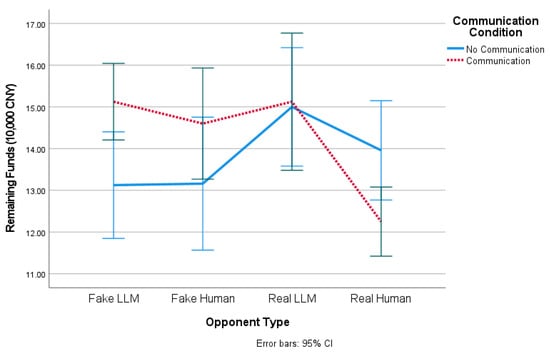
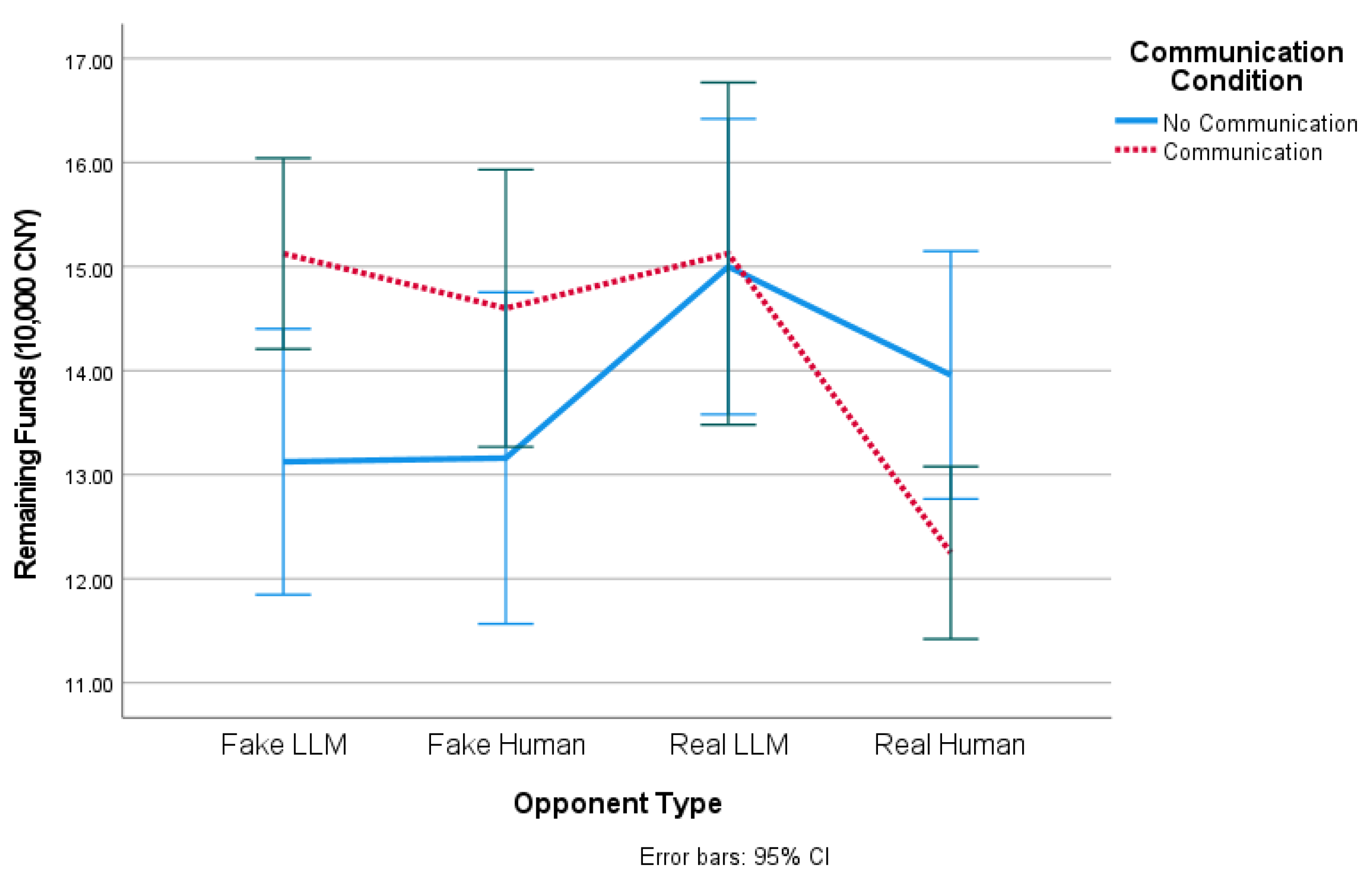
More importantly, the study revealed a significant interaction between opponent type and communication condition, F(3, 185) = 3.318, p = 0.021, and ηp2 = 0.052 (see Figure 1). This indicates that the impact of communication availability on human participants’ final funds varies depending on the type of opponent encountered during the game. Although the overall model explained a modest proportion of variance (R2 = 0.101, adjusted R2 = 0.067), this level of explanatory power is consistent with expectations for behavioral research in complex social interaction settings, where multiple unmeasured factors—including individual cognitive styles, momentary strategic adaptation, and opponent behavior variability—inevitably contribute to outcome variance. The partial eta squared values for the primary effects (opponent type: ηp2 = 0.049; interaction: ηp2 = 0.052) fall within the small-to-medium range according to conventional benchmarks [58], which is typical for between-subjects experimental designs in behavioral economics and human–computer interaction research. Importantly, the robustness of the key finding—the significant advantage of the Real LLM group over the Real Human group—across both the ANOVA and the SVO-controlled regression (B = 1.952, p = 0.003) provides confidence in the reliability of the observed effects despite the modest overall model fit.
Figure 1.
Interaction between Opponent Type and Communication Condition.
4.2. Simple Effects Analysis of the Interaction
To further understand the interaction between game partner type and communication condition, we conducted simple effects analyses. These analyses proceeded in two directions: first, examining whether the communication condition produced a significant effect under each game partner type; second, examining whether the game partner type produced a significant effect under each communication condition.
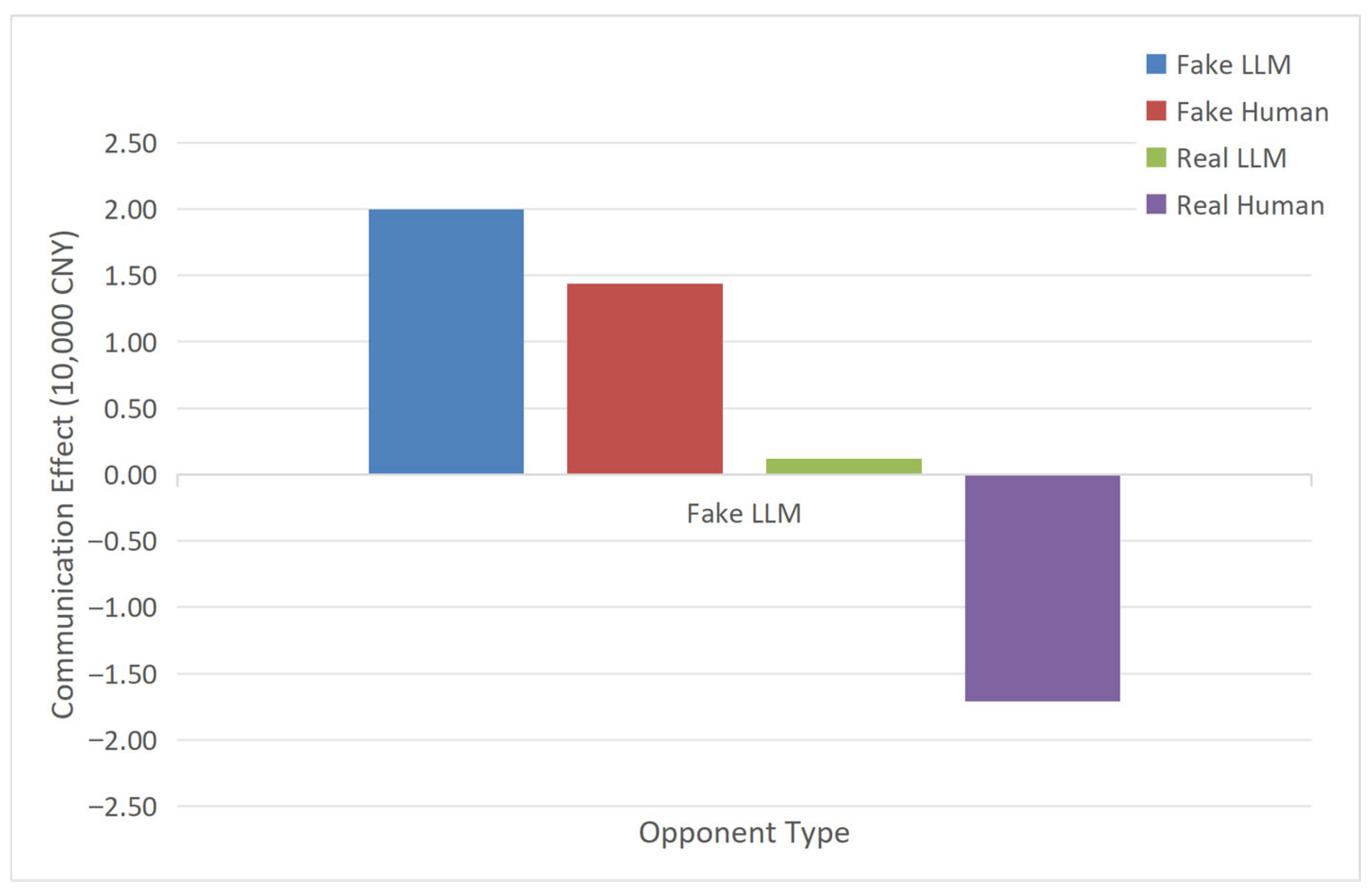
The simple effects analysis revealed that the influence of communication conditions varied depending on the type of game partner. In the Fake LLM group, the remaining funds under the communication condition (M = 15.12, SE = 0.44) were significantly higher than under the no-communication condition (M = 13.12, SE = 0.62), with a mean difference of 2.00, t(46) = 2.630, p = 0.012, 95% CI [0.48, 3.52]. This indicates that when participants were informed their opponent was an AI but were actually matched with a human, the communication phase significantly improved their economic outcomes. In the Fake Human group, the remaining funds under the communication condition (M = 14.60, SE = 0.65) were numerically higher than those under the no-communication condition (M = 13.16, SE = 0.77), with a mean difference of 1.44. However, this difference did not reach statistical significance: t(48) = 1.431, p = 0.159. In the real large model group, the communication condition had almost no effect on remaining funds. The difference between the communication group (M = 15.12, SE = 0.79) and the non-communication group (M = 15.00, SE = 0.69) was negligible, t(46) = 0.119, p = 0.906.
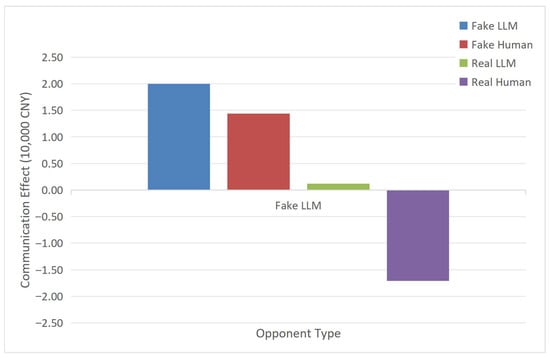
Notably, in the human-player group, the communication condition produced a reverse effect. The remaining funds in the communication condition (M = 12.25, SE = 0.40) were significantly lower than those in the no-communication condition (M = 13.96, SE = 0.58), with a mean difference of −1.71, t(46) = −2.436, p = 0.019, 95% CI [−3.12, −0.30]. This finding indicates that when both players are real individuals, and communication is permitted, the communication phase actually led to a deterioration in participants’ economic outcomes. Overall, communication significantly improved participants’ economic outcomes when facing “fake” opponents but produced an opposite effect when facing real opponents. The communication effect for each opponent type group is illustrated in Figure 2.
Figure 2.
Simple Effects of Communication Condition on Remaining Funds.
From another perspective, in the non-communication group, the type of opponent had no significant effect on the remaining funds: F(3, 93) = 1.727, p = 0.167, and ηp2 = 0.053. This indicates that in the absence of communication, participants’ response patterns toward different opponent types tended to converge. In contrast, within the communication group, the influence of opponent type was significant: F(3, 93) = 5.288, p = 0.002, and ηp2 = 0.146. Specifically, the real human group had the lowest remaining funds (M = 12.25, SE = 0.40) across all groups, significantly lower than the fake large model group (M = 15.12, SE = 0.44), the fake human group (M = 14.60, SE = 0.65), and the real large model group (M = 15.12, SE = 0.79). This pattern reveals the core mechanism of the interaction: the communication phase amplified the differences between the real human opponent and other types of opponents, making the real human group the worst-performing group under communication conditions.
4.3. Testing the Moderating Role of Social Value Orientation (SVO)
To examine whether social value orientation (SVO) moderates the effect of opponent type and communication condition on remaining funds, this study constructed a hierarchical regression model. First, following Murphy et al. (2011) [8] criteria, participants with an SVO angle greater than 22.45° were classified as prosocial (n = 97), while those < 22.45° were categorized as pro-self (n = 97). Univariate ANOVA revealed no significant difference in remaining funds between groups, F(1, 192) = 0.342, p = 0.559, indicating no main effect of SVO type on remaining funds.
Regarding the moderation of SVO on the communication condition effect, a first-level model was constructed with communication condition (virtual coding: 0 = no communication, 1 = communication) and SVO centralization (centralized M = 0, SD = 11.23) as predictors, yielding an explanatory power of R2 = 0.006, p = 0.557. After adding the SVO × communication condition interaction term in the second layer, the model’s explanatory power did not increase significantly: ΔR2 = 0.002, F(1, 190) = 0.384, and p = 0.536. The interaction term coefficient was non-significant: B = 0.018, SE = 0.029, t = 0.620, p = 0.536, 95% CI [−0.039, 0.075], indicating that SVO did not moderate the effect of communication conditions.
Regarding the SVO’s moderation of the game partner type effect, with game partner type dummy variables (D1 = fake large model, D2 = fake human, D3 = real large model, reference group = real human) and SVO centralization as first-level predictors, the model explained R2 = 0.049, F(4, 189) = 2.384, and p = 0.047. After adding three SVO × game partner type interaction terms in the second layer, the model’s explanatory power increased but did not reach significance: ΔR2 = 0.025, F(3, 186) = 1.669, p = 0.170. All three interaction terms were insignificant: Real Large Model × SVO (B = −0.017, SE = 0.048, t = −0.354, and p = 0.723).
Notably, after controlling for SVO and its interaction terms, the main effect of the True Large Model condition relative to the Real Person reference group remained significant: B = 1.952, SE = 0.651, t = 3.000, and p = 0.003, 95% CI [0.668, 3.236], indicating that the influence of game opponent type on rational decision-making is independent of individuals’ social value orientation, and this effect is robust. Based on the above results, the moderating effect of social value orientation on both game opponent type and communication condition effects is not established. A brief discussion follows.
5. Discussion
This study employed an enhanced reverse Prisoner’s Dilemma paradigm to examine how the type of game counterpart (real person, fake person, real large model, fake large model) and communication conditions (with/without communication) influence human rational decision-making. Results revealed a significant main effect of game counterpart type on participants’ final remaining funds, with a significant interaction involving communication conditions.
5.1. Identity Framing Effect and Rational Decision-Making
The significant main effect of opponent type on participants’ final remaining funds (F(3, 185) = 3.179, p = 0.025) indicates systematic differences in decision-making levels when facing opponents of different identities. Specifically, multiple comparisons revealed that the residual funds in the real large model group were significantly higher than those in the real person group (mean difference = 1.96, p = 0.017, 95% CI [0.24, 3.68]). This finding suggests that when participants explicitly knew their opponent was an AI large model and it actually was an AI, they more frequently chose the rationally dominant strategy of “Confess,” thereby securing higher residual funds. This finding supports the human preference effect revealed by Ishowo-Oloko et al. (2019), wherein participants exhibit significantly lower cooperative tendencies and socio-emotional engagement when aware that their opponent is a machine compared to human opponents [19]. This study extends that finding: in the reverse Prisoner’s Dilemma, participants in the genuine large model group, explicitly aware that their opponent was AI, experienced reduced socio-emotional interference. Their decision-making focused more intently on payoff structures, leading to more frequent selection of the rationally dominant strategy “confess.” This ultimately resulted in significantly higher residual funds. This contrasts with the findings from algorithmic aversion research, which show that when incentive structures are sufficiently clear, reduced social considerations when facing AI translate into decision advantages rather than hindrances [56,59].
According to Waytz et al. (2010) [60], research on Theory of Mind, humans adjust their mentalization levels during social cognition based on the perceived attributes of interaction partners.
When perceiving opponents as human, participants tend to allocate more cognitive resources to inferring others’ intentions and strategies, leading to greater interference from socio-emotional factors in decision-making. Conversely, when identifying opponents as AI or encountering ambiguous identities, participants focus more on the payoff structure itself, tending toward more rational calculations and decisions.
5.2. Interaction Effect Explanation: Communication and Identity Consistency
This study found a significant interaction between game opponent type and communication condition (F(3, 185) = 3.318, p = 0.021), indicating that communication effectiveness is linked to the type of game opponent. Simple effects analysis revealed that in the fake large model group, the remaining funds under communication conditions were significantly higher than under non-communication conditions. A similar trend emerged in the fake human group. However, in the real human and real large model groups, communication conditions had no significant impact on the outcomes.
This interaction effect can be explained through the lens of Predictive Coding Theory. Kahl and Kopp (2018) [61] note that in social interactions, individuals continuously update internal models of their interaction partner’s behavioral patterns to minimize prediction errors. When the identity information of the game counterpart (e.g., labeled as “large language model” or “human”) does not fully align with its behavioral logic, individuals face uncertainty in interpreting that identity. In such contexts, communication provides additional behavioral cues or social signals, helping participants to more accurately model opponents’ intentions. This enables more effective prediction of their actions, adjustment of personal strategies, and reduction in social cognitive ambiguity.
Particularly in the Fake Human group (where the game partner was named “human” but was actually a large language model), the remaining funds in the communication condition (M = 14.60, SE = 0.65) were greater than in the non-communication condition (M = 13.16, SE = 0.77) (mean difference = 1.44), though this difference did not reach statistical significance, t(48) = 1.431, p = 0.159. This numerical trend suggests that when AI mimics human communication, its patterned language and response characteristics may help participants more accurately identify and exploit the opponent’s “algorithmic nature,” thereby enhancing the tendency toward rational decision-making. This finding aligns with Madhavan and Wiegmann (2007) [62] on human–computer interaction, indicating that when subjects perceive inconsistencies or subtle variations in an interactive partner’s response patterns, they shift from heuristic to more analytical decision-making processes. When subjects detect the formulaic characteristics of AI mimicking human communication, they may reassess the opponent’s nature, thereby adjusting strategies to focus more on the payoff structure itself.
Further supporting this interpretation is Hancock et al. (2007) [63] research on linguistic indicators of deception in text-based computer-mediated communication. They found that individuals can keenly detect subtle differences in online textual exchanges. When AI exhibits certain patterned linguistic features during communication, participants may reassess the nature of their opponent, leading to a greater tendency toward rationally optimal decision strategies.
Similarly, in the fake large model group (labeled as large language models but operated by humans), participants in the communication condition (M = 15.12, SE = 0.44) retained significantly more funds than those in the non-communication condition (M = 13.12, SE = 0.62) (mean difference = 2.00, t(46) = 2.630, p = 0.012, 95% CI [0.48, 3.52]). Castelo et al. (2019) [64] found that individuals tend to exhibit stronger rational calculation tendencies and fewer social considerations when facing decision-makers labeled as “algorithms,” particularly in tasks involving subjective judgments. However, when these “algorithms” display human-like characteristics (such as communication behaviors), individuals reassess their social nature, thereby altering their willingness to cooperate.
In contrast, communication failed to significantly influence residual fund levels in both the human-agent and large-model-agent groups. This may stem from the high alignment between the agents’ surface identities and actual behaviors in these scenarios, where communication provided limited incremental information, thus failing to substantially alter participants’ decision strategies. This aligns with the findings of Valley et al. (2002) [65], showing that in highly transparent interactions, communication primarily serves a confirmatory rather than exploratory function.
5.3. Social Value Orientation
Regarding moderation effects, this study hypothesized that social value orientation (SVO) would moderate the influence of game partner type on rational decision-making. However, stratified regression results failed to support this hypothesis (ΔR2 = 0.025, p = 0.170). This outcome may stem from several factors: First, the reverse Prisoner’s Dilemma paradigm employed in this study structurally reinforced rational choice by adjusting the payoff matrix to make “confession” a strictly dominant strategy. Within this framework, the scope for social preferences to influence decisions was relatively constrained, thereby weakening the predictive power of SVO. Second, March [59]’s systematic review found that human decision-making becomes more rational when interacting with computers or AI, with significantly reduced interference from socio-emotional factors. This pattern was similarly observed in this study: when the game opponent involved AI, participants’ decision processes were potentially driven more by identity perception and rational calculation rather than individual social value preferences, thereby reducing SVO’s predictive power over behavior. Furthermore, although neither moderation path (SVO × communication condition, SVO × game partner type) reached significance, the residual funding advantage in the True Large Model group remained robust after controlling for SVO (B = 1.952, p = 0.003). This further demonstrates that the influence of game partner type on rational decision-making is a stable effect independent of individual social value orientations, ruling out the possibility of SVO acting as a confounding variable.
6. Conclusions
The primary theoretical contributions of this study are as follows:
First, through a reverse Prisoner’s Dilemma design, this study challenges the universal assumption in traditional game theory that “communication promotes cooperation.” Results indicate that in scenarios where rational choices and collective interests are significantly divergent, communication primarily reduces uncertainty to optimize individual rational decisions rather than fostering cooperative behavior. This supports the exploration of strategic information utilization, suggesting that in explicit conflict situations, communication may reinforce rather than mitigate rational self-interested behavior [66]. Second, this study extends the application of the Theory of Mind to human–computer interaction. Findings reveal significant differences in participants’ mentalization levels toward different types of game opponents, reflecting Gray’s two-dimensional model of mind perception. This model posits that participants adjust their decision strategies based on perceived levels of experience and agency in opponents [67]. That is, when encountering opponents with lower mental levels, more rational coping strategies are adopted. Furthermore, this study uncovered unique communication effects in identity-incongruent scenarios (fake large models), enriching the Hybrid Attribution Model [55,68] that explains how humans simultaneously apply mechanical and psychological attributions. Results indicate that when an opponent’s surface identity conflicts with their actual behavioral patterns, humans rely more heavily on behavioral cues within communication to adjust their attribution frameworks and strategy choices.
Practical implications of this study are as follows:
In high-conflict game scenarios, people tend to adopt more rational strategies toward AI, implying that AI systems must be designed to account for potential strategic exploitation by humans. Particularly in high-stakes contexts like financial transactions and resource allocation, AI systems may require more sophisticated strategies to balance efficiency and fairness. Second, consistency between identity labels and actual behavior significantly impacts human–AI interaction. When designing AI systems, their demonstrated capabilities should align with their claimed identities to prevent trust collapse caused by mismatches between expectations and performance [63,69].
Limitations of this study include:
First, the moderating effect of SVO did not reach statistical significance, potentially due to the forced rationality design of the reverse Prisoner’s Dilemma. Future research may validate SVO’s moderating role under different payoff structures. Second, the three-round game design effectively captured the core influences of subject type and communication conditions on decision-making. However, the forced rationality structure of the reverse Prisoner’s Dilemma may have constrained the space for strategy evolution, making it difficult to fully reveal the dynamic processes of long-term trust building and punishment for betrayal within this framework. Future studies could retain the core manipulation of this study while appropriately increasing the number of game rounds to explore the dynamic trajectories of strategy development and the long-term stability of communication effects. Future research could manipulate the degree of linguistic anthropomorphism in GLM4 or other large language models to explore how different levels of anthropomorphism in AI influence human decision-making. It could also examine the differential effects of specific communication content (e.g., promises, threats) on decisions, and extend to multi-player game scenarios to investigate how group dynamics affect human–machine game behavior.
Supplementary Materials
The following supporting information can be downloaded at https://www.mdpi.com/article/10.3390/app16083633/s1, Table S1: Participant-level dataset including anonymized participant ID, experimental group assignment (opponent type and communication condition), final remaining funds, demographic variables (gender, age, education level, birthplace), and Social Value Orientation (SVO) scores.
Author Contributions
Conceptualization, Y.W. and B.W.; methodology, Y.W. and B.W.; software, W.Z.; formal analysis, Y.W.; investigation, Y.W. and R.L.; data curation, Y.W.; writing—original draft preparation, Y.W.; writing—review and editing, B.W. and D.Z.; visualization, Y.W.; supervision, B.W. All authors have read and agreed to the published version of the manuscript.
Funding
This research received no external funding. The APC was funded by Tianjin University.
Institutional Review Board Statement
The study was conducted in accordance with the Declaration of Helsinki and approved by the Ethics Committee of Tianjin University (protocol code TJUE2026-H-S-036).
Informed Consent Statement
Informed consent was obtained from all subjects involved in the study.
Data Availability Statement
The raw data supporting the conclusions of this article will be made available by the authors on request.
Acknowledgments
During the conduct of this study, the authors used GLM-4 (ChatGLM, GLM-4-Plus, Zhipu AI, 2024) for the purposes of serving as an AI opponent in the Prisoner’s Dilemma experiment. The authors take full responsibility for the content of this publication.
Conflicts of Interest
Author Dongming Zhao was employed by the company China Mobile Communications Group. The remaining authors declare that the research was conducted in the absence of any commercial or financial relationships that could be construed as a potential conflict of interest.
Abbreviations
The following abbreviations are used in this manuscript:
| LLM | Large Language Model |
| SVO | Social Value Orientation |
| WoZ | Wizard of Oz |
| HCI | Human–Computer Interaction |
| GLM | General Linear Model |
Appendix A
Appendix A.1. Self-Introduction Script for AI Opponent Conditions
In the Real LLM and Fake LLM conditions, the AI opponent delivered the following fixed self-introduction prior to the game:
“I am an AI assistant, ChatGLM (Zhipu Qingyan), developed based on the language model trained by Zhipu AI in 2023. My task is to provide appropriate responses and support to users’ questions and requests. In this experiment, I am your game opponent.”
Appendix A.2. Complete ANOVA Results
Table A1.
Complete ANOVA Results for Remaining Funds.
Appendix A.3. Prompt Structure for GLM-4-Plus
The following prompt structure was used to instruct GLM-4-Plus throughout the experiment. Bracketed items indicate content that was filled in, dynamically based on participant responses.
Initial prompt: The game rules, payoff matrix, role assignment (Player B), and initial endowment (200,000 CNY) were provided. The model was instructed to make independent decisions each round with no prescribed strategy.
Round prompts: After each round, the participant’s choice was relayed to the model. In the communication condition, the model was additionally prompted to generate one sentence directed at the participant before the next round.
The full prompt text (in Chinese) is available from the corresponding author upon request.
References
- Zahedi, Z.; Kambhampati, S. Human-AI Symbiosis: A Survey of Current Approaches. arXiv 2021, arXiv:2103.09990. [Google Scholar] [CrossRef] [Scilit]
- Brown, T.B.; Mann, B.; Ryder, N.; Subbiah, M.; Kaplan, J.; Dhariwal, P.; Neelakantan, A.; Shyam, P.; Sastry, G.; Askell, A.; et al. Language models are few-shot learners. In Proceedings of the 34th International Conference on Neural Information Processing Systems, Vancouver, BC, Canada, 6–12 December 2020; p. 159. [Google Scholar]
- Anthropic. Introducing Claude. Available online: https://www.anthropic.com/news/introducing-claude (accessed on 22 May 2025).
- Achiam, O.J.; Adler, S.; Agarwal, S.; Ahmad, L.; Akkaya, I.; Aleman, F.L.; Almeida, D.; Altenschmidt, J.; Altman, S.; Anadkat, S.; et al. GPT-4 Technical Report. arXiv 2023, arXiv:2303.08774. [Google Scholar] [CrossRef] [Scilit]
- Rahwan, I.; Cebrian, M.; Obradovich, N.; Bongard, J.; Bonnefon, J.-F.; Breazeal, C.; Crandall, J.W.; Christakis, N.A.; Couzin, I.D.; Jackson, M.O.; et al. Machine behaviour. Nature 2019, 568, 477–486. [Google Scholar] [CrossRef] [Scilit] [PubMed]
- Camerer, C.F. Behavioral Game Theory: Experiments in Strategic Interaction; Princeton University Press: Princeton, NJ, USA, 2003. [Google Scholar]
- de Melo, C.M.; Marsella, S.; Gratch, J. Human Cooperation When Acting Through Autonomous Machines. Proc. Natl. Acad. Sci. USA 2019, 116, 3482–3487. [Google Scholar] [CrossRef] [Scilit]
- Murphy, R.; Ackermann, K.; Handgraaf, M. Measuring Social Value Orientation. Judgm. Decis. Mak. 2011, 6, 771–781. [Google Scholar] [CrossRef] [Scilit]
- Tucker, A.W. A Two-Person Dilemma. In Readings in Games and Information; Rasmusen, E., Ed.; Blackwell Publishers: Oxford, UK, 2001; pp. 7–8. [Google Scholar]
- Rapoport, A.; Chammah, A.M. Prisoner’s Dilemma: A Study in Conflict and Cooperation; University of Michigan Press: Ann Arbor, MI, USA, 1965. [Google Scholar]
- Nash, J.F. Equilibrium points in n-person games. Proc. Natl. Acad. Sci. USA 1950, 36, 48–49. [Google Scholar] [CrossRef] [Scilit]
- Nash, J. Non-Cooperative Games. Ann. Math. 1951, 54, 286–295. [Google Scholar] [CrossRef] [Scilit]
- Fudenberg, D.; Tirole, J. Game Theory; MIT Press: Cambridge, CA, USA, 1992; Volume 60. [Google Scholar]
- Gibbons, R. Game Theory for Applied Economists; Princeton University Press: Princeton, NJ, USA, 1992. [Google Scholar]
- Axelrod, R. The Evolution of Cooperation; Basic Books: New York, NY, USA, 1984. [Google Scholar]
- Axelrod, R.; Hamilton, W.D. The Evolution of Cooperation. Science 1981, 211, 1390–1396. [Google Scholar] [CrossRef] [Scilit]
- Fudenberg, D.; Maskin, E. The Folk Theorem in Repeated Games with Discounting or with Incomplete Information. Econometrica 1986, 54, 533–554. [Google Scholar] [CrossRef] [Scilit]
- Dal Bó, P.; Fréchette, G.R. Strategy Choice in the Infinitely Repeated Prisoner’s Dilemma. Am. Econ. Rev. 2019, 109, 3929–3952. [Google Scholar] [CrossRef] [Scilit]
- Ishowo-Oloko, F.; Bonnefon, J.-F.; Soroye, Z.; Crandall, J.; Rahwan, I.; Rahwan, T. Behavioural evidence for a transparency–efficiency tradeoff in human–machine cooperation. Nat. Mach. Intell. 2019, 1, 517–521. [Google Scholar] [CrossRef] [Scilit]
- Becker, D.; Rueda, D.; Beese, F.; Torres, B.S.G.; Lafdili, M.; Ahrens, K.; Fu, D.; Strahl, E.; Weber, T.; Wermter, S. The Emotional Dilemma: Influence of a Human-like Robot on Trust and Cooperation. In Proceedings of the 2023 32nd IEEE International Conference on Robot and Human Interactive Communication (RO-MAN), Busan, Republic of Korea, 28–31 August 2023; pp. 1689–1696. [Google Scholar]
- Hsieh, T.-Y.; Cross, E.S. People’s dispositional cooperative tendencies towards robots are unaffected by robots’ negative emotional displays in prisoner’s dilemma games. Cogn. Emot. 2022, 36, 995–1019. [Google Scholar] [CrossRef] [Scilit] [PubMed]
- Maggioni, M.A.; Rossignoli, D. If it looks like a human and speaks like a human … Communication and cooperation in strategic Human–Robot interactions. J. Behav. Exp. Econ. 2023, 104, 102011. [Google Scholar] [CrossRef] [Scilit]
- Dütting, P.; Mirrokni, V.; Leme, R.P.; Xu, H.; Zuo, S. Mechanism Design for Large Language Models. In Proceedings of the ACM Web Conference 2024, Singapore, 13–17 May 2024; pp. 144–155. [Google Scholar]
- Taitler, B.; Ben-Porat, O. Braess’s Paradox of Generative AI. arXiv 2024, arXiv:2409.05506. [Google Scholar] [CrossRef] [Scilit]
- Jiang, G.X.; Yang, S.R.; Wang, Y.Y.; Hui, P. When trust collides: Exploring human-LLM cooperation intention through the prisoner’s dilemma. Int. J. Hum.-Comput. Stud. 2026, 209, 103740. [Google Scholar] [CrossRef] [Scilit]
- Lorè, N.; Heydari, B. Strategic behavior of large language models and the role of game structure versus contextual framing. Sci. Rep. 2024, 14, 18490. [Google Scholar] [CrossRef] [Scilit]
- Han, J.; Battu, B.; Romic, I.; Rahwan, T.; Holme, P. Static network structure cannot stabilize cooperation among large language model agents. PLoS ONE 2025, 20, e0320094. [Google Scholar] [CrossRef] [Scilit]
- Hohenstein, J.; Jung, M. AI as a moral crumple zone: The effects of AI-mediated communication on attribution and trust. Comput. Hum. Behav. 2020, 106, 106190. [Google Scholar] [CrossRef] [Scilit]
- Skjuve, M.; Følstad, A.; Fostervold, K.I.; Brandtzaeg, P.B. My Chatbot Companion—A Study of Human-Chatbot Relationships. Int. J. Hum. -Comput. Stud. 2021, 149, 102601. [Google Scholar] [CrossRef] [Scilit]
- Sekeres, G. The Effects of Communication on a Middle Equilibrium in Prisoner’s Dilemma. Doctoral Dissertation, Haverford College, Haverford, PA, USA, 2022. [Google Scholar]
- Kugler, T.; Kausel, E.E.; Kocher, M.G. Are groups more rational than individuals? A review of interactive decision making in groups. Wiley Interdiscip. Rev. Cogn. Sci. 2012, 3, 471–482. [Google Scholar] [CrossRef] [Scilit]
- Kagel, J.H. Cooperation through communication: Teams and individuals in finitely repeated Prisoners’ dilemma games. J. Econ. Behav. Organ. 2018, 146, 55–64. [Google Scholar] [CrossRef] [Scilit]
- Zörner, S.; Arts, E.; Vasiljevic, B.; Srivastava, A.; Schmalzl, F.; Mir, G.; Bhatia, K.; Strahl, E.; Peters, A.; Alpay, T.; et al. An Immersive Investment Game to Study Human-Robot Trust. Front. Robot. AI 2021, 8, 644529. [Google Scholar] [CrossRef] [Scilit] [PubMed]
- Chen, J.; Yuan, S.; Ye, R.; Majumder, B.P.; Richardson, K. Put Your Money Where Your Mouth Is: Evaluating Strategic Planning and Execution of LLM Agents in an Auction Arena. arXiv 2023, arXiv:2310.05746. [Google Scholar]
- Gandhi, K.; Sadigh, D.; Goodman, N. Strategic Reasoning with Language Models. arXiv 2023, arXiv:2305.19165. [Google Scholar] [CrossRef] [Scilit]
- Mozikov, M.; Orekhov, D.; Nasonov, I.; Baltsat, K.; Pedashenko, V.; Abramov, D.; Severin, N.; Maximov, Y.; Savchenko, A.; Makarov, I.; et al. HL-EAI: A Multimodal Framework Enabling Emotional Reciprocity in Human-AI Strategic Decision-Making. In Proceedings of the 2025 Conference on Multimedia-MM, Dublin, Ireland, 27–31 October 2025; pp. 13501–13503. [Google Scholar]
- Van Lange, P.A.M. Beyond Self-interest: A Set of Propositions Relevant to Interpersonal Orientations. Eur. Rev. Soc. Psychol. 2000, 11, 297–331. [Google Scholar] [CrossRef] [Scilit]
- Murphy, R.O.; Ackermann, K.A. Social value orientation: Theoretical and measurement issues in the study of social preferences. Personal. Soc. Psychol. Rev. 2014, 18, 13–41. [Google Scholar] [CrossRef] [Scilit]
- Bogaert, S.; Boone, C.; Declerck, C. Social value orientation and cooperation in social dilemmas: A review and conceptual model. Br. J. Soc. Psychol. 2008, 47, 453–480. [Google Scholar] [CrossRef] [Scilit]
- Xia, Y.; Zhu, Y.; Liu, Y.; Li, Z.; Zong, J.; Li, Y. The Influence and Mechanism of Social Value Orientation on Cooperative Behavior in Gift Exchange Game. In Proceedings of the 2023 35th Chinese Control and Decision Conference (CCDC), Yichang, China, 20–22 May 2023; pp. 3168–3174. [Google Scholar]
- Balliet, D.; Parks, C.; Joireman, J. Social Value Orientation and Cooperation in Social Dilemmas: A Meta-Analysis. Group Process. Intergroup Relat. 2009, 12, 533–547. [Google Scholar] [CrossRef] [Scilit]
- Murphy, R.O.; Ackermann, K.A. Social preferences, positive expectations, and trust based cooperation. J. Math. Psychol. 2015, 67, 45–50. [Google Scholar] [CrossRef] [Scilit]
- Zhang, Y.; Yu, Z.; Mai, X. The influence and mechanism of social value orientation on self-other risk decision making. Acta Psychol. Sin. 2020, 52, 895–908. (In Chinese) [Google Scholar] [CrossRef] [Scilit]
- Kelley, J.F. An iterative design methodology for user-friendly natural language office information applications. ACM Trans. Inf. Syst. 1984, 2, 26–41. [Google Scholar] [CrossRef] [Scilit]
- Dahlbäck, N.; Jönsson, A.; Ahrenberg, L. Wizard of Oz studies: Why and how. In Proceedings of the 1st international conference on Intelligent user interfaces, Orlando, FL, USA, 4–7 January 1993; pp. 193–200. [Google Scholar]
- Bernsen, N.O.; Dybkjær, H.; Dybkjær, L. Designing Interactive Speech Systems: From First Ideas to User Testing; Springer: Berlin, Germany, 1994. [Google Scholar]
- Steinfeld, A.; Fong, T.; Kaber, D.; Lewis, M.; Scholtz, J.; Schultz, A.; Goodrich, M. Common metrics for human-robot interaction. In Proceedings of the 1st ACM SIGCHI/SIGART conference on Human-robot interaction, Salt Lake City, UT, USA, 2–3 March 2006; pp. 33–40. [Google Scholar]
- Nass, C.; Steuer, J.; Tauber, E.R. Computers are social actors. In Proceedings of the SIGCHI Conference on Human Factors in Computing Systems, Boston, MA, USA, 24–28 April 1994; pp. 72–78. [Google Scholar]
- Reeves, B.; Nass, C. The Media Equation: How People Treat Computers, Television, and New Media Like Real People and Pla; Bibliovault OAI Repository; The University of Chicago Press: Chicago, IL, USA, 1996. [Google Scholar]
- Sandoval, E.B.; Mubin, O.; Obaid, M. Human Robot Interaction and Fiction: A Contradiction. In Proceedings of the Social Robotics, Sydney, NSW, Australia, 27–29 October 2014; pp. 54–63. [Google Scholar]
- Hancock, P.A.; Billings, D.R.; Schaefer, K.E.; Chen, J.Y.; de Visser, E.J.; Parasuraman, R. A meta-analysis of factors affecting trust in human-robot interaction. Hum. Factors 2011, 53, 517–527. [Google Scholar] [CrossRef] [Scilit]
- Zhang, Z.; Zhang, F.; Yuan, S.; Guo, F.; Wang, Y. Psychometric analysis of the Chinese version of the SVO slider measure. Stud. Psychol. Behav. 2015, 13, 404–409. (In Chinese) [Google Scholar]
- Zeng, T.G.A.; Xu, B.; Wang, B.; Zhang, C.; Yin, D.; Rojas, D.; Feng, G.; Zhao, H.; Lai, H.; Yu, H.; et al. ChatGLM: A Family of Large Language Models from GLM-130B to GLM-4 All Tools. arXiv 2024, arXiv:2406.12793. [Google Scholar]
- Pan, D.W.; Chen, W.L.; Shi, J.; Wu, C.Y.; Wang, D.; Hong, C.S.; Han, Z. Bayesian Inference-Aided Large Language Model Agents in Infinitely Repeated Games: A Dynamic Network View. IEEE Trans. Netw. Sci. Eng. 2026, 13, 2004–2021. [Google Scholar] [CrossRef] [Scilit]
- Grujić, J.; Eke, B.; Cabrales, A.; Cuesta, J.A.; Sánchez, A. Three is a crowd in iterated prisoner’s dilemmas: Experimental evidence on reciprocal behavior. Sci. Rep. 2012, 2, 638. [Google Scholar] [CrossRef] [Scilit]
- Logg, J.M.; Minson, J.A.; Moore, D.A. Algorithm appreciation: People prefer algorithmic to human judgment. Organ. Behav. Hum. Decis. Process. 2019, 151, 90–103. [Google Scholar] [CrossRef] [Scilit]
- George, D.; Mallery, P. IBM SPSS Statistics 26 Step by Step: A Simple Guide and Reference, 16th ed.; Routledge: New York, NY, USA, 2019. [Google Scholar]
- Cohen, J. Statistical Power Analysis for the Behavioral Sciences, 2nd ed.; Lawrence Erlbaum Associates: Hillsdale, NJ, USA, 1988. [Google Scholar]
- March, C. The Behavioral Economics of Artificial Intelligence: Lessons from Experiments with Computer Players; Bamberg University: Bamberg, Germany, 2019. [Google Scholar]
- Waytz, A.; Gray, K.; Epley, N.; Wegner, D.M. Causes and consequences of mind perception. Trends Cogn. Sci. 2010, 14, 383–388. [Google Scholar] [CrossRef] [Scilit]
- Kahl, S.; Kopp, S. A Predictive Processing Model of Perception and Action for Self-Other Distinction. Front. Psychol. 2018, 9, 2421. [Google Scholar] [CrossRef] [Scilit]
- Madhavan, P.; Wiegmann, D.A. Similarities and differences between human-human and human-automation trust: An integrative review. Theor. Issues Ergon. Sci. 2007, 8, 277–301. [Google Scholar] [CrossRef] [Scilit]
- Hancock, J.; Curry, L.; Goorha, S.; Woodworth, M. On Lying and Being Lied To: A Linguistic Analysis of Deception in Computer-Mediated Communication. Discourse Process. 2008, 45, 1–23. [Google Scholar] [CrossRef] [Scilit]
- Castelo, N.; Bos, M.W.; Lehmann, D.R. Task-Dependent Algorithm Aversion. J. Mark. Res. 2019, 56, 809–825. [Google Scholar] [CrossRef] [Scilit]
- Valley, K.; Thompson, L.; Gibbons, R.; Bazerman, M.H. How Communication Improves Efficiency in Bargaining Games. Games Econ. Behav. 2002, 38, 127–155. [Google Scholar] [CrossRef] [Scilit]
- Galinsky, A.D.; Mussweiler, T. First offers as anchors: The role of perspective-taking and negotiator focus. J. Pers. Soc. Psychol. 2001, 81, 657–669. [Google Scholar] [CrossRef] [PubMed]
- Gray, H.M.; Gray, K.; Wegner, D.M. Dimensions of Mind Perception. Science 2007, 315, 619. [Google Scholar] [CrossRef] [Scilit]
- Marchesi, S.; Ghiglino, D.; Ciardo, F.; Perez-Osorio, J.; Baykara, E.; Wykowska, A. Do We Adopt the Intentional Stance Toward Humanoid Robots? Front. Psychol. 2019, 10, 450. [Google Scholar] [CrossRef] [Scilit]
- Epley, N.; Waytz, A.; Cacioppo, J.T. On seeing human: A three-factor theory of anthropomorphism. Psychol. Rev. 2007, 114, 864–886. [Google Scholar] [CrossRef] [Scilit]

Disclaimer/Publisher’s Note: The statements, opinions and data contained in all publications are solely those of the individual author(s) and contributor(s) and not of MDPI and/or the editor(s). MDPI and/or the editor(s) disclaim responsibility for any injury to people or property resulting from any ideas, methods, instructions or products referred to in the content. |
© 2026 by the authors. Licensee MDPI, Basel, Switzerland. This article is an open access article distributed under the terms and conditions of the Creative Commons Attribution (CC BY) license.