


Abstract
This study carries out the research on event-triggered output feedback control tailored for discrete-time switched linear systems. A dynamic event-triggered mechanism (DETM) is utilized to mitigate the triggering frequency. To ensure stability and control performance, it is assumed that an event is triggered whenever the system undergoes a switch. First, the closed-loop stability of the underlying switched system with DETM is analyzed via the switched Lyapunov function method, followed by the establishment of a stability criterion for the system under arbitrary switching. Based on this criterion, a dynamic event-triggered output feedback control strategy is devised. The viability and application potential of our proposed control strategy is validated through simulation trials using a morphing aircraft model. Furthermore, when we pit dynamic event-triggered control (DETC) against its static (SETC) version, the proposed DETM reduces the trigger events and prolongs the inter-event intervals versus the SETM, while retaining nearly identical control accuracy and energy consumption, thus providing an efficient solution for resource-constrained networked control systems.
1. Introduction
Switched systems, which integrate continuous and discrete dynamics, have emerged as a key research focus in control theory. Over the past few years, switched systems have captured mounting focus given their versatile applications in areas including power electronics [1], networked control systems [2], robotics control [3], air traffic control [4] and modern agricultural systems [5]. Early foundational works focused on average dwell-time constraints [6], multi-function stability analysis frameworks [7], and mode-dependent stability evaluation methods [8], offering a firm basis for conducting stability analysis and designing controllers.
Among the existing literature, most research has focused on periodic control for switched systems. Surveys addressing core topics in switched systems’ stability analysis and controller design can be found in [9,10]. Ref. [11] explores the stability assessment and control design of switched discrete-time systems through switched quadratic Lyapunov functions but omits event-triggered control (ETC), potentially squandering available bandwidth. To mitigate the inefficiencies of periodic sampling, ETC has emerged as an alternative paradigm for sampled-data control. Within ETC frameworks, control actions are only executed when predefined events are triggered. As a resource-efficient approach for distributed and networked systems, ETC strategies [12,13,14] have been extensively studied in recent years. Ref. [15] proposed a mode-dependent linearly weighted event-triggered mechanism (ETM) that leverages the positivity of the output. This ETM is integrated with multiple co-positive Lyapunov–Krasovskii functionals to realize asynchronous output feedback control. Ref. [16] extends this ETM-based concept to dynamic output feedback control and deduces synthesis conditions relying on linear matrix inequality (LMI), conditions that simultaneously determine controller gains and trigger parameters. Ref. [17] co-designs output feedback ETC and switching logic for switched linear systems, yielding a tight dwell-time bound. This bound guarantees Zeno-free global uniform asymptotic stability (GUAS) using only output measurements, providing a systematic framework for stability control and practical implementation of switched systems under the ETC paradigm. Although these studies have successfully demonstrated the advantages of ETC for switched systems, they rely on static or quasi-static ETMs, triggering conditions that fail to adapt to the real-time evolution of system states.
To overcome the limitations of static event-triggered mechanisms (SETM), DETC has recently gained prominence. DETC incorporates an internal dynamic variable, governed by an auxiliary differential equation, into the trigger condition, enabling online adjustment of the threshold. This dynamic approach enhances the flexibility and adaptability in real-time control systems. Ref. [18] explores a filter-mode-dependent and quasi-time-dependent Lyapunov function tailored for discrete-time switched Takagi–Sugeno fuzzy systems, providing an extensible Lyapunov framework alongside performance bounds that readily support the subsequent development of DETMs. Ref. [19] demonstrates that adaptive neural predictors can dynamically reshape event thresholds in networked environments, while [20] shows that fuzzy-model-based filters maintain robustness against hybrid cyber-attacks by embedding mode-dependent event triggers. Ref. [21] proposes a novel DETM by introducing an additional variable to the SETC, showing that the DETM reduces event-trigger counts compared to its SETM. This work has inspired further relevant research on DETMs, see for instance [22,23]. Specifically, ref. [22] develops a synchronization control strategy under a DETM for discrete-time delayed complex dynamic networks, establishing a novel discrete-time dynamic event-triggered framework. Ref. [24] designs a communication scheme with dynamic event triggering to schedule interactions between intelligent agents, through a configurable rule-based threshold. Ref. [25] proposes a dynamic event-triggered optimal control strategy for discrete-time nonlinear Markov jump systems via policy iteration-based adaptive dynamic programming, with actor–critic neural networks for approximation. Notably, the DETMs discussed in [24,25,26,27,28] not only increase the triggering flexibility but also yield improved control performance. In all these cases, dynamic triggers primarily aim at reducing the communication load or improving performance, but they are mostly studied for non-switched plants, specific network structures, or under state-feedback assumptions, rather than for discrete-time switched systems with static output feedback under arbitrary switching.
Parallel to this line, output feedback control has been recognized as an effective way to reduce sensing and implementation complexity while still exploiting the benefits of event-based transmission, granting the approach in [29] a distinct advantage over state feedback controllers [30]. In contrast, discretization is generally a prerequisite for the application of theorems designed for continuous-time systems [31]. Although [32] has recently focused on performance-based event-triggered control for discrete-time switched systems suffering from actuator saturation, its triggering rule remains unchanged. The full adaptive potential of dynamic event-triggered output feedback control remains largely untapped. Notably, ref. [33] was partially bridged by devising a reinforcement learning (RL)-based event-triggered optimal control (ETOC) scheme tailored for Itô-type stochastic strict-feedback systems, coupled with an identifier–critic–actor framework integrating dynamic event-triggered mechanisms (DETMs) and RL. Ref. [34] further extended this integration of DETMs, fuzzy control, and RL to nonlinear systems with state constraints. These contributions are valuable for practical switched systems, as they demonstrate how DETMs are customized to balance safety, optimality, and resource efficiency. Motivated by these advances, the present study proposes a novel control method to enhance both the control efficiency and closed-loop stability of discrete-time switched systems.
This study puts forward a dynamic event-triggered output feedback control approach tailored for discrete-time switched systems subject to arbitrary switching, verified via a switching Lyapunov function and an LMI-based GUAS condition. To enable adaptive threshold adjustment, the proposed DETM incorporates an internal dynamic variable that is governed by an auxiliary difference equation. This allows the DETM to adaptively tune the trigger threshold online, resulting in fewer data transmissions than its static counterpart. Simulations on a switched morphing aircraft model demonstrate this advantage quantitatively: the dynamic scheme maintains the same control performance while significantly reducing the trigger rate compared with static output feedback. In contrast to existing works on event-triggered control for switched systems and dynamic triggering mechanisms, the present paper is novel in three main aspects:
(i) We address discrete-time switched linear systems under completely arbitrary switching and design a static output feedback controller that only uses measured outputs, rather than full-state or observer-based dynamic feedback as in [16,17,31].
(ii) We propose a dynamic event-triggered mechanism whose internal variable is explicitly incorporated into a switched Lyapunov function. This yields a joint Lyapunov function that combines mode-dependent quadratic terms with the dynamic triggering variable and leads to LMI-based GUAS conditions for the closed-loop system under arbitrary switching. To our knowledge, no such discrete-time LMI-synthesizable DETM output-feedback framework has been reported for arbitrarily switched systems.
(iii) We further conduct a quantitative comparison between the proposed DETM and a conventional static ETM on a morphing aircraft model. The numerical results show that, under the same arbitrary switching sequence, the DETM reduces total trigger events and prolongs inter-event intervals, while ensuring GUAS and comparable tracking performance to the static trigger. This confirms that the proposed scheme achieves a favorable trade-off among stability, control precision and communication efficiency.
This work is structured as follows. Section 2 provides a brief description of the system and formulates the research problem. Section 3 is dedicated to the stability analysis of the closed-loop system, where the switching Lyapunov function method is employed to derive sufficient stability conditions, and the associated design of the output feedback control strategy is systematically addressed. Section 4 uses a practical example to verify the effectiveness and advantages of our proposed method. This example also demonstrates the practical potential of the proposed control technique. Finally, Section 5 summarizes the key conclusions of the study.
2. Preliminaries and Problem Formulation
The objective of this paper is to develop a control strategy that combines a static output feedback controller with a DETM for discrete-time linear switched systems. The proposed approach ensures that the control input is computed exclusively from measurable outputs, while the DETM facilitates the formulation of the control law. The timing of control variable updates is determined by dynamically adjusted event-triggered conditions, ultimately ensuring the closed-loop system achieves GUAS under all admissible switching sequences.
Consider the following switched linear system given by
where represents the state, and and are the controlled vector and output [8]. The switching signal is defined as follows: : , where N refers to the number of subsystems. , and are system matrices. For the sake of simplicity, , and are used to represent the state matrices of the subsystem. Let denote the sampling instants.
Whenever a subsystem switch occurs at time instant , an event is enforced at . That is, the output is sampled and transmitted at each switching instant, and the controller gain is synchronously updated such that . Under this assumption, switching instants form a subset of the event-triggering instants, which ensures that the controller mode and the plant mode remain synchronized. The assumption is purely structural and does not affect the Lyapunov-based stability analysis.
Considering that the control synthesis is related to the design of the switched output feedback controller, the controller is designed as
where is the feedback gain with appropriate dimension [35]. For , the triggering condition is evaluated over a time interval. We make the assumption that and , which denotes synchronous switching over the full operating interval of subsystems and subsystem .
The DETM is used to determine whether the current output sample needs to be transmitted to the controller and gather the relevant time sequence of triggering moments satisfying . At the heart of signal transmission systems lies the critical challenge of establishing when triggers should fire. By leveraging the DETM approach, we can pinpoint precise sampling instances that map directly to their corresponding execution moments. Therefore, the next trigger time is calculated according to the following conditions
where is a random constant, and is a given constant. and are weighting constants to be designed. denotes the set of switching instants. is the error variable from the last trigger to the current moment. The dynamic variable is chosen by
in which is a designed constant, and for . The proposed DETM can be viewed as a dynamic adjustment of the triggering threshold. The internal variable aggregates the recent output energy and the error term, with exponential forgetting governed by . When the output error stays small, the recursion (4) grows, which relaxes condition (3) and lengthens the inter-event times; when the error increases, the negative contribution of reduces, the inequality (3) is violated earlier, and a new event is triggered.
Remark 1.
The triggering parameters θ, ζ, ω, λ and ϵ each serve distinct roles in system dynamics. θ balances and the output error to adjust trigger conservatism. ζ weights output energy and to influence triggering frequency. ω scales , with smaller values tightening and larger values (closer to 1) relaxing the trigger condition. governs the evolution rate of in its recursive update. acts as a weighting factor for the term , which quantifies the magnitude of the error signal . A larger ϵ amplifies the suppression effect of the error term on the update of , while a smaller ϵ weakens this effect. When is identically zero, the DETM reduces to a SETM. In this paper, the parameters are chosen to satisfy additional inequalities derived in the stability analysis, ensuring both well-posedness of and the desired decay properties.
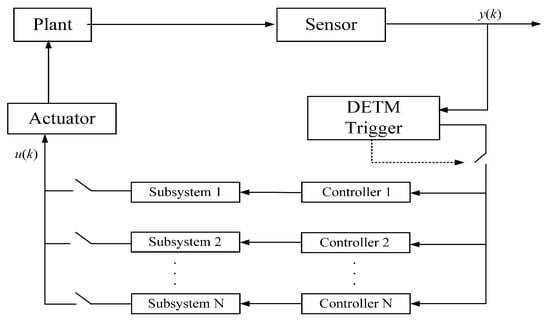
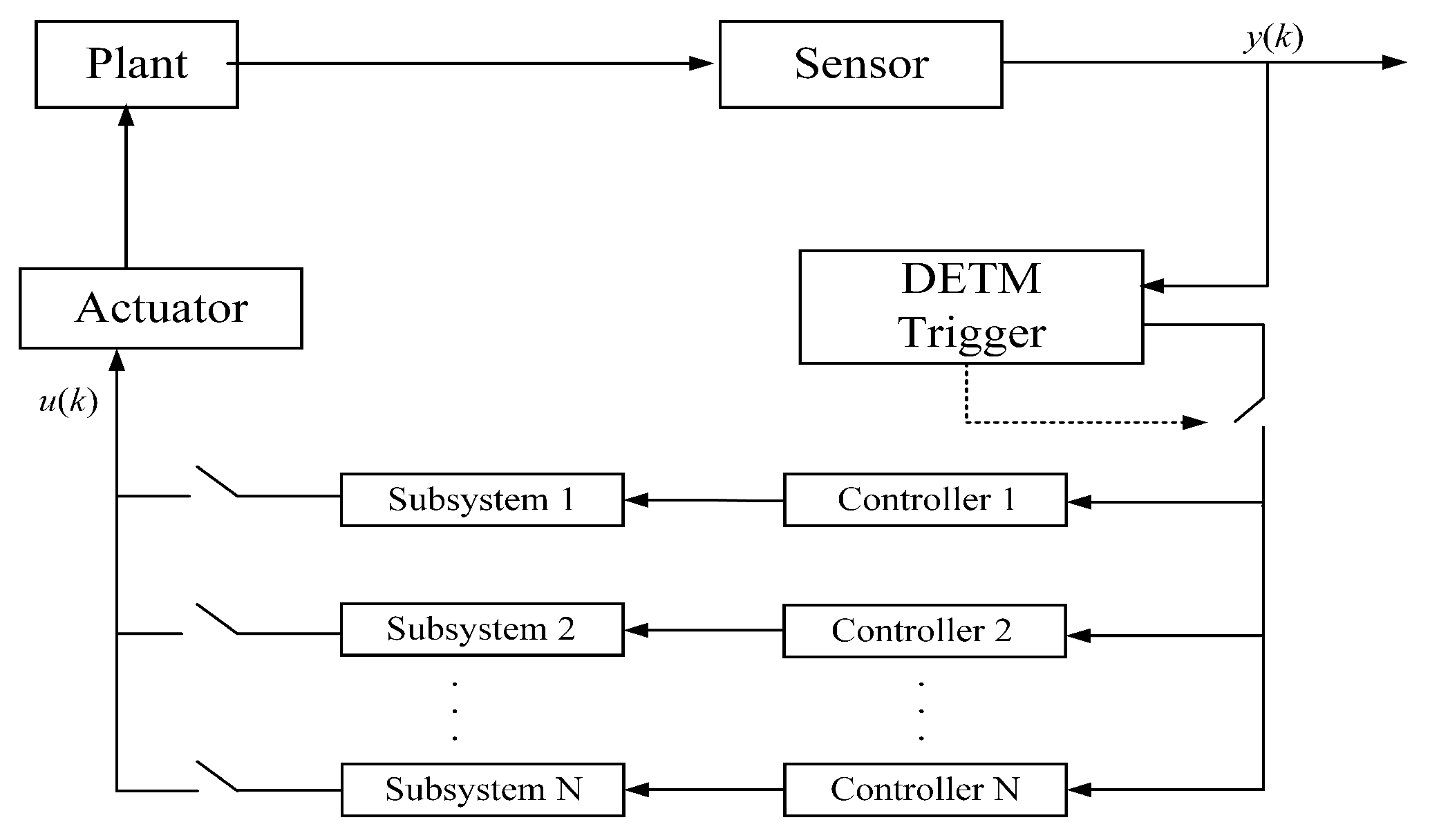
To facilitate implementation, the complete flow chart of the proposed DETM-based output feedback strategy is shown in Figure 1.
Figure 1.
Control architecture of the DETM for switched systems.
Guaranteeing that closed-loop switched systems maintain stable operation: system (1) may be transformed into
where . Prior to presenting the primary results, we first recall the definitions and lemmas below, which hold significant importance in the proof of the core findings. Throughout the theoretical analysis, the matrices , , and are assumed to be precisely known, and the switched system (1) does not contain explicit parametric uncertainties or exogenous disturbances. This standard assumption in Lyapunov-based stability analysis facilitates the clear presentation of the proposed DETM design. The effects of uncertainties is investigated in the simulation via injection of external disturbance.
Definition 1
([36]). The linear system
is GUAS if there is a function such that
- (1) V is a positive-definite function, decreasing along the trajectories and radially unbounded.
- (2) is negative definite along the solutions of (6). The Lyapunov function is thus positive definite, decreasing along the trajectories, and radially unbounded if , andfor all and with and positive scalars.
- Notations
Standard notations are used throughout this paper. stands for the set of nonnegative integers. is the transpose of the matrix X. () indicates that X is positive definite (negative definite).
In the following, the synthesis problem of the switched output feedback controller will be studied based on the above concepts.
3. Main Results
3.1. Stability Analysis
In this part, we determine how to evaluate the origin stability of the system described by Equation (1) that can be switched by itself. Moreover, for the convenience of controller synthesis, the stability criteria are expressed as LMIs.
For dynamic event-triggered output feedback, a sufficient condition for GUAS is derived using the switched Lyapunov function method. Furthermore, an augmented Lyapunov function incorporating the dynamic triggering variable is constructed to prove GUAS. This construction also converts stability requirements into easily solvable inequalities.
Theorem 1.
Consider the switched system (1). If there exist scalars , and and a set of matrices , such that , the following inequalities are satisfied
where , and , then the system (5) with DETM defined in (3) and (4) is GUAS under arbitrary switching. These conditions yield a sufficient Lyapunov-based stability criterion. Moreover, the number of such inequalities increases quadratically as the number of subsystems N grows.
Proof of Theorem 1.
Define the Lyapunov function W as follows
then, it could be obtained that
Suppose that the switching signal satisfies and for all . Define the function
then, it follows that
which yields
From (4), it could be derived that
According to the DETM (3), this leads to the conclusion that
Multiplying both sides of the inequality by , it arrives at
Under the parameter constraint (9), we have
which further implies
It is obvious that holds for all , and (11) simplifies to (9).
In summary, it is evident that , and . Adding the two inequalities yields . It follows that holds, which finishes the proof. □
Remark 2.
The stability conditions in Theorem 1 require at least one communication at each switching instant, beyond the events triggered by the DETM. Thus, the total number of transmissions over satisfies
where denotes the number of switches, and denotes the number of state-triggered events induced by the DETM. The proposed method does not reduce , as it is determined by external switching logic or system physical dynamics. Instead, communication efficiency is improved by reducing relative to an SETM under arbitrary switching signals, and may dominate the communication burden and restrict further performance improvement. Such a limitation arises from the system architecture that imposes mandatory updates at switching instants, rather than the DETM design, which will be explored in future work by embedding switching events into a unified dynamic triggering framework.
3.2. Output Feedback Control Design Under DETM
Based on the stability results established in the preceding section, this part addresses static output feedback control for discrete-time switched systems. The control input is directly computed from the measured output at the latest triggering instant, without introducing any dynamic observer or state estimator. This setup conforms to practical scenarios where system outputs are accessible with satisfactory quality and enables us to concentrate on the interplay between the DETM and the switched closed-loop dynamics.
Lemma 1
([35]). For real matrices and R, if a constant ρ exists such that
it follows that , and .
Theorem 2.
Proof of Theorem 2.
By Schur complement, this results in
where .
Remark 3.
The LMI conditions in Theorem 2 are standard for switched systems and solvable via numerical tools such as MATLAB R2023b LMI Toolbox and YALMIP (SeDuMi/MOSEK). The scalar inequality is practically feasible with and positive tunable parameters . Parameters ζ and ϵ balance the triggering frequency and control performance without imposing structural constraints on the plant. For parameter tuning, select first, then adjust under Constraint (9), and fine-tune ω to regulate triggering aggressiveness. The explicit inter-event time bound in Corollary 1 guides this tuning.
A corollary is presented below to further refine the design conditions for the DETM within the framework of Theorem 2, where explicit parameter constraints are provided to ensure both system stability and event-triggering efficiency.
Corollary 1.
Suppose that the inequalities (13) and (14) in Theorem 2 hold. If for given parameters ζ and ϵ, there also exists a scalar satisfying such that
then the output feedback controller (2) with gains , together with the DETM specified in (3) and (4), guarantees that the closed-loop system remains GUAS regardless of switching conditions. Moreover, the minimum inter-event interval has a positive lower bound given by
Proof of Corollary 1.
Consider the Lyapunov function
where evolves according to
Using assumptions with , we can write
Between two triggering instants, the triggering condition (3) holds:
Therefore,
At the next triggering instant , the inequality (21) becomes active. Since an event is generated, the error is reset, i.e., ; so, the condition reads
Using and (18), we obtain
On the other hand, by GUAS from Theorem 2, there exists such that the quadratic Lyapunov term satisfies
Substituting (24), (26) and (27) into (25) and using the fact that is bounded away from zero between events, one can derive
Taking natural logarithms and using yields
Since , and , we have , and thus
which is exactly the lower bound in Corollary 1. Together with the GUAS result from Theorem 2, this shows that the closed-loop system is globally uniformly asymptotically stable and that event times are separated by a strictly positive dwell time. □
4. Simulation
Drawing on a morphing aircraft model sourced from reference [37], this section studies the performance of our proposed dynamic event-triggered output feedback control strategy. The morphing aircraft in this case study can adjust its wing sweep angle from the loiter configuration to the dash configuration . Accordingly, the parameter denotes the relative sweep angle variation and acts as a scheduling variable to characterize the aerodynamic property changes between low-speed loitering and high-speed dash flight. In practical scenarios, configuration transitions take place during typical mission phases, including surveillance, maneuvering and rapid repositioning.
Example 1.
Consider a morphing aircraft model as follows:
To enable control design, (31) is linearized via small-perturbation analysis around equilibrium points . Define the perturbations as
The small-perturbation linear equation of morphing aircraft at equilibrium points can be deduced as
where and represent the system matrices at equilibrium points, and , are the input matrices of the aircraft. After linearization, the system reduces to a linear parameter-varying (LPV) model:
where
where is the state vector, and denotes the input vector.
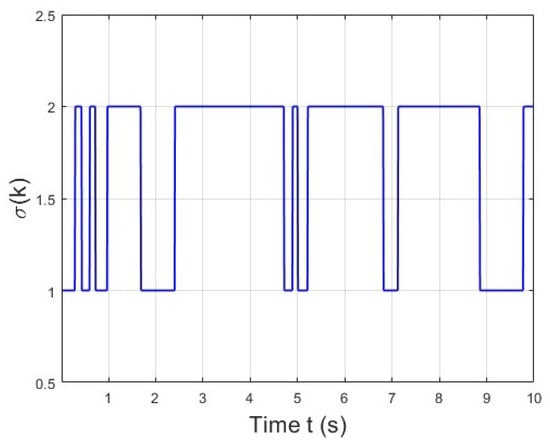
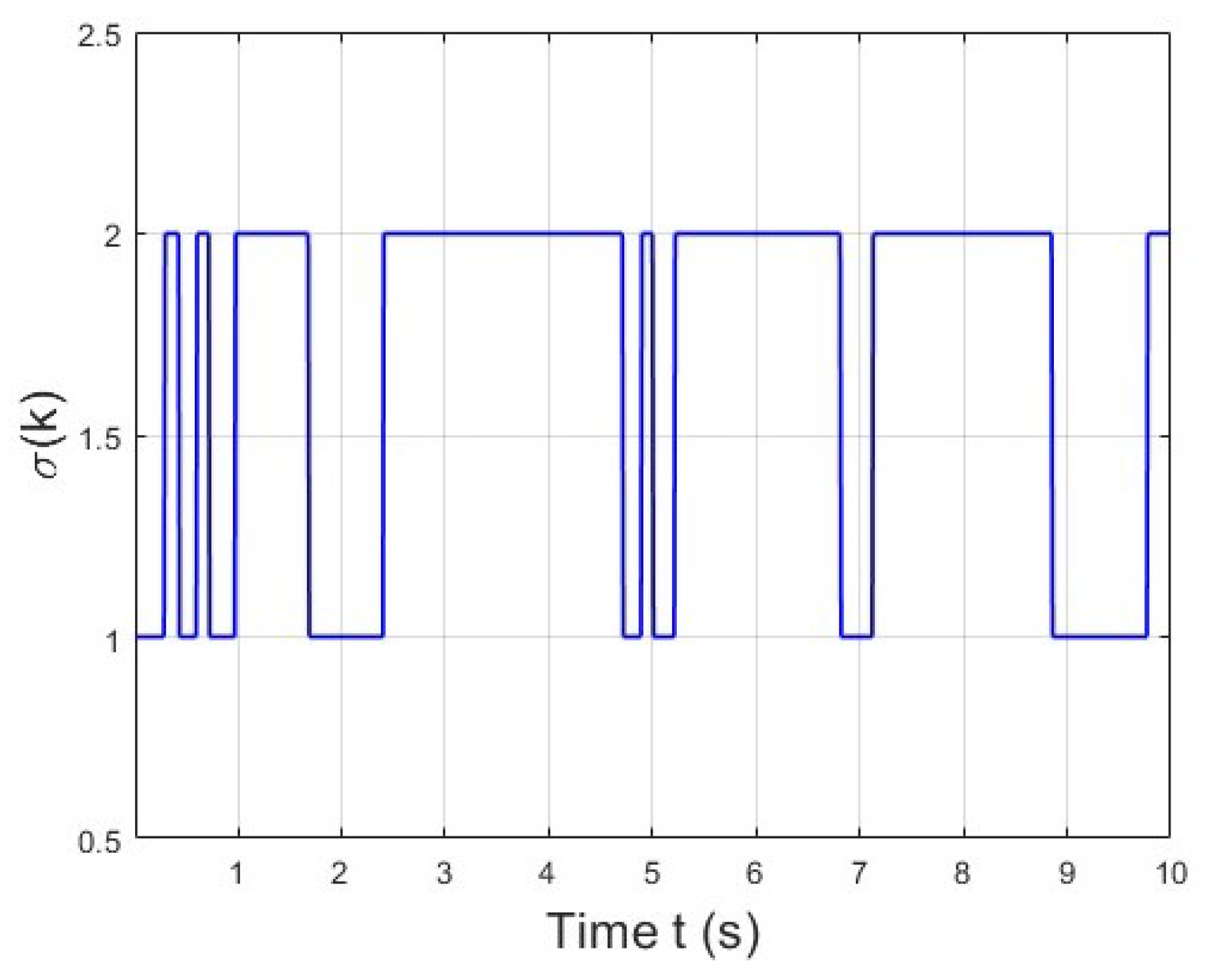
Selecting and as two reference points and the sampling period , the switching signal takes the form illustrated in Figure 2. After discretizing the continuous system, two subsystems are obtained:
Figure 2.
The randomly generated arbitrary switching signal.
Combining the above subsystems, the general model of the discrete-time switched system is constructed:
where represents the switching signal. This signal adjusts subsystem matrices based on the real-time wing sweep angle configuration, realizes the discrete-time characterization of multi-modal dynamics, and provides a solid foundational framework for the subsequent ETC strategy design and simulation verification.
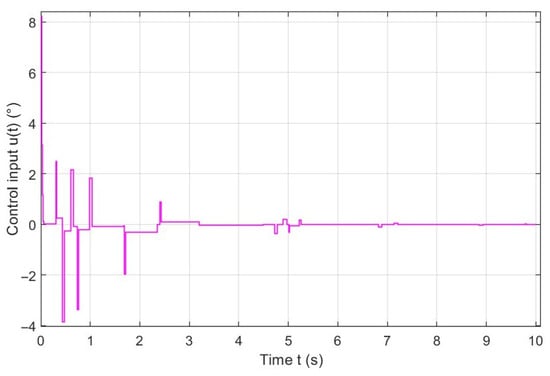
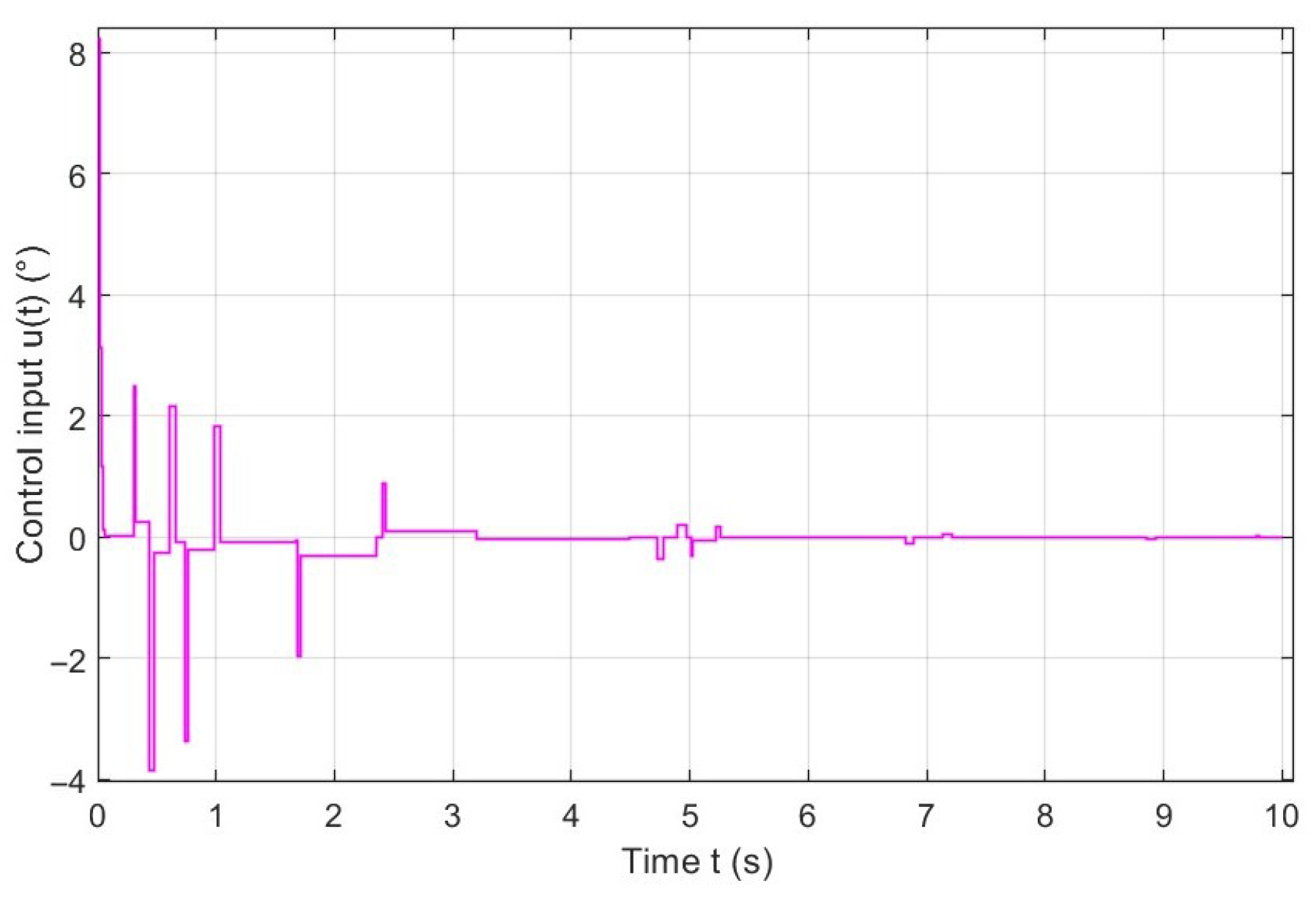
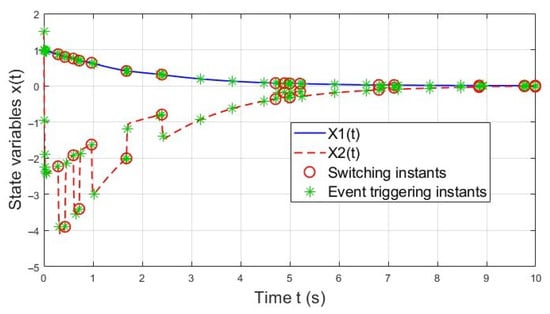
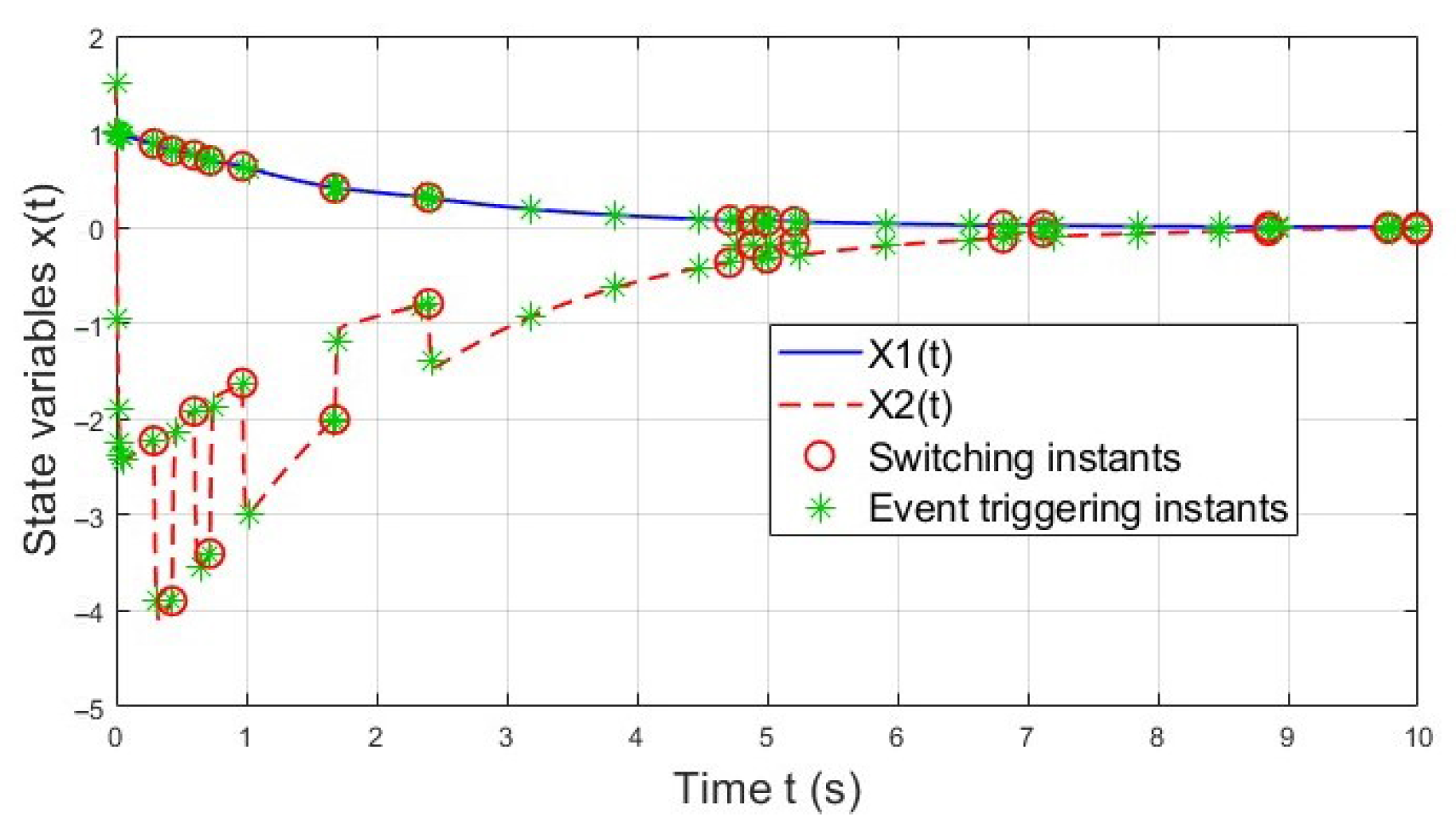
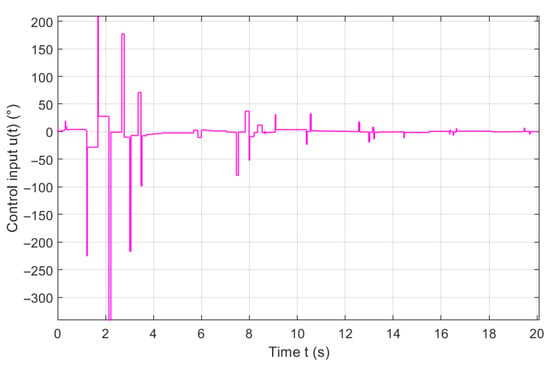
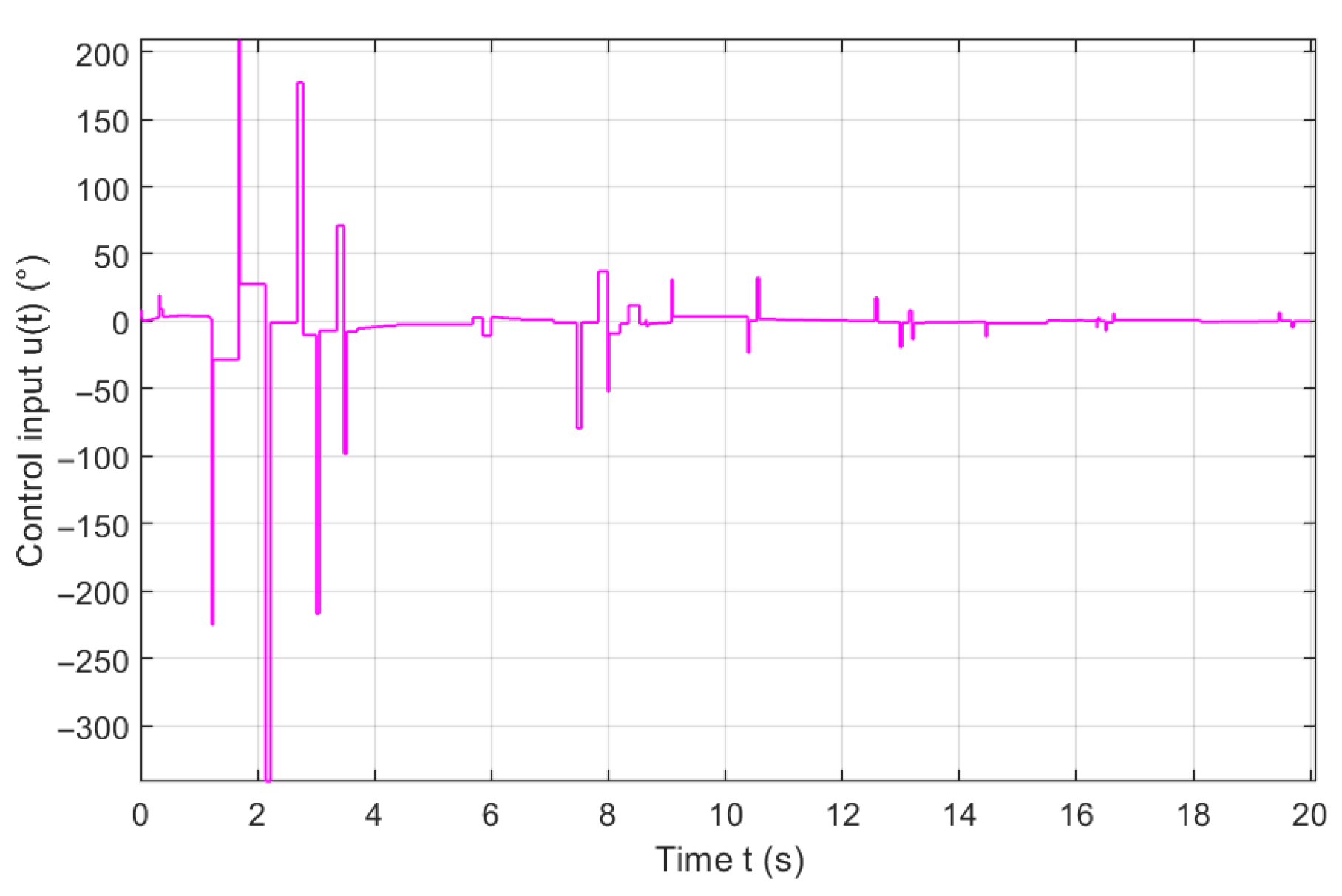
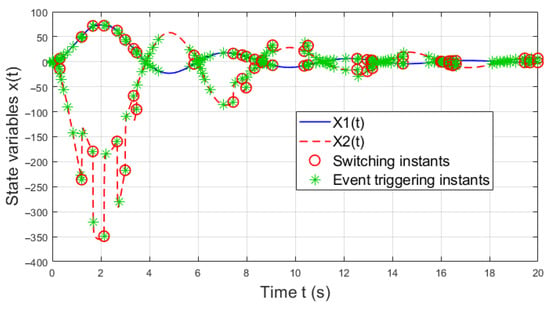
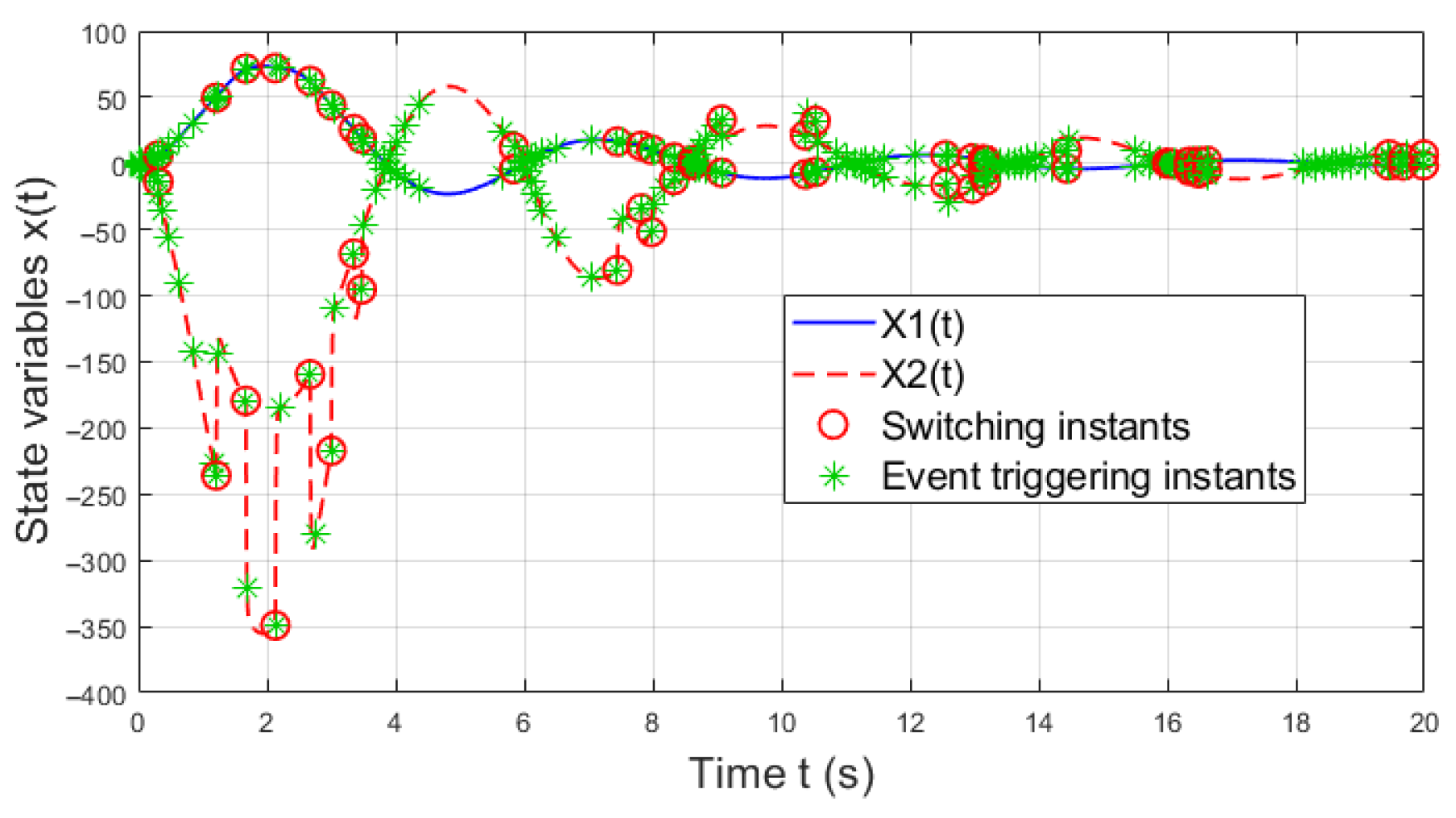
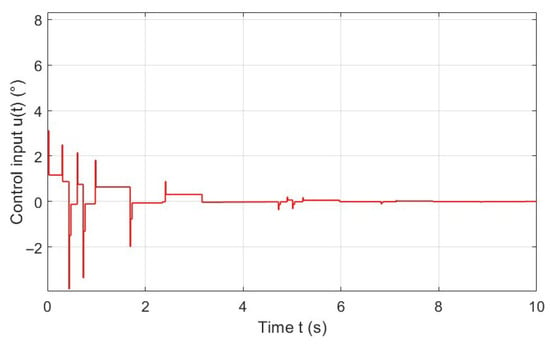
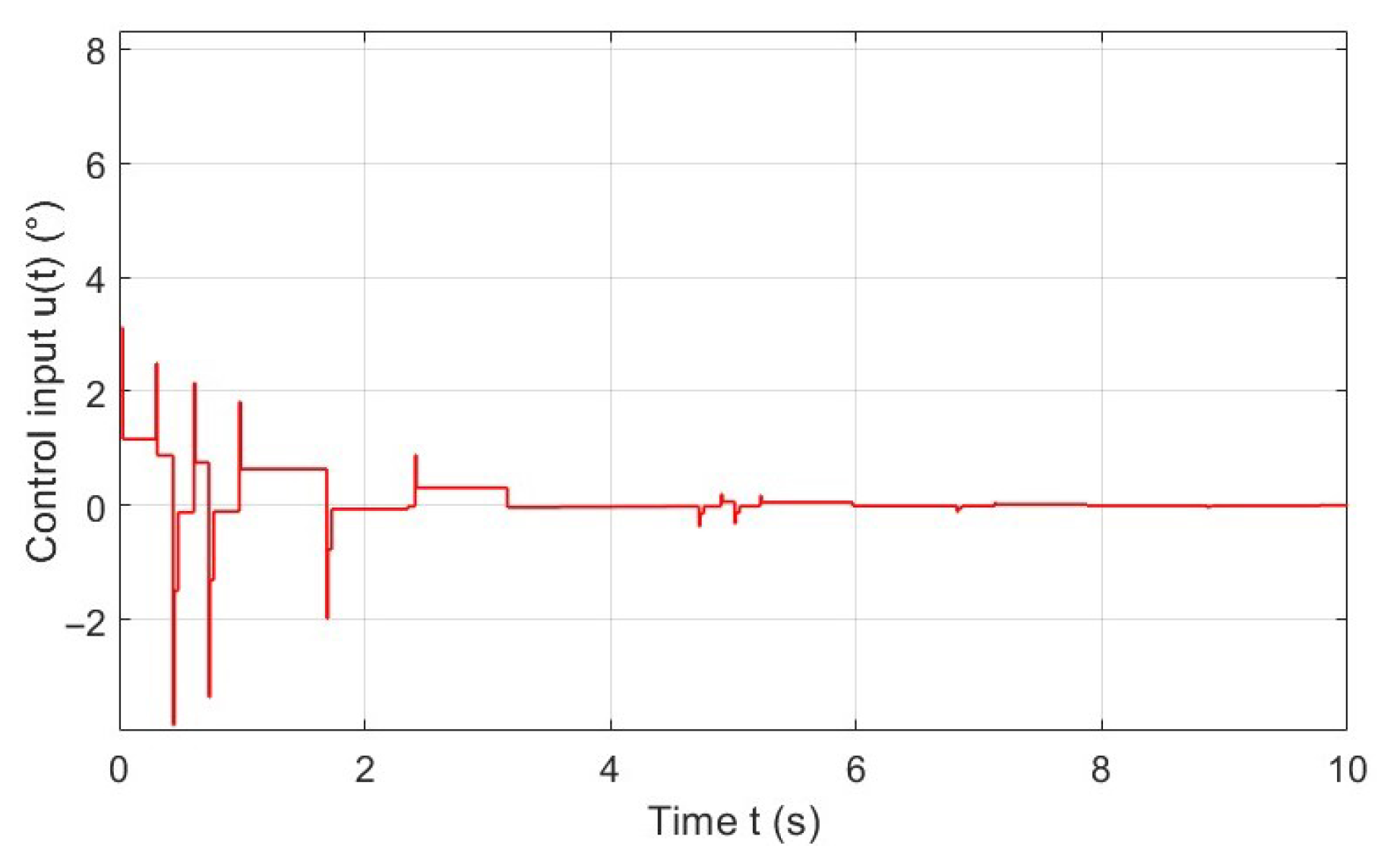
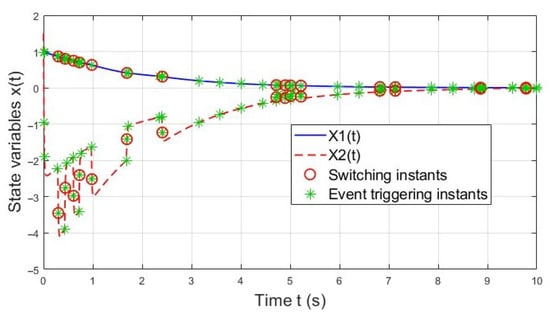
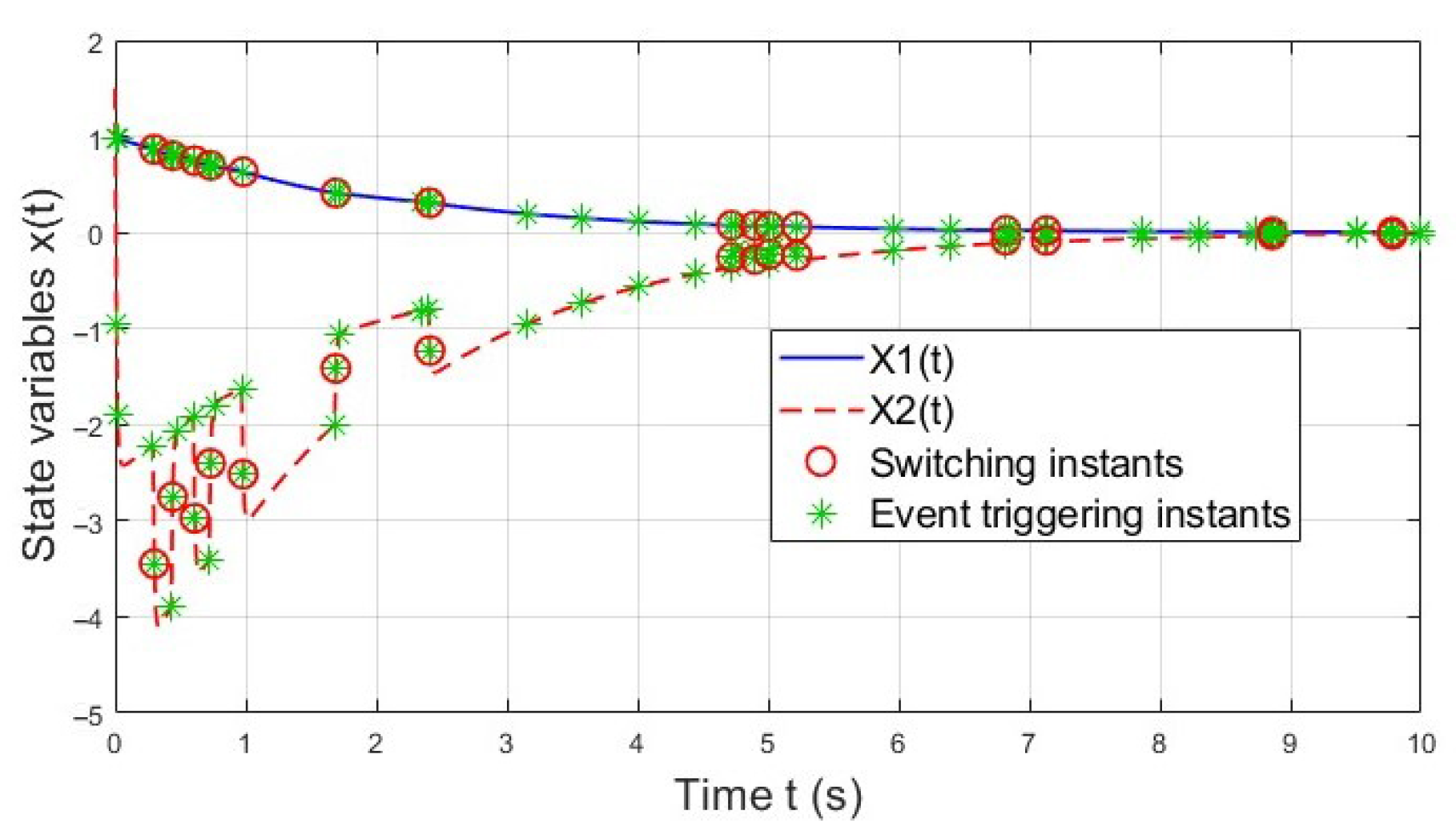
The trigger condition parameter is set to , and , the positive definite matrix is , and the controller gain is designed to be . With the designed controller, the corresponding system input and state responses are shown in Figure 3 and Figure 4. Obviously, the resulting system is GUAS.
Figure 3.
Dynamic event-triggered control input.
Figure 4.
State response of the closed-loop system under DETC.
In order to further test the resistance of the control method we developed to external interference, a time-varying disturbance is introduced into the system dynamics. Following the introduction of the disturbance, the system input and state trajectories are presented in Figure 5 and Figure 6. Note that the disturbance is only introduced in simulations to evaluate the robustness of the proposed controller. The theoretical results in Section 3.1 and Section 3.2 do not explicitly consider such disturbances. However, the closed-loop responses in the figures demonstrate that the DETM-based controller tolerates moderate time-varying perturbations while maintaining stability, implying inherent practical robustness.
Figure 5.
Dynamic event-triggered control input under disturbance.
Figure 6.
State response of the closed-loop system with disturbance under DETC.
To verify the superiority of the designed controller, a comparison between dynamic and static event-triggered controls is conducted. Under the same switching sequence, the proposed dynamic event-triggered scheme generates fewer triggering events than the static one. For a fair comparison, the triggering parameters of both schemes are tuned following a unified calibration procedure. The control input signal and state response diagrams under the STEM are shown in Figure 7 and Figure 8, respectively. It is observed that the control input signal under SETM changes more frequently, resulting in unnecessary resource wastage, and its state response may exhibit unwanted oscillations. In contrast, DETM enables smoother and more efficient system operation.
Figure 7.
Static event-triggered control input.
Figure 8.
State response of the closed-loop system under SETC.
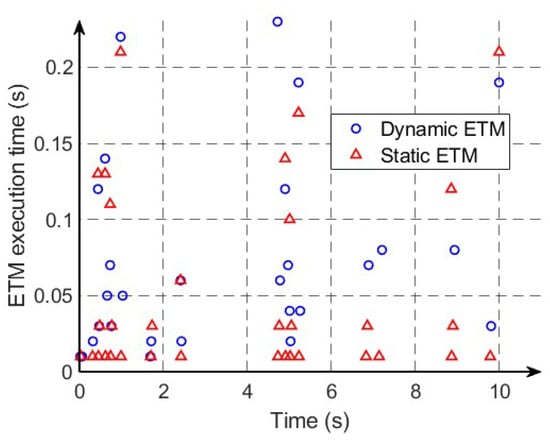
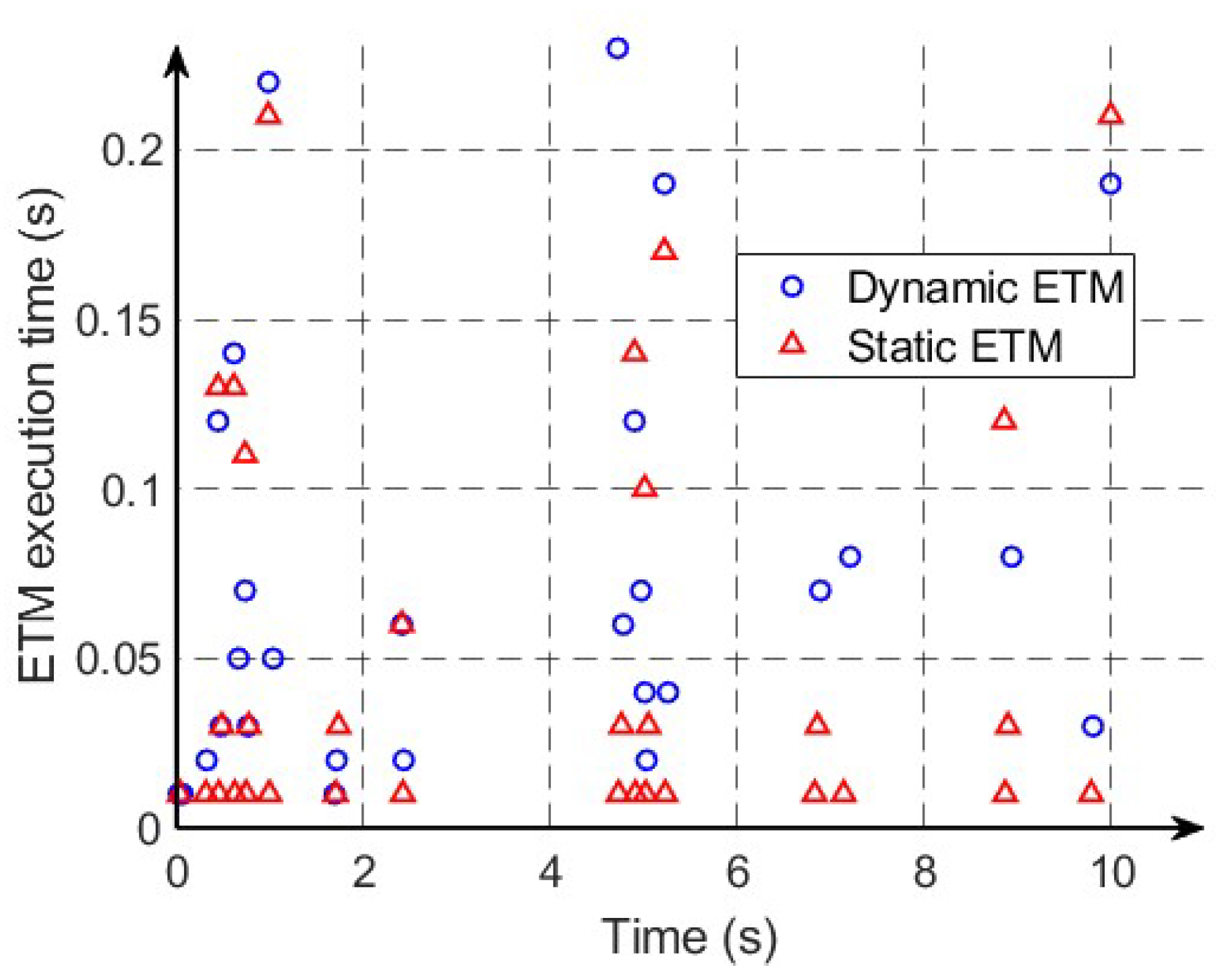
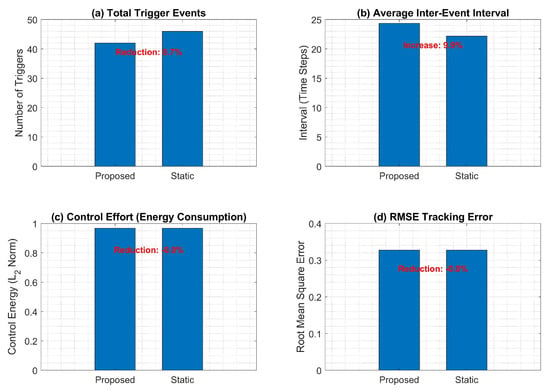
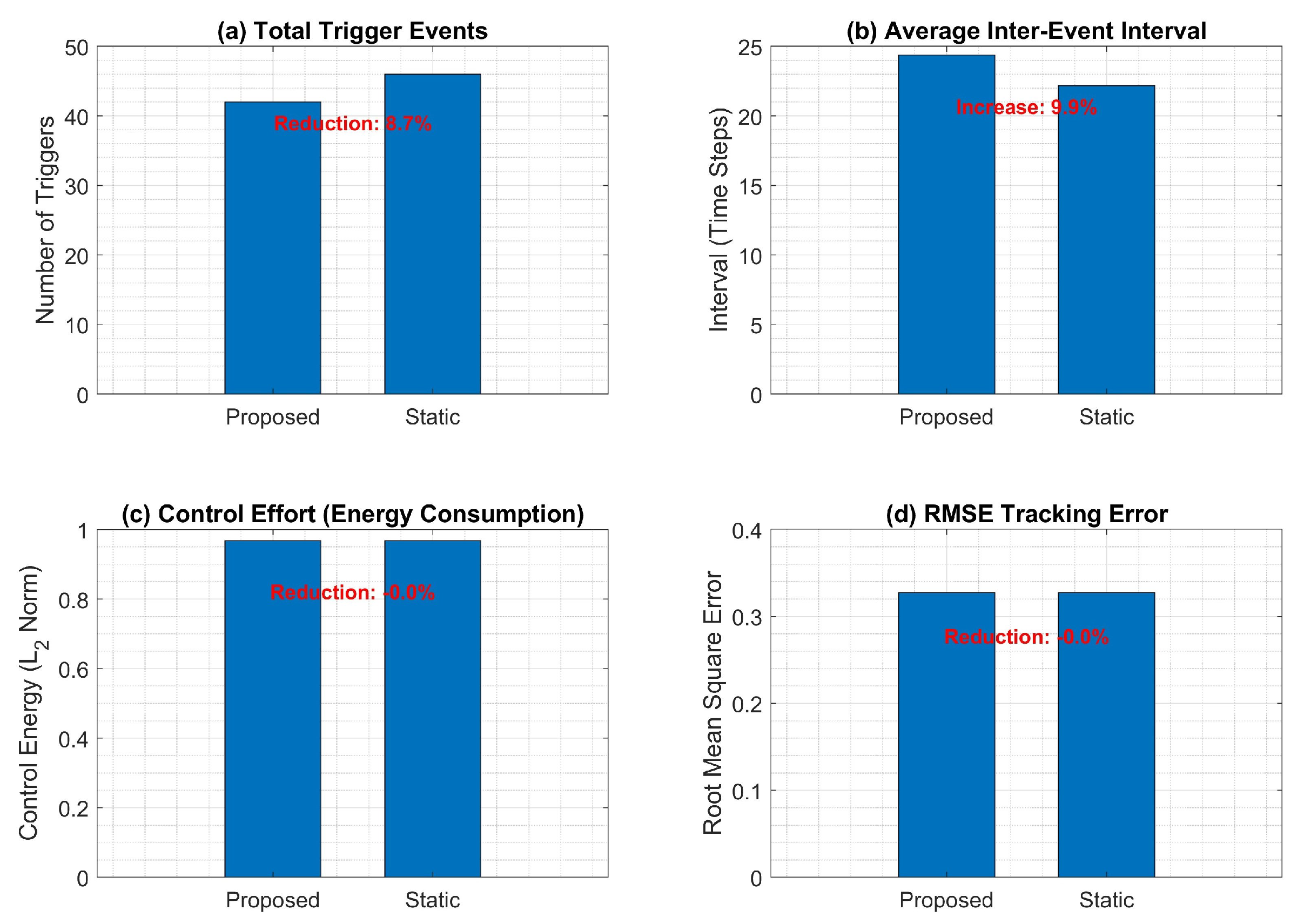
In order to verify our proposed method, Figure 9 shows the comparison chart of ETMs’ execution time, while Figure 10 shows the histogram of related performance indicators. Figure 9 illustrates the execution time profiles of DETM and SETM over time, where SETM exhibits more frequent instances of high execution time, whereas DETM demonstrates lower and more stable execution times, thereby indicating superior time utilization efficiency. Figure 10 quantifies the performance disparities between the proposed DETM and the conventional SETM under identical switching sequences; as depicted, the DETM reduces trigger events by 8.7% and prolongs inter-event intervals by 9.9%, which in turn lowers the communication and computational overheads, and it also consumes less control input energy while achieving a tracking error that is comparable to or better than that of SETM, all of which corroborate the superiority of DETM in balancing the resource efficiency and control precision for discrete-time switched systems.
Figure 9.
Comparison of the ETM execution time under dynamic and static ETC.
Figure 10.
Comparison of the performance indices under dynamic and static ETC.
In practical terms, the proposed strategy can be implemented on real networked control platforms with modest requirements. The controller uses only measured outputs; so, no state observer or additional sensors are needed. In the morphing aircraft example, standard measurements such as the angle of attack and pitch rate are sufficient. The dynamic event-triggered mechanism is evaluated locally from the current output, the last transmitted output, and a scalar internal variable updated by a simple difference equation; so, the online computation reduces to a few low-dimensional matrix–vector operations and a scalar inequality test at each sampling instant. Since the LMI conditions for the controller gains are solved offline with standard software, the real-time computational burden is very light.
5. Conclusions
A dynamic event-triggered output feedback controller for discrete-time switched linear systems under synchronous switching conditions is studied in this paper. Distinct from prior work, a novel dynamic control strategy is developed, thereby yielding significant enhancements in control efficiency and system stability. Given that the full system state is not always directly measurable, an output feedback controller combined with DETM is developed to address this practical constraint. Lyapunov stability theory is employed to verify the GUAS of the proposed strategy, with the associated output feedback controller being constructed thereafter. Parameters for both the output feedback controller and its integrated DETM are designed based on the stability conditions formulated in LMI form. Finally, the efficacy and merits of the design approach are confirmed through a morphing aircraft’s switched model.
Author Contributions
X.W. and Y.T. conceived of the presented idea; X.W. and Y.L. designed the control algorithm and performed the simulation experiment. All authors wrote the manuscript. All authors have read and agreed to the published version of the manuscript.
Funding
This research was funded by Shanghai Pujiang Talent Program, grant number 25PJD049.
Institutional Review Board Statement
Not applicable.
Informed Consent Statement
Not applicable.
Data Availability Statement
Data supporting the results of this research can be obtained from the corresponding author upon reasonable request.
Conflicts of Interest
The authors declare no conflicts of interest.
References
- Kim, Y.-R.; Lee, S.-Y.; Cui, S.; Jung, J.-J. Improved Dynamics of DC Bus Control with a Zig-Zag Transformer for Bipolar DC Distribution Systems. J. Power Electron. 2023, 23, 1654–1664. [Google Scholar] [CrossRef] [Scilit]
- Ma, X.; Chou, T. Finite-Time Neural Adaptive Control for High-Order Nonlinear Switching Multi-Agent System Based on Switching Linear State Observer. Proc. Inst. Mech. Eng. Part I J. Syst. Control Eng. 2025, 239, 1489–1505. [Google Scholar] [CrossRef] [Scilit]
- Yang, T.; Zhai, M.; Fang, Y.; Sun, N. Adaptive Fuzzy Control of Underactuated Switched Systems with Disturbance Observation and Actuated/Unactuated Motion Constraints. IEEE Trans. Fuzzy Syst. 2023, 32, 1195–1207. [Google Scholar] [CrossRef] [Scilit]
- Hashemzadeh, F.; Kumbasar, T. Swarm of Drones for Surveillance Monitoring of a Grounded Target: An Event-Triggered Approach. Drone Syst. Appl. 2024, 12, 1–16. [Google Scholar] [CrossRef] [Scilit]
- Pierre, C.; Lenain, R.; Laneurit, J.; Rousseau, V. A Multi-Control Strategy to Achieve Autonomous Field Operation. AgriEngineering 2022, 4, 770–788. [Google Scholar] [CrossRef] [Scilit]
- Hespanha, J.P.; Morse, A.S. Stability of Switched Systems with Average Dwell-Time. In Proceedings of the 38th IEEE Conference on Decision and Control (Cat. No. 99CH36304); IEEE: Piscataway, NJ, USA, 1999; Volume 3, pp. 2655–2660. [Google Scholar]
- Branicky, M.S. Multiple Lyapunov Functions and Other Analysis Tools for Switched and Hybrid Systems. IEEE Trans. Autom. Control 2002, 43, 475–482. [Google Scholar] [CrossRef] [Scilit]
- Daafouz, J.; Riedinger, P.; Iung, C. Stability Analysis and Control Synthesis for Switched Systems: A Switched Lyapunov Function Approach. IEEE Trans. Autom. Control 2002, 47, 1883–1887. [Google Scholar] [CrossRef] [Scilit]
- Liberzon, D.; Morse, A.S. Basic Problems in Stability and Design of Switched Systems. IEEE Control Syst. Mag. 2002, 19, 59–70. [Google Scholar]
- Liberzon, D. Switching in Systems and Control; Springer: Berlin/Heidelberg, Germany, 2003; Volume 190. [Google Scholar]
- Wen, J.; Nguang, S.K.; Shi, P.; Zhao, X. Stability and Control of Discrete-Time Switched Systems via One-Step Ahead Lyapunov Function Approach. IET Control Theory Appl. 2018, 12, 1141–1147. [Google Scholar] [CrossRef] [Scilit]
- Hu, Q.; Shi, Y. Event-Based Coordinated Control of Spacecraft Formation Flying Under Limited Communication. Nonlinear Dyn. 2020, 99, 2139–2159. [Google Scholar] [CrossRef] [Scilit]
- Kazemy, A.; Lam, J.; Zhang, X.-M. Event-Triggered Output Feedback Synchronization of Master–Slave Neural Networks Under Deception Attacks. IEEE Trans. Neural Netw. Learn. Syst. 2020, 33, 952–961. [Google Scholar] [CrossRef] [Scilit]
- Yu, W.; Chen, Q.; Zhou, H.; An, X.; Liu, Q. Output Feedback Control of Nonlinear Time-Delay Systems with Multiple Uncertainties via an Event-Triggered Strategy. Control Theory Technol. 2025, 23, 321–340. [Google Scholar] [CrossRef] [Scilit]
- Liu, J.; Yang, Y.; Li, H.; Geng, Y. Event-Triggered Output-Feedback Control for Networked Switched Positive Systems with Asynchronous Switching. Int. J. Control Autom. Syst. 2021, 19, 3101–3110. [Google Scholar] [CrossRef] [Scilit]
- Fei, Z.; Guan, C.; Zhao, X. Event-Triggered Dynamic Output Feedback Control for Switched Systems with Frequent Asynchronism. IEEE Trans. Autom. Control 2019, 65, 3120–3127. [Google Scholar] [CrossRef] [Scilit]
- Qi, Y.; Cao, M. Event-Triggered Dynamic Output Feedback Control for Switched Linear Systems. In 2016 35th Chinese Control Conference (CCC); IEEE: Piscataway, NJ, USA, 2016; pp. 2361–2367. [Google Scholar]
- Shi, S.; Fei, Z.; Shi, P.; Ahn, C.K. Asynchronous Filtering for Discrete-Time Switched T–S Fuzzy Systems. IEEE Trans. Fuzzy Syst. 2019, 28, 1531–1541. [Google Scholar] [CrossRef] [Scilit]
- Zhang, H.; Wei, W.; Liu, Q. Prediction of the High-Quality Development Level of Inbound Tourism Based on Adaptive Neural Network Technology. J. Control Decis. 2023, 10, 112–125. [Google Scholar] [CrossRef] [Scilit]
- Wang, G.; Li, F.; Wang, Y.; Wang, J.; Shen, H. Fuzzy-Model-Based H∞ Filtering for Discrete-Time Singular Markov Jump Nonlinear Systems against Hybrid Attacks. J. Control Decis. 2024, 11, 233–244. [Google Scholar] [CrossRef] [Scilit]
- Girard, A. Dynamic Triggering Mechanisms for Event-Triggered Control. IEEE Trans. Autom. Control 2014, 60, 1992–1997. [Google Scholar] [CrossRef] [Scilit]
- Li, Q.; Shen, B.; Wang, Z.; Huang, T.; Luo, J. Synchronization Control for a Class of Discrete Time-Delay Complex Dynamical Networks: A Dynamic Event-Triggered Approach. IEEE Trans. Cybern. 2018, 49, 1979–1986. [Google Scholar] [CrossRef] [Scilit] [PubMed]
- Hajshirmohamadi, S.; Sheikholeslam, F.; Davoodi, M.; Meskin, N. Event-Triggered Simultaneous Fault Detection and Tracking Control for Multi-Agent Systems. Int. J. Control 2019, 92, 1928–1944. [Google Scholar] [CrossRef] [Scilit]
- Ge, X.; Han, Q.-L. Distributed Formation Control of Networked Multi-Agent Systems Using a Dynamic Event-Triggered Communication Mechanism. IEEE Trans. Ind. Electron. 2017, 64, 8118–8127. [Google Scholar] [CrossRef] [Scilit]
- Tang, F.; Wang, H.; Chang, X.-H.; Zhang, L.; Alharbi, K.H. Dynamic Event-Triggered Control for Discrete-Time Nonlinear Markov Jump Systems Using Policy Iteration-Based Adaptive Dynamic Programming. Nonlinear Anal. Hybrid Syst. 2023, 49, 101338. [Google Scholar] [CrossRef] [Scilit]
- Wang, Y.-L.; Lim, C.-C.; Shi, P. Adaptively Adjusted Event-Triggering Mechanism on Fault Detection for Networked Control Systems. IEEE Trans. Cybern. 2016, 47, 2299–2311. [Google Scholar] [CrossRef] [Scilit]
- Yan, H.; Hu, C.; Zhang, H.; Karimi, H.R.; Jiang, X.; Liu, M. H∞ Output Tracking Control for Networked Systems with Adaptively Adjusted Event-Triggered Scheme. IEEE Trans. Syst. Man Cybern. Syst. 2018, 49, 2050–2058. [Google Scholar] [CrossRef] [Scilit]
- Yan, S.; Shen, M.; Zhang, G.; Nguang, S.K. Reliable H∞ Output Control of Nonlinear Systems with Dynamic Event-Triggered Scheme. J. Frankl. Inst. 2019, 356, 58–79. [Google Scholar] [CrossRef] [Scilit]
- Zheng, Q.; Xu, S.; Du, B. Quantized Guaranteed Cost Output Feedback Control for Nonlinear Networked Control Systems and Its Applications. IEEE Trans. Fuzzy Syst. 2021, 30, 2402–2411. [Google Scholar] [CrossRef] [Scilit]
- Qi, Y.; Cao, M. Finite-Time Boundedness and Stabilisation of Switched Linear Systems Using Event-Triggered Controllers. IET Control Theory Appl. 2017, 11, 3240–3248. [Google Scholar] [CrossRef] [Scilit]
- Deaecto, G.S.; Geromel, J.C.; Daafouz, J. Dynamic Output Feedback H∞ Control of Switched Linear Systems. Automatica 2011, 47, 1713–1720. [Google Scholar] [CrossRef] [Scilit]
- Wang, Q.; Yang, Y.; Tian, F.; Chen, G. Event-Triggered H∞ Control for Discrete-Time Switched Systems with Saturation Nonlinearities. ISA Trans. 2024, 144, 105–112. [Google Scholar] [CrossRef] [Scilit]
- Zhu, H.-Y.; Li, Y.-X.; Tong, S. Dynamic Event-Triggered Reinforcement Learning Control of Stochastic Nonlinear Systems. IEEE Trans. Fuzzy Syst. 2023, 31, 2917–2928. [Google Scholar] [CrossRef] [Scilit]
- Zhu, H.-Y.; Li, Y.-X.; Tong, S. Fuzzy Adaptive Tracking of Constrained Nonlinear Systems with Event-Sampling Reinforcement Learning. IEEE Trans. Fuzzy Syst. 2023, 32, 536–546. [Google Scholar] [CrossRef] [Scilit]
- Zhou, J.; Park, J.H.; Shen, H. Non-Fragile Reduced-Order Dynamic Output Feedback H∞ Control for Switched Systems with Average Dwell-Time Switching. Int. J. Control 2016, 89, 281–296. [Google Scholar] [CrossRef] [Scilit]
- Khalil, H.K. Nonlinear Systems, 3rd ed.; Prentice Hall: Upper Saddle River, NJ, USA, 2002. [Google Scholar]
- Jiang, W.; Dong, C.; Wang, Q. A Systematic Method of Smooth Switching LPV Controllers Design for a Morphing Aircraft. Chin. J. Aeronaut. 2015, 28, 1640–1649. [Google Scholar] [CrossRef] [Scilit]
Disclaimer/Publisher’s Note: The statements, opinions and data contained in all publications are solely those of the individual author(s) and contributor(s) and not of MDPI and/or the editor(s). MDPI and/or the editor(s) disclaim responsibility for any injury to people or property resulting from any ideas, methods, instructions or products referred to in the content. |
© 2026 by the authors. Licensee MDPI, Basel, Switzerland. This article is an open access article distributed under the terms and conditions of the Creative Commons Attribution (CC BY) license.