


Abstract
The rapid advancement of smart agricultural technologies has transformed modern farming practices, enhancing productivity, precision, and sustainability while introducing new ergonomic challenges. This study aimed to evaluate and prioritize ergonomic criteria associated with three major smart agricultural technologies—GPS-guided tractors, agricultural drones, and automatic irrigation systems—within a multi-stakeholder decision-making framework. The Analytic Hierarchy Process (AHP) was applied to data collected from 53 experts representing four stakeholder groups: academia, operators/farmers, manufacturers, and sectoral organizations. Five ergonomic criteria—physical workload reduction, task duration, user safety, training requirement, and cost/applicability—were analyzed to determine their relative importance. The results indicate that user safety emerged as the most influential ergonomic factor for academia, farmers, and sectoral organizations, highlighting the importance of risk reduction and operator protection in smart farming environments. In contrast, manufacturers prioritized cost and applicability, reflecting economic feasibility considerations in technology development and deployment. These findings demonstrate that ergonomic priorities differ across stakeholder groups and emphasize the need for human-centered design approaches in the development of smart agricultural systems. The proposed multi-stakeholder AHP framework provides a practical and evidence-based decision-support tool for integrating ergonomic considerations into agricultural technology design, implementation, and policy development.
1. Introduction
1.1. Background
To meet the food demand of a growing global population and to improve resource efficiency, the agricultural sector is entering a new era, often referred to as Agriculture 4.0 or Smart Agriculture, driven by digitalization and automation [1,2,3,4].
This transformation integrates information and communication technologies (ICT) such as the Internet of Things (IoT), unmanned aerial vehicles (UAVs), autonomous tractors, cloud platforms, and precision sensors into agricultural production processes [5,6,7,8].
These technologies—including UAVs for crop monitoring, spraying, and disease detection, as well as semi-autonomous tractors used in field operations—not only enhance precision and reduce labor demands but also reshape human–machine interaction in agricultural systems [9,10,11].
While digital and robotic tools have significantly improved agricultural productivity, they have also changed the nature of agricultural work, introducing new ergonomic and cognitive challenges for workers [12,13,14,15].
Although these systems reduce physical workload, they often require higher levels of visual attention, technical skill, and cognitive control [16,17,18].
In this evolving context, ergonomics—encompassing physical, cognitive, and organizational dimensions—remains a critical factor for achieving human well-being, system safety, and sustainable agricultural performance [19,20,21].
1.2. Problem Statement
The integration of smart technologies in agriculture reduces traditional physical workloads (e.g., manual handling, repetitive tool use, or field spraying) [10,16].
However, it simultaneously introduces new types of ergonomic risks and cognitive loads for operators.
Mechanized operations involving prolonged sitting and vibration exposure may lead to musculoskeletal disorders (MSDs), while handheld devices can cause upper limb fatigue and vibration-related discomfort. These findings are consistent with previous studies highlighting ergonomic risks and occupational safety challenges in agricultural systems [11,17].
Moreover, smart farming increasingly depends on screen-based monitoring, digital interfaces, and semi-autonomous control, which demand constant attention and decision-making.
Continuous interaction with display panels and real-time sensor data may lead to visual fatigue, increased mental workload, and operator stress, eventually leading to cognitive strain and decreased efficiency [12,13,18].
Human–machine interaction, particularly in collaborative environments where humans and robots operate together, also brings new ergonomic challenges related to situational awareness, safety, and trust in automation [7,19].
Despite these emerging challenges, ergonomic assessment often lags behind the technological advancement of smart farming systems.
Most existing agricultural ergonomics studies focus mainly on physical workloads in manual or mechanized operations [10,16,17], neglecting the cognitive and systemic dimensions of human–technology interaction.
Moreover, few studies have conducted a comprehensive evaluation involving different stakeholder groups such as academics, users, manufacturers, and sectoral organizations [6,9,13].
1.3. Research Gap and Motivation
Multi-criteria decision-making (MCDM) methods—particularly the Analytic Hierarchy Process (AHP)—are widely used to support complex agricultural decisions such as technology selection, irrigation prioritization, and sustainability assessments [20,21,22].
Although these methods are well established for agricultural planning, studies that explicitly address the prioritization of ergonomic factors across different smart agricultural technologies remain limited [23,24].
Existing frameworks for Agriculture 4.0 and Agriculture 5.0 emphasize productivity, efficiency, and digital integration, but rarely incorporate ergonomic or human-centered criteria in their evaluation models [1,4,5,25].
While “human-in-the-loop” and human-centered AI paradigms are frequently highlighted, few practical tools translate these concepts into systematic, decision-based approaches that consider ergonomic risks and user experience [25,26,27].
Furthermore, most ergonomic evaluations assess individual systems in isolation (e.g., tractors, drones, or irrigation systems) [11,16,17], without providing comparative insight into their relative ergonomic effects.
Therefore, a need exists for a comprehensive, stakeholder-based analytical framework that can compare multiple smart agricultural technologies in terms of ergonomic factors—addressing both physical and cognitive aspects simultaneously.
In addition, there is a lack of comparative studies that simultaneously evaluate multiple smart agricultural technologies from an ergonomic perspective while incorporating different stakeholder viewpoints. Existing research generally focuses on single technologies or specific ergonomic aspects, without providing an integrated framework that captures both physical and cognitive dimensions across diverse user groups. Therefore, a systematic and multi-stakeholder-based prioritization approach is required to better understand how ergonomic criteria influence the adoption and sustainability of smart agricultural technologies.
1.4. Aim and Objectives
This study aims to prioritize and compare the ergonomic risk factors of selected smart agricultural technologies (GPS-guided tractors, agricultural drones, and automatic irrigation systems) within the context of Türkiye through a structured multi-stakeholder evaluation approach.
Specific objectives are to:
- Identify ergonomic factors associated with different technologies based on expert perspectives and literature synthesis [11,16,17,23].
- Define five key ergonomic criteria—physical workload reduction, task duration, user safety, training requirement, and cost/applicability—and analyze their relative importance through a structured decision-making framework [10,11,12,13,18].
- Compare and interpret how different stakeholder groups (academics, operators, manufacturers, and sectoral organizations) prioritize ergonomic aspects within smart agriculture, connecting the findings to human-centered Agriculture 4.0 and 5.0 paradigms [1,4,5,25,26,27].
By integrating ergonomic evaluation with multi-stakeholder perspectives, this study contributes to bridging the gap between technological innovation and human-centered agricultural mechanization.
2. Materials and Methods
2.1. Research Design
This research adopts a quantitative, multi-stakeholder analytical framework to evaluate the relative importance of ergonomic factors associated with different smart agricultural technologies.
This study integrates expert judgments from multiple stakeholder groups to establish a comparative understanding of ergonomic priorities using a structured decision-making model.
The overall research flow involves three primary stages:
- (1)
- Defining ergonomic evaluation criteria based on the literature;
- (2)
- Collecting expert assessments through a structured questionnaire;
- (3)
- Analyzing the results through a weighted comparison among stakeholder groups.
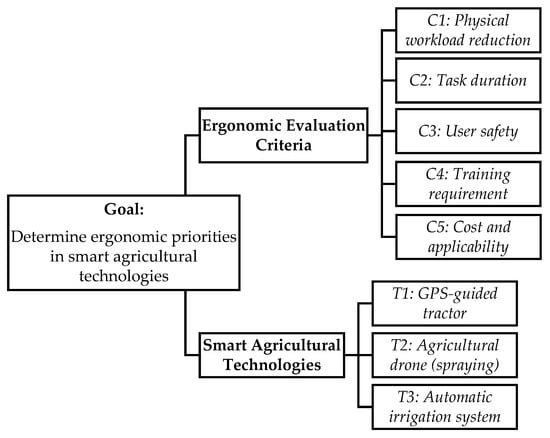
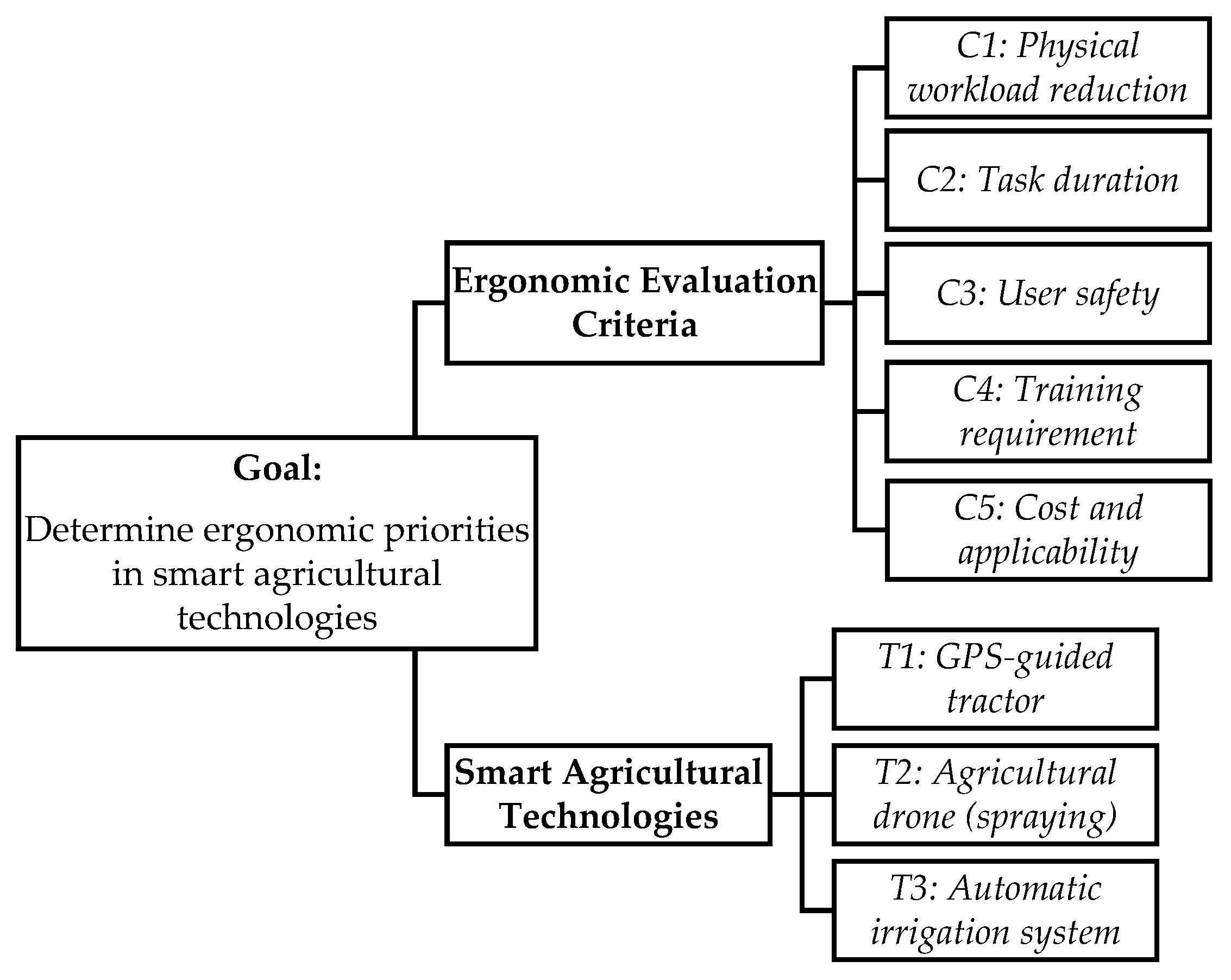
The methodological structure follows a hierarchical evaluation model (Figure 1), where the main research goal—to determine ergonomic priorities in smart agricultural technologies—is placed at the top of the hierarchy, followed by five ergonomic criteria, and finally, the selected smart agricultural technologies.
Figure 1.
Hierarchical structure of the Analytic Hierarchy Process (AHP) model used to prioritize ergonomic criteria for three smart agricultural technologies: GPS-guided tractors, agricultural drones, and automatic irrigation systems.
This hierarchical arrangement reflects the core logic of the Analytic Hierarchy Process (AHP), which decomposes a complex decision problem into interrelated levels, allowing for a systematic and consistent comparison of multiple criteria and alternatives.The AHP framework was chosen for its proven effectiveness in evaluating ergonomics-related decisions in agriculture and technology adoption studies.
2.2. Study Scope and Framework
This study was conducted in the context of smart agricultural technologies that are increasingly adopted in Türkiye, particularly in regions with mechanized and semi-automated farming systems.
Three technologies were examined based on their prevalence and relevance to ergonomic considerations:
- GPS-guided tractors;
- Agricultural drones (UAV-based spraying systems);
- Automatic irrigation systems.
Each technology represents a distinct interaction type between human operators and mechanized systems—ranging from direct physical operation (tractors) to remote control (drones) and fully automated management (irrigation).
This selection allows for a comparative analysis of physical and cognitive ergonomic demands across different automation levels.
These technologies were specifically selected due to their widespread adoption in modern agricultural practices and their representation of different levels of automation and human–machine interaction. GPS-guided tractors represent semi-automated systems with direct operator involvement, agricultural drones reflect remote-controlled operations requiring high cognitive engagement, and automatic irrigation systems illustrate fully automated processes with minimal human intervention. This diversity enables a comprehensive comparison of ergonomic challenges across varying operational contexts.
2.3. Definition of Ergonomic Criteria
Based on the agricultural ergonomics and occupational health literature, five key criteria (Table 1) were identified to represent the primary dimensions of ergonomic performance in smart farming environments:
Table 1.
Ergonomic criteria used in the Analytic Hierarchy Process (AHP) model for evaluating smart agricultural technologies.
These criteria represent both physical ergonomic dimensions (C1 and C3) and cognitive or organizational aspects (C2, C4, and C5).
The criteria were validated by three independent experts in agricultural ergonomics and occupational health prior to data collection to ensure contextual relevance and conceptual clarity.
2.4. Participant Groups and Sampling
The data were collected from 53 participants representing four stakeholder groups to ensure a balanced and diverse multi-stakeholder evaluation:
- Academia (n = 20, 37.7%)—researchers, engineers, and academic staff specializing in agricultural engineering, ergonomics, and mechanization.
- Operators/Farmers (n = 10, 18.9%)—active users of smart agricultural technologies such as GPS-guided tractors, drones, and automatic irrigation systems.
- Manufacturers/Industry Experts (n = 15, 28.3%)—professionals from agricultural machinery and technology companies, including engineers, production managers, and technical consultants.
- Sectoral and Non-Governmental Organizations (STK) (n = 8, 15.1%)—representatives from national and regional professional bodies, such as:
- ▪
- The Turkish Agricultural Machinery Association (TARMAKDER);
- ▪
- The Turkish Association of Agricultural Machinery and Equipment Manufacturers (TARMAKBİR);
- ▪
- Local Chambers of Agriculture (e.g., the Kırşehir Chamber of Agriculture).
These organizations play a critical role in bridging policy, research, and practice within the agricultural machinery sector. Their inclusion ensured that the study incorporated perspectives from industry associations, producers, and end-user networks.
Participants were selected using purposive sampling, focusing on individuals with a minimum of two years of professional experience in agricultural technology, ergonomics, or machinery operation. The category “0–5 years” in Table 2, therefore, represents participants with experience ranging from 2 to 5 years.
Table 2.
Demographic characteristics of participants (n = 53).
The proportional distribution of stakeholder groups was designed to reflect the structure of the smart agricultural technology ecosystem, ensuring representation from research, industry, and practical application domains. This approach enabled a balanced inclusion of perspectives from decision-makers, technology developers, and end users, which is essential for capturing diverse ergonomic priorities in multi-stakeholder evaluations.
All participants voluntarily completed the questionnaire after providing informed consent prior to participation.
No personal or identifiable data were collected, and the study received ethical approval from the Institutional Ethics Committee (Approval No. 2026/01/03, dated 22 January 2026).
2.5. Data Collection
Data were collected between November and December 2025 using an online questionnaire (Google Forms).
The survey consisted of two main sections:
- (1)
- Demographic information (e.g., age, education, occupation, experience, and technology used);
- (2)
- A structured comparative evaluation of the five ergonomic criteria.
Participants were asked to perform pairwise comparisons between the ergonomic criteria using a 1–9 importance scale, where
1 = equally important;
3 = slightly more important;
5 = moderately more important;
7 = strongly more important;
9 = extremely more important.
Each participant answered 10 comparison questions (since 5 criteria yield 10 pairwise combinations). The average response time was approximately 10–12 min.
2.6. Data Analysis
The analysis followed the hierarchical weighting and consistency assessment framework proposed by Saaty (2013) [28].
For each stakeholder group, a 5 × 5 pairwise comparison matrix was constructed, and the geometric mean method was applied to compute group-level aggregate judgments.
Criterion weights were obtained by normalizing the principal eigenvector of each comparison matrix.
Specifically, the relative importance of each criterion was determined by calculating the principal eigenvector of the pairwise comparison matrix and normalizing it so that the sum of all weights equals one. This procedure ensures that the derived weights reflect the relative contribution of each criterion to the overall decision-making process. The consistency of these weights was then verified using the Consistency Index (CI) and Consistency Ratio (CR).
The Consistency Index (CI) and Consistency Ratio (CR) were used to verify judgment consistency, as shown in Equation (1):
where λmax is the maximum eigenvalue, n is the number of criteria (n = 5), and RI is the Random Index value (RI = 1.12 for n = 5). A CR value of 0.10 or lower indicates an acceptable level of judgment consistency.
All analyses were conducted using Microsoft Excel and cross-validated using the SuperDecisions software (Version 3.2).
The resulting weights were compared across stakeholder groups to identify differences in ergonomic prioritization patterns and to reveal variations in decision-making preferences among stakeholders.
The results were visualized using bar charts and radar plots to represent relative importance across criteria and stakeholder groups.
3. Results
3.1. Descriptive Statistics of Participants
A total of 53 experts participated in the study, representing four stakeholder groups: academia (n = 20, 37.7%), operators/farmers (n = 10, 18.9%), manufacturers (n = 15, 28.3%), and sectoral or non-governmental organizations (n = 8, 15.1%).
All participants voluntarily participated in the survey after providing informed consent.
Table 2 summarizes the demographic characteristics of the participants, including gender, age, professional experience, and technological background.
Most respondents were male (90.6%), aged primarily between 46 and 60 years (34%).
The majority of participants had less than five years of experience (56.6%) with smart agricultural technologies, mainly involving GPS-guided tractors (52.8%), automatic irrigation systems (49.1%), and agricultural drones (37.7%). These distributions reflect a balanced representation of both academic and field-level expertise, consistent with the multi-stakeholder design of this research.
3.2. AHP Matrix Consistency and Validation
In the Analytic Hierarchy Process (AHP), the consistency of expert judgments is a critical criterion that determines the reliability and stability of the resulting weights.
According to the theoretical framework established by Saaty (2013) [28] and further developed by Forman and Gass (2001) [29], the logical coherence of pairwise comparisons must be evaluated using the Consistency Index (CI) and Consistency Ratio (CR).
The CR is obtained by dividing the Consistency Index (CI) by the Random Index (RI) value, as shown in Equation (2):
where λmax is the maximum eigenvalue of the comparison matrix, n is the number of criteria, and RI is the Random Index (1.12 for n = 5).
A CR value of 0.10 or lower is generally considered acceptable and indicates that the expert judgments are logically consistent and free from significant contradictions [28,29,30].
All responses satisfied the acceptable CR threshold (≤0.10); therefore, no responses were removed from the dataset.
Group-level consistency was then verified using the geometric mean method, which reduces the influence of extreme judgments and ensures more stable group decisions [31,32].
This approach has been widely adopted in agricultural ergonomics and risk evaluation studies for its ability to maintain internal coherence across heterogeneous expert groups [10,23,24].
The mean CR values for each stakeholder group are presented in Table 3.
Table 3.
Consistency Ratio (CR) values per stakeholder group.
All four groups achieved acceptable levels of consistency (CR ≤ 0.10), confirming that participants provided reliable and logically consistent pairwise comparisons throughout the pairwise comparison process.
The CR values reported in Table 3 represent the average consistency ratios calculated for individual responses within each stakeholder group before aggregation.
3.3. Priority Weights of Ergonomic Criteria
The priority weights of the ergonomic criteria were calculated using the Analytic Hierarchy Process (AHP) for each stakeholder group. Table 4 presents the normalized weights obtained from the pairwise comparison matrices aggregated through the geometric mean method.
Table 4.
Priority weights of ergonomic criteria by stakeholder group.
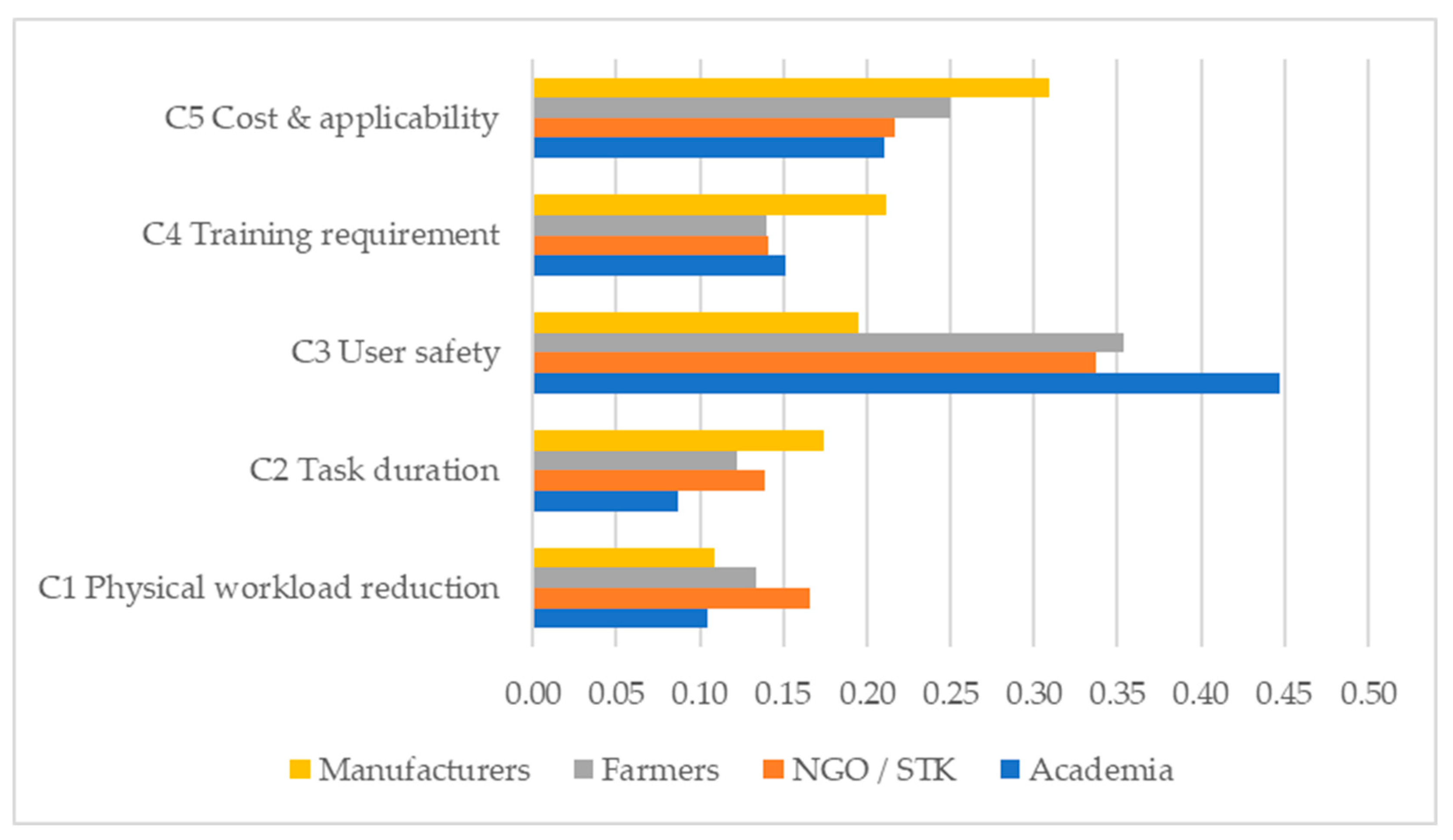
The results reveal noticeable differences in how stakeholder groups prioritize ergonomic factors in smart agricultural technologies. While academic experts, NGOs, and farmers placed the highest importance on user safety (C3), manufacturers prioritized cost and applicability (C5) as the most influential factor.
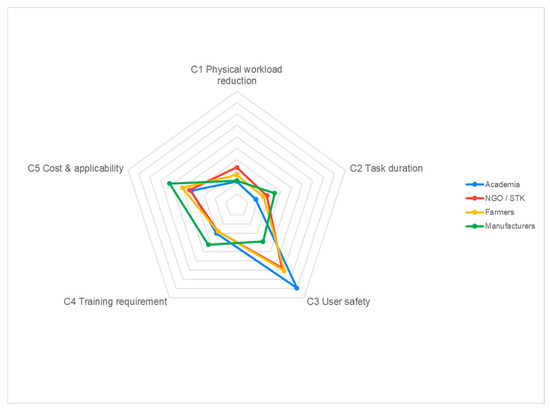
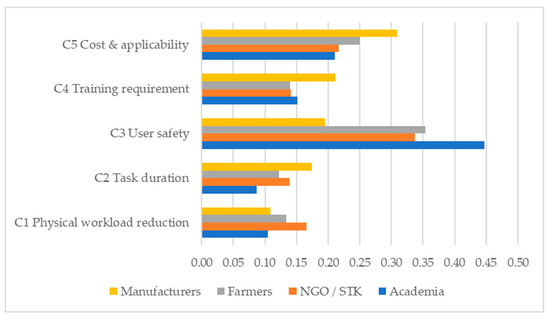
As shown in Figure 2 and Figure 3, user safety (C3) emerged as the most influential ergonomic factor for academia (0.447), NGOs (0.337), and farmers (0.354). In contrast, the manufacturer group emphasized cost and applicability (C5) with the highest weight of 0.309. The radar chart highlights the overall pattern of stakeholder differences, while the bar chart provides a clearer comparison of the magnitude of these differences across criteria. Together, these visualizations enhance the interpretability of stakeholder-based ergonomic prioritization. These findings indicate that ergonomic priorities differ across stakeholder groups, reflecting their distinct operational roles and technological expectations within smart agricultural systems.
Figure 2.
Radar chart illustrating stakeholder-based differences in ergonomic criteria prioritization.
Figure 3.
Bar chart comparing ergonomic criteria weights across stakeholder groups.
These findings are consistent with previous studies that applied multi-criteria decision-making approaches in agricultural and technological contexts, where safety-related and operational factors were frequently identified as dominant criteria in decision processes [20,21,22]. Similarly, studies focusing on agricultural ergonomics and mechanization have emphasized that risk reduction, operator safety, and system efficiency are key determinants influencing technology adoption and performance outcomes [23,24,25,26,27]. In this context, the prioritization patterns observed in this study align with existing literature, confirming that ergonomic considerations—particularly user safety—play a central role in the evaluation of smart agricultural technologies.
4. Discussion
4.1. Main Findings
The results of this study indicate that user safety (C3) emerged as the most influential ergonomic criterion among the majority of stakeholder groups, including academics, farmers, and representatives of sectoral organizations. This finding highlights that, despite the increasing automation of agricultural systems, human-centered considerations such as operator safety and risk reduction remain fundamental in the adoption of smart agricultural technologies.
In contrast, the manufacturer group assigned the highest importance to cost and applicability (C5). This difference reflects the economic and technological feasibility considerations that typically guide industrial decision-making processes. Such variations demonstrate that ergonomic priorities are not uniform across stakeholders and are shaped by the professional roles, responsibilities, and operational contexts of each group within the agricultural technology ecosystem.
Overall, the prominence of safety-related concerns confirms that technological innovation in agriculture must remain closely aligned with human well-being. Even though automation and digitalization aim to reduce physical labor, agricultural operators continue to face safety risks and ergonomic challenges associated with machinery operation, system monitoring, and human–machine interaction. Therefore, ensuring safe and ergonomically optimized working conditions remains a key requirement for sustainable smart agriculture.
These findings are consistent with previous research emphasizing that mechanized and semi-automated agricultural systems, while improving productivity, may still expose operators to risks related to vibration, posture, and system interaction [9,10,19].
The relatively lower prioritization of cost/applicability (C5) and training requirement (C4) among most stakeholder groups suggests that ergonomic and safety benefits are often perceived as more critical than economic or educational considerations.
This finding is consistent with the results reported by Benos et al. [10] and Vitale et al. [11], who observed that in agricultural mechanization contexts, operators often prioritize risk reduction and ease of operation over financial feasibility.
While academics and STK/NGO representatives emphasized user safety, operators prioritized workload reduction and time efficiency, and manufacturers paid greater attention to cost-effectiveness.
This diversity of priorities reflects each group’s professional focus and operational responsibilities within the smart agriculture ecosystem.
4.2. Comparison with Previous Studies
The results of this study align with a growing body of literature highlighting the importance of ergonomic considerations in modern agricultural systems. Benos et al. [10] and Barač and Plaščak [23] demonstrated that ergonomic risks such as posture strain, vibration exposure, and musculoskeletal disorders remain significant even in technologically advanced tractor operations.
Similarly, Eskandari Nasab and Maghsoudi [24] reported that user safety and training requirements are among the most influential factors in evaluating drone-based agricultural spraying systems. These findings confirm that technological advancements do not eliminate ergonomic challenges but instead shift them toward new forms of human–technology interaction.
The present study extends these insights by providing a comparative, multi-technology evaluation framework, simultaneously examining tractors, drones, and irrigation systems. By integrating multiple technologies within a single analytical structure, the study provides a more comprehensive understanding of ergonomic trade-offs in smart agricultural environments.
Furthermore, the prioritization of safety-related criteria supports the emerging perspective of Agriculture 5.0, which emphasizes human-centered technological systems designed to enhance human capability rather than replace it [14,15,16]. In this context, ergonomics becomes not only a worker welfare issue but also a critical factor influencing productivity, technology acceptance, and long-term sustainability.
Compared with previous studies such as those by Lieder et al. [18] and Aiello and Catania [26], this research contributes by explicitly incorporating multi-stakeholder perspectives into the ergonomic evaluation process. The results demonstrate how decision priorities vary between academic experts, industrial actors, and field operators, offering a more nuanced understanding of ergonomic decision-making in smart agriculture.
4.3. Practical Implications
The findings of this study offer several practical implications for policymakers, agricultural engineers, and technology developers.
First, the consistent prioritization of user safety among most stakeholder groups underscores the importance of integrating safety-oriented ergonomic principles into the design of smart agricultural machinery and systems. Manufacturers should therefore prioritize features such as vibration mitigation systems, improved cabin ergonomics, intuitive control interfaces, and enhanced operator protection mechanisms [33].
Second, the relatively high importance assigned to physical workload reduction and task efficiency suggests that agricultural operators still evaluate technology primarily through its ability to improve physical performance and operational efficiency. Extension programs and training initiatives should therefore focus not only on the technical operation of smart technologies but also on their ergonomic use, particularly for older or less experienced users.
Third, sectoral organizations and professional associations, such as TARMAKDER, TARMAKBİR, and regional chambers of agriculture, can utilize these findings to promote safer technology adoption practices through targeted training programs, awareness campaigns, and industry guidelines.
Such collaborative efforts between policymakers, industry stakeholders, and agricultural users can help ensure that technological innovation remains aligned with human capabilities and ergonomic sustainability.
4.4. Limitations and Future Research
Despite its contributions, this study has several limitations that should be acknowledged. First, the Analytic Hierarchy Process (AHP) relies on expert judgments, which inherently contain a degree of subjectivity despite the application of consistency verification procedures (CR ≤ 0.10). Future studies could complement these findings with objective ergonomic measurements, such as postural analysis, electromyography (EMG), or physiological workload indicators [34,35,36].
Second, although the study included multiple stakeholder groups, the participants primarily represent the Turkish agricultural sector. Future cross-country studies could investigate whether cultural, technological, or operational differences influence ergonomic perceptions and technology evaluation patterns in smart agriculture [37]. In addition, the gender distribution of participants was predominantly male, which reflects the current structure of the agricultural machinery and mechanization sector. This imbalance reflects industry trends rather than a limitation of the sampling design. Nevertheless, future studies could aim to include a more gender-balanced sample to further enrich the diversity of perspectives in ergonomic evaluations.
Third, the research focused on three representative smart agricultural technologies—GPS-guided tractors, agricultural drones, and automatic irrigation systems. Future research could expand the analysis to include emerging technologies such as autonomous harvesters, robotic planting systems, and AI-based decision-support tools [38].
In addition, future research could incorporate SCADA-based monitoring and control systems, especially in automated irrigation and precision agriculture, to investigate their potential impact on ergonomic performance and human–machine interaction in smart farming environments [34,39].
Additionally, integrating other multi-criteria decision-making approaches—such as TOPSIS, DEMATEL, or Fuzzy-AHP—could improve sensitivity analysis and enhance the robustness of ergonomic prioritization models [5,20,21,22,40,41,42].
5. Conclusions
This study developed and applied a multi-stakeholder AHP-based analytical framework to evaluate and prioritize five ergonomic criteria—physical workload reduction, task duration, user safety, training requirement, and cost/applicability—across four stakeholder groups (academia, operators/farmers, manufacturers, and sectoral organizations) within the context of smart agricultural technologies. Using 10 pairwise comparison questions derived from the AHP hierarchy, the model quantified the relative importance of ergonomic factors based on the judgments of 53 experts representing different actors in the smart agriculture ecosystem.
The results revealed that user safety (C3) consistently received the highest priority weights among academia, farmers, and sectoral organizations, emphasizing that the adoption of smart agricultural technologies remains strongly influenced by safety considerations and risk reduction. In contrast, manufacturers prioritized cost and applicability (C5), reflecting economic feasibility and implementation concerns associated with technology development and commercialization. These findings highlight that ergonomic priorities vary across stakeholder groups, shaped by their operational roles and expectations within smart agricultural systems.
These findings further demonstrate that the transition toward Agriculture 4.0 and Agriculture 5.0 must remain fundamentally human-centered, ensuring that technological innovation enhances operator safety, usability, and overall well-being rather than focusing solely on productivity and automation efficiency [14,15,16,35].
The proposed AHP framework provides a quantifiable and evidence-based approach for integrating ergonomic considerations into decision-making processes in agricultural technology evaluation. By incorporating multi-stakeholder expertise, the model bridges the gap between theoretical ergonomic principles and practical technological design considerations, offering a comprehensive perspective for future smart farming systems [36,41].
From a practical standpoint, the results suggest three key directions for improving the ergonomic sustainability of smart agricultural technologies: (i) the development of ergonomic design standards for smart machinery and human–machine interfaces, (ii) the implementation of training and extension programs aimed at improving ergonomic awareness and safe technology use among operators, and (iii) stronger collaboration among research institutions, manufacturers, and sectoral organizations to promote safety-oriented innovation in agricultural mechanization [36,41].
Future research could further strengthen the analytical robustness of ergonomic prioritization by incorporating objective ergonomic indicators, such as posture analysis, vibration exposure, and physiological workload measurements, alongside expert-based evaluations [35,36]. In addition, integrating hybrid multi-criteria decision-making (MCDM) methods, such as TOPSIS, DEMATEL, or Fuzzy-AHP, may provide deeper insights into the interrelationships between ergonomic factors and technology adoption decisions [20,21,22,40,41,42].
Comparative studies across different countries or agricultural production systems may also help identify how cultural, technological, and environmental conditions influence ergonomic decision preferences in smart farming environments [37,39,43,44].
Ultimately, this research demonstrates that technological progress in agriculture should not only pursue productivity gains but must also be guided by ergonomic awareness and human-centered design principles. The multi-stakeholder AHP model proposed in this study offers a practical decision-support framework for integrating human factors into the development of next-generation agricultural technologies, ensuring that automation supports and enhances human capabilities rather than replacing them [35,41].
Author Contributions
The research concept, study design, and overall execution were primarily developed and carried out by G.Ö.E., who led the formulation of research objectives, methodological design, data analysis, and manuscript preparation. M.B.E. contributed to the validation of analytical procedures, provided technical insights related to agricultural machinery systems, and participated in the critical review of the manuscript. İ.A. contributed to literature synthesis, data interpretation, and manuscript editing, providing valuable academic feedback during the revision phase. All authors have read and agreed to the published version of the manuscript.
Funding
This research received no external funding.
Institutional Review Board Statement
The study was conducted in accordance with the Declaration of Helsinki and approved by the Institutional Review Board (Scientific Research and Publication Ethics Committee) of Kırşehir Ahi Evran University, Faculty of Engineering and Natural Sciences (Decision No: 2026/01/03, Date: 22 January 2026).
Informed Consent Statement
Written informed consent has been obtained from the patient(s) to publish this paper.
Data Availability Statement
The data that support the findings of this study are available from the corresponding author upon reasonable request. Due to the inclusion of expert opinions obtained through voluntary participation, the raw datasets are not publicly shared to ensure the confidentiality and privacy of respondents. However, anonymized data supporting the findings of this study are available from the corresponding author upon reasonable request.
Acknowledgments
The authors express their sincere appreciation to all experts, engineers, researchers, and practitioners who voluntarily participated in the survey and shared their valuable insights during the evaluation process. Special thanks are extended to the representatives from TARMAKDER (Turkish Agricultural Machinery Association), TARMAKBİR (Turkish Association of Agricultural Machinery and Equipment Manufacturers), TAGEM (General Directorate of Agricultural Research and Policies), and various Directorates within the Ministry of Agriculture and Forestry, as well as local Chambers of Agriculture, whose professional expertise and field experience greatly contributed to the validity and relevance of the study. The authors also acknowledge the academic support provided by Kırşehir Ahi Evran University, Ankara University, and Ege University, and express gratitude to colleagues who offered constructive feedback and encouragement throughout the research.
Conflicts of Interest
The authors declare no conflicts of interest.
References
- Kumar, A.; Pant, S. Analytical hierarchy process for sustainable agriculture: An overview. MethodsX 2023, 10, 101954. [Google Scholar] [CrossRef] [Scilit] [PubMed]
- Loures, L.; Chamizo, A.; Ferreira, P.; Loures, A.; Castanho, R.; Panagopoulos, T. Assessing the effectiveness of precision agriculture management systems in Mediterranean small farms. Sustainability 2020, 12, 3765. [Google Scholar] [CrossRef] [Scilit]
- Ateş, M.G.; Şahin, Y. Evaluation of Industry 4.0 applications for agriculture using AHP methodology. Kocaeli J. Sci. Eng. 2021, 4, 39–45. [Google Scholar] [CrossRef] [Scilit]
- Uztürk, D.; Büyüközkan, G. Industry 4.0 technologies in Smart Agriculture: A review and a technology assessment model proposition. Technol. Forecast. Soc. Change 2024, 208, 123640. [Google Scholar] [CrossRef] [Scilit]
- Tavana, M.; Soltanifar, M.; Santos-Arteaga, F.J. Analytical hierarchy process: Revolution and evolution. Ann. Oper. Res. 2023, 326, 879–907. [Google Scholar] [CrossRef] [Scilit]
- Mammarla, M.; Comba, L.; Biglia, A.; Dabbene, F.; Gay, P. Cooperation of unmanned systems for agricultural applications: A theoretical framework. Biosyst. Eng. 2022, 223, 61–80. [Google Scholar] [CrossRef] [Scilit]
- del Cerro, J.; Cruz Ulloa, C.; Barrientos, A.; de León Rivas, J. Unmanned Aerial Vehicles in Agriculture: A Survey. Agronomy 2021, 11, 203. [Google Scholar] [CrossRef] [Scilit]
- Ecer, F.; Ögel, İ.Y.; Krishankumar, R.; Tirkolaee, E.B. The q-rung fuzzy LOPCOW-VIKOR model to assess the role of unmanned aerial vehicles for precision agriculture realization in the Agri-Food 4.0 era. Artif. Intell. Rev. 2023, 56, 13373–13406. [Google Scholar] [CrossRef] [Scilit]
- Benos, L.; Bechar, A.; Bochtis, D. Safety and ergonomics in human-robot interactive agricultural operations. Biosyst. Eng. 2020, 200, 55–72. [Google Scholar] [CrossRef] [Scilit]
- Benos, L.; Tsaopoulos, D.; Bochtis, D. A Review on Ergonomics in Agriculture. Part II: Mechanized Operations. Appl. Sci. 2020, 10, 3484. [Google Scholar] [CrossRef] [Scilit]
- Vitale, E.; Vella, F.; Matera, S.; Rizzo, G.C.; Rapisarda, L.; Roggio, F.; Musumeci, G.; Rapisarda, V.; Romano, E.; Filetti, V. Precision Agriculture: Assessment of Ergonomic Risks of Assisted Driving System. Appl. Sci. 2024, 14, 3738. [Google Scholar] [CrossRef] [Scilit]
- Hayati, A.; Marzban, A. A review of the ergonomic problems of agricultural activities in connection with mechanization: Some Iranian farm works as instances. WORK A J. Prev. Assess. Rehabil. 2025, 82, 715–726. [Google Scholar] [CrossRef] [Scilit]
- Giallanzza, A.; La Scala, G.; Micale, R.; La Fata, C.M. Occupational health and safety issues in human-robot collaboration: State of the art and open challenges. Saf. Sci. 2024, 169, 106313. [Google Scholar] [CrossRef] [Scilit]
- Ioniță, A.-R.; Anghel, D.-C.; Boudouh, T. Mind, Machine, and Meaning: Cognitive Ergonomics and Adaptive Interfaces in the Age of Industry 5.0. Appl. Sci. 2025, 15, 7703. [Google Scholar] [CrossRef] [Scilit]
- Holzinger, A.; Fister, I.; Fister, I.; Kaul, H.-P.; Asseng, S. Human-Centered AI in Smart Farming: Toward Agriculture 5.0. IEEE Access 2024, 12, 62199–62214. [Google Scholar] [CrossRef] [Scilit]
- Holzinger, A.; Saranti, A.; Angerschmid, A.; Retzlaff, C.O.; Gronauer, A.; Pejakovic, V.; Medel-Jimenez, F.; Krexner, T.; Gollob, C.; Stampfer, K. Digital Transformation in Smart Farm and Forest Operations Needs Human-Centered AI: Challenges and Future Directions. Sensors 2022, 22, 3043. [Google Scholar] [CrossRef] [Scilit] [PubMed]
- Qahtan, S.; Alsattar, H.; Zaidan, A.A.; Deveci, M.; Pamucar, D.; Delen, D.; Pedrycz, W. Evaluation of agriculture–food 4.0 supply chain approaches using Fermatean probabilistic hesitant-fuzzy sets. Appl. Soft Comput. 2023, 138, 110170. [Google Scholar] [CrossRef] [Scilit]
- Lieder, S.; Schröter-Schlaack, C. Smart Farming Technologies in Arable Farming: Towards a Holistic Assessment of Opportunities and Risks. Sustainability 2021, 13, 6783. [Google Scholar] [CrossRef] [Scilit]
- Genaidy, A.M.; Karwowski, W. Human performance in lean production environment: Critical assessment and research framework. Hum. Factors Man. 2003, 13, 317–330. [Google Scholar] [CrossRef] [Scilit]
- Sandoval, A.; Requelme, N.; Cachipuendo, C. Multi-criteria decision-making methodology for prioritizing irrigation projects. Water Policy 2025, 27, 804–822. [Google Scholar] [CrossRef] [Scilit]
- Mendoza, G.A.; Prabhu, R. Multiple criteria decision making approaches to assessing forest sustainability using criteria and indicators: A case study. For. Ecol. Manag. 2000, 131, 107–126. [Google Scholar] [CrossRef] [Scilit]
- Moslem, S.; Ghorbanzadeh, O.; Blaschke, T.; Duleba, S. Analysing Stakeholder Consensus for a Sustainable Transport Development Decision by the Fuzzy AHP and Interval AHP. Sustainability 2019, 11, 3271. [Google Scholar] [CrossRef] [Scilit]
- Barač, Ž.; Plaščak, I.; Jurić, T.; Marković, M. The Impact of Vibrations on the Hand–Arm System and Body of Agricultural Tractor Operators in Relation to Operational Parameters, Approach: Analytical Hierarchical Process (AHP). AgriEngineering 2025, 7, 56. [Google Scholar] [CrossRef] [Scilit]
- Eskandari Nasab, Z.; Maghsoudi, H. Assessing and prioritizing agricultural drone sprayers in Kerman Province: An AHP approach. Biomech. Bioenergy Res. J. 2024, 3, 36–45. Available online: https://agris.fao.org/search/en/providers/124041/records/6679523408a12dd249d21a83 (accessed on 26 February 2026).
- Mazloumi, A.; Kouhnavard, B. Investigation of Observational Techniques Ergonomic Risk Assessment of Work-Related Musculoskeletal Disorders among Farmers—A Systematic Review. J. Agromed. 2025, 30, 616–639. [Google Scholar] [CrossRef] [Scilit]
- Aiello, G.; Catania, P.; Vallone, M.; Venticinque, M. Worker safety in agriculture 4.0: A new approach for mapping operator’s vibration risk through activity recognition. Comput. Electron. Agric. 2022, 193, 106637. [Google Scholar] [CrossRef] [Scilit]
- Benos, L.; Tsaopoulos, D.; Bochtis, D. A Review on Ergonomics in Agriculture. Part I: Manual Operations. Appl. Sci. 2020, 10, 1905. [Google Scholar] [CrossRef] [Scilit]
- Saaty, T.L. Analytic hierarchy process. In Encyclopedia of Operations Research and Management Science; Springer: Boston, MA, USA, 2013; pp. 52–64. [Google Scholar]
- Forman, E.; Gass, S. The Analytic Hierarchy Process: An exposition. Oper. Res. 2001, 49, 469–486. [Google Scholar] [CrossRef] [Scilit]
- Vargas, L.G. An overview of the analytic hierarchy process and its applications. Eur. J. Oper. Res. 1990, 48, 2–8. [Google Scholar] [CrossRef] [Scilit]
- Escobar, M.T.; Moreno-jiménez, J.M. Aggregation of Individual Preference Structures in Ahp-Group Decision Making. Group Decis. Negot. 2007, 16, 287–301. [Google Scholar] [CrossRef] [Scilit]
- Aguarón, J.; Moreno-Jiménez, J.M. The geometric consistency index: Approximated thresholds. Eur. J. Oper. Res. 2003, 147, 137–145. [Google Scholar] [CrossRef] [Scilit]
- Aygün, İ.; Urkan, E.; Özgünaltay-Ertuğrul, G. Tarımsal üretimde ergonomiye bir bakış. In Biyosistem Mühendisliği III; Atılgan, A., Ed.; Akademisyen Kitabevi: Ankara, Türkiye, 2022; pp. 155–171. [Google Scholar] [CrossRef] [Scilit]
- Duran-Ros, M.; Puig-Bargués, J.; Arbat, G.; Barragán, J.; Ramírez de Cartagena, F. Definition of a SCADA system for a microirrigation network with effluents. Comput. Electron. Agric. 2008, 64, 338–342. [Google Scholar] [CrossRef] [Scilit]
- Ertuğrul, Ö.; Özgünaltay Ertuğrul, G.; Değirmencioğlu, A.; Kadirova, S. Analyzing sustainable cotton production in Türkiye through the water energy carbon nexus framework. Sci. Rep. 2026. [Google Scholar] [CrossRef] [Scilit] [PubMed]
- Alkan, B.; Özgünaltay Ertuğrul, G. Evaluating the relationship between land consolidation and agricultural mechanization: Evidence from a case study in Türkiye. Sustainability 2025, 17, 11039. [Google Scholar] [CrossRef] [Scilit]
- Özgünaltay-Ertuğrul, G.; Ertuğrul, Ö.; Öz, E. Tarım traktörleri kazaları ve tarımsal mekanizasyon düzeyi ilişkisi: Türkiye örneği. In Tarımsal Perspektif; Kazankaya, A., Doğan, A., Eds.; Iksad Publications: Ankara, Türkiye, 2022; pp. 289–305. [Google Scholar]
- Henao, D.; Sanchez-Echeverri, L.A.; Tovar-Perilla, N.J. Potential Utilization of Rice Waste in the Construction Sector: A Multi-Criteria Decision Analysis Approach. Resources 2024, 13, 139. [Google Scholar] [CrossRef] [Scilit]
- Ertuğrul, Ö.; Daher, B.; Özgünaltay Ertuğrul, G.; Mohtar, R. From agricultural waste to energy: Assessing the bioenergy potential of South-Central Texas. Energies 2024, 17, 802. [Google Scholar] [CrossRef] [Scilit]
- Alzahmi, W.; Ndiaye, M. A Multi-Criteria AHP Framework for Solar PV End-of-Life Management. Sustainability 2025, 17, 1828. [Google Scholar] [CrossRef] [Scilit]
- Kirmikil, M. Which Factors Are More Important in Land Consolidation Block Planning? An Analytic Hierarchy Process Approach for Prioritization. Sustainability 2025, 17, 2314. [Google Scholar] [CrossRef] [Scilit]
- Ertuğrul, G.Ö.; Aygün, İ.; Urkan, E. A Study Examining the Potential of the 5S Methodology for Improving Efficiency in Agricultural Production Processes. Turk. J. Agric.-Food Sci. Technol. 2025, 13, 587. [Google Scholar] [CrossRef] [Scilit]
- Degirmencioglu, A.; Mohtar, R.H.; Daher, B.T.; Ozgunaltay Ertugrul, G.; Ertugrul, O. Assessing the sustainability of crop production in the Gediz basin, Turkey: A water, energy and food nexus approach. Fresenius Environ. Bull. 2019, 4, 2511–2522. [Google Scholar]
- Özüağ, S.; Ertuğrul, Ö. Enhanced Occupational Safety in Agricultural Machinery Factories: Artificial Intelligence-Driven Helmet Detection Using Transfer Learning and Majority Voting. Appl. Sci. 2024, 14, 11278. [Google Scholar] [CrossRef] [Scilit]

Disclaimer/Publisher’s Note: The statements, opinions and data contained in all publications are solely those of the individual author(s) and contributor(s) and not of MDPI and/or the editor(s). MDPI and/or the editor(s) disclaim responsibility for any injury to people or property resulting from any ideas, methods, instructions or products referred to in the content. |
© 2026 by the authors. Licensee MDPI, Basel, Switzerland. This article is an open access article distributed under the terms and conditions of the Creative Commons Attribution (CC BY) license.