1. Introduction
The demand for adaptive vibration control in advanced engineering systems has driven the development of smart dampers based on magnetorheological (MR) fluids [
1,
2]. A feasible method to overcome issues such as particle sedimentation and restricted dynamic range in conventional MR dampers is to impregnate the fluid into a solid porous matrix, which provides distributed and customizable flow resistance [
3,
4]. Although metal foams have been explored as such matrices, their rigid, cell-like pore structures primarily contribute to static flow resistance.
Beyond MR dampers, a wide class of vibration control devices, such as shell dampers, vibro-impact dampers, and eddy-current inertial dampers, also exhibit complex nonlinear hysteresis and pronounced frequency-dependent behavior [
5,
6,
7]. For instance, shell-type dampers rely on the deformation of thin-walled structures to dissipate energy, and their dynamic response is highly sensitive to excitation amplitude and frequency [
5]. Similarly, vibro-impact dampers introduce strong nonlinearities through intermittent contact, leading to frequency-dependent energy transfer [
6], while eddy-current inertial dampers combine magnetic and inertial effects, resulting in rate-dependent damping characteristics [
7]. Understanding and modeling such frequency-dependent nonlinearities is therefore a recurring challenge in the field of adaptive vibration isolation.
In contrast, Entangled Metallic Wire Meshes (EMWMs) exhibit a fundamentally different microstructure, namely a three-dimensional network composed of intertwined metal wires, which forms a compliant and deformable framework [
8,
9,
10]. Different from the fixed pores of foams, the structure of EMWM can undergo recoverable deformation under load, suggesting a more dynamic and complex fluid–structure interaction when integrated with Magnetorheological (MR) fluid. Our prior research has verified the improved tunable damping performance of an EMWM-MR composite damper [
11].
To comprehensively harness this potential, an accurate dynamic model is essential for simulation and model-based control. However, for the EMWM-MR composite, the damping behavior exhibits an intrinsic and strong dependence on both the control current and the excitation frequency. This bivariate (
I,
f) dependence stems from the coupled interaction between the field-dependent yield of the MR fluid and the rate-sensitive, deformable EMWM matrix [
12,
13]. Existing modeling approaches for MR dampers, which often treat parameters as constants or univariate functions of current alone [
12,
13], are insufficient to capture this essential dual-adaptive characteristic. Ignoring this bivariate (
I,
f) characteristic constrains model accuracy and impedes the development of frequency-aware control strategies.
To address this gap, this study aims to propose a control-oriented constitutive modeling framework specifically tailored for the EMWM-MR composite damper. The core of this framework is a bivariate hysteresis model in which all parameters are explicit, continuous functions of both I and f, thereby directly capturing the device’s dual-adaptive dynamics. Beyond providing a high-fidelity simulation tool, a key objective is to utilize this framework to uncover the underlying physical dissipation mechanisms that differentiate this composite from conventional MR devices. Specifically, the consistent identification of a damping exponent α > 1 across the tested range quantitatively reveals an inertial-flow-dominated regime within the EMWM matrix, which is attributed to non-Darcian flow in its porous structure. The fully parameterized model, validated within a low-frequency, small-amplitude operational regime, is intended to serve as a ready-to-use tool for simulation and a foundation for frequency-aware, model-based semi-active control strategies in adaptive vibration isolation systems.
The remainder of this paper is organized as follows:
Section 2 describes the damper architecture and the proposed constitutive model;
Section 3 details the experimental setup and the two-step identification methodology;
Section 4 presents the identified parameter functions and model validation;
Section 5 discusses the physical interpretation of the results, the model’s utility and limitations; and
Section 6 concludes the work.
2. Damper Architecture and Constitutive Modeling
2.1. Composite Damper Design and Working Principle
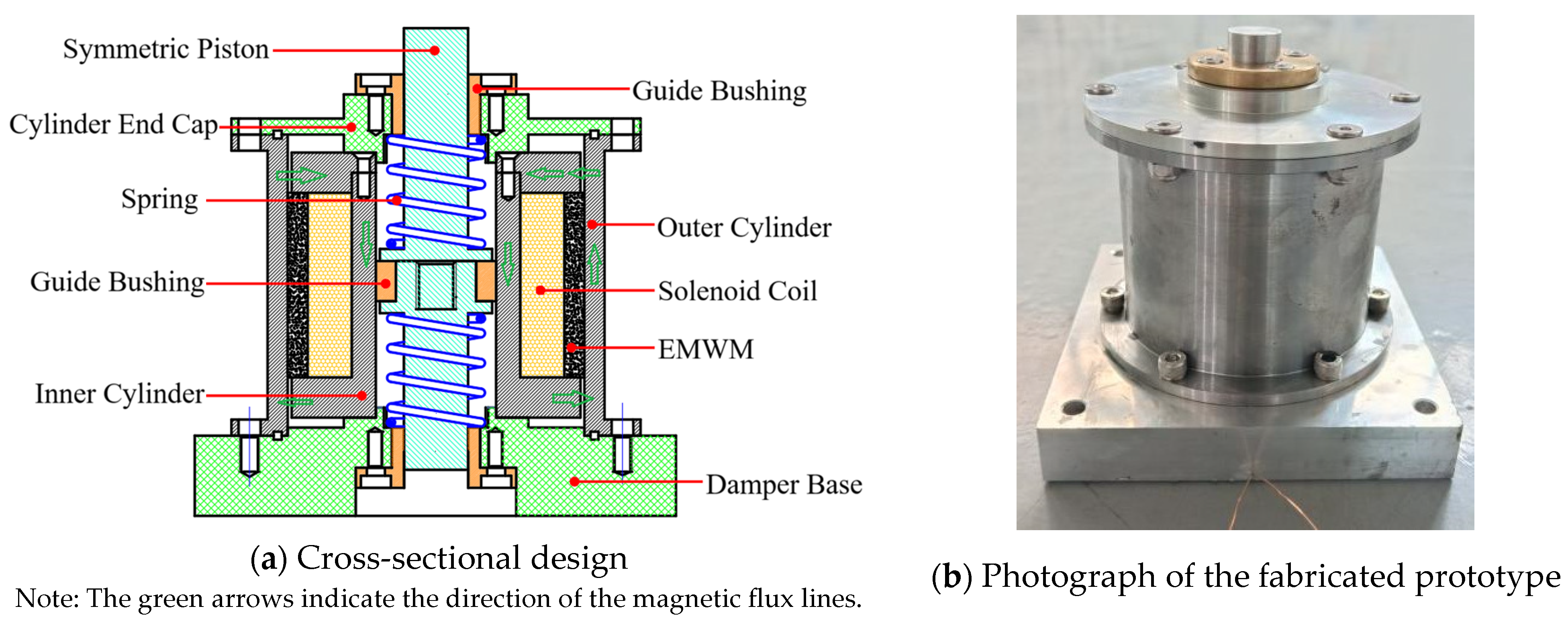
The intelligent damper under investigation, whose schematic cross-section is depicted in
Figure 1a, is characterized by a concentric dual-cylinder design. Its core novelty lies in the integration of three functional components:
- ①
Entangled Metal Wire Mesh (EMWM) Porous Matrix: A hollow cylindrical structure, manufactured from intertwined 304 stainless steel wires, is placed between the inner and outer magnetic cylinders. It serves as a permanent, deformable, and highly permeable flow channel that generates substantial distributed flow resistance (micro-orifice damping). Different from rigid porous media (e.g., metal foams), the compliant, three-dimensional network of the EMWM is expected to exhibit complex, rate-dependent fluid–structure interactions during dynamic loading.
- ②
Magnetorheological Fluid: Fills the voids within the EMWM and the annular damping gap. Its field-dependent yield stress is regulated by the magnetic field produced by a copper coil (1500 turns) wound around the inner cylinder.
- ③
Mechanical Springs and Symmetric Piston: Offer a baseline restoring force and guarantee centering, leading to symmetric compression-tension behavior.
A photograph of the actually fabricated EMWM-MR composite damper is presented in
Figure 1b. The successful fabrication of this physical device validates the manufacturability of the design and serves as the test specimen for all the experimental investigations reported in the subsequent sections.
When energized by a direct current (
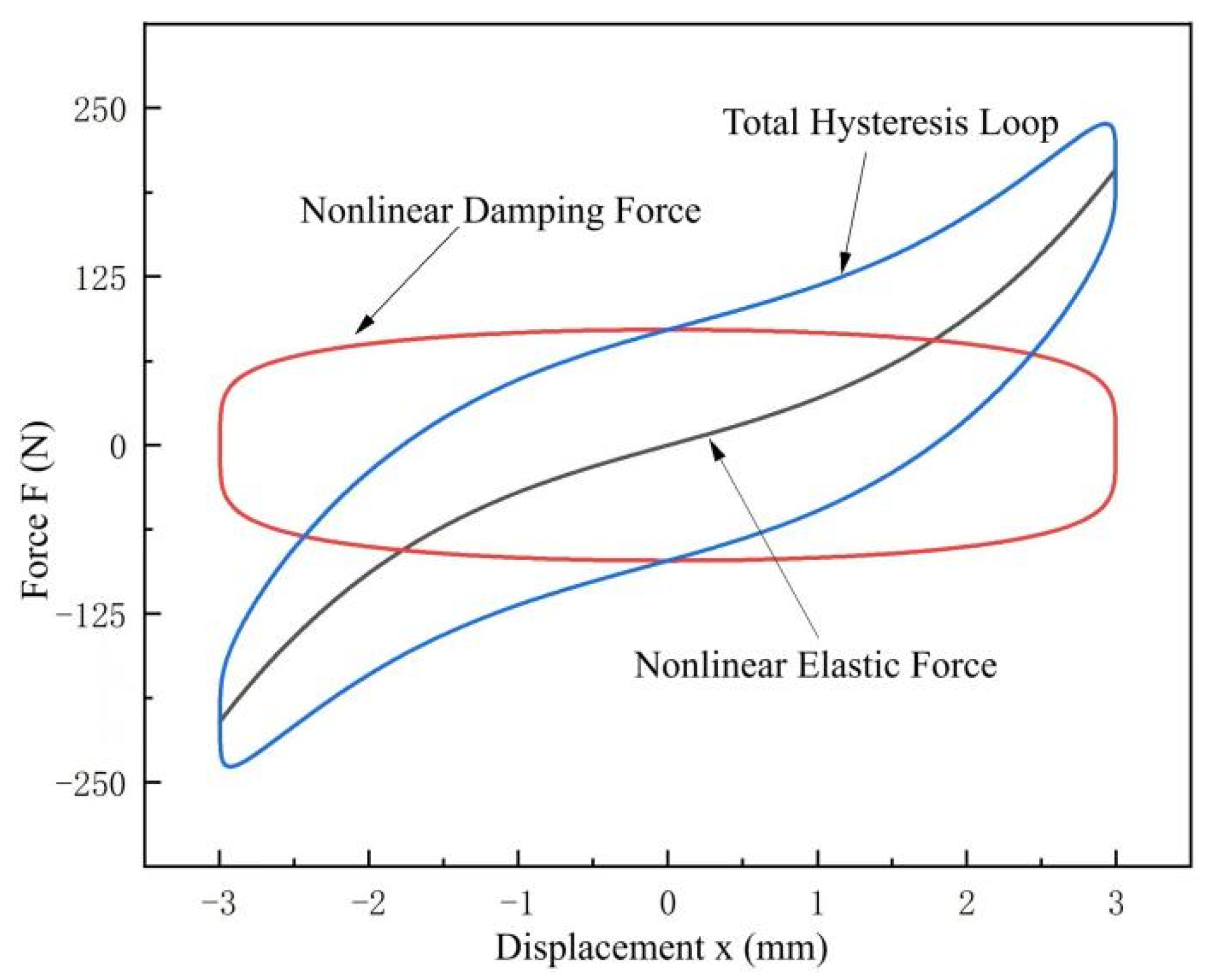
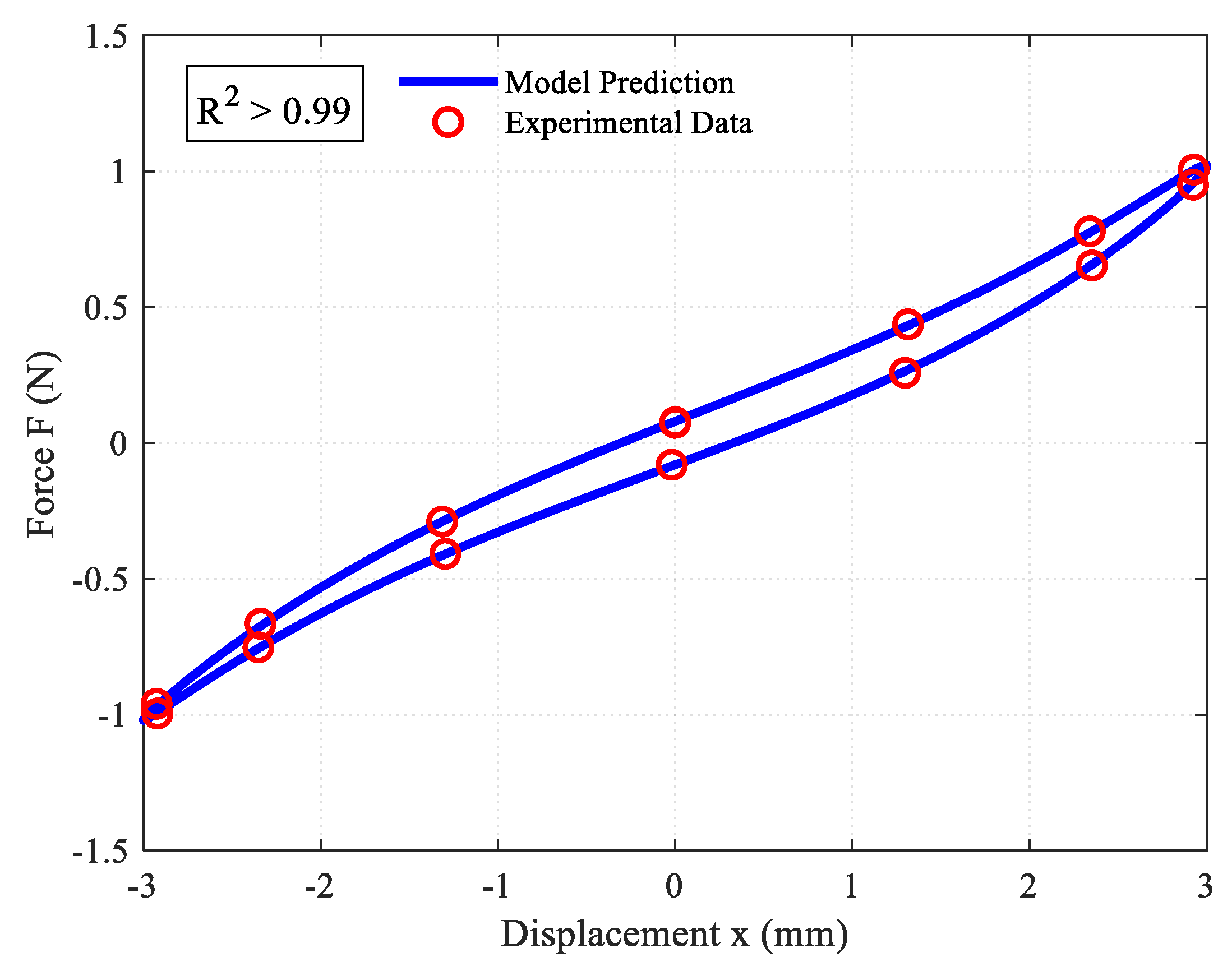
I), the magnetorheological (MR) fluid within the annular gap and the pores of the entangled metallic wire mesh (EMWM) generates a field-dependent yield stress. During the motion of the piston, the fluid is compelled to flow through both the narrow gap and the intricate, deformable interconnected pore network of the EMWM. The synergy between the field-induced shear resistance and the distributed porous flow resistance (the latter being modulated by both the magnetic field and the flow rate due to the EMWM’s compliance) gives rise to the highly nonlinear, tunable force–displacement hysteresis, as exemplified in
Figure 2. The symmetry of these hysteresis loops is a crucial observation that provides insights for the subsequent model structure.
2.2. Hysteresis Decomposition and Model Structure
The symmetrical characteristic of the measured hysteresis (
Figure 2) enables a fundamental decomposition of the total restoring force
F into a conservative, displacement-dependent component
Fk and a dissipative, velocity-dependent component
Fc [
13].
where
and
.
To verify the validity of this symmetry assumption under our experimental conditions, we computed the asymmetry factor for all tested (I, f) pairs; the factor remained below 3%, confirming excellent symmetry. Additionally, multiple consecutive cycles were overlaid and showed negligible variation, indicating that magnetic history and transient effects do not introduce measurable asymmetry. Therefore, the decomposition in Equation (1) is well justified for this symmetric damper design.
The elastic force (
Fk(
x)) is formulated as a cubic polynomial, which is demonstrated to be adequate for capturing the observed nonlinear stiffening characteristic.
In this context, k1 denotes the linearized stiffness, and k3 governs the amplitude-dependent hardening/softening behavior.
The damping force
utilizes a generalized power-law model to characterize the pronounced non-Newtonian, amplitude-dependent dissipation that has been observed [
14]:
The parameter c scales the overall magnitude of the damping. The exponent α defines the fundamental velocity-dependence of the damping force: when α = 1, it corresponds to linear viscous damping; α < 1 is typical of Bingham-plastic or shear-thinning behavior; whereas α > 1 indicates super-linear damping, which is often associated with inertial effects in fluid flow through porous media. This parameter will be of central importance in the subsequent mechanistic analysis of the composite’s dissipation.
2.3. The Proposed Bivariate Functional Model
The damper’s smart behaviour is governed by the magnetic field (controlled by
I) and is inherently frequency-dependent due to the coupled viscoelastic and fluid-dynamic response of the compliant EMWM matrix and the MR fluid. To capture this essential dual-input characteristic of the EMWM-MR composite, we propose a constitutive framework where all model parameters are explicit, continuous functions of both the control current
I and the excitation frequency
f:
Equation (4) forms the basis of the proposed framework. Unlike conventional models with fixed or univariate parameters, this formulation is specifically designed to embed the coupled I-f physics inherent to the EMWM-MR composite into a control-amenable mathematical form. Specifically:
- ①
k1(I, f) and k3(I, f) represent the dynamic stiffness modulated by both magnetic activation and excitation rate, reflecting the interplay between field-induced chain formation in the MR fluid and the strain-rate-dependent elasticity of the EMWM matrix.
- ②
c(I, f), and α(I, f) together capture the adaptive damping behavior, where the magnitude and fundamental velocity-dependence of dissipation are simultaneously shaped by the magnetic field and the fluid–structure interaction frequency.
Thus, the functions k1(I, f), k3(I, f), c(I, f), and α(I, f) are not merely empirical fits but mathematical representations of the underlying coupled physics. Identifying these functions from experimental data represents the first step towards a predictive and control-oriented constitutive law for this class of smart composite dampers. The subsequent identification and analysis of these functions, particularly α(I, f), will provide direct insight into the operational regimes and dominant dissipation mechanisms of the device.
3. Experimental Identification Methodology
3.1. Dynamic Testing Protocol
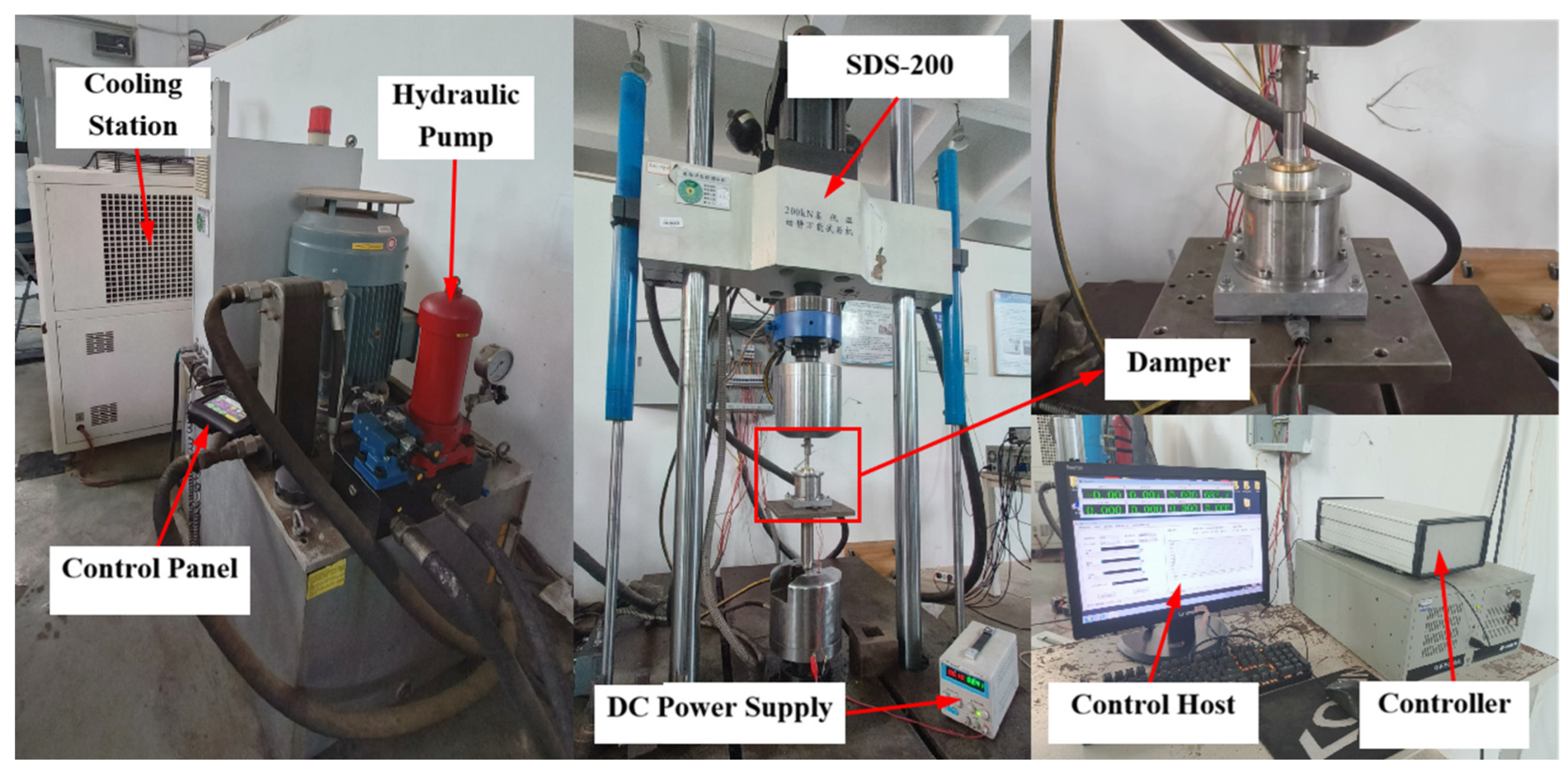
Dynamic characterization was carried out using a closed-loop electro-hydraulic servo testing system (SDS-200, Sinotest Equipment Co., Ltd., Changchun, China, maximum dynamic force ±200 kN, actuator stroke ±75 mm) under displacement-controlled sinusoidal excitation. The restoring force and displacement signals were synchronously recorded by the testing system’s built-in data acquisition module at a sampling rate of 5 kHz. The control current for the damper’s electromagnet was provided by an external programmable DC power supply (Guangzhou Feima Electric Co., Ltd., Guangzhou, China, model FPS3030D, 0–30 V/0–3 A). All tests were conducted at a controlled room temperature of 23 ± 1 °C. A fixed displacement amplitude of 3 mm was employed throughout to focus on the coupled current–frequency effects and to establish a baseline model within a defined operational regime.
Figure 3 shows a photograph of the complete experimental setup, illustrating the damper mounted on the testing machine, the DC power supply, and the data acquisition system.
To map the parameter space of the model in Equation (4), two targeted experimental series were designed to investigate the damper’s behavior in its key operational regimes:
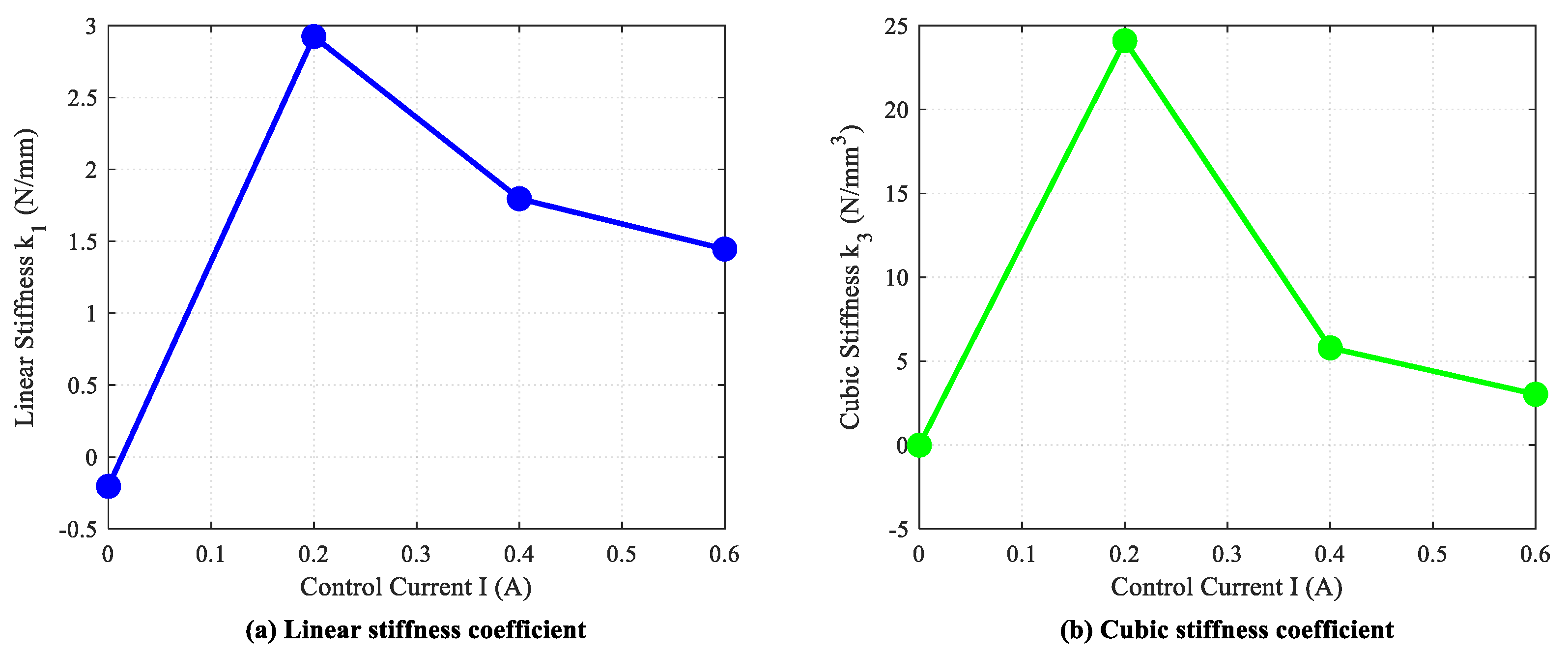
Current Sweep: The excitation frequency was fixed at f = 6.0 Hz. This frequency falls within a typical range for low-frequency vibration isolation, providing a relevant basis for characterizing current-dependent behavior. The control current was varied as I = {0.0, 0.2, 0.4, 0.6} A. The choice of 0.2 A increments was based on preliminary tests which showed that this step size adequately captures the non-monotonic trends, especially the peak near 0.2 A, while keeping the experimental matrix manageable.
Frequency Sweep: The control current was fixed at I = 0.4 A. This current level was chosen to ensure a clearly magneto-active state while avoiding full saturation, thereby capturing the tunable range of the composite’s response during the frequency sweep. The excitation frequency was varied as f = {1.5, 3.0, 4.5, 6.0} Hz, spanning a range relevant to fundamental isolation scenarios.
Force and displacement data were synchronously collected at a sampling rate of 5 kHz. For each (I, f) pair, data from five stable cycles were averaged to obtain a representative hysteresis loop for analysis.
3.2. Two-Step Parameter Identification Procedure
The symmetric hysteresis loops (
Figure 2) confirm the validity of the force decomposition in Equation (1) for this composite damper, enabling a straightforward two-step identification procedure consistent with methods for symmetric hysteretic systems [
13].
For each recorded hysteresis loop , a two-step identification procedure was implemented:
Step 1—Identification of Elastic Parameters
A cubic polynomial fitted to the experimental data through ordinary least squares. This directly yields the estimates and . The symmetric mechanical configuration justifies the exclusion of even-order terms.
Step 2—Identification of Damping Parameters
The damping force component is isolated as:
By taking the logarithm of Equation (3), a linear relationship is derived:
Linear regression on the data then furnishes the estimates and . This linearization is valid because the power-law model (Equation (3)) implies a log-linear relationship between the force magnitude and the velocity magnitude.
This two-step approach is computationally efficient, physically interpretable, and capitalizes on the symmetric nature of the hysteresis to decouple the identification of stiffness and damping effects—a strategy that is well-established in the identification of nonlinear vibration isolators [
13].
This process yields discrete parameter sets for each experimentally tested (I, f) pair.
3.3. Functional Surface Fitting
To acquire the continuous functions requisite in Equation (4), the discrete parameter estimates for the EMWM-MR composite were fitted as surfaces across the (
I,
f) plane. Bivariate quadratic polynomials were selected due to their equilibrium between flexibility and parsimony and their ability to capture the dominant trends and interactions within the tested operational window:
where
θ denotes any one of the four parameters
k1,
k3,
c, or
α. Least-squares fitting yielded four sets of coefficients
βθ, which collectively define the identified bivariate functional model for the composite damper.
5. Discussion
5.1. Interpretation of the Bivariate Functional Form
This study establishes a constitutive modeling framework tailored for the EMWM-MR composite damper, wherein all parameters are explicit, continuous functions of both the control current
I and the excitation frequency
f. This formulation directly addresses a prevalent simplification in the modeling of adaptive dampers, where parameters are commonly regarded as constants or as univariate functions solely dependent on the magnetic field [
15,
16]. Traditional phenomenological models, such as the widely used Bouc-Wen or Bingham-type models [
15,
16], rely on frequency-independent parameters and are effective for characterizing conventional MR dampers under steady-state or narrowband conditions. However, their functional dimensionality may be insufficient to fully capture the dynamic interaction between the magnetic field effect and the frequency-dependent fluid–structure interaction inherent in the EMWM-MR composite.
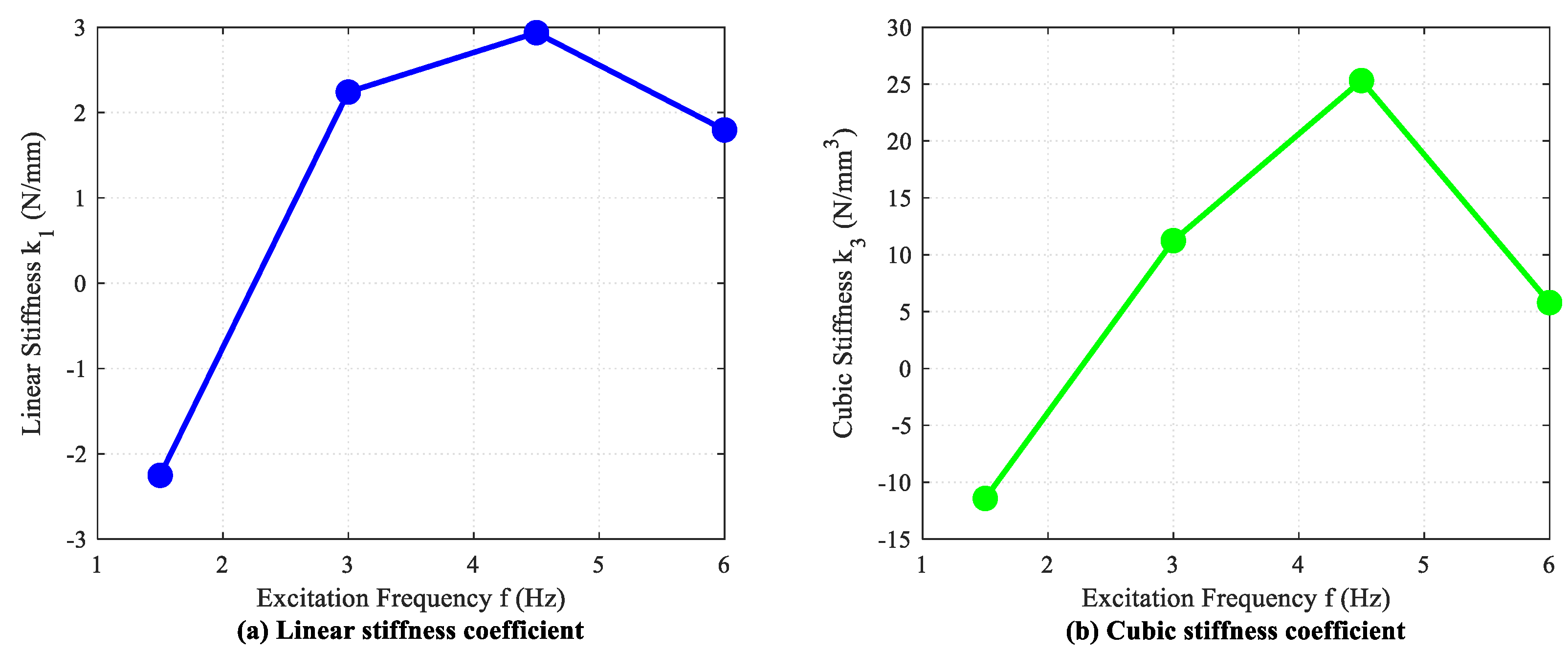
The experimental data underscore the necessity of this bivariate approach. The observed frequency dependence, particularly the non-monotonic ‘peak’ in dynamic stiffness (
Figure 6a,b), indicates that the resistive properties of the damper are not static. They emerge dynamically from the rate-dependent competition between the field-induced yielding of the MR fluid and the viscoelastic/fluid-dynamic response of the compliant EMWM matrix. By explicitly incorporating this dual-adaptive nature into a mathematical framework, our model bridges a crucial gap between the complex physics of the device and the requirements of control-oriented modeling. Thus, the proposed bivariate functional form is not merely an empirical extension but a necessary step towards accurate performance prediction under realistic, frequency-rich excitations for this class of smart composites.
5.2. Physical Significance of α > 1 and the Role of the EMWM
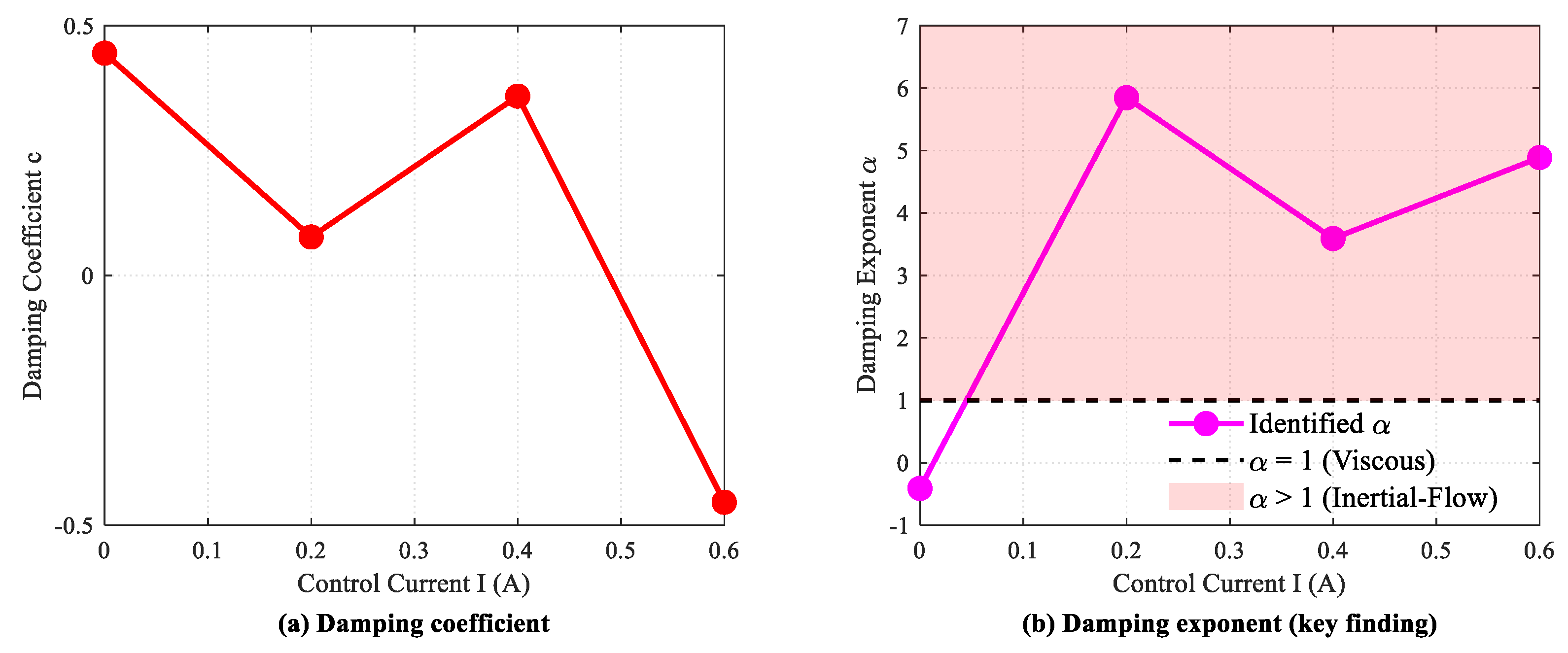
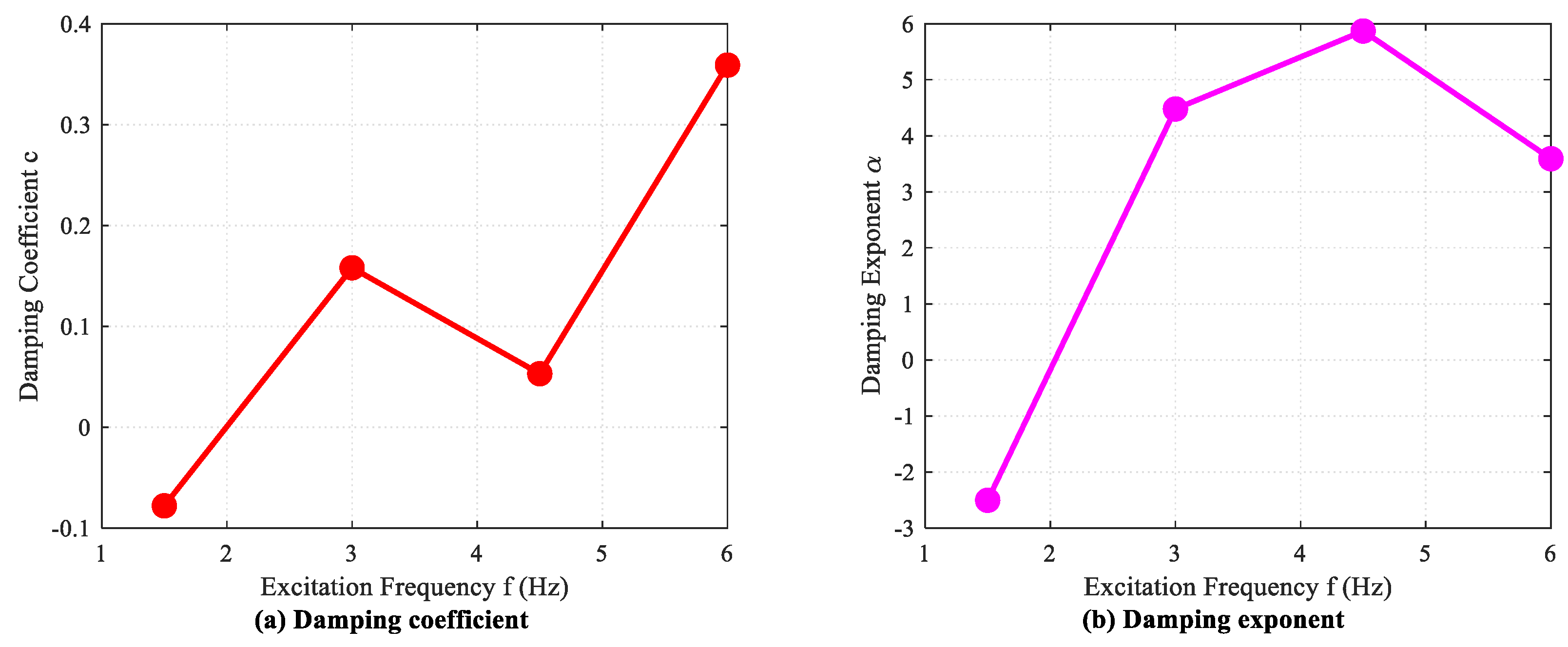
The most salient mechanistic insight from this study is the consistent identification of a damping exponent
α greater than unity across the tested operational range (
Figure 5b and
Figure 7b). This finding carries substantial physical implications. In traditional MR dampers operating in shear or flow mode, the damping force typically exhibits a linear (
α ≈ 1, viscous) or sub-linear (
α < 1, Bingham-plastic) dependence on velocity, as described by conventional models [
14]. The persistent super-linear dependence (
α > 1) observed here strongly suggests that the EMWM matrix plays a dominant role in altering the primary energy dissipation pathway.
This behavior is attributed to inertial flow resistance within the deformable yet persistent porous structure of the EMWM, leading to a non-Darcian flow regime. At sufficiently high velocities or Reynolds numbers, the linear relationship between pressure drop and velocity (Darcy’s law) breaks down due to significant inertial effects at the pore scale, classically described by the Forchheimer equation that includes a quadratic velocity term [
17]. The condition
α(
I,
f) > 1 serves as a direct quantitative indicator of this inertial-flow-dominated regime, implying that energy dissipation scales super-linearly with velocity, analogous to the inertial term in the Forchheimer equation.
To provide a quantitative basis for this interpretation, we estimate the pore-scale Reynolds number
. According to the material specifications (MRF-A178, Shenzhen Bohai New Materials Technology Co., Ltd., Shenzhen, China), the MR fluid density is
ρ = 2.72 × 10
3 kg/m
3 and the zero-field viscosity is μ = 0.072 Pa·s. The EMWM used in the composite has a porosity of ε = 0.823 and is fabricated from 0.3 mm diameter stainless steel wires; following the theoretical framework for EMWM established by Guo et al. [
18], the characteristic pore diameter is estimated as
dp ≈ 0.4 mm. For the maximum excitation frequency of 6 Hz and amplitude 3 mm, the peak piston velocity is
vpiston = 2πfA = 0.113 m/s. Assuming the fluid is forced through the porous EMWM, the interstitial velocity is approximately
v =
vpiston/ε ≈ 0.14 m/s. Substituting these values yields
Rep ≈ 2.1. This value falls within the typical transition range for the onset of inertial effects in porous media (
Re ~ 1–10) [
17], confirming that the flow is likely to enter the non-Darcy regime. Therefore, the identified
α > 1 is consistent with a transition toward inertial-flow-dominated dissipation.
Consequently, our results demonstrate a transition from the field-induced, shear-dominated dissipation characteristic of conventional MR devices to a matrix-induced, inertial-flow-dominated dissipation enabled by the EMWM. This mechanistic understanding not only explains the enhanced energy dissipation capacity of the composite damper but also validates the design rationale of utilizing a compliant metallic porous matrix as an active functional element to exploit inertial effects. This distinguishes EMWM-enhanced MR dampers from their traditional counterparts, presenting a new paradigm for achieving high, tunable damping through pore-scale fluid dynamics tailored by both magnetic field and excitation frequency.
5.3. Model Utility, Limitations, and Future Extensions
The fully parameterized model (
Table 1) provides a control-oriented constitutive tool for system simulation and model-based control within the characterized operational regime. Its explicit functional form facilitates straightforward implementation in dynamic simulation environments for performance prediction under realistic conditions. It is important to clarify the status of the proposed model: it is a high-quality, regime-based parameterization that accurately captures the damper’s behavior within the experimental range used for identification. While it is inspired by the underlying physics and yields physically meaningful parameters, it should not be considered a full constitutive model in the strict sense (i.e., derived from first principles). Rather, it serves as a practical engineering tool that embeds the dominant coupled
I-
f dynamics into a compact mathematical form, making it readily usable for simulation and control design.
A key aspect of the current model is its defined scope. Identification and validation were conducted at a fixed displacement amplitude of 3 mm and within a frequency range of 1.5–6.0 Hz. Thus, the model is validated for this low-amplitude, low-frequency domain, which encompasses many isolation scenarios. Within this range, the model achieves high fidelity and reliable interpolation, making it a ready-to-use tool for preliminary design and control synthesis. Extrapolation to significantly different amplitudes or frequencies may lead to inaccurate predictions because the parameters k3, c, and α are likely amplitude-dependent. Moreover, the bivariate quadratic functions used to represent parameter surfaces are empirical and should not be extrapolated far beyond the fitted domain.
The identified parameter functions also offer quantitative guidance for design optimization. For instance, the EMWM porosity or wire diameter could be tailored to shape the inertial damping characteristics reflected in c(I, f) and α(I, f), and the MR fluid could be selected based on its impact on the stiffness functions k1(I, f) and k3(I, f).
In summary, the model strikes a balance between clarity, identifiability, and direct utility. The provided coefficients enable straightforward implementation, while the functional dependencies, especially α(I, f) > 1, offer clear physical insight and quantitative targets for the co-design of next-generation adaptive dampers based on EMWM-MR composites. Future investigations will focus on extending the framework to a tri-variate formulation F(I, f, A) that incorporates amplitude dependence, and on validating the model under broader excitation conditions, including random and impact-like loads. Within its validated range, however, the model provides a reliable and computationally efficient representation of the EMWM-MR damper’s hysteresis.
5.4. Implications for Frequency-Aware Semi-Active Control
From a control perspective, the explicit, physics-transparent, and functionally parameterized structure of the proposed model makes it well-suited for the synthesis of advanced model-based control strategies. The bivariate functions k1(I, f), c(I, f), and α(I, f) provide a direct mathematical mapping from the operational inputs (current I, instantaneous dominant frequency f) to the damping force output.
This formulation enables algorithms, such as Model Predictive Control (MPC) or Inverse Dynamics Control, to solve in real-time for the suitable control current
I(
t). Importantly, the model can be directly embedded into the prediction equation of an MPC framework. By incorporating real-time estimates of the spectral content of the disturbance (or its dominant frequency
f), the controller can compute the current
I required to achieve a desired force or motion trajectory, thereby enabling truly frequency-aware semi-active control. This paradigm has the potential to outperform traditional, frequency-oblivious heuristics, such as skyhook or groundhook control [
19,
20], particularly under transient or broadband excitations. By providing an accurate and computationally efficient constitutive relation that captures the coupled (
I-
f) dynamics within the characterized regime, this research supplies the essential plant model layer needed for implementing such next-generation adaptive control systems in intelligent vibration isolation applications utilizing EMWM-MR composites.
6. Conclusions
This research develops a practical, control-oriented constitutive framework for modeling the hysteresis behavior of an Entangled Metallic Wire Mesh–Magnetorheological (EMWM-MR) composite damper. The model is specifically structured as , where all parameters are explicit bivariate functions of the control current I and excitation frequency f. The primary contributions of this work are as follows:
It proposes a first bivariate functional modeling framework specifically tailored for the EMWM-MR composite damper. This framework directly captures the coupled current-frequency dynamics inherent to this smart composite, providing a physics-informed structure that decouples and quantifies the nonlinear elastic and damping components.
A systematic two-step identification methodology yields fully parameterized, ready-to-implement functions for k1(I, f), k3(I, f), c(I, f), and α(I, f). The model demonstrates high accuracy (R2 > 0.99) within the characterized low-frequency, small-amplitude regime and exhibits reliable predictive capability for interpolated operating conditions, as further confirmed by leave-one-out cross-validation.
The framework provides a key mechanistic insight: the consistently identified damping exponent α > 1 quantifies a transition to an inertial-flow-dominated dissipation regime within the EMWM matrix. Pore-scale Reynolds number estimates (Rep ≈ 2.1) support the interpretation that non-Darcian flow is responsible for this super-linear damping. This finding distinguishes the composite’s behavior from that of conventional MR dampers and links macroscopic performance to non-Darcian flow physics at the pore scale.
The identified model serves as a direct foundation for simulation and frequency-aware control design in low-frequency vibration isolation applications. The explicit parameter functions enable efficient implementation in dynamic models and offer a clear pathway for synthesizing advanced, model-based semi-active control strategies.
In summary, this study delivers both a usable engineering tool and fundamental insight into the adaptive dynamics of field-responsive porous composites. The coefficients provided in
Table 1 constitute a complete, implementable model for the studied operational range. Future work will focus on extending this framework into a tri-variate form
to encompass amplitude-dependent effects and broader frequency ranges for enhanced applicability in broadband vibration control.