Design and Implementation of a Low-Cost Dual-Structure Laser Shooting System with Physical and Web-Based Targets for School Physical Education


Abstract
1. Introduction
- (1)
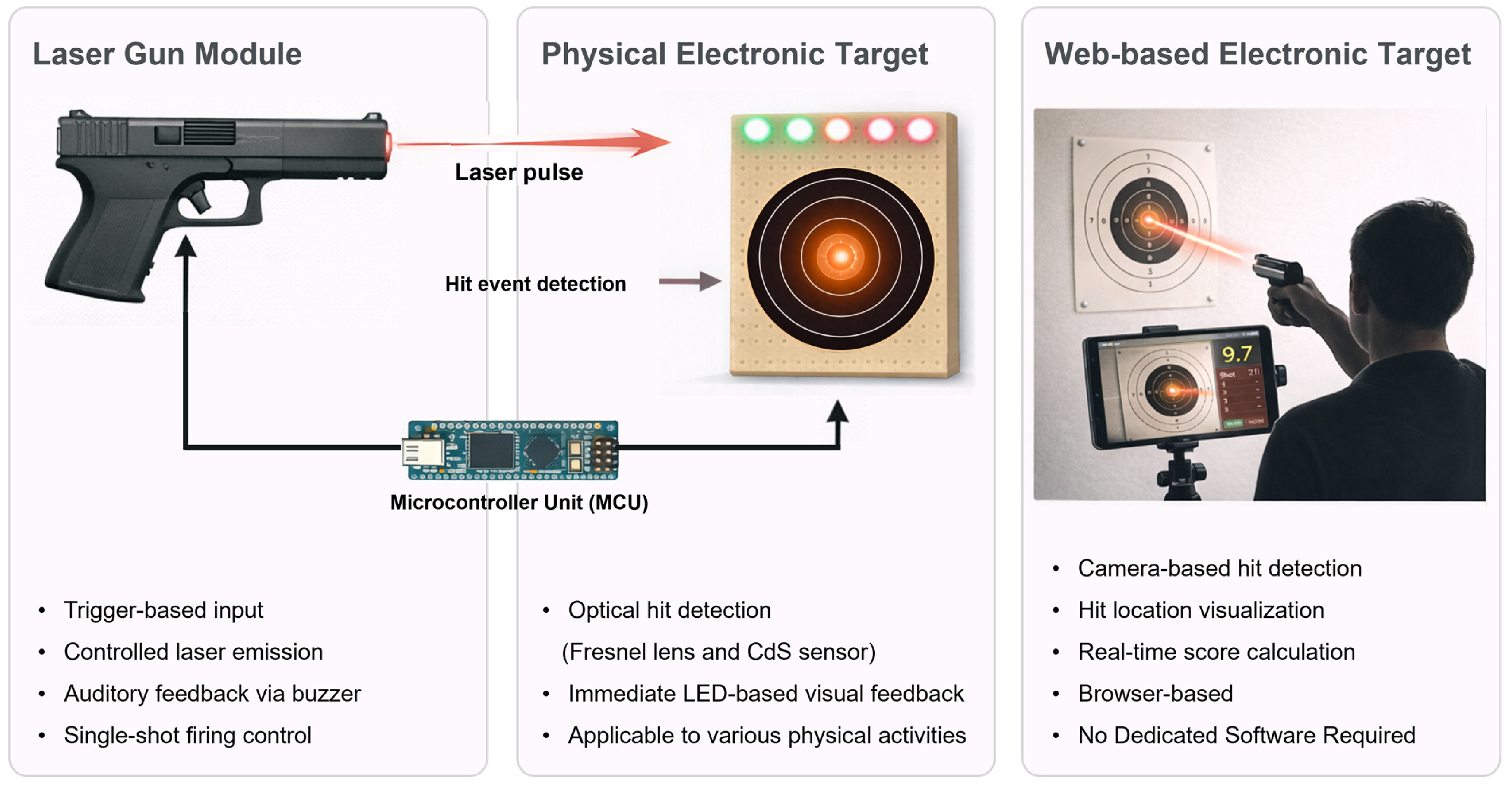
- Architecture: We propose a low-cost, open, dual-structure architecture that integrates a physical electronic target and a web-based electronic target using off-the-shelf components and browser-based software, addressing key cost and scalability limitations of existing commercial and prototype systems.
- (2)
- Safety and deployment: We implement and experimentally validate a safety-embedded laser control mechanism and modular hardware structure tailored for deployment in school physical education and recreational settings, explicitly documenting safety-related design and control logic.
- (3)
- Integrated evaluation and guidelines: We provide an integrated design and performance evaluation of both target modules, establishing practical implementation guidelines for combining immediate physical feedback with digital logging and visualization in instructional shooting environments.
2. Materials and Methods
2.1. System Concept and Design Requirements
2.2. System Implementation
2.2.1. Laser-Gun Module
2.2.2. Physical Electronic Target Module
2.2.3. Web-Based Target System
2.3. Experimental Setup and Validation
2.3.1. Experimental Environment and System Configuration
2.3.2. Shooting Protocol and Trial Structure
2.3.3. Measurement Variables and Evaluation Metrics
- Hit detection rate, defined as TP/(TP + FN) × 100 for the physical electronic target module.
- Agreement (exact match), defined as the proportion of trials in which both the numeric score and the hit/miss classification matched the manually labeled ground truth for the web-based electronic target module.
- False-positive occurrence, defined as the number of false detections recorded during miss trials (i.e., FP counts).
2.3.4. Expert Validation Procedure
2.3.5. Field Operation Safety Guidelines
3. Results
3.1. Single-Shot Control and Abnormal Event Suppression
3.2. Laser Emission Timing Characteristics
3.3. Hit and Miss Detection Performance of the Physical Electronic Target
3.4. Score Agreement and Hit/Miss Classification Performance of the Web-Based Electronic Target
3.5. Expert Validation Results
4. Discussion
4.1. Interpretation of System Design Outcomes and Expert Validation
4.2. Technical Contributions Through Comparison with Prior Studies
4.3. Practical Implications for Educational and Recreational Deployment
5. Conclusions
Supplementary Materials
Author Contributions
Funding
Institutional Review Board Statement
Informed Consent Statement
Data Availability Statement
Conflicts of Interest
References
- da Silva, F.M.; Sousa, P.M.; Pinheiro, V.B.; López-Torres, O.; Roman, I.R.; Mon-López, D. Which are the most determinant psychological factors in Olympic shooting performance? A self-perspective from elite shooters. Int. J. Environ. Res. Public Health 2021, 18, 4637. [Google Scholar] [CrossRef] [Scilit]
- Wu, T.-Y.; Nien, J.-T.; Kuan, G.; Wu, C.-H.; Chang, Y.-C.; Chen, H.-C.; Chang, Y.-K. The effects of mindfulness-based intervention on shooting performance and cognitive functions in archers. Front. Psychol. 2021, 12, 661961. [Google Scholar] [CrossRef] [Scilit] [PubMed]
- Union Internationale de Pentathlon Moderne (UIPM). Laser Run. Available online: https://www.uipmworld.org/events/laser-run (accessed on 29 January 2026).
- Union Internationale de Pentathlon Moderne (UIPM). 2025 UIPM Para Laser Run Competition Guidelines; UIPM: Lausanne, Switzerland, 2025; Available online: https://www.uipmworld.org/sites/default/files/2025_uipm_para_laser_run_competition_guidelines.pdf (accessed on 29 January 2026).
- Turner, L.; Johnson, T.G.; Calvert, H.G.; Chaloupka, F.J. Stretched too thin? The relationship between insufficient resource allocation and physical education instructional time and assessment practices. Teach. Teach. Educ. 2017, 68, 210–219. [Google Scholar] [CrossRef] [Scilit]
- Nariz, F.A., II. Advancing Inclusive Physical Education, Fitness, and Wellness: Bridging Gaps for Students with Disabilities in Academic and Community Settings. IJSAT-Int. J. Sci. Technol. 2025, 16. [Google Scholar] [CrossRef] [Scilit]
- Zhang, J.; Xin, J.; Xu, T.; Liu, Y. A Low-Cost Simulation System for Shooting Training Based on Image Processing. In Proceedings of the Chinese Intelligent Automation Conference (CIAC 2025), Singapore, 4–6 July 2025; Springer Nature: Singapore, 2025; pp. 57–66. [Google Scholar] [CrossRef] [Scilit]
- Fedaravičius, A.; Pilkauskas, K.; Slizys, E.; Survila, A. Research and development of training pistols for laser shooting simulation system. Def. Technol. 2020, 16, 530–534. [Google Scholar] [CrossRef] [Scilit]
- Hagara, L.; Lábr, M. Home LASER Shooting Simulator (HomeLESS); Technical Report; University of Defence in Brno: Brno, Czech Republic, 2016. [Google Scholar]
- IEC 60825-1:2014; Safety of Laser Products. International Electrotechnical Commission (IEC): Geneva, Switzerland, 2014.
- Sliney, D.H.; Wolbarsht, M.L. Safety with Lasers and Other Optical Sources; Plenum Press: New York, NY, USA, 1980. [Google Scholar]
- Sargent, J.; Calderón, A. Technology-enhanced learning physical education? J. Teach. Phys. Educ. 2022, 41, 689–709. [Google Scholar] [CrossRef] [Scilit]
- Soetedjo, A.; Mahmudi, A.; Ashari, M.I.; Nakhoda, Y.I. Detecting laser spot in shooting simulator using an embedded camera. Int. J. Smart Sens. Intell. Syst. 2014, 7, 423–441. [Google Scholar] [CrossRef] [Scilit]
- Soetedjo, A.; Mahmudi, A.; Ashari, M.I.; Nakhoda, Y.I. Low cost shooting simulator based on a single board computer. Am. J. Appl. Sci. 2015, 12, 130–141. [Google Scholar] [CrossRef] [Scilit]
- Casey, A.; Goodyear, V.A.; Armour, K.M. Rethinking the Relationship between Pedagogy, Technology and Learning in Health and Physical Education. Sport Educ. Soc. 2017, 22, 288–304. [Google Scholar] [CrossRef] [Scilit]
- Halverson, P.; Sheridan, K. The maker movement in education. Harv. Educ. Rev. 2014, 84, 495–504. [Google Scholar] [CrossRef] [Scilit]
- Saiz-González, P.; Sierra-Díaz, J.; Cecchini, J.A.; Fernandez-Rio, J. Digital technology use in physical education. Educ. Inf. Technol. 2025, 30, 18733–18748. [Google Scholar] [CrossRef] [Scilit]
- Jastrow, F.; Greve, S.; Thumel, M.; Diekhoff, H.; Süßenbach, J. Digital technology in physical education. Ger. J. Exerc. Sport Res. 2022, 52, 504–528. [Google Scholar] [CrossRef] [Scilit]
- Li, L.; Li, M.; Sun, W.; Li, Z.; Yang, Z. Spot detection for laser sensors. Sensors 2023, 23, 3891. [Google Scholar] [CrossRef] [Scilit] [PubMed]
- Moinuddin, A.; Goel, A.; Sethi, Y. The role of augmented feedback on motor learning. Cureus 2021, 13, e19695. [Google Scholar] [CrossRef] [Scilit] [PubMed]
- Casey, A.; Goodyear, V.A.; Armour, K.M. Digital Technologies and Learning in Physical Education; Routledge: London, UK, 2017. [Google Scholar]
- Dyson, B.; Grineski, S. Using cooperative learning structures in physical education. J. Phys. Educ. Recreat. Dance 2001, 72, 28–31. [Google Scholar] [CrossRef] [Scilit]
- Casey, A.; Goodyear, V.A.; Dyson, B.P. Model fidelity and students’ responses to an authenticated unit. J. Teach. Phys. Educ. 2015, 34, 642–660. [Google Scholar] [CrossRef] [Scilit]
- Haegele, J.A.; Wilson, W.J.; Zhu, X.; Bueche, J.J.; Brady, E.; Li, C. Barriers and facilitators to inclusion in integrated physical education. Eur. Phys. Educ. Rev. 2021, 27, 297–311. [Google Scholar] [CrossRef] [Scilit]
- Ertmer, P.A.; Ottenbreit-Leftwich, A.T. Teacher technology change. J. Res. Technol. Educ. 2010, 42, 255–284. [Google Scholar] [CrossRef] [Scilit]
- ISO 9241-11:2018; Ergonomics of Human-System Interaction—Part 11: Usability: Definitions and Concepts. International Organization for Standardization (ISO): Geneva, Switzerland, 2018.




| Pin | Connected Component | Signal Type /Configuration | Description |
|---|---|---|---|
| D6 | Micro switch | Digital input, active-low | Detects trigger press (short to GND when pressed). |
| D2 | Tilt switch | Digital input, active-low | Detects cocking action via orientation change. |
| D5 | Laser module | Digital output | Drives the laser module with a time-limited pulse. |
| D4 | Piezo buzzer | Digital output | Provides sound feedback for cocking and firing events. |
| VCC, GND | Power rail | DC supply | Powered by three AAA cells; VCC/GND supplied via a USB power connector. |
| Pin | Connected Component | Signal Type/Configuration | Description |
|---|---|---|---|
| A0 | CdS photoresistor | Analog input | Detects laser hits based on a rapid increase in illuminance. |
| D7 | Addressable RGB LED strip | Digital output (single-wire data) | Drives addressable RGB LEDs for immediate visual feedback on hit events. |
| VCC, GND | Power rail | DC supply | Powered by three AAA cells; VCC/GND supplied via a USB power connector. |
| Scenario | Trials | Abnormal Events | Error % (95% CI) | Notes |
|---|---|---|---|---|
| S1: Long press (2 s) | 20 | 0 | 0.0 (0.0–16.8) | No unintended repeat firing |
| S2: Rapid presses (20) | 20 | 0 | 0.0 (0.0–16.8) | Lockout function verified |
| S3: bounce/jitter | 20 | 0 | 0.0 (0.0–16.8) | Debounce and lockout verified |
| Total | 60 | 0 | 0.0 (0.0–6.0) | — |
| Item | Trials (n) | Double-Count Events (n) | Double-Count Rate % (95% CI) |
|---|---|---|---|
| Single-shot firing | 20 | 0 | 0.0 (0.0–16.8) |
| Total Trials (n) | Mean | SD | Min | Max | Range |
|---|---|---|---|---|---|
| 30 | 10.021 | 0.0021 | 10.016 | 10.024 | 0.008 |
| Illuminance (lx) | Incidence Angle (°) | TP | FN | Hit Detection Rate % (95% CI) | FP |
|---|---|---|---|---|---|
| 300 | 0 | 20 | 0 | 100.0 (83.2–100) | 0 |
| 15 | 20 | 0 | 100.0 (83.2–100) | 0 | |
| 30 | 19 | 1 | 95.0 (75.1–99.9) | 0 | |
| 600 | 0 | 20 | 0 | 100.0 (83.2–100) | 0 |
| 15 | 20 | 0 | 100.0 (83.2–100) | 0 | |
| 30 | 18 | 2 | 90.0 (68.3–98.8) | 0 | |
| 900 | 0 | 20 | 0 | 100.0 (83.2–100) | 0 |
| 15 | 20 | 0 | 100.0 (83.2–100) | 0 | |
| 30 | 17 | 3 | 85.0 (62.1–96.8) | 0 |
| Condition | Trials () | Exact Match () | Agreement (%) (95% CI) | FN | FP |
|---|---|---|---|---|---|
| Hit (scoring ring region) | 30 | 30 | 100.0 (88.4–100) | 0 | 0 |
| Miss (outside scoring region) | 30 | 30 | 100.0 (88.4–100) | 0 | 0 |
| Total | 60 | 60 | 100.0 (94.0–100) | 0 | 0 |
| Evaluation Dimension | Mean (M) | SD | S-CVI/Ave |
|---|---|---|---|
| Safety | 5.00 | 0.00 | 1.00 |
| Functionality | 4.78 | 0.43 | 1.00 |
| Cost Efficiency | 5.00 | 0.00 | 1.00 |
| Ease of Fabrication and Maintenance | 4.61 | 0.50 | 1.00 |
| Applicability | 4.89 | 0.32 | 1.00 |
Disclaimer/Publisher’s Note: The statements, opinions and data contained in all publications are solely those of the individual author(s) and contributor(s) and not of MDPI and/or the editor(s). MDPI and/or the editor(s) disclaim responsibility for any injury to people or property resulting from any ideas, methods, instructions or products referred to in the content. |
© 2026 by the authors. Licensee MDPI, Basel, Switzerland. This article is an open access article distributed under the terms and conditions of the Creative Commons Attribution (CC BY) license.
Share and Cite
Kwon, Y.; Kim, D.; Yang, D.; Kang, M.; Cho, G. Design and Implementation of a Low-Cost Dual-Structure Laser Shooting System with Physical and Web-Based Targets for School Physical Education. Appl. Sci. 2026, 16, 3347. https://doi.org/10.3390/app16073347
Kwon Y, Kim D, Yang D, Kang M, Cho G. Design and Implementation of a Low-Cost Dual-Structure Laser Shooting System with Physical and Web-Based Targets for School Physical Education. Applied Sciences. 2026; 16(7):3347. https://doi.org/10.3390/app16073347
Chicago/Turabian StyleKwon, Yongchul, Donghyun Kim, Dongsuk Yang, Minseo Kang, and Gunsang Cho. 2026. "Design and Implementation of a Low-Cost Dual-Structure Laser Shooting System with Physical and Web-Based Targets for School Physical Education" Applied Sciences 16, no. 7: 3347. https://doi.org/10.3390/app16073347
APA StyleKwon, Y., Kim, D., Yang, D., Kang, M., & Cho, G. (2026). Design and Implementation of a Low-Cost Dual-Structure Laser Shooting System with Physical and Web-Based Targets for School Physical Education. Applied Sciences, 16(7), 3347. https://doi.org/10.3390/app16073347