


Abstract
In competitive sport, an athlete’s success is often linked to their physical strength, skill, and overall athletic ability. However, physical talent alone does not fully account for sporting success, as psychological and other personal factors also play a crucial role in achieving high performance. Thus, the present cross-sectional study aimed to examine the relationships between perfectionistic personality characteristics, achievement goal orientations, and trait anxiety among young football players using correlation and regression analyses. Participants consisted of 152 male U16 football players (M = 15.67, SD = 0.54) competing in the official league organized by the Cyprus Turkish Football Federation (CTFF). Data were collected using the Sport Multidimensional Perfectionism Scale (SMPS), the 2 × 2 Achievement Goals Questionnaire for Sport (AGQ-S), and the State Trait Anxiety Inventory (STAI). Pearson’s correlation analyses and simple linear regression models were conducted to examine relationships among variables and to identify significant predictors of trait anxiety. Correlation analyses revealed that trait anxiety was positively associated with concern over mistakes (r = 0.28, p < 0.01), perceived parental pressure (r = 0.17, p < 0.05), and mastery-avoidance goals (r = 0.37, p < 0.01), whereas it was negatively associated with mastery-approach goals (r = −0.18, p < 0.05). Regression analyses indicated that concern over mistakes significantly predicted trait anxiety (β = 0.25, p = 0.003), while perceived parental pressure was not a significant direct predictor (β = 0.10, p = 0.21). In addition, mastery-avoidance goals significantly predicted trait anxiety (β = 0.43, p < 0.001), whereas mastery-approach goals were negatively associated with trait anxiety (β = −0.28, p < 0.001). In conclusion, the findings indicate that perfectionistic concerns and mastery-avoidance goals are key factors associated with higher trait anxiety, whereas mastery-approach orientations may serve as a protective factor among young football players.
1. Introduction
Achieving elite status in sport generally requires long-term engagement in structured training beginning in early childhood, demanding sustained commitment, discipline, and perseverance [1]. While athletic success is often associated with physical attributes and technical skills, these factors alone may be insufficient to fully explain performance outcomes, as psychological and personal characteristics also play a crucial role [2]. Despite such long-term investment, only a small proportion of junior athletes advance to the senior elite level, while many withdraw due to exhaustion, reduced motivation, or psychological strain. The factors that shape these different outcomes are multifaceted, encompassing both motivational and psychological dimensions [3].
Young athletes represent a critical developmental period characterized by increased sensitivity to evaluation, performance pressure, and social comparison. During this stage, young athletes are more vulnerable to anxiety-related responses due to ongoing psychological and emotional development [4,5]. Moreover, football, as a highly competitive and performance-oriented team sport, places substantial demands on athletes through constant evaluation, external expectations, and competitive stress [6,7]. These characteristics make youth football a particularly relevant context for examining the interplay between perfectionism, achievement goals, and anxiety.
Anxiety is a widely recognized construct in sport psychology, influencing both performance and athlete development [2,6]. It is commonly conceptualized as comprising both cognitive and somatic components, reflecting psychological processes such as worry, fear of failure, and perceived physiological responses [8,9]. In addition to these subjective dimensions, anxiety has also been examined in clinical and physiological research using objective indicators such as cortisol levels and autonomic responses [10]. Accordingly, the present study focuses more on cognitive constructs and evaluates trait anxiety using validated self-report measures within a youth sport context.
Within this framework, Spielberger et al. [11] have distinguished between trait and state anxiety, where trait anxiety reflects a stable predisposition to perceive situations as threatening, and state anxiety represents a temporary emotional response to specific situations [8,12]. In youth sport contexts, trait anxiety is particularly important due to its relatively enduring nature [2], as individuals with higher levels of trait anxiety tend to exhibit stronger anxiety responses in performance-related situations [13,14]. Elevated levels of trait anxiety may be associated with maladaptive emotional reactions and negative sport experiences over time [15,16]. However, it has also been suggested that moderate levels of anxiety may be a necessary motive for athletes in performance under certain conditions [17]. These contrasting perspectives may highlight the multidimensional nature of anxiety and emphasize the role of individual differences in shaping how anxiety is experienced and regulated [18]. For instance, lower psychological profiles have been associated with higher anxiety levels, whereas more developed cognitive and social skills are linked to lower anxiety [6]. In this regard, personality characteristics have been identified as key factors in understanding anxiety in sport [19]. In the present study, perfectionism is a fundamental construct influencing young athletes’ interpretations of performance demands and long-term anxiety tendencies.
Perfectionism is a multidimensional personality characteristic involving the pursuit of high-performance standards and a tendency toward a critical self-evaluation [20,21]. Although striving for excellence may support development, perfectionism has also been associated with maladaptive outcomes in youth sport [22,23]. Accordingly, researchers commonly distinguish between adaptive (perfectionistic strivings) and maladaptive (perfectionistic concerns) dimensions of perfectionism [24]. Perfectionistic strivings are typically linked to personal standards and achievement-oriented motivation, while perfectionistic concerns involve excessive self-criticism, perceived external pressure, anxiety, and persistent feelings of inadequacy [25]. In particular, socially prescribed perfectionism, which reflects the perception that important others demand flawless performance, has been consistently associated with negative psychological outcomes such as stress and anxiety [3,21]. In contrast, self-oriented perfectionism is often conceptualized as a motivational form of striving that may be associated with more adaptive outcomes [20,24,26]. Recent research further supports this distinction, linking perfectionistic concerns to the frustration of basic psychological needs [27], negative emotional responses [28], amotivation [29], and higher levels of burnout [30]. On the other hand, perfectionistic strivings have been associated with improved performance [26], greater intrinsic motivation [29], and stronger team cohesion [31]. In addition, the broader sport environment and motivational climates may influence how perfectionistic tendencies are experienced and expressed [32]. Importantly, perfectionism has been shown to relate differently to athletes’ motivational orientations and achievement goals [21]. Therefore, examining achievement goals alongside perfectionism is expected to provide a more comprehensive approach for understanding factors related to trait anxiety in youth athletes [22]. In this respect, achievement goal theory offers a suitable theoretical basis for the present study.
Achievement goal theory has been broadly applied for understanding how individuals define success and the drive behind behavior in achievement contexts [33,34]. Within this framework, goals are typically differentiated based on how competence is defined and whether it is approached or avoided. The 2 × 2 Achievement Goals Framework distinguishes between mastery-approach, mastery-avoidance, performance-approach, and performance-avoidance goals [35,36]. Mastery-approach goals stand for personal improvement and skill development, while mastery-avoidance goals reflect concerns about failing to improve or losing previously acquired competence [37]. In contrast, performance-approach goals involve striving to outperform others, while performance-avoidance goals are characterized by efforts to avoid underperforming compared to others [38]. These goal orientations have been shown to be differently associated with athletes’ motivation, emotional experiences, and performance-related outcomes. Beyond individual goal orientations, the motivational climate created by coaches has been identified as an important contextual factor that may shape how athletes interpret success and regulate their behavior. In particular, task-oriented climates have been associated with more adaptive motivational patterns and lower levels of anxiety, whereas ego-oriented climates may be linked to increased pressure and maladaptive emotional responses in youth sport settings [31,39]. Within this context, task-oriented motivational climates may be aligned with mastery-approach tendencies that emphasize learning and personal improvement, whereas ego-oriented climates may be associated with avoidance-based orientations characterized by concerns about failure and negative evaluation. Hence, the 2 × 2 Achievement Goals Framework is adopted in this study as a theoretical basis for examining the motivational processes associated with trait anxiety in youth athletes.
While anxiety in sport has received substantial recognition as a crucial factor influencing athletes’ performance and motivation [2], the existing literature has predominantly focused more on state anxiety [39,40,41,42,43,44] with comparatively less attention given to more stable forms like trait anxiety, particularly in youth sport contexts. Given that trait anxiety represents a relatively stable and enduring psychological disposition, examining trait anxiety may offer valuable insights into the persistent nature of anxiety-related tendencies and their role in adolescents’ developmental processes. In addition, youth sport studies conducted within the context of the Turkish Republic of North Cyprus (TRNC) remain limited [45,46], particularly in relation to psychosocial domains. Investigating these processes within the TRNC context may therefore provide context-specific insights into how youth sport environments shape athletes’ psychological experiences and development.
Accordingly, the present study adopts a cross-sectional correlational design to examine the relationships between perfectionism, achievement goal orientations, and trait anxiety among U16 football players in the TRNC. By focusing on trait anxiety within an underrepresented context, the study aims to contribute to the literature through a more nuanced understanding of trait anxiety in youth sport and to offer practically relevant insights for key stakeholders, including coaches, parents, and youth sport organizations. In light of these, the three main research hypotheses are listed below:
- (1)
- Perceived parental pressure will be positively associated with trait anxiety among young football players.
- (2)
- Avoidance-oriented achievement goals (mastery-avoidance and performance-avoidance) will be positively associated with higher trait anxiety levels, whereas approach-oriented goals will be associated with lower or non-significant levels of trait anxiety.
- (3)
- Concern over mistakes will be positively associated with trait anxiety among young football players.
2. Materials and Methods
This study was designed as a cross-sectional, quantitative correlational study conducted in the Turkish Republic of Northern Cyprus (TRNC).
2.1. Procedure
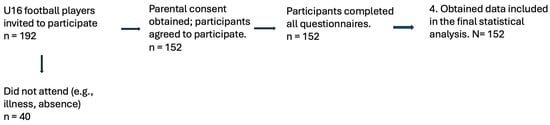
This study adopted a cross-sectional correlational design and employed simple linear regression analysis to examine the relationships among the dimensions of perfectionism, achievement goal orientations, and trait anxiety in U16 football players. Prior to data collection, ethical approval was obtained from the Ethics Committee of Girne American University (Approval Code: 2023-2024/8; Approval Date: 8 March 2024). Participants were recruited through direct contact with club representatives and coaches, from whom permission to conduct the study was obtained. Following approval, appointments were scheduled with each team. To ensure representation across different regions of the TRNC, data were collected through face-to-face visits to clubs across six provinces. In total, 12 teams participated in the study, including three teams from Nicosia (the capital), three teams from Famagusta, three teams from Güzelyurt, two teams from Kyrenia, and one team from Lefke. Data could not be collected from Iskele, as the only team in that region was unavailable during the data collection period. The inclusion criteria required participants to be active U16 football players competing in the U16 league and not older than 16 years of age. Accordingly, only players meeting these criteria were invited to participate, and no ineligible participants were included in the recruitment process. As all participants were minors, written informed consent was obtained from their parents prior to participation. In addition, the study procedures were clearly explained to the athletes, and voluntary participation was ensured through the signing of assent forms by the players. Data were collected using three questionnaires administered in a group setting at club facilities prior to training sessions. The questionnaires were completed sequentially, and each session, including the explanation of the study and completion of the instruments, lasted approximately one hour. The researcher was present during all data collection sessions to provide standardized instructions and to ensure consistency across teams. The same procedure was applied in all participating clubs. A total of 192 eligible players were invited to participate in the study. However, 40 players were unable to attend the scheduled sessions due to illness or other personal reasons, including the unavailability of parental consent at the time of data collection. No participants were excluded based on the inclusion criteria, as all invited players met the eligibility requirements. All participants who attended the sessions and provided the necessary consent forms took part in the study voluntarily. All data were collected anonymously and stored securely by the researchers in accordance with applicable data protection and confidentiality regulations (Figure 1).
Figure 1.
Flowchart of participant recruitment, participation, and inclusion in the study.
2.2. Participants
The participants of this study consisted of 152 male football players (N = 152) competing in the official U16 league organized by the Cyprus Turkish Football Federation (CTFF) during the 2024–2025 competitive season in the Turkish Republic of Northern Cyprus (TRNC). The mean age of the participants was 15.67 years (SD = 0.54). The sample included athletes from 12 different teams located across five provinces: Nicosia, Famagusta, Güzelyurt, Kyrenia, and Lefke. These teams were selected to provide representation across the main regions in which organized youth football is actively conducted in the TRNC. A convenience sampling strategy was employed, as access to participants was dependent on club availability and voluntary participation. The sampling process was designed to include teams from multiple regions and established football academies, ensuring a diverse and contextually representative sample of youth football players within the TRNC.
2.3. Measurements
2.3.1. Sport Multidimensional Perfectionism Scale (SMPS)
Dunn et al. [47] developed the Sport Multidimensional Perfectionism Scale (SMPS) in response to the need for a domain-specific measure of perfectionism in an athletic environment [48,49], adapting key principles from Frost et al.’s [50] Multidimensional Perfectionism Scale and Hewitt and Flett’s [51] conceptual framework. The scale consists of 30 items and four subdimensions: personal standards, concern over mistakes, perceived parental pressure, and perceived coach pressure. These dimensions reflect both the intrapersonal and interpersonal components of perfectionism, which are theorised to influence athletes’ motivation and affective experiences [47]. The Turkish adaptation and validation of the scale was conducted by Çepikkurt [52]. An exploratory factor analysis using varimax rotation yielded a revised structure of 19 items and three subdimensions (personal standards, concern over mistakes, and perceived parental pressure), explaining 46.2% of the total variance [44]. In this Turkish validation of the scale, the perceived coach pressure subscale from the original version did not emerge as a distinct factor, which aligns with previous research indicating that coach–athlete dynamics may vary across cultural settings [53]. Internal consistency coefficients obtained in the adaptation study were 0.76 for concern over mistakes, 0.76 for personal standards, and 0.77 for perceived parental pressure, indicating acceptable reliability levels. Test–retest reliability values measured at a 4-week interval ranged from 0.57 to 0.62, demonstrating moderate temporal stability [44]. Çepikkurt [52] reported in her study that reliability analyses yielded Cronbach’s alpha coefficients of 0.77 for the concern over mistakes subdimension, 0.67 for the personal standards subdimension, and 0.81 for the perceived parental pressure subdimension. These coefficients demonstrate satisfactory internal consistency for research purposes, especially within youth sport populations, where psychological constructs are often viewed as developmental and changeable [44,52].
2.3.2. 2 × 2 Achievement Goals Questionnaire for Sport (AGQ-S)
The 2 × 2 Achievement Goals Questionnaire for Sport (AGQ-S) was initially developed by Conroy et al. [54] to assess athletes’ mastery- and performance-based goals, particularly in a sport environment, utilizing an approach–avoidance framework derived from Elliot and McGregor’s [55] achievement goal theory. The questionnaire includes 12 items divided into four subdimensions: mastery-approach, mastery-avoidance, performance-approach, and performance-avoidance. Each subdimension reflects a distinct motivational orientation that affects athletes’ awareness and behavioral direction in sport. The scale uses a seven-point Likert format, ranging from “1 = Strongly Agree” to “7 = Strongly Disagree”. The Turkish version of the AGQ-S was developed by Kazak Çetinkalp [56], who affirmed the factorial validity of the four-factor model through confirmatory factor analysis. The study showed satisfactory fit indices (e.g., χ2/df ≈ 3.00, RMSEA ≤ 0.07, CFI ≥ 0.95, GFI ≥ 0.90), supporting the Turkish version’s conservation of the intended theoretical structure and its applicability with Turkish athletes. Internal consistency coefficients for the adapted form ranged from 0.73 to 0.94 across the four dimensions, indicating significant reliability in the Turkish sport context. Additionally, cross-cultural studies demonstrated that the AGQ-S maintains structural cohesion across age groups and elite levels, further supporting its appropriateness in youth sport [37]. Moreover, in another study, reliability analyses among U16 handball players yielded Cronbach’s alpha coefficients of 0.89 for mastery-approach, 0.77 for mastery-avoidance, 0.81 for performance-approach, and 0.69 for performance-avoidance [44]. These results revealed that the AGQ-S demonstrates adequate internal consistency within the targeted age group (U16) and is suitable for assessing motivational orientations in the context of youth football in the TRNC.
2.3.3. State Trait Anxiety Inventory (STAI)
The State Trait Anxiety Inventory (STAI) was initially developed by Spielberger et al. [11] to differentiate transient state anxiety and enduring trait anxiety, with the latter representing a general tendency to perceive situations as threatening [12]. The trait form consists of 20 items rated on a 4-point Likert scale, including both anxiety-present and anxiety-absent items, some of which are reverse-coded to provide a convenient measurement of the trait anxiety construct [12]. The STAI was adapted to Turkish by Öner and Le Compte [57]. Öner and Le Compte [57] adopted a standardised translation-back-translation procedure and verified the scale’s suitability in Turkish samples. The original two-factor conceptualisation and strong internal consistency were preserved, with Cronbach’s alpha coefficients typically ranging from 0.83 to 0.87 for the trait aspect [57]. Further studies have confirmed the reliability and factorial stability of the Turkish adaptation across clinical, educational, and athletic populations [58] and have confirmed the robustness of the trait anxiety construct within Turkish cultural contexts [59].
2.3.4. Statistical Analysis
All statistical analyses were performed using IBM SPSS version 22.0. The normality of the data was assessed using the Shapiro–Wilk test. As the data were normally distributed, parametric tests were applied, and the results are presented as mean and standard deviation. Descriptive statistics, including minimum and maximum values, were calculated for all variables. Pearson’s correlation analysis was conducted to examine the relationships among multidimensional sport perfectionism, achievement goals, and trait anxiety. Furthermore, simple linear regression analyses were performed to determine the predictive effects of perfectionism and achievement goals on trait anxiety. Effect sizes were interpreted based on correlation coefficients (r) and standardized regression coefficients (β).
3. Results
Descriptive statistics for all study variables are presented in Table 1, based on participants’ responses. Regarding perfectionism, participants reported moderate levels of concern about mistakes (M = 19.67, SD = 6.23) and perceived parental pressure (M = 17.01, SD = 5.86). Personal standards demonstrated the highest mean score (M = 24.44, SD = 3.98), indicating generally elevated goal-setting tendencies among athletes. Regarding achievement goals, participants demonstrated relatively high levels of mastery-approach orientation (M = 19.78, SD = 2.63), indicating a strong tendency toward improvement- and learning-focused goals. Performance-approach goals were also above the theoretical midpoint (M = 17.42, SD = 3.89). In contrast, mastery-avoidance (M = 14.40, SD = 4.80) and performance-avoidance (M = 14.48, SD = 5.05) scores were moderately elevated. Finally, the mean level of trait anxiety was moderate (M = 38.82, SD = 7.82).
Table 1.
Descriptive statistics of all scales’ subdimensions.
Pearson’s correlation coefficients among all study variables are shown in Table 2. According to the statistics, trait anxiety was highly and positively correlated with concern over mistakes (r = 0.28, p < 0.01) and mastery-avoidance goals (r = 0.37, p < 0.01). In addition, trait anxiety was positively correlated with perceived parental pressure (r = 0.17, p < 0.05). In contrast, the mastery approach subdimension was negatively associated with predicted trait anxiety (r = −0.18, p < 0.05). Personal standards (r = 0.13), performance-approach (r = −0.03), and performance-avoidance (r = 0.09) showed non-significant correlation with trait anxiety. Concern over mistakes demonstrated significant positive correlations with perceived parental pressure (r = 0.29, p < 0.01), personal standards (r = 0.36, p < 0.01), mastery-avoidance (r = 0.48, p < 0.01), performance-avoidance (r = 0.22, p < 0.01), and trait anxiety. Perceived parental pressure was positively associated with mastery-avoidance (r = 0.20, p < 0.05), and it significantly predicted performance-approach (r = 0.35, p < 0.01), performance-avoidance (r = 0.31, p < 0.01), and personal standards (r = 0.22, p < 0.01). Mastery-avoidance goals were positively correlated with mastery-approach (r = 0.22, p < 0.01), performance-approach (r = 0.27, p < 0.01), performance-avoidance (r = 0.30, p < 0.01), and trait anxiety (r = 0.37, p < 0.01). A strong positive association was observed between mastery-approach and performance-approach goals (r = 0.55, p < 0.01), as well as between performance-approach and performance-avoidance goals (r = 0.54, p < 0.01).
Table 2.
Correlation analysis.
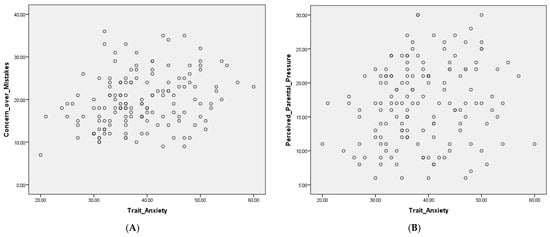
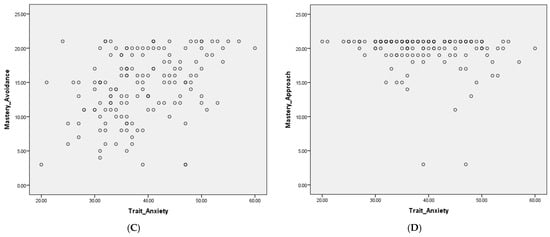
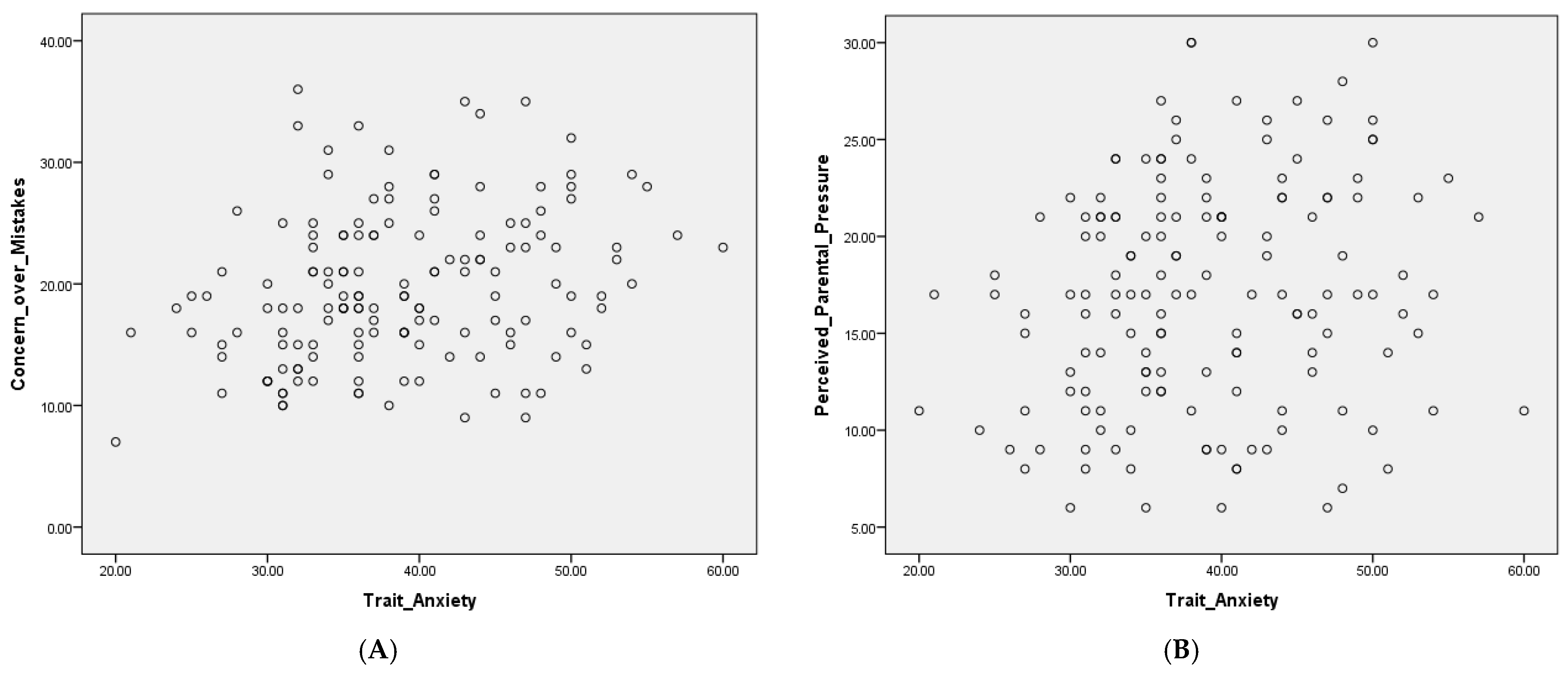
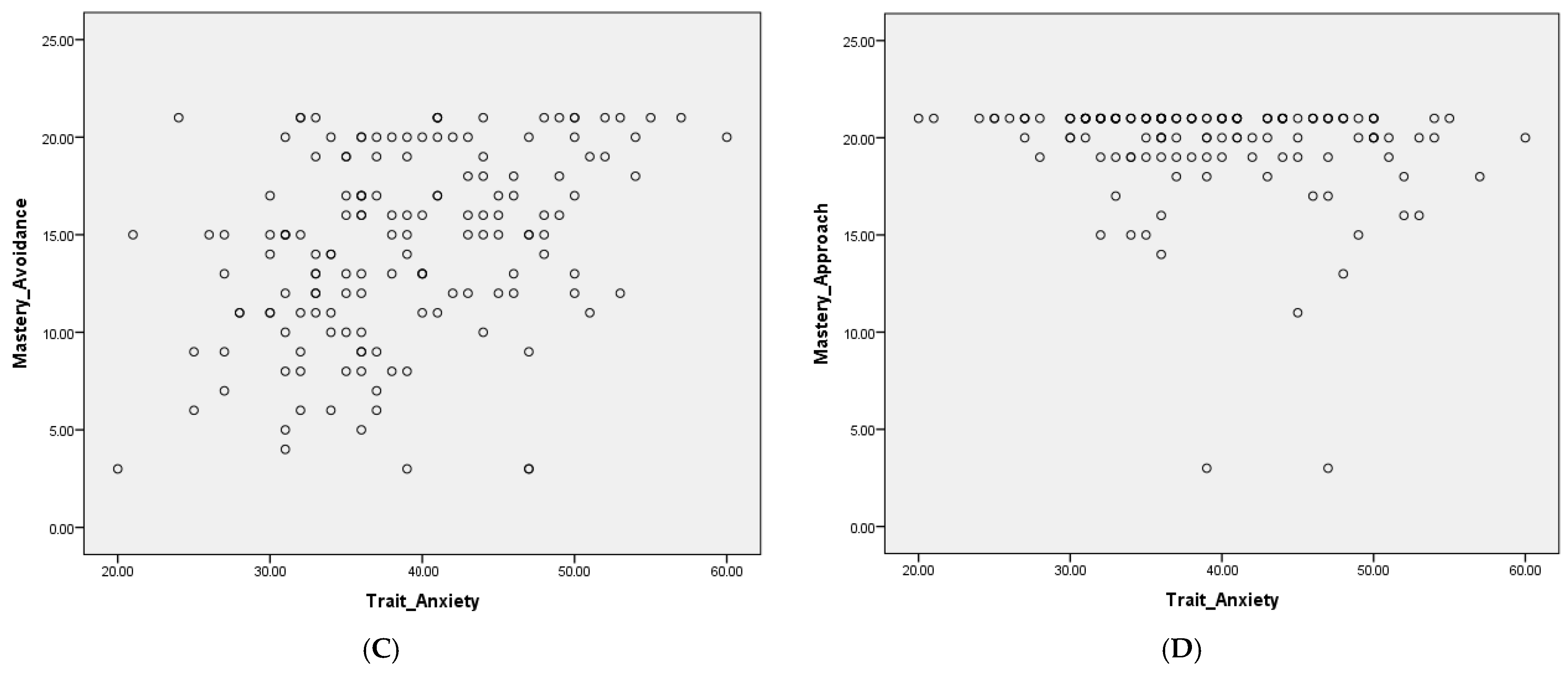
The relationships between trait anxiety and the main study variables are presented in Figure 2. Each panel displays a scatter plot illustrating the distribution of individual participants’ scores, where each dot represents a participant’s score on the respective scales. As shown in Figure 2A,B, trait anxiety demonstrates a positive association with concern over mistakes and perceived parental pressure. Similarly, a positive trend can be observed between trait anxiety and mastery-avoidance (Figure 2C). In contrast, the relationship between trait anxiety and mastery-approach appears weaker and less pronounced (Figure 2D).
Figure 2.
Relationships between trait anxiety and key psychological variables in youth football players (A–D).
A serial simple linear regression analysis was applied to examine predictors of trait anxiety in Table 3. Concern over mistakes significantly predicted trait anxiety (β = 0.25, t = 2.98, p = 0.003), accounting for 7.3% of the variance (Adj. R2 = 0.07). In contrast, perceived parental pressure did not significantly predict trait anxiety (β = 0.10, p = 0.21). Regarding achievement goals, mastery-approach negatively predicted trait anxiety (β = −0.28, p < 0.001). In contrast, mastery-avoidance emerged as a strong positive predictor of trait anxiety (β = 0.43, p < 0.001), explaining approximately 19.7% of the variance (Adj. R2 = 0.20). Concern over mistakes significantly predicted mastery-avoidance goals (β = 0.45, p < 0.001), accounting for 21.5% of the variance. Perceived parental pressure and personal standards did not significantly predict mastery-avoidance goals. Perceived parental pressure significantly predicted performance-avoidance goals (β = 0.27, p = 0.001) and performance-approach goals (β = 0.35, p < 0.001). Concern over mistakes did not significantly predict performance-avoidance goals (p = 0.07). Overall, the regression findings were largely consistent with the correlational results, highlighting the central role of concern over mistakes and mastery-avoidance goals in relation to trait anxiety.
Table 3.
Regression analysis.
4. Discussion
The findings indicated that perceived parental pressure was significantly associated with performance-approach, performance-avoidance, and mastery-avoidance goals, while no significant relationship was observed with mastery-approach. Although performance goals did not show a significant direct effect on trait anxiety in the present findings, previous research suggests that performance-oriented goals may be linked to a more outcome-focused mindset, in which learning processes may become less important [37,60]. When young athletes place greater emphasis on performance outcomes and disengage from skill development, it has been suggested that their performance may be negatively affected in the long term [21]. Moreover, the association between perceived parental pressure and both performance-approach and performance-avoidance goals can seem contradictory, but it may reflect an underlying psychological conflict. Young athletes may pursue performance-approach goals to demonstrate competence and gain external validation, while simultaneously adopting performance-avoidance goals to avoid negative judgments and perceived inadequacy, reflecting the complex influence of parental involvement on motivation in youth sport [43,61]. This pattern of parental pressure may be interpreted in relation to the spotlight effect, a cognitive bias in which individuals overestimate the extent to which others are observing and evaluating their behavior [62].
A substantial body of research identifies parents as key social agents influencing young athletes’ motivational and emotional experiences [5,63,64,65]. When parental involvement is perceived as pressuring rather than supportive, young athletes may become more driven by extrinsic motives, previously linked to maladaptive perfectionism [29,66,67]. In this context, behaviors such as excessive instruction, sideline directing, or inconsistent feedback may be interpreted as controlling, potentially undermining enjoyment and intrinsic engagement [60,68,69,70]. Such patterns may contribute to negative sport experiences and may be linked to higher levels of anxiety [71]. Given that this age group is still navigating critical developmental stages [4], these findings highlight the importance of guiding parental involvement in youth sport. Coaches and club administrators may play a critical role in promoting autonomy-supportive communication, encouraging a focus on personal improvement rather than outcomes, and fostering motivational climates that support athletes’ confidence, resilience, and overall psychological well-being [61].
In contrast to expectations, perceived parental pressure did not demonstrate a strong direct effect on trait anxiety. Instead, the findings suggest that its influence may operate through indirect pathways. Specifically, parental pressure was strongly associated with concern over mistakes and mastery-avoidance, two constructs well-established as precursors of trait anxiety in youth athletes [26,66]. This pattern may reflect a more complex and potentially maladaptive sequence, in which performance pressure is associated with fear of making mistakes, which in turn may be linked to the avoidance of mastery-oriented tasks, and elevated anxiety levels [42,43,61]. This may reflect environments in which success is overly defined by winning and flawless performance, potentially leading young athletes to perceive mistakes as threatening rather than developmental opportunities [69,71]. When parents impose their own expectations, emphasize winning, compare their children with peers, intervene in problem-solving, and provide harsh criticism, a performance-centered mindset may become more dominant [65,72]. In these contexts, athletes may become increasingly focused on avoiding failure rather than engaging in skill acquisition, reinforcing maladaptive perfectionistic tendencies over time [67]. This perspective aligns with the notion that controlling parenting, characterized by autonomy-thwarting and pressuring behaviors [73], may function as an indirect risk factor for long-term anxiety vulnerability in adolescent athletes. Accordingly, increasing parental awareness through effective communication with coaches, engagement with professional guidance, and participation in structured sport parenting programs may be critical in promoting healthier motivational environments and supporting athletes’ psychological well-being [65,71,74].
Another key finding was that concern over mistakes emerged as the strongest predictor of mastery-avoidance, which was associated with higher levels of trait anxiety. Success is typically evaluated by outcome-oriented standards; some young athletes may shift toward maladaptive perfectionism, prioritizing the avoidance of failure over the pursuit of improvement [75]. In this context, rather than reflecting a simple fear of mistakes, this tendency may stem from athletes’ sensitivity to evaluation and perceived inadequacy, which can discourage engagement in challenging or unfamiliar tasks [31,39]. This interpretation is consistent with models of socially prescribed perfectionism, in which athletes internalize external expectations and perceive mistakes as indicators of personal failure or inadequacy [76].
Although external pressures from adults may be associated with fear of mistakes, internal interpretations appear to play a crucial role in reinforcing this avoidance-driven pattern [42,77]. When mistakes and corrective feedback are perceived as threats, athletes may become increasingly focused on error avoidance, which may undermine their sense of competence and increase negative self-cognitive responses [78,79]. Such reactions may also manifest as heightened emotional responses to performance outcomes, including frustration and disproportionate disappointment [80]. Over time, these internalized responses may contribute to maladaptive coping patterns and increased psychological vulnerability [77,81]. Given that early sport participation years are critical for skill acquisition [82], persistent avoidance may limit both learning opportunities and long-term development in youth athletes [21,43]. Therefore, personality assessment tools may be beneficial for coaches to identify the individual perceptions and reactions towards stress [78]. In addition, fostering supportive environments that encourage adaptive interpretations of mistakes may be critical in promoting healthier psychological and developmental outcomes [39,70,72].
In practice, to prevent this issue, training environments in youth football may benefit from practices that tolerate mistakes and frame them as an inherent part of the learning process [70,83,84]. However, previous research suggests that physical education and sport systems in the TRNC have faced challenges in adapting to contemporary practices [45], which may also be observed in football academies. The contemporary youth sport literature suggests that supportive, mastery- and task-oriented environments, in which mistakes are normalized as part of the learning process, may be associated with more adaptive engagement and skill development among young athletes [32,39,85,86]. This may also help athletes perceive errors as opportunities to enhance skill acquisition, potentially increasing their desire and enjoyment of participation [31,39]. Accordingly, coaches may be more effective when they conceptualize their role as educators who are responsible for developing adolescents in the long term [5,76,87]. In this regard, club administrators may also play an important role in selecting coaching profiles that emphasize developmental and pedagogical competencies in younger age categories. Such environments may be more likely to support adaptive responses to errors, particularly when coaches demonstrate patience and maintain open communication by balancing constructive feedback and praise [65,76].
Mastery-avoidance emerged as the strongest predictor of trait anxiety, highlighting its central role in understanding anxiety in youth athletes. This finding suggests that athletes who are primarily motivated by a fear of not improving and who perceive tasks as threatening may be more prone to persistent anxiety [78]. Unlike approach-oriented goals, mastery-avoidance goals are associated with a more continuous sense of threat, as athletes may tend to focus on their perceived deficiencies rather than personal progress [43]. Youth athletes are in a critical developmental stage marked by identity formation and evolving perceptions of competence [5,82]. In this context, mastery-avoidance may be particularly salient, as it reflects heightened perception of threat, which may be linked to fluctuation in self-confidence and increased concerns about personal inadequacy [6,79,88]. Therefore, addressing mastery-avoidance goals in youth sport settings may be essential for reducing anxiety and supporting healthier psychological development.
In this research, mastery-avoidance emerged as a key variable associated with the relationship between previously discussed risk factors, such as perceived parental pressure and concern over mistakes, which may conceivably be translated into anxiety among young athletes, primarily through indirect pathways. This finding highlights mastery-avoidance as a central factor associated with the relationship between perfectionistic concerns, environmental pressures, and persistent anxiety among adolescent athletes. Consistent with the previous studies, mastery-avoidance appears to reflect maladaptive motivational processes that may limit engagement in learning and skill development [35,43,85,89,90].
In contrast, the findings also suggest that mastery-approach orientations may function as a protective factor against trait anxiety. Understanding how coaches can foster mastery-approach goals may help inform strategies aimed at supporting positive mental health outcomes. By highlighting mastery-approach as a crucial aspect associated with lower trait anxiety, these findings suggest that anxiety in youth football may not be shaped merely by external pressures or personality traits, but may also be related to the type of motivational goals athletes adopt [75]. Coaches who emphasize learning, personal growth, and effort over winning may contribute to the development of a mastery-approach climate, which may be associated with lower anxiety levels and greater resilience [32,39]. This insight underscores the importance of coaching education programs that prioritize goal-setting strategies aligned with fostering adaptive motivation, potentially contributing to both performance and mental health outcomes among youth athletes. Especially among young age groups, those who have adopted a learning and striving mentality may tend to conceptualize success as a process rather than an outcome [91]. As a result, greater value may be placed on their own education and training culture, which, in turn, mistakes may not be interpreted as threats, but as sources of information supporting development [91]. This adaptive motivational mindset is likely to enhance perceived control and competence, which consecutively may buffer young athletes against anxiety [37].
From a psychological perspective, athletes with a strong mastery-approach tend to report greater confidence in their ability to manage outcomes such as success, failure, and mistakes [6,37]. As fear of making mistakes diminishes and performance is no longer experienced as menacing, anxiety may become less prominent [43]. The findings highlight the presence of two contrasting pathways, with mastery-avoidance linked to maladaptive outcomes and mastery-approach associated with adaptive orientation. This may reveal the importance of nurturing a safe environment in which process- and task-oriented learning is prioritized in youth sport [39,92]. Such an atmosphere may be important not only for supporting more adaptive motivational patterns but also for maintaining psychological well-being [5].
The present study offers several practical implications for key stakeholders involved in youth football environments. To mitigate the potential negative effects of perceived parental pressure, parents may benefit from adopting autonomy-supportive communication styles that promote mutual respect and acknowledge young athletes’ perspectives [61,70]. Such an approach may help adolescents feel psychologically supported and respected within the sport context. Parents may further enhance their knowledge through regular communication with coaches and by participating in structured sport-parent education programs [74]. Coaches, in turn, may contribute to healthier motivational experiences by fostering training climates that tolerate mistakes, prioritize learning processes over performance outcomes, and emphasize task-oriented rather than ego-oriented motivational structures [86]. Given that athletes may interpret similar experiences differently, the use of personality assessment tools may help coaches adopt more individualized approaches [78]. At the organizational level, football academies should prioritize the recruitment and continuous professional development of coaches with strong pedagogical competencies. Finally, the expansion of state- and federation-supported initiatives in the TRNC may play an important role in promoting the adoption of contemporary youth sport practices and enhancing the developmental environments available to young athletes.
Several limitations should be acknowledged. The cross-sectional design limits causal inference, and reliance on self-report measures may have introduced social desirability bias. Moreover, psychological variables were assessed at a single time point, limiting the ability to capture developmental change. The sample consisted solely of young male football players, limiting the generalizability of the findings to other age groups, female athletes, or other sports. Furthermore, training years and competition experience were not assessed. Including such variables may provide additional insight into developmental processes; therefore, it is recommended for future research. Finally, although the relationships among variables were examined using correlation and regression analyses, more advanced analytical approaches, such as structural equation modeling, could provide a more comprehensive understanding of the underlying mechanisms.
5. Conclusions
This study examined the relationships between perfectionism, achievement goal orientations, and trait anxiety among young football players. The findings indicate that perfectionistic concerns, particularly concern over mistakes, and mastery-avoidance goals are key factors associated with higher levels of trait anxiety. In contrast, mastery-approach orientation emerged as a protective factor. These results highlight the importance of motivational processes in understanding anxiety in youth sport and suggest that future research may benefit from longitudinal designs and more comprehensive analytical approaches.
Author Contributions
Conceptualization, İ.P. and E.D.; methodology, İ.P.; formal analysis, İ.P.; investigation, İ.P.; data curation, İ.P.; writing—original draft preparation, İ.P.; writing—review and editing, İ.P. and E.D.; supervision, E.D. All authors have read and agreed to the published version of the manuscript.
Funding
This research received no external funding.
Institutional Review Board Statement
The study was conducted in accordance with the Declaration of Helsinki and approved by the Institutional Review Board of Girne American University (Approval Code: 2023-2024/8; Approval Date: 8 March 2024).
Informed Consent Statement
Informed consent was obtained from all participants and their legal guardians prior to participation in the study. Participation was voluntary, and all data were collected anonymously.
Data Availability Statement
The data presented in this study are available on reasonable request from the corresponding author. The data are not publicly available due to privacy and ethical restrictions.
Conflicts of Interest
The authors declare no conflicts of interest.
Abbreviations
The following abbreviations are used in this manuscript:
| TRNC | Turkish Republic of Northern Cyprus |
| CTFF | Cyprus Turkish Football Federation |
| AGQ-S | Achievement Goals Questionnaire for Sport |
| SMPS | Sport Multidimensional Perfectionism Scale |
| STAI | State Trait Anxiety Inventory |
| U16 | Under-16 |
| M | Mean |
| SD | Standard deviation |
| r | Pearson’s correlation coefficient |
| Β | Standardized regression coefficient |
| p | Significance level |
| SE | Standard error |
References
- Elferink-Gemser, M.T.; Jordet, G.; Coelho-E-Silva, M.J.; Visscher, C. The Marvels of Elite Sports: How to Get There? Br. J. Sports Med. 2011, 45, 683–684. [Google Scholar] [CrossRef] [Scilit]
- Whiteley, G. How Trait and State Anxiety Influence Athletic Performance. Bachelor’s Thesis, Wittenberg University, Springfield, OH, USA, 2013. [Google Scholar]
- Curran, T.; Hill, A.P.; Jowett, G.E.; Mallinson-Howard, S.H. The Relationship between Multidimensional Perfectionism and Passion in Junior Athletes. Int. J. Sport Psychol. 2014, 45, 369–384. [Google Scholar]
- Bergeron, M.F.; Côté, J.; Cumming, S.P.; Purcell, R.; Armstrong, N.; Basilico, L.; Burrows, K.; Charrin, J.-B.; Felix, A.; Groesswang, H.; et al. IOC Consensus Statement on Elite Youth Athletes Competing at the Olympic Games: Essentials to a Healthy, Safe and Sustainable Paradigm. Br. J. Sports Med. 2024, 58, 946–965. [Google Scholar] [CrossRef] [Scilit]
- Walton, C.C.; Purcell, R.; Henderson, J.L.; Kim, J.; Kerr, G.; Frost, J.; Gwyther, K.; Pilkington, V.; Rice, S.; Tamminen, K.A. Mental Health Among Elite Youth Athletes: A Narrative Overview to Advance Research and Practice. Sports Health Multidiscip. Approach 2024, 16, 166–176. [Google Scholar] [CrossRef] [Scilit] [PubMed]
- Domínguez-González, J.A.; Reigal, R.E.; Morales-Sánchez, V.; Hernández-Mendo, A. Analysis of the Sports Psychological Profile, Competitive Anxiety, Self-Confidence and Flow State in Young Football Players. Sports 2024, 12, 20. [Google Scholar] [CrossRef] [Scilit]
- Prior, E.; Papathomas, A.; Rhind, D. A Systematic Scoping Review of Athlete Mental Health within Competitive Sport: Interventions, Recommendations, and Policy. Int. Rev. Sport Exerc. Psychol. 2024, 17, 903–925. [Google Scholar] [CrossRef] [Scilit]
- Li, Y.; Ma, J.; Xi, Y.; Li, J. Big Five Personality and Mind Wandering in Athletes: Mediating Role of Trait Anxiety. Front. Psychol. 2024, 15, 1232312. [Google Scholar] [CrossRef] [Scilit]
- Ren, P.; Song, T.; Chi, L.; Wang, X.; Miao, X. The Adverse Effect of Anxiety on Dynamic Anticipation Performance. Front. Psychol. 2022, 13, 823989. [Google Scholar] [CrossRef] [Scilit]
- Soler-López, A.; Moreno-Villanueva, A.; Gómez-Carmona, C.D.; Pino-Ortega, J. The Role of Biomarkers in Monitoring Chronic Fatigue Among Male Professional Team Athletes: A Systematic Review. Sensors 2024, 24, 6862. [Google Scholar] [CrossRef] [Scilit]
- Spielberger, C.D.; Gorsuch, R.L.; Lushene, R.E. STAI Manual for the State-Trait Anxiety Inventory; Consulting Psychologists Press: Palo Alto, CA, USA, 1970. [Google Scholar]
- Spielberger, C.D. State-Trait Anxiety Inventory for Adults; Mind Garden: Redwood City, CA, USA, 1983. [Google Scholar]
- Martens, R.; Vealey, R.S.; Burton, D.; Martens, R. Competitive Anxiety in Sport; Human Kinetics Books: Champaign, IL, USA, 1990. [Google Scholar]
- Horikawa, M.; Yagi, A. The Relationships among Trait Anxiety, State Anxiety and the Goal Performance of Penalty Shoot-Out by University Soccer Players. PLoS ONE 2012, 7, e35727. [Google Scholar] [CrossRef] [Scilit]
- Rice, S.M.; Purcell, R.; De Silva, S.; Mawren, D.; McGorry, P.D.; Parker, A.G. The Mental Health of Elite Athletes: A Narrative Systematic Review. Sports Med. 2016, 46, 1333–1353. [Google Scholar] [CrossRef] [Scilit] [PubMed]
- Cox, R.H. Sport Psychology: Concepts and Applications, 7th ed.; McGraw-Hill: New York, NY, USA, 2012. [Google Scholar]
- Ford, J.; Ildefonso, K.; Jones, M.; Arvinen-Barrow, M. Sport-Related Anxiety: Current Insights. Open Access J. Sports Med. 2017, 8, 205–212. [Google Scholar] [CrossRef] [Scilit]
- Pijpers, J.R.; Oudejans, R.R.D.; Holsheimer, F.; Bakker, F.C. Anxiety–Performance Relationships in Climbing: A Process-Oriented Approach. Psychol. Sport Exerc. 2003, 4, 283–304. [Google Scholar] [CrossRef] [Scilit]
- Kotov, R.; Gamez, W.; Schmidt, F.; Watson, D. Linking “Big” Personality Traits to Anxiety, Depressive, and Substance Use Disorders: A Meta-Analysis. Psychol. Bull. 2010, 136, 768–821. [Google Scholar] [CrossRef] [Scilit] [PubMed]
- Flett, G.L.; Hewitt, P.L. Perfectionism and Maladjustment: An Overview of Theoretical, Definitional, and Treatment Issues. In Perfectionism: Theory, Research, and Treatment; Flett, G.L., Hewitt, P.L., Eds.; American Psychological Association: Washington, DC, USA, 2002; pp. 5–31. [Google Scholar]
- Stoeber, J.; Stoll, O.; Pescheck, E.; Otto, K. Perfectionism and Achievement Goals in Athletes: Relations with Approach and Avoidance Orientations in Mastery and Performance Goals. Psychol. Sport Exerc. 2008, 9, 102–121. [Google Scholar] [CrossRef] [Scilit]
- Zarghmi, M.; Ghamary, A.; ShaykhShabani, S.; Varzaneh, A. Perfectionism and Achievement Goals in Adult Male Elite Athletes Who Compete at the National Level and Above. J. Hum. Kinet. 2010, 26, 147–154. [Google Scholar] [CrossRef] [Scilit]
- Damián Núñez, E.F.; Villanueva, L.M.S.; Mendoza, M.A.T.; Dorian Isla Alcoser, S.; Palacios Garay, J.P.; Hernández-Vásquez, R. Perfectionism as a Paradoxical Factor in Sport and Exercise Performance: An Umbrella Review. Iran. J. Psychiatry 2024, 19, 247–254. [Google Scholar] [CrossRef] [Scilit]
- Stoeber, J.; Otto, K. Positive Conceptions of Perfectionism: Approaches, Evidence, Challenges. Personal. Soc. Psychol. Rev. 2006, 10, 295–319. [Google Scholar] [CrossRef] [Scilit]
- Freire, G.L.M.; Sousa, V.C.; Moraes, J.F.V.N.; Alves, J.F.N.; Oliveira, D.V.; Nascimento, J.R.A. Are the Traits of Perfectionism Associated with Pre-Competitive Anxiety in Young Athletes? Cuad. Psicol. Deporte 2020, 20, 37–46. [Google Scholar] [CrossRef] [Scilit]
- Hill, A.P.; Mallinson-Howard, S.H.; Jowett, G.E. Multidimensional Perfectionism in Sport: A Meta-Analytical Review. Sport Exerc. Perform. Psychol. 2018, 7, 235–270. [Google Scholar] [CrossRef] [Scilit]
- Jowett, G.E.; Hill, A.P.; Hall, H.K.; Curran, T. Perfectionism, Burnout and Engagement in Youth Sport: The Mediating Role of Basic Psychological Needs. Psychol. Sport Exerc. 2016, 24, 18–26. [Google Scholar] [CrossRef] [Scilit]
- Pineda-Espejel, H.A.; Morquecho-Sánchez, R.; Fernández, R.; González-Hernández, J. Perfeccionismo interpersonal, miedo a fallar, y afectos en el deporte. Cuad. Psicol. Deporte 2019, 19, 113–123. [Google Scholar] [CrossRef] [Scilit]
- Cowden, R.; Crust, L.; Jackman, P.; Duckett, R. Perfectionism and Motivation in Sport: The Mediating Role of Mental Toughness. S. Afr. J. Sci. 2019, 115, 1–7. [Google Scholar] [CrossRef] [Scilit]
- Yang, J.-H.; Yang, H.-J.; Choi, C.; Bum, C.-H. Systematic Review and Meta-Analysis on Burnout Owing to Perfectionism in Elite Athletes Based on the Multidimensional Perfectionism Scale (MPS) and Athlete Burnout Questionnaire (ABQ). Healthcare 2023, 11, 1417. [Google Scholar] [CrossRef] [Scilit] [PubMed]
- de Andrade do Nascimento Junio, J.R.; Morais Freire, G.L.; Fortes de Sousa Fortes, L.; Codonhato, R.; Vicentini de Oliveira, D. Group Cohesion, Conflict, Achievement Goals and Anxiety in Youth Sport: Differences According to the 2 × 2 Model of Perfectionism. Int. J. Sport Psychol. 2024, 55, 391–411. [Google Scholar] [CrossRef]
- Hill, A.P.; Smith, E.P.; Hall, H.K. Perfectionism, Burnout, and Depressive Symptoms in Youth Soccer Players: Moderation by Empowering and Disempowering Climates. J. Clin. Sport Psychol. 2024, 20, 57–81. [Google Scholar] [CrossRef] [Scilit]
- Elliot, A.J. Approach and Avoidance Motivation and Achievement Goals. Educ. Psychol. 1999, 34, 169–189. [Google Scholar] [CrossRef] [Scilit]
- Elliot, A.J.; Thrash, T.M. Achievement Goals and the Hierarchical Model of Achievement Motivation. Educ. Psychol. Rev. 2001, 13, 139–156. [Google Scholar] [CrossRef] [Scilit]
- Lochbaum, M.; Jean-Noel, J.; Pinar, C.; Gilson, T. A Meta-Analytic Review of Elliot’s (1999) Hierarchical Model of Approach and Avoidance Motivation in the Sport, Physical Activity, and Physical Education Literature. J. Sport Health Sci. 2017, 6, 68–80. [Google Scholar] [CrossRef] [Scilit]
- Elliot, A.J.; Harackiewicz, J.M. Approach and Avoidance Achievement Goals and Intrinsic Motivation: A Mediational Analysis. J. Pers. Soc. Psychol. 1996, 70, 461–475. [Google Scholar] [CrossRef]
- Lochbaum, M.; Benoit, T.; Kazak, Z. The 2 × 2 Achievement Goals in Sport and Physical Activity Contexts: A Meta-Analytic Test of Context, Gender, Culture, and Socioeconomic Status Differences and Analysis of Motivations, Regulations, Affect, Effort, and Physical Activity Correlates. Eur. J. Investig. Health Psychol. Educ. 2019, 10, 173–205. [Google Scholar] [CrossRef] [Scilit]
- Hamoud, M.; Sæther, S.A.; Bjørnebekk, G. Self-Regulation and Performance among Elite Youth Soccer Players: The Role of Approach-Avoidance Motivation. Front. Psychol. 2024, 15, 1416931. [Google Scholar] [CrossRef] [Scilit]
- Morales-Sánchez, V.; Caballero-Cerbán, M.; Postigo-Martín, C.; Morillo-Baro, J.P.; Hernández-Mendo, A.; Reigal, R.E. Perceived Motivational Climate Determines Self-Confidence and Precompetitive Anxiety in Young Soccer Players: Analysis by Gender. Sustainability 2022, 14, 15673. [Google Scholar] [CrossRef] [Scilit]
- Berastegui-Martínez, J.; Barrenetxea-García, J.; Tomás, J.M.; Esnaola, I. The Influence of Parental and Coach Pressure on Competitive State Anxiety: The Mediating Role of Emotional Intelligence. Perform. Enhanc. Health 2026, 14, 100408. [Google Scholar] [CrossRef] [Scilit]
- González-Hernández, J.; Barrera-Vázquez, D.; Gómez-López, M. Self -Confidence in Young Athletes: A Protective Factor Against Perfectionism and Anxiety in Competitive Grassroots Sport. Percept. Mot. Ski. 2024, 131, 2324–2345. [Google Scholar] [CrossRef] [Scilit] [PubMed]
- Sagar, S.S.; Stoeber, J. Perfectionism, Fear of Failure, and Affective Responses to Success and Failure: The Central Role of Fear of Experiencing Shame and Embarrassment. J. Sport Exerc. Psychol. 2009, 31, 602–627. [Google Scholar] [CrossRef] [Scilit] [PubMed]
- Sagar, S.S.; Busch, B.K.; Jowett, S. Success and Failure, Fear of Failure, and Coping Responses of Adolescent Academy Football Players. J. Appl. Sport Psychol. 2010, 22, 213–230. [Google Scholar] [CrossRef] [Scilit]
- Çepikkurt, F.; İnanç, B.Y. Mükemmeliyetçilik ve başarı hedeflerinin hentbolcuların müsabaka öncesi yaşadıkları durumluk kaygıyı belirlemedeki rolü. Sporm. Beden Eğitimi Ve Spor Bilim. Derg. 2012, 10, 43–51. [Google Scholar] [CrossRef] [Scilit]
- Deniz, S.; Yenel, F. The Structural Analysis of Physical Education and Sports System in The Turkish Republic of Northern Cyprus. Procedia Soc. Behav. Sci. 2013, 89, 772–780. [Google Scholar] [CrossRef] [Scilit]
- Batihan, M.; Acar, M.F.; Doğgün, M. Comparison of FMS Tests and Digital Goniometer Measurement Values in U15 Age Category Football Players in TRNC. Turk. Online J. Educ. Technol. 2024, 23, 39–50. [Google Scholar]
- Dunn, J.G.H.; Dunn, J.C.; Gotwals, J.K.; Vallance, J.K.H.; Craft, J.M.; Syrotuik, D.G. Establishing Construct Validity Evidence for the Sport Multidimensional Perfectionism Scale. Psychol. Sport Exerc. 2006, 7, 57–79. [Google Scholar] [CrossRef] [Scilit]
- Dunn, J.G.H.; Dunn, J.C.; Syrotuik, D.G. Relationship between Multidimensional Perfectionism and Goal Orientations in Sport. J. Sport Exerc. Psychol. 2002, 24, 376–395. [Google Scholar] [CrossRef] [Scilit]
- Dunn, J.G.H.; Gotwals, J.K.; Dunn, J.C. An Examination of the Domain Specificity of Perfectionism among Intercollegiate Student-Athletes. Personal. Individ. Differ. 2005, 38, 1439–1448. [Google Scholar] [CrossRef] [Scilit]
- Frost, R.O.; Marten, P.; Lahart, C.; Rosenblate, R. The Dimensions of Perfectionism. Cogn. Ther. Res. 1990, 14, 449–468. [Google Scholar] [CrossRef] [Scilit]
- Hewitt, P.L.; Flett, G.L. Perfectionism in the Self and Social Contexts: Conceptualization, Assessment, and Association with Psychopathology. J. Pers. Soc. Psychol. 1991, 60, 456–470. [Google Scholar] [CrossRef]
- Çepikkurt, F. Üniversiteli Hentbolcuların Mükemmeliyetçilik ve Kaygı Düzeyleri ile Başarı Hedefleri ve Müsabaka Sonuçlarına Yaptıkları Yükleme Biçimleri Arasındaki İlişkinin İncelenmesi. Ph.D. Thesis, Çukurova University, Adana, Türkiye, 2011. [Google Scholar]
- Yang, S.X.; Jowett, S. Psychometric Properties of the Coach–Athlete Relationship Questionnaire (CART-Q) in Seven Countries. Psychol. Sport Exerc. 2012, 13, 36–43. [Google Scholar] [CrossRef] [Scilit]
- Conroy, D.E.; Elliot, A.J.; Hofer, S.M. A 2 × 2 Achievement Goals Questionnaire for Sport: Evidence for Factorial Invariance, Temporal Stability, and External Validity. J. Sport Exerc. Psychol. 2003, 25, 456–476. [Google Scholar] [CrossRef] [Scilit]
- Elliot, A.J.; McGregor, H.A. A 2 × 2 Achievement Goal Framework. J. Pers. Soc. Psychol. 2001, 80, 501–519. [Google Scholar] [CrossRef]
- Kazak Çetinkalp, Z. Sporda Hür İrade Kuramı ve Başarı Hedefi Kuramının Değerlendirilmesi. Ph.D. Thesis, Ege Üniversitesi, İzmir, Türkiye, 2009. [Google Scholar]
- Öner, N.; Le Compte, A. Durumluk-Sürekli Kaygı Envanteri El Kitabı; Boğaziçi Üniversite Yayınları: İstanbul, Türkiye, 1983. [Google Scholar]
- Gürer, B.; Adılogulları, İ.; Sahın, H. Examination of state-trait anxiety levels of elite athletes according to some variables. Turk. J. Sport Exerc. 2014, 16, 4–7. [Google Scholar] [CrossRef] [Scilit]
- Döner, S.; Efe, Y.S.; Elmalı, F. Turkish Adaptation of the State–Trait Anxiety Inventory Short Version (STAIS-5, STAIT-5). Int. J. Nurs. Pract. 2024, 30, e13304. [Google Scholar] [CrossRef] [Scilit] [PubMed]
- Harwood, C.G.; Keegan, R.J.; Smith, J.M.J.; Raine, A.S. A Systematic Review of the Intrapersonal Correlates of Motivational Climate Perceptions in Sport and Physical Activity. Psychol. Sport Exerc. 2015, 18, 9–25. [Google Scholar] [CrossRef] [Scilit]
- Gao, Z.; Chee, C.S.; Norjali Wazir, M.R.W.; Wang, J.; Zheng, X.; Wang, T. The Role of Parents in the Motivation of Young Athletes: A Systematic Review. Front. Psychol. 2024, 14, 1291711. [Google Scholar] [CrossRef] [Scilit]
- Gilovich, T.; Medvec, V.H.; Savitsky, K. The Spotlight Effect in Social Judgment: An Egocentric Bias in Estimates of the Salience of One’s Own Actions and Appearance. J. Pers. Soc. Psychol. 2000, 78, 211–222. [Google Scholar] [CrossRef]
- Holt, N.; Knight, C. Parenting in Youth Sport: From Research to Practice; Routledge: Abingdon, UK, 2014. [Google Scholar]
- Knight, C.J.; Dorsch, T.E.; Osai, K.V.; Haderlie, K.L.; Sellars, P.A. Influences on Parental Involvement in Youth Sport. Sport Exerc. Perform. Psychol. 2016, 5, 161–178. [Google Scholar] [CrossRef] [Scilit]
- Liu, C.; Zhao, F.; Nong, S.; Lin, Z. Being a Right Parent: A Narrative Review of the Theory and Practice of Parental Involvement in Sport Parenting. Front. Psychol. 2024, 15, 1412708. [Google Scholar] [CrossRef] [Scilit]
- Sapieja, K.M.; Dunn, J.G.H.; Holt, N.L. Perfectionism and Perceptions of Parenting Styles in Male Youth Soccer. J. Sport Exerc. Psychol. 2011, 33, 20–39. [Google Scholar] [CrossRef] [Scilit]
- Madigan, D.J.; Curran, T.; Stoeber, J.; Hill, A.P.; Smith, M.M.; Passfield, L. Development of Perfectionism in Junior Athletes: A Three-Sample Study of Coach and Parental Pressure. J. Sport Exerc. Psychol. 2019, 41, 167–175. [Google Scholar] [CrossRef] [Scilit]
- Knight, C.J.; Neely, K.C.; Holt, N.L. Parental Behaviors in Team Sports: How Do Female Athletes Want Parents to Behave? J. Appl. Sport Psychol. 2011, 23, 76–92. [Google Scholar] [CrossRef] [Scilit]
- Morais, C.; Rui Gomes, A.; Teixeira, M.; Branco, C. Athletes’ Perspective on Parental Involvement, Motivation, and Performance throughout a Football Season. J. Phys. Educ. Sport 2025, 25, 527–538. [Google Scholar] [CrossRef]
- Coutinho, P.; Bessa, C.; Dias, C.; Mesquita, I.; Fonseca, A.M. Unveiling Players’ Perceptions of Mother- and Father-Initiated Motivational Climates and Fear of Failure in Youth Male Team Sports. Sports 2024, 12, 244. [Google Scholar] [CrossRef] [Scilit]
- Amado, D.; Sánchez-Oliva, D.; González-Ponce, I.; Pulido-González, J.J.; Sánchez-Miguel, P.A. Incidence of Parental Support and Pressure on Their Children’s Motivational Processes towards Sport Practice Regarding Gender. PLoS ONE 2015, 10, e0128015. [Google Scholar] [CrossRef] [Scilit]
- Harwood, C.G.; Knight, C.J. Parenting in Youth Sport: A Position Paper on Parenting Expertise. Psychol. Sport Exerc. 2015, 16, 24–35. [Google Scholar] [CrossRef] [Scilit]
- Soenens, B.; Vansteenkiste, M. A Theoretical Upgrade of the Concept of Parental Psychological Control: Proposing New Insights on the Basis of Self-Determination Theory. Dev. Rev. 2010, 30, 74–99. [Google Scholar] [CrossRef] [Scilit]
- Burke, S.; Sharp, L.-A.; Woods, D.; Paradis, K.F. Enhancing Parental Support through Parent-Education Programs in Youth Sport: A Systematic Review. Int. Rev. Sport Exerc. Psychol. 2021, 17, 208–235. [Google Scholar] [CrossRef] [Scilit]
- Kang, W.; Gong, C. Exploring Potential Mediating Mechanisms between Maladaptive Perfectionism and Athlete Burnout Based on Multi-Theory Perspectives. Front. Psychol. 2024, 15, 1416281. [Google Scholar] [CrossRef] [Scilit]
- Fu, Y.; Li, X.; Sun, J.; Li, C.; Peng, Y.; Hong, F.; Pan, J. The Relationship between Self-Oriented Perfectionism and Athlete Burnout: A Longitudinal Study. Front. Psychol. 2025, 16, 1656816. [Google Scholar] [CrossRef] [Scilit]
- Török, L.; Szabó, Z.P.; Orosz, G. Elite Athletes’ Perfectionistic Striving vs. Concerns as Opposing Predictors of Self-Handicapping with the Mediating Role of Attributional Style. Front. Psychol. 2022, 13, 862122. [Google Scholar] [CrossRef] [Scilit]
- Dai, P.; Chen, C.; Gu, M. The Influence of Athletes’ Personality Traits on Competition Performance: The Multiple Mediating Effects of Competitive Anxiety, Perfectionism, and Stressors. Front. Psychol. 2026, 16, 1724618. [Google Scholar] [CrossRef] [Scilit]
- Adie, J.W.; Duda, J.L.; Ntoumanis, N. Achievement Goals, Competition Appraisals, and the Well- and Ill-Being of Elite Youth Soccer Players Over Two Competitive Seasons. J. Sport Exerc. Psychol. 2010, 32, 555–579. [Google Scholar] [CrossRef] [Scilit] [PubMed]
- Dunn, J.G.H.; Gotwals, J.K.; Dunn, J.C.; Lizmore, M.R. Perfectionism, Pre-Competitive Worry, and Optimism in High-Performance Youth Athletes. Int. J. Sport Exerc. Psychol. 2019, 18, 749–763. [Google Scholar] [CrossRef] [Scilit]
- Gustafsson, H.; Sagar, S.S.; Stenling, A. Fear of Failure, Psychological Stress, and Burnout among Adolescent Athletes Competing in High Level Sport. Scand. J. Med. Sci. Sports 2016, 27, 2091–2102. [Google Scholar] [CrossRef] [Scilit] [PubMed]
- Côté, J.; Vierimaa, M. The Developmental Model of Sport Participation: 15 Years after Its First Conceptualization. Sci. Sports 2014, 29, S63–S69. [Google Scholar] [CrossRef] [Scilit]
- Duda, J.L. The Conceptual and Empirical Foundations of Empowering CoachingTM: Setting the Stage for the PAPA Project. Int. J. Sport Exerc. Psychol. 2013, 11, 311–318. [Google Scholar] [CrossRef] [Scilit]
- Castro-Sánchez, M.; Zurita-Ortega, F.; Ubago-Jiménez, J.L.; González-Valero, G.; García-Mármol, E.; Chacón-Cuberos, R. Relationships between Anxiety, Emotional Intelligence, and Motivational Climate among Adolescent Football Players. Sports 2019, 7, 34. [Google Scholar] [CrossRef] [Scilit]
- Barkoukis, V.; Gråstén, A.; Huhtiniemi, M.; Jaakkola, T. Developmental Relations of Achievement Goals and Affect in Physical Education. Psychol. Sport Exerc. 2024, 75, 102700. [Google Scholar] [CrossRef] [Scilit]
- Castillo-Jiménez, N.; López-Walle, J.M.; Tomás, I.; Tristán, J.; Duda, J.L.; Balaguer, I. Empowering and Disempowering Motivational Climates, Mediating Psychological Processes, and Future Intentions of Sport Participation. Int. J. Environ. Res. Public Health 2022, 19, 896. [Google Scholar] [CrossRef] [Scilit]
- Smith, R.E.; Smoll, F.L.; Cumming, S.P. Effects of a Motivational Climate Intervention for Coaches on Young Athletes’ Sport Performance Anxiety. J. Sport Exerc. Psychol. 2007, 29, 39–59. [Google Scholar] [CrossRef] [Scilit]
- Chatterjee, D.; Dasgupta, S.R.; Dutta, A. The Adolescent Football Mind: How Age and Playing Position Influence Competitive State Anxiety, Self-Confidence, and Cognitive Interference in Indian Footballers. Front. Sports Act. Living 2025, 7, 1695658. [Google Scholar] [CrossRef] [Scilit] [PubMed]
- Madjar, N.; Kaplan, A.; Weinstock, M. Clarifying Mastery-Avoidance Goals in High School: Distinguishing between Intrapersonal and Task-Based Standards of Competence. Contemp. Educ. Psychol. 2011, 36, 268–279. [Google Scholar] [CrossRef] [Scilit]
- Azeem, K.; Zubair, A. Role of Academic Self-Handicapping and Self-Regulated Learning Strategies in Mastery Goal Orientation among Adolescents. FWU J. Soc. Sci. 2021, 15, 152–172. [Google Scholar] [CrossRef] [Scilit]
- Greblo, Z.; Barić, R.; Cecić Erpič, S. Perfectionistic Strivings and Perfectionistic Concerns in Athletes: The Role of Peer Motivational Climate. Curr. Psychol. 2015, 35, 370–376. [Google Scholar] [CrossRef] [Scilit]
- Arı, A.E.; Korkmaz, B.C. Sport Burnout in Student-Athletes: The Role of Cognitive Flexibility, Task and Ego Orientation in Sport and Sport Anxiety. Spor Bilim. Derg. 2025, 36, 86–104. [Google Scholar] [CrossRef] [Scilit]

Disclaimer/Publisher’s Note: The statements, opinions and data contained in all publications are solely those of the individual author(s) and contributor(s) and not of MDPI and/or the editor(s). MDPI and/or the editor(s) disclaim responsibility for any injury to people or property resulting from any ideas, methods, instructions or products referred to in the content. |
© 2026 by the authors. Licensee MDPI, Basel, Switzerland. This article is an open access article distributed under the terms and conditions of the Creative Commons Attribution (CC BY) license.