


Abstract
Voluntary vehicle use restriction policies targeting a broad population of vehicles may be more effective in reducing driving distance, as participation is self-selected by drivers. However, because groups that benefit more from participation-related incentives are more likely to enroll in the program, it is necessary to address potential sample imbalance between treatment and control groups when comparing policy effects before and after implementation. In addition, analyses relying on indirect indicators, such as air quality, have limitations in accurately estimating the actual policy effect. To address these issues, this study applies propensity score weighting (PSW) to correct for imbalance between the treatment and control groups and directly estimates the policy effect using vehicle-level driving distance data. Since driving distance may inherently reflect unobserved heterogeneity across vehicles (e.g., driving habits) as well as temporal variation, a difference-in-difference (DID) approach with two-way fixed effects is employed to control for these factors and estimate the causal effect of the policy. Focusing on Busan, South Korea, the effects of the Self Car-Free Day System—a voluntary vehicle use restriction policy—are examined. The results show that vehicles registered in the program experienced an additional reduction of 3.563 km/day in average daily driving distance compared to unregistered vehicles. This reduction exceeds the expected decrease under the assumption of strict compliance with the designated no-driving day alone, suggesting that participants may have voluntarily refrained from vehicle use on days other than the designated restriction day.
1. Introduction
Transportation Demand Management (TDM) refers to a policy strategy aimed at improving the efficiency of urban transportation systems by discouraging the use of private automobiles and promoting more efficient and environmentally friendly modes of transportation. TDM policies include various measures such as road congestion pricing, parking policies, public transport priority policies, and vehicle use restriction policies [1]. Among these, vehicle use restriction policies are one of the representative TDM measures designed to directly reduce vehicle use. Such policies include license-plate-based vehicle use restriction policies, which limit vehicle use on specific days or during certain time periods based on conditions such as vehicle emission levels or the last digit of license plates [2,3,4,5,6,7,8], as well as Low Emission Zone (LEZ), which designate areas where vehicle access is restricted [9,10,11,12,13]. In addition, some policies restrict vehicle use through legal regulations by designating specific areas or corridors as public transport-only zones, where only public transport and pedestrians are allowed. Alternatively, there are approaches that encourage citizens to voluntarily reduce vehicle use on particular days, dates, or time periods [14,15,16,17,18,19].
The effects of vehicle use restriction policies have been evaluated from various perspectives, including transportation, environmental, and health aspects, based on changes observed before and after policy implementation. From a transportation perspective, several studies have analyzed changes in traffic volume before and after the implementation of such policies [3,6], while others have examined changes in travel behavior or driving distance using household travel surveys or questionnaire surveys [2,8,14,19]. From an environmental perspective, some studies have assessed changes in air quality following policy implementation [4,5,7,8,10,11,13,16,18], whereas others have estimated changes in greenhouse gas emissions based on fuel consumption data [8,9,17]. From a health perspective, several studies have investigated the impacts of changes in travel behavior or reductions in air pollution on public health outcomes [12,14].
However, despite the large body of research on vehicle use restriction policies, studies examining the effects of voluntary participation-based policies remain relatively limited compared with those focusing on policies based on legal enforcement. This is largely because voluntary participation policies are often implemented only within limited areas or are conducted as one-time events on weekends or public holidays, making it difficult to analyze their sustained effects at the citywide level. In addition, studies that directly analyze whether driving distances actually decrease as a result of vehicle use restriction policies are also limited. This is mainly due to the difficulty of obtaining driving distance data at the individual vehicle level. Consequently, previous studies have primarily evaluated policy effects using indirect indicators such as traffic volume, fuel consumption, and air quality.
This study focuses on the effects of voluntary participation-based vehicle use restriction policies. Among such policies, the Self Car-Free Day System implemented in South Korea requires participants to refrain from operating their vehicles from 7 a.m. to 8 p.m. on one self-designated weekday between Monday and Friday. The system encourages voluntary participation by providing various incentives to registered participants. Since the policy is implemented on a continuous weekly basis and applies to the entire city rather than to specific road segments, it provides an appropriate context for analyzing the sustained, city-level effects of voluntary vehicle use restriction policies.
In this study, we directly analyze changes in driving distance associated with policy implementation by utilizing data on individual vehicles’ Car-Free Day system registration status and their driving distances. To this end, Busan, one of the cities in South Korea where the Car-Free Day system is implemented, was selected as the study area, and the policy effects were analyzed using driving distance data and Car-Free Day system registration data.
However, because the Car-Free Day system provides various incentives to encourage participation, the decision to participate in the policy may depend on individual characteristics. As a result, self-selection bias may arise, leading to potential imbalances in characteristics between the participating and non-participant groups. When such imbalances exist between the treatment and control groups, the estimated policy effects may be biased [20,21,22,23]. Previous studies have rarely accounted for this issue, as they primarily relied on indirect indicators. To address this limitation, the study applies propensity score weighting (PSW) to adjust for observable differences between the participating and non-participant groups, thereby improving the reliability of the policy effect estimation.
In addition, it is necessary to account for temporal trends inherent in driving distance data as well as heterogeneity across individual vehicles. In South Korea, driving distance has generally shown a decreasing trend over time. If a Difference-in-Differences (DID) analysis is conducted without controlling for this trend, the overall decline may be incorrectly attributed to the policy effect, leading to a potential overestimation of its impact. To address this issue, this study employs a two-way fixed effects (TWFE) model, which allows for the simultaneous control of both time fixed effects and individual fixed effects. By doing so, common time-related trends, including the overall decreasing pattern in driving distance, are appropriately accounted for.
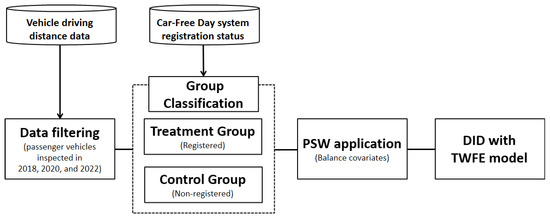
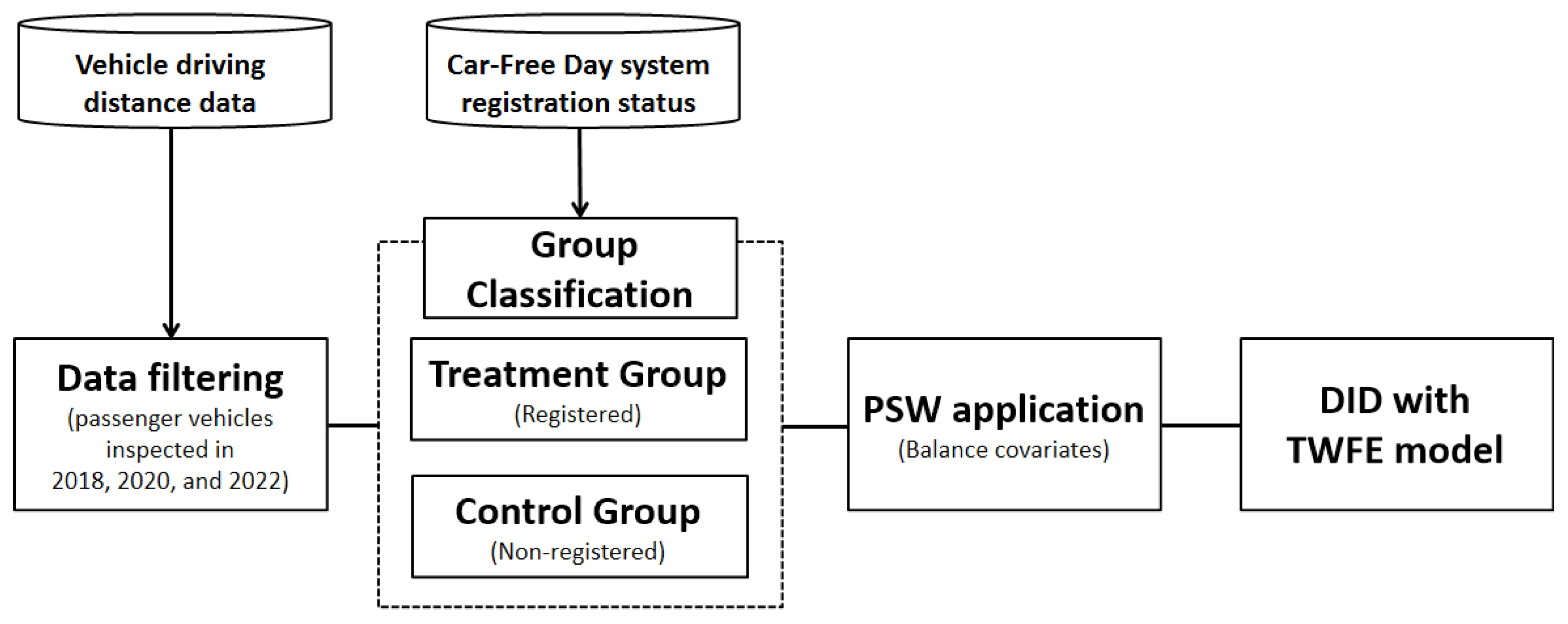
Accordingly, this study proceeds following the workflow illustrated in Figure 1. First, individuals with available and usable data are selected from the driving distance dataset. Next, using the registration status information of the Car-Free Day system, the sample is divided into a treatment group and a control group. PSW is then applied to balance the two groups. Finally, a DID analysis is conducted using a TWFE model.
Figure 1.
Research framework of the study.
This study contributes to the existing literature in the following ways. First, it directly analyzes the effects of a voluntary participation-based vehicle use restriction policy by utilizing actual driving distance data at the individual vehicle level. Second, by addressing the potential issue of selection bias inherent in voluntary participation policies, this study applies PSW to correct for imbalances in observable characteristics between the participating and non-participant groups, thereby enhancing the reliability of the estimated policy effects.
The remainder of this paper is organized as follows. sect:sec2 reviews prior studies related to the effects of vehicle use restriction policies and the PSW methodology, and identifies the contributions of this study. sect:sec3 describes the Car-Free Day system in South Korea, the study site, and the collected data, and presents the necessity of applying the TWFE model and PSW, along with the results of the PSW application. sect:sec4 first explores the effects of the Car-Free Day system through a simple comparison of average daily driving distances across groups, and then empirically analyzes the policy effects using a DID approach based on the TWFE model. Finally, sect:sec5 discusses the implications of the findings and policy recommendations, and outlines the limitations of the study as well as directions for future research.
2. Literature Review
2.1. Effects of Vehicle Use Restriction Policies
The effects of vehicle use restriction policies have been examined from various perspectives, including transportation, environmental, and public health aspects, based on changes observed before and after policy implementation.
From a transportation perspective, numerous studies have focused on license-plate-based driving restriction policies. Liu et al. [3] analyzed the effects of a vehicle use restriction policy implemented in Langfang, China, using License Plate Recognition (LPR) data to measure traffic volume and applying a Regression Discontinuity (RD) design. Their results showed a reduction in traffic volume and an improvement in travel speed following policy strengthening; however, the overall effectiveness was limited due to illegal driving and increased vehicle usage [3]. Chaziris and Yannis statistically compared traffic indicators and congestion indices before and after the implementation of a license-plate-based vehicle use restriction policy in Athens, Greece, using data on traffic volume, travel speed, and metro usage. Their results showed an increase in travel speed and a reduction in congestion within the city center; however, no significant changes were observed in peripheral areas [6]. In addition, Guerra and Millard-Ball evaluated the Hoy No Circula policy in Mexico City using a RD design based on driving distance from household travel survey data, and reported that there was no significant reduction in vehicle driving distance [2]. Bonilla conducted a comparative analysis of different policy stages for the Pico y Placa policy in Bogota, Colombia, using data on carbon monoxide concentrations, gasoline consumption, vehicle sales, and vehicle registrations. The results indicated that there was no clear evidence of reduced vehicle use or improvements in air quality [8]. Meanwhile, a study analyzing the Paris Respire policy in Paris, France [14] employed a spatiotemporal DID approach using traffic volume data and individual sleep data, and found that traffic volume decreased by approximately 24.9% and sleep duration increased by about 2.2% in areas where the policy was implemented. Furthermore, a study on the 30 Dagen Minder Wagen campaign in Flanders, Belgium [19] used survey-based travel behavior data and a before-and-after comparison, and confirmed that automobile use decreased along with an approximately 30% reduction in emissions [19].
From an environmental perspective, Viard and Fu conducted a DID analysis on a license-plate-based vehicle use restriction policy in Beijing, China, using Air Pollution Index (API) and meteorological data, and found that air pollution decreased to come extent following policy implementation [4]. In contrast, Song analyzed AQI data from nine cities in China using a DID approach and reported that such policies did not have a statistically significant impact on improving air quality in the long term [5]. Similarly, Lin et al. [7] evaluated a vehicle use restriction policy in Sao Paulo, Brazil, using air pollution monitoring data and meteorological data within a fixed effects DID framework. Their results suggested that although there were reductions in some pollutants, the overall improvement in air quality was limited [7]. In addition, Xiao et al. compared a vehicle use restriction policy with an old vehicle scrappage policy in Beijing, China. Using emission data, they conducted a multivariate regression and cost-effectiveness analysis, and found that the old vehicle scrappage policy was more cost-effective [13].
Low Emission Zone (LEZ) policies have also been examined from an environmental perspective. Ma et al. applied a regression discontinuity design (RDD) to air quality monitoring data and meteorological data to evaluate the Ultra Low Emission Zone (ULEZ) policy in London, UK, and found that concentrations decreased by less than approximately 3% [10]. Panteliadis et al. analyzed the LEZ policy in Amsterdam, the Netherlands, using a regression model that controlled for meteorological factors and traffic volume, and reported that traffic-related air pollutant concentrations decreased by approximately 5–13% [11]. Peters et al. evaluated the LEZ policy in Madrid, Spain, using a DID approach based on vehicle registration data and fuel consumption data, and found that although registrations of alternative fuel vehicles increased, the reduction in emissions was not statistically significant [9].
The effects of Car-Free Day policies have also been analyzed from an environmental perspective. Rachman and barus evaluated the Car-Free Day policy in Jakarta, Indonesia, using a comparative analysis based on air quality monitoring data and found that the improvement in air quality was limited [16]. Masiol et al. assessed a vehicle use restriction policy in the Po Valley region of Italy using a time-series analysis of 13 years of air pollution data, and reported that the short-term effects were limited [18].
Finally, from a health perspective, Margaryan conducted a DID analysis of LEZ policies across multiple cities in Germany using air quality data and individual health data based on health insurance records, and reported that the risks of cardiovascular and respiratory diseases significantly decreased following policy implementation [12]. The study on the Paris Respire policy in Paris, France [14], mentioned above, also examined not only transportation outcomes but additionally analyzed sleep quality, thereby evaluating the policy effects from a health perspective as well.
However, despite the substantial body of research on the effects of vehicle use restriction policies, studies focusing on voluntary participation-based policies remain limited. In addition, studies that directly examine whether driving distances of individual vehicles actually decrease as a result of such policies are also scarce. This is because voluntary participation-based policies are often implemented in limited areas or as one-time events, making it difficult to analyze sustained effects at the citywide level, and because it is challenging to obtain driving distance data at the individual vehicle level.
2.2. Propensity Score Weighting
In the case of policies involving voluntary participation, the decision to participate may be influenced by individual characteristics, leading to differences in characteristics between the treatment and control groups. Such self-selection can result in selection bias in observational studies and may consequently affect the estimation of causal relationships between the treatment and outcome variables [20,21,22,23]. In such cases, prior to applying models for causal inference, preprocessing methods–such as matching methods, weighting methods, nonparametric approaches, and robust estimation–can be used to reduce differences between the treatment and control groups and thereby improve the reliability of causal effect estimation [24].
In this study, among these preprocessing methods, the Propensity Score Weighting (PSW) approach, a weighting method, is applied. PSW estimates the probability of being assigned to the treatment group (propensity score) using covariates that influence treatment assignment, and incorporates these probabilities as weights in subsequent modeling [24]. Compared to Propensity Score Matching (PSM), which constructs the sample by performing one-to-one matching between treatment and control units with similar propensity scores, PSW has the advantage of less information loss. This is because PSM excludes unmatched observations due to its one-to-one matching procedure [25].
Li et al. [20] defined patients who underwent Right Heart Catheterization (RHC) and those who did not as the treatment and control groups, respectively, using data from a critical care study. They identified imbalances between the two groups across 72 covariates, applied PSW to improve this imbalance, and analyzed significant differences between the groups [20]. Ramkumar et al. [25] noted that, in observational studies, patients are not randomly assigned to treatments, which leads to selection bias. They divided coronary artery bypass grafting (CABG) patients into treatment and control groups based on the use of bilateral internal mammary artery (BIMA) versus single internal mammary artery (SIMA), applied PSW, and achieved balance between the two groups [25]. In addition, there are studies that explicitly address the potential for selection bias, such as one that examined the effect of coach replacement on team performance in the Italian professional soccer league by balancing teams with and without a mid-season coach change using PSW [24]. Another study applied PSW to compare minority and white police officers in the United States, defining them as treatment and control groups to examine differences in perceptions by race [26]. Furthermore, in the evaluation of traffic safety policies, PSW has been applied to correct for covariate imbalance between treated and comparison sites prior to estimating policy effects [27]. There are also studies that analyzed the effects of the urban built environment and residential self-selection on commuting mode choice by comparing social housing residents with general housing residents and applying PSW to account for differences in sociodemographic characteristics [28].
In previous studies, selection bias has been assessed using the Standardized Mean Difference (SMD) of each covariate between the treatment and control groups. Although the terminology used to describe SMD varies slightly across studies, they consistently employ the SMD metric. SMD is defined as the absolute difference in covariate means between the treatment and control groups divided by the pooled standard deviation. A value of 0.1 or less is generally considered to indicate that the covariate is well balanced. A detailed explanation is provided in Section 3.4.
This study differs from previous research in two main aspects. First, unlike prior studies that were relatively limited and relied on indirect measures, this study directly analyzes the effects of a voluntary participation-based policy using driving distance data. Second, whereas previous studies primarily relied on indirect indicators and did not account for self-selection bias inherent in voluntary participation policies, this study explicitly considers this issue and applies PSW to improve the reliability of policy effect estimation.
3. The Self Car-Free Day System, Study Site and Data
3.1. The Self Car-Free Day System
The Self Car-Free Day System is a voluntary, citizen-participatory policy under which registered private passenger vehicles are prohibited from being used from 7 a.m. to 8 p.m. on one designated weekday between Monday and Friday. The policy is implemented on a weekly basis and participation is not mandatory. Eligible vehicles under the Self Car-Free Day System are non-commercial private passenger cars with a seating capacity of ten or fewer. The policy was introduced with the aim of reducing carbon emissions from private vehicles, promoting energy conservation, and alleviating traffic congestion. Compliance with the Self Car-Free Day System is verified through the installation of RFID readers at major locations within participating local governments, which detect electronic identification tags attached to registered vehicles. In South Korea, the program was first introduced in Seoul in 2003 and was subsequently expanded to Gyeonggi Province, Busan, Daejeon, Ulsan, Incheon, and Daegu. However, the program has since been discontinued in Seoul and Gyeonggi Province; in the case of Seoul, it was replaced by the Car Mileage Program.
As a voluntary, citizen-participatory policy, the Self Car-Free Day System provides various incentives to encourage participation. Upon registration, participants are eligible for benefits in the public sector, including reductions in vehicle taxes, discounts on public parking fees, discounts for residential parking permits, and partial exemptions from traffic inducement charges. In addition, benefits are also offered in the private sector, such as discounts on dining, vehicle maintenance, fuel purchases, and cultural activities. It should be noted that the specific benefits vary across local governments implementing the policy. In particular, Daegu provides public transportation mileage instead of vehicle tax reductions.
3.2. Study Site
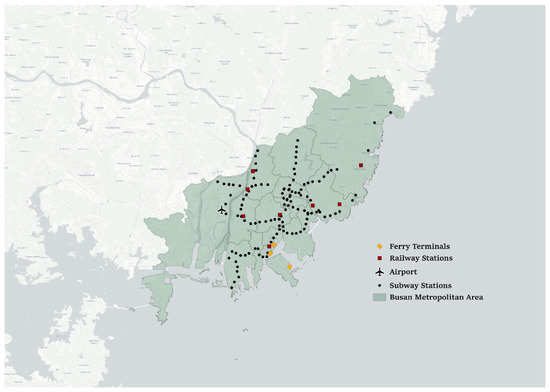
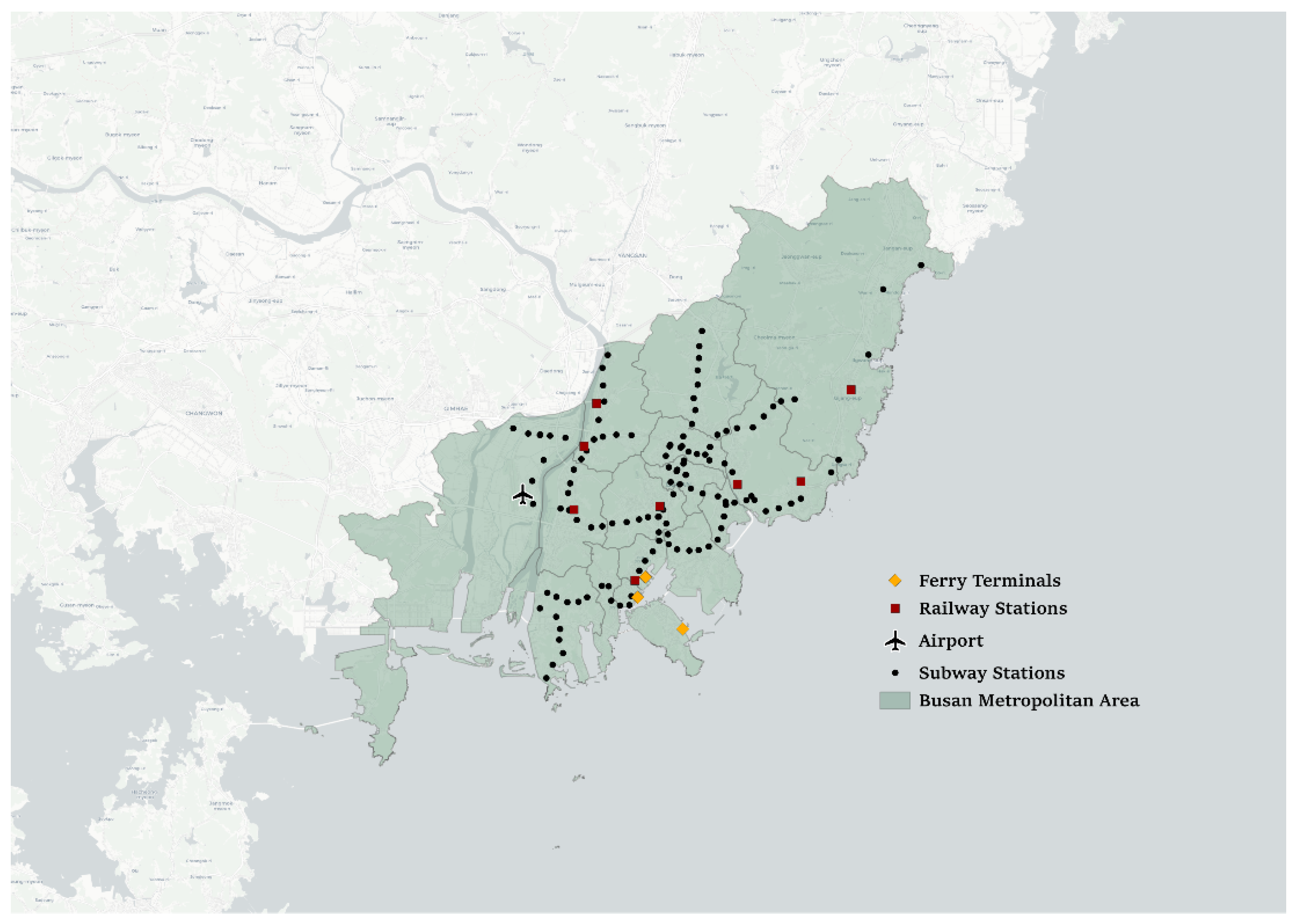
Busan, the study area of this research, is the second-largest city in South Korea after Seoul and is a coastal city located at the southernmost part of the Korean Peninsula [29]. The city has a total area of approximately 771 km2, with a population of about 3.33 million as of 2023, a population density of 4343 persons/km2, and approximately 1.56 million registered vehicles. The GRDP is 114.165 trillion KRW, accounting for 4.7% of the national total. In terms of industrial structure, the service and other sectors account for the largest share at 75.8%, followed by mining and manufacturing at 17.4%, and construction at 5.2%. Among the 1.56 million registered vehicles, approximately 1.18 million are privately owned, with a per capita private vehicle ownership rate of 0.36 vehicles per person. This represents an increase of about 0.1 vehicles per person compared to 0.27 vehicles per person in 2015, indicating an increased reliance on private transportation in Busan [30]. In addition to bus services, Busan has an urban rail system, and its accessibility is further enhanced by the presence of an international airport and passenger terminals, enabling access via both air and maritime transportation. Moreover, high-speed rail stations are in operation, providing strong connectivity with other regions. Figure 2 presents a map showing the location and area of Busan, along with the locations of the airport, urban rail stations, railway stations, and passenger terminals.
Figure 2.
Location of Busan, South Korea, and Major Transportation Facilities.
However, due to high population density in urban areas and intensive freight transport activities centered around the port, the transportation sector accounted for approximately 42% of total emissions in 2022 (measured in terms of VKT), thereby emphasizing the need for policies aimed at reducing driving distance [31].
Number of Vehicles Registered for the Self Car-Free Day System in Busan
In this study, information on vehicles registered for the Self Car-Free Day System in Busan was collected. The dataset includes the year of registration, and the number of vehicles registered for the Self Car-Free Day System in Busan by year is presented in Table 1. As shown in the table, the number of vehicles registered for the program exhibits a gradual increasing trend over time. In this study, vehicles that registered for the Self Car-Free Day System in 2021 were selected as the analysis sample. This selection was made to enable linkage with driving distance data.
Table 1.
Yearly vehicle registrations for the Self Car-Free Day System in Busan.
3.3. Driving Distance Data
3.3.1. Trends in Passenger Car Driving Distance in South Korea
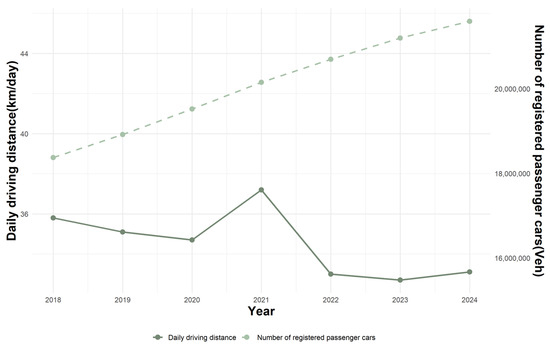
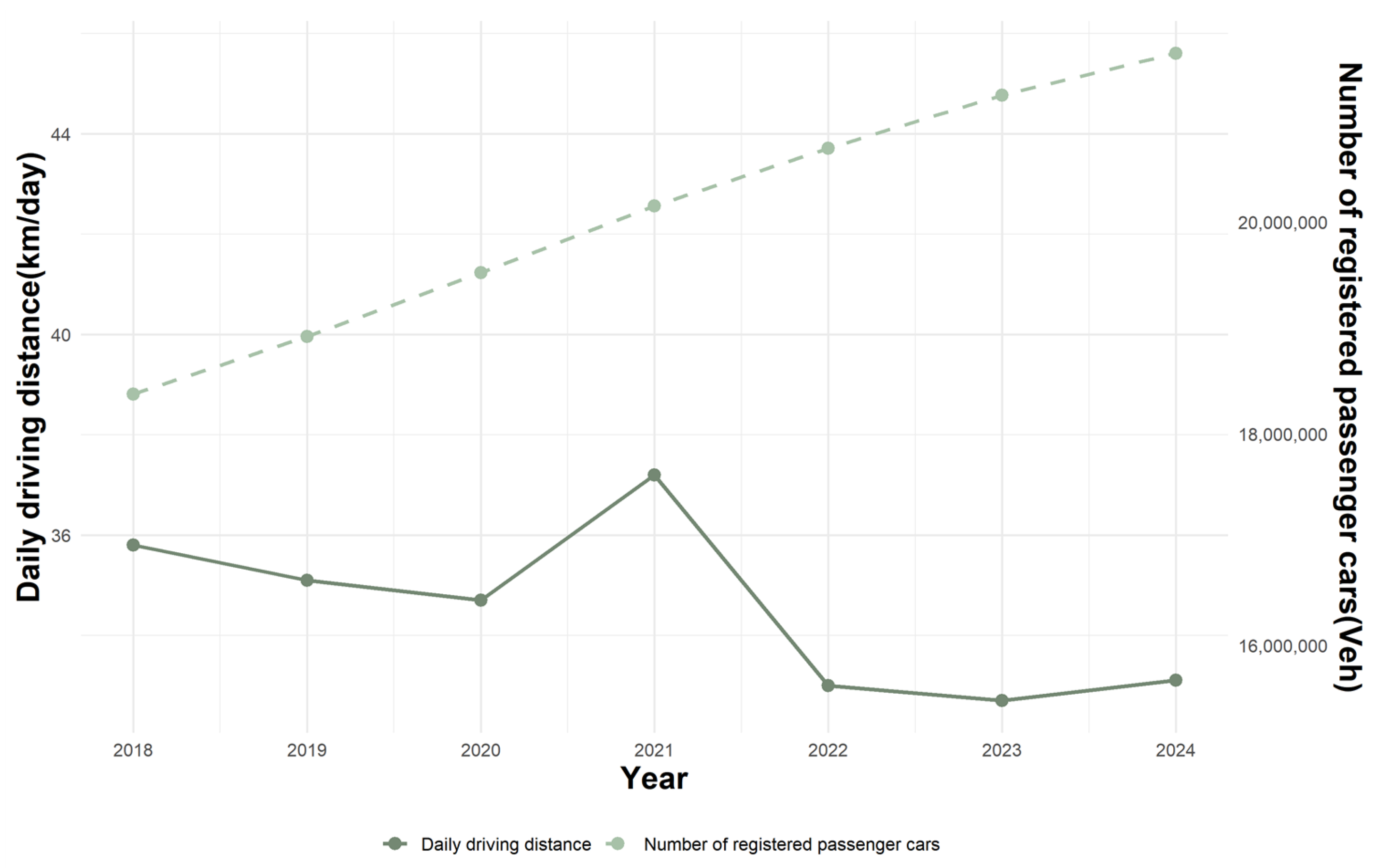
The Korea Transportation Safety Authority publishes annual statistics on driving distance. Focusing on passenger cars, Figure 3 presents regional data for South Korea on average daily driving distance per vehicle and the number of registered passenger cars from 2019 to 2024. In the figure, the green solid line represents the average daily driving distance per passenger car (km/day) nationwide, while the green dashed line indicates the number of registered passenger cars (vehicles). Overall, except for 2021, the average daily driving distance per vehicle shows a declining trend. This pattern can be attributed to the increase in the total number of registered vehicles nationwide, which has led to a reduction in average driving distance per vehicle.
Figure 3.
Average daily driving distance per passenger car and number of registered passenger cars in South Korea.
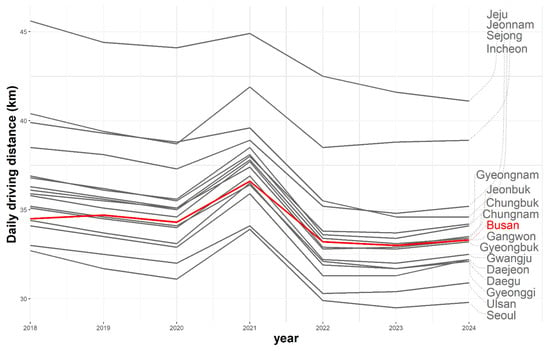
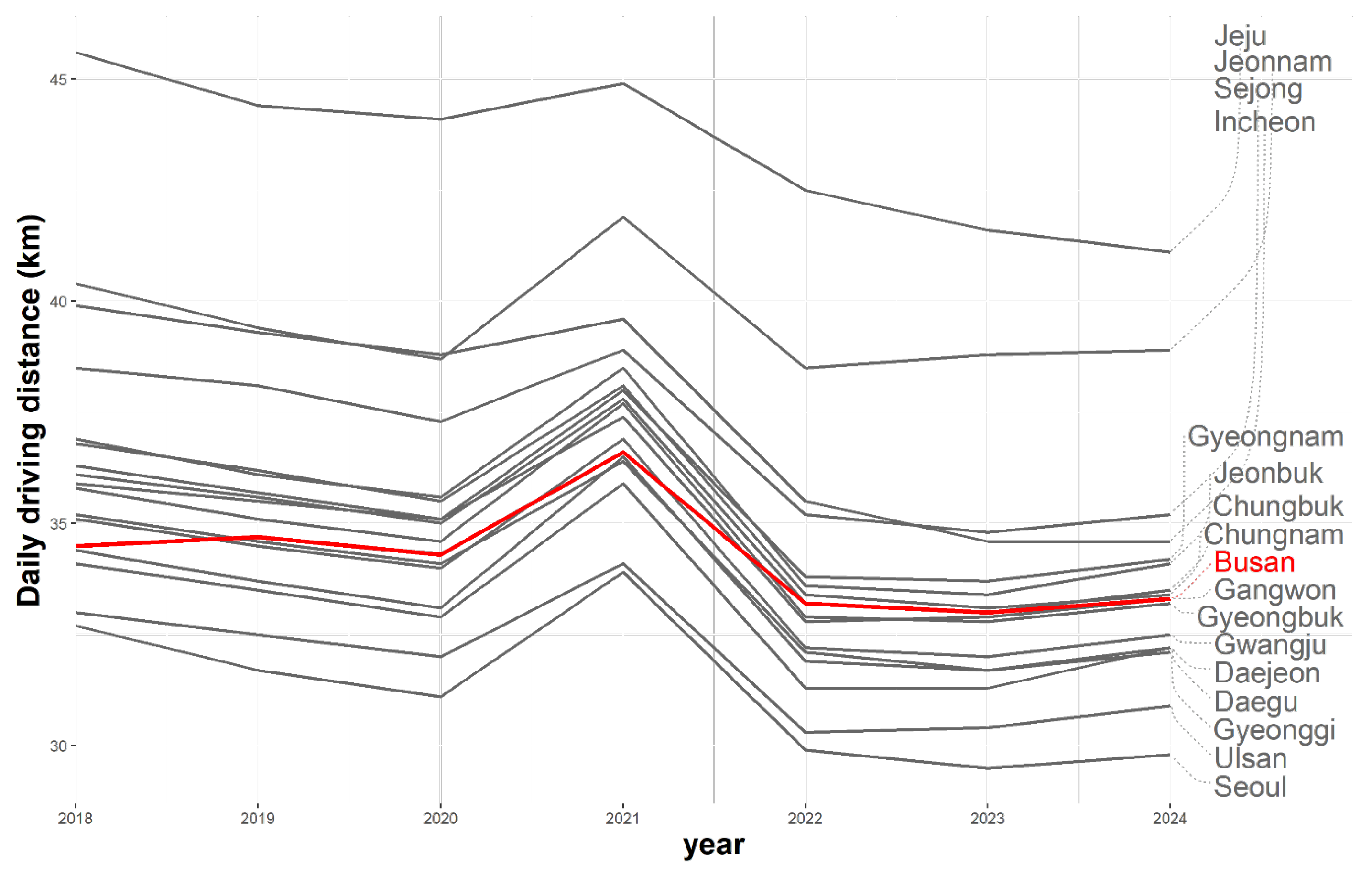
Figure 4 presents the average daily driving distance of passenger cars by region in South Korea. Overall, except for Jeonnam Province and the year 2021, average daily driving distance exhibits a declining trend. In particular, Busan (red solid line), which is the focus of this study, also shows a decreasing trend in average daily driving distance over time.
Figure 4.
Average daily driving distance by region in South Korea.
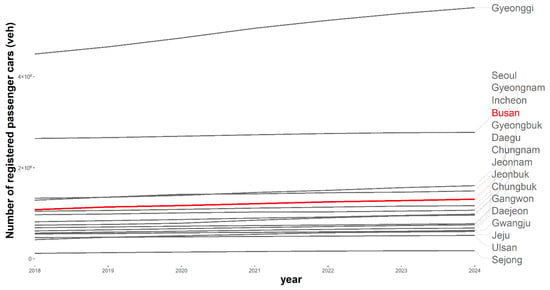
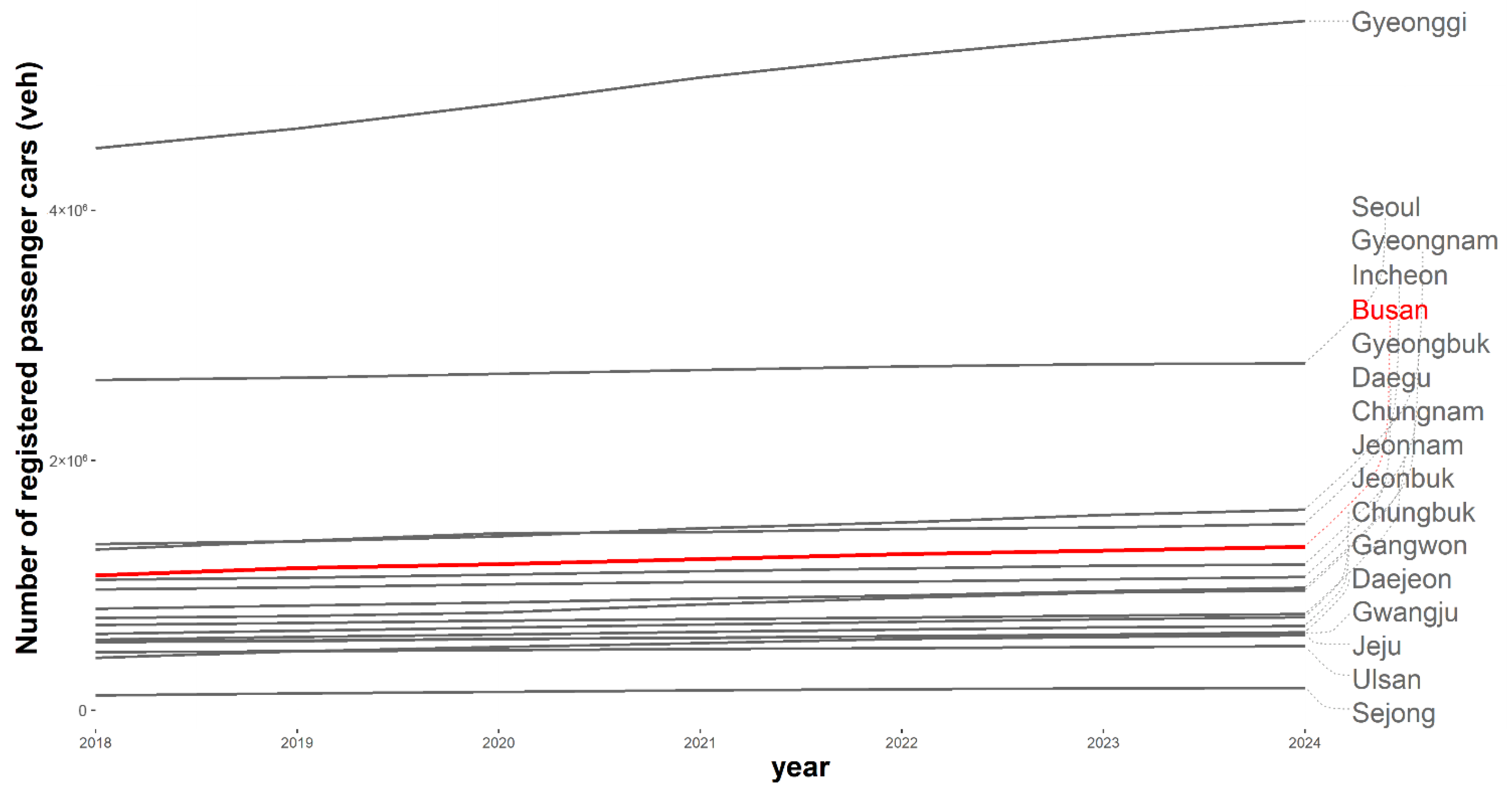
Figure 5 presents the number of registered passenger cars by region in South Korea. Overall, the number of registered passenger cars shows an increasing trend across all regions. In particular, Busan (red solid line), which is the focus of this study, also exhibits an increasing trend in passenger car registrations.
Figure 5.
Number of registered passenger cars by region in South Korea.
If the declining trend in average daily driving distance of passenger cars is not taken into account, the estimated effects of the Self Car-Free Day System before and after implementation may be overstated. Therefore, it is necessary to consider a modeling approach that controls for such time-related effects.
3.3.2. Passenger Car Driving Distance Data
In this study, passenger car driving distance data for Busan from 2018 to 2024 were collected from the Korea Transportation Safety Authority. The dataset includes vehicle characteristics (vehicle type, fuel type, payload capacity, and engine displacement), inspection year, and average daily driving distance.
Although data were collected annually from 2018 to 2024, passenger cars in South Korea are subject to vehicle inspection every two years. Accordingly, to enable comparison around the registration year of the Self Car-Free Day System (2021), the analysis was restricted to vehicles that underwent inspections in 2018, 2020, and 2022. Among a total of 134,465 vehicles with inspection records, vehicles that did not follow the biennial inspection cycle were excluded. As a result, 11,410 vehicles (8.5%) were selected for the final analysis sample. Of these, 1048 vehicles (9.2%) were registered for the Self Car-Free Day System and classified as the treatment group, while 10,362 vehicles (90.8%) were not registered and classified as the control group (Table 2).
Table 2.
The number of vehicles used in this study.
Because the data used in this study were not collected through an experimental design, the treatment group was not randomly assigned, which constitutes a limitation of the analysis. This implies that vehicles registered for the Self Car-Free Day System may possess specific characteristics that differ from those of non-registered vehicles, resulting in sample imbalance, commonly referred to as selection bias. Such non-random sample composition can undermine the validity of policy effect comparisons. Therefore, it is necessary to employ a method that adjusts for pre-existing differences between the two groups to ensure comparability. In this study, propensity score weighting (PSW) is applied to correct for this imbalance.
3.4. Controlling for Selection Bias via Propensity Score Weighting
To apply PSW, the propensity score must first be estimated. The propensity score is defined as the probability that each subject is assigned to the treatment group, calculated using covariates through models such as logistic or probit regression [24]. PSW utilizes this propensity score as a weight in the analysis of treatment effects. Let the propensity score be denoted as ; then, the weight used in PSW is given as follows [25]:
Here, i denotes the i-th subject. The treated units are assigned a weight of 1, whereas the control units are reweighted to achieve covariate balance with the treated group. In particular, larger weights are given to selected control observations to align their distribution with that of the treated group.
After applying the PSW method, it is necessary to assess whether balance between the two groups has been achieved. This can be evaluated by calculating the average value of the absolute standardized mean differences (SMD) across covariates and examining whether this value exceeds a predefined threshold. In this context, the SMD for a covariate z can be expressed as follows [24]:
Here, denotes the i-th covariate for the treatment group, and denotes the i-th covariate for the control group. In general, a value exceeding 0.1 is considered indicative of imbalance in the corresponding covariate [24,26,27,28].
In this study, the selected covariates include vehicle type, fuel type, vehicle age, payload capacity, and engine displacement, and a logistic regression model is used to estimate the propensity scores. These covariates are considered to indirectly capture subject characteristics and are available in the driving distance dataset.
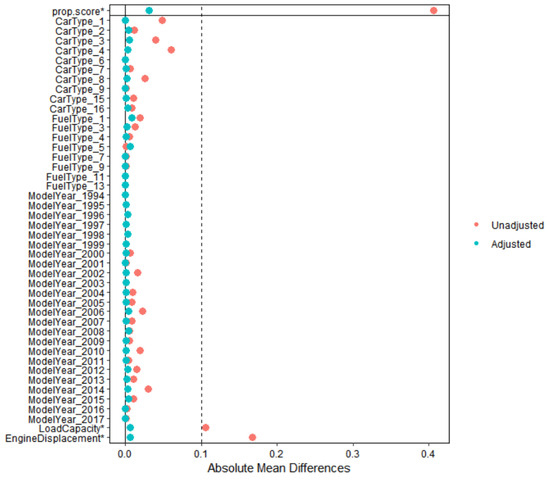
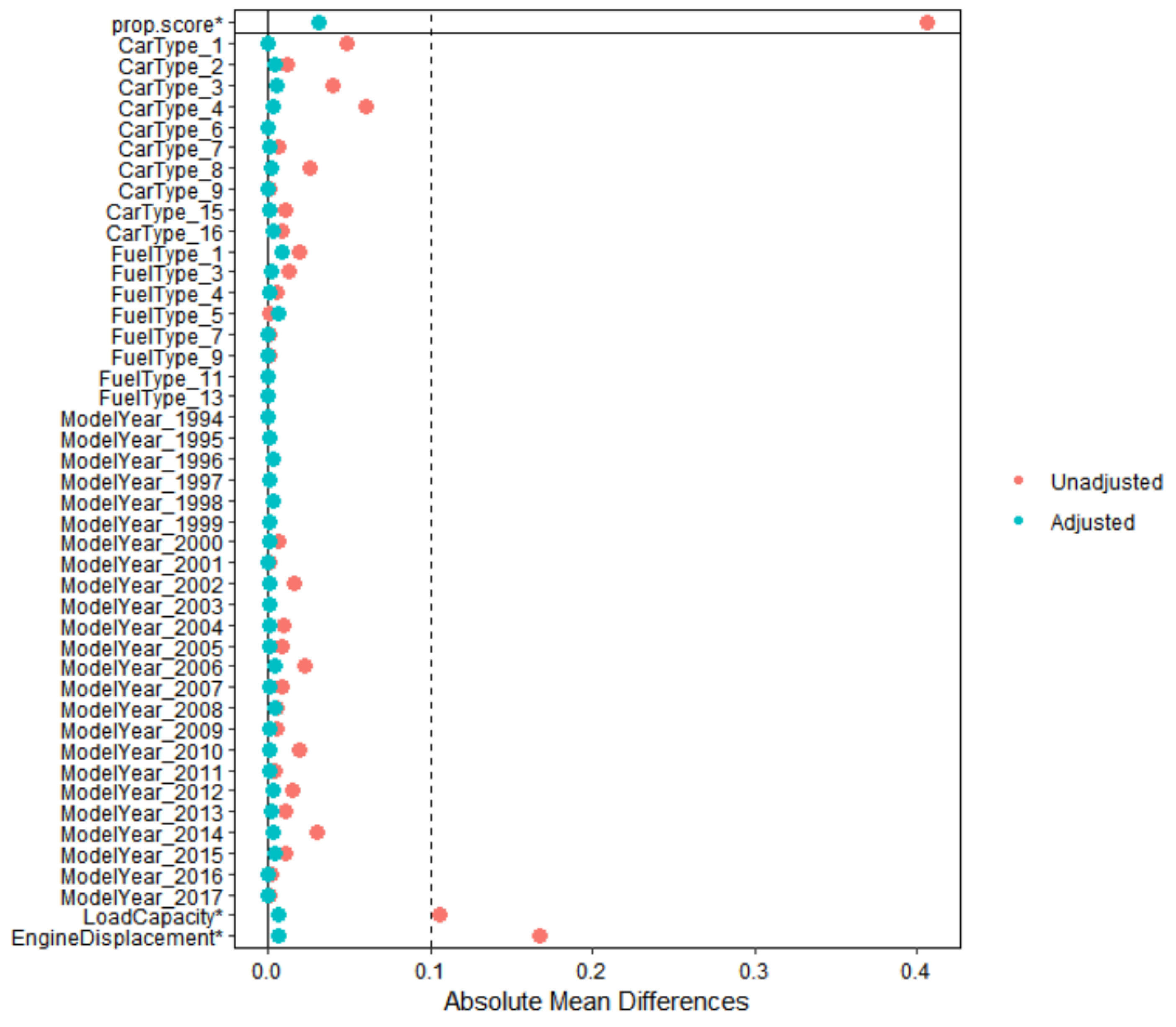
Figure 6 presents the SMD before and after applying PSW. The top entry, prop.score, represents the SMD of the propensity scores between the treatment and control groups. prop.score is marked with an asterisk and indicates a calculated SMD rather than a covariate. As shown in the figure, before applying PSW (red dots), SMD values exceeding 0.1 are observed for payload capacity and engine displacement, indicating imbalance between the treatment and control groups for these covariates. After applying PSW (green dots), the SMD values for all covariates fall below 0.1, suggesting that balance between the two groups has been achieved. For vehicle type, categories 1–4 represent general light, small, medium, and large vehicles, respectively; 5–8 represent multipurpose light, small, medium, and large vehicles; 9–12 represent freight light, small, medium, and large vehicles; and 13–16 represent other light, small, medium, and large vehicles. For fuel type, categories 1–3 correspond to gasoline, 4 to diesel, 5 to LPG, 6 to kerosene, 7 to CNG, 8 to LNG, 9–12 to hybrid, and 13 to electric.
Figure 6.
SMD before and after applying PSW for the treatment and control groups.
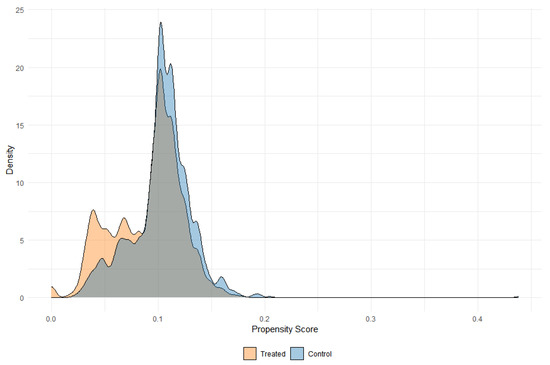
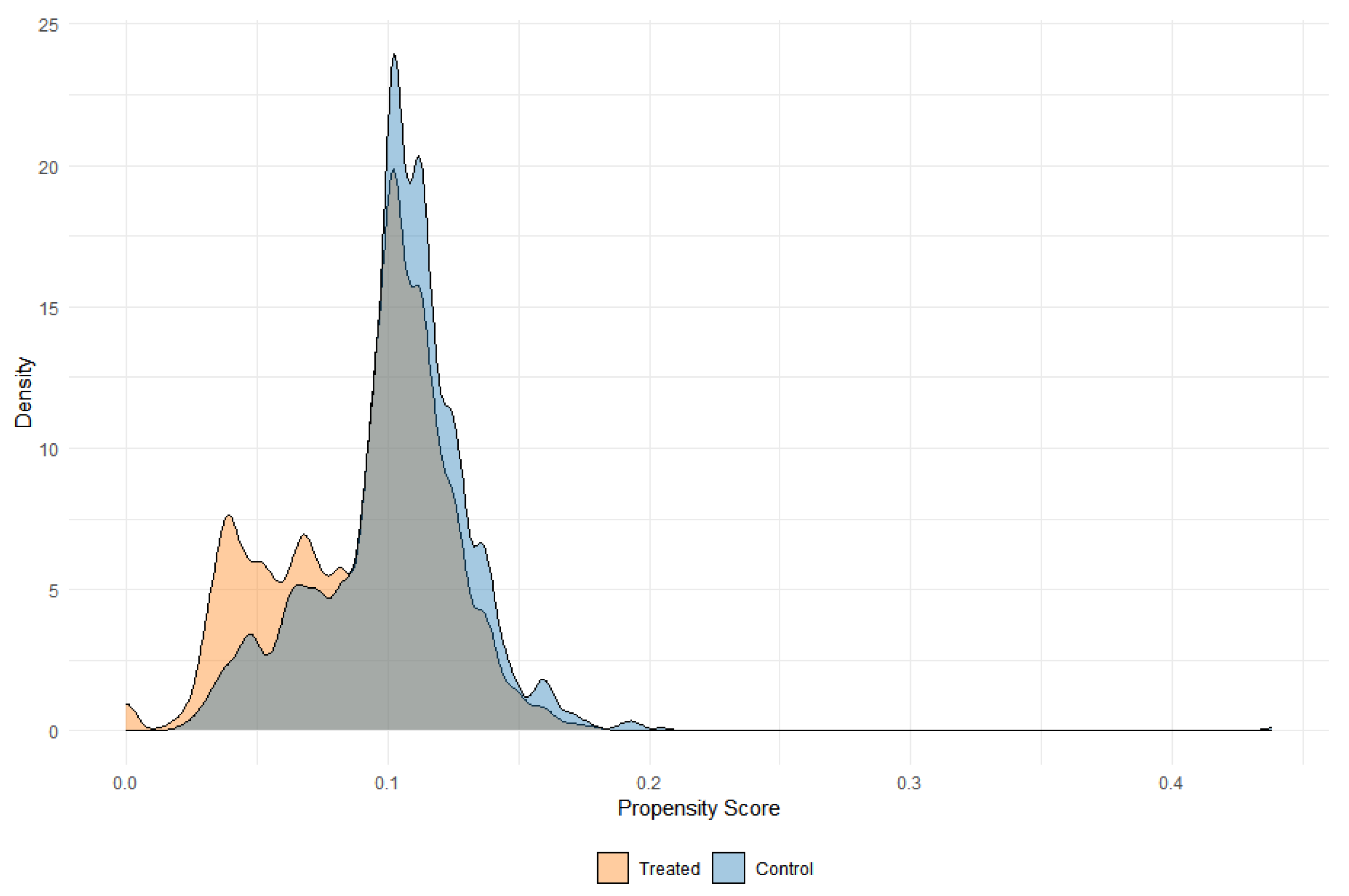
Figure 7 visualizes the distributions of the estimated propensity scores for the treatment group (orange) and the control group (blue). As illustrated, the distributions largely overlap across most of the range (gray), indicating that sufficient common support has been established. In other words, there exists a substantial region over which the two groups are comparable. Although there are some areas with limited overlap, these are not expected to materially affect the overall result of the analysis.
Figure 7.
Distributions of propensity scores for the treatment and control groups.
4. Impact of Passenger Car Use Restriction Policies on Driving Distance
4.1. Simple Comparison
To provide a simple comparison of the effects of passenger car vehicle use restriction policies, such as the Self Car-Free Day System, the average daily driving distance of the treatment and control groups was examined by year. To this end, Table 3 presents the annual average daily driving distance for both groups, along with the absolute and relative changes in average daily driving distance compared with two years earlier.
Table 3.
The mean of the daily driving distance by the analysis group (km/day × vehicle).
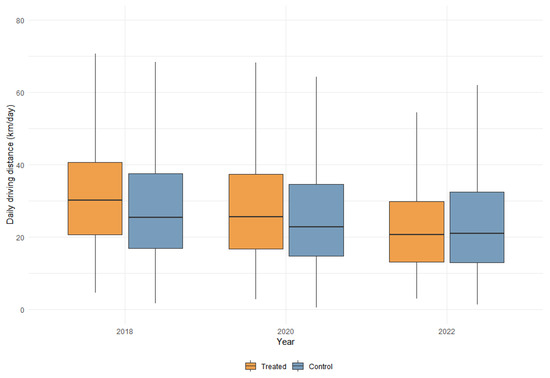
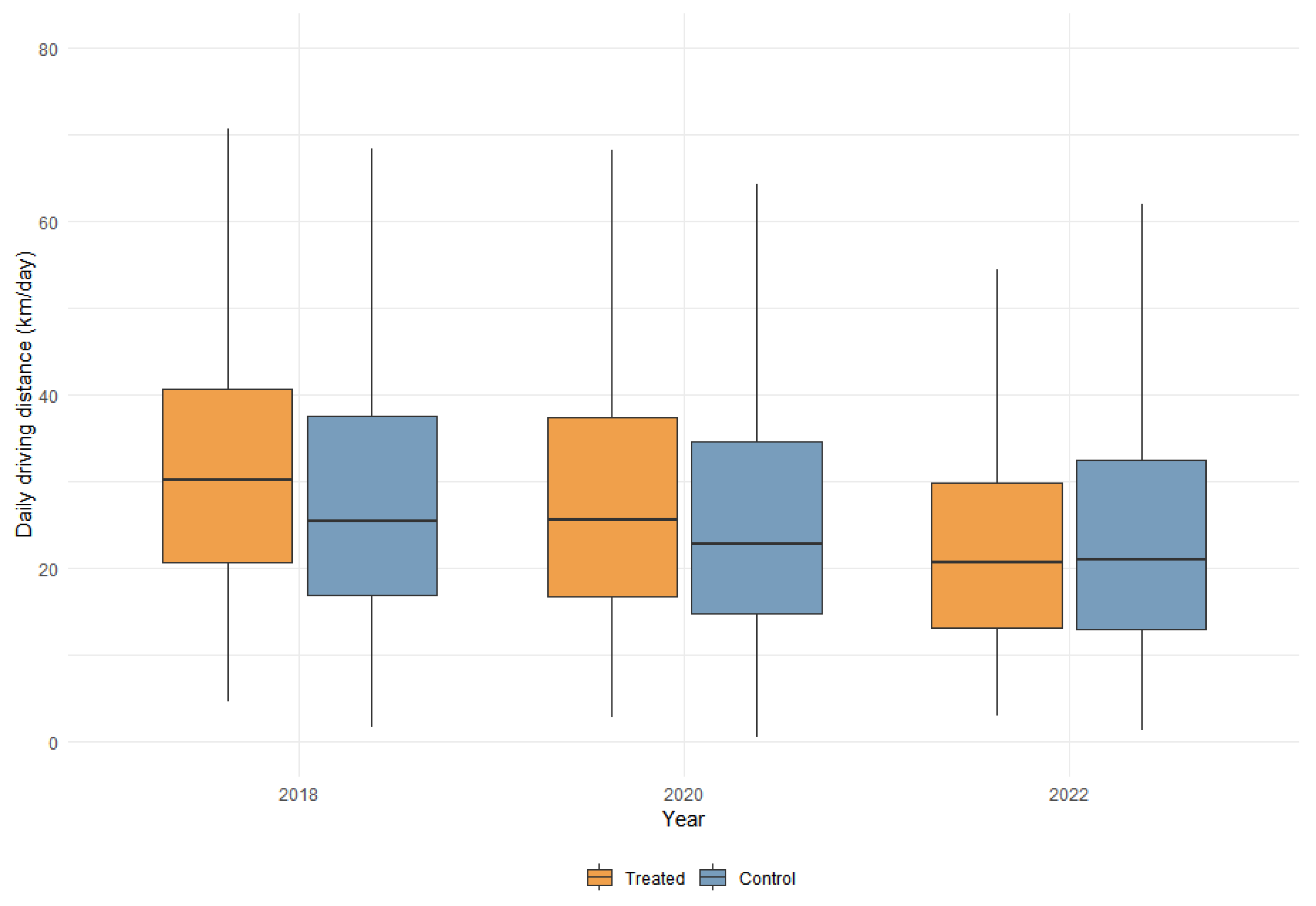
As shown in the table, from 2018 to 2022, the average daily driving distance declined for both the treatment and control groups, with the magnitude of the reduction being larger for the treatment group than for the control group. In addition, within the treatment group, the reduction in average daily driving distance after registration in the Self Car-Free Day System (2022) was greater than the reduction observed prior to registration (2020). These findings suggest that the Self Car-Free Day System had a positive effect on reducing driving distance. The declining trend in average daily driving distance is also illustrated in Figure 8, which presents boxplots of the annual distributions of average daily driving distance by group. In the figure, the orange boxes represent the treatment group, while the blue boxes represent the control group. Although the ranges of the two groups do not show substantial differences, the median values (black lines within the boxes) gradually decrease over time.
Figure 8.
Boxplots of annual average daily driving distance for the treatment and control groups.
However, to identify the effect of the Self Car-Free Day System, it is important to account for the overall declining trend in passenger car driving distance observed nationwide, as shown in Figure 2, as well as the decreasing trend in the annual average daily driving distance of the control group reported in Table 3. Moreover, although the sample was constructed to ensure identical fuel-type composition between the treatment and control groups, the fact that the treatment group exhibited higher average daily driving distances than the control group in 2018 and 2020 may reflect inherent characteristics of vehicles registered for the Self Car-Free Day System. Therefore, vehicle-specific driving distance characteristics should also be taken into consideration when evaluating the effects of the Self Car-Free Day System.
4.2. Comparison Using Difference-in-Differences with Two-Way Fixed Effects Model
The difference-in-differences (DID) method is a widely used analytical approach for estimating causal effects by comparing outcomes before and after a treatment. This method identifies the treatment effect by examining the difference in outcome changes between a group that receives the treatment (the treatment group) and a group that does not (the control group). For valid estimation, DID relies on the parallel trends assumption, which posits that, in the absence of treatment, the treatment group would have followed the same temporal trend as the control group. This assumption is a key condition that justifies comparing changes in outcomes between the two groups [32]. In the classical DID framework, which typically uses only one pre-treatment and one post-treatment observation, the parallel trends assumption is generally assumed to hold without formal testing.
Data observed at multiple time points for the same unit are commonly referred to as longitudinal or panel data. When applying DID to longitudinal or panel data, several important considerations arise [33,34]. First, treatment effects may be heterogeneous across subjects and over time. Second, simply dividing the timeline into pre- and post-treatment periods may fail to capture dynamic temporal patterns. Third, there may exist heteroskedasticity across subjects as well as serial correlation over time, which need to be appropriately addressed in the estimation strategy.
First, heterogeneous treatment effects across subjects and over time may lead to biased estimation of pre- and post-treatment changes. To address this issue, a two-way fixed effects (TWFE) model is commonly employed. The TWFE model is a linear regression framework that incorporates both unit fixed effects and time fixed effects, allowing for the estimation of subject-specific and time-specific intercepts. By controlling for unobserved heterogeneity across subjects and common shocks over time, the TWFE model allows for the estimation of the treatment effect net of heterogeneous influences.
In this context, the heterogeneity considered in this study is distinct from the treatment effect heterogeneity arising from differences in treatment timing, as discussed by Ruttenauer and Aksoy [32], Goodman-Bacon [35], Callaway and Sant’Anna [36], Sun and Abraham [37] and de chaisemartin and D’Haultfoeuille [38]. In this study, vehicles that participated in the policy in 2021 are defined as the treatment group, while vehicles that did not participate in the same period are used as the control group. As such, treatment timing heterogeneity is not present in our setting. Therefore, the heterogeneity considered in this study corresponds to forms that can be adequately controlled for within a conventional fixed effects framework, including unit-level heterogeneity (e.g., driving habits) and common time-varying factors (e.g., the overall declining trend in driving distance in South Korea). The basic specification of the TWFE model is given as follows:
Here, denotes the response variable for subject i at time t, represents the unit fixed effect for subject i, and denotes the time fixed effect at time t. The term refers to the k-th independent variable for subject i at time t; in the DID framework, this typically includes a dummy variable indicating the pre- and post-treatment periods, as well as additional covariates, when necessary [32,33,34,39].
Second, to capture temporal dynamics, it is insufficient to simply divide the analysis period into pre- and post-treatment periods, as in the conventional 2 × 2 DID framework. Instead, when multiple observations over time are available for the same unit—as in this study, which uses vehicle-level average daily driving distance data for 2018, 2020, and 2022—DID can be applied separately for each time period to estimate how treatment effects evolve over time. This approach can be implemented through an event-study two-way fixed effects (TWFE) model. In particular, by examining the similarity of pre-treatment trends between the treatment and control groups, the plausibility of the parallel trends assumption can be indirectly assessed. However, such comparisons do not constitute a formal test of the parallel trends assumption and are intended to provide only limited supporting evidence [39].
Third, when serial correlation across time is present, the standard errors of the estimated coefficients in the TWFE model may be underestimated [40]. To address this issue, clustered standard errors are employed when conducting inference on the regression coefficients, unlike conventional standard errors, clustered standard errors account for heteroskedasticity and serial correlation, thereby enabling reliable statistical inference after model estimation [33]. The specification of the event-study TWFE model used in this study is given as follows [39]:
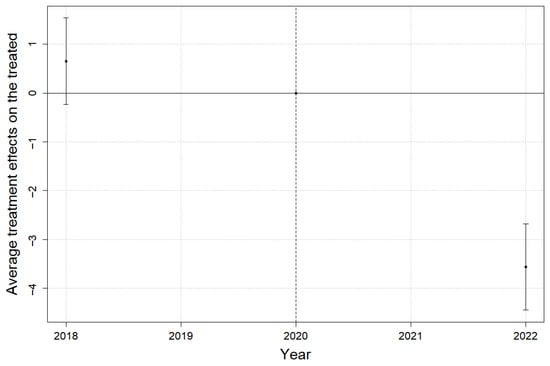
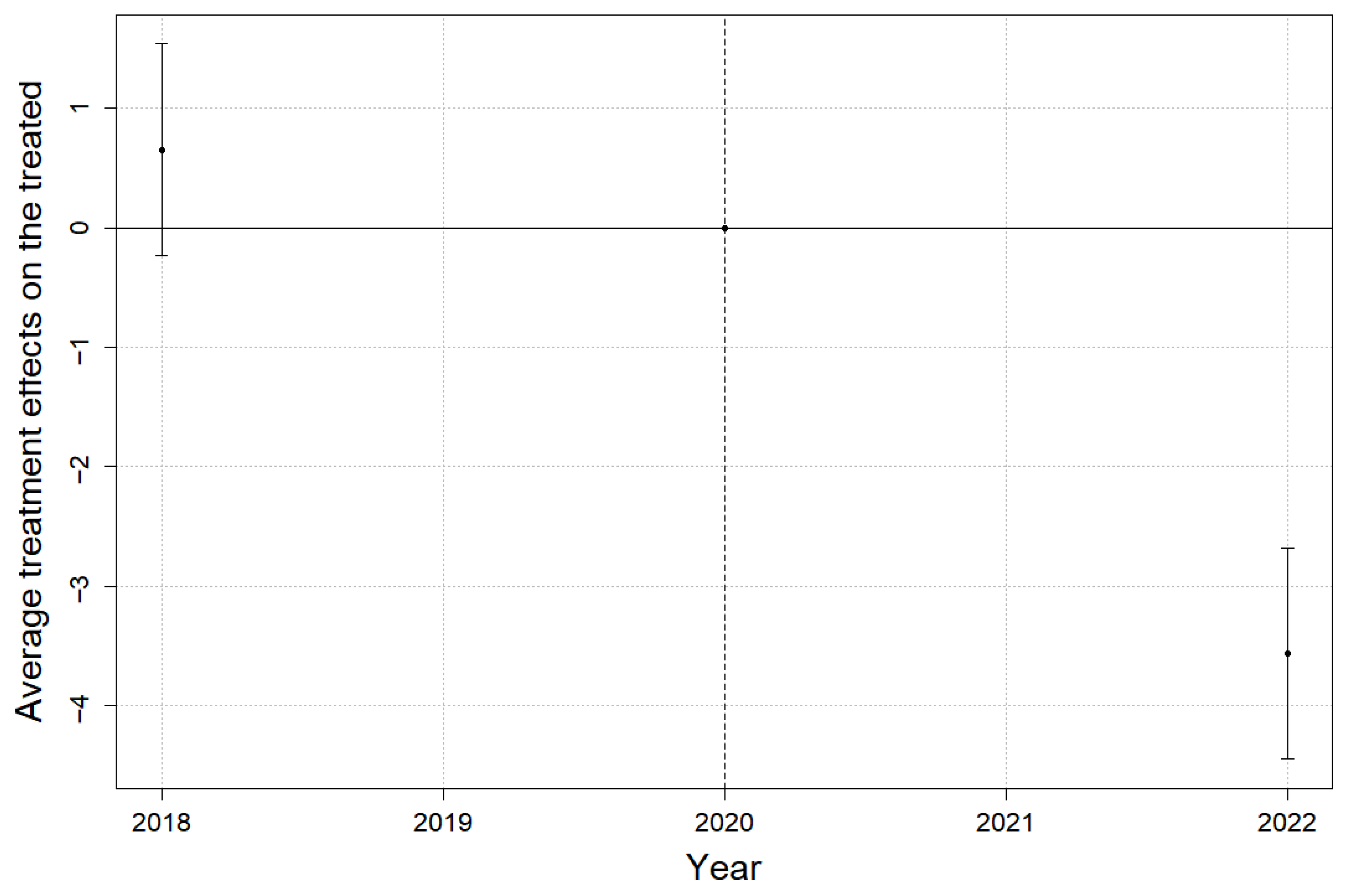
Here, Treatment equals 1 if vehicle i belongs to the treatment group and 0 otherwise. Because this study focuses on vehicles registered for the Self Car-Free Day System in 2021, the reference year for treatment is set to 2020. The coefficient represents the difference in the average change in daily driving distance between the treatment and control groups in 2018 relative to 2020, while represents the corresponding difference for 2022 relative to 2020. Accordingly, can be used to indirectly assess the plausibility of the parallel trends assumption, whereas is used to examine whether registration for the Self Car-Free Day System led to a reduction in average daily driving distance. The difference in the average change in daily driving distance between the treatment and control groups is referred to as the average treatment effect on the treated (ATT) [32,33,34,39].
When applying the TWFE model, the previously estimated PSW was incorporated. The estimation was performed using the statistical computing software R (version 4.4.1) with the plm and fixest packages.
The results of this study are reported in Table 4. The coefficient , which is used to test the parallel trends assumption, is not statistically significant, providing support for the parallel trends assumption. The coefficient captures the average change in daily driving distance of the treatment group relative to the control group after treatment and shows that the average daily driving distance of the treatment group decreased by 3.56 km/day more than that of the control group. This effect is statistically significant at the 1% level.
Table 4.
Estimation results from the Two-Way Fixed Effects Model.
The event-study plot corresponding to these results is presented in Figure 9. In the figure, the black dots represent the estimated ATT for each year, corresponding to the coefficients and reported in Table 4. The vertical lines above and below each dot indicate the 95% confidence intervals of the ATT estimates. As shown in the figure, the 95% confidence interval for the ATT in 2018 includes zero, providing evidence in support of the parallel trends assumption. In contrast, the 95% confidence interval for the ATT in 2022 does not include zero and lies entirely below zero, indicating that, relative to 2020, the average daily driving distance of the treatment group decreased more than that of the control group.
Figure 9.
Event-study plot.
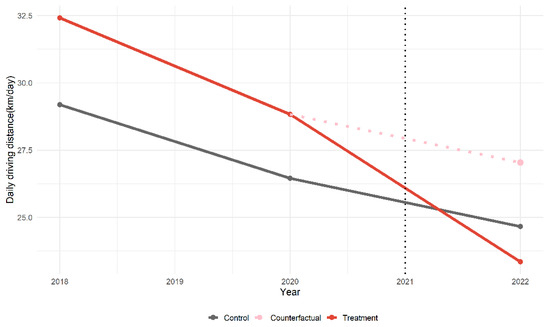
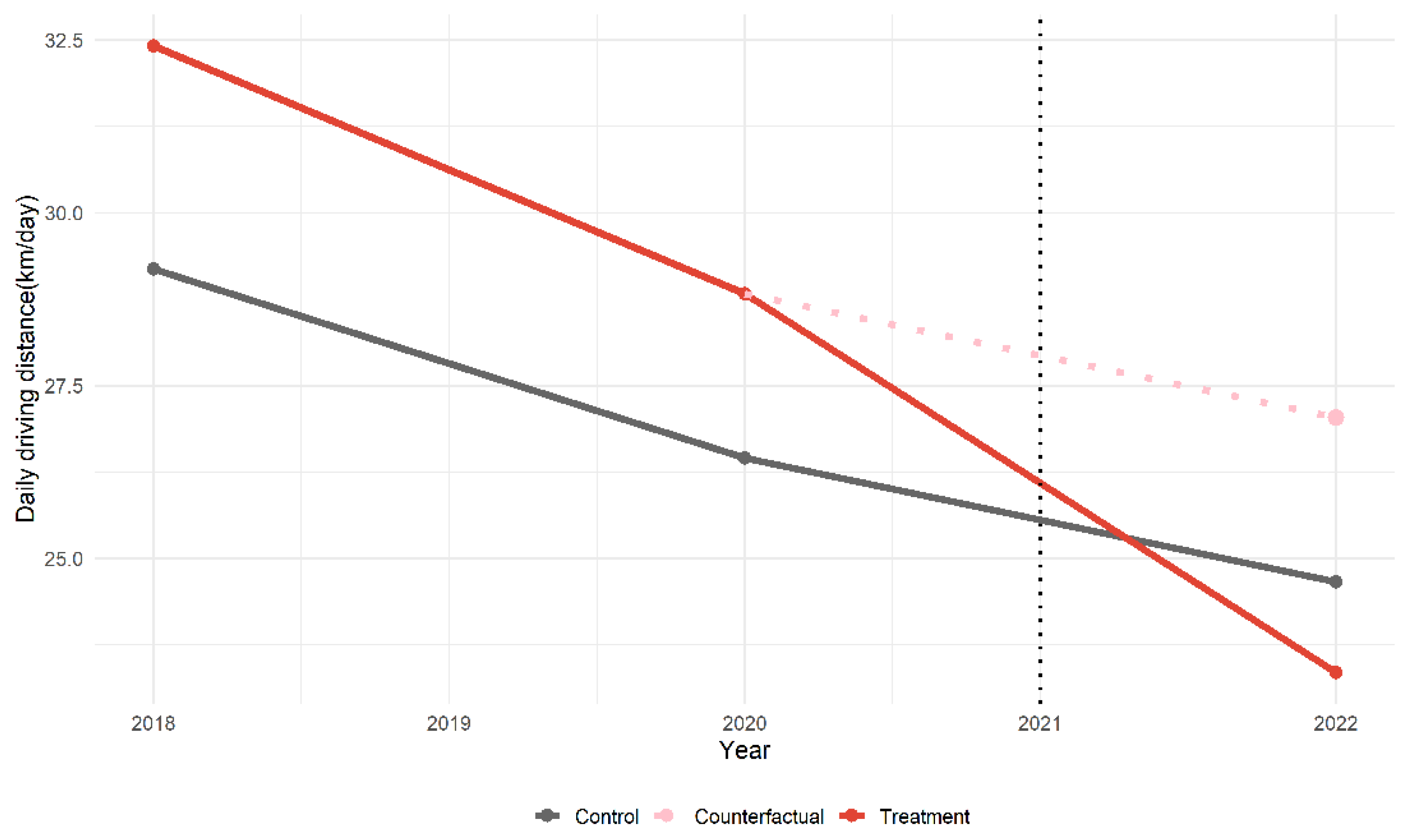
These findings can also be intuitively illustrated by examining the trends in average daily driving distance for the treatment and control groups using a line graph. Figure 10 presents the annual mean values of average daily driving distance, separately for the treatment and control groups. In the figure, the treatment group is shown by a red solid line, while the control group is represented by a gray solid line. Following registration for the Self Car-Free Day System in 2021, the driving distance of the treatment group exhibits a pronounced decline. This reduction is larger than the change observed for the control group, suggesting that the effects of the policy were concentrated on the treatment group.
Figure 10.
Changes in the average daily driving distance before and after the implementation of the Self Car-Free Day System are shown for the treatment group and the control group.
As a robustness check, an additional DID analysis was conducted using propensity score matching (PSM). After matching, 1048 vehicles in the treatment group were matched to 1049 vehicles in the control group. As each matched vehicle was observed over three time periods, the final sample consisted of 6294 observations. The standard mean differences (SMD) for all covariates were below 0.1, indicating that the distributions of the two groups were well balanced. The DID results show that the estimated coefficients are and , which are consistent with those obtained from the PSW-based analysis. In addition, the adjusted is 0.587, which is also comparable to the PSW results. These findings suggest that the estimated treatment effect is not substantially affected by the choice of propensity score adjustment method.
5. Conclusions and Discussion
This study aimed to evaluate the before–after effects of the Self Car-Free Day System, a voluntary passenger car use restriction policy, among vehicle use restriction policies. Because voluntary participation policies may lead to imbalances between treatment and control groups, propensity score weighting (PSW) was applied to address potential selection bias. In addition, as the data consisted of repeated observations for the same vehicles over multiple periods, a difference-in-differences (DID) approach with a two-way fixed effects (TWFE) model was employed to control for unit-specific and time-specific unobserved heterogeneity. Accordingly, exogenous shocks such as the reduction in mobility due to COVID-19 are also accounted for through time fixed effects and thus controlled for in the analysis.
The analysis focused on Busan, South Korea, using vehicle registration data for the Self Car-Free Day System and passenger car driving distance data. Vehicles registered in the Self Car-Free Day System in 2021 were defined as the treatment group, while unregistered vehicles served as the control group. To implement PSW, covariates expected to influence participation in the program—vehicle type, fuel type, model year, payload capacity, and engine displacement—were included.
After applying PSW, balance between the treatment and control groups was achieved. The DID analysis using the TWFE model revealed a statistically significant reduction in driving distance following participation in the Self Car-Free Day System. Vehicles registered in the program exhibited an additional reduction of 3.563 km/day in average daily driving distance compared to unregistered vehicles. As subject-specific and time-specific effects were controlled for and the parallel trends assumption was satisfied, this reduction of 3.563 km/day can be interpreted as a causal effect of the Self Car-Free Day System.
As a robustness check, an additional DID analysis was conducted using propensity score matching (PSM). The results showed no substantial differences from those obtained using PSW, suggesting that the estimated treatment effect is not strongly affected by the choice of propensity score adjustment method. In this study, PSW was adopted as the primary analytical approach, taking into account the efficiency of sample utilization.
Given that the average daily driving distance of the treatment group in 2020 was 28.83 km/day, the expected average daily driving distance in 2022 would be 24.72 km/day if the treatment group had strictly complied with the Self Car-Free Day System (see Appendix A for the details). Based on this assumption, the recalculated reduction in driving distance for the treatment group in 2022 is 4.11 km/day, which is 2.32 km/day greater than the reduction observed in the control group (1.79 km/day). However, the treatment effect estimated in this study indicates a larger reduction of 3.563 km/day, exceeding the reduction expected under strict compliance with the designated no-driving day alone. This finding suggests that the Self Car-Free Day System may generate an extended effect beyond restricting vehicle use on the designated day, influencing overall vehicle usage behavior. This may be attributed to the fact that participating drivers voluntarily refrained from using their vehicles not only on the designated day but also on other days. Because the Self Car-Free Day System is a voluntary participation policy, it is less likely to induce detour-related increases in driving distance. Moreover, refraining from vehicle use for one day per week contributes to a substantial reduction in total driving distance.
While the Self Car-Free Day System demonstrates a meaningful effect in reducing driving distance, participation rates remain low in regions other than Busan. Therefore, if the policy is to be sustained and expanded, measures to increase participation rates are necessary. Such measures should not rely solely on enhanced incentives but should be accompanied by transportation demand management policies that reduce the inconvenience of not using a private vehicle for one day. To enhance participation in the Car-Free Day system, a policy approach that provides integrated incentives can be considered. Currently, participants are offered vehicle-related incentives such as reductions in automobile tax and discounts on public parking fees. However, to increase the perceived benefits of participation and to provide practical alternatives on restricted driving days, it is necessary to introduce incentives linked to alternative modes of transportation. For example, integrating the program with public transportation rebate schemes or providing free access to public bike-sharing services could help expand participation. In particular, free public bicycle passes could be extended to include shared personal mobility services, thereby supporting last-mile connectivity. In the long term, policies aimed at improving the quality of public transportation services should be implemented in parallel to ensure mobility convenience even without the use of private vehicles. For instance, reducing transit headways and improving accessibility are expected to lower dependence on private cars and encourage more sustained participation in the Car-Free Day system.
Several limitations of this study should be noted. First, the analysis focuses on the effects of the Self Car-Free Day System based on the 2021 registration year, limiting the assessment of cumulative or long-term effects. Given that the program in Busan was initiated in 2007, future research could conduct parallel analyses for multiple registration cohorts or apply models capable of capturing dynamic, multi-period treatment effects. In such settings, vehicles that were part of the treatment group in earlier periods may withdraw from the program in later periods and transition into the control group, necessitating the application of models that account for treatment switching. This issue is left for future research. Second, the driving distance data are derived from vehicle inspection records. As passenger cars in South Korea undergo inspections every two years, some years are not observed in the dataset. Ideally, data that allow for annual tracking of vehicle driving distances would be required; however, such comprehensive data for all passenger vehicles are currently unavailable. Third, this study uses three time points—2018, 2020, and 2022—and the pre-treatment period is limited to a single time point (2018), which constrains the ability to fully verify the parallel trends assumption using a sufficiently long pre-treatment period. Therefore, the results of the parallel trends test in this study should be interpreted with caution, as they are based on limited information. Accordingly, future research should incorporate additional time points as more data become available.
Additional avenues for future research include estimating the extent of carbon emission reductions based on the observed decrease in driving distance. Since Tier 3 carbon emission estimation methods are distance-based, applying this approach would enable the quantification of emission reduction effects associated with the Car-Free Day system.
Despite these limitations, this study is meaningful in that it directly analyzes the effects of a voluntary vehicle use restriction policy targeting a large population of vehicles by utilizing individual vehicle driving distance data before and after policy implementation. In addition, by accounting for potential biases arising from the voluntary nature of the policy and applying appropriate data preprocessing methods, this study contributes to improving the reliability of policy effect estimation.
Author Contributions
Conceptualization, K.S.; methodology and validation, H.S. and K.S.; formal analysis, H.S. and K.S.; investigation and resources, K.S.; data curation, H.S.; writing—original draft preparation, H.S. and K.S.; writing—review and editing, H.S. and K.S.; visualization, H.S. and K.S.; supervision, K.S. All authors have read and agreed to the published version of the manuscript.
Funding
This research was supported by the Korea Agency for Infrastructure Technology Advancement (KAIA) grant funded by the Ministry of Land, Infrastructure, and Transport (Grant RS-2023-00245871).
Institutional Review Board Statement
Not applicable.
Informed Consent Statement
Not applicable.
Data Availability Statement
The data presented in this study are available on request from the corresponding author.
Conflicts of Interest
The authors declare no conflicts of interests.
Appendix A
The average daily driving distance of the treatment group is 28.83 km/day. Multiplying this value by 365 days yields a total annual driving distance of 10,522.95 km. Since the Car-Free Day system restricts vehicle use for one day per week, full compliance implies that vehicles are not operated for a total of 52 days per year (i.e., 52 weeks). Accordingly, the annual reduction in driving distance is estimated as 1499.16 km. Based on this, the expected average daily driving distance can be calculated as km/day.
References
- Broaddus, A.; Litman, T.; Menon, G. Transportation Demand Management Training Document; Deutsche Gesellschaft fur Technische Zusammenarbeit (GTZ): Eschborn, Germany, 2009; pp. 8–9. [Google Scholar]
- Guerra, E.; Millard-Ball, A. Getting around a license-plate ban: Behavioral responses to Mexico City’s driving restriction. Transp. Res. Part D Transp. Environ. 2017, 55, 113–126. [Google Scholar] [CrossRef] [Scilit]
- Liu, Z.; Li, R.; Wang, X.C.; Shang, P. Effects of vehicle restriction policies: Analysis using license plate recognition data in Langfang, China. Transp. Res. Part A Policy Pract. 2018, 118, 89–103. [Google Scholar] [CrossRef] [Scilit]
- Viard, V.B.; Fu, S. The effect of Beijing’s driving restrictions on pollution and economic activity. J. Public Econ. 2015, 125, 98–115. [Google Scholar] [CrossRef] [Scilit]
- Song, Y. The effect of the end-number license plate driving restriction on reducing air pollution in China. China Econ. Rev. 2024, 87, 102252. [Google Scholar] [CrossRef] [Scilit]
- Chaziris, A.; Yannis, G. A critical assessment of Athens Traffic Restrictions using multiple data sources. Transp. Res. Procedia 2023, 72, 375–382. [Google Scholar] [CrossRef] [Scilit]
- Lin Lawell, C.Y.C.; Zhang, W.; Umanskaya, V.I. The Effects of Driving Restrictions on Air Quality: Sao Paulo, Bogota, Beijing, and Tianjin. In Proceedings of the Agricultural and Applied Economics Association Annual Meeting, Pittsburgh, PA, USA, 24–26 July 2011. [Google Scholar]
- Bonilla, J.A. The more stringent, the better? Rationing car use in Bogota with moderate and drastic restrictions. World Bank Econ. Rev. 2019, 33, 516–534. [Google Scholar] [CrossRef] [Scilit]
- Peters, J.F.; Burguillo, M.; Arranz, J.M. Low Emission Zones: Effects on Alternative-Fuel Vehicle Uptake and Fleet CO2 Emissions. Transp. Res. Part D Transp. Environ. 2021, 95, 102882. [Google Scholar] [CrossRef] [Scilit]
- Ma, L.; Graham, D.J.; Stettler, M.E. Has the Ultra Low Emission Zone in London improved air quality? Environ. Res. Lett. 2021, 16, 124001. [Google Scholar] [CrossRef] [Scilit]
- Panteliadis, P.; Strak, M.; Hoek, G.; Weijers, E.; van der Zee, S.; Dijkema, M. Implementation of a low emission zone and evaluation of effects on air quality by long-term monitoring. Atmos. Environ. 2014, 86, 113–119. [Google Scholar] [CrossRef] [Scilit]
- Margaryan, S. Low emission zones and population health. J. Health Econ. 2021, 76, 102402. [Google Scholar] [CrossRef] [Scilit] [PubMed]
- Xiao, C.; Chang, M.; Guo, P.; Chen, Q.; Tian, X. Comparison of the cost-effectiveness of eliminating high-polluting old vehicles and imposing driving restrictions to reduce vehicle emissions in Beijing. Transp. Res. Part D Transp. Environ. 2019, 67, 291–302. [Google Scholar]
- de Preux, L.; Miraldo, M.; Rizmie, D. Sweet Dreams Are Made of This: The Co-Benefit of a Pedestrianisation Policy in Paris on Sleep; Health, Econometrics and Data Group (HEDG) Working Papers, No. 24/12; Department of Economics, University of York: Heslington, UK, 2024. [Google Scholar]
- Farda, M.; Balijepalli, C. Exploring the effectiveness of demand management policy in reducing traffic congestion and environmental pollution: Car-free day and odd-even plate measures for Bandung city in Indonesia. Case Stud. Transp. Policy 2018, 6, 577–590. [Google Scholar]
- Barus, L.S.; Rachman, H.O. Impact of Car-Free Day on air pollution and its multifarious advantages in Sudirman-Thamrin Street, Jakarta. GEOMATE J. 2019, 17, 167–172. [Google Scholar]
- Fitrahadi, M.N.; Andriansyah, T.; Fahnur, I.M.; Hariani, M.L.; Widjaja, A.M.H. Implementation of Car-Free Days in Support of Sustainable Development to Reduce Vehicle CO2 Emissions in Urban Areas. J. Transnatl. Univers. Stud. 2024, 2, 617–632. [Google Scholar] [CrossRef] [Scilit]
- Masiol, M.; Agostinelli, C.; Formenton, G.; Tarabotti, E.; Pavoni, B. Thirteen years of air pollution hourly monitoring in a large city: Potential sources, trends, cycles and effects of car-free days. Sci. Total Environ. 2014, 494, 84–96. [Google Scholar] [PubMed]
- van Vessem, C.; Macharis, C.; Keseru, I.; Mommens, K. 30 Days with less cars: The effect of a month-long car-free campaign in Flanders, Belgium. Transp. Res. Interdiscip. Perspect. 2024, 27, 101227. [Google Scholar] [CrossRef] [Scilit]
- Li, F.; Morgan, K.L.; Zaslavsky, A.M. Balancing covariates via propensity score weighting. J. Am. Stat. Assoc. 2018, 113, 390–400. [Google Scholar] [CrossRef] [Scilit]
- Jeong, J.; Kim, Y. Robust estimation of a marginal causal effect on the binary outcome using propensity score matching. J. Korean Data Inf. Sci. Soc. 2024, 35, 161–177. [Google Scholar] [CrossRef] [Scilit]
- Rosenbaum, P.R.; Rubin, D.B. The central role of the propensity score in observational studies for causal effects. Biometrika 1983, 70, 41–55. [Google Scholar] [CrossRef] [Scilit]
- Ho, D.E.; Imai, K.; King, G.; Stuart, E.A. Matching as nonparametric preprocessing for reducing model dependence in parametric causal inference. Political Anal. 2007, 15, 199–236. [Google Scholar] [CrossRef] [Scilit]
- Narita, K.; Tena, J.D.D.; Detotto, C. Causal inference with observational data: A tutorial on propensity score analysis. Leadersh. Q. 2023, 34, 101678. [Google Scholar] [CrossRef] [Scilit]
- Ramkumar, N.; Iribarne, A.; Olmstead, E.M.; Malenka, D.J.; Mackenzie, T.A. Why are we weighting? Understanding the estimates from propensity score weighting and matching methods. Circ. Cardiovasc. Qual. Outcomes 2024, 17, e007803. [Google Scholar] [CrossRef] [Scilit] [PubMed]
- Ridgeway, G.; Kovalchik, S.A.; Griffin, B.A.; Kabeto, M.U. Propensity score analysis with survey weighted data. J. Causal Inference 2015, 3, 237–249. [Google Scholar] [CrossRef] [Scilit]
- Zhang, Y.; Li, H.; Sze, N.N.; Ren, G. Propensity score methods for road safety evaluation: Practical suggestions from a simulation study. Accid. Anal. Prev. 2021, 158, 106200. [Google Scholar] [CrossRef] [Scilit]
- Deng, Y.; Zhao, P. Quantifying residential self-selection effects on commuting mode choice: A natural experiment. Transp. Res. Part D Transp. Environ. 2022, 104, 103197. [Google Scholar]
- Busan Metropolitan City. Available online: https://www.busan.go.kr/index (accessed on 14 March 2026).
- Busan Metropolitan City. Social Indicators in Busan 2024; Busan Metropolitan City: Busan, Republic of Korea, 2024. [Google Scholar]
- Greenhouse Gas Inventory & Research Center of Korea. Available online: https://www.gir.go.kr/home/board/read.do;jsessionid=e4tt1Cd1e7MQ555MuZMpEmH6waizaQkgqa35IanZdqnD1DJIlY7TRI8cWu5kDHiS.og_was1_servlet_engine1?pagerOffset=20&maxPageItems=10&maxIndexPages=10&searchKey=&searchValue=&menuId=36&boardMasterId=2&boardId=81 (accessed on 14 March 2026).
- Ruttenauer, T.; Aksoy, O. When can we use two-way fixed-effects (TWFE): A comparison of TWFE and novel dynamic difference-in-differences estimators. arXiv 2024, arXiv:2402.09928. [Google Scholar]
- Frees, E.W. Longitudinal and Panel Data: Analysis and Applications for the Social Sciences; Cambridge University Press: Cambridge, UK, 2004. [Google Scholar]
- De Chaisemartin, C.; d’Haultfoeuille, X. Two-way fixed effects and differences-in-differences with heterogeneous treatment effects: A survey. Econom. J. 2023, 26, C1–C30. [Google Scholar]
- Goodman-Bacon, A. Difference-in-differences with variation in treatment timing. J. Econom. 2021, 225, 254–277. [Google Scholar]
- Callaway, B.; Sant’Anna, P.H.C. Difference-in-differences with multiple time periods. J. Econom. 2021, 225, 200–230. [Google Scholar]
- Sun, L.; Abraham, S. Estimating dynamic treatment effects in event studies with heterogeneous treatment effects. J. Econom. 2021, 225, 175–199. [Google Scholar] [CrossRef] [Scilit]
- de Chaisemartin, C.; D’Haultfoeuille, X. Two-way fixed effects estimators with heterogeneous treatment effects. Am. Econ. Rev. 2020, 110, 2964–2996. [Google Scholar] [CrossRef] [Scilit]
- Baker, A.; Callaway, B.; Cunningham, S.; Goodman-Bacon, A.; Sant’Anna, P.H. Difference-in-Differences designs: A practitioner’s guide. arXiv 2025, arXiv:2503.13323. [Google Scholar]
- Bertrand, M.; Duflo, E.; Mullainathan, S. How much should we trust differences-in-differences estimates? Q. J. Econ. 2004, 119, 249–275. [Google Scholar] [CrossRef] [Scilit]

Disclaimer/Publisher’s Note: The statements, opinions and data contained in all publications are solely those of the individual author(s) and contributor(s) and not of MDPI and/or the editor(s). MDPI and/or the editor(s) disclaim responsibility for any injury to people or property resulting from any ideas, methods, instructions or products referred to in the content. |
© 2026 by the authors. Licensee MDPI, Basel, Switzerland. This article is an open access article distributed under the terms and conditions of the Creative Commons Attribution (CC BY) license.