


Abstract
This paper presents a novel dual-module Permanent Magnet Linear Synchronous Motor (PMLSM) featuring an unequal tooth-shoe topology, alongside a highly efficient surrogate-assisted framework to maximize average thrust and minimize thrust ripple. To overcome the computational bottleneck of expensive Finite Element Analysis (FEA), we propose a Constraint-Preserving Maximin Latin Hypercube Design (CP-MmLHD) coupled with an ARD-Kriging model and the Expected Hypervolume Improvement (EHVI) criterion. This closed-loop framework expertly handles strict geometric constraints and anisotropic parameter sensitivities. Within a strict budget of only 150 FEA evaluations, the framework successfully identifies a high-quality Pareto front. Notably, a representative optimal design reduces thrust ripple by over 80% without compromising average thrust. Furthermore, comparative experiments demonstrate superior computational efficiency over conventional algorithms, while multi-run statistical benchmarking and stochastic Monte Carlo analysis rigorously confirm the framework’s algorithmic robustness and manufacturing reliability.
1. Introduction
Permanent Magnet Linear Synchronous Motors (PMLSMs) have been extensively deployed in industrial automation, rail transit, and precision manufacturing, owing to their inherent advantages of structural simplicity, high efficiency, and rapid dynamic response [1,2,3]. Specifically, the flat-type PMLSM is distinguished by its compact form factor, high air-gap flux density, and superior thrust density, making it particularly suitable for direct-drive applications demanding high force and positioning accuracy [2,4]. Nevertheless, due to the finite length of the stator and the discrete arrangement of permanent magnets (PMs), short-primary flat PMLSMs inherently suffer from pronounced end effects and thrust ripple, which significantly deteriorate motion smoothness and control precision [5,6].
To mitigate thrust ripple, topology optimization remains a primary strategy. Conventional approaches include the optimization of tooth geometry [7], magnetic poles [8], and end structures [9]. For instance, segmented PMs and skewed poles have been employed to attenuate cogging forces and end forces, though often at the expense of average thrust reduction [10]. While Halbach arrays can enhance average thrust and suppress cogging torque by improving air-gap flux distribution [11,12], they entail prohibitive manufacturing costs. Alternatively, optimizing end-tooth geometry offers a viable path to suppress end effects [13]. Various profiles, such as trapezoidal [14], arc [15], and semi-arch [16], have been investigated. However, these complex topologies impose stringent manufacturing tolerances and introduce high-dimensional parameter spaces. To accurately capture the highly non-linear electromagnetic phenomena, high-fidelity transient Finite Element Analysis (FEA) featuring dense mesh generation and minuscule time steps is indispensable. This imposes a prohibitive computational burden, rendering traditional heuristic algorithms practically infeasible for rapid industrial design cycles.
To circumvent this computational bottleneck, Surrogate-Assisted Optimization (SAO) has emerged as the dominant paradigm in electrical machine design [17]. Recent advancements (2022–2026) have witnessed a proliferation of machine learning techniques integrated with evolutionary algorithms. For PMLSM applications, Song et al. [18] employed an extreme learning machine (ELM) to alleviate thrust ripple, while Lee and Lim [19] applied a machine-learning-assisted niche genetic algorithm for auxiliary tooth design. For rotary machines, state-of-the-art frameworks have deployed CatBoost [20], combined neural networks bridging NSGA-II [21], Bayesian-optimized support vector regression (BO-SVR) [22], and physics-assisted neural networks (PANN) [23] to enhance torque performance.
Despite these methodological strides, critically analyzing existing SAO paradigms reveals structural limitations when applied to the constrained, highly anisotropic design spaces of flat-type PMLSMs. While conventional surrogate-assisted evolutionary algorithms (e.g., surrogate-driven NSGA-II) maintain population diversity, they mandate massive initial datasets. Consequently, recent studies necessitated 300 [24], 625 [18], 1024 [20], 3000 [19], 6559 [22], or even 8900 [23] expensive FEA evaluations, a demand fundamentally incompatible with severe industrial computational budgets. Foundational Bayesian optimization frameworks, such as EGO [25] and its multi-objective extensions (MO-EGO), provide a more sample-efficient alternative through sequential infill. However, they typically employ isotropic Kriging kernels, rendering them structurally blind to scenarios where parameter sensitivities differ by orders of magnitude. Furthermore, scalarization-based approaches like ParEGO [26] reduce the multi-objective problem to a sequence of single-objective subproblems via random Chebyshev decompositions. While this avoids the need for a vector-valued acquisition function, it inadvertently distorts the Pareto front geometry—a critical limitation for the convex front structures observed in this study. Finally, traditional Latin Hypercube Sampling (LHS) typically resorts to “sample-and-reject” heuristics when navigating strict geometric inequality constraints, inevitably engendering sample sparsity and boundary voids. These limitations—spanning surrogate modeling, acquisition strategy, and sampling efficiency—define the specific algorithmic gaps that the proposed framework seeks to bridge.
To systematically address these research gaps, this paper formulates a synergistic methodology merging advanced electromagnetic topology with a highly data-efficient active learning framework. Fundamentally, the novelty of this work encompasses both structural and algorithmic dimensions. From a structural perspective, a novel dual-module unequal tooth-shoe topology is proposed, which physically orchestrates a multi-dimensional thrust ripple suppression mechanism by leveraging modular spatial translation for fundamental detent force cancellation, while coordinating unequal tooth-shoes and optimized end-teeth to locally reconstruct air-gap permeance. From an algorithmic perspective, an advanced multi-objective framework coupling ARD-Kriging with the Expected Hypervolume Improvement (EHVI) acquisition function is developed. Compared to existing static surrogate frameworks, this methodology uniquely integrates a Constraint-Preserving Maximin Latin Hypercube Design (CP-MmLHD) to strictly maintain geometric feasibility, and an Automatic Relevance Determination (ARD) mechanism to autonomously quantify anisotropic dimensional sensitivities. By propagating this targeted predictive variance directly into the EHVI criterion, the framework dynamically directs expensive FEA evaluations exclusively toward the most critical Pareto-optimal regions. Consequently, the proposed framework achieves superior Pareto convergence with a severely constrained budget of merely 150 FEA evaluations, demonstrating an order-of-magnitude efficiency enhancement over contemporary SAO methodologies.
The remainder of this paper is organized as follows: Section 2 analyzes the topology and physical mechanisms of the modular unequal tooth-shoe PMLSM. Section 3 formulates the multi-objective optimization model and its strict geometric constraints. Section 4 details the proposed optimization framework—incorporating the CP-MmLHD sampling technique, ARD-Kriging modeling, and EHVI acquisition—and explicitly validates its algorithmic robustness through a multi-run mathematical benchmark. Section 5 presents the high-fidelity engineering optimization results, comparative algorithmic benchmarking, transient FEA verification including a mesh independence study, and a stochastic Manufacturing Robustness Analysis. Finally, conclusions are drawn in Section 6.
2. Motor Topology and Operating Principle Analysis
Thrust ripple, comprising cogging and end forces, remains the primary impediment to high-precision servo performance in PMLSMs. Conventional mitigation strategies typically address isolated structural parameters—such as modular segmentation or unequal tooth widths—and often fail to suppress multi-source ripple components simultaneously. To overcome this limitation, we propose a novel short-primary flat-type PMLSM featuring a dual-module configuration, unequal tooth-shoes, and optimized end-teeth. This section details the motor topology and elucidates the underlying ripple suppression mechanisms, ranging from system-level phase compensation to local permeance reconstruction.
2.1. Topology and Features of the Modular Unequal Tooth-Shoe PMLSM
The proposed PMLSM adopts a short-primary, long-secondary configuration, with its key geometric parameters annotated in Figure 1, and the fixed structural parameters detailed in Table 1. The primary mover comprises two fully symmetrical 5-pole/6-slot (5p6s) modular units (Module I/II). The ferromagnetic core features rectangular semi-closed slots embedded with double-layer concentrated windings, while the secondary stator consists of a surface-mounted Permanent Magnet (PM) array with alternating magnetization supported by a back iron. The salient structural innovations are threefold:
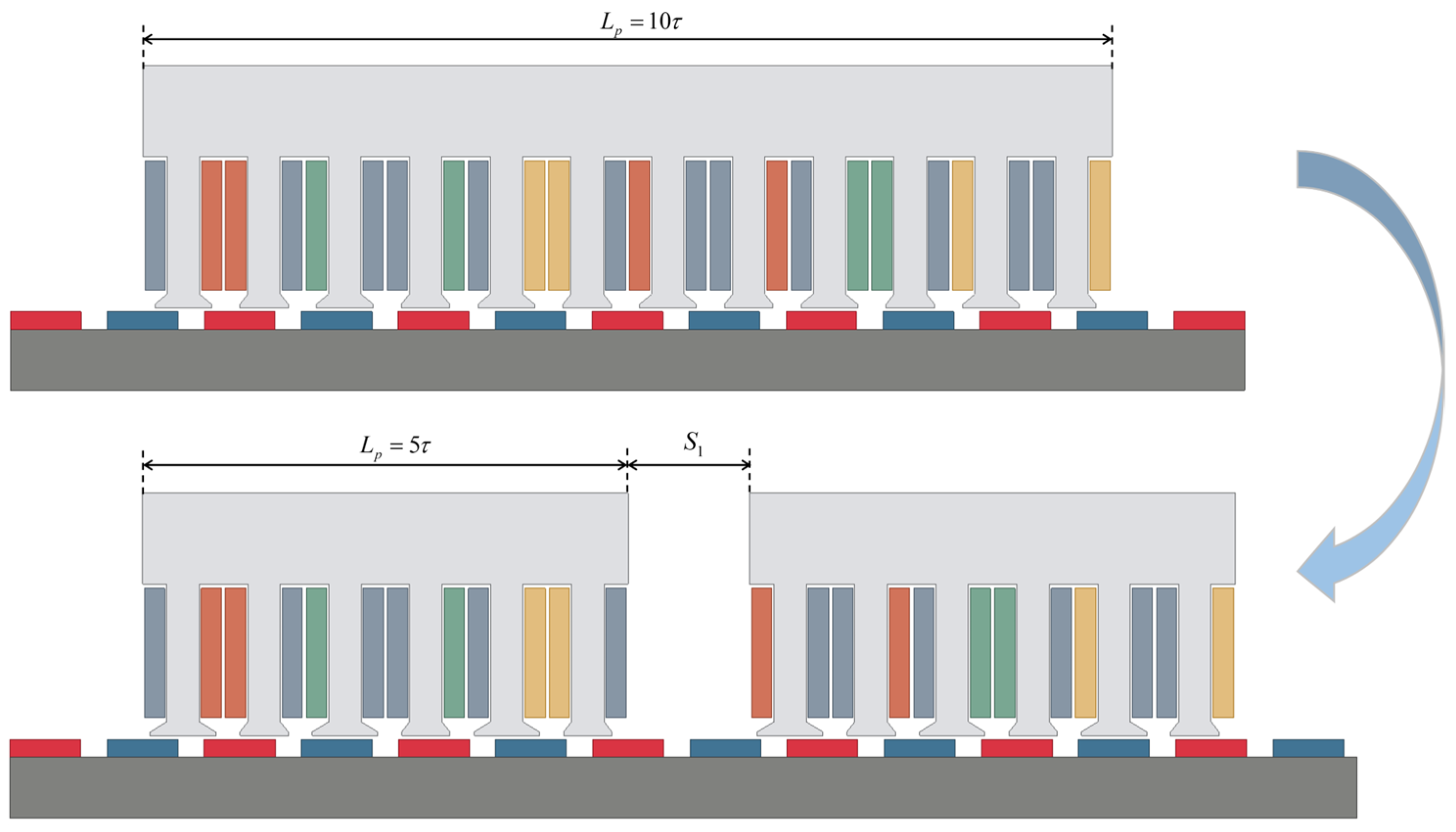
- Modular primary: The conventional 10-pole/12-slot (10p12s) primary is segmented into two centrally symmetric 5p6s modules. A spatial displacement is introduced between them to achieve phase cancellation of the cogging force.
- Unequal tooth-shoes: Excluding the end regions, the main teeth within each module adopt alternating primary () and secondary () tooth-shoe widths. This establishes a double-slot-pitch () sub-periodicity to effectively reconstruct the air-gap permeance distribution.
- Optimized end-teeth: End-teeth with a designable recession height are deployed at both primary extremities to smooth the magnetic circuit transition and mitigate edge-effect-induced end forces.
Figure 1.
Illustration of the key geometric parameters of the proposed PMLSM.
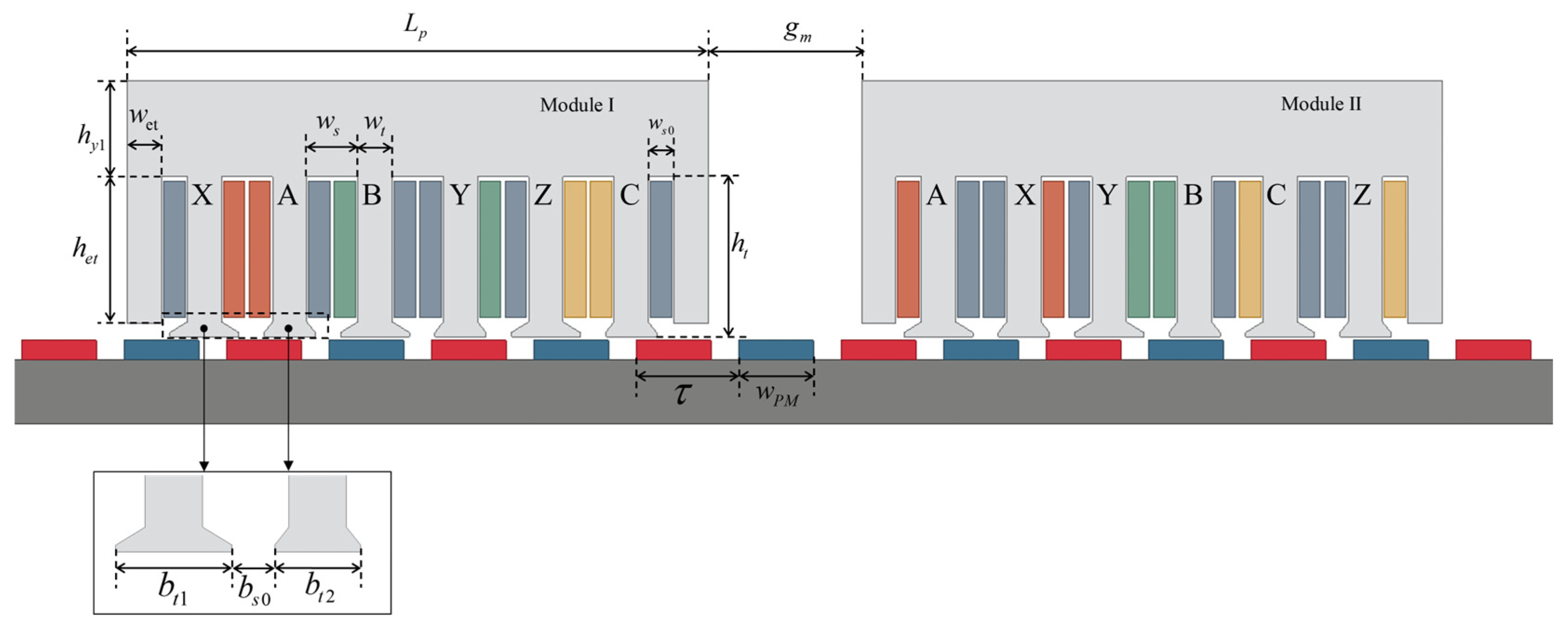
Table 1.
Fixed Structural Parameters of the Proposed PMLSM.
2.2. Principle of Phase Compensation via Modular Structure
Addressing the inherent detent force issues in flat-type PMLSMs, a system-level suppression strategy is implemented via the modular topology. As depicted in Figure 2, the essence of this design lies in leveraging the spatial displacement between modules to create a phase counter-cancellation of the cogging force.
Figure 2.
Modularization process of the 5-pole/6-slot unit module.
According to PMLSM theory, the period of the cogging force fluctuation in a 5-pole/6-slot unit is governed by the least common multiple of the pole and slot numbers. Its Fourier series expression is given by
where is the amplitude of the -th harmonic, denotes the relative position between the primary and secondary, and is the initial phase angle. Consequently, if Module II is spatially shifted by a distance relative to its pre-modularized position, the generated cogging force waveform undergoes a corresponding phase shift. The total cogging force , representing the superposition of the two modular components, can be derived using trigonometric sum-to-product identities:
To eliminate the fundamental component, the compensation coefficient must satisfy . Considering the redundancy requirements for end optimization, a displacement of mm is selected. This corresponds to a phase shift of , resulting in the complete cancellation of the fundamental cogging force. Simultaneously, the back-EMF reduction is maintained below 1%, thereby striking a balance between thrust performance and motion smoothness.
2.3. Mechanism of Cogging Force Attenuation via Unequal Tooth-Shoes
Building upon the system-level suppression achieved by modular translation, the unequal tooth-shoe structure is designed to reconstruct the spatial distribution of air-gap permeance, thereby attenuating the excitation source of the cogging force at the component level. Based on the principle of virtual work, the air-gap magnetic field energy and the single-module cogging force can be expressed as
In the unequal tooth-shoe configuration, the alternating arrangement of widths and establishes a sub-periodic structure based on a double slot pitch (). The squared relative permeance can be expanded via Fourier series as
where is the DC component and is the -th harmonic coefficient. Through Fourier integration, the analytical expression for each harmonic coefficient is derived:
where is a constant related to the squared permeance difference between the tooth-shoe and slot regions.
Since the energy of the cogging force is predominantly concentrated in frequency bands corresponding to even-order harmonics, differentiating and allows for the modulation of the permeance harmonic amplitude . Optimizing attenuates its coupling intensity with the permanent magnet magnetomotive force (MMF) harmonics, thereby mitigating the primary excitation sources of the cogging force. Physically, the disparity in tooth widths induces a slight shift in the equivalent magnetic field centers of the main and secondary teeth. This introduces a phase difference between the local cogging forces generated by respective teeth. Through the optimization of the tooth width combination, destructive interference is induced between these force components macroscopically, significantly reducing the peak magnitude of the total cogging force.
2.4. Mechanism of End Force Suppression via End-Teeth
The finite length of the primary iron core results in a discontinuity in the magnetic circuit at the ends, inducing end forces, which constitute another major source of thrust ripple. It is notable that the modular displacement strategy exhibits a negligible suppression effect on end forces; at mm, the spatial phase difference in the end forces is approximately , resulting in a mere amplitude reduction of 3.4%. To mitigate the step change in end permeance, an end-tooth structure is introduced at both extremities of the primary module. Defining the recession height of the end-tooth relative to the bottom surface of the main tooth-shoe as , the equivalent air-gap permeance in the end-tooth region implies:
where is the mechanical air gap, is the fixed main tooth height, and is the designable end-tooth height.
The end-tooth structure suppresses end forces through a synergistic dual-mechanism. Specifically, increasing minimizes the permeance disparity between the end region and the active core, while optimizing the end-tooth width elongates the magnetic field transition zone. Consequently, these coordinated geometric adjustments collectively smooth the magnetic permeance gradient, thereby effectively mitigating end force fluctuations.
3. Multi-Objective Optimization Model Construction
The preceding theoretical analysis qualitatively validated the ripple suppression mechanisms afforded by modular translation, unequal tooth-shoes, and end-tooth structures. Nevertheless, the electromagnetic field within the PMLSM inherently exhibits strong non-linearity, and the sensitivity of average thrust and thrust ripple to geometric parameters is characterized by high-order coupling effects. To navigate this complex design space and ascertain the optimal trade-off between conflicting performance metrics, a rigorous multi-objective optimization model is formulated. This section first defines the design variables and the associated geometric constraints.
3.1. Design Variables and Constraints
Six critical geometric parameters governing end effects, cogging force, and air-gap flux density are defined as the design vector . Their feasible domains and initial values are specified in Table 2. To guarantee manufacturability and spatial validity, the design space is bounded by inequality constraints, collectively formulated as :
- Winding Accommodation Constraint (): . This limits the combined tooth-shoe width to ensure adequate slot area for winding insertion, yielding an upper bound of 36 mm based on the minimum permissible slot opening .
- Collision Avoidance Constraint (): . Derived from the required inter-module clearance (), this strictly prevents mechanical interference between adjacent modules during operation.
Table 2.
Design Variables and Boundaries for Optimization.
3.2. Optimization Objectives
To achieve a trade-off between thrust capability and motion smoothness, a Multi-Objective Optimization Problem (MOOP) is formulated. The primary goal is to minimize thrust ripple while ensuring the average thrust meets the rated requirement. The mathematical model is defined as follows:
where represents the average thrust (integrated mean over one electrical cycle), and and denote the peak and valley values of the instantaneous thrust. Thrust Ripple Rate (TRR) is adopted as the metric for motion smoothness. Note that maximizing average thrust is converted to minimizing its negative value to standardize the minimization framework.
The global optimization of this six-dimensional constrained problem will be addressed using the high-fidelity surrogate framework detailed in Section 4.
4. Multi-Objective Optimization Method Based on ARD-Kriging and EHVI
Multi-objective optimization of PMLSMs presents a severe computational bottleneck. A single high-fidelity FEA evaluation typically requires several minutes, making traditional evolutionary algorithms—which demand thousands of evaluations—practically infeasible [27]. Surrogate-Assisted Optimization (SAO) addresses this challenge by replacing expensive physics-based simulations with highly efficient metamodels [28]. To navigate the high-dimensional, constrained, and anisotropic PMLSM design space, this section introduces a synergistic optimization framework. This framework integrates a Constraint-Preserving Maximin Latin Hypercube Design (CP-MmLHD) for initial sampling, ARD-Kriging for surrogate modeling, and the Expected Hypervolume Improvement (EHVI) acquisition function. Together, these components enable a highly efficient approximation of the Pareto front within a strictly limited FEA budget.
4.1. Framework Architecture
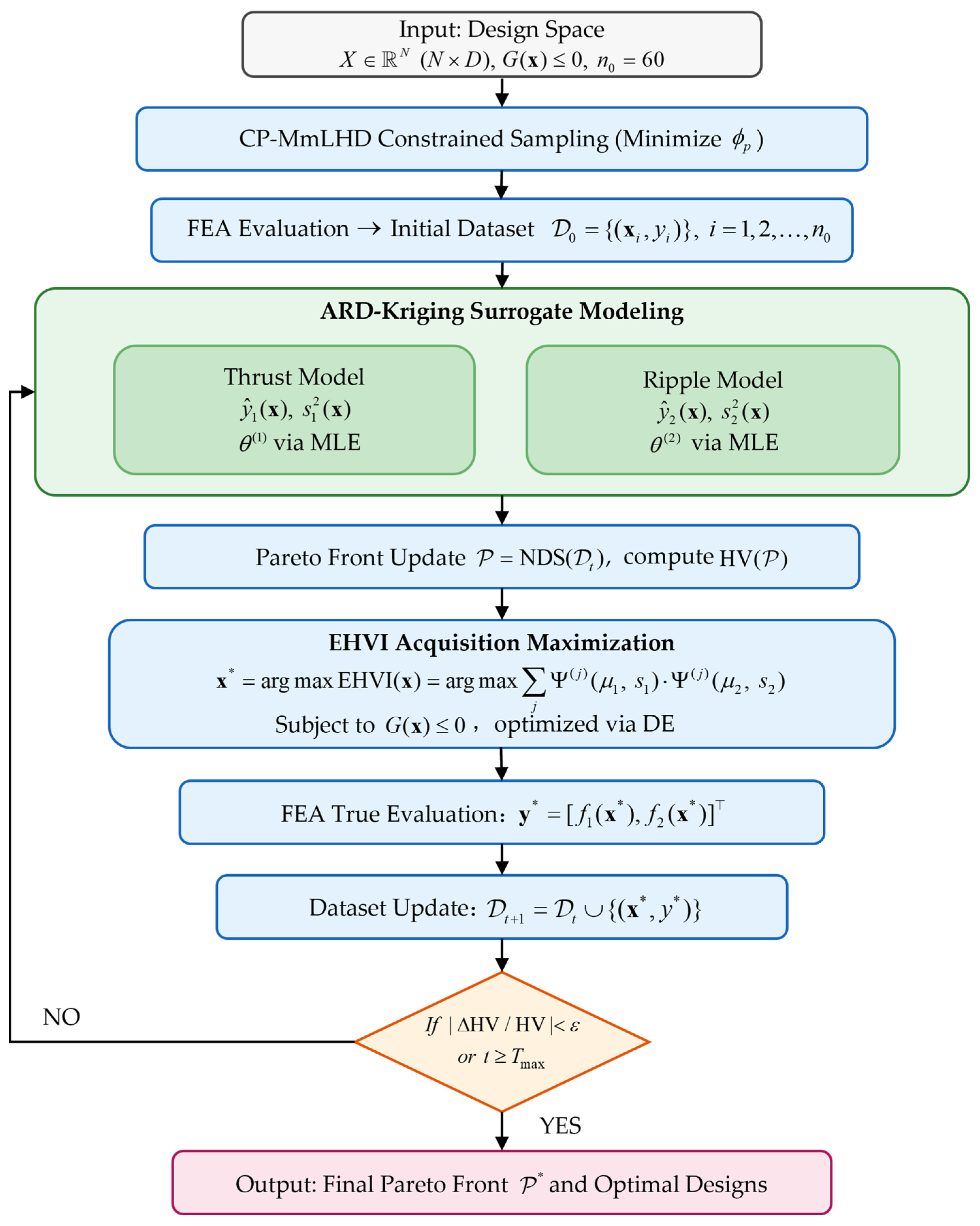
The proposed ARD-Kriging-EHVI framework operates on a closed-loop sequential learning mechanism comprising “Initial Sampling–Surrogate Modeling–Sequential Optimization,” as illustrated in Figure 3. The workflow proceeds as follows:
Figure 3.
Flowchart of the proposed ARD-Kriging-EHVI multi-objective optimization framework, illustrating the closed-loop process from initial CP-MmLHD sampling to sequential Pareto front approximation.
The three components of the proposed framework each address one of these structural limitations in a targeted and mutually reinforcing manner. CP-MmLHD eliminates the boundary clustering inherent in constrained LHS through a hard-rejection mechanism, ensuring that the initial dataset faithfully represents the feasible domain. The ARD mechanism replaces the isotropic kernel with dimension-specific length scales, enabling the surrogate to automatically identify which variables govern each objective—a capability that isotropic models structurally lack. EHVI then directly maximizes the expected gain in Pareto hypervolume without scalarization, preserving front geometry throughout the sequential search. It is the integration of these three components—each resolving a distinct gap in prior SAO frameworks—that constitutes the primary methodological contribution of this work.
4.2. Constraint-Preserving Initial Sampling Strategy (CP-MmLHD)
The spatial distribution of initial samples dictates the surrogate model’s ability to capture global landscape features. Conventional Latin Hypercube Sampling (LHS) often employs a “sample-and-reject” strategy when facing strict geometric constraints (as defined in Section 3), leading to sparse sampling near boundaries and degraded space-filling quality. To address this, a Constraint-Preserving Maximin Latin Hypercube Design (CP-MmLHD) is proposed to generate a uniform distribution over the feasible domain while strictly satisfying all constraints.
The Maximin distance criterion proposed by Morris and Mitchell [29] is adopted to maximize the minimum inter-site distance. Let denote the design matrix in a -dimensional space normalized to . To ensure differentiability, the scalar performance metric is utilized:
where represents the sorted sequence of unique Euclidean distances between all pairs of points, denotes the frequency of distance , and is a regularization parameter (set to ). Minimizing is asymptotically equivalent to maximizing the minimum distance, forcing samples to exhibit a “mutually repulsive” uniform distribution.
CP-MmLHD employs a Simulated Annealing (SA) algorithm integrated with a hard-rejection mechanism, proceeding in two phases:
- Feasible Initialization: A standard random LHS is generated. Infeasible points violating geometric constraints are iteratively reset and locally perturbed until the entire matrix resides within the feasible domain;
- Iterative Optimization: During the -th iteration (), the following steps are executed:
- (1)
- Structure-Preserving Perturbation: A column is randomly selected, and elements in row and row are swapped. This column-wise exchange inherently preserves the stratified projection property of LHS.
- (2)
- Hard Rejection: The perturbed samples and are checked against the constraint set . If any violation occurs, the swap is immediately revoked. This logic ensures that no infeasible solution is ever introduced into the optimization process.
- (3)
- Metropolis Criterion: If the new matrix is feasible, the energy difference is calculated. The move is accepted if or via the probability , where .
- (4)
- Annealing Schedule: Temperature decays as () to balance global exploration and local convergence.
The performance of CP-MmLHD is benchmarked against Standard-LHS and Constrained LHS (CLHS) within the 6-dimensional PMLSM design space (Table 3). Metrics include Constraint Satisfaction Rate (CSR) and Minimum Distance (MinDist).
Table 3.
Performance Comparison of Different Sampling Strategies in the Constrained PMLSM Design Space.
Results indicate that CP-MmLHD achieves a 100% CSR, eliminating sample loss. Notably, its MinDist is approximately 2.4 times that of CLHS, and is reduced by 49%. This substantiates its superior capability in avoiding boundary clustering and providing high-fidelity training data for subsequent modeling.
4.3. Anisotropic ARD-Kriging Modeling
PMLSM performance exhibits strong anisotropy, where sensitivity varies significantly across design variables. Traditional isotropic Kriging, which assumes uniform spatial correlation, risks underfitting critical features or overfitting redundant dimensions. To mitigate this, Automatic Relevance Determination (ARD) is introduced to construct an anisotropic Kriging model.
4.3.1. Mathematical Framework of Gaussian Process Regression
The ARD-Kriging model treats the deterministic response as a realization of a stationary Gaussian process:
where is the global mean, and is a zero-mean Gaussian process with covariance defined by
Here, is the process variance, is the correlation kernel, and is the vector of anisotropic hyperparameters.
4.3.2. ARD Kernel and Sensitivity Identification
To balance smoothness and non-linearity capture, the Matérn-5/2 kernel is employed. The ARD mechanism replaces the Euclidean distance with a weighted distance :
The hyperparameter corresponds to the inverse square of the correlation length scale for dimension . This parameterization imparts an automatic pruning capability: a large implies rapid correlation decay, indicating high sensitivity to dimension ; conversely, for irrelevant dimensions, converges to the lower bound (set to ), effectively nullifying their contribution to the distance metric.
4.3.3. Hyperparameter Estimation and Prediction
The model is trained by maximizing the concentrated log-likelihood (CLL). A regularization term is added to the correlation matrix () to prevent singularity. The Maximum Likelihood Estimates (MLE) for the mean and variance are
Substituting these into the log-likelihood function yields the optimization objective:
A hybrid strategy combining Differential Evolution (DE) for global search and L-BFGS-B for local refinement is utilized to solve (15). The Best Linear Unbiased Prediction (BLUP) for a new point yields the mean and Mean Squared Prediction Error (MSPE) :
where is the correlation vector between and the sample set.
4.3.4. Algorithm Validation
The Normalized Root Mean Square Error (NRMSE) and Coefficient of Determination () are employed as core metrics to validate the algorithm.
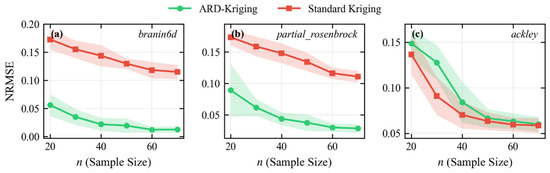
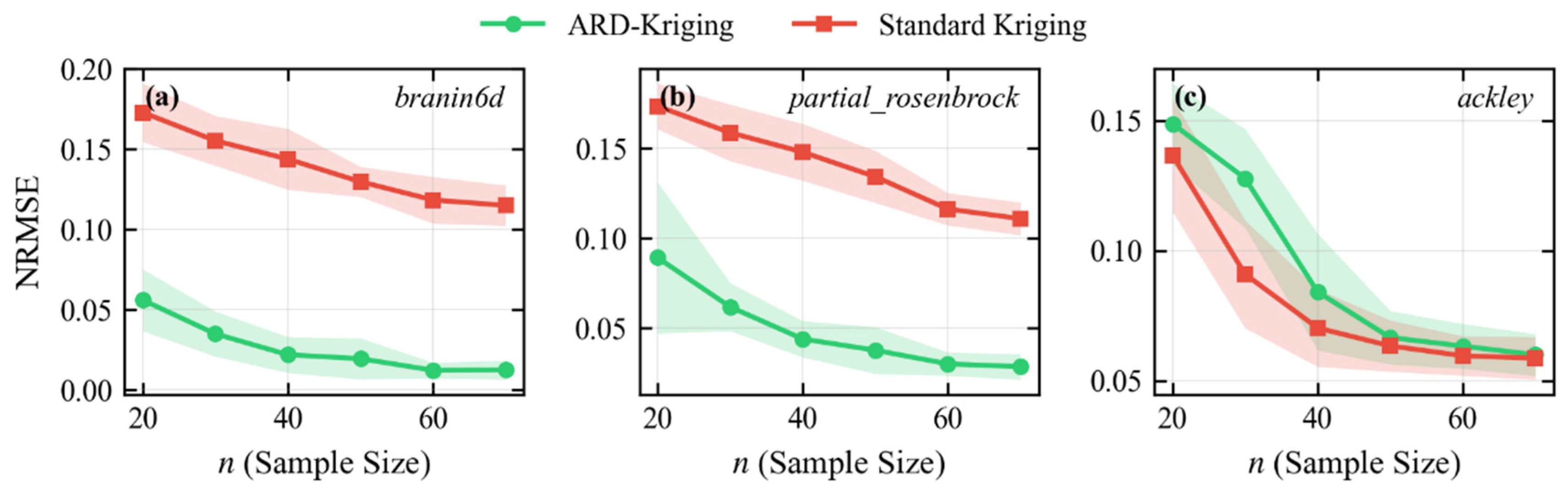
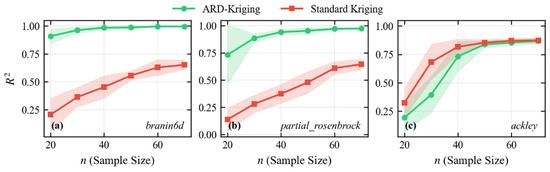
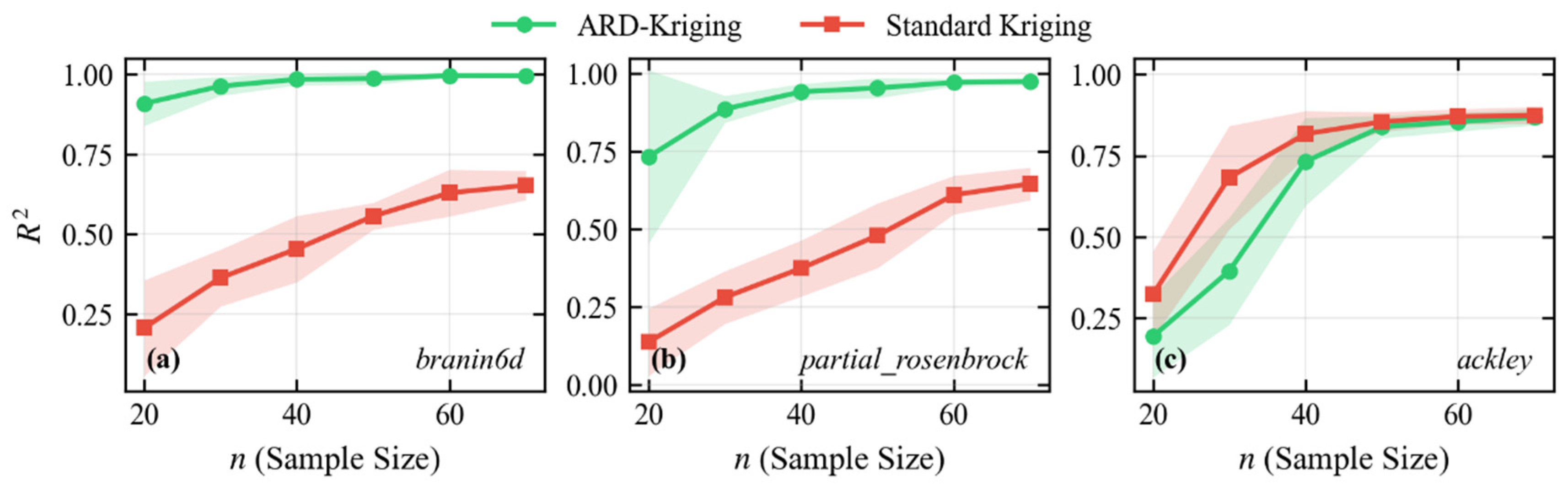
Three representative benchmark functions—Branin-6D (strongly anisotropic), Partial-Rosenbrock (non-linear interactions), and Ackley (isotropic)—were utilized to rigorously benchmark ARD-Kriging against standard Kriging (i.e., the baseline Gaussian Process model without the ARD mechanism). Crucially, the dimensionality of these benchmarks was purposefully configured to 6D to directly mirror the exact number of geometric design variables in the target PMLSM optimization problem. Furthermore, these specific functions were deliberately selected to encompass fundamentally diverse topographical landscapes: strong anisotropy, non-linear parameter interactions, and severe multimodality. Each benchmark function was independently executed 20 times to ensure statistical reliability. The mathematical validation demonstrates that in strongly anisotropic scenarios analogous to the PMLSM design space, ARD-Kriging significantly mitigates NRMSE compared to standard Kriging. This corroborates its superior suitability for high-dimensional feature extraction.
As shown in Table 4 and Figure 4 and Figure 5, the results demonstrate that in strongly anisotropic scenarios analogous to the PMLSM design space, ARD-Kriging leverages dimensional sensitivity identification to reduce the NRMSE by an order of magnitude compared to standard Kriging, effectively mitigating interference from redundant dimensions. Although the additional hyperparameters introduced by the ARD mechanism may induce slight overfitting in purely isotropic problems, the substantial gains in feature extraction capability far outweigh the costs associated with increased model complexity during highly anisotropic motor optimization. Consequently, these findings definitively validate the superior applicability of ARD-Kriging for the proposed PMLSM design space.
Table 4.
Accuracy Comparison Between ARD-Kriging and Standard Kriging (Matérn-5/2 Kernel, , ).
Figure 4.
NRMSE performance comparison between ARD-Kriging and standard Kriging with respect to sample size: (a) Branin-6D, (b) Partial-Rosenbrock, and (c) Ackley.
Figure 5.
performance comparison between ARD-Kriging and standard Kriging with respect to sample size: (a) Branin-6D, (b) Partial-Rosenbrock, and (c) Ackley.
4.4. Multi-Objective Expected Hypervolume Improvement (EHVI)
Since average thrust and thrust ripple are conflicting objectives, the goal is to approximate the Pareto front. Hypervolume (HV) is the only unary metric strictly compliant with Pareto dominance. The EHVI acquisition function is adopted to maximize the expected gain in HV.
For a normalized objective space () and a reference point , the Hypervolume of a non-dominated set is the Lebesgue measure of the dominated region:
where denotes the Lebesgue measure and indicates Pareto dominance. The increment from a new candidate is defined as
The expected increment under the predictive distribution is formulated as
This integral is computed via the Cell Decomposition method. The objective space is partitioned into grid cells based on the sorted non-dominated set. For the -th cell, the boundaries and are established. The total EHVI is the summation of the expected improvements across all cells:
where evaluates the truncated Gaussian distribution using the standard normal PDF and CDF :
The synergy between the ARD mechanism and the EHVI acquisition function establishes a highly efficient, physics-informed search paradigm. Specifically, critical dimensions identified by ARD directly propagate their prediction variance into the EHVI calculation. This targeted uncertainty propagation is mathematically orchestrated via the auxiliary function , balancing exploration—driven by the predictive standard deviation toward highly uncertain gaps along the Pareto front—and exploitation, guided by the predictive mean toward known optimal regions. Consequently, this mechanism strategically concentrates the limited FEA budget on resolving the Pareto front governed by dominant design variables, effectively circumventing the wasteful evaluation of irrelevant subspaces and substantially elevating the overall optimization efficiency.
4.5. Multi-Run Statistical Validation on BraninCurrin-6D
To rigorously evaluate the run-to-run statistical consistency of the complete optimization loop prior to engineering deployment, a dedicated multi-run statistical experiment was conducted using the BraninCurrin-6D benchmark.
The BraninCurrin function, a canonical benchmark in multi-objective Bayesian optimization, was extended to six dimensions by appending four irrelevant dummy variables. This configuration directly mirrors the highly anisotropic sensitivity structure of the PMLSM design space, where only a small subset of variables actively drives the objectives. To ensure numerical reliability, the reference hypervolume was independently established via Sobol convergence analysis and NSGA-II cross-validation. Twenty independent runs per algorithm were executed under a strictly constrained budget of 30 evaluations. This reduced budget creates a more demanding test environment than the actual PMLSM optimization, ensuring conservative and robust statistical conclusions.
The statistical results, summarized in Table 5, highlight the superior stability of the proposed methodology. ARD-Kriging-EHVI achieved the highest mean hypervolume and the lowest run-to-run variance, exhibiting a standard deviation approximately 20 times smaller than the conventional baselines. Notably, while both standard Kriging-EHVI and ParEGO experienced complete optimization failures (final HV of zero) across the 20 runs, ARD-Kriging-EHVI maintained consistent convergence. A paired Wilcoxon signed-rank test confirmed that the performance advantage of the proposed framework over both baselines is highly statistically significant (p < 0.001). Furthermore, while the two baselines showed statistically indistinguishable final hypervolumes, standard Kriging-EHVI demonstrated a better search trajectory (measured by HV AUC) than ParEGO, underscoring the inefficiency of scalarization in anisotropic spaces. Collectively, these findings mathematically validate that the ARD mechanism effectively identifies active dimensions and suppresses noise, securing high algorithmic reproducibility prior to the expensive FEA optimization phase.
Table 5.
Statistical comparison of multi-objective optimization algorithms on the BraninCurrin-6D benchmark over 20 independent runs.
5. Optimization Results and Analysis
Leveraging the ARD-Kriging-EHVI multi-objective optimization framework formulated in Section 4, this section systematically resolves the multi-objective optimization model established in Section 3 and provides an in-depth analysis of the resulting performance characteristics.
5.1. Finite Element Modeling and Optimization Framework Setup
To accurately evaluate the electromagnetic performance of the PMLSM candidates, a 2D transient Finite Element Analysis (FEA) model is established using Ansys Maxwell 22R1. A Balloon boundary condition is assigned to the outer region to accurately simulate the infinite space for magnetic leakage flux. To capture the precise air-gap permeance variations induced by the unequal tooth-shoes, local mesh refinement is strictly enforced in the air-gap and stator slot-opening regions. Taking the balanced design (Scheme 5) as an example, the discretized FEA model comprises approximately 66,313 mesh elements.
The proposed ARD-Kriging-EHVI optimization framework is implemented entirely in Python 3.12. To achieve automated closed-loop evaluation, a co-simulation methodology is deployed. Specifically, Python dynamically modifies the geometric parameters by generating and executing a VBScript (VBS) file. This script drives Ansys Maxwell to construct the FEA model, execute the transient solver, extract the resultant and TRR, and return these true physical responses to the Python environment for surrogate updating. All simulations were executed on a high-performance workstation equipped with an AMD Ryzen Threadripper PRO 9970X CPU (Advanced Micro Devices, Inc., Santa Clara, CA, USA) and 64 GB of RAM (Corsair Memory, Inc., Fremont, CA, USA). The computational cost for a single high-fidelity FEA evaluation is approximately 20 min.
The dataset generation is strictly partitioned to fulfill modeling and sequential optimization requirements. Initially, a training dataset comprising samples is generated exclusively via the CP-MmLHD method. To monitor the initial hyperparameter estimation of the ARD-Kriging models and detect potential misspecification prior to sequential infill, a Leave-One-Out Cross-Validation (LOOCV) is conducted on this training set. The resulting metrics serve strictly as a baseline reference rather than a primary accuracy criterion, as the sequential EHVI-guided infill is structurally designed to progressively self-correct and refine model fidelity toward the Pareto-optimal region. Subsequently, an update dataset consisting of 90 sequential iterations is acquired. During each iteration, the framework evaluates the EHVI acquisition function to propose a new optimal candidate, executes the VBS-driven FEA solver to acquire the physical response, and sequentially refines the surrogate model.
5.2. ARD Variable Importance Analysis
Building upon the experimental setup described in Section 5.1, the ARD-Kriging surrogate models are trained with hyperparameters optimized via the Differential Evolution (DE) algorithm, parameterized with a population size of , a scaling factor of , and a crossover probability of . The EHVI acquisition function is maximized using the same DE configuration. The entire optimization workflow is constrained to a total budget of 150 FEA evaluations, comprising the initial 60-sample training set and 90 sequential infill iterations.
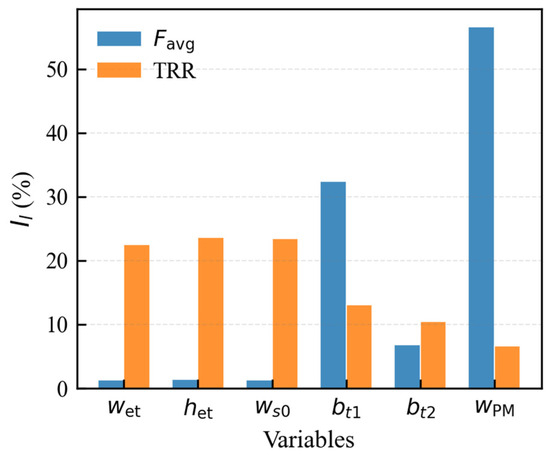
To facilitate an intuitive comparison of the relative contributions of each variable, the ARD hyperparameters are transformed into normalized importance percentages:
As illustrated in Figure 6, the sensitivity distributions for the two objectives are markedly distinct. This reflects the fundamentally different physical origins of average thrust and thrust ripple.
Figure 6.
ARD hyperparameters and normalized importance of the design variables.
For average thrust (), the PM width () emerges as the overwhelmingly dominant variable, accounting for approximately 55% of the total sensitivity. This is physically expected: directly controls the fundamental amplitude of the air-gap flux density, providing the primary energy input for thrust generation. The primary tooth-shoe width () ranks second, as it governs the effective permeance area exposed to the PM flux and modulates the main flux path conductance. Notably, the end-tooth parameters (, , ) show comparatively low importance for average thrust. This confirms that their influence is largely confined to local magnetic field transitions at the primary extremities, rather than the bulk flux linkage.
For the thrust ripple rate (TRR), the sensitivity profile reverses substantially. The three end-region parameters collectively account for over 60% of the total importance. This highlights the dominant role of the end-tooth structure in smoothing permeance discontinuities at the primary boundaries, which act as the principal excitation source for end forces. Furthermore, the tooth-shoe widths ( and ) retain significant but secondary importance. Their unequal arrangement modulates the sub-periodic permeance harmonics within each module, successfully attenuating cogging force components that standard equal-tooth designs cannot suppress. Despite its dominance in thrust generation, shows a relatively modest influence on ripple. This indicates that ripple mitigation in this topology is primarily a geometric challenge rather than a magnetic loading issue.
Ultimately, this clearly differentiated sensitivity structure validates the necessity of a synergistic multi-objective optimization strategy over sequential single-parameter tuning. It also provides physically grounded guidance for priority-driven design refinement in engineering practice.
5.3. Hypervolume Convergence Analysis
Hypervolume (HV) serves as the core metric for evaluating the quality of non-dominated solution sets in multi-objective optimization. To ensure the comparability of HV values across different iteration stages, this study normalizes the objective space based on the initial sampling boundaries, setting the reference point at . The theoretical maximum of the normalized HV relative to the initial bounds is 1.21; however, as sequential infill samples surpass the initial objective space boundaries—achieving higher thrust or lower ripple—the actual HV value can exceed 1.21.
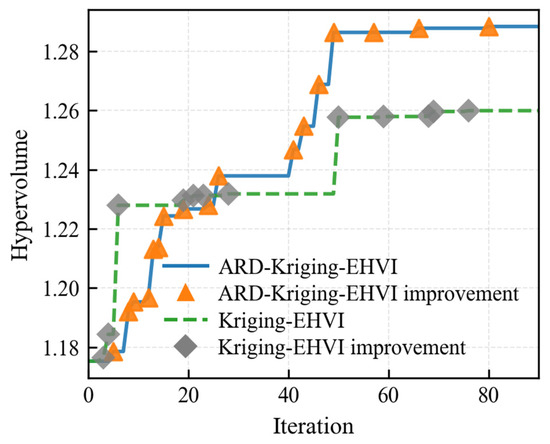
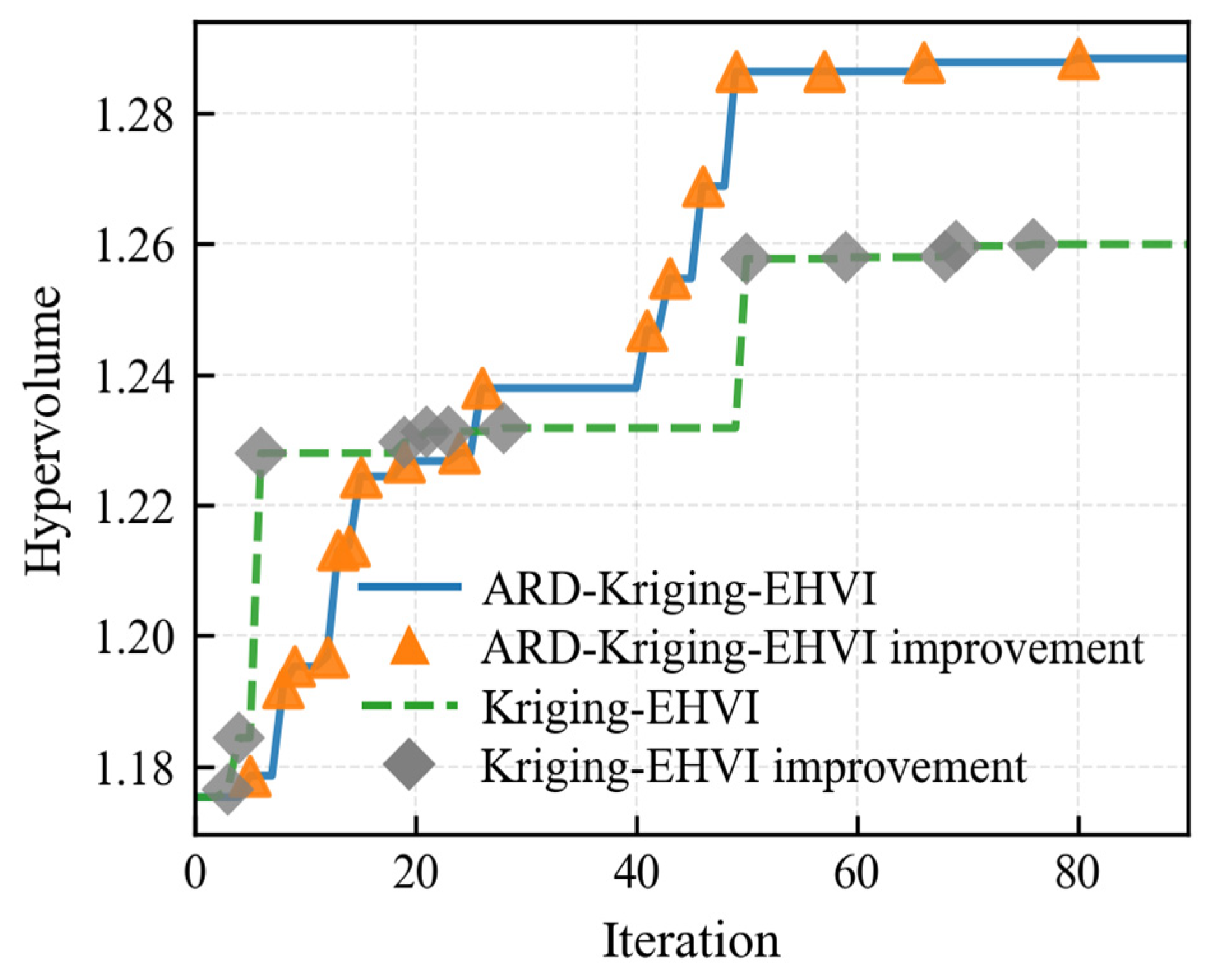
Figure 7 depicts the evolution trajectory of the HV indicator over iterations under different surrogate models. The triangular and gray diamond markers denote iteration points where substantial HV improvements occur in the ARD-Kriging-EHVI and standard Kriging-EHVI optimization frameworks, respectively.
Figure 7.
Evolution of the Pareto front during the sequential optimization process. The transition from initial samples to final optimal designs visually demonstrates the successful trade-off between thrust enhancement and ripple reduction.
As observed in Figure 7, within the Kriging-EHVI framework, the HV indicator initially exhibits a rapid ascent and outpaces the ARD-Kriging-EHVI method before the 30th iteration. Nevertheless, as the iteration proceeds, its improvement rate decelerates, allowing the ARD-Kriging-EHVI framework to surpass it and sustain continuous enhancement. The HV curve of the ARD-Kriging-EHVI framework presents a characteristic “rapid ascent—asymptotic stabilization” convergence pattern. The early optimization phase demonstrates pronounced exploration capabilities, with the HV escalating rapidly from an initial value of 1.1753, effectively identifying highly promising unknown regions. Specifically, the HV reaches 1.1953 at the 10th iteration, 1.2267 at the 20th, and 1.2379 at the 30th. The HV increment during the first 30 iterations is 0.0626, accounting for 55.4% of the total increment, signifying peak efficiency in Pareto front approximation during early iterations.
The intermediate phase transitions into a dynamic balance between exploration and exploitation, manifesting as a markedly attenuated HV growth rate. By the 50th iteration, the HV achieves 1.2864, a marginal increase of 0.0485 from the 30th iteration. Here, infill samples primarily function to populate voids within the established Pareto front rather than expanding its boundaries, thereby enhancing the distributional uniformity of the solution set. During the final iterations, HV growth approaches stagnation. The HV stabilizes at 1.2878 by the 70th iteration and converges to = 1.2884 at the 90th iteration, with no discernible improvement observed in the final 10 generations. The HV increment over the last 30 iterations is a mere 0.0020 (1.8% of the total), substantiating that the Pareto front has essentially reached a steady state, rendering the marginal contribution of additional FEA evaluations negligible.
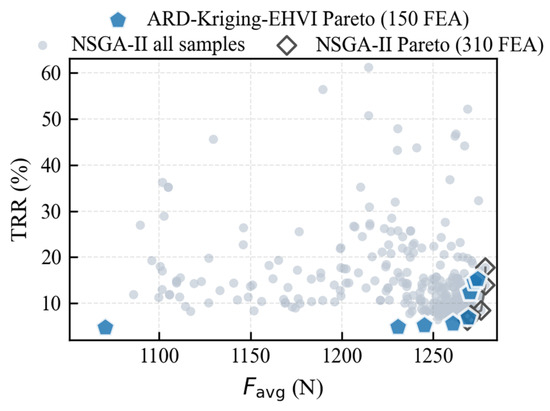
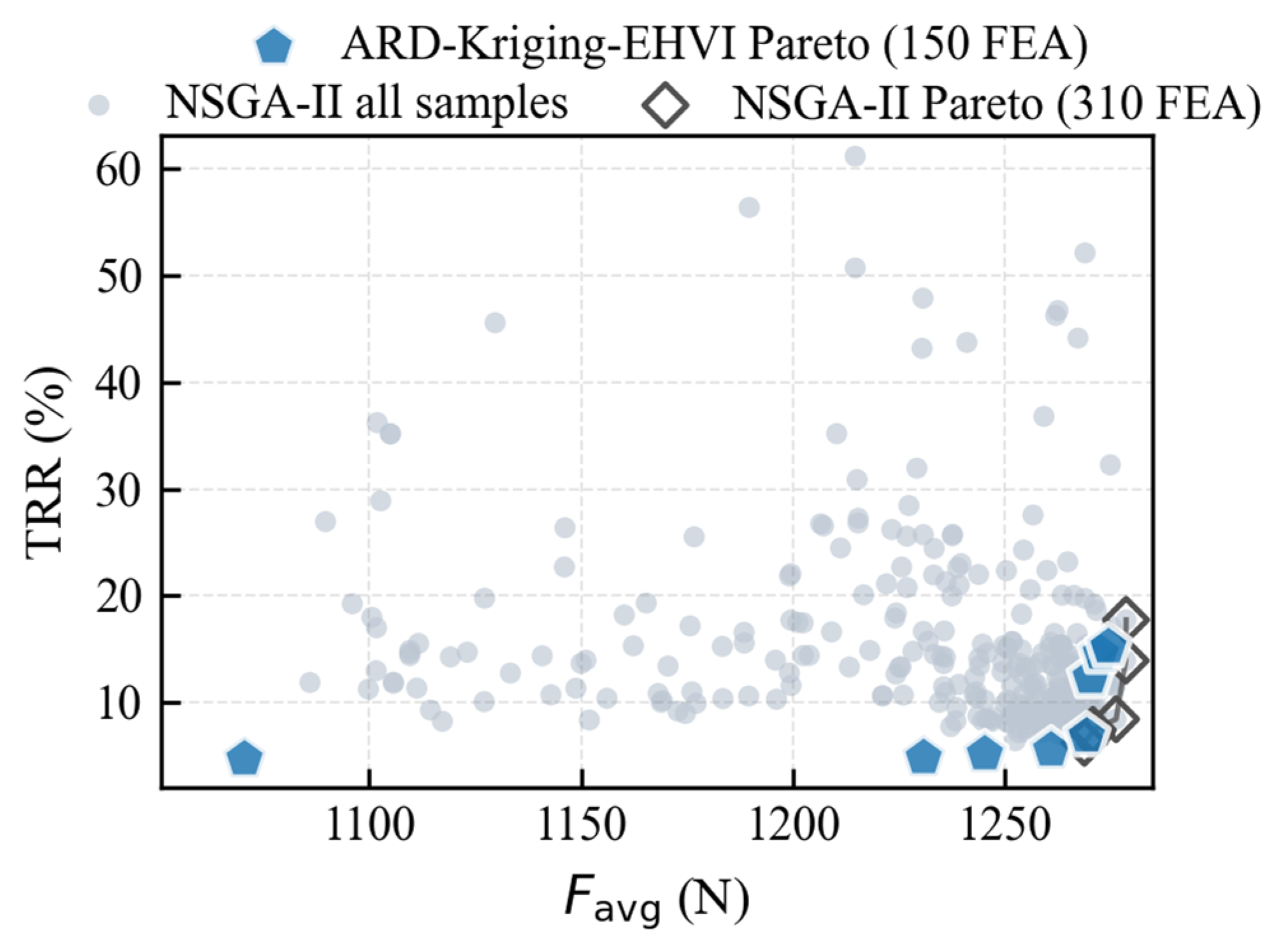
A direct experimental comparison against the conventional NSGA-II algorithm further validates the computational advantages of the proposed framework. Both methods were initialized with an identical dataset of 60 CP-MmLHD samples within the same feasible design space. The NSGA-II was executed for five generations with 50 offspring per generation, consuming a total of 310 high-fidelity FEA evaluations. As visually confirmed by the comparative Pareto fronts in Figure 8, the ARD-Kriging-EHVI framework demonstrates an overwhelming superiority in both exploration breadth and computational efficiency. While the NSGA-II solutions tightly cluster within a narrow high-thrust region, the proposed framework secures well-distributed Pareto solutions that span a vastly wider objective space using merely 150 evaluations. Most notably, ARD-Kriging-EHVI successfully explores the critical low-ripple region that NSGA-II completely fails to reach. This profound contrast confirms that the proposed surrogate methodology effectively slashes the computational burden by over 50%, whilst exhibiting an exceptional capability to discover highly diverse and globally optimal design trade-offs.
Figure 8.
Comparative Pareto fronts obtained by the proposed ARD-Kriging-EHVI framework and the conventional NSGA-II.
5.4. Pareto Front Analysis
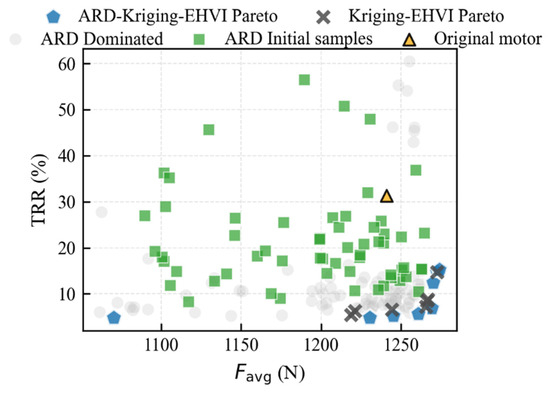
Following 90 sequential iterations, the algorithm outputs the final non-dominated solution set. To visually depict the convergence of the optimization process, Figure 9 illustrates the objective space distribution at the culmination of the 90th iteration.
Figure 9.
Pareto front and sample point distribution at the 90th sequential iteration.
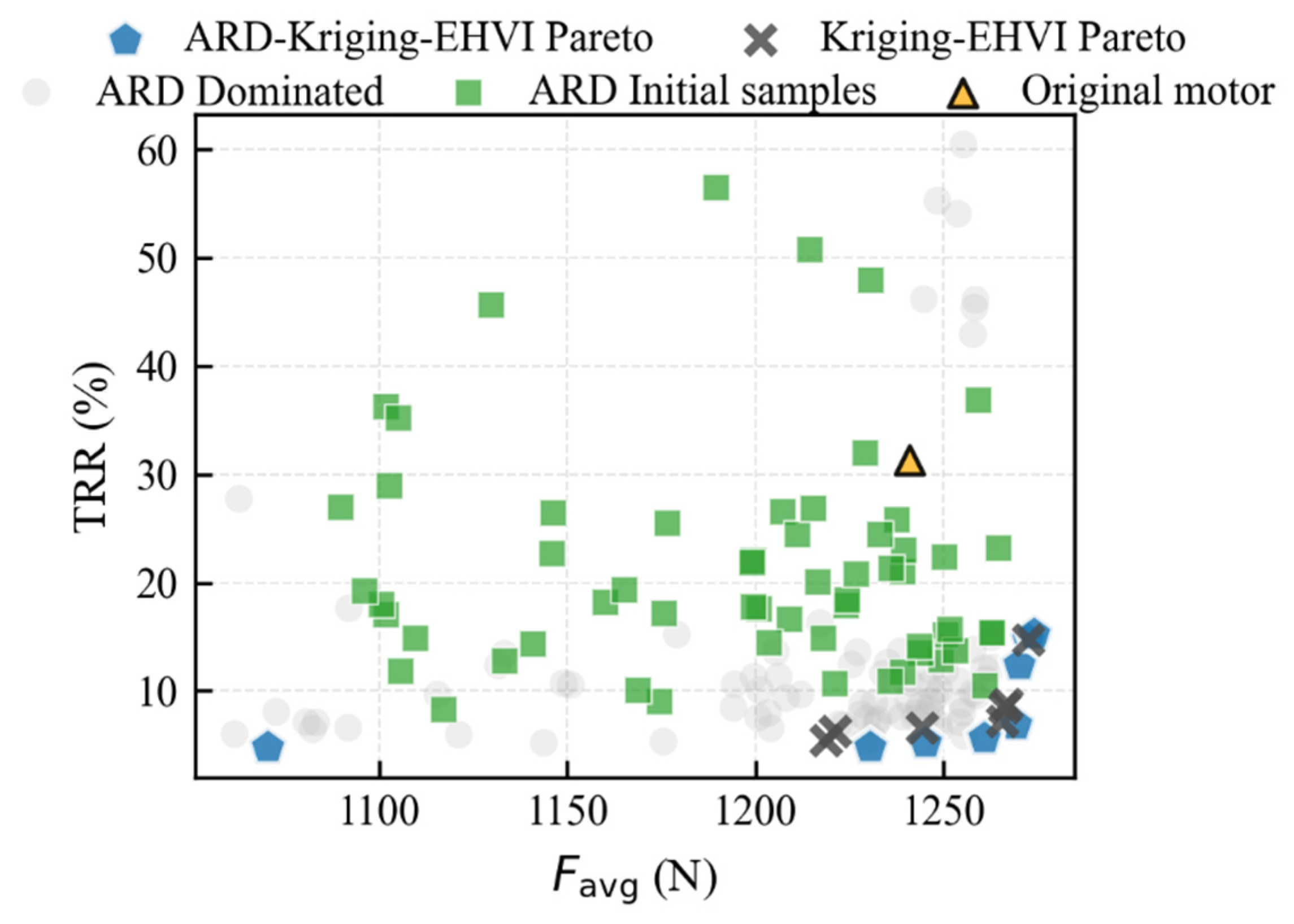
Several salient features are observable from Figure 9. The Pareto front derived via the ARD-Kriging-EHVI optimization boasts a richer set of non-dominated solutions, exhibiting significant superiority over the standard Kriging-EHVI counterpart in both quantity and uniform distribution. Its Pareto front manifests a distinct convex profile, seamlessly extending from the high-thrust region to the low-ripple region. The prototype motor design (indicated by the yellow triangle) lies well behind the Pareto front, structurally substantiating the necessity and efficacy of the optimization design. The systematic optimization governed by the ARD-Kriging-EHVI framework facilitates a substantial reduction in thrust ripple rate while maintaining or even augmenting average thrust. During the initial phase, samples are sporadically dispersed across the objective space, with the majority exhibiting severe thrust ripple. Upon transitioning to the EHVI-driven sequential optimization phase, newly generated infill samples visibly cluster along the vicinity of the true front. This distribution characteristic verifies that the algorithm successfully navigates computational resources towards potentially fertile regions of the Pareto front, effectively mitigating wasteful exploration in low-value sub-spaces.
Table 6 details the design parameters and performance metrics of the eight non-dominated solutions extracted from the final Pareto front, ordered by descending average thrust. These specific solutions epitomize the optimal trade-off sets between thrust capability and ripple mitigation within the defined design space. As summarized in Table 6, the Pareto-optimal solutions naturally span three performance regions—high-thrust (Scheme 1, Scheme 2 and Scheme 3), balanced (Scheme 4, Scheme 5 and Scheme 6), and low-ripple (Scheme 7 and Scheme 8)—reflecting a well-distributed coverage of the thrust–ripple trade-off space. All Pareto candidates substantially outperform the baseline prototype in thrust ripple reduction, with the balanced region offering particularly attractive configurations for practical servo applications. These results confirm the effectiveness of the proposed optimization framework in simultaneously advancing both performance objectives.
Table 6.
Optimal Design Parameters on the Pareto Front (in Descending Order of Average Thrust).
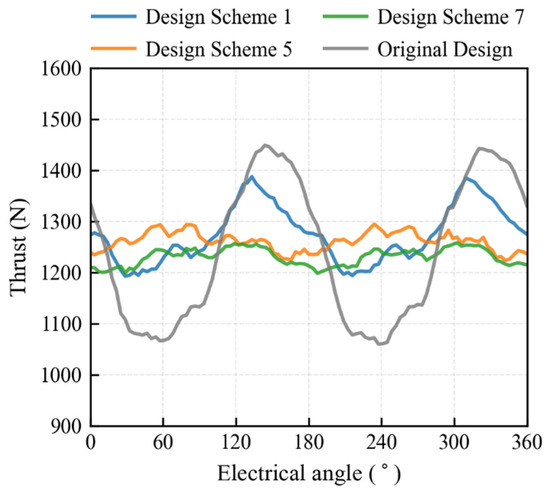
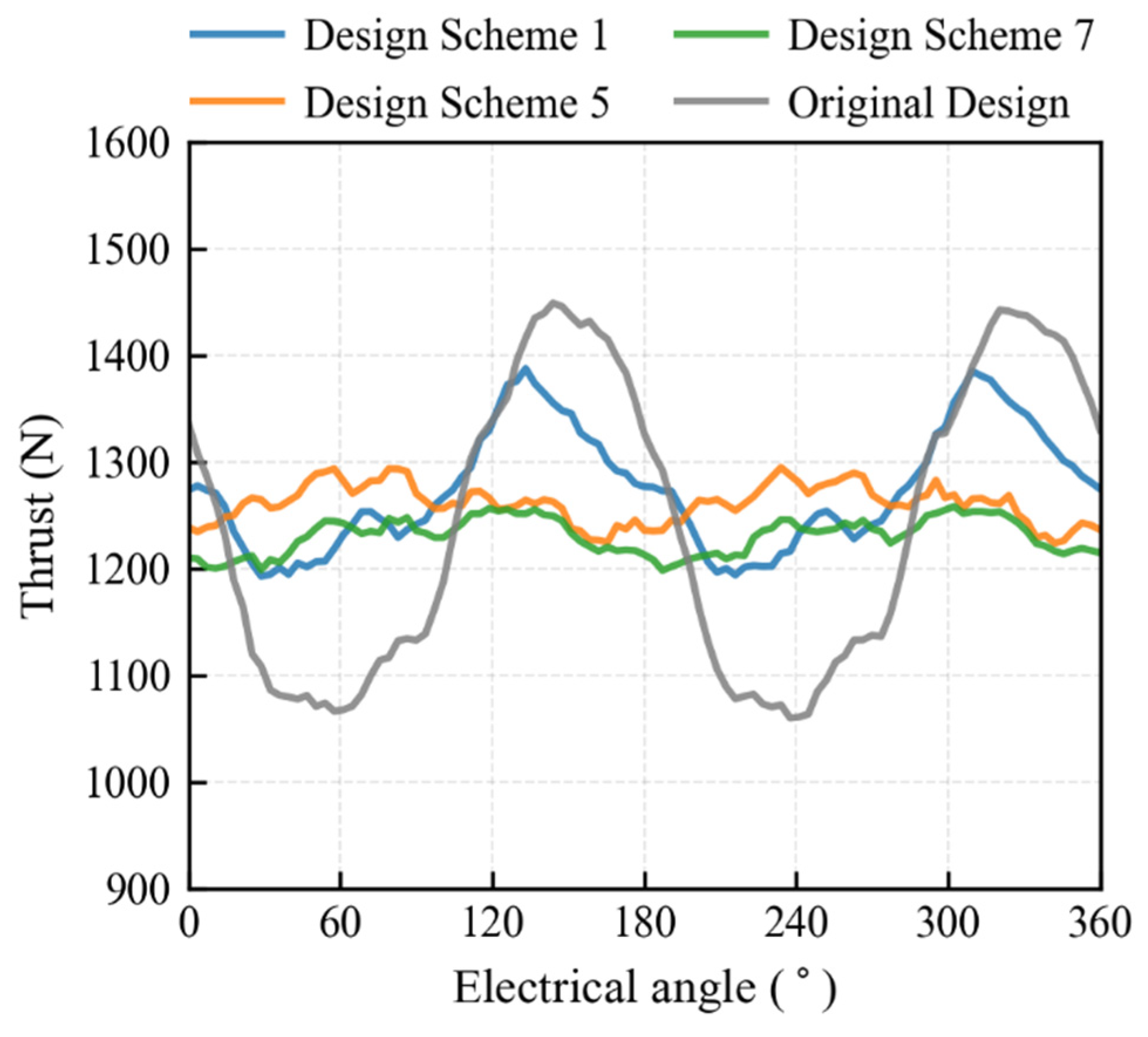
Table 7 juxtaposes representative designs from the Pareto front against the original baseline prototype to quantitatively benchmark the optimization yield of the framework. Three representative designs—a high-thrust (Scheme 1), a balanced (Scheme 5), and a low-ripple (Scheme 7) solution—are selected for detailed comparison, with their thrust waveforms shown in Figure 10 and performance metrics listed in Table 7. All three designs achieve substantial ripple reduction relative to the baseline while maintaining competitive average thrust levels, demonstrating that the ARD-Kriging-EHVI framework effectively resolves the thrust–ripple trade-off across diverse performance targets. The balanced design (Scheme 5) is highlighted as particularly suitable for practical applications, offering an excellent compromise between the two objectives.
Table 7.
Performance Comparison Between Representative Optimal Designs and the Original Design.
Figure 10.
Thrust waveforms of the representative design schemes over one electrical cycle.
5.5. Comprehensive Verification and Comparative Discussion
A quantitative comparison between the representative balanced design (Scheme 5) and recently published surrogate-assisted methodologies further contextualizes the computational efficiency of the proposed framework. As summarized in Table 8, existing frameworks typically require a substantial computational budget, ranging from 300 to 3000 high-fidelity FEA evaluations to reach convergence. By contrast, the proposed ARD-Kriging-EHVI framework achieves convergence and competitive ripple suppression within a strictly constrained budget of 150 evaluations. This comparative analysis demonstrates that the proposed methodology significantly reduces the computational overhead while effectively securing a stable Pareto-optimal balance.
Table 8.
Performance and Efficiency Comparison with Recent Surrogate-Assisted Motor Optimization Studies.
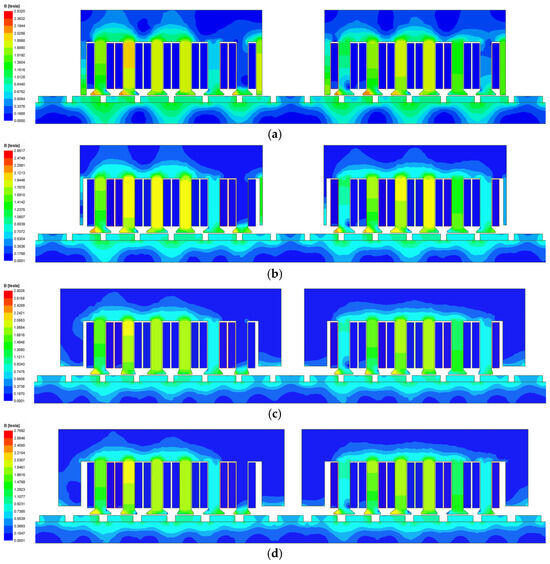
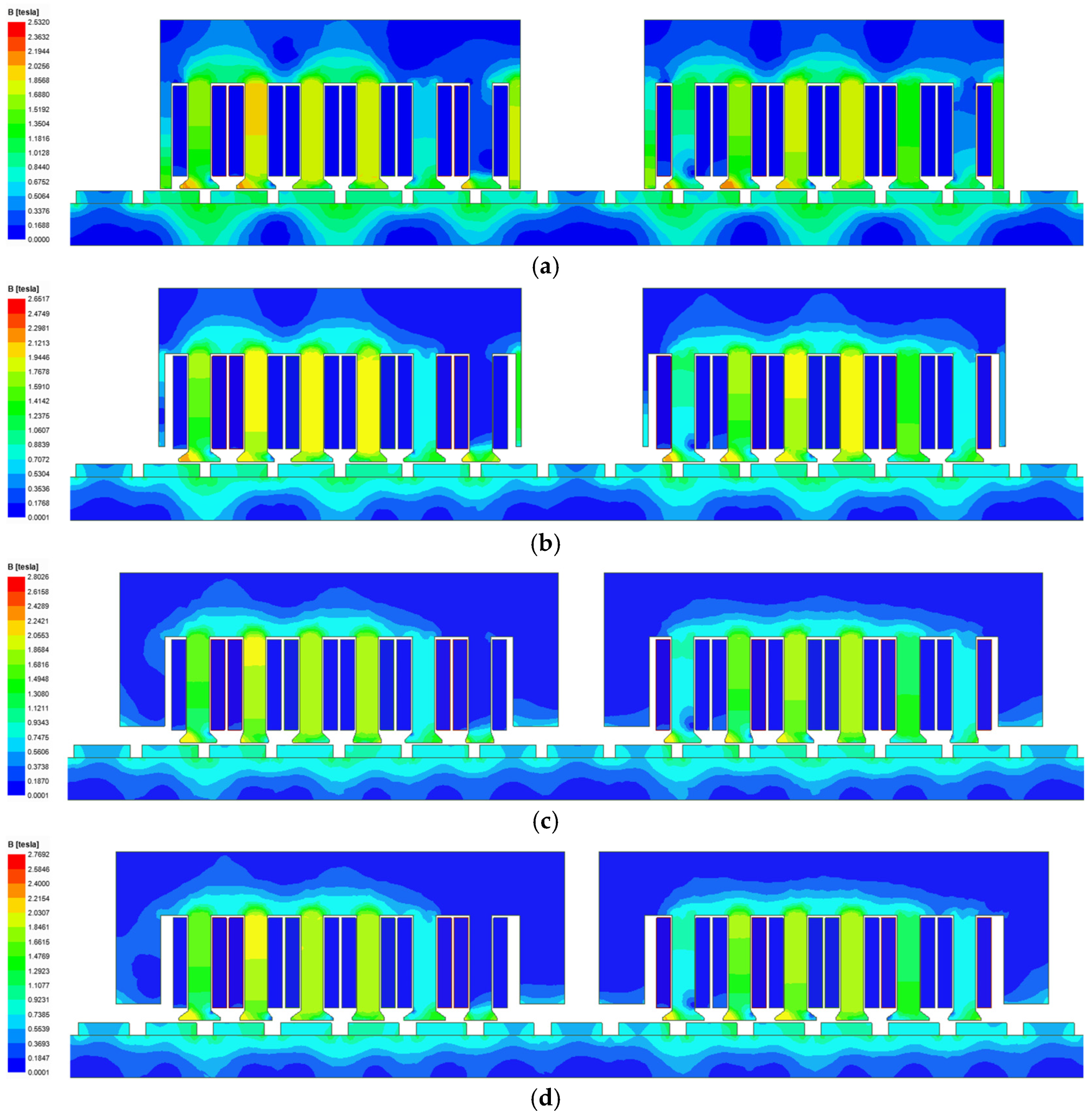
To provide direct physical corroboration of the Pareto-optimal results reported in Table 6 and Table 7, Figure 11 presents the transient magnetic flux density () contour distributions obtained from Ansys Maxwell FEA for the original prototype and three representative optimized designs. In the original configuration (Figure 11a), the peak flux density is 2.53 T, with the high- zones partially concentrated at the end-tooth tips and the boundaries between the two modules, producing an abrupt permeance discontinuity at the primary extremities. This localized magnetic field non-uniformity constitutes the dominant source of end-force-induced thrust ripple, directly consistent with the mechanism formulated in Section 2.4.
Figure 11.
Transient magnetic flux density () contour distributions computed by ANSYS Maxwell 22R1 for (a) the original prototype, (b) Scheme 1 (maximum ), (c) Scheme 5 (balanced design), and (d) Scheme 7 (minimum thrust ripple). Each subplot retains its individual color scale to maximize local contrast; peak values are 2.53 T, 2.65 T, 2.80 T, and 2.77 T for (a–d), respectively.
As the optimization progresses, a systematic evolution of the field distribution becomes evident. Scheme 1 (Figure 11b) exhibits a slightly elevated peak of 2.65 T, attributable to the expanded PM width that maximizes air-gap flux linkage and hence . Scheme 5 (Figure 11c) reaches the highest peak of 2.80 T driven by further PM expansion; however, the unequal tooth-shoe topology effectively begins to homogenize the magnetic flux distribution across the main air gap, while the optimized end-tooth geometry achieves a smoother permeance transition at the module boundaries. Scheme 7 (Figure 11d), despite maintaining a peak of 2.77 T, demonstrates the most globally uniform spatial field distribution among all designs. The alternating unequal tooth-shoes systematically reconstruct the permeance harmonics to yield a highly homogeneous active air-gap field, and simultaneously, the optimized end-teeth substantially reduce the saturation gradient at the primary extremities, ensuring progressive rather than abrupt boundary transitions. This comprehensive spatial redistribution—synergistically homogenizing both the main air-gap field and the boundary permeance profile—constitutes the core electromagnetic mechanism underlying the 84.44% thrust ripple reduction achieved by Scheme 7. The progressive improvement from Figure 11a–d directly confirms that the ARD-Kriging-EHVI framework has converged upon geometries that physically realize the multi-source ripple suppression mechanisms proposed in Section 2.
To validate the numerical stability of the FEA solutions underlying all reported results, a mesh independence study was conducted on the representative balanced design (Scheme 5) across six successive discretization densities ranging from 31,141 to 113,801 elements. The predicted and thrust ripple amplitude exhibit pronounced asymptotic convergence as the mesh is refined; beyond 66,313 elements, both quantities stabilize with negligible further variation. Specifically, relative to the maximum-density configuration of 113,801 elements, the adopted 66,313-element mesh restricts the relative deviation in to below 0.5% and the absolute fluctuation in thrust ripple amplitude to within 0.3%. These results confirm that the reported electromagnetic performance metrics are robust with respect to spatial discretization and are free from mesh-induced artifacts.
The aforementioned results definitively substantiate the efficacy of the ARD-Kriging-EHVI framework. Subject to a strict computational budget of merely 150 FEA evaluations, the framework adeptly derives a diversified repository of optimal designs catering to varied operational requisites, delivering a rich spectrum of robust alternatives for subsequent engineering decision-making.
5.6. Manufacturing Robustness Analysis
While the optimization schemes situated on the Pareto front exhibit exceptional performance metrics in numerical simulations, it is imperative to address the inevitable dimensional deviations encountered during physical manufacturing. Consequently, this section employs a Monte Carlo perturbation simulation method to systematically evaluate the performance stability of a representative optimal design under standard manufacturing tolerances, thereby verifying its engineering practicability.
Scheme 5, a quintessential balanced design offering a superior trade-off with high industrial viability, is selected as the validation subject. Defining the nominal design parameter vector as and the manufacturing tolerance as , the actual machined parameters can be mathematically modeled as
where designates the stochastic perturbation vector characterized by a uniform distribution. The uniform distribution postulates that any deviation within the tolerance band is equally probable, which aligns with standard machining characteristics. Furthermore, it enforces equal probabilities for boundary and central values, yielding a more conservative worst-case assessment compared to a normal distribution. For variables situated strictly on the design space boundaries, the perturbation direction is constrained, e.g., if a variable lies on the upper bound, only negative perturbation is permissible; conversely, for a lower bound, only positive perturbation applies. This study sets = 0.1 mm, corresponding to conventional machining precision grades.
Based on this perturbation model, Monte Carlo random sampling generates 20 sets of perturbed design schemes, each undergoing FEA evaluation to record the resultant thrust capability and ripple rate. Table 9 summarizes the key statistical findings of this Monte Carlo simulation. The Coefficient of Variation (CV), defined as , serves as the core metric for performance stability, where and denote the sample mean and standard deviation, respectively. The CV eliminates dimensional discrepancies, facilitating horizontal comparisons across distinct physical quantities.
Table 9.
Statistical Results of Manufacturing Robustness for Scheme 5.
The 95% Confidence Intervals in Table 9 are estimated via Bootstrap resampling (10,000 iterations) to account for the statistical uncertainty of the finite sample. As shown, the average thrust exhibits very low sensitivity to manufacturing tolerances, while the ripple rate displays comparatively higher variability; both metrics nonetheless remain well within acceptable engineering bounds, confirming the robustness of the optimized design.
Beyond statistical averages, the worst-case analysis in Table 10 confirms that Scheme 5 maintains satisfactory performance under the most adverse combination of manufacturing deviations. Both the worst-case average thrust and ripple rate remain within the prescribed design thresholds, validating that the theoretically optimized gains translate reliably into physical manufacturing.
Table 10.
Worst-Case Performance Analysis.
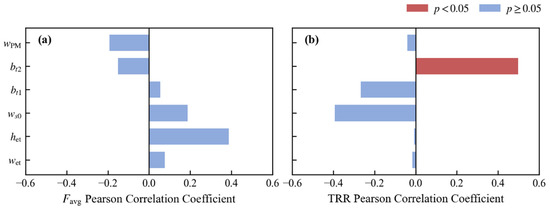
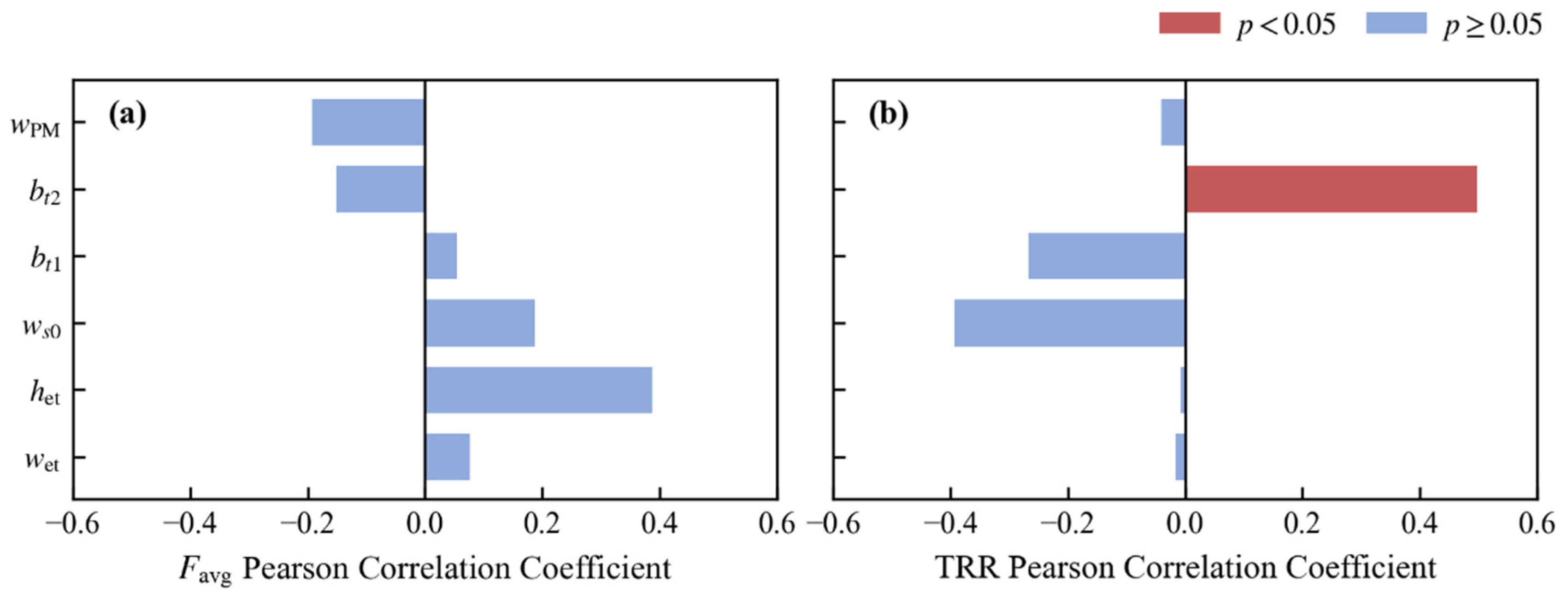
As illustrated in Figure 12, while the average thrust demonstrates no significant sensitivity to dimensional perturbations, the secondary tooth-shoe width emerges as the sole design variable exhibiting a statistically significant correlation with the thrust ripple rate (, ) at a significance level of . Although the limited sample size of 20 constrains the statistical power to detect weaker correlations, Bootstrap resampling analysis (95% CI: [0.19, 0.73]) validates that the positive influence of on the ripple rate possesses formidable statistical robustness. This discovery prescribes clear directives for subsequent process control. Specifically, during the prototype fabrication phase, deploying a more stringent dimensional tolerance strategy exclusively for the secondary tooth-shoe width represents a highly targeted and cost-effective methodology to further fortify the manufacturing stability of the thrust ripple rate.
Figure 12.
Pearson correlation analysis of design variable perturbations on electromagnetic performance: (a) Average thrust and (b) Thrust ripple rate, TRR.
In practical PMLSM fabrication, performance drift between idealized FEA predictions and actual hardware is predominantly induced by machining tolerances and material property variations. The stochastic Monte Carlo analysis presented above explicitly quantifies these tolerance effects and the design’s sensitivity to physical noise. The results demonstrate that the optimized design maintains a substantial 82.08% performance buffer, effectively absorbing dimensional deviations and confirming the strong manufacturing robustness of the proposed framework.
6. Conclusions
This study systematically integrates advanced motor topology design with an efficient surrogate-assisted multi-objective optimization framework. Mechanistic analyses of the unequal tooth-shoes and end-geometry meticulously elucidate the intrinsic influence of structural parameters on electromagnetic performance. Notably, the permanent magnet (PM) width and primary tooth-shoe width predominantly govern the average thrust, whereas the end-tooth height, end-slot width, and end-tooth width synergistically dictate the thrust ripple rate. These findings establish a solid physical foundation for priority-driven, staged tuning in engineering practices.
Methodologically, a closed-loop sequential optimization framework is formulated and implemented. This framework leverages CP-MmLHD to guarantee high-quality space-filling properties for initial sampling, employs ARD-Kriging to autonomously identify critical dimensional sensitivities and quantify prediction uncertainty, and utilizes EHVI to orchestrate the delicate balance between global exploration and local exploitation. Consequently, the synergy between the surrogate model and the acquisition function maximizes the information gain per FEA evaluation.
Optimization results substantiate the superior efficacy of the proposed workflow. Constrained to a stringent budget of merely 150 FEA evaluations, the normalized hypervolume is substantially elevated from 1.1753 to 1.2884 (9.62% increment). Ultimately, eight high-fidelity Pareto solutions are extracted, spanning an average thrust range of 1070–1274 N and a thrust ripple rate of 4.78–15.3%. A representative optimized design successfully mitigates the thrust ripple by over 80% relative to the baseline prototype. Compared to conventional Evolutionary Algorithms (EAs), the computational burden is drastically reduced, confirming both the efficiency and engineering viability of the proposed methodology.
In summary, this research constructs a pragmatic bridge between theoretical electromagnetics and industrial engineering. It not only deepens the fundamental understanding of topology–performance coupling but also delivers a highly scalable optimization paradigm. This offers a viable pathway for the rapid design iteration of PMLSMs and analogous complex electromagnetic systems. Future research will prioritize experimental prototype fabrication and testing to physically validate the simulated electromagnetic performances and fully close the engineering validation loop. Furthermore, we intend to explore the adaptability of the ARD-Kriging-EHVI methodology in handling more demanding, multi-physics design scenarios.
Author Contributions
Conceptualization, C.F. and L.G.; methodology, C.F.; software, C.F.; validation, C.F., L.G. and J.J.; formal analysis, C.F.; investigation, C.F.; resources, L.G. and W.L.; data curation, C.F.; writing—original draft preparation, C.F.; writing—review and editing, C.F., L.G., J.J., B.W. and W.L.; visualization, C.F.; supervision, L.G.; project administration, L.G.; funding acquisition, L.G. All authors have read and agreed to the published version of the manuscript.
Funding
This work was supported in part by the National Natural Science Foundation of China under Grant 52277068, and in part by the Key Research and Development Program of Zhejiang Science and Technology Department under Grant 2025C01015, 2025C03013, 2025C03011 and Grant 2025C02006.
Institutional Review Board Statement
Not applicable.
Informed Consent Statement
Not applicable.
Data Availability Statement
The original contributions presented in this study are included in the article. Further inquiries can be directed to the corresponding author.
Conflicts of Interest
The authors declare no conflicts of interest.
References
- Lu, Q.F.; Shen, Y.M.; Ye, Y.Y. Development of Permanent Magnet Linear Synchronous Motors Structure and Research. Proc. Chin. Soc. Electr. Eng. 2019, 39, 2575–2588. [Google Scholar] [CrossRef]
- Sato, K. High-Precision and High-Speed Positioning of 100G Linear Synchronous Motor. Precis. Eng. 2015, 39, 31–37. [Google Scholar] [CrossRef] [Scilit]
- Zhang, J.M.; Su, H.; Ren, Q.; Li, W.; Zhou, H.C. Review on Development and Key Technologies of Permanent Magnet Synchronous Traction System for Rail Transit. J. Traffic Transp. Eng. 2021, 21, 63–77. [Google Scholar] [CrossRef]
- Pan, J.; Fu, P.; Niu, S.; Wang, C.; Zhang, X. High-Precision Coordinated Position Control of Integrated Permanent Magnet Synchronous Linear Motor Stations. IEEE Access 2020, 8, 126253–126265. [Google Scholar] [CrossRef] [Scilit]
- Chen, S.; Liu, Y.; Zhang, Q.; Tan, J. Analysis and Suppression of Thrust Ripple in a Permanent Magnet Linear Synchronous Motor—A Review. Energies 2025, 18, 863. [Google Scholar] [CrossRef] [Scilit]
- Zhao, Y.; Liu, Z.; Gong, J.; Yu, X.; Qiu, J.; Rodríguez-Andina, J.J. Improved Multiobjective Optimization of Tubular Slotless Permanent Magnet Linear Synchronous Motor for High-Performance Z-Axis Actuators. IEEE/ASME Trans. Mechatron. 2025, 30, 7077–7088. [Google Scholar] [CrossRef] [Scilit]
- Lan, Z.; Chen, L.; Xiao, X.; Luo, Y.; Deng, M.; Zhu, S. Detent Force Suppression of Permanent Magnet Linear Synchronous Motor Based on a V-Shaped Tooth-Slot Structure. IET Electr. Power Appl. 2023, 17, 535–546. [Google Scholar] [CrossRef] [Scilit]
- Tootoonchian, F.; Nasiri-Gheidari, Z. Cogging Force Mitigation Techniques in a Modular Linear Permanent Magnet Motor. IET Electr. Power Appl. 2016, 10, 667–674. [Google Scholar] [CrossRef] [Scilit]
- Wang, Q.; Yang, Y.; Ma, P.; Zhang, J.; Li, Y. Analysis and Suppression of Phase Unbalance Induced Force Ripples in Permanent Magnet Linear Motors. IEEE Access 2022, 10, 5416–5423. [Google Scholar] [CrossRef] [Scilit]
- Tan, Q.; Li, J.; Wang, X.; Huang, X.; Tian, B. Analysis and Suppression of Normal Force Ripple for Long Primary Permanent Magnet Linear Synchronous Motor. IEEE Trans. Ind. Appl. 2025, 61, 3674–3686. [Google Scholar] [CrossRef] [Scilit]
- Li, B.; Zhang, J.; Zhao, X.; Liu, B.; Dong, H. Research on Air Gap Magnetic Field Characteristics of Trapezoidal Halbach Permanent Magnet Linear Synchronous Motor Based on Improved Equivalent Surface Current Method. Energies 2023, 16, 793. [Google Scholar] [CrossRef] [Scilit]
- Liu, Z.; Zhou, Q.; Li, W. Analysis of Electromagnetic Characteristics of a Novel Toroidal Acceleration Linear Motor. CES Trans. Electr. Mach. Syst. 2022, 6, 113–117. [Google Scholar] [CrossRef] [Scilit]
- Boff, B.H.B.; Eckert, P.R.; Amara, Y. A Comprehensive Review on the End Effects of Linear Permanent Magnet Machines. IEEE Trans. Ind. Appl. 2023, 59, 1728–1741. [Google Scholar] [CrossRef] [Scilit]
- Park, E.-J.; Kim, Y.-J.; Jung, S.-Y. Edge Effect Minimization of Stationary Discontinuous Armature PMLSM Using Skewed Magnets and Stair Shape Auxiliary Teeth. In Proceedings of the 2013 International Conference on Electrical Machines and Systems (ICEMS), Busan, Republic of Korea, 26–29 October 2013; pp. 1958–1961. [Google Scholar]
- Kim, Y.-J.; Jung, S.-Y. Minimization of Outlet Edge Force Using Stair Shape Auxiliary Teeth in a Stationary Discontinuous Armature Linear Permanent Magnet Motor. IEEE Trans. Magn. 2011, 47, 3228–3231. [Google Scholar] [CrossRef] [Scilit]
- Park, E.-J.; Kim, Y.-J.; Jung, S.-Y. Optimal Design of Semi-Arch Auxiliary Teeth of Stationary Discontinuous Armature PMLSM with Concentrated Winding Using Design of Experiment. In Proceedings of the 9th IET International Conference on Computation in Electromagnetics (CEM 2014), London, UK, 1–2 April 2014; pp. 1–2. [Google Scholar]
- Liu, L.; Li, Z.; Kang, H.; Xiao, Y.; Sun, L.; Zhao, H.; Zhu, Z.Q.; Ma, Y. Review of surrogate model assisted multi-objective design optimization of electrical machines: New opportunities and challenges. Renew. Sustain. Energy Rev. 2025, 215, 115609. [Google Scholar] [CrossRef] [Scilit]
- Song, J.; Dong, F.; Zhao, J.; Wang, H.; He, Z.; Wang, L. An efficient multiobjective design optimization method for a PMSLM based on an extreme learning machine. IEEE Trans. Ind. Electron. 2019, 66, 1001–1011. [Google Scholar] [CrossRef] [Scilit]
- Lee, J.-S.; Lim, D.-K. Optimal design of a permanent magnet linear synchronous motor for thrust ripple reduction based on machine learning. J. Electr. Eng. Technol. 2026, 21, 383–391. [Google Scholar] [CrossRef] [Scilit]
- Pan, Z.; Fang, S.; Wang, H.; Zhong, Y. Accurate and efficient surrogate model-assisted optimal design of flux reversal permanent magnet arc motor. IEEE Trans. Ind. Electron. 2023, 70, 9312–9325. [Google Scholar] [CrossRef] [Scilit]
- Yu, Y.; Pan, Y.; Chen, Q.; Hu, Y.; Gao, J.; Zhao, Z.; Niu, S.; Zhou, S. Multi-objective optimization strategy for permanent magnet synchronous motor based on combined surrogate model and optimization algorithm. Energies 2023, 16, 1630. [Google Scholar] [CrossRef] [Scilit]
- Ji, Y.; Lu, Q.; Li, Y.; Fang, Y. Surrogate model-based design optimization of consequent-pole asymmetric rotor hybrid interior permanent magnet synchronous machine. IEEE Trans. Ind. Appl. 2026, 62, 2535–2548. [Google Scholar] [CrossRef] [Scilit]
- Sakamoto, Y.; Xu, Y.; Wang, B.; Yamamoto, T.; Nishimura, Y. Multi-objective motor design optimization with physics-assisted neural network model. In Proceedings of the 2023 IEEE International Electric Machines & Drives Conference (IEMDC), San Francisco, CA, USA, 15–18 May 2023; pp. 1–7. [Google Scholar] [CrossRef] [Scilit]
- Park, S.; Kim, H.-W.; Song, I.-S.; Jung, S.-Y. Design of permanent magnet linear motor to prevent irreversible demagnetization and reduce detent force. J. Electr. Eng. Technol. 2026, 21, 1837–1848. [Google Scholar] [CrossRef] [Scilit]
- Jones, D.R.; Schonlau, M.; Welch, W.J. Efficient global optimization of expensive black-box functions. J. Glob. Optim. 1998, 13, 455–492. [Google Scholar] [CrossRef] [Scilit]
- Knowles, J. ParEGO: A hybrid algorithm with on-line landscape approximation for expensive multiobjective optimization problems. IEEE Trans. Evol. Comput. 2006, 10, 50–66. [Google Scholar] [CrossRef] [Scilit]
- Loka, N.; Ibrahim, M.; Couckuyt, I.; Van Nieuwenhuyse, I.; Dhaene, T. Cheap-Expensive Multi-Objective Bayesian Optimization for Permanent Magnet Synchronous Motor Design. Eng. Comput. 2024, 40, 2143–2159. [Google Scholar] [CrossRef] [Scilit]
- Ahmed, S.; Grabher, C.; Kim, H.-J.; Koseki, T. Multifidelity Surrogate Assisted Rapid Design of Transverse-Flux Permanent Magnet Linear Synchronous Motor. IEEE Trans. Ind. Electron. 2020, 67, 7280–7289. [Google Scholar] [CrossRef] [Scilit]
- Morris, M.D.; Mitchell, T.J. Exploratory Designs for Computational Experiments. J. Stat. Plan. Inference 1995, 43, 381–402. [Google Scholar] [CrossRef] [Scilit]

Disclaimer/Publisher’s Note: The statements, opinions and data contained in all publications are solely those of the individual author(s) and contributor(s) and not of MDPI and/or the editor(s). MDPI and/or the editor(s) disclaim responsibility for any injury to people or property resulting from any ideas, methods, instructions or products referred to in the content. |
© 2026 by the authors. Licensee MDPI, Basel, Switzerland. This article is an open access article distributed under the terms and conditions of the Creative Commons Attribution (CC BY) license.